
 The Intrinsic Value Podcast - The Investor’s Podcast Network
8 Nov 2026 · 1h 25m

 Add vo to ChatGPT or Claude to ask about everything you hear
vo listened to this episode to put together the overview and transcript, so there may be the odd mistake.
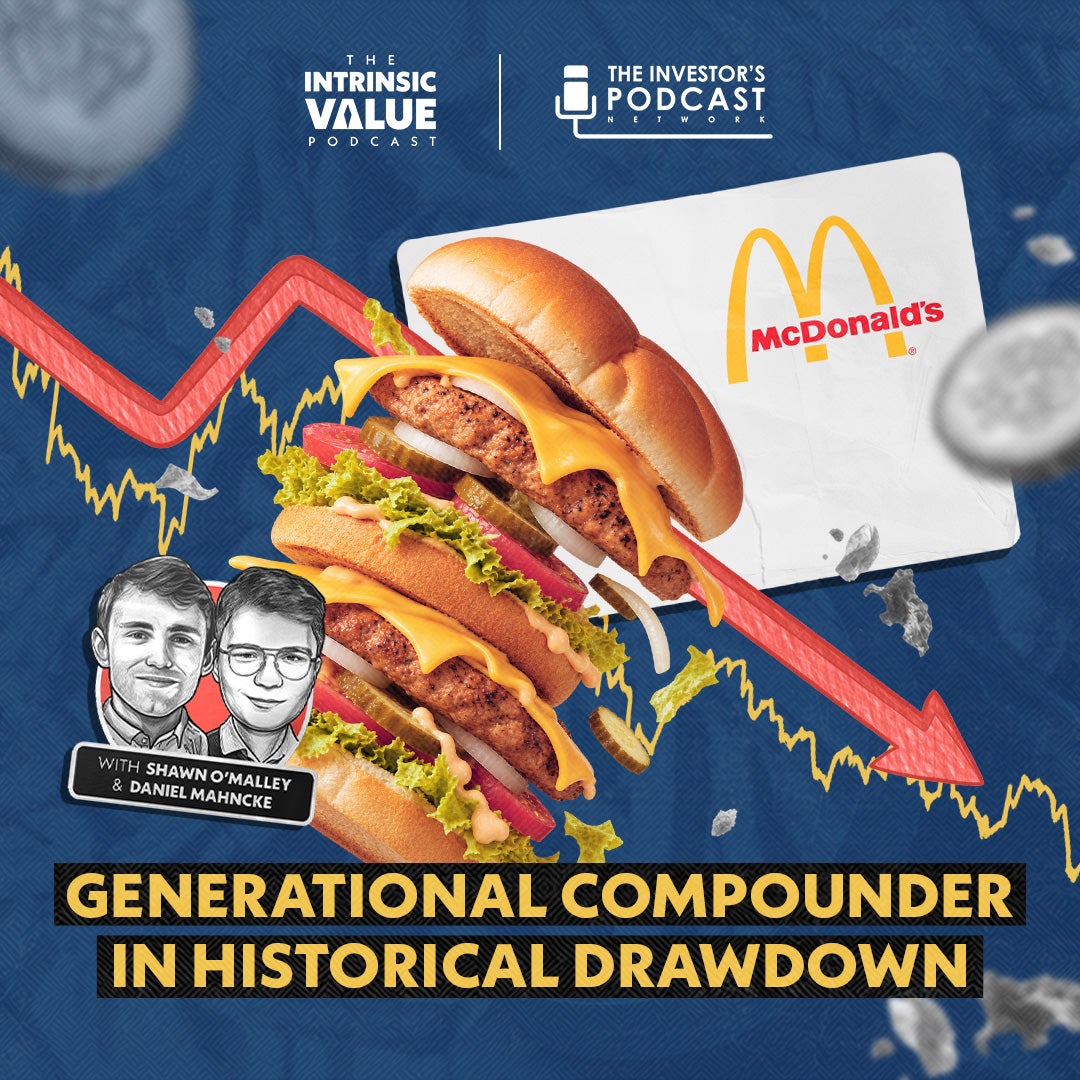
McDonald’s as a “generational compounder” trading at multi-year lows, with the core investment case framed as an asset-light franchising/real-estate business (rent + royalties) rather than operating restaurants. The episode also weighs risks from consumer weakness and potential long-term disruption from GLP-1 weight-loss drugs, plus how McDonald’s app-driven loyalty affects traffic and franchisee economics.
Daniel Mahncke and Shawn O’Malley. The hosts discuss McDonald’s history and business model; they reference investors Warren Buffett (owned ~4% in 1996; later called selling a big mistake) and Bill Ackman (took ~5% stake ~20 years ago; argued most economic earnings came from land/franchising).
McDonald’s operates ~5% of restaurants; ~95% are franchised. McDonald’s owns land under ~60% and buildings in nearly ~80%, making rent/royalties the dominant profit source (over 90% of profits). Rent/royalty structure includes a percentage of sales plus fixed minimums, supporting bankability and expansion. McDonald’s app has 220M+ users opened in last 90 days; loyalty members drive ~2x store visits.
1948 “Speedy Service System” (menu cut to nine items; kitchen assembly-line). Buffett’s McDonald’s visits. Ackman’s proposed spin-off/lever-up plan. GLP-1 threat discussion and CEO viral burger-bite controversy.
0:00Shawn O’Malley: McDonald's might be the best known brand in the world and it's the world's largest fast food franchise and it's trading at multi-year lows.
0:07Daniel Mahncke: You almost never get the opportunity to buy McDonald's shares at a discount and Buffett once owned 4 % of McDonald's and called selling it one of his biggest mistakes.
0:18Shawn O’Malley: Well, today we'll find out whether the market is finally giving us a chance to make up for that mistake and make it part of our portfolio.
0:30Shawn O’Malley: The Intrinsic Value Podcast by the Investors Podcast Network. Since 2014, with over 180 million downloads, we've learned directly from the world's best investors. Now, we're applying those lessons to analyze businesses and investment opportunities every week, helping you uncover intrinsic value. This show is not investment advice. It's intended for informational and entertainment purposes only. All opinions expressed by hosts and guests are solely their own, and they may have investments in the securities discussed. And now, here are your hosts, Sean O'Malley and Daniel Munker.
1:12Daniel Mahncke: I looked back at all the episodes we did covering stocks, and I did notice that we've never covered a restaurant before. We've done airlines, e-commerce, banks, luxury software, data centers, apps, and a whole bunch of other types of businesses, but not a single restaurant.
1:31Shawn O’Malley: Well, to be fair, most of them are not great businesses, although you can probably say the same for airlines or car manufacturers, and we still looked at them. Actually, I remember how we debated the tipping culture when I was in the US, and we kept being shocked by the idea of, you know, paying your employees$1.50 per hour and then charging 20 % service fees plus an additional tip for the waiters, or at least I should say I was shocked. I'm not used to that here in Germany. And I kind of asked myself, if that's how it works, shouldn't U.S. restaurants be vastly more profitable than restaurants everywhere else in the world where they actually have to pay the staff that is working for them?
2:05Shawn O’Malley: But of course, that's not really true. For one, you have the back of house staff like, you know, cooks or dishwashers and so forth, and they are still paid full wages. And then secondly, in many states, you also receive a full minimum wage before tips. And then most importantly, and we all know that the industry is highly competitive. So any cost advantages are basically shared by all the participants and often they end up in the price anyway.
2:28Daniel Mahncke: Well, I can definitely see why it wouldn't feel that way since food in the US is still pretty expensive compared to most other places in the world. But yeah, if the tipping culture were less common, I think you would just see that baked into the price of the food. So you'd be paying the money anyway, either in the form of tips or just included in the price. But really, it's a moot point since you don't tip anyways at McDonald's.
2:49Shawn O’Malley: Well, maybe that's why McDonald's has more than 70 million daily customers globally.
2:54Daniel Mahncke: Well, it could be true. And it's really an incredible number if you think about it. But McDonald's is the most recognizable brand really in the world. So it's not too much of a surprise.
3:05Shawn O’Malley: I don't know in which country you would need to be to ask them whether they know McDonald's. And they would say no. I feel like wherever you go in the world, everybody knows McDonald's. And most people you talk to actually have visited one. And one of those 70 million daily customers, and perhaps one of the most loyal ones, is a person we all know, Warren Buffett. He's pretty famous for his McDonald's visits. I know there's this video where he shows his daily life, and the first stop is in the morning at McDonald's. And he also invested in the stock back then in 1996, actually on more than 4 % of the company.
3:36Shawn O’Malley: And that was worth about$1.4 billion. And he ended up selling his steak, though. And he called that decision later a very big mistake. just a couple of years later, actually, when he wrote one of his letters. And Mendoza performed quite well. So he looked back at it and he definitely owned some companies like Coca-Cola, for example, who are at least in a similar business. And he sort of, you know, thought it was a mistake to sell it. And that investment would have been worth about 10 times more today than what he paid. And that wouldn't even include all the dividends that he would have been paid.
4:03Shawn O’Malley: And we all know he's quite big on those dividend stocks. And nevertheless, he had some concerns about the business model and that he basically didn't see the same concerns with his other investments like Coca-Cola, which made him kind of famous today. And actually, I saw a video where he and Charlie argued why they saw their position. So maybe we'll just play it here. A great many of the decisions on fast food as to where you eat is simply based on which one you see. I mean, convenience is a huge factor.
4:29Daniel Mahncke: So if you are going by a McDonald's or a Burger King or a Wendy's and you happen to be hungry at that point or if you're traveling on the road and you see one of those signs up you're probably going to stop with the you may very well stop at the one you see uh so there's there is not the there's a loyalty factor but it but it's it's just not going to be the the same in food people want to vary their i don't i mean i'm happy to eat every day but but most people want to vary what where they where they eat as they as they uh uh go through the uh the week or the month or the year and and
5:07Shawn O’Malley: they don't really have any great desire to bury their their soft drink the same way it's just that it's not it's not the same thing so there's no knock on mcdonald's at all it's just the nature of the of the kind of kind of industry they're in charlie i can't think of anybody else who before McDonald's ever did what McDonald's did to create a chain of restaurants on such a scale
5:36Daniel Mahncke: that worked. Oh, Howard Johnson's tried. Yeah, there were a lot of failures. Some of you are old enough around Omaha to remember Reed's. Harker's. Or Harker's. Harker's. Harker's. Harker's Wholesome Hamburgers.
5:49Shawn O’Malley: Right.
5:49Daniel Mahncke: And they came and they went, those chains. and uh but the it is a much tougher business that mcdonald's is in
6:02Shawn O’Malley: it's price sensitive too i mean obviously part of that's comparative you can
6:08Daniel Mahncke: you could spend a lot more money on hamburgers in the course of a year than razor blades i mean you can't save that much by changing razor blades there's actually another investor that we know quite well was the history of McDonald's too. And that's Bill Ackman. He took a 5 % stake in McDonald's about 20 years ago. And his thesis back then was that something like 90 % of McDonald's economic earnings came from its land and its franchising. And actually the real estate alone was worth more than the entire market capitalization of the company at the time. So his idea that he proposed was to spin off most of the company owned restaurants and then borrow against the real estate to buy back more stock.
6:50Shawn O’Malley: And back then, McDonald's didn't want to do that. So Ackman eventually sold his state, just like Buffett did. Then if you look at what McDonald's did in the past two decades, it's more or less exactly what Bill Ackman wanted the company to do. But that's not what the company was supposed to do when it started. So maybe we just talk a bit about the history of the business, which is definitely interesting. So there was a time, obviously, when it was just about selling burgers at McDonald's. And the company was founded by two brothers in San Bernardino, which is in California. and that was about 85 years ago.
7:19Shawn O’Malley: So the names of those two brothers were Richard and Maurice McDonald's. So that kind of answers the questions of why McDonald's is called McDonald's. And for the first eight years, it was more or less a normal drive-in with car hops and a big menu. And by the way, for all the people who don't know what car hops are, because I didn't know before I researched it, it's basically if you just drive in your car to a parking lot and then you would get the service in your car. So you also eat in your car. So it's not the same as a drive-thru, which is what I thought when I first looked at it. But in 1948, they sort of revolutionized that model.
7:49Shawn O’Malley: So they revolutionized how fast food works. And you basically move from these co-hops to what we know today, basically, you know, essentially later. So they closed for a few months. They cut the menu down to nine items. I know that we at TAP, we often talk about simplicity. So that's what they did. They had a huge menu before and then they cut it down to just nine items. And they got rid, as I said, of the co-hops and they basically rebuilt the kitchen as an assembly line. So they called it the speedy service system.
8:15Daniel Mahncke: Well, it's a shame that that name didn't survive. I think the speedy service system is better than fast food. And I will say, I've only been to Sonic a few times, but I'm pretty sure they still have car hops.
8:27Shawn O’Malley: That's true. I think there are a couple of places that still do. I don't know any in Germany, but I heard there are some in the US. So you've experienced it. What's your take on it? Is it better than a drive-thru or just going to a restaurant?
8:38Daniel Mahncke: Yeah, I mean, I feel like whenever I get fast food anyways, I'm eating in my car. So there's sort of like a novelty experience to it. That was sort of fun. But I think I really didn't like the food the one time I did it. So I have a bit of a sour taste in my mouth.
8:54Shawn O’Malley: Well, that's not good. Also, I don't like the idea if I have three to four friends in my car and I think about my friends of them all eating fast food in my car. I feel like I will need to clean that car quite often if that would be the case. But, you know, for McDonald's, the most important thing is that the business model survived. So you have this limited menu and a fast food delivery. So, you know, you can pick it up more or less immediately and then maybe just like you do, you did another car afterwards, but you can also take it home, for example. And I actually want to ask you another question, which is take a guess how much a hamburger cost back then when McDonald's was first founded.
9:26Daniel Mahncke: Oh gosh, I'm trying to do the inflation math in my head. I know that candy probably around this time was maybe a few cents. So if I extrapolate that, I don't know, maybe 25 cents for a burger.
9:42Shawn O’Malley: That's a pretty good guess. It's actually 15 cents, so slightly less, but still, I would say a pretty good guess. And I gotta say, when I saw those inflation rates, I thought that's a pretty good reminder to be invested in the market and not just have your money sit in any bank account. I mean, 15 cents compared to what a burger nowadays costs. And I think it's about$4 if you just think about a hamburger, probably more if you would, for example, buy a Big Mac. Anyway, though, this model worked so well that they started selling a few franchises in California and then also later in Arizona. but the two brothers were at least not that interested in making it a larger thing.
10:15Shawn O’Malley: So they themselves wouldn't have been the reason why now everybody in the world knows McDonald's. There was a guy though who was very interested in making it a bigger thing.
10:23Daniel Mahncke: Oh yeah, that was Ray Kroc. And as you know from your trip to the US a few months back, Daniel, I love milkshakes and Kroc was a salesman for milkshake machines. So I think in another life that's a job I would have had. And actually, McDonald's ordered some of his machines, and he was basically wondering why one hamburger shop would need eight of his machines. So he actually went out to San Bernardino and visited the shops. And when he saw the lines of people in front of the store, he realized how they ran the kitchen really more like a factory than a restaurant. And he saw the potential for how this could be much bigger than a handful of stores.
11:03Daniel Mahncke: And so he made a deal with them. Kroc would get the right to franchise McDonald's nationally. the franchisees would pay 1.9 % of sales. And then out of that 1.9%, about a half a percent would go back to the brothers. And so in 1955, Kroc opened his first restaurant in Illinois and he paid a franchise fee of just$950.
11:25Shawn O’Malley: And that sounds very cheap, but for perspective, that would be about$12 ,000 in today's money, which is still not that bad because today I Googled that the initial fee for a McDonald's franchise is about$45 ,000. And if you combine all the costs that go into, you know, building it and so forth, you would actually spend between$1.5 and$3 million to open up a new McDonald's. So obviously it depends on where you want to build it, right? And those additional costs are also why the deal for Kroc back then was pretty terrible. He sold 18 franchises in total in his first year and he could barely even cover his expenses.
11:56Shawn O’Malley: So he was basically paying for things like, you know, field consultants, employee training, and then site selection. And he was getting 1.4 % off sales for it, which even if you think about it, doesn't sound like a lot of money. He solved that problem though by turning McDonald's into the massive real estate company that we know and basically discuss today. And he did that by meeting a man who was called Harry Sonneburn. And Sonneburn had been the finance VP at Tasty Freeze. I personally don't know it. It's never been in Germany. I don't know if it's a name to you. Apparently it still exists. And it was basically an ice cream and burger chain company.
12:28Shawn O’Malley: And in 1956, he joined Kroc as basically the CFO of the company and then later the president. And Thunderborn had the idea not only to focus on making money on the hamburgers, but instead on the land and the stores and then franchise them out. So McDonald's would find a side, then they would buy it or at least take a long-term lease on it. And then they would sublease it to the franchisee with a markup of about 20 to 40%. And the rent was basically set as the greater of a fixed minimum or a percentage of sales.
12:56Daniel Mahncke: well I've definitely seen I don't know if there's any tasty freezes open but I've definitely seen the remnants of sort of like how you see you drive past some places and you can see where there was a blockbuster sign hanging up and it's like sort of like the dirt around the lettering has been like engraved into into the siding I've definitely seen some artifacts of of tasty freeze But anyways, when there was really an economic downturn or a bad month, I think what's interesting about this model is that he made sure he was paid through this fixed minimum. And then in the good times, he had some exposure to the upside, right?
13:35Daniel Mahncke: When the restaurant did well, he would benefit more from this percentage split that he has that scales with the restaurant's success.
13:43Shawn O’Malley: It's a way better model than the one he had running or going for him before. And basically, there are three major advantages to that model. So first, it obviously gave the company a second revenue stream that was much more reliable than the royalty. And then second, it also gave them control back. Because if you're a franchisee who isn't running the store well, which is quite important for your reputation, if you have so many stores, you'd all need them to run pretty well. But then at this point, you're not a licensee anymore, but you're actually a tenant. And as we all know, a tenant can be evicted.
14:10Shawn O’Malley: And then the third advantage is, and probably this is the most interesting one, it also made the company bankable. Because if you want to buy new stores, you need a lot of money and probably also credit. So Sonnebond went to banks and insurance companies for that matter and essentially told them, look, we are not in the restaurant business anymore. We're now a real estate company. And if you're in the 50s, and that's probably still true today, the restaurant industry is seen as a place where, you know, probably money goes to die. It's not easy to get credit because oftentimes those places go broke at some point.
14:38Shawn O’Malley: But real estate can get your loan much more easily. So that was the money that they used to, you know, fund the expansion of the business, especially buying new property. And I also got to say that the insurance companies that loaned them money made a pretty incredible deal too. When I looked at the details, I think they gave them a loan of about$1.5 million and an interest rate of 7%, which back then was quite normal. And to be completely honest, we're kind of getting there again. But they also received 22.5 % of the equity in that company.
15:05Daniel Mahncke: If anything, a 7 % interest rate to sort of an upstart franchise business model, that sounds like a pretty good rate. But I guess they had to hand over 22.5 % of the equity to get that. And of course, that 22.5 % would be worth tens of billions of dollars today, even after accounting for dilution over time. So yeah, that's a pretty good return on$1.5 million. But I've actually heard that Kroc really wasn't the type of guy that you would want to do business with, at least not from a personal standpoint. I mean, he was clearly a very good businessman, but maybe not so much of a great partner. And so he eventually decided that he wanted to own all of McDonald's and buy out the Founder Brothers.
15:48Daniel Mahncke: And I think you mentioned they wanted something like$2.7 million. And that was a pretty major investment back then. And Kroc wasn't happy about the price tag, but he did end up paying it.
15:59Shawn O’Malley: He did. But at that point, he didn't yet actually own all of the McDonald's franchise stores. Because there was one left that the McDonald's Brothers, it was actually the original one in San Bernardino. They promised to their employees. So they obviously couldn't name it McDonald's anymore because they sold their name to Kroc. So they just called it the Big M. But even that was not enough for Kroc. He wanted that store to be closed. So what he did is he opened a McDonald's store close by and then basically over time bankrupted the Big M. So he later said in an interview about this, I needed the McDonald's name and those golden arches.
16:30Shawn O’Malley: So what are you going to do with a name like Kroc?
16:34Daniel Mahncke: Well, it definitely doesn't have the same ring to it. I guess if you change Kroc from the K to the C, You could have maybe sold these$70 rubber clogs with that name. But, you know, it feels like so long ago, Daniel. But remember when we had Crocs shares in our portfolio?
16:51Shawn O’Malley: I do remember. That was a good time. It was a very profitable investment for the two of us. So, you know, maybe 70 years later, he could have had a successful business with that name. Back then, he didn't feel like it. So I even think that if you look back at it, probably McDonald's needed a guy like him to turn this company into, you know, the global empire that it is today. because I think it fits the business model much more than this romantic idea of the McDonald's brothers. I mean, obviously the marketing is probably supposed to be more focused on harmony, family, friendliness, and so forth.
17:19Shawn O’Malley: At least when I think back about my childhood, that's how McDonald's seemed to me. And if you want to run a successful fast food chain, that's what you want, right? The marketing is supposed to be, hey, this is healthy food. This is for families. It's cheap. But we all know back there in the kitchen, you have to be very strict about how you do things. You have to be fast. You have to be efficient. And that's basically what McDonald's did, right? They were precise, they were relentless. And, you know, there was this, by Croc actually invented playbook of what he called QSCNV, which stands for quality, service, cleanliness, and value.
17:51Shawn O’Malley: And probably some of that reputation has not survived after he, you know, gave that business up to the people who followed.
17:58Daniel Mahncke: I don't know if it's the catchiest acronym I've ever heard, but I guess it works. And it seems a little questionable for me whether I would connect quality and cleanliness with McDonald's. But, you know, fair enough. One of the most recent things that comes to mind for me when I think of McDonald's, since I'm not really a particularly active customer, was that viral clip of the CEO where he basically takes a bite into their own burger. And it's very difficult for him. He looks uncomfortable. And so it was not the best viral marketing for the company that you could imagine.
18:32Shawn O’Malley: Yeah, he also called the burger a quote unquote product, which might be right technically, but it's definitely not what you want to hear someone say about the food that you just ate a couple of hours ago. And I still got to say, you know, that entire thing, I felt like the reaction was a bit too harsh. I mean, to me, Chris Kaczynski, who is the McDonald's CEO we just talked about, just seems to be more of a numbers guy and, you know, perhaps not the most authentic person for a video shoot eating a burger. Because to me, it seemed like, and he also said that in an interview later on, he was just way more concerned with, you know, not looking weird while eating and talking.
19:03Shawn O’Malley: And I can kind of get that. If you're the CEO of a company and now you're supposed to eat something, but then also talk, I could understand, you know, why you maybe look a bit more weird. Obviously in hindsight, those were better options than looking like you're just disgusted by your own product or food, which, you know, I think that's what the internet made out of it. But I mean, I don't eat at McDonald's because I believe the food they sell to you is not healthy. And that's obviously well documented as well. So my eating habits are generally a bit complex, probably similar to yours. So the fact that I, we wouldn't eat at McDonald's, I don't think it says anything about the average consumer.
19:35Shawn O’Malley: And I think there definitely is a place for McDonald's to exist. But still, if the general perception is what you sell is unhealthy, and then you as the CEO are sitting there in a video, and it feels like you don't want to eat your own food, that's definitely not good. I still got to say just because I feel like it's intellectually honest, what I find even worse is the whole soft drink business. So Coca-Cola might be at the top of all of that. And, you know, Buffett and Munger never had any problems investing in Coke, despite talking about this win-win for the company and for the consumer quite a lot.
20:04Shawn O’Malley: And to me personally, it's not a kill criterion to invest in a company that offers a product that maybe I personally wouldn't use, because I don't feel like I should sit on, I don't know, you can probably call it a moral high horse. But I also believe that if a product is not a win-win, you will have a harder time in the wrong one. So part of it is maybe just rational decision making, you know, not choosing companies that might make it harder for you because they're not good for the consumer.
20:27Daniel Mahncke: I think I probably echo the way you think about McDonald's. I will say to this day, if there were one thing I was going to get at McDonald's, it would probably be a McMuffin. And if I knew that I was, you know, treating myself to McDonald's, I would probably get a Coca-Cola too. But, you know, that's just, it's a special treat. But I think the way you view it is pretty similar to how I think about Meta in particular. And with Meta, you've seen over many years now how lawsuits have impacted the business. And it hasn't really been in a major way yet, but we have come pretty close, especially recently.
21:02Daniel Mahncke: And so there's just simplicity to owning businesses that are really win-wins for society and sort of letting them do their job. And it goes back to the scale economy shared from Nick's sleep with Costco and also with Amazon. I think Amazon is a win-win business. When they become more efficient, they reduce prices or they invest in their logistics. And then that means packages arrive earlier and it ends up being a better experience for everybody who uses it. And so McDonald's has an incentive to lower food quality if it means saving more money. And since they serve lower income customers, it's really not a great setup for society because they have this incentive to really worsen the quality of the ingredients.
21:48Daniel Mahncke: and not a lot of incentive to produce higher quality, healthier food for folks. If you're a fundamental investor like me, you need financial data that actually keeps up with you. That's why me and my colleague Daniel Manka use Fiscal AI for every episode of the Intrinsic Value podcast. Fiscal AI is a modern financial data provider for global stocks, and we use their web-based terminal all the time on the show. It pairs a clean, modern interface with institutional great data, over 20 years of financial statements, plus company-specific segments and KPIs that I love digging into. You want Uber's gross bookings?
22:23Daniel Mahncke: It's there. You want to see Caspi's payment volumes? It's there. And I know because we pulled these metrics for our podcasts on Uber and Caspi, but what's new is that they've just launched their own AI connector. What that means is you can plug all of that data, 20 years of financials, earnings call transcripts, fund letters, news, filings, and much more directly into Cloud, ChatGPT, or whatever AI you use for investment research. So your AI is working from institutional quality data straight from the source. Whether you want a powerful out-of-the-box stock research terminal or a data connector to supercharge your AI, use our link fiscal.ai slash T-I-V-P to get 15 % off.
23:05Daniel Mahncke: Again, that's fiscal.ai slash T-I-V-P. And you'll find the link in the show notes as well.
23:12Shawn O’Malley: We'll definitely get to that, especially later on, because we have to talk about GLP One Drugs and their impact today. But before I get too negative, there is definitely a reason why we pitch McDonald's as a stock today, because McDonald's itself, as we alluded to in the beginning, is more of a real estate business than anything else. So the way this works in detail is that McDonald's operates only about 5 % of all its restaurants itself, and the other 95 % are run by franchisees. So McDonald's owns the land under roughly 60 % of them, most of them in the US. And then in nearly 80 % of cases, McDonald's owns the building too.
23:45Shawn O’Malley: So when they don't own the land, they basically lease it and then they lease it for a mock-up to the franchisee. So in the end, in the vast majority of cases, the franchisee is a McDonald's tenant or has McDonald's as their landlord.
23:58Daniel Mahncke: And that is a dramatically better business than just running the low margin restaurants themselves?
24:04Shawn O’Malley: It definitely is. I mean, if you look at the margins, for example, McDonald's has an operating margin of 46%. And then if you look at a place like Chipotle, which is an excellent operator in the industry as well, the stock didn't perform that well lately. But if you just look at the numbers, it is a pretty good business. And I think a lot of people say that the quality of food might be a bit better than it is at McDonald's. And even that place is only at margins of about 15%. So for the restaurant business that McDonald's runs itself, the revenue is close to$10 billion. And then the costs on there are about$8.5 billion.
24:32Shawn O’Malley: So that includes everything from food to labor. And those are the biggest parts, but also all the other stuff. So the margin there is also about 15%. So even if you look at the places that they actually operate, they're quite good at being efficient and having high margins compared to other industry peers. But obviously the rent and the royalties are about$16.5 billion coming at an 84 % margin. So it's a way better and more important business for McDonald's.
24:56Daniel Mahncke: And if you add it all up, more than 90 % of profits come from franchising. So that's royalties and then the rent that the franchisees basically pay to McDonald's for owning the real estate. And that's also why you have this generally weird dynamic where the margin for McDonald's goes up basically whenever they sell a restaurant to a franchisee. And so what you more commonly see is that margins go up with scale as companies spread their revenues across a fixed cost base or as a restaurant, you'll build more stores. But in this case, it's different, right? Revenue goes down because you're losing out on the sales from the restaurant that you owned entirely, which on average would be about$4 million per year per store.
25:40Daniel Mahncke: But you then replace it with less capital intensive rent and royalty payments that come with a higher profit margin.
25:49Shawn O’Malley: And at the latest Investor Day, McDonald's actually said that they want the operating margin to be in the low to mid 50s by 2030. And part of why they want to get there, or maybe how they want to get there, is just selling more places and then franchising them out, which is, again, a good way, as you said, to increase the margin. And it also means that revenue is going down a bit, but it's definitely the better trade-off. And by the way, if you ever listen to a McDonald's earnings call or maybe an Investor Day, it actually feels weird because there is just so much corporate speech. And while I didn't find it weird when the CEO called the burger a product in the video that we mentioned earlier, I do kind of find it weird when an entire investor day treats every sort of beef or food as basically a good that you have to scale or take market share in.
26:31Shawn O’Malley: And I don't know, just to me, that feels a bit off. I know that you sometimes talk about the investor calls of Adobe and how boring they are. Here, it makes it sort of being boring and also a bit weird just listening to it.
26:43Daniel Mahncke: Well, I have a friend who works for a chicken company where basically they sell the meat and distribute it to grocery stores. And she does chicken marketing. So listening to how she speaks about chicken products and their competition with beef is very, very interesting and funny to me. But we should get more into this question today of how much McDonald's is impacted by GLP-1s and whether it will become a big problem for them. And I think it's particularly interesting given that they technically are really only indirectly dependent on the success of their restaurants, right? So we just talked about the main business of McDonald's, you know, the listed publicly traded company is not actually selling burgers technically.
27:36Daniel Mahncke: And what's also interesting on the GLP-1 front is it seems like there are already some new peptides out there and perhaps more on the way that are significantly more effective at reducing appetites and causing weight loss than Ozempic, which in its own right was considered a really big breakthrough. So we may be moving into a world where we look back sort of in astonishment at the widespread rates of obesity today. And we see that as being a thing of the past. And that would be great for society, but obviously not so great for McDonald's shareholders. And before we get into all that, though, how about we look a little bit more at these rent contracts and see what it actually looks like for a franchisee to sign a deal with McDonald's?
28:20Shawn O’Malley: Just one quick comment on your first point, because of course, McDonald's still needs to ensure that the restaurants and the franchisees are popular and they make a good amount of money because otherwise they will just close their stores. And if they do that, they will also stop paying rent and royalty. So a lot of people made this real estate argument and we'll get into the value of it in a minute. So that definitely is a good investment case just based on how much that is worth. But still in general, you need the restaurants and you need McDonald's itself to still be a place where people want to go and eat, even though the stock or the company behind the stock is not trading on how many burgers are actually being sold.
28:55Shawn O’Malley: But again, it's interesting if you think about how much the real estate is actually worth for McDonald's right now, because it's on the balance sheet with only about$28 billion of value. So that's basically the value that McDonald's once paid for all of these stores and the real estate in general. And much of that land and the buildings were bought decades ago. So partly in the 1960s and the 1970s. So the real estate is worth a lot more money today than back then. In fact, there are some estimates that are found that are basically saying, or at least estimating that the real estate alone could be worth about$120 billion today.
29:28Daniel Mahncke: Reminds me a lot of Copart, which is a company we've talked about on the show plenty of times, and that's a company that owns its land and bought much of it at lower prices decades ago.
29:39Shawn O’Malley: It's definitely similar. I feel like it's Copart on steroids because McDonald's not only owns way more real estate, but it's also in the most sought after addresses in the world, basically. Whenever you go to, for example, London or New York City, you will see a McDonald's at pretty much the best address that you can think of. And many of those deals, although not all, are owned by them. So you can imagine just how valuable the real estate of them actually is. And if you look at their market cap today, it's about$160 billion. So if those estimates are actually accurate and the entire operating company is at that point only worth$40 billion, and that would be producing$8 billion in free cash flow in a normal year.
30:14Shawn O’Malley: So you would technically, dividing between the real estate business and then also the operating business, talk about five times cash flow for the operating business, just because you have$120 billion worth with all the land and the buildings that they own. And I know this sounds pretty good. And then you're asking, well, if I can buy McDonald's for five times operating earnings, why wouldn't I do that? Well, technically, because I just said that you still need the restaurants to do well. Otherwise, the rent goes down, just you don't earn it anymore. And it's the same with the royalties. So the biggest use of that asset is basically to just lever up against it and then buy back shares or maybe pay a dividend.
30:50Shawn O’Malley: basically what Bill Ackman suggested in 2005, so 20 years ago, because otherwise if you sell it, you just don't have an operating business anymore. But to get back to your original question about the setup of the leases, so typically what you have is a 20-year franchise agreement, which by the way is another reason where you can't just sell all your buildings because you have tenants in there for at least 20 years if the contract just renewed. And as we discussed before, the rent is basically a percentage of sales with a fixed minimum. So it's yet another reason why McDonald's also needs to have the restaurants perform the best they can.
31:22Shawn O’Malley: And the percentage basically depends on how much McDonald's invested in the site or the building. So if you talk about an old building that's fully depreciated, you might talk about 8.5 % of sales. And then for a typical new building, you would talk about 10%. And for an expensive site, we just talked about the one in London, or we talked about the one in New York City, you can easily also pay 15 % because obviously the earnings potential there is much higher. And then on top of that, you also pay royalty, that is 4 % of sales in the US. And then there's a separate 4 % for the National Advertising Fund.
31:53Daniel Mahncke: Between booking guests, coordinating with the team and answering listener emails, my inbox doesn't shut off when the workday ends. I'd sit down to dinner and I'm still thinking about the thread I never answered. Superhuman Mail fixed that. It is the most productive email app I've ever used. And it's part of the superhuman productivity suite. So it works inside the tools and sites I already use. My go-to feature is Ask AI. Instead of digging through a month old thread for what a guest said, I just ask and it pulls the answer in seconds. And on the mobile app, write with voice turns what I say into a polished draft in my own tone so I can reply on the go without getting pulled back into work mode.
32:41Daniel Mahncke: Email should be a system built for the long haul, not a daily fire drill. Get back to what matters. One month of superhuman mail free at superhuman.com slash T-I-V-P. That's superhuman.com slash T-I-V-P. It sounds pretty expensive. And if we go back to the store economics and say the average McDonald's is doing about$4 million in revenue per year, then they would pay something around $400 ,000 in rent,$160 ,000 in royalties, and then$160 ,000 would go into the marketing pot too. And that's before you account for any of the costs of actually running the place, right? The food and the labor. And so the hierarchy here kind of reminds me of what we described in our GE episode But in aerospace, the airlines had the worst economics.
33:33Daniel Mahncke: Then the plane makers had better economics, but still not great. And then the engine makers had better economics still. And then the best economics were at the very top with the aftermarket parts sellers. And so in restaurants, it's sort of the same shape. Independent restaurants have the worst economics. Most of them fail within a few years. And then you have these company-operated chains like Chipotle, where you own the stores and you take all the operating risk. but you get the scale that comes with that. And then you get these more asset-light franchisers like Yum or Restaurant Brands, where you collect royalties, but you don't actually own the real estate.
34:09Daniel Mahncke: And then at the very top of the best economics, you have the franchisor who's also the landlord. And really nobody else does that better than McDonald's.
34:17Shawn O’Malley: I guess the difference between the two, and I like the analogy generally, is that we both very much like the tailwind of air travel over the next decades. And I have a couple more questions and you just mentioned it before about the future of fast food. And I say that because the economics of even the highest player in the hierarchy obviously still depend on all the others. So, you know, if we go to the airlines or, you know, just GE, a fewer people fly and there's less demand for engines than GE struggles, just as the OEMs like Airbus and Boeing and also the airlines. So it's basically all connected, even though some make more money than others.
34:49Shawn O’Malley: And when there's less demand for fast food and McDonald's in particular, obviously, even the superior business model can't save them either.
34:56Daniel Mahncke: So how are the franchisees doing right now? And perhaps I mean, you can give an overview of just McDonald's operating business generally. I think you mentioned that you don't have a ton of fast food chains like we do in the US, but obviously McDonald's is a major thing in Germany as well.
35:14Shawn O’Malley: McDonald's is everywhere, that's true. But we definitely don't have the same selection or variety of fast food chains here in Germany or maybe just food spots in general. I mean, what's quite remarkable, how many food sports you guys have in the US and then even in smaller towns, like for example, Charlottesville and so many of them, as we just talked about when I think we were driving to Chick-fil-A, which is actually a private company. But we talked about how many of those companies that we just see are publicly traded companies. And when I was in London last week, Kyle actually asked me which German restaurant chain or brand he could know because, you know, for example, they're a public company or they expanded globally.
35:47Shawn O’Malley: And I actually struggled to name a single one, which is kind of scary. But yes, again, like McDonald's is obviously big in Germany. And they generally differentiate between three market categories. So the first one would be the US, which is almost 40 % of system-wide sales. So that means you have more than 13 ,500 restaurants. And then 95 % of those are franchised. And McDonald's owns the real estate with most of them, as I said, especially in the US. And then the second market is what they call international operated markets, which is McDonald's speak for those are the big wealthy countries where McDonald's runs the market itself and then also franchises to local operators.
36:23Shawn O’Malley: And that's Germany, it's the UK, it's France, it's Canada, it's Australia, Italy, Spain, and so forth. So primarily North America and Western Europe. And that's 35 % of system wide sales. And then you have the third bucket, which is international developmental licensed markets. And that basically includes, you could say everything else. So you have China, Japan, Latin America, you have the Middle East, you have India, and you know, all of those markets. McDonald's usually doesn't run any of the places. So there might be a master franchise that owns the whole country, and then it builds its own restaurants with its own money, of course, and pays McDonald's a general royalty.
36:57Shawn O’Malley: So that might be 26 % of system-wide sales, and it's about a quarter of all the restaurants of, you know, McDonald's globally.
37:05Daniel Mahncke: Well, it's pretty remarkable to see the difference between the share of system-wide sales and then the revenue that McDonald's actually makes in those markets. So in the US, McDonald's owns the real estate most of the time. So system-wide sales and the actual revenue are about even. Europe is responsible for 50 % of system-wide sales, but only 35 % of McDonald's revenue. And then in the third bucket, the difference is by far the largest. So I assume that that third bucket, McDonald's, they don't own any real estate and it's just a royalty business only? Is that the right way to think of it?
37:38Shawn O’Malley: Yes, it's only the royalty. So usually when we talk about, you know, the franchise revenue, it's royalty and rent. In that third bucket, it's only the first part. So they don't own the real estate. They don't own anything. It's basically just, you know, them giving the right to local companies to use the name McDonald's. And a good example is Arcos Dorados, which is also listed on the New York Stock Exchange on the ticker ARCO. And that's sort of the master franchise for all of that's in America. And that's about 4 % of McDonald's system were at sales. And they signed a 20-year agreement just recently with McDonald's that started in 2025.
38:11Shawn O’Malley: So it goes up until 2045. And by the way, if you ever want to look at basically the details of the franchisee side of McDonald's, you should look into their filings because they break down in quite a lot of detail how that looks. And they're actually the source for all of the numbers that I have in this episode. And then you have China, which I probably also should bring up because it's more of a special case. So McDonald's initially sold 80 % of that business in 2017 to Cytek and Carlyle. But then they bought back 28 % just two or three years ago. So now they own close to half of the business again.
38:43Shawn O’Malley: So it's slightly different for China compared to the rest of the third bucket.
38:47Daniel Mahncke: And China is actually the fastest growing market by restaurant count for McDonald's. And management has talked about opening around a thousand restaurants a year there, which is just ridiculous. But the comps in China were actually negative recently, though. And I guess that's not too surprising, given the weak consumer in China that we've talked about in some of our recent episodes, like with LVMH and Hermes. And obviously, those are different customer demographics. But I think the point generally is that the consumers in the middle class, even the upper middle class, and especially, of course, the lower class, are really struggling in China due to the property market crisis there.
39:27Daniel Mahncke: And so their budgets for everything from luxury spending to even McDonald's are being impacted.
39:32Shawn O’Malley: And it's definitely not a China-specific starter. I mean, McDonald's is a pretty good proxy for how consumers are generally doing, especially lower-income customers. And traffic has certainly slowed down in 2026. And that's globally, not only in the US and not only in China. It's not dramatic, but it was at least stagnant in Q1. And then it actually decreased slightly in Q2. And at least management is expecting that that trend will continue for the rest of the year. And I don't think that's really what scares me. I think there will be good times and bad times. And when I can buy a business that I know will recover when times are getting better, I'm happy to buy it at times when it's not all rainbows and sunshines and it just looks great, which is why you now have to pay significantly less for McDonald's than just four to five months ago.
40:13Shawn O’Malley: And as you sort of brought up, what I'm more interested in is whether McDonald's has more, let's say, long-term problems or maybe terminal problems, right? We talk about GLP-1 as a threat to McDonald's or even competitors like Chick-fil-A, which I know you're a big fan of, might take some share. And I think those are the ones that I would actually focus on more. So when you listen to my Don's calls, and I don't like it that much, it's mostly about getting through this economic downturn with, you know, something like value menus, digital offers, especially in the app and so forth. But those long-term threats, they're not addressed to at least the extent that I would like.
40:47Daniel Mahncke: Gosh, the McDonald's app is such a big thing for kids and teenagers and folks in their early 20s too. I remember that being really defining how and where we would hang out if somebody had a special offer for a free set of fries at McDonald's or a free soda. All of a sudden, we would find ourselves hanging out there. And so I think the app is really sort of an interesting point for them relative to their competition, right? And in terms of their advantages, they have more than 220 million folks who have opened the app in the last 90 days. 90-day active users. And that number has been growing by 45 % in the last three years.
41:28Daniel Mahncke: So the app is as popular than it's ever been. And those members, on average, folks who frequently use the app, they end up attending the stores twice as often as non-loyalty members.
41:42Shawn O’Malley: It's funny you bring it up because I only now remember that I actually did the same with a lot of my friends when we were back in school, that somebody had the app and they were talking like, hey, I get 10 chicken nuggets for free. So you just suddenly joined the group to go then. It's funny because it was 10 years ago, at least. And it was still a big thing. But in the last 10 years, it just grew exponentially, right? So the online sales, unsurprisingly, became more and more important each year since then. So by now, sales initiated on the phone represent about 40 % of total system wide sales in McDonald's top five markets.
42:13Shawn O’Malley: And those are, for example, US, UK, Germany, those sort of markets. And then in China, it's probably unsurprisingly way more extreme than that with 98 % of sales coming through a digital channel. So that is not only the phone, it could also be on your desktop, but 98 % of sales means basically all they sell, right? And especially in times when the consumer is weak, I think that's an advantage that you have through the app because, you know, you can just re-engage people with these value offers, for example, you know, special discounts, special menu stuff that you usually don't get and all of that while you can basically get the list prices unchanged.
42:45Shawn O’Malley: So it doesn't seem like things generally need to get cheaper. It's just an offer that, for example, is valid for two days. You get 10 chicken nuggets at 30 % off, and then you get more people to go to a McDonald's again. But I still don't really think of it as a moat.
42:59Daniel Mahncke: I would probably call it something of a margin of safety. I mean, management has said about two-thirds of the traffic they lost came from these loyal customers, people who were already in the app. And one of the reasons they gave for that was that they cut back on digital offers at the time. So the advantage is that they can notice that quickly and can act on it. But it also means that regulars may quickly stop going to McDonald's when there are no special offers. And you basically condition your most active customer group to always expect discounts. And that's an issue in a different way we talked about with Nike.
43:37Shawn O’Malley: It's definitely a problem also for the franchisees. And it's part of why they don't like that dynamic because it's easy for McDonald's to just re-engage people and get them into the shops. But some of the stuff the franchisees talked about in the last couple of months is a lot of times they just didn't have the same office. So somebody would go to a McDonald's because of the app. There was an offer that they were supposed to get. They go to a certain McDonald's and they don't get what they thought they would get just based on the app. So some people do it and some people don't. And obviously that's not a good thing for McDonald's.
44:03Shawn O’Malley: Usually you get the same experience every single time. That's why you go there. You know exactly what to expect. And part of that is also why the CEO said they didn't perform or they didn't execute at the level that they used to. That, you know, you put out these offers, for example, and no matter where you go, you'll actually be able to redeem them. And that has been definitely a big problem, especially when you think about that. Loyalty members by now make up about$40 billion of all sales last year. And that's close to 30 % of everything that McDonald's sells. So if those people don't like the way, you know, their orders are handled at McDonald's, that's definitely a big problem.
44:35Shawn O’Malley: The other advantage, if we talk about the positive side of the app again, is definitely the advertising rate. I mean, you talked about the advertising fund in itself, which if you just combine McDonald's, it's bigger than KFC, Taco Bell and Pizza Hut combined. And then you not only have that big marketing budget, it's also pointed pretty precisely at your customers because you have this huge database of 220 million people. So again, it's not a moat, but it's definitely a massive advantage nonetheless, even if, for example, you condition some people to wait for offers.
45:04Daniel Mahncke: You mentioned the long-term risks to the business before, so maybe we should talk about them now. I was blown away recently when I heard that one in nine Americans are now using a GLP-1 drug to lose weight, and that's tens of millions of people. Internationally, I think that trend is really just starting. From what I understand about the effect of these drugs, they basically reduce your hunger, which at first glance doesn't seem like much of a very good thing for fast food chains. I'd also bet on these emotional decisions to kind of quickly choose fast food out of convenience instead of cooking something at home yourself.
45:44Shawn O’Malley: It's an interesting topic. And I think, you know, the two of us are by now quite famous for not covering healthcare companies, but I definitely need to learn more about GLP-1 and peptides and all that sort of stuff because it's quite interesting. I mean, it used to be much more into fitness and nutrition than I am nowadays. And one thing that you quickly learn is that there's pretty much nothing that you can take that's actually measurable in the effects that it has without side effects. So maybe creatine, if you know what that is, it's probably the closest to having that effect without any side effects.
46:13Shawn O’Malley: But then peptides came and there were these incredible stories about what they can do. And I'm naturally skeptical, as we all know. So I didn't pay much attention to them for a long time. But thinking about what they can do just seemed a bit too good for me to be true. But GLP-1 is one of those peptides and appears to work pretty well. And as you said, by now, it's 11 to 12 % of American adults now taking one of these GLP-1 drugs. It could be a Zempick. It could be Vigovie. It could actually be one of the more modern things. These are actually, I wouldn't say outdated, but they're definitely more modern versions of that on the market.
46:45Shawn O’Malley: And the use of those has nearly quadrupled in just two years' time. So these drugs are basically working by mimicking a natural gut hormone that slows digestion and then increases the feeling of fullness, which obviously leads to reduced appetite. And our market research shows that households with a GLP-1 user tend to spend about 8 % less at fast food chains, coffee shops, and basically all similar places within six months of using or taking that drug.
47:10Daniel Mahncke: Goodness, I mean, given the number of people taking these drugs, are we starting to see these numbers show up in McDonald's quarterly results?
47:19Shawn O’Malley: I think we should, but given that it's still mostly a US phenomenon and using the numbers that we talked about above, I think the impact right now should be about 1 % of sales, which doesn't sound massive. But again, we're also just at the start. And I think that McDonald's had some data from probably third parties because otherwise I wouldn't know how they get to it. But they say about 85 % of households with a GLP One user still visit McDonald's. And it didn't sound like they would also spend significantly less money. So the impact is not huge. So what they say is they basically prefer McNuggets.
47:50Shawn O’Malley: They prefer Filet-O-Fish and Happy Meals. So basically what I ordered when I was 12 years old, and obviously the reason why they like it is it's smaller meal sizes and it's also less fatty food. So McDonald's is now trying these portion flexible and protein led options to sort of better accommodate their preferences.
48:06Daniel Mahncke: It does seem intuitively that smaller menus would equate to less spending, even if they continue to go to McDonald's, unless they're paying a premium for these protein first options.
48:19Shawn O’Malley: Well, you know, it's kind of funny, but they probably are. Like whenever you have these new protein products, the price goes up. And actually, if you look at the numbers, the reason why McDonald's is not down further in terms of sales numbers is because they increase prices. So if you think about that, it's not the most sustainable way. And I definitely don't buy the idea that it's supposed to be a chance for McDonald's, which is how they want to sell it to you. I guess the question for us as investors is mostly whether this will be an impact of 1 % or 10 % on sales. And I got to admit, I thought it would be closer to 1 % for a long time, because again, I had this more skeptical view of GLP-1 drugs, but the more I learn about them, the more uncertain I am.
48:56Shawn O’Malley: And honestly, I'm surprised we haven't yet seen a bigger impact. When I talk to people who are currently using them, they describe not only less appetite, but also a pretty major shift in the kinds of food that they crave. So sugar and sweets, for example, are way less popular and you crave more, we talked about it, protein, which is why McDonald's now says, hey, we want to sell more chicken, we want to sell more fish. But still, you don't necessarily go to McDonald's for protein food. So I also asked Trevor, who is a doctor in our mastermind community, and this is what he said, you know, for GLP-1 drugs and their impact on their patients usually.
49:30Daniel Mahncke: I'm Dr. Trevor Day, and today I'm explaining the biology behind the GLP-1 blockbuster market. So medications like WeGoVe from Novo and ZepBound from Eli Lilly target specific receptors to achieve two massive shifts in consumer behavior. So first, they slow gastrointestinal transit time. Think of it as causing a traffic jam in the stomach and the intestines. So food moves slower, people feel fuller for longer, and appetite reduces. Secondly, they also rewrite the perception of reward by altering the dopamine pathways in our brain. So you know when you have that first sip of coffee in the morning, or you eat that little bit of chocolate, or you have that savory, greasy, salty French fry, and you just think, ah, this is great.
50:20Daniel Mahncke: So that's a little dopamine squirt that's happening in your brain. We also get dopamine squirts from social media, gambling, alcohol, things like that. Now the GLP ones downplay these exact pleasure responses, basically crushing the cravings entirely. So by correcting for both gut biology and brain chemistry, these therapies are changing consumer behavior. This is why they are rewriting the global healthcare economy. What's also interesting is how some people said that their routines actually became healthier. So you would probably think that people might not work out more or eat healthier because they feel like they have this magic GLP-1 drug that they can just take and it does the weight loss work for them.
51:07Daniel Mahncke: But it actually turns out differently pretty frequently because people will feel more comfortable in their bodies and more capable of exercising. And it sort of like jumpstarts their momentum in the right direction that they build on. So they end up often going to the gym more often or going for a run more often than they otherwise would have.
51:28Shawn O’Malley: we may need to say because it might sound different we are not doing any advertisements here for glp1 drugs and we're not using them but i was definitely surprised by how well they seem to work and also just by how fast spread they currently are i mean it's still the beginning um and you know i thought about it too in terms of what do i think about them generally and i didn't really like the glp1 drugs either because obviously they make it much easier to lose weight um that's that from a utilitarian perspective they clearly produce way more good than bad and i mean And if they force shops like McDonald's to change their menus and include healthy options, that would also be a major benefit for people like you and I.
52:05Daniel Mahncke: It does seem like the GLP-1 question has really yet to be answered. And yet, given the widespread use of them today, I would have expected a larger impact on the financial results of a company like McDonald's. But that doesn't yet seem to be the case. And really, the market narrative at the moment for explaining any weakness in McDonald's sales seems to be more macro-related and talking about how much money people have in their pocket than having to do with huge shifts and customer preferences.
52:35Shawn O’Malley: Yeah, I was surprised too. When I looked at McDonald's, I thought it must be, you know, the stock going down must be due to GLP wants. And even then I was surprised by how severe or basically not severe the drawdown has been because I could imagine this is a terminal risk that probably most people didn't think would exist for another 20 or 30 years. But apparently that's not the case. Right now it looks like the market is more worried, as you said about the macro thing. And actually, McDonald's, if you compare charts, very much behaves like an inverted 10-year treasury bond. So the 10-year note yield has climbed 32 % since early March, while McDonald's stock has dropped an identical 32 % over the same timeframe.
53:11Shawn O’Malley: So one reason for the inverse correlation is that McDonald's real estate portfolio obviously drops in value when rates go up. And given its size, that's quite a substantial impact on the company. McDonald's also has$40 billion of long-term debt, although that is mostly fixed rates. So I don't think it's about, you know, the debt they have and refinancing it, although it's currently at significantly lower rates, about 4 % on average. I think the second reason is that McDonald's, because of its stability and dividend, basically competes with bonds in some investors' portfolios. So you now have a 10-year that is paying you well over 5%, and that seems it's not that attractive anymore to own McDonald's at a 3 % dividend yield, given that you don't take on any company-related risk if you just own a bond.
53:54Daniel Mahncke: Well, it's a really interesting correlation and really at the right price. I like to take on the company-specific risk to get a potentially higher return, but that's not how everybody thinks about investing. And some people prioritize more stable cash flows to live off of. And what's fundamentally different to me today with McDonald's as an investment is that over the years, there's been plenty of outrage against the company and protests and movements supporting healthier lifestyles, but they all really rely on people building their own willpower to resist what is effectively a pretty addictive drug to many people, right?
54:31Daniel Mahncke: I mean, it's a really potent concoction of sugar and salt and fat and biologically our defenses to resist that are just very poor. So even though two decades worth of school kids, for example, in America have been shown the Super Size Me documentary, I remember watching that in middle school, where this guy eats only at McDonald's for every meal over the course of a month and then documents the health effects. I mean, you can imagine how that went for him. And still, that didn't turn people off from eating there at any kind of meaningful scale. But now that we have a widely available, affordable option that actually chemically changes our body's cravings for junk food, then to me, that gives really a whole lot more reason to believe that this is a challenge that's not going to fade away for McDonald's and will only continue to grow globally and also isn't one that's just a market narrative.
55:24Daniel Mahncke: There is real substance to the concern, whereas with some of these other movements that I talked about, there's a lot of narrative and news around them. But at the end of the day, it didn't fundamentally change the reality that it's very hard to resist the temptation of junk food.
55:39Shawn O’Malley: We oftentimes talk about inertia and just doing what you have done in the past so that you have now something that basically forces you to change that rhythm and just your your habits daily i think that's probably the most powerful threat that we have had mcdonald's seeing in probably decades if not ever and i think there are not a lot of people that would have thought that such a terminal risk would come up at any point at least not as soon as it did well with all that said how about we we talk about the
56:06Daniel Mahncke: competition, right? Because that's the other type of risk here. You have these fast food companies potentially competing with each other over a shrinking pie of fast food spending dollars in the coming years. And obviously, you know, my favorite is Chick-fil-A and it's really the only fast food that I'm willing to eat. And I do wish they were public because if they were, I would be buying shares hand over fist. I think it would be a good way to sort of hedge my own personal spending there. And just, gosh, nothing beats there. Their sandwiches are so good. And for context, Chick-fil-A did about$24 billion in sales last year in the US in only 3 ,300 restaurants.
56:47Daniel Mahncke: And that's actually up from$12 billion in 2019. So they've doubled in six years and their average restaurant does$7.7 million, which is nearly twice as much as McDonald's. And I think what we've seen happen is Chick-fil-A going increasingly from being a regional chain, mostly across the southeast of the US, to becoming more and more a nationwide chain.
57:10Shawn O’Malley: What I was surprised to see when I did my research here is they actually closed on Sunday, which definitely gave me Germany vibes because all stores here are always closed on Sundays, except actually for restaurants and theaters and so on. And I don't really like that. Usually I stand there on a Sunday, don't realizing what day it is, and I can't get into the supermarket. So I don't know how I feel about them being closed on Sundays, but I can at least now probably say that I wasn't there when I visited you in Charlottesville on a Sunday. So I could give it a try. And I must say it's pretty good.
57:38Shawn O’Malley: Even though I only had one bite, I think the quality of food is likely higher than most other fast food places we can go. And because Chick-fil-A is so successful, I think that's part of why McDonald's wants to double down on chicken because I can definitely see there's competition coming in on that end. And again, they talk about gaining 1.5 percentage points of share in chicken, which might be phrased similar to as your friend would do when they talked about chicken and beef competition. So I hope that at least sort of gives you an idea of why I think it sounds so weird talking like that. If you listen to an earnings call for hours and hours, multiple of them, and they talk about gaining 1.5 % points of share in chicken, that just doesn't sound right to me.
58:17Daniel Mahncke: I mean, it can maybe make you lose your appetite. It's a bit of a weird way to think about things. But McDonald's should already be quite big in chicken, right? I mean, McNuggets are huge and they do have their own chicken sandwiches and wraps as well. So it's not like this is an entirely new product area for the company.
58:36Shawn O’Malley: Absolutely not. I mean, McDonald's has about 20 % of the chicken market, which is actually$130 billion annually. It's an absolutely massive market. And that's pretty much on par with beef. But beef is a smaller market. So percentage wise, McDonald's is much more dominant in beef compared to chicken. And one of the interesting differences between McDonald's and Chick-fil-A is that franchisees are only allowed to own one Chick-fil-A store. With McDonald's, you can own as many as you want. And oftentimes, especially if you are in smaller cities, one person owns the McDonald's stores of, you know, let's say the next 10 kilometer range.
59:09Shawn O’Malley: So most of the people there have multiple stores. And maybe that's, you know, one of the reasons why the service at Chick-fil-A feels much better. Because if you own only one store, you'll be much more focused on making it the best business and, you know, the most efficient, but also the most feel-good way for customers. And if you own 10, you're just more interested in how you can run all of them as efficiently as possible. And you can't focus as much on just one store.
59:32Daniel Mahncke: I think my problem with McDonald's is really pretty anecdotal because really just their food makes me nauseous. I don't think I've really enjoyed eating there since I was a kid. I did used to love getting, you know, like a plain cheeseburger back in the day. And like I said, I can maybe do a McMuffin. But I just don't have that same problem today with Chick-fil-A to the same extent. And, you know, it sounds a little bit silly, but it also doesn't feel as trashy, for lack of a better word, to go there. The social perception around eating at Chick-fil-A is definitely less negative, I've found, than McDonald's.
1:00:10Daniel Mahncke: And perhaps it's because the restaurants are usually in better condition and it's a more pleasant atmosphere. And typically the service at Chick-fil-A is just, I mean, it's incredible. It really actually feels like the employees want to be there, which is an anomaly in most jobs. But, you know, McDonald's employees, they're certainly not a resounding endorsement of having pride in their jobs, typically.
1:00:35Shawn O’Malley: One thing I noticed when I was at McDonald's in London is they don't taste like a lot. Like, you know, I was still kind of happy to just get another cheeseburger and kind of get reminded of, you know, how it was as a kid. And I felt like back then, they might not have been healthy, but I definitely liked them. I enjoyed eating them. But now when I just took a bite, it didn't really feel like much. I didn't taste the beef or the cheese in the way that I did back then. Maybe it's because by now I just taste things differently because I'm not conditioned anymore to eat there. But maybe it also that it just doesn't feel like beef in the way that it should feel.
1:01:08Shawn O’Malley: So I don't know what exactly it is, but it definitely felt different. And we could also discuss other brands like Taco Bell, Burger King, and Wendy's. But I think generally compared to those, they're just clear structural advantages that McDonald's has that are likely to persist significantly more scale. You're talking better unit economics. It's a better brand. And even though it's a competitive and tough industry to be in, you can clearly see if you compare the unit economics, McDonald's is a way better business than most of its competitors. If you maybe not talk about Chick-fil-A, for example.
1:01:38Shawn O’Malley: To me, I just don't feel like McDonald's is a bit in a situation like Nike. So they have significantly more scale than any other competitor. They are a global brand and they're better known than anyone. And, you know, as Buffett said in this clip that we showed in the beginning, fast food is weird where, you know, you don't say I want to go to McDonald's now. It's more like you see the store somewhere in the city, you're hungry, you know what you get. So you just on the spot decide to go to McDonald's. So it's pretty much also about availability, which is why it's such a big thing if they are global and they're just everywhere.
1:02:06Shawn O’Malley: so I'm not saying that you know McDonald's stock will follow Nike's path but to me they sort of have lost what made them special 10 to 15 years ago and again this could be 100 % my personal bias and as someone who doesn't eat fast food anymore I'm aware I'm not the right person to ask but McDonald's felt like a family and kids thing back in the day and I just personally and maybe just the advertising don't get that feeling anymore it feels more like it's primarily winning on scale accessibility and again inertia. And then again, maybe a different data point. When I talked to Kyle in London, he told me that his kids still love to go to McDonald's from time to time.
1:02:42Shawn O’Malley: So maybe Sean, the two of us and the problem.
1:02:45Daniel Mahncke: We very well could be. I do think, and this is true of a lot of restaurants, the thing that's changed the most in the last few years is pricing in the sort of post-pandemic era. You used to go to McDonald's when it was supposed to be really cheap and fast. And since 2019, though, menu prices have gone up by 40%. I don't think people's incomes have gone up by 40 % in that time. And, you know, of course, inflation did cause their input prices to go up as well. But it doesn't seem like McDonald's really did everything in their power to not pass on those costs to consumers. And now they're trying to get people back with their$5 meal deals and the under$3 menu.
1:03:26Daniel Mahncke: So they are trying to maybe find some redemption. They tested out their pricing power and now they're going back on some of that.
1:03:35Shawn O’Malley: Yeah, I think this goes back to Nick Sleep's scale economy share model, right? So you use your scale and efficiencies to basically pass on cost savings to consumers. But of course, you know, the dynamic here is it's sort of different because you don't have headquarters setting prices, but the franchisees doing that. So they don't experience the same Amazon or Walmart like scale efficiency. So they care about their franchise and being profitable at the end of the month. And if you only own one store, you don't get the same dynamic as, you know, Amazon would if they sell more volume. So you primarily care about what are my unit economics and not about what are the unit economics of the average McDonald's store.
1:04:11Shawn O’Malley: And also to be fair to McDonald's, I compared their cost increases to their price increases between 2019 and 2025. And they didn't ruthlessly take margin on the back of, you know, rising inflation. They were more or less in line with inflation averaged out over those years. The only higher increases have happened in 2022 and 2023. But basically in the years before that, they didn't increase prices as much.
1:04:32Daniel Mahncke: Well, I've also heard that McDonald's, besides chicken, is looking to expand into beverages. And so they launched a whole new drinks lineup under the McCafe brand nationally back in May. And so we're talking craft sodas, refreshers, cold brew, and Red Bull energy drinks as well. And so there was really a short time, about two years, when they ran these, they're called Cosmics, that were small shops that were really colorful and you could get these customizable specialty drinks and teas and cold coffees and energy boosters and some light snacks, stuff like that, that were meant to target Gen Z crowds and compete with Dutch bros.
1:05:11Daniel Mahncke: And so they closed them again, but the most successful drinks are now supposed to be sold in McDonald's restaurants.
1:05:18Shawn O’Malley: I'm not proud to say that it took me about two days to figure out how you actually pronounce that. I always thought it was not Cosmix, but Cosmecas. Yes. And then at some point I figured out that's definitely not how you say it. So unfortunately, I did that before we started recording this episode. And I think generally drinks are sort of a natural expansion of the business. And McDonald's estimates that this market would be worth about$100 billion, you know, at least in that range. And they have the goal to gain 1.5 percentage points of share, which is coincidentally the same number as for chicken.
1:05:47Shawn O’Malley: I'm not saying anything, but probably they have precise mathematical models for why exactly it's 1.5 % of share, but I just felt it was a funny coincidence that it's, you know, 1.5 percentage points for both of these products.
1:05:59Daniel Mahncke: We've talked about the consumer and the competition, but the people who actually have to deal with all of these different challenges are the franchisees. So how are they doing these days? How do things look for the average franchisee of a McDonald's?
1:06:14Shawn O’Malley: Not as badly as you would think if, you know, just like I did, you would go through all of the research that, you know, basically all the articles they have out in public. So again, like the average US McDonald's is doing about$4 million in sales. And then after food, labor, rent, royalties, and so forth, the franchisee keeps about$500 ,000 in cashflow per restaurant. And that's up almost 50 % since 2019. So you would think they had a pretty good stretch. The problem though, is that most of that appreciation came in the post-pandemic years. We're talking 22 and 23, where also the price tags have been way more significant than in the last couple of years.
1:06:49Shawn O’Malley: So while the six-year view might look great, franchisee cash flow is actually down about 10 % from those post-pandemic peaks. And I think it's only human to anchor on the highest number that you've ever achieved and then think about how gains were pulled forward because of demand and price increases in those years.
1:07:06Daniel Mahncke: I think the sentiment could be better. And there is an independent franchisee group, the National Owners Association, that surveyed about 100 of the roughly 2 ,000 US owner operators this summer. And 95 % said the restaurant profitability declined in the first quarter of this year. And 97 % said the company's current plan is not improving their cash flow. And then something like 80 % said their cash flow is, quote, not sufficient to support required reinvestment obligations. And that last one is really the important part because as we said, McDonald's does not pay for the restaurants. It pays for the land and the building and charges rent for it and the kitchen and the remodel, the technology.
1:07:46Daniel Mahncke: That is all the franchisee's money.
1:07:49Shawn O’Malley: Basically, the way the model works is that McDonald's grows on someone else's capital, which is an incredible business model, as long as that someone can actually afford to still make all the necessary changes and updates. And right now, they're basically telling McDonald's, hey, we can't afford that anymore. And that's why McDonald's plans to step in with what they call the next strategy. and much of that strategy we have already discussed. It's gaining share in chicken, it's expanding into beverages, it's growing the app and so on, but it's also about the restaurants themselves. So you're talking about remodeled kitchens, you talk about new technology, most likely we'll talk AI and for example, the part where you order and so forth.
1:08:25Shawn O’Malley: And for all of that, the average US restaurant needs about$800 ,000 of investment and roughly 70 % of the US ones are supposed to go through it in the next four years. And if you just do some quick math, that would be about seven to eight billion dollars of franchisee money and because the franchisees just said hey we can't afford to do all of those updates and you just said earlier that some of those do feel outdated so it's definitely needed for those mcdonald's franchises mcdonald is going to help so they want to pay about 8.5 billion dollars for the next 10 years so through 2036 and about 5 billion of that is supposed to come up until 2030 so you're talking 1.5 to 2 billion dollar of that as direct capital.
1:09:06Shawn O’Malley: So we talk actual cash and then the rest is rent relief. So there's no major impact on the current cash levels, but obviously you make a bit less revenue.
1:09:15Daniel Mahncke: And the stock fell 5 % to a four-year low on that day.
1:09:19Shawn O’Malley: Yeah, it turns out if you tell investors you will make less money, they don't like it that much. But I mean, again, it's probably a bit short-term focus because, you know, you're looking at a company that is investing into the future. But it definitely hurts because when I say, you know, this is part of the revenue, initially you would assume it's CapEx, right? Because it's an investment that the company makes. But because of the business model of McDonald's, it's basically revenue coming straight out of this 84 % margin rent and royalty line. And the impact of that could be, if you do the math for the next three years, as much as 3 % annually on revenue.
1:09:52Shawn O’Malley: And that's quite a massive hit.
1:09:54Daniel Mahncke: Definitely seems like a very short-term response for the market, but I don't think we should be surprise. And ultimately, you need to modernize your restaurants every now and then. And as I said earlier, many of them do feel sort of outdated and definitely not on par with places like Chick Filet, but I have my biases. And while McDonald's could technically say, hey, that's not our problem, that really isn't much of a win-win relationship with their franchisees and not a great way to build a sustainably profitable business on both sides for the franchisee and for McDonald's. So the 14 % from rent and royalties don't come in when the franchisees leave, right?
1:10:31Daniel Mahncke: So you have to make sure that those franchisees can survive and thrive. And this has happened in the past. I mean, roughly every 10 to 15 years, McDonald's will basically admit that their restaurants have gotten stale and they'll force a big reinvestment cycle. I've seen it happen a few times now in my life, 2003, 2015, and now 2026. And anyways, before we get to the valuation, let's just quickly talk about the management team, especially Kim Chinsky. And besides not making a good impression in McDonald's Instagram videos, how has he performed with the business and how is he incentivized?
1:11:10Shawn O’Malley: I would say he's a typical career CEO. So definitely not the founder type. Usually that's what we're looking for. But at the same time, I mean, either you're good or bad at what you're doing, right? And in our last episode, you know, when we talked about GE, we talked about how Calp completely changed GE's fate. And he was a career CEO too. He wasn't the founder type either. And if I look at Kim Chinsky and, you know, his path in the last couple of years as CEO, he basically came into the company in 2019. And, you know, he came up through companies like Procter & Gamble, Pepsi, and even Kraft before joining McDonald's on the strategy side since 2015.
1:11:44Shawn O’Malley: So he did not immediately come in as CEO. He's more of a brand guy. And also, as I mentioned before for the video, he's a numbers guy too. And under his accelerating the Arches strategy, which was the name in 2020 for basically the new initiative going out for the next couple of years, the core was marketing, focusing more on one base menu, pretty much as we talked about in the early beginnings of McDonald's and then going digital, having delivery, having drive-thrus, all that sort of stuff. And McDonald's added about$40 billion of system-wide sales over that time frame and over$3 billion of operating income.
1:12:18Shawn O’Malley: So that's definitely a strong result. And also, if you look at that and compare it to the comps in the industry, it's definitely a way better performance than most of those companies.
1:12:27Daniel Mahncke: What does his compensation look like, though? I mean, I assume that it would be very hard for him to build up a meaningful stake of shares as a percentage of the total, just because the company is so mature.
1:12:39Shawn O’Malley: Yes, he does not own a lot of stock. And that's close to impossible, as you just said, when he joined a company that is as old as McDonald's. But he's still doing fine. I mean, he was paid$20.5 million last year, and the vast majority of that, actually$15 to$60 million, was long-term equity. So 50 % of that is performance-based. You know, it's based on EPS growth, where I think the target is 6 % a year, which is not a lot, but it's better than nothing. He's also incentivized on return on invested capital and the total shareholder return versus the S &P refund. Although, out of those three factors, the EPS part is about 70 % of the factor for this compensation.
1:13:16Shawn O’Malley: And the other 50 % is stock options. So I think it's a decent incentive program. Due to the EPS factor, it's very likely that they will continue to do buybacks because it's way easier at that point to achieve the 6%, even if the business is not performing that well. And I also personally like that he's incentivized on return on invested capital, especially now that we just talked about them investing$8.5 billion on remodeling some of their restaurants. And what is a bit more of a political matter is that the CEO has paid significant amounts of money compared to the median employee. So while 20 million is not uncommon for a company the size of McDonald's, what is uncommon is to have the CEO get paid more than 1 ,000 times the median employee's salary, which is one of the biggest ratios in the S &P 500.
1:14:01Daniel Mahncke: Well, I would assume that it does probably look that way at a lot of fast food chains. And in the end, those are jobs that you usually don't do for long, but typically to start a career or work wow, you're studying. So how does capital allocation look though? I mean, you already mentioned that McDonald's is well known for its dividend and that Kim Chensky is incentivized to buy back shares to hit the earnings per share target more easily.
1:14:26Shawn O’Malley: McDonald's just became a dividend king. So in September, they raised it for the 50th consecutive year every year since 1976. So it's$7.72 a year now, which is about a 3.3 % dividend yield at the current price. And that's basically the highest the stock has had since 2020. And they also bought back$2.1 billion of stock last year. And if you add up buybacks and the dividend, they essentially gave back 100 % of free cash flow to shareholders.
1:14:55Daniel Mahncke: Okay, well, pretty good. How about valuation time then? Let's see what McDonald's is worth to a long term value investor.
1:15:04Shawn O’Malley: It's time. So yeah, again, I mean, we have McDonald's trading about 30 % from its 52 week high. And that's a PE of 18, which sounds pretty low for such a high margin business with arguably one of the strongest brands in the world. And the average PE over the last decade has been between 24 and 25 times. So it's certainly at a cheaper point in time right now. And when I built the model, you know, just for information, because you can always download them and then change the numbers, I ignored the system wide sales because, you know, they matter to see what the underlying franchises are doing or whether they're healthy.
1:15:35Shawn O’Malley: And that's an important metric. But McDonald's itself is only having revenue of about$27 billion. and that's the revenue they get from royalties and rent. Then the self-managed stores, which are not a lot compared to other franchise ones. So rather than modeling geographic segments like US or Europe, I also built the model around the streams of income that they have. So the ones that actually hit McDonald's P &L and the first and by far the biggest one is franchise revenue. So the rent and royalties that we talked about a hundred times today and that's about$16.5 billion in 2025. So over 60 % of revenue and it's extraordinarily profitable as we said, you know, after subtracting the occupancy costs of McDonald's and, you know, the carries as a landlord, the margin on that stream is almost 85%.
1:16:17Shawn O’Malley: And then you have the second stream, which is roughly 2000 restaurants of McDonald's that they operate themselves. And those generated close to$10 billion of sales in 2025. But again, the margin on that has only been about 15%, which compared to the other comps is pretty good, but way lower than the other part of the business, because McDonald's here is paying for the cost, you're talking beef, you talk chicken, the crew, electricity, and all of that stuff itself.
1:16:41Daniel Mahncke: Evidently, you're not expecting a ton of growth in the coming years. I mean, revenue is only growing at 1.6%. And I assume because of the cost of the next strategy that, as mentioned, is not accounted for as capex or cost of goods sold, but instead comes as reduced revenue. And it's essentially a form of rent relief, if you see that as being part of the explanatory factor for that.
1:17:06Shawn O’Malley: Absolutely. I mean, that will definitely be a pretty significant impact on revenue in the next couple of years. It shouldn't be that much of an impact on operating income, which I still expect to grow in the mid-single digit range because, you know, the selling of these self-operated stores, which is part of the strategy, makes the business more profitable. But it's yet another reason for lower revenue growth. So you have the next strategy and then you also have the idea of selling more of your stores, which, again, good for margins, bad for revenue. So overall, All I expect, mid-single-digit EPS growth for the next five years.
1:17:35Shawn O’Malley: Then you add to that 3 % dividend yield and some buybacks. And I personally get to a fair value here today at about$220 per share. And with a margin of safety, that would be lower. Usually we add 20%. But you could also say you have such a massive real estate portfolio that part of the margin of safety is already included in McDonald's. And all of this is on an estimated PEO, an exit multiple of 20. If you would, for example, use a PEO of 25, you would get to a significantly higher value of about$260 per share. So it sounds like a fairly valued return expectation would be about 10 % for the stock.
1:18:10Daniel Mahncke: But for more than that, either the multiple needs to move up or the next strategy needs to work out better than expected and would actually be causing more growth instead of just basically defending their current positioning.
1:18:25Shawn O’Malley: Yes, but you could also turn around and say if the GLP-1 situation were to get closer to a 10 % sales decline scenario, you also have quite some downside left. I only model basically assuming you would get low single-digit sales declines if even, if that's not the case and GLP-1 is hitting the business way more than we expect, at least right now, you would definitely have a bear case here.
1:18:47Daniel Mahncke: Well, I sent you a video the other day that apparently you had already stumbled across in your research, but just for the listener, it was all about GLP-1 peptides and how specifically the technology around weight loss peptides is already dramatically improving. And so really my takeaway is that the first generation of weight loss products, so think Ozempic, when combined with exercise and other lifestyle changes, could be expected to drive maybe a 15 % reduction in body fat. But for the next generation of peptides, the results in some of the early studies are apparently about twice as good with people losing nearly 30 % of their excess body fat.
1:19:24Daniel Mahncke: So we haven't even seen the first generation of drugs make their way around the world. But now there are even more promising versions popping up. And so it just seems like it is really starting to accelerate. And that's why I said earlier that we may be on a better trajectory than ever to effectively abolish obesity, at least for those who are willing to opt into drug-based treatment and pair that with some other modest lifestyle changes. And I think the ripple effects of that over the next few decades. I'm sure that'll be huge. And really the most obvious victim is fast food. So maybe there's some wishful thinking on my end about society getting healthier, but this is far from being wildly speculative either.
1:20:04Daniel Mahncke: And because of that, I just don't see how I could sleep at night owning shares in McDonald's. I mean, for starters, there's sort of the moral concerns, but bigger than that, in my view, is the terminal value concerns where we just simply don't have a ton of confidence that on an inflation adjusted basis, McDonald's addressable market and their business will be bigger in the US and most of their developed markets in a decade or so from now. And if that is the case, I mean, I won't say it's impossible for them to deliver decent returns to shareholders, but the odds are very much going to be stacked against you.
1:20:37Daniel Mahncke: And it's going to be very hard unless you get an incredibly good price for the investment to work out well.
1:20:44Shawn O’Malley: I think McDonald's, because of its real estate portfolio, it definitely has a margin of safety somewhere, right? So if you want a stable company that perhaps gives you high single-digital returns, and that includes dividends and buybacks for a pretty long time, I think McDonald's is a good opportunity. But given the uncertainty around GLP-1 drugs and the fact that it's still a competitive industry after all, I mean, we looked at some other big companies, I sort of made the analogy to Nike. I don't think they will end up in the same sort of scenario as Nike is currently in, but still those are companies that you look at and the brand is so strong so you think there's nothing that can happen to them but then you look at glp ones and you also look at the generally bad perception of mcdonald's and if you combine those two the fact that you can now suddenly change what your body's craving for plus the bad you know rep that mcdonald's had for quite some time i think it can cause problems that you know to me at least i don't feel like getting sufficiently compensated at today's prices for that risk so i think i agree that you know despite the real estate portfolio and McDonald's just being a fun one to research because you still have a lot of memories of how you used to consume it as a kid.
1:21:50Shawn O’Malley: It's not an investment that currently either of us is very excited about, I would say. So with that said, let me close it for today with a quote by Ron Buffett. If he's part of the episode, we always have to close with a quote of him. And he said, quote, the difference between successful people and really successful people is that really successful people say no to almost everything. So sometimes when we're doing these episodes and we end up not investing despite the business being great. I like to remind myself of that quote, especially now that our portfolio is pretty full and we actually only add to the best companies because otherwise the opportunity cost is selling one of the companies that we already like so much.
1:22:24Shawn O’Malley: Buffett gives us some good advice here on how to handle that. And with that being said, have a great day and see you all next time.
1:22:32Daniel Mahncke: Just a quick note before you go, this episode would not be possible without our friends at Fiscal AI. It is the complete stock research terminal that Daniel, Kyle, and I use on every single episode. With every company we dig into, pulling 20 years worth of financials, digging into segment level data, and grabbing quotes from the latest earnings calls, real-time institutional grade data, all in one place. And now with our new AI connector, you can plug that same data, financials, transcripts, fund letters, news, filings, and more, straight into Cloud ChatGVT, or whatever AI you use for your own research.
1:23:07Daniel Mahncke: If you want to try it yourself, Head to fiscal.ai slash T-I-V-P to get 15 % off. The link is in the show notes. That's fiscal.ai slash T-I-V-P. Thanks for listening.
1:23:20Shawn O’Malley: Thanks for listening to T-I-P. Visit theinvestorspodcast.com for show notes and educational resources. This podcast is for informational and entertainment purposes only and does not provide financial, investment, tax, or legal advice. The content is impersonal and does not consider your objectives, financial situation, or needs. investing involves risk including possible loss of principle and past performance is not a guarantee of future results listeners should do their own research and consult a qualified professional before making any financial decisions nothing on this show is a recommendation or solicitation to buy or sell any security or other financial product hosts guests and the investors podcast network may hold positions in securities discussed and may change those positions at any time without notice references to any third-party products services or advertisers do not constitute endorsements and the Investors Podcast Network is not responsible for any claims made by them.
1:24:09Shawn O’Malley: Copyright by the Investors Podcast Network. All rights reserved.
1:24:34Thank you.
Daniel Mahncke and Shawn O’Malley cover their first restaurant stock. Although one could argue it isn’t really a restaurant business at all. McDonald’s (NYSE: MCD) is the landlord behind $139 billion of yearly sales across roughly 46,000 restaurants. About 95% of those restaurants are run by franchisees, who paid McDonald’s around $10.4 billion in rent and $6 billion in royalties last year. That means about 91% of McDonald’s restaurant-level profit comes from collecting rent and royalties, not from selling burgers.
Daniel and Shawn explain how Ray Kroc took over McDonald’s and came up with the real estate plans with his business partner Sonneborn. They also cover how Bill Ackman’s 2005 refranchising plan was rejected by management, then carried out a decade later by Steve Easterbrook, the CEO who was later fired and handed back $105 million. They look at why franchisees are currently pushing back, and what the roughly $8.5 billion of rent relief and remodel support announced at the September investor day means for shareholders. They also ask whether GLP-1 drugs can be a terminal risk for McDonald’s. In the end, they walk through the valuation model and decide whether the world’s most famous landlord is worth its price, and whether McDonald’s earns a spot in The Intrinsic Value Portfolio.
IN THIS EPISODE YOU’LL LEARN:
(00:00:00) Intro
(00:00:31) About McDonald’s journey to a global franchise
(00:09:41) Why and how McDonald’s turned into a real estate company
(00:19:46) How McDonald’s actually makes money
(00:24:14) How the franchising business works
(00:25:07) Why McDonald’s wants to sell more restaurants
(00:44:23) How GLP-1 drugs change the business
(01:14:13) Valuation discussion
(01:16:49) What MCD’s stock is worth
(01:20:03) Whether MCD will be added to The Intrinsic Value Portfolio
Disclaimer: Slight discrepancies in the timestamps may occur due to podcast platform differences.
BOOKS AND RESOURCES
If you are interested in a Community for investors to learn, share ideas, network, and join calls with experts: Apply for The Intrinsic Value Mastermind.
If you are interested in more personal meet-ups, meeting superinvestors, and discussing investing and things that go beyond: Apply for The Mastermind: Inner Circle.
Track The Intrinsic Value Portfolio.
Portfolio Review Submit Tool.
McDonald’s Investor Day.
McDonald’s Investor Relations.
Check out Jeff Nippard – Peptides.
Check out our previous Intrinsic Value breakdowns Uber, Nike, Reddit, Nintendo, Airbnb, AutoZone, Alphabet, Ulta, John Deere, Madison Square Garden Sports.
Related books mentioned in the podcast.
Ad-free episodes on our Premium Feed.
NEW TO THE SHOW?
Get smarter about valuing businesses through The Intrinsic Value Newsletter.
Check out The Investor’s Podcast Starter Packs.
Follow our official social media accounts: X | LinkedIn | Facebook.
Try our tool for picking stock winners and managing our portfolios: TIP Finance.
Enjoy exclusive perks from our favorite Apps and Services.
Learn how to better start, manage, and grow your business with the best business podcasts.
SPONSORS
Support our free podcast by supporting our sponsors:
Fiscal.AI
Superhuman
References to any third-party products, services, or advertisers do not constitute endorsements, and The Investor’s Podcast Network is not responsible for any claims made by them.
Support our show by becoming a premium member! https://theinvestorspodcastnetwork.supportingcast.fm
Scan the code with your iPhone camera
Listen in the app.