
In short
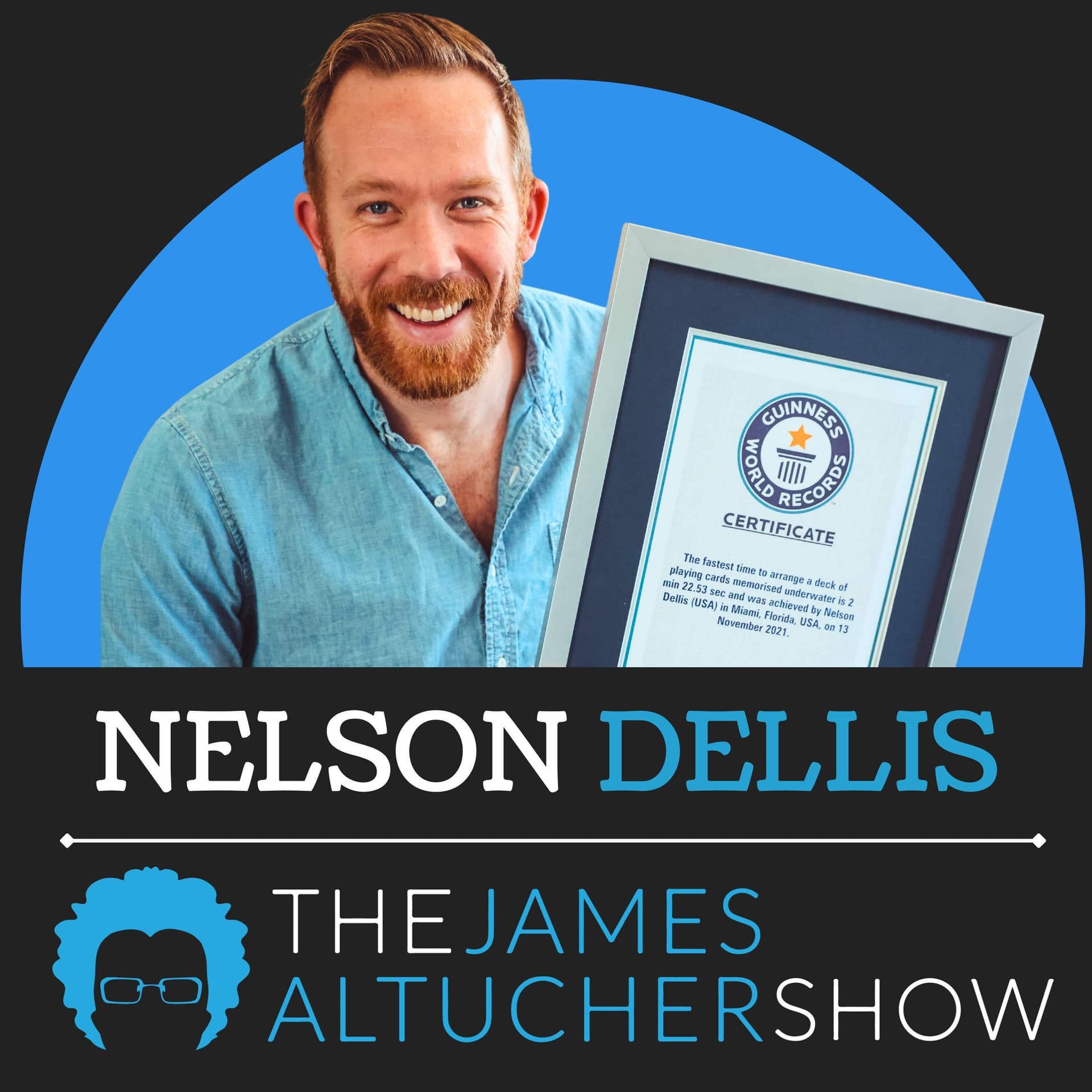
Nelson Dellis (six-time USA memory champion; Guinness record holder) explains how memory training techniques may help slow cognitive decline, and shares “Everyday Genius” skills for appearing smarter—covering memory palaces, memorizing huge number sequences (e.g., pi), focus/reading-for-retention methods, and social “cold reading”/mentalism-style perception.
Guest backgrounds
Dellis is a competitive memory athlete who trains daily with timed drills (cards, long digit strings, names/faces) and uses software to track performance. He’s written Everyday Genius and competes in USA/world memory events. He also collaborates with/knows experts from related fields: speed readers, magicians/mentalists, and memory-competition peers (e.g., Simon Reinhardt).
Key claims
Alzheimer’s prevention evidence is “not fully clear,” but Dellis argues lifestyle/environment and daily mental discipline may help slow it. “Genius” is subjective; memory, reading retention, focus, and long-term learning are foundational. Speed reading should be reframed as “focus reading” (don’t sacrifice comprehension).
Notable examples
memorizing 10,000 digits of pi with chunking to avoid “collisions”; speed numbers practice (405 digits in 5 minutes in practice; world record rumored 600–700). Cold reading tips: eye contact, pupil dilation, and body orientation. Reading retention: use a pointer/finger, read first/last sentences, and visualize like a “movie.”
Written by AI. May contain mistakes. Listen to the episode to check what was said.
Chapters
Tap a time to open that second in VOMemory and Alzheimer's Connection
0:34 to 2:41
Discussion on how memory techniques can potentially delay Alzheimer's.
“that's really what changed everything for me.”
Daily Memory Training
2:48 to 4:34
Insights into daily memory training practices and their benefits.
“I just want to mention a few years ago, so I play chess and I was looking for ways to improve my memory.”
Discipline and Memory Techniques
4:34 to 5:46
Exploration of the relationship between discipline and memory enhancement.
“the training that I do is for those competitions, which is nice because it's very measurable.”
Everyday Genius Techniques
5:46 to 6:58
Overview of memory techniques presented in the book 'Everyday Genius'.
“So it's not necessarily the memory techniques themselves.”
World Record Memory Challenges
6:58 to 9:30
Insights into memory challenges and world records, including digits of pi.
“And you also have the techniques on remote viewing.”
Emotional Context in Memory
9:30 to 14:01
The importance of emotional connections in memorizing information.
“It seems to me, correct me if I'm wrong, to do this 10 ,000 pie trick or whatever you call it, it's sort of like you turn the 10 ,000 digits almost into a story where the letters are linked to the numbers.”
Memory Competitions and Records
14:01 to 16:41
Explore the impressive records in memory competitions and the evolving standards of memory athletes.
“And, but what's your record for the most amount of numbers?”
Understanding Genius and Its Subjectivity
16:41 to 20:01
Delve into the subjective nature of genius and common societal perceptions associated with it.
“There are some kind of collectively accepted geniuses, historical figures, Albert Einstein, Tesla, right?”
Foundational Components of Genius
20:01 to 23:21
Learn about the foundational skills that contribute to perceived genius, including memory and focus.
“So a lot of it is based on memory, but I think it's also generally just understanding that our brain can be so much more than most people think it is.”
Techniques for Speed Reading and Retention
23:21 to 27:01
Discover effective speed reading techniques that aid in retention and comprehension of material.
“So if you just take your finger or a pencil or just some pointer thing and guide your eyes as you read across the page, that is going to help you tremendously increase your speed.”
Show all 27 chapters
The Importance of Reinforcement in Learning
27:01 to 28:00
Understand the significance of revisiting learned material to strengthen memory and comprehension.
The Science of Memory and Cramming
28:00 to 29:19
Learn about the effects of cramming on memory retention and the importance of revisiting material regularly.
“if i read a book let's say let's say a guest is coming on tomorrow and i read his and it's like a history of World War II.”
Enhancing Memory through Visualization Techniques
29:20 to 33:18
Discover visualization techniques to improve memory retention while reading.
“So what you're getting into is more like, how do I remember the stuff that I'm speed reading or reading faster?”
Understanding Cold Reading Techniques
33:42 to 37:39
Explore the principles of cold reading and how to perceive others effectively.
“that's not part of kind of the memory techniques you've used to become, you know, U.S.”
The Art of Deception in Mentalism
37:40 to 42:00
Delve into the methods used by mentalists to create the illusion of mind reading.
“Yeah, I think one that's, I mean, I think an obvious one is eye contact, right?”
The Psychology of Choice in Magic
42:00 to 44:35
Explore how magicians influence choices and the psychology behind it.
“the interaction, the actual real interaction that maybe on a YouTube video you get to see where the information was given, even though the person didn't really realize that they were giving it.”
Remote Viewing and Memory Athletes
44:35 to 47:19
Learn about the intersection of memory techniques and remote viewing.
“Yeah, but I think in that case, like, let's say you had a Queen of Hearts and like, you know, two of clubs, a three of spades, you know, like very boring cards and the queen is like the queen.”
The Stargate Program and Remote Viewing
47:19 to 50:41
Discover the military's interest in remote viewing and its implications.
“And then you would get some percentage of that if you learn.”
Experiences with Remote Viewing
50:41 to 56:00
Hear about the author's personal journey and results with remote viewing.
“and then yeah i spent a month learning from a remote viewing coach the whole time i thought this is absolutely ridiculous and techniques are in the book i talk about the process the exact process I was taught.”
Remote Viewing and Confidence in Predictions
56:00 to 56:50
Learn about the intriguing concept of remote viewing and its impact on confidence.
“Because I usually put like 10 bucks or something.”
Exploring Out-of-Body Experiences
56:50 to 58:20
Discover techniques and perspectives on out-of-body experiences as discussed by the guest.
“And that chapter in the book is fascinating.”
The Power of Focus and Visualization
58:20 to 1:02:09
Understand the significance of focus and visualization in enhancing mental capabilities.
“So with out-of-body, some of the techniques you can do, the best place to try this is on a comfortable bed or on a comfortable sofa.”
Memory Techniques and Card Counting
1:02:09 to 1:04:42
Learn about memory techniques related to card counting and the realities behind them.
“But I think if you really want to get deeper into your own mind, it starts with some of those techniques.”
Training Memory and Its Broader Impacts
1:04:42 to 1:07:16
Explore the effects of memory training on overall cognitive abilities and daily life.
“You know, it's always in a format that will lend itself to be memorized very easily if I choose to, like things in my life.”
Aging and Competitiveness in Memory Sports
1:07:16 to 1:09:51
Discuss the impact of age on performance and competitiveness in memory athletics.
“Yeah, like maybe you strengthen your ability to attach some emotional charge to things you see around you.”
Exploring Memory Techniques and Everyday Genius
1:10:01 to 1:11:24
Learn about effective memory techniques and the concept of appearing genius.
“Like that does seem like if someone does that, you think, oh my God, that's a genius.”
Nelson's Work and Future Projects
1:11:24 to 1:12:12
Discover Nelson's coaching work and his upcoming book ideas.
“Oh man, I mean, I alluded to writing a little bit more about that last chapter and kind of that woo-woo space, but I don't know, we'll see.”
Transcript
Automatic transcript. May contain errors.0:00James Altucher:This is the new Weight Watchers. Built for real life and real results, no matter what mode you're in. Maddie went all in for her big day and lost 33 pounds. Emily lost 85 pounds and hit her goal while still living her life. Weight Watchers gave me the tools and I feel amazing. Join the millions of members and lose weight with the number one doctor-recommended weight loss program. Lose more at WeightWatchers.com. At six months, participants in a clinical trial of Weight Watchers program lost an average of 12 pounds. Today on the James Altucher Show. My grandmother having her memory robbed of her because of Alzheimer's, that's really what changed everything for me.
0:40I didn't want the same thing to happen to me. And it led me down this rabbit hole of reading about memory and discovering that there were techniques to improve memory.
0:50James Altucher:Reading is so important because you only live one life. But when you read, it's as if you're absorbing someone else's entire life in just a few days because you read their book. And if you retain even like one or two things from that, you basically incorporated the complete life lessons of some other individual into your consciousness. And if you do that a lot of times, you have thousands of people inside your head. Sometimes when we have that intuition, that gut feeling about something and it's right, where did that come from? It almost came out of nowhere. But what if that was just our brains being able to quiet the noise and get into that signal where that information lies and you find some information that isn't something that you could have gotten from anything around you from your other five senses, right?
1:32James Altucher:This isn't your average business podcast and he's not your average host. This is the James Altucher Show.
1:50James Altucher:Everyday genius, hacks to boost your memory, focus, problem solving, and much more. I talked to Nelson Dulles, who's the six-time USA memory champion. He also has broken many records in the Guinness Book of World Records involving some of his memory activities. His whole point in the book Everyday Genius is that with just some practice and some of the techniques that he describes in the book, you can basically be a genius or at least appear like a genius. And we talk about everything from being a mentalist, cold reading, fast math, all sorts of tricks, tips, things I did not even know about. And I've done a lot of podcasts about memory and so on, but there was tricks he showed me that were incredible and you'll get to learn them in this podcast.
2:38James Altucher:So Everyday Genius with Nelson Dulles. Enjoy.
2:48James Altucher:I just want to mention a few years ago, so I play chess and I was looking for ways to improve my memory. So there's a company Chessable that sells chess courses and they introduced me to Simon Reinhardt who gave me a bunch of memory lessons. You know, he's former world memory champion. Yeah, yeah, yeah. So you worked with him one-on-one? Yeah. Awesome. Yeah, he's a good friend of mine. And it was great. Like I learned all the memory palace techniques and we applied it to chess and it was very interesting. But, you know, we'll talk about this later. Like the memory palace being one of those main memory techniques.
3:24James Altucher:But I want to kind of get into your background a little first. Like you always say you got inspired to learn about memory because of your grandmother's experience with Alzheimer's. and I want to know if you still feel that there's a connection between memory techniques and maybe forestalling Alzheimer's. Yeah, great place to start and I do. I think that I know the evidence isn't fully clear on how to prevent Alzheimer's. It's one of the top 10 leading causes of death in the US and the only one without a cure. But it is seeming more and more that it's an environmental thing. that we can prevent or slow down by things in our life, right?
4:09Like what we eat, what we do day to day with our minds, how physically active we are. And so obviously the mental training, the memory training is that component of training your brain in some aspect day in and day out. And that's what I do for my competitions. It's become a staple of my life. Every day I do my memory training, just like I try to stay physically fit and go to the gym every day as much as I can.
4:32James Altucher:What do you do every day for memory training? for someone like me who's interested in memory competitions, the training that I do is for those competitions, which is nice because it's very measurable. So at these competitions, they have us memorizing decks of cards as fast as possible, long strings of numbers, names and faces. And I use software that basically throws a bunch of that information at me, times me, and I try to memorize it as fast as possible. And I do reps or sets of these exercises and I keep track of my performance over time and things like that. And that's the way I go about it.
5:07It doesn't have to be for everybody, but it is a good way to kind of measure progress over time. And I think that by building these habits over the years, you know, I think differently. My mind processes information differently because of all the time I've spent kind of rewiring how I process information and memorize things. So I'd have to think that down the road, let's say I'm destined to get Alzheimer's, regardless of whether I'm a champion or not, The champion version of myself would have these kind of built-in backup fail-safe systems that would, I think, push out the effects of Alzheimer's.
5:40I don't know, whether it's a month, six months, a couple of years, it's got to be something. That's my stance on it.
5:46James Altucher:So it's not necessarily the memory techniques themselves. It's the discipline required to make you a champion, like the best in the world at something that you feel is what would kind of push Alzheimer's off a little bit. Yeah, good point. And specifically using your mind day in and day out. The techniques obviously make the process easier and more inviting. It's not that fun to try to memorize things if it's just you're forgetting stuff all the time and it's boring and tedious. With memory techniques, it makes it a lot easier, a lot more fun and rewarding because you feel like, wow, I can do something that to me is incredible.
6:24I think that's what helps at least me get back in my chair every day to do the training because I loved it so much.
6:30James Altucher:So I want to get into all this. Your book, Everyday Genius, has so many amazing, amazing techniques, by the way. So I've read the book and now I'm going to spend probably another 100 hours or so trying to master some of these techniques. I've always wanted to be one of those guys where it's like, oh, what's 763 times 472? And have like an answer in one second. You have all these great math techniques. Then you have these great techniques on, obviously, memorization. You have a ton of techniques. but I'm really fascinated also by some of the techniques like on, on cold reading. And you also have the techniques on remote viewing.
7:06And we'll talk about that later, but what got you first into,
7:12James Altucher:Oh, I'm, I'm not only going to learn some memory. I'm not only gonna get a better memory. I'm going to become the U S champion for memory. And I didn't even know, I mean, I did, but I didn't really know how much of a competitive areas is like that. there's an every year a usa memory champion and a world memory champion and so on yeah yeah listen i never expected myself to be involved with any of that i didn't even know they existed until i started dabbling in it you know with my grandmother having her memory robbed of her because of alzheimer's that's really what changed everything for me i didn't want the same thing to happen to me and it led me down this rabbit hole of reading about memory and discovering that there were techniques to improve memory i had no concept of that i thought you were born with a memory and that was what you had and yeah there were little memory tricks maybe you learned little monics in school that helped from time to time but nothing that would allow me to memorize a deck of cards or thousands of numbers that's that's not for me i can't do that that's for a photographic memory kind of person right and this is a big issue like so just to be clear like there was one you were going for a world record at one point and they showed you the first 15 ,000 digits of pi and then they ask you okay here they give you four or five digits and you have to say and those are digits that are in somewhere in those first 15 ,000 digits of pi and you have to say what are the five numbers or four numbers before and what are the four numbers after that sequence you'd have to know where those digits are right in in pi out of 15 000 and and the technique you use you know i guess there's all these mnemonic techniques to help you memorize all 15 000 digits but it's really like amazing to to do that that's like you know it's like magic it does feel like magic oftentimes that specific record it was 10 000 digits so you're telling me up that's great it was 10 000 i gotta remember memory that's okay i should just let you say 15 000 sounds more impressive but yeah that's something that sounds impossible and you know even just memorizing 10 000 digits of pi and saying it you know all 10 000 digits that already sounds insane but then to be able to target different chunks of it that somebody randomly calls out and be able to continue from there backwards and forwards that sounds like an added level of impossibility like how even or why but if you really truly understand what's happening in our minds when we approach something like that it seems reasonable it's just not many people understand this process and if they did i think they'd be a little more like oh yeah that seems doable or maybe i don't want to sit there and memorize the 10 000 but i could see how someone could do it with a quote-unquote average mind yeah and a lot of it is and and look i've i've talked before on the podcast about the memory palace technique, Jim Quick, who's not a memory champion, but he's written books about this stuff.
10:09James Altucher:It seems to me, correct me if I'm wrong, to do this 10 ,000 pie trick or whatever you call it, it's sort of like you turn the 10 ,000 digits almost into a story where the letters are linked to the numbers. But my question, when you're actually doing this, if the digits that they give you kind of fall in between words, you know, so you're getting the last half of one word in your memorization story and the first half of another word. Do you have to memorize multiple pathways through the 10 ,000 digits in order to get this right? Right. So there's a reason why this specific record is 10 ,000 because there, well, if you just said, hey, here are 10 ,000 digits, I can choose any five-digit sequence, there are going to be numerous ones that are similar, if not the same, okay, if you choose anything.
11:02So they said, okay, well, let's maybe divvy it up by five. So there's a set chunks of five. Like every five is separated from the other. And those are the chunks that I'm going to say, right? And so within 10 ,000, there's only 24 pairs that are the same. And unfortunately, if you get given one of those by the judges, you do have to say both locations. But past 10 ,000, that we call these collisions because they collide in terms of the memory palace images, but they balloon crazy amounts after 10 ,000. So the records seem to kind of get watered down. Not watered down, it's still difficult. But in terms of being able to do it speedily, there'd be too many potential collisions for a lot more cases.
11:45So that's why they kept it to that. And then there's that specified five-digit sequence. Now, I have done it for certain portions where you can give me any sequence, but five digits is quite short to really find the location. So if I was going to say, hey, you got to do it for any kind of sequence that you like, I'd probably ask for like 10 digits so I can really find the place.
12:08James Altucher:I see because 10 digits is going to be bigger than the average word. So chances are the digits they give you, you'll somehow recognize kind of the words that you've memorized in your mind. You'll recognize a pattern in there. Exactly. somewhere that word that i'll be piecing together words out of those 10 10 digits and find the the pair or the ones that like oh that's this location i can find it whereas the the five there could be multiple candidates and it might take longer to to to target it and and for people who might be kind of a little bit trying to understand this discussion let me i'm going to explain it at 50 000 foot level what i think is happening you could correct me if i'm wrong without getting into the exact technique because that that's in your book and it's described very well in your book but the idea is that numbers are hard to memorize because you can't really attach them to some real world emotional context.
12:57James Altucher:But words, if I can translate the numbers into words, I can usually come up with some emotional connection between some memory I have and that word. And then you kind of get into the memory palace technique and all this stuff. So a lot of memory is about connecting something that you have to memorize to some emotional context because then the emotions provide an extra energy boost to memorize something. Right. And if you think about numbers, it's probably one of the more abstract pieces of information that we get to deal with. And so that makes it harder to memorize. Our brains look at it and it's all just a bunch of symbols.
13:39And if you can have a dedicated system to convert those abstract symbols into things that you could visualize that bring up emotions and sensory information, it's a lot easier to remember those things.
13:52James Altucher:And you know, the average person, they say like seven digits is like their max that they can, seven numbers. That's why phone numbers are like seven digits. So you can memorize seven digits. And, but what's your record for the most amount of numbers? Like you're shown and then like a minute later, you can like repeat it. Yeah. Well, it depends on how much time I have. With the 10 ,000, I had as much time as I needed to actually store them. And then I'm tested on them, right? But in memory competitions, they actually time it. There's different timed events. But the most common one is speed numbers, which is five minutes.
14:27And you have to memorize as many digits in order as you can. My personal best in practice was 405 digits in a row. And what is the world record? yeah i was gonna say it's changing all the time i'm not in my heyday of competition anymore i've since retired you know but it's it's like the four minute mile you know like somebody broke this one record once and then the record just kept falling and falling and people made predictions like oh nobody could remember remember more than seven digits you know maybe a few more there's some outliers but you know a hundred away and then you know 20 years later, here are these memory athletes memorizing hundreds and hundreds of numbers really fast.
15:08I think the world record might be in the 600, 700 range in five minutes, which is insane. Even me, I don't even understand how that's happening right now.
15:21James Altucher:So I really want to get into the concepts of the book because the idea, everyday genius, is that you're showing these techniques, which could basically, in a matter of days, take, let's say, the average person. I hate using that phrase, the average person, but take the average person and give them some almost like cocktail party tricks where they could like prove that they're a genius. But you also go into how to improve like things like social IQ. So you socially, you appear like a genius or there's, there's lots of ways people can appear like a genius, like having extreme math ability, society associates that with being genius.
15:56James Altucher:Yeah. Having glasses, people associate that with being. You're smart. Yeah. Like, like I can go into any scenario. It doesn't matter if I'm stupid or not. Having black curly hair and glasses, people think automatically I'm a genius. So I get away with a lot. They looked at both of us. They probably decide to give you the genius label, I think. Right, and you're the one who could memorize 400 digits in five minutes, and I can't remember phone numbers. So is that the idea? Like if I wanted to appear, or if anybody was listening to this and wanted to appear like a genius at the next party they went to, What would be like the first couple of things you would have them do?
16:34Yeah, yeah. Yeah, I mean, before I get into that, I think generally it's helpful to understand that I think, and we touched on it, that genius is subjective, right? There are some kind of collectively accepted geniuses, historical figures, Albert Einstein, Tesla, right? Benjamin Franklin, maybe, right? And then some might fight you on those. We're like, no, no, no, not Benjamin Franklin. Salvador Dali, you know? And some are in the artistic world. Some are just really good speakers and they just always are snappy with their answers. And that's genius to someone. But yeah, maybe it's also that mental calculator.
17:08There's the guy that Rain Man was based off of Impeak, who was on the spectrum, but was capable of some incredible things. Genius? Maybe, maybe not. Socially, maybe not a genius, but in other aspects, yes.
17:24James Altucher:You're right. It's subjective, but there are many things that people culturally tie to genius. If you watch almost any TV show, the smartest person in the TV show usually has a chessboard in the background. So chessboard is associated. Yeah, or Rubik's Cube, right? Yeah, or Rubik's Cube. Or Sherlock Holmes has this almost photographic memory. So all these small little things are associated with this cultural concept of genius. But you're right, it's subjective or cultural. But anyways, in the book, yeah, I break it down into some of the categories that, are associated with genius and how to tap into them.
17:57And then the first part of the book, I really kind of try to build a foundation. What I think are kind of the foundational components to being a genius. And I think there's many ways to read this book. I think one way is to just appreciate genius and our capabilities of our mind and learning these tricks to appear a genius. But I think the deeper message is that you can feel to yourself smarter than you think you are, and that you are capable of genius. So it's not all about just like showing off and seeming tricking people into thinking you're smarter than you are. But again, going back to that, it's subjective.
18:31Like who's to say a lot of the geniuses we think out there, maybe they're just using some tricks too, right? But ultimately these basic foundational places to start, I think it's memory. I think generally people who have better memories tend to be smarter. Why? Well, they can remember more information and use it, right? It also kind of, if you can do phenomenal things with your memory, it looks like something that this concept of genius, meaning something kind of unattainable that is not for the everyday person. I think that's often associated with memory. The second part is being able to, I think, pull information from content that you consume.
19:15So I have a whole chapter on reading faster and remembering what you read. because I feel like in general, if you are well-read, you have a lot more information at your disposal. Tie that with memory and you can remember a lot more of what you read and use that as you traverse the world, right? You can say interesting things. You can reference different quotes or topics or writers, whatever. Then I talk about focus and attention. I think if you could master that skill of being able to hone in on whatever it is, whether it's a conversation you're having or a craft that you're trying to master, that is like gold currency in this day and age.
19:53I think it's so hard to be able to hone our focus. We're constantly being distracted. And then the last component to that is just being able to learn and to learn better and to remember for the long term. So a lot of it is based on memory, but I think it's also generally just understanding that our brain can be so much more than most people think it is.
20:17James Altucher:There's a couple things I want to unpack there. First off, the speed reading or the reading faster and retaining what you learn, this is really important for so many reasons. And A, it's really to focus because you have to focus on what you're reading in order to learn from it. And this is, like you said, this is like a gold currency in today's society because every study shows our attention spans and our ability to focus has gotten lower because of social media. I'm not making any judgment on this. like social media has its own ups and downs and pros and cons, but the speed reading techniques, I have to read often very fast.
20:52James Altucher:I've done 1500 podcast episodes. Almost every episode is with someone who's written a book. Sometimes I'm doing four or five podcasts in a week. I've got to read an enormous amount and you do develop techniques. And I found my own techniques were very similar to what you were talking about in the book, but maybe describe, and by the way, I just want to reiterate, reading is so important because you only live one life, like you live your life. But when you read, it's as if you're absorbing someone else's entire life in just a few days because you read their book. And if you retain even like one or two things from that, you've basically incorporated the complete life lessons of some other individual into your consciousness.
21:35James Altucher:And if you do that a lot of times, you have thousands of people inside your head. Yeah, yeah. That's a great way to put it. I love that. Totally. And so what's your favorite speed reading technique for retention? Yeah, before I dive into that, I do change the name of it in the middle of the chapter where it starts as speed reading into focus reading. I feel like speed reading gets such a bad rap and there's a lot of scammy kind of promises out there on speed reading. You know, increase your reading speed by 2 ,000 words per minute. And it's like, well, yeah, I mean, you can read as fast as you'd like, but the goal is obviously to absorb the information that you're trying to get out of it.
22:20And if you read too fast, you're not going to remember anything. So there is, I think, a reasonable limit to how fast you want to read. But I think it's important to recognize that this is also a skill and that you can train that speed. And that there are going to be cases where you do want to read faster In your case, you have a guest coming on, a bunch of guests, different books. You got to read the books or at least be somewhat familiar with the books that you're going to be talking about. But then there's other books that are like a fine wine that you have put on your shelf and you're waiting for the right time to read it when you can sit down and really spend time with it.
22:59And you don't want to rush through it. So your reading speed for that might be terribly slow, but that's the point. You want to take a look around and smell the roses. right so i think this chapter is more about having the tools to read faster if you want to to a reasonable degree so you can still retain things but also being able to you know ebb up and down that speed when necessary while still not losing or or trying to maintain that that level of absorption and memory of what you're reading right one of my favorite tips you know if i'm trying to read fast and people don't think about this often and it feels like you're a kindergartner when you do it, but it's to use some kind of eye tracker, right?
Read the full transcript
23:39So if you just take your finger or a pencil or just some pointer thing and guide your eyes as you read across the page, that is going to help you tremendously increase your speed. Because oftentimes, if you just read normally, I'm sure a lot of people can relate to this, you'll find your eyes jumping a lot, right? It might even just...
23:59James Altucher:And you also reread a sentence. And you reread, right? You might jump back, right? But when you put a pointer there and you guide yourself, that finger dictates the pace. And that thing wants to keep moving. And if you encourage yourself to just always keep the finger moving, your eyes will follow. And you'll be surprised how quickly your eyes can actually keep track. Sometimes they show these commercials of speed reading apps where they show like one word at a time, and it just like changes faster and faster. And I don't love those because it's digital and I prefer kind of more of an analog version of reading, but you can see how we have a lot more in us at a rapid pace to still have some comprehension of words that are flying by us.
24:40The other thing to note is that you don't necessarily have to read from the left side of the page, the very left side of the page, to the right side of the page. And so what I encourage people to do is, you know, start with a small margin, but maybe lightly draw two margins, maybe, you know, a half inch or an inch from both sides of the page and just follow your finger between those lines you know you might say well nelson you're not going to read all the pages all the all the lines on each page well your peripheral is picking up on information and i have a little paragraph in in that chapter where i actually jumble up the letters of the whole paragraph and you are able to read it normally so the whole thing if you look at it objectively it looks just like gibberish but we can read it because essentially our mind can piece together a lot given context clues and suggestive components.
25:32So you don't necessarily have to read every single word. Our brain can do a lot of piecing it together. So if you imagine adding those two things together, moving your speed along, kind of shortening the distance your eyes have to travel through a page, chapter, book, you're going to save time there and still remember the same amount as if you were to read all the words.
25:52James Altucher:And I guess like when I'm actually trying to speed read, there's sort of like a stress in that. Am I really remembering everything? Like I, so in the, I think the way to get rid of that stress is like do these techniques, but, but practice a lot. And I don't quite know how you set it up so that you could practice. Like, you know, maybe there's some information on the page and you kind of try to write the words, what you memorized or what you learned. But, but I think it's very important what you just said that you don't have to read every word. Yeah, exactly. that's an important technique like i'll tell you one thing i do and i'm curious if if you like this technique just as a writer i know writers put the most emphasis on like the first sentence and maybe the last sentence of the paragraph so if you just read the first sentence the last sentence of a paragraph a you're gonna peripherally get what's in the paragraph anyway but b though you're getting the most important information of the paragraph just by reading the first and last sentence of each paragraph and again it goes back to what are you truly trying to get out of this it depends on the reading material too if it's a common kind of self-help book there's usually one main theme that's repeated on over and over again right so do you have to absolutely read every section maybe not right like if you're trying to just get through the book because you have guests coming on you generally want to get the idea of the book and pick apart some of the interesting parts right this idea of skimming through it can be a little more constructive and controlled without it being like i'm just skimming through it page by page but still remembering the gist of most of the important parts of the book you know and it could be as simple as that like just reading the first and last sentences of a page or a section yeah no that's really important but and you do make the distinction like if i'm reading let's say a literary novel or a collection of short stories then you absolutely can't speed read to get the benefits of the book like it's often the way the writer is crafting each word and each sentence that you have to appreciate to get the most enjoyment out of the book but okay maybe that's like an exception but but let me ask you a question this is something that has been i've kind of realized while doing these 12 years of podcasting if i read a book let's say let's say a guest is coming on tomorrow and i read his and it's like a history of World War II.
28:09So I know for myself, if I could just sit there and read the book the
28:14James Altucher:day before the podcast, right up until the minute of the podcast, and I'll have like almost word for word, page by page, I'll have the whole book in my short-term memory. And then a half hour after the podcast is over, I can't even remember who was on the podcast. It's like, what's going on there? Do I have Alzheimer's or something going on there? No. I mean, what you're doing there is cramming. yeah and our brains i talk about this in the in two of the chapters there on memory and learning but you know we remember things for longer when we revisit them a lot and we review them we build these stronger connections in our brain our neural connections to the things that we learn when they get stronger if if they're used over and over again so something like that where you just read it before yes it's going to be very front of mind but the connections there are weak and will be dropped and lost very quickly.
29:05Hence why when you cram for an exam, you may remember a lot of it in the test, but then afterwards it falls away. But if you studied responsibly, right, and reviewed often the weeks leading up to the exam, you probably will remember more. I mean, that's just the science of the brain. So what you're getting into is more like, how do I remember the stuff that I'm speed reading or reading faster? And one of the things I wanted to mention that instantly will boost your memory for what you read. And again, it varies on effectiveness depending on how dense the text is, right? If it's fun fantasy fiction versus, you know, civil war dates and, you know, all sorts of political technical jargon, that might be a little more tricky to retain all of that.
29:50But generally what I suggest is if you're reading, you know, a lot of people will just look at the words on the page, right? And just read it for what it is. They'll get meaning out of it, but they're not really using their visuals, their mind's eye to visualize what's unfolding in these words, right? So if you can, and this is a memory technique, it's visualization, right? It's coming up with basically pictures that are associative and emotional in your mind when you memorize something, but you can create that as you read, as if a movie was unfolding before your eyes, right? So I think that's kind of a given that they're doing that, but I don't think they're truly doing it where you really try to immerse yourself inside of this experience that is being written in front of you as if you were there and what it might feel like.
30:34If you can start to paint that picture as you read, that will enhance your memory for a lot of the passages in the text that you're reading without feeling like it's much effort. You know? Yeah, so you're right though. I think if I'm reading a book
30:49James Altucher:about a civil war battle, I am kind of picturing that battle in my head. But how do you really visualize it? What's the difference between what I'm doing and like really visualizing it. Yeah, well, I think, you know, when you start to get, let's say a Civil War text, right? There's going to be some dates in there. There's going to be some generals, names, all sorts of like specific facts, right? And visualizing those may be difficult or may just be hard to hold on to. I feel like there's more of a process that needs to happen when you're interacting with a book like that. And I don't think it's as simple as just like, I'm going to read this and hold it all.
31:26Like you can apply memory techniques to what you read, but it's hard to do it fully in the process of reading. I think the best way is to just have a well thought out strategy on how to basically study, right? And, you know, obviously the less reading for joy that you're doing, like, because it's just a fun read to something more work related, technical or something for your show where there's a lot more detail that you may need to store. I think that's where you need to really interact with the book in terms of, so I'll underline, I'll highlight things, I'll square box things out, I'll write in the margins.
32:01My books look messed up when I'm done with them because I've interacted with them. And then what I'll do is I'll organize all of that information by chapter. After every chapter, I do two things. I will always try to recall what I remember. And it's not a stressful event. It's not like I have to remember everything. It's just like, what do I remember? What happened here? What are any quick things that just stuck? And that's a great test to make sure that I paid attention. And it's using active recall to fortify the things that I already kind of picked up on. Then I'll organize the tidbits that I noted or wrote in the margins with in some kind of external form.
32:43I have a little book journal that I write things in, keep notes on, and it's all kind of formally written chapter by chapter. You can do that digitally if you prefer. And then I'll eventually review those things too. Those are there for reference as well because I do recognize that things that I want to keep for the long term have to be reviewed ultimately. It's kind of like the bummer side of memory techniques because nobody likes to review. But if you have a method for it, it makes it a lot easier. And recognizing that that's the thing that carries things into long-term memory, then you got to work with that.
33:19James Altucher:take a quick break if you like this episode i'd really really appreciate it it means so much to me please share it with your friends and subscribe to the podcast email me at alcatra gmail.com and tell me why you subscribed thanks
33:41James Altucher:i want to um jump to the section where you talk about cold reading which which i know that's not part of kind of the memory techniques you've used to become, you know, U.S. memory champion and so on, but it's such fascinating stuff. And clearly you've done a deep dive on it. And it is one of those things where if you could sort of look at someone and it almost seems like magic or it is magic, if you could determine some things about them that they think is, how could you possibly know that? That does convey genius vibes. And so, you know, So what's a time when someone cold read you and you were amazed and then you started to learn the techniques and those techniques worked?
34:23Yeah, so I feel like I'm pretty good at kind of just picking up on people's vibes. I mean, that's maybe subjective too, but I never really had any specific things I'd look for. The world of memory has a lot of overlap with the world of magic and mentalists. and I picked up a few friends along the way who are full-time magicians and they are experts at this stuff.
34:49James Altucher:And by the way, can I interrupt you for a second? Like being the, the, this world memory champion is, are your friends like all these cool magicians and like, you know, other people who've done like amazing memory, like athletic stuff? Basically. I mean, every chapter in this book, I mean, I usually have like a little story. It's because I have relations to people who are experts in these fields, right? Like I have a few mental calculator friends who are amazing at that. I have a bunch of magicians and mentalists who are amazing at that. Intuition chapter, I have people who are psychic, have strengths in these psi abilities.
35:24Speed readers, I have friends who are, that is what they do. And you have that one friend who's like great
35:28James Altucher:at like solving riddles. Yeah, yeah. And he's technically a magician, but I mean, he is just phenomenal at breaking down those riddles. I think he just practices them a lot. So, you know, getting to interact with real magicians as friends, you know, you pick up a lot on how magic truly works. You know, I used to just be in awe and like, it's hard to actually find answers to how tricks are done. Because there's this whole magician code of don't just give away the answers. And it's funny because a lot of my magician friends, even though they're friends, they'll be like, I can't tell you how they do that.
36:03And all of a sudden, they're like, come on, just tell me, you know, like some of them, they give me little hints and things like that. But I think the bigger takeaway is just watching them in action and seeing how they can distract people or pick up on different things that someone they're performing for plays into or doesn't buy and they have to shift. And being able to pick up on those subtleties as the trick goes on. So one of my specific friends, his name is Spidey. You might see him on the internet. He's constantly looking at videos of celebrities or politicians in famous viral memeful moments where they might be lying or hiding something.
36:43And he analyzes pretty indepthly what he really thinks is going on. But he will say that even the cold reading stuff is not an exact science. Because some people are very good liars. Some people are terrible liars. And so, you know, just using a few subtle cues doesn't necessarily mean they are lying or hiding something or shy or, you know, excited or interested in you. But if you piece some of those things to look out for together, it usually can indicate a certain feeling or a reading on a person. But again, it's not an exact science. But it's fun to kind of having the back of your mind as you navigate, especially in the context of this chapter where it's the social genius.
37:28Like, how can you be more perceptive in social situations with interactions with others, right? And picking up and reading the room on what's going on.
37:37James Altucher:And so what are some, like, just basic good cold reading techniques that you find on average work and that work very well? Yeah, I think one that's, I mean, I think an obvious one is eye contact, right? If you're engaging with someone and they have great eye contact with you, then that shows that they are interested, really focused on what you're saying. And if they're not, like if they're diverting their eyes a lot or they're kind of shifty and maybe kind of turned away a bit, you can maybe, it's not necessarily you'll know what they're up to, but you can tell that they don't have your full attention, right?
38:13And there might be another meaning for that. I think another thing you can do is a lot of this can be translated to like first dates or when you're with someone that you're trying to really win over and see if they even like you, right? Oftentimes when someone is truly into you or interested in you, and again, it doesn't have to be in a romantic way, their pupils will be dilated. But that could also be because it's dark where you are, right? And then they need to have more light coming into their eyes. But if someone's really focused on you and interested, their eyes are open, right? Another thing is just kind of their positioning towards you.
38:51So, you know, if you're approaching someone and they approach you dead on and they're facing you as you're having this conversation completely, again, this shows that they are fully in your presence, fully attentive. If they're partially turned, you know, or like you approach them, but they don't turn towards you, there could be a lot said there that, you know, maybe they're not interested to talk to you or maybe they have somewhere to be or there's something else on their mind. You know, there's a lot that can be interpreted here, but you can, as you kind of have this idea of what certain body parts or micro expressions might be popping up, you have more to play with, right?
39:29To kind of play around with this interaction with this other person.
39:32James Altucher:How can I use it then to cold read them? How can I use some of these techniques to cold read them? Like what, what, like I want to, I want them to say by the end of the conversation, oh my God, how did you know that? So this is, it goes back to being a little more perceptive as much as you can and going into situations like this where you're kind of primed to notice the little things, right? Some people might just be focused on what they want to say, or, you know, maybe they're too nervous to even think about anything else. but oh my god i gotta say hi to this person but if you walk into a situation where everything about this person what their body is doing what they're wearing what they say could have extra meaning i think a lot of it is common sense in terms of what you could pick up you know and and glean from kind of their tone of voice or the the words they use yeah so like so like so like how do the these mentalists do it though where you know it's like oh pick a name from your child's or that no one would ever expect and they and they get it right on on these youtube videos yeah i don't know how much i can share there but a lot of that stuff is not as interesting as you think when you discover how they're actually doing it it's some sleight of hand you know there's a few mentalists out there well mentalists in general will it's an act right it's a show but a lot of them will say like I can't read minds, right?
41:00I read people or something like that, right? But in reality, they're not reading people either. There's a trick involved. Oftentimes, where they may ask the person, hey, can you think about your childhood lover or your first kiss or something like that? Childhood lover, that sounds terrible. You know what I mean? Your first love, whatever. Think of their name and then they can tell how long their name is or something like that. or think of a letter and then they find the letter, right? And then they say the name, of course. I'd say 99 times out of 100, that name is already known before he does that or he or she does that.
41:38He's like Googled the person or he knows who he's going to meet. Listen, there's so many ways and this is where it gets even beyond what I fully know because I'm not a mentalist. I've just dabbled and I have friends who are. But there are schools that are quite deceptive, that people have little gimmicks. There are even little things that are done before the interaction, the actual real interaction that maybe on a YouTube video you get to see where the information was given, even though the person didn't really realize that they were giving it. But yeah, there's a lot and I don't dive into that and I don't want to upset my magician friends by revealing this.
42:16They're not going to listen to this. Just upset them. No, I can't. I can't. I'm not a magician, so I don't have the magician code but i have enough magician friends that i have to respect the magician's code
42:27James Altucher:oh man i'm dying to learn like some of these techniques well you do describe some of this stuff in terms of i guess what's called pushing like in terms of like pick a card any card and and they could or think of a number from one to 13 there's ways to push what they naturally think of and they think they're making an independent choice but you're increasing the odds that the choice is what you want them to pick. Sure. And you could do that a lot with like sleight of hand. Some magicians are great at, you know, forcing a card by manual means. But there are also some studies into what most common answers are for certain things that you ask a person to say.
43:05Like if you were to ask somebody, think of a number between one and 10 really quickly, most times someone will say seven. That's usually what they'll go for. If you ask for a number between one and five, they'll usually say three. If you say a number between one and a hundred, or even 42 is a pretty common one because of hitchhiker's guide, they'll often say 37. And it's like, well, why 37? Why 37? I think it's because it's such, it's, first of all, it's a prime number. It's like kind of a weird one. I don't know. A lot of these, I don't know how you explain why a person would say that, you know, it's, it's, it's goes into psychology of like, well, maybe it's not obvious, but you got to think like if you were to pull the universe to just guess a random number, there is going to be a favorite, right?
43:48That comes out, even if it's marginally. And the question is why, but maybe it doesn't matter why. If you know some of these ahead of time, then you can use them to sound like you're like literally predicting what this person is thinking. I think with playing cards, the first one that most people say is queen of hearts. And then if they're given a little more time to think, that's the other thing, right? Sometimes if you make sure it's a snap decision, they'll say one thing commonly. But then if they have a little more time to think, then they might go another route because they're trying to think of how, like, Queen of Hearts, or maybe that's too obvious.
44:21Let's do, and then it's Ace of Spades if they have, you know, more time to think about it.
44:25James Altucher:So maybe the idea is to, like, if you show five cards and one of them is the Queen of Hearts and it's just randomly in the middle and you only give them a few seconds to look and then you close it up, maybe you could kind of, maybe there's like an 80 % chance then they're thinking Queen of Hearts. Yeah, but I think in that case, like, let's say you had a Queen of Hearts and like, you know, two of clubs, a three of spades, you know, like very boring cards and the queen is like the queen. I think you'd get away with that if you were to say just like, it's a quick look, right? Because if you were like, look at these cards, choose one, I think they'd be like, I'm going to choose a queen of hearts.
44:55But no, that's a bit too obvious. And then they'd go with something more obscure, right? That's where it gets super fun to kind of explore that, you know?
45:03James Altucher:When you say quick, if they say pick quickly, Is that something where they connect the QU, people connect the QU with the Queen of Hearts, or is that not really relevant? I think there is some level of being able to subliminally guide them. I'm not a professional at that. I do talk about how my magician friend suggested things to me. And while I could have totally chose other, in the example that I give, I could have gone in another direction on any other day. But his subtle gestures, I think, guided me a little bit. I think there's also a bit of kind of chance and synchronicity and some of the tricks you see happen.
45:41But for example, he asked me at one point, he's trying to guess a card, right? That he maneuvered into my possession. And I don't know what it is. And he doesn't know what it is either. He does. But it seems like he doesn't. But he's trying to make me say the card. And it's the nine of spades, right? So he says, you know, black or red. But the way he does it, he said, you know, or I think he said red or black, that same hand movement. And according to him, there's a little suggestion there that you're going to probably say the thing last that I kind of stress a little nicer maybe in my voice. And then when I say the number, he said, pick a number between, you know, ace and 13, right?
46:25And so that already, I'm probably going to choose something higher, closer to the 13. But I'm not going to choose 13 because that would be too obvious. I'm going to choose maybe something in the middle, but maybe a little higher. It's not guaranteed that I'm going to say nine, but it's a, if he does that trick enough, I'm sure there's a lot of people who would say nine. And if you ask, what would he have done if I had said eight or something like that? That's where magicians are pros at this stuff. They always have a backup, right? And he probably could have, at that point, he probably would have been like, okay, give me the card.
46:55And he would have finagled it into the eight, you know, something like that.
46:59James Altucher:You know, there was towards the end of the book, there's this fascinating section where this group approaches you and says they want to teach you remote viewing, like the ability to see things not necessarily in your vicinity. And they wanted to use it to make stock market investments or trades. And they were going to start trading on a$1.2 million portfolio. And then you would get some percentage of that if you learn. And they said they had reason to believe that people who have strong memories can learn these remote doing techniques better. And so what happened? Yeah, I will tell you a quick funny story related to what you said earlier in the call.
47:40You know, this group was interested in memory athletes specifically because of what you just said, that we are maybe better at it because of our trained visual abilities from memorizing. so they approached me and one other memory guy can you guess who that other memory guy is simon reinhardt yeah that's that's fascinating but i don't think i don't think he didn't love it he he was really good at it from what he told me but he thought it was a load of crap right the whole time even though he was good at it yeah it's a wild phenomenon we'll talk about it more in a second but i think it's funny i i don't think he would ever admit that he was a part of that because it is very woo woo right uh but it was him and me and and we were the only ones who kind of were interested at first and got deep into.
48:22I don't know where he stands on it nowadays, but he was the other mental athlete. I don't know if I referenced that in the book, but it's a little secret. But anyways, there was this cryptic post on a Facebook page that memory athletes kind of frequent and we share ideas on them. It said, interested in a paid position for memory athletes. That was really it. And I was like, wow, okay. I'm always curious what people have as an idea for hiring a memory athlete i've dabbled in card counting and coaching people for all sorts of weird things so i'm just always curious what will come out of this so i threw my hat in the ring and then i got this phone call a couple days later and the guy's like hey have you ever heard of remote viewing i hadn't i thought it was i don't know they're like streaming services or something but he's like no no have you heard of this project stargate and then it started to click i was like oh yes okay i've heard about this and then i started to be like oh what is this call this is this sounds like a a scam i'm gonna be asked for money um because then you know stargate program was this i mean there were multiple programs through the 70s 80s and 90s but stargate is the most well known by name where in the military they were seeking out and training ordinary people how to do this thing called remote viewing which is basically a protocol a structured approach to ESP and psychic ability.
49:48And the argument was that this is something that we all can tap into to some extent. Now, it may not be like, oh, just guess the winning lottery tickets and you can do that. But no, picking up on subtle things that is information. It might not be super in-depth information, but it is information nevertheless. And if you can use that information or get that information from seemingly nothing, from thin air, then we should train that. We should use that. And the military saw the potential in that. So anyways, they said, hey, we're going to train you for a month. We'll pay you. And I was like, okay.
50:22And then you will go out in the field and we'll get a daily task to do a remote viewing session towards this project, which is to guess the improvement or decline of stocks day by day. And you'll earn a percentage of the earnings off of our bankroll, which was 1.2 million or something like that.
50:54and then yeah i spent a month learning from a remote viewing coach the whole time i thought this is absolutely ridiculous and techniques are in the book i talk about the process the exact process I was taught. And then I had situations, experiences, results from some of the sessions pretty early on, like during the first week that I was like, I don't know how this would have been possible. Like, did my coach feed me information subliminally? Is this a trick? Like what's going on here? And then I had sessions where I just was, I blew myself away. Like I got goosebumps. Whenever I think about it, I get goosebumps because it was almost exact.
51:33Because he would he would make me do a session. I'd have to remote view up, come up with information about some target that is randomly chosen. Not even by him. He wouldn't even know what the target is. He'd choose it through software they had that was randomized. And then after I'd do the session, I'd have all this stuff written down, scribbled about what I was predicting and seeing. Colors, textures, a sketch, details about it, you know, how it feels and where it's located. And then he'd reveal it to me. We'd look at it together and sometimes I'd be way off. I'd be like, that's not anything there.
52:07Sometimes you'd be like, well, yeah, I could convince myself it's kind of fits. But then a lot of times I would get stuff where it was exactly the thing. And I'd be like, what, how? And that's where I started to change kind of my worldview because I never believed in any of this stuff, let alone that I could do that. And then, yeah, it's just, again, I believe now it's just something that you can train. We all have this intuitive capability within our brains. I think it's a very primitive, ancient part of our brain's abilities that we don't use anymore or listen to. What do you think scientifically is going on?
52:43James Altucher:Like, what do you think, if you were to try to figure it out? Man, without getting too woo-woo here, I believe it's, I mean, I think it's tied to consciousness and the fact that I think information is just everywhere. I think the universe is information. And what that means is I think everything is out there. You know, like all facts about the world, all happenings, past and future, is just there in some substrate. Arguably, I guess, written or maybe written to some extent. And our brains serve as kind of a receiver that we can tap into and get that information at certain times, right? And sometimes when we have that intuition, that gut feeling about something and it's right, Like, where did that come from?
53:29It almost came out of nowhere. But what if that was just our brains being able to quiet the noise and get into that signal, right? Connect to that signal where that information lies. And you'd find some information that isn't something that you could have gotten from anything around you from your other five senses, right? And so I think that's got to be some part of the explanation because how else am I able to pick up on this information in these situations? Could it be luck? I thought that for a while, but then there were too many hits that were too precise to be just luck, like too many components.
54:02James Altucher:And you didn't quite finish the story. You kind of implied that you were going to be writing about this for your next book. Oh, yeah. But did you make stock market profits for them or did you continue with them? Oh, man. No, I did make a little bit of money as the whole project kept going. But it did die suddenly for a crazy unrelated reason. The guy who ran it ran into some real troubled legal allocations. I never met the guy, so I had no idea, but it killed the project right there, unfortunately. Whatever. I always look at it as it was the intro to this shift in my worldview and what's possible on that front of the mind.
54:43I've been involved with other projects, not as kind of fun story-like. It sounds like a movie sometimes. But I live in Saratoga Springs up here in New York, and we have a racetrack. every summer the racetrack opens and I'm constantly applying this stuff to predicting horse races. I don't put a lot of money in it because I try to be responsible with my money, but I'm always keeping stats of when I do this. I do this for a lot of sports as well, outcomes. And it's really just to see like how accurate is this? And I will get things correct close to 60 % of the time. Wow, that's impressive. That's better than the guess, right?
55:23when there's two options to choose win or lose um horse racing is a little bit different because there's varying amount of horses but i'm still above what you would expect you know with a horse race you typically have 10 horses so 10 if you just guessed off the cuff knew nothing about the
55:38James Altucher:races and just guess what happens if you've always been on the favorite in a horse race what's the statistics that i actually don't know that but i know in terms of money you're not going to make much money because they're the favorites you obviously you make the most money when it's the the underdogs and then usually i will throw a little bet if it is what i remote view is the underdog and i've won a few crazy pots from that notably the the belmont was up here a couple years back i was here last year but i i predicted the the the belmont and it's a weird experience because when i remote viewed it i knew it i don't know how else to explain it and it's easy to say that after you get it right and you win but i truly knew that i was going to win and i was guessing to myself, I was asking myself, what should I bet?
56:23Because I usually put like 10 bucks or something. I don't want to be crazy. But I was like, but I know this person's going to win. Why would I put more? And of course, I'm fighting with myself. Is this really true? Is this real? I ended up putting 50, which was a larger bet for me and still had a great payout. It was a weird sensation to know that this was the winner. I'd seen it and the confidence that that brings. It sounds wild to say that sometimes. It sounds silly.
56:50James Altucher:No, it's fascinating. And that chapter in the book is fascinating. And I'm going to start using those techniques. I remember as a kid, and you discuss this guy in the book, and you discuss these techniques. I read this book by a guy you talk about in the book, Robert Monroe. And this is like when I was 13 years old. I read this book, Journeys Out of the Body by Robert Monroe, where he talks about his out-of-the-body experiences. And you talk about various techniques for having an out-of-the-body experience, including lucid dreaming, which is a commonly accepted now technique for at least feeling, whether it's consciously or something like you're it's something's going on where you feel like you're out of the body you might not be out of the body it might just be some aspect of the brain that makes you feel that way but it's a way of inducing this this sort of feeling and you talk about various techniques for inducing that experience yeah yeah it's it's i think different people have different thresholds of what they'll allow to be called out of body you know you some people might even just straight up say lucid dreaming is out of body.
57:48Some people have these kind of states where they just feel removed from their body. That's out of body, right? But some are more targeted that, you know, it literally feels like you're floating and out of your body and you can see your body. I generally am more open. I think it's just this feeling of disassociating with your body is the idea of an out of body. I don't think you necessarily have to see your body, but just this feeling of being disassociated to it is enough. And I think when you explore that place, there's so much out there. And that's kind of what I tap into in this chapter is we're so cognizant of what's in front of us and in here, but there's a lot that can kind of happen out here in this metaphysical space that is still very hard to explain and describe, but I think gets a necessary place to explore, especially when you're talking about the mind and genius.
58:41So with out-of-body, some of the techniques you can do, the best place to try this is on a comfortable bed or on a comfortable sofa. You don't even have to be laying down. And I would encourage you maybe not to do this when you're going to bed, when you're tired, because you'll probably just fall asleep. Granted, you could try to maybe lucid dream, and there's techniques I I talk about for that. But if you're actively trying to get this experience of coming out of your body, what you can do is just obviously calm yourself, focus on your breathing. One of the best techniques is this, where you're using a rope, an imaginary rope that you can imagine.
59:17And again, this comes down to visualization too, where you might imagine this rope dangling in front of you and that you reach for it. Again, you're still, perfectly still, so don't actually try to reach for it it's not you this physical thing that's supposed to move right it's something else right there something about you and then just slowly try to imagine pulling on that rope and sometimes it works sometimes it doesn't but it's one of these things if you hone in on what that focusing on that that process you might get a quick glimpse of you came out of your body or you have this weird sensation that it felt like you were detached for a split second The hard thing about this is that as soon as you have that feeling, your body or your mind, whatever it is, gets shocked.
1:00:04It feels like, oh, I shouldn't be here. Something's wrong. It feels weird, like you're falling off a cliff. And so you zap back into your body. But then that's where the practice comes in. You can try to do that and stay out of your body a little longer and longer until if you can master it, and I've been able to tap into it. I'm still working on it. Robert Monroe was very good at it. You can do anything you want. in this realm. And that's where things get really spicy and controversial and weird because sometimes people have out-of-body experiences and they can bring back information that can't be explained in any other way that they were able to go there without their body actually following them.
1:00:44James Altucher:And I want to add that even if someone, like let's say you're listening to this and you absolutely don't believe that this is possible, there's actually what I'll call a plan be, which is why you should still do these techniques. And this is related to other chapters in your book. Focus. In order to do this, like the rope technique you just described, you have to really train your focus and your visualization about this rope. You can't be thinking about social media. You can't be thinking about some other problem in your life. You have to really focus. And you mentioned how focus is such an important technique for appearing like a genius.
1:01:18James Altucher:and also, yeah, again, the visualization aspect, there's this meditation. Basically, what you're describing is a kind of meditation. So there's this meditative aspect. Even if you don't believe it, there's nothing wrong with trying it. There's only upside to trying it. Yeah, and I think exactly what you said. Even if you don't get out of your body, what you're learning to do is to quiet the mind and focus. And I think even if you don't want to get metaphysical and woo-woo, The things that you can get out of being in a focused state where the noise is quieted, you learn so many things about yourself and your inner being and mind that you can't find unless you do that.
1:02:04So that in itself, I think, is worth exploring. Forget about the woo-woo stuff. That can be incorporated or not. But I think if you really want to get deeper into your own mind, it starts with some of those techniques.
1:02:18James Altucher:Now, one other, given, you know, your memory athletics, you know, and again, you know, you've broken world records, won championships. Have other opportunities come up? Like have hedge funds called you and said, hey, we just want like a smart guy like you to work for us or card counting groups asked you to join? because clearly card counting and you and you write about this in the book card counting but clearly this is a a ripe area for you to to be a participant in yeah and you know it's not so much that i well in in terms of different companies or hedge funds asking me to work for them yeah it's usually to come help train some of their employees you know in a lot of these techniques but the the card counting thing yeah i've been approached a few times to be a part of a team i did do that for a while.
1:03:03It's a bit of a grind, to be honest. Truly work on a blackjack card counting team. It's a lot of fun, in my opinion. But yeah, I mean, having a good memory doesn't necessarily make you able to card count better because it's truly just simple math. You could remember stuff if you wanted to. You could remember the cards. I can, but it's really not necessary. There are more advanced techniques in advantage play for blackjack specifically and other card games where memory of cards is a lot more useful. And I've dabbled in some of those, but it does take a lot of time and effort. It's not as glamorous as everybody thinks with card counting, you know, like the movie 21.
1:03:45You're spending hours and hours at the table and there's a lot of ups and downs. But it is fun. It is fun when you win a lot in a session or two when you're playing right by the trained strategies that you've learned.
1:03:59James Altucher:It's funny though, because it's different than the movie. even with perfect card counting, you're just increasing your odds from like, you know, 49 % out of 100 to 51%. So there's still going to be sessions that you lose. It's just that some sessions you're going to win big. But mathematically, if you're winning 51 % of the time, this goes back to kind of how I was saying with the remote viewing, 60 % of the time, man, I'll take it. If I keep doing it, I'm going to come out on top, right? And even with 51%, that's why you have to be ready if you want to play serious card counting. to go with the highs and the lows because there will be some crazy lows but overall you are going to come up ahead with that slight advantage and that's why it's it's that that beatable game if you play it that way now one one issue i always have with the standard memorization techniques like again i'll talk about the memory palace it's like you're training yourself to remember like for instance a list of numbers or a list of items and then and then really in order to learn these things to learn these things for the for the long term you have to there's space repetition then you talk about this in the book there's there's all sorts of other techniques but is there any way to kind of just improve my memory in general like let's say i don't have a photographic memory is there any way to learn to have a photographic memory right i get that question a lot because you know people will say oh yeah nelson you're you're training memorizing cards memorizing numbers you must just be good at memorizing that stuff and the answer that is well yeah i mean it's it's i'm very good at remembering that specific stuff because that's what i train but there are some side effects to positive side effects to memorizing very specific things that can translate to memorizing general things or even things that you're not conscious of but what i will say is that what i've trained and that is automatic at this point is how i perceive information around me.
1:05:53You know, it's always in a format that will lend itself to be memorized very easily if I choose to, like things in my life. I feel like I can remember a lot more of my life since getting into memory techniques just because I put a lot more focus on training my memory. And it's not necessarily that I'm actively using a technique, but I have strengthened the muscle. You know, it's like if you go to the gym and you just have five stations that you work, right and one's doing your biceps one's specifically doing your quads one's your calves right and one's your your your pecs right and so you're doing those specific exercises every single day yeah you're gonna have huge muscles in those areas and then someone might argue like well how does that help you you know run around in the world well if you're generally building out these specific muscles it is preparing you in a in a broad sense for a lot of providing you have a good range of touching on all the muscles, it will help you in everyday life when you play sports, when you have to dive out of the way because something's approaching you.
1:06:56Working on those specific things will build out the whole, even if that's not what you're necessarily specifically training for. And the same idea goes for the mind, right? You can train specific things, and as long as it's broad enough, it can translate to everyday stuff that you might not know exactly how to use the techniques, but they're still working in some capacity nevertheless.
1:07:18James Altucher:Yeah, like maybe you strengthen your ability to attach some emotional charge to things you see around you. So it makes it easier for you to memorize in general. Yeah, yeah, exactly, right? Like, I mean, even when I look at numbers, I can't help but see them as the images that I have set for them. And even though I'm not trying to store them in a memory palace or memorize them, I'm seeing them as something that's inherently more memorable than the numbers themselves. So just from that fact alone, they become or became more memorable. Like if you got diagnosed with Alzheimer's today, what would you start doing?
1:07:55I'd be very angry, first of all, that I did all that work. I mean, I just keep doing what I'm doing. I don't think I will. I don't think I'd show any symptoms of it for quite a while because even if I did have it, I think the memory techniques and the control I have over my mind would push it back or any symptoms of it for quite a while.
1:08:17James Altucher:And you said you're retired from basically the sport of memory athletics. Do you think there's a peak age where past that age, it's just a little bit harder to be competitive in memory? Yes. Like there's 80-year-olds winning this? I think there could be i think what it comes down to is time honestly i think that's probably the biggest thing i don't have as much time as i used to although granted an elderly person might have more time again but you often find younger people winning like the most recent champion i think he's in his 20s you know when i was winning i was in my 20s i did win you know 2024 i was 40 so 41 at that time so So, you know, I don't think I was the oldest.
1:09:02I think there was a 50-year-old who won a few times back in the day. But I don't know. I think it's still early.
1:09:09James Altucher:How old is our mutual friend Simon Reinhardt? I think he's in his 40s. I think he's around my age. He might be a year or two older than me. Yeah. I think he's retired though too. Yeah, I don't know if he competes anymore. He was a phenomenal memory athlete. He had the speed card record for a while. He broke down to the first sub 20 seconds that ever was. For memorizing a 52-car deck? Or he hit the 20-second mark. I think that was the threshold he managed. Well, listen, Nelson Dulles, author of Everyday Genius, Hacks to Boost Your Memory, Focus Problem Solving, and much more, Nelson Dulles. By the way, we didn't even touch upon all the calculation techniques.
1:09:55James Altucher:I really love this stuff. like how to do square roots really fast, cube roots really fast. Like that does seem like if someone does that, you think, oh my God, that's a genius. But it's very specific techniques. So it's not like we're going to go over them on a podcast. But I encourage people, if like all you want to do is math really fast, then that's, this is like the best one chapter in a book that I've ever seen on this. And the techniques are amazing. But just all the chapters are really good. And I really, I've experimented quite a bit with the memory palace stuff. And I really think it's incredibly useful, incredibly useful.
1:10:31James Altucher:And the chapters on cold reading and the other social techniques is brilliant stuff. I really am planning on using these ideas myself. Just a great all around book. And I will say, just in terms of the title, the title is almost a little bit tongue in cheek, like everyday genius. It's sort of like shortcuts to make it appear as if you're a genius. But I will say that concept is an important concept. And I've taken advantage of that concept, which is showing up in a group and very quickly doing something that makes you appear like the genius in that group. That concept works. And these techniques to help with that concept will make it even easier.
1:11:11James Altucher:So I really think this is a book that needed to be written. And it's always a pleasure to meet someone and talk to someone who's among the best in the world at what they do. and so I really appreciate you coming on the show. What's your next book? Oh man, I mean, I alluded to writing a little bit more about that last chapter and kind of that woo-woo space, but I don't know, we'll see. I'm on this high right now of this everyday genius stage of my life, Nelson 2.0, so we'll see. I'll let this play out and decide where it takes me. Are corporations like paying you to give talks and consult their, to make their employees geniuses?
1:11:49Yeah, I mean, that's what I mean. it wasn't always without wording for genius, but mostly memory. But yeah, I mean, that's what I do. A lot of private coaching one-on-one with entrepreneurs and athletes and actors. And I create courses, my YouTube content's out there to teach this stuff. And yeah, I do from time to time some corporate speaking engagements.
1:12:09James Altucher:Well, Nelson Dallas, thank you so much. And everybody should pick up Everyday Genius. Yep. Thank you, James. Appreciate it.
1:12:29We'll be right back.
1:12:50Cognite hoy a Cox. Requiere Cox Mobile Gigant Limited. Garantía de precio no incluye impuestos y cargos. Velocidad de datos móviles se reduce después de 20 gigas al mes.
From the publisher
A Note from James:
I talked to Nelson Dellis, who’s a six-time USA Memory Champion and has broken multiple Guinness World Records. His book, Everyday Genius, makes a pretty bold claim—that with some practice and the right techniques, you can dramatically improve how your brain works.
We didn’t just talk about memory. We got into everything: mental math, focus, cold reading, even some techniques that feel almost like magic. And I’ve done a lot of episodes on memory over the years—but Nelson showed me things I hadn’t seen before.
What stood out to me is this idea that “genius” isn’t some fixed trait. It’s a collection of skills you can build. Some of them are surprisingly simple once you understand how your brain actually works.
I’m definitely going to spend more time practicing some of these techniques. There’s a lot here that’s immediately useful—and a lot that could take years to master.
Episode Description:
James sits down with world memory champion Nelson Dellis to break down what memory really is—and how far it can be pushed.
Nelson explains how his grandmother’s battle with Alzheimer’s led him into the world of memory training, eventually becoming one of the best in the world. From memorizing thousands of digits to competing in global competitions, he shows that memory is not a fixed trait—it’s a skill.
The conversation goes beyond memory into focus, reading, learning, and even social intelligence. Nelson shares practical techniques for improving recall, reading faster without losing comprehension, and using visualization to retain more information.
They also explore the edge cases—cold reading, intuition, and even experiments with “remote viewing”—where perception and cognition blur into something that feels almost supernatural.
At its core, this episode is about expanding what you believe your brain is capable of.
What You’ll Learn:
- Why memory is a trainable skill—not something you’re born with
- How visualization and emotional context dramatically improve recall
- The difference between “speed reading” and “focus reading”
- Simple techniques to retain more from books and conversations
- How cold reading works (and why it feels like magic)
- Why reviewing information—not cramming—is key to long-term memory
- The mental habits that create the appearance of “genius”
- How attention and focus are becoming rare—and valuable—skills
Timestamped Chapters:
- 00:02:00 – Nelson’s origin story: Alzheimer’s and the motivation to master memory
- 00:02:16 – Why reading is like living thousands of lives
- 00:03:13 – Introducing Everyday Genius and the promise of trainable intelligence
- 00:04:33 – Memory palace techniques and applying them to real-world skills
- 00:05:13 – Can memory training help prevent Alzheimer’s?
- 00:06:13 – Daily memory training routines and measurable progress
- 00:08:16 – From beginner to USA Memory Champion
- 00:10:00 – Memorizing 10,000 digits of pi: how it actually works
- 00:11:31 – Turning numbers into stories: the core of memory systems
- 00:14:28 – Why emotion and visualization drive memory
- 00:16:00 – Memory competition benchmarks and world-class performance
- 00:18:00 – What “genius” actually means—and how to simulate it
- 00:20:00 – The four pillars: memory, reading, focus, and learning
- 00:23:33 – Speed reading vs. focus reading (and why most people get it wrong)
- 00:25:12 – The finger-tracking technique to instantly read faster
- 00:27:16 – Why you don’t need to read every word
- 00:30:17 – Why cramming fails (and how memory actually forms)
- 00:31:17 – Visualization while reading: turning text into a movie
- 00:34:00 – Active recall, note-taking, and long-term retention systems
- 00:37:16 – Cold reading and social intelligence
- 00:41:00 – Body language cues: attention, interest, and perception
- 00:43:00 – How mentalists create the illusion of mind reading
- 00:46:00 – Psychological “forcing” and influencing choices
- 00:51:00 – Remote viewing experiments and cognitive edge cases
Additional Resources
See Privacy Policy at https://art19.com/privacy and California Privacy Notice at https://art19.com/privacy#do-not-sell-my-info.

