
In short
Podcast Episode Notes
Podcast Title
The Jordan Harbinger Show
Episode Title
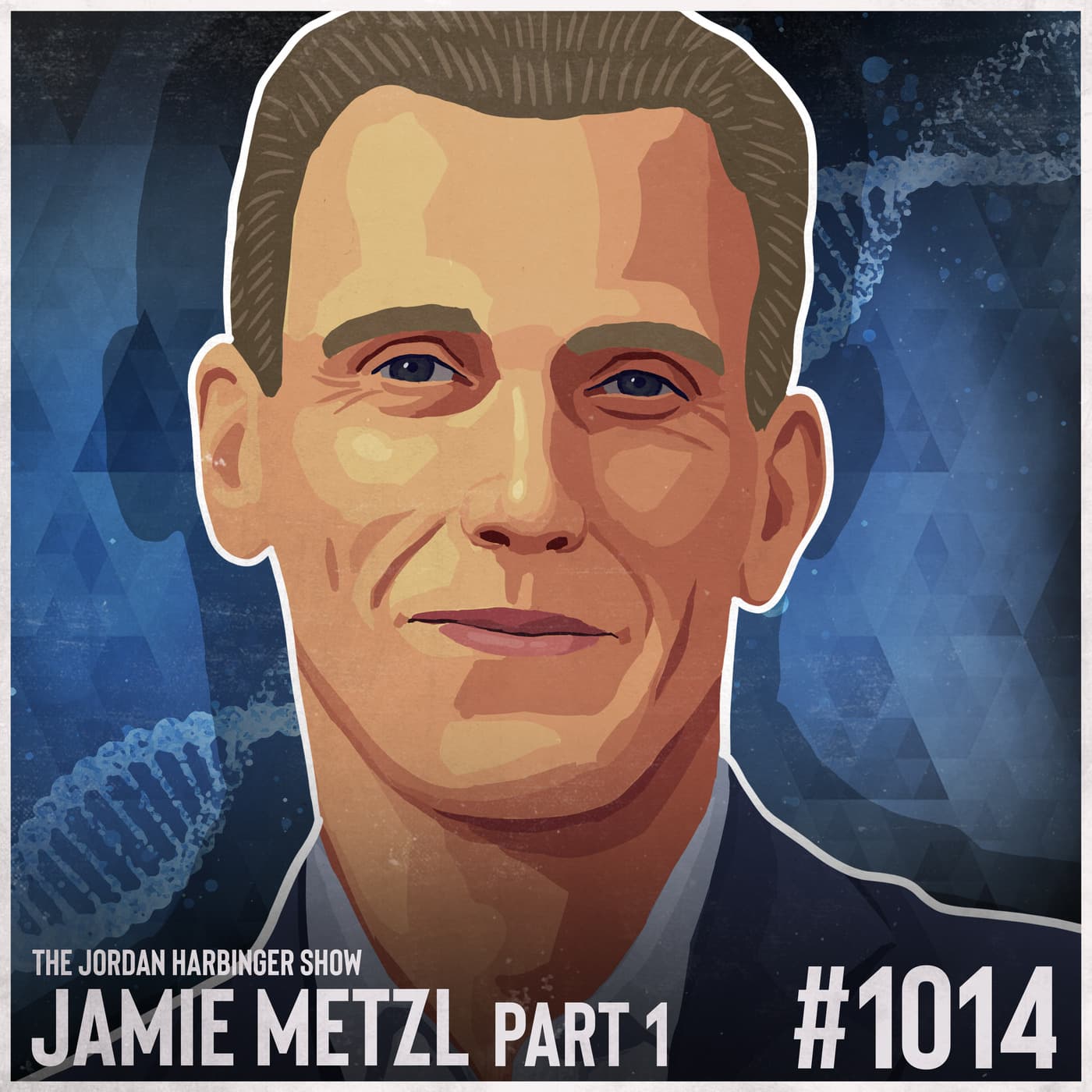
1014: Jamie Metzl | AI Solutions for Hunger, Health, & Habitat Part One
Episode Description
Jamie Metzl discusses the rapid evolution of AI and biotechnology, exploring both risks and rewards in the context of addressing global challenges like hunger and health. This episode is the first part of a two-part series.
---
Key Discussion Points
Technological Progress and Its Acceleration
- Exponential Growth: Metzl argues that scientific advancements in the next 14 years will surpass those of the last century, with another century's worth of progress expected in the following seven years.
- Integration of AI: AI will not remain a standalone technology but will weave into various aspects of our lives, enhancing scientific discoveries and problem-solving capabilities.
Genetic Engineering and Ethical Considerations
- Embryo Selection and Modification: Advances in genetic engineering may allow for the selection and modification of embryos for desirable traits, introducing significant ethical questions.
- Impact on Human Evolution: The potential for directed evolution through genetic enhancements raises concerns regarding societal impacts and the definition of what it means to be human.
Challenges in Comprehending Rapid Change
- Cognitive Limitations: The pace of technological change often outstrips our evolved capacity to grasp its implications, presenting governance and adaptation challenges.
- Value-Driven Approach: Humanity must establish a clear set of values and goals to guide the responsible use of technology and navigate this new landscape.
---
Insights from Jamie Metzl
- Basic vs. Applied Science: While the basic science of extending human life appears promising, applied science often faces overhype without sufficient evidence of effectiveness.
- Healthy Lifestyle Emphasis: Metzl advocates for traditional health practices such as exercise and healthy eating rather than unproven supplements or interventions.
Personal Experiences and Anecdotes
- Medical Interventions: Metzl shares insights from personal experiences with various health treatments, emphasizing the importance of evidence-based practices.
- Perception of Technology: The conversation touches on how perceptions of technology shift over time, comparing past innovations to current advancements.
Future Implications
- Healthcare Evolution: The future of healthcare may shift towards personalized and predictive models, using genetic and biological data to inform medical decisions.
- Collective Problem-Solving: As AI enhances data analysis, it opens new avenues for solving complex challenges, resetting the baseline for human ingenuity.
---
Conclusion In part one of the discussion with Jamie Metzl, the focus is on the intertwining of AI and biotechnology, the implications of rapid technological change, and the importance of ethical frameworks to guide future advancements. The conversation sets the stage for deeper exploration in part two.
---
Additional Resources
- Full show notes: [The Jordan Harbinger Show Episode 1014](https://jordanharbinger.com/1014)
- Sign up for Six-Minute Networking: [sixminutenetworking.com](https://jordanharbinger.com/course)
- Subscribe to the newsletter: [Wee Bit Wiser](https://jordanharbinger.com/news/)
---
Sponsors
- 1-800-CONTACTS: Offers convenient online ordering and customer service.
- Pacific Life: Provides life insurance and retirement solutions.
---
Upcoming Episode
- The conversation continues in Part Two, delving deeper into the implications of AI and biotechnology.
Written by AI. May contain mistakes. Listen to the episode to check what was said.
Transcript
Automatic transcript. May contain errors.0:28This episode is sponsored in part by 1-800-CONTACTS. customer service and perks like free returns, free exchanges, even free torn lens replacement. Jen loves their Express exam, which lets you renew your prescription online in under 10 minutes. It's a vision exam, not a full eye exam, but it gives you a doctor-issued prescription if you're seeing clearly with your current lenses, no waiting rooms, no dilation drops, remember those things? And with their best price guarantee, if you find your contacts cheaper somewhere else, they'll beat it. Getting contacts doesn't have to be a hassle. Let 1-800-CONTACTS get you the lenses you need right now.
0:56Order online at 1-800-CONTACTS.com or download the free 1-800-CONTACTS app today. What can 160 years of experience teach you about the future? When it comes to protecting what matters, Pacific Life provides life insurance, retirement income, and employee benefits for people and businesses building a more confident tomorrow. Strategies rooted in strength and backed by experience. Ask a financial professional how Pacific Life can help you today. Pacific Life Insurance Company, Omaha, Nebraska, and in New York. Pacific Life and Annuity, Phoenix, Arizona. Coming up next on the Jordan Harbinger Show.
1:34And every problem, like I was saying before, resets the baseline so that somebody who might have spent their whole life trying to solve this problem, they show up to work the next day. Oh, this problem is already solved. What's the next problem that I'm going to solve. And so that's where we are. People think this is about technology. We are unleashing one of the greatest powers in the known universe, and that is human imagination.
2:03Welcome to the show. I'm Jordan Harbinger. On the Jordan Harbinger Show, we decode the stories, secrets, and skills of the world's most fascinating people and turn their wisdom into practical advice that you can use to impact your own life and those around you. Our mission is to help you become a better informed, more critical thinker through long form conversations with a variety of amazing folks from spies to CEOs, athletes, authors, thinkers, performers, even the occasional cold case homicide investigator, real life pirate, hacker, Emmy nominated comedian or extreme athlete. And if you're new to the show or you want to tell your friends about the show, I suggest our episode starter packs.
2:37These are collections of our favorite episodes on persuasion and negotiation, psychology, geopolitics, disinformation, cyber warfare, crime and cults and more. That'll help new listeners get a taste of everything we do here on the show. Just visit jordanharbinger.com slash start or search for us in your Spotify app to get started. Today on the show, my friend Jamie Metzl, back for I think the third round here, this time to talk about how AI will revolutionize human progress and even our own lifespans. We'll explore why we can't wrap our puny human minds around how fast progress is accelerating and what this perception glitch means about the next couple of decades.
3:10We'll also discuss Chinese engineered super babies, how AI will help us solve problems not just faster, but in new ways humans have never thought of before, and how AI will revolutionize not only medicine, but agriculture, and remove some of the basic limitations of civilization as we know it. A lot of bold claims discussed here today. Here we go with Jamie Metzl.
3:33Well, glad to have you back on, man. It's kind of cool that you're not a floating head on Skype or whatever. You know, sometimes I wonder that myself, but I'm really thrilled to be here with but this is the first time we've met in person. So that's great too. You're much better looking in person. You know, you're right. I am. Thank you. There's a lot to be excited about in our lifetimes coming up anyway. Well, I mean, right now, yes, but also coming up as well. For sure coming up. But right now, I mean, what a miracle just to be alive. The odds of being on this one planet, we don't know if there are others that support life.
4:06I mean, I'd rather be a human than kind of any other life form. We're already humans. we're fed and we're clothed and we have these amazing technology, I think it's pretty great. It is great. It is great. Our lifetimes might be extended for quite a long time as well. I don't know. Yeah, I hope so. I lecture a lot about this. And I was actually the keynote speaker a few weeks ago at the Milan Longevity Forum. And what I always say is the basic science... I assume that's in Milan, Michigan. Exactly. Yeah. And they have great Italian food there. Yeah. Olive Garden. The basic, exactly, the basic science about extending lifespan is actually really exciting.
4:44So we've extended the life of roundworms, of mice, but humans aren't just big roundworms. We're not just big mice. So the applied science where people are saying, oh, this thing worked in mice, therefore you humans should do this. That's a bunch of baloney. And so I do think that while the basic science is incredibly exciting, the applied science is just being massively overhyped. So you have all these people taking these NAD plus glusters. I was going to say NAD plus, yeah. Like getting blood transfusions from their kids, people doing all sorts of things. Brian, yeah. Yeah, exactly. My friend, all sorts of things that are just at worst not proven.
5:23And some of them like telomerase are actually harmful. So if you want to live a long life, do Blue Zone stuff, exercise, eat a healthy diet, have loving, supporting relationships, do all of those things. The other stuff, we don't know whether it will help at all. Yeah, the NAD thing, you can imagine. People send me books, people send me supplements too. Like, hey, this is scientifically proven to reduce aging. For mice, if you're a mouse. Yeah, if you're a mouse, but also what we mean by that is your skin will look healthy as you slowly rot inside. Yeah, and it's not just if you're a mouse. It's if you're a genetically engineered, cloned laboratory mouse.
6:02because they live in these absolutely controlled conditions. So we just, it could work. David Sinclair is a friend of mine. He's an anti-aging doctor. He's the kind of the guru of these NAD plus boosters, particularly NMN, a professor at Harvard Medical School. But who knows whether this stuff works. Again, humans, we're not just big mice. And so we have all these gurus who are saying, hey, do this. We have no clue whether it works. Again, it could be harmful. yeah i worry about it being harmful it also makes you feel like crap you ever done that interview do you try intravenous nad or anything no i don't do it all because i again if there's a thing i don't know it will help you don't want to be the first person i agree you should be like number 10 000 when all these other diy people maybe let's just probably have tried it out and there's oh my god i did it and if just an n of one isn't enough because like who knows what's happening, but that's why I'm for proof.
6:58I could not agree more. I went into a doctor near me to try ketamine therapy. I didn't, which is actually something I did not need. I didn't, I was recommended to try it. I think it's for depression, which I do not have, but people are asking me about it. So I was like, I have a policy. I will never put anything. All right. So I will never ask you to put anything in your body if I haven't put it in mine. Like that's my supplement rule for the show. And that's not great because it's not like, oh man, Jordan died taking, well I don't want to name it. I guess you're not going to take that. Right like me taking it and trying it doesn't mean it's good or safe or useful but anyway they put the NAD in there and I just felt absolutely horrible and sick and I was like what is this trash you know and they're like oh it's anti-aging but it's also good for the ketamine thing.
7:37Anyway I interviewed Dennis Rodman on this show years ago and he was on an NAD IV drip during the show and he was basically falling asleep and hunched over and I was like turn that thing down. But who knows what he had been doing the night before there's so many variables we don't even know whether this does anything in people and then that's the problem is we kind of go from hey here's you know one study in laboratory mice to everybody needs to take it and the way they the reason they can do it is that these nutraceuticals aren't regulated here in the united states it's like trillions of dollars of sales nobody has any clue whether almost all of it works and i think that's the challenge we all want to believe that these things are true, that we can just take these magic pills.
8:22And there are some magic pills for sure. But so far, these anti-aging pills aren't proven to be magic. Exercising an hour a day, that's magic. Eating a healthy diet, not eating a lot of processed foods, that's magic. So my feeling is focus on the magic, you know. What's crazy is these people take anything, but really it's like if you slept more and you ate more fiber, you would be 20 % ahead of where you are now and it's like no i want to stay up all night partying with celebrities but then take an iv drip in the morning exactly i'm not gonna eat healthy vegetables but i'm gonna do this thing and i'm gonna have a scoop of ag1 which if they're your sponsor they are okay yeah i love ag1 but for me i'd rather that's what i was gonna say exactly no i mean nothing wrong with it and frankly if i wasn't eating a healthy diet i think it's actually great if you're running around and you don't have time and you...
9:15As I take a sip of my... Exactly. Definitely good for you to add. If you don't have time, like that's a great way to get nutrients. But if you have time, have a beautiful salad from your garden. I had a lot of salads, too. It's like we're kind of, we feel like science isn't there to totally save us. Science is there to help us. And we also have to help ourselves. We have to recognize that we represent 3.8 billion years of evolution. We've learned a couple of things along the way. so let's integrate what we've learned and these new capabilities, but don't, we shouldn't all just feel like, oh, the new thing is better than the old thing.
9:50We're in the context of AI. The new thing is just going to, going to replace the old thing of us. We're kind of an incredible species. We have a lot of tricks up our sleeves. It's scary when you think I interviewed, do you know, Dr. David Fagenbaum? You know who that is? Oh, he's my friend. I love him. Such a good guy. I mean, just to take your own adversity and to turn your adversity, not just into something that saves you, but that saves an increasing number of other people. Incredible. I love that guy. I had a great episode with him on the show, but it was scary because, and he said the same thing.
10:26He said when he was sick, he thought, surely there's thousands of people working on every conceivable disease that you can get. And the answer is, if you have diabetes, there's a lot of people working on it. And if you have, what would he have? Castleman's syndrome or whatever it's called? No one is working. Literally no one. That's the thing is there are these rare diseases because there's so much diversity within humans. And so if you have something that everybody has, then there's a lot of energy. There's billions of dollars in profit. And even things where we're having a hard time treating like Alzheimer's, we know that lots of people are getting dementia and Alzheimer's, the numbers are going up.
10:59So there's a lot of money. But if you had something like what David had or all these other rare disease that he's trying to work on, And there's not a lot of money going. And that's why, I know we're going to get to talking about my book, but the - Eventually, yeah. It's okay. I'm just enjoying chatting. The basic thing is we have these new capabilities to see patterns that would not be possible to see with our unaided human brains. And we're able to see connections between things. And because of that, we're able to group unlike things, seemingly unlike things together. And that's what David is doing is to say, all right, so we have these rare diseases that are individually rare, but collectively they're not rare.
11:35So how can we think a little bit differently about how we do healthcare so we can solve this bigger category of rare diseases rather than saying that everything needs to go into this one problem of Castleman's disease? What scared me, though, is that there's a lot of stuff where no one's really working on it. And rare doesn't mean, oh, one in 300 million people got this. It means that there's like 20 ,000 people or more at any given time, probably way more, with whatever disease that you have or that you're getting or that your dad or mom has. It's like ALS is like this horrible way to go where your body slowly shuts down, but your brain is working.
12:09And then eventually you can only blink and then you stop breathing or your heart stops. That's truly awful. And it's not like the one, there's not five people that have this. Like there's thousands and thousands, but it's still not enough to make it happen. So these breakthroughs are kind of, you know, you don't think about them when you're 30 or just like, whatever. Oh, that's cool. But then when you're 44, like me, or probably when you're 54 or 64, you're like, oh, my dad died of that. Oh, wait a minute. He died when he was three years older than I am right now. Oh, wait a minute. What if I get that?
12:39And then you start losing sleep. It's a really important point that you just made about kind of awareness at different ages. And I write about this in the book in the context of my chapter on healthcare. Because of these intersecting AI genetics and biotechnology revolutions, because we're able to start seeing things, seeing patterns differently, we're changing our healthcare systems. And I'll circle back to why this is important for the age thing. So we're moving from our world of generalized healthcare based on population averages. We treat you because you're a human. to our world of personalized or precision healthcare, saying we need to know who you are on an individual basis.
13:12And that's when we need all of your regular medical information, but also your whole sequence genome and all of this other systems biology information that we use. And that's with gene therapies and these other than personal called pharmacogenomics, meaning we tailor drugs for your biology. It's not drugs for people, it's drugs for you. But as we build these huge data sets, and the basic formula is more and higher quality data, more computing power and better algorithms, that's what lets us see these patterns. We're going to move into the next phase of our healthcare, which is predictive and preventive.
13:44And in predictive and preventive, it's not, hey, wait till you're 65 and then a symptom shows up. Right. It's, hey, this symptom, maybe if it's a genetic disorder, maybe that if you're 44, maybe that genetic disorder started, the germ of that was 44 years and nine months ago. Right. And if you knew, if your parents knew from that moment, soon after your mother's egg was fertilized. Sure. Or after birth. Hey, this is a concern. There are things that for a lot of diseases that you could do earlier in life. It's type 2 diabetes, focus on diet and exercise. Yeah, that's true. If it's a genetic form of breast cancer, early screening rather than waiting until you're 40.
14:25So we're going to move back. And so then the goal of healthcare in many ways of life, and it's what your whole podcast is about, is that we have a range of possibility. How do we function toward the upper level of that range? And then are there places where we can go above our innate capability? And anyone who's vaccinated, you're already doing that. If you're wearing glasses, you're already doing that. But maybe there are going to be other areas, not just in healthcare and everywhere. And I think that's really exciting. It is exciting. You're right. I suppose if you knew like, hey, you're going to end up with colon cancer, almost for sure.
14:56We figured out how to look for that in the genome. And there you are. You would eat a ton of fiber or whatever. You did a ton of fiber your whole life. A ton of AG1. Yeah, yeah, that's right. I don't know if there's fiber in there. But you would eat, you'd be having a salad every day or you'd be taking that Metamucil from the time you were three years old and be in your baby bottle for God's sake, right? And then you might be able to dodge that bullet. But that's such an essential point because I just think that, and it's such a clear thing is if you knew you were going to get colon cancer or you knew you, not that you were going to get it, you knew you were at high risk.
15:25Super high risk, yeah. How big of a deal would it be for you to be a vegetarian who eats a bunch of salads? Yeah. And it's like no big deal at all. It wouldn't be a question. It'd be like your religion. Yeah. You would just do it and nobody would be able to shake you out of it. Yeah. Versus not doing that, living a different way. And when you're X years old, to have, oh, you have colon cancer and now you have six months to live yeah yeah so i just think that it's we just need to one start thinking a little bit differently and two we need to think well what's the you know i was i was giving a big talk we did a science salon at the mit museum last night and everywhere i go people ask like what's the role of humans in a world of these powerful technologies and i think there's a wonderful future for humans but humans have co-evolved with our technologies for thousands of years and more likely small numbers of tens of thousands of years.
16:18So it's not us versus our technology. Our technology is us. It's a manifestation of us. And the question is, what's the best way for us to co-evolve in a healthy, sustainable way with our technologies? And these kinds of examples where you could imagine having sensors in our bathrooms, even inside of our bodies that are just saying, hey, here's a concern. So I've written about this. It's like, what I would love is to have sensors all over my bathroom and they're watching me, they're in the toilet, they're doing breath and I'm not even noticing it. And then I have a smoothie every morning and my bathroom AI communicates with the refrigerator AI.
16:57Every morning, I'm just getting my smoothie. It tastes exactly the same, but there's just like a balance of different vitamins and minerals and nutrients. And I just, I think we need to make it seamless. It's not like, oh, I'm going to go do technology now. There's a healthy ecosystem where the technology supports us. Yeah, that would be kind of like a smart blender that says, oh, we can analyze what you did this morning and you need more fiber. Yeah, no, for sure. And we have that. We already have that with basically digital pills where you have kind of all these inputs and then it says, all right, we'll take a little bit of this, a little bit of that, and then it's a pill.
17:30Like, why even think about it? I think it's exactly that thing. You need a little fiber. Here's where it feels like you're getting a cold. We're going to put a little more zinc and vitamin C in your smoothie. And in my dream scenario, you don't even taste it. It's just happening. It's just life. What are those things called? Those glucose monitors that jab you, but they're a sticker? Yeah. Continuous glucose monitor. Yeah, yeah. So yeah. Have you done it? I have. And it was, I thought, oh, where's the part that does the, where's the computer? It's so small. It's inside a pin. It's incredible, yeah.
17:56And I was like, there's literal NFC technology in here where I tap my phone on a piece of tape that's on my elbow, basically, tricep. And it tells the phone what my blood sugars looked like for the last nine hours. Like, this is nuts. So in 10 or whatever years, you're going to be able to have that. It's going to be like, here's the entire vitamin chemical content of your blood. You do need more zinc or you are really low on vitamin D. So we drop some into your smoothie or just take a supplement because you're, or go get in the sun, whatever it is. It's right around the corner. Because when I saw that, I thought, this is the whole, this is the thing.
18:30It's like this little disc. I know. I couldn't believe it. I couldn't believe it. And that's eventually going to be just. I think it's right. And I think that's a perfect example. So many people, they think about the future of technology, and it's like, oh my God, it's the Terminator. They're coming to get us. Some of this can be just really simple stuff that leads to really actionable outputs that are helpful. And so I think that's what this whole thing is about. People feel like this technology question is a yes or no question. Yes, we're going to do it, and we're all in, and it's the end of humanity.
19:02or no, we don't do it. And then we have to go back to the ice ages to protect us against Arnold Schwarzenegger. And the truth of the matter, at least as I see it, is that there's just going to be so many different manifestations and some of them are going to be incredibly awesome like this. Some of them are going to be terrible. Some things we're going to try something and we're so, geez, that was a mistake and we're going to have to shut it down. And most of them, we're just going to be kind of trying to negotiate what's the best use. Like, you know, we all love our cars, but it took a while to have like crappy pintos that were lighting on fire.
19:34We had to figure out how to do cars. And now we're the beneficiaries. And now we're saying, all right, what's the next step for cars? And maybe it's, it is these driverless cars that get in far fewer accidents than we humans do. Maybe it's something else. That's the path of humanity. Speaking of Chinese products, how about a word from our sponsors? We'll be right back. If you're wondering how I managed to book all these incredible people for the show, it is because of my network, the circle of people I know, like, and trust I'm teaching you how to build your network for free. The same thing that I do.
20:02I know you're not booking for a podcast, but this is great for relationship building skills, work, personal, inspiring other people to want to develop a relationship with you. And the course does it in a non-cringy, down-to-earth way. It's not awkward. It's not cheesy. It's not going to make you look bad or feel bad. Just practical stuff that'll make you a better connector, a better colleague, a better friend, and a better peer in a few minutes a day. And many of the guests on the show subscribe and contribute to the course. So come on and join us. You'll be in smart company where you belong. You can find the course at sixminutenetworking.com.
20:32Oh, and it is free. Once again, no credit card, none of that nonsense, just more free stuff from us, sixminutenetworking.com. Now, back to Jamie Metzl. One of the most fascinating things is how fast progress is accelerating. You write in the book, when I look at progress, right, I think, wow, look at what happened over the last 50 years. That is amazing. Look how far we've come. It's absolutely incredible. And then someone will say like, well, the iPhone didn't exist at this point. And you're like, oh my gosh, that's true, right? The smartphone didn't exist. You didn't have internet in your pocket, whatever.
21:00There's still a long way to go, but the rate of progress is increasing a ton, and that's something that it's hard to perceive as a human. We're not used to that. So you wrote that we will progress more over the next 14 years than we have in the past 100 years, which that is really hard to wrap your brain around. And then the next seven years will be another century of progress at today's rate of progress. And I'll just repeat that. Over the next 14 years, we're going to progress more than we have in the last century. And the seven years after that will be another 100 years-ish of progress, which that's insane.
21:38That's insane. That's like steam engine to iPhone, but it's going to happen in 14 years. How? How? As you know, Jordan, I write nonfiction, but I also write science. Hopefully. Yeah. But I also write fiction. I also write science fiction because I just feel like to think about this point that you've raised, we have to overcome the innate evolved conservatism of our brains. Tens, hundreds of thousands of years ago, hundreds of thousands, there were two early humans in the savannas of Africa and they were standing together. One of them was your ancestor and one was somebody else. And that other guy was looking up in the sky and saying, oh, there's a bird.
22:22Someday maybe humans can fly like birds. And wouldn't that be great? And your ancestor was the guy who said, hey, is that a rustle in the grass? That could be a saber-toothed tiger. I remember last time there was a rustle in the grass. There was a saber. I'm out of here. And so your ancestor ran because they were selected for that practical thing. And the other guy, this dreaming guy, that's the guy who got eaten by the saber tooth. And it happens over and over again. So our practical thinking, it's our core survival skill. It's why we've lasted. But now every technology begets every other technology.
22:55So we have four times more humans now than we did a hundred years ago. We have 85 % literacy, global literacy rate now. It was 15 % a hundred years ago. So more educated people. We're connected to each other, so nobody's solving problems that have already been solved. We have these, what I call, it's the title of the book, super converging technologies, where every technology is embedded in every other. So we had the agricultural revolution 10 ,000 years ago. That made our civilizations possible with their writing systems. When you look at computer code, what are the letters? We call them Latin letters.
23:27They're actually ancient Phoenician letters. That's what makes up the computer codes. With these computer languages, We can have the computing revolution, which enables the machine learning revolution, which enables the AI revolution. And with the tools of AI, we're interrogating evolved natural systems, like how a plant distributes nutrients through a leaf, and using those patterns to design better computer chips that speed up the machine learning AI, let us understand evolved natural systems more. So there's just an acceleration because we're learning more with more people, unleashing human imagination, and we have these incredible tools and capabilities and technologies that are getting better and better.
Read the full transcript
24:12And that doesn't mean everything is going to advance at this rate, but anything that can be digitized, anything that's connected to these kinds of scientific and technological capabilities is going to accelerate. And that's why, again, it's the central point of the book. If we think this is a conversation about technology, we're going to get lost. This is a conversation about humanity, and it's a conversation about values. It's about who are we as we guide these revolutions? What are the values that we seek to infuse into every decision about how these technologies are or aren't used so that we can try to, again, co-evolve with our technology to build the kind of future that we own?
24:56That doesn't mean there aren't going to be twists and turns and problems. There certainly will. But we need to know what we're trying to achieve as individuals and as a community. And that needs to guide us going forward. And this is probably going to be the clip for YouTube or whatever, or TikTok or whatever the kids use. The whole 21st century, we'll see progress equivalent to 20 ,000 years. That's a pretty bold claim, man. You know, it's just the rate of acceleration is just unbelievable. And acceleration begets acceleration. When people think about AI, most people I speak, oh, AI, I just did AI.
25:33I went to chat GBT and I did AI. That's how most people think. Yeah. And then what I say is, tell me, how did electricity influence your life today? And people take a step and think, well, I guess I woke up with an alarm clock, but I was in my house and we had air conditioning and there was a car and I guess there was food and my clothes. And then you think, geez, electricity is in everything. It's in my haircut insofar as I have hair. It's everywhere. And that's the thing. AI isn't, oh, I'm going to go do AI. AI is going to be just part of everything. It's going to be an accelerant for everything.
26:09It's going to be woven into everything. We have these new things, self-driving laboratories. So we have the pace of scientific changes. It has been regulated just by what scientists can do. But now we have new programs like Google DeepMind's AlphaFold3, which just came out, that by my calculations that I described in the book, it saved 645 potential, 645 million years of human researcher time. So it would take just a decade ago, three years for a human scientist to characterize a single protein, which means to understand a protein, you need to understand the string of amino acids, and you need to understand the shape.
26:51So to characterize one, to match those two things using the older approach called X-ray crystallography or even electron microscopy would take about three years. So there's 200, roughly 215 million proteins known to science. So if you say that 215 million times three years, 645 million years to characterize every protein. Now we have this program that they can do it in a couple of days. And so that's 645 million years that scientists and researchers can - It'll be done by Tuesday. By lunch. By lunch. I've got a lunch. Right. No, but they can redeploy, rather than spending your entire career saying, how do we characterize a protein?
27:33It's, what do we do with a characterized protein? And it's not just that. Well, what are all of the other problems in the world that are at this or a lower level of complexity where there's certain ingredients you need to have a solvable problem, you need to have a data set for the AI systems to train on and some other things. But there are a lot of problems at that or lower levels of complexity. And so let's say now we're putting 200 million years of innovation time back into the pot. What are the things that we're going to do? And every problem, like I was saying before, resets the baseline so that somebody who might have spent their whole life trying to solve this problem, they show up to work the next day.
28:17Oh, this problem is already solved. What's the next problem that I'm going to solve? And so that's where we are. People think this is about technology. We are unleashing one of the greatest powers in the known universe, and that is human imagination. Yeah, it's wild, man. Somebody in 1900, right? They'd be amazed by the television. They would just go, wow, look at that flat color picture. And they'd be looking behind it like, I just can't believe it. But AI, even chat GPT, in high-speed internet, imagine showing that to somebody in the Stone Age who's on the ground in the dirt, banging one rock against another one and sees a spark and is suddenly like, whoa.
28:56Exactly. Or is banging this out and you're like, what are you doing? He's making a spearhead out of a stone so he can throw it at a woolly mammoth. And you're trying to show him chat GPT and you're like, no, what you do is you ask this thing and he's looking behind it. He literally can't even, what are these things that are appearing, right? This written language. And you're like, oh crap, I got to back up the truck. You know, so your listeners won't know this, but you and I are in this studio, which is appropriately called WTF Studio. That's right. And the thing is, how many, for this Stone Age guy, how many WTFs would they say as you tried to explain television to this Stone Age person?
29:33Who doesn't have spoken language. And you'd be like, let's say WTF in that is like, urgh. It's like, you'd say, oh, here's this. And it's like, urgh. It's a lot of grunts. And then it's like, and here's another thing. Urgh. and you would have to say like what does that even mean how is that even possible and now we're more accustomed to internalizing oh impossible things and then they just become normal like people for one day or so oh my god chat gpt is really cool and then it's like what an idiot it doesn't recognize that you can't have five eggs in chocolate chip cookie recipes i'm so disappointed yeah like look it made a picture where the person has six fingers this thing sucks exactly it's like wait they just generated out of nowhere something that you told it to exactly a rembrandt style painting because you mentioned that and it's like but the guy has six fingers this thing is useless man i gotta fix that exactly yeah it's really the exponential rate of progress is really something i mean we are basically nomadic hunter-gatherers in comparison to our grandkids it's crazy yeah no until i write about this in the in the book that's why the first chapter of the book, it's called The Nature of Change, because you can't understand anything about the second order questions, about what are the things that are going to change?
30:45What are the dangers? How do we build the best possible world? If you haven't internalized the process of change, I write about in the 1970s, I grew up in Kansas City, and in our basement, we had this old black and white television, and somebody in our family hooked it up. We had this game Pong, which was And it was like, you had two dials and there was like a little bar and there was a little dot. It was like a tennis, I guess. And it just went ping. It's a square ball. Yeah. And then it was the coolest thing ever. It's like, we would like literally stay up all night playing Pong. And it was like, it's never going to get any better than this.
31:22Right. Pong. And so now obviously there's Grand Theft Auto, there's ChatGPT, there are all these kinds of things. But ChatGPT, GPT-4, GPT-4-0, every technology that we have now is Pong. 10 years ago. Remember when we thought GBT4 was so cool? It was so basic. And it's always going to be, this is going to get better and better, faster and faster. I think that's the thing. Everybody always thinks, oh my God, like people thought a hundred years ago, this is the height of progress. And that doesn't mean things can't go wrong and things don't twist and turn. And we had two world wars, but we are beginning this process of acceleration and that really changes everything you mentioned we'll be able to solve ai will not only solve problems that are complex but we're going to solve new ways to solve new problems faster and then the results will be distributed immediately across the globe you gave in the book you talk about is it mendel and or mendel and darwin yeah they would have figured out not only that evolution exists but also how natural selection works right neither of them had both of those things solved yeah they were they pieces.
32:30And so that's what is kind of incredible. So Mendel and Darwin, Darwin actually had a book in his library that included Mendel's famous paper, which Darwin never read. And Mendel's paper, it took more than 30, you know, but Mendel was unrecognized during his lifetime. It was about 30 years after his death. He should watch us do Punnett squares in biology classes. Exactly. He'd be like, wow, you guys. He was rediscovering. It's the point I was making earlier, when we were all kind of not connected, when people were discovering, like, the difference between when the Bronze Age started in different civilizations.
33:04It was thousands of years apart. So if you're in a place that didn't have the recipe for bronze, it's 2 ,000 years. You're just doing stuff in another way. You're making tools in another way, making weapons in another way, doing all those kinds of things. And you're not contributing your knowledge to the universe of, hey, what's the cool stuff that we can do with bronze? Now everything is, you have an innovation, it's shared the next day. And so you don't have this problem. So we have just collective problem solving. So these drivers of evolution. So Darwin, which it was really kind of incredible how he figured out that random mutation and natural selection are driving evolution forward, but he didn't really understand what could be the mechanism generating that random mutation.
33:51And that's what Mendel was studying with his pea plants. and that was saying, well, there's genetic inheritance and it gets kind of shuffled up and the part comes from the father and part comes from the mother. And so I think that's, I think, again, it's the same story of humans learning. We're understanding these natural systems. It's not, there's a term synthetic biology, which I don't really like. There's two terms that I really don't like. One is synthetic biology and the other is artificial general intelligence. And the thing that I don't like about synthetic biology, the word, even though I was just at the SynBio conference in San Jose.
34:25Did you tell them about how you hated the name? I'll tell you a third thing that I'll say in a sec. But what's happening is not humans generating biology from scratch. I think a better term, which I didn't coin, is nature co-design. There's a natural world. And certainly for at least 10 ,000 years since the dawn of agriculture, but even longer, humans have been tweaking the natural world in order to drive the kinds of outcomes that we want. So getting plants that We don't have where we don't have to hunt to go and gather them from the wild or doing all. So you're planting the strawberries that you liked near you.
35:01Yeah, near you. So you don't have to go. Yeah. And most of these things, our ancestors wouldn't have even known what they were. Because if you just go into Whole Foods, pretty much the entire sustainable organic section is all shit that we humans have essentially invented. If you said, like, show me this. Show me broccoli. Yeah. 20 ,000 years ago. Like, you could look around the world. You would never find broccoli. You'd never find corn. You'd never find any of these things. Somebody gave me a natural strawberry, and I was like, oh, why are they so small? Yeah, yeah. I was like, this is what a strawberry looks like.
35:32I'm like, no, a strawberry fits in my, it's like a baseball. Exactly. And I take a bite out of it. That's why I think when French people come here, it's like, what the hell is that? It doesn't taste good, but it looks good. What did you inject this thing with? No, they grow like that. Exactly. So the basic point is science is a team sport. It requires a lot of people coming together. And because of that, as our ability to come together increases, as our technologies become better, we're just able to do better things. So I don't like the term synthetic biology. I don't like the terms artificial and general intelligence because we're not, when I ask people what it is, well, it's like AIs that can do everything that humans can do.
36:08If we create AIs that can do everything that humans do, we are screwed. Humans, like we have an evolved embodied intelligence. It's 3.8 billion years. You and I are here, like we've done, this is our third podcast interview that we've done. Oh, I'm glad you know that. Cause I was like, he's been on once before. Third, no third. Wow, that's great. Yeah, this is our first one in person. So it's the first time that we've met in person, although we've been in touch for years. There's something different about being in person. And it's not just intelligence. Like our bodies are covered in all of these sensors.
36:42We have all these perceptions, some of which get to the point of, oh, I'm analyzing why this is happening. And some of them are just like, Ed Yong had a great book called An Immense World, where he talks about every animal is covered with all these sensors. And these sensors are survival mechanisms where you're just figuring out, what foods am I comfortable eating? What person am I comfortable trusting? Is this a safe environment? All these things, questions that we know to ask, questions that we don't know how to ask. So if we made an AI that was just an AI human, I'd actually be terrified. Well, it's brain only with all the sensors ripped out, right?
37:16Exactly. Yeah. without the everything. And so what we're doing is not creating an AGI, which again, I don't know what that is. We are creating a machine intelligence. No one looks at a dog and say, oh, my dog is a really dumb human, or that dolphin is a dumb human. A dog has just dog intelligence. There's better and worse dog intelligence. There's better and worse dolphin intelligence. I'm sure, although it's hard for us to decipher what that is, we're creating that new thing. And that's the conversation that we should have. We're making... And then the third thing it's apropos of nothing, but I just, I said it last night and then these people got really pissed off.
37:51Don't invite him back again. Exactly, exactly. Well, no, I was talking about how we're entering this new age of technological, rapid technological innovation. It's going to create all these opportunities and all these challenges. And we have to really think about how do we govern these, how do we use these powers wisely? Because if we use them wisely, we unlock this amazing future. We can cure all of these cancers and feed everybody and clothe everybody and change our models for living. We can do it much more sustainably, even rewild big parts of the planet. If we get it wrong, we're massively screwed in all sorts of ways.
38:27And I write about that in the book. And so I said, and so if all we're doing is saying, hey, this is about consciousness raising, we're going to be screwed. And then I said the thing that pissed people off. I said, and that's why I think that Greta Thunberg has been a net negative contributor to the world. Oh, you threw shade on Greta Thunberg? I threw shade. People got really pissed off. That doesn't work. And the reason was in the beginning when she was saying, hey, we need to be aware of climate change. That was actually really important. She got all these kids around the world and we need these kids.
38:56And I certainly work with lots of kids on idealistic ventures, like my global interdependence movement, which you can maybe talk about later. But then everybody becomes an effing Kardashian. So Donald Trump realized, hey, it's an attention economy. If you get attention, you can translate attention into power and money. So he realized, I'm just going to be the most outrageous on every issue. And Greta Thunberg is like Greta Thunberg Kardashian. It's like first she was climate and outrage climate, then don't go to school. And now it's like, well, it's about Hamas. So she still have climate in education.
39:34But the thing is, when it's an attention economy, you have to be the Kardashian. You have to be at the far end of extremism. You have to be so outrageous that you are capturing that attention. Because if you don't, someone else is going to be more outrageous than you. And so rather than people saying, hey, what's the North Star? What am I trying to actually achieve? People, and it's on all sides, it's Trump, it's AOC, it's Greta Thunberg, are saying, how can I be the most outrageous person? Because then I'm going to get that attention and money. And instead, and again, the reason I've written the book is what we should be saying is, what's our North Star?
40:13So if you're an ancient sailor, you say, I'm trying to get from here to there. There's where I'm going. There are going to be winds blowing in all different directions. I'm going to have to attack this way. I don't have to attack this. I'm going to have to learn. I'm going to have to adapt. But I know that's where I'm going. If we don't have that conversation about values and goals. And this is just a, hey, there's a bunch of technology. Let's look at the technology. If it's not about where are we going and how do we get there, we're going to get lost in a really dangerous way. Speaking of growing new appendages, it's time for a word from our sponsors.
40:44We'll be right back. If you like this episode of the show, I invite you to do what other smart and considerate listeners do, which is take a moment and support our amazing sponsors. All the deals, discount codes, and ways to support the show are searchable and clickable over at jordanharbinger.com slash deals. If you can't remember the name of a sponsor, you can't find a code, please just email me, jordan at jordanharbinger.com. I am more than happy to surface that code for you. It is that important that you support those who support the show. Now for the rest of part one with Jamie Metzl. Yeah, there are activists that do not go into the extreme zone, and they're still doing a good job.
41:20And look at Malala Yousafzai. She doesn't go, she's not on TikTok screwing around with other causes. And she's saying, here's what I'm trying to achieve. right it's not like oh my god the camera is there i'm going there it's like it's like there and that's why she's amazing it's like there are all these women and girls who are being oppressed i have my personal story and my courage which gives me this platform and i'm going to really focus on what are all of the things that i can do so i'm not saying don't be in front of the camera obviously say that straight to the camera sorry i don't know which one we have there's a lot Three, four.
41:56Take your pay. Sorry, I looked at camera four. What I'm saying is this is about values. It's not about attention. It's about values. And sometimes getting, I'm here with you on this podcast, obviously. So fighting for your values, you have to fight for them in the place where their fate is being determined. But we have to say, well, here's what we're fighting for. We're not fighting for outrage. We're not fighting for attention. We're fighting for desired outcomes. You mentioned in the book about these Chinese engineered babies, or maybe I just took that note based on something you wrote. both this stuff is amazing and it's a little worrisome right so essentially children are being bred is kind of a creepy word but whatever with super high iqs well can you explain this i can tell by your face i've already blown it no no it's a few different things woven together so i'll even go back the first time you and i spoke was around the time i think it was 2019 for the launch of my then book hacking darwin and that book was on the future of human genetic engineering, when a big piece of that was human-assisted reproduction.
42:56So in the late 2018, when that book was on its way to being printed, I called my publisher and I said, we need to pull this book out of production. And I've got bad news and good news. And so the bad news is that in the book, I write, it's about the future of human genetic engineering. And we can't publish a book about human genetic engineering after the first CRISPR babies have been born. And those were genome-edited babies that were born in China. The good news is that in the book, I predicted that this would happen. I predicted it would happen in China and explained why I thought it was going to happen in China.
43:37And I included a list of five specific genes that I thought were going to be the first targets of this genetic manipulation in China. And CCR5, which was that gene, was one of the genes on my list. And so for this, which was the hardback version, all we need to do is I just need to add a couple of sentences saying, and this thing that I've exactly predicted has happened. It's easier to change an unborn child's genes than it is to pull a book out of print and add something, by the way, which I'm sure you found out. Here's where we're potentially going. And that is just a week and a half ago, I was in Lisbon.
44:16I was the keynote speaker for the International Embryologists Association, which actually, in my mind, is an endly fascinating field. Lisbon, Ohio is really nice this time of year. What's that? Yeah, exactly. Lisbon, Ohio is great this time of year. I think we're traveling to all the same places. So we are moving to a world because of all of our new capabilities, including genome sequencing. We're able to understand, process and understand these vast amounts of data. Right now, actually yesterday, the Southern Baptists had a vote. They saw that. Yeah, they're voting against IVF, which is, in my mind, deeply unfortunate because so much beautiful life has been brought into the world in IVF.
44:58And so with IVF, in vitro fertilization, which has now been around for 45 years, the mother's eggs are extracted from her body, fertilized with the biological father's sperm, grown for a certain number of days, and then put back into the mother. And that's why I'm sure there are lots of people who are actually listening to this podcast who are IVF babies. And IVF is a wonderful miracle for life. There's a more recent tool called preimplantation genetic testing. And what that means is, so when you have this fertilized egg, you first, you have to grow it in a laboratory environment. And so everybody knows this from high school biology or even before, is you start from one cell and then you're two cells, then you're four cells, then you're eight cells.
45:44And so after about five days of that kind of replication, you extract a few cells from that little zygote, that little ball of cells, and then you can sequence them. And so because essentially the genetic recipe for us is in every cell, then you can understand something about that future, what it would be a future child. So right now that's used to say, all right, this child is going to have some deadly single gene mutation disorder. There's some kind of diseases and disorders where it's just one letters off, and then you could have a deadly disorder as a result of that. And so if you're doing IVF and you're choosing between 10 embryos, you could say, well, I'm not going to pick one of a kid that's going to die when they're three years old.
46:31I'm going to pick one of a kid who's not going to die when they're three or five or whatever years old. But because there's so much potential information in that cell when you sequence it, well, what can you learn from that extracted and sequenced cell? Well, the question is, what can you learn from human genetics? And the answer is a lot. And so we're moving up the complexity scale of being able to say, all right, in addition to these single gene mutation or simple genetic patterns for things like eye color, how complex of traits can we predict? I'm actually on the advisory board of a company, Genomic Prediction, that's doing that, but there's, it's called polygenic risk scoring, but really it's just going to be polygenic analysis where you say, all right, so we have these 10, we can now order them roughly from likely tallest to likely shortest.
47:20Maybe we can rank order them likely highest genetic component of IQ to lowest genetic component of IQ, which would have big implications for all sorts of things. And then there's a newer technology, and it was not so long ago in Kyoto, which Kyoto, of course, is in Pennsylvania. And I went to the laboratory where there are pioneers in a thing called in vitro gametogenesis. But basically what it means is you take an adult cell, like a skin cell. So you do a skin graft. You have millions of cells just from a little scrape of your skin. You use a thing, you induce those adult cells into stem cells.
48:04So it's called induced pluripotent stem cells. You're taking a cell backward. You can reverse it. Backward in evolutionary time. So now you have a stem cell. Then you take it forward in time by inducing those skin cells into stem cells, or stem cells are cells that can become anything, and then to egg precursor cells, and then to egg cells. So now you have a million egg cells. Like I talked about those 10. This is real? This exists right now? It exists not yet for human applications. I see. This is in mice. This is incredible. It's incredible. So now you have a million eggs. Instead of like the 12 that got taken out of the surgery.
48:46Exactly. You know, we all have friends. I mean, I'm older than you, but we all have these friends. So I went and I had my egg extract and I had three eggs and I'm so depressed or whatever. Now you've got three million. You've got a million or three. It literally, the sky's the limit. And there's trillions of cells in your body. So now you have a million cells and you have an automated system in this. This is still a hypothetical, but you have an automated system. You grow those million cells for five days. In an automated way, you extract a few cells from each of those million. You sequence each one of those.
49:16And now you're choosing from a million options. So forget genome editing that happened with these CRISPR babies. You're choosing from a million options just within the random mutation that is just part of biology. That's how we evolve. You say, what am I selecting for? What are my priorities? I want to have high, whatever, genetic component of IQ. I want tall. I want short. I want somebody who's more likely to be an Olympic sprinter than somebody else. There's a lot of choice. Our ancestors took chickens, wild chickens laying one egg a month, and knowing nothing about the science of genetics, just with using the power of reproduction and push reproduction, turn those into domesticated chickens laying one egg a day.
50:05How far can we go? Who knows? But certainly if we decide that selecting for the genetic component of IQ, and there's a whole debate on what is IQ and whether it's valuable or biased or anything like that, but we'll leave that aside for now, we can really, really push evolution. And then on top of that, we already have this capability, which has already been applied unethically, in my view, to humans, of then going into the genome. Let's say you pick that one in a million embryos, pre-implanted embryos that you hope to implant. Then you can go in and do genome editing on that to say, all right, here are some number of changes.
50:46And again, everything is moving up the complexity scale. So five years ago, we'd say, well, you could go in and make one change, like change one letter to another letter. But now there are growing capacities to make multiple changes at the same time. Obviously, these are very complex, evolved biological systems. It's 3.8 billion years of trade-offs. We don't even close to fully understand how these systems work. But these are capabilities that we already have. And as we were saying before, these capabilities are getting better and better every single day. So our biology is about as complex as it's been for millions of years.
51:24This is wild. But our capabilities are increasing at this exponential rate. So eventually, do you think most people will be born like this? Because it'll be like, look, you can take your chances, and maybe like super conservative religious people will be like, look, I'm going to let God choose. Fine. But for the rest of us, it might be like, nope, 6 '4", no diseases, no degeneration over time, super long lifespan. And just, I mean, pick, I like light green, blue-ish eyes. Yeah, yeah, yeah. You know, like you could pick everything. No leg hair on the female. Like you could just pick anything you want.
51:59Yeah, yeah. So my partner, my girlfriend is younger than I am. And so that is the only exposure that I have to TikTok, that TikTok exists. And so she had this thing where she was showing me that it was like this meme. I'm looking for a man in finance, 6 '5 with blue eyes. And apparently it's like young people around the world are like doing versions of this. So in my last book, Hacking Darwin, I have a chapter called The End of Sex, which is exactly about this, that nature has an error rate. When somebody, and I hope this happens to nobody, but when somebody says, oh, I'm having this child and this child has a deadly genetic disorder, you don't say, wow, that's Darwinism at work.
52:41that disorder, that's just part of being a human being. Right, natural selection didn't work out for you. Sorry about that. It's like, but that's just the thing, because we're always mutating. Some help, some hurt, and some do nothing. And so it's a distribution. And so you showed up here on the distribution. No, we say, F that. We're going to do everything we can to fight it. We're going to do everything we can to save your child, which is the right answer. So nature has a built-in error rate. And so if and when we get to the point where having a child, through the application of science, IVF, pre-implantation, genetic testing, and if appropriate, genome editing of pre-implanted embryos.
53:18If people come to see that as a safer option than reproducing the quote-unquote old fashion way, and the old fashion way isn't even the old fashion way. I mean, like when you say the old fashion way, it's like all of these technological interventions and ultrasound and going to a hospital and the incubator and all those kinds, like that's not the old fashion way, that's the new fashion way. That's true. If it gets to the point, which I think is already happening in some parts of the world where people perceive that doing this through science is better and safer than people are going to do it. And then when we have this optionality of like picking embryos, maybe picking from more embryos, maybe making a small number of edits, people are going to do it and people are going to do it more.
53:59And as people perceive benefits, they're going to want to do that. And that doesn't mean this should be unrestricted. Actually, I think that societies should restrict some of these things because not everybody understands what's good for them. We talked about in the beginning of our conversation, we talked about all these interventions where people are so desperate to slow the aging process. You could read something in Men's Health Magazine and they go, I'm going to do that systemic life-changing intervention because I read something in Men's Health. So I think we're going to get there, but we need to be cautious.
54:31You're about to hear a preview of the Jordan Harbinger Show about junk science. There is this anti-establishment sentiment that leads to blanket science denial, which is enormously problematic and seems to be growing. There is so much false information on the internet, it's very easy to just baselessly claim that legitimate information is false. We're having to reckon with the fact that the internet is doing this to us. It's very much a double-edged sword. It's giving us all the information, and so it's very hard to, like, censor things. But then also we have all of these, you know, lies and charlatans, and this stuff propagates like wildfire, and it's an enormous problem.
55:09It's just such an alluring narrative. It's so easy to peddle. We want it to be true so bad, but it's not real. You need to be equipped with some ability, some set of skills, to be able to discern the validity of information, particularly scientific. Platforms like YouTube have had to make adjustments to their algorithm because they have come to understand how much they have been facilitating this destruction of our sociological fabric by allowing people to travel down these rabbit holes. It's a very attractive narrative, right? It gives you a sense of purpose. It's a big problem. That's why we're in the post-truth era.
55:43Whatever you want to find on the Internet, it's there. All the truth and all the lies. When you wrap your identity around a false cause, you're eliminating yourself from some other possible contribution that you could be making. I'm crusading against this thing. Yeah, we should remain driven and encourage others to do the same. I think it's the biggest problem facing mankind. If you want to increase your scientific literacy and not get suckered into believing weaponized hogwash and passing it off to your friends and family's fact, check out episode 745 with Dave Farina on The Jordan Harbinger Show.
56:19All right, that's it for part one. We're going to be back in a few days with part two. All Things Jamie Metzl will be in the show notes at jordanharbinger.com. Advertisers, deals, discount codes, ways to support the show, all at jordanharbinger.com slash deals. Please consider supporting those who support the show. Also, we've revamped our newsletter, We Bit Wiser. Every week, we give you something specific, something practical, something that'll have an immediate impact on your decisions, your psychology, your relationships in under two minutes. If you haven't signed up yet, I invite you to come check it out.
56:47It's a great companion to the show, jordanharbinger.com slash news is where you can find it. Don't forget about Six Minute Networking as well over at sixminutenetworking.com. I'm at Jordan Harbinger on Twitter and Instagram. You can also connect with me on LinkedIn. This show is created in association with Podcast One. My team is Jen Harbinger, Jace Sanderson, Robert Fogerty, Ian Baird, and Gabriel Mizrahi. Remember, we rise by lifting others. The fee for the show is you share it with friends when you find something useful or interesting. The greatest compliment you can give us is to share the show with those you care about.
57:17If you know somebody who's interested in AI, medical innovation, or just wants to live forever, definitely share this episode with them. In the meantime, I hope you apply what you hear on the show so you can live what you learn. And we'll see you next time.
57:34This episode is sponsored in part by the Something You Should Know podcast. Finding a great new podcast can feel like searching for a needle in a haystack. Let me save you some hassle. Check out Something You Should Know with my friend Mike Carruthers. Every episode is packed with fascinating insights that you can actually use. Mike interviews top experts on topics that shape your life, like how to optimize your brain chemistry, the best and worst ways to apologize, probably could have used that recently, why couples hate to talk about money. No matter the topic, Mike asks the questions you'd want to ask, getting straight to the good stuff, and the conversations are always engaging, always insightful, guaranteed to leave you a little smarter than before.
58:06They've got thousands of five-star reviews, but do you even need that? I'm recommending it. You don't need other people's opinion, right, at this point, I would hope. Anyway, give it a listen. Just search for something you should know wherever you get your podcasts. Look for the bright yellow light bulb and start listening to something you should know.
From the publisher
AI and biotech are rapidly changing our world. Superconvergence author Jamie Metzl explores the risks and rewards of this unprecedented era! [Part 1/2]
What We Discuss with Jamie Metzl:- Technological progress is accelerating exponentially. According to Superconvergence author Jamie Metzl, the scientific advancements made in the next 14 years will outdo those of the last century, followed by another century's worth in only seven years.
- AI (artificial intelligence) is not just a standalone technology, but will be integrated into every aspect of our lives, boosting the rate of scientific discoveries and problem-solving across all fields.
- Advances in genetic engineering and reproductive technologies may lead to the ability to select and modify embryos for desired traits, raising ethical questions and potentially redirecting the future of human evolution.
- The rapid pace of technological change is outstripping our evolved ability to comprehend it, leading to challenges in adapting and governing these new technologies responsibly.
- To navigate this rapidly changing world, humanity should focus on developing a clear set of values and goals to guide its collective use of technology.
- And much more — to be continued in part 2/2 coming later this week!
Full show notes and resources can be found here: jordanharbinger.com/1014
This Episode Is Brought To You By Our Fine Sponsors: jordanharbinger.com/dealsSign up for Six-Minute Networking — our free networking and relationship development mini course — at jordanharbinger.com/course!
Subscribe to our once-a-week Wee Bit Wiser newsletter today and start filling your Wednesdays with wisdom!
Do you even Reddit, bro? Join us at r/JordanHarbinger!
Like this show? Please leave us a review here — even one sentence helps! Consider including your Twitter handle so we can thank you personally!
See Privacy Policy at https://art19.com/privacy and California Privacy Notice at https://art19.com/privacy#do-not-sell-my-info.