
In short
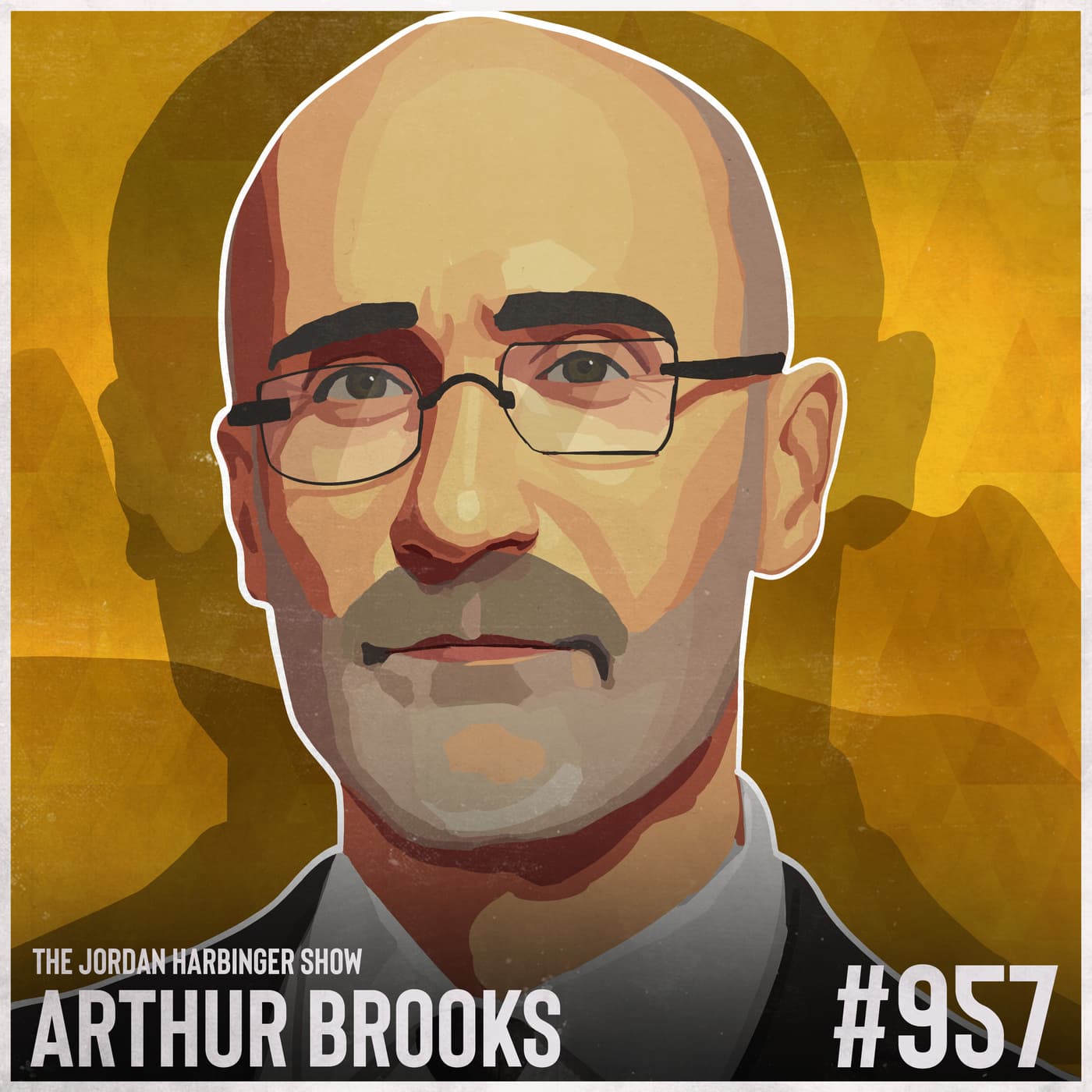
Podcast Summary: The Jordan Harbinger Show - Episode 957: Arthur Brooks | The Art and Science of Getting Happier
Episode Overview
In this episode of *The Jordan Harbinger Show*, host Jordan Harbinger interviews Arthur Brooks, a renowned social scientist and co-author of the book *Build the Life You Want*. The discussion centers around the concept of happiness, exploring its definition, the common misconceptions surrounding it, and practical strategies for cultivating a happier life. Brooks emphasizes that happiness should be viewed as a direction rather than a destination.
Key Topics Discussed
Understanding Happiness
- Happiness as Direction: Brooks suggests that happiness is not a fixed state but rather a journey. It’s about enjoying the ride rather than arriving at a destination.
- Common Misconceptions: Many people equate happiness with material success, power, or fame, but these do not lead to lasting satisfaction.
Dangers of Victim Mentality
- Brooks warns against adopting a victim mentality, which can hinder personal growth and happiness.
- The culture of blame in society can lead to disempowerment and dissatisfaction.
Emotional Intelligence
- Brooks discusses the importance of nurturing emotional intelligence and moving away from achievement-based identity to self-awareness.
- Shifting focus from how others perceive you to how you perceive yourself can enhance well-being.
Fluid vs. Crystallized Intelligence
- Fluid Intelligence: This refers to the ability to reason and solve new problems independently of previously acquired knowledge (peaks in early adulthood).
- Crystallized Intelligence: This involves knowledge gained through experience and education (increases with age).
- Brooks encourages a shift in career focus from tasks requiring fluid intelligence to those requiring crystallized intelligence as one ages.
Practical Tips for Cultivating Happiness
- Active Emotional Replacement: Brooks advocates for consciously replacing negative emotions with positive ones. For example, substituting feelings of resentment with gratitude can shift one's mindset.
- Building Meaningful Relationships: Focus on nurturing friendships that do not have transactional expectations, which enriches life and fosters a sense of belonging.
- Managing Relationships with Others: It’s crucial to put on your own oxygen mask first; taking care of your own emotional health is vital in supporting others, especially those experiencing negativity.
The Impact of Culture and Society
- Cultural Influences on Happiness: Brooks highlights how societal changes, particularly since the 1990s, have affected happiness levels, pointing to factors like family life decay and increased loneliness due to social media.
- The Role of Work: The evolving attitude toward work influences happiness. Brooks discusses how a sense of purpose and service in one’s work contributes to fulfillment.
The Effect of Current Events on Happiness
- Brooks identifies several "storms" that have contributed to a decrease in happiness, including social media influences, political polarization, and the isolating effects of the COVID-19 pandemic.
Conclusion Arthur Brooks provides a comprehensive look at happiness through a scientific and practical lens, arguing that it is attainable through intentional behaviors, a focus on meaningful relationships, and a shift in mindset. The episode encourages listeners to take charge of their happiness rather than waiting for external circumstances to change.
Key Takeaways
- Happiness is a journey, not a destination.
- Avoid victim mentality; take responsibility for your happiness.
- Emotional intelligence can be nurtured to improve well-being.
- Shift from fluid intelligence tasks to those leveraging crystallized intelligence as one ages.
- Replace negative emotions with positive ones actively.
- Focus on building authentic, non-transactional relationships for greater life satisfaction.
- Be aware of cultural influences and seek to cultivate a supportive environment for emotional health.
For further resources and insights from this episode, visit [jordanharbinger.com/957](https://jordanharbinger.com/957).
Written by AI. May contain mistakes. Listen to the episode to check what was said.
Transcript
Automatic transcript. May contain errors.0:28This episode is sponsored in part by 1-800-CONTACTS. customer service and perks like free returns, free exchanges, even free torn lens replacement. Jen loves their Express exam, which lets you renew your prescription online in under 10 minutes. It's a vision exam, not a full eye exam, but it gives you a doctor issued prescription if you're seeing clearly with your current lenses, no waiting rooms, no dilation drops, remember those things? And with their best price guarantee, if you find your contacts cheaper somewhere else, they'll beat it. Getting contacts doesn't have to be a hassle. Let 1-800-CONTACTS get you the lenses you need right now.
0:56Order online at 1-800-CONTACTS.com or download the free 1-800-CONTACTS app today. What can 160 years of experience teach you about the future? When it comes to protecting what matters, Pacific Life provides life insurance, retirement income, and employee benefits for people and businesses building a more confident tomorrow. Strategies rooted in strength and backed by experience. Ask a financial professional how Pacific Life can help you today. Pacific Life Insurance Company, Omaha, Nebraska, and in New York. Pacific Life and Annuity, Phoenix, Arizona. Coming up next on the Jordan Harbinger Show.
1:34Money, power, pleasure, and fame are not the secret of happiness. Your grandmother told you that, but you're always like, yeah, let me figure that out by myself, right? And it turns out that the first thing, if you get a lot of one of those things of money, power, pleasure, or prestige, admiration of other people, the first thing that you want when you get it is more of that because you think you didn't have enough. That's why you're not satisfied. It never occurs to you that you were chasing the wrong thing.
2:01Welcome to the show. I'm Jordan Harbinger. On the Jordan Harbinger Show, we decode the stories, secrets, and skills of the world's most fascinating people and turn their wisdom into practical advice that you can use to impact your own life and those around you. Our mission is to help you become a better informed, more critical thinker through long form conversations with a variety of amazing folks from spies to CEOs, athletes, authors, thinkers, performers, even the occasional arms dealer, drug trafficker, gold smuggler, national security advisor, astronaut, or special operator. And if you're new to the show or you want to tell your friends about the show, I suggest our episode starter packs.
2:35These are collections of some of our favorite episodes on persuasion and negotiation, psychology, geopolitics, disinformation and cyber warfare, crime and cults, and more. That'll help new listeners get a taste of everything we do here on the show, just visit jordanharbinger.com slash start or search for us in your Spotify app to get started. Today, we're talking about happiness. Normally, I don't love doing episodes about something as vague as happiness, but I actually think it helps to have a language around happiness and how to discuss it with ourselves because we need language to be able to put these types of thoughts into our head, translate our messy emotions into something we can actually work with a little bit.
3:08So join me here today as we dig into fulfillment, satisfaction, introversion, extroversion, why it's best to have friends that are quote-unquote useless to you, depression, anxiety, workaholism, happiness and memory, how we can improve the way we remember things, how we deal with difficult and negative family members, and more. So here we go with my friend Arthur Brooks.
3:31I know that you converted, is that the right word, converted to Catholicism as a young man? Yeah, yeah, yeah. Just to be fully transparent, often when I think, oh, this person was raised Catholic, I think, oh, wow, this person had super strict parents, and they were going, like I said before the show, going to Latin mass five times a week, and maybe they got hit with a belt here and there or something. I don't know. Kneeling on the broomstick is kind of what I envision from these things. And I know that's a ridiculous stereotype completely. I guess I'm just going off what my parents tell me, what it was like growing up.
4:01Were your parents raised Catholic? My dad was, but I think it was kind of like, we're Catholic because our neighborhood is Catholic and the church nearby is Catholic and you got to go. And they also they called it Catholic because they were from Poland, sort of. So Catholic, they were Catholic and Catholic. Yeah, that's that's a Michigan accent when you're from Ukraine, I guess, and slash Poland slash Hungary slash whatever, whatever that city was, which is now in Ukraine before was Poland, except Poland didn't exist. Converting as a young man. That's interesting, though, because that's, well, one, it's unusual.
4:35And two, instead of just being born into a religion, it seems like you probably thought long and hard about it after something happened. So what was the catalyst for that? Yeah, so it was a form of adolescent rebellion, among other things. I'm not going to make it too fancy. I was 15 years old. Okay. And I was raised in a Christian home. So I was raised in an evangelical Protestant home, and one that was not severe, one that was really very loving and one in which I had a good relationship with God, so I felt, etc. But I always had this kind of life philosophy that you get to build your life. You get to choose.
5:09It's kind of a responsibility for you to choose the elements of your life. You choose your spouse. You choose your career. But I also thought you choose your political views. You choose your religion. Not over and over and over again, not to be a ridiculous sentimentalist about it, but kind of why? Because life is a discovery process. Life is a startup process where you're trying to figure out what it is out there. And it's a total adventure. And I always had that view, you know? And so the result is I always, you know, I wound up voting very differently than my parents. And, and, you know, when I was in this religious experience, it was, you know, I kind of had a semi-mystical experience as a kid, which mystical experiences, you know, we always think about them as an apparition of the blessed version Mary, or, you know, some, you know, of a Buddha appearing as somebody.
5:51Most mystical experiences don't work that way. The way most people who feel that they have mystical experiences, the way that those work is that something kind of gets stuck in their head. And that's actually kind of what happened to me. I was on a school music trip to Mexico City as a 15-year-old and through a boring trip through the Basilica of the Shrine of Guadalupe, which is an image of the Blessed Virgin Mary on a garment that appeared to a guy in the 16th century named Juan Diego, and then it was presented to the bishop, and the image has been maintained in the front of the church. I didn't know anything about the story.
6:26The story itself is incredibly mystical. Whether or not you believe that it's authentic, one thing that really is true is that there were very few Catholic conversions in Mexico at the time for the obvious reason that the Spanish were not making a very good pitch, you know, convert or die. It turns out not to be that compelling for the love of God, as it turns out. But then when the Blessed Virgin Mary appears to Juan Diego, this peasant, this Mexican guy, she appears, this is a weird thing, she appears as a mestiza, which is to say a woman of mixed race. Now, that sounds kind of, you know, who cares now, right?
6:58But not then, man. I mean, it's like there's no way that that was going to happen spontaneously. I mean, she was a woman of, you know, these two races coming together. The whole point was that she's us, man. She's all of us. She's all of us at the same time. And that image of the Blessed Virgin Mary as a woman of mixed race had this huge cultural impact. They had a nuclear bomb on the culture. And 7 million indigenous Mexican people were converted to the Catholic faith in the next nine years. And the legend was, I did not know this at the time when I was 15 years old, that you lay eyes on it, lock eyes with the Blessed Virgin Mary in the tilma of Juan Diego on this garment, and you're going to convert.
7:36Of course, I didn't know that. But I looked at it, and I remember looking at it for about 15 minutes, going, what is it about that? What is it about that? And I went home. I grew up in Seattle. And I went home and I just couldn't stop thinking about it is all it was. I just couldn't get it out of my head. So I said, what the heck? I'm going to go to the local Catholic church. Why not? I went to the local Catholic church. I talked to a priest. I started reading some stuff. And about a year later, I converted. And I was 16 years old. I became a Roman Catholic. My parents were like, I guess it's better than drugs.
8:05Yeah. Yeah. Although, arguably, they must have, maybe they thought you were on drugs when this happened. because I would imagine, and I'm not trying to be insulting, I think a lot of people would say like, okay, you know, what were you eating? What were you ingesting? You're 15, you're in Mexico, and you have a religious experience. Like, what a coincidence, right? Yeah, I guess. That was the old days, though. I mean, this is like, I don't know, 1980 or something like that. So it wasn't, you know, right now you'd be, it would be clearly I was experimenting with ayahuasca or mescaline or something like that.
8:34But no. And it was just, you know, I was just a kid, basically. And I had this very entrepreneurial view of my own life. And later on, I started thinking about politics seriously on my own way and charted my own course and created my own career as I thought was appropriate. I went halfway around the world to try to convince a girl to marry me that I had fallen in love with on a trip to Europe. And I had to learn the language first and all that kind of stuff. And so that's kind of how I live my life, as a matter of fact. And it's not sentimental at all. On the contrary, it's kind of building it is the whole spirit that I have.
9:05And that's how I view everything today. That's how I view the whole subject that I now study and write and speak and teach about, which is happiness, which is you got to build it, man. It's in your hands. Is your wife Spanish? Yeah, my wife is Barcelona. Okay. She's Catalana. And so, yeah. So I actually met her when I was on a concert tour. I was a classical musician for the first 12 years of my career. I was on a concert tour in the Burgundy region of France and met a girl who was studying there as a student. She was the same age as me. She was from Barcelona. and in a week I put together this plan.
9:38I thought, I bet I could get that girl to marry me. Wow. And she's like, no. She's like, no, I don't believe in marriage because Europeans are so fancy and so sophisticated. Oh, yeah, interesting. Yeah, yeah. And she was from an atheist, communist family and the whole deal. Communist? Yeah, yeah, for sure. Like godless communist, well in the stereotype. Godless communist. Oh, yeah, oh, yeah, yeah, yeah. Oh, yeah, the Catalans in Barcelona, man, they are hard-read, hard-read atheists. So, but I put together a plan and I, I moved to Barcelona and I took a job in the symphony in Barcelona and I spent the next two years learning the language, trying to close the deal.
10:14And at first she's like, no, no, no, no, no. And then, you know, we just celebrated our 32nd wedding anniversary. We've got three grown kids and grandkids now. I knew she had to be Spanish because you said Mestiza, which I was, I know you don't have a lisp and people only do that when they only, they only, they only do that. I learned the language. When they speak Spanish. That's right. Yeah. Is it true that that Z sounding like TH thing in Spanish comes because the king a long time ago had a speech impediment and everyone thought it was chic to talk like the king? That is the legend. And it's not just the Z, not just the theta.
10:46It's also the C that's the soft C. So there's a hard C, but it is a soft C that's also. But the S is still the S sound in Castilian Spanish. And the legend is that the Spanish that came across through the conquistadores and explorers to South America was before that entered the accent. And that's the reason that that's happened. But for me, I learned Spanish by falling in love with a woman and taking language lessons every single day for my first year in Spain. And to me, it would just seem super weird to not pronounce, you know, Barcelona. Right, sure. To me, having learned it by living in Mexico, it makes me giggle every time for no good reason.
11:26I'm like a child. I know. And when somebody uses, what is it, vosotros, I'm always like, oh, look how fancy you are using a thing that we ditched. I know, second person plural. And there's no way to talk in any other way than that. So I speak Spanish a lot in the United States because it really is a second official or unofficial second language. And I spend a lot of time in Barcelona still. And later, I learned Catalan too, which is a different language, which is the indigenous language in Barcelona. But now when I'm speaking Spanish, you know, I speak three words to a Dominican Uber driver who's new and he'll be like, you're from Spain, aren't you?
12:00That's cool if they're mistaking you as a foreign native speaker. Yeah. All right. Happiness. It's all the rage now, man. Yeah, it's all the rage. It's a very it's very trendy, incredible business, incredible business. Does being happy or happiness, does that come somewhat naturally to you? Because you're a thoughtful guy. Usually thoughtful people are miserable. Well, I'm miserable. It's true. The reason I study happiness is because I want it, not because I have it. It's, you know, I don't have any trouble breathing and I don't, it doesn't occur to me to study air. The truth is people who do work in behavioral sciences, it's me search is what they do, not research.
12:36And I started studying happiness because I had the tools to look at human behavior. And later I started adding a lot of neuroscience to my toolkit. And I realized I wasn't using it for things that mattered to me and my life and the people who are around me. And I study happiness because I want more of it. And I'm convinced that with proper understanding of the science and change of behavior, we get more of it. And I'm living proof, Jordan. I mean, I chart my happiness very carefully using quantitative tools that are there, have good construct validity to them. My own happiness has risen by 60 % in the past five years.
13:06I mean, that's amazing. It is amazing to me. I think most people would settle for a single digit percentage of happiness increase. Yeah, I mean, look, the denominator was low. My base was really low. Were you depressed? Like, were you actively just miserable? No? No, no. I mean, but I was running a company. Last time I was on the show, I was the president of a think tank in Washington, D.C. Yeah, that's right. Wow, that was a while ago, though. That might have been four or five years ago. That was five years ago. That was five years ago. That was when Love Your Enemies came out. And that's the book I was writing about and that I was talking about.
13:37And I remember really excited about your show because I've been a listener for a long time. But I was running this think tank and I was pretty burned out. And, you know, being a CEO of a huge nonprofit organization in Washington, D.C., the epicenter of political battles, oh, my goodness, it was hard. I was in the nadir of happiness for me, at least. And then I left. I walked away from it. Went really well. I mean, the job went really well. It wasn't a problem or a scandal or any trouble with my board. It was time to move on. And I did, and I dedicated myself to bringing the science of happiness to millions of people was what I decided I was going to do.
14:10And that in and of itself was just the tonic I needed. And man, I can't wait to get to work every day now. I can't wait. I hate that I'm derailing the conversation like this, but I'm going to do it anyway. You said nadir. That sounds like an Arabic word, and I just had to look it up. I know I've heard it before. It's the opposite of peak. Is that an algebra term from early Islamic science times, like when they invented algebra? Probably. way. It doesn't look English-y to me. It doesn't. Almost certainly it did come from Arabic. It's actually geometric because we're talking about a particular shape of something.
14:42I see. But probably it actually comes from Arabic. The great thing about English is that it's a salad. It's a tossed salad of different languages. Yeah. And so that's the reason that you can, there's all kinds of ways you can pronounce different words too and it's all legal. It's great. The opposite is zenith. Right. So not peak. Yeah. Or the opposite would be zenith or apogee. Yeah. Okay. So you get an email from Oprah saying she's your biggest fan and wants to be your best friend, write a book with you. That would make you happy, but that would scare me too, right? Well, yeah, the way that it worked is funny because I have a column in the Atlantic that for several years has been coming out every Thursday morning on the basic science of happiness.
15:20And, you know, it reaches about half a million people a week. You know, it's not 10 million, but 500 ,000 people that want to read about the science of happiness. Yeah, that's a lot. You don't know who's reading it. It's like, you don't know. You know some people are listening to your show, but you don't know everybody. And there's somebody out there where you'd be like, holy mackerel, Obama is listening to the Jordan Arbinger show. You never know. He's like, hello, Mr. President. He's listening to us right now. But it turns out that Oprah Winfrey was a regular reader of the column, especially during the pandemic lockdowns.
15:48She was at her place in Southern California and looking forward, learning new things and using the time really productively. And one of the things that she was doing was reading the column. So I had a book that came out in February of 2022 called From Strength to Strength. And it was really about the striver's curse, how people who are super hardworking and get into the late 30s and early 40s, they're starting to see that they're slowing down in their ideas and in their passion a little bit. And what's actually happening and how you can turn it around and how you can actually get happier in the second half of the life than you were in the first half of the life.
16:18She read it on the first day it was on the market. She's a very fast reader and called her folks, called the people that work with me. and I could have a startup on the science of happiness at this time. And they're like, this is Oprah Winfrey. And I'm like, yeah, this is Batman. I don't think so. But it turns out there was, and we were talking person to person within a few days. And I did her podcast and it's like a house on fire. I mean, we've got the same mission, lift people up and bring them together in bonds of happiness and love. And I've got one way to do it. She's got another way to do it.
16:46And they're like, let's join forces, man. We cooked up a whole bunch of different things. We've done some podcasts together and we wrote the book together. There's a whole bunch of stuff that's going to come out of this, we feel like, because it just gives us a lot of energy and joy to work together. She's awesome, by the way. I bet she is. I hope you get a chance to visit her place in Hawaii or something like that. I hear that's pretty damn nice, too. It looks great. We structured the whole book together at her place in California. Oh, wow. We stayed there for a bunch of days and we talked and talked and talked and talked about what was going to be in the book.
17:16And, you know, then we would go back and forth. So that's usually where we meet is her place in Santa Barbara. That must have been surreal, man, not to distract from all the amazing things you've done. But when Oprah is like, let's hang, that doesn't happen to anyone. Yeah, I feel very privileged. And it's interesting because, you know, I've specialized a lot in the psychology of super strivers and their happiness and misery. And a lot of very famous people that I've had a privilege to work with are not the same in person as they are in private. Oprah is the same. She's the same person. And the reason is she's kind of cracked the code, which is this.
17:50And it really got to the nub of the matter when I actually met her. So one of the things that the big mistakes that a lot of people make is they think that if they're really successful, then they'll be happy. That's wrong. Money, power, pleasure, and fame are not the secret of happiness. Your grandmother told you that, but you're always like, yeah, let me figure that out by myself, right? And it turns out that the first thing, if you get a lot of one of those things of money, power, pleasure, or prestige, admiration of other people, the first thing that you want when you get it is more of that because you think you didn't have enough.
18:17That's why you're not satisfied. It never occurs to you that you were chasing the wrong thing. Now, those things aren't bad. They're just intermediate goals to what really matters, which is service and love to other people. That's what really matters to be a happy person. That means faith, whatever that means to you. That means family life. That means friendship. And that means serving the rest of the world with the way that you earn your daily bread. That's what brings long-lasting satisfaction, enjoyment, and meaning to your life. And Oprah is one of the few people I've ever met that is at the towering, crowning heights of the worldly success and using them personally to get to the real success goals.
18:54She cracked the code. She cracked the code. It's amazing. It shows up in her show, too, right? One of the reasons it was popular was in part because, and I grew up watching it with my mom, in part because she would show up and just talk about real stuff. And talk show hosts really didn't do a whole lot of that. They certainly weren't talking about themselves. So that was really this authenticity that came, that's now a buzzword, almost sort of originated with that type of person, with her specifically on television, doing that for millions of people. And yeah, you certainly see other very well-known, famous billionaires who are transparent-ish.
19:28Like Elon says, you probably don't want to be me. And that's not like a, I think a lot of people initially thought, oh, he's just being sort of like cheeky, like, oh, I'm a billionaire and everyone loves me, but you don't want to be me. And the more he says it, the more I start to be like, oh, no, he's really serious that you don't want to be him. Like, there's a lot of stuff going on there that he just probably can't control and that is making him miserable. And he's just said, screw it. I'm taking everybody to Mars because the rest of my life is not necessarily maybe working out how I would have chosen.
19:57The thing to keep in mind is that all fabulously successful people are making a systematic error in their happiness. This is the thing to keep in mind. And I'm glad that Elon is successful, right? I'm glad that he's doing it. But here's the calculation that they're making. They're doing something where the benefit that they're going to get for their worldly success is lower than the cost that they're going to bear, but they're driven to do it for outside reasons over and over and over and over again. So he has enough self-awareness clearly to say it's like this driven nature that I have. It's crazy.
20:30It's misery. It's torture. And everybody's like, yeah, right, buddy. if I had$200 billion, then I'd be really happy. Think about it. Really? You really think that having$200 billion would make your wife love you? I've actually tested this in my research. I interviewed a lot of billionaires. And I would ask them, what is the biggest mistake that you made in your thinking about what your life was going to be like when you were happy? And one of them literally said, the biggest mistake I made was thinking that if I got rich, my wife was going started loving me. And I got rich and she didn't. Wow.
21:04That's really sad. But that's life. Yeah. You know, if you actually think and this is, you know, dudes will do this. I'm very much in the fitness and health space because, you know, the happiness work that I do, the neuroscience, et cetera, work that fits in very well. You know, I've done work with, you know, Peter Atiyah and Max Lugavere, the Mind Pump guys, all these really great podcasters in this particular space. And so I wound up meeting a lot of men in particular, and they actually think that if I get single digit body fat and, you know, lower abs that are visible. And if I, you know, I get PRs in the gym and I get vascularization of my muscles that women are going to love me.
21:43Not women are just going to like me and say, wow, which by the way, they also won't. The only compliments you're going to get if you have lower abs are from other dudes. Yeah. From dudes at the gym where you're showing off. Yeah. A hundred percent. It's like, dude, man, you're ripped, dude. And it'll make you feel good for like one second. And women are like, kind of gross. That's actually kind of gross. But the point is that we want love. We want love. And so the result is we'll do what we think is going to bring us success in the business of life where the currency is love. And we get it wrong.
Read the full transcript
22:14People are not going to love you because you're rich. They're not going to love you because you're powerful. They'll admire you. They'll copy you. They'll kiss up to you. They may even sleep with you. They're not going to love you and you're built for love. Do we have data? Well, I assume you have data on American happiness because the cliche is that we're unhappier than we've ever been. And I used to think that was probably an exaggeration. Oh, we're just seeing it more on social media. But I actually think that we probably are unhappier than we've ever been because I just see it so much more.
22:44And again, it could be an illusion, but what does the data say? They don't say that we're unhappier than we've ever been. They say that we're unhappier than we've ever been since we've been keeping the data, which is like 1972. Okay, so like Great Depression could have been worse, World War II or something. Oh my gosh, yeah, yeah. I strongly suspect that the Great Depression wasn't worse. I strongly suspect that the World War II was actually a high point in American happiness because great adversity together is actually, what you find is the clinical depression falls like crazy during wartime.
23:14We were probably much, much unhappier during the Civil War, however, because the internecine conflict is so damaging. So we don't know. The bottom line is that we know that since about 1990, American happiness has been falling. And we actually know why. Oh, really? Yeah, there's climate change and there's weather change. So I don't mean that literally. Okay, I was like, geez, people need to calm down about the weather then. No, okay, tell us what you mean. I'm going to go all Granit Thunberg on here right now. How dare you? Yeah, the climate change, in other words, is that the climate of happiness is changing, which means just like a degree here and there, the general conditions.
23:49And the weather is that there's storms that have been pushing happiness down. The climate is that there's basically four things in a culture that will systematically maintain the level of happiness in communities and in the society. And that's the faith that people have or life philosophy, their sense of the transcendent. And it's different things in different places. Some places are Muslim. Some places are Christian. Some places are secular, but they're quite philosophical, right? I mean, if you go back to ancient Greece, it was, you know, Epicurean philosophy or whatever it happened to be. but the whole sense that there's a why here that people can understand.
24:22The second is family life. Family life has been degraded systematically since 1990. People getting married less, people having fewer kids. People are a third less likely to say they're in love now than even in the 1980s, than people who are in their 20s in the 1980s. So family life is just, it's getting basically on the ropes and getting beat up. Can I ask you something about the family life thing? Because a lot of people will say, oh, because of abortion and gay marriage and stuff, Does that figure at all into the happiness data? Because I find it hard to believe that married gay people are ruining family life and whatnot.
24:57I just feel like that's kind of bigotry. But I'm curious if there's data around this at all. Even if you're the most socially conservative person in the world, the crisis in family life is not gay marriage, it's straight divorce. That's what it is. Yeah, that makes more sense. Yeah, totally. Of course. Just look at the numbers. Just look at the numbers. I mean, it's just like a sheer numbers game under those circumstances. So even if you think that gay marriage is the worst thing that's ever happened in life, which most of your listeners don't, even if you thought that, you can't get around the fact that 45 % of American marriages are ending in divorce.
25:26Now, in certain socioeconomic groups, it's more like 90%, actually. And by the way, cohabiting relationships have a dissolution rate above 90%. So if you don't get married in the first place, the chances are more than 9 and 10 you're going to break up. Wow. So that's not even a good substitute. So that's the problem. I mean, you know, that's the problem, not forming families in the first place, not falling in love. And I can give you all the reasons for that from social media to dating apps to misbegotten expectations to the, you know, the basic propaganda that we're telling young people about what romance is all about, which is all a bunch of hogwash and lies.
26:01Family life. Second, third, I should say. Third is friendship. People are lonelier than they've ever been before. And again, there's a litany of reasons for that from all the way from social media to the way that, you know, people have moved away from their communities so that people have virtual friends, which don't count. They have deal friends, which don't count. And they have fewer and fewer enduring real friendships that occur over the course of their life, which are intimate relationships. And so consequently, the percentage of people saying nobody knows me well has doubled since about 1990.
26:31That's a crisis. That's a loneliness crisis, isolation crisis. That's number three. Deal friends. What is that? You said you have too many deal friends. That sounded like real friends, but I assume it's a clever way to say the opposite of a real friend. Yes, real and deal, baby. Okay. And deal friends are useful. Useful, useful, useful to you. Real friends are useless. They're beautifully, cosmically useless. I don't be worthless. I have that kind of friends too. I mean, useless. You don't need them. You just love them. You know, and so many people, they don't have time for it. They don't have time for it.
27:02It's like, I don't know. I used to have that kind of friend in college. But, you know, it's a long time ago. And now the kids, the mortgage, the job, I moved away. You need useless friends, man. Those are the real friends. Yeah. And so if you go through the top 10 people with whom you have contact in a given week, you put R's and D's after their name. That's not Republican or Democrat, by the way. That's real and deal. And if you have too many D's, you're in trouble. You're going to be lonely. That's going to explain it.
27:29You're listening to The Jordan Harbinger Show with our guest, Arthur Brooks. We'll be right back. This episode is sponsored in part by LinkedIn. If you've ever hired for your small business, you know how important it is to find the right person. That's why LinkedIn Jobs is stepping things up with their new AI assistant so you can feel comfortable you're finding top talent you can't find anywhere else. The best part is that those great candidates are already on LinkedIn. In fact, employees hired through LinkedIn, they're 30 % more likely to stick around for at least a year compared to those hired through the leading competitor.
27:56That's a big deal when every hire counts. Think about the last time you worked with somebody who just got it. You didn't have to redo their work after hours. you could actually trust them. Now, compare that to the cost of a bad hire. Training time, salary, lost opportunities, stress on your existing team, and then the emotional fun of letting them go and starting all over again. When you add that up, spending a bit of energy up front to find the right person is a no-brainer. That's exactly where LinkedIn Jobs shines, helping you get it right the first time so you're growing your business instead of constantly cleaning up hiring mistakes.
28:24Hire right the first time. Post your job for free at linkedin.com slash harbinger. Then promote it to use LinkedIn Jobs' new AI assistant, making it easier and faster to find top candidates. That's linkedin.com slash harbinger to post your job for free. Terms and conditions apply. If you're wondering how I managed to book all these great authors, thinkers, and creators every single week, it is because of my network, the circle of people I know, like, and trust. We already talked about how important relationships are in your life and in your happiness. I'm teaching you how to build your network for free over at sixminutenetworking.com.
28:56This is a relationship building course, very apropos today's episode. It's also none cringey. It's very easy to do. It's down to earth. It's not gonna make you look bad or feel bad. It's not gonna make other people look bad or feel bad. It's just practical stuff that's gonna make you a better connector, a better colleague, a better friend, a better peer, and dare I say it, maybe a little bit of a happier person. Six minutes a day is all it takes, and many of the guests on our show subscribe and contribute to this course. So come join us. You'll be in smart and happy company where you belong. You can find the course at sixminutenetworking.com.
29:26Now back to Arthur Brooks. So an example would be like, oh, I shouldn't hang out with Nick, the guy that is the tattooed biker guy who I like to go shooting with. I should hang out with this guy because he has a big email list and he might maybe one day I'll shill something on there. And you choose that person. You're just working together and you don't actually know if he's got kids. Oh, I see. You don't actually know if he's got a happy marriage. You don't know. He's just kind of a nice guy. It's OK. and you're friendly at work and you're good to each other. And it's very important to maintain a amicable relationship so that you can actually work together appropriately.
30:01But you know, Nick the biker. So Jordan, you're pretty famous. Ha, on the internet. For you, real friends are people who don't actually care. Care, yeah. They don't care. I do think about that all the time. A friend of mine asked me, who's also kind of got an internet profile. He said, do you find it hard to make friends? And I say, yeah. And he's like, yeah, but you and I clicked really well. And I said, that's because you probably don't need anything from me and I know that. And he's like, yeah, that's kind of how I feel about you. Like, which is ironic because we can, we could definitely help each other in the business department because we both have online profiles, but we don't ever talk about that stuff really ever.
30:36And it's not a part of our relationship. And yet when I get cold emails or messages from somebody else and they want to be friendly with me, I, there's just, even if it's totally unfounded, there's a sneaking suspicion in the back of my mind, if they want something, and my wife will spot it before I will. She'll go, that guy just, he's trying a little too hard. I don't think he just wants to be friendly. And I'm like, oh, you're just paranoid. And then sure enough, we hang out three times. And then the fourth time, he's like, can you write the forward to my book? Can I come on your podcast? And I'm like, I'm an idiot.
31:02It hurts, man, because you're like, oh, you just love me for my podcast. Yeah, and the reason your wife knows that is because women are better at that. Women have been taken advantage of for 500 ,000 years. So there's an innate spider sense of women going back to the place to scene about what a dude is gonna use you. Yeah. So that's what wives are so wonderful is because they're looking out for us. You know, they're like, take her, take her alert. No, he's a good dude. I really like it. Take her alert. They're always right. They're always right. Yeah. She's merciless with it too, man. I wouldn't want to be on her bedside.
31:36She's like, I blocked this person and I uninvited. I'm like, it wasn't that bad. She's like, oh, it's only going to get worse from here. And she's not wrong. Do you think COVID made this whole thing worse? Because I feel like despite having more time when COVID hit, it, obviously you couldn't go out and see people. So I think a lot of folks replaced their real IRL friends with people that they were talking to online or gaming with, or they just moved because they didn't need to live in San Francisco anymore. So they got, they moved to Albuquerque, but then they still couldn't go anywhere and they just never made, they never replaced that circle of friends.
32:09That's horrible. That's one of the storms that we'll talk about in a minute. But the whole point is that there's a neuropeptide in the brain that functions of the hormone called oxytocin. You've heard of it. Most people have. And that's the hormone of human bonding. It's a miracle. I mean, when you've got two kids, so when you make eye contact with your baby for the first time, it's like the 4th of July inside your head. That's oxytocin. And evolutionary biologists will say, so that's why we need that so Jordan doesn't leave the baby on the bus or something, right? But the truth is, it's deeper, man.
32:38It is actually a miracle. And you only get that really from eye contact and touch. That's when you get the maximum amount of this oxytocin. And you'll be like, There's a monkey on your back. You'll be getting the shakes if you don't get it. And so the result is that you'll look for it any place. And often you'll get it from sources that are unproductive, like social media, for example. Social media gives you no oxytocin virtually. And so you binge it to get as much as you can. That's like getting all your meals at a fast food place. Yeah, 7-Eleven. It's like, I'm really hungry. And so I'm going to fill up on burgers and fries.
33:10And then you do it again and again and again. You get way too many calories with just a dribble of nutrients. And so the result is you could become, if you eat wrong, you could become malnourished and obese simultaneously. And that's what's happened to people is actually in the wake of COVID where they substituted in real life for these virtual relationships. They're getting lonelier and lonelier and lonelier and don't know why. That's why. That's what it comes down to. They're starving. They've got the monkey on their back. They're like detoxing and it's bad. You know, they don't know what to do because they've actually made, they've wired in all these decisions.
33:40They actually moved to Albuquerque. And also, if they went into the office, that would be empty, so it wouldn't matter anyway. We're in a bad mental health situation in this country because of that. The ongoing, you know, rolling crisis of melancholy and isolation is no joke. I think most people probably consider their spouse their closest friend, which it sounds nice until you really think about that, and then it's a little sad, I would imagine. The key thing is with marriage, with permanent romantic partners, is the goal is actually best friendship. And by the fifth year, the goal of any relationship that's going to last and bring you a lot of happiness is no longer the passionate love, it's the companionate love.
34:18That's the term of art in my field is companionate love. Now, that doesn't sound hot, I know. But it does have plenty of passion still in it. But that's the goal. If you can actually be best friends by five years, you're in good shape. If, however, and it's a funny thing, people who are really, really passionate, when the passion recedes like a tide going out, where there's nothing left on the beach, and they're like, I don't know what happened. I was completely in love with that dude. But then I realized that we weren't even friends. That's when they break up and they have a horrible relationship after that.
34:47That's when you loved somebody passionately and then you hate them. It's because you find out you didn't like them as a person. And you didn't know that until the tide went out. The tide went out of your hormone levels, of your sex hormone levels, of the noradrenaline and the dopamine levels, the serotonin differences that actually occur in the neurocascade of falling in love. Sooner or later, that stuff's going to recede. You better be friends. if you're going to have a permanent relationship. So that's, it's totally legit. Now here's the problem. Men tend to have not enough other friendship.
35:16It's not enough to have one friend and that's your wife. 60 % of 60 year old men say their best friend is their wife. 30 % of their wives say their best friend is their husband. I know. It's like the story of unrequited friendship. It's very, it's a very, and the reason is because dudes, they're all deal, no real. They're all deal, no real. And it's because like, if they have a conventional setup and their family and mom was taking care of the kids, then mom has more friends and mom has more of a social life. And they're just like, I'm not gonna hang out with somebody after work. That's cheating my family.
35:46And so by the time they're 60 years old, they don't even know how to make friends. They're like little kids. They don't know how to do it. There's a guy who is, I gotta be careful because he works for a very world famous person as his bodyguard. All right. And he called me out of the blue after I met him. I was doing a training seminar for his security company. he called me out of the blue emailed me out of the blue I should say and was like hey uh do you want to get together and I was like oh that's I wonder if he's starting another training company whatever so I was like sure and then we sat down and I was like so what's going on and he's like okay this is gonna sound weird man but I grew up in this weird household and it was kind of abusive and I don't really I realized I don't have that many friends and I thought you were an interesting guy and he's like you can leave now if that's just too weird and I was like no let's be friends so now we're friends and he's like I just can't believe that worked and I'm like guys need to do more of this, man.
36:36You need to reach out to somebody and be like, hey, man, we need more friends and we should just be friends. Like that's what you do in kindergarten works then. Why wouldn't it work now? Yeah. And by the way, that works really well in human romantic relationships, too. There's too much subtlety that actually goes into the way that people will adjudicate their relationships on online dating platforms, for example. Plus, by the way, we set it up so that you throw out everybody who's not a carbon copy of you and you're dating your sibling, which is one of the reasons that the which is that's not hot one of the reasons that you find that people date more but have less romantic and sexual interest in the people that they're dating is because they're curating their profile to get people who are too much like them hotness comes from difference not from similarity and there's a whole lot of neurobiology i want why that's the case but it kind of makes sense and so if you're dating the old-fashioned way which is you're meeting people going hey you want to go have dinner with me uh which is scary and And young people today be like, that sounds like I was stalker or an axer or creepy.
37:37That's how we did it in the 80s. That's the only way you're going to meet somebody. There's a randomness that comes from meeting people. That's how I fell in love with a Spanish girl when I didn't speak a single word of English, is by basically a Meternic Music Festival. They're like, I don't know. I had somebody translate that, I think you're very beautiful. And I would like to know if you would like to go have dinner with me, because that's all the chance I had to communicate. And that was like that bodyguard coming to you. He goes, hey, Jordan, you want to be my friend? like do it dude I mean it's like play the card that you've got take the shot be an entrepreneur in the business of life you know and if you get your heart stomped on so be it but you got to get in the game or you're never going to have anything good you'll have no good deals yeah it's man having friends that are useless to you or can't do anything for you is a funny counterintuitive and very good tip I think looking at some of the mistakes I see that you talked about earlier on the show that people make thinking the source of unhappiness or the source of happiness for that matter is external.
38:31And I think a lot of folks, when you highlight this, they'll deny it. But I think a lot of folks, they're waiting for the world to change so that they can become happy. But betting on other people to stop being jerks is a terrible bet, generally. Yeah, totally. I mean, it's like the most counterproductive strategy that people have in their lives is waiting to get happy because their circumstances change. I will be able to get happy when this particular barrier to my happiness clears, when my relationship gets better, when my health gets better, when the economy gets better. You can't do that. You got to work on yourself because it's the only thing that's under your own direct management.
39:07Yet it's the thing that most people are least likely to manage. They get mad at the outside world. By the way, this is the ideology that demagogues use to manipulate people. We're in this unbelievable culture war in America and it's making people rich and famous. They're basically saying, you're a victim, you should be aggrieved, you should be really angry, and by the way, I will take care of you. Give me your support, give me your votes, give me your money, give me your attention, give me your eyeballs, right? Give me, you know, whatever I want in academic following on college campuses. It's completely insane.
39:42It is basically disempowering people to say, yeah, that's right, I can't be happy because the world's against me. Right, yeah. That's wrong. You wrote this really, really concisely in the book, something along the lines of no positive circumstance can make us permanently happy and no negative circumstance can make happiness impossible. That's right. Well, first of all, it's really great news because it means that happiness is not like a destination you arrive in. It's just a direction that you travel in. So because of that, I guess we can stop looking to be happy 100 % of the time because it's not possible.
40:14It's not even desirable because you'd be dead. You know, being happy 100 % of the time would mean that you don't have any negative emotions and emotions, I mean, we all have the same emotions. We all have different intensities, but we have the same emotions. I mean, the negative emotions are the same between all human beings, which is sadness and anger and fear and disgust. And then we have cocktails of those emotions, for example. We all have more or less the same positive emotions and different intensities. And the point is that if we got rid of the so-called bad feelings, which don't exist, because all emotions are is information about the outside world, our brain telling us this is something to avoid or to approach so that we can survive and pass on our genes.
40:51That's all it is is primordial information that actually comes from the limbic system of the brain. And where people are basically saying, I want to be happy. You really want to get rid of your fear? If you got rid of your fear, you'd get tracked down and killed. You'd step in front of a car. You don't want to be sad. Well, that means you're actually not going to do what it takes to maintain relationships appropriately because you will no longer be averse to the idea of being left alone. You'll get fired. You'll have no friends, and your spouse will leave you. in the Pleistocene, you would have thrown out of your tribe and walked the frozen tundra and died alone, right?
41:22And so you need these negative aversive emotions, as it turns out. And so therefore, life is a very complicated mosaic. What you want to be is happier by managing those things so they don't manage you and to be fully alive so you can learn from these things and get deeper and to grow and to have more love with the people around you and with the divine. And that requires that you have your eyes open and understand the science behind this and and become a lot more comfortable with the inevitable bad times in life. Yeah, the book has a lot of practical stuff like journaling and tests for positive and negative affect that we don't really have time to do live here on the show.
41:59But this stuff is interesting because when you do it, you're like, oh, okay, maybe I do lean in this direction or the other. Did you do it? Did you take the test? It did it when I was reading the book though. So I don't have the results in front of me or anything, unfortunately. I should have thought of that. At some point, that's worth talking about. I know we don't have time today, David, that's something that's really worth talking about because the whole point is you have the same emotions as everybody else, but you have your unique emotional intensity profile. You might feel positive emotions more or less than the average person and negative emotions more or less than the other person.
42:29And that gives you unique weaknesses and strengths that you need to know about. And the book tells you, you know, who are you and what should you do? What's the relationship between happiness and something like satisfaction? Satisfaction is a component of happiness. So happiness is not a feeling. Feelings are evidence of happiness. Like the smell of the turkey is evidence of Thanksgiving dinner. You know something good is going on in the kitchen by the smell, but you wouldn't say that the smell is the Thanksgiving dinner. That's really good news because if happiness were a feeling, you'd just be chasing a vapor and man, that's no way to live.
43:01But a lot of people live that way. Yeah. So the key thing to understand is that happiness is a combination of three macronutrients. It's sort of like the protein, carbohydrates, and fat of happiness. It's enjoyment with life, it's satisfaction in life, and it's meaning of life. Those are the three things that we need to get in balance and abundance. And we need to understand each one. And none of them is straightforward. So the first thing that you asked me about was that component, that middle component, which is satisfaction. Satisfaction is the joy you get after struggle. It's the funniest thing about human beings.
43:32If you don't struggle, no satisfaction. If my students cheat on my exam, which they can't very easily, and I give them an A, they get no satisfaction from the grade because they didn't work for it. Humans are made to struggle. That's why it's so sweet when you tried hard for something. I mean, look, you're very satisfied with this program, which is extremely popular after killing yourself for 16 years for it. I bet you that this podcast is an enormous source of Jordan Harbinger's satisfaction. For sure. And it should be, but it has to do with the struggle more than the success. And that's really what it comes down to.
44:06Now, the problem with satisfaction, number one, is that people, they're unwilling to defer their gratification. So they don't get enough satisfaction in life. But the second thing is it doesn't last. It never lasts. Mother Nature says that if you get that car, you'll love it forever. If you move to California, you'll enjoy the sunshine for the rest of your life. Data says six months, you'll enjoy the sunshine, but the taxes are forever. So choose wisely. It's true. I'm not trying to hurt you. I know you're living in California. Yeah, I do go outside a lot. Yeah, I know. But when you move there, you are poor.
44:34That's true. Yeah, facts. Yeah, yeah. That's right. And moving from Michigan. By the way, there's a great study that actually has two groups in the study of Michiganders and Californians. And they're asked the same thing. Who is happier? People in Michigan and people in California. And they agree that people in California are happier. And they're wrong. It turns out there's no systematic difference between people who live in crummy, gray, cold, rainy Michigan and people who live in California. Did you know I was from Michigan or not? You told me that before. Okay. Good memory. Because I was like, wow, what are the odds?
45:05Yeah. I mean, I believe it. That's right. I believe it. Yeah. Yeah. For sure. Because, you know, it turns out it's not the weather. It turns out it's the people and the love is actually what brings happiness to your life. So it comes down to you can be really, really miserable in sunny Southern California. My wife doesn't believe it, by the way. She's from Barcelona. She's all about sunshine. Yeah. We usually spend four to six weeks a year in San Clemente in Orange County. It's great. I got to tell you, but my wife is never more cheerful. But the data say that after six months, she'd be back to, you know, any groove that she was in in Massachusetts.
45:34Yeah. The trick is live somewhere that has winter and then escape the winter and then you're glad and then you go back home. That's actually true. You should live the place where your family and friends are and where you like the people. And then systematically, you should expose yourself to the kind of weather that gives that that raises your mood, but not for very long. If you, you know, you're in your golden years and you've got enough dough. Yeah, absolutely. If you want to get a place in Florida, knock yourself out. unless that's where your people are, you don't need to make it your domicile to get the happiness benefit.
46:01That's interesting. Yeah, I'm doing it wrong, right? I'm living in California while I'm young-ish. And then when I'm old, I'll move to Spain. Yeah, I know. It's like when you're old, you'll move to Michigan. You'll move back to Michigan. That is highly unlikely, I think. Who knows? Yeah, I grew up in Seattle. It's funny. My wife and I have lived in 20 places in the last 32 years. We've moved around. It's like we're not the witness protection program, by the way. But, you know, we've moved around a lot. And it's funny because our happiness doesn't really change on the basis of that because we carry everything on our backs.
46:33You know, we've got a really good marriage and we love our kids and so far our kids really love us. And that's really what it comes down to is the love in your life, the love in your life. So we did three of the four and then we didn't do, you mentioned something about a storm. Let's close that loop before we forget. Okay. Well, the fourth thing is your work. The fourth thing that's actually been degrading happiness in America is the attitudes that people have toward their work. People are less and less likely to say, my work is my passion. My work is my vocation. It has a lot to do with just the way that people talk about work, the way that people are just way more materialistic than they've been in the past.
47:05And not to mention the fact that there's kind of a workism cult where you have to do something that is the be all and end all. And your work is actually supposed to be your personality. You're supposed to be your identity for so many people. That's just too much freight for your work to carry. The two things you need to look for in your work are very, very simple. You need to earn your success, feeling like you're creating value and you're recognized for it. The second thing is you need to serve other people. You need to feel like you are providing a service that people need and their life is better as a result of it.
47:33Those are the two things that you need to find. Even though if it's frustrating sometimes, it'll be fundamentally a source of happiness and people have less and less of that. So that's the climate. Those four things, faith, family, friends, and work have been in decline. The storms are really simple. Number one is 2008, 2009, 2010, the advent of social media on phones. I used to think when I was looking at the data, it must be the financial crisis. No, no, no, no. Social media, especially social media on smartphones and everybody getting on social media, which was alienating. It was depressing for people.
48:03People used it inappropriately. People got really addicted. They got the scarcity of oxytocin and all the stuff we talked about before. The second storm was political polarization and the advent of cancel culture. One in six Americans is not talking to a family member because of politics in America today. That is complete insanity. That is crazy. It's complete craziness. I have colleagues in academia who are telling their students that if your parents disagree with your politics, they're erasing your identity and you should cut them off. That's cult-like behavior. That is crazy. That's complete craziness.
48:33There's one reason for schism with your family, that's abuse. And differences of opinion are not abuse, even strong differences of opinion. Right. If they're pro-life and you're pro-choice, that is not abuse. That is not abuse. That is a cult tactic to isolate people from those who have different ideas than them, especially if it's family or close friends. The cancel culture academic people my age that are fomenting victimization and identitarian politics are just, you know, leaders in the moonies. That's what they are. Wow. I mean, they're basically conscripting child soldiers into their culture war.
49:05And it's time for young people to say, I am not going to fight your stupid war. I'm tired of being miserable. Stop making me miserable. I'm not going to hate my roommate because my roommate's a Republican. I'm just not going to do it. Conscientious objectors to the culture war. By the way, this is a bipartisan criticism because it's cult-like behavior on both sides of the cultural and political divides. If you disagree with me, you're a bad, evil person. You hate America. Anybody who's telling you that is not out for your good. They're out for their own profit is the bottom line. That was horrible.
49:35You know, the Buddha one time said that when you hate, it's like picking up a hot coal to throw at somebody else. The one who has burned the worst is you. That's the key. Anybody who's fomenting your hatred does not have your interests at heart. And that's just endemic in America today, endemic in America today. The third is, of course, corona. We already talked about corona, where it was so unbelievably isolating. The damage it did with the unbelievable mishandling of the crisis where, you know, close all the schools, lock everybody down. Don't go out of the house. I mean, I get it that people reacted in the way that they did because everybody was afraid, but the damage is just, we can't even begin to estimate the extent of the mental health crisis, the isolation crisis that this is continuing to visit on America.
50:19The symptoms of clinical depression quadrupled in the first six months of the pandemic and haven't fallen. We see higher rates of drug abuse, higher rates of child abuse continuing. We have higher rates of self-harm. Suicides are at an all-time high coming out of the pandemic. I can people have, you know, there are a lot of young people say, I literally don't know how to make friends because it was during their tenure. My daughter graduated from high school during that year. Her last year and a half of high school, she literally saw no other students. That's terrible. It was awful. She made a run for the border.
50:50She went to college in Spain just to get away from the, you know, it's like it was just anyway. This is the Jordan Harbinger Show with our guest, Arthur Brooks. We'll be right back. If you like this episode of the show, I invite you to do what other smart and considerate listeners do, which is take a moment and support our amazing sponsors. All the deals, discount codes, and ways to support the show are at jordanharbinger.com slash deals. It's clickable and searchable right there. That's the easiest way to do it. And hey, if you can't remember the name of a sponsor, you can't find the code, go ahead and email me jordan at jordanharbinger.com.
51:23I am more than happy to surface those codes for you. Yes, it is that important. Thank you for supporting those who support the show. Now for the rest of my conversation with Arthur Brooks.
51:59great. And then I, then it was over. That was it. Yeah. Yeah. Yeah. My, my oldest son was graduated from Princeton in 2020 and his entire senior year was online. You know, his graduation was on YouTube and it was completely grim. It was completely grim. My other son was in the Marine Corps all the way through. He went in December of 2019 into the Marine Corps during bootcamp. They all got this weird pneumonia that nobody knew what it was. It was the coronavirus for sure. They all got it, right? But, you know, five months into the coronavirus epidemic, he's like, what epidemic? He's in the Marines, you know?
52:33He's sleeping out, you know, with tarantulas at 29 Palms, you know, doing his indoctrination for this in-doc for the scout sniper platoon. It's like, no, it's like, no. Masks? What are you, crazy? Oh, man. He kind of dodged it, I guess, other than getting it during boot camp, which would have been brutal. But he's, you know, he's like, it was brutal, but, you know, boot camp's brutal. Yeah. It was just a little bit more brutal. One other layer, plus being a fit 19-year-old or what, 20-year-old doesn't hurt. Not a high risk. It was not a high risk group. This was not like, you know, this was not an old folks home.
53:07Something interesting that I caught on when you were discussing the work in the book, the, you know, career and work, was the concept of self-objectification. What is this? This is fascinating. I've thought about this, but I've never had a term for it. In the early 1970s, there was a clinical psychologist by the name of Wayne Oates who diagnosed a new kind of addiction he called workaholism. It's really entered the – it shouldn't be called workism because there's no alcohol involved, obviously. It's a neologism. But the whole point is in addiction to work, it stimulates the same dopamine pathways, et cetera.
53:40Underlying workaholism is actually a much nastier addiction, which is the success. this idea that I'm a successful person, which is my whole image of myself, and it only comes from what I can do through work. And this leads people with a work addiction to bypass all sorts of happiness just to be special. And underlying that is a kind of objectification of the self. A success addict, somebody who is the special one, you know, somebody who always got the best, almost always it has to do with your relationship with your parents and the expectations you have for yourself. They almost always were the hardest workers, doing the biggest projects, getting the best SAT scores.
54:16These are the people who go on to not be able to get to feel fully alive unless they're succeeding at something and being told and being complimented for succeeding. This is the meth pipe for these people. That's the cookie that they get. That's the only thing that really gets their dopamine surging. And they've wired their brains this way, usually in pre-adolescence is the way that this works. And behind that is this idea that I'm not a real person. I'm a success machine. That's self-objectification. And that's really, really bad. That's actually sinful as far as I'm concerned. I mean, my dad would be like, if I was staring at a woman or something, he's like, what's wrong with you?
54:50What's wrong with you? It's like, now, dad, I'm just a dude. But discipline yourself. You don't treat a woman like an object. It starts with disciplining your own way of thinking. That's a human being just like you. That's the reason that pornography is so morally objectionable, because it objectifies a person as if they were nothing more than body parts. That's a bad thing to do morally. It's also a bad thing for you to do, because you lose perspective on... That's the reason that people can consume a lot of pornography and get addicted to it. It ruins their human relationships. Because when a real person is in a body, they can't cope with it, is really what it comes down to.
55:27There's a lot of interesting neuroscience on this that's coming out right now. Well, the same thing we do it to ourselves, success addicts. what am I? I'm a success machine. How do I know I'm fully alive? So I'm doing well at school, then I'm doing well at work is what it comes down to. Who's Jordan? Jordan is 400 ,000 downloads of every episode or 4 million downloads of every episode. That's absurd. Your wife would be like, what's wrong with you? Yeah, that's weird. She probably has. Yeah, it is. It's tough because you do it. The problem is you don't realize you're doing that to yourself until something happens.
55:55So when I separated from my old show and my old company and it was kind of sudden, And I was like, who am I? And my wife was like, what are you talking about? And I'm like, but I was Jordan from this thing. And she's like, yeah, you're still Jordan. You're just going to start something else. And I was like, you don't understand. It's like my legs got chopped off for a few months. It really was. Yeah, yeah. What you'll find is that people who are super, super, super identified with something, if they either retire or change, often they will find that their handwriting changes. Really? That because they're so disequilibrated from the sense of self that literally their handwriting change.
56:29And I noticed this when I left, I was president of this think tank and it was my, you know, 11 years of a CEO, it was a very famous think tank and it was a pretty powerful position. And that was kind of how I saw myself. And I just walked away from it. And I remember signing a check for the bank and it didn't look like my signature. That's weird. It's either Alzheimer's or, you know, the liminal state between, you know, two different phases of life. Fortunately, it was the latter. That really makes you a different person when your handwriting is changing. That's like you telling me your voice changes.
56:57It's crazy. All kinds of things. Your sense of humor will change. A lot of things will change when you actually go between senses of self, as it turns out. And part of the reason is because it has such a, it's so impactful on the brain. The way you're thinking, the way that you're processing information changes so much. I mean, it's actually important. I've had four very different careers. So I've really taken my career down to the studs every decade. This last one was really hard because I was 55. You know, before it was in my mid 40s, before that I was in my mid 30s when I had done it. And each time it gets a little harder because I'm a little bit more rigid, as it turns out.
57:33Another thing along those lines was you mentioned how memory is affected by our present emotional state. And this is this blew my mind because I can see how people who are currently feel in some type of way or who often feel negative can easily construct a narrative that their entire life has consisted mostly of negative events. I was going to say until they really examine it, but maybe even if they do, they just color everything. But it also seems like the inverse might also be true, which seems like it could be something of a superpower if utilized correctly. Like maybe you did have a rough past, but you you're able to influence your present emotional state and realize that that past doesn't necessarily exist anymore.
58:11And you could maybe even just color some of the positive events. And I don't know, there's got to be a way to utilize this, right? As almost like a time travel weapon. Yeah, no, absolutely. You can edit your past. You can absolutely edit your past. Memory is funny because memory, the memories that we have in our brains are actually reassembled. There are a bunch of different events that we put together into a series of events, which is every memory. And the individual parts are stored in different parts of the brain and have to be mentally reassembled every single time. It's a very interesting process.
58:45Memory is something that has not been understood for very long and still isn't understood very well. It's such a weird thing. There's two kinds of memories. There's a memory of something that allows you to drive without thinking about it. And there's memory of, I remember Christmas of 1975 kind of memory when Uncle Mark got shit-faced and was like lying out in the front yard and somebody called the cops and, you know, that sort of thing. It's funny how memory actually works in that particular way. But that actually gives us a whole lot of power because what will happen is we have what evolutionary psychologists call negativity bias.
59:21And that's a bias toward negative emotions, which are always more salient than positive emotions because they're more likely to keep us alive. Positive emotions are, for example, if you go out with a bunch of friends, you and your wife go out with three other couples and you're having a great time, near the end, and kind of a bad argument happens, kind of a negative thing happens, that's what you're going to remember as a result of that. Why? Because the negativity is a vestige of your ancient brain that says, if it's negative, that's got to get your attention. That's what's got to get your attention, because that could be a threat to you.
59:53Like somebody frowning at you from across the room, pay attention, because that might do you in, no matter how fun the party was, that might do you in out of the street. That's why your ancestors have passed on their genes. And that's called negativity bias, where one negative conversation can wipe out an entire evening of very pleasant repartee, right? Okay, so the reason I say that is because that's when it's very easy for you to have a negativity bias about your past, but that's not accurate in a lot of cases. It's actually not accurate that Christmas in 1975 was so terrible because of Uncle Mark and his drinking problems.
1:00:27There's also lovely stuff that happened, and what you need to do is to go back and resurrect it and pay attention to it and write it down, to write down what the experience of that actually was. And you can actually permanently change your relationship to your past and your experiences by being more realistic about what actually happened, which is probably better than you remember. Yeah, that's interesting. It's almost like, and I want to separate this from people who have like chronic medical anxiety or whatever, because two jerks telling them to like, just be happier, just imagine things differently is not really what we're trying to do here, right?
1:00:59No, it's not. But not only that, one of the things that we know is that all of these techniques, which are called metacognitive techniques, thinking about thinking, working on your own thinking, moving the experience of your emotions from your limbic system where you react to them to your prefrontal cortex where you can manage them. None of this is a substitute for mental health treatment. None of this is actually incompatible with mental health treatment. Everything that we're talking about here is perfectly compatible with people who are suffering from generalized anxiety or any other mood disorder.
1:01:29It makes things better. It's an accelerant to any treatment that you have with prescription drugs or therapy. That's the good news about it. It's all true for everybody. It just might not be enough for everybody. I know we're running a little bit tight on time. So I do want to ask, what if it's not our emotions that are dragging us down? And I know we can't blame others for our emotional state or whatever you want to call it. But sometimes we're married to somebody or related to somebody or parenting somebody that has a negative outlook, whether that's justified or not. And sometimes that becomes the focus of the entire relationship.
1:02:02Does what we're talking about hold up in cases like that? Yeah, for sure. Because remember what we talked about a minute ago, which is don't try to change the outside world. Somebody else's emotions is the outside world. Now, it's hard living with a depressed person. It's hard. It's hard living with somebody who's negative or sad or burning out on their job. I've asked my wife the darkest time. She would often say it's really hard being married to you. And part of the reason is because, you know, she's honest. She's super honest with me, right? And that's good, you know, because we have a very, very honest relationship because we love each other.
1:02:32There's never any threat. She's not going to bail on me because I'm being a real bummer, but it's really hard. And in those moments, I would look at the data and I would say, you got to put on your own oxygen mask first. You know, if I'm bumming you out, you need to avoid me maybe for a little while and I'm not going to take it personally. And the same thing is true for all of us. Look, it's hard to be in a relationship with another person, but that means you have to be even better about your own emotional hygiene. That's a key thing to keep in mind is the distinction that I've often written and talked about is about the difference between your empathy towards somebody you love and your compassion towards somebody you love.
1:03:06Empathy is feeling their pain, and it's not very effective for helping them, and it's kind of bad for you sometimes when somebody is chronically negative. Compassion has a little bit of empathy in it, but it's the ability to not be paralyzed by it and the willingness to take action even if the other person doesn't like it. You're going to see in a few years when your kids are teenagers that it's bad to be empathetic, but you should always be compassionate. Because compassion is going to be like, look, buddy, I'm not your friend. I'm your dad. This is going to happen. I know you don't like it, but at some point, I pray to God that you will recognize that this was the right thing for me to do.
1:03:41And the weird thing is it's always that way. My kids come to me now, they're like, yeah, man, thanks, dad. Because I had enough sophistication in this material to not be paralyzed by my own empathy and actually be able to go all the way to compassion. When you're with a person that's suffering from a lot of hard emotions, that's when compassion is more salient and taking care of yourself is more important. As we cultivate virtues like compassion, it seems like we're focusing on other people instead of just focusing on ourselves. Is that the idea? Is that part of the idea here? It's willing their good for them.
1:04:12It's really what it comes down to. So a lot of people have good motives for their empathy, but all it is is saying, I'm going to feel your pain alongside you is really what it comes down to. Well, when somebody is nothing more than pain, then you're basically kissing somebody on the lips who has a bad communicable disease is what it comes down to. You need a little bit of understanding their pain, but you need to be committed to their well-being. Part of their well-being is going to be you taking care of yourself. If you're taking care of somebody who's got, who's pretty ill, it's pretty important that you keep your own health in good shape so that you can actually take care of that person.
1:04:46That's a compassionate thing to do is the bottom line. And that's what people need to be paying attention to. If you're married with or living with somebody who is really, really, really depressed, you need to actually say to that person, I can't take care of you if I'm going to be just dragged down all the time. So I'm finding ways so that I can be a happy person to be a better partner to you. Just say it like that. You know, I don't know a depressed person on the planet. It wouldn't be like, oh, yeah, I don't want to make you depressed because I love you. So let's find ways where I can make it easier for you to take care of me.
1:05:14How does emotional contagion actually happen scientifically or in practice? Do we just walk on eggshells and that makes us feel anxious as well as the other person? Or is it based on the conversations going on inside the house? Like, how do the emotions actually spread? What method of transmission is there? Emotional contagion is a real phenomenon. and it's measured inside close kinship groups that when somebody is more and more negative, you'll find that that will pass around almost as if it were a virus. Now the contagion mechanism is disputed. One of the explanations for that is the so-called mirror neurons.
1:05:48One of the ways that we can be, that you and I can have a conversation with each other is that I'm monitoring your mood and you're monitoring mine. I'm doing it automatically and so are you using our mirror neurons where when emotional phenomena are happening inside Jordan's brain, I perceive it autonomically in my brain, and it makes me feel the emotions that you're displaying. That's one of the things that we find. And so for example, you find that when somebody sees, there's a part of the brain that processes affective pain, the part of the pain that's not like it actually physically hurts, but I don't like it.
1:06:22That's called the dorsal anterior cingulate cortex. My dorsal anterior cingulate cortex is actually going to be more active if I see you in physical pain. That's because of this mirror neuronic activity. And it's a pretty compelling explanation of how it's going to be spread around. My brain is going to be more attuned to the people that I love. And so my mirror neurons are going to be more turned on with the people that I love. And the result of that is when they're in pain, I'm going to be feeling a lot more pain under the circumstances. And that means I need to take special steps to think I got to put my own mask on so that I don't actually catch your pace.
1:06:57I Interesting, because, you know, you hear terms like emotional contagion, and you go, is that just a, like a cute term for something that seems to be happening, or is it actual science? And it's funny that it's real. Yeah, science. It's science. It's real. I mean, it's a metaphor for physical contagion through virus passage, and to that extent, it's a metaphor, but the truth is, you can contact emotions for another person. Absolutely. Tell me about replacing emotions. I loved this, and I love your caffeine analogy. I would love to learn or teach the audience how to do this? Well, first, let's teach the audience how to use caffeine.
1:07:31Approximately 97 % of your listeners are caffeine users. The way that caffeine works is it actually doesn't pep you up. Caffeine is a clever little molecule because it's shaped like another molecule called adenosine. You're not going to ruin coffee for us, are you? Because if so, I'm going to stop you. No, no, no, no. Continue. I'm going to tell you how to use it most effectively. So adenosine is a molecule. And what it does is in the synapses of the brain, when it goes from one neuron to another to calm you down. And part of the reason is because you have excitatory and inhibitory neurotransmitters.
1:08:02So you're always in this equilibrium of pepping up and calming down depending on what you're doing and the mood that you need to have the task at hand, whether it's bedtime or time to wake up, et cetera. And adenosine is an inhibitory calming neuromodulator. It's supposed to, but it has a particular shape and it goes into a slot. It goes into a plug in your brain and you start to mellow out. Caffeine looks just like it. It's shaped just like it goes into the slots that adenosine is supposed to go into. So adenosine can't go in. Caffeine doesn't pep you up. Caffeine doesn't let you calm down is what happens.
1:08:33And so the result is you start to, if you drink too much, you start to feel jittery. It's a substitute molecule. Now, one of the reasons that you crash at two o 'clock in the afternoon, if you wake up in the first 10 minutes, you chug a bunch of caffeine is it takes that long to metabolize the caffeine and all the molecules of caffeine come out at the same time. All the adenosine goes into the plugs all at the same time and you crash like crazy at two or three in the afternoon. The answer to that is don't drink your caffeine for the first 90 minutes that you're awake to clear the rotating adenosine a little bit.
1:09:03And so when the caffeine molecules come out, there's not so much adenosine that's been kind of circling the parking lot looking for parking spaces. So you won't have the crash if you wait is what we find. Okay, that's the science of adenosine and caffeine. But that's in the book, I use that as a metaphor for the way that emotions work. You've got all of these emotions that you have that are very appropriate, but really uncomfortable and not the only choice. So for example, because of my negativity bias, I'm resentful a lot. A couple of weeks ago, I was on the airplane. I'm lucky because I'm traveling all the time.
1:09:36So the airlines are as nice to me as they can be. And I was sitting in first class, I'm going like, this meal isn't even warm. And I'm thinking, wait a second, dude, you're in the front of the plane, you're getting to Los Angeles from Boston on time, and you're working and you're a little bit mad because your frittata is not quite warm enough. Your bougie airplane meal. Yeah. But thinking about that, what happened was I was able to intellectually bring a substitute emotion, which was gratitude. That gratitude actually filled the resentment slots, and I felt a lot better. Another one is sadness and humor.
1:10:12What people will find often is that if they're feeling really sad and they make a joke, everybody laughs and they feel a lot better. It's a substitute emotion. compassion for empathy is a classic case of the things that and with all of these negative emotions that we have we can find an also appropriate sometimes more appropriate positive emotion that we choose to act out and display and so doing that emotional substitution is a an incredibly strong metacognitive technique for emotional self-management that is seemingly quite powerful and probably requires a lot of practice but seems like a worthwhile skill totally now i I know we're at the end of the line here, but there was an interesting, almost throwaway thing in the book, and I wanted to cover it.
1:10:53It's totally, it's seemingly unrelated to what we're talking about here, but you mentioned concepts called fluid intelligence and crystal intelligence, which ones, like one declines, and as you get older, one goes up. I would love to talk about this because I'd never heard of this before, and it's kind of good news for guys my age and older. It's sort of bad news that leads to good news. Well, that's true. There was a great social psychologist in Britain in the 60s and 70s named Raymond Cattell. world's leading expert in intelligence. Now, we think of intelligence as sort of that G factor, IQ, you know, how well you do in your SATs.
1:11:25You know, what's your IQ score? 130, two standard deviations above the mean, you know, 145, genius, you know, that kind of thing. Well, Raymond Cattell thought about intelligence in a very different way. It had to do with specific skills that happen at specific times. The first kind of intelligence you get as an adult is fluid intelligence, which really measures in working memory, innovative capacity, ability to focus. That's what you have in your 20s and 30s. And when you're getting more and more skills, man, you're going to go screaming up that fluid intelligence curve. And that's why you get really good.
1:11:56Super high performers who might be self-objectifiers and success addicts, they have unbelievably high fluid intelligence. It makes you super good. You're like the star litigator. You're a good surgeon. You're an incredibly innovative podcaster, journalist, whatever your thing is, right? But it peaks around age 39, and then it starts to decline. So when you've got tons of energy and you've got good health, but suddenly you start to burn out. The reason people burn out of their first career, usually in their 40s, the reason is because they're not making progress anymore and things are getting harder when they should have kept getting easier.
1:12:30And they don't know why. They can't quite put their finger on it. It's because of the decrease in fluid intelligence. There's a second intelligence curve that comes in behind it called crystallized intelligence. That's an intelligence that doesn't rely on working memory. Thank God. Trust me. It doesn't require innovative capacity. It requires wisdom and pattern recognition and teaching ability. That's what actually you get way, way more of. It increases to your 40s and 50s and 60s and 70s. It stays high in your 80s and even into your 90s. This is something you get more and more and more of. So what you need to do is actually go from in your career and your life from activities that favor fluid intelligence to activities that favor crystallized intelligence.
1:13:12Fluid intelligence for me was I was writing articles that were so mathematically sophisticated in my 30s, I can't read them today. This stuff was super esoteric. There would be like 12 people in the world that could read my academic journal articles. Now I write a column for The Atlantic that has 500 ,000 readers. Why? Because I'm a teacher. I've gone on to my crystallized intelligence curve. I can talk. You're not a neuroscientist. You're just a really smart, curious guy with a lot of experience interviewing experts and stuff, which is great. It's an incredible skill. But if I start talking to you as if you were an academic neuroscientist, you'd be like, I think we're out of time after 15 minutes.
1:13:50The truth is I have to talk in a way where I can explain relatively sophisticated concepts in a way that non-specialists can understand it. Otherwise, I'm not going to give any benefit. And the reason I can do that is because I'm on my crystallized intelligence curve. So what is your innovator curve and what is your instructor curve? Everybody's got both. If you're a lawyer, be a star litigator, and then be the managing partner. If you're an entrepreneur, start as a startup guy and then go to being a venture capitalist, right? And this is different for different people and different careers. And we all need to figure that out if we want to be successful and if we want to be happy.
1:14:24Well, thanks for dumbing all this stuff down for us plebs, Arthur. It's always a pleasure learning from you. It's not dumbing it down. What I'm doing is I'm trying to democratize some of the secrets of the universe. And the reason I do it is because I want to get happier. I want to bring love and happiness. You know, my mission in life is to lift people up and bring them together in bonds of happiness and love using science and ideas. And quite frankly, Jordan, I can't do that without you. I guess my only words to you are thank you. Thank you. That was good, man. I liked it. I liked it too. It's interesting because, you know, all the best podcasters, there's one thing that they do, and there's only, you know, like 10 or 20 in the world that do this, is that you're channeling the curiosity of your audience.
1:15:03You're thinking. You're thinking. It's like, I'm going to ask a question that I'm sure everybody's got. Yeah. That's your criterion. Your criterion is not, I'm going to, you know, ask Arthur something that I'm interested in that probably nobody else is. You're super good at it. So thank you for that. Thank you. Next time, let's do it in person once again. I'd love that. Thank you so much. Thanks, Jordan. We've got a preview trailer of our interview with Dan Pink on why some of us are morning people and some of us are evening people and why science says we're more racist in the afternoon. People were more likely to get parole early in the day and immediately after the judge had her break.
1:15:41If you came before the judge's break, you had a 10 percent chance. If you came right after the judge's break, you had about a 70 percent chance. They had two groups of jurors. Every group had the same set of facts. One person had a defendant named Robert Garner. The other person had a defendant named Roberto Garcia, but on the same set of facts. Then they had another group that deliberated in the afternoon. Same deal. When jurors deliberated in the morning, they rendered the same verdict for Garner and Garcia because it's the same set of facts. But when they deliberated in the afternoon, they were more likely to exonerate Garner and convict Garcia.
1:16:16Racial bias increases during that time. I would love to be the kind of badass who gets up at four o 'clock in the morning, works out, reads three newspapers in three different languages, and is like at the office at 6.15 before the cleaning crew. But you know what? That's not me. So the idea that everybody can just get up earlier, that's easier said than done. It's not very sustainable. I know there's a ton of fellow entrepreneurs and just regular folks out there that have trouble getting up early and think, oh, I'm lazy. About 15 % of us are very strong morning people, walks. About 20 % of us are very strong evening people, owls.
1:16:51Two-thirds of us are in between. We are in some ways walking timepieces. We have time and timing literally imbued in our physiology. For more with Dan Pink, including how to match your schedule to your body's peak times for rest, recovery, and optimal focus, check out episode 63 here on The Jordan Harbinger Show. I really like the idea that no positive circumstance can make us permanently happy, and no negative circumstance can make happiness impossible. I love that idea. The approval of others, it's a prison built by us, but we hold the key. We always overestimate how much other people think about us.
1:17:32My grandpa used to say, you spend the first third of your life worrying about what everyone's thinking about you. The second third of your life, you decide you don't care what other people think about you. And the third third of your life, you realize nobody was ever really thinking about you. The sooner we realize this, the happier we're going to be. Arthur mentioned envy on the show. We've got a bunch of episodes and articles on envy. Definitely going to be linking those in the show notes as well. He mentioned the power of regret as well. We also have a whole episode with Dan Pink on regret.
1:17:57That's episode 625. Lots of practicals in the book, especially about finding a fulfilling career and career path. So if you're in that little juncture in your life, you might find this book especially useful. All things Arthur Brooks will be in the show notes at jordanharbinger.com. You can also ask the AI chatbot also on the website. Transcripts in the show notes, advertisers, deals, discount codes, and ways to support the show, all at jordanharbinger.com slash deals, clickable, searchable, et cetera, et cetera. please consider supporting those who support the show. We've also got the newsletter every week.
1:18:25The team and I dig into an older episode of the show and dissect lessons from it. So if you are a fan of the show, and I hope you are, you want a recap of important highlights and takeaways, or you just want to know what to listen to next, the newsletter is a great place to do just that. JordanHarbinger.com slash news is where you can find it. Don't forget about 6-Minute Networking as well over at 6minutenetworking.com. I'm at JordanHarbinger on both Twitter and Instagram. You can also connect with me on LinkedIn. I love talking with you there too. This show is created in association with Podcast One.
1:18:52My team is Jen Harbinger, Jace Sanderson, Robert Fogarty, Millie Ocampo, Ian Baird, and Gabriel Mizrahi. Remember, we rise by lifting others. The fee for this show is to share it with friends when you find something useful or interesting. The greatest compliment you can give us is to share the show with those you care about. So if you know somebody who's interested in happiness, the science of happiness, maybe needs a little more happiness in their life, definitely share this episode with them. In the meantime, I hope you apply what you hear on the show so you can live what you learn. And we'll see you next time.
1:19:19This episode is sponsored in part by the Something You Should Know podcast. Finding a great new podcast can feel like searching for a needle in a haystack. Let me save you some hassle. Check out Something You Should Know with my friend Mike Carruthers. Every episode is packed with fascinating insights that you can actually use. Mike interviews top experts on topics that shape your life, like how to optimize your brain chemistry, the best and worst ways to apologize, probably could have used that recently, why couples hate to talk about money. No matter the topic, Mike asks the questions you'd want to ask, getting straight to the good stuff, and the conversations are always engaging, always insightful, guaranteed to leave you a little smarter than before.
1:19:50They've got thousands of five-star reviews, but do you even need that? I'm recommending it. You don't need other people's opinion, right? At this point, I would hope. Anyway, give it a listen. Just search for Something You Should Know wherever you get your podcasts. Look for the bright yellow light bulb and start listening to Something You Should Know.
From the publisher
If happiness is a direction rather than a destination, how can we ensure we're enjoying the ride? Build the Life You Want co-author Arthur Brooks guides us!
What We Discuss with Arthur Brooks:- Understanding happiness as a direction rather than a destination.
- The dangers of victim mentality and culture wars.
- The pitfalls of betting on others to change.
- Fluid vs. crystallized intelligence.
- How we can nurture our emotional intelligence and shift focus from achievement-based self-objectification to self-awareness.
- And much more...
Full show notes and resources can be found here: jordanharbinger.com/957
This Episode Is Brought To You By Our Fine Sponsors: jordanharbinger.com/dealsSign up for Six-Minute Networking — our free networking and relationship development mini course — at jordanharbinger.com/course!
Like this show? Please leave us a review here — even one sentence helps! Consider including your Twitter handle so we can thank you personally!
See Privacy Policy at https://art19.com/privacy and California Privacy Notice at https://art19.com/privacy#do-not-sell-my-info.