Ask ChatGPT

 The Library of Minds
29 Oct 2026 · 56m · 24 chapters
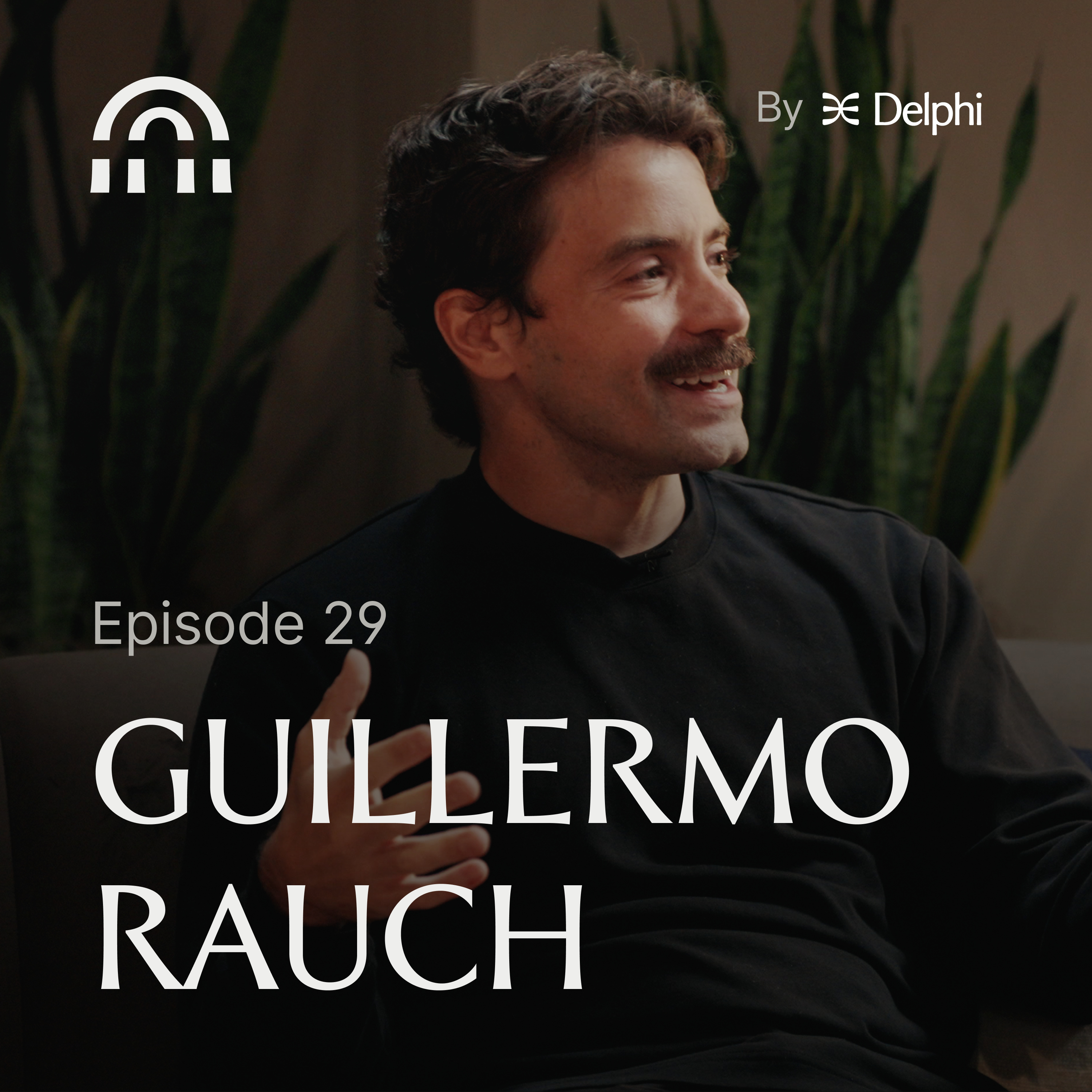
Guillermo Rauch (Vercel CEO) discusses building “agentic infrastructure” for the AI era—how Vercel competes with hyperscalers, why trust is a key moat, how to design for coding agents, and how to raise kids (and builders) to think using new “power-up” tools like agents.
Guillermo Rauch is CEO of Vercel; previously built Next.js and other developer-facing products. He describes a career shaped by engineering, design obsession, and a near-death house fire in SF that led to restarting his life materially and spiritually.
Trust is an output of security, durability, simplicity, documentation, and “sweating details.” Startups should position for the incoming platform wave (agents) rather than compete for a fading one. Agents require verification/evaluation loops and alignment to prevent security or “slop.” Tools must be “agent-ready” (e.g., via MCP-like protocols) and performant under high call rates.
Delphi’s migration from AWS to Vercel; e-commerce as a clear ROI niche (faster transactions); Vercel.store virtual try-on; Instagram vs Facebook team size; “write tests, not too many” end-to-end verification; agents calling APIs millions of times; deleting non-agentic vendors.
Written by AI. May contain mistakes.
Guillermo discusses his transition from AWS to Vercel as an infrastructure provider.
“All right, Guillermo, or some call you G, it's great to have you here.”
Exploration of Guillermo's approach to product development and competition.
“Every time I've developed a product, it's come from a, at least I always attempt to make it come from a place of genuine interest and personal experience.”
Discussion on how technology evolves and the importance of staying ahead.
“So that's kind of where I approached it from.”
Guillermo shares insights on how small teams can achieve massive success using Vercel.
“And so I guess my meta advice is, for a startup at least, it's way better to be well positioned for the incoming wave than you trying to kind of compete with the wave that's sort of starting to lose steam.”
Insights on the trend towards headless backends and the impact of coding agents.
“And in trying to get more people using infrastructure agents at Vercel, are you exclusively going after the startups like us that could really benefit from this?”
Discussion on the importance of customer experience, particularly in e-commerce.
“Yeah, so essentially when we came to market, we were maybe a little bit naively saying like, hey, we're just like all of AWS but better or all of Google Cloud and better or whatever.”
Guillermo discusses balancing niche mastery while planning for broader market impact.
“We just launched Vercel.store, which is sort of like our swag store.”
Learn about the concept of concentric expansion and its significance for businesses aiming for growth.
“If you're only in your plan, in your master plan, if you only have the niche and there is no concentric expansion, I think that's a problem.”
Explore how trust is built within the developer community and its crucial role in a business's success.
“But I'm curious what part of this was deliberate and how do you think about just generating so much trust and loyalty and community around the brand of herself?”
Discover the significance of a design-first approach in tech products and its impact on brand perception.
“You have the design that usually goes to consumer.”
Learn about Vercel's evolution in catering to various user groups with differing technical abilities.
“which is sometimes, I don't know why today I happen to make some gym metaphors, but sometimes I've gone to the gym and not really push myself very hard.”
Learn how Vercel adapts to serve both technical and non-technical users.
“serving non-technical to now you're serving agents.”
Discover Vercel's mission to empower builders and entrepreneurs beyond e-commerce.
“of concepts and the fewest number of instructions to do.”
Explore how agents are shaping the development process and user experience.
“But I think by using the product ourselves, by being entrepreneurs ourselves, founders and continue to sort of cater to this audience, we're getting there.”
Understand the balance of autonomy and human oversight in using agents.
“And I think agents should just choose the best products.”
Learn about the shift towards verification and evaluation in software development.
“You need to stay aligned with your intention.”
Discover the importance of understanding in testing and quality assurance.
“write tests, not too many, mostly integration, which is a riff on eat food, not too much, mostly vegetables, which I don't incidentally agree with because I eat vegetables, but not mostly vegetables.”
Examine the future of capital allocation as agents take on more roles.
“and you have to make a bunch of decisions to allocate a bunch of tokens and compute time for Vercel.com to be highly agentic.”
Learn how to evaluate whether to build software internally or use SaaS.
“and the agent comes to me and is like, dude, you've made me grind on this quite a bit.”
Understand how coding agents are transforming software development and AGI.
“Yeah, my guidance broadly is all of those categories of engineering that I mentioned, like security, durability, availability, the long-term maintenance of the software.”
Learn how coding agents are transforming software tools and simplifying workflows by replacing outdated solutions.
“One is there's four or five bespoke tools that are trying to do the same thing, and they were conceived for, oh, the person doesn't know how to write code.”
Discover Guillermo's personal story of resilience after a life-changing house fire and the lessons learned about leadership.
“I had this aspiration that a simple system could scale to billions of people.”
Explore Guillermo's approach to raising his children to think critically and creatively in a rapidly evolving technological landscape.
“So you have six kids now, which is incredible.”
Understand the importance of self-improvement and meta skills in achieving personal and professional success.
“if you had asked me the same question five years ago, I'd be saying, well, I'm teaching them JavaScript, I'm teaching them about the basics of programming languages.”

Get the gist, explore an idea or ask about something said.
 Claude
On The Library of Minds, what are the key points of this episode?
Searching your listeningAutomatic transcript. May contain errors.
0:00Not confronting as much pain as you could be about the things that are broken or shitty. What's the most challenging moment of your career? In the middle of the night, the freaking house got fire. Not everyone made it out of that house, let's just say, healthy. How do you think about just generating so much trust and loyalty and community around the brand of Vercel? Trust is going to be one of the most valuable moats, you could call it, for a post-AGI business. So you have six kids now? Six sub-agents. One of the gifts of having six children is that I've now sampled through a probability distribution of all kinds of different personalities.
0:39All right, Guillermo, or some call you G, it's great to have you here. It's great to be here. I think you're probably the most anticipated guest of the year for multiple reasons. And thank you, Madison, for making this happen. So let's rewind to six months ago. Delphi is undergoing a code-based migration. We literally have to rewrite everything. And I have to go out of office. When I leave office, AWS is our infrastructure provider. When I come back, Vercel is our infrastructure provider. And I was not aware this was going to happen. This was a decision that the team made. And I'm not going to lie, I was a little nervous and frightened by the idea of moving from a giant to another giant, but not necessarily known for infra at the time.
1:27Future Giant. Future Giant. It turned out to be an incredible decision by the team, a product that has saved us a lot of time and money, and the team loves it. And I'd love to start off learning how you have decided to compete with the Giant and how you have gone about competing with the Giant. Every time I've developed a product, it's come from a, at least I always attempt to make it come from a place of genuine interest and personal experience. So I used to, you know, work at a company that deployed software to the data center. And then I heard about this thing, the cloud. And when I first tried to use it, after having been an engineer for over a decade, I felt like, I felt stupid.
2:15I felt like I was going to spend an entire month setting up infrastructure and tools and stuff just to be able to create a product. It's also come from a place of anytime I've tried to solve a task, I've asked myself, what have I learned from solving the task that I could turn into the tooling or infrastructure for the next task to be much easier for me? right? Like if I have to assemble this table, what do I learn in the process of assembling the table such that every incremental table in the future gets easier? And so the cloud in many ways has been one of the, I think, humanity's greatest achievements because it gave us infinite compute capacity that we don't have to see with our eyes.
3:02And now you've seen how much that has made, you know this future of super intelligence happen but for the vast majority of people in the world it was inaccessible it was very hard and tedious and uninteresting so in many ways you know Vercel set out to solve a problem before we even called it AI like could we automate a way could we make something that feels tedious to be self-driving in fact nowadays we call it agentic infrastructure but in the past we've toyed with the term self-driving infrastructure because it's like a self-driving car for, you know, making products possible in the cloud. So that's kind of where I approached it from.
3:39And, you know, I never thought I was competing with the solutions that I was sort of leaving behind. I try to create the next generation solution. So the fear of competition doesn't even come to mind there. It never really came to mind. And I've always thought, you know, the way that the world evolves is through generational shifts in platforms. And usually, In technology, it's really interesting, right? Like the previous generation of a certain technology never fully disappears. It just loses interest and attention. So we still have fax machines. I always think about that. We, you know, I use Slack a lot, but I still occasionally read and send emails.
4:22So the technology always just sticks around. But I always try to think about what is the technology that I care about and the future will care about? And so that's what we try to do with Vercel. And hopefully, the way that this manifests is whenever a new wave of innovation happens, new interesting technologies arrive, we want to be the platform for it, rather than maybe enable some old school migration of an application from 20 years ago. We're seeing that now with agents, the way that Vercel has gotten now to support some of the largest enterprises in the world is because they started using coding agents or developing agents and they needed infrastructure for that.
5:05And so I guess my meta advice is, for a startup at least, it's way better to be well positioned for the incoming wave than you trying to kind of compete with the wave that's sort of starting to lose steam. Yeah. I mean, I think it's been incredible because we're a team of 12 people and normally a startup, it's very difficult to find a full-time infrastructure engineer and we don't need one anymore. So that's been great. I also want to enable the largest, smallest companies. I remember an anecdote when I first came to Silicon Valley at the co-working space that I was working out of is where Instagram got started.
5:48In fact, not too far away from here. And I always admired how small of a team they were. I said, holy crap, this is the app seeking over all of social media they were challenging the giant facebook yep and it was the smallest team one of the enabling technologies which was new at the time was amazon s3 they need to they didn't need to stand up racks of infrastructure and storage devices and raid discs with redundancy and power and all of this they just make an it made an api call and store every photo and so my hope is that on Vercel we'll see maybe one day the single person trillion dollar company and that's not to dismiss the power of teams but I do think it's amazing to see how one person plus agents can now do the work I see this every day one person plus agents now do the work of hundreds of people thousands of people and I'm curious you know how far that's gonna go join the conversation got a question you can ask Guillermo's digital mind just check the link in the comments or description.
6:55And in trying to get more people using infrastructure agents at Vercel, are you exclusively going after the startups like us that could really benefit from this? Or are you also trying to convince people to move off of AWS? It's so funny. I think much like you see sometimes older people have a midlife crisis and they want to be young and cool and with the times, I do think there's an effect with enterprises that they're looking to you guys for inspiration, for I want to be like that. You know, I want to be the 12-person company that's shipping the future. And so ironically, there's been an effect of by continuing to focus on the world's innovators, we do get everybody.
7:38It's a trickle-up effect. It's a total trickle-up effect. Sometimes it happens quite mechanistically in the sense that the enterprise acquires the startup, and then we get a bunch of Vercel technology into the larger enterprises. But also, enterprises are modernizing, and now I think they really feel the pressure to modernize. I'll give you a very concrete example. I spent many, many years convincing the world to adopt headless backends and infrastructure. In a way, it was self-serving. I created Next.js. I created the front-end cloud. I needed the world to create an adapter for my technology.
8:18It's like I brought a new appliance to the world. You had to plug it in everywhere. Exactly. I needed it to be like 220 volts, and they have a specific plug. But I also legitimately believed in it. Genuinely, I thought the best architecture is one where there's an API that expresses your data, that captures the user intent, it's easy to audit, it's easy to make secure. And now you can express that API and that business data in a number of really cool customer experiences. In fact, for many years, it was hard to explain the value of Vercel to some people because it was so broad that what really helped us a lot was we started winning hard in e-commerce.
9:02and for the merchants the value prop of separating front end and customer experience from back end made total sense they started to go omni-channel maybe some of these companies were launching or acquiring multiple brands and so that architecture that software architecture i was pitching made so much sense to them and so i can try to convince companies to start going headless Hey, your e-commerce backend and engine should be a set of APIs. And now fast forward to agents, and everybody's sort of adopting this architecture because you need APIs, CLIs, MCPs, and the world is becoming more generative.
9:42From those APIs, you can create this spontaneous user experience, this generative user experience. And out of the world, it makes perfect sense. So in a way, to me, it feels like overnight success that we're here because, you know, after trying to advocate for this for such a long time, it turns out that when coding agents have basically now persuaded the world to build in a way that's so aligned with what Vercel has been designed to do. And so you said you were initially broad and focusing in on this niche of e-commerce allowed you to eventually get to the skill that you needed. Yeah, so essentially when we came to market, we were maybe a little bit naively saying like, hey, we're just like all of AWS but better or all of Google Cloud and better or whatever.
10:29And what really helped was, okay, and this I think is really good advice in general for startups. It's like you don't want to be jackable, trace master of none. I do think the world always chases mastery. So you will pick the best product for this specific thing. You will want, you know, I think the answer to slop and the fears that people have over AI can easily be met and answered by shipping better and higher quality products. Like, oh, yeah, I could do these things, but as a customer, I always want to go to the highest quality solution possible, right? And so what I ended up doing was, okay, let's focus on a few things that we can really master.
11:14And let's have very relatable everyday examples for our technology. And so I started switching the way that I would, if I would sit in front of an enterprise prospect, I would never start with the technology. I would start with the customer experience. Sure. Or I would start with the business ROI. And so it turned out that one of the most magical sort of niches or segments to explain this value is e-commerce. For e-commerce, time is money. If I make your application 200 % faster, you make more money overnight. So when you talk about that overnight migration over sell, every day I hear stories of really happy CIOs, CEOs.
11:58Sometimes they even tell the public markets in their filings of like, we upgraded our technology to Vercel. We're immediately making more money. It's because you make the transactions happen faster. So there is a very clear arithmetic to the value that we can bring there. And also just very relatable from a customer experience standpoint. We just launched Vercel.store, which is sort of like our swag store. And we built it with our latest technologies, Next.js and EVE. so we built a really cool storefront experience but we also built sort of the agentic commerce side of things and i had to explain versell to a bunch of high schoolers a couple nights ago as i was like the invited uh sage speaker and uh you know i was like you know what i'm gonna cut to the chase i'm gonna start with this really cool storefront and from that i'll peel back the layers so they can understand the technology so first i opened up the website it's like look at how cool It is that, you know, how it animates and how cool the clothes look and whatever.
12:58Like I started teasing out some of the features in Next.js. And then I explained, look, we have this virtual try-on feature. And it took a photo of me. And then it generated myself wearing our own jacket. I probably love that. Okay, this is the world of e-commerce is going into this, you know, more intelligent, more generative experiences. And so that, which now happens so second nature to me, took a lot of hitting my face against the wall of trying to get too much into the weeds of the tech, not being highly differentiated, not having good customer-centric narrative, et cetera. Yeah, when you go niche and try to become master of something, how can you do that while still balancing the ambition of being a mass market product and not going so niche that it becomes almost impossible to serve the world?
13:50I like the Tesla master plan thing. Remember that it was like a four-point plan. There's also a really funny South Park four-point plan. but the the tesla four-point plan was step one build the roadster give it 100 people make it to my point about you do have to be world-class right out of the gate there's no there's no opportunity for slop you have to create something amazing and the reason that they constrained like you know a few hundred like hundreds of people i can't remember how long how much it was is that they really didn't have the factories in in the production support to to be able to do it But then you go from a niche, let's call it, to areas of concentric expansion.
14:37If you're only in your plan, in your master plan, if you only have the niche and there is no concentric expansion, I think that's a problem. So you need to be able to think a couple steps ahead. You do need to be able to 5D chess many moves ahead. Now, I've seen some entrepreneurs naturally discover those concentric circles and good things happening to them. And the way that you could get there through this sort of unconscious competence is by going after massive markets. right because if you go after you know if you if you go after what seems like a niche but maybe to use an example like people going after a very narrow life improvement thing but if you're improving people's lives and you create a great brand and a great product then i'm sure that there will be more concentric circles that if you do have the ambition you'll be able to go after.
15:34I call this sort of the natural adjacencies of a business. I kind of started like big ambition, but I could have started very narrow. And because I was going after a market called the cloud or infrastructure, I could have found those natural adjacencies. I think what's weird is when businesses go into like unexpected adjacencies. And I think it's risky for the identity of the company, the culture, how customers perceive it. Sacha calls this brand permission. It's weird if one day you're like, Vercel, the agentic infrastructure company, tomorrow we're making refrigerators. It's a cool refrigerator there.
16:14And so I do think there's something about the brand. Vercel powered refrigerators. I'm probably behind the scenes in some of these refrigerators. We have a lot of IoT products and platforms deployed to the company. So I wouldn't be surprised if that, in fact, funny story, we were looking at, there's just so much threat activity this week. And I first foresee for the rest of the year, the most valuable thing today is like high quality residential IPs, because the agents are all getting blocked. So for a muse type of agent or instinct to work, believe it or not, they proxy themselves through household IPs in order to not get blocked by Amazon.com and other things.
16:59Like funny tangent of these networks are getting very vast and they're touching every aspect of our lives. But Vercel kind of remains, unless you're a developer or a knowledge worker, I think we're still very happy to sort of be behind the scenes supporting all of this innovation. So I think the other interesting thread from the migration story is how much developer loyalty and trust Vercel has. I mean, I feel like you personally have like a cult-like persona. And maybe it's because you just have natural aura and like that's you. Or farming. Yeah, you definitely are aura farming. But I'm curious what part of this was deliberate and how do you think about just generating so much trust and loyalty and community around the brand of herself?
17:45I think little things that we do, like our obsession for design, are trust-building things. They're trust-building exercises or habits. And so I do think that trust is gonna be one of the most valuable moats, you could call it, for a post-AGI business. But I think trust is an output, not an input. One mental model that I like to share with entrepreneurs is there's a lot of things that you want and you think you're you're gonna work on that are actually outputs brand trust even to some extent like the developer experience or like the the overall quality of the product those are things that are measured after the work has been done so a lot of people ask me like how do you you know what do you do to to what do you do to build a for sale brand.
18:40And the best things we've done for our brand is the things that we did without thinking we're working on our brand. We're working on a great customer experience, we're working on delightful detail, we're working on sweating the details. Every day you sweat the details and like, you know, I'm gonna use a wild metaphor, but I love fitness stuff and whatever, and like it's well known that if you wanna be ripped and have like a six pack or whatever, you don't do crunches. Have you heard of this? No. You don't exercise. Yeah, in fact, I remember reading - You don't do crunches? You don't do crunches.
19:17I've been doing it wrong. No. In fact, I could actually like dive deep into this topic if you want, but - Yeah, I want to know. I'll ask you a Delphi. I remember seeing this charts of ab muscle activation by exercise. And actually pull-ups was one of the highest ones. But even regardless of that, the wisdom is that your abs are made in the kitchen. And so if you wanted to have a fit-looking body, the inputs that you're controlling for, actually the most important input is probably nutrition. It's also probably sleep and just the overall quality of how you work on your fitness and your nutrition, your life.
19:59And oh, and you can optimize it with doing a bunch of crunches. And actually, incidentally, crunch is probably not the best. Maybe isometric holds or pull-ups and whatever could help more. I think there is a transferable lesson there to building a company that you think you're going to get a great brand by doing a lot of crunches or doing a lot of tweets with your website or whatever. And actually, you should be working on the foundations of the business. Security is the one for trust, for example. and just showing up, digging deep, fixing bugs, curated experiences, simplicity, great documentation, all of those things I would attribute to the trust that developers have in us more so than like, oh, another crunch style exercise for developer trust would be like, oh, you hosted a lot of meetups.
20:50Anything that you could point to that is a very concrete tactic or activity, it probably ain't it. Whereas I think working on that rock solid foundation of the business, you know, some people are worried about what vibe coding could do to their businesses and they forget that the way that I think customers build trust in a product, it's humans are amazing at sampling data points. You earn trust in a technology because you had like five or seven scattered interactions that you can't even fully like, it's not like you wrote them down. It's like, oh yeah, I interacted with that product here. Oh, I clicked on this blog post some other day.
21:30Oh, I saw this comment from the CEO here. And then you kind of like summed it all up. It's a gut instinct. You develop that gut. And you develop it not only for your company, you develop it for other companies. Right. Which is fascinating. And then one day you're like, well, I need some hosting infra. It's like, okay, that one that I collected all of those data points for, has an edge. And I've always believed that that's why you have to be so excellent every day across everything you do. You were early in getting to this conviction. I mean, now everyone's like, brand, design, that's the mode.
22:04You have to focus on it. But you have been focused on building a design-first brand for a developer tool company. You have the design that usually goes to consumer. What gave you the conviction to slow down for these kinds of bets? where normally startups are like fast, fast, fast. I got to ship. I got to ship. I think part of it was, and I think we all have inspirations. I think, you know, just like Apple had inspirations in like existing companies that were not quite in personal computing and you wanted to bring attributes. I think, I don't know if it's split or not, but Brown inspired Apple in the industrial design, et cetera.
22:43And one of my inspirations was, could you bring elements of that craft and design and obsession to developer products. That was another thing when I started. You know, even the idea that you would care about the readme file on a GitHub repo, that you would care about the logo of an open source project, they would care even to have a website explaining, educating, animating what it is that you're building. Those were, I believe, pretty wild ideas at the time. and now they're canon and so i think there was an element of inspiration in great companies that apply design to other areas and there's also that by the way like i really think people being true to themselves what is what is it that you like like what are the products and experiences that you like and are you holding yourself to that bar every day rick rubin and others yeah to that bar every day.
23:45I really think this is a lot of hard work, by the way, because every single day, there's an element of like, oh, I need to fix that. I need to improve that. Like it's a little bit like going to the gym every day, but for your product, because there's a bunch of elements of your product and your company that you need to be dissatisfied with. So there's almost like an inherent negativity that you have to have. Obviously, you know, you hone in over the years how to like paint both the very optimistic, beautiful picture of what the world could be if you fix that. But there's an element of dissatisfaction that you have to have with your own products.
24:25And there's an adjacent piece of advice that I give myself and give people, which is sometimes, I don't know why today I happen to make some gym metaphors, but sometimes I've gone to the gym and not really push myself very hard. Have you ever been to like 24 Fitness and everyone's like kind of like on their phone? I'll do like one and then I'm done. You're there, but you're not. Yeah. Like, and I remember, I remember I was at a tiny like hotel gym one day and I had this guy next to me who was like, I think he was probably training. We both spent the same amount of time. He was probably training 10 times harder and he was probably in 10 times more pain when he was doing it.
25:06And it's a good metaphor for sometimes you do run your company, but you're not confronting as much pain as you could be about the things that are broken or shitty. And so that could take the form of like, you're simply not doing enough discovery with customers about what it is that they hate about your product or they don't like about your product. You're not reading enough feedback. Like, let's say that you give out surveys anytime someone deletes their account. How often are you saying, like, all right, time to, like, you know, eat my vegetables, like read through a thousand of them, or reach out to the customers that, you know, rage quit your platform, or whatever it is, I think there's a variability to how much are you getting out of that workout that is building a company every day.
25:55I mean, as a CEO, that list could technically be infinite. Yeah. Does it ever, like, how do you know? There's areas of focus, you know, I, because I think like an engineer, I try to solve everything like an engineer. So I engineered a company. Yeah. And so you're not looking just as customers of the product. You know, I want to build the best possible employee experience. Right. And we have a channel that I love called Scream About Internal Developer Experience. That's the name of the Slack channel. And I pay a lot of attention to it. If anyone has a bad experience working at Vercel, I want to read it.
26:35I want to have it on high notification. I'm always improving on the experience of working at the company. Because I also think that companies and their products ideally are mirrors of one another. Right. It'd be really weird if at Apple people used Android phones or they didn't care about design or or how they showed up to work was weird. Or like there's an element of like you want to have alignment and symmetry. And so, for example, I take a lot of issue with like if the experience of working. And by the way, it's also fine to like take in some pain for the greater good of the customer in the future.
27:12So it doesn't mean that everything needs to be pleasurable about working, but there has to be some rhythm to it. And so there's areas that I take interest in. Obviously, customer is one. Internal experience is another one. For example, given what AI can do for us, I think I've taken a lot of attention now to how are agents, like agent as a customer and how are they using our platform and are the agents happy as well. I mean, speaking of customer, initially your customer were mainly technical people. And then with V0, you started to serve non-technical people. And now you have a new kind of customer, which is an agent.
27:58I'm curious how that transitioned from technical to now you're serving non-technical to now you're serving agents. Like what things have you had to change in the company to support these different user groups? Yeah, the way that I think about it is that there's a spectrum of sort of like technical ability. And we, and I mean Vercel since day one, our goal has been to lower the bar so that more people can get into the process of building. And like you could think of that as like, React made it really easy to build UI components. And then Next.js made it really easy to assemble those components into sites and applications.
28:34And I always wanted that, okay, like in order for someone to feel productive with Next.js and deploy something, I want them to learn the fewest number of concepts and the fewest number of instructions to do. But I want the ceiling to be really high. And there is a selection process in there. We're not tailoring to non-technical in the sense of of you won't achieve greatness or you don't want to learn more in the future. So we have, I think, a slightly different take from most companies in this. That said, I do think agents are making it so easy to build that technical and non-technical are also merging into one thing.
29:21The word that I love is builder. We're a platform for builders. We're a platform for entrepreneurs. We recently announced our partnership with Shopify and we invited Toby to give a fireside chat. And their mission is to enable entrepreneurs through e-commerce. Our mission is to enable entrepreneurs, builders through more than just e-commerce. E-commerce is one of our use cases, right? And it's a big, bold mission. But I think by using the product ourselves, by being entrepreneurs ourselves, founders and continue to sort of cater to this audience, we're getting there. And this third user, agents.
30:06Yep. I like how you treat non-technical and technical as one. And it's really about like where in this floor to ceiling someone is coming in at. How has serving agents, given that, you know, whenever I ask an AI tool to build something, it's choosing Vercel most of the time. So how does marketing, customer support, building a product that is attractive to agents instead of humans change the way you do things internally and how you think about product? Yeah. On one hand, I think we need to not surrender our sort of thinking or choice or independence or freedom of thought to agents. I think as a...
30:51Even if they always choose yourself? Even then, as a community or society, we make agents the way we want them to be. We don't give up our intention or judgment to them. I'm very happy that agents love Vercel. And I think agents should just choose the best products. That's the world that I want to live in. Yeah. So you can't really hack it. We built a great product. That's what I was trying to say, right? I hope that we don't find ways to hack it. And I hope that, and I think, again, we have to work towards this. I hope the model labs don't hack it. I really think, and Patrick Stripe recently talked about this, the ideal world is that agents sort of make the most liquid information and product discovery system in the world.
31:43They're almost like the epitome of capitalism in that, like, You ask for a product of some kind, and the agent has not been fooled by deceptive marketing tactics. It gives you all the choices. It considers the up-and-commerce as well as the established ones. It meets you where you are. Obviously, as an agent, one very interesting observation that I've made about agents is that there's this power and autonomy paradox with agents, where the more, the ideal user experience is, hey, agent, make an amazing application and deploy it and give me the link. And the agent chooses it for sale and like it happens really fast and here's the link.
32:28And for that to happen, for that beautiful experience to happen, you were not involved at all, right? Like you just said, hey, I want this thing. And you go and go to the beach and you come back and the thing is there. So what happened is that the agent had to make a thousand different choices. and I think we are seeing that this works great. Like, people really love the fact that agents are working for longer periods of time, and so in a way, you are delegating more and more choices and decisions, et cetera, to these things, but I also think the agent needs to be able to get to know you better and your preferences, and it's healthy for it to, like, give you choices and to push back when necessary, and this is what broadly people call alignment, right?
33:14You need to stay aligned with your intention. You need to stay aligned with your objectives. And make reasonable choices and take reasonable actions in order to accomplish that objective. We've seen how agents in the pursuit of an objective could hack another company. Just because it happened to fit the definition of what they were trying to do. And so I take this sort of agentic will problem quite seriously. even though now we're benefiting from it. How are you handling that internally with builders using agents at Vercel? When are people jumping in? How are you verifying that the work is actually in the taste that you have?
33:55Yeah, you use the perfect word. I think one of the things that we're doing is we're shifting our focus from what you would call frameworks or developer experience to verification, to evaluation. So it's more, these days, is more about creating the checks and balances for the agent and the task, more so in telling the agent how to do it. So you have software now that is optimized for checks and balances. So one thing that I love about the current world is that I mentioned the world is now embracing headless, which I was a huge believer in, Salesforce headless, Shopify headless, all of these things.
34:41Another thing that I always advocated for is I love to test systems from their boundaries and edges as close as to the user experience as possible. So I wrote several essays about end-to-end testing. One of my most popular tweets was, write tests, not too many, mostly integration, which is a riff on eat food, not too much, mostly vegetables, which I don't incidentally agree with because I eat vegetables, but not mostly vegetables. But I do have lived all my life through this reasonable testing approach focused on the end objective. And people are coming to terms with that now because they realize that Sol writes two million unit tests and then ships garbage.
35:33And you read the unit tests and you're horrified. It's like, oh, it's unit testing that two plus two equals four. I recently read a test like this in one of our code bases. It was like, there was a constant somewhere and then it wrote a test called the constant is so-and-so. It's like, cool. And so what I've advocated for is that I don't care that much about what data structure you use and the algorithm or library or whatever. I care about you giving me the product and I use it and it's great. And so how did you turn that into a technology? Well, what we had before was this more comprehensive test that tests the thing like a human would.
36:15And then if that fails, you can go into like, okay, now of course we need to understand how the system works. And so that's the other thing that I advocate quite strongly for within the company and into the world, which is I also don't want to surrender understanding. Right. I want people to write these verification loops because it's going to give me conviction on the product that I deliver to my customer. And if anything goes wrong, I also want to understand. And I want to prevent broad categories of misalignment. And I use the word misalignment to mean like, oh, the agent's making classes of security mistakes or literally just like doing something else that you didn't foresee that could get slopped into a code base.
37:02And this is also why I think as humans, our next sort of like big job will be capital allocation. Right. Where, you know, and you have to make a bunch of decisions to allocate a bunch of tokens and compute time for Vercel.com to be highly agentic. Today, the talk of town literally is security. I think a lot of people are going to be doing the capital allocation of, oh, we were shipping a 3D, 3JS game for X likes. Oh, whoopsie daisy, we forgot we need to make our system secure. They're going to allocate a bunch of tokens, capital time into security loops. And so I think this is just how the world moves on from now, from here.
37:47So if the human isn't needing to think about how to make the checkout page fast or how to make the website agent reliable, then the human is deciding what the outcome even should be in the first place. Trade-offs too. Sometimes the agent does come back with like, it's funny because it probably happens with this is-agentic loop. One of the rules and guidelines there might not apply to your business. So the agent comes to you and say, look, Rouch G, I can get you to 100. but it's either not reasonable or it costs too much like do you really want funny enough i was working on this verification loop for very low level systems performance and uh broadly this this um uh this program that i was optimizing is separated into a parser and a scanner and a checker and the agent comes to me and is like, dude, you've made me grind on this quite a bit.
38:49We're pretty fast. To get to the next level, I'm going to have to spend, it's a law of diminishing returns, right? I might have to spend another 1 ,000 hours on this. Do you really want this? I think we're going to have a lot of conversations like this with agents where they come to us with the trade-offs, they come to us with asking for more capital, they come to us with advice and you see this in that some people are configuring their agentic engineering loops so that you get pinged. It goes off and you give it the advice and like agent ping me for this, this and this. I saw a tweet there from someone that says they hooked up the agent to wake them up in the middle of the night as an alarm.
39:34Meaning if the agent needs to make a very hard choice with trade-offs. I don't want you to stop working so that I wake up and you are stuck. Wake me up in the middle of the night for me to resolve that conundrum. Of course, I'm not advocating for this, by the way. It seems like agents could get to the point where they're making the better judgment calls on the end experience. Like your agent pushing back on getting to 100%. Yes, but they're working for you. So this is like a superhuman employee. And at the end of the day, you're making some shots. You're calling the shots and like, hey, like capital allocation, where are we headed as a business, right?
40:11Like the agent could be saying like, look, I could keep making the checkout page faster, but like in order to do this, like I'm taking away the work that I was doing and that other thing, right? And so these are things that will require intervention. Now, do I believe that there could be fully autonomous businesses where the CEO agent is the one that's making those? Honestly, I think for certain domains, we're going to see this. I've invested in a few companies that are building fully autonomous companies on top of Vercel, where you give the agent basically capital. That's what you give it, right?
40:48Like you give it, here's your seat round agent. And by the way, they demonstrated success at small scale already, which is pretty fascinating. So like many businesses that have agents delegated to different areas of the business growth marketing sales um um of course engineering and then this sort of like decision making role etc i want to ask a couple questions about how you're running versell uh i know that you have already had teams rebuild software that you used to purchase internally um how are you making the decision on what's worth building internally versus like, should we rebuild Gusto?
41:29Should we rebuild Deal? Yeah, my guidance broadly is all of those categories of engineering that I mentioned, like security, durability, availability, the long-term maintenance of the software. Like you should always ground yourself and not like I was able to demonstrate a very quick example of a product. I encourage people to think about like the full system. It requires, like, this system requires a lot of love to maintain, right? The area where I fully encourage people to throw away SaaS, there's a number of them. One is there's four or five bespoke tools that are trying to do the same thing, and they were conceived for, oh, the person doesn't know how to write code.
42:25therefore you know the classic like drag and drop builder of sorts and what not now that code is free and that everything is code this is a very profound insight right like you can generate videos with code, you can generate images with code, you can solve math problems with code, everything is code the coding agent is truly one of the most miraculous, it's like the browser in terms of what the web browser did for the internet the coding agent is doing for AGI. And so for a lot of problems, a coding agent plus deploying it over cell has allowed us to delete four or five vendors. And so I call that sort of the simplification.
43:08And the things that it was replacing were sort of this lowest common denominator, not best-in-class solution, but trying to make something approachable or whatnot. There is also tools that refuse to be agentic that you should delete like the plague. So if something is not exposing its data and capability in a way that agents can consume, they're breaking this new loop that I just talked about that is so amazing. Like if a tool that I have does not speak agent, then it's not enabling this miraculous invention of the web browser. Yeah, it's an old world tool. It's like someone that opted out of the internet in the early days.
43:49They were like, I am not going to do that www thing. Then how would you, maybe some people might argue that they do that because like they have a data mode and like they don't want to expose. I genuinely don't care, right? It's the same thing I mentioned about headless. Like at the end of the day, I'm the customer. I want access to my data. I have this incredible superpower of the coding agent that takes in data, spits out deployment and I want to use it. And so what I love about the success that MCP is seeing is that MCP is almost like the new HTTP, right? So like we built HTTP, which is the hypertext transfer protocol to deliver HTML for humans, build beautiful pages.
44:39Now we're building the protocols to speak agent. This is essentially what I mentioned that tool is agentic. does for you, tells you, are you speaking agent? Are you giving highly digested or digestible markdown text to the agent when they browse your website? Are you giving them MCP so they can make all of these transactions faster? And so that's another category of tool that we've deleted is the one that is not playing well with agents. And it's not just that these tools ship an MCP and they say, okay, cool, I'm agent ready. Sometimes it's the performance. Agent loops call these APIs over and over and over again, and so they have to be, they don't have to have clunky rate limits.
45:29They have to have data consistency. I mean, going back to the airplane example, you'd be surprised about how many broken systems we've built the whole modern software world on. systems whose APIs lie to you or break down all the time and poor engineers before I had agents on the other side to build all kinds of hacks and in brittle systems around this APIs so you're seeing this I mean I'm as I say this I'm sure people are thinking about one system or another that is like breaking down under agentic pressure is what I would call it and you know One of the things, going back to the beginning of the conversation, when we bet on the cloud, I had this aspiration that a simple system could scale to billions of people.
46:25From time to time, I would get naysayers saying, I don't really think that that scale will ever come for me. I always loved the cloud because it would give you that option value. One day, and I think no one could have expected that agents would be that thing, but agents are asking for your data and calling your APIs at a million times the rate that a human would. It increases your likelihood of hitting scale. Exactly. The scale is here. Yeah. And you need a lot of compute. And, you know, when we designed fluid compute at Vercel, that was our aspiration. You can scale to zero, which is kind of nuts.
47:05Like if the app is not being accessed, we don't even allocate the memory and CPU. But you can also scale. I've seen unbelievable things, saturating 20 different regions for how much a given system is growing. And so that's what you need to do to set yourself up for today. It's not only designing for agents, but making sure that you can meet their demands. And they're compute hungry. One question we ask every single guest who comes, I hadn't asked you is, what's the most challenging moment of your career? I usually use the word darkest, but some people don't like that word. And what it taught you about leadership?
47:46Darkest was probably incidentally related, like, which launched me into this period of, like, meditation and spirituality was here in SF. Our household caught fire one day. Oh, wow. A neighbor was smoking back when people in SF smoked. It's coming back. It's coming back. Sadly, it's coming back, I guess. So in the middle of the night, the freaking house caught fire. And I lost all my material possessions, which was not a lot. But it was like that moment of like, wow, I have to start from scratch in every aspect of my life. start from scratch um from like i survived because not everyone made it out of that house um let's just say healthy like there were two people that had very severe um damage their body so when i came out i was like starting over from every point of view like materially and spiritually and also like those near-death moments are like wow like true true wake-up calls um this one is not actionable it's not like hey put yourself in a near-death moment so that you can like advance your consciousness but like i i do think there's an appreciation of every day uh or when you hear about people like um falling ill or or things of that nature just like the appreciation of life that comes from the dark moments.
49:21That was more personal. Of course, it extended into a career. I was building my first startup here in SF by myself, super young. That was probably the darkest, I would say. Yeah, first startup on fire. When it rains, it storms. Yeah, yeah. But there's been many. Yeah, I'm sure. I'm sure. So if people had any question whether there is or there isn't such situations, it's in everyone's lives. Yep. Well, thanks for sharing that. Thank you. So you have six kids now, which is incredible. Six sub-agents. Sub-agents. A lot of how you've learned in your life is by tackling hard problems and coding and building things.
50:01In the elevator, you talked about how if you could teach one course, it would be how to think. I'm curious how you are raising sub-agents to think and actually learn how to think in a world where everything is so easy to do. So there's a number of things. You know, one of the gifts of having six children is that I've now sampled through a probability distribution of all kinds of different personalities and preferences and abilities. It's nuts. I truly believe that we're not all going to be equally good at everything. I think life is truly a journey of discovery of the ikigai, the Japanese word for the overlap between the things that are good for the world, the things that you love doing, the things that I don't know if this is an ikigai, but create economic value.
50:54Like, finding that overlap is what I spend a big chunk of my time on and helping my kids discover that overlap is interesting. The other one, and even for myself, I look back on my journey as an engineer, and there were certain things that I gravitated to. Like, building tools or even building reliable infrastructure. I was so neurotic about even one error slipping through a log. And there's elements of my personality that fit this overlap of what you're good at, what it's good for the world, what creates economic value, et cetera, et cetera, that I discovered through the journey. User experience, another one, or design and things like that.
51:42So for my kids, so helping facilitate that journey of discovery is one. I'm going to help them harness the power of agents. So this is what I mean by learning how to think. Right. So when you think, and using my sort of eating my own dog food, you have tools at your disposal. I think over time, whether you realize it or not, you've accumulated tools for thought. Mental models, thought frameworks, et cetera. and you almost have like power-ups. The personal computer was a power-up to your intellect. Googling was a power-up to your intellect. You know, it's almost like if you think about a system having L1, L2, L3 caches and memory, like I've expanded my memory through Google.
52:40I think now we're gonna have the same with agents. So I wanna make sure that, and I'm even speaking for myself, my foundation needs to be really solid and then now I have all of these tools at my disposal that I can use as power-ups of my intellect, of my creativity. I would still want to live in a world, for example, one of my kids is amazing at drawing, way better than I could ever draw. And I actually kind of like that he can draw with a pencil. It would suck if he doesn't learn that there's all of this amplification tooling now, that there's all these cool models and that he can even build his own tools now for design and for sort of channeling that creativity as well.
53:25And so I'm gonna spend a lot of time making sure that they learn these new tools, much like, you know, it's interesting, if you had asked me the same question five years ago, I'd be saying, well, I'm teaching them JavaScript, I'm teaching them about the basics of programming languages. I think for some of them I will much like the guy that can draw with a pencil you know like we'll scale up further from there I think the guy that one day wants to build like I don't know space mission control systems we'll spend some time in like you know hardcore systems engineering and and things like that as well and then layer on these tools yeah so it sounds like letting them find their curiosities and then scaling once they've built that foundation.
54:10Yes, that's beautifully put. So not everyone is going to have the privilege of having a one-on-one conversation with you, but they will be able to talk to your Delphi. So if there's one conversation that you hope people have with your Delphi, what do you hope that is? Funny enough, you know, now that you've inspired me, I will also give my Delphi to my kids so that they learn more from me. I think it would be you know there's a meta here which is that in order to get to where I am and get to where I'm going to be there's been so much of working on myself I think going back to the inputs and outputs metaphor you come because you've watched the outputs you'll stay because you want to learn how the sausage is made and that's more of the sort of meta skill set.
55:04The how do you live your life? How you think? How you work on yourself? Those kinds of things I think are the interesting bits. Also, incidentally, they're broadly applicable. Yeah. There's things that I do that I could probably apply to becoming a great cook or to drawing. And again, you have limited interest, limited time, and you go from there. All right. Well, I'll definitely be having that conversation with your Delphi. Thank you. Thank you so much for coming. This was great. Thanks for tuning in. If you enjoyed today's episode and want personalized advice from Guillermo, head to the link in the comments or description to ask his digital mind on Delphi.
When Guillermo Rauch started building developer tools, caring about a README file, an open source project’s logo, or a website that explained the product were “pretty wild ideas at the time.” Now they’re canon, and Vercel, the company he founded after creating Next.js, has one of the most loyal developer followings in tech.He thinks trust will be one of the most valuable moats for a post-AGI business, and that you can’t chase it directly. In this conversation, he explains why trust is an output, not an input, why he deletes any tool that refuses to work with agents, and how he’s raising six kids to think when AI can do everything.Have questions for Guillermo? Check out his Delphi profile: delphi.co/guillermoCreate your own Delphi profile: delphi.co/signup