
In short
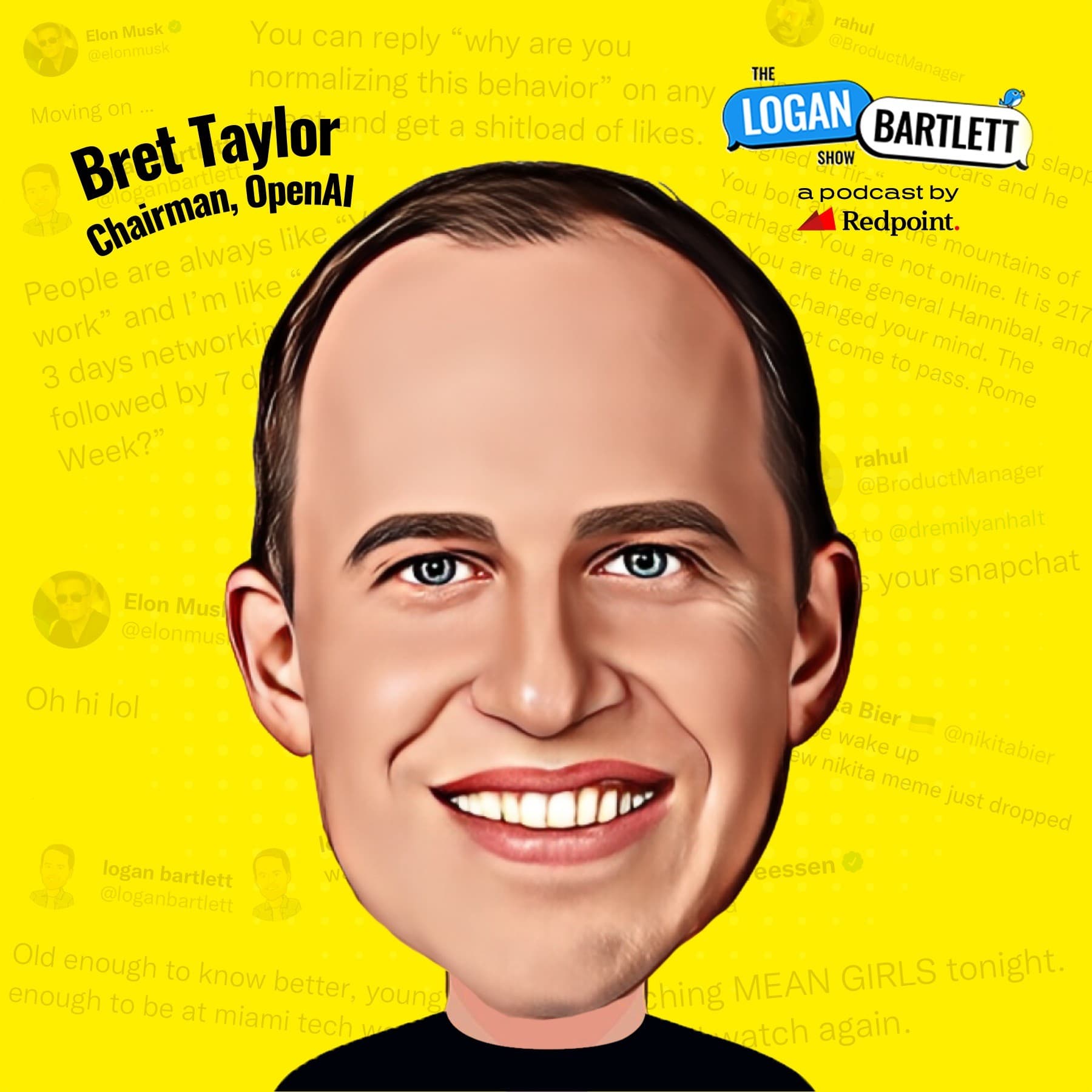
The Logan Bartlett Show - Episode 150 Summary: Bret Taylor (CEO, Sierra)
Podcast Description The Logan Bartlett Show hosts conversations with entrepreneurs and investors to extract valuable tactics and frameworks for navigating the startup landscape. Each episode covers various topics including hiring, go-to-market strategies, product development, growth, and fundraising.
Episode Overview Episode Title: A New Class of Software Winners Guest: Bret Taylor, CEO of Sierra and former co-CEO of Salesforce Air Date: [Insert Date]
In this episode, Bret Taylor shares insights on the AI revolution's impact on startups and incumbents, comparing it to past technological shifts like the Internet. The discussion covers various aspects of the changing software landscape, business models, pricing strategies, and the future of AI in customer experience.
---
Key Topics Discussed
- Introduction and Recent Milestone
- Bret Taylor discusses Sierra's recent funding round, emphasizing it as a milestone in building a durable company in the AI agents space for customer service.
- AI Market and Historical Comparisons
- Comparison to Internet Revolution:
- Similarities in market opportunities for AI as with early internet companies like Google versus AltaVista.
- Need for sustained execution and innovation to dominate in AI, as it was crucial in the internet era.
- Competitive Landscape and Business Models
- Intensely Competitive Environment:
- Clear market opportunities in customer service, software engineering, content marketing, etc.
- Emphasizes the importance of strong strategy and execution in a competitive landscape.
- Outcome-Based Pricing and Value Creation
- Discussed the concept of value-based pricing, particularly in the context of AI tools like Sierra.
- Explains how the value of AI solutions should be measured against the actual business outcomes they generate (e.g., sales margins).
- Technological Shifts and Business Transitions
- The transition from traditional software models to AI-driven solutions.
- Discussed how the perception of value in software has evolved, driven by AI's capacity to perform tasks rather than just enhance productivity.
- Adoption Challenges and Forward Deployed Engineering
- Addressed the challenges organizations face in adopting AI, stressing the importance of change management in deploying AI solutions.
- Highlighted the need for a hands-on approach to ensure successful AI implementation.
- Future of AI and Customer Experience
- Taylor predicts a shift towards AI agents as the primary interface for customer interactions, shaping how businesses engage with customers.
- Discussed the potential for AI agents to handle not just support but also sales and personal inquiries.
- Career Advice in the Age of AI
- Encourages individuals, especially young professionals, to embrace AI tools and leverage them to enhance productivity.
- Suggests that understanding foundational concepts in computer science will remain valuable.
---
Key Takeaways
- Historical Lessons: Understanding previous tech revolutions can guide current strategies in AI adoption and market positioning.
- Competitive Execution: Sustained execution is critical to establish a leadership position in AI markets.
- Value Proposition: Companies should focus on demonstrating clear, quantifiable outcomes when pricing AI solutions.
- Cultural Shift: As AI becomes more integrated, companies will need to rethink their customer engagement strategies and business models.
- Career Resilience: Professionals should adapt to technological advancements and continually learn to stay relevant in their fields.
---
Final Thoughts Bret Taylor emphasizes that the AI revolution is not just a fleeting trend; it represents a substantial shift in how software interacts with business processes and consumer behavior. Companies that adapt to these changes and embrace innovative pricing and engagement strategies will likely emerge as leaders in the new landscape.
---
Listen to the Episode
- [Apple Podcasts](https://podcasts.apple.com/us/podcast/the-logan-bartlett-show/id1606770839)
- [Spotify](https://open.spotify.com/show/5WqBqDb4br3LlyVrdqOYYb?si=3076e6c1b5c94d63&nd=1)
- [YouTube](https://www.youtube.com/channel/UCugS0jD5IAdoqzjaNYzns7w?sub_confirmation=1)
Follow on Socials
- [Instagram](https://www.instagram.com/theloganbartlettshow)
- [Twitter](https://twitter.com/loganbartshow)
- [TikTok](https://www.tiktok.com/@theloganbartlettshow)
---
*Note: This summary is crafted based on the transcript provided and encapsulates the core discussions and insights shared during the podcast episode featuring Bret Taylor.*
Written by AI. May contain mistakes. Listen to the episode to check what was said.
Transcript
Automatic transcript. May contain errors.0:00Brett, thank you for doing this. Thanks for having me. I'm glad we got it on the calendar. It's a good time to do it. You guys recently announced a new round. Congratulations. Thank you. I appreciate it. It's a nice milestone on the journey, a good testament to what you guys have built to date and where you're headed over time. Yeah, it's a milestone, but I think that's the way to put it. Raising financing is just adding fuel to get to the place you want to go. And I think for an entrepreneur like me and my co-founder, Clay, it's, you know, we want to create an enduring, durable company. And so it's just that, just a milestone.
0:36But it's a good time to reflect. We're really proud. I think we're the clear leader in the space we operate, which is AI agents for customer experience, customer service. But I always talk about how similar this AI wave is to the original Internet wave. And AltaVista was first, and Google's the one who writes the history book. So we need multiple years of sustained, impeccable execution basically from here. And then I'll be happy. But I'm excited for the most. There's the Norm MacDonald joke that like the good guys always won in history. It's like you get to define the terms of success in that way.
1:12I guess what do you think to that end when you're making that comparison to Internet versus AI? Like where do you think the parallels exist? And what do you think breaks down as you kind of think about comparing the two? One thing that I think is quite similar is there were some very obvious bets on the internet, like search and e-commerce being two of the most prominent, and payments. You know, you don't need to be that savvy about the internet to think, wow, it might be useful. People could buy things, you know, digitally. And the question was, who will own that market? will Amazon and buy.com had very different strategies, even different portfolios of products that they initially sold.
1:53Amazon clearly had a much better both strategy execution. There's a lot of details they got right. Look at the search market. I mentioned AltaVista and Google, but one of the more impressive technical companies that we competed against was InktoMe. They had a really good engineering team. And I could tell you why PageRank was better, but they had a solid team, but they had a B2B business model. They essentially licensed their search engine to portals. And that left out the opportunity to create AdWords, which turned out to be the greatest business model of all time. So there's so many details that dictate whether you're the one you turn into Google or AltaVista or InktoMe.
2:30But going back to your question, what's interesting about the AI market is there are a few areas that are obviously going to be impacted by AI. Software engineering, customer service, content marketing, visual effects industry. There's probably others, different TAM, the legal industry. And as a consequence, you know, it's not like I got this great idea. Hey, if I told you, oh my gosh, AI for customer service, it's not, the concept is obvious. The question is, do you have the right product? Do you have the right go-to-market model? That's why I mentioned the Ink to Me, Google thing. Are you B2B or UB2C?
3:07What is the packaging? What is the form factor that will become dominant? And so as a consequence, it's an intensely competitive time, just like my recollection of the dot-com era is. And I think that's really interesting. So you have very clear markets with very intense competition. And that's different than other markets. I think when the mobile phone came out, some of those categories like ride sharing wasn't like a self-evident market, you know, and then there was a couple of great insights and it created, you know, the Ubers and the Lyfts of the world. I think right now, many of the biggest markets are already known.
3:45And as a consequence, one of our company values is actually competitive intensity, which is unusual. And, you know, it's the first line of that is we know we're not entitled to our success. and I think it's a really important part of being successful in this era. Where it breaks down, I think it's shifted the landscape of what is a software company. I love the example of Harvey, who's a company I really admire. I can't think of a great legal tech company. I'm sure there are a couple. I don't mean that in a backhanded way towards any of them, but it wasn't like if you went through the top 10 enterprise software companies in public markets, there's not one in legal tech, right?
4:23There's ERP systems and CRM systems and all these others. It's just not one of the key categories, in part because the TAM for selling productivity enhancement to lawyers is not that big. But now, all of a sudden, with Harvey, if you're actually doing the work and doing the antitrust review, all of a sudden, the total addressable market looks huge because the addressable market of legal advice and legal labor is actually quite large. So that's really interesting to me because I think the traditional perception of where there are addressable markets in software I think has been upended because agents aren't simply productivity enhancements for people but actually doing a job.
5:06And as a consequence, I think how you evaluate the value of a piece of software starts to move away from traditional software productivity metrics. And think about a CIRA agent that actually makes a sale for you. The way you would value that is not really even related to AI or software. The way you'd value it is basically what are the margins on that sale? What would be the commission you'd pay a person to make that sale? And so as a consequence, I think it really has like dramatically shifted the traditional view of how to value software just as either a venture capitalist or an economist. It's really changed the markets.
5:47And I think I'm excited for that. I think it's going to be a really positive thing for our industry. The other great thing is I can dub over Usain Harvey and Slyce and Lagora for the totality of that. And so we don't have to give any plugs to Harvey throughout this. It's a great market. No, it's a great example, too, though. So I'm curious, like one of the things that I've thought about with your example, and I'd be curious what you think of this, is like to some extent the outcome-based pricing in general is so demonstrable ROI. And it's very clear what people are willing to pay for it in some ways.
6:24And also you're somewhat beholden to alternatives in some ways. And so like I think about what value I get from Zoom. And if Zoom was the only thing that existed in the world, I don't know. We could probably get Redpoint to pay$10 million for it or something, right? Just because it's like that impactful to our day to day. But they don't get to charge that because there's Teams and there's Google Meet and there's other stuff like that. And so I guess as you think about outcome-based pricing for your business or for Harvey and Legora, like doing work in that way, is there any framework or like how do you think price pressure plays out in some ways when there are these alternatives that can exist?
7:12Do you think that it ends up eroding some of the, you know, the ROI pricing that you can get in the early days? I have a slightly different way of thinking about it, but I'll try to answer your question directly, too. You can reject my question. No, it's like really obnoxious. Yeah. Answer a different question. I think part of the reason that there is price compression for tools like Zoom or Slack and Teams is in part because the value you get from a sort of horizontal productivity tool is very hard to measure. If you just think about running a 120 ,000 person company that's a global company, you're paying per seat for something like a Zoom or a Slack or something.
7:56It's sort of funny because you're paying the same value per seat for like the most sophisticated research and development engineer and like the new grad in your pick the least strategic department of whatever that company does. And as a consequence, I think when you're thinking of horizontal software, whether it's productivity software or communication software, you end up with pricing that is somewhat commoditized. And there are some rare exceptions where companies are able to charge a premium. In contrast, though, if you look at the enterprise software market that are oriented towards departments, say ServiceNow for ITSM or Salesforce for CRM or SAP for ERP systems, the value that those companies derive per seat for their application is traditionally much larger, usually more than an order of magnitude of software like Zoom.
8:47Even though many fewer people use it, but it's closer to business value. You know the value of balancing your company's ledger and auditing your financials before an earnings call. You know the value of a sale. And as a consequence, the business value you're selling is more measurable. It's closer to that business value. The analogy I would give for outcomes-based is we're going from impression ads to CPC ads. And one way of looking at outcomes-based pricing that I don't agree with is you're sort of leaving money on the table. That would be like making a modern cost-per-click ads auction and saying you're leaving impressions on the table.
9:34And that's not the way anyone thinks of it anymore, just because history has played out and the value has accrued towards CPCs and cost-per-conversion now for modern ad networks. I think in the sort of digital economy, the closest you can get to a measurable, accountable outcome, the more value will accrue to your platform. And so going back to your question, will competition cause price compression? Probably. But I think in general, the closer you are to a really valuable business outcome, the more your platform will be valued relative to the value of that business outcome, as opposed to being compared to another piece of technology.
10:18and so you know it's interesting i'm not sure what outcomes base would be for zoom because you'd have to ascribe a value to every single video call you have and i'm sure some are quite important when you're you know closing a huge deal and some are totally trivial and that's just not easy uh in ciria's business we help build ai agents for customer experience and you know your cost per contact in your call center and you know the cost savings that an AI agent could drive. You know the value of a new product sale and if your AI agent helps make that sale, just like you know how much you pay a salesperson for doing that, you know how much valuable it is to your agent.
10:59And as a consequence of being really close to that value, I think it's a really natural way to charge for it. And for companies, it means they can model this not proportional to sort of the cost of a technology, but proportional to the value that they're getting as a business. The thing I think will happen, which is a mix of competition and technology adoption is a lot of AI agents now are being compared to their human counterparts, whether it's labor costs or effectiveness in a market like software engineering or customer service an area that perhaps conventional wisdom is AI agents will come to be dominant parts of this industry, you have to imagine that in 10 years, you'll start comparing agents to other agents.
11:47And that will lead to all sorts of differences. The cost won't be comparing to labor costs. You'll be comparing it to inference costs. But the effectiveness will presumably be different. And I think the thing people often missed are second order effects. So just going back to Sierra's business. I think a lot of people think about AI agents for customer experience, and they think call center automation. And that's true. And if a phone call costs$20 today, and it costs 20 cents with AI, wow, that's a great opportunity to recoup operating expense savings. But imagine you run a big telecommunications company, and your entire business is based on lifetime value.
12:23And you have some subscribers who are on a higher tier plan for 10 years, or some subscribers on a lower tier plan for one year, your business is really a function of customer acquisition costs and attrition. And now all of a sudden, you know, your$20 phone call went to 20 cents. Are you just going to recoup those costs? Are you going to think, how many more conversations can I have with my subscribers and actually increase the size of the plan they're on, reduce the likelihood that, you know, they see it out on television and switch to another, you know, mobile phone provider. And all of a sudden you realize, wow, that's a lot more important than the operating expense savings I might have gotten from reducing my BPO costs.
13:04And I think it will actually change the market. And so in some ways you could say, you know, will the first or second order effects be price compression? I actually think it will be much more dramatic than that, which is actually what you do with customer engagement will just shift entirely. and you'll stop thinking of it as a cost center, when the price of a phone call starts to approach the price of a page view, you're going to do a lot more of them. And as a consequence, I think it's just going to really upend the markets. And in particular, I think the way you'll value it is very hard to predict right now.
13:38But I think it will go closer towards business outcomes than the cost of the technology. I guess wrapped in that, and I don't mean to ask you to speculate about other businesses because you have a great one that you're running here today. But there is this analogy that I've sort of flipped back and forth in my mind a little bit, which is internet versus mobile of what is AI as an opportunity set. Does the outcome set look more like the internet in that the value captured by big independent standalone companies is larger than that of existing businesses that have leveraged the technology in some way, shape, or form.
14:26Versus mobile, I think we could probably both agree that the biggest beneficiaries of mobile were probably Google with Android, Apple with the App Store, Facebook. Probably most of the value that was created was probably in some type of incumbents in some way. And I guess as you think about where there might be net new opportunities or where vectors of value are going to be created, do you think that— Do you think the same about the Internet, that most of the value accrued to Amazon and Google? As opposed to— Actually, I just haven't done the math on it. I'm not arguing with you, actually. No.
15:03It's two of the most valuable companies of all time and the top five of the S &P 500 and all that. But it's so interesting. I remember the book, The Long Tail and all that, but it's created incredible economies. So if you took at the top 100 software companies in the stock market, the top five are, you know, the Meta, Google, Amazon, et cetera, Apple, Microsoft. But like the next 40 are like SaaS companies, many of which most people have never heard of unless you're sort of in our business. What is the sum of the long tail? And I look at like incredible businesses like Shopify as an example. And, you know, Shopify is a beneficiary of that, but they're empowering entrepreneurs.
15:53The totality of the business is on top of, yeah. I always think of like Patrick at Stripe talking about increasing the GDP of the internet. So I think the long, the internet in particular is an extremely long tail. And I think it's, you know, really changed the economy in dramatic ways and changed distribution mechanics. And, you know, you look at certainly Meta or TikTok wouldn't exist without the Internet. And do you give credit to the Internet or do you prescribe it all there? So I'm happy to answer your question. But just to say, I don't know actually how to think about that because every company is a digital company.
16:26Yeah, it's interesting. It's an interesting point. And maybe I need to reframe how I asked the question because I think you might be right that the totality of the value created on top of the platform itself dwarfs that. It may actually. I'd be interested for someone smarter than me to do that analysis. I think it does, but I don't know that. It's also hard to define. It's hard to define. Is a bank with 60 ,000 software engineers a software company or a bank? And the HVAC company that can now reach customers in a more meaningful way that grew from$1 million in revenue to$20 million in revenue.
16:59Who do you give credit to for that stuff? That's interesting. But I guess the question I had is there's sort of this, I guess the Salesforce of mobile proved to be Salesforce in a lot of ways. It was kind of a continuing, at least within that. And obviously there's disruption that ended up happening with Uber and taxis or Airbnb and hotels or whatever it is. I guess as you think about those big software players, and you mentioned ServiceNow and SAP, obviously, you know, Salesforce in the ecosystem as well. Do you think that the lion's share of those will be the ones that persist if we pick, I don't know, the 10 industries and who the – or not horizontal, I guess, but like who the application players are on there?
17:44Do you think the lion's share of those will survive and be the next generation of it, akin to mobile? Or do you think we'll look at a lot of disruption and net new companies are going to be who captures ITSM or CRM or ERP or whatever three-letter acronym? I think there will be disruption. But I don't think any one of those will definitely be disrupted. I actually, I think it's just going to require a lot of execution. um uh i was joking around with toby at shopify one time that you know you find a cynical engineer like are you just a database in the cloud you're like kind of yeah yeah i mean it's like look i mean it kind of under sells the decade plus of work i put into this database of the cloud but yeah it kind of is if you look at software as a service reductively it is a database in the cloud with a lot of workflows on top.
18:33And what agents will end up doing is those workflows. And so, you know, I haven't done a lot of work on ERP systems, but if you just imagine, you know, the procurement processes and, you know, contracting and all the things that sort of make up it, and then the Ernst & Young auditor using it to, you know, audit your financials for a quarterly earnings report, how much of that will be AI agents? And then what is the value of that platform when the forms and fields in the web browser aren't used very much anymore? Not nothing. I actually think that ledger, the balanced books that you have, is actually quite useful.
19:13So it's not zero. And then similarly, yeah, could the company who made the forms and fields in the web browser make the agents? Yeah, I could definitely see that. But the thing that we've seen just time and time again in technology, though, is, you know, there's all the fancy names for innovators dilemma, crossing the chasm. I can't remember what they all mean anymore. But, you know, effectively, when you're an incumbent, you sort of become addicted to your product and business model. And as a consequence, when there's a big platform shift underneath you, you end up usually with a graveyard of companies who usually for business model reasons couldn't make that transition.
19:51and Siebel systems with on-premises software relative to a company like Salesforce. You could see the companies like Microsoft had fits and starts with the internet and cloud and came out quite strong. And so if you're big enough, you get multiple at-bats with these transitions. So my guess is we will have a few stories, you know, maybe a Satya-level story of a company that came out even stronger on the other side of it. And we'll have some stories like Siebel Systems, you know, of companies that saw the slow-motion car wreck in front of them and couldn't turn the wheel fast enough just because of the natural gravitational forces that keep large companies from innovating.
20:39And the thing that I feel really grateful to have briefly been, you know, a public company CEO, because you really feel those gravitational forces. You know, it's investors say they're long term and every single quarter you go out and you get a report card, you know, on your business. And, you know, I have so much admiration for people like Chantanu at Adobe who went through that transition from perpetual license software to ratable revenue. you, it's so much a craft and like true business model transitions. It changes your balance sheet, changes your like accounting. And so like all of a sudden you look more or less profitable, even though I always laugh about accounting.
21:18It's like, it's like the cashflow is the same, but all these numbers shift around. And then on top of you have to have, be a great storyteller and bring your employees along with you, your investors along with you, your, your, your customers along with you. It's formidable. And so I said, you know, I think a lot of entrepreneurs are like, yeah, we're going to, you know, disrupt the incumbents. And actually sort of funny having sat in that seat for a while. I have a ton of empathy. And I think some great leaders will come out of this. And just like the reputation Satya has for transitioning Microsoft into the Azure cloud era.
21:50But it is absolutely not a foregone conclusion. And in fact, I think, you know, for most of these incumbents, the default will be that they will be disruptive if they don't embrace, you know, where software is going. You've talked about this in the past and you kind of alluded to it there, but the business model elements of it seem far harder with all those constituencies. You talked about shareholders and employees and customers and just managing expectations and taking people through all the accounting and eosyncrasies. It seems like that in your mind is even more challenging than the technological elements.
22:27Without question, in my mind. I actually, I don't, there are points where technology is really hard. You know, in 1995, it was really hard to make a scalable website, you know, and like the modern practices. I don't think like, you know, things like Memcache didn't exist. And, you know, just getting databases to scale was a big deal. And I was talking to someone who worked at Oracle when Salesforce was starting, and they were talking about multi-tenancy in a database. It was like a novel concept. So, yeah, I don't want to minimize the technology. But you don't need to be an AI researcher to see making agents that work somewhat effectively will get really easy relatively soon.
23:07It's really hard right now. And it's just technology will improve. so how you actually build a product that's useful for a stakeholder is one thing but then what is the business model and the the reason why it's hard to make a business model shift is just the change management of that so if you're a any SaaS company in your portfolio I'm probably has the same incentive structure which is you have your annual recurring revenue and sales people get incentivized to increase it. And you might have a team that is incentivized to reduce attrition. So you're sort of adding to your annuity and you're trying to keep attrition down so you don't lose value in that annuity.
23:49It's kind of how all software as a service companies work. Okay. So now think about it from the perspective of on an individual account, they're paying you, I'll just make it even numbers. They're paying you a million dollars a year. And you have a disruptive new technology that in 10 years will mean they're paying you$10 million. But if you rolled it out that year, it would go down to$200 ,000. How do you actually do that? If you're a public company, that's really hard, just because like, all of a sudden, you're going to look like your business is slowing down, even though you're just eating your vegetables for a greater, you know, brighter future.
24:25If you're a not unprofitable or not cashflow positive startup, all of a sudden does your burn rate go way up? Let's say none of those applied. You're a private company that somehow is very, all those things, all of a sudden your employees jump ship in the middle because they're betting on the come. And you just look at the transition from Windows revenue to Azure Active Directory. each one of those is a ground game at the customer by customer level to sort of transition people into that new world. And it's so easy for, you know, armchair strategists to be like, of course, that's the correct thing to do.
25:05And then the question is like, well, if you don't care about the messy middle, yeah, it's totally obvious. But everyone in the world cares about the messy middle. So it requires just incredibly exceptional leadership to go through those transitions. And I think people don't think about it enough. And I just think in part just because a lot of folks haven't really operated businesses at scale before. And I've told this story before, but at Google, our first campus was SGI, Silicon Graphics. And we moved into their campus after they effectively were going out of business. and at Facebook we moved into Sun Microsystems campus after they were acquired and sort of like summarily shut down by Oracle and like both of those companies in my relatively short career were successful companies and built campuses and in my relatively short career at the time had gone out of business and were selling their campus for parts.
26:00It was just because their technology and business model was once great and they didn't transition to the next one and that is the default for companies in our industry. And there's just a very small handful of companies that have been able to move to multiple products, change business models, but you can list them on like maybe two hands. And I think it's very important as entrepreneurs we keep that in mind because if your ambition is to create a company that outlives you, which is certainly my ambition, you have to create a culture that's not like a one trick pony. I've heard you talk about like the three different segments of maybe the AI ecosystem today being foundation models, tools, and then applied AI.
26:44One of the questions that I think we have come up, and I'm not just asking diligence questions that are somewhat unanswerable, but I think you said that a unique lens is where the foundation model is pushing up into different applications, where that's going to be true and where it might be harder to go do. and you look at something like Cloud Code, which is kind of saddened between being the foundation model and the actual application itself. I guess where you sit, you have an interesting purview of both. You have a board seat with OpenAI, and then you also have a company. Is there any way that you think about that and where companies can exist as applied AI systems on top of foundation models versus where foundation models are going to capture value?
Read the full transcript
27:35I'll give sort of one framework that I think about the technology evolution, which is in the early days of a new technology, whether it's the smartphone or the web browser, in the early days of the technology adoption cycle, a lot of the value in it is making it just work. Like it's hard to make a website or a database that scales to consumer scale on a website. That was true in 1995. It was true in 1998. In 2025, it's absolutely trivial to make a website. It's absolutely trivial to make a scalable database. You could go on Vercel or whatever and do it in the afternoon. So in the early days of these technology cycles, often startups and incumbents will be selling the vision of what that new platform is, and it works.
28:28And that's the value proposition. If that continues to be your value proposition from 1998 through 2025, you're not going to exist as a company because it becomes a commodity because essentially the platform matures. And so the entire ecosystem around it matures. I assume that will happen with reasoning agents and action taking agents and voice agents and all the things that are really, really, really hard today. And so as a consequence, I think, you know, for companies that are building applied AI agents, they need to focus today on making it work because it's one of the main values that the companies provide.
29:09But they need to, as you think about, you know, building a product, which is like, what is our value on top of that? And, you know, when I was joking around about is like every SaaS company just a database in the cloud. Well, it turns out they've created a ton of value on top of that database. No one cares about the fact that the database scales anymore. That's not like a question you have about your SaaS product. Whatever you do, it's got bigger problems, right? And I think, so I think what's going on now is I think people are not in a rational way, sort of just literally translating the technology to a domain.
29:44and the question I would have if I were doing due diligence in front of your company is like, what is the product? Once the fact that the technology works is no longer the differentiator, what does it become? And I think some domains will have really obvious answers to that that aren't really about AI. They're more about the intersection of the technology with the business application. Just like you talked about Ramp, which is where a customer at Sierra and a huge fan. And, you know, like, I don't care what database they use, like the value they provide is like facilitated by technology. What I care about is I can bring a corporate credit card for every employee of Sierra, and it's great.
30:25And so I think that's the transition that will happen here. And as you're sort of thinking about, you know, where will a foundation model company move into it? If the history doesn't repeat itself, but it rhymes sense, where have infrastructure as a service companies, you know, obviated the need for a software as a service application on top. Very similar because, yeah, and I'd say there's a few rules of thumb there. Is it a developed product? Because developers are working on the infrastructure. So there's like a gravitational pull of the tools around it. And you see that with a lot of developer platforms that there's often alternatives in AWS or Azure that are directly competitive with like, you know, they're similar to usually open source competitors as well.
31:08So, you know, number two, when I mentioned the tools space and my personal framework, those are pretty, I think, at risk, you know, of having some of the foundation model companies move into it because like data labeling or, you know, things like that. Maybe not, maybe so, you know, but if you're actually trying to be a great customer of one of these foundation model providers, it's an adjacency. And so that's a natural expansion. The closer you get to a vertical business that's really an application, it could happen to date. There hasn't really been a company that has sold both horizontal infrastructure and vertical applications that succeeded.
31:51And I don't think it's just technology. No offense to any of the SaaS companies, as I mentioned, but it's not like the great engineering teams that Amazon or Azure couldn't build those. I'm sure they could, but it's very different. You have a different product management culture. You're selling to different buyers. You have a different business model. And as a consequence, the sum of the thousand reasons why selling a solution is different than selling a piece of infrastructure sort of create two different companies effectively. And there can't be one company that does everything. There's just different cultures produce different products and platforms.
32:30And I don't personally see that changing. the age of AI. You implicitly touched on something that we've seen a lot of, and I've talked to people, your former coworker, Mark Benioff, about this as well. But it's interesting where we've seen this culture of, I guess, the nomenclature is forward deployed engineering pop up more and more, which is Palantirism that I think doesn't mean what it meant at Palantir, at least how people use it today. I guess I'm curious just to get your perspective on that, because I think it probably ties into the point on you're really selling the ability to stitch these things together initially.
33:14And there's probably some element of human service around that today, but maybe not forever. And I'm curious your perspective. Yeah, I'll give my broad take on why I think it's trendy right now. And then I'll talk about Sierra specifically. So yeah, I think the change management of adopting AI is fairly formidable. If you have an agent that takes action against, you know, 20 or 30 systems, there's both the systems integrations complexity of that, but there's also, you know, just the change management of who was doing that before, you know, how do you put guardrails around it, all these other things.
33:50And over time, I think all of this will and much of it is sort of productized today. But in the meantime, time, one of the main ways an AI project fails is adoption or deployment. And so I think a lot of companies, younger AI companies in particular, found there's a strong correlation between being more hands-on or high touch and driving outcomes for customers, which has solved some of that adoption gap. Sierra, we have a model that's quite flexible. So we have a no-code product for, I'll say customer experience teams, like operations teams. So you can build an agent without knowing any technology.
34:30We have a platform as a service for building agents called our agent SDK that engineering teams like Ramp use to build AI functionality. And then we have an optional agent development team that can help handhold you through that process. And it's really there so that we can show up not just with a product, but actually show up and make you successful with it. And it is, you know, it's definitely, as you said, not really the Palantir model per se. It's just our way of saying we're going to accommodate the way you want to use this technology. Maybe it's your operations team. Maybe it's your engineering team.
35:08Maybe you don't know how to adopt it. And we're going to make you successful no matter what. One of the things I was really proud of when we announced our financing today is over half of our customers have over a billion in revenue. and over 20 % have over$10 billion revenue, which is unusual for a company of our age. And I think it's because we're approaching companies in many of the most regulated industries that have a ton of constraints. And we'll have conversations about, are AI-based guardrails enough? Do you need deterministic guardrails? How do you deal with compliance? How do you deal with auditing?
35:42And there's a lot of product in there, but a lot of it is integrating into your, how do those controls work today? You know, how can we help you with that change management as you're changing your BPO strategy because you're adopting this technology? And so for us, it's really trying to be not just a vendor, but a partner. And it's really there to drive outcomes and ensure that this isn't AI tourism, but these agents are actually going live and driving business value quickly. I don't know where it will go as an industry. I actually, I think, you know, I don't know the Palantir folks really well.
36:18We have a few other alumni on the team, though, but I think it's great for them for starting a trend. You know, I was interested. We moved into the old HP building once at Facebook, and they were famous for creating the first, like, open office floor plan. I think they had cubes, so it was not quite as open office. And, you know, what Marissa did at Google with the Associate Product Manager program has been replicated. I think, you know, credit to Alex and Palantir team for whether or not it's exactly the same role. I love the kind of like exploration of these different delivery organizational models in Silicon Valley.
36:52And I think we'll benefit from it. I think we'll learn a lot from it. No company wants to be a professional services firm. So there's a caricature of what that becomes that is not great. But I like the accountability that it implies. And it allows meeting customers where they are in their journey, which I'm sure is particularly important as you sell to larger organizations in some ways. is going to have different constituencies that are more mature, more willing to dive headfirst versus want more scaffolding or guardrails around it. It's an interesting thing because like we were early investors in Snowflake.
37:25And one of the things I think they did best was like dogmatically picking where the future was headed and just being a purist about, no, we're the cloud, we're working in the cloud. This is what we're going to do. No, we're not going to do on-prem for you, all that. And projecting the customers that didn't want to meet them on the path of inevitability that they saw coming. And it's interesting where you want to bring these customers along and meet in the journey, which I think is super important at this moment in time. And we've seen it across different industries as well. But I guess every market is going to be a little bit different and every company is going to execute in a different way.
38:02Well, there's a few kind of like meta points that I think are really interesting to think about, which is another number I wish I had. But in the enterprise software market, what percentage annually is spent on software licensing versus implementation? I think it's like 3x implementation or something. I think that's probably right. And some of it is just bad decision making, too much customization. And I talked to a lot of very sophisticated CIOs who are aware of that, and you kind of want more out of the box, so your total cost of ownership is lower. But it's interesting, too, because you have software engineering agents now, which will presumably reduce the marginal cost of implementation.
38:48You have an entire ecosystem of companies built around. Some are very high in consulting. Some are more, you know, rote implementation and there's sort of a spectrum of systems integrators there. And then you have software companies now with this sort of forward deployed motion. But you combine that all with AI agents as well. and does the cost of implementation go down? I think probably. And then who the people who do it might shift a little bit. It's not totally obvious how that will play out. But then on top of that, you combine that with outcomes-based pricing and the elephant in the room with outcomes-based pricing is if it doesn't get implemented well, you don't get paid.
39:28So you have to have a more accountable model to facilitate that business model. I think all of that, we have a really great set of partners in the systems integrator community. But I think it's a conversation with them and us just moving towards more accountability. And I think and I'm hopeful for companies around the world, the cost of actually deploying this technology should go down a lot. And it's something we try to manufacture that just because I think it's really important that companies don't have huge upfront costs to find value in AI. But there's a lot of variables that are shifting at the same time.
40:03And I just have to imagine if you and I are sitting here 10 years from now and I ask that same question, I imagine the answer will be different. I don't know, but I imagine the answer will be different. Well, and the same thing happened, I guess it's not entirely novel, when we were shifting from TCO upfront licenses. And I remember early in my career, there were cloud systems integrators, right? I don't know if you remember these names, they're like cloud Sherpas and Appirio and all these names, they were like cloud system integrators. And you know, what happened is like everyone had to become a cloud system integrator in some way.
40:38They had to figure out, hey, well, if it was, you know, to use the reverse of your analogy, if it was$10 million over time, or if it was$10 million upfront, instead of whatever over an extended period of time, you had to figure out how to make that math work or the customer wasn't going to pay for it. I guess it brings up another thing that, and now I'm not even going through the questions, I'm just sort of asking unanswerable things in some ways. But one of the things that I've thought about is we have this democratizing force that's happening in software development, which enables a lot of organizations to develop their own bespoke solutions in a much lighter lift way than ever has been possible in the past.
41:25I'm sure you've had customers that, you know, tried to DIY or maybe they still are. And your solution is obviously a little bit harder than building, I don't know, like an HR bot or something that's like calling payroll data or something like that, making up a stupid example. And then in the other side of that, you have democratizing software development that will allow people to commercialize applications in a more meaningful way. And at the end of the day, like, are we going to see more net software sold into organizations because it's democratized and people are going to be able to specialize in, hey, I'm the, you know, the SMB ITSM for the HVAC industry, whatever, making up a stupid example there.
42:16And you can build that company and try to release those customers and have all the ontologies and all those things kind of built out. And so we might have more software vendors get created and sold into the enterprise, even though the example I gave was SMB. Or do you think there's just some limiting force on how many solutions people can buy and you just don't want to have 5 ,000 different commercial vendors within your organization? Yeah, it's a wonderful question. uh i think two trends are happening or maybe more than two trends are happening the same time first the whole economy has been digitizing for the past 25 years and i think the emergence of ai will just increase the pace of that evolution because as i mentioned before it's digitizing professions that weren't really digital before like the paralegal profession and then that will increase demand for software.
43:10Similarly, though, we've had a, since I've been alive, a shortage of software developers, and now you have software engineering agents. And at some point, presumably, we will actually, as these agents become more productive, presumably we'll figure out what the limit of how many software engineers we need are. We've never experienced it. I don't know what the answer is, just because we don't know what the actual demand for software is. And then, as you said you have the kind of disruption of the software industry, which is what is a software company. And my intuition is you have the infrastructure providers, as I said, selling the intelligence.
43:46And then my intuition is that the software as a service companies who made apps before will be companies that make agents tomorrow and they have purpose-built agents. Companies might have five agents around a particular line of business or industry. That's my hypothesis. I think that most companies will want to purchase agents from companies, like from software companies, rather than DIY. I think the reason for that is that even with the advancements in software engineering, if you build software, you own it and you have to maintain it. And software is like a lawn. Like it just can't sit statically and actually continue to do its job.
44:29I'll just take the ERP example. you know let's say there's a new accounting standard that comes out like one came out in software what seven years ago i can't remember six or seven yeah six or six do you know you're the whole idea the whole the economics of the software industry is like everyone needs that new accounting standard not just you and you know a software company can sort of amortize the complexity of rolling that out and then on top of that if you're reporting your earnings like how do you know it's correct and like you're also you know sort of essentially outsourcing the correctness and the accountability for that correctness to a firm.
45:04And that seems quite rational to me because I don't think like it's the idea of it, you know, was never that complicated, but just the incentives of having sort of the amortized costs of innovation, you know, just continues to make sense to me. Because even if you could ask an AI to write it, how do you know it's right? And you start to like pull that thread and it just seems like a company should do that. That's my - There's some comfort in having the edge cases spread out across a bunch of different vendors and expertise. Don't you feel secure? Like when you buy a new product that like, you know, who else uses it?
45:39And you're like, I trust their judgment too. And that dynamic is real. And, you know, I, I, so that's why my strong intuition is it will continue. It is really interesting though, to know like, what is the shape of our industry? I've thought a lot about this. And actually, I talked about it a lot just because I identify as a computer programmer. You know, I really do. And it's just really interesting to see your own profession so upended by a piece of technology. As we migrate from being authors of software to operators of code generating machines, how many machine operators do you need or want?
46:15What are the tools that they need? How satisfying is that job? My intuition is it will be actually more fun and more satisfying. Like I just love adding leverage, you know, to my own life, you know, and to be able to symphony conduct a bunch of software engineers. I talked to so many people at the office who like on before they head into work, kick off an agent and then come in to look at the full request. It's pretty cool. I mean, it's really neat. I don't know how it'll play out in the industry, though, but I believe that there will be agent companies. I believe they'll be delivering a ton of value.
46:48And in fact, I think perhaps a lot more value because they're actually accomplishing tasks as opposed to amorphous productivity enhancements. And you talk about enterprise software. Anyone who's been in this industry long enough had had to do a presentation about ROI. And it's always the same, I don't say nonsense, but you have X salespeople and they all get Y more productive. And you should pay us. we're only asking for half of that value, you know, and everyone in the room is skeptical. And now you have these agents actually autonomously performing tasks. I think it's both extremely valuable and I think it's extremely valuable as a company.
47:28Yeah, it's interesting that orchestrating thing, like it may, the answer that I think I would probably land on, which has gotten people in trouble when they sort of said out loud is like, it might be far more fun to fewer people. There just might be less people inherently orchestrating the multi-agents in some way. But we don't know. We don't know. You know, maybe. But, you know, we don't know how much demand there is for software. That's right. We've never experienced, we've never satisfied it. Yes. So I don't know. And going back to my easier analogy about reducing the cost of a customer phone call from$20 to$0.20 to$0.02.
48:08cents. It just changes the dynamic. Imagine if a page view of a website costs$20, like the web would be really different. You just wouldn't have, you wouldn't have blogs. It would just be a very different world. Now that, you know, there's no, no one thinks about the marginal cost of a page view. I'm sure there is a cost, right? You add it up, but so marginal, you don't think about it. It's just going to change. The second and third effects are huge. And so, you know, as you think about scaling up a software company, you want to grow, right? And so the only reason you'd have fewer people is if it didn't contribute to your growth.
48:45And it's not obvious to me that like just less is always better. The question is like, do you saturate your market with fewer people? And I just think that the saturation of like, how much innovation can this market absorb? Like we've never experienced that. And now we might have the opportunity to, but the idea that it's strictly I'm like, maybe. But is the next Google the one that says, I want just as many software machine operators as I had programmers before, and I'm just going to produce something that's worth trillions in value as a consequence? I don't know. I don't know what the answer is.
49:19I feel like we're nerding out about enterprise software, but you were the co-CEO of maybe the biggest, probably the biggest standalone application software. PurePlay. PurePlay company out there. From a consumption of software standpoint, if I think about my own behavior, I've shifted to definitely visiting far fewer websites because I just ask Claude or ChatGPT. I think you mean ChatGPT. or whatever it is in the same way that it is in the past. Do you think that it's an inevitability that enterprise software consumption moves in that direction where we have some central portal, ChatGPT, that we're asking the questions of Salesforce or Snowflake or Workday or ServiceNow and that we're no longer going to the domains in the same way that we have in the past?
50:31Probably. I mean, I think that you end up with this. I actually think just speaking from a consumer perspective first, I think sort of consumer leads enterprise in a lot of ways. You'll end up having agents or agent, you know, who helps you digest and synthesize information, help you take action. When I planned like our vacation this summer, I used ChatTBT exclusively and it was amazing. And I'm sure there was 20 websites I didn't visit that I could have. But I also visited some. I ended up finding the actual, you know, Airbnbs we stayed in through the service. So it didn't take away traffic from, you know, the Airbnb sites, but a lot of the, like, maybe the travel recommendations and others that I didn't.
51:19So I think there'll be winners and losers in that. But then as you look at enterprise software, I always like to think of it as jobs to be done. Like, what is the job you hire this piece of software to do? And, you know, if you took it like my alma mater, you know, CRM software, it manages leads opportunities and, you know, manages your sales pipeline. And there's still going to be salespeople and they still need to sell and they need to be accountable. They need to get paid. That's going to be a ton of value. And, you know, those jobs to be done, how you do them is will probably change dramatically.
51:50And as much as I love Salesforce, people don't, you know, good salesperson doesn't want to stare at that screen all day. They want to go sell. Right. And so, you know, I think the future of that industry will hopefully be more delightful for the people using it. And but I think it will really change the shape of it. One interesting point about what you and I just said about ChatGPT that I think is interesting, though, is. kind of the aggregators like the Ben Thompson sort of theory of the consumer internet is really interesting here because you sort of look at the internet and you have demand generation, which is like social media and the ad platforms associated with them.
52:28And you have demand fulfillment, which is web search and pay-per-click ads and AdWords and things like that. So much of that with sort of chat GPT specifically, actually, is really changing. And so, you know, if you look at the sort of direct consumer retail market, the relationship between Shopify and Instagram and TikTok and all that, it's quite nuanced. And I think you're just going to see like a real big shift in consumer behavior, which will have a ton of downstream effects. And, you know, just like People spend a lot of time thinking about search engine optimization and, you know, people who are dependent on the app store for distribution have spent a lot of time thinking about that.
53:12Some are really happy with it. Some are very upset about it. We are entering a new world where these agents will mediate the consumer experience for a lot of different brands. And I think it will. People are still working through the implications of that. I was talking to someone who works in the telecommunications industry about all the work they do for offers, you know, like to incentivize you to, you know, switch, you know, cable or mobile phone plans. And if it's consumer agents, do the offers go away? Does everything, you know, revert to the lowest price plan? You know, in the travel industry, as I was describing my vacation, like what businesses win from that, what lose?
53:54is if you are an aggregator of sorts and you've been focused on Google, how do you translate that business to ChatTBT? And my guess is just like there's an ecosystem of like companies built around helping people with purchase ads effectively, search engine optimization. There's this whole world that hasn't yet been created around that. But I also think it'll really change the economy because so much starts with consumer behavior and trickles down from there. And I think we're in the very early innings of that behavior change. Yeah, it's interesting to see at a personal level, like the personalization that exists in terms of the content I receive has just gotten so good.
54:34And it could be outbound emails, feels like a very simple thing. But at some point, there's a saturation. The number of hyper-personalized outbound emails I get, there's just like a saturation point that I ultimately. And what's the saturation point for your personal agent? Yeah, exactly. It's infinite, right? I guess it's an interesting question. So what do you think, like you and Clay have a bet about at what point like agent to agent will out be more than 50 percent of human to agent, I guess. Can you maybe outline that for people? And then what do you think like the implications of that of that are?
55:07Yeah. So Clay and I have a lot of bets. Clay has won every single one of our bets so far. Is that is he like a has he been more of the maximalist? He has been the more maximalist optimist. And I don't know if I'm just like, I like to think of myself as an optimist, but in this case, he's taken the upside. Someone has to be more. Someone has to be more, and he's been right every time. So I think he's going to win this one, too. You know, all of our agents have a brand at the top, and they power a company's customer experiences. So ADT has an agent you can talk to over the phone or over chat and DirecTV and SiriusXM.
55:43And, you know, most of those conversations today are people talking to the agent. And we had imagined a world where, you know, some combination of OpenAI and Google and Apple, and you'll have a personal agent that you'll send on a task who might, for example, go change your Series XM plan because you want a different type of content. We have a bet of when the line will cross where the majority of the conversations will switch over from people to other AI agents. I think this probably will happen. I think that the experience you were talking about with Claude and ChatGPT, I think, is real. And I think, you know, it feels like Maslow's hierarchy of needs of those experiences are first, you know, think, second, go out on the Internet and do research on my behalf.
56:36And then after that, take action on my behalf. I'm not quite to the level where I would give it my credit card and ask it to go book a trip. But it doesn't feel like that's a decade from now. That feels way sooner, I think. And I don't think I'm that overly optimistic on that front. And when you do, do these services sort of become headless in some ways, like where they're there to, if the majority of your interactions with your customers are via their agents, it just upends how you think about everything from user interface design to what your business model is. And I'm not smart enough to predict the second order effects.
57:13I think it's easy to imagine that world if you just took the current world and projected it into that future. But that's not what's going to happen. It's going to be gradual. And it will really change the business model for a lot of consumer companies. One of the main values we hope to provide at Cira is helping future-proof our customers for that. Their agents are compatible with people. They're compatible with other agents. They can be embedded in their mobile app. They can be used via WhatsApp. You know, smart speakers make a comeback. You can publish your agent to those smart speakers. I think that's really important right now.
57:50I think we really want to be a trusted AI advisor to each of our customers. And I think it's so complex to predict where the future is going. But step one is make your customer experience available in that new world. Then you can decide, you know, what is it that the search engine optimization in that world? I don't know. But the last thing you want is to, you know, not have your, not be able to conduct commerce and gain new customers in that new world. And that's one of the longer term value propositions that we provide. You've touched on elements of this, I guess, in how you've described Sierra.
58:23But I think you've used customer experience more than support, more than sales and any of that. I guess where are we on the journey? And I realize every customer is going to be slightly different. And the lines probably blend a little bit between what's doing support versus what's doing sales. But are you seeing more and more people are letting it shift from being the support resolution thing to starting to have some more sales-oriented conversations? Where are we on that journey? Absolutely. Mostly without exception, our customers want to handle inbound customer support, but want their agent to be the front door for their customer experience.
59:08One of our earliest deployments was for a shoe company. And the very first session was, I'm going to a wedding in Hawaii. What sandals will go with my bridesmaid dress? Which is not a customer support query. It's very much a product discovery, a considered purchase. It turns out that when you have a free-form AI agent with a brand at the top, you talk to it. And sometimes you might have a traditional customer service question. But a lot of the time, you're just talking to it the way you would talk to an associate who worked for that company. And it's really hard to segment your AI agent. It's not always obvious what the customer's intent is.
59:53So the pattern that we've seen for a lot of our customers is they may come to us for one problem or where they want a solution. And then quickly, the thread sort of gets pulled to be a broader sense of the customer experience. And I think it was really exciting. I actually, we really believe that every company's AI agent will be as important as their website or their mobile app, that it will come to encompass all of that functionality. And if you think about a company's website, you can buy things, you can learn about their history, you can learn with the executive team, it's a public company, there's probably an investor relations section.
1:00:27I think your AI agent will do all of that because at some point you ask like, why not? You know, why can't I ask the, you know, whatever ADT agent, anything I want to about their storied 150 year old history? I should be able to. And that's quite exciting in my mind. And so, you know, we're successful in achieving our mission. When you encounter a company's branded AI agent in the wild, we'd like to be powered by our platform. And we'd like it to be personalized to you, to know your historical interactions with that brand, to really be like a concierge type experience, to be able to take action on anything you want to take action on.
1:01:06And when you have that experience for you to feel like, wow, this company gets me, you know, and that's something that I think you can do at scale with AI that you just could not do before. As we wrap, one of the things you said earlier that I would love your perspective on is identifying as a software developer at your core. And I think if someone had asked me five years ago, maybe three years ago, like what field felt that they should go into or what should they study in college? I would be like, well, I mean, I don't know. This seems like the biggest scarcity we have in society today and the value of it only goes up.
1:01:45And now if that person came back to me, this is a fictional person. I don't think I actually had this conversation. I'd be like, oh, my bad. I'm a little off there. But I still think, I mean, to your point, like the abstraction of managing multiple agents and all that stuff very well could exist. I guess as maybe you counsel young people, and I have a lot of younger listeners, to think about their career in some ways and like what pockets of society and professionalism are going to persist this next industrial revolution that we're going to go through in turbo speed instead of 100 years we're going to go through in 10 or something.
1:02:28I don't know what the right time horizon is, obviously. But is there any advice that you give or you think about for people that are kind of trying to navigate their way through an uncertain future? It's probably the number one question I get from people outside of our industry just because it is so hard to know what jobs will sort of endure. First of all, I'll say I think lots of jobs will endure. We create an economy around the technology we produce, not the other way around. And so we've gone through the agrarian revolution, the industrial revolution. We've gone through globalization. And it really shifted our economy a lot.
1:03:02All of those. If you just look at the percentage of people who are farmers or worked in factories who now are sort of a services economy. So the idea that the jobs are all going away just doesn't make any sense to me. We find new things. We'll do new things. Can you imagine going back to a farmer that worked every day, 15 hours a day to produce food? And it's like none of this podcasting thing, actually. Let us tell us in 100 years. That's why no one thinks about acquiring food anymore. That's just like, yeah. And just turning on a light switch. It's just like my mind. So that I am not personally worried about.
1:03:35But that's at a societal level, not an individual. That's at a societal level, individual level. I mean, I just think that your jobs will probably change less frequently, like vocations. Like the way we do things I think will change dramatically. I think it's really important to understand the value your department provides. I've used the analogy before of accounting before and after Microsoft Excel. Your job wasn't to add up numbers. You did that with your HP calculator and actual physical spreadsheets before. And then when Microsoft Excel came out, the arithmetic of accounting became a commodity.
1:04:16And, you know, you end up with higher leverage things like pivot tables and fewer people doing more things. That's what I think about investment banking. Like bankers in the 80s worked 100 hours a week and bankers today work 100 hours a week. Exactly. But they're doing a lot more and their models are more sophisticated. It's very different things. So what I like to think about, and I, you know, if you were that accountant before and after Excel, are you the one who learned pivot tables first and taught your colleagues at work? And your boss said, wow, that person's like a go-getter. They learned this amazing new thing that made them a lot more productive.
1:04:50And if you're a software engineer, that means are you using, you know, Codex and Cloud Code on the weekends and like leaning into the tools? That would be the advice I would give, which is this is for the people who adopt it. They'll be 10 or 100x more productive than their peers. And if you lean into using the tools, and they'll change a lot. Like the difference between Cursor 1 years ago and Codex and Cloud Code today is stark, right? So we're talking on a monthly basis these tools are changing. And if you do, I think you can create a career around them. And I'm not sure what it will be. It might be something that's obvious in your career.
1:05:30It might be something that's counterintuitive. But I think that it's for younger people in particular, this is a new superpower, a super intelligence that you have access to. Make it a part of your daily life and be the one who pulls it into your profession and into your career. And then whatever happens to your profession, you're going to be on the bleeding edge of it. Are you the first company to put up a website? Are you the first accountant to use Excel? Are you the first software engineer who's got coding agents working for yourself, you know, and producing your outcome? And if you're in that position, I think you're in a really, both it's a mindset and a kind of a safeguard for your career.
1:06:10On the what to study, I still am a big believer in computer science. I think, you know, one of the criticisms of some computer science departments is they've been not, you know, too theoretical. You know, if you think about complexity theory and, you know, how algorithms work and distributed systems, I think a lot of that will really benefit you. It's hard to tell an AI agent what to do if you don't have the context on what it's doing. It's very easy to make really significant mistakes. So I think it's probably more important than ever to understand the fundamentals. and the other thing though, I just like maybe in a parting thought, I wonder and I to some degree hope that this will benefit generalists.
1:06:55I think Patrick's written a lot about this in the context of science, but the world has gone towards more specialization as just the world has become more complex. And as a consequence, someone with like a great app idea who wasn't a great programmer had to depend on a lot of different people to make it. And put another way, you could have great taste, but if you didn't actually have the tools of the craft to act on that taste, the world might not benefit from it. I always think of like Christopher Nolan at 22 or whatever. He made Memento, but he couldn't have made Interstellar. You just need too much money to make a movie like that.
1:07:30Will the next Christopher Nolan be able to act on his creative vision without societal permission because the cost of doing so is so much easier? You don't need to be a visual effects expert. You can just be a person with a great artistic vision. So one of the things I really hope that's a little adjacent to career advice is, you know, generalists who understand a pretty broad range of things fairly well will be able to leverage AI and this technology to produce exceptional things. And I think that's really good for society. I think the move towards narrow specialization, most great breakthroughs in science and technology and products and art have been like the cross product and intersection of a lot of different domains of expertise.
1:08:15Brett, thank you for doing this. My pleasure.
From the publisher
Bret Taylor is the CEO of Sierra and Chairman of the Board of OpenAI. He previously served as co-CEO of Salesforce. I sat down with Bret to explore how the AI revolution compares to previous platform shifts and what it means for both startups and incumbents navigating this transition.
(00:00) Introduction and Recent Milestone
(00:38) AI Market and Historical Comparisons
(02:30) Competitive Landscape and Business Models
(06:02) Outcome-Based Pricing and Value Creation
(13:52) Technological Shifts and Business Transitions
(26:32) Adoption Challenges and Forward Deployed Engineering
(37:21) Early Investment in Snowflake and Cloud Strategy
(38:02) Enterprise Software Market Dynamics
(38:38) AI Agents and Implementation Costs
(41:06) Democratization of Software Development
(43:35) The Future of Software Companies and AI Agents
(49:36) Consumer Behavior and AI Agents
(58:56) The Role of AI in Customer Experience
(01:01:25) Career Advice in the Age of AI
Executive Producer: Rashad Assir
Mixing and editing: Justin Hrabovsky
Check out Unsupervised Learning, Redpoint's AI Podcast: https://www.youtube.com/@UCUl-s_Vp-Kkk_XVyDylNwLA
🎙 Listen to the show
Apple Podcasts: https://podcasts.apple.com/us/podcast/the-logan-bartlett-show/id1606770839
Spotify: https://open.spotify.com/show/5WqBqDb4br3LlyVrdqOYYb?si=3076e6c1b5c94d63&nd=1
🎥 Subscribe on YouTube: https://www.youtube.com/channel/UCugS0jD5IAdoqzjaNYzns7w?sub_confirmation=1
Follow on Socials
📸 Instagram - https://www.instagram.com/theloganbartlettshow
🐦 Twitter - https://twitter.com/loganbartshow
🎬 Clips on TikTok - https://www.tiktok.com/@theloganbartlettshow
About the Show
Logan Bartlett is a Software Investor at Redpoint Ventures - a Silicon Valley-based VC with $6B AUM and investments in Snowflake, DraftKings, Twilio, and Netflix. In each episode, Logan goes behind the scenes with world-class entrepreneurs and investors. If you're interested in the real inside baseball of tech, entrepreneurship, and start-up investing, tune in every Friday for new episodes.