
 Ask ChatGPT


 The Majestic SEO Podcast
5 Aug 2026 · 44m · 21 chapters
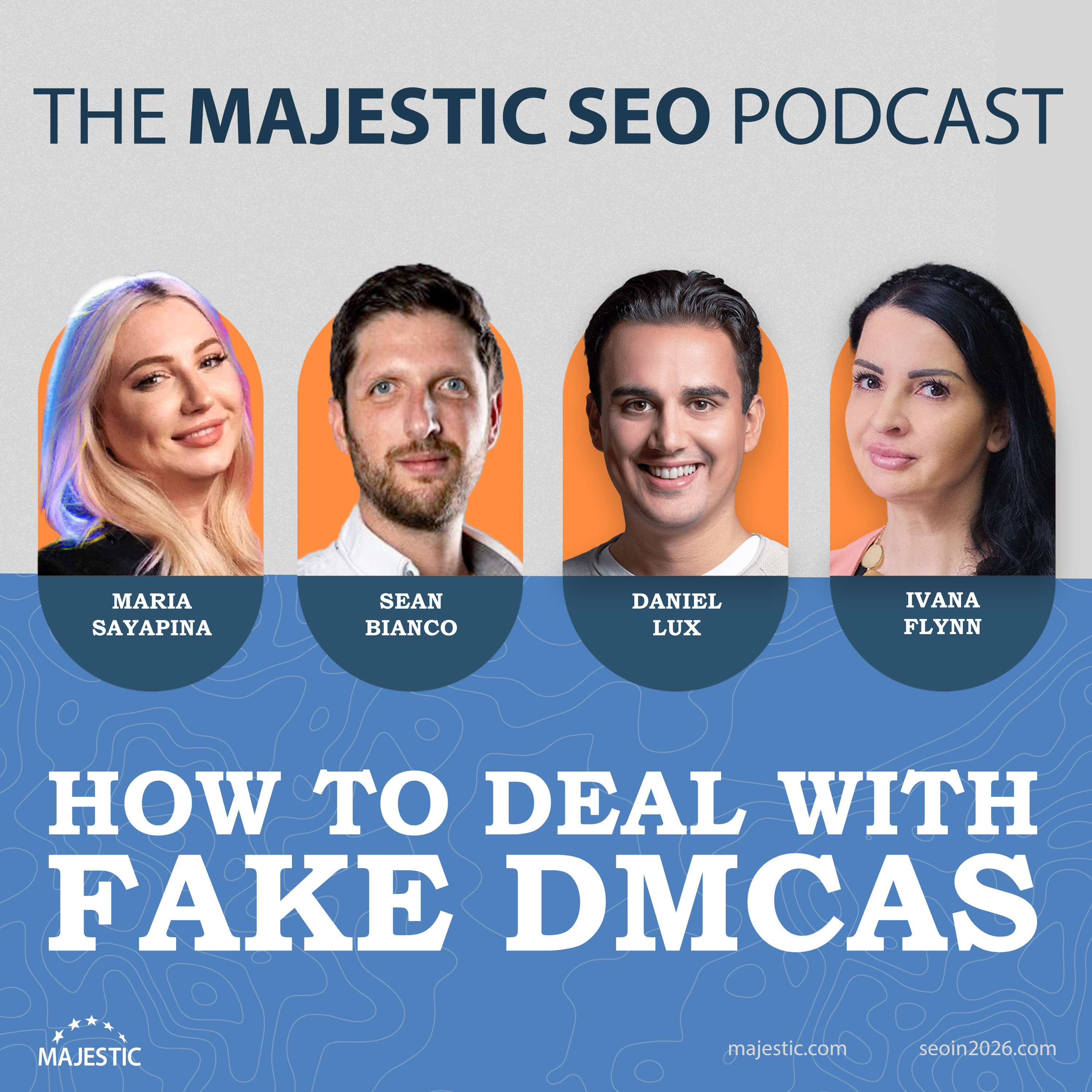
How to deal with fake DMCA takedowns used as negative SEO in hyper-competitive iGaming markets, including detection, counter-notice strategy, and prevention/mitigation.
Written by AI. May contain mistakes.
Ivana explains what a DMCA takedown is and its implications for visibility.
“But I think this is one of the hot ones recently.”
Discussion on the misuse of DMCA takedowns for competitive advantage.
“DMCA was originally signed in 1998 by Bill Clinton as protecting your digital work online.”
Panelists discuss strategies and tools to protect against DMCA abuse.
“Barry Schwartz recently published on DMCA.”
Sean highlights the alarming trend of using DMCA as an unethical SEO tool.
“And this is where things start getting problematic.”
The panel discusses how to identify the sources of DMCA attacks.
“for either defamation, which is even worse, or for copyright notices.”
Panelists share insights on how quickly to respond to DMCA notices.
“then for example via a lot of links that basically inject the negative signal into the backlink profile so Ivana who's really doing this is it competitors is it scrapers blackout agencies other people out there.”
Daniel introduces a tool developed to track DMCA notices efficiently.
“And if so, how do you identify straight away that DMCA notice has been filed?”
Learn about the challenges of dealing with DMCA notices and how the Lumen database functions.
“So we created a tool that actually finds all of the DMCA's and tell you page and tell you Lumen claim immediately.”
Explore how automated DMCA attacks can negatively affect site rankings and trust.
“So it was never intended for us as SEOs.”
Discuss the distinction between legitimate and illegitimate DMCA takedown requests.
“And it's also kind of made for the exhaustion at some point, I think.”
Learn strategies for effectively submitting counter-notices to DMCA claims.
“which is good because that's how the tool should be used.”
Learn about handling digital claims and the potential for automation in counter notifications.
“Okay, printed letters are not going to help you.”
Explore the complexities and challenges of dealing with DMCA takedowns in competitive niches.
“I think this part of the automization is very important.”
Discover how DMCA takedowns are being used as a strategic weapon against successful sites.
“But once you have 50, 60, 100, 1 ,000, 2 ,000 DMCA strikes coming at your brand every single day, there's no amount of protection that you can put into place to stop it from happening.”
Gain insights on strategies to mitigate the risks associated with DMCA strikes.
“It's something which is being used as a method of removing people from the search results.”
Learn how to quickly identify and address ranking drops due to DMCA notices.
“If, as an SEO, you see a sudden reduction in rankings and traffic, how do you quickly identify what has happened?”
Understand when DMCA issues transition from SEO challenges to legal matters.
“knowing what has happened to your page in Google.”
Realize how DMCA takedowns affect visibility solely on Google while other search engines remain unaffected.
“And then they are convinced they were not hit by it, even though you show them like, look, it's not working in Google.”
Hear final thoughts from the panel on actions SEOs can take regarding DMCA takedowns.
“you so shall we start off with Maria what's one thing that an SEO can do now to either find out more or action something in relation to DMCA?”
Learn effective strategies for dealing with DMCA strikes and negative SEO.
“stay one step ahead of the competition with, let's say, heavily guarded secrets when it comes to how to do SEO on hyper-competitive markets.”
Discover expert tips on how to protect yourself from DMCA issues and negative SEO.
“You can just find me on, so just go type in Sean Bianco on LinkedIn and you'll find me there quite easily.”

Get the gist, explore an idea or ask about something said.
 Claude
On The Majestic SEO Podcast, what are the key points of this episode?
Searching your listeningAutomatic transcript. May contain errors.
0:00How to deal with fake DMCAs.
0:07Hello and welcome to the August 2026 edition of the Majestic SEO panel discussing how to deal with fake DMCAs. I'm your host David Bain. Joining me today are four great guests. Let's meet them starting off with Ivana. Hello everyone, thank you for joining us. I'm Ivana. I am an SEO for many years and lately I feel like a paralegal because I deal with all of these fake DMCA's that we will discover today what they are and how to deal with them. Thank you for having me. Great introduction. Thanks for joining us Ivana. Also with us today is Maria. Hi everyone, thank you for having me. And I have been in iGaming affiliation for the last 10 plus years.
0:44And I think the last two years have been a lot about fake DMCA along other challenges. But I think this is one of the hot ones recently. One of the hot ones. Thank you so much, Maria. And also with us today is Daniel. Hello, I'm Daniel. I'm the founder of LinkSight and I'm a Blackout SEO expert. Wonderful. Thank you, Daniel. And last but not least is Sean. Sean Bianco, founder at Game Changer and iGaming SEO Boardroom as a co-founder. I work in the most hyper-competitive niches in iGaming, just like my friends over here. So when it comes to the stuff you have to deal with online, I think we're covering a good segment of the internet when it comes to hyper-competition.
1:26So this is going to be a fun one. Okay, sounds good. So if you're working on a hyper competitive niche, then obviously, as Sean was saying there, you need to be aware of all the grayish activities that can go on. Ivana, what is a DMCA takedown? Basically, somebody is after your visibility. DMCA was originally signed in 1998 by Bill Clinton as protecting your digital work online. It's a good thing. Somebody steals from you, you appeal, and they just take them down saying, hey, you stolen from someone. However, some clever SEOs with a little bit of twisted mind have decided to use this as a blackhead negative SEO attacks.
2:09And in our industry, because there's a lot of money streaming and, you know, being positioned one, two, three, it's really a real money. They started to use this to take you down. And how it works, they basically say, this is my content, submit it to Google through the Google form, and Google just submit. Doesn't have to act immediately. Currently, I'm recovering things that were submitted 9, 10, 11 of April. So this is how much of a queue we created. And then it just takes you down. They don't check if the claim is true. According to the US legislation, they need to take it down and the burden of proof is on you so if you want to be visible and indexable in google again which of course we all want to because this is seo then you need to go through the counter noticing process and providing evidence that you did not steal which is kind of very unsavory process but this is what we deal with and i gaming of course it's pruned to all of these attacks but we are not the only one and if you are paying attention to all of these you will see that search Engine Land recently published why DMCA's are here and why they are not disappearing, why they cannot go anywhere.
3:18Barry Schwartz recently published on DMCA. So they are everywhere and people are starting to pay attention. So I hope even with this podcast, Google will start to pay attention and somehow perfect the takedown process. Because currently the takedown process is I own the content and that's it. There is no check if you are a real person. There is no ID check. There is no business check. You can be anyone. It's super, super easy. If you are countering, you need to prove you are a real person. So I hope Google will. I know they cannot just disobey the legislation, but maybe they can take the takedowns to a level when it's a little bit more difficult.
3:57So Ivana, is there any likelihood that the burden of proof will shift and it'll be the burden of proof on the person that's actually trying to take the content down? Or is that not going to work either? I would absolutely love that. At least, maybe not burden of proof, but at least if they have to submit a real ID or business data that they are real. Because right now it's just they take you down within seconds and then you're losing revenue almost immediately. The takedowns for them are for free. And this is the big scary thing because negative SEOs come in different shapes and forms. We have links attacks.
4:31We have UGC links attacks. We have DDoS attacks, negative CTR attacks. And all of these are costly things. so you need to have a budget thousands of euros sometimes more when it comes to good d-dose attacks dmc is for free just takes a few seconds of your life little bit of your soul and backbone and then you're done you're taking someone's work down for no good reason just because you want to be more visible and you want to you don't want to do the hard work you want to take a shortcut really so that sounds like a great definition to me there as well um sean daniel maria is there anything that you'd like to add to what ivana was saying there in terms of um definition of what a dmc takedown is what i can add is that we have been using dmca tool for years before this right so we've been using it accordingly properly that it was working um it's not um it's a surprise to anyone sometimes people copy your content and we see a copied site and we would go submit and it has been used for years as a tool to fight copycats uh and it's just in the recent years i would say a year or two that started to unravel with the speed which is i think it started very slowly and right now it's just affecting absolutely everyone and i think the worst part of this is that you can do prevention there are ways and tools how to protect yourselves however no one can give you 100 % guarantee that you're protected and you're doing everything right even though you're doing everything right and I think this is one of the scariest things that you're doing everything right by the book but you don't know if that will happen to you or not and that's I think is is a very interesting position to be in.
6:14Sean you were gonna add something there yeah I think something which is scary but has to be dealt with is that there's a certain cohort of SEOs out there that are starting to treat DMCA is by definition as a tool in their toolbox. Right. And this is where things start getting problematic. So when SEO start looking at DMCA as a tool, which they can utilize all of a sudden, it goes away from the gentleman's game of, hey, I'm going to do SEO better than you. And this was also something that we all used to do. We used to meet outside at conferences or whatnot. And like, ah, you found the trick, which got you up to number one, right?
6:48On these hyper-competitive keywords. I'll get you next time. But now it's, and I hope, honestly, I hope that people watching this podcast never have to experience this in their niches because to an extent, this is like kind of encapsulated in hyper-competitive niches. But now it's also, it's become a game of, you know, very clearly automated DMCA strikes happening consistently at times when people are either asleep or they'll be busy or abroad. It's quite eloquent what's going on. It's basically been weaponized. And unfortunately, there are a cohort of SEOs out there that are starting to look at a DMCA notice for either defamation, which is even worse, or for copyright notices.
7:35They are starting to look at it like a tool in their toolbox, just like outreach was, just like content was, just like link indexation was and all of these other tools, which are, let's say, the tools that people fight by and live by and do a better job by when they figure something out. It got so bad, David, that in some cases, people are not even trying to counter the notices and they're just trying to find different paths towards getting their site indexed again, whether that's redirecting, double redirecting, free-diver, free-diver redirecting, canonicalizing. And something to mention also is that when there's DMCA strikes happening within your market, and if this is happening to you, it's quite easy to figure out who's actually benefiting from it, okay?
8:24Because you're going to be able – and it's quite easy to see the kinds of tactics which start being employed when this is happening. You start noticing that sites which aren't built for long-term gains, but are built to churn and burn, start coming up more frequently, right? because the people that are perpetrating these actions are people who are opting purposely for short-term gains because they know that they're going to be attacked by their competitors also. So, yeah, if I can just add something over here, it's a very scary scenario when you're in a market and this becomes proliferated and people start looking at it as a tool in their toolbox and not as something which is supposed to be used for its legitimate purpose.
9:04Daniel, what are your thoughts? Do you agree with Sean that it's getting for some industries, for some brands so bad that you almost don't have the resources to fight them and you actually have to actually find other ways to deal with it and maybe just ignore it to a certain degree? Yeah, yes. I mean, I agree. The thing here is that negative SEO existed for like all the time SEO existed, but DMCA takedowns made it a lot cheaper to perform negative SEO. So the asymmetry here of the attacker investing very little resources and creating a lot of damage on the brand side, for example, that basically made DMCA takedowns the number one negative SEO tool right now.
9:55So those blackhead SEOs that are malicious, that attack brands, they basically lean on it a lot because it's so efficient. so that's why we see it everywhere it's much easier to to take down a site via DMCA take down then for example via a lot of links that basically inject the negative signal into the backlink profile so Ivana who's really doing this is it competitors is it scrapers blackout agencies other people out there. How can you quickly identify who's doing this and what can you quickly do about it? We all know who is mainly doing it in our industry. And as well, if somebody writes about them, like Press Gazette, they send a DMCA takedown to the article that is written about them.
10:46It's not just to take your visibility, it's as well to stop spreading the truth. So there are people that are absolutely petrified that we know about this, that we know about their tactics. And when you talk about it, you become the attacked one. So yes, there is definitely not just one company, but one is very predominant in our industry. And others just figured out it works. So they are copying this approach. And as Daniel said, it's super efficient because if you do any other attack, like negative CTR, it takes time, it takes money. And the effect might happen, might not happen, might be a little bit.
11:22But DMCA's are immediate. They take your five pages down that make you money. You're done. Your revenue is gone. And you can see in the markets when you are working with a client and you are protecting them and cleaning their DMCA's and they suddenly stop. It's because the attacker usually take the position one, two, three. It's quite easy to see because they are persistent. So currently I'm working with a client morning, evening, morning, evening, new DMCA, morning, evening on the same pages. less you are visible, even if we restore it, of course, because sometimes the restoration can be very fast.
11:56We are able to do it within 12 to 24 hours. Not all the time. Sometimes it gets stuck in a system, of course. But because you are being de-indexed so many times, you're dropping and somebody else is climbing. And suddenly you can see the website being position one, two for the keywords that you are one, two. And the attacks stop. It's quite obvious that the attack can stop because they already took your money. they already took your positions so in the end if you know how this market works if you are keeping an eye on serps you know exactly who's after you how quickly do you have to deal with this because obviously um any time where your page isn't indexable then it's um could be crawled and google could think that this page isn't there anymore and doesn't want to rank it anymore um is there a certain amount of time that's safe to leave it or do you simply just have to deal with this as soon as possible.
12:50And if so, how do you identify straight away that DMCA notice has been filed? Now, this is a tricky one, because you need to act as soon as possible. I have a client and they left it for months. They were like, they were not paying attention to it because it was not their main pages. It was pages they didn't really care about. And they got like 500 pages de-indexed this way. Google is now thinking you are not countering, meaning you are actually stealing all of this content, they derunked all of the website. Like even if it's not your main keywords, you're going to be derunked. So you need to clean up almost immediately.
13:24And that is the problem. A lot of people still don't understand that DMCA's exist. They are just like, my pages are de-indexed and I don't know why. We are talking about it and spreading the knowledge more and more, but I have lots of clients coming to me with SEO questions. And in the end, they are DMCA questions. So we try to act as soon as possible. Now the detection of this, it's quite tricky because yes it is true that sometimes you get a notice in your google search console and you get this notice saying it says removals and we are taking this page down because this person or this company complained and this is the url and this is the lumen notice and that's done however this doesn't happen all the time many times your pages are disappearing and you don't know so you need to find why and you need to go through lumen which is a massive bottleneck so So that's why we brought in here Daniel, because he actually is a very clever person and he created a tool for it to actually find all of the DMCA's because we were all desperate.
14:20So we're like, let's work on this. So we created a tool that actually finds all of the DMCA's and tell you page and tell you Lumen claim immediately. I don't know how often it goes, every 24 hours, something like that. So you are informed and it comes to your email or Slack or wherever you want. So we had to build some because Google didn't give us that. So that's lumendatabase.org by the look of it. Daniel, would you like to expand on that? Yes. Yeah, sure. So Google has some kind of agreement with lumendatabase.org, I think, since early 2000s. And lumendatabase.org is run by, I think, some professor.
15:03I'm not sure which University, but one of the Ivy League. Harvard. Yeah, Harvard. Yeah. And basically, lumendatabase.org is a free service and has the, basically, the, is the only place where Google is publishing all the DMCA notices. Google also runs a Google Transparency Report, which also So it exposes, yeah, those takedown notices, but it's not complete. So if you want a complete view at everything, you need to go to lumendatabase.org and the website's quite sluggish and a pain to work with. So a lot of people complain about it because even like in the Google SERPs, if you have a DMCA takedown, you can see at the bottom of the page of the google search page you can see that google is referring to lumen notice ids so there's a very strong connection between google and lumen database log for those notices and if you want to for example see the notice details like the description or who filed it you need to basically go to the the link on the lumen website and to see more details you need to put in your email and have a capture etc and it's it's a very inefficient to work with especially if you're a target of like if you're really getting to like attacked and you have more URLs being down, it's very hard to work with it.
16:48And also, in general, why it was possible to build DMCA Boss, which is a tool that helps you getting notified immediately or, let's say, same day when URLs of yours getting attacked, which I built with Ivana. basically the why it's possible is that you do not need all the information to file a counter notice to get it basically processed and also approved. So you are not fully reliant on lumen database.org to do that. but still I think many people think that and also it's still something to be improved in my opinion that if you're getting attacked that you have to deal with such a website which doesn't feel like the user experience you get with Google products even though Google has some issues here and there with the user experience, Lumen database is far away from it.
18:01So, yeah, that's what I can tell you about this, David. If I may, Lumen was not built for SEOs. Lumen is based for researchers. So if you even want the API, it's for researchers only. So it was never intended for us as SEOs. That's why it's so buggy, because they don't expect us to attack each other every time and just flood them. So many times Lumen gives you like, oh, we have a problem. There's 503 error. this is this error because they don't expect that amount of traffic we are breaking it as we go and as we attack each other sorry to jump there i just wanted to give a little bit more um holistic view why link lumen database is not the best for us great ivana so i mean daniel also mentioned that um there can be so many pages attacked um and i was going to bring maria in here and just ask um kind of flood of fake notices function as a DOS attack on rankings and kind of even damage the whole domain's trust and not just single URLs?
18:59Yes. I think in one attack, because the DMCA attack is so automated right now, they are trying, it's so much easier to do, right, with all the AI and everything. So they're attacking everything that you can. So, and obviously not every submission is going to take down the site for different reasons. So they tried to flood you with a lot of information. Some will take down the pages, some might not. But that attack, I do think has a negative effect, right? You've been constantly bombarded with this. And you probably have to, if you're getting those messages in the search console, you get encounter notice which sometimes take as ivana said from couple of days to two weeks three months and this is this inefficiency also probably of the crawlability of the budget of google trying to crawl so obviously this is not healthy for any of the seo sites um things that can be done to prevent this right we have the dmca check that supposedly crawl your site and make sure that your content is correct.
20:08However, some of the issues, because a lot of these attacks, we're talking about DMCA right now, but most of the time they happen together. You have DDoS, DMCA backlinks attack all in the same week. So as you're preventing a DDoS attack, your DMCA check wouldn't crawl the site, so you're become vulnerable. So you really need to prepare and kind of be prepared to deal with this and prevent your crawl budget and make sure that you're allowing Googlebot to crawl and DMCbot to crawl whilst not allowing DDoS bots to. So it gets really tricky. And I think on top of all of this, so there are attacks that last for one day, two days a week, and then there are prolonged ones.
20:57Imagine you're being attacked for a month or two like this. You get exhausted. And I think this is where Sean was making a point where people just don't want to deal with this and they just redirect because it's one thing, I think, to deal with this for a day or two or three, maybe a week, two months of a constant attacks. You just want to give up, I think. And it's also kind of made for the exhaustion at some point, I think. Okay, Sean, obviously there are some takedown requests that are actually in good faith. What would you say is the percentage of requests that are actually in bad faith versus good faith?
21:34And what are the red flags that takedown is in bad faith rather than a legitimate dispute? I've never seen a legitimate dispute, so I can't talk about that. So, I mean, I just see and have to deal with all of the negative ones constantly and consistently. And I mean, thank God LLMs have guardrails, okay? Because if LLMs did not have guardrails, this would be 10 times worse than it is right now because everyone would be doing it, not just the few who've created potentially what I'm assuming are scripts to run this automatically. So I think something that needs to be noted over here also, which hasn't been discussed, is that this isn't something happening on some corner of the Internet that is limited to this corner of the Internet.
22:22I mean, I've seen billion-dollar brands get hit by DMCA strikes and be removed from Google's search results. I've seen people and I've helped recover people with Tivana who have been hit with DMCA strikes for six months and to Maria's point and to your point also David suddenly we're not ranking as well on other keywords when you lift everything and you lift them fast then all of a sudden not only do those pages that they've been removed from in terms of content start ranking but also other pages which they were not performing that well on start ranking also I mean, there are so many ways that DMCA can be used in addition to what I'm currently seeing.
23:05I would be scared to say it because I think if people get even more creative than they are now, God knows what could happen. Because there are ways where you won't even be able to deal with the DMCA strike in many cases, depending on how people attack a website. so i think over here it's important to note as maria said that if you do start seeing this in your industry um don't just go you're going to get exhausted okay um in our industry which is a hyper-competitive industry before it used to be a game of being better than everyone else now you also have to be not only good at claiming positions but you have to be equally as good as holding those positions not only from the dmca perspective but from every perspective okay So you cannot be an SEO expert anymore.
23:52You have to be an SEO and negative SEO recovery and identification expert. So that's like one point which is extremely important. Maria, you wanted to say something? Yeah, just to add on the legitimate attack, as you said, you haven't seen it. I actually recently, two days ago, I've seen UKCG filing a complaint for non-gun, promotional non-gunstop pages, which is good because that's how the tool should be used. And obviously you can see the difference of the quality of the submission as well. So when it's like automated AI submission, it's just like random, random site. You copied it from, I don't know, times.com or something.
24:36And then you see a proper way how it should work. There is UKCG submitting, why it's non-compliant, why it should be taken down. and it's like well it's actually the reason purpose for this tool and it should be working how it's supposed to be uh and i just hope that more of the legitimate takes down should be happening because to support your claim sean like there is other sides that should be taken down because they're not promoting the right content right so we need something like tool is just what's the filter who can submit uh like you know just creation of the jira tickets we need to have certain fields should be compulsory who is submitting the request can you identify yourself what is the benefit to your business and so on so forth not just fill up certain fields and you're done so just to kind of to answer David's question there are some requests that are working in favor however there's so little of them versus the other flood of what's happening with AI on automation So what are the ways to try to ensure that a solid counter notice is delivered?
25:43What are the key elements that are part of that? And what's a realistic timeline to get reinstated? I mean, Ivana, you mentioned that you've managed to get pages reinstated within about 12 hours or so. What's the average? What's a good aim in terms of time scale to get reinstated? And what are the key elements to incorporate as part of this counter notice? First of all, I want to say it depends on an industry I learned recently. If you are doing a counter notice outside of iGaming, it can be within an hour. I was amazed. It's like really because the queue of the attacks is not so huge. It was within an hour.
26:19I was like, wow, how did this happen? I just helped a friend with something. I was like, how did this happen so fast? Like, wow. For iGaming, I think realistically you can aim at the 12 to 24 hours if you are doing it properly which means you are using the correct url because people tend to go to wrong submission places it's there is a one long one with a question mark that you should use we can maybe put it under somewhere i'll send it to you um but people usually click on the one that is in the notices that come to google search console this one takes months for some strange reason so if you're using the correct one it's fast as well you are providing the correct data which means which url was attacked try to give them the lumen notice because if you don't give them the information there is an automation on the other end and they need to start to look into it if it gets to a human it takes months if you help automation to understand that your page is real and you provide enough evidence to to show them that you are online for five years with the same content then you are going to go through fast however people get emotional and people flood the counter notice with lots of information that shouldn't even be there, how many clicks they lost and how many impressions and how much revenue.
27:38And now the AI bot is completely lost. As you know, AI works with tokenization. Tokens cost money. If you make it that it can resolve it within 10 tokens, not 200 tokens, you win. It is the same thing. So we need to be super efficient. As well, I had a client and they actually created a very beautiful legal letter and printed it and send it to the headquarters of Google in Silicon Valley. This is a digital claim. You need to take care of it digitally. Okay, printed letters are not going to help you. I understood what they were trying to do. There was like really a legal appeal against their 25 or whatever pages that were attacked.
28:20It went nowhere. Then they came to me and within 12 hours we were back. So be efficient. Just give the absolutely core info. Don't waste the tokens. If you're wasting tokens, you are just making problem for the AI and making problem for yourself. I'm sorry, Ivana, just to clarify, are you saying that you can automate dealing with this and so you can use AI to do the counter notifications? I think you could. However, I do it manually, but I have like what I do every time. And I always check myself because I don't know how great automation is going to do. I saw people trying to do automation takes months.
28:56You could, but when I do it one by one manually, it goes faster. But I'm sure you can automate anything these days. Daniel, would you like to add to something? Automization, what you can do is that first of all, you need to be aware that you're taken down. I think this part of the automization is very important. So either you use our tool or you build one yourself where you basically detect that one of your URLs is de-indexed and has a notice, like a takedown notice in the Google SERP. So you can react to it. I think this is the biggest issue because there are brands out there that have like 10 ,000 URLs and they literally can't check them by hand.
29:40And so having a system in place that is covering the detection of an incoming takedown notice I think is key. And filing the counter notices if you have a good template. You can also basically structure it and use, for example, features like in Chrome, autofill and just do little adjustments and then get them sent to Google. So, Sean, obviously the best way to deal with something is to try and ensure that that thing doesn't happen to begin with. What can site owners do to proactively reduce their risk in this happening? Elements like, I guess, timestamping of content, different monitoring, watermarking, things like that.
30:32What would you say about that? the number one advice, don't be successful in SEO in a hyper-competitive niche. Just rank on page 10, right? Like the second that you rank on page one of Google, that's position one, you are like a wild pig and everyone gets out their guns and starts shooting at you. So this is effectively how it's working in hyper-competitive niches right now. If you do well, people are going to find a way to take you down. So you can prepare whatever you want to try and circumvent it. But once you have 50, 60, 100, 1 ,000, 2 ,000 DMCA strikes coming at your brand every single day, there's no amount of protection that you can put into place to stop it from happening.
31:14And there are different types of DMCA strikes also. I mean, we started seeing one which is hit like actually several ones which are hitting root domains, not only specific pages recently. I mean, David, people are even cheeky enough to do this. Well, let's say when they use their, let's say, nuclear warhead, specifically on the day of a Google update. So people start scratching their heads. How is it that I lost all of my rankings? I must be that I got hit by a spam update over here. So, yeah, I'm sure there are loads of best practices, but let's be quite honest. This is not something where best practices really apply.
31:53This is something which has been weaponized. It's something which is being used as a method of removing people from the search results. And in my opinion, you have two options. Either option one is you get really good at counter-noticing, dealing with the whole process that Ivana's been talking about at extreme length. So I won't go into that in more detail. So when it takes longer, how do you get it to go back to being short or how do you speed up the process as much as possible? And you have to accept because currently Google is not coming to save you. OK, Google is under an obligation as far as I'm aware, a legal obligation.
32:31And I think it persists specifically to the United States. It doesn't persist to the European Union, but we are suffering the results of it in the European Union. And there's nothing as far as I'm aware from a legal perspective that European Union entities can do to protect themselves against this, let's say, trauma. so this is something which is facilitated by Google, it's causing damage to your site and you have to get extremely good at dealing with it and if you are being attacked consistently you have to come to terms with the fact that you are going to be down every two days so you recover a URL, if you are in a hyper-competitive niche where there's money to be made in high-ranking keywords you're going to be up for two days, on the third day you're going to be down, then it's a game of cat and mouse where you go you recover it you're down you're up again for another two days and then you're done and it just keeps on going so you either have to play that game because google is not coming to save you at least not now google maybe this you can hear if you're listening to this maybe you should change something to make it a little bit of a better process or option number two is you change your strategy completely okay you go from a single asset approach to a multi-asset approach where you start learning how to do things such as authority funneling recycling of authority and you start ensuring that once you do get hit you know how to recover it and migrate your authority elsewhere and have multiple legs to stand on not just one asset so again david if you start getting hit by this in a you know non-competitive non-competitive environment as ivana mentioned you're going to be able to recover it really fast it's not a problem but then when you start getting you know automated hits the queue starts increasing things take way longer um as maria said previously it's either an endurance thing right and you start becoming an endurance fighter of a negative seo protection um or you you go on the attack not by utilizing tmca but you go on the attack by having a multi-domain strategy where if you do get hit you're always going to have one domain which is ranking instead of the other so seo was always about penguin panda pigeon hummingbird sean you brought in a game of cat and mouse and you also mentioned the fact that don't be a wild pig i think as well let's try and get one more animal in before the end um now one other thing sean that you did mention interestingly is that um some people will actually attempt a dmc takedown on the day of a google update and seo was really really struggled to determine what happened.
35:12Maria, let's bring you in again here. If, as an SEO, you see a sudden reduction in rankings and traffic, how do you quickly identify what has happened? I mean, it's quite easy, right? You just go to Google and check on the SERPs. I think right now, SERPs are your best friend. If you're not on SERP, you're out of SERP. So what can be done is you either got manual penalty, right, and you can check that with Google. you got DMCA, you check Lumen database. So I think you can know what happened pretty much instantly. And again, for if you're ranking position one, two, three on the top competitive keyword, you know it immediately something is wrong.
35:54I mean, you know, even if there are sometimes instances, something happens with Google, I've noticed recently, it's just we've been like down for a few hours. And like, you know, you know what clicks are going down that something is wrong. I think there was just a glitch. But yeah, you check the SERP, you check your manual actions, you check your Lumen database, and you know what has happened. I think it's pretty standard for anyone in the gaming industry to just go and check what's happening in the SERPs. Obviously, if you're ranking, I don't know, second page of Google and so on, it's much harder because obviously from getting a few clicks to de-indexing, you wouldn't see maybe that much of a big deal.
36:36But yeah, obviously, if you're ranking, you're seeing the drop instantly. It's right to the heart. So it's not a nice feeling, by the way. But then you deal with this, right? You go counter notice. You see if it's a manual action. You do all the steps. Another part is that we have had so many different things that has happened on top of that, right? DMCA even if you take down you see canonical redirects domain coming up there so it's it's it's a very interesting world we live in but I would say when it comes to DMCA you just go SERP check your SERPs for your keywords for domains and there are tons of the keyword ranking tools out there and I think sometimes they all show different results just get a good VPN and start checking the SERPs yourselves, I would say, or get data for SEO scraper and you know your keywords at whatever time you need to check.
37:35So SERPs and checking the SERPs is the best tool against knowing what has happened to your page in Google. Ivana, an SEO's job is getting broader and broader, isn't it? So when does this stop being an SEO problem and become a legal one? When the DMCA's became a real thing, which is, I first time heard of DMCA was January 2024. I I remember having a call with client and they were panicking and we together figure out what's going on. It's the first time I saw it. And then I saw a few, a few 2024. By now, I do it every day. I started to deal with DMCA's early March and ever since I'm dealing with it every single day.
38:13So I would say once DMCA became part of everyday SEO's life, then it became part of our job. And SEO is never stable. It's never, we do just links. We do just content. So we are very ready to take on a new challenge. I think we are the most flexible people in any industry. Whatever you throw at us, we will learn how to work with it. So it's not really a shock that it changed. For me, the shock is how effective it is and how much Google is allowing it. That this is happening is just a new form of negative SEO, as Daniel said. It was always here. Once it was more links, then it was more DDoS, then it was more this, then it was more that.
38:55But right now is DMCA, and I'm afraid they are here to stay because they are too effective, too cheap, and Google doesn't help. One more very important thing that I don't think we mentioned and people should hear, if you are hit by DMCA in Google, you disappear in Google. You are still visible in Bing. You are still Google findable in Yahoo or DuckDuck or anything else. This affects only Google search, okay, because it's submitted to Google platform. And people many times do not realize it because they see in their Google Analytics, for example, that the page is still getting traffic. And then they are convinced they were not hit by it, even though you show them like, look, it's not working in Google.
39:35In Google, you have this DMCA. But because there is still traffic, they get confused. So be aware that the page is still live. People can still directly go to it. They can still find it through other search engines. however you disappeared in Google and let's be honest Google is still the king of the SEO traffic for us let's finish off by getting everyone in the panel's views on what's one thing that an SEO can do now in relation to either finding out more information about DMCA takedowns or one action that they can take in relation to that and then just confirming who you are and where people can find you so shall we start off with Maria what's one thing that an SEO can do now to either find out more or action something in relation to DMCA?
40:17I think if whoever was watching this podcast on a good start, right, so they get an overview of what's happening, it's just if someone never dealt with DMCA, I suggest just go to Lumen database, check your domain, if there is anything there, learn about it. I think there are a lot of articles about it, but just educate why this is happening and why people are doing this, because really and truly the tool has been created to serve to remove certain content from the internet it's just been used wrongly um so lumen database double check what it is uh and i think this podcast is a good start rowan where can people find you maria they can find me working at find.com i'm working for a giving affiliation and dealing with the dmca request so uh or linkedin you know i mean we do a lot of podcasts and discussions, I think, in this group.
41:10And we have a lot of meetings outside and different conferences. So recently, DMC has been a big topic for us. Lovely. Thank you, Maria. And Daniel, what's the final thought that you'd like to leave the listener with and where can people find you? Yeah, so Google Search Console won't notify you always on time and even at all. So don't trust the Google Search Console for being notified for DMCA takedown notices. Check yourself, check your sites in the SERPs. And yeah, take control and don't just rely on trust. And people can find me on linksec.com and on LinkedIn. Thank you so much, Daniel. And also the same to Sean.
41:53Shameless plug over here, I guess, but we built the iGaming SEO Ballroom specifically for providing people information on how to deal with DMCA strikes, negative SEO, stay one step ahead of the competition with, let's say, heavily guarded secrets when it comes to how to do SEO on hyper-competitive markets. So that is iGaming, so IGAM, so iGamingSEOboardroom.com. You can go over there, click to join the waitlist, add your details. And there's quite a backlog, but if you're accepted, you'll get added to a private community of people who are dealing with this every single day and who help each other, let's say, get out of it.
42:34Thank you so much, Sean. And anything else and where people can find you? You can just find me on, so just go type in Sean Bianco on LinkedIn and you'll find me there quite easily. Thanks so much, Sean. And last but not least, Ivana. Ivana, what are your final thoughts and where can people find you? I would love to say that you can protect yourself with like DMCA.com. You can find pages being the index with DMCA boss and make sure that you allow archive. OK, if your pages are not in archive, your claim is going to be much more difficult. So those are my top three tips, how to stay safe and vigilant.
43:09And you can find me usually on my LinkedIn, unless it's attacked by the people that are doing the DMCA's because I talk about it too much. So if my LinkedIn is working, then it's Ivana Flynn. And I have a YouTube channel where I talk extreme amount on DMCA's and all the other negative SEOs. All of these people have been my guests. So that's iGaming SEO Boardroom. You will find it on LinkedIn, on YouTube. Hopefully on LinkedIn as well. but fingers crossed I don't get attacked again but that's like a DMCA on my persona so you know we have to live with that thank you for having me Crazy world, thank you so much for joining us I've been your host David Bain and you've been listening to the Majestic SU panel if you want to join us live next time sign up at majestic.com slash webinars and of course check out suin2026.com until we meet again bye bye for now
August's Majestic SEO panel discusses how to deal with Fake DMCAs. Joining David Bain are Ivana Flynn, Maria Sayapina, Daniel Lux and Sean Bianco. Talking points are as follows... What exactly counts as a "fake" or abusive DMCA takedown, and who typically files them — competitors, scrapers, black-hat agencies? What actually happens to a page's rankings/index status once a DMCA notice is filed — even before it's resolved? Can a flood of fake notices function as a denial-of-service attack on rankings, and does it damage the whole domain's trust, not just one URL? What are the red flags that a takedown is bad-faith rather than a legitimate dispute? Walk us through the counter-notification process — what does a solid counter-notice need, and what's the realistic timeline to get reinstated? What can site owners do proactively to reduce their risk (timestamping, monitoring, watermarking) and catch a filing early? When does this stop being an SEO problem and become a legal one — is Section 512(f) (penalties for false claims) ever actually enforced?
