In short
This episode of The Naked Scientist explores fungi from “fairy rings” in the field to real-world applications. In Grantchester Meadows, historian of mycology Dr Nathan Smith and Laura Verdina (president of the University of Cambridge Mycology Society) hunt mushrooms and explain that visible mushrooms are the “fruiting body” of a larger underground mycelium network. They discuss fairy rings: fungi grow outward in circles, and the ring edge marks where mushrooms emerge; ring size can estimate age. They also cover hyphae as thread-like cells, fungal enzyme digestion of cellulose and lignin, and mycorrhizae nutrient trading (plants provide carbon; fungi provide phosphates/nitrates), with fertilizers disrupting this symbiosis. Guest Joni Wildman (University of Bath) explains mycelium-based materials: growing fungi on waste (including engineered wood offcuts) to make low-energy, biodegradable insulation/packaging. Magnus Iverson (MycoMine) describes fungal bioremediation for oil pollutants and PFOS, using “biomatching” and microcube bioreactors, with biomass converted to biochar. Finally, neuropsychopharmacologist David Nutt (Imperial College) discusses psilocybin therapy for treatment-resistant depression: it activates 5-HT2A serotonin receptors, “turns off” depression-related brain circuits, and may produce lasting neuroplasticity after a single dose. Notable examples include parasol mushrooms, honey fungus, mycelium insulation panels, and diesel/PFOS cleanup microcubes.
Written by AI. May contain mistakes. Listen to the episode to check what was said.
Chapters
Tap a time to open that second in VOExploring Grantchester Meadows
1:01 to 2:15
Discussion about the location and the quest for fungi.
“to learn about the biology and applications of one of the largest and most intriguing organisms on the planet, the fungus.”
Finding the Right Spot for Fungi
2:15 to 2:57
Expert tips on where to hunt for mushrooms.
“society merch and earrings you didn't wear the earrings today and you we knew you who you were when you were coming from a distance Nathan because you've got two massive toadstools on your top.”
The Fascination with Mushrooms
2:57 to 4:10
Personal stories of how the guests became interested in mycology.
“like the place to go hunting what singles did out as a good prospect?”
Understanding Fungal Growth
4:10 to 6:06
Insights into how fungi grow and form structures like fairy rings.
“But what's the significance of the ring, Nathan?”
The Fungal Network Beneath Us
6:06 to 6:41
Exploration of the hidden mycelium network that supports fungi.
Fungi as Decomposers
6:41 to 7:37
How fungi break down organic matter and their role in ecosystems.
Symbiosis Between Fungi and Plants
7:37 to 11:03
Discussion on the mutual benefits between fungi and plant roots.
The Communication of Trees Through Fungi
11:03 to 12:06
How trees can communicate through fungal networks.
Identifying Edible versus Poisonous Mushrooms
12:06 to 13:55
Guidance on how to distinguish safe mushrooms from toxic ones.
The Versatility of Fungi: Transforming Waste into Materials
14:00 to 20:30
Learn how fungi can create biodegradable materials for construction and packaging.
“As Nathan was explaining, fungi form what's called a mycelium, which is the network of interconnected cellular threads that run through the soil or whatever the fungus is growing on.”
Show all 16 chapters
Bioremediation: Fungi to the Rescue
21:46 to 28:01
Explore how fungi are used to clean environmental pollutants through bioremediation.
“And we're really grateful to those of you who are supporting us.”
Enhancing Fungi's Capabilities
28:01 to 29:00
Learn how fungi can be trained to improve pollution degradation without genetic modification.
“So are there ways to tinker with them to beef up what they're capable of doing and therefore get much improved performance and do cleanups faster?”
Psilocybin Therapy and Its Mechanisms
29:00 to 30:38
Discover how psilocybin therapy works and its effects on the brain.
“This is the psychoactive chemical that's found in magic mushrooms, and Imperial College neuropsychopharmacologist David Nutt has been putting these chemicals to the test for real.”
Understanding the Effects of Psilocybin
30:38 to 33:11
Explore how psilocybin interacts with serotonin receptors and impacts mental states.
“Indeed so tell us about that when when someone consumes psilocybin what actually happens where does it go what does it do how does it exert the effects that it does?”
The Therapeutic Potential of Psychedelics
33:11 to 35:46
Learn about the therapeutic effects of psychedelics on conditions like depression.
“It tends to be that in people who've got a lot of stress, distress, anxiety, depression, addiction, that the trips tend to be challenging.”
Long-Term Effects of Psilocybin Treatment
35:46 to 36:49
Understand how psilocybin can lead to lasting changes in mental health.
“So people are basically more, they're freed from the constraints that the depression has put on them, often for decades.”
Transcript
Automatic transcript. May contain errors.0:00Who says Halloween only lasts one day? With Wayfair, one night of Halloween becomes a whole season at home. From larger-than-life yard decor and moody lighting to festive accents for every room in the house, Wayfair has what you need to make Halloween feel like magic all in one place. Because the best Halloween memories aren't made in just one night. They're made all season long. Shop Halloween decor now at Wayfair.com.
0:46Hello and welcome to The Naked Scientist, the show that brings you the biggest breakthroughs and talks to the major movers and shakers in the worlds of science, technology and medicine. I'm Chris Smith and today we're heading over to Virginia Woolf Territory in Grantchester Meadows to learn about the biology and applications of one of the largest and most intriguing organisms on the planet, the fungus.
1:22well it's a smashing evening i'm out here on grantchester meadows by the river cam and the reason i've come out here on this wonderfully warm evening is to go looking for fungi and my partners in crime on this venture were going to help me do this. I'm Dr Nathan Smith I'm a historian of mycology mycologist based in Cardiff. Welcome Nathan and you popped in all the way from Cardiff to come and see us. Yes well actually I'm teaching a fungi course at the Botanic Gardens in Cambridge later this week and it was an excellent opportunity to come to a little bit earlier. And was there mushroom in your schedule to fit us in?
1:58Oh for fungi always. and my name is Laura Verdina I am the president of the university's mycology society and I'm also an enthusiast of mushrooms but not an expert well you both dress for the occasion I'm really impressed actually you've got a mushroom top on I mean is that the society top no I've got separate society merch and earrings you didn't wear the earrings today and you we knew you who you were when you were coming from a distance Nathan because you've got two massive toadstools on your top. Yes you always got to advertise the good news that is mycology so it's always a good excuse to dress up.
2:33Is this a good place to come? You've brought us to Grantchester Meadows, you're our mushroom hunting guide Laura, is this a good place to find them? Well you can definitely find mushrooms here, I take the society here every year. There are definitely great places around Cambridge, there's Thetford Forest, Wandelbury as well is a great place and Grantchester is just one of the amazing fields to look for mushrooms in. What are you looking for when you're thinking yep that looks like the place to go hunting what singles did out as a good prospect? Either somewhere which has an open field or somewhere with lots of dark spaces you know damp places lots of trees as well can be a good place to look or any fallen log.
3:13You didn't tell me why you got interested in mushrooms in the first place? Well my parents used to take me on hikes and though I didn't really like the hiking bit the way I stayed you know entertained during these hikes is by looking for mushrooms the first one I ever found was this massive clump of honey fungus and I was just like wow this is like an amazing massive gathering of mushrooms like how has this happened and so I got intrigued by that I started reading about mushrooms and ever since then I've been looking for them on any walk I've been on how did you get into it Nathan I really fell into it so I started off a real interest in like antimicrobials obviously these are produced by fungi and from there during my time at Cambridge I kind of became more involved in like field mycology and just seeing fungi all around.
3:57I think it's something I always find really interesting that with fungi there's probably a new species within 100 meters of you wherever you are in the world and that that's really kind of captured my interest. Right we're going to put your skills to the test then Laura you've got about 60 seconds to find us some mushrooms you up for it? Yes let's go. Go on then lead the way. but where are you taking us? so I'm taking you into a sort of underpass with lots of dark trees as I said it's a good place to look for if you're looking for mushrooms go somewhere dark and dingy
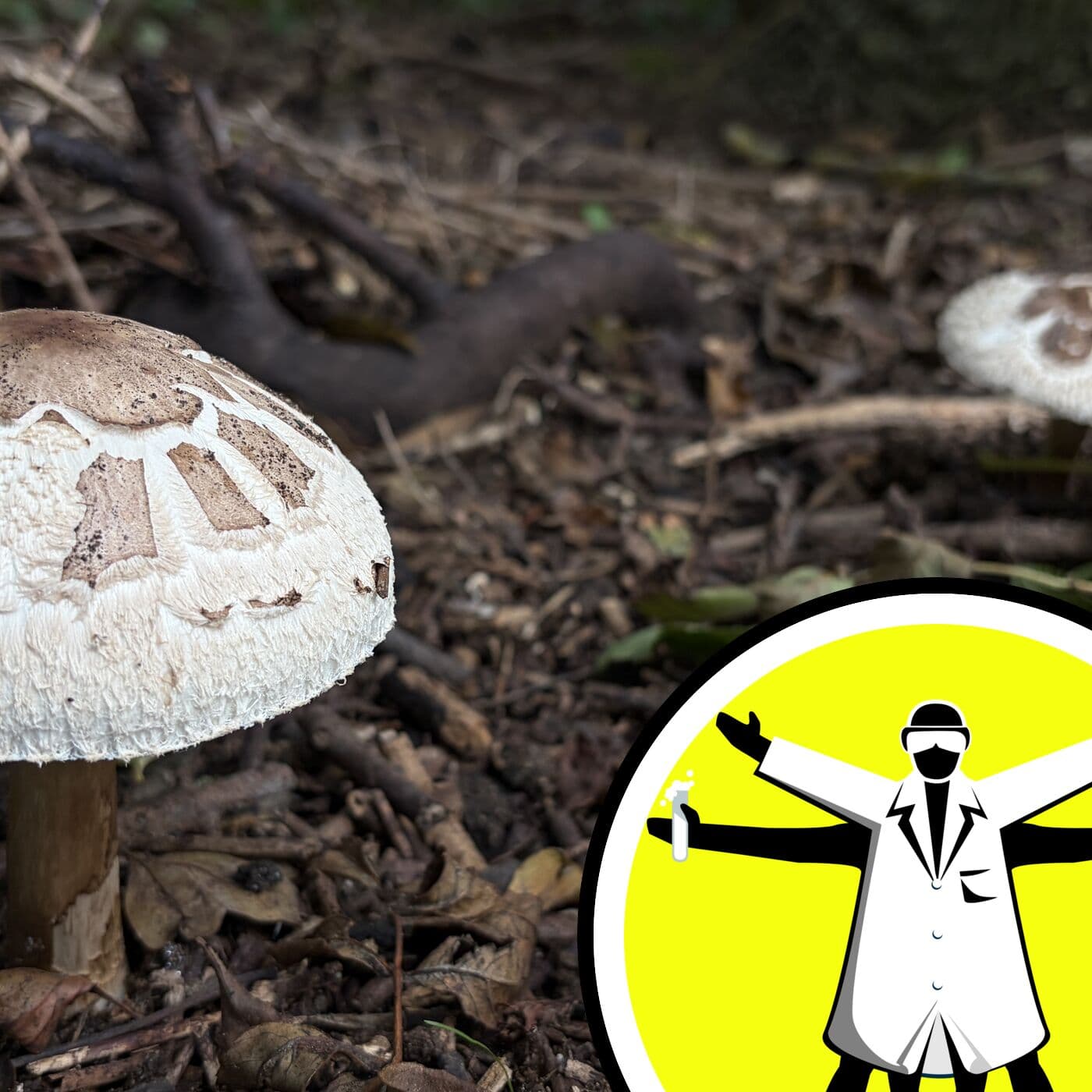
4:33well this is lots of trees you're dead right there and obviously that's making it darker off the track lots of fallen leaves is that helpful always always look through the leaves like through any grasses as well a lot of the time fungi are hiding so you have to really look for them oh da da wow okay tell us what we're seeing so i believe these are a type of parasol mushroom i think they're that because of the sort of umbrella shape that they make with their cap and they've got a sort of scaly marking on the cap as well laura's brought us into a sort of clearing surrounded by pretty tall trees lots of leaf litter branches that have been stacked up and a big ring of these white mushrooms they're probably about five ten centimeters across these ones um they are in a ring is that significant you tend to find a lot of mushrooms form sort of i think they're called fairy rings i'm not actually sure why they form these rings but it's really interesting when they do i've heard that there's a lot of sort of mythical legends that are associated with stepping into the ring.
5:41But what's the significance of the ring, Nathan? So in terms of biology, fungi kind of grow outwards in a circle and where the mushrooms come up is right at the edge of their growth ring. So like as they grow out, this ring gets wider and wider and wider. And it kind of shows you a little bit of quite interesting things about the fungi. So you can estimate the age of the fungus, if you can measure the ring. And then as Laura mentioned, you've got these fantastic folktales kind of linked to the disturbances it causes. So as fungi are growing they're breaking down nutrients and so you can even see fungi rings when there are no fungi where you see like a richness of grass so perhaps if you walk around you might see like a rich dark green circle of grass and that's a sign that there's some fungi under the ground they're kind of breaking those nutrients and helping feed the grass around them the mushrooms we can see then they're only one small part of this thing there's a much bigger entity here and the mushrooms are just one visible part of it yes it's something that i um always like to describe it as like the mushrooms are the apple of the tree the apple of the fungal tree and below here is a high full network kind of spreads below the soil extracting nutrients to produce this this mushroom which is the fruiting body it's the apple it's where the mushroom seed or spores are so talk me through that what is going on under the soil then if i were to take a sample of the soil underneath where this ring of what laura tells us parasol mushrooms are growing what would i see in there so if you you to look at the soil itself you may actually not see that much at all but if you look closely you might see like these thin white threads of what we call hyphae which are the main body of the fungus and these are long networks often they're multi-nucleates they are weird cells it's probably the best way of saying it we're very closely related to fungi fungi are closely more closely related to us than they are to plants but they're also their own quite distinct and quite magical creatures.
7:32So there's like a spider web of these threads ramifying through the soil these little thin fungal threads. Yeah and that's a really good way of saying it like no spider web so you know spider silk is famous for being nice and thin and mycelia are also thin which means they can really penetrate quite deep into the soil a lot more efficiently than roots. And how big would the fungus be if it's all one organism then presumably if it's if these are just long cells their extensions of cells that must be huge then that organism so here we can see it's we've got quite a nice uh record because you've got the ring we can see that the organism itself is about the size of the ring it's about a meter across oh easily yes and depth they don't tend to go too far down into the ground they tend to be on on the upper levels of of soil because that's where a lot of the organic matter is that they can break down and digest how are they doing that how are they leaves and gets its energy from the sun these are completely white and you're saying they're just like the apple of the tree all the actions going on underground so what's it living on so for parasol mushrooms they're they're decomposers they're breaking down what's around them and quite interesting here this ring of parasols is buried under quite a large pile of sticks and so they're breaking those downs and nutrients from there releasing into the soil and they're sucking them up and the way that fungi digest is they kind of excrete the enzymes outside of themselves they break these materials down they take it back in and plants aren't easy to digest they've got two big chemicals they've got cellulose which is in all plants they've got lignin which we can think of as the woody chemical it's the thing that makes things woody and fungi are excellent digesters of both so they'll be breaking those down extracting the carbon primarily from that they'll be getting the phosphorus and nitrate from the soil itself what happens when that fungus meets one of the other dwellers of the soil whether that's the roots of a tree or another fungus so when it meets a fungus it engages in a form of combat so the the same mechanism that excretes these enzymes to digest it can also excrete chemicals to attack this fungus and kind of like form these boundary lines so sometimes people walk by by tables see these lovely patterns in the tables they have and those are the the fungal combat zones between two wood fungi that are meeting and attacking.
9:51Now this is a decomposing fungus but other fungi form what we call mycorrhizae, myco meaning fungus, rhizae meaning root and these fungi form symbiotic relationships, intimate relationships with plant roots. What does that comprise? What does it involve? So essentially the fungal hyphae kind of wrap around or wrap inside depending on the relationship and that allows a market of exchange whereby the plant as you mentioned produces photosynthate so it's carbon drawn from the sky and it has lots of that and it can trade that with the fungus for phosphates and nitrates which the fungus is better at getting from the soil intriguing so the fungus is using its biochemistry to rot stuff down get nutrients and then it trades them with a plant for other things it can't make or can't get so easily.
10:43The plant gets the things it can't get so easily. The fungus gets something out of the equation and everyone's a winner. Well, often yes, but what it comes down to is the plant has carbon. It's always going to have carbon. It's trading something that doesn't matter. The plant produces so much carbon that it has excess and it can trade it away. The fungus really does need it. And there's some quite interesting studies where if you put fertilizers into the ground, one of the things that happens straight away is the symbiosis ends because the plant can access these fully accessible phosphates and nitrates it doesn't need the fungus anymore and it can cast it aside interesting so by fertilizing soil we're making it less fertile potentially because you're destroying that natural marketplace in the soil that would feed the plant exactly and that's a core bit of research as we look to kind of adapt ourselves to a changing world a more climate variable welds we're going to need to rely on these relationships a lot more and actually these symbiosis are susceptible to human intervention and particularly fertilizers make what a wonderful phrase yeah it is making it less fertile in the long run and do the plants therefore trade through the fungus because i'm thinking if you've got one tree here and another one a few meters away over there their their roots might not be in direct contact but they are in contact with the same fungus so is there a potential for one tree to talk to another through this fungal network oh you've heard the most controversial aspects of mycology and the answer is yes in the sense that one fungus connects itself to multiple trees and each tree connects itself to multiple fungi and there is the potential for communication to occur through there what's also particularly interesting is that there's the potential for kind of cheating and like robbing the bank if you will and some plants have evolved the strategy to kind of smash and grab it's an amazing world isn't it absolutely stunning absolutely fascinating i can't get over how lovely the evening is for you know mid to late september and it's just stunning it's been really warm and the sun's just going down birds are flying around and there's the odd person walking around just beautiful one thing that's always intrigued me is why is it that i can eat some of these things quite safely but some of them I definitely can't well fungi are a whole kingdom in the same way that you can you know eat some snakes but you know eat some snakes I suppose if you wanted to or but you know there's some frogs that you shouldn't eat some fungi have evolved defenses to prevent themselves being eaten and that can include chemicals that are poisonous or chemicals that cause other effects but are designed to be poisonous to other creatures other than us how do i tell the difference is there an easy rule of thumb what i can eat and what i shouldn't i i would say the rule of thumb is that only eat something that you're confident in what it is so there's about six species in the uk that will kill you out of 16 to 18 000 so it's good odds i'm not going to take the chance though no no no and it's it's the problem is that these the the species that are poisonous are often quite quite abundant and so it's one that always double check and only eat what you're comfortable eating there's some fantastic guidebooks that will kind of like set you on the right path mycologist nathan smith so there's a lot more to a mushroom than just that potentially tasty thing we pick and cook essentially it is only the tip of the iceberg because most of the action and the bulk of the organism itself is actually beneath the surface.
14:24As Nathan was explaining, fungi form what's called a mycelium, which is the network of interconnected cellular threads that run through the soil or whatever the fungus is growing on. But this structure can actually be exploited to stitch substances together, making new materials with all kinds of exciting properties. One growth area is in the building, packaging and even textile industries, where fungi can turn waste that might otherwise end up in landfill into biodegradable building materials that can replace inorganic insulation, plastics and even polystyrenes. Laura Verdina, whom you just heard taking us to find some fungi out in the Grandchester Meadows, has been hearing from Bath University mycologist Joni Wildman, who's doing just this.
15:07When fungal mycelium is grown on organic matter, that network will grow through it and through that colonisation and the digestion processes of the fungi, it forms a natural adhesive which then will bind it together and this happens in nature but if this is then done um as i've been doing within say a panel shaped container then once the mycelium has grown through that material you've put in there you're left with a solid material which is called a mycelium-based material and this can be removed and dried to give a non-living panel with properties which are similar to a slab of polystyrene. So part of my research has focused on how we can make this process of making materials using the mycelium work using more complex waste materials that otherwise have limited recycling options.
16:08So I looked to the construction industry itself for a waste stream to use and one challenging material is engineered wood products these are products like oriented strand board and it's essentially bits of wood which are stuck together with sometimes quite nasty adhesives which mean that it's hard to recycle or degrade and sometimes can be quite flammable or other bad things associated with it so I took offcuts of it and managed to grow my fungus on them to successfully produce these mycelium-based materials. I'm sure they were good at insulating and had the potential for a lower carbon footprint than both conventional insulation and then mycelium-based materials that may have been with these other organic materials.
17:02Why did you decide to choose fungi as the solution to this problem? Fungi are great at digesting things, and I think that's the key thing with making these materials. They do this all the time in nature, breaking down complex organic molecules like lignin and cellulose in wood and recycling that back into ecosystems. And so it's this digestive capability that underpins how fungi can transform these different waste sources into new materials. Why is this more sustainable than traditional methods to make materials like this? Energy inputs to making this are really quite low. You can even make them at home.
17:46The raw inputs in terms of waste materials make them sustainable too. whereas conventional insulation materials things like expanded polystyrene they're plastic-based fossil fuel derived materials and therefore they're depleting finite resources the organic nature of these mycelium-based materials makes them circular and therefore compatible with circular-based economy principles what are some of the applications for these mycelial materials my focus is using them as insulation materials in homes but it's also been shown that the mycelium can be fire retardant which is obviously a really important property for a construction material they're relatively easy to produce beyond construction they have applications in packaging and textiles particularly they're great for replacing polystyrene packaging very cool because in some cases it could be used as packaging and then you could directly compost it after use.
18:52Mycelium materials also have been shown to be good as leather alternatives. There are companies that have made mycelium shoes, bags, watch straps and all sorts. I think one mycelium leather handbag went for almost£5 ,000. So could you see this and other mushroom-based materials being used widely in the construction industry in the future? I do. And steps are being made in that direction. There's pilot projects which are taking place by some really cool companies that have production of mycelium-based insulation panels really starting to scale up. There's really exciting potential for low-income countries because as I said they're low energy to produce you don't need expensive machinery to produce and they're quite quick to produce or in disaster relief as I said because those benefits of needing little energy and you could potentially use local waste streams to make these materials quickly and on site.
20:01Do you need to be somewhat realistic though and understand that replacing conventional construction materials will be tough. I think as a society, we're just pretty addicted to plastics in general. So if we can make a small cut in those unsustainable options and replace them with these mycelium-based materials, then that would be fantastic. Joni Wildman at the University of Bath. So you're not worried about hosting the whole family for the holidays? Why would I be? Wayfair had everything I needed to get the house holiday ready. What if Mike brings his cheerful dogs? My tree has tons of five-star reviews telling me how sturdy it is.
20:47But what if everyone's plus one brings a plus one? We'll see how extendable this extendable table really is. And extra chairs are on the way. Okay. What if there's a blizzard and everyone has to sleep over? Ready to go with extra bedding and towels. From guest-ready essentials to holiday decor you can trust. Wayfair delivers.
21:27This is the Naked Scientist podcast with me, Chris Smith. and today we're exploring the magic of mushrooms and their alternative uses. And if you are enjoying the programme, then do please consider supporting us over at nakedscientist.com forward slash donate. We've made it really easy to do. It's extremely safe and secure, but it does enable us to keep making the world class shows that we do every week. And we're really grateful to those of you who are supporting us. We've heard so far how fungi operate and how they use their biochemical toolkit to turn trash into treasure, like low carbon insulation and readily recyclable packaging materials.
22:03But their abilities don't stop there, because fungi can also be used to clean up the messes we've made. This is a process called bioremediation, and Magnus Iverson has founded a business called Mycomine, which won the 2023 Fungi as the Future Award for its breakthrough technology. Mycomine is what we call a bioremediation company, which means that we develop and provide biological solutions to treatment of different kinds of environmental pollutions. And we work mainly with oil-based pollutions, such as fuels, etc., but also more complex molecules like PFOS, the forever chemicals, pHs, and so on.
22:48And you use specifically fungi to do this? Yeah, we work mainly with fungus and we have over the years built up a biobank of different kinds of fungal isolates or fungal species that are specialised to different kinds of pollution. So if you, for instance, have the problem with diesel in water, then we have that specific fungal strain here at our biobank that we can use. where do you find them in the first place how do you just happen to have a fungus that can eat diesel we have over the years collected a lot of different type of fungi from polluted sites so we have been at refineries mines brownfields deep in the oceans in all kinds of extreme environments but also very very polluted environments that's where we find our fungi.
23:46And how do you actually use them? So if I had a problem if I had a diesel contaminated site and I came to you and said I need to clean this up what's the approach? So first we do something we call biomatching which is basically just a screening of the pollution and different fungal strains to find the most optimal one. But then we design and construct and install a treatment plant. We call it microcubes. It's basically a container-based system in which we have bioreactors. And in these bioreactors, we introduce the fungi and we start the cleaning process or the degradation process of the specific pollution so if it's water that is polluted we pump it in into our bioreactors and the fungi get into contact with it and start to break down the chemical bonds and the pollutions what do you do with the fungi because are they safe at the end of that because i can see if you've got something that the fungi break down into just harmless material and make more fungi that's fine but if they're consuming something that may remain toxic you might end up with a large amount of toxic fungus so although it's all in one place it's still toxic so how do you handle that so the good thing with fungi and other microbes as well is that when they break up the chemical bonds in these pollutions they sort of neutralize the pollutions and make them not dangerous at all anymore.
25:19So basically you can you could look at it as they are picking out the different types of carbon atoms from these very very dangerous molecules and they build new cells. So there's nothing harmful left in the fungi after the process. It's completely environmentally friendly. So the biomass that we get out of the process can be used for soil improvement. We usually turn it into something called biochar, which is a way to basically bind the carbon for a very, very long time in a material that you can use for soil improvement or in different industrial processes we are also looking at using the fungi or the biomass for biomaterials so for instance making insulation of it or acoustic plates or something like that so it's a very useful product that comes out at the end of the of the bioremediation process I was wondering about things like remediation of arsenic in groundwater, lead, cadmium, heavy metal poisoning, especially around mine sites and things like that.
26:35Does that not end up in your fungus as well? yeah that's a good question um i we mainly work with um hydrocarbons or oils as i said and that is a process where they basically degrade it but when it comes to arsenic and lead and metals elements in general um that is a slightly different process because they you can't obviously break down metals they will remain as they are but you can transform them into another compound. So in that case, there's an extraction process where we have a polluted material, a polluted water, for instance, where the fungi can extract the metals out of it and they can enrich it in something called a biomineral.
27:25So that is what we usually call micro-mining or bio-mining. Basically, the fungi can take metals from one place and enrich it into another place. And that end material can then be taken away from the water or from the biomass and used for either hazardous waste or you can actually maybe recycle the metals if the volumes are big enough and the concentrations are big enough. Can you evolve your fungi? Because obviously you've gone to places where the fungi are naturally there already, but that doesn't mean they're as good as they could be. So are there ways to tinker with them to beef up what they're capable of doing and therefore get much improved performance and do cleanups faster?
28:10Yes, we have taken the decision. We will not modify them genetically, GMO, because that involves a lot more bureaucracy and restrictions on how we use the fungi. But we can sort of train them, which means that we expose them for high amounts of pollutions over time, which leads to, I would say, a biological adaptation, both when it comes to they sustaining in the pollution, but also increasing in the degradation process. So we can definitely increase their capabilities of degrading different kind of pollutions without making too much of a genetic modification in them. Really clever stuff. Magnus Iverson at MycoMine there.
29:00From industrial cleanup to mushrooms in medicine now, and one of the approaches showing great promise for cases of treatment-resistant depression, which affect about 30 % of people with mood disorders, is psilocybin therapy. This is the psychoactive chemical that's found in magic mushrooms, and Imperial College neuropsychopharmacologist David Nutt has been putting these chemicals to the test for real. But why, I wondered first, do fungi make substances capable of altering the way our brains work in the first place? There are two theories. One is that this stuff's aversive, so when mammals come along and munch on the mushroom, they have a trip which is so bizarre that they don't want to come and eat more mushrooms.
29:42the other theory is that maybe some animals like it so they go and munch and then maybe spread the spores of the fungus further i suspect it's more a deterrent than attraction though indeed because lots of plants do actually make chemicals that are reversive they put things off of eating them garlic does that onions does that it's to deter herbivores and we're just the exception and then you've got other plants that make caffeine for example and make insects remember through the caffeine effect where those plants grew so you you do see that effect in nature so it wouldn't be a total stretch to say fungi are doing something similar well i know i think fungi were there way before plants in evolutionary terms some people think they're the beginnings of the first nervous systems and of course nervous systems connect through neurotransmitters of which serotonin is one of the oldest of the neurotransmitters and of course psilocybin the active ingredient in magic mushrooms targets a particular subtype of serotonin receptors and that's how it produces its effect.
30:38Indeed so tell us about that when when someone consumes psilocybin what actually happens where does it go what does it do how does it exert the effects that it does? So psilocybin interestingly is a pro-drug it's a very stable molecule it's only activated after it's taken into a body so it gets into our body and then it's broken down and then you have a thing called It's psilocybin. Psilocybin floats around the blood, gets into the brain, and then it starts stimulating a particular subtype. There are at least 16 serotonin receptor subtypes in the brain, and they do different things. But the one psilocybin particularly stimulates is the 5-HT2A receptor, the serotonin 2A receptor.
31:17And that is highly expressed in the cortex of the brain in the most recently evolved parts of the human brain. So psilocybin disrupts the very high level processing of the human brain. Therefore, if it's activating that receptor, it's basically pretending to be serotonin as far as your brain's concerned. That tips the balance as though your brain is awash with a lot more serotonin than it would normally be. That's a great question. And the way to answer that question, of course, is to block those receptors. But if you block those receptors, you don't get a great deal of effect. In fact, I was a volunteer for the very first blocker of those receptors 30 years ago.
31:58It didn't do a great deal. So we don't really understand why the brain has so many of these serotonin receptors. But what we know categorically is that psychedelics work on those brain regions. How does the effect get terminated? Once there's psilocins in the brain and it's locked onto those receptors and it's producing those effects, what brings the effect to an end? It washes out, basically. The interesting thing about serotoninic psychedelics, of which psilocybin is perhaps the most common example, but there are others like DMT, dimethyl, tryptamine, there's LSD, of course. Their effects are terminated by clearance from the brain.
32:36And in fact, your comment about being locked in applies particularly to LSD, because the strange thing about LSD is it's a very big molecule. and it gets into the receptor slowly but when it gets in the receptor kind of closes it little lid it closes and locks the lsd molecule into the receptor and that's why lsd trips last for 10 12 20 hours whereas psilocybin trips last for four to five hours because it washes out and when people talk about bad trips what's happening there a bad trip is a trip that you don't enjoy and a good trip obviously is a trip that you do enjoy and it's a really important aspect to this whole field, which is the content of the trip is completely unpredictable.
33:17It tends to be that in people who've got a lot of stress, distress, anxiety, depression, addiction, that the trips tend to be challenging. People often go back to traumas and that may be why they're therapeutic because even though you have a challenging trip, most people say they get benefit from it. And how did it emerge that when people have these experiences that there might be knock-on effects for conditions like depression and anxiety. How did that come to light? The rediscovery of what you might call the therapeutic value of psychedelics for mental illness, it came from our work at Imperial where we did the first brain imaging studies of psilocybin and showed, to our surprise, completely the opposite effect of what we predicted.
34:01We found, strangely, that psilocybin didn't actually turn on the brain, it turned off the brain, and particularly it turned off parts of the brain which drive depression and that's why we did the first depression study because we thought we could potentially turn off the depressed centers in the brains of people who were depressed because obviously the original experiments we did were in normal healthy volunteers who weren't depressed but you still turned off that brain circuit you're finding now though that you can shake people out of almost almost like an entrenched depression people with treatment resistant depression seem to respond quite well to these chemicals and they get an effect where they get relief for much longer than the chemical is in their brain we can we can pretty much prove that can't we so why should there be an effect then that persists after you stop taking the drug you take it once for a period of time then you get this relief that endures how so this is truly a paradigm shift in the treatment of mental illness uh how it works is still a subject of some research and And of course, actually, just to be clear, the research is very difficult to do because these drugs are still illegal.
35:09So there are very few places in the world that have licenses to study these drugs. But we're fortunate we do have them. And our current thinking is that there's a sequence of activity. So the first thing is that during the trip, the underlying thought processes, which are often, as you said, deeply entrenched, get broken down. so people for a period can think differently and they can feel released from the ruminations of repetitive negative thoughts that underpin a disorder say like depression but then afterwards their brain the brain is in a more flexible state it's called a state called neuroplasticity and we can measure this very easily in in pre-clinical animal models we're trying to do that in humans but there's no reason to suppose the human brain isn't the same because the the ability for people to think differently persists long after the trip and that is partly because you've broken down the underlying habitual thoughts and partly because your brain is more flexible and we can image that we can show for three weeks after a single psilocybin trip the brain is more flexible as defined by the ability to change the networks in the brain they move between different energy states more frequently more easily so the brain is more flexible so you You can learn new things and encode new ways of relating to people, relating to the past, planning for the future.
36:31So people are basically more, they're freed from the constraints that the depression has put on them, often for decades. Really interesting. Neuropsychopharmacologist David Nutt talking about the studies they are currently undertaking that are revealing that the magic mushroom agent psilocybin can loosen the learned behaviour that seems to underpin at least some cases of hard-to-treat depression. That's it for this week. I hope you have enjoyed our romp through the mycological world of fungi and how they can benefit everything from the building trade to entrenched low moods and clearing up the messes that we're making in the environment.
37:05This programme was actually the brainchild of Laura Verdina, who's a student at Queen's College in Cambridge, who've been kind enough to make it possible for Laura to work with us over the summer and her in turn to lend us her wonderful insights into the world of fungi. Thanks very much, Laura. It's been a pleasure having you with us. we're back with the latest science news stories of the week on friday including the discovery of the organism that is capable of tolerating the hottest temperatures on earth and it's a fascinating story so make sure you don't miss it meanwhile the latest episode of our e-life podcast has just landed and it too is a good listen you can catch that at nakedscientist.com forward slash e-life for more science in the meantime i'm chris smith thanks for listening and until the next program.
37:48Goodbye.
Read the full transcript
38:08Hey y 'all, Kelly Clarkson here with Wayfair. You know my favorite compliment during the holidays? your house feels so cozy. That's when I know everyone's comfortable enough to kick off their shoes, grab more dessert, and stay a little longer. Wayfair makes it easy with everything from dining furniture to festive guest room essentials all in one place. So whether you're hosting for an afternoon or all weekend, everyone feels right at home. Get holiday guests ready at wayfair.com or on the Wayfair app today. Wayfair, every style, every home.