 The Peterman Pod
9 Nov 2026 · 43m

 Add vo to ChatGPT or Claude to ask about everything you hear
vo listened to this episode to put together the overview and transcript, so there may be the odd mistake.
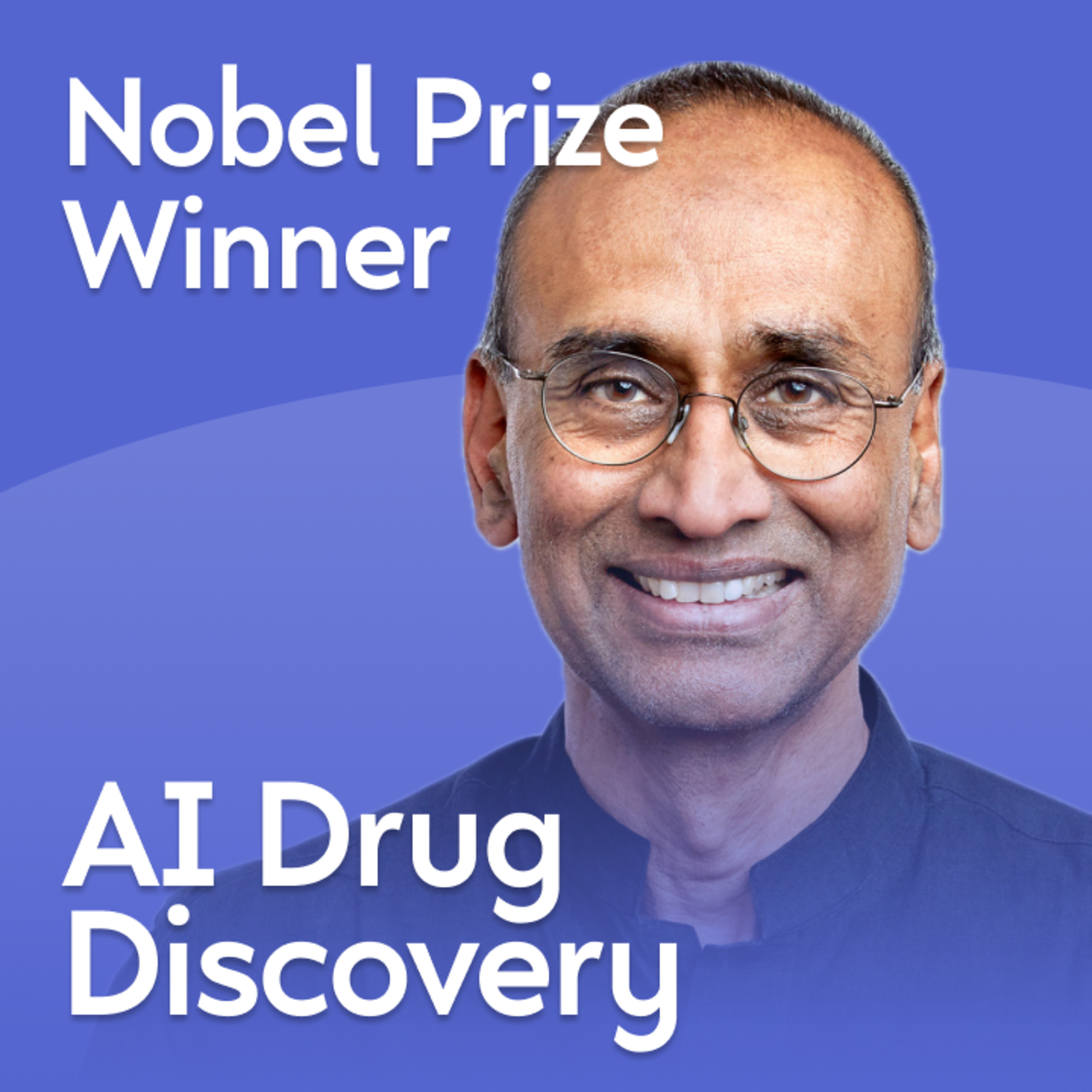
Venki Ramakrishnan discusses how AI is accelerating biology and drug discovery, but argues the experimental and clinical-trial bottlenecks remain rate-limiting. He explains the drug-design pipeline: AI can generate candidate molecules predicted to bind protein pockets, but toxicity prediction, synthesizability, and downstream kinetics/off-target effects still require experiments. He also compares AI’s impact in computational tasks (e.g., protein folding) versus complex organismal biology, and emphasizes that humans must still choose the most important scientific questions.
Venki Ramakrishnan, Nobel Prize winner; Scientific Advisory Board member for Isomorphic Labs. Background includes a PhD in physics, a pivot to biology, and a long career studying ribosomes; he learned crystallography via a sabbatical and helped advance ribosome structure/mechanism work.
AI is promising for early filtering and protein structure prediction, but not yet an “oracle” for toxicity/side effects; biology’s complexity makes full prediction harder than in math/physics.
AlphaFold and DeepMind’s gene-mutation effect prediction program; off-target side effects even in monoclonal antibodies; FDA clinical-trial registration still requires funding and patient recruitment.
0:00The experimental part is always going to be the bottleneck.
0:05Peterman: This is Venki Ramakrishnan, Nobel Prize winner and Scientific Advisory Board member for Demis Asabas' Isomorphic Labs. And I asked him all about how AI may impact drug discovery and the field of biology. It's definitely accelerating biology. I think the more complex biology you get, the less impact it's had so far. The question is whether AI can predict toxicity. In some cases it can, but... Here's the full episode.
0:37Peterman: There's a lot of interest from people in technology on how AI can advance drug discovery. And I want to ask you, what is the actual shape of the work in discovering or designing a drug or maybe a molecule that binds to something that you care about? The principle is that they've used AI successfully to predict how proteins fold, and that has worked really well. It's not completely perfect, but even experimental work is prone to mistakes. So the question is, how do you go from there to understanding that you have a target molecule like a protein, and to stop it from working, you may have to bind a molecule in a critical pocket where it does its chemical reaction or where it binds something else.
1:38So essentially, you're trying to block it from working. occasionally you might want to improve its function that's even harder but blocking is the easier thing and so the question is can ai come up with an array of molecules now traditionally this has been done by some mixture of computational chemistry and just screening thousands of molecules seeing if you have a head then seeing where it binds then gradually improving it in an iterative process. But the question is whether AI can speed this up, whether you can have a better idea, and so on. So I would say the early things look promising, but we need clinical trials, we need actual experimental proofs of principle that actually brings a drug out onto the market and showing that AI has accelerated the process.
2:38Now, I think people in the field are optimistic, but I think you have to really wait for the results, I would say.
2:48Peterman: When you think of that process of actually finding a molecule that blocks that critical pocket in the protein, what is the work, the steps that you take to actually design a drug? Well, okay, so AI can come up with a bunch of molecules that it thinks will fit based on recognizing patterns of interaction and so on that it's been trained on, right? And then of those molecules, you know, some of them may have toxic side effects. The question is whether AI can predict toxicity. In some cases it can, but I'm not sure it can do it in all cases. and then the molecules have to be, you have to be able to synthesize them in an easy way and then you have to test them.
3:40So the experimental part is always going to be the bottleneck, you know, getting the experiments done, getting enough data to go to clinical trials and then carrying out clinical trials. That's always going to be the big stumbling block or bottleneck. And even in traditional drug design, many, many drugs fail in clinical trials, even though they've been very promising in animal studies or studies in the lab. And so I think it'll become clearer in a few years, you know, how efficient and how much better it is. But I would say the people in the field are very optimistic.
4:28Peterman: It sounds like AI could maybe help in the search phases or the brute force of actually. Yes, that's the whole premise is that it can speed up and make that initial filter much more efficient. So that's the hope. And I think, you know, we have to wait a few years and see how it's panning out. But even if that was a perfect, let's say it was an oracle, it could just give you something that you know binds, there's still all these downstream steps in the physical world. Oh, yeah, definitely. You know, because I can tell you, even with things like monoclonal antibodies, which are very specific, there are people who went into critical care in phase one clinical trials because of some unexpected side effect, you know, off-target binding.
5:28So you really have to do all the trials before you can, you know, release it on the market. So it's not, you know, AI could be very fast at its computational work, but the experimental work is still going to be the rate limiting factor. Human biology is complicated. So, you know, it's not, I don't know if it's possible to predict all of those, you know, potential side effects and the kinetics of the drug. How quickly is the drug excreted? You know, these are all things you have to do experimentally at the moment. I mean, in some distant future, you know, maybe you will reach a world where these things can be predicted, but I don't think we're there today.
6:16Peterman: Is there enough slots for all the people who have drugs that want to do clinical testing? Well, they have to fund it and find the patients and so on. So that's the limiting factor. I mean, the FDA, if you propose, you know, if you have sufficient animal data and, you know, some, you know, animal safety data and a clear rationale, the FDA will say, okay, you can perform it. You can register a clinical trial. But you still have to fund the trial. Somebody has to fund the trial. Somebody has to find the patients. You know, so it's a big process. And, you know, big pharmaceutical companies are used to doing that sort of thing.
7:03Peterman: In other fields like math and computer science that are more closed, we see that these models are drastically changing the frontier and the state of the art. Do you expect a similar down the road in molecular biology? I think biology is intrinsically much more complex. It's not a defined system like mathematics or computation. So my gut feeling is that, I mean, AI has proven itself in some aspects of chemistry. For example, I talked about protein folding and alpha fold, which won the Nobel Prize. But I think, you know, for complicated cellular biology and especially at the organismal level, it is highly complex.
7:53It'll be harder, I think, to make progress than with mathematics and so on. The other thing I notice is that AI has been, even in mathematics, AI has been very good at solving increasingly hard problems. But it's not currently, as far as I can tell, and I'm not a mathematician, so you can take it for what it's worth. I don't see it as defining what is interesting, what are the big questions. Those problems were all defined by human beings, okay? So will AI come to the stage where it says, okay, here are some really new things that we really need to understand. And by the way, here's the solution, okay?
8:41That's a different kind of thing. And, you know, humans excel at having that forward vision. So if they're going to use AI as a tool, sure, that's great. You know, but to expect AI to just do everything, it's not clear. I think the best way to think of it is it could be an incredibly powerful tool for humans to use to solve complicated problems.
9:15Peterman: I know in those fields, because the ability to propose a paper, the cost has gone down because of AI. I don't know if you or your peers have noticed in biology or similar fields, is there an influx of papers, maybe AI assisted in either just the prose or maybe the experimentation? I don't know, because if it happens, it would happen a lot in computational biology and areas like that. Certainly, it's made coding a lot easier. So, you know, that's accelerating science. And we talked about protein prediction. There's now a new program released by DeepMind, which tries to predict what genes will do if mutated and so on.
10:02So I think things are progressing. And yes, it's definitely accelerating biology. I think the more complex biology you get, the less impact it's had so far, except for highly computational problems. But I think that that could change. You can think of me, I'm not somebody who's, you know, sort of this wildly optimistic type. I take a more cautious look at things.
10:36Peterman: You got a PhD in physics, and then at some point you did a hard pivot into biology. And I think a lot of people, whether because of sunk cost or some other reason, they might not have the confidence to pivot so hard. What gave you the confidence to switch? Oh, I don't know if it was confidence. There's both a push and a pull there. I just wasn't feeling very motivated about continuing my physics career. I thought, you know, the problems I was working on were not that interesting. And I didn't see with my particular graduate training and PhD, I didn't see a real future for me in physics, to be honest.
11:24I thought if I stayed in physics, I'd probably end up in some second rate or even third rate position doing very, you know, incremental or boring stuff, if at all. And I thought that I was giving myself a second chance. So it's not like I had this great confidence in saying, oh, I'm going to go off and do this other great thing. I just thought of it as, you know, I mean, it's like punting in football, you know. I just thought, okay, I'll give myself a second chance.
12:03Peterman: When you were in physics, you had this, I guess, research taste or the sense that continuing that research, those problems were not interesting or they were not... Yeah, they wouldn't go anywhere. You know, my thesis has maybe 20 citations after 50 years or something. So you can see probably nobody read it. And the thing, it had almost no impact. And the thing is that biology, when I made the switch, was really booming. You know, all sorts of things were happening. It was like going through a revolution. And I thought, oh, this is, you know, this is where the action is. So that was the pull. You know, the push was that I, you know, wasn't so thrilled about what I was doing.
12:52But the pull was that biology was going through a very interesting time. And it's weird because that revolution hasn't stopped. You know, new things keep happening in biology that has really made it a very exciting place. Because as new tools appear, you can crack aspects of very difficult problems that you couldn't before. sort of you can get to the next level in difficult problems. So it turned out in hindsight to have been a good choice. And that was completely by accident. I read an article in Scientific American when I was a grad student in La Jolla. And the article was written by these two professors at Yale, Peter Moore and Don Engelman.
13:39It was about the ribosome, which is this large machine that reads our genes, genetic information, which basically resides on mRNA, which is a copy of DNA, of the gene on DNA, and uses that information to make proteins. So it's a very, very central molecule in the cell. It's one of the oldest molecules of life. Probably predates DNA because before the ribosome, the cell wasn't making proteins in any systematic way. So why would it need genes to encode proteins? So it's an incredibly ancient molecule that's still absolutely central to life. And by that time, I knew what a ribosome was because I'd gone to this graduate school after my PhD.
14:29As you pointed out, I pivoted. But in the pivot, I started graduate school all over again. In fact, the first year, I even took undergrad courses because I didn't really know anything. And so I knew what a ribosome was. So I wrote to them and they offered me a fellowship to go to Yale. And that was the start of my sort of ribosome career in 1978. And I sort of, you know, basically, it lasted my whole life, actually.
15:01Peterman: Earlier, you were saying that even if AI accelerates the problem solving, the picking what problems are interesting, picking what problems are important, that at least today is uniquely human and valuable. Do you have any thoughts on how to pick interesting scientific problems to solve and how do you pick? Well, you know, there are big problems like the origin of life or, you know, how does the body develop from a single cell into a complicated animal, you know, complicated body or what happens to the brain and how does the brain work? How does it even make decisions? What's the basis of your feeling of sentience?
15:53Things like that. So those are big, complicated questions, but you can't answer them overnight. You have to say, okay, that's a big question. Where do I start? and you have to sort of carve out a path that gets you closer to what you want to do or what you want to answer. And I think that's where the judgment comes in. You have to combine something that's important with something that's feasible. Work on something important, but it's completely premature. The tools aren't there. Even the conceptual framework isn't there. You're just wasting your time, right? On the other hand, if you just do some little incremental thing, just wandering around and not getting towards some larger goal.
16:41So you have to somehow combine the two. You have to have an overarching vision. And then you have to break it up into steps that are getting you closer. So I like to think of it as, you know, in physics, there's a random walk and there's also a directed random walk. Directly random walk means that you have a bias to get towards someplace. So it'll still be a bit random. You won't go there in a straight line. You'll make mistakes. You'll take detours and so on. But you're gradually getting towards the goal. In a completely random walk, you're just wandering around, and you're not getting towards anything.
17:18So I think that's the difference between having a long-term goal or vision. Like, what is the question you want to answer?
17:27Peterman: I see. If I recall correctly, at the time when you started deeply getting involved in ribosomes, that space was not as booming? Oh, it had gone through a boom in the 50s and 60s when people had discovered the ribosome. They found out what it did. They found out who the players were. They discovered mRNA. they discovered you know tRNAs and how all these things come together on the ribosome and make protein and then the people who did that I mean some very famous biologists like Francis Crick and Sidney Brenner they just sort of said okay the rest of the stuff is all details and we're going to move on and you know look at development or the brain or something but then there were few people who still said hey wait a minute there's a big enormous molecule half a million atoms and it does these things, but we have no idea what it looks like or how it does it.
18:27So if you're interested in that and the actual mechanisms, then it was still an interesting problem. If you just were interested conceptually that, oh, ribosome binds mRNA, brings in tRNAs, joins amino acids together to make a protein, then the problem was solved and you can move on. So it's a slightly philosophical difference. And the problem was to get to that next level seemed almost impossible in the 60s and 70s, which is partly why these guys just left, sort of declared victory and left. And there were only a few people kind of banging away, trying to get little bits of information and so on.
19:07So when I entered the field, it was not that fashionable. And certainly by the time I finished my fellowship, it was really unfashionable. I had a very hard time getting a job. And then, you know, technology improved and so on and methods improved. And people realized you might be able to solve the whole thing at atomic resolution. And that would be a big deal. And so then it took off again. And now the field has drifted to more complex questions like how are ribosomes assembled in the cell? That's not a random process. It's a very orderly process and highly efficient. And how are ribosomes regulated?
19:57You know, how do you turn off? First of all, how is the production of ribosomes regulated? But then also, how does the ribosome, how does the cell decide, oh, I want to make, translate this piece of RNA very efficiently and, you know, and not so efficiently in other cases? How do I look at protein quality control?
20:23Peterman: Is the ribosome product really actually good or is it defective? And what do I do about it? So there are all sorts of regulatory questions, like if the ribosome stalls, the cell has to make a decision. Do I just now, you know, disintegrate this whole complex and start over or do I relieve the stall somehow? And then viruses can hijack the ribosome to make its own proteins. So how does that work and how can you maybe prevent that? So lots of higher level questions beyond the basic structure. So when you were picking that unfashionable field, did you have a sense that the technology was advancing enough so that you could solve it or that was just pure happenstance?
21:11We sort of went in stages. First, we figured out where the components of the ribosome were roughly in space, but that doesn't tell you a lot about how it works. And then we thought, okay, the technology is there to take each little piece of the ribosome and look at its structure. But without knowing the context, that also in the end didn't tell us much. And by that time, by the time we had done a bit of that work, it had been, you know, 10 years had gone by. And then really after a sabbatical here in Cambridge And when I went back to the U.S. I was at Brookhaven National Lab on Long Island And then I went to the University of Utah And at that point I realized that maybe the time is ripe to tackle the whole thing And there were other people There was, you know, Ara Yonat who died just this year Just a couple of months ago So she had obtained, along with Heinz-Gunter Wittmann, she had obtained crystals, the first crystals of the ribosome.
22:13But, you know, the field had been going on for 15 years by that time and no structures had come out. And so a number of us felt you could maybe start having, go into it with some new ideas and new angles.
22:31Peterman: OpenAI, Anthropic, and Cursor all use this product to make their lives easier. WorkOS is an API platform that adds enterprise features like SSO, SCIM, and RBAC to your app. These are things that you need to sell to other companies but aren't the main focus of what you're building. And now they've added more support for AI agents. For instance, Auth4Agents gives each agent its own identity with short-lived scope tokens instead of a long-lived API key. So if something goes wrong, you can revoke one session and everything under it dies. Another feature they have is Airlock, which is an authorization layer.
23:03Peterman: Every action agent takes is checked against rules that you can write in plain English. So it's not rubber stamping everything and it's not running unsupervised either. And lastly, they have Pipes, which connects your agents to over 300 third-party tools without you ever needing to manage a token. So if you're building SaaS or AI agents and selling to enterprises, WorkOS fills all these gaps in a few lines of code. Check them out at WorkOS.com to learn more and get started. And I appreciate them for sponsoring my show. In your career, and you had the PhD in physics, and then you pivoted to biology, and you didn't finish a biology PhD.
23:42Peterman: No, because I went to do this fellowship. But you had the expertise for biology, but not the social signaling that, hey, I have a PhD. And I was curious, did that set you back in any way? It might have. You know, for example, if I'd finished a PhD from UCSD in biology, maybe my CV would have looked a little better. Okay. But as it was, I had a physics degree in theoretical condensed matter physics, you know, which no biologist could even understand the title of the thesis from Ohio University, which is a good university. but not, you know, I would say, you know, like a top tier in molecular biology.
24:26And so I had this weird CV. So when I started applying for jobs after a postdoc, most people said, well, this is a rather strange CV and probably put it in pile B. And I didn't get any interest at all. So in the end, I went to Oak Ridge National Lab for a year, but then they had promised me a biology lab of my own, but then funding for that was not forthcoming. And so I left after 15 months to go to Brookhaven National Lab. And that's where I got my start as an independent scientist. and that's when I went on sabbatical to learn chryslography, which is the technique my lab used to solve the ribosome.
25:18Peterman: So if you were advising a young person and they're thinking about finishing that credential for the sake of whatever downstream benefits and social signaling or... It's a mixed bag because, you know, maybe if I'd finished my PhD, I would not have gone into the work on ribosomes and my career would have been very different. It's very hard to predict whether it would have been as successful or not. It might've been the safer option, but it's not clear it would have been the better option. And that you can only, you can't really predict. I would say to people, you know, you have to do something that you really care about and that you think is interesting.
26:06and, you know, yes, you need good credentials. You should try to go to the best environment. And, you know, best environment doesn't mean the school that's highest ranked in some, you know, U.S. news and world report or something. It's the best environment for what you want to do, okay? Are the people there, are the mentors there really good at what they're doing? Are they going to mentor you well? Are your colleagues going to be good? Are they going to be stimulating? Do they have the infrastructure that you need to get top-level science done? So those are the things you should look out for. And there are lots of places like that.
26:46And they'll vary depending on what area you're interested in.
26:51Peterman: I thought it might be interesting since you deeply studied physics and biology to ask you, what do you think the main differences are between the subjects, aside from the obvious subject matter? Well, biology is very complex. So you have a lot of questions in biology as settled by experiment. It's very hard to predict theoretically what will happen. Although, as we discussed, you know, with the AI and computational methods, people are trying to do more prediction computationally. But it is a highly complex system. And in the end, you need experiments to settle what's going on. and I would say because it's so complex, if you want to study the effect of something, how do you know that whatever changes you see are because of whatever you did or it's not just some random thing?
27:54So in biology, you always have to do control experiments. You add your factor, see what happens and then you see what happens if you don't add the factor. So you have to carefully design control experiments. And of course, in medicine, this is why you have randomized clinical trials, which have proper controls. That's an even more complex system, like a human being, because we're all highly variable and so on. And so, but in physics, you can construct an experiment that's extremely simple, where the answer, you know, from the result, you know exactly what's happening, you know. So physicists often don't think about control experiments.
28:39It's not part of their culture. They're more about defining the experiment so it's very sort of clean. And so that's a fundamental difference. The other thing is physicists often will want to go into biology and want to predict everything from first principles. And you can't do that. Every system has its own scale of complexity. So just because you can solve the Schrodinger equation for a simple system doesn't mean you can then start applying it to understand memory. you know, like the brain or something, even though they're all governed by the laws of quantum mechanics ultimately. But it doesn't matter because you're studying it at a completely different level of complexity.
29:29So you have to deal with it on those terms. And so that's a problem sometimes that physicists have when they move into biology. They never stop thinking like physicists. And what they need to do is stop. They can use their physics training, but they need to start thinking like biologists and ask, you know, what is the question? How do I approach this? And so on. And some people have been better at it than others.
30:04Peterman: In Q &A somewhere, someone asked you why you got interested in physics. and you replied that when you were young, physics and math were logical and pure in a sense and biology was more memorization. Oh yeah, the way it was taught, especially in India where I grew up, was it was all rote memorization and I never got a sense of biology as a kind of interesting detective puzzle and I didn't get that until much later. Yeah, why is that? When I went to high school as well, it was a similar, there was maybe a tier list of math and physics are kind of the pure ones at the top. And then maybe chemistry and then biology is even more memorization.
30:50Peterman: Is that in the nature of the subject or in the nature of how it's taught? I think it's a little bit of both in that biology has lots of complicated facts that you have to remember. And same with chemistry. You know, you can learn about mechanisms, but you still have to remember a lot of stuff because otherwise you're constantly looking up stuff, you know. So I think it's partly the nature of the field, but I think it could be taught a lot better in the sense of, and I think it is being taught better, much better than 50, 60 years ago when I was, you know, in high school. So I think it is being taught better where you're focusing on concepts and ideas and sort of why does this, you know, apart from, of course, why is answered by evolution in biology.
31:47The answer to any why question is because, you know, evolution selected for that process. But the question is, you know, how does this work? What does it mean? what is the sort of purpose? Purpose I don't mean in some philosophical sense, but we have no purpose except to exist and reproduce, I guess. But the thing is, what is this pathway doing? So what is this enzyme doing in this pathway, for example? So I think there are ways to teach it conceptually that make it less of a memorization. In fact, it'll make the memorization easier because you have some context for remembering these facts.
32:35Peterman: Yeah, I guess some part of it is just the nature of the subject as well because you could show up on a test not having deeply studied on math, but you could figure out, you know, derive things. Up to a point, yeah, because you can't, you know, when you're sitting in a three-hour exam, you can't sort of reinvent all of mathematics on the fly, right? I mean, you know, first of all, you'd have to be brilliant. And secondly, it would take too much time, even if you were some sort of genius. So I think it does, you do need to remember things, even in mathematics and certainly also in physics. But I take your point, you can do more from first principles in those fields.
33:22Peterman: So in the tech industry, there's this pattern I've seen where physicists often do well in other areas like AI research. Physicists have invaded almost every field. Yeah, that's true. Why is that? You mentioned the physics training. What is it about? I think because physicists are very comfortable with quantitative thinking. They're used to numbers. They're used to using mathematics. They're used to using complex instrumentation if they're experimentalists. So I think that gives them a little, you know, I think it makes them well trained for entering a number of other fields. In one of your lectures, it was about kind of telling the story of how you won the Nobel Prize.
34:14Peterman: You ended it saying that science doesn't depend on being a genius, but it depends on several other things. And one of the things that you said it depended on was skill. But when I think of a skilled researcher, I can't help but think of a genius. So what is skill in research that is not intelligence? Well, skill means that you've been very well trained in the art. You're competent. You know what to do. You know how to carry out an experiment or a calculation. So I would say skill is different. I mean, genius means that you're able to see things that are not obvious to the vast majority of people.
34:59You're able to see a few steps beyond what's obvious to the field. I think that would be my sort of definition.
35:11Peterman: and in that same lecture you talked about the politics of recognition especially in the context of the nobel prize and you mentioned these terms of uh pre-nobelitis and post-nobelitis or yeah basically when you're getting close to the award but not quite having it or you've already won um and i was curious did you did you get pre-nobelitis at any point i i did i mean everybody I think, you know, what happens is that, you know, you do something important. The first thing you don't think is, oh, you know, I could get a Nobel Prize. That's not what you think about. You think, wow, this is fantastic, you know.
35:51But then you get invited to lots of talks, conferences, and so on. And everywhere you go, people say, hey, you know, this could get a Nobel Prize. And then suddenly that kind of warps your own thinking. And then you start thinking, well, okay, you know, it's limited to three people. And, you know, there are a whole bunch of people contributing to this field. And then I noticed that in conferences, people who are in this sort of pre-Nobelitis mode, they'll very subtly, you know, talk up their work. And, you know, they won't mention, you know, other people's work, especially competitors' work as much and so on.
36:31It's a kind of human psychology. And, you know, I just think that it's a little unfortunate. And it's partly the community's fault and society's fault that they give so much importance to this one award. I mean, there are lots of other prizes, you know, the Lasker Prize and Breakthrough Prize. But if you walk down the street, and, you know, by the way, the Breakthrough Prize pays, you know, three or four times, you know, three times a Nobel Prize. And if you share a Nobel Prize, it's like, you know, could be up to nine times. Okay. So the thing is, but if you walk down the street, you live in Manhattan, you walk down the street and you ask some random person, have you heard of the Nobel Prize?
37:19They'll say, oh, yeah, sure. And we say, have you heard of the Breakthrough Prize? They'll say, no, what's that? Okay, so you see, it's had this, because of its history, and all these, you know, it got launched at a time when genetics was being discovered, the nature of chemical bonding and reactions were being discovered, and quantum mechanics and relativity were being discovered. So all three fields had this once-in-centuries kind of revolution. and so the prizes went to like these absolutely great scientists you know Einstein and people like that okay Paul Dirac and Linus Pauling people so it was just you know and Rutherford so so it it created a kind of branding for the Nobel and of course you know the people who get it now some of them might be in that class but most of them are not okay let's face it they're They're not Einstein's or even Richard Feynman or something.
38:22So I think it's created its own cachet. And so it's not surprising that people who think they might have a chance really kind of ask whether they might get it.
38:38Peterman: Is there a top book that impacted you or maybe a book that you'd recommend to people? In physics, I really enjoyed Feynman's biographies Surely you're joking, Mr. Feynman And then he's also had other short essay books, you know So I find him a very lively and entertaining writer In biology, I was very influenced by a book that's highly controversial Which is Jim Watson's The Double Helix Because for the first time, it made me realize that biology was not a rote collection of facts. You know, it was like an exciting detective story to try and get at the structure of this molecule that contained, you know, the key to how life works and so on.
39:24Of course, you know, it's controversial because of his very frank description and also rather derogatory descriptions of Rosalind Franklin. But even with that, I mean, and I know many women who have been highly influenced by that book. In fact, Jennifer Doudna in her own autobiography or memoir talks about how she read it as a high school student and said, you know, and thought this was so exciting that she wanted to go into molecular biology. So I think it is, despite its faults, it's a very exciting book.
40:06Peterman: And then, yeah, last question for you is, if you could go back in time knowing everything you know now, what advice would you give yourself if you were just entering the industry? It's very hard to say because what seemed like mistakes at the time seemed to, you know, worked out in some way. You know, so, I mean, I went to Ohio University. I didn't do so well. Partly it was my fault. I mean, I would say largely my fault. But then I met my wife there, you know, so it was a life-changing experience for me. So I don't see that, you know, anything has been really bad. I would say the advice I would give people is stay open-minded.
40:53And if things look like they're not working, don't be afraid to, you know, change. You know, that fear of change is something that often will paralyze people so they'll stay in the same rut. And I would say being open-minded and being open to new ideas, to new techniques, or even to new fields, or moving, you know, going to new institutions. change is sometimes you know necessary and and can be quite invigorating so so my advice would be to stay open-minded and not be too fixated on on what you're doing awesome well thank you so
41:41Peterman: much for your time you're welcome hey thank you for watching this podcast if you liked it and you want to see the show grow please support with a comment or a like also if you have any recommendations for people you want me to bring on please drop a comment guests like barbara liskov mike stonebreaker mark brooker these were all people that i brought on because someone left a comment on another note aside from the podcast i'm working on building the ergonomic keyboard that i wish existed here's a glance at the prototype it's a split keyboard so there's two sides this is in the case but yeah we launched on kickstarter and we hit our goal within eight hours of launching i really appreciate it if you were one of the people who grabbed one of the early units we're now working on the long journey of building the tooling now and so if you still want to pick one up i've left the late pledges open on kickstarter so you can grab one there i'll put a link in the description thank you again for watching the podcast and i'll see you in the next episode
Venki Ramakrishnan (Molecular biologist, Nobel Prize): "The experimental part [of drug discovery] is always going to be the bottleneck."
Recent headlines about using AI to speed up drug discovery made me curious about what that looks like and where it is today. So I flew to the UK to interview Venki Ramakrishnan who is on the scientific advisory board of Demis Hassabis' Isomorphic Labs.
He has described himself as a "failed physicist" starting originally with a physics PhD who changed fields because he felt his work was incremental. After pivoting into molecular biology without a degree he discovered the field of work that eventually led to his Nobel prize.
So aside from drug discovery, I also asked him about how AI is impacting the field of biology, how biology compares to physics, and the politics behind the Nobel prize.
• My ergonomic keyboard project I mentioned, you can follow along here: https://read.compose.llc/
• The Kickstarter page for it: https://www.kickstarter.com/projects/ryanlpeterman/compose-simple-ergonomics-beautifully-done
Podcast links:
• YouTube: https://www.youtube.com/watch?v=-1q0zA21AkY
• Apple: https://podcasts.apple.com/us/podcast/the-peterman-pod/id1777363835
• Transcript: https://www.developing.dev/p/e074-venki-ramakrishnan
Thank you to this episode's sponsor for supporting my work:
• WorkOS: makes your app Enterprise Ready with easy to use APIs to add SSO, SCIM, RBAC, and more in just a few lines of code, check them out at https://workos.com/
Timestamps:
(00:00) Intro
(00:43) How drugs are designed
(04:54) Why drug testing remains difficult
(07:02) How AI will impact the field of biology
(10:35) Switching from physics to biology
(15:00) How to choose research problems that matter
(23:19) Did lacking a credential hurt his career
(26:50) Physics vs biology
(33:21) Why physicists succeed in other fields
(35:10) The politics of the Nobel Prize
(38:37) Top scientific book recommendations
(40:05) Advice for young people
(41:43) Outro
Where to find Venki:
• Personal website (MRC Laboratory of Molecular Biology): https://mrclmb.ac.uk/research-leaders/venki-ramakrishnan/
• Google Scholar: https://scholar.google.com/citations?hl=&user=oTI5BjIAAAAJ
• Royal Society: https://royalsociety.org/people/venki-ramakrishnan-12139/?page=43
• Nobel Prize: https://www.nobelprize.org/prizes/chemistry/2009/ramakrishnan/biographical/
• Wikipedia: https://en.wikipedia.org/wiki/Venki_Ramakrishnan
Where to find Ryan:
• Newsletter: https://www.developing.dev/
• X/Twitter: https://x.com/ryanlpeterman
• LinkedIn: https://www.linkedin.com/in/ryanlpeterman/
• Threads: https://www.threads.com/@ryanlpeterman
• Instagram: https://www.instagram.com/ryanlpeterman
• TikTok: https://www.tiktok.com/@ryanlpeterman
Referenced in this episode:
• Isomorphic Labs: https://www.isomorphiclabs.com/
• AlphaFold: https://deepmind.google/science/alphafold/
• AlphaGenome: https://deepmind.google/blog/alphagenome-ai-for-better-understanding-the-genome/
• Neutron-Scattering Studies of the Ribosome (Scientific American, 1976): https://www.scientificamerican.com/article/neutron-scattering-studies-of-the-r/
• Surely You're Joking, Mr. Feynman!: https://wwnorton.com/books/Surely-Youre-Joking-Mr-Feynman/
• The Double Helix: https://www.simonandschuster.com/books/The-Double-Helix/James-D-Watson/9780743216302
Scan the code with your iPhone camera
Listen in the app.