 The Rest Is History
18 Oct 2026 · 1h 5m

 Add vo to ChatGPT or Claude to ask about everything you hear
vo listened to this episode to put together the overview and transcript, so there may be the odd mistake.
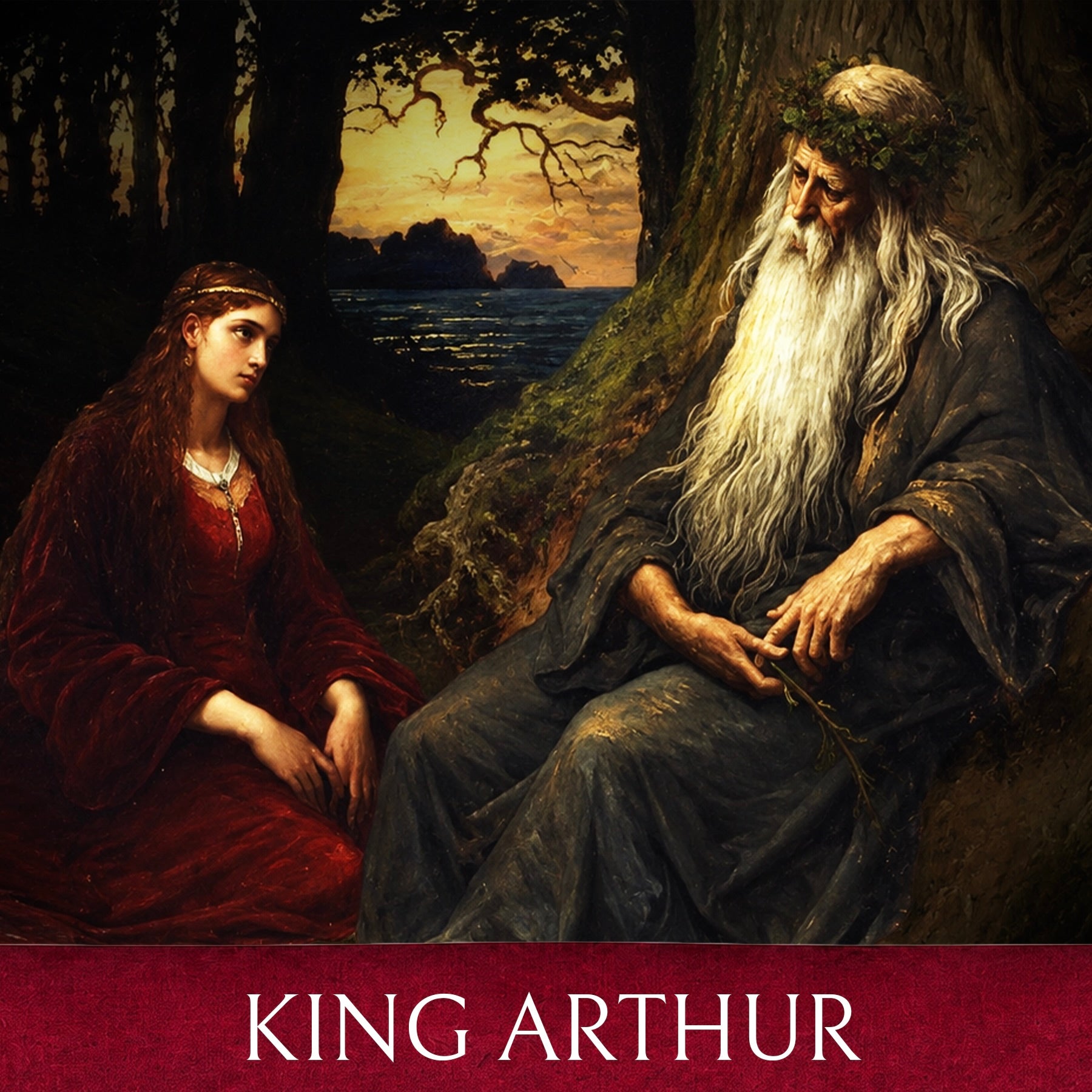
Part 3 of “King Arthur: The Mysteries of Merlin” explains how Geoffrey of Monmouth’s History of the Kings of Britain created the Arthurian legend—especially Arthur’s conception at Tintagel, the role of Merlin, and why medieval scholars treated Merlin as historical. It also covers Merlin’s supposed origins, his prophecies, and later romance traditions (Sword in the Stone; Merlin’s downfall with a Lady of the Lake).
Tom and Dominic (hosts) discuss sources and medieval belief; no external guests are named in the provided transcript.
Geoffrey marketed fiction as fact; Merlin and Arthur were widely accepted as real by medieval intellectuals; Merlin’s prophecies were interpreted as predicting events (Norman Conquest, Henry I’s White Ship, later political upheavals). Merlin’s “historical” basis may come from Welsh traditions (Myrthym) and earlier texts (Nennius’ Historia Brittonum).
Tintagel’s impregnable isthmus; Uther disguised as Gorlois to sleep with Igraine; Arthur’s sword Caliburnus and spear Ron; Merlin’s red/white dragons; Aldrich Vitalis mapping prophecies; Welsh uprisings (Owain Glyndŵr), Joan of Arc admirers, and Henry Tudor (Henry VII).
0:00Dominic Sandbrook: Fall has never looked or tasted this good. Sweetgreen's fall harvest menu is back with seasonal favorites dressed to impress and made to be devoured. Warm roasted sweet potatoes, crisp apples, maple glazed Brussels and crave worthy flavors in the autumn harvest bowl, maple glazed salmon plate and roasted bacon Brussels side. The season's most desirable menu has returned to Sweetgreen featuring fall's best dressed. Make your move. Order on the Sweetgreen app. You can't reason with the sun. Trust us. We've tried. This summer, it's time to put that angry ball of fire on mute. Columbia's OmniShade technology is engineered to protect you from the sun's harsh rays that can burn and damage your skin.
0:44Dominic Sandbrook: The sun is relentless, but so is our gear. Level up your summer at Columbia.com to spend more time outside and less time slathering on aloe lotion. You're welcome. Columbia. Engineered for whatever.
1:00Dominic Sandbrook: Star Wars The Mandalorian and Grogu is now streaming on Disney+. What are you waiting for? Hop on. The must-see galactic adventure comes home on Disney+. This is the way. Our only chance is to work together.
1:16Tom Holland: I like this kid. Always wear your seatbelt.
1:22Dominic Sandbrook: Star Wars The Mandalorian and Grogu, now streaming on Disney+. Raid PG-13.
1:41Dominic Sandbrook: A week went by and the king's passion for Ygrane had become more than he could bear. He summoned Ulfin of Ridd-Karadok, one of his friends, and told him how desperately besotted he was with Ygrane. If I cannot have her, then I am convinced that I shall suffer a physical breakdown. You must tell me how I can satisfy my desire for her, for otherwise I shall die of this passion which is burning me up. What you request is impossible, answered Ulfin. We can't possibly approach Ygrin while she's inside the walls of Tintagel. The castle is built high above the sea, which surrounds it on all sides, and the only way across to it is via a narrow isthmus of rock.
2:22Dominic Sandbrook: three armed men could hold it against you even were you to stand there with the entire might of britain at your back the only man who could possibly solve such a problem is the prophet merlin with his assistance you might i think be able to obtain what you want and so the king recognizing the truth of what ulfin had said sent for merlin so that's a thrillingly dramatic moment in the history of the kings of britain by jeffrey of monmouth so jeffrey of monmouth wrote that in the late 1130s it was the british bunkbuster of the entire middle ages it's the book that basically invented the legend of king arthur it packaged and presented him as this towering figure of european stature as a conqueror who had ruled as the greatest and most glorious king in all British history.
3:19Dominic Sandbrook: And the passage above is the origin story. So Tom, remind everybody who Uther Pendragon is.
3:27Tom Holland: So Uther Pendragon is the king in that passage that you were reading. He is the king of Britain and Igraine, for whom he has the massive hots, is the wife of Gouloir, the Duke of Cornwall. and Jeffrey describes Igraine as being the most beautiful woman in Britain and Uther and Goulwa had originally been allies in the fight against the Saxons who will be coming to in due course in this episode but then Uther holds court and he gets his first glimpse of the wife of Goulwa the beauteous Igraine and he falls madly in love with her and basically he can't stop gawping at you know eyes wide kind of salivating and galois takes massive umbrage at this and he leaves he storms out of uther's court without getting the king's permission um and heads off to his duchy of cornwall and uther has a massive strop about this because he feels it's very disrespectful and he demands that galois return with a grain galois refuses and so uther um invades cornwall torching its towns and castles burning everything in his path and because gulwa knows that he can't resist the might of the king of britain in the open field of battle he pursues a guerrilla strategy um but not before you know he goes out into um into the the woods and the wilds of cornwall to pursue this guerrilla strategy but first of all he makes sure that igraine is secure by putting her in his strongest castle.
4:59Tom Holland: And this, as we heard in the passage that you read, is Tintagel, the fortress of the narrow entrance. And it stands to this day on the northern cliffs of Cornwall, built on a kind of rocky, precipitous headland, very narrow isthmus, as described in that passage. And it has a natural water supply as well, so you can hold out for a pretty long time. And if you've never been there, I mean, it's a spectacular setting, incredibly dramatic and effectively impregnable.
5:32Dominic Sandbrook: Yeah. However, it's impregnable if you are attacking with conventional forces. Correct. But what if you have the world's ultimate weapon of mass destruction, indeed, the world's greatest wizard on your side?
5:46Tom Holland: Well, in that case, everything is slightly different. And fortunately, the greatest wizard is floating around Cornwall at this point. And this is Merlin, who is indeed a figure of awesome supernatural potency. So who is he? He is the son of a princess who, as a very young girl, had been placed in a nunnery where she had lived a life of virginal purity. but she had been met in her dreams by a glamorous and faintly sulfurous figure who turns out to be an incubus which is a demon in the form of a very handsome young man and this incubus gets this this virgin princess this virgin nun pregnant um and so merlin is the son of a woman a mortal woman but doesn't have a mortal father so that makes him very distinctive um it endows him with all kinds of powers so he is a prophet he can see far into the future and he is an enchanter and if you want a brilliant spell then merlin is your man and that is what uther wants and specifically he wants a spell that will enable him to sleep with a grain and merlin is told this by uther and he obliges so this is what um jeffrey of monmouth has merlin say by means of my magic i can make you look exactly like gullar so that you will resemble him in every way and everything goes to plan so uther who is now looking exactly like gullar is able to ride across the narrow Isthmus.
7:32Tom Holland: He's recognised by the guards who open the gates to him. He's admitted to the castle. He goes to Egraine, who naturally assumes that this is indeed her husband. Uther, disguised as Goulwa, sleeps with Egraine. And again, to quote Geoffrey of Monmouth, that very night, she conceived Arthur, most famous of men.
7:54Dominic Sandbrook: Yeah, but was he? This is the question. So when we were introducing this episode, we talked about how Geoffrey of Monmouth had effectively invented or created the Arthur industry. So up to this point, is Arthur the most famous of men or is Geoffrey making that up?
8:11Tom Holland: Well, the mad thing is, is that by describing Arthur as the most famous of men, Geoffrey basically succeeds in making that claim true. Hitherto, it had not been the case. Previously, Arthur had featured in a few obscure Welsh texts, some enigmatic poems, the odd entry in a latin chronicle or two but really nothing more than that nothing that would reverberate beyond the bounds of wales but now thanks to um the incredible success of the history of the kings of britain jeffrey's history all of this changes and loads of what jeffrey includes in this book will become part of the common currency of Arthurian legend and of medieval literature more generally.
9:01Tom Holland: And it's actually, it's still being recycled to this day. So examples include the whole Arthur being conceived in Tintagel's story, which Jeffrey basically seems to have made up. Anyone who has seen John Borman's film Excalibur, it opens with this scene, Uther galloping across the dragon's breath, this kind of blue mist which has been blown by Merlin across the sea. It is also Geoffrey who introduces Excalibur, which he actually calls it Calaburnus. So that's kind of the Latin form of it. And it's Geoffrey who gives us the name of Arthur's spear, which we've already mentioned. It's called Ron.
9:42Tom Holland: And so both Ron and Calaburnus are the Latinized forms of names that Geoffrey had found in Welsh poetry describing the sword and spear of Arthur, respectively and also there are other aspects of the legend that we've already touched on so in episode one we talked about this um mordred's treachery the last battle arthur being taken to avalon all of this originates with um with jeffrey of monmouth so essentially without jeffrey there would have been no arthurian legends they would have dominic you would call it the mythos
10:13Dominic Sandbrook: no arthurian mythos but is jeffrey conscious that he's inventing the mythos well well jeffrey is describing it to us rather differently isn't he he's not like jrr tolkien and you know who's happy for his works to be sold as fiction he's selling this as fact right hence
10:33Tom Holland: the title of his book well yeah the history of the the kings of britain he's absolutely marketing it as as fact and since he did actually make most of it up um i i think you could compare him not only to Tolkien or Rowling, but perhaps to Dan Brown. There's more than a whiff of the Da Vinci Code about this. Because a bit like Dan Brown, I mean, he's got this mad lunatic story, but he says, oh, you know, Leonardo was part of it and, you know, the Knights Templar and things like that. Basically, Geoffrey of Monmouth had done something quite similar. So he's dug up sources for some of the stories that he tells, as we shall see.
11:12Tom Holland: But I think most of them he does basically seem to have invented. And he disguises the bits for which he doesn't have recognizable sources by claiming that he'd been given a very ancient book, those are his words, by the Archdeacon of Oxford. It had been written in Welsh and Geoffrey has translated it. This is the claim. Now, it has to be said, there is absolutely no evidence that this book ever existed. And it is true that at the time there were scholars who basically suspected Geoffrey of having perpetrated a massive fraud. And they're right. I think this is one of the most influential literary frauds of all time.
11:54Tom Holland: And a fun example of somebody who suspected that Geoffrey was a fraud is a guy called Gerald of Wales, a very entertaining writer, goes around Ireland and Wales being incredibly rude about the Irish and the Welsh. And he's writing half a century later. And he describes a man who is being oppressed by demons and to quote Gerald Wales whenever the gospel of Saint John was placed on this poor man's chest the evil spirits like startled birds would fly away but should the gospel be removed and replaced by Geoffrey's book then back they would flock and in larger numbers than before.
12:28Dominic Sandbrook: This sounds like a sort of internal Welsh literary spat. It does slightly.
12:33Tom Holland: And I think it's telling that Gerald was Welsh, because perhaps he's more clear-eyed about exactly what it is that Geoffrey is inventing. But in England, and in fact, across the rest of Christendom, I mean, even the most reputable chroniclers are blown away by Geoffrey's book when they read it. so the key endorsement for it and this i guess is like uh lord dacre saying that the hitler diaries were authentic yeah except lord dacre retracted that didn't he he did this is never retracted and jeffrey's um book is taken as fact the guy who is the lord dacre of of this whole shenanigans um is an english chronicler called henry of huntingdon and he's traveling to rome and in January 1139, he stops off at an abbey called Beck in Normandy.
13:26Tom Holland: And in this abbey, he is shown Geoffrey's recently completed text. It's just been not exactly published, but it's appeared. And he reads it and he declares himself stupefied. And this matters because Henry of Huntingdon is a a much admired historian himself. And to boot, he is the Archdeacon of Huntingdon. So his commendation is very, very influential. There's a feeling that this is a commendation that can be trusted. And so it helps to ensure that Geoffrey's work is read not just as a compilation of remarkable stories and entertaining tales, but as a serious, credible work of history And a measure of how rapidly it gains a reputation of something that can be trusted is that 10 years after Henry of Huntingdon had given his commendation, another English chronicler, Alfred of Beverly, he states explicitly that it is essentially an embarrassment for any historian by this point not to have read and engaged with this kind of bombshell research which Geoffrey has published.
14:36Tom Holland: This is stuff that any reputable historian should now be on top of.
14:41Dominic Sandbrook: So it's like that Black Athena. It's like one of those kind of books that rockets up and people say, my God, it's transformed the field. Unbelievable. And then only after that do fellow Welshmen say, it's absolutely tosh.
14:56Tom Holland: Except that Gerald Wales is ignored. Oh, sad. As we said, there are naysayers, but I think partly people are convinced by it in a kind of academic sense, but I think also people just want to believe it. Yeah, of course. It's so fun. It's so exciting. And as a result of this, you get two key figures who previously had been barely known outside Wales, Cornwall, Brittany, being established almost overnight as titanic figures, not in the mythology of Europe, but in the history of Europe. And the first of these, of course, is Arthur, who is portrayed by Geoffrey, as you said, not just as a king of Britain, but as a great conqueror, you know, the peer of Alexander the Great or Julius Caesar.
15:40Tom Holland: And Geoffrey describes him conquering Scotland, Ireland, Iceland, Norway, Denmark, Gaul. And he would have conquered Rome had Mordred not stabbed him in the back. So this is when the story of the last battle is introduced. in Geoffrey of Monmouth, Arthur isn't a broad fighting Lancelot, who hasn't by this stage been invented, but fighting the emperor of Rome and would have won had it not been for Mordred the treachery. And this promotion by Geoffrey of Arthur as a world conqueror has real world political consequences because it's invoked by Edward I to justify his conquest of, his attempted conquest, I should say, of Scotland.
16:22Tom Holland: And as late as the Elizabethan period, John Dee, so Elizabeth's kind of court necromancer. Yeah, sorcerer. Her sorcerer is invoking Arthur's conquests as a justification for English naval expansion out into the Atlantic. And it's John Dee who first uses the phrase British Empire. And when he uses that rather than an English empire, it's because he's invoking the memory of Arthur. So there's a sense in which the whole British Empire is named after Arthur's conquests.
16:58Dominic Sandbrook: I love that. Which, of course, didn't happen. But of course, the other character whom Geoffrey summons out of the mists of Welsh legend is the subject of today's episode, which is Merlin. So Merlin, we already introduced him. He is the incredibly powerful wizard whom Uther has enlisted to transform him into this bloke so that he can sleep with a grain. And so basically, without Merlin, there would be no Arthur. And to us, it seems obvious that Merlin is made up. Did it seem obvious to people who were reading Geoffrey of Monmouth's book when it was first written?
17:37Tom Holland: This is the amazing thing. I had always assumed that was the case. I had thought, you know, this guy who's a wizard and a prophet, surely people thought that he was a figure of myth, of folktale or whatever. But this turns out not to be the case at all. Merlin was widely accepted by, not just by kind of general readers, but by scholars in the Middle Ages as absolutely having been an authentic figure of history. And as a result of this, the feats of magic and of prophecy which he is supposed to have performed make him an object of unusual fascination. Because essentially he is the only figure who issues prophecies who can be accepted by medieval intellectuals as having actually existed.
18:31Tom Holland: and the consequence of this is that over the course of the middle ages in the stories that are told about arthur merlin comes to play an ever more kind of proactive role because essentially the writers of the romances are giving readers what they want people want to know more about merlin so in jeffrey's history um merlin vanishes from the scene directly he has transformed um uther into the image of gullwar so according to jeffrey gullwar the husband of egraine is killed that same night um in a skirmish um uther is therefore free to marry egraine and they live happily ever after as king and queen and when arthur is born he is raised as the heir to the throne there's no kind of complications about that and so when uther dies um he's poisoned in St.
19:22Tom Holland: Albans, according to Geoffrey, there's a very smooth succession. Arthur is 15 years old. He can sit on the throne and rule. And there's absolutely no need for him, for instance, to pull a sword from a stone to demonstrate that he's the rightful king of Britain. Everyone accepts it.
19:39Dominic Sandbrook: So no need for Merlin to play the Obi-Wan Kenobi role that he's best known for?
19:44Tom Holland: No need at all. But anyone who has seen The Sword and the Stone will know that this is not how the the myth ultimately takes form because by the time Mallory comes to write the Mort d 'Arthur and we've been saying basically the myth of Arthur that people have in their heads now essentially comes from Mallory in Mallory's account Merlin takes the newborn Arthur and he gives him to an obscure knight called Sir Ector to be raised alongside Sir Ector's own son Kay and Kay is the useless knight who in due course will become the seneschal because Arthur has been growing up as a boy in obscurity. He needs to demonstrate his right to the throne of Britain.
20:25Tom Holland: And so to facilitate this, Merlin magics up the sword in the stone to demonstrate in the most spectacular manner possible Arthur's right to rule as king. And this motif seems to be drawn from legends of saints in Italy who, around the period when the story is introduced, are drawing swords from stones.
20:45Dominic Sandbrook: Why are they taking swords from stones?
20:47Tom Holland: To demonstrate their holiness. I mean, to demonstrate, you know, what they say is right. It's essentially, it seems to have become a kind of recognized way of demonstrating your fitness. I mean, there must have been an awful lot of people putting swords in stones to begin with. Well, really, I suppose. Or God. I don't think the question of how the swords get in the stones bear too much inquiry, to be honest. Anyway, you just have to accept it. Arthur draws a sword from the stone and he thereby becomes the rightful king of Britain. And once he's on the throne, Merlin is serving him as his kind of teacher, his guide, his advisor.
21:24Tom Holland: He's kind of Gandalf to Frodo, Dumbledore to Harry Potter. But in due course, Merlin does vanish from the scene because he ends up besotted by one of the damsels of the Lady of the Lake, even though he knows as he is falling in love with this damsel that she is going to prove his doom. home and sure enough the happy couple go on a holiday to cornwall where else um and there merlin shows his girlfriend a magic stone so he knows how to to show a girl a good time and to quote mallory by her subtle working she made merlin to go under that stone to let her wit of the marvels there but she wrought so there for him that he came never out for all the craft he could
22:09Dominic Sandbrook: do so this is nimway the girl who tricks him yeah yes and so supposedly merlin is still buried
22:15Tom Holland: beneath that rock to this day. Yeah. Somewhere in Cornwall, waiting to be let out.
22:19Dominic Sandbrook: An important lesson in not falling for the wiles of beautiful young women.
22:23Tom Holland: Particularly if they're from lakes.
22:26Dominic Sandbrook: Yes. So, people, you know, they read all this, they hear all the stories and they say, well, this definitely happened. Merlin sounds pretty real to me.
22:38Tom Holland: So these kind of romance stories, I don't think they do think happened. Okay. I mean, I think they recognise that it's entertainment but i mean just to reiterate they do think that merlin as well as being a figure of romance and fantasy there had been a real figure called merlin and there's a brilliant book on this on just how historical merlin was believed to have been in the middle ages by anne lawrence mathers the true history of merlin the magician and she writes in that his feats of magic were at least potentially real historical events in themselves and thus they provided evidence of what magical power could do And the one thing more than anything else that people are obsessed by, and this is something that Geoffrey was obsessed by too, is the sense of Merlin as having been an authentic prophet, a man who had genuinely seen into the future.
23:32Tom Holland: He had had glimpses of what was to come. And the explosive implications of this were recognized right from the moment that Geoffrey's history was published. So very shortly after it appeared, there was an Anglo-Norman monk called Alderic Vitalis. And he's pouring over it. And he comes to this great compilation of Merlin's prophecies, which is contained within Geoffrey's history. And he is blown away by the implications of what he's reading. Now, it has to be said that Aldrich is a very sober, a very reliable historian. He's a key source for the Norman Conquest. We quoted him a lot in our series on 1066.
24:11Tom Holland: But he's a churchman, and as such, he believes that prophecy is true. There are prophecies in the Bible, so therefore prophecies must be authentic. And so he sits down and he works out, well, when was Merlin delivering these prophecies? And he works out that the prophecies that Geoffrey has recorded in his history, delivered by Merlin, are six centuries old. And so bearing that in mind, he reads through Merlin's prophecies as laid out in Geoffrey's history. And he tries to map the prophecies that he's reading onto the events of the 600 years that have followed on that are separating Merlin from Aldrich Fatalis.
24:51Tom Holland: And to work out, well, what did Merlin prophesy?
24:54Dominic Sandbrook: I love how it doesn't occur to him that Geoffrey of Monmouth himself would have known what had happened in the intervening 600 years and therefore had he been making it up he could have ensured that merlin's prophecies were accurate but order it vitalis is not it's not
25:09Tom Holland: as cynical as i am he's like your clear-eyed skepticism right so when orderic reads merlin's prophecies in jeffrey's history what does he find foretold well it very obviously merlin speaks of a boar of cornwall who is going to come to rule both and i quote the islands of the ocean and the forests of gaul and whose fate would be shrouded in mystery and this is obviously arthur this is the arthur as detailed in jeffrey's history but then um an intriguing prophecy um merlin foretells that a people dressed in wood and iron mail um are destined to invade britain and punish the english for their wickedness and impose on them the yoke of perpetual slavery so who do you think
25:56Dominic Sandbrook: they are it does sound like it could be the normans i think it is the normans so either merlin is incredibly farsighted or jeffrey of monmouth is making this up and knows that the normans did actually conquer england and i can't decide which of those two options is more plausible
26:11Tom Holland: oh dominic there's more so here's another prophecy the lion's cubs shall be transformed into saltwater fishes. What's he making of that?
26:18Dominic Sandbrook: I mean, some people might say meaningless and so vague that it could mean anything. I guess other people might say the lion's cubs could be, could it be the son of Henry I killed in the white ship in 1120? Yes, could be. And that's, again, either uncanny from Merlin or Geoffrey of Monmouth knows that happened and has constructed a vague prophecy to imply that Merlin also knew that it was, well knew that it was going to happen it's it's incredible stuff i have to say okay well set your
26:50Tom Holland: skepticism aside because yeah the consequence of the um of the drowning of henry's only legitimate heir in the white ship is that you you end up with the civil war between um henry's daughter matilda and his nephew stephen the anarchy so the anarchy 20 years of civil war and this is just kicking off as order it is studying jeffrey's book and so he looks again at the prophecies and what does he find the island will lie sodden with tears oh my god it's unbelievable unbelievable
27:22Dominic Sandbrook: yeah i mean this is actually to be fair park your skepticism i was foolish to have been so skeptical i was trying to impose my own 21st century sensibility on something that is probably greater and more mysterious than my puny mind can possibly encompass and i apologize to the
27:39Tom Holland: listeners okay so that being so it's it's the 1130s when jeffrey's knowledge of what is to happen in the future it cuts off you know he doesn't know what's going to happen after that so uh de merlin's prophecies stop in the 1130s they don't they carry on and on for page after page in Jeffrey's book and Aldrich is of course tantalized by this and he shows great self-discipline in not presuming to analyze what these prophecies might be foretelling yeah partly I think because he feels nervous about probing God's plans for the future yeah but also it has to be said because the prophecies themselves are sensationally cryptic they're chilling actually I'll try a few on you yeah so the ass of wickedness will come next swift against the goldsmiths but slow against the wolves ravenous appetite so what do you think that means that's boris johnson's covid parties i think i was wondering if maybe it was something about the imf or something oh 1976 the imf bailout
28:43Dominic Sandbrook: who's the ass of wickedness tony ben sealy i guess yeah maybe tony ben i don't know the goldsmiths So international currency speculators and the Wolves Rappinus Appetite. Is that the IMF? They're the names of Zurich. Right. Yeah. The names of Zurich is actually from an older, from a 60s devaluation crisis. Oh, okay. Whatever. Well, maybe it's that one then. It could be the 1967 devaluation of the pound. It could be the sterling crisis of the summer of 1966. I mean, it's multipurpose. Listen, they're both in the future to Merlin. So either way, it proves it.
29:16Tom Holland: And then a tree shall spring up on the top of the Tower of London. I don't know what that means.
29:20Dominic Sandbrook: 2012 Olympics opening ceremony. Yeah, of course. Yeah, or the poppies going over the side of the tower. Yeah, the poppies for the anniversary of the First World War, completely.
29:32Tom Holland: And then the hedgehog will hide its apples inside Winchester and will construct hidden passages under the earth. The hedgehog?
29:38Dominic Sandbrook: Maybe the extension of the M3 through Twyford Down. The failed trust budget? I mean, it's impossible to say, isn't it? hidden passages under the earth is that the construction of the London Underground
29:52Tom Holland: I think it's Tyford the extension of the M3 and they drove it through the Tyford that's my feeling Swampy was supposing it maybe he's a hedgehog
30:03Dominic Sandbrook: so I used to live in Nostradamus' hometown of Saint-Landre-Provence in the south of France and I went to the Nostradamus Museum there which was absolutely useless to have waxworks rubbish waxworks it had waxworks it had lots of waxworks Yeah, I can imagine. It was terrible. Staring at an empty room would have been a better way to spend a rainy afternoon. And the thing that struck me about Nostradamus' predictions, which I'd been quite interested in when I was about 10, is that they were absolutely worthless because they're so vague and so cryptic. It's like a horoscope, basically. It could mean absolutely anything.
30:44Dominic Sandbrook: But of course, that's the appeal of them, isn't it? Yeah, of course. Now, am I right in thinking that Nostradamus may have been inspired to write these ridiculous and worthless prophecies by Merlin? Yeah.
30:56Tom Holland: Well, because Merlin is the archetype of a prophet who comes up with mad cryptic clues that could basically mean anything. So yes, Nostradamus is absolutely inspired by his example. Because as we say, Merlin is the great prophetic star. And throughout the Middle Ages, people are endlessly identifying Merlin's cryptic imagery with the great events of their own times. But more than that, they are directly being inspired by Merlin's prophecies to undertake what otherwise might often seem quite quixotic projects. so we've we've um covered two of these seemingly quixotic projects on uh on the rest is history so one of them um was in 1400 when owen glendua raised the banner of welsh independence against henry the fourth more welsh history really yeah when this appointment becomes overkill yeah
31:55Dominic Sandbrook: absolutely there's a lot of welsh history still to come massive overkill because he's he's read
32:00Tom Holland: Merlin's prophecies and he reads into them a prophecy that he is going to defeat the English and didn't work out for him obviously and in 1428 it was invoked by admirers of Joan of Arc
32:11Dominic Sandbrook: who again discovered in Merlin's prophecies but she the hedgehog I can't remember what she is
32:19Tom Holland: I mean I don't who knows but I tell you who else is inspired by it a man you admire as a hard-headed shrewd ruthless analyst of politics who would never be model-headed and that is Henry Tudor the man who becomes Henry VII another Welshman and he is inspired by Merlin's prophecies to launch his invasion of England and overthrow Richard III so I mean I admire both those men to be fair so the salient fact is Merlin's prophecies are in Geoffrey's book people in the middle ages believe them and they're often inspired by them to kind of change the course of history so it's a kind of classic example of the way in which the Arthurian legends reflect medieval society and politics and culture, but also end up influencing the course of events and things like that.
33:02I guess the question though is, you know, it's always very tempting for people to
33:06Dominic Sandbrook: think, oh, obviously people in the past were complete fools and gullible and all of this kind of thing, and they believed any old nonsense. But we know that's not true. We know that people in the past were just as sceptical and clear-eyed as we are. And smart. And it's massively patronizing yeah to paint them as idiots as sort of you know dunces and whatnot so why is it that people who as you as you rightly say somebody like ordering vitalis an extremely smart you know well-adjusted successful person why is it that they believe that this is you know this is
33:45Tom Holland: legitimate stuff and can be trusted because jeffrey's account does include uh sources which are are obscure and authentically ancient and someone like henry of huntingdon who's written a history of england is particularly qualified to recognize this that he he recognizes source material that jeffrey is using in the fabric of of his history and so he is therefore inclined to accept the truth of what Geoffrey is saying when he says, well, I've come across other sources. You know, the fact that he hasn't produced these other sources doesn't, you know, I mean, Henry's relying on him to be telling the truth.
34:25Tom Holland: And these sources, because they derive from long before Geoffrey's time, I mean, centuries before Geoffrey's time, do, in the opinion of people like Henry of Huntingdon and Aldrich for Thales, seem to indicate that both Merlin and Arthur were more than just figments of Geoffrey's imagination. And so the question obviously is, well, what were these sources? What did they reveal about Merlin? And in fact, what were the implications for placing Arthur himself within the sweep of early medieval history?
35:01Dominic Sandbrook: So many questions, but we will be finding out the answers after the break.
35:10Dominic Sandbrook: This episode is brought to you by TikTok. We obviously love history here. It's always a treat to make a new discovery, especially in unexpected ways. Which is exactly what happens on TikTok.
35:23Tom Holland: Like, you know coffee, you make it, add milk, drink it, nothing more, except...
35:31Dominic Sandbrook: Except when you hop on TikTok, You don't just learn how to make an authentic cappuccino. You can also discover videos about how in the 1700s, people would pour their coffee into saucers to let it cool before drinking it. And suddenly, you're imagining how people lived, drank, socialised.
35:52Tom Holland: Makes you wonder what will baffle historians about us. And that's the joy of TikTok.
35:57Dominic Sandbrook: You look for one thing and find yourself somewhere completely different. Your next discovery is waiting. on TikTok. Visit tiktok.com forward slash discover more.
36:34Dominic Sandbrook: The desirable menu has returned to Sweetgreen, featuring fall's best dressed. Make your move. Order on the Sweetgreen app. You can't reason with the sun. Trust us. We've tried. This summer, it's time to put that angry ball of fire on mute. Columbia's OmniShade technology is engineered to protect you from the sun's harsh rays that can burn and damage your skin. The sun is relentless, but so is our gear. Level up your summer at Columbia.com to spend more time outside and less time slathering on aloe lotion. You're welcome. Columbia. Engineered for whatever.
37:16Dominic Sandbrook: Welcome back to The Rest is History. So we have been dancing around this question now for two and a half episodes. and the time is fast approaching when we will finally get the answer that we're looking for did king arthur actually exist now tom as a sort of as a little amuse bouche before that let's try to pin down something else first and this is about merlin um so we've done you know jeffrey we've talked about jeffrey monmouth we talked about his mysterious sources and you're cast light on those. Did Merlin exist? If so, when did he live? Who was he? If he didn't exist, how is it possible that Geoffrey of Monmouth could have persuaded so many intelligent scholarly people that he did?
38:06Tom Holland: Okay, to answer that, we need to look in more detail, I think, at exactly what Geoffrey has to tell us about Merlin. Because of course, he's claiming to be writing a history, not a romance and so it is very important to for jeffrey's purposes um that he situate merlin and indeed arthur in a very very precise historical context and this context um it's basically the fifth and sixth centuries ad which is one of the darkest and therefore the most intensely debated periods in the whole of british history it's you know in terms of sources it's a huge black hole and in jeffrey's account this period begins with the withdrawal of the romans from britain in 410 and in jeffrey's account um the romans withdraw for very kind of donald trump reasons this is jeffrey um quoting the romans to the britons stop being lazy pick up your shields swords and spears you'll be more than a match for your enemies we romans are fed up with having to travel here to do all your fighting for you so in other words man up do it yourselves yeah unfortunately the britons proved to be complete snowflakes and so the moment the romans have withdrawn the irish start attacking them from the sea and the picts start crossing hadrian's wall and flooding southwards and the cities of the roman province of britannia start going up in flames and the The Britons tried to solve this problem by bringing over a king who is a descendant from the ancient line of British kings going all the way back to Brutus, the Trojan, the grandson of Aeneas who'd sailed to Britain and killed a load of giants.
39:57Tom Holland: And this is the opening of Geoffrey's history. And basically all the kings of Britain are descended from Brutus and Constantine is one of these. He's been living in Brittany. So the Britons go over, get Constantine, bring him back to britain and constantine proves to be pretty good as a king he hangs around for about a decade and then unfortunately he gets stabbed to death by a pictish assassin and britain is plunged back into crisis now into this power vacuum there steps a man called vortigern i wondered if we'd get to him oh yeah so what does how does vortigern um establish himself as a king of britain even though he's not descended from Brutus.
40:38Tom Holland: Well, first of all, he tries to eliminate the three sons of Constantine. And the eldest one, he has murdered by a warband of Picts. So the Picts are killing a lot of people at this point. But the other two at this point, who are only toddlers and little babies, are evacuated by their guardians back to Brittany. And there they're beyond the reach of vortigern and the name of these two infant princes one of them is called ambrosius aurelianus and the other one is called uther pendragon and obviously we will be hearing more about both of
41:14Dominic Sandbrook: them in due course quite different names quite i mean one looks very much like a latin name and the other absolutely does not looks like it could be kind of welsh or something so um yeah Yeah. Weird that Constantine would give his kids such wildly different names. But anyway.
41:32Tom Holland: And also just to say that Geoffrey calls him not Uther Paws Pendragon, but Uther Pendragon. It's all one name. It's all one word. Yeah. That's a long name. Which makes it an even madder name.
41:43Dominic Sandbrook: Yeah. It's a mad name.
41:45Tom Holland: Anyway, these are details, Dominic. Okay. Because back in Britain, Vortigone has had himself crowned and is now laying claim to the rule of the whole of Britain. But he's understandably paranoid because he knows that ambrosius aurelianus the oldest of the two surviving sons of constantine you know he's back in britney he's growing up he's being trained in arms um you know he might come back and try and get his rightful um patrimony back from portigan and also there are still hordes of picts and irish rampaging across the country and so they need to be dealt with um how's he going to handle all this and it's at this point that a seeming solution hoves into view and it what hoves interview is something that is very 2026 it's three boatloads of illegal immigrants who wash up on the coast of kent and they're led by two brothers called hengist and horser both of which in ancient german means apparently horse yeah and these migrants turn out to have come from saxony uh and that they are armed warriors who despite not being christians they're pagans seen the answers to vortigand's prayers and so vortigand duly hires them as mercenaries the saxons help him to defeat the picts and the irish and then because hengist who is um the kind of the leader.
43:12Tom Holland: He's aware that Vortigern is kind of twitchy about what's going to happen when Ambrosius Aurelianus comes of age. Hengist approaches Vortigern with a cunning plan, and he says, why not let us send to our own country and invite more armed young men to join us so that our battle strength may thereby be enhanced? And Vortigern, rather than smelling a rat, thinks this is an absolutely brilliant idea. And so ever more boatloads of armed young Saxons start to arrive and settle in Britain. And I mean, I guess if you weren't a fan of Vortigone, you would call it the Vortigone wave. Very good.
43:54Dominic Sandbrook: Wave of immigration. Very good. So Nigel Farage joins us on the show. Brilliant.
43:58Tom Holland: Well, the whole thing now starts to play out like a kind of a reform or restore fever dream. So the Saxons settle in Britain and they start hitting on the Britons' women.
44:09Dominic Sandbrook: Oh, no.
44:09Tom Holland: Plus, there are so many of the Saxons by now that the Britons start to worry that the Saxons are going to take over and establish their rule. It's like being in a foreign land, isn't it? And so a lot of these Britons want their country back. Yeah, of course. But Vortigern is anxious to reconcile them, to create a multicultural society, you might say. And so he says, well, let's have a great peace conference. Let's try and forge a common path and we will live together as brothers.
44:39Dominic Sandbrook: Where does he invite them? Where does he want to have this conference?
44:41Tom Holland: Well, he invites them to Wiltshire and the Salisbury area. I probably had to have Wiltshire and the Salisbury area back on the show. And so the Britons and the Saxons, the leaders of both sides, they come to Wiltshire and the Salisbury area, to Salisbury Plain, and they're supposed to come unarmed, which the Britons do. But the Saxons, I'm afraid to say, cheat by hiding their daggers, their Saxa, from which they take their names, in their boots. And when Hengist gives the signal, they draw these knives out and they start attacking the Britons. And huge numbers of the Britons are murdered and their bodies end up being buried by a local holy man on Salisbury Plain.
45:15Tom Holland: And Vortigern is taken prisoner and he's forced to surrender his kingdom in exchange for his life. And the Saxons then take advantage of this to occupy London, York, Lincoln, Winchester. So all the kind of the major towns of Britain. And to quote Geoffrey, when Vortigern saw the devastation that had befallen Britain, he fled into the depths of Wales, unsure how to combat these accursed people. And it is now at last that Merlin enters the story. Vortigern is stuck for sensible policies. And so he invites all his court magicians to give him advice. they they they give him brilliant advice they say basically what you should do is build a very tall and impregnable tower and hide yourself in it so that no one can get you and vortigand thinks okay well that's a good plan uh where should i build it the obvious place i'll build it on mount snowden and so his workmen start doing this but there's a problem because every day his workmen lay the foundations and start building up the wall and every night the foundations and stonework get swallowed up by the earth so that in the morning there's nothing left.
46:17Tom Holland: Vortigin gets very cross about this and so he summons his magicians again and says well what's going on here what's the problem and they tell Vortigin well what you need to do you need to find a young boy without a father so listeners may remember we've had a young boy without a father on the show already kill this boy mix his blood in with the mortar et voila all will be well you'll be able to build your tower. And so this is where Merlin comes in, because remember, of course, doesn't have a father. He doesn't have a father. He's the son of this incubus, this demon. And so Merlin is brought to Vortigern's presence.
46:51Tom Holland: But already, even though he's just a young boy, it's evident that he is a much better magician than any of the magicians that Vortigern has in his court. And he tells Vortigern, look, don't kill me. What you need to do is to get your workmen to dig a hole where they're trying to build the tower and at the bottom of the hole Merlin says they will find a pool incredible that Vortigern would listen to him and not to his magicians who said kill this boy listen Dominic I honestly think that this is a story that doesn't doesn't bear too much investigation doesn't bear too much skeptical and close analysis just accept that the workmen they dig the hole and just as Merlin had said they find the pool and so Merlin then gets the court magicians and he says to them, tell me you lying flatterers, what lies beneath the pool?
47:38Tom Holland: And obviously the magicians don't know, but Merlin does. And so he tells them below the pool are two sleeping dragons and Merlin orders the pool to be drained. And once the water has ebbed away, the two dragons emerge from the respective caves in which they've been sleeping. And one dragon is red and one dragon is white and they start to fight. And first the white dragon has the better of things, and then the red dragon, and so it goes on. The fight continues and continues and continues. And Vortigern demands to know of Merlin, well, what does this mean? What does it portend? And Merlin goes into a prophetic vision, and then he bursts into tears, and he starts to chant.
48:18Tom Holland: Alas for the red dragon, its end is near. Its cavernous lair will be occupied by the white dragon, which symbolizes the Saxons whom you, Vortigern, have invited over. The red dragon represents the people of britain who will be overrun and it is the red dragon of course that will go on to become the emblem of wales but first merlin offers the britons reassurance first he says the boar of cornwall shall keep these invaders at bay for it will trample down their necks beneath its feet and this of course is a prophecy of arthur and it all comes to pass just as Merlin had foretold Vortigone that it would.
48:57Tom Holland: So Ambrosius Aurelianus, who all this time has been growing up, very well trained, very practiced in weaponry. He is now of an age to claim his patrimony. So he crosses from Brittany back to Britain, seizes the throne from Vortigone. Vortigone himself is cornered in a wooden tower. So not a stone tower. So very foolish of him. And he gets burnt alive. So that's him. He's asking for it. He's had a, yeah, he's useless. Ambrosius Aurelianus then defeats and beheads Hengist. And he goes on to enjoy a triumphant reign. And in due course, he gets assassinated and he is succeeded first by his brother, Uther Pendragon, and then, of course, by Arthur, Uther's son.
49:35Tom Holland: And Arthur, before he embarks on his career of imperial conquest overseas, first of all, he defeats the Saxons in a succession of battles. And the most glorious of all these battles is won by Arthur at a place called Baden Hill. and Baden Hill is identified by Geoffrey with Hill above Bath. All right. Nice to be winning a battle on an old Roman site. Well, that's what Geoffrey says. And what Geoffrey also says is that while all this has been going on, Merlin has been getting up to all kinds of shenanigans. And among them is he has transported Stonehenge from Ireland to Salisbury Plain, where it is erected to serve as a war memorial to the Britons murdered by Hengist in his attack on them.
50:15Dominic Sandbrook: Oh, that's a nice explanation.
50:17Tom Holland: Yeah. That's how Stonehenge came to exist.
50:20Dominic Sandbrook: But the Saxons are still there, aren't they? I mean, they are growing in number. Yes, a growing menace.
50:27Tom Holland: And once Arthur has gone off to Avalon, they return with renewed force. And Geoffrey's history, if you're a Welsh reader, ends on a very sombre note, because the Saxons, under the rule of their great king Athelstan, are now the masters of what has become Logres, the lost land, the kingdom of England. and it is with the reign of Athelstan that Geoffrey ends his history of the kings of Britain. And as for the Britons, Geoffrey writes, God did not wish them to rule in Britain anymore until that time should arrive, which had been prophesied to Arthur by Merlin.
51:00Dominic Sandbrook: There's an awful lot going on there, a lot to unpick. When it first comes out, people like Henry of Huntington and Aldrich Fatalis, I mean, we've been emphasising that These are not gullible, stupid men at all. What do they make of all this stuff about dragons in caves and people being burned in
51:18Tom Holland: towers and all of these goings on? I think they assume that this is the material that was in this mysterious Welsh book given to Geoffrey by the Archdeacon of Oxford, which no one has ever seen apart from Geoffrey, I think is what they assume. But the reason they don't just dismiss Geoffrey as a liar is because they can recognize in this narrative details that do authentically derive from what are in effect the only written sources for the century or so that follows the collapse of uh roman rule in britain okay so do
51:49Dominic Sandbrook: you know this reminds me of that famous academic footnote where i can't remember what it's from where some academic professor wrote the footnote just says this was revealed to me in a dream
51:58Tom Holland: it's not i mean it's not a dream that's the point yeah it is uh you know it there is this mysterious work of history which yeah jeffrey says is true but he but he is drawing on texts that certainly henry henry of huntingdon can recognize there aren't many of them okay they are there so let's just have a look at what what these sources are the source specifically for merlin there is an assemblage of kind of various Welsh writings that when you stitch them together do enable the life to be written of a kind of wild prophet called Myrthym. And the earliest of these, it only derives from the 10th century, but Myrthym himself by the lifetime of Geoffrey is supposed to have lived much earlier.
52:45Tom Holland: So in around the 6th century and tradition said that he had been driven mad by the death in battle of the king who he'd been serving and that Myrthyn had fled into the woods where he'd lived on roots and wild berries and uttered wild prophecies. And the key thing that Geoffrey takes from this tradition aside from the prophecies is the name of Merlin. Myrthyn and Merlin are obviously cognate. When Myrthyn is written in Welsh, if you're a French reader seeing it in jeffrey's latin text it's going to read like merde so french word for shit basically and so this is generally thought why jeffrey changes his name to merlin okay but you were you were saying what about merlin's meeting with vortigern the stuff about the red and white dragons the link with arthur and all of that essentially the the germ of this derives from another earlier source which was written in in 829 purportedly by a welsh monk called nennius and this is the historia britonum the history of the britons and it includes vortigun welcoming hengist and horser to britain yeah when they land in kent the kind of the mass arrival of the saxons from across the sea vortigun retreating to what nennius describes as the remote boundaries of his kingdom and trying to build his tower the mysterious boy without a father and the red and white dragons so they are all in Nennius.
54:11Tom Holland: The boy in this story isn't called Merlin or in Jonathan. Instead, confusingly, he's called Ambrosius. And he ends up revealing that he's the son not of an incubus, but of a Roman consul. And so it's unclear here whether this is meant to be Ambrosius Aurelianus, who in Geoffrey's history is clearly a very separate character from Merlin. And it's presumably this that enabled Geoffrey, when he kind of read the Historia Bretonum, to separate out Ambrosius, who is the infant prophet, and Ambrosius Aurelianus, who is the great warrior, who goes on to defeat Vortigern and defeat the Saxons, and to portray Merlin and Ambrosius Aurelianus as two separate and distinct characters.
54:54Dominic Sandbrook: So he's basically splitting them into two. He's splitting them into two.
54:57Tom Holland: Yeah. And it's a masterstroke, because by aligning this kind of infant Ambrosius, the infant prophet, with Mirthin, Geoffrey is able to create this composite character called Merlin but even more crucially it enables him to construct a link then between Merlin and Arthur and it's this that persuades scholars like Henry of Huntingdon that both Merlin and Arthur are authentically rooted in history okay because there's just enough material that's been drawn from authentic sources that scholars can recognize it and think, oh yeah, Geoffrey's really onto something. And it's just clearly that he has better sources than us.
55:37Tom Holland: But the scaffolding for that story is what Geoffrey is using. So the scaffolding is from Nennius, basically.
55:43Dominic Sandbrook: And so Nennius is our oldest source for Arthur? Is that effectively what you're saying?
55:48Tom Holland: Yes. And so Nennius, the Historia Bretonum, contains what can be described without any fear of exaggeration as the single most consequential paragraph ever written about Arthur. And the reason that it's so consequential is because it is the oldest surviving document to name him. So it's, you know, said it's from 829, so early 9th century, but also because it situates Arthur in a context that seemed to Geoffrey's contemporaries and indeed to many scholars in the 20th century to be an entirely plausible one. Because namely, the resistance of the Britons in post-Roman Britain to the westwards advance of the Saxons.
56:29Tom Holland: And it's portraying him not as a figure of romance, not as a figure of myth or poetry, but of history. Nennius is describing Arthur as a dux ballorum, the leader of wars. It lists 12 victories that he's supposed to have won against the Saxons. And the 12 of these battles is Baden Hill. So that's where Geoffrey gets it from.
56:47Dominic Sandbrook: This is the genesis of Geoffrey's idea, of Geoffrey's stuff about the battles, about Arthur,
56:52Tom Holland: about the showdown in bath well baden hill it's jeffrey who says that it's bath there's nothing to indicate in nennius where baden hill was there's a kind of big mystery there and this paragraph is not lengthy i think it's about 14 sentences but it provides the the kind of the acorn from which the entire massive oak of jeffrey's history and then the arthurian legends more generally, will sprout. So it's absolutely crucial to the whole edifice. And the reason that it's crucial is because the other two key sources for the fifth and sixth centuries that Geoffrey is drawing on, and which Henry of Huntingdon obviously recognises, both of them are older than the Historia Bretonum, and neither of them actually mention Arthur.
57:38Tom Holland: So that's the problem. so you need the Historia Bretonum because otherwise you don't have Arthur so these two sources both of them are much better known I think than the Historia Bretonum the first of these is by Bede who's a Northumbrian monk and he is writing around 730 the ecclesiastical history of the English people the first great work of history in English and Bede of course is essentially English he's an Anglian of Northumbria and so his perspective is very different from that of Nennius the Welsh monk. And you could see why he might not mention Arthur if he's English. You might not be interested in them.
58:11Tom Holland: But in Bede's history, you do get lots of familiar names and details. So you get Vortigone, you get Hengist and Horsa, you get the three ships landing in Kent, you get Ambrosius Aurelianus. Bede mentions all of those. And Bede himself is drawing on an even earlier source. And this is the only source that was available to Geoffrey, certainly, that actually derived from the period in which he was setting Merlin and Arthur.
58:34Dominic Sandbrook: Yeah, because all of these other things are written generations and generations afterwards. But this guy, so he's Gildas, and he's writing what, the late 5th century, early 6th century? So within possibly living memory of the events that he's talking about.
58:49Tom Holland: Yeah, so Gildas is the saint who will pop up in the story about Melwas abducting Guinevere that we talked about in the previous episode. That is not historic. That's something that's made up many, many centuries later. But there are certain things that we could probably say with some degree of safety about Gildas. He probably lived in southern Britain, the west country, southern Wales, that's the likeliest. He's definitely a Briton. He has an odd name. So David Howlett, great scholar of onomastics in this period, he suggested it might come from Hebrew and means skinny, which I like. From the Latin that he writes, it's evident that Gildas is highly educated and very familiar with Latin legal terms.
59:29Tom Holland: That's kind of interesting. It's about a century after the Romans have withdrawn. It implies that the traditional frameworks of Roman culture haven't completely collapsed by this point. And Gildas is the author of what I think can fairly be described as the Dark Ages equivalent of a Daily Mail editorial. And this is a text called the De Exidio Britanniae, the ruin of Britain. And it is a Jeremiad which laments a country going to the dogs, a country that's been ruined by incompetent establishment stooges. It's resulted in the collapse of property prices across Britain. Britain is now overrun by immigrants, and it's basically on the brink of total collapse.
1:00:10Dominic Sandbrook: Wow, sounds very familiar. But Gildas' argument, I mean, it's unusual to see even you know the most excitable daily mail columnist making this argument today he says this is all because god is having you know god is punishing the uh the british people for their sins they've been licentious and god is taking no prisoners wouldn't peter hitchens kind of maybe say that
1:00:32Tom Holland: i don't know maybe something like that anyway by the by anyway yes so dominic as you say gildas's thesis is that the british the sinners god is angry with them he's punishing them so essentially what he's writing isn't a history it's a sermon and the form that the punishment that god is sending to the britons is one that will be echoed in their different ways by bead by nennius by jeffrey of monmouth namely that the saxons have been invited into britain to serve as mercenaries and they are now running amok like wolves let into a sheepfold and to quote gildas nothing more harmful nor more bitter ever happened to our island than this so he is writing a sermon and as a result, there is a frustrating lack of historical detail.
1:01:13Tom Holland: He's not giving us basically the kind of things that we need and want. So Ambrosius Aurelianus, he does get a mention, and he's described as a Roman nobleman. Also getting a mention is Baden Hill, and it's described as a siege, a successful siege. And Gildas mentions it because it occurs in the year of his birth. So it's maybe 30, 40 years before Gildas is writing. Gildas does also mention a proud tyrant who has employed the Saxons as mercenaries, but otherwise this proud tyrant has no name and it's left a bead to give him the name of Fortigan, which is then picked up by Geoffrey of Monmouth. But otherwise, that is it.
1:01:53Tom Holland: There's nothing in Gildas about Hengist and Horsa, no mention of red and white dragons and ruchely dominic there is no mention of arthur the implication in gildas is that the battle leader who wins baden hill is ambrosius aurelianus what are the implications of all this for the question that this whole series has been moving towards namely did Arthur actually exist is he a figure of history as well as of legend was he a great war leader who for a short while managed to keep the Anglo-Saxon invaders at bay or is it possible that in Arthur's case there really can be smoke without fire so many questions and in the
1:02:43Dominic Sandbrook: next and final episode of this series we will definitively and exclusively be giving the verdict we will discuss the theories about who Arthur was where he lived when he might have lived and as I say exclusively on the rest is history Tom Holland will be pronouncing an absolutely definitive verdict on whether King Arthur existed and who he was this is unbelievable stuff now I can imagine lots of people are thinking i cannot wait to hear this the way to listen to it right now is to join our own uh dark ages small boat get on the high seas with us uh and the members of the rest is history club and you can do that by going to the rest is history.com and signing up you will get ad-free listening you will get early access series and a whole host of supplementary benefits so on that bombshell i literally cannot wait i'm so excited i will see you next time for the answers to the questions that have perplexed so many great minds for so long who was king arthur and did he really exist goodbye bye
1:03:57Dominic Sandbrook: fall has never looked or tasted this good sweet greens fall harvest menu is back with seasonal favorites dressed to impress and made to be devoured. Warm roasted sweet potatoes, crisp apples, maple glazed Brussels, and crave worthy flavors in the autumn harvest bowl, maple glazed salmon plate, and roasted bacon Brussels side. The season's most desirable menu has returned to Sweetgreen, featuring fall's best dressed. Make your move. Order on the Sweetgreen app. You can't reason with the sun. Trust us. We've tried. This summer, it's time to put that angry ball of fire on mute. Columbia's OmniShade technology is engineered to protect you from the sun's harsh rays that can burn and damage your skin.
1:04:41Dominic Sandbrook: The sun is relentless, but so is our gear. Level up your summer at Columbia.com to spend more time outside and less time slathering on aloe lotion. You're welcome. Columbia, engineered for whatever.
1:04:57Dominic Sandbrook: Star Wars The Mandalorian and Grogu is now streaming on Disney+. What are you waiting for? Hop on. The must-see galactic adventure comes home on Disney+. This is the way. Our only chance is to work together.
1:05:14Tom Holland: I like this kid. Always wear your seatbelt.
1:05:19Dominic Sandbrook: Star Wars The Mandalorian and Grogu. Now streaming on Disney+. Read PG-13.
What are the origins of Merlin, the powerful wizard and King Arthur’s advisor? Who was Geoffrey of Monmouth, and what role did he play in evolving the tales of Arthur and the Round Table? And, was Merlin based on a real historical figure from the Saxon invasion of Britain in the 5th century, and the totemic battle of Badon…?
Join Tom and Dominic as they delve into the true origins of history’s greatest wizard: Merlin….
Join The Rest Is History Club: Unlock the full experience of the show – with exclusive bonus episodes, ad-free listening, early access to every series and live show tickets, a members-only newsletter, discounted books from the show, and access to our private Discord chatroom. Sign up directly at therestishistory.com.
To read our new newsletter, sign up at: therestishistory.com/newsletters_______
Your next discovery is waiting on TikTok.
_______
Advertise with us: Partnerships@goalhanger.com
_______
Twitter:
@TheRestHistory
@holland_tom
@dcsandbrook
Video Editors: Jack Meek, Harry Swan + Adam Thornton
Social Producer: Harry Balden
Producers: Tabby Syrett & Aaliyah Akude
Senior Producer: Callum Hill
Executive Producer: Dom Johnson
Learn more about your ad choices. Visit podcastchoices.com/adchoices
Scan the code with your iPhone camera
Listen in the app.