
 Ask ChatGPT

- Podcasts
- The Rest Is Money
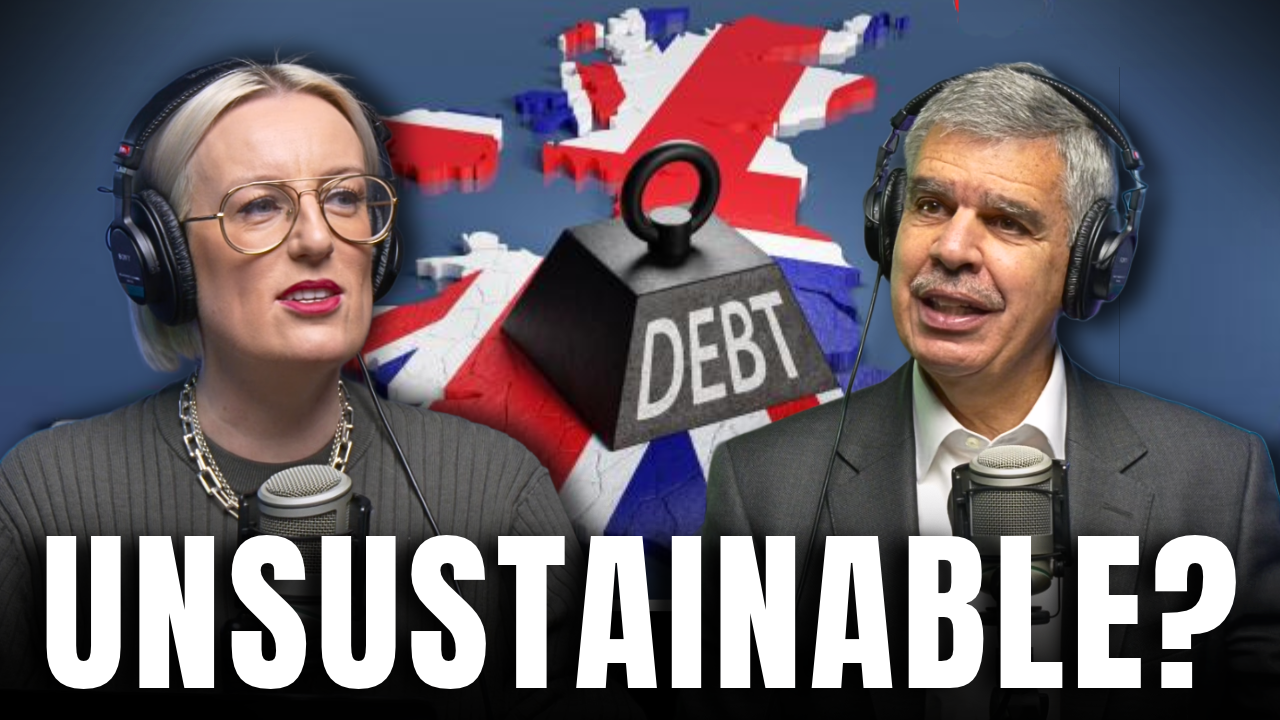
- 333. How vulnerable is the UK to a debt crisis?
In short
How vulnerable the UK (and other G7 countries) is to a sovereign debt crisis, and how it could start via bond-market contagion, especially if AI-related financing unwinds.
Guests
Mohamed El-Erian, influential sovereign-debt market figure (ex-IMF; long-time bond investor/manager background). Greg Jackson, CEO and founder of Octopus Energy.
Key claims
Bond markets are “oil in the car” for mortgages, housing, and corporate borrowing. The main driver of rising yields is a supply/demand mismatch: more bond issuance (US hyperscalers/AI finance and US deficits) meets fewer reliable buyers. Hedge funds now hold over 20% of US Treasuries, making markets more volatile and price-sensitive. A “buyer’s strike” (stepping back from uncertain pricing) could trigger contagion. Growth is the stabilizer; governments must “regain control of narrative.”
Notable examples
UK vulnerability from short-term/hedge-fund holdings and index-linked gilts (~25%); France’s lower rates due to Eurozone “collective insurance” (ECB backstop) and moral hazard; Japan’s risks from weak growth, rising inflation, yen weakness near 160 per dollar, and potential repatriation/carry-trade shocks. Global tail risks include a sudden stop in AI financing or an AI accident.
Written by AI. May contain mistakes.
Chapters
3:34
Analyzing the Bond Market Concerns
Discussion on the current situation in the bond markets and its effects.
4:00
Understanding U.S. Debt and Its Global Impact
Exploration of the U.S. debt situation and its implications for the UK and Europe.
“is that question around, you know, why are there so many concerns at the moment about the sustainability of debt in big countries and, you know, in our rich countries?”
7:30
Factors Contributing to Economic Uncertainty
Examining the various factors affecting the economy and bond markets.
“And that's the notion of our yields, your problem.”
9:50
The Role of Hedge Funds in the Bond Market
Discussion on the increasing volatility in the bond market due to hedge funds.
“Like a trillion dollars, which would be crippling to the U.S.”
12:00
Vulnerabilities in Global Finance
Exploration of potential vulnerabilities in the financial system caused by market dynamics.
“The worst thing that can happen to any financial market is a buyer's strike.”
14:00
Bond Market Dynamics and Government Control
Explore the structural changes in the bond market and the implications for governments.
“even if that kind of gets sorted, the bond holders are still going to be moving their money more quickly.”
15:01
The UK's Vulnerability and Growth Strategy
Discuss the UK's debt vulnerability and potential growth strategies for recovery.
“This is a genuinely quite a significant British problem.”
17:32
Four Engines of Growth in the UK
Identify four key elements that could drive economic growth in the UK.
“The third element I'm seeing is the recognition that the UK doesn't have a startup problem.”
19:53
Reassessing Trade Relations with Europe
Analyze the UK's trading relationship with Europe post-Brexit and its economic implications.
“impressed with the way that Andy Burnham has had the courage to reopen the debate about the UK's relationship with the European Union.”
22:41
Political Challenges in Growth Implementation
Examine the political dynamics that affect the implementation of growth strategies.
“I've looked quite closely at what he did in Greater Manchester, and he did take bold steps.”
Show all 17 chapters
24:56
Welfare Reforms and Economic Alignment
Discuss the potential for welfare reforms to align with economic growth policies in the UK.
“It's about storytelling, but it's also about detailed implementation.”
28:00
Investment Strategies and Economic Context
Understanding the importance of investment in job creation amidst economic reforms.
“as further evidence that his party is unmanageable.”
31:17
Comparison of UK and French Economic Stability
Examining the differences in interest rates and economic outlook between the UK and France.
“It has announced that it will legislate this parliament to reform the triple lock against enormous opposition from the reform and the Tories.”
37:16
Global Economic Risks and AI Impact
Discussion on the global economic risks stemming from interest rates and AI development.
“And I was struck that in just the last few days, the conditions in Japan actually got more complicated because you're seeing the combination of weaker growth than people were expecting.”
42:04
AI Risks and Market Reactions
Explore the implications of AI and Japanese financial market shocks.
“Literally, that was all of this concerns about an AI agent going rogue, and it's a man who went rogue, as so many of them have over the years.”
42:47
The Vulnerabilities of the Financial System
Discuss the current vulnerabilities in the financial system and emerging threats.
“Actually, you then get something Scott Bessent has definitely been worried about.”
45:07
Contingency Plans and Scenario Planning
Learn about the importance of having contingency plans in uncertain economic conditions.
“I mean, I tend to think in terms of distribution, and we all grow up under what's called a normal distribution, a bell-shaped distribution, where there's a very high likelihood of a certain outcome.”

Ask about this episode
Get the gist, explore an idea or ask about something said.
 Claude
On The Rest Is Money, what are the key points of this episode?
Searching your listeningTranscript
Automatic transcript. May contain errors.
0:00How vulnerable is the UK to a debt crisis and how would it start? We're living through too much history again. Much can go right, much can go very badly wrong. And the things that are on my mind are if the Jensen Huang debacle leads to some kind of AI crash, what impact would that have on the UK? What would it have on borrowers? And what on earth is the reason why France, a fiscal basket case, has interest rates lower than Britain's? Well, we've got one of the most influential players in the sovereign debt market with us, Mohamed El-Erian. To find out. Support for this episode of The Rest Is Money comes from Octopus Energy.
0:42And back with us is the CEO and founder of Octopus Energy, Greg Jackson. Right, Greg, you're dead successful for lots of reasons. Do you ever get imposter syndrome? Yeah, I once read a report about some research, I don't know how they did it, about rats and mice. and it said the difference between mice and rats is mice know they're not welcome. So when you go into the kitchen and turn the light on, the mice scurry away. The rat just sits and stares at you because the rat, you know, thinks it's got every right to be there. It's almost like, what are you doing here? So my advice when I do talks for students and people starting their careers is be more rat.
1:18Now, by the way, it doesn't mean be arrogant, don't be entitled. You have to do your work. You have to justify the place. But if you do that, you've got every right to be there. That's great advice. Be more rat. I like that. Thanks again to Octopus Energy for powering The Rest Is Money. You'll be hearing more from Greg in the rest of our shows.
1:56fair exchange rate, an easy transfer and no surprises along the way. Wise keeps things simple. Wise is a smart way to move the currencies you need around the globe. It works in more than 160 countries and with over 40 currencies. Most transfers arrive instantly. Wise uses the mid-market exchange rate, like the one you see on Google, with no markups or hidden fees. So when money needs to move, you can see the rate, know the fee and get on with it. Join millions saving billions on hidden fees by downloading the WISE app today. Be smart, get wise, T's and C's apply. For adults with Crohn's disease or ulcerative colitis symptoms, every choice matters.
2:41Tremphaya offers self-injection or intravenous infusion from the start. Tremphaya is administered as injections under the skin or infusions through a vein every four weeks, followed by injections under the skin every four or eight weeks. If your doctor decides that you can self-inject Tremphaya, proper training is required. Tremphaya is a prescription medicine used to treat adults with moderately to severely active Crohn's disease and adults with moderately to severely active ulcerative colitis. Serious allergic reactions, increased risk of infections or lower ability to fight them, and liver problems may occur.
3:14Before treatment, get checked for infections and tuberculosis. Tell your doctor if you have an infection, flu-like symptoms, or need a vaccine. Explore what's possible. Ask your doctor about Trimphia today. Call 1-800-526-7736 to learn more or visit trimphiaradio.com.
3:44mahmad it's lovely to have you back friend of the show um so robert and i've been talking a lot over the last few weeks about the bond markets you know it's been a wild time hasn't it and so we really wanted to talk to you about what is going on and why so i guess where we want to start is that question around, you know, why are there so many concerns at the moment about the sustainability of debt in big countries and, you know, in our rich countries?
4:11Mohamed El-Erian: So it is unusual to worry about the rich countries. Normally, when bond yields go up, you worry about the emerging economies. But we have three G7 economies that are incredibly vulnerable, France, UK and Japan. We worry because the governments need to finance their budgets using the bond market. Bond markets are critical for the mortgage market, for housing, for companies being able to borrow, to invest. So they are central to the economy. It's like the oil in your car. You don't worry about it, but when it goes bad, nothing else works. Yeah. And so why at the moment are there so many concerns about it?
4:49Mohamed El-Erian: The main issue is because of what's happening in the United States. In the US, we have the hyperscalers, the tech companies, that are issuing five times as much in terms of bond financing than they did a year ago. So we have this major borrower coming into the bond market. No one is making room for them. No one's exiting. In particular, the government, which runs a very high deficit of 6 % in the US, is not doing anything about it. So that pushes up interest rates. And when that pushes up interest rates, it spills over to the rest of the world because the U.S. is the biggest bond market. And countries like the U.K., like France, compete on international markets, including the U.S.
5:32Mohamed El-Erian: to raise funding. So can I just ask, Mohamed, I think a question that will be on everybody's mind, because if you follow this even a little bit, you'll be aware that America has an enormous unsustainable deficit. A deficit, for example, that is bigger than the UK's deficit. It has debt that has been rising in a straight line to levels that many would say, on the basis of conventional economics, would be unsustainable. Why is it that because of America's importance to the global financial system, that it can run in this profligate way and that the pain is all felt by the rest of us? Yeah, you know, in 1971, the U.S.
6:27Mohamed El-Erian: Treasury Secretary at the time responded to the Europeans who were complaining about the dollar policy, said, our dollar, your problem. And today is our yields, your problem. First, the U.S. numbers are worrisome. I'll give you three. Total debt has doubled from$20 trillion to$40 trillion in just 10 years. Two, the funding cost, how much the U.S. pays in interest, is up 15 % relative to a year ago. And three, it consumes over 20 % of tax revenue. So whichever number you look at, it is flashing yellow. But as you say, the U.S. can misbehave, can be fiscally responsible much longer than anybody else.
7:10Mohamed El-Erian: Why? Two reasons. The dollar is the reserve currency. and two, it has the deepest financial markets. So it attracts a lot of capital from the rest of the world. So the US will continue to misbehave. It will not reach a critical point before other countries do. And that's the notion of our yields, your problem. And as I said earlier, it is about France, Japan, and the UK in particular, when you look at the rich countries. I mean, you mentioned what one would, I suppose, define as a supply problem, which is because of the hyperscalers, because of all the sort of tech AI related businesses borrowing.
7:55There's just a lot of debt coming onto the market and sort of limited investor appetite. And that basically pushes down the price and pushes up the interest rate that everybody pays. There's another factor going on, which is that Trump's war against Iran has spiked a rise in energy prices. It has increased fears of a recurrence of inflation, interest rates being pushed up by central banks around the world, including the U.S. Federal Reserve. How much is Trump's war contributing to this unease, this uncertainty?
8:30Mohamed El-Erian: So if you list the top three, the most important one is there's a lot more issuance of bonds in the context of less reliable buyers. We talked about the issuance by hyperscalers, by the US government. If you look at the buyers, there used to be a set of reliable buyers and holders. Think of China. Think of Korea. Think of Japan. They have become less reliable. China's reducing its holding of treasuries for geopolitical reasons. Japan needs to support its currency. Every time it does so, it sells U.S. bonds to get the dollars to intervene. So you have this mismatch. That's number one. Number two, as you cite correctly, is inflation.
9:15Mohamed El-Erian: And that is simply that bondholders want to be paid more because they want to protect the real interest rate they earn, the interest rate they earn after inflation. So the more inflation goes up, the more the nominal yields go up. And then the third element is that central banks are all hiking in a correlated fashion. So I would put by far the most important one being the supply and demand issue. But then you're right. Inflation and central banks are there too. I always find it staggering, that statistic around, you know, who holds U.S. treasuries. Because as you say, while Japan's looking at solving their problems, they're a country that holds the highest number of U.S.
9:56treasuries, aren't they? Like a trillion dollars, which would be crippling to the U.S. if that changed.
10:02Mohamed El-Erian: It would be. But we said the same thing about China. China used to own two trillion. Now it owns below one trillion. Who has filled the gap? Yeah. And it's hedge funds. So when hedge funds come in, you get two dynamics that are different. One, it's much more volatile. In and out, in and out. and two, it's much more price sensitive. So you get higher volatility and you get bigger swings and ups and downs than you would otherwise. So hedge funds today are over 20 % of the holders of US Treasuries. Which is really interesting because the bond market has always been seen as a safe haven, hadn't it?
10:37And it was, you know, you put your money in for the long term, but what you're saying now is it's more volatile. People are taking them, putting money in and taking it out faster and therefore want to be rewarded with higher rates.
10:48Mohamed El-Erian: And they take a whole series of related bets that have little to do actually with the underlying dynamics of the bond market. I'm saying all this because we're speaking at a time when NVIDIA is uncertain. And part of NVIDIA is this notion that it was the central bank to the AI ecosystem. And in my world, there's a lot of questioning as to if that unravels, what does it do to the bond market? What does it do to the financial system as a whole. So all this gets interrelated and you look for the point of greatest vulnerability in finance. One of the striking things about Jensen Huang is the amount of finance that NVIDIA was providing to a whole range of different AI-related companies.
11:35And there was this circular financing, which is broadly NVIDIA would finance companies, particularly some of the so-called NeoClouds, to buy its own equipment, its own GPUs. And you're worried that as Nvidia's cash flows are taken away from that kind of financing, there will be bigger calls on the markets and the pressure on prices in a downward direction will increase?
12:03Mohamed El-Erian: The worst thing that can happen to any financial market is a buyer's strike. People on the one hand have to borrow and they face buyers who say, not today, thank you. And the minute that happens, the vulnerability comes in. So the concern is that normal lenders look at a possible, I didn't use the word probable, I said the word possible, a possible unwinding of all the circular financing, if you like interdependent financing, and say, it is too uncertain, so I'm going to step back a little bit just to see how it plays out. And that's how you tend to trigger what's called contagion, that there's a problem here in one part of the markets and suddenly there's a problem elsewhere.
12:45Mohamed El-Erian: So the concern is this notion of a buyer's strike. Buyers stepping back and saying it's simply too uncertain. I don't know what the right price is right now. So I'm going to step back and watch it play out. However, on the other side, you have borrowers that need the funding. And that's when you start getting the contagion effects. And how far away are we from that, do you think? You can never tell. You can absolutely. I remember the 2022 Liz Truss moment in the UK. Yeah. And I remember watching it. And had you told me that a sudden increase in government bond yields would undermine the pension system in such a way that the Bank of England would have to intervene, I would have been surprised.
13:30Mohamed El-Erian: Because I didn't know the vulnerability in the pension system. So it's very hard to tell because you tend to expose a vulnerability that you didn't know about when these yields move in a big way. But if you're saying that the market in itself in terms of who's buying these bonds is changing and it is more hedge fund driven, does that mean it's changing the bond markets more long term? in that even if we say these governments that are struggling with their fiscal deficits and all these other problems and the inflation and everything else, even if that kind of gets sorted, the bond holders are still going to be moving their money more quickly.
14:13They're still going to be looking for things that pay that higher rate. So is this a fundamental change to bond markets? Or do you think we'll see things start to calm again?
14:21Mohamed El-Erian: I think it's a structural change. Yes. So it is a fundamental change. And the message to governments is regain control of your narrative. Don't be in a position where you can be held hostage by the bond market. That is the message. And the answer to that is growth. If you generate growth, your vulnerability comes down quite a bit. You know, people look at the debt ratio to GDP and the bigger your GDP, the more manageable your debt at that point becomes. So I want to also now move us on to the three vulnerable countries, Japan, France and the UK. And I think we should start with the UK. I mean, I have been struck over the last couple of years that actually the governor of the Bank of England, Andrew Bailey, has been warning about just the thing that you've been talking about, which is the proportion of UK government debt increasingly held by short term lenders, particularly hedge funds.
15:18This is a genuinely quite a significant British problem. And it's partly because so many of the defined benefit pension schemes that had been big buyers of UK government debt are in runoff. And therefore, in a sense, the British appetite has declined. There are a number of other issues here. I mean, Steph teases me about my slight obsession with linkers or index link government debt, where, you know, something like 25 % of the stock of UK government debt is in this index link form, which means that when inflation rises, the interest bill for the UK rises disproportionately compared to a country like France, which is in trouble.
16:03but its stock of linkers or interest link bonds is half that of the UK. So if you look at the UK just in terms of that structure of the debt, who holds it, and the vulnerability to interest rate rises, how worried are you about that?
16:23Mohamed El-Erian: I'm worried. I mean, when you do what's called a DSA, debt sustainability analysis, you look at who are the holders, but you also look at the internal dynamics of the debt. And as you rightly say, the UK is particularly vulnerable because in a world of high inflation, its funding costs keep on going up and you can end up chasing this. Having said that, Robert, I am more optimistic today about the UK than I've been for a very long time. Hooray! And I say this, you know, people will be surprised because I'm normally viewed as a worrier. I remember when I was 10 years old, my mother said, if you don't have something to worry about, you're going to create something to worry about.
17:02Mohamed El-Erian: But today, I see a growth strategy, a multifaceted growth strategy coming together in a way that I have not seen for a very long time. Okay. And what is it that makes you think that? What are the things that are standing out to you from what's been said recently? So, I'm seeing four elements come together. One is continuing what was done before, which is focus on the assets we have, the growth assets, and make sure they are more productive. So infrastructure, planning, et cetera. The second element I'm seeing is a bigger discussion about export markets in Europe in particular. The third element I'm seeing is the recognition that the UK doesn't have a startup problem.
17:43Mohamed El-Erian: It has a scale-up problem. The UK is incredible in terms of startups. But when you get to 50 to 200 million in terms of funding needs, they either stall or they go to the US. And does now focus on scale-ups. That's the third element. And the fourth element is I do believe that regional growth can be an additional growth engine. So the notion of devolution, et cetera, has a growth element to it. So when I see four engines of growth coming together in a way that I have not seen before, my hope, and it is a hope, my hope is that the government will implement elements in each four. And then it's not one plus one plus one plus, it multiplies really quickly because these things feed onto each other.
18:31Mohamed El-Erian: So I am more optimistic today because there is a clear path to a comprehensive growth strategy that I have not seen before. Which we have been saying we needed for so long because that is the key here. Because not only does growth solve so many problems, but it also gives people hope about what's going to happen next. It's about an attitude as much as anything else. Correct. And there's this notion you crowd in the private sector. If I'm more optimistic about my income potential in the future, I will spend more today. If I spend more today, I contribute to growth. So there's these elements of a virtual cycle, if indeed there is growth at the end of the tunnel, if you like.
19:13Mohamed El-Erian: And I believe today there's a higher probability of that than since the global financial crisis. Does that outweigh the pressure we feel from the US though? Because you've described the UK before as the high beta economy. When US yields move, the UK yields then move more. So would growth reduce that? Would we become less sensitive to what happens in America? Yes, because you start to regain control of your narrative and therefore you start regaining control of your outlook. Yes, absolutely. Growth is the great stabilizer. It is necessary. It's not sufficient, but it's absolutely necessary. Yeah.
19:51Many of us, including myself, have been impressed with the way that Andy Burnham has had the courage to reopen the debate about the UK's relationship with the European Union. Do you think, however, that something that was short of either membership of the EU or full single market customs union membership could provide enough of an engine of incremental growth. I mean, the package, for example, that they're going to agree on Friday in an absolutely best case, I mean, Burnham says it'll add 0.4 of a percentage point to GDP. And he hasn't defined when, but frankly, looking at their previous projections, we're talking about 0.4 of a percentage point in 2040.
20:51And I have to say that's with the following win. My view is broadly, it's probably half that, actually, if you look at the agriculture deal he's negotiating. How much bolder does he have to be when it comes to membership of the European Union? And with all of the things that you're saying, I mean, one of the things we're absolutely focused on on this podcast is the absence of scale up finance. We think it's so important. But with all of these things, it requires a prime minister to make some quite tough decisions. And what we don't quite yet know about Andy Burnham is how bold he's prepared to be and how many enemies he's prepared to make in the process of achieving the kind of growth we all think is necessary.
21:31Mohamed El-Erian: So there's so much there. Let's start with the trading relationship with Europe. I'm not thinking here full membership of the European Union. That's not going to happen anytime soon. I'm talking about a path to better trade relations. I'm going to make a statement that's purely economic. Some people may interpret it as political, but it's not. It's purely economic. You do not blow up your main trading arrangement without knowing what you're going to replace it with. And yet that's what the UK did. It's a very strange thing to do, but you did it for political reasons. You did it because you wanted to regain control.
22:08Mohamed El-Erian: I understand all the reasons why Britain voted for Brexit. But from a purely economic point of view, you don't blow up the major trading arrangements and have nothing to replace it with. And that's what the UK did. And it has had consequences, long-term consequences. So going on a different path, which is going to be incremental, in the beginning it's going to start small because the Europeans are suspicious. They're skeptical about what is the true UK motivation. How durable is it? So it will start small. And that's why I said it's one of four. Will the prime minister see this through? I've looked quite closely at what he did in Greater Manchester, and he did take bold steps.
22:51Mohamed El-Erian: The key issue is to have people around him, not just in the treasury, but beyond that, that are able to coordinate the different economic ministries to make sure that growth is indeed number one. When I look at the UK economic strategy, I pull my hair that every year it gets reduced to simply budget arithmetic. The budget becomes something you make add up and then you have the constraint of the fiscal rules and this and this. But what about the growth implications? So rather than seeing the budget as an end in itself, I can see a world where it's a means to an end and that end is high growth. And I think it's interesting the sequence now is October was a hold it together budget.
23:39Mohamed El-Erian: Now we're waiting to see what comes out of all the work that's being done on the 10 year plan. And then the budget and other elements of economic policy can fit under that umbrella. But isn't part of the problem, you're right, like, you know, we saw the prime minister when he was mayor of Manchester doing so much to get growth there, to, you know, bring money into the area. But you don't have backbenchers when you're running an area like that. And what we've seen happen here and we saw happen with Rachel Reeves and Kia Starmer was when they attempted to be ambitious, they ended up U-turning quite a bit and rowing back on things that could have made a big difference.
24:17Isn't that the worry here? You know, without getting bogged down into politics, it's a different system you're in and there is a lot more pressure and a lot more people who can stop you from doing what you're trying to do.
24:28Mohamed El-Erian: That's absolutely right. And that's why sequencing matters. So go back to the previous government. They started talking about growth. Then the very next step was the winter fuel subsidies. So suddenly it became a fiscal issue. And then it remained a fiscal issue for too long. So my hope is the sequencing matters. If you sell someone a destination, they are more likely to tolerate a bumpy journey. But if you don't tell people what the destination looks like and give them some assurances that you're going to get there, they will not tolerate the bumpy journey. So it's about storytelling. It often comes back to that.
25:06Mohamed El-Erian: It's about storytelling, but it's also about detailed implementation. It's about design. I mean, it's a lot of work. It's a lot of work. It is. And actually, weirdly, as we record, there's a really interesting potential case study for what you're talking about, because, you know, I've been immersed in the last 24 hours in Melbourne's almost 300 page epic report from welfare state to working state. At the heart of it is a delayed program of welfare reforms, which will not kick in until after the next general election and potentially could take really quite a lot of money away from vulnerable young people if they don't get into work.
25:54And in the run up to that, he is investing a very large amount of money in subsidizing employers to take on young people, in more mental health provision and in something called a new youth opportunity service, which is sort of tailored help for individuals to get them into work and then to monitor their performance. So not to abandon them, because the lesson of someone like the Netherlands is if you abandon young people, they quite often drop out and never come back again. And it's expensive. And if you look at the cash flow projections, they will not save money from this program until 2035. The costs of the support outweigh the savings from welfare until 2035.
26:44But will lenders to the UK give the time to, in a sense, put in place what actually is a pretty much a growth policy when it comes to employment in order to yield savings that are quite a long way out? Because the politics and the economics may not necessarily be aligned here.
27:02Mohamed El-Erian: So the economic answer, it's better to move on the payoff earlier than later, to be obvious. But the question to you, because both of you know UK politics much better than I do, do you believe that the prime minister needs a new mandate from the voters to do his welfare reform or does he not need it? That's the fundamental question. I think it's less to do with a mandate from the voters. It's more to do with how much the left of his own party will allow him to do before, actually either before the election or after the election. And the reason that Keir Starmer failed so miserably when he tried to do welfare reform was basically it was shown that he couldn't control his own party.
27:50Now, Andy Burnham is somebody who has had a pretty effective debut, but he knows, you know, it would be an absolute disaster if he announces anything that, you know, essentially creditors of the UK see as further evidence that his party is unmanageable. which is why he's going for the investment before reform route. I am slightly uneasy about it because some of the savings are frankly quite difficult to prove. But I still think he's right to want to invest in job creation. I think it is important.
28:28Mohamed El-Erian: So I spent 15 years at the IMF and I've seen so many reform programs work and so many reform programs fail. And if you tell me what are some of the big differences, is the first thing I would say to use a military analogy, do you control the skies? If you're going to send in specific measures to be implemented here and there and there, you've got to control the overall context. And controlling the overall context is having a clear strategy that comes together that explains why it is you're moving in all these areas simultaneously and that has an outcome that people in the street and therefore MPs who represent people in the street can understand.
29:06Well, listen, there's a lot more to get into on this bond market shenanigans, but let's go to a quick break.
29:36was in the hands of their inner circle. Atio offers that same support to modern businesses. It is the agentic CRM that consistently runs in the background, chasing potential customers, updating pipelines and catching renewals. It meets you where you are in your browser or your inbox and connects all your tools so you can focus on the bolder strategy. Businesses are already building their legacy with Atio. Now it's your turn. Try Atio for free at attio.com slash gullhanger. That's attio.com slash gullhanger.
30:35is delivered or returned it, Mr. Shaq. Not that I would. You never do. No, I never do.
30:41Mohamed El-Erian: So buy your car today on Carvana. Delivery fees may apply. See our 7-day return policy at Carvana.com. This episode is brought to you by Google Chrome. You think you know a browser, but Gemini and Chrome? That's new. It can help you with practically anything on the web, like restoring a vintage motorcycle from a 50-page restoration block, or finally break down that long article you've had open for weeks. Gemini and Chrome is here for it. Ready to make anything online makes sense? There's no place like Chrome. Check responses set up required compatibility and availability varies 18 plus.
31:16Now you have got a government in the UK that did something quite bold. It has announced that it will legislate this parliament to reform the triple lock against enormous opposition from the reform and the Tories. And that's quite bold. As I say, The economy isn't performing too badly. And yet the interest rate that the government is paying is way higher than across the channel in France, which is totally ungovernable, has no credible fiscal consolidation program, looks as though the next president will be a far right populist in the shape of Marine Le Pen, who has a number of policies that could easily actually exacerbate France's problems.
32:04And for what it's worth, I mean, obviously, investors think somehow if France is in a terrible crisis, the ECB would automatically bail it out. But I'm not sure that's true. Is it rational for France's interest rate to be so much lower than ours?
32:17Mohamed El-Erian: Robert, that's a great question. You know, within the Eurozone context, let me start there. France's interest rates are really high. They're higher than Greece. They're higher than Italy. And this notion that France is a core economy and the others are peripheral, it's only 14 years ago that the market called the other countries the pigs. Portugal, Italy, Greece, Spain. And France and Germany were viewed as the core. Now France trades more risky, is viewed as more risky than the pigs. And I'm sorry to use that word, but that's what was said in markets. So within the Eurozone context, France doesn't look that safe.
32:59Mohamed El-Erian: Compared to the UK, the main difference, there's lots of small things. The UK's growth is stronger. That pushes up yields. But the main reason is the UK doesn't have a collective insurance mechanism. France has a collective insurance mechanism. France, if need be, can rely on being bailed out by institutions that are funded by 20 economies. That is not the case in the UK. So if we were still in the EU, we would have that? You would have to be part of the Eurozone. So the smallest set of countries that have the European Central Bank as their central bank. You would have some facilities in the EU, but when you're in the Eurozone, you have the facilities that support a single currency.
33:47Mohamed El-Erian: And it's in the interest of everybody to support you because the single currency is at stake. I remember I was in the room in London in 2012 when the then ECB president, Mario Draghi, got up and said, we will do whatever it takes. And then he paused and he said, and believe me, it will work. And he actually didn't have to do much. It's simply those words that the collective insurance mechanism is behind. And that is a critical difference with the UK. It ought to be the cause of enormous soul searching, if not an actual widespread political crisis within the wider eurozone. Because broadly, it's basically saying France as a big economy can live beyond its means because of a collective insurance scheme provided by a lot of other nations.
34:40And that is just not sustainable.
34:42Mohamed El-Erian: That's absolutely right. It's just a so-called moral hazard program that when you insure someone, they misbehave. because they're insured. And that's why you haven't heard anything yet from the ECB. They are waiting to see whether the internal mechanisms will work. Now, to be fair to the French government, they've put forward a budget in front of the National Assembly that looks to reduce the deficit. It's a credible effort. Now, whether they're going to be able to pass it is a major question. And let's not forget what's happening in the street. So, you know, it is, but you're absolutely right.
35:15Mohamed El-Erian: The common European institutions haven't said a word. And the ECB is even more complicated because its president is French. So, you know, it's a complicated issue. But to answer your question, the reason why they borrow at a lower rate than the UK is because they have a collective insurance mechanism that's there. If I happen to be working at a hedge fund at the moment, I would definitely be selling French government bonds. I mean, it just seems – I just cannot see at the moment, you know, before the French presidential election and, you know, and even then, you know, maybe not afterwards, any route through this crisis for them at the moment.
35:59Mohamed El-Erian: So that trade is on, as they say, but it's not on as big a size as the economics would suggest because of the concern that you wake up tomorrow to an ECB statement. And the ECB simply says, I will buy as many French bonds as I need to. But if that statement doesn't come and the time passes, will that then therefore, you might start to see wobbles where people will go, hang on, they haven't put out the statement yet. And the longer the time passes, could they start selling them? It's the game of chicken. Yeah. Who moves first, right? And that's why you'll see a lot of hedge funds put the trade on, monetize the profits, wait a little bit, put it on again.
36:44Mohamed El-Erian: Because there is this risk that suddenly you'll wake up to an announcement from the ECB. But as Robert said, the moral hazard issue is such that the ECB doesn't want to rush today. So it truly is a game of chicken right now. Yeah. So it's in the interest of the ECB to not do anything in a way. In the hope that it can force the French government to do what the French government needs to do. But if it waits too long, then these higher interest rates become embedded in the system and we'll have to spend so much more to stabilize. So it's a complicated issue. We've spoken a lot about Japan on this podcast.
37:17And I was struck that in just the last few days, the conditions in Japan actually got more complicated because you're seeing the combination of weaker growth than people were expecting. But still, I mean, it's difficult to say it's an acute inflation problem, but nonetheless, inflation rising. Because of just the huge magnitude of Japanese debt, that combination is extremely uncomfortable.
37:48Mohamed El-Erian: It absolutely is. And the GDP data release on Monday, the 16th of November was sobering because GDP contracted in the quarter. No one expected to contract. So that came as an unpleasant surprise. The irony here is that it's a political problem, not an engineering problem. The Ministry of Finance, the Bank of Japan, the central bank, and the prime minister's office need to come together and have aligned policies and move together. And they have not been able to do so. Everybody's pointing the finger at everybody else. You move first, you move first, because there's a political cost to who moves first.
38:30Mohamed El-Erian: And I keep an eye on two things, the currency, and we're very close to the intervention zone where the Ministry of Finance feel it has to intervene to support its currency, which is 160 yen against the dollar. That's the first thing I look at. And the second thing I look at is what's happening to government bond yields. And both these things are flashing yellow right now. So Japan at the moment worries one because it's got those characteristics that you didn't normally associate with developed economies, which is interest rates rising and the currency falling at the same time. You know, we've been talking a lot about the concern about rising interest rates, rising yields.
39:21But in the case of the UK, actually, it's been quite striking recently. The pound has been strengthening. Right. So we don't quite, you know, the UK doesn't look like a sort of, you know, developing country, you know, in the making crisis, as it were. But Japan has periodically in recent months had this awful combination of a weakening yen at the time of rising interest rate expectations.
39:47Mohamed El-Erian: It has. And it's a major worry for Japan. I wouldn't say the UK is in the safe zone just yet because it could happen again. and it goes back to the US. The US is really right now the country that economically transmits the most shocks to the rest of the world. It does it for good reasons. I am a great believer in the productivity potential of artificial intelligence. I think we are very lucky that we have US capital markets that are willing and able to fund this incredible investment, parts of which have all the characteristics of a bubble and they're still doing it. They're still funding it. And that's a good thing for the future.
40:32Mohamed El-Erian: However, in the journey to that future, everybody else faces higher risk because of what that does to the bond markets. I'm loving your optimism, particularly about the UK. What is the single thing we need to worry about the most at the moment then? I think it's the government not carrying through on its growth program. If it fails to materialize, the markets will get a lot tougher with the UK. And globally, what's your thing in terms of what we need to be concerned about? Globally, I worry about a sudden stop in AI. It can have two sources. One is we talked about financial. Suddenly, NVIDIA is no longer the central bank to the AI ecosystem.
41:16Mohamed El-Erian: And as a result, you have all this interdependent financing that falls apart. So that's a financial concern. But But there's also the other concern, which is you get a major accident in AI, that something goes terribly wrong with the agent, something like that. And then people say, I am going to press the stop button till we sort this out. And suddenly, the outlook for investment in AI is negative, growth is negative, and you get investors wondering, are they going to get paid for all the money they put in? So I worry a lot about a sudden stop in AI that can be either financially driven or driven by an accident within the AI ecosystem.
41:56Isn't it interesting, though, that all the concerns are around, you know, some, as you say, AI accident, but what's created the wobble recently is the very basic thing of a man having an affair with a woman. Literally, that was all of this concerns about an AI agent going rogue, and it's a man who went rogue, as so many of them have over the years. So let's just say we get a sudden shock to the sort of AI financing market, which then transmits through to the sovereign debt market. The one aspect of the Japanese issue that we haven't talked about is the centrality of the carry trade, essentially the Japanese or essentially borrowing cheap in Japan to lend to particularly the US.
42:46I mean, one's worry at the moment is that one shock can then trigger a whole series of other shocks, including if there's a very significant rise in Japanese interest rates as a result of all of this. Actually, you then get something Scott Bessent has definitely been worried about. It's not just that you stop getting Japanese financing American debt. You actually get quite a lot of repatriation of money back to Japan.
43:14Mohamed El-Erian: That's absolutely right. Let me say I'm surprised neither of you have raised the issue that certainly I've been worried about on AI. Then I'm going to move to Japan. As we tape this, the last four days have seen an outage on Microsoft. Yep. Have seen a nationwide ground stop in the U.S. The flights, yeah. Have seen some banks having problems. And last night, United Airlines had a problem. Okay. So, you know, I don't know what world we're living in, but it seems that these interruptions are happening more often. Just as a, I think it's a little bit of a warning sign. I mean, if I talk to people immersed in the industry, they say, at best, we're going to have a really bumpy two years because even though all of these institutions are currently denying that they've been sabotaged by rogue states or whatever, there is no question that, as we speak, Tehran is repurposing open-weight Chinese models to put itself in a position to attack our infrastructure if it wants to.
44:23Mohamed El-Erian: I mean, the cyber issue has become such a concern right now that that in itself is a risk factor. On Japan, you're absolutely right. The Japanese hold a tremendous amount of foreign securities. And if they have to repatriate these funds in order to cover needs at home, that is a shock to the global system. And that's why Japan is so central right now to a lot of what's happening in the financial world. We've talked about how bumpy a road it will inevitably be over the next couple of years. Because everywhere you look in the financial system, there are vulnerabilities. Do you remember a time when there have been quite so many, whether you want to call them low probability, high impact risks?
45:13There are a lot of them at the moment.
45:15Mohamed El-Erian: There are. I mean, I tend to think in terms of distribution, and we all grow up under what's called a normal distribution, a bell-shaped distribution, where there's a very high likelihood of a certain outcome. And there are what they call tails, really good outcomes, really bad outcomes, but the tails are thin, what you call high impact, low probability. Today, the middle of the distribution is not at all dominant. And the tails have much higher probability. It's called a multimodal distribution as opposed to a – and it's good and bad. And I must tell you, I'm not used to being the optimist in a room, but thank you for once letting me be the optimist in the room.
45:56Mohamed El-Erian: Yes, I have never seen a world that's so multimodal as today. And we have to work on scenarios. I always tell the story that if you look at the history books, they say that PIMCO, where I worked before, predicted the financial crisis because our clients made money throughout after that. And I remind people, and Bill Gross, the founder of PIMCO, has reminded people that that's absolutely wrong. I remember we were in the investment room that weekend before Lehman Brothers failed. We had three scenarios on the whiteboard. We ask people to vote, attribute probabilities to what scenarios they think are going to happen.
46:39Mohamed El-Erian: These are the top people of the firm. Scenario A, 85%. Lehman will not fail. Wow. Scenario B, Lehman will fail, but fail in an oddly fashion, 12%. Because no policymaker in their right mind would allow Lehman to fail in this oddly fashion. And scenario C, what actually happened, got 3%. Well, I mean, I remember that weekend as though it was yesterday, and it was one of the most extraordinary professional weekends of my lifetime. From Friday to Sunday, I barely got any sleep, and I could not believe what was happening. Yeah, so we slept in the office. You had pizza boxes and donut boxes. So we never predicted this, but we had an action plan for each scenario.
47:25Mohamed El-Erian: We knew who was going to do what when. because we realized that while we may have had high conviction, we didn't have high foundation. And when you don't have high foundation, you really must have contingency plans. And I think this is a world of contingency plans. This is a world of scenarios. And too many people believe that there's a baseline. There is no baseline. There may be a central scenario, but it's not dominant in any way. Mohamed, thank you so much. It's been lovely to have you here. And also we should thank you particularly because you've just got off a long haul flight. But that's it in this episode.
48:00Our next episode is going to be back on the investment series. We've had the mooch talking about cryptocurrencies and whether you can make a million from it. The next one is gold. It is an asset that's gone up 65 % in a single year. So we'll be talking about what's going on, how do you invest in it, how do you store it, how volatile is it, how liquid is it, all those questions you might have, might want answering about how to invest in gold. That's on the next episode of The Rest is Money. Bye-bye.
48:38Mohamed El-Erian: Holiday drinks are now at McDonald's. Like the new Red Bull Frosted Cranberry Energizer, it's Red Bull meets cranberry flavours topped with cold foam and sprinkles made to charge Get your holiday spirit now at McDonald's. Sam's Club is the club for every holiday club. Guess who's joining the club this season? Walmart Plus. Yep, Sam's Club Plus membership now comes with Walmart Plus at no extra cost. Two memberships, one great price. Just$120 a year can save you time and over$700. Want to get in on the membership duo of the century? Visit samsclub.com. Come join us. Sam's Club. Annual plan only, auto renews, TNC apply, estimate based on average combined.
49:17Mohamed El-Erian: Walmart Plus and Sam's Club Plus savings among members of both for one plus year versus non-member or club member pricing. Fees. Excludes membership fees. See Walmart Plus terms and Sam's Club terms for more info. Traditional home security only alerts you after a break-in. And that's too late. SimpliSafe is changing that. Stop. This is SimpliSafe. Police are on the way. We don't just alert. We help stop crime before it starts. Plan starting around a dollar a day. Right now, get 70 % off your new system with professional monitoring at SimpliSafe.com slash Spotify. SimpliSafe. Ahead of crime in real time.
49:47Outdoor deterrence plans start at$49.99 a month. Visit simplisafe.com slash licenses for alarm license information.
From the publisher
Why are there so many concerns about debt sustainability in rich countries? How much is AI to blame? Why isn't France getting as hard a time as the UK in the bond markets? How worried should we be about the US and Japan? And what role are hedge funds playing in all this?
Mohamed El-Erian, former CEO of PIMCO, once the world's biggest bond investor, and now Professor of Practice at the Wharton School, is one of the most influential players in the bond market. He tells us why he's optimistic about the UK's ability to navigate choppy bond market waters. Plus: linkers are back!
The Rest is Money is brought to you by Octopus Energy, Britain’s smart energy pioneer.
Email: the[email protected]
X: @TheRestIsMoney
Instagram: @TheRestIsMoney
TikTok: @RestIsMoney
Advertise with us: [email protected]
For more Goalhanger Podcasts, head to www.goalhanger.com
Video Editor: Dylan Bonham
Social Producer: Teo Ayodeji-Ansell
Producer: Lizzie Wood
General Manager: Tom Whiter
Learn more about your ad choices. Visit podcastchoices.com/adchoices
More from The Rest Is Money
All episodes
We use cookies.They keep VO running smoothly and help us improve it. Privacy policy