 The Rest Is Politics
3 Nov 2026 · 1h 10m

 Add vo to ChatGPT or Claude to ask about everything you hear
vo listened to this episode to put together the overview and transcript, so there may be the odd mistake.
The US midterm elections, with on-the-ground reporting from Appalachia (Ohio, eastern Kentucky, West Virginia) and a Trump rally in Ohio; plus whether youth protests against Trump could spread to Britain. They also discuss Senate control math, polling reliability, turnout (especially early voting), and campaign tactics.
Rory Stewart (co-host; reports from Roanoke, Virginia and earlier travel through Ohio, Kentucky, West Virginia; attended a Trump rally in Chillicothe, Ohio). Izzy (corespondent; drove Texas to Louisiana, reporting on Louisiana’s closer-than-expected race and local drivers like economy and racism). Alastair Campbell (co-host; moderates; provides polling/turnout context).
Appalachia’s poverty and “deaths of despair” are more extreme than expected; Trump support persists even among people who dislike him, often due to abortion/gay marriage and cost-of-living anger. Polling may be misleading due to turnout uncertainty. Early voting records suggest high motivation, likely driven by dissatisfaction with incumbents and Trump.
A West Virginia young woman describing opioid-to-fentanyl-to-meth addiction in her family and traumatic church “exorcism” practices; Huntington’s overdose surge (30,000 to 100,000 in a decade). Louisiana Democrats hiding with secret pins; a teacher moving detention because parents can’t pick up kids. Trump rally details: MAGA style, “White House repairs” framing, and aggressive crowd interactions with protesters.
0:08Welcome to the Restless Policy's Question Time with me Alastair Campbell and with me Rory Stewart. And this is going out ahead of the main episode because we are going to be doing a main episode on Wednesday to digest the results from the US midterm elections. But this question time is going to lead and be substantially about the midterms. First with Rory, who's where are you at the moment, Rory? I'm now in Roanoke, Virginia. OK, Rory in Virginia. And then later we're going to be joined by Izzy, who has been to all sorts of places, including Louisiana, which I am fascinated to hear what is going on there.
0:44Now, Rory, first question. Rachel, is the hillbilly country that J.D. Vance famously wrote about in Hillbilly Elegy really as different from the rest of the US as he suggested? And if so, do those differences really affect the way people in the region vote? And Douglas, what has been your biggest surprise when investigating the midterms?
1:06Rory Stewart: Just to remind people who haven't listened to our wonderful mini-series on J.D. Vance, Hillbilly Elegy is this best-selling book written by J.D. Vance. 2016, that describes his own family's journey. And it's a journey from rural mountain poverty down to the factories of Ohio. Very old story for Appalachia. School teachers, the cliche was, would say to their students who wanted to know how they could get on in life that they needed to concentrate on the three R's, reading, writing, and Route 23, which is the road that takes you out of the state into Ohio. And it's a book about violence and poverty in the mountains, and it's a book about industrial decline in Ohio, and it's about the loss of pride and identity amongst the white working class.
1:56Rory Stewart: And since 2016, there have been any number of journalists heading into Eastern Kentucky, West Virginia, to try to interview these voters because they flipped very hard and very quickly towards Donald Trump. These were often counties which were pretty moderate, traditionally Democrats in some cases, that went 80 % Trump. And so it's those areas that I've been in, trying to work out whether this narrative is overdone. It'll be an analogy for those who haven't read it. I've read it twice. I read it first when it came out. And I thought, wow, what an amazing story of aspiration and achievement. And I read it again when he became vice president.
2:38And I thought, how did a guy from that background become so vile? Not least about, to my mind, about a lot of the people that he left behind. So it's interesting how differently you can read the same book when the starring character is in a different period of their life. This episode is powered by Fuse Energy. Most energy companies are counting on you doing absolutely nothing, not questioning what you're paying, not switching, just letting your tariff roll on, which is costing you hundreds of pounds every year.
3:11Rory Stewart: But the apathy goes deeper than our bills. We've almost given up on energy itself. We seem to all be accepting energy is expensive, the system's outdated, but that complacency is costing us. Fuse Energy does not accept that because the energy transition is not something that just happens somewhere else. Fuse is building an energy company which which is designed to bring down the cost of energy. And right now, its tariffs are up to£100 below the off-gem price cap. So switching isn't just about paying less, it's about expecting more from your energy company, and it only takes you three minutes. Switch to Fuse at FuseEnergy.com slash politics.
3:50Rory Stewart: Use the code POLITICS, and you'll get a free TripPlus subscription allowing you to hear all the extraordinary members' content that Alistair and I are now producing for you. Visit FuseEnergy.com for full terms and conditions.
4:06This episode is brought to you by NordVPN.
4:09Rory Stewart: We work out ways to protect ourselves from unwanted things every day. Okay, Rory, how do you protect yourself from small talk? I say, very good to see you, I've got to get on to get my kids from school. Yeah, you also have another one that you use quite a lot, so I must go. I'm on Jordan time. I'm on Jordan time, that's good. I like that. Okay, how do you protect yourself from arguing with your co-host? I just watch you argue with other people. No, I have this tactic when I think I'm losing my temper, I just rub my thumb and my index finger together, that's what I do, and I just calm down. Yeah, that's cool.
4:43And how do you protect yourself from online scams?
4:45Rory Stewart: Well, the answer is I find NordVPN useful for that. It's not just a VPN app. They've built in next-gen antivirus block scams, phishing attacks before they reach you, so you can carry on knowing you're secure. To get the best discount on your NordVPN plan, go to nordvpn.com slash rest is politics. You'll get four extra months free on the two-year plan, plus a 30-day money-back guarantee. The link is in the episode description. Hi, this is Gary Lineker from Goalhangers. The rest is football. This episode is brought to you by WISE. It's only when you start moving money between currencies that you really think about the exchange rate, the fee, and what might be hidden away in the small print.
5:22Rory Stewart: Whether you're living abroad, paying someone overseas, or just trying to manage your money across borders, you want a fair exchange rate, an easy transfer and no surprises along the way. Wise keeps things simple. Wise is a smart way to move the currencies you need around the globe. It works in more than 160 countries and with over 40 currencies. Most transfers arrive instantly. Wise uses the mid-market exchange rate, like the one you see on Google, with no markups or hidden fees. So when money needs to move, you can see the rate, know the fee and get on with it. Join millions saving billions on hidden fees by downloading the Wise app today.
6:02Rory Stewart: Be smart, get wise, T's and C's apply. When we spoke last time, I was in Ohio. And since then, we've been in eastern Kentucky and in Appalachian, West Virginia. And initially, I thought maybe it isn't as dramatic as J.D. Vance was saying, because we came down through Ohio into bits of eastern Kentucky that looked relatively prosperous, But pretty soon, once you're off Route 23, once you're into the valleys, it's unlike anything you've ever seen. These are very, very steep river valleys. And essentially, the mountain comes right the way down to the river. There's no land at the bottom. And then just occasionally, every couple of miles or so, there will be just enough sort of meadow at the bottom of the mountain.
6:47Rory Stewart: And then there will be an array often of trailers arranged, double trailers, single trailers in a meadow. and then you'll be back into this narrow mountain valley. And then again, on any available bit of land, 20, 30 little houses, and then on again. It's very, very far. I mean, it's unlike Britain, where you might see, I mean, some of the bits of poverty that you see, you would recognize from some bits of Britain. I mean, maybe Eastington Colliery, maybe some bits around Merth of Tidfall, maybe some of the stories around Green Oak. But here, it's not pockets of poverty where you can get in a car and in half an hour, you find yourself in a kind of prosperous place where you can get a flat white.
7:30Rory Stewart: This is hour after hour of driving before you finally get to a larger valley, which might have a Wendy's and a dollar store. And when we really started talking in detail to, we're talking to a young woman, for example, for an hour and a half yesterday in West Virginia. And she was extraordinary. I mean, she described, firstly, church. Her mother was an addict. And actually, her mother's addiction, I think, follows the pattern of a lot of the drug addiction here. Starts with opioids, pharmaceutical opioids, the kind of stuff, the Sackler family, produced through Purdue Pharma. Then it goes on heroin.
8:13Rory Stewart: And then it goes on to fentanyl. And now it's into methamphetamines. But And she and her sister were adopted, her sister when she was one, she was when she was nine, by a conservative Christian family. And when, for example, she was 16, they found that she'd slept with someone, they took her into church, and they forced her in front of the entire congregation to be prayed over to get the sex demon out of her and water and oil poured her over. is a very traumatic, humiliating experience for a young woman. She talked about the fact that this church preached very, very strong pro-Israeli policies on the basis of apocalyptic Christian prophecies about the rapture.
8:57Rory Stewart: And she just talked about the struggle of everyday life. I mean, just before I flip back to you, I want to finish on that you will see descriptions. There's been an article in the FT recently, for example, about Rotherham of areas of the UK, which on the surface resemble this. Factories close, people struggling to get work. But this is a bit different from those areas of the UK. Firstly, because it's very, very white. It's a much smaller minority ethnic community. But secondly, because unlike in England and Wales, there has been a massive explosion in what Angus Deaton calls deaths of despair.
9:34Rory Stewart: The number of white men particularly, but white people in general without degrees, dying prematurely tripled. This is drugs, this is alcoholism, this is suicide. There was nothing like this in England and Wales. So even though we had the same globalization, the same automation, this incredible explosion, we were in a town actually outside the mountains, Huntington, West Virginia, which is on the Ohio River. 88 million pills flooding into a place of 80 ,000 people. Overdose deaths going up from 30 ,000 to over 100 ,000 within a decade. So this is much more extreme than I was expecting. Over to you.
10:21I thought you were going to say something on the version of something you said on the podcast last week when Douglas's question about what surprised you, namely that you've been surprised at meeting people whose lives don't seem to be made any better by Donald Trump, who have very little in common with Donald Trump, and yet who will keep telling you that they might be voting for him. I just wondered, when you're in these sorts of areas, what are you seeing politically? What is somebody like that young woman saying to you about the role of politics in her life, particularly as the question as Rachel said, because we're talking here J.D.
11:01Vance territory?
11:01Rory Stewart: So the sense is that these are very conservative areas. She was emphasizing that these Pentecostal churches, which perhaps a third of the population go to, most of the national data suggests 80 % of people going to those churches vote Republican. and we were in a Pentecostal service yesterday morning, Sunday morning, with a pastor who made it clear that for him, it's basically all about abortion and gay marriage. And as a result, they sort of excused Donald Trump's moral excrescences. I was trying to say to the pastor, look, this guy is a liar, he's corrupt. And some of them will say openly, there's a range.
11:48Rory Stewart: I mean, there's extreme pro-Trump supporters who said to us, oh, I imagine the reason we went to a Trump rally. And as we were waiting for him to turn up, somebody said, the reason he's late is almost certainly because he's praying. And I thought it was a complete joke. I mean, obviously, he's not late because he's praying. But there's a very broad stream of people who don't think that about Trump. They say he's an idiot. But then they go on to say, but there's no difference between these leaders. And I'm going to vote for the one who's on abortion and gay marriage. But that isn't what I think is going to define the election.
12:21Rory Stewart: I think what's going to define the election, as Rory Campbell, your son has pointed out, is cost of living. Because again and again and again, people keep coming back to the fact that their gas prices are soared up, their groceries are soared up. And these are people on very, very marginal incomes. It's difficult to see because their incomes data sounds like they're wealthier than people in Britain, but healthcare costs and health insurance absorb an enormous amount. People are in a lot of debt. They might have a fancy car, they might even have a boat, but they're really living paycheck to paycheck.
12:56Rory Stewart: And they felt that Trump's America first agenda was going to make things cheaper for them. And they may not have an explanation of how it's gone wrong. I mean, some of them might say it's the Iran war, some of them might say it's tariffs, but they know, and they know that he's lying. And when he stands up and says, the economy's never been so good, inflation's down, employment's up, that they can see he's lying. Now, they might say they're all liars, but that I think is what will mean that they'll either stay home and a small number may begin to flip towards the Democrats. Yeah. The New York Times had a really interesting piece about the difference between Trump's campaigning language and rhetoric compared to 10 years ago.
13:45And it's interesting. I don't know how they've worked out. I presume it's your friend AI that has worked this out for them. He's used 19 % more what they define as all or nothing words. An all or nothing word is always, never, everything, all, totally. He has more than doubled from six per thousand words to 15 per thousand words now, what are loosely identified as cursing words. and the other thing is that the ai assessed level of his speaking by language assessment is somewhere between fourth and fifth grade the average presidential uh speaking style in history is eighth grade and he's now posting online 21 times a day compared to 13 this is data very kindly provided by the aforementioned rory campbell who's you haven't bumped into the other rory at all have you as you've been sort of crisscrossing the uh this i don't know he's clearly he's
14:44Rory Stewart: clearly on a similar trip i mean there's a similar trip going on we should we should probably actually get him on um it's i because he's got thinks very hard about politics and voting um one thing alistair i wanted to get you in on i mean just to remind people of what we're talking about it's kind of brief cheesy explainer it's all about the senate at the moment so at the moment the senate is 53 Republicans, 47 Democrats. So the Democrats have got to win four seats to move it across. And normally at a midterm, it often goes against the incumbent sitting president by about seven points. We're now seeing polling suggesting 11, 12, 13 point swings towards the Democrats.
15:27Rory Stewart: Massive polling warning here, which is that the pollsters got it wrong significantly recently in the last four runs. And famously, some of the great polling doyans of all time, Ann Seltzer in Iowa, miscalled Kamala Harris dramatically a few days before the election. And the thing that gets it, makes it so difficult for anyone looking at this polling is to work out turnout. The thing that brought Trump in last time was something really extraordinary, which is that African American and Hispanic men who historically didn't vote suddenly turned up and voted for him. So with all those provisors and with the proviso that if the polls are wrong by three or four points all in the same direction, it could be very tight.
16:12Rory Stewart: It's looking very exciting and it's looking very exciting in about eight different senatorial seats. And I wonder whether any of these senatorial candidates have caught your eyes, you know, Tallarico or Ossoff or Petula in Alaska or what you were making of their campaigns. Several of them have caught my eye and several of them, I think, are deeply impressive. I think Ossoff is impressive. I think Tallarico is impressive. Tallarico is the one that I worry about, but Rory tells me that I shouldn't. The reason is because I've been to Texas and we went to Texas fairly regularly when George Bush was president because he was always inviting Tony down to his neck of the woods.
16:54And it just feels very, very hard. Even the more liberal areas of Texas, it feels very, very hard to imagine. I think he's been extraordinarily impressive. We'll come on maybe a bit later to talk about Abdul Al-Sayed in Michigan because we've had this. In fact, let's do this now because we had quite a lot of questions about this. We'll just go to this one. Rose, will Hayley Stevens flip to Rodgers actually make a difference? So this is Hayley Stevens, who Abdul Al-Sahid beat for the nomination, and who's been having this sort of playing footsie, whether she would or wouldn't turn up at his last rally and support him.
17:30And then lo and behold, Eva Pohl, she comes out and basically says that she's backing the very right wing, very Trumpian Republican. so what's your view on that my view is it is damaging uh it's horrible for the democrats because it felt like they were they had momentum in their sales and everybody's now talking about this i'm not convinced that it's going to have a massive impact upon the vote outside michigan and even inside michigan i think it might just weirdly i think it might motivate people to get
18:02Rory Stewart: out and vote for abdul michigan is currently democrat held so if they were to lose michigan And that, of course, puts them one step backwards while they're trying to move a few steps forward. Abdulaziz was always a risk. You know, there will be Democratic voters who won't want to come out for him. He's an incredible social media communicator. I wondered whether our amazing producers could just put up the very different images of the key Democratic candidates in these key races, because they're all so different. I wonder whether you feel like me that how different it is to British politics. So you've got Abdul Saeed, who we talk about a lot, but is basically a kind of bro.
18:42Rory Stewart: He's a kind of big, muscular football captain who also happens to be from Egyptian heritage, pro-Palestinian, openly Muslim. you've got josh turek uh running in iowa and josh is in a wheelchair he's a paralympic basketball chief you've got pastor adam hamilton running in kansas who comes across as he is as like a senior elderly methodist minister you've got the candidate in maine who's a fifth generation logger who's like a heavy set elderly working class man you've got ossoff who is central casting incredibly forensic you know handsome kind of american dude ossoff could do with a little bit more height oh he's not tall enough he's not tall he's not he's not he's not very tall no and i mean i can't when was the last president when was the last when was the last small president No, you're right.
19:43Rory Stewart: The tall ones always win, don't they? Well, Tallarico is like, you know, he's like the Rory Stewart candidate. He's like a sort of slightly geeky. A bit weird. He gives things that are pretty close to moral sermons when he speaks. He's like a kind of earnest young pastor. Then you've got, you know, Mary Patola in Alaska, whose slogan is Fish family freedom. And she's from the Yupik community. So she's a Native American. You've got Sherrod Brown, who we were looking at in Ohio, who's like a rumpled 50-year senator union official. You've got Roy Cooper, who's like a reassuring elderly lawyer. I just think it's an amazing variety of people.
20:24Rory Stewart: It's not at all like British politics, where everybody seems to come out of central casting. They're every different age, shape, size, ethnicity. It's an incredible, If they all get into the Senate, it's an extraordinary. It's diverse, not just, you know, in terms of gender and ethnicity, it's diverse in terms of kind of personality type style. It's so interesting, though, because we tend to think of American politics through, I guess, because we see the American president so much. And even Trump actually has that sort of slight identikit touched in, they always wear a suit, they always wear a shirt and tie.
21:04but I think what you're saying, what you're pointing to is the fact that America is so vast and these states are so vast. I mean, you're talking about, you know, when they were talking the other day, I heard Tallarico talking about how many people had done the early voting. We're already well into the millions. And I think, look, I think the, on the one hand, obviously this election is incredibly important and we're right. It's right that the whole world is talking about it. On the other hand, And it's slightly weird that these people become household names around the world. Well, ultimately, they are, you know, okay, they're very big localities, but they're overseas local politicians.
21:44I mean, I got a news alert the other day because Chris Murphy, the very interesting Democrat guy, because he'd had a stroke. Now, there aren't that many British politicians who, maybe if they died, yeah, you'd get a news alert, but being rushed to hospital, there's not that many that are going to give your breaking news alert. Just on where we are, Rory, on the polling, Michigan may change or may not change because of this Hayley Stevens thing. But the closing New York Times poll, which my, Rory, tells me is the one that's probably closest to what they think is the truth, because they basically say that they, this goes back to your point earlier, they acknowledge, the guy who does their polling, acknowledges that over the past, their methodology has rated the Democrats more highly than they should have done.
22:32So this has got weighting against the Democrats, this new methodology. They have Michigan. Well, first thing to say is that North Carolina and Georgia, basically they now think they're so far gone that they're not even sort of looking at it. The one that they're interested in is the one that they hadn't been interested in before, which is Kansas. Michigan Democrats up 11, Texas Democrats plus seven, Maine plus six, Kansas plus five, Ohio plus five, Alaska plus two, Iowa plus one. So it does get very, very narrow down towards the bottom of that list. But Trump's approval rate, I thought this was really interesting.
23:10If you take those seven states, Trump's approval rating is minus 21. And you'll like this one given where you've just been. Approval for Trump is now under 50 with white voters who didn't go to college. And that's the first time that has happened. He's always been pretty high up with white voters who didn't go to college. He's now fallen below 50. So look, I'm relentlessly pessimistic in elections. I always stay pessimistic to the end, which is why I couldn't quite bring myself to say what I thought on election night. I was already gloomy even before the event. But I think on this one, it's hard to see with the sort of sustained polling leads that the Democrats have had in several of these places that they won't flip quite a few of these, but we'll have to wait and see.
24:03Rory Stewart: I don't know whether you've seen anything from Sarah Longwell, who I think you'd enjoy a lot because she does focus groups, which I think you've always said you're more interested in than polling. In her focus groups consistently, people saw Trump as this businessman. They'd watched him on The Apprentice. So many people watched him on The Apprentice night after night. And he had some magic sauce. He was going to come in and he was going to sort stuff out, going to put America first, bring the stuff down. And they just feel really, really disappointed. But her other, I thought most radical comment, which I've encountered going around is that when you ask people where they get their news from, and my father-in-law just wrote to me, he said, saying, well, if you want to understand the trick, watch Fox News.
24:43Rory Stewart: And I've been watching quite a lot of Fox News. She says, that's no longer true, that four years ago, eight years ago, people would say, I'm watching Fox News, or I'm reading the local newspaper. Today, people don't know where they get their news from. They literally can't answer you. And her conclusion is that what's happening is that they're scrolling TikTok or Instagram, they're following what they're really interested in, which is basketball or a cooking show. And then somehow subliminally, some political messaging gets in and they wake up in the morning suddenly with a political view about Iran or, you know, straightforward moves, whatever, but they don't know where it's come from.
25:23Rory Stewart: And nobody can deconstruct these very individualized, specific to the individual algorithms to really track where this stuff is coming from. I'll tell you one thing, we should bring Izzy in in a minute because she's been to different places to you um but just give you some of rory's been sending me the early in-person voting stats north carolina um which was considered swing and now isn't then uh they the betting markets now have them at 98 now here's on the on the early in-person voting i don't know how they work these things out or whether it's actually real votes that are counted earlier because in our elections You're not allowed to sort of tell people what the early voting, postal voting looks like.
26:092024, Republicans were plus 41 ,457. 2026, this election, Democrats are at plus 343 ,548. Louisiana, where I know Izzy has been, and which is generally seen as a safe Republican seat, in 2024 the republicans were more than 80 000 up on the early voting the democrats now 15 981 and here's one rory how many votes do you think were cast early in texas don't know how many were cast early in texas 6.9 million that's 50 more than in 2022 help me understand this
26:56Rory Stewart: Because it's amazing. I mean, what are we supposed to read into? I mean, I saw similar figures from Kansas on Friday. 49.6 million people have voted early across all states, which is a new record. What that normally says, what a high, high motivation to early turnout usually says is that there is an obvious question which the voters are seeking to answer. okay now you've been there and i've not but i am guessing the obvious question is do you feel good about the way the incumbents are doing i think that feels like the obvious question do you have a reason to in a in a polarized politics where none of the politicians are very popular do you have a reason to vote against somebody more than the others and that it feels to me is probably the question that's driving those early numbers but rory just before we bring in Izzy, and I do have a bone to pick with you.
27:55I know you're in America. I know it's possible to get caught up in the moment, but what on earth were you doing wearing a red make America great again baseball cap? Where were you? Who put it on your head? And why was it there?
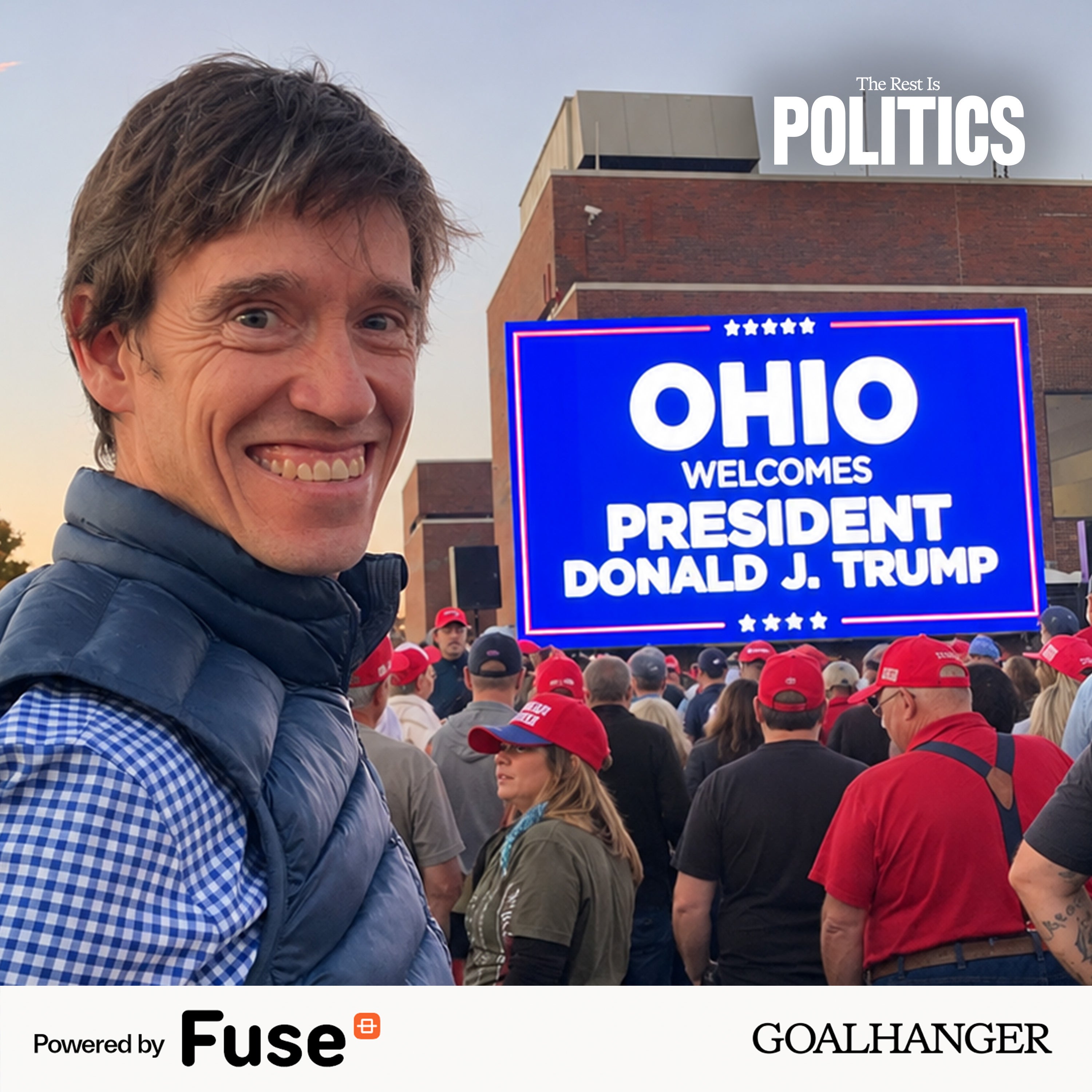
28:12Rory Stewart: So I was with our team, with Celine and with Daisy and with Bella at a Trump rally. We went to hear Donald Trump speak in Chillicotte, Ohio. And we stood in line for, I want to say, four, five hours with MAGA supporters. And all around were people wearing these hats. And I was actually felt very, very uncomfortable. There had been a protester on the edge who was one solitary, very, very brave woman who looked as though she might be Latino, protesting with a banner and with everyone screaming at her. Another protester who was physically assaulted, their heads smacked against the pavement in a way that literally sounded like a gunshot going off.
29:01These very, very aggressive people alongside children all around us.
29:08Rory Stewart: I put on the hat partly to try not to draw too much attention to ourselves because I was very worried we were not going to be allowed in. We wouldn't be allowed to see anything and that people would think that we'd come there to mock them, that we were protesters. In retrospect, though, I think it was a mistake. I mean, I am picking up very much from people here that wearing a MAGA hat, not quite Prince Harry putting on a Nazi uniform, but it's not cool. It's not something that Americans think is funny. It's a symbol of something that people find so disturbing and traumatizing. And they see it as an endorsement of President Trump.
29:48Rory Stewart: I mean, the rally was extraordinary too, Alistair, because I'd never sat through him speaking for an hour and a quarter. And you're absolutely right. All that stuff you got from the New York Times is true. But my goodness, he was so much better than the other Republican speakers. You know, they were all there, all the characters you would have heard of. Vivek Ramaswamy, who was running to be governor of Ohio, Husted, who's running to be the senator. He's the guy with the nice bum. Yeah, which Trump lent into. When everybody's reported that I said he's got a great ass, and he's got a great ass.
30:23Rory Stewart: And look at his ass. It's terrific. But I didn't just say he's got a great ass. He's got great feet, got great shoulders, got a great head. And then he went on to this amazing rambling description of how this guy was an American football star. Basically, what Trump seemed to be saying to his audience is, this guy looks a bit boring, but he can rip your heart out. He's a real tough guy. He didn't seem to be able to get up for praising Vivek Ramaswamy in the same way. Maybe because Vivek Ramaswamy is not like the kind of masculine, I think, the kind of masculine white sports star that Trump finds easy to sell to his audience.
30:59Rory Stewart: So, Vivek sat there throughout an hour and a quarter and barely got any praise from Trump. all the thing was devoted to this is a real man. And then he went off and talked about his White House repairs. And for the first time, I understood what was happening here. Because obviously, when we report it, we're normally like, well, this guy's completely demented. Why does he spend his whole time talking about White House repairs? But for the audience of people who love him, it feels as though he's a guy leaning at a bar, totally at ease. His pacing is incredible. His pauses are incredible. He's looking everybody in the eye.
31:35Rory Stewart: He senses the energy of the room. There are these cadences, there are these jokes. And essentially what he's doing is he's saying, it's a sort of compliment to the audience. He's saying, I'm not a politician who's going to do the kind of thing that you and I would be used to, which is, this is a small town in Ohio. I'm going to come and I'm going to do 15 minutes. I'm going to get back on my plan. I'm going to be out. He's saying to his people, I love you. You're my people. And I'm going to spend an hour and a quarter, just shooting the breeze with you. And I'm going to talk to you about my home restoration.
32:05Rory Stewart: All of you guys like restoring your homes. I'm restoring my home. My home's the White House. You've got your own houses. And I'll just tell you stories about my wife, me and the lights and this, that and the other. And I could see the charm and appeal of it for the hardcore MAGA supporters. Is it all boring? No, no, no. It was mesmerizing. It wasn't boring at all. The boring ones were the Republican congressmen and senators who were absolutely like central casting, there were their suits, you know, thank God, the Bible, Jesus, keeping taxes down. And he didn't do any of that. There's nothing hypocritical about him.
32:42Rory Stewart: He didn't try to talk about Jesus. He didn't try to talk about any of that stuff. What he did do was relentlessly boost. There was no moment in the whole speech where he acknowledged there was any problem at all. It wasn't a political style where you say, look, I know you're hurting, but stick with us. It was, things have never been so good. This is absolutely amazing. There are zero people crossing the border. You know, the economy is at its strongest level ever. Stock exchange is up. And every time there was a pause, everyone would just shout, USA, USA, USA. It's real nationalism. And you remember when we watched him speak live in Davos, you know, a different audience.
33:21But But do you remember that two or three people, I think you among them, were sort of trying to keep me sort of chained into my chair as I was shouting out, that's a lie, that's another lie. Were you not sort of tempted just to stand up and say, you're lying again?
33:36Rory Stewart: Yeah, I don't think you, Alistair, would have been able to handle it. I think you would have walked out after about 10 minutes. I think you would have been so enraged, bored and disgusted that you would have just walked out. But I mean, look, this is a man. I think these are the end days. This was a very, very small gymnasium they'd chosen. So they must have been worried that they had to keep them in a thing that took about 2 ,000 people because they were worried not enough people would turn up. 2 ,000? Wow. Take it back in the day, there would have been 30 ,000, 40 ,000 people turning up. And some of the MAGA crowd was wandering away before the end of the speech.
34:14Rory Stewart: So you could create a narrative around this is the end days. This is a guy who's finished tailing off. but you still saw, I mean, I thought it was the most incredible thing to be able to do to go to that kind of rally because you could still see what the magic must have been 10 years ago. And it's just partly, he's a much easier speaker than almost any other American political communicator. I mean, he's more like a, it's more the style of a Pentecostal preacher who can speak for an hour and a quarter without notes and just keep the rhythms going, keep the jokes going. Okay, Royalist, I'm fascinated that you were so fascinated and mesmerised.
34:55I found his style at Davos mesmerising, but in an utterly revolting way. But, you know, he seems to have – I think he's wheeling you in a bit, but there we are. Listen, let's bring in – we've talked about Izzy, and Izzy's wrote a fantastic piece in the newsletter at the Weekend. Doubtless has more to come. But there's a question here from Diane, which I think Izzy can help us answer. There's a lot in the news about the most contested states, but what states have been forgotten and why? Izzy, how are you?
35:22Rory Stewart: Hello, I'm good. How are you? Very well, very well. So where have you been? Tell us where have you been first? So I drove over from Texas to Louisiana on Thursday. And since then, I've been driving across Louisiana. I've gone west to east, which only takes about four hours because it's so tidy that way. um but it's interesting because as that question suggests you know there's been essentially no national or international press coverage of the race in louisiana um part of that is because it's so tiny part of that is because it's always been a very safe seat um trump has won 60 of the vote here more than 60 of the vote here since 2016 um it's so republican so you'll like this i met um a group of women who were all in their late 70s and they're Democrats and they're based in Acadia, which voted for Trump.
36:22Rory Stewart: 80 % of people that voted for Trump in 2024. And so they were so afraid of telling people that they were Democrat because you stop getting invited to dinners, you lose friends, that they started wearing like a special secret pin and that would let them identify each other in public. And if you were wearing the pin, you would say, okay, you're a Democrat too. But the crucial thing now is that the race seems, you know, much closer than anyone expected. So, the Republicans are still very likely going to win, but it's a lot, lot closer. The Democrats are doing a lot better than they have done in any of the last, you know, five or six elections.
36:59Rory Stewart: And Izzy, why do you think this is? What are you picking up? You told us when you were with us last week that the Latino community in Texas, and you said a lot of that was about immigration. What is it that's driving the, sorry, aggressive ICE enforcement, people feeling the immigration enforcement was too aggressive? Is that the story in Louisiana? I think the big thing here is the economy. So, Louisiana has the highest poverty rate of any state. I spoke to one school teacher who teaches in a public school. And he was saying that so they've had to move, they used to have detention after school, you know, like most schools do, they had to move their detention to lunchtime, because parents couldn't afford to come and pick their children up if they missed the school bus.
37:47Rory Stewart: So there was one child who not for detention wanted to stay late for band practice. And this teacher found out that he was walking himself home 12 miles after school because his parents had no way of coming to get him and he couldn't afford to take um there's very little public transport so he couldn't afford to take an uber or something like that um so a big big thing is the economy the other thing is racism um both black and white people that i spoke to said that racism which had been getting a little bit better for uh you know 10 years before 2016 since then has really started to come back one pastor described it as if someone had ripped the bandage off a wound that they had hoped was starting to heal.
38:30Rory Stewart: Others said that, you know, there's just started to be people have started to sort of naturally segregate again. And sort of there would be places that you just knew you wouldn't go or events you knew weren't for you or people like you. So that's a big driver. And people are just really angry about that um and then also the republicans i mean i spoke to uh some sort of more old school republicans who are furious with trump for things like the epstein files or renaming the gulf of mexico and they just think he's you know he had great ideas but now has become one person described him as godlike um so those are the sort of main drivers i think like alistair was saying you know there's been unprecedented or not unprecedented sorry there's been record early turnout um a lot of that has been black voters which is really encouraging for the democrats um so yeah so it just seems like people are really really angry they're voting more than they would have done otherwise and it's yeah it's the economy and racism predominantly is is your sense both this is a question for both of you really the because we talk a lot we see the polls and we think 50 50 and we think oh well that's half are going to vote this half are going to vote that are we still in a place where more people will not vote than will actually vote for either of the main parties that they've got on the ballot is your sense that i mean you can talk to lots of people but i wonder how many of the people you spoke to will actually vote or whether that we're still in a deeply cynical apathetic culture yeah let me let me try and And then, Izzy, back to you.
40:08Rory Stewart: I mean, my sense is that for many, many Republican voters, they're not going to vote for the Democratic Party. They're more likely to stay at home, that it's become very, very tribal. And for Republican voters that I talk to who say Trump's an idiot, it's Trump's an idiot, not that he's an immoral devil. And they then very quickly do somewhat aboutery about the Democrats being corrupt and useless. And abortion, transgender, these kinds of issues really, really matter. So those people stay at home. The Republican voters who might shift across that 15 % might shift across talk in a different way.
40:51Rory Stewart: They say, oh, actually, the problem, there was no problem with Kamala Harris. The problem was that Biden didn't step down early enough and that there wasn't a primary. I've heard that a number of times. So that I think is the soft Republican tempted towards the Democrats providing a reason for why they didn't vote for Kamala Harris. They're saying there was nothing wrong with her, nothing wrong with the Democratic Party. It was just a procedural issue around primaries and Biden that kept me away. Those people might go back. But the 80 % of the Republican vote, I think, is never going to consider going towards the Democrats because they also have invested so much in the story around trump i mean being a republican for 10 years has been trump it would be astonishing if they were really able to come out and say i've seen the lights and i'm about a vote in a different direction so i think that might be a turnout is he i think um so i was speaking to james carville who yeah you know alistair i think yeah um and he so he was what's he called the raging cajun the raging cajun i was thinking that yeah he had what a fantastic nickname you need a better nickname Alistair okay I'll I'll work on that the um so he was Bill Clinton's strategist and they won the state in 1992 Louisiana in 1992 and he's the one that came up with the phrase it's the economy stupid um and I only spoke to him briefly but he essentially we were talking about why the Democrats are doing so well when they don't have sort of a national leader.
42:20Rory Stewart: And he was saying, you know, at the minute, they don't need one. Everyone is voting against Trump, they're not voting for the Democrats. So I think that's sort of an interesting, you know, sort of obvious, but also interesting, because it's like people won't necessarily vote, they won't view it as voting for the Democrats, which they may be more opposed to doing, they might just view it as voting against Trump, which is someone that they're really angry at. that's why the midterms are always a little bit different because and it is such a strange system there's let me ask you both you've both been there for a while now the question that rory asked me earlier which of the the more high profile democrat politicians do you look at and think one they might have their mind on running for the top job or two that they might have what it takes to get the top job is there any of this really impressed you because you're obviously seeing much more of them we do here well let me start i mean of the of these seven or eight key senate races many of them have kept a pretty low profile there's been a big difference between those that are out there on social media and on the podcasts and getting the likes so the ones that you know we've heard of talariko ossoff abdul al-sayed are the key three examples of people who are really pushing social media profile.
43:45Rory Stewart: There's another whole lot of them, Sherrod Brown, Cooper, and others who have kept it very low-key, very local. And I guess we can assume those are not the people who are going to be running for the presidential races. So of those three new figures, well, I guess the big fight within the Democratic Party is between the progressive left and the kind of mainstream. We need someone who can retake Middle America. And that's where I think people like Ossoff and Tallarico come ahead. And Ossoff is the obvious one. I mean, he's so far ahead now. It's very, very weird in what was supposed to be a marginal race.
44:27Rory Stewart: As you said, Alistair, Ossoff is so far ahead that people are barely bothering to cover it anymore. And I guess his height notwithstanding, although Tallarico appeals to me much more in the way that Mayor Pete appeals, it may be for the red-blooded American voter. They may seem a little geeky and not central casting enough, is he? The guy that's running for senator here, Jamie Davis for the Democrats, he has had, I think, zero funding from the National Party. He's running against people who in the Republican ad space, they have been running a AI generated video of him sort of ominously walking towards the camera.
45:13Rory Stewart: He's a black man. And people are saying, you know, that's trying to discourage white voters by making him seem ominous. But, yeah, so I think there's a lot of people who haven't necessarily even been on the national radar who might be worth looking at. I'm going to be, like you said, writing more about this in the newsletter, which will be out on Thursday. Yeah, so to remind people, you can sign up to that at therestispolitics.com forward slash newsletter. Well, you'd be pleased to know, Izzy, I was in the, because of my friend Martin Briley, who hates me talking about swimming in the Lido because he says it brings more people to the Lido when we actually want nice peace and calm.
45:50But somebody in the Lido this morning, just randomly as I'm swimming, swam by and said, I am enjoying Izzy's contributions from the United States midterms. So there you are. You're being noticed. Can I just maybe before we go to break? I've been fascinated on just how nasty some of the Republican campaigning has been. And I wonder if that's the same everywhere, or is it just because we see, I mean, the level of racism against Abdul al-Sayed has been extraordinary. Trump actually said in a rally, he hopes they, the people of Florida, send him back to where he came from. He was born in Michigan, and it's Mike Rogers who lives in Florida, his opponent.
46:33they've done this huge thing about talarico being gay being vegan um neither of which they know to be true um and also this this idea that because he had a couple of days off for a cough or something he was all these sort of conspiracies these theories going and i just wondered if that is the norm you mentioned the ai generated video is are you seeing kind of nasty unpleasant
46:57Rory Stewart: campaigning kind of everywhere the key one is ilhan omar which has been completely disgusting I mean, this is the congressman who is of Somali origin. And again, in the Trump rally, very clearly, he said, this woman is married to her brother. She had her children with her brother. And she needs to go back to where she came from. And Somalia is not a real country. I mean, it's really, I mean, it's denigrating Somalis, it's denigrating Somalia, and it's suggesting she's engaged not just in fraud, but in incest. I mean, you know, that's what I find so difficult about this, which is that Trump is so horrifying.
47:41Rory Stewart: And what I can't quite handle is these religious leaders who seem to be like, yeah, he's a bit of an idiot. But, you know, politicians are idiots. And to be honest, you know, their way of getting around it is that like at the last election, I thought, what kind of country is this that we've just got to choose between Kamala Harris and Donald Trump's pathetic? Like, are these the two best people we can? No, there is a massive moral difference between Kamala Harris and Donald Trump on all these things. Exactly that. There's all these adverts. And the thing that people were telling me here, this one pastor I spoke to, Tony Ricard, and he was born the year before the Civil Rights Act was passed.
48:18Rory Stewart: And he remembers what it was like before, you know, he remembers, obviously, his parents couldn't vote. and he was saying that now children today don't remember what it was like and they have no conception of what people fought against and these adverts things like this that you see on the tv is what's encouraging and freeing people to behave in the way that they're starting to behave in again um so that's the sort of real real world impact on it too well listen izzy look forward to your piece uh on thursday and doubtless more thereafter thank you for everything on the two episodes you've joined us.
48:53And just to remind readers, restispolitics.com forward slash newsletter.
48:58Rory Stewart: Well, we're going to go for a quick break now. And if you want to hear that miniseries about J.D. Vance or indeed any of our other miniseries, go to the restispolitics.com. Rory, you've triggered me there by mentioning miniseries because I've just had the very, very good news that none other than the Prime Minister of the United Kingdom, Andy Burnham, the word persevilliant has passed his lips or passed his pen, it might have been, Because this guy, Carl Bushby, who's been walking 31 ,000 miles over many, many years around the world, just got back to Hull. And I just got a message that in the message that Andy Burnham sent, he used the word percivilian.
49:37So we're very, very, very, very pleased about that. And we're going to take a break.
49:42Rory Stewart: Shaq here. What's it like to buy a car from Carvana 100 % online and get it delivered to your door? Let me tell you. Your car is here, Mr. Shaq. Thank you, Mr. Carvana guy. Can't wait to take it for a spin. Only the best for you, Mr. Shaq. Hey, have you always been so big, tall, and handsome? Not always. I was 6 '10 once. Seven days delivered or returned, Mr. Shaq? Not that I would. You never do. No, I never do. So buy your car today on Carvana. Delivery fees may apply. See our seven-day return policy at Carvana.com.
50:16Rory Stewart: Hi, everyone. It's Katty Kay here from The Rest is Politics US. The midterms are almost here. It's the biggest political moment of the year. And Anthony Scaramucci and I will be right there with you, making sense of every twist and turn as the results come in. That's right. We're going to be live on YouTube covering the midterms as we get the results. Will Donald Trump be a lame duck for the next two years or walk away with a mandate to do whatever he wants? We're about to find out. So join us from midnight to 3 a.m. Eastern time on November the 4th will be live reacting to all of the results as they come in.
50:51So make sure you're subscribed to The Rest is Politics US on YouTube and turn on notifications, please. You won't want to miss this.
51:04Welcome back to The Rest is Politics Question Time with me, Alistair Campbell. And with me, Rory Stewart. And Rory, next question is brought to us by Evelyn Partners and none other than the wonderful Steph McGovern from The Rest is Money is going to be putting this question to us. And it is about a subject we talked about last week, the budget. Steph, over to you.
51:24Rory Stewart: Hey, Rory and Alistair. So quick question for you. If you were putting together this budget, what is the one tough decision you would have made that would have got the economy growing? And how would you have convinced the public it was the right call? Well, I'd be focusing on making things easier for business, getting growth going. But I'm going to be really controversial and wind up most of the rest of the politics listeners by saying, I would have found a way of attracting non-DOMs back to the UK. And I would have found a way of charging them a flat fee, could be£500 ,000 a year. And in return, people who'd made their money outside the UK, wanted to come to the UK, invest in the UK, could come in and do that without having to face bills on their inheritance tax and the kind of things that are making wealthy people very reluctant to come to the UK at the moment.
52:12Presumably, you think that would have raised money for the Exchequer and also got people who style themselves as wealth creators and entrepreneurs back into the UK economy rather than Dubai or Milan or wherever they might have gone to.
52:23Rory Stewart: Exactly. And I guess the question, you know, which is partly for you is, would it be possible if you said to the British public, all these people are going to be charged 500 ,000 a year or a million a year to come here, but we're not going to tax them inheritance tax? Would people accept that as an argument? It'd be a tough one to make. I think it's a very interesting idea. I actually wonder if it's an idea that might have worked at the time of Labour getting into office, but would be more difficult now. The two things I was thinking of, one was Europe, it won't be surprising to know, I would have announced, this wouldn't be for immediate growth, but it would have signalled an intent and a confidence in the debate.
53:01I would have announced the upcoming publication of a white paper on the economic and geopolitical and strategic costs of Brexit. And I think that would have framed the debate better than, well, we might just have a look at it sometime soon, et cetera, et cetera, et cetera. But I think I would have gone for something. This relates to what you've said. I would have found something which helped the economy, which helped the public finances, and which went in a different direction to Rachel Reeves' budget. So I would have found a way to mitigate what is business's probably biggest complaint, or one of the biggest complaints they have about the Labour government, which is the national insurance rise and the reasons that were given for it and maybe somehow related that to the whole debate about welfare reform and needs.
53:45In other words, reframe the argument about tax on jobs, as it were, as part of a bigger campaign to say the big goal of this government over the next two, three years before the next election is to start getting the welfare bill down by getting more and more young people into jobs and we're therefore going to make it a lot easier for employers to hire them in the first place.
54:05Rory Stewart: How about getting back to the old chestnut of putting up the top rate of income tax and justifying it in terms of funding defence, for example? I'm a big believer that the way to raise money is to put up income tax, not wealth taxes. I think wealth taxes are going to terrify wealth creators, but you justify it by saying we face a new threat from Russia. It would also, however, be a clear breach of a manifesto promise that Andy Burnham has said he is not going to break. I also think that these questions are about growth. And I think that one of the arguments the government is having to take on is the extent to which the budget was seen as a sort of fairly modest tax and spend budget, as opposed to what people maybe wanted more, which was something that said, this is going for growth.
54:54And I think you and I both talked about areas where maybe the growth agenda would have been clearer. I think he's been too clear about the fact that he's not going to break those tax promises, which is one of the reasons, I guess, why people keep saying that even though he keeps ruling it out, maybe there will be an election earlier than we think. As it happens, I think that would be a mistake. And I don't think he's going to make that mistake, but we shall see.
55:15Rory Stewart: I mean, these budgets are so important. And I think this steady-as-you-go budget is one way to play it. But this is the real way to define the long-term impacts. I mean, people's finances are affected by these things, not just in a year, but over 5, 10 years. And of course, there are changes that have been announced in previous budgets that are only now coming into force. So the political argument will move on constantly, but the consequences don't. And that matters, I guess, for anyone thinking about their finances, which is where Evelyn Partners, our sponsors, have experts which help clients understand what the changes could mean for their financial plans, for their long-term goals, and for preparing for what's next.
55:54So if you want to go beyond the headlines and understand what the budget means for you and your finances, visit evelyn.com forward slash budget 2026.
56:06Rory Stewart: So Alistair, you've very, very kindly been asking us a lot of questions about the US. So we're going to turn the spotlight on to you, because we're going to bring some questions back to Europe now, where some extraordinary things have been happening. And actually, one of the weird things watching Fox News in my hotel room is that they're covering France all the time. In fact, Trump talks about it a lot. A lot of the Republicans talk about it. They're trying to use the demonstrations and violence in Europe as an example of what might happen if you voted for the Democrats in the US. So here's a question for you from Hayley.
56:37Rory Stewart: Having watched the youth protests spread into Germany over the weekend, is there any chance they could spread to the UK? And James, no student loan reform in the budget, 2 million people have a 9 % tax for their work life. Surely this isn't sustainable. Maybe start to you if you could bear on what's happening in France, Spain, Ireland, Albania, Portugal, Italy, Belgium, Germany, Austria, Czech Republic, Netherlands, etc. Yeah, there's definitely something going on, that's for sure. Look, we talked a lot about the protests in France. But I think that of all those countries you listed, the one that really took me aback at the weekend was Germany.
57:17France, we're kind of used to big demonstrations. And okay, Germany have demonstrations, but there was a level of violence and looting and theft that you don't normally associate with modern Germany. So you're seeing something Europe-wide, and I think there'll be lots and lots of different reasons for it. Some of it is people who just want to have a bundle with the police. That's always been the case in some places. People like fighting with the police. Often the place to do that has been big football matches, and there was an element of that. And I think one of the mistakes the French made in their handling of this, they tried to make it very much about hard left protesters.
57:59Just as Trump, any heckler he gets at his rallies, he says they're sort of paid, hard left, radical left protesters. I think these protests are too big to be dismissed in that way. I think there's something deeper going on, which I think is incumbent on politicians really to think through. And, you know, the question about whether they could come here, you know, we've got quite a record of of protests and sometimes violent protests but it it tends to be you know if you think about the history of modern political violence i my mind always goes back to the poll tax or the miners strike it's some time ago we've had riots over specific incidents but in terms of something that feels like a sort of real groundswell political political uprising and this is this feels closer to that for me and i i just so i was on question time, the BBC question time, as opposed to this question time last week.
58:50And one of the questions was from a young guy who, and his question was, I've just graduated. He was a history and politics graduate. I've just graduated. Was my degree worth it? Now, a lot of people are asking that question. A lot of young people are finding that they are applying for hundreds and hundreds and hundreds of jobs and rarely getting a reply. And when they do reply, they can tell that it's been written by AI and their CV was probably written by read by AI if at all can't get on the housing ladder unless they've got wealthy parents all this stuff is real and you know I mentioned on the program that I'm I'm part of a campaign that's starting uh on November the 9th with Richard Layard who you will know who's sort of big happiness guru Gus O'Donnell former cabinet secretary and the campaign is going to be called uh back young people now because you know we talked about the budget, I think if there was one thing I really, really would have liked to have heard, it was something, and I know student loans is difficult because of the financing, but I would like to hear something that was going specifically to try to help young people.
59:58I think they think helping young people is increasing the minimum wage. Well, it does help. But actually, we're talking now about a lot of young people who are not necessarily from poor or underprivileged backgrounds. They're people who have played the game, done well at school, gone to university. So I don't know that the violence like this will come here. But I think that unless the politicians address some of these issues, which I think is so important, what Alan Milburn's report is going to say, and how the government responds to it.
1:00:29Rory Stewart: One of the things that strikes me when I read out that list of all the countries where it's happening is what it does to me is remind me of the Arab Spring. I mean, it's very, very weird sense that countries that are very different with different cultures, different constitutions, different political structures. In the case of the Arab Spring, somebody sets himself alight in Tunisia and almost immediately you have revolution in Tunisia and then Libya, then Egypt, Syria, Lebanon, Yemen, Bahrain. And here, too, something very odd. I mean, it's not – it may be driven by socioeconomic fundamentals, but I wonder whether there isn't also a social media element that allows the same phenomenon.
1:01:12Rory Stewart: Because it can't – it's not – if you looked at the data, Portugal, Netherlands, Germany, France, I mean, they've got different growth rates. They've got different unemployment rates. They've got different welfare systems. You know, as Alan Milburn will point out when he puts his report, there is about a third of the support for NEATs in Britain that there is for Germany. And, you know, you could triple, you know, you could spend another 40 billion pounds a year to provide the kind of support for NEATs in Britain that they already have in Germany. And yet you would still have the rights you've got in Germany.
1:01:49Rory Stewart: So what do you think is allowing it to spill across borders so quickly? I think social media does play a part. And not just social media, the fact that, you know, we instantly see and there is so much coverage of anything that involves violence. And I also don't underestimate the extent to which the Russians do pump this stuff out. They are all across our social media networks. There is a thing in the manosphere about, you know, you were talking about Trump and liking big, strong men and the whole manliness thing. And that's about fighting. and then throw in, you've got the Russians on one side, you've got MAGA on the other side.
1:02:26And what you described in Ohio felt to me like way worse than the sort of standard of living that we see in challenging parts of Europe. But you've got that messaging going out as well. But I do think it's a sense of a generation feeling that they're not being heard, they're not being listened to. I'm amazed when I go, when I'm talking to students in particular, This thing about just not getting replied to the whole time, never applying for jobs, taking the effort to do a CV, and then they don't even get a rejection, never mind any reply whatsoever. And I think AI is exacerbating that. It was very interesting at question time because there were quite a lot – no, not a lot.
1:03:12It's pretty much a kind of middle-aged, older audience. But there were young people there. They were really fired up. They were really fired up. And I thought the other thing that was interesting, particularly in Germany and France, that was the coverage was dominated by the protests there, is how many of the young people actually were saying they didn't want it to be overtaken by all this violence because they felt the points that they were trying to make were just being completely lost. And, you know, the best coverage I saw of the whole thing in France I can't remember the name of the program, but it was a long report on Al Jazeera.
1:03:47And it analyzed the scale of coverage across all the French networks and all the French talk shows. It was all about the violence. There was a minuscule amount of debate about any of the issues. It was all about the violence. It was the right wing saying, we need more police. The police need to be tougher. And it was the left wing saying, we have to listen to the young people. But the guy pointed out that nobody could actually quite articulate across the media what it was they wanted themselves to articulate. It was class sizes, it was housing, it was joblessness, it was all these different things.
1:04:22but i think it is a warning to us and that's why i think that um look andy burnham's got a real job on his hands this neats report i've talked to alan milburn a little bit about what's coming if it's going to be fully fully funded yes the long-term thing is to get the welfare bills down but there's going to have to be some pretty heavy inward flow of investment to help people who are no longer in education employment or training to find it it's not going to come out of a clear blue sky.
1:04:50Rory Stewart: And the heartbreaking thing for me is that so many of the policy prescriptions we look for already exist in places like Germany and France. I mean, we often talk about how can we get the cost of building infrastructure or energy down to French levels. We talk about how we can provide neat support comparable to Germany. And the depressing thing about these demonstrations is that even if by some miracle, and it would take five, 10 years and cost hundreds of billions of pounds, we were able to reach continental levels of progress on those issues, you still would have a lot of very, very angry young people because some of this is about the whole, I'm afraid, the whole structure of a modern economy.
1:05:34Rory Stewart: And that's where AI comes in. What are the jobs available for somebody in Rotherham? Well, there's just not much of it. its low-paid warehouse jobs, its care jobs, its equivalents of zero-hour contracts. And that's true here in the US. I'm now in Roanoke, Virginia. You can see that around us here. It's true across Europe. And it's not that clear that any politician from any party has the real solution to that, because often, even if they did all the things they dreamt of, they would just become a little bit closer to a country which is also facing riots and demonstrations on which, Alastair, I'm going to finish with a cheerier note and a question to you to try, because it's been a great question time, but it's been quite serious.
1:06:20Rory Stewart: I mean, and this, of course, is sad too, but maybe a chance for some optimism along with sadness, which is a question from Jake. I was saddened to hear about the passing of Patrick Stewart, who was such an outspoken voice on political issues, particularly Brexit. So this is a chance for Campbell to pay tribute to a steward. Oh, very good. So Alistair, how do you feel about his passing? Do you have any stories or memories of the great man? Well, I did feel very sad. I was aware he was ill. I wasn't aware he was so ill. And I thought it was interesting. He has huge coverage of his death and around the world.
1:07:01I mean, it was around the world. We sometimes underestimate, I think, when we have these British stars, just how big. I mean, it was a huge story in Germany, in France, in Italy, in Australia. I mean, I was sort of scouring the place. But I thought, I have to say, this is the rest of it.
1:07:16Rory Stewart: And Alastair, just on that, very quickly, my only anecdote on that is Shoshana, who's obviously an American, the only time I've seen her literally tongue-tied is when I introduced her to Patrick Stewart. It was the funniest thing I'd ever seen. I know she worshipped Patrick Stewart. So I had this opportunity. I took her over to meet him and she literally couldn't get a word out. She kept just sort of staring at him and goggling. She was so in awe of this man. That was the story that comes into my head when you say that is when I introduced Fiona to Roger Bannister. Famously, the first man to run a mile in under four minutes.
1:07:54And I said, this is Roger Bannister, the athlete, as I could see this. Fiori not computing at all the athlete to which she said oh what was your distance and he very nicely very politely said no no my Shoshana story she knew exactly who Patrick
1:08:11Rory Stewart: Stewart was because she'd watched Star Trek repeatedly and and worshipped him I mean I think for her it was like meeting I don't know be like I don't know you meeting Elvis or something I mean it was really or Maradona or maybe me meeting Maradona yeah I did that I did that once I've never talked about that. No, but he was in a – the one thing I thought missing from this sort of scale of the obituaries was actually his politics. He was – you know, we had a list of celebrity supporters, call them what you want. And some of them came and went, and some of them could be a bit flaky at times. He was absolutely solid.
1:08:51and you know we should put in the in the newsletter he did a brilliant broadcast about the benefits of the european convention of human rights we used to use him because of the voice we used to use him as a voiceover for so some of our best political broadcasts were voiced over by by patrick stewart added to which we also had him introducing speakers at rallies and and what have you he was just a wonderful man he was he was also was a he was a yorkshireman i think he once said that the proudest moment of his life was when he was made chancellor of Huddersfield University. He was a lifelong supporter of Huddersfield Town.
1:09:25And we, you know, we obviously like Northern football clubs that don't always do very well. So no, he was a great, great guy. And I think we underestimate just how many amazing British actors we have. And so yeah, very, very, very, very sad. And I'm glad that Shoshana got to meet him, Rory. Well done for introducing her we should all i don't believe this thing about never meet your heroes i think you should always meet your heroes i would have loved to have met elvis i would have loved it
1:10:00Rory Stewart: well alice thank you very much it's been an amazing question time and we'll see you on wednesday morning when we were talking about the results there you go looking looking forward to it very much thanks again
1:10:31The Great Game. Strategic struggle between Britain and Russia. We assess Prime Minister with high confidence it was Russian. Holding the Russians accountable is World War 3 They took down a British passenger jet containing 350 people Man in the Kremlin is playing, Alex You've got to ask yourself, do you want to play or not? You're the Prime Minister You've done nothing!
1:11:04Rory Stewart: We would need to understand the policy context All the relevant context will be structured as a framework today and disseminated into an operation order, or FRAGO A fragger that says to kill the president of Russia. Yes. New from Goalhanger. Who is going to be able to pull this off? You're my soldier, are you? Sergeant Tom McDuff. Duffy. An audio drama journey like no other. Men like Duffy, they are our most valuable weapons. Devised as a technically rigorous geopolitical action thriller. We have two times friendly key. Where Britain plays its strongest hand. He's the best. Against its strongest foe.
1:11:47Don't do it that way! Bear Hunt. Available now wherever you get your podcasts.
What has Rory uncovered on the road through JD Vance country, and how did he feel attending a Trump MAGA rally? What is driving the wave of youth protests sweeping across Europe, and could we see similar unrest in the UK? What will be the political legacy of the late, great Patrick Stewart, and what was he really like?
Join Rory and Alastair as they answer all these questions and more in this week’s edition of Question Time.
__________
Enjoy Rory and Alastair’s interview with Kevin Rudd by searching ‘Leading’ on Spotify, Apple, or YouTube.
Join The Rest Is Politics Plus. Start your free trial at therestispolitics.com to unlock exclusive bonus content – including Rory and Alastair’s miniseries – plus ad-free listening, early access to episodes and live show tickets, exclusive newsletters, discounted book prices, and a private chatroom on Discord.
Go deeper into the world of The Rest Is Politics by signing up for our free newsletter HERE, featuring exclusive interviews, analysis and weekend reads from Alastair and Rory.
The Rest Is Politics is powered by Fuse Energy. Stop overpaying for energy. Switch at fuseenergy.com/politics and get a free TRIP+ subscription.
🌏 Upgrade your online protection with an all-in-one security app! Get an exclusive NordVPN deal + 4 months extra here ➼ nordvpn.com/restispolitics It’s risk free with NordVPN’s 30-day money-back guarantee!
__________
Instagram: @restispolitics
Twitter: @restispolitics
Email: therestispolitics@goalhanger.com
__________
Social Producer: Celine Charles, Emma Jackson
Video Editor: Tom McCagherty, Jack Meek
Assistant Producer: Daisy Alston-Horne, Jake Preston
Producer: Evan Green
Exec Producer: Bella Soames
Reporter: Isabelle Stanley
Learn more about your ad choices. Visit podcastchoices.com/adchoices
Scan the code with your iPhone camera
Listen in the app.