Ask ChatGPT

 The Rich Roll Podcast
29 Oct 2026 · 2h 21m · 53 chapters
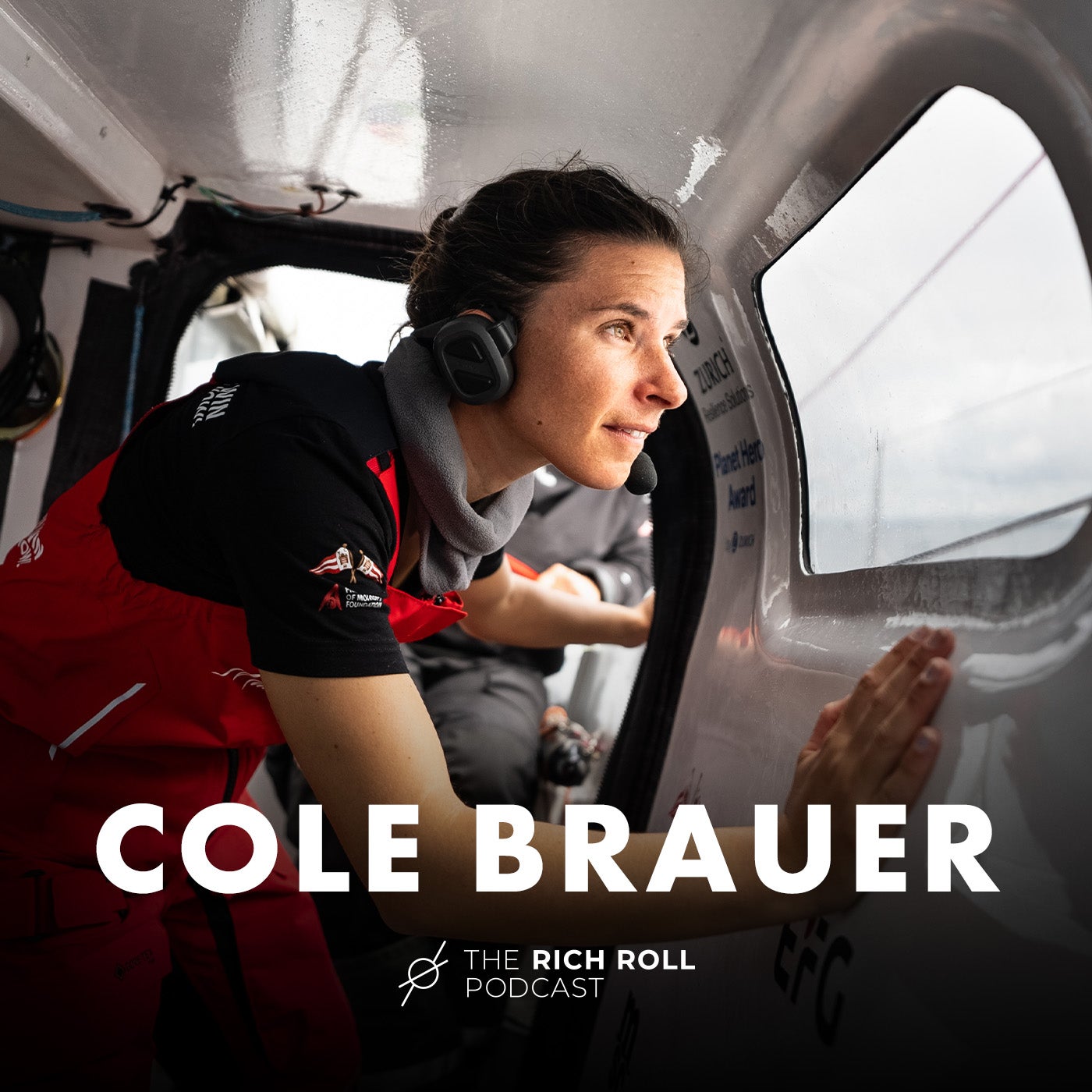
Cole Brauer’s life lessons from her 130-day, solo, unassisted Global Solo Challenge sailing around the world, and how she built resilience through mind-body connection, humility, surrender to nature, and problem-solving under extreme duress. The episode also covers accessibility and inclusion in sailing, equal pay, and how she used storytelling tech (Starlink + onboard cameras) to humanize ocean racing.
Cole Brauer (hosted interview). She is the youngest and only woman in the Global Solo Challenge, finishing second and becoming the first American woman to complete the solo, unassisted circumnavigation. She started the race in late Oct 2023 and finished in early March 2024, covering just over 27,000 nautical miles (about five Atlantic crossings). She grew up on Eastern Long Island (fishing community vs. wealthy Hamptons), studied photojournalism/advertising at SCAD, then food science/human nutrition at the University of Hawai‘i, and later became a boat captain/preparator before her major races.
Written by AI. May contain mistakes.
Explore Cole's journey in the Global Solo Challenge and her remarkable feat.
“I think you're so inspiring, not just for the feats that you've accomplished, but the example that you set for the world, for young women.”
Learn the difference between nautical miles and regular miles.
“And this is the equivalent of crossing the Atlantic five times.”
Cole discusses her mission to make sailing more accessible and inclusive.
“Is it because there's up and down motion?”
Discover how Cole's background and experiences shaped her love for the sea.
“And it's been run in more of a legacy program where you have very, very wealthy people, the Roosevelt's, the Kennedy's, who have kind of commandeered this world.”
Cole reflects on her artistic background and its influence on her sailing career.
“Well, let's take it back to the beginning.”
Learn about the author's journey into sailing and the community in Hawaii.
“it all yeah exactly where and then i i transferred the university of hawaii to get a little bit closer to nature.”
Explore the author's competitive upbringing shaped by family expectations.
“So there's the fishing background, the appreciation of just being out in nature in its fullness.”
Understand the challenges faced when entering a male-dominated sport.
“people with disabilities to be able to pick up the book and read it quickly read it without stumbling as much as I normally stumble over words and books.”
Discover the cultural differences in sailing between Hawaii and the East Coast.
“Actually, side note, my brain chemistry has changed massively being in Europe.”
Hear about the author's groundbreaking race victories and their impact.
“I would change that we, instead of just having one of ones, we start to have more people in these, you know, pinnacle sports that are like him where he's not afraid to dress the way that he wants to dress.”
Cole shares the challenges and strategies behind entering a significant sailing race.
“There's a whole story of just being able to like get into the position where you, you know, were an entrant in a race like that to begin with.”
Cole discusses how the Day Brothers became pivotal to her sailing career and the journey ahead.
“So she was like, you do the talking and just get us on that start line.”
Exploring the retrofitting of her boat and the introduction of innovative technology.
“thing it's a totally insane thing and i i i dedicated the book to them because the dream would have probably still been on the drawing board to this day if it wasn't for them.”
Cole outlines the unique aspects of her solo sailing experience, including support systems.
“It's sort of the off-road vehicle of racing sailboats.”
Cole discusses the trust and technology behind her sailing journey.
“And originally the whole team was pretty skeptical of it.”
Cole shares her struggles and challenges faced during the race.
“Like, these system failures that you have.”
Cole reflects on how anger has fueled her drive and determination.
“That is what fueled me to be the way that I am.”
Cole reflects on how anger has fueled her drive and determination.
“They are the mobile phone accessory company for outdoor explorations because let's be honest, you guys, when you're out there alone blazing a trail, your phone really isn't just a phone.”
Cole explores her journey of self-discovery and resilience.
“And you did grow up kind of in the dichotomy of this super financially wealthy place and still always you were the kid from Springs.”
Cole shares her tumultuous journey through youth, addiction, and finding purpose.
“I mean, it wasn't, it's not something that I, you know, wanted to tell the kids, hey, you should be in a fight club and beat the crap out of each other.”
Cole discusses the lessons learned from her time in an underground fight club and its impact on her life.
“And so I'm really happy that as a kid I did that.”
Cole talks about her experience in the sailing community and the challenges of fitting in.
“Maybe if I hadn't had the underground fight club, I would have ended up in jail or never leaving or maybe pregnant living in, you know, like a dirty shack in Montauk, which also would have been fine too.”
Cole reflects on her authentic storytelling on social media during her race and its unique challenges.
“But then there's the chameleon aspect of who you have had to be to get into your position.”
Cole explains the logistical challenges of sailing, including food and water management during her journey.
“And I wanted the Instagram to be much more of me than I had ever showed anyone in the world.”
Learn about the physical and mental challenges faced while sailing alone.
“So you have all of this added weight from Starlink and the batteries and the like, right?”
Discover how mistakes at sea contributed to learning and resilience.
“And I talk about it a little in the book about like purging land.”
Understand the risks and strategies involved in navigating busy shipping lanes.
“career um yeah but here you are talking about it on a podcast yeah but at this point at this point He loves me.”
Explore the critical decision-making process during extreme weather conditions.
“Um, I don't know if that was the specific moment of like the cargo ship just happened to be there.”
Cole reflects on a pivotal decision to protect herself and her boat during a storm.
“I chose to protect first light, um, then go for the win, which was at this point, Philippe, I was chasing down Philippe who was in first place.”
Cole shares the strange experience of returning to land and dealing with newfound fame.
“And I just recently met up with my meteorologist, Chelsea, who I mentioned in the book a lot.”
Cole discusses the challenges of media attention after her race and its toll on her well-being.
“I have to tell you, it was really weird because I was super protected on First Light.”
Cole describes the difficulty of transitioning back to everyday life after a high-stakes adventure.
“And so as you had asked early earlier about, you know, what was like the most like difficult time during the race, I say, you know, it was of course the hell week breaking my ribs and stuff like that.”
Cole expresses her deep emotional connection with her boat, First Light.
“some degree of depression from being in this dopaminergic, you know, environment for such a long period of time and then being in like a dearth of it.”
Cole discusses the process of writing her book as a way to heal and reflect on her experiences.
“And we talked about this before we came on camera of why I wrote the book twice.”
Cole highlights the importance of human decision-making over boat issues during her journey.
“One of the surprising things that I read in the book was that defied my assumptions or expectations.”
Cole reflects on the balance between humility in sailing and the competitive spirit needed to win.
“Because I hadn't been sailing for even 16 years.”
Learn about the importance of intuition and humility in sailing and decision-making.
“Like go down with the ship, that old mentality.”
Discover how to interpret natural signs for weather prediction while at sea.
“And so you can have all the models on the planet, you know.”
Explore the deep connection to nature and how it informs human experience and existence.
“I think that we have lost this art form, which is appreciating nature for the way that it is and not trying to avoid it or change it.”
Understand how life lessons learned at sea can translate to everyday life on land.
“I'm going to sit with the birds for a minute and just listen to them coo.”
Reflect on how modern life and capitalism distract from essential human needs.
“behind a different way of living on land that it can't help but be eroded the moment your foot steps up onto the dock.”
Learn how storytelling plays a role in inspiring young women to embrace failure.
“You know, you don't need a super fancy therapist just to enjoy a conversation, man and woman, together.”
Discover the value of failure in personal growth and career changes.
“And honestly, the more that you fail, you're actually learning exactly who you are.”
Explore empowering messages for young girls and the role of supportive parents.
“I had a wonderful taxi driver when I was coming here from the airport yesterday.”
Understand the journey of self-discovery through diverse experiences.
“And that's the one thing that I would say.”
Learn how to overcome fear of judgment when pursuing new interests.
“And maybe that's a little psychosis, a little crazy.”
Examine the constraints of identity and the importance of diverse experiences.
“And then we turn to these stories to feel protected or a sense of self or a sense of belonging.”
Discover why sports serve as a positive outlet for youth.
“And that addiction was a lot healthier than it could have been that if I had kept going with drugs and alcohol and kept moving in that way.”
Explore what defines greatness in competitive sailing amidst challenges.
“I always tell parents, if you move kids into sports, it keeps them from being bored enough to do bad things.”
Learn about the unconventional decision to take a risky sailing route.
“I talked to my weather router chelsea who eventually became my weather router for the around the world race I talked to her three days before and I said What do you think about this path that is you know?”
Discover the surprising outcomes of Cole's unconventional racing strategy.
“They're actually moving forward faster than your basic white guy because they got nothing to lose.”
Explore Cole's transition to a high-performance racing yacht and her future plans.
“And I was in the back of the boat while they're putting a reef in.”
Cole shares her emotional journey and lessons learned from her sailing experience.
“And so, I mean, it was such this amazing moment.”

Get the gist, explore an idea or ask about something said.
 Claude
On The Rich Roll Podcast, what are the key points of this episode?
Searching your listeningAutomatic transcript. May contain errors.
0:00This episode is brought to you by Eight Sleep. And oh man, I can't wait to tell you what these guys are up to. If you've listened to this show for any length of time, you've heard me bang on about sleep as the single highest leverage recovery tool there is, hands down. And when people ask me what to actually do about it, my answer is always the same. Dial in your sleep hygiene. And one of the ways that I do that is through the pod by Eight Sleep. It's this smart mattress cover that really has been, hands down, the biggest game changer in terms of how well I sleep. Eight Sleep just launched the next generation, Pod6, and they're offering my audience, all of you guys, up to$200 off.
0:38I haven't even gotten my hands on one yet. I can't wait. But the Pod6 sports the lowest starting price Eight Sleep has ever offered. They also shrunk the hub by 50%, so it tucks under most bed frames now, so the tech basically disappears. And everything I love carries over. smart sleep tracking, and cooling or heating each side of the bed from 55 to 110 degrees Fahrenheit. The Pod6 delivers up to 34 % more deep sleep. Individual results may vary, of course. Use my code RICHROLL at 8sleep.com slash RICHROLL for up to$200 off the Pod6. You get 30 days to try it at home and return it if you don't love it.
1:19Pretty confident you will. I had to make the decision of, do I go into this storm that's blowing 85 knots or do I protect myself and lose the race? Cole Brower isn't just a champion sailboat racer. She was the youngest and only woman to compete in an event called the Global Solo Challenge, finishing second to become the first American woman to single-handedly race a sailboat across the world, solo and unassisted. Along the way, the world fell in love with her as she shared the highs, the lows, the doldrums, and the extreme difficulties of this endeavor on social media. Very candid videos that included chaos and injury, self-administering, medical procedures, emotional breakdowns, all of which connected us to just how grueling this challenge was to simply survive, as well as videos that were very warm and sometimes silly, like snuggling with stuffed animals in her pajamas, dance parties, and dinner parties for one that humanized her and upended the alpha male silverback stereotype associated with professional ocean racing.
2:31I almost sunk the boat twice. I had run aground a few times, almost caught the boat on fire twice. I had already made every other mistake that she could possibly make, and that's what made it a successful race. Cole's a badass, wise beyond her years, and today this model of resilience, grit, and unapologetic girliness shares all. The Dragon Time mindset that has propelled her to break structural barriers, subvert norms, defy expectations, and achieve greatness. We talk about why problem solving in high-stakes environments under extreme duress is all about mind-body connection and how humility, surrender, and deep connection to nature are essential to her success.
3:22It's great to have you here. I'm such a fan. I think you're so inspiring, not just for the feats that you've accomplished, but the example that you set for the world, for young women. And I'm really interested in the story behind the story because I think there's a lot more there than people realize. Of course, you communicate this in your new book, First Light. Congratulations. Thank you. And I learned a lot about sailing and how much more complicated it is than I initially realized. I was reflecting on having Alex Honnold on the podcast a number of years ago after he had free soloed El Capitan, but before the movie had come out.
4:06And I thought in the aftermath of that conversation that I understood what he had done. And then I saw the movie and realized, oh, I didn't really understand this at all. And having watched many of your Instagram videos and followed the story, I thought I understood what you were doing. And then I read the book And I was like, oh, I didn't really, I don't really understand this world at all. What you have accomplished is remarkable. And I think we should just contextualize the audience around this for people that are unfamiliar with you. You're most well known for having come in second place in the Global Solo Challenge where you raced a sailboat for how many days?
4:51I mean, you started at the end of October in 2023 and finished in early March. Yeah, so 130 days. 130 days, solo, unassisted, the youngest in the field of this competition, the only woman, and the first American woman to have completed this challenge. Did I get that right? Yeah, yeah. How many nautical miles? It's just over 27 ,000 nautical miles. And this is the equivalent of crossing the Atlantic five times. Yeah, five or six times. What is the difference between a nautical mile and a mile? I've never understood this. And why would you create a distinction? Nautical mile, so funny. That's not the question I thought you would start with.
5:40Quiz time. It's always bothered me. Also like knots and miles per hour. Why do you have to have your own thing? It's super, it's only 1.1. And to be completely honest and candid here, I can't remember the 1.1 if it's nautical mile or if it's - See, you don't even know. What is the reason for this? Give me a second. Okay, sorry, I'm interrupting you. I do that. I apologize. I believe, I believe, I think it's one nautical mile for every 1.1 mile, regular mile that we know as Americans. And so that means 27 ,000 nautical miles actually equates to something like 29 ,000 miles, I believe. Also, someone fact-checked me.
6:28Is it because there's up and down motion? And so for every mile, you're actually traversing a little bit more than a mile? I think miles and nautical miles were developed by two different people. And I could also be making this up. But a nautical mile comes from knots on a rope. And so they would throw the rope overboard. And then like how fast they were going is knots. And then that's how you kind of equated that to nautical miles also. Something like this. Someone fact check me. Somebody. We've got a whole studio here. Either way, it's its own language. you know and and that is almost symbolic of like the insular world of sailing and it is a very curious subculture that in many ways you have not only distinguished yourself in but also subverted along the way and i think that is where you kind of intersect with culture in the way that you're communicating your experiences and and what these races are like in a really palpable way that has that has impacted a lot of people.
7:31I mean, your social media presence is insane and you really brought the world into the physical demands of this challenge, but also like the emotional journey and humanizing it in a way that made it relatable and created an emotional connection with a lot of people where, you know, the whole world was sort of like cheering for you. I wanted the book to be very much like an accessibility experiment. And when we look at sailing, we don't see accessibility. We don't see inclusion at all. Sailing is a super expensive sport. And it's been run in more of a legacy program where you have very, very wealthy people, the Roosevelt's, the Kennedy's, who have kind of commandeered this world.
8:21And then people look up to the old style of, you know, sailing and say, that's what I want to be. I want to wear my epaulets and I want to go on my huge, very expensive multimillion dollar yacht. And I want to sail against other people that also have multimillion dollar yachts. And a lot of times there really hasn't been a space for women to be involved in that conversation at all, even in the working side. And I, of course, when starting out, started out really in the working, the hired help side. And I think that with my book, I really wanted people to look at it almost like a pathway. My pathway was this like kind of crazy, you know, artistic way of being able to get to completing my dream of being the first American woman to race solo around the planet at 29 years old.
9:12And I had spent 10 years focusing on that and not focusing on just being, you know, that, that one statistic of like, okay, I wanted to be able to take it and say, there's other women that are out there that are just like me that could also do this. It doesn't just have to be me, Cole Brower. It could be, you know, the woman that's walking down the street that just could maybe be better at meteorology than me and who probably is better at meteorology but just hasn't been able to be allowed into that community because it's so expensive. It's why in the book I actually talk about the prices of things because talking about prices of things in our world is not kosher, right?
10:00You don't sit at the New York Yacht Club and talk about how expensive someone's$7 million boat is and what their annual costs are. You don't mention any of those things, but I wanted to kind of break that barrier in the book and say, no, I'm going to be transparent. This is how much it costs. It's difficult, it's expensive, and this is how much I was getting paid. And that's something that actually moves women forward in the sport because I have found out just by asking these questions to other men in the industry, how much are you getting paid? And they tell me three times the amount that I'm getting paid.
10:36Same age, if not younger and with less experience. And that's how I ended up even pushing to do this campaign. It wasn't about becoming this global phenomenon or icon on Instagram. It was about just promoting equal pay in my industry. And it just happened to turn out that I also liked creating videos and having fun offshore. You're quite good at it. Well, let's take it back to the beginning. I'm interested in what captured you in the first place about the sea. When did you realize like, oh, this is what I want to do? I think there was a few different ways or reasoning that brought me into wanting to be on the water.
11:24I think one of the main things that happened was I grew up on Eastern Long Island in the dichotomy of having wealthy people living next door. But my dad worked construction and my mom had a small store in town in East Hampton. Right. When people hear East Hampton, it's like ding, ding, ding. Ding, ding. Kim Kardashian. The wealthiest of the wealthy. But it's a stratified area. You know, like there's a whole sort of blue collar support class there that coexists with the, you know, coastal elites, I suppose, right? Yeah. And that is more the world that you grew up in. So you're in and around all of these people.
12:10And, of course, sailing is a part of that, but also on the outside of that. And sailing for me was really not available. I mean, the buy-in for a yacht club in the Hamptons is incredibly expensive. Nobody could ever be able to afford that. Also, working on a construction salary or landscaping or teacher salary. And so the thing that was available to me as a teenager growing up on eastern Long Island was fishing because it is a fishing community. And that's where everyone that needs to make money and wants to make quick tips goes. And so I started fishing. I started fishing because my boyfriend at the time was a fisherman.
12:54His dad was a fisherman. His grandfather was a fisherman out in Montauk. And I kind of just grabbed on to that. And what I found was that I would wake up in the most beautiful place on the planet, which was so far away from land. Miles and miles where you could just see the tip of Montauk. And it'd be super flat, calm with these nice big rolling waves. And I express this in the book that it was like that was a very clear moment to me. Like, oh, wow, I could do this for the rest of my life. And not the fishing side, but just being out there in nature, period, the end. And I then transferred to the University of Hawaii from an art school that I went to in Georgia, which I know you said that your daughter goes to Chicago.
13:46I went to SCAD. I went to Savannah College of Art and Design. design yeah and i studied photojournalism and advertising and i loved it because you have to learn all these different artist forms and that's probably why the instagram looks the way that it does i'm seeing a clear pathway from that to yeah are you seeing everything you know contributes it all yeah exactly where and then i i transferred the university of hawaii to get a little bit closer to nature. My mom had gotten diagnosed with cancer. And so I went into studying food science and human nutrition. And I loved Hawaii. I absolutely loved it.
14:26But I had never been sailing before. But sailing in Hawaii, everything is very quite inclusive in Hawaii. And so I was immediately pulled in by this community. I had no friends, no family. And the Hawaiian beautiful community was like, yeah, come in. Let's show you our culture, which is – Polynesian culture is rooted in this thousands and thousands of years of studying celestial navigation, studying how when you lay down on the bottom of the boat, you can feel where land is just by the way that the ripples of the water hit the hull. And even now, I treat sailing much more as an art form than just muscling sails around and pulling on ropes and grinding, you know, the crap out of the ropes until they break.
15:19I'm much more – I can still take my artist background from Savannah College of Art and Design and transfer it into this athleticism, which is – I got that from Polynesian culture. So there's the fishing background, the appreciation of just being out in nature in its fullness. There's the inclusiveness and the warm heartedness of the Hawaiian culture welcoming you into this world of sailing and this even deeper connection with nature, like an understanding of it. When does the racing part enter though? Because then it enters into kind of a performance context. Well, I've always been a very competitive person.
16:03I think my parents met in a gym. They were triathletes. And so they had raised me quite strong in you're going to be an athlete. And they didn't ever think I would be a professional athlete. They just always kind of pushed me to be an athlete in general. My dad was really harsh on me. He's German. So he was very strict. I had to beat all the boys no matter what. A German triathlete. I'm sorry. He's, yeah, he's a strong, he's got a very strong mind. And we had these tests in New York, the presidential tests. I don't know if anyone's ever heard of them. Presidential physical fitness test. This is no longer, right?
16:46Like I don't think that exists anymore. I still have - I wouldn't have even thought it existed in your era. It was massive. My dad was insane about it. He was absolutely insane. He was so focused on me being the best of the best, no matter what. And it wasn't to create me into this thing that could make money or whatever. It was just, he wanted me to beat the boys. He raised me to be a boy. He was like, you're going to be the strongest out of everyone. You're going to do the most amount of pull-ups. You're going to do the most amount of pushups, everything. You're going to be the fastest. And it's not like you're going to be the fastest girl.
17:22You're going to be the fastest person. And he had put it into my head that it was 100 % possible. And it didn't matter that I was born with these physical features of a woman. I was going to be the best. Also a lot of pressure. Which was fun. He put the same amount of pressure, but on my sister with books. And for me, I'm very dyslexic um i actually with the book i when writing the book and designing i got to actually design how it's um when you open the book like how it reads and the fonts and everything i specifically picked a font that was easy to read for dyslexics because i am one and i wanted even people with disabilities to be able to pick up the book and read it quickly read it without stumbling as much as I normally stumble over words and books.
18:15And I've even had a lot of feedback so far of people saying, oh, I'm so glad that you did an audio book because they have a learning disability or maybe they're losing their sight or whatever it may be. And so I wanted the book to be able to be accessible across everyone. And you could take what I was being brought up with with my parents is that very, very strong mentality. And now I still have that kind of stubborn, strong mentality. Yes, clearly. Maybe not always a good thing. Right. All right. So, you know, faster than the boys, uh, as you know, stronger than the boys, faster than the boys growing up with that.
19:00Um, I don't know if it was an expectation, but a burgeoning mentality around that, a competitive streak. You're in Hawaii, so you're getting introduced to sailing as a sport. This is in deep contrast to when you return to the East Coast and have to encounter a very different relationship with the sport and the kind of walled garden of silverback alpha males and a series of conflicts and run-ins with that culture. Yeah. It was so different. It was – I can't express to you how difficult it was. I came back to the East Coast with an obscene amount of confidence, cockiness, and just pure happiness.
19:56I'm like, I can do anything no matter what. I mean, this had been transferred from my parents that I could do whatever I wanted. Then I moved out to Hawaii. It was very accessible and inclusive. They had told me, yes, you can do whatever you want. I moved back to the East Coast, like the blue blazer type of East Coast sailing, and was hit immediately in the face with this idea that, oh my gosh, I've got these three strikes against me. I'm young. I'm small. And what was my - You're also a woman. Thank you. Yeah. But it's true. Actually, side note, my brain chemistry has changed massively being in Europe.
20:39Now I am competing at the highest level of my sport. And we're 50-50 on the race course and actually in the shed. So on base, we're 50-50 on the short team. You mean gender-wise? Gender-wise. Yeah. And we're 50-50. What do you attribute that change to? It's been so the organization of sailing at this higher level called the ocean race, they have been working on this gender equity for since I don't know, before 2017. So pre me to movement. And because they had been spending so much effort on this the last like 10 years, now we have equal equal. The sailing below that, the private sector of sailing is nothing like that.
21:28It's still maybe 10 % women in the pro sector. And so that's moving up into the ocean race. What I'm doing now actually is really amazing because I don't even look at myself like I'm a woman. I'm treated. The only thing that differs me from the people that I'm sailing with is that I'm American. And there's not really any Americans that have managed to move their way into that top sector because we don't have enough sailing programs and accessibility here in the United States. And most women and men usually get tired of dealing with the BS and then never really move forward all the way up. Like the amount of molasses that you're swimming through to get to the pinnacle of our sport is insane from both men and women.
22:20And it's because the private sector, the billionaires that own the boats who then hire you because you, you know, look nice or you're this or you know this person. I mean, a lot of people after like my whole journey had gotten viral were inviting me because they just wanted me to sit on their boat and look pretty. I was like, wait, I did all this work just to then go backwards in this world? I suppose there's some parallel to Lewis Hamilton in Formula One, this very moneyed sport that is impossible to penetrate unless you're the scion of some billionaire to become a driver and you have the funds to get your kid into a car when you're very young and all that kind of thing, right?
23:05Yeah. And Lewis being, you know, kind of an outlier in that regard, coming from a very different background and somehow, you know, through the support of his dad and the like and being scrappy, like figured a third door in, you know. So how were you able to, you know, swim through the currents of this molasses to open that door and get on the inside of this? I'm so glad you brought him up. Like, have you seen his fashion style? I mean, he is fabulous. Yeah, he's a one of one. He's a one of one, exactly. And that's the only thing that I would change. I would change that we, instead of just having one of ones, we start to have more people in these, you know, pinnacle sports that are like him where he's not afraid to dress the way that he wants to dress.
23:53And it's a fashion show for him. For me, I'm exactly the same way. I, the first race that I won and won so convincingly that people were hating on me, um, was this race called the Bermuda one, two. I raced, uh, you go from Newport to Bermuda solo, and then you race back double-handed and I raced down, um, and I won the solo division and I didn't just win it. I won by 90 miles, which is like insane. Cause it's only a 600 nautical mile race. I mean, that's like totally insane. So people were like, this is a fluke. Like, what'd you do? Did you pay off the weather gods to like allow you to get there faster?
24:32But I invited one of my really close girlfriends to do the race back with me. And no women had ever won the solo or the double-handed. And then we won them way back by 60 miles. And I wore a wedding dress to the awards ceremony as like the biggest FU to the establishment. And I was like, this is it. Like I have been, I've had my face shoved in the mud so much. If this is the last race I ever am allowed to do because, you know, I don't have the money or I don't have the time or whatever else I have to go back to work, then I'm going to do it in absolute style. I'm going to be here. And I think that's why he does it.
25:15He does, he, he creates, lets his creativeness flourish because you never really know if it's going to go away. If you come from a background that doesn't tailor you to be in there forever, you come out swinging, you know? There is a big difference between a wellness trend and a program with over 40 clinical trials behind it. Studied at Stanford, Yale, the Mayo Clinic, Prolon is the second thing. What if you could put the body into a fasting state while still eating food? And the answer that they arrived at is the five-day fasting mimicking diet. Five days of pre-portioned plant-based food labeled by day, zero guesswork.
26:04And the only nutrition program clinically shown to trigger autophagy in humans. That's your body's Nobel Prize winning cellular cleanup process, clearing out damaged cells and driving renewal, while also targeting fat and protecting muscle. Run it three months in a row, and it's clinically shown to reduce biological age by an average of two and a half years. Two and a half years. For me, Prolon is the closest thing to a longevity intervention with real clinical research behind it. It's the tool I trust for this kind of work. So if you're ready for your own reset, and you should be, for a limited time, Prolon is offering all of you guys 15 % off site-wide plus a$40 bonus gift when you subscribe to their five-day program.
26:49Just visit prolonlife.com slash richroll. This episode is brought to you by Noble Mobile. Noble is a cell phone carrier that pays you cash back for using your phone less. I know, it sounds insane, a phone company that doesn't want your attention, but that's their whole business. You get unlimited talk, text, and data on T-Mobile's 5G network, and they pay you up to$20 a month for the screen time you don't use. You can take it as cash, you can put it toward your bill, or you can let them grow it at 5.5%. Can you believe that? But the part that actually changes things is that you can watch the number climb all month, and so it basically gamifies presence.
27:34So the next time you're 30 minutes into a scroll that you didn't choose, there's this new thought, which is, wait, this is costing me money right now. And that is a surprisingly effective interruption. I made the switch a while back. I'm never going back because it's a no-brainer. We all need our phones, but we also need to live in the real world. And I think that this is just a really great solution to that. And right now, listeners of the show can learn more and get their first month of Noble Mobile for just$10 by entering promo code RICHROLL at checkout. Go to noblemobile.com slash richroll.
28:14How did you even get to a place where you could participate in that race? There's a whole story of just being able to like get into the position where you, you know, were an entrant in a race like that to begin with. That is how I weaseled my way into that race. So my sponsors who allowed me to do the Around the World race, pre-Around the World race, they had talked to me and they said, okay, well, we want you to be able to try to use this boat and figure out and train against us. and they had a different boat that I was racing against them. They were our training partners. And I was working so hard with this idea of like, I really want to do this race, the Bermuda 1-2.
29:02I'd always wanted to do it. I had been denied doing it years before. My previous sponsors had dropped out about two weeks before the start of that race. And I felt like this is the pinnacle of me if I can do this race. And so I talked to the sponsors and I don't want to say that I lied to them, but I just said to one of them, yeah, the other guys are really excited about me doing this race. And they were like, oh yeah, they know you want to do this race? Oh yeah, yeah, yeah. And then on the same dock, at the same time, I went over to the other sponsor and I said, yeah, man, you know, these guys, they're super excited to me.
29:41You know, what do you think of me doing this? Oh, yeah, yeah. If they're into it, I'll do it too. Right. This is what a film producer does, by the way. You have to be ahead of yourself a little. You got to be a little. And my partner in crime at this time, my co-skipper, Kat, she was like sitting and working on the boat, watching me just finagle this scene. And she was just like, I'm going to stay out of this one. She's more of an electronics girly. She works behind the scenes a lot more. And so for her, when she opens her mouth, she'll get us all fired. So she was like, you do the talking and just get us on that start line.
30:20And I was like, and it was a make or break because that was the end of April or like the beginning of May. And the race started at the end of June. So I had no time to like push. And when you have like no time, there's something inside us humans where we just make things happen no matter what. The sponsors you're referring to are the Day Brothers. Yeah. One of which, correct me if I'm wrong, is like executive vice president of World Bicycle Relief and also an executive vice president at SRAM, the bicycle components company. Yeah, that's actually true. What was it about these guys? like how did you get them interested in what you're doing?
31:04Because this is an inflection point in your career. Like they enter the picture and suddenly you go from somebody who's really struggling to be able to even do your thing to getting this boat, getting it retrofitted, First Lights, the name of your book, this beloved vessel that you anthropomorphize by calling it mother and teacher and girlfriend and boyfriend, et cetera. And that really paves the way for everything that follows yeah they um yeah so who you're talking about is fk day um he became almost one of my guardian angels um i met fk and he was i i was racing on this boat and the boat originally was named dragon and he was on a um he was with a different boat at the time called longbow and And he, very quiet, you would never know that he had money.
32:00You would never know. He's got a long ponytail. He's one of the founders of SRAM. And he was the one who actually stepped away from SRAM, a big business, to actually then create World Bicycle Relief. And he created World Bicycle Relief because he, with his ex-wife, because they went to Africa and they were super tired of seeing people struggling to have transport to be able to get, you know, from one place to the next to work, to school. And he said, you know, we have a bike component company, a super expensive, high-end luxury bike component company that specifically works with, you know, very wealthy athletes that make tons of money that are sponsored.
32:41and he couldn't handle that anymore. He was traveling all over the world and he said, you know, we really need to make this world easier for people to be able to get around. And a bicycle is super simple. I mean, he's the guy who invented the gear shifter. I mean, you know, the original gear shifters were like this on your bike. He's the guy. He's the guy that did this. Everything that's changed our whole brain chemistry about how to ride a bike safely was him. And I had no idea when I first met him. I just thought he was this super nice guy who had a boat down at the end of the dock. And I just like, he's super quiet, really nice guy.
33:24He likes to have a drink at the end of the day. And I just had no idea. And there was one day that there was the brothers and they were all hanging out because there's three brothers actually. And they were like, oh, we've seen you working on the boat so much. We would love for you to come out to dinner with us. And so I went out to dinner with them in Fort Lauderdale where the boat was based. And they pretty much drank me under the table. I'm 100 pounds, so it doesn't take that much. And they love tequila shots. And so we had like a private room in this, you know, steakhouse or whatnot. And it was their family.
34:02It was their friends. It was everyone. It was loud. It was fun. We were having a good time. I went outside and I puked and I was like, okay, I'm not a wuss. I'm going to go back. I'm going to do this. And so I went back and I hung out with them and then like pushed alcohol away from me. And not very many people know that story actually, which is funny. And I got a phone call like maybe two weeks later. And it was from the manager of FK. His name is Jimmy. He's in the book also. And he was like, so the brothers are like super interested to see what, you know, what you want to do. And I was like, what do you mean?
34:42And they're like, oh, well, you told them you want to be the first American woman to race solo around the planet, which I was very drunk. I don't remember pitching because I technically was not pitching. I was just talking, you know, having a conversation with some really nice people. And they, FK in particular, was like, yeah, I love it. Let's do it. We need to get more women on the start line. We need to get more boats on the start line. You know, do you want to run your own program? And at this point, it wasn't, this wasn't paid. They said, if you work on the boat for free, then you get to sail the boat for free.
35:24You don't have to pay for anything. We'll cover the cost of the maintenance and things like that, but you still have to do the work on the boat. And I was like, done. That's great. This is called being a preparator. Yes, exactly. Where you take care of the boat and set it up and get it ready for racing. And this is something you already knew how to do. Yes. I think that was actually the blessing behind the whole thing is that the actual learning part, I had already been spending years being one. I had already been a boat captain. I had already been like a preparator. I had already been in charge of this boat for five years, even with the previous owner.
36:08and FK and Link, they ended up buying the boat from the owner within 60 minutes of the owner putting the boat up for sale. And then within a couple of weeks later, the boat was given to me, which is, I have to tell you, that's not very normal. That's not normal in the world of sailing for anyone. But I think FK and Link, and they already work in the nonprofit world. They're already used to giving a lot of their money away. They're already used to doing this like Willy Wonka golden ticket moment with other people that once I learned that they were used to this, I didn't feel so guilty because originally when they bought the boat and then tried to give it to me, I told them no.
36:57I didn't know what their intentions were. I didn't know what they wanted from me and they just kept telling me we don't want anything from you we just want you to do the dream whatever that dream may be even if the dream was just to do the bermuda one too they were like we don't we don't care we just want you to do it i mean it's that's incredible it's a totally insane thing it's a totally insane thing and i i i dedicated the book to them because the dream would have probably still been on the drawing board to this day if it wasn't for them. I mean, they were my guardian angels. While the culture of sailing might be this archaic monolith of some sorts, within sailboat racing, it isn't a monolith.
37:48There's all these different classes. We've seen Larry Ellison and his catamaran like the world cut like that there's that type of racing um which feels more like that's the formula one kind of like the most high-end 300 000 or 300 million dollar programs crazy boats crazy boats yeah you your boat is what is it called a class 40 class 40 and that means that it is a 40 foot fiberglass exactly racing sailboat you're already there that's perfect see i'm trying to understand all of this. I'm not going to pretend that I understand this world. You're doing a thousand percent better than anyone I've ever interviewed with, I have to tell you.
38:31You're doing really well. You've done your research. This class of boat and in the race around the world, was everybody racing the same class of sailboat or were there different classes within that? How does that work? The race that I ended up going around the world with in 2023, there was a couple of class 40s that were in that, but you could actually bring in any boat that you wanted to. And that was kind of the fun part of the race. Um, the race is actually called a pursuit race. So the slower boats started sooner than the faster boats and a class 40, uh, like first light, we started in the mid range.
39:08We were the halfway point where, you know, a boat that was maybe smaller or older or wooden versus me as being a lighter boat fiberglass would have started in August while I started at the end of October. And then my job as a racer was to start and chase them down. And which I actually really liked that. It's the only race right now that actually does something like that. Normally most, most boats start at the same time and then they just do the, the handicap system at the end. So even if you cross the finish line, you still don't know where you are where with this race as soon as you cross the finish line you know if your first second third eighth whatever it may be and i actually kind of liked that you knew where you stood from like the get-go right and you broke the record for your class of boat in that race is that right i did yeah i did i would have broken it by two weeks but i only broke it by one You describe this boat as a tank.
40:12This is not built for comfort. It's sort of the off-road vehicle of racing sailboats. The Day Brothers helped you retrofit it and also helped you rig it with all of these cameras, which created its own sort of shockwave within the culture of sailing. Yes. This was very unusual. No one had ever done this before. Configuring it with Starlink and all the like so that you could be storytelling. So we were the first sailboat to go around the planet successfully with Starlink. And we had gotten a lot of slack for that. In the beginning, my marine electrician, Duncan, who lives in Connecticut, he's kind of a mad scientist.
41:00and he had been working on a lot of motor yachts. And he was like, hey, we're putting this technology on all the motor yachts with like the billionaires. Like why wouldn't we just put it on a 40 foot racing boat also? And I mean, the original Starlink was, we called it the pizza box because it was so big. I mean, it was literally like you had a dash like on the back of the boat. And we didn't know, is it gonna work? Like what's gonna happen? And the race organizer was super like, no, this isn't going to work. And you're still going to have to deal with your, you know, other sort of satellite companies.
41:37And I fought him. I was like, no, if my marine electrician is like, this is, this is where we're going. I trust him because he's, he's, he knows like he, he does this every single day, installing these things for billionaires. What, what's the difference for just a little 40 foot racing boat? Also, Duncan was the, was the guy who actually said that, you know, we should put cameras on board. And originally the whole team was pretty skeptical of it. Like why, you know, it's a, it's a thing, uh, it seems invasive and, but, um, his son, um, who was only 13, I think 13 or 15 at the time, um, put a big firewalls.
42:22He's like a little coder. It's so cute. Um, so we had Duncan and then we had his son, William, who were working together to make it so that like only four people had full access to the cameras at all time they always texted me pre-hand to be like hey um just checking in or whatnot or like they they didn't they wouldn't look inside the boat they just checked the cameras outside the boat um and it's actually one of the reasons why the the book is actually named sailing solo but not alone um First Light, Sandling's Holden But Not Alone, because I had FK that put 100 % of his trust into me. I mean, he was the CEO of a major company.
43:04And he was like, hey, I'm your investor. This is your company now. Kolbrower Ocean Racing is your company. I'm just an investor. You hire the people. You put this together. And so he allowed me to hire everyone and anyone that I wanted. And the only person that he wanted on the team was Duncan, who was his marine electrician. And I ended up naming the book, you know, First Light Sailing Solo, but Not Alone, because, yeah, I sailed around the world 130 days alone or solo. But actually, technically, I had a really amazing team, like behind the scenes all the time checking up on me. And I really wanted the book to show that, that, yeah, I was unassisted, of course.
43:50Nobody could touch the boat for 130 days at all. If they touched the boat at all, I would be disqualified. But I could call them at like my worst horrible moments and say, oh, I really need help with this or that or, you know, whatnot. And we would Apollo 13 the shit out of it. I have to tell you, there was a lot of things that broke. And I could call my friends on shore and just be like, hey, show me how to fix it. And they would take something apart while they had on land to teach me how to fix it off, like, in the middle of the ocean. I mean, the book is mainly, like, for, this was for the team.
44:30Because, yeah, everything's about me now, but it's really about them. The Apollo 13 comparison is pretty apt. Like, these system failures that you have. I mean, there's this crazy situation that you get yourself into where like the first and second autopilot fail. And it turns out it's the result of like a$200 piece of equipment that wasn't waterproof. But you had gotten tossed about and had broken rib. and you're trying to jerry-rig this thing by yourself, using your toes to kind of keep the runner, the tiller straight while you're, I mean, it's a movie. Seeing like, was that, that had to be one of the lowest, most difficult moments in the race?
45:24In the race, it was one of the most difficult moments for sure. During the race itself, I would say, you have to pull yourselves like out of the depths of despair of like okay well this happened and this happened and there's a phone call that I actually have with my mother at the time because we're trying to make the decision of whether or not I drop out of the race itself and I at this point I'm a month in I've now cracked my ribs um things are breaking uh like I'm I'm am I I haven't gotten my period. Like, so I'm very emotional. I'm very like, my emotions are all over the place. I can't control any of it.
46:06I'm dehydrated. I'm hungry. And then trying to make the decision of, okay, well then I'm going to probably have to sail the next, you know, 3000 miles to Australia and I'll just give it up. It was a conversation with my mother and my mother was like, we don't stop. Broward's don't stop. And it goes back to what we originally were talking about, how my mom and my dad were quite strong or are quite strong individuals and always pushed me to be the best of the best, which could now seem maybe a little abusive for like children nowadays because we just don't push kids the way that we did in like the 80s and 90s.
46:44And for me, like I needed that. I needed someone like my mother who was like, no, remember who you are, like away from sailing, away from being an athlete. Remember who you are born to be. You are born to keep moving forward. We never go backwards. And having that moment with my mother was such a strong thing. I mean, she told me not to use anger as fuel, which that was the only thing I argued about with her because for me, even as an angry teenager, I was the same. That is what fueled me to be the way that I am. Everyone thinks I'm bubbly and happy because that's what they see on the Instagram and that's what they see in interviews.
47:30But actually, some of the strongest moments of my life have been fueled by the burning, fiery anger, the anger that goes up the back of your spine and creates goosebumps on your arms. The thing that makes you want to run through walls, that's what made me get through that hell week.
48:09cold, the overcast morning ride, the hike at altitude, the hours in the car, the low winter sun straight in your face. These things matter. Your skin is absorbing all of it quietly all year long, which means the people who actually protect their skin aren't the ones who only remember to do it in July. They're the ones who are still wearing it in January. It took years to understand this, to get it through my thick skull, but practicing it got quite a bit easier once I found freaks of nature. The sun stick swipes on in seconds. There's no white cast. There's no greasy hands. You get 80 minutes of water resistance.
48:45There's no chemical fillers, no microplastics. Not surprising given that it comes from my guy, Kelly Slater, 11-time world champion and a man with absolutely absurd standards. Their sun stick sold out last summer and their mineral spray is selling really fast. Everything is in stock right now though, so make sure you get it before it sells out. Go to freaksofnature.com and use code RICHROLL to save 20 % when you order now.
49:14This episode is brought to you by Taurus, which is a brand new sponsor I'm really excited to tell you about. They are the mobile phone accessory company for outdoor explorations because let's be honest, you guys, when you're out there alone blazing a trail, your phone really isn't just a phone. It's like an appendage. It's your safety tether, your map, your camera the real cost of dropping it isn't necessarily the screen it's the low-grade worry that you carry with you the whole way and that's exactly what torus built the q3 air pro to eliminate which is this case that you see right here they developed it with legendary climber tommy caldwell and the engineering i gotta say is really genuinely very clever they developed this air duet dual layer airbag system airbags there's airbags in here there's this outer layer that intercepts the impact and an inner layer that disperses what's left you get serious protection in a case that stays slim enough for everyday life i drop my phone constantly but now thanks to torus i don't have to worry about it it's got this very cool 360 degree very lightweight magnetic stand pivots around like that you can just place your phone like on a rock you can put it on its side like this and then it just disappears back into the case and right now for all of you guys Taurus is offering 15 % off your order of the Taurus Q3 Air Pro when you enter the code RICHROLL at TaurusLife.com.
50:44What is the source of that anger? Like what is beneath all of that? I am still working on myself. I am still trying to figure out. I mean, I have a couple ideas of where a lot of that anger comes from, just from like being maybe being brought up in situations maybe that weren't so great or, you know, we didn't we didn't grow up with with that much money or anything. And you did grow up kind of in the dichotomy of this super financially wealthy place and still always you were the kid from Springs. You were one of the dirty Springers. And maybe that comes from always wanting to prove that, no, I can amount to something bigger and better even though I didn't come from that legacy.
51:37Maybe that's one of the – I think there's many different reasons, but I think this is definitely one of them. It's like a frustration that you feel and you're like, no, but my parents raised me to be the best. And everyone tells me that I'm not. Like that creates this resentment and this like, but I know that I can be. Like the same way with going around the world. I have so many people ask me, okay, so like what made you believe that you could do it? And the answer is, well, there was no other option in my mind. There was nothing inside my head, the three months of prep to do the race. There wasn't one ounce of doubt.
52:18And where does that come from? Like that self-belief, like that conviction that you're in the right place, doing what you're supposed to be doing, and that your success is undeniable. Like, of course, this is going to play out the way that I've envisioned it. I think that's from 10 years of focusing on being the best that I could every single day, showing up early, leaving late, working in the industry, in an industry that's not accessible or really made for me. I don't fit the specific mold in this sailing world, in this industry at all. And so then you have to learn everything. The amount of times that I would go to the bar and I would sit there and all the bros would be talking to each other about tactics and navigation and what they were doing and how did they trim the sails to make the boat really fast.
53:13They would say all of their knowledge. They would tell everything in front of me because they did not see anything. You were invisible. I was invisible for years. Completely invisible. And they had no idea I was taking notes. They had no idea. Right. Right. It's almost a secret weapon. In the midst of this dismissiveness, you're absorbing all of this knowledge like a sponge. I wrote down all these S words that came to mind in your story. There's subversion. We talked about that. There's self-reliance. There's the silverbacks. There's survival. There's submission, this tension between the humility that's required to contend with nature in all its strength and fury, the scaries, which I want to talk about.
54:07The Sunday scaries, yeah. And this strength, right? And kind of this undercurrent of anger. And you mentioned And, you know, kind of being this kid in high school who, you know, was trying to figure out where you fit in. And you tell this story about, like, you and your misfit friends created, like, your own fight club. Like, I'm trying to envision this. Like, you legit had a fight club where you were punching each other out. Legitimately had a fight club in Carl's basement. clear path from that to you having to withstand getting punched by a coach at one point, this guy Lewis, right? But developing this resilience that you could withstand that sort of thing.
54:52Like you could dish it out as much as you needed to take it. I think it's the story of me and the fight club, the underground fight club, was something that kind of flowed out of me really easily. And I never thought about putting it in the book, honestly. And then all of a sudden I was writing and I was like, you know, my life doesn't make any sense if I don't put the Underground Fight Club into it, because it really epitomizes what growing up out of Springs, East Hampton, Montauk as a blue collar kid is like, because if you don't have a place to put your frustration with life, because there's nothing to do in the wintertime.
55:36Everything is shut down. There's zero to do other than drink, do drugs, and then get into fights. And if not, then you end up in a car in a car accident. There really is nothing to do out there. And the way that we actually, I think, protected each other and protected ourselves is that we took all our frustration of growing up and boredom and we put it into something maybe that would help us one day and also keep us like entertained. I mean, it wasn't, it's not something that I, you know, wanted to tell the kids, hey, you should be in a fight club and beat the crap out of each other. And then, you know, like smoke a lot of weed and drink and stuff.
56:16I don't want to promote that, you know, like the me and my track uniform, like whiskey spilt down it and then still going next day to go run track. I don't want to promote that side. But also, we didn't have the technology growing up that kids have nowadays. And I'm so happy I went through that. I'm so happy that I went through that age in my life of drugs and alcohol and making bad mistakes and getting arrested. I'm so glad that I did that because if I hadn't, I would have been doing that in college, which would have been really bad. Like I'm quite well-educated because I didn't really drink in college.
57:02I didn't do any drugs. By 2013, I touched nothing. I was like, that's it. Drugs are out of my system. I'm done. Like I'm going to push into what I'm going to take the type of addiction that comes from my family. My family had huge levels of addiction. My dad was an alcoholic and has been clean for a long time now. I'm going to take that same addictive personality that I know as a Brauer I have and I'm going to put it into sailing. And I did. I took everything. I didn't drink. I didn't do any drug. Nothing. I immediately became addicted to sailing. and like if it didn't come from that underground fight club of getting you know your ass handed to you from your friends and showing that you know I'd rather have that happen than get into a really bad car accident you know driving too fast and wrap myself around a tree as one of those teenagers like at least I was sounds crazy I was safe in the underground uh fight club you know we beat the crap out of each other, but at least I knew if I laid down on the ground for a while bleeding, nothing was going to happen.
58:18And so I'm really happy that as a kid I did that. And I don't talk about it as much in the book because for one, when I was first writing the book, I wrote an encyclopedia and my publisher was like, okay, we have to reel this one back a little bit. And so I don't talk about it as much in the book, but you can't have the underground fight club without showing how resilience comes through from that. And also protecting myself. I mean, I'm sure I would have been dead. I'm sure. What's happening with the other members of the underground fight club? Are they still - They never left. Yeah. They never left.
58:57I recently saw Al, who's in the book. He's in the prologue. He was my boyfriend who's the fisherman. And I recently saw him. He's never left Montauk, ever. And he's still doing the same stuff. I mean, it's great. He loves his life. I'm not complaining at all or showing, you know. But it is really interesting. I went back recently for the first time in 12 years. And the only thing that's changed in Montauk is the name of the bar. But it's still the bar. It still used to be called Liars. And you used to walk in there. And it was a little dive bar. and there's four stools and he was still sitting on that on one of those stools and you know he's still ordering budweiser i mean he's covered in tattoos got budweiser tattooed on his arm um and he's got the crown over here he's got an octopus under here and he's he's covered in tattoos um and i still thought he was adorable when i saw him he looks exactly the same maybe a little like worse for wear because of like the drugs and the alcohol and things like that but I went back to Montauk and it was nothing had changed.
1:00:04And I was the only one out of any of my friends who went to college. I got out and now I'm, you know, on your podcast, which is super cool. Maybe if I hadn't had the underground fight club, I would have ended up in jail or never leaving or maybe pregnant living in, you know, like a dirty shack in Montauk, which also would have been fine too. It just would have been a very different pathway. And the sailing world, what I mentioned in the book is that that moment that happens later in the book with that coach was such a crazy moment because I felt like I had been found out. I felt like the sailing world who had always looked at me like this cute marshmallow-y girl that just followed the rules and everything, all of a sudden I was in a bar fight at a yacht club.
1:01:01And now I had to backtrack super hard and be like, oh, okay, we can't let my inner fight club come out and show this super exclusive, preppy world that I've been, maybe that I don't belong. There's an interesting tension between authenticity, like the way that you were storytelling on social media during the race, like really just allowing yourself to be who you are. And there was something infectious about like the video dinner parties and you would have spa days and there's stuffed animals everywhere. And you're basically a teenage girl in your bedroom, like making vlogs. That's what it was supposed to be.
1:01:50Except that you're like a thousand miles from the closest person in the middle of the ocean, you know, contending with nature in all its fury in the midst of this race that you're in contention, you know, to win as the first American women to even do this. Like the duality of that is crazy enough. But there was like a sweetness and just you couldn't help but like fall in love with you and like, you know, want to go on this journey with you. And you were showing, you know, warts and all like what it's like. Like, here's how I have to wash my clothes and all the stuff, right? Down to like opening Christmas presents and you being alone and all of that.
1:02:31But then there's the chameleon aspect of who you have had to be to get into your position. Like how to navigate this subculture and the tricky personalities and the male-dominated culture. Like how to be strategic about that to get what you want. Yeah, it's exhausting.
1:03:20get what you want out of it or what you need. Oh, it's super interesting. I saw a quote recently from Darwin, Charles Darwin, that said something along the lines of what makes a species last longer is not strength or intelligence, it's adaptability. And I think that's what I've had to learn over time is adaptability. Like if I'm at the New York Yacht Club surrounded by a bunch of older men who have been in the industry for a super long time and they're dressed up to the nines and, you know, they, they walk in a certain way and they talk in a certain way. And I, I can do that. I give me a martini, let's go.
1:04:01Like I, I can, I can play that part. But if I'm going and hanging out with a bunch of my girlfriends, um, who are in the pro world, um, who are scrappy and they're wild and they're artists. A lot of them are artists. They work in the industry as sailmakers. So that means that they're working with their hands all the time. They're boat captains. They're working on wooden yachts or carbon boats or whatever it may be. They are, I mean, for me, like that's, I actually feel quite comfortable in that world. But to be able to still go to, you know, the yacht club and be treated with respect is you have to be the chameleon.
1:04:43You have to be able to play both sides. And that was what I really liked about my sponsors was I didn't have to pretend with them because they weren't your typical yacht club, super wealthy people who own super wealthy boats like that. That wasn't them. I mean, they were just regular guys who created a wonderful company who happened to make a lot of money a long time ago. So they're used to having that much money. So I would consider them old money. And they had a lot of trust in me. They looked at me like, hey, you've been doing this for a long time. Why would we step in and tell you what to do differently?
1:05:27I think anyone that gets that type of sponsorship for any athlete, Formula One or NASCAR, anything. It's so beautiful for me because that's how you really move forward with your investment. If you let your athlete just be creative and have fun like the Instagram, I could be truly me, which is the teenage girl with my fluffy pillows and my stuffed animals. And, you know, that was me. One day my music would be piano music. The next second it was EDM. Next second it was metal. And that's who I am naturally. Naturally I'm, you know, flowy and wherever I'm feeling that day. And I wanted the Instagram to be much more of me than I had ever showed anyone in the world.
1:06:21Were you doing all your own editing of those while you're sailing this boat? Like, was there somebody else? They would get sent to them and they would post it or you were doing all of that? So I had Lydia Mullen, who was fabulous. I had brought her on the team about two days before the start of the race, and then she hit the ground running with me. So the first month, we worked together on the social media side while I was still sailing. And it was her idea, actually, the post every single day. And I hated her for it. Like, literally on the first 24 hours, she was like, so we're going to do another video tomorrow.
1:06:58And I was like, no. And at this point, I was feeling pretty sick. I had gotten food poisoning from land and then got offshore and didn't really go that well. And so she had edited the videos for the first month. And actually watching her do the edits from afar, then I started to realize that, oh, maybe I want to change this a little bit, change this a little bit. And oh, maybe actually it would be better to do this. And that's how I started editing. I started editing after the first month. So I was out there for four months and one week. And after the first month, I started editing all the videos after that.
1:07:35And honestly, it was super fun. Because you're in the Southern Ocean after the first month. And the Southern Ocean is super gray. It's like being here in the wintertime when there's no snow. Like it can be just brutal on you. Like your body just feels like it's just shrinking up. So having a purpose to wake up and be like, oh, what am I going to film today? What am I going to edit today? It like kept my mind fluffy and kept it fun and kept it pink and sparkly and like it kept it energized where I could see a lot of the other guys were doing blogs or something. and wow the videos and the photos and the things that came out of their boats was heinous like they hadn't shaved in months and they had bags under their eyes and i was like oh and my mom kept texting me and going the guys look really bad like it's scary the guys look really bad but it also gives you uh like a lens into the competition in real time like there's some degree of psychological warfare.
1:08:44Like they're looking bad and you're like, hi guys, you know, like today we're going to like, today we're going to learn how to use my, my copy. And don't think for a second they're not seeing that. Right. I think they partially hated me, but also it was so funny because there was a couple of guys that were super sweet and would write to me and they didn't have Starlink or anything. So they would write me emails. Um, I got a few emails from a few competitors that were like, keep going. We love to see it. And every single one of those competitors didn't end up finishing the race. One guy, two guys sank.
1:09:21One guy lost, two guys lost their mass. One guy, well, he had sank, but then the other guy had kidney stones. And then another guy dislocated his shoulder. And so me just cracking my ribs, I thought, wow, I'm doing fine. like compared to everyone else like cracked ribs took like four or five weeks to heal I was like I'm good like nothing I don't have kidney stones at least like that's way worse this is this is the fight club you know I'm fine I'm a little broken but like I at least I can still stand up like I'm I'm good and I was keeping up with my my diet very well I had done all the meal prep because How do you fit all of that?
1:10:06We didn't even talk about weight. So you have all of this added weight from Starlink and the batteries and the like, right? Then there's 160 days worth of food. Exactly. I don't even know how the water works. Water is a desalinator. So you take water from the ocean, pump it through a high pressure membrane, and it creates perfect, like as perfect water as you can possibly get. There's no minerals. And then you add minerals back in for your own health. If not, it would make you more dehydrated. And then you use that water also to cook your food. It's astronaut food. So the food's super light. It's all dehydrated food.
1:10:46and then you just add boiling water to it, shake it up, leave it for 10 minutes, and then you eat it. But you're losing weight. You're losing muscle mass. You have to get comfortable giving yourself IVs. That was a new one for me for sure. Yeah. Which you have a discomfort with needles. I don't like needles at all. To this day, I still kind of pass out a little bit. And also, it was interesting, as somebody who doesn't know really much about this at all, of course, you're traversing the globe. So you're going to go through all different types of ocean scenarios. But the variance here is pretty severe.
1:11:29I mean, you mentioned getting food poisoning. I mean, you're in the North Atlantic. There's pretty high velocity, not winds that you're contending with. You're sick. then you get to the equator and it's the doldrums, right? Is this when you're like, okay, now I'm going to edit my own videos. You know, this like you can't even distinguish sky from sea and the disorientation of that. There is a mental kind of malaise that sets in. Yeah. I think the first two weeks were the hardest for sure. And I talk about it a little in the book about like purging land. And we are so used to being surrounded by people.
1:12:10Even like, imagine you spend a day alone, alone, right? But then you still go to the grocery store to pick up groceries. You go over and get your coffee from, you know, your barista. You still, good morning. How are you? You do the niceties, you leave. That day still was considered alone, right? Because maybe you came back to edit or work or write or whatever it may be. um but like you there's being alone and there's being alone there's being alone and if something happens the closest person is a thousand miles away yes yes best case scenario especially in the southern ocean and you can't rely on anyone else to come and protect you you have to be able to fix absolutely everything and it's actually something that brings me quite a lot of comfort because over the last 10 years, I had learned how to do electrics and mechanics all just by working in that sector, by being a sale maker and not professionally, but just making a ton of mistakes.
1:13:13And I mean, like I wish that the book had been in volumes because there would have been an entire book, 240 pages just dedicated to every mistake that I made on First Light before she was named First Light when she was Dragon. I sat down last week with a girlfriend of mine, with Serena, and her and I talked about every mistake that I'd ever done on First Light. And there was just not enough pages. I mean, I almost sunk the boat twice. That didn't make it into the book. With different people, too. Different mistakes. weeks um i had run aground a few times um and then had to try to get myself off this like hump ground i um almost caught the boat on fire twice um the actually the third time that i tried to do it wasn't my fault that was duncan that was my electronics guy which was hilarious we also did not put that in the book because he was like please don't put that in the book you'll ruin my career um yeah but here you are talking about it on a podcast yeah but at this point at this point He loves me.
1:14:21He's like a dad to me, so it's okay. And his career is pretty solid, so I don't think he has to worry about that. But there's the amount of mistakes that I made with First Light. I mean, we just talk about me losing the mast. That's the only mistake I talk about, but there's thousands. Oh my God. The amount of learning that happens from every mistake, like dire mistake that you make, that's how I was able to go around the world so successfully and come back as if the boat had never even gone around the world. Like we came back and the boat did not look in bad shape. Like she, she could have gone again.
1:14:57And she did. I, I then sold the boat to a woman, uh, in Australia and we sailed the boat together another 74 days from Spain to Australia together. And like, that's how I had left the boat in such good shape. The first place guy, Philippe, I love him. I still see him in France. He came in with a broken boom. Everything was broken. The boat was like falling apart. And for me, I had already made so many mistakes before that I knew the boat so well. I knew where the worst parts were going to be. I knew it was going to be the autopilot. I just didn't think I was going to be dealing with the autopilot with cracked ribs.
1:15:36That was not on my bingo list at all. But I knew where the weaknesses were. And that's what made it a successful race because I had already made every other mistake that you could possibly make. Even so, there's no way that you could get a handle on all the variables that you're going to have to face. It's just an unmanageable situation when you're going to be at sea for four months and anything goes and anything can happen and you're totally on your own. Yes, you can contact people and communicate what's going on, but ultimately it's down to you and your self-reliance and resilience to problem solve in real time, including a near collision with a gigantic cargo ship.
1:16:21There's some crazy shit that goes down. Oh, yeah, that one. Also ends up playing to your advantage in the aftermath of that. You've gained time on Philippe because of a strategic decision that you made. Oh, on Ronnie. Yeah. Oh, Ronnie. On Ronnie. Yeah, yeah, yeah. Another competitor. That was not the – I mean, Um, I don't know if that was the specific moment of like the cargo ship just happened to be there. Um, at that moment, which is funny note that, uh, the guy in the cargo ship ended up seeing my Instagram afterwards and he wrote me an email apologizing. Cause basically he wouldn't yield. Right.
1:17:02And this was creating a. Basically he just wasn't understanding why I wasn't moving out of the way. And I was kind of like, well, I'm spinning in circles. The doldrums, there's no wind. And I was spinning in circles trying to get things organized and like go south. I was like, I just need to get south so I can get into the southeast trades. And once I'm in the southeast trades, then I'm bombing it down to the St. Helena High and then to the Southern Ocean. You know, it's like a pathway. It's a highway. And you have to get past the biggest roadblock, which is the doldrums crossing the equator. And there happened to be a giant cargo ship also right there.
1:17:40And cargo ships love the doldrums because there's very little waves and there's less bad weather. And so you're not fighting to move around. So you know that there's going to be cargo ships around there. And for me, being alone, all your alarms are going off. It's messing with your head mentally. but also you're trying to talk to this guy on the radio where there's static and say, hey, I can't move out of your way right now. I can't use my engine. And it's not translating well at all. And eventually it's a near miss. We miss each other, of course. I'm still alive today. and then I keep going and yeah and then I get this really wonderful email which I just recently found it again because I was like maybe I made that email up in my head because he sent it to me when I was blasting along in the southeast trades about a week later and he said oh my god like that was you like I misunderstood who you were and what you were doing and pretty much I should have avoided you more, which sailboats do actually have priority over a lot of vessels, but tonnage always wins.
1:19:04And so I'm always a very defensive player when it comes to cargo ships. I'm like, you go first. No, no, no, you may go first. There's no police officer that's going to pull you guys over and sort it out. No, that's actually the best and worst part about being offshore is the best part is that there's guidelines. There is rules like coal regs. It's a rule book. Everyone knows it. Everyone that takes their captain's license like me knows these set of rules. But when you get out there, it's the wild, wild west. Like if you want to have that cargo ship move out of the way, you call that cargo ship and you go, hey, can you move 20 degrees?
1:19:47and they either say yes or no. And you wouldn't do that on the highway here in New York. If you had access to call that taxi driver and tell them to move out of the way, they would tell you to fuck off. Right. Yeah. And so that is kind of the blessing and the curse of being offshore. Talk a little bit about, you mentioned Hell Week, and we talked a little bit about the equipment failures and you breaking your ribs, a couple of ribs, right? Trying to fix these situations, like what it means to be in like a death spin essentially. And then there's like the Drake Passage and going around Cape Horn.
1:20:31Like you talk about like these swells that are the size of school buses that you're like pitching. You know, like when you think about, you know, contending with the ocean, And, you know, like that's what people like are most fearful of or imagining, you know, are the experiences that bring you in the closest proximity to disaster or death. Yeah, it's so interesting. I think that reducing the amount of variables is definitely important. We were just discussing variables. And I think when you're on a 40-foot boat, at least the variables are less because you understand that, okay, this is how big the boat is.
1:21:10these are all the places that can go wrong electrically, mechanically with sales or whatnot. And so you have a set amount of tools that are on board and you know how to fix just about everything. And you have tools that can work as three different fixes. And we walk through everything before we even leave the dock. I do the same thing actually professionally now. I am in charge professionally for creating what we call spares lists. And so my job is to create what the list and I purchase everything and I organize everything. I take pictures of everything. And then the whole team that's on land has access to that Excel spreadsheet.
1:21:51And so when something goes wrong, I know, okay, well, this is the stepwise of how to fix it. Okay. We ripped a sale. This is the stepwise. This is who I'm going to call if I need assistance on any of these things. And so you try before you even leave the dock to reduce the amount of variables altogether so that when you get into these situations, like going into a death spin, which just means that the autopilot shuts off, she tacks through the wind and just throws you around. And it happened a few times on the race itself. It's just part of the – it's part of life on the boat. You have to always be ready for anything and everything.
1:22:35But it's knowing how to fix it. It's knowing, okay, what do I have in my list of goodies to be able to fix this? Like I switched in the secondary autopilot when the first one conked out. And then same with I had a secondary rudder reference that was the sensor that had also conked out, the one that had gotten wet. and there's things now to this day where I always put a spare rudder reference even another one on board because of the knowledge that I learned from sailing first light around the world and then getting to the Drake Passage which if if no one knows what the Drake Passage is it is kind of the funnel of where the entire Pacific Ocean then tries to funnel all the way through this like 500-mile stretch of water.
1:23:27And if anyone knows what it's like to, you squeeze a hose as tight as possible and then you open that hose back up, what's the first thing that happens? You get hit in the face. That's the Drake Passage. Everything hits the Andes super hard and turns that whole area into Parmesan cheese and then funnels down through that area. And so playing it safe through that whole area is so important. And that's actually the reason why I ended up getting second place because I chose to protect myself. I chose to protect first light, um, then go for the win, which was at this point, Philippe, I was chasing down Philippe who was in first place.
1:24:14And I had to make the decision of, do I go into this storm that's blowing 85 knots or 90 mile an hour winds? Or do I protect myself and lose the race? And I didn't mention too much in the book about it, but that is something that is so hard to express to people about how devastating that can be. Because you still have to move on. You still have to keep sailing your boat. But internally, you almost become two different people. You have to take your competitiveness and you have to put it away, your whole ego and your pride, and you put it away and you say, no, this person who I am needs to go away.
1:24:56And I need to learn just to protect the boat and protect myself before the Drake Passage to avoid these giant storms that I call thing one and thing two. So basically two cyclones. Yeah. Giant, like the size of Texas and one was like the size of California. And I just recently met up with my meteorologist, Chelsea, who I mentioned in the book a lot. We met here in New York. She flew up and we were chatting. I haven't seen her in so long. And I asked her like, truthfully, was that the correct decision for me to make? Or did I purposely fall over? And she was like, no, you would have died. And that is such a relieving moment for me because nobody remembers that I got second place in that race.
1:25:56Nobody cares. It doesn't really matter. It really doesn't. And there was so many people on that dock when I arrived. People had flown from California to come all the way to Aucrida, Spain. I mean, people did not care. Did you have a sense of this growing, like this groundswell of support based upon your daily posting on social media? Like, obviously, you're seeing the numbers. Like, I don't know how many Instagram followers you had at the outset, but it grows to like 400 ,000. I'm sure you're seeing the comments and the light. So you have like an abstract idea that like, oh, wow, like people are paying attention to this.
1:26:35But you're still out there alone. You know, it's not until you complete it and you're back on land and there's kind of a media, you know, sensation, you know, swirling about you. It was super weird. I have to tell you, it was really weird because I was super protected on First Light. First Light was, you know, my everything. And then all of a sudden that protection was gone. I had been watching the numbers, of course, on the Instagram. We started when I first joined the Instagram. I think I had 2 ,000 followers or something. It was just my friends. And then it went to 10 ,000 before the start of the race.
1:27:18And then I finished, you know, with like 450 ,000 or something crazy. But I had no idea what that number meant because who does? Maybe Taylor Swift knows what that number means, you know, because she can relate it to stadiums. I did not truly understand what that meant or how many lives that I had impacted or walked into their living room. I had no idea. And my team had done a great job of protecting me. I had told them, you know, no interviews. We take, you know, we'll take three interviews before I get in. And then we cut off no interviews five days before I arrive. Absolutely not. And the one thing that I wished that maybe I'd put my foot down a little bit stronger about was that we went into like 30 hours of interviews the day I got in.
1:28:12And I was broken. I was completely broken. which now looking back, it's a great portfolio to have. Like as a business person, I think that that's really great that we did that, but it destroyed me. It took months for me to recover, if not a year to recover just from how destroying those moments were from coming back because it's not like I had even a moment to just sit on first light and thank her for like what she had, what she had accomplished as my trusty steed. And I was thrust into this world. And so as you had asked early earlier about, you know, what was like the most like difficult time during the race, I say, you know, it was of course the hell week breaking my ribs and stuff like that.
1:29:07The most difficult of the entire thing was coming back to land and being thrust into this media attention world that one, I was not set up to deal with. And two, I didn't know how to act. I didn't know, do I shake people's hand? Do I kiss them on the cheek? Do I, I had no, I hadn't touched anyone for four and a half months. And now all of a sudden I was supposed to just be like Princess Diana. I didn't do really that, that correct of things because I had no idea. And I knew that the sponsorship was ending. Like all of us got fired. You know, it's like, okay, the sponsorship goes until the day you arrive.
1:29:50And then you just go back to your normal jobs. And so there was no like weaning off period. There was no recovery period. It was just, I guess I got to go back and get a job. And so I went back to Newport. I moved back into my van and I tried to get a job again, but I was the most famous sailor on the planet. Yeah, that's very weird. Yeah. I mean, it's similar to a soldier returning from a deployment, like being in this high stakes, high risk environment for an extended period of time. And then they get on a plane and 24 hours later, they're back in normal society trying to figure out how to like acclimate.
1:30:34And get a job at the grocery store. Yeah. And, you know, coming from such a heightened experience and, and, and then an expectation that you should be able to just slide right back in seamlessly. And then the low grade kind of, whether it's PTSD or some, some degree of depression from being in this dopaminergic, you know, environment for such a long period of time and then being in like a dearth of it. Like you shared recently in an Instagram post, it might have even been a couple of days ago, like you're in France and you're like, I should be all excited about promoting my book and all that. But it's like, you're uncomfortable on land.
1:31:14Like this is foreign territory for you and it hits you different. Like you're happy and alive when you're in a boat on the water and you're a little kind of confused and disoriented when you have to navigate, you know, the streets of New York City? Oh, I mean, you couldn't say it any better than that. Honestly, it's, it's so true. It's completely disorienting, completely disorienting. And the positive response on that Instagram post was what actually brought me a lot of, um, like a lot of love because I didn't speak super openly about it when I first came back because for one, I didn't want people to know that I was struggling so badly because I didn't want people to look at me like, oh, she's ungrateful for all of this media attention or she's ungrateful for this or that.
1:32:08She should be happy. And the truth of the matter is I wasn't happy because when I was actually happy, I was with her. I was with first light. And now she was like a child that was ripped from my arms. And I was told, okay, so now you should be happy that your child's been ripped from you. And not just the boat being like physically away, but actually just like the mentality of being around her and like the feeling that she gives you when you're on her and you're working with her. And in the book, I talk to her all the time. And that's true. I would have put more like cameos with her in there, but I think that that would have made me look a little more crazy.
1:32:53A little goes a long way. Yeah, yeah, yeah. But it's true. It is an absolute love story to her. Like writing the book was super cathartic. And we talked about this before we came on camera of why I wrote the book twice. Because the first time I wrote the book, I was in a really angry place because I hadn't, And my child had been ripped from me. Like the soul had been ripped from me. And so I wrote the book in a super angry way of everything that had caused me problems in my whole life. I was so angry and mad. And then I reread it with a different mindset when I was a little bit in a better headspace.
1:33:31And I went, oh, my God, I can't publish this. This isn't me. This is a part of me. But this isn't who I truly am. and I'm really happy with the way that the book is now because it's much more of a like it has the happiness it has the sad it has the anger it has exactly who I am it has all of it it has the piano music and the EDM it's got so much more of me truly me where the Instagram was that but you only saw one and a half minutes of that. That's the hardest part about Instagram, this short form video. So there's people all over the planet who think that they know who I am, but they've only watched a minute and a half of me.
1:34:21And with the book, the book is truly, truly me. And it's long form. And that's, I had so many people come to me and say, oh, we want to make a movie. And I said, no, no, no. We're not going to make a movie yet. We're going to write the book. I need to go through this personally. I need to like sit in my van and really like work through these internal demons myself and find out like what is actually truly going on. And I'm going to do that through words, through my journals. And so if there never is a movie made, that's okay. Like I'm okay to die with this. I'm really happy. There is a movie in it though.
1:35:06I mean, it's very cinematic. One of the surprising things that I read in the book was that defied my assumptions or expectations. You would imagine that circumnavigating the globe in a 40-foot sailboat, that if something should go wrong, it's probably the boat, I don't know, like your, you know, like your mast is going to snap or you're going to tip over, you know, all of these kinds of cataclysms. And what you say is, no, it's actually, it's actually like human error that is the biggest problem. It's like, it's like mind and body. There's sleep deprivation. There's the derangement with sleep deprivation.
1:35:52There's making bad decisions under stress and all of these things. These are what are driving like the disastrous situations. The boat is fine. The boat is built to withstand all of this. Yeah. I think that's what's so amazing about the boat is that you first have to take care of yourself because if you don't feel good, the boat's not going to feel good. You need to feel the best of your abilities. You need to be eating and drinking water and keeping up with some exercise and keeping your mind right and listening to music even when you're stressed out. I mean, why I wore the headphones so much.
1:36:27They died eventually. The headphones, the Bluetooth wouldn't even connect because there's so much corrosion inside the headphones. And I still wore them. I wore them almost just to muffle some of the sounds to relax my mind and body. Because the more that I could relax, the harder that I would push the boat. And I could still hear things, if she was creaking or didn't like what I had just done, okay, let's ease off a little bit. We'll do this. We'll do this. Us as humans, we're more likely to screw something up than the boat screwing something up. Because boats are like, as we talked about, she's a tank, she's a machine.
1:37:05And she's tried and true. I mean, when I went around the world, she was already 16 years old. That's an old boat, a very old boat. And working with her, who was already tried and true, I knew that the biggest variable was going to be me. Because I hadn't been sailing for even 16 years. She had been sailing longer than I had been. And so I knew that I could put my trust into her, that she will protect me no matter what. And a lot of us sailors, at least the smart ones, we know that the boat is our first life raft. You know, we have all this safety equipment on board. You know, we have two life rafts on board, actual life rafts on board, one spare and one actual one.
1:37:49But the first line of defense, the first thing that you must do is that the boat is your actual first life raft. That's life raft zero. And so you protect the boat at all costs. Fidelity to the vessel. Yeah. As you say. Like go down with the ship, that old mentality. And that decision to check your ego around Drake Passage and protect the vessel ends up paying off. And I think it's a lesson in a really important piece here, which is the humility that you have to have to contend with the elements in this way. and how you reconcile that with the competitive spirit of trying to push the envelope to win a race in a competition context.
1:38:42I'm curious around your intuition around the decision-making here. You're reading the weather like tea leaves. Yes, you have a meteorologist, but it's also up to you. You're like, okay, the clouds are looking like this. I think my gut is telling me I should make this decision. Even if maybe the data points are saying this, here's where I know I can assert my competitiveness and maybe push things. And here is where I need to kind of lay down and let nature have its way until we get to the other side of whatever it is. Oh, that's so true. The tea leaves. That's such a good quote, actually. It's so funny because it's so true.
1:39:30I think that the tea leaves of the sky, the clouds, are 100%. It tells you time. And so you have forecasts, right? We have all these different forecasts. You have six different models of these forecasts. And they're all telling you when different storms or things are going to hit you, right, or going to happen. But the clouds are what tell you what actually are happening. They're going to tell you, okay, is it 30 minutes? Is it two days? Is it a week? When is this thing that's going to happen? When is it going to happen? And so you can have all the models on the planet, you know. And truthfully, the information that you're getting in the Southern Ocean is quite slow.
1:40:12It's not that great of information because we don't have any land down there. And so there isn't like all of a sudden these, you know, like different towers and things down there. And there's no boats down there either. So it's not like you can look online and say, oh, a boat recorded that it was 40 knots at this point. You know, there's nothing. There's nothing down there in the Southern Ocean. It's like being in Mars. And so really the tea leaves, the clouds are your best way of understanding. And I loved that part of it. How are you decoding that, though? Like what are you seeing in the clouds that are allowing you to make this decision versus that one?
1:40:52Oh, my gosh. I wish we were walking through a park right now. You could like show me. I would love to show you. What are we not seeing in the clouds that could help guide our lives? Oh, my gosh. That is like the question I'm always like. Because honestly, I do a lot of these workshops actually with kids about like reducing the amount of fear that we have around weather systems. And, okay, will it rain today? Is there a storm coming? Is this? Because, like, nature doesn't make shit up. It just, she doesn't. She doesn't do it. She, like, weather and, like, has been happening forever. And it's predictable.
1:41:32It's always been predictable. But it's just us as humans just not observing it. You know, we always look at the meteorologists almost as them doing, like, this dark science. They're not doing a dark science. We just haven't spent any time to learn it, and they don't teach it to us in school. They say, okay, you know, when it starts raining, you know, you put a jacket on. That's not preventative. You know, that's post. That's already, why did it start raining? What was the last two days in the clouds that showed us that it was going to rain? So, for instance, I'll give you an example that you could use right now.
1:42:11If you look outside and there's a little rainbow ring around the sun, right? And sometimes it happens here. It pretty much happens everywhere. It's going to rain the next day. I can promise you on my life it will rain the next day because that shows. There's moisture. There's moisture and ice crystals that are up in the upper atmosphere. If you see these little wispy clouds, like we call them mares' tails, and they look like little tails in the sky, you're probably going to have like a front coming through in the next two days. And if it doesn't come through, it means something stopped it. So that's probably a blocking high.
1:42:52These things, I mean, I said a lot of crazy words. I know I said a lot of crazy words. So don't get hung up on that. But these things I learned as a kid. And I learned these as a kid from growing up in the marsh and being a dirty springer. That's where I learn these things. It's akin to an indigenous tribe who knows how to forage their food on the land and can track every animal and can read the sky and the stars and just has such a profound, deep connection to their environment that we have just completely lost touch with. I had this guy, Paul Rosalie, on the show who spends like half the year living in the Amazon and has just incredible stories about the people that he's met.
1:43:41And just the level of sophistication that they understand their environment and what everything is. And all of the, like, it's more than tea leaves. Like everything is providing you with information and everything you need to kind of understand what's going to happen, what is happening, et cetera. and and we have we just live completely detached from that and i have to imagine that on some level like your love of being out there a thousand miles away from the closest person is connecting you with that like very ancient thing about being human that we've lost touch with and so you're a competitive athlete but you're also like an explorer who's out there and coming back to remind us that this is who we are.
1:44:31Yeah. That's beautiful. But I couldn't agree more. I think that we have lost this art form, which is appreciating nature for the way that it is and not trying to avoid it or change it. And that goes back to your S's, your submission. I don't try to fight nature because I will never win and we will never win. There's a quote out there right now about how the planet is dying because of what we're doing to it as humans. And the truth of the matter is the planet is not dying. We as a human race, we are killing ourselves. And that is super important to know. I know that's controversial, but we're over not being controversial.
1:45:25We're clearly destroying the planet. It's a climate crisis. We're not, it's not climate change. It's already changed. And I see it when I'm out there in the middle of the ocean. The storms that used to be quite predictable in the Southern Ocean, they're getting bigger. They're getting a lot scarier. And it's something on a 40 foot boat that I can see so clear as day. But people that, you know, when you're here and you're in, you know, an apartment or something and, or we don't see it as much. We're quite protected here. We're protected in this little land mass, you know, from the big hurricanes that come through and they grab onto the, you know, onto the Gulf Stream and then they keep going, you know, over.
1:46:06Like we are so protected here, but one day we're not going to be super protected anymore. And I just want to be able to learn from these experiences of being offshore. And I think that's what's so amazing. We could either learn to battle out Mother Nature and keep fighting her, or we can learn how to live symbiotically with her. It doesn't have to be negative. It doesn't have to say, oh my God, we're dying. And we can still look at Mother Nature as a mother and a protector. But if you slap your mother in the face, what do you think she's going to do to you? She's going to slap you right back. And that's Mother Nature too.
1:46:46And so I don't battle out mother nature. I like am very particular about how I work with mother nature. And like what you said, you know, when is it time to lay down and let her take over control? And when I went through the drag passage, that was that moment. I knew that like losing the race at that moment, getting second place was, ah, it's what I had to do. Like, and that, that storm that was coming through was not something against me. It's not like it knew that I was there. That storm was coming through whether I was there or not. And so I don't hate the storm. I respect the storm. I understand the storm.
1:47:26And now I need to learn how to navigate around that storm so I don't die. How do these lessons that you've learned out on the open seas translate into things that you can apply in your terrestrial life? Super, super important. I think the last chapter of the book actually touches on that a little bit, on how the presentness that you feel offshore, like you get into your routine, you wake up, you make your coffee, you go watch the sunrise every single morning like clockwork. You go and do your checklist. Okay, this has some chief on it. I have to fix this. Oh, there was some birds that hung out.
1:48:10I'm going to sit with the birds for a minute and just listen to them coo. Oh, okay. I need to do a sale change next. It's coming up in probably about 12 hours. Okay. I'll start like internally planning out my sale change. And you just live on this absolute beautiful plane of presentness. I'm not thinking about, you know, like what I'm going to eat in a week from now. I'm thinking what I'm going to eat right now. And I don't, I'm not thinking about what my future holds, which is quite distracting. I think us as humans, when we come back to the world, we always think, okay, what am I going to do in a year from now, in 10 years from now?
1:48:48Oh, what's next? What's next? But when you're in the middle of the ocean, you can't be thinking like that because it's distracting. You need to focus on the now. And so when I come back to land, I work super hard to try to stay as present as possible. I wake up. I try to do some form of routine. I try to stay focused. I try not to think too far in advance, which a lot of my family members don't like that because they're New Yorkers. So they're like, okay, what are we doing next? But I always advise people when you're going through something that's super hard in your life, you need to take every single moment step by step.
1:49:30because if you start thinking too far in advance, you miss out on the beauty of what's happening right now. Being present and essentially essentialism, what's really important. Yeah. But there's so much momentum and energy behind a different way of living on land that it can't help but be eroded the moment your foot steps up onto the dock. Yeah. You have to be honest with yourself about how you feel in that moment, right? As a consumer, as someone who comes back into planet Earth, onto land, you have these advertisements thrown at you and, oh, buy this and do this and blah, blah, blah, blah, blah.
1:50:20And when you're offshore, there's none of that. You're not going by any billboards. You're not going by... Like there's nothing around. It's just how beautiful the planet is. It's how it was, you know, a million years ago and how it will be for another million years. There's no billboards. There's no commercialism. There's no capitalism. There's no nothing. There's just I got to eat. I have to sleep. I have to shit. And I've got to take care of the boat and myself. And the occasional cargo ship. And the occasional cargo ship most of them are. To remind you that commerce is still happening. It's still going.
1:50:54Yeah. And sometimes you got to talk to a cargo ship guy, which is okay. Those moments go by pretty quickly. But it's true. When I come back to planet Earth, I have to physically stop myself from being accepted too much back into a capitalist society of like, oh, I need to go buy this and I need to do this. You don't need any of it. Like essentially, you need to eat and you need to sleep and you need to breathe. And you need to stay focused on being like giving love out to the world. And that love comes back. And I think we forget that. And then we wonder why so many things are messed up in our heads and we have a lot of mental illness.
1:51:42We have problems and depression. it's because we've stopped focusing on what actually matters, our families, just focusing on our families and on our friends. And you don't have to go out for really fancy dinners. You can just sit like this, have a coffee, and just unload everything that's in your mind. You know, you don't need a super fancy therapist just to enjoy a conversation, man and woman, together. And I think it's super important. On the topic of giving love and receiving love, this is basically what you were doing in your storytelling in the midst of this race. what is the message that you want the young woman out there to hear, the person who is grappling with how they show up in the world, how they manifest their dreams, how they should think about what's important in their life?
1:52:44Because I think you wield a certain degree of influence over a generation of girls and young women who are emerging into the world and trying to figure it out. So true. That's so true. I think the way that I would speak to like your daughters, for instance, right? I would say that it's okay to fail. I failed and restarted my life multiple times and it's okay. And honestly, the more that you fail, you're actually learning exactly who you are. And it doesn't matter what industry you're in. It doesn't matter where you want to go at that moment. It could change massively. For instance, I've watched my sister know exactly what she wants to be since she was 12 years old.
1:53:37She wanted to be a scientist. And then she couldn't get a job. She got fired from this job or didn't do this. She was part of the park ranger situation and firings. But she knew exactly what she wanted for so long. And then she would have issue after issue after issue, ending back at my parents' house, living back at my parents' house. And we're twins. And I would say that it's okay to fail. It's okay to cry in your car. I do it all the time. It's okay to like change your mind. I went to art school and then from art school, I went into medicine and then I became a pro sailor. It sounds insane and it is, but I can look back and say that the things that I learned at art school then transferred into the Instagram, the things that I learned from going into nutrition school, then I meal prepped for my around the world race.
1:54:39Every little bit of knowledge that I've learned from all these different industries is what made the book. It's what made me for who I am. The advice that I would give a young woman out there is that it's okay. It's okay to fail. We've been told for so long that it's not okay to fail and we have to do it right the first time. It's not right now. We're moving in to the 21st century. It's okay for women to fail and it's okay for women to fail and still move up. And it's okay to be a woman, to be small, and to be the youngest and still succeed. Yeah. It shouldn't matter where you come from or what you look like.
1:55:18It just shouldn't. I had a wonderful taxi driver when I was coming here from the airport yesterday. And he asked me the same question. What would I tell his seven-year-old daughter? We talked for an hour from JFK all the way to my hotel. He was from India. And he was the, you know, what, what would you, what advice would you give a seven-year-old girl, like coming up in this world that, you know, we're, we're going through so much geopolitical stuff. And as an immigrant, it doesn't feel that comfortable being here anymore. What would you tell that little seven-year-old girl who doesn't look like me or doesn't look like the rest of the population?
1:55:56And I said, don't care what people say to you, Just keep working for it, like looking forward anything. Find your dream, find your passion, and push forward. It doesn't matter what you look like. One day history will look back and say, wow, I can't believe we look down upon people because of the way that they look. Like, are you kidding? That's what we had to do? That's all that we had to do is just allow people to flourish no matter what they look like or their backgrounds. I mean, imagine if someone hadn't looked down upon me. I probably would have gone around the world at 24 instead of 29. But everything happens for a reason.
1:56:40And what is the message to the parents of the young girls and young women who are trying to instill in their daughters that spirit, that fire, that strength? that's necessary to not only survive but thrive in this very strange and rapidly changing world. I think the things that I would tell parents is to let your kids be who they want to be. Like let them be creative. That was the one thing my parents, even though they were very strict and strong and they pushed me into a lot of different sports and they were quite hard on me. But the one thing they said is that they didn't care what sport or what I did as long as I did it 110%.
1:57:33They just didn't want me to be 80 % into something. They said, you can go anywhere in the planet. You can study whatever religion you want to study. We weren't religious. We didn't have anything to hold us down. Nothing. My parents were like, you can travel anywhere in the world. You have a passport. This is your life. You can do anything. You can learn any language. You can marry anyone that you want as long as you are happy and you do it at 110%. And that's the one thing that I would say. And that all comes from my parents. And for them to do that in the 90s, for them to go against the status quo and say, no, no.
1:58:13Like you can be whoever you want to be. I mean, it's what made me the way that I am now. and we would definitely not have a book right now if my parents had been, oh, no, you must be a doctor. You must be a lawyer. You must be this. No, like I had to go to art school to then go into medicine to then become a pro athlete. I had to do that. But it's only in the rear view, you know, that you have 2020 on how all of those experiences congeal and contribute to, you know, the unique kind of offering that you, you know, are able to make to the world. Yeah. But it can be confusing. Like, I think there's, it's like, I'm in art school, but I should be, you know, like when you're in it, you can't see that and you don't know how all these things later are going to connect.
1:59:02And I think it's okay to try different things. Like for me, going from art school to like going into nutrition school, it was one day to the next. That decision happened in one day. And I didn't tell my parents. And I bought a plane ticket with all of my money and I moved out to Hawaii. And that was it. And I would have to say my parents weren't that ecstatic about it. But that's because they are in a tiny town and for them change is big. But me as already being an artist, change is what you do every single time you finish an art project. okay I finished this art project time to try something else you don't just keep painting the same painting over and over again and my parents who maybe were less of the creative mindset maybe couldn't understand why I was leaving you know art to go to you know nutrition and for me I it didn't really feel like that crazy of a transition I was 18 19 years old and I knew I wanted to change.
2:00:06And also I felt like my wings were just growing bigger and bigger. So like why clip them and stay in some place that maybe wasn't the right thing? And I never looked back. I flew out to Hawaii and I didn't think about it one bit. And maybe that's a little psychosis, a little crazy. But also I think like not limiting yourself to only being one identity. I talk to people all the time who are like, oh no, I'm an engineer. I can't do anything else. I'm just an engineer. And I'm like, well, why? Why put yourself in this tiny little box and do the same job for 30 years when you love to paint? And they're like, oh, well, I can't make any money painting.
2:00:55Well, do you need all the money in the universe to be happy? And the answer is no. Thank you. They're also just stories, you know, stories that we create based upon a set of experiences in our past that get cemented in a certain way and make us feel safe and secure in a very uncertain world and keep fear at bay, you know. And then we turn to these stories to feel protected or a sense of self or a sense of belonging. And to challenge them is frightening for most people. But in my experience, the harder you're clinging on to a particular identity, the more you're robbing yourself of the richness of a variety of experiences that are available to you when you realize like, oh, it is just a story that I've bought into.
2:01:47It's not actually real in any tangible sense. I agree completely. But that's difficult, you know, and we all want to belong to our certain, you know, communities in certain ways. And, you know, to say, well, I'm going to go do this threatens that sense of belonging that is part and parcel of this identity that you've constructed. And so it's not any one thing. It's important that we feel connected to certain people and have a sense of grounding while also understanding that we can hold ourselves hostage in those respective roles. Hostage. That's a good word for it. I think that we seem to do that and we seem to be the fear factor of trying something new.
2:02:37you know and and i just don't i don't think that we should feel that fear like fear of judgment fear of like oh well if i start something new then maybe i'm not very good at it but that's okay i mean no one's great at something when they first start it i was not great when i started sailing like not great at all like it was embarrassing but it was i still showed up every single day and kept working on it because like feeling the salt spray and feeling the amount of work that I needed to put in to make this good, it was something that became an addiction. And that addiction was a lot healthier than it could have been that if I had kept going with drugs and alcohol and kept moving in that way.
2:03:30Because a lot of kids out of boredom get sucked into these into drugs, into alcohol, into not great social scenes. But sports is such an amazing outlet. I always tell parents, if you move kids into sports, it keeps them from being bored enough to do bad things. Yeah, for sure. On the subject of greatness, what is it that you think makes you great at this? I mean, when you won the Bermuda 1-2, like by, you know, a landslide or whatever the term is in sailing. No, landslide's good. Sounds good. A seaside. A sea slide. Ooh, a sea slide. Like, what is it that you were doing that other people weren't doing that allowed you to, you know, gap your competitors to such a significant degree?
2:04:25I mean, you're doing something that's making you better? Literally, you couldn't ask a better question. It's because I had no fear. I had zero fear. I had no judgment. I mean, I was at rock bottom. Nothing to lose, no fear. No. Nobody thought I could do anything or amount to absolutely anything in the sport. So when you're already at ground zero, the only way to go is up. I had the the Bermuda one two is a great example of this is that I and when I do speaking engagements I talk about the Bermuda one two and usually people are like well why are you talking about we want to hear about the other thing like what is this what what does this have to do and I'm like the Bermuda one two was actually one of the most important races of my entire life I had been denied from years from doing it my sponsorship had dropped out so I was even more committed to like this is the race of my dreams like this is this is the moment and then I get out there.
2:05:25And when you're looking at the weather routing, which just means you're looking at the forecast and you're trying to make the decision on where to go on the course itself. The course is not like a baseball field where it's like, oh, it's only this big. It's actually the whole world is your course. You can take whatever path you want to go, but it's the weather that determines on how fast you go or how slow you go. And because I had nothing to lose at this point, I picked the most insane path that no normal human would choose and I chose it three days before I left I talked to my weather router chelsea who eventually became my weather router for the around the world race I talked to her three days before and I said What do you think about this path that is you know?
2:06:1490 miles off of the rum line which rum line just means from point a to point b the fastest the quote-unquote fastest way I said, what do you think about this crazy path where I'm going to have to point at Delaware at one point, which is very far away from Bermuda? Yeah, that's not really in the right direction. Not really in the right direction. Yeah. And what if I point in this direction and I go this far off of the actual line that I'm supposed to be going? Do you think that, like, this would be insane? And she goes, yeah, it'd be completely insane and none of the other competitors would ever even think about it.
2:06:48And I said, I'm going to do it. 100%. And the rationale was what? That you would get some kind of boomerang effect from the wind? Exactly. So there was a – this is going to get very technical for a second. There was a front that was coming through. And what that meant is that it was actually chasing me down, so it was following me. And so Bermuda's over here on the right, and Newport is on the left. And so what I was going to do is I was going to stay on the left quadrant and then kind of boomerang around. That was the goal. Because the front was actually between Delaware, like in that quadrant of Delaware and Newport.
2:07:29And it was slowly moving down the coast, the east coast like this. and what I knew is that I was going to be in the strongest wind on that side of the quadrant and it was going to be downwind so it's going to be coming from behind me so that means if I put up really big sails I'm going to go really fast downwind but the way that fronts work is that if you're too fast you run through it and then you stop and so what kept happening is that I would pick up speed and I would run really fast and I'd actually outrun the wind and then like I'd have to wait. I would wait and then it would catch up. And so I just did this, but at least I knew the wind was coming.
2:08:11I was for sure. Okay. I know the wind's behind me because it keeps catching up to me. And so for three days, the wind just kept on catching up to me. I'd be too fast. Then I'd slow down. Then it would catch up to me, like slow down where the other guys who were on the other side of the course, the right side of the course, um, or the right side of the quadrant, just following the rum line, like you would, they didn't have as much wind on that side. But technically, they would be sailing less distance. So they chose that path because it was less distance and less wind. I was choosing more distance but more wind, which is like you could totally get screwed up by that.
2:08:50Yeah, it could have gone the other way. Oh, it could have gone last place. And this is before technology. So before technology, I couldn't tell where the other competitors were. So it's not like I could look at them and say, okay, this is, they're going there. Maybe I should go there or how fast they're going. So I finished the race and I had no idea where I was. So when they came by with the champagne to hand it to me, I was like, am I last? And they were like, no, you've, you've just won. And I was like, what? They were like, and a lot, like a lot, a lot. That's crazy. I had absolutely no idea.
2:09:30But I was so confident in myself and the ability that I had with my vessel. I just knew her like the back of my hand. I knew how to do sail changes, like eyes closed, in the dark. It didn't matter. I mean, I didn't sleep for a couple days, but I was like, I knew how to push her hard enough but still protect her. and I chose the path that maybe wasn't the like the one that everyone else would but it totally paid and I think that if I had been maybe a more experienced sailor or if I had you know maybe been in the industry long enough maybe I wouldn't have taken that and maybe I wouldn't have won and because I won because it would have worn that out of you like that willingness to think outside the box or take that kind of risk.
2:10:24And that is what people with disparity in this world actually do the best. The people who have been pushed into the corner the hardest are more willing to do the crazy path. And so they're more willing to win. They're actually moving forward faster than your basic white guy because they got nothing to lose. it's really amazing to see what people are doing like in other countries who just you know i got nothing to lose this isn't part of my culture this isn't but hey i've got one life to live and i'm just gonna go as hard as humanly possible that's a really cool message i know that uh you ruffle uh when you step on land and people like your parents ask you what's next but i'm gonna to ask you that question as we wind down here.
2:11:20So tomorrow the book comes out, you're kind of in promo mode, but as much as you live in the moment and are a tea leaf reader of the clouds, I'm sure you are also planning what's next, like in your identity, at least for now as a professional sailboat racer, and maybe what's next, like what's on the horizon near and far. Well, right now the book is actually meant to be a stepping stone into my next campaign. So right now I actually just flew in yesterday from a race that I sailed across the Atlantic. I left New York. You were in New York, like in Brooklyn, not that long ago, but you had to race a sailboat to France and then come back here.
2:12:06I know. Like that's another race, but keep going. I know. We can talk about that one in another interview, but it's true. So I'm racing on this super high performance racing yacht right now that's 60 feet and first light was 40 feet. And the boat that I'm racing on is actually foiling, which foiling to anyone that doesn't know is where it partially lifts out of the water and has a little foil that sticks down. and you do twice the speeds of what a normal boat would do. And that's why it only took me eight days to get across, seven and a half days to get across the Atlantic, which is like wild compared to what it normally, normally it would take three weeks, two and a half, three weeks.
2:12:50We're going super fast now. And so my next campaign is actually to, right now I'm working under a team to kind of learn as much as I can from this German-French team because there's no Americans. And I mean no Americans that are in the fleet that I am moving into right now. And my goal is to work under this team almost as like a mentee and eventually take all the knowledge and steal as much knowledge as possible and then bring it to create my own team here in the United States and bring my team that I had for First Light back. Very cool. And that's kind of the goal. The goal is to really just have an American flag on the start line.
2:13:35And I'm working on that super hard. But I have to first learn how to sail the boat, which this transatlantic, the race that we just did, the video that you saw on Instagram, it showed that like clearly it was an emotional moment because it was the first time that I had felt a boat the same way that I had felt with First Light. And that type of emotional connection, like where you talk to her, like we had a horrible situation on the boat where it was 40 knots of wind and things are breaking and the boat wiped out and the rudder reference bracket had broken off. And I was in the back of the boat while they're putting a reef in.
2:14:14All these crazy things were happening in like 40 knots of wind. And I'm in the back of the boat with glue, attempting to glue this carbon piece to make a makeshift bracket for the rudder reference, which is also my little baby bird, back into its place. And I remember that moment just being like, oh, my God, I'm back on first light. How did I get here? Right. This crazy high-tech boat with carbon fiber and everything. And you're gluing it. I'm like, oh, my God, I'm back. I'm so back. And but the like you can probably even tell from my Instagram I was I was me again. I was me again. Like it was so cathartic to write the book and then to be now back on this boat.
2:14:59And I think I sailed her a lot better than the other guys that are on the boat right now. The boat that I'm sailing on because the knowledge that I learned from First Light of actually just feeling like sitting quietly and taking 20 minutes. to actually just, okay, how's she feeling? Oh, she doesn't like that. Okay, change the autopilot. Oh, let's move a little bit of this around, move a little. And then all of a sudden she's blasting. Locked in. Super. I had the most amazing moment on the race. So we were, it was about 40 knots of wind. So insane, it's dark. And we're doing about 34 knots of boat speed, which is about just under 40 knots of miles per hour, which is like absolutely insane.
2:15:47Yeah. And I'm there and I'm controlling the boat. It's pitch black. And I have my foot up against like the bulkhead because I'm like, oh, if I hit something right now, I'll die. And so I'm like, there's no airbags or seatbelts or anything. So you're like, I might die today, but that's okay. And you're controlling the boat. And the guy who runs the whole boat, literally, like it's his sponsorship and he's in charge and he's been sailing around the planet and he's done the hardest races on the globe. He comes up and he looks at me and he goes, oh, my God, it's scary up here. And I was like, yeah.
2:16:24And he goes, I'm not going to be up here for this. And he leaves shift. So when you're sailing with like four people, you have two people on and two people off. and he was like, fuck this. And he left shift. He was like, it's just dangerous. One of us is going to die and it's not going to be me. And so he goes back down and puts his headphones on and does his breathing exercises, trying to relax. Like, this is insane. I don't know if you understand. This guy has sailed around the world seven times. And he left his post because he got freaked out. He was like, oh, absolutely not over my dead body.
2:17:01Bye. And so he left. And I was like, is it scary? Because for me, I could feel her so well. I felt in control. But for someone who wasn't feeling her, yeah, okay. She felt crazy. She felt like, wah, bah, bah, bah, bah, bah, bah, bah. Like alarms were going, me, me, me. Like masked alarm, bah. And then you're like grinding certain things on to get the alarms to stop going off. Like it's, the things were going insane. and then another guy came up on deck two hours later so now I'm I'm alone for two hours doing what we call solo watch because he was like oh no f this and so the other guy comes up on deck and he goes you're gonna break the boat and I was like what do you mean he's like the boat like you're breaking the boat like as if I was like out of control like like a crazy psychosis woman like in a straitjacket like all of a sudden controlling about and so he starts to change change the autopilot and change things.
2:17:59And I was like, no, no, no. And I see Boris come up behind me and he goes, no, no, don't change anything. Let her go. Let her run. And the other guy, the French guys, they start talking in French and I don't understand French. And they start yelling at each other in French. This is the middle of the night. Like it's pitch black. There's nothing around in the middle of the Atlantic ocean. And he, they start yelling at each other in French about like, oh no, she's going to take the mask down. She's going to break this. We can't have her do this. And Boris goes, I'm in charge of this boat and the boat feels good.
2:18:32Let her run. And so they let me have it. And so then I turned the boat back to where it was and I put everything exactly the way it was. And she was just blasting along. And we made up 55 miles that night. We were a hundred miles behind the third place boat. We made 55 miles up. you're like a fighter test pilot in the right stuff no it's that intuitive feel like you like you know what the boat's limits are and you're so in sync with it you're like no this is actually like we're just in like this flow state with each other it's a flow state that's exactly the word for it super cool and it is and we sat down and did a debrief back in france and the like our our technical manager was there and he kind of made a joke and he was like oh so I heard that someone told you to try to slow down the boat blah blah blah and I was like oh yeah I'm really sorry you know I didn't I didn't mean to like kind of overstep there or whatnot because like I'm the youngest person on the boat I'm the newest to the Amoca fleet I don't speak French in a very French mafia world and you're new to this kind of racing and this kind of boat Exactly.
2:19:44And Boris was sitting next to me during this debrief who has gone around the world seven times. And he was like, no, it was such a beautiful moment. You had her and I trusted you. And the worst thing that we could have done was to take it out of your hands and change what you had done. because like you were feeling her. And he told me that he was proud of me. And he's my mentor. And so, I mean, it was such this amazing moment. But this is something that I had learned from First Light. I had learned this through the Drake Passage. I had learned this when I did the giant diversion through thing one and thing two to protect the boat.
2:20:26I knew when I was going to die and when I was needs to push the boat harder. And I learned that all from her. And to be able to actually translate that to my new job on this super intense fighter jet of a boat makes me really proud of myself. Super cool. You were sending it. Oh, it was bombing. Oh, I wish it was so cool. It's such a highlight of my last week. And yeah, I'm feeling quite content now that I've let go of First Light. because that's what it was. Like the final chapter is goodbye to First Light. And it's taken about two years to recover from that loss of relationship. And that's what the book is all about.
2:21:11The book is a love story. Yeah, it's a love affair. It's a rom-com. It's a rom-com. It's a rough go there for a minute, but now you have a new love. And you know what else you're good at sending? Good podcast. Woo!
2:21:40before we continue with the show i want to point you toward an award-winning podcast i think a lot of you will get something out of if you're a parent you know this feeling you want real trustworthy guidance but most of what's out there either overwhelms you or makes you feel like you're failing. That is exactly the gap that raising good humans fills and why I'm thrilled to welcome this show into our Voicing Change family. It's hosted by Dr. Eliza Pressman, a developmental psychologist out of Mount Sinai who has spent nearly two decades working with families and is a mom of four herself. Each episode, she sits down with experts and parents and goes deep on the actual tools that work without the guilt and the noise, which is exactly the kind of conversation I respect.
2:22:26Whether you want advice on how to date after divorce, what new fathers should expect when their partners are expecting, or how to talk to your tween about the hard stuff, Raising Good Humans is for you. New episodes drop every Friday, so go find Raising Good Humans wherever you're listening to this right now.
Cole Brauer is the first American woman to race solo, nonstop around the world, and the author of First Light: Sailing Solo but Not Alone.
We discuss the Dragon Time mindset, breaking into the walled garden of alpha males, 130 days alone at sea, choosing her boat over the win at Cape Horn, and why coming home was harder than the ocean.
Along the way, she teaches me what a ring around the sun means.
Cole is a badass wise beyond her years. And our conversation is cinematic. Enjoy!
Show notes + MORE
Watch on YouTube
Newsletter Sign-Up
Today’s Sponsors:
Eight Sleep: Get $350 off your Pod 5 Ultra with code RICHROLL👉🏼https://www.eightsleep.com/richroll
Prolon: Get 15% OFF sitewide + a $40 bonus gift👉🏼https://www.prolonlife.com/richroll
Noble Mobile: Try Noble for just $10 with code RICHROLL👉🏼https://www.noblemobile.com
Freaks of Nature: Save 20% with code RICHROLL👉🏼https://www.freaksofnature.com
TORRAS: Get 15% off the TORRAS Q3 Air Pro case with code RICHROLL👉🏼https://torraslife.com/products/iphone-17-pro-max-case-ostand-q3-air-pro
Check out all of the amazing discounts from our Sponsors👉🏼https://www.richroll.com/sponsors
Find out more about Voicing Change Media at https://www.voicingchange.media and follow us @voicingchange
Learn more about your ad choices. Visit podcastchoices.com/adchoices