

 The Rich Roll Podcast
5 Nov 2026 · 2h 42m

 Add vo to ChatGPT or Claude to ask about everything you hear
vo listened to this episode to put together the overview and transcript, so there may be the odd mistake.
Cedric King’s experience running (and recovering through) the 2026 New York City Marathon after a 2012 Afghanistan blast that left him a double amputee, framed as a story of service, purpose, and “not tapping out.” The episode also includes the hosts’ reflections on perspective (“everything is neutral until you apply perspective”) and a “pencil/sharpener” metaphor for how suffering can reveal purpose.
0:00This episode is brought to you by a brand new brand partner. I'm really delighted to be working with Kohler Health, the company behind your favorite high quality home fixtures. Also make some seriously advanced wellness products. It's called Dakota. And what it is, is a very discreet toilet mounted health tracker. It gives you a daily gut health score. It keeps track of your hydration needs. And third, it alerts you if any blood is present. Basically, the Kohler Health Dakota is a proactive, preventive health technology that empowers you with super insightful feedback on how your body responds to what you feed it to help you make more informed decisions to ensure your body is healthy and functionally optimal.
0:45The Dakota is new, so I admit to being a bit skeptical, but I gotta say I've been super impressed with it. For the very first time, I actually have real-time insights into what's actually going on inside my gut, which before this was essentially invisible. And over time, you learn what normal looks like for your body, so you notice when something changes. And it's thoughtfully private. Every session starts with your fingerprint, and of course, your data is encrypted. Right now, Kohler Health is offering 10 % off Dakota when you enter promo code RICHROLL10 at checkout. Go to Kohler.com slash Kohler Health to learn more.
1:30So as many of you may know, 18 months ago, I underwent spinal fusion, which was a pretty significant and intense operation that prompted my surgeon at the time to say, Rich, you can forget about a future with running. All I remember about that moment was thinking to myself, forget that. And it was then and there that I set this goal to complete the 2026 New York City Marathon. And to prove him wrong, I proceeded to get to work. For the first year, my movement was restricted to walking only, very slow walking. That's all I did was walk. In fact, I didn't run at all until about six months ago, starting with a very slow single mile.
2:17And from there, and out of caution to protect my still to this day healing spine, I restrained my quote unquote run training to only two five mile treadmill run walks per week maximum, nothing more. So to say that I was unprepared to run 26.2 miles last Sunday is quite an understatement. But I towed the starting line anyway, and I didn't do it to announce some kind of comeback to running or to some return to form, but instead to simply celebrate turning 60, to enjoy this remarkable day in New York City, and to mark my ongoing recovery from this surgery. And beyond that, and most importantly, I wanted to signify a new and different relationship that I'm forming with this form of movement I love, this sport of running.
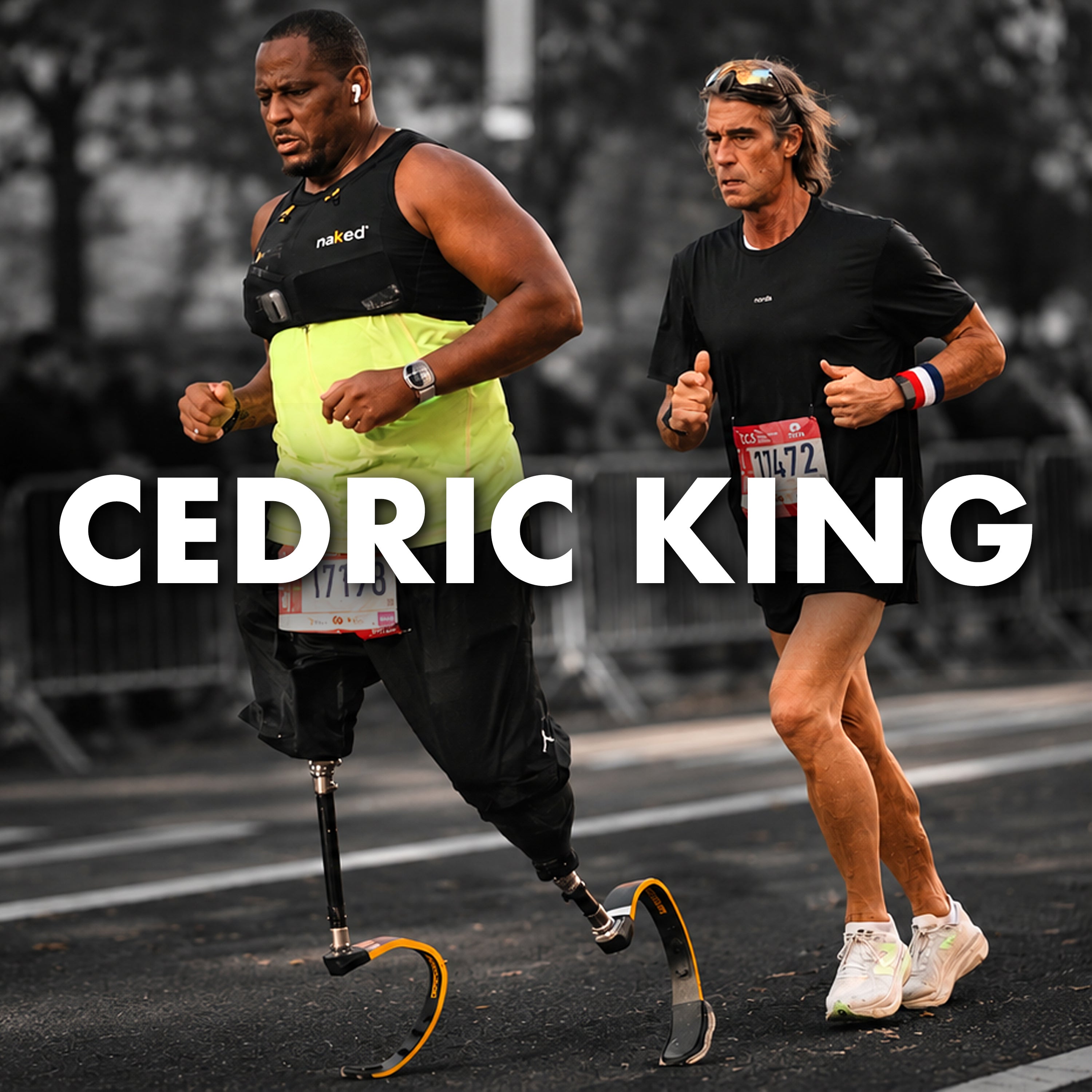
3:11One that is much more about service and connection than it is about ego gratifying performance goals. And in the interest of that aim, I decided to join my friend and Go Brewing founder, Joe Chura, to spend those 26.2 miles supporting someone else to help somebody else cross that finish line. That person was former U.S. Army Master Sergeant and double amputee athlete Cedric King. Together, Joe and I guided Cedric successfully across the finish line to celebrate Cedric, who also happened to set a new personal course PR. But it's all about what happened along the way. And what happened forever changed me.
3:52It was a day better than anything I could have personally scripted. The best day on the best day to be in the best city in the world. Marathon Day in New York City. And so today, I wanted to share that day with you and more, all from the perspective of one of the most inspirational humans I've ever met. Please enjoy the infectious, positive energy of Cedric King. your new best friend, and possibly even your new life coach. Dude, we went on a journey yesterday, my friend. How are you feeling, buddy? Very sore. Very sore. Understandably. My back and this leg right here is stinging a little bit. Stinging a little bit.
4:42I have no doubt. uh you dug really deep there was a question mark near the end there where i thought uh-oh you know yeah is he digging too deep has he dug too deep too soon uh but you pulled it out man and we got you a pr yes you did this was a course pr but every time i finish a race i do want something else to work on and because yesterday wasn't a perfect race that gives me a little bit It's something to go into the tool shed and work on for the next few months. So what did you take away? I know that I cannot hit the gas on the last mile. I can't give. And I know that's something that we always say, you got to empty the tank.
5:27And yeah, you do. But you do need to be smart about when you empty the tank. I emptied the tank maybe about a mile and three quarters too early. And we're going downhill and we are moving. And it felt terrific until it didn't. And then you got to dig deep. Our friend, Joe Chura, who also was part of our three-person team. Yeah. Founder of Go Brewing. Shout out Go Brewing. Shout out Joe. He's here. Yeah. He told me many times over the course of the day, like, our job is to, you know, restrain him. Like I have, because Joe has, has paced you and supported you now through 10 marathons, I think. Yes.
6:1210 or 11 marathons or something like that. And he's like, Cedric gets a little excited. You know, we got to stick to the plan and we got to reel him in occasionally. But in that final stretch, I mean, we were in Central Park and you found a new gear. I did. And you started to throw down pretty hard. And I was like, oh, damn. We were doing like eight minute miles or something. He's like going for it. I didn't realize like, oh, he's got, he's had a whole other gear the whole time. And now is the moment he's going to throw down. But you, uh, you, uh, you spit it out a little too soon, you know, and then you ran out of gas and then you really, you really like met your maker.
6:47And we still, that was when we were kind of making that turn onto 57th street. Yeah. And we have that long stretch before you go into the park and, uh, the wheels were, were coming off. Wheels were coming off. But I think that goes back to what we were talking about coming up first Avenue. we're at like mile 20 we're in the middle of 22 to 23 and you look over at me and you say hey remember man this is what you asked for and this was a place where I am losing energy and massive amounts of energy and I don't have anything left but at that point you did remind me and you put purpose in the pain by saying yo remember this way you want to be it not not tongue in cheek and not making light of the situation.
7:32But you just reminded me, hey, this is exactly where you figure out who you are. Not at the beginning of the race where you got tons of energy and not in the middle of the race where people are cheering. At the end of the race where there are people that are cheering, but you got no energy. You got nothing left in the tank. And now you get to figure out who you really are. And that was where I was like, okay, yeah this does suck but now that pain has a purpose behind it so what did you what did you learn about yourself when you met yourself in that state that yeah it sucks and yet it's painful but i don't have to quit i don't like there are people that were running they were our group that was consistently with us the last four or five miles the same crew the same guy the old guy i I was like, I put a beat on that dude's back.
8:29I was like, we're going to finish before him. That's probably why I hit the gas. So I was like, he's not finishing before me. He was somebody's great granddad. I was like, uh-uh, nah, not you, buddy. Not happening. But hey, shout out to him wherever he is. I hope he's watching. But I found out that I don't have to quit just because I'm tired. And listen, listen, I don't want this to sound so cliche-ish. But, dude, when you are out of gas, you can make a compelling argument to tap out. Because there's nothing left in the tank. And you can say, hey, man, you gave it the best you had. And no one's going to say boo.
9:04And nobody. Look, to me especially, everybody's going to still, they're going to clap if I tap out. I'm going to still get lauded if I tap out. It doesn't matter what you do. No matter what I do. You walk into the room. Hey! But think about it. At that point in time, I still got to say, bro, you didn't have to tap out just because you're tired, just because the tank was empty. You didn't have to tap out. You could have walked to that next stoplight and you could have recharged and gave it all you had again. We saw guys out there. I don't know if you saw this. There's two guys out there specifically.
9:41One, I pointed out to you. This guy did the whole marathon in a wheelchair backwards. One leg that he still had functional. And if that dude don't have to quit. Backwards, Bob. Backwards, Bob. Backwards, Bill. I mean, first of all, he looks like he's 85 years old. Absolutely. Maybe 90. But this guy was doing the whole marathon backwards without the sight of him knowing where he's going. He just has the guides to keep him from going into the walls. Backwards in a wheelchair. Backwards in a wheelchair. With one leg. With just one leg. Yes. Yes. So it goes to my brain thinking, OK, he's tired and he doesn't.
10:25So it's possible that I could be tired and I don't quit. And hey, look, whoever's listening to this, maybe you're tired. But the truth is, you don't have to tap out. You could take a break, wake up tomorrow morning and give it the best that you got. Is that going to help you win the race? Maybe, maybe not. But you will be able to look yourself in the mirror and say, golly, I'm proud of who I see in the other side of this mirror right here. You said it wasn't a perfect race. I don't know that any race is ever perfect. But what did you take away from that experience specifically that you're going to bring into your tool shed to be better next time?
11:02I had some nutrition fixes that I did. I did BCAAs. I did those disgusting ketones. Sorry if I'm losing sponsors. but those disgusting ketone shots did help we missed two ketone shot alarms i set them on my watch and i i just i forgot them i could have used those but i was like i'm feeling great i don't need to do it and sometimes that is that's one of your biggest mistakes where you say hey look i'm feeling great i could skip it but it come back to hurt you later so i can incorporate making sure that I'm good about taking. But you can also empower your support crew. Like I actually didn't know what your feeding schedule was.
11:43If you had said at the beginning or took me aside and said like, make sure every hour I do this, every half an hour I do this. And then I could have, you could have offloaded that responsibility, but I didn't actually know. Yeah, we had four watches between me. All right, if you had two, we had four or five watches between the three of us. And I was using both of my alarms. Joe was using two sets of alarms on his. I'm sure I could have told you, hey, look, I need this ketone shot every 90 minutes. I need this Advil an hour out from finish. It would help things be better. But that's a great thing.
12:18I never want to run a perfect race because I always want to be working on something better. We're in Central Park, and you asked me, you're like, what's your GPS watch say? Because that's a little bit of a mind game. You know, mine had said we had run almost a mile more than the course. So you're thinking you're done. You look at your watch, and you're like, oh, man. That's one of the biggest weights that I carried the whole day yesterday. Because the GPS in my Bluetooth, I was constantly hearing, we're at the mile. When I could see the mile is actually way down the street. So my GPS saying, we're at mile 17.
13:02and in real life mile 17 is nowhere in sight and that was so mentally debilitating man i'm feeling like i'm getting the the rush that we're there but i'm not getting i'm not seeing the satisfaction of being there and that every single mile i had to deal with now we're not there yet and i had to find ways to say okay this is just a segmentary goal that we're getting to this is not the actual goal we'll be there in seven tenths of a mile but constantly having to deal with that that was tough and i man that was one of the things why i looked over at you i said hey man what's your gpsa i was like okay he's dealing with it too yeah but when you know that you're not in it alone it kind of gave me a little bit of strength to know that I didn't even want to ask Joe.
13:59I know Joe's marathon, his GPS was probably dead on, but I just wanted to know I wouldn't end it by myself, man. What would it have done to your mindset to know that Joe, while we're kind of going through this whole experience, he's on his phone redesigning the Achilles website? That was the other bane of my existence just today. I was like He's literally like using clawed code and he's like reworking the website for Achilles International which is the organization that you know kind of put us in it oversees the disabled athlete kind of endurance 100 % great organization Achilles International they are the reason for probably my second turnaround in life for you you had a turnaround in your life and it meant so much to your well being it meant so much to your self-identity, to who you could really become.
14:55With all your accolades that you had in the beginning, this moment in your life happens and now you find a new rich. Well, Achilles was my moment. It wasn't just the blast, but it was after the blast. I find a community of people that helped me find a new and better me. And we are running yesterday, 20, 21 miles. And throughout this whole day, Joe is redeveloping their website interface while we are, me and you are over there like,
15:34are we there yet? Okay, time. Joe's like, all right, Claude, here's the next prompt that you gotta do. I'm like, what a dirtbag. I love that guy, man. He's like my brother, man. So Joe supported you through 10, 11 marathons. You have completed 32, 33 marathons? Yeah, 32. 11 Bostons, five Disneys, five Chicagos, four New Yorks, two Berlins, one Tokyo, one London, and one Sydney. And you did the half Ironman. Yeah, I've done two half Ironmans. I've come short on three full Ironmans. And obviously, I know somebody between the two of us. has done the world championship, which I will do one day. I saw the video of you running the lava.
16:27What is it? The lava. Yeah, the lava fields. The lava fields. Yeah, on the big island. That was at Ultraman. That wasn't the Kona World Championship. I've never done that race. Talk your talk, boy. Talk your talk, man. That's what you're supposed to do. No, I just didn't want any confusion. I've never competed at the world championships of Ironman. That's a whole different thing. I did a different race there. Yeah. We're talking about you, buddy. I want to take it back. You know, I am interviewing you part on the slide. That's all right. I'll let you get away with it a little bit, but just not too much.
16:59You mentioned how Achilles kind of came into your life and helped to birth this new life that you're experiencing now where you get to inspire people and participate in these challenges. I mean, out on the course, it was unreal how much support you were getting from the crowd. It was an honor to support you. And it was also just a delight to participate in this event, which is the best day to be in New York City, the best city in the world. Like New York City is undefeated. And we had perfect conditions. The crowds turned out. They were unbelievable. And just the entire way, it was like Cedric, Cedric.
17:40The amount of support that you were getting, like it was such a cool thing, you know, to be there. It just gave me hopefulness for humanity. to see the unity and the community that in this time of division and acrimony where everybody seems to be fighting online like oh this is this is real people you know when they get together i remember kind of orient themselves around a single purpose and goal you and i were just we talked about it briefly out there but this is exactly the medicine that our humanity needs it's strangers from different ethnicities strangers from different countries cheering on each other and cheering on people that are really trying hard to accomplish something.
18:24Do you remember that? Mm-hmm. Like, it's so cool today to not try hard. It's so, it's almost like, it's almost cool to be nonchalant about something. But for this one day out of the year, we saw 60 ,000 people trying really, really hard to defeat the voice on the inside of them that is desperately wanting them to be smaller and to be less. and for you to have a stranger to come out there and to cheer you on that's never met you before that just wants to see you win bro that's that's the gift that we all need yeah this is the true medicine of our culture not just not just athletics not just running not just fitness but the spirit behind it, let me come out and cheer you on and help you win your race.
19:18That's beautiful, man. It'll go right over your head if you're not into this, if you weren't there, but just listen to what I'm saying. This is exactly what we need in our culture and humanity today, cheering on other people to see someone else win. That's what we need, man. Yeah. Fundamentally, when you get to the brass tacks of everything, every single person just wants to be seen and understood. And that experience yesterday was sort of that in action. Like, I see you. I feel you. I understand you. I'm here for you. I want you to win. I'm here to support you. You know, like just to feel that experience and then what it feels like to support the, you know, the crowd that's supporting people or in my case, like supporting you.
20:09Like when you're, when you kind of get out of your own self-obsession and make it about somebody else, like that's where you discover happiness. It's not through chasing all of these ego gratifying things or trying to, you know, like surround yourself with a bunch of material items or prestigious jobs, et cetera. It's like being of service, man. That is the answer. I really, I really wanted so much this weekend. I wanted to get a jacket, right? And I wanted to get some cool merch to take back. But one of the things that paled in comparison to all the things that I wanted is exactly what I got.
20:49I got a chance to see you be out there on a course where so many people walked up to you. and just said, man, you changed my life. And I've heard that before, but to know that what you have gone through was medicine to someone else is such a blessing. And I'd like to think that maybe what I've gone through, losing both my legs, was medicine to someone else. Yes, it was poison to me almost, but it was healing to somebody else. So maybe I didn't go through this in vain. And maybe this didn't happen for nothing. And maybe what happened to you didn't happen for nothing. Yeah. I mean, you have said that what happened to you, you now consider your finest hour.
21:37Not because I was super brave and not because I was in shape and not because I didn't feel the fear. It was, hey, I got a second chance, man. I got a second chance. There's so many dudes. Look, this week, we're going to celebrate Veterans Day in about five days. Five or six days, we're going to celebrate Veterans Day. And I know that most of the people that are going to not be here are not going to be the way they used to be. Those are the heroes. I was one of the lucky ones that got a second chance, man. And look, I'm trying to make the best out of it just by being the best that I can be. I got a second shot, man.
22:21What am I doing complaining about? Minutia, this is the true blessing. This is my finest hour. I got a second chance. Let's make the most of it. I am just over the moon to finally and officially announce my partnership with Norda. Founded in 2020 during COVID by husband and wife team Nick and Willa Martyr, everything about Nordisk shoes screams next level, from the unboxing experience to performing in them under pressure in the most demanding conditions. I decided I was going to check them out and bought my first pair, the 001A, and I tested them for the first time on the trails around Joshua Tree.
23:06I noticed the difference immediately, mainly how instantly I felt connected to the terrain, which is really what trail running is all about. What I felt was like this effortless conversation was taking place between myself and the earth. And from that moment forward, I was just obsessed. When you think about most trail shoes, they're either light or durable. They're never both. They're definitely not stylish, but Norda found a way to innovate its way out of that trade. And what they did was they built the world's first seamless trail shoe from this bio-based material called Dyneema, which is 15 times stronger than steel, but also light enough to float on water.
23:45Their idea of sustainability is building a shoe that lasts hundreds of hard miles instead of a replacement every season. So please check them out. Experience the ultimate in trail running innovation and shop the latest collection by visiting nordarun.com.
24:07Everybody and anybody who spends time outdoors knows the moment. You're reaching for a hold. You're pulling your phone out for that shot at the top. And what happens? It like slips out of your hands. And there's that half second of slow motion where all you can do is watch it fall and you're powerless. Well, Taurus built the Q3 Air Pro for exactly that half second. They developed it with legendary climber Tommy Caldwell. so you know it's super legit. And the engineering is really smart. Instead of making a thick brick-like case like its competitors, Taurus built this ingenious dual airbag cushion system.
24:44They call it Air Duet, which cradles your phone with an outer layer that catches the initial impact and an inner layer that disperses what's left. You can actually see the airbag structure, these buffers on the outside here, which for me is great because I have a habit of dropping my phone, which I did the other day on a sharp rock, no less. Pretty convinced that my iPhone was a goner, but amazingly, thanks to Taurus, it was absolutely fine. Here is a detail I'd flag, the built-in magnetic stand. Prop it up to follow a workout, frame a shot, hands-free, navigate or charge wirelessly, then it folds right back into the case.
25:20And it's still slim enough for everyday life. For listeners of the show, Taurus is offering 15 % off your order of the Taurus Q3 Air Pro when you enter the code RICHROLL at TaurusLife.com.
25:37Well, we're kind of dancing around it, so let's go directly towards it. You're in Afghanistan. It's summer of 2012. Walk me through exactly what happened. Just like every day in Afghanistan, and look, just to let you know, I'm no tough guy, man. I'm not one of the super-duper tough guys out there. You got guys that are way more heroic than me. But this particular summer, 2012, we're doing a reconnaissance of a building. You're a master sergeant in the Army. At the time, I wasn't a master sergeant. Oh, you weren't? I was a sergeant first class in the 82nd Airborne Division. Oh, 82nd. Rangers lead the way.
26:24I'm an airborne ranger. and sure enough we're doing a simple reconnaissance on a building the taliban had been using this little hut or this little shack to store their arms and their explosives and all that stuff and we were just supposed to go and just find validity that this was the place we go in there and man we hit the jackpot it's like ammo right over there it's like wires you know like i'm not trying to teach people how to build bombs but it's like bomb making material in this room. And we had the jackpot. It was almost like, hey, you got everything done at your job within the first hour.
27:01You're going to get off early today. Sure enough, we're taking pictures, we're sending all the photos and images up to headquarters. And it was going so great, Rich, that I just said, hey, look, hey, I'm going to go outside and I'm going to let the guys on the outer perimeter know that it's time to go. I just make a slight movement to my right and a In a split second, it feels like in the split second, like I've been tossed in a fire. The loudest sound that I've ever heard blows both my eardrums out. The overpressure punctures my lung cavity. I'm in the air. I'd never had a concussion before, but it felt like time was slowing down, like super duper slow.
27:54All of a sudden, the time comes right back to normal. I'm laying on the ground and I don't know what had happened. I don't know quite how bad it was. So I just tried to stand up like normal. It was almost like if you ever ice skated before and you slipped and fell down, you tried to stand back up. But you can't get your grip. It was just like that. The medic runs over to me and everything sounds like this now. everything's muffled because I can't hear the way that I could before I got like fluid coming out of my ears and the medic wants me to just stay stay on the ground comes over and he takes a tourniquet and starts putting a tourniquet on my legs I never thought about looking down but this is the first time I just glanced down and you see your shoes right here you got these shoelaces right here Yeah.
28:47These are sort of like the similar shoelaces that I had on my boots. These shoelaces were like in little pieces all over the ground. And I had canvas boots. The pieces of the boot were like, it looked like somebody put them in a shredder. They were all over the ground. And now the sand that was brownish beige, now it's like pink. And now I could start to smell the blood. have you ever bit your tongue before and you kind of taste that metallic taste it smells like that it smells like that all around me and i know that i'm running out of time because i can't feel the pain or is the adrenaline just coursing and you you're just in this surreal it's an instantaneous pain it feels like i'm on fire for like the first probably five minutes because it's shrapnel it's extremely hot that's blown through all of this this flesh skin so Every piece of shrapnel is, I mean, I don't know if you've been shot before, but it's like hot pieces of metal that are all in my body.
29:53And they're cooling down, but not soon enough, though. Yeah. So it's agony. But I do remember starting to lose a conscience. I can't inhale like I normally would. But because the lungs have been punctured, every inhale that I do get, it's not a full inhale. Maybe it's like 60 % or 40 % or something like that. So as soon as I inhale, I need to do it again because I'm running out of air. And breaths are getting shorter. And now your field of view is this wide. But if you continue to hyperventilate, you're going to start seeing this wide field of view do this. It's starting to get dark on the edges.
30:36and I know I'm running out of time. I know I am, man. I don't know how much. I don't know if I got five minutes left. I don't know if I got two minutes left. I don't know what it is, but I do remember them trying to get the helicopter, but when they tried to get the helicopter, I guess the ISIS or the Taliban, whoever the insurgents that were on the ground, they were trying to shoot the helicopter out of the air by the grace of God, man, by the grace of God almighty. I get on the helicopter, me, the interpreter, and another one of my soldiers are on the helicopter. And we get to the nearest hospital.
31:14It was almost like MASH. Have you ever seen MASH? Sure. Maybe some of the young guns that are listening to this, Ray, maybe you ain't never seen a show called MASH, but it was just like the opening credits of MASH. I'm coming over a mountain range, and I'm landing at the nearest field hospital, and there are doctors and nurses that are running out on a tarmac to come and get me out of the gurney. and I go into this tent and I slip into a coma. I have no recollection over the next eight days, man. But in that eight days, I obviously lose both my legs. Yeah, they tried to save the legs. They couldn't.
31:50And you wake up eight days later and are told that your legs are no longer. Where did you wake up? I wake up. Did they take you back to the States? So I went from Kandahar to Bagram, from Bagram to Lanzstuhl, Germany, from Lanzstuhl, Germany to D.C., from D.C. to Bethesda, Maryland. So it was quick to Walter Reed. I say, well, eight days. Yeah, with a few stops in between. But this is just, I have no recollection of any of that stuff. I saw a picture. Obviously, I woke up with a Purple Heart and a Bronze Star on my chest or somewhere in my bags or somewhere close to the hospital bed. But I don't remember being awarded them.
32:34But I have like the certificates and it's in my records and stuff. But I don't remember any of that stuff. But I wake up in a hospital room in Bethesda, Maryland. And not really knowing where I'm at. It's the first week of August. And I really don't even know that my legs are gone. I know that I had injured my legs. But because of phantom sensations, I don't have any reason to feel that there are no toes there or no shins there or no calf there. because I still feel toes. It's just they're not there. How did you take the news? That's the lowest point of my life. That's the lowest point of my life.
33:12I'm not a crier, man. I struggle to really tap in and be emotional in the moments where I probably should feel where I'm supposed to feel. But in that moment, every weight of pain, of embarrassment, of shame, of anger, it all culminated in that moment. I just, I yelled, I screamed. They had a feeding tube inside me. And I remember taking it out. I couldn't take it anymore. I was just sobbing uncontrollably. Because in my mind, how could this happen to me, man? Not that I would want it to happen to anybody else, Rich, but golly, man, why me? And why now? Both legs? How old were you? Right before my 34th birthday.
34:05Right before my 35th birthday. I was 34 years old. I mean, the fear and the pain, that's understandable. What's the shame piece about? At the time, I'm a Sergeant First Class in the U.S. military. I should be promoted to Command Sergeant Major within a few years. Not a lot of senior guys get injured on patrols. But it's not like you messed up. I feel like I sort of did, and I'll tell you why. In Afghanistan, there's procedures to where you can kind of track where the bomb would be at. And we use sensors, but because Afghanistan has so much shrapnel and screws and soda cans, trash everywhere. So we just had them turn down the sensitivity because we'd still be on that patrol.
35:07It's just so much there. We just kept getting hits. And I just felt like, man, why me, man? Why? This doesn't happen to anybody. I got a wife. I got daughters. Like how in the world am I going to be a dad again? How am I going to protect my family? I'm going to walk funny from now on. I'm going to be in a wheelchair. That's not me. Why? No. I'm going to need my wife to push me around in a wheelchair. No, I'm going to need her to drive me places. I'm a guy's guy. I'm a ranger, man. I'm not supposed to be getting pushed around in a wheelchair. I'm a ranger, man. I'm supposed to be jumping out of airplanes and walking up mountains and fighting Taliban, man.
35:54I'm not supposed to be in a hospital. I'm supposed to be out there with my guys. How long did you, like, wallow in that state? If we're just being honest, I was still in that state.
36:15Yesterday is a prime example, man. I am duking it out with somebody's great granddad on mile 24. And he's got the worst form, but he's so consistent. I'm like, what am I doing? It's part of this ego we talked about yesterday. I don't know if you remember it. But there's a part on the inside of me that still does not come to grips with me being a double amputee. part of me is like, yo, if I get these legs back at mile 10, I am going to cook the rest of this field, which is also why on the downhills, I love going fast. When we were going downhill, I love picking up the pace. You were cooking. When I am going that fast, it makes me feel like I'm back or maybe this is what it used to feel like.
37:13it helps me feel like maybe maybe like i'm in a time machine and i can go back and i could feel the way that i used to feel again i appreciate the honesty because it would be easy for you to just say like now it's just about like me being an example for other people and showing them that they can do x y and z not that that's not central to what you are doing and what you're about but to I still got the vulnerability to admit like, actually, like, I still just want to feel like I'm normal again. And that's, that's one of the times in my life where I feel like I'm Cedric again. I'm that guy. I'm pre-injury.
37:53Yesterday, I don't know if you remember it, but when we were coming into Harlem, there's like a, there's like a, it's like a bridge that's going downhill. And I was lagging behind you and Joe a little bit. But I ran up to you. Once I saw that bridge go down, I was like, all right, let's go, boys. And I couldn't go far. But on that downhill, man, I felt like 34 again.
38:20I felt terrific, man. If anybody could go back and feel 10 years younger, you would. Sure. And in those moments, I feel like I'm 34 again, man. But not for nothing. You also said to me a couple of times over the course of the day, look around, look what's happening, look what we get to do. None of this would be part of my life had that not happened to me. And you were expressing gratitude for having this life where you get to do these things. Like who knows what you would be doing had your life proceeded normally and you're in a different situation. And my sense was that like, you feel as if your life has so much greater depth and meaning, and you have this purpose that animates you and drives you.
39:12And I could feel the thankfulness for that. And just please, please, please, if you're listening to this interview, please, I'm going to say this with as much, like, be careful with this. I look at this now as a gift. okay? And I don't know what someone's going through that's listening to this. But the moment I began to look at this as a gift, life changed. It stopped being, this was a penalty that I paid, and this was a curse that was put upon me. And now that I look at it as a gift, that's the way that life delivers it to me. I get to go and run with people like yourself. I get to go and run all over the world.
40:01Or I get sometimes to have people come up to me in the airport and just want to hug me. Or somebody say, hey man, listen, can you make a video for my aunt? She just lost her leg. Could you just give her some inspiration, please? Or can you just let her know everything's going to be all right? And that's the thing that will outlive me, man. It's not the stuff that I will accumulate or it's not the interviews that will last forever, but it's the people that you touch. It's the moments where you try to make it right for somebody else. If you could do that, that'll outlive you. How did you flip the switch?
40:34At what point did you move from wallowing in, you know, fear and shame and all of that to understanding and real, like taking ownership of this as like a new, like the, perhaps like the birth of a new life. I'll tell you where.
40:56I'm in Bethesda. It's about a week and a half, maybe two weeks into my stay at Bethesda. And I'm not sure if you remember, but there's an Olympics every four years. But when they do the Olympics, it's usually in August. It's right before September. And I am watching the 2012 Olympics. And for that week and a half, two weeks, I'm watching the first double amputee prosthetic blade runner. And he's competing against regular dudes. And I'm like, Oscar was out there. And I'm like, oh, man, what a time to be in the ER. The timing of that was just perfect for me. I was able to witness someone that had been in a situation similar to mine do what everybody said he should not be doing.
41:55He's running against able-bodied Olympians and he's winning. That was sort of like the light that I needed at that moment. A day later, I tried to cut on the TV. And in Bethesda, it's one of the best hospitals you could ever go to if you're in the military. But the Wi-Fi went out. And when the Wi-Fi goes out, the cable's out. And I'm hitting the little button right there on the bed. I'm trying to turn it on. And no Wi-Fi, no cable. I try to grab my iPad. No Wi-Fi. I just got games downloaded on here. And I'm like, ah, nothing. And I'm not sure if this was maybe the first time where I started practicing like stillness, but in this moment, I am very still and there's nothing to try and grab my attention.
42:54I have to be totally focused. It's totally silent in there. It's dark and the nurse had just left. So she won't be back for about a couple of hours. And it's just me in silence. and I desperately am looking for something to distract me, the last thing I want to do is deal with this, right, at the time. So there's a stack of care packages right off to the side of the bed. And these are from people all over the United States that packed care packages for the troops. Man, I must have had a pile of them this high. And I go over, rich, right on top, there's a box, and it's got a little weight to it.
43:35I go open it up. It's got like bubble wrap and packing peanuts in there. And sure enough, there is a pack of paper and a pack of pencils. The old school kind with the number two, the little paint, the eraser. Perfect. And I'm looking through this box and it's got candy. It's got magazines. It's got combs. It's got, I don't know if you remember, Chia Pets. It's got Chia Pets in there. All types of stuff. Just stuff for you to kind of get your mood up. I look through the box and I see the pencils and I see the paper. It's just no pencil sharpener in there. And this sends me over the edge. I'm already frustrated the cable's out.
44:21And I'm already frustrated the nurses are not going to come back for another couple hours. I can't watch Oscar. He's supposed to break some other record. And now I am without a pencil sharpener. And I just yell at God. I get angry at God. And I say, how could you let this happen to me? And when is it going to get better? Why me? And when is it going to get better? No answers. You would think that God would speak with words that we can understand, but this was him speaking in silence. Until I hear these words, maybe about five minutes later, it's like, you are the pencil. Now keep in mind, I don't have this box right in front of me anymore.
45:17I just laid it to the side and I'm yelling up at the ceiling. And the answer is, you are the pencil. I am the pencil? You. Me? Are you sure? Yes. It was just like this. And over the last, I don't know what, 14 years, not only do I understand that, hey, man, I'm the pencil. Yeah, I am. But you are too, dog. What does that mean, you are the pencil? I said the same thing. I said, what is it? Bro, it's almost like we switched places. What does that mean? I'm the pencil. But this is what it means, man. What are you supposed to do with that? Let me tell you, man. Those pencils. You got lead in your head.
46:04I got lead in my head. That's exactly what I felt like. It's like, is that what it means? No, man. Those pencils, it was like a pack of 10 of them. And because I didn't have the sharpener, I wish I, I mean, I looked on, DoorDash and Uber Eats all over Manhattan for somebody would deliver me a pack of pencils for this interview. But it's supposed to be like this, I guess. But in this pack of pencils that was on this in this care package, I said, man, I'm the pencil. But without the pencil sharpener, this pencil, as good as it is, it never truly achieves its purpose. Without the pencil sharpener, Yes, great.
46:48The pencil will always be a pencil. The pencil will always have meaning, but it will never achieve purpose unless it meets the sharpener. You, you, you would have never been the rich that you are today had you never gone through your sharpener experience. I am the same way. This was my sharpening experience. And for one slight moment, it took the pain away from what happened and it gave this pain purpose. Oh, wait a minute. You mean to tell me that just as that pencil needs that sharpener, I need the sharpening of life? Oh, man, wait a minute. So when tough things happen, it has a purpose. if that sharpener can sharpen that pencil, that pencil can achieve its life purpose.
47:49And here's the crazy thing about the pencil. Without that sharpener, that lead will always be inside. It will never be exposed. And without the sharpener of life, the thing that's inside you, it will never make it to the light, man. It'll always be buried under the parts of you. It'll always be buried under the ego or the money or the fame or the fortune or whatever. It'll always be in track. It'll always be in there. But the moment you go into the sharpener, the best parts of you, they don't stay on the inside anymore. They come on the outside. How many people you know that are truly great today, they went through a sharpening experience and the best parts of them the world could see now.
48:36Man, you don't get no Michael Jordan without him being cut from the varsity. You don't get the Magic Johnson we see today without the HIV diagnosis. You don't, man. You don't. You don't get Batman without his parents getting killed. You don't even get to know Alfred until his parents are killed, man. You don't get a Superman without Krypton blowing up. And you don't get a Cedric King without him stepping on a bomb in Afghanistan.
49:35and a drop glass on the lift gate so you can toss in groceries without opening the whole thing. These are small decisions, but they add up to far more room than the outside suggests. Inside, it's built to be lived in. The panoramic glass roof floods the cabin with light and the backseat has real legroom. The whole palette is inspired by nature, so it feels considered rather than default. It's the kind of design you notice more the longer you live with it. See for yourself to book a demo drive, head to rivian.com backslash demo dash drive.
50:12This episode is brought to you by Whoop, the, not a, the wearable health and fitness coach that gives you personalized and very helpful insights into your sleep recovery, strain, and how your daily choices are actually landing in your body. We know how some choices land. If we stay up too late, if we're overly stressed, we know it will degrade how we feel the next day. But we also make many other choices where blindly unaware impact our bodies negatively. And for me, it was actually an epiphany to see in a graph how eating late before bed raises my stress levels and resting heart rate while I sleep, which negatively impacts sleep quality and HRV in quite surprising ways.
50:55For me, this is huge and hugely empowering because it takes the argument out of my head and puts the data in front of my eyes, how I'm actually recovering, what the accumulated strain has cost me, whether my body is absorbing the work or just tolerating it. Also, it's not only for people interested in physical training. Anybody juggling work, travel, family, stress, trying not to feel wrecked by Thursday, all of you, all of us, we get the same thing. Your body's been telling you something and here is your opportunity to hear it a little bit better with Whoop. Go to join.whoop.com slash roll for one month free of Whoop.
51:39We talked about it a little bit out on the course. This thing that my wife always reminds me of, which is that everything that happens to us is neutral until you apply perspective. Meaning, things happen. We make mistakes. We succeed at things. We fall short. and then the world has its say and things occur. What happened to you happened to you. Everybody has their version of that. It's not gonna be as extreme as what you have endured, but we're so quick to label these things as bad or good, terrible, awesome. Oh, that's amazing. Oh, that's the worst thing. The worst outcome I could have imagined, blah, blah, blah.
52:20And we're doing it in the moment and we don't have really any evidence to support a positive or negative perspective on either of these things. And ultimately, it's a choice. And if you believe, as I do, that we're here to grow, evolve, and serve, everything that happens is serving that because everything is an opportunity to grow if you can perceive it as such. And this story or this analogy or metaphor about being the pencil leads to the second observation, which is that a pencil is ultimately a tool for somebody to use. And if you're a pencil, you are a utility for somebody else's problem solving or creative expression.
53:04And if you see yourself as that, as I know you do, like you being out on the marathon course, you're basically like transmitting this message of like, I am a tool for the inspiration of others. People can project upon you their own fears and see what you're doing and extract inspiration from that. And in a sense, using you in the most positive kind of interpretation of the word use, because use can be a negative thing, but using you for their own personal betterment. That's right. Yesterday, before we started, or maybe in the first few miles, We got to Brooklyn and I was like, oh, I just want to be a billboard for what's possible in someone else's life.
53:49Like I told you, God gave me a second chance, man. It ain't about me no more. And to your point, yes, it's how you look at what happened to you. It's not about what happened to you. It's how you see it. I did not see this in the beginning. So I don't want anybody to think they got to hurry up and get to this place of reflection right now. No, it took me a while, man. But I think this moment of reflection where the pencil happened, this pencil analogy, that helped me along the road a little bit. But it still took a lot of time for me to see that this could be used for good. I mean like every superhero that we always talk about There is power in every pain And I think that it's very irresponsible of us To want power without problems This was a super problem Especially in the beginning But from this I extract a superpower I know that they're fictitious superheroes, but I think that the story behind them is so powerful.
55:04It's for us to look at what happens to us. Some unfortunate circumstances can be turned around and some very powerful tools that we could use not for ourselves, but for 1.7 million people looking on the course yesterday. Yes, it's my pain, but maybe I can show you that, hey, maybe God didn't give up on you either. Or maybe, yes, you just became a single parent, but maybe you can keep going too because we're doing it. We're living proof that you can keep going. You don't have to tap out. You can if you want to, but you don't have to. And if you find the strength to keep going, there are tangible benefits that you will get in life.
55:49But more importantly, there's people that you're going to bless that your gift will outlive you.
56:01The reflexive kind of defense against that that I can kind of hear in my head from the average person is, well, like, what do I have to give? You know, like, yeah, I have my pain, but like I didn't lose my legs and like, you know, my story isn't all that extreme. So, you know, it doesn't really mean that much in terms of how it might impact other people. But I think, you know, everybody has their pain and your pain is your pain. And you're this extreme example of it. But it's really just, again, like a metaphor for like everybody. Nobody gets gets out of life alive. You know, we all have our we're all on our hero's journey and we all have our lowest moments.
56:39And that thing that happens at the bottom of the second act where all hope is lost. We're all living that out on some level, like that archetype, right? And to be able to be you as a mirror for everyone else to kind of reflect on their own, like where they are in their own hero's journey. And to say, if I'm not there yet or if I'm in that really dark place, like there is hope on the other side. There is possibility. There is a way to use it as alchemy to transform it, to transmute it into something positive. Bro, do not get it. And everybody's story is worthy of telling. We've all lived a unique set of experiences, and that has value.
57:25One of my favorite books that I ran across, especially maybe two books, Man's Search for Meaning. I was given this book a week before this happened. The chaplain. The week before stepping on the IED? The week before this, the chaplain was trying to make it out to our outpost. And because there's so many ambushes to vehicle convoys, the chaplain couldn't make it out to our outpost. But the week before this happened, the chaplain comes out. He has a little service in our little tent where we eat at, and he has a stack of books. And he leaves some books, some Bibles and stuff. And Man's Search for Meaning was the last book that was left.
58:14Most of the guys just took the Bibles, right? So I was like, yo, I've heard about Viktor Frankl, but I didn't have a book. So the week prior to this happening, I get to the place. I think the last chapter I got you was the part where they were finding the value of that little small, like you're lucky if you find a pea in this bottom of this watery soup. And it just baffled me. I was like, wow. They were at a point so low that happiness was finding a small piece of rice or a pea in the bottom of a questionably watery soup. A cold watery soup. I was like, wow. Wow, that means that your perception of what happy or blessed or thankful can be shifted so much.
59:05Probably the next day I got injured. But that was one of the guides to this happening. A year before this happened, I finished the book called The Alchemist. And to your point with the alchemy, this is you taking something that's so abstract and turning it into something beautiful. something that's not initially beautiful something that is anything but beautiful but you could turn it into your own goal you could turn it and i don't mean goal in the set in the sense of something i aspire to go get but you could turn it into something very rare you could turn it into something very rare something very beautiful by your attitude by the way that you see it now a for the person that is listening to this and say man i'm not i don't have a one percent injury i'm not one of the people that was given life-changing money, or I'm not charismatic.
59:58And what do I have to give to the world? If you feel like that right now, you are at the right place, the right podcast. Here it is right here. You must start with living a life of service. Yesterday, I know we keep saying yesterday, but yesterday, right before we started the marathon, I don't know if you know, but I was super nervous, man. And every time I get super nervous because I know I'm getting ready to go in and fight this humongous bully for the next six hours, I tried and it worked. It worked. What I did was start going around hugging other people and encouraging other people. And soon the fear that I did have that I was going to have to go and face this six-hour task started becoming, hey, let me give encouragement to the people that are getting ready to tackle of this too.
1:00:48And they were just as afraid as I am. They were just as nervous as I am. But what I did was I took this nervous energy and I put it to use through giving away the very thing that I needed. The very encouragement that I needed to say, okay, we could do this. I was giving it away. And by me giving away hugs and smiles and reassurance to other people in a certain way, that kind of quelled the storm for me. If you practice it enough, it will work in your darkest moment. Anytime I got to go on stage and give a talk, I spend time hugging and giving away the great energy because it's a reflection. It bounces back to you.
1:01:34Even when you do it selfishly, you receive exponentially. 100%. It almost doesn't matter your motivations. And I think there's a lot of, when you say service, I think people conflate that with like, you got to go work a soup kitchen or something like that. It's a mentality shift in how you're just interacting with other people in the world. Hey, man, it takes nothing to say, hey, look, I'm at Starbucks right now. I'm at the coffee wherever. I'm going to grab two cups because I know somebody that I work with will probably want a coffee right now. It doesn't matter if they want the cup or not. It's just you are being of service to someone else.
1:02:13Hey, look, when I go to the airport today, maybe the guy needs this extra zelle that I give him. Hey, look, man. Hey, here's 20 bucks or 50 bucks or whatever it is. I want to make sure that the moments where I feel like that I can't, I feel service. I know it sounds cliches and maybe like corny, but it really works because you stop looking at yourself differently. When you live a life to give, you stop seeing yourself the same. You start seeing yourself as a person that is not confined to the way that you used to be. Now you start seeing yourself as, wait, I have just evolved into a different dimension.
1:02:57Now I am not trapped by what I thought was just limiting forces, just me being the old way that I was. Now the choices that I make have superseded the need that I thought I had to be in. I had to be in this little box. I had to be the old Cedric. Nope. Now I can give. And it doesn't matter what the circumstances are. I am a giver now, not just in word, but also in deed. I hope it makes sense, man. I hope I'm saying it right. Here's how it's gonna make sense. Let's go back to the Bronx. I think it was on the bridge to Harlem. You're starting to fade a little bit. And this is when Joe was working on the website.
1:03:41Yeah, he was. We're up ahead. Knee deep in Claude. And we turn around and we're like, where's Cedric? And you were way back. And I witnessed something I'll never forget because I knew you were hurting. You pulled over to the side and there was a woman sitting on the curb. And instead of, you know, kind of obsessing on your own challenge in the moment, you stopped and you leaned down and you started talking to her and you started asking her how she was doing and encouraging her that she could get back up and complete this thing. And you helped her up and got her back on her feet and moving again.
1:04:22And I was like, that is unbelievable. During these moments, I know that it's not me anymore because I'm out of gas, man. I got nothing left in the tank. So when I am out of gas and I got nothing left in the tank, I know that there's moments of self-reflection. But I also know that I am in a minefield, so to speak, of people that are going through the same thing that I am going through. It's just you got to look around to your left, your right, your front, your back. And there's going to be somebody that's there that's struggling just like you. Sure enough, my Bluetooth was acting up. So I couldn't be distracted in this moment.
1:05:03I was like, oh, man, where is that song? What were you listening to? Were you listening to music? Man, I had gospel going on for the first 13 miles at Mahalia Jackson. But I had some, Kurt Franklin was up there. Everybody there. But at mile 13, we crossed the Pulaski Bridge, and my playlist starts to run. It starts to loop again. So I was like, all right, let me find something else. I cut on a different YouTube playlist. And I don't know what goes on, but sometimes we get around a lot of people. My Bluetooth starts acting up. So right as we're coming up that hill, Bluetooth's out. I'm like, what in the world is going on?
1:05:38Start checking all the connections. And to my left, I see somebody that's sitting down. And it looked like she was in tears. And Joe and I have seen this 100 times, man, where there have been people out there that are in tears because marathons tend to make you emotional when you got nothing left. And I was like, hey, listen, you got this. It ain't over. This is exactly where you're supposed to be at. This is the time. This is your moment right now. You're not going to brag about any other time in this marathon, but you will brag about this moment. This is going to come a day, maybe a week from now, maybe a year from now, but you're going to brag about the moment where you had nothing left and you got up and you kept going.
1:06:25That's the moment you're going to remember. That's the moment that you're going to remember when grandma's got chemo in a couple of years and you got up and kept fighting. You kept believing in yourself. And that's the moment that you're going to take someone else to be able to encourage them. It ain't the moments where we got all the energy. It ain't the moments we got all the money. Those are not the moments that we treasure. We if we're being honest, we treasure the moments where it was it was dark and it was two or three dudes with baseball bats. And and you still had to put your dukes up and fight anyway.
1:07:00Those are the moments that you remember that you're going to be so proud of yourself, man. What did she say to you when you said that to her? She said nothing. She didn't say anything. She said not one word. She got up. No, well, she did. She said, thank you. She got up, and this is what made me a little afraid. She got up. She started walking, and then she started running. And I was like, uh-oh. I may have sabotaged this lady. Maybe she's going to hit the gas pedal too hard. I don't know, but I never saw her again. And I don't know what it was. I don't know what it was, but I hope that if she were listening to this right now, I would thank her for allowing me to be part of that story that she tells herself.
1:07:44In addition to looking at what happened to you as this gift, you also have this perspective that you were spared. You told me out on the course, I'm not sure I totally understand, that when it occurred, there were like two grenades that the pins were still in, meaning I guess that it could have been a lot worse. It could have taken your life. Yeah. Had it gone a different way. A hand grenade, all right, shout out to Joe. A hand grenade is no bigger than this soda can right here. Maybe it's just a little taller, but it's no bigger than this. That's not soda. That's a fine go brewing. This is a fine gold brewing elixir of life.
1:08:27Non-alcoholic beer. Shout out to Go Brewing. But a grenade is no bigger than this soda can right here, this beer can. I had two of them hooked to me. A grenade is very simple. It's an explosive. It's a spoon and it's a pen. This spoon will keep this grenade dormant for eternity. If this pen is in this grenade, you can remove the pen. And guess what? But as long as you hold that spoon still, it will not explode until the end of the world. But the moment you let that spoon go, you got about five seconds. And it's going to have a 35 meter kill radius. I had two of them on me. Now, the force that blew both of these legs off was strong enough to separate appendages, was strong enough to rip the skin off of my right arm, was strong enough to take the rifle barrel and have it have a slight bend in it.
1:09:32Now, anybody that's listened to this, anybody that's ever been to Afghanistan, Iraq, and you do foot patrols, everybody has grenades. Every squad leader, every platoon sergeant, every team sergeant, everybody's got frag grenades or flashbangs. I just happened to have two of them on me that day. And it's not even, it's very normal. It's very normal. the blast goes off, those two pins stayed put. If it's strong enough to take my legs off, surely the blast is strong enough to rip those pins out. Surely it's strong enough to let those spoons fly, but it didn't. And I know I got a second chance, Rich.
1:10:14This ain't me banging my chest and saying, look at me how tough. No, man, I got a second chance. I was given by the grace of God a second chance. And I hope that someone's listening to this. Man, the second chance that you got, it's not for you. It's for you to give the good that's inside you. Use it wisely. Don't use it for more ego. Use it wisely. I remember this one time, Rich. This is the first second chance that I got. I say the second chance. I'm a paratrooper. I jump out of airplanes for a living. The sergeant comes out and says, everybody with more than 12 jumps, I want you here. Everybody with more than 12 jumps, I want you in a group over here.
1:11:08Early one morning, early one morning, Fort Bragg, North Carolina. I was so excited that I had more than 12 jumps. I'm so glad that I am not with the rookies anymore. I gladly go over there. I don't even ask questions. Why this group? I didn't care. I just wanted to be with the senior guys. Go over here. Everything's great. Little did I know, two hours later, I am sitting on the edge of a helicopter, just like this, just like this, sitting on the edge of a helicopter. The ground is way down there. Now, obviously, I got legs, so it looks a little bit different than how it does right now. But I'm sitting on the edge of a helicopter, me and my two buddies right here.
1:11:49It doesn't even occur to me why I am in this other formation. Didn't ask, didn't care. The jump master says 30 seconds. One, well, says one minute, 30 seconds. stand by and taps me on my back of my shoulder. I jump off. It's a helicopter jump. But since the helicopter jumps are slightly different and dynamic, it's a longer, it's a longer count. It's a longer free fall. 1 ,000, 2 ,000, 3 ,000, 4 ,000. Seems like an eternity. I'm falling. 5 ,000, 6 ,000. I feel the parachute start to open it up and I am elated. Oh my goodness. My buddy that was just right here, he's way over there about a hundred yards.
1:12:45And there's a big problem at this point. I look up for the first time. I look up and there's not one, but two, three, four, five holes in the parachute big as your chest. And now I got decision to make. The way that the army does parachuting, you get two chances at it. You get a main parachute, which mine now has five holes in it, and you get a secondary parachute right here. Now, if your second parachute doesn't work, hey, it's a bad day at the job for you. But just so happens that my second parachute is right here ready to be deployed i panic and i reach for rich and i start to pull it and my buddy that's about 100 yards over he says no no no don't don't pull the parachute what do you mean don't pull a parachute look at the hose up in the parachute i'm pulling don't don't touch it don't touch it don't touch it the hose is supposed to be there what do you mean the holes are supposed to be there they're supposed don't touch it they're supposed to be there what do you mean we're at a thousand feet above ground level and we're arguing about me pulling my reserve parachute he said no the holes are built into the parachute They actually provide forward thrust and control over the canopy.
1:14:15That is basically your new steering wheel. This is a better parachute. This is why you are in that different group. And just like the holes are built into that parachute, the holes are built into our life, dog. it's not the fact that the legs got blown off yeah it's built into there and it is built in in such a way that now you have more control over your canopy this will give you if you can see it that way back to the point where your wife just said if you can look at it for good if you can use it for good now you can control your descent a little bit better it's not a tragedy Stop panicking.
1:15:06Don't pull the let me get out of here strategy. No, just be calm for a second. The closer you get to the ground, you're going to be glad that you don't have to fall into that lake right there. Or you're going to be glad you don't have to crash into those trees or run into that building right there. You're going to be glad that you can slow the parachute down. You're going to be glad that you can land softly and not crash. Why? Because of those holes up in that parachute. They're built in. It's supposed to be there. I love that. That's so fantastic. At the same time, I can't help but think that there was a communication breakdown in the chain of command.
1:15:47Why was it not told to you that there's supposed to be these holes? Because you almost made a fatal decision. Remember, in the beginning of the story, I didn't care why I was over here. This group of people were almost the ones that did not have to have the group over here were novices. So they had parachutes that didn't have steering components. They had parachutes that didn't have holes in them. So they were at the mercy of whatever the wind gave them. These parachutists over here, they were a little bit more seasoned. They'd already done these jumps. So these guys are almost being given a responsibility to use these higher end parachutes, these more advanced parachutes.
1:16:38Why? Because they're more advanced parachutists. So I should have paid attention somewhere in those two, three hours of, man, you're in pre-jump. You're in actions in the aircraft. You are doing these pre-parachute drills to be able to understand, hey, it's going to be a little bit different experience. Man, I was so happy to be over here with the big dogs. You weren't paying attention. I didn't care. But obviously, Robinson, about 100 yards away, he did. And thank God for those moments in my life where these things have happened to kind of prepare me for moments like this. to help me understand that these holes in life are built into my story.
1:17:31They're built onto the path. Dorothy is supposed to run into the poison poppies. She's supposed to run into the Wicked Witch of the West. She's supposed to run into people along her pathway that help her get back home. And no different than on the Wizard of Oz, it's no different than us in life. This is built Into our pathway Now you can curse it Or you can embrace it You can call it a curse or you can call it This is my greatest gift man What are you calling it What are you calling it Are you calling the divorce Are you calling it the worst thing ever Are you calling it The worst day of my life Or can you get to a place Where you're thankful For it I think you can become thankful for it What kind of kid were you?
1:18:26This is the part where I'm almost embarrassed to say this, but growing up, I got picked on. I got picked on. At least I didn't have older brothers. Did you have older brothers? No. I didn't either. But in my neighborhood, I wouldn't have grown up anywhere else, but there's a couple of dudes that was always older. that would like rough house me up. And it was still confidence that I have now. It's still the confidence that I have now I should have had back then. Yeah. Because I didn't know how to stand up. It's easy to envision you like this kid who's just owning his peers, like with all this confidence and bluster.
1:19:12No, no, okay, all right. The kids that I hung out with were just a little bit younger than me. All my buddies were just a little bit, I had two real, real good friends that were the same age as me, especially we're talking about 9th, 10th, 11th, 12th grade. We're talking about maybe 7th grade to 12th grade. All my really, really good friends were a little bit younger than me. So I felt like that this is where this charisma comes from because I'm a little bit older. And when you're young, you kind of look up to older kids. So all my peers in the neighborhood were older, but they were always older guys than me.
1:19:51And those dudes, or some of those dudes, some of those dudes would like, I would get picked on a little bit. I would get roughed house a little bit. And honestly, you know what? Like bullied or are you down or less than that? I would say, now you're talking about bullying in the 90s and the 80s is way different than bullying today. Not to take anything away from the bullying that you have on social media, but this is physical. Like, hey, a play fight, you know, kids wrestled back in the 80s and 90s. You turn on WWF, WWE, we're practicing wrestling. But sometimes when you're growing up as guys, it gets physical.
1:20:30And I would get owned a lot, man. I would get owned a lot. And it would be like on the back of the bus. Somewhere between the middle of where the second wheel well is to the back of the bus is some characters back there. It's almost like the back alley crew. And you don't want to go all the way back to the back of the bus because those dudes back there are a little bit older, a lot stronger. And if you happen to sit back there, you're going to catch it with some bored teenagers that are just looking for weakness. What was going on at home? My mom is a single mom. My dad struggled with alcohol dependence.
1:21:06He struggled with some really, really tough challenges with himself. And he was always my dad. I always loved them, but I just never got a chance to spend a lot of time with them. I didn't grow up seeing a husband and a wife be there for each other and grow together and disagree. So it affected the relationships that I have up to now. Having a father in your life, man, is so powerful. You could have the one guy that's proud of you and help you go out and conquer the world, man. or you could be bullied and not know how to stand up for yourself. A dad will make you go out there and fight that dude.
1:21:50Whereas if you don't have a dad there, he's not going to hold you to the – he's not going to hold you and say, hey, you need to go and stand up for him. So what's the relationship between that dynamic at home and with your peer group and the decision to enlist in the Army? Like you were – how old were you? You were really young, right? I chose to go into the Army. I was a little bit younger than the average guy, 17 when I went to the army. And I could not, I could not do what some of the other kids in the neighborhood were doing. The older guys that were my age, those dudes were now starting to wear flashy clothes.
1:22:25And they were, you know, dating really pretty girls. And those dudes had fast money. And they were, some of them, some of them, not all of them, some of them had made some decisions where I knew that my mom and my grandparents, they would kill me. It wouldn't be the streets that took me out. It would be them. So I had really, really strong family members that would not allow me to take the path of least resistance. I go into the military. And now that same validation that I wanted from a male figure, now I'm seeing that from dude with the guys that are in my face every day. The sergeants that demanded respect.
1:23:05I didn't live up to the respect that they demanded in the beginning. I didn't live up to their expectations in the beginning. I was a knucklehead when I first came in the military. I didn't know what it was to have a male figure yell at you and then hold you accountable without you feeling like it's personal. I would always think that, well, if somebody's yelling at me, it must mean it's a personal thing. Not knowing that you can be held accountable without catching feelings about it, without being emotional about it. He just wants to see you be better. But the ironic thing that I saw was the guys that had dads in their life, man, they were, them dudes was all good.
1:23:49We were both in the same trouble, but those, they took it, they took it easier. They took it better. They didn't take it personal. And I wish that I had that. It took me a while to get to that place, man. Is dad in the past tense or is dad still around? And do you have a relationship with him? That's a great question. He just passed away. Yeah. And I think - From alcoholism? Yeah. It caught up to him. It caught up to him. A life of probably trying to extinguish the pain. And to be honest with you, I ran into a little bit of it too. It wasn't with alcohol, but when I got injured, it was - please please please please do not miss this but for me about i was one of the fortunate ones not to get hooked on some of the prescriptions that i was given um the doctors were doing their job they just were trying to keep me out of pain you get your legs blown off and you're having surgeries all the time you get some really good you get some really good drugs i mean sure i i I don't want to say it so crass, but I was getting really good medication to be able to manage pain with.
1:25:05The problem with it is I started to abuse it a little bit. It's not because I wanted to be abusing it. It's not because I wanted to be irresponsible. But pain can be something that's so debilitating sometimes. Just a little bit of relief is great. And these things are highly addictive. I mean, like, it's not a moral weakness, dude. I had a guy on the show recently who was a naval aviator. And he was flying, like, F-18s and was out on maneuvers. And just, it's a long story, but he ended up losing control of the plane and was headed towards the ocean at 700 miles an hour, just short of the - Mach.
1:26:01Yeah, he was Mach 0.95, just short of the speed of sound. And he had a microsecond to eject before his plane just vaporized on the ocean surface. And so he has the distinction of like having being the fastest ejection survivor in like naval aviating history, but it destroyed his body. It's a long story, but like, you know, and he has a whole story of being in the VA system and, you know, kind of how that typically goes and just being on a whole battery of medications. And like, you know, it's very difficult to kind of heal your way out of that. And a lot of people get stuck. And it's not surprising that a very large percentage of people end up addicted to these substances.
1:26:51The VA gets a bad rap. I was introduced to the VA in D.C. on Urban Street. And in our country, we got a great system. But it takes two entities. The patient has to be adamant about going to make sure that they get the care. But the VA also has to do a better job. and you got to do a better job at meeting the veteran where they are. And they try, they try. So I'm not, I get great care, but look at me though, man. I'm going to always get to the front of the line most times or I'm going to get the first phone call because of my catastrophic injuries. But I hope we can get to a place where we can help vets out, not just medically, but, you know, homeless vets.
1:27:38I don't know how in the world you can go and fight for our country And then when you come back home, you get left holding the bag. We got to do a better job of that. How did you snap out of the opioid addiction situation? I'll be honest. I didn't. I didn't. It was not me. It was not me. Let me say this. Have you ever been in a situation where one, for me, it was one oxy. They call it oxys or something like that. Oxytoxin or oxycontin. Oxycodone. Oxycontin. They're like so tiny. They're like the size of an Altoid Mini. But I would take one and it would feel like, oh, I'm back. It felt terrific until it didn't.
1:28:29And then what used to take one, Oxy, now it takes two. And two almost felt a little bit better. I was like, okay. And it lasted for longer. So now I could be rid of pain for hours now. Yeah, I'm in a wheelchair. And yes, these hands are all in a cast and this burns all on me. But you know what? I'm almost bulletproof now. I feel like, wow, basically almost like without the injury until two is not doing it for me anymore. And this took months. It took months. But I got up to maybe like a five-a-day habit. And I know that there are people that's five. That's all you take. But five was a lot for me.
1:29:15But I started to notice that a part of me was dying. The pain was dying. But a part of me was dying too, though, man. And I noticed it because every night we would watch something for the kids. My kids were really young at the time. And SpongeBob was like a big deal to them. And I would normally crack up watching SpongeBob. But at this juncture, I was so out of it. I would just be dazed. I'd just be out of it. And they'd be cracking up laughing. And they expect, you know, when kids laugh and they see you, they're expecting you to laugh with them. But I wasn't. I was so out of it. And I remember just knowing that, you know, there's a part of me that's supposed to be laughing right now that is so far gone that I don't even find humor in this moment.
1:30:03I don't find enjoyment with this. I want to be in this catatonic state longer so I don't have to face the pain that is going to come when this wears off. So let me stay here a little bit longer. And I became addicted, not to necessarily the oxys, but I came addicted to not being in pain. Does that make sense? To not wanting to be in agony, I guess? Sure. I mean, the substance is just a vehicle for finding an exit door from whatever pain you're suffering. I mean, that is the nature of addiction. I didn't know that at the time. I'd never been in a hospital. Maybe once. Ibuprofen was like the strongest thing that I ever had taken.
1:30:58So Oxys was like, whoa. You weren't like getting drunk in high school and stuff like that? I don't drink now. I have had a moment where just being introduced to alcohol, I've had one real hard drunk moment. And that was like, nope, I'm not doing that anymore. In the barracks years ago, gin was like a big deal. And if you're old enough to buy it, you share it with your younger buddies, bro, that gin had me sinning. So it wasn't until you were in the military? And when I came in the military, I had my first introduction to alcohol with real army dudes. Yeah. I was like, oh, this makes you throw up.
1:31:41I don't want to do that. Oh, this right here makes your breath smell bad. And hey, just when you think you're saying something real smooth to the ladies, it's not as cool as you thought it was. And alcohol never really took to me. Well, also your dad. But I did not even put two and two together to even think about that at the time. I just wanted to fit in with the guys in the military. But it just never took. It never took. I was always doing something like playing hoops or something like that or being with the girlfriend that I had at the time. So it was always like alcohol wasn't that thing.
1:32:19It wasn't until I got injured until where I was like, oh, this is what addiction is. It's not me being irresponsible. It's just me not wanting to be in agony. And you could tell yourself, hey, that's noble. Who wants to be in pain all day? This is understandable. Anybody would understand. I don't want to be in agony all day, but my prescriptions are running low five times faster than they would be. And rightfully so. I'm in true agony. My legs have been blown off. And every day I'm in debilitating pain. I don't want to do this anymore. and when you're faced with being in pain all day not wanting to be here anymore can i say that or oxys let me take the oxys i don't want to end it all but i don't want to be in pain so this is like the lesser of three evils or maybe but now you're checked out and so how do you uh you know come to the realization that you got to end it and how did you how did you do that kids man we just had christmas in bethesda they were going to bethesda elementary i know we were talking about that i grew up in bethesda bro so we've got the bethesda thing i used to deliver pizzas to you know like the where there's like there's these dorm rooms where like these military enlisted guys live that i think are working at walter reed or whatever i was there all the time Terrible tippers, by the way.
1:33:50Terrible. These guys did not tip. Maybe a little bit better now, though. Hopefully. Anyway, and I went to Bethesda Elementary. So I went to your kids. My daughters went there. Your daughters went there, yeah. But here's the problem I have with Bethesda Elementary. D.C. has notorious snow every year. And this particular year, they call it Snowmageddon. It's two or three blizzards. And Montgomery County gave them snow days for what felt like a whole month. Yeah. Well, the thing about DC is it does get those big snow days, but you only get them like once or twice a year and it's not enough. It's insufficient to justify the budget to have all the like snow removal equipment to keep the roads.
1:34:34So the thing when you're a kid, it's awesome because every time it snows, the schools are closed no matter what. Like it could be like one inch on the ground and no school.
1:35:09You know what? crazy thing that happened in their family. So they had all these new Barbies, all these new Barbies. And when I didn't understand as a dad and as a guy, little girls take the outfits and they get rid of the outfits and they start making their own outfits. My daughters took some paper towel and had made a new dress for Barbie and was getting Barbie a wedding in their little room. You know, those apartments, they have like, sometimes they have like two room apartments. One of their rooms was their room. And I walk in or I roll in and they're having a wedding. And they're like, dad, we need you to be the boy doll.
1:35:54I was like, what do you need me to do? They were like, we need you to read this. They're about to have a wedding. And we need you to read this right here so we can hold and make it have their wedding. But they needed me to get out of the wheelchair onto the floor. and they wanted me to just be there in the same capacity that I was before. I didn't realize that, but I was making excuses to why I couldn't get out of the floor. I couldn't get on the floor because I was so in my own. You're out of it. And I kept making legitimate, what I thought was legitimate excuses. I can't play with you guys the way that I used to.
1:36:31No, no, no, no. I just wanted to go back and be by myself. Because partly I'm ashamed that I'm this out of it, I'm this high. But part of it, I wanted to send them the message that I'm different now. And my daughter, to your question, my daughter says this, Dad, we just want you to play with us the way that you used to. We just want you to play with us the way that you used to play with us. And it just stopped everything. It was like, pause. And it resonates as I say it right now, just as much as it did back in December, 2013. Dad, we just want you to play with us.
1:37:28And I'm making excuses to why I can't play with him. I am now fighting for my own high. I'm now fighting to be apart from them. I'm fighting for my own wanting to be smaller than what I know that I am. And in that moment, it might not have been my own strength, but I did see that there's something that's wrong right now. I'm better than this. It wasn't, I got to go cold turkey. It wasn't that. It wasn't that at all, man. And to anyone who's struggling with something, I don't want to minimize your fight. I just did not have the strength to do it on my own. And my daughter said something that stuck, and that was the way out for me.
1:38:23That was the escape. That was my way out. And fortunately for me, man, I didn't. I never went back. Did you cold turkey it, or did you wean yourself off? I know. And once again, that's why I hate telling this part of the story. It wasn't that I weaned it. I just didn't go back and feel the prescription. So maybe I wasn't that far along. Maybe I don't want to minimize anybody's fight. But for me, I got to the point where I knew something's wrong, but I could not have stopped if she hadn't said that, or I probably would not have stopped if I didn't notice it. But every time I would go to the doc, they would ask me, what kind of pain you're on?
1:39:11And scale them on to 10. I would always say like nine or 10. and I would always describe to them what it feels like and they would always prescribe. I would just be like, hey. Sure. But I could have made - You're going to continue to prescribe it and it would escalate. Your using would escalate. Eventually, you were just going to have to face some version of what you experienced. Like that was inevitable. I mean, I'm glad you got out of it, but then you had to weather through your pain without it, right? What was that like? And what is your pain like now? Like, do you have the phantom pain? I do have phantom pains now.
1:39:50But I will say this. In those first few months of freedom, it wasn't like my life turned around. I feel 100%. It wasn't like that. It wasn't like that. I had to go through being okay with being in pain because now I had a real why to why I didn't want to be high. I had a why. I didn't mean for that to rhyme, but I had a why for why I didn't want to be high. It was those little girls who wanted their dad back then. And maybe I loved them more than I loved being out of it. Maybe I loved them a little bit more than me wanting to be out of it. And that gave me just enough room to escape and stay gone.
1:40:44It was just a window that I needed to be okay with being in a little bit of pain. And sooner or later, what I didn't understand was my body would soon be okay and normalize this feeling. So these phantom pains that I have now, they're normal now. But back then it wasn't normal. It felt like my feet were on fire or it felt like my hands were like being crushed or felt like my leg was being like set ablaze. Now my body has normalized that feeling. Every now and again, I do have extreme, extreme phantom pains and it feels like my toes are in a vice or some sort. But they come and they go. And it's been like that for 14 years.
1:41:26But I now know that I'm not in a situation where I have to go and medicate it. I'm okay with it raging and screaming and being painful and knowing that that will pass sooner or later. And I'll go back to baseline. Yeah, it does suck. When it happens, I don't know if it's going to happen last night. Last night. Last night. Prime example. 2.30 in the morning. I told you I woke up at 2.30, but I didn't tell you why. Phantom pain, out of nowhere. It feels like I got an itch back of my foot. That's such a trip. I don't have a back of my foot. You can't satisfy that itch. So what do you do? You have to be in discomfort and know that it will pass, and you cannot force it to pass sooner.
1:42:22you gotta sit in the discomfort and know that you don't have to medicate it bro it's almost like hey just because i'm tired doesn't mean i have to quit just because i'm in pain doesn't mean i have to medicate it my body will figure it out if i'm patient and i stay in the pocket you see those quarterbacks that feel the heat and they want to hurry up and get out of the pocket because they don't see the receiver yet and they just let me get out of here it's sort of like that Nothing against quarterbacks that are mobile quarterbacks. Shout out to all quarterbacks out there. All right, let me hit you with this.
1:42:58Did that flirtation with addiction change your relationship, your internal relationship with your father or the father that you never had? That's part one. And part two, seeing your daughter's desire to just have their dad back the way he was before, not the legs, but the energy, the presence. Did that take you back to young Cedric and his desire to just want to have a dad who was present with him? Is there any connective tissue there that you've thought about? Question number one, to your point, yes, it totally, it totally gave me a new and better understanding of, oh, he's not staying away because he didn't want to be with me.
1:44:00He's staying away because it's a shame. He doesn't want me to pick up something that he's got on him or something that he's fighting. He doesn't want me seeing him succumb. to what could be taking him down. So instead of my son seeing that, guess what? I will separate myself. I won't call as much. And I understand that now. I never took it personal, but I always just wish I could have had somebody there guiding me through this uncertain manhood journey. I understand why he had to stay away now. So today, for my daughters, I always, from the day they were born, before I got injured, I always wanted to be, me and Joe talk about this, I always want to be the dad that I never got.
1:44:51I always want to be a little bit better. I want them to be able to have a dad that comes to recitals or comes to plays or sporting events, swimming meets. I want to be there. And it feels just as good being there as maybe if my dad had been there. Maybe it's selfish a little bit. Maybe I'm showing up to be able to relive something that I never had. And that's all right with me right now. I hope what I don't do is, I hope I don't weaponize and say, I was always there for you, so I hope that I'd never be that guy. I'm doing it because I love being there. And that's all that really matters, you know?
1:45:40And the first part? The first part is, yes, hey, for that first question, yeah, I don't. I don't. I don't hold it against him because I understand that he's dealing with that. And for me, understanding it means, oh, this could have easily been you, Cedric. You didn't understand why he wasn't there, but now I do. And it's not because he was weak. He just never got a chance to get that door open long enough for him to stay gone. When you went through your struggles, the people that saw you when you were at your best before this happened, I am sure that they have the very best stories of you. Of you being at your very best or your most witty or your funniest or at your best moments.
1:46:33And those are the moments that they could share with the people that love you the most. When my dad was younger, he had friends all over the county. and the day that he passed, the day we had the funeral, man, everybody came up to me and we told me, your dad, boy, he gave me the shirt off his back. Your dad gave me money when I didn't have a dime. Your dad was this, your dad was that. As a means to say, hey, look, I know he succumbed to this, but please don't get that guy mistaken with the guy that he really is. I would not want someone coming to tell my daughter stories of me that were better than their stories of me.
1:47:20Does that make sense? Yeah. July 20, 2012. This is when it happens. You told me yesterday that you ran Boston, I think, 21 months later, the Boston Marathon. Yeah, man. 21 months from everything that you just elaborated on to running the Boston Marathon. How is that possible? How did that happen? Once again, a lot of grace. A lot of things had to happen. If you can remember, April 2013, Boston Marathon happens. and at the finish line there are three separate huge bombs that are at the finish line and on american soil i am witnessing what just happened to me just a year prior less than a year prior and now i'm watching it happen i just got in my running legs i just got in my running legs So the walking legs that I walked in here on, I had walked on those for a while.
1:48:34And I got to the point where the doc was going to give me the thumbs up so that I could start running. That's all I cared about. I wanted to get back to doing what I used to do. I was so laser focused on wanting to get back to the way things were. And I just got my running blades and I'm putting them on and I'm doing my little steps. And I'm trying to I'm seeing how light they are and seeing a more agile. And at the back of the amputee little OT facility, there's a TV. And they had ESPN on there. And I'm doing a workout. And now I started to see one, two, three, five, seven, ten people congregate at the back of the room.
1:49:17This is a massive gym. It has a track in it. But now there's a crowd of people. And the crowd is starting to get bigger in the back of the room. And I stay, look, I stay running. But by the time I come back to the next lap, I glance at the screen and there's like breaking news, smoke, people running, carnage. And I put, I mean, I figure out what had happened. And it's so ironic that I say, and this is where you got to be careful, when you ask for something. I remember wanting to help the victims. or I didn't say victims, the heroes of that day. I can remember just saying a small prayer and saying, man, Lord, help me to be of service to people in Boston one of these days.
1:50:08I would love to be there on the scene to be able to help out. And you got to be careful. You got to be careful. That was April 2013. 13, one year after I said that small prayer was 21 months after I lose my legs. I am at the starting line of the Boston Marathon. And not just in a capacity to go and tell them my story, but in a capacity to just show my story on the biggest stage, dog. This was one year after they had just experienced what I had experienced, not even two years after me losing my legs. And one of the greatest moments wasn't just for me to run it. It was to be able to run it for a young man named Martin Richard.
1:51:01Martin was an eight-year-old that was on the finish line of the bombing. The bombs were placed on the right side of the finish line as you're approaching Boylston, on the left side, on the right side, and then a little bit further down. And these bombs were placed in strategic places right at the finish line where the supporters and the cheerers would have been the thickest. Martin was an eight-year-old. He was standing right next to his little sister who was standing right next to his dad. If you look at the video, there is a backpack that gets set right at his legs. Right there. Somebody walks off.
1:51:53Moments later, the bomb vaporizes the young man. Well, it doesn't vaporize him, but it kills him. It kills him. His little sister becomes an amputee. His dad loses his hearing. And in that particular day of the bombing, anybody who's old enough to understand that, that was a very significant moment in American history because anybody who's watching knows just, especially in the running community, knows just how important that moment of a marathon finish line is. and it's such a celebrated event. And that's something that we hold so dear, not just as athletic as athletes, but as Americans. We celebrate at finish lines.
1:52:42We celebrate at sporting events. And for that to be attacked, it was just unbelievable. Obviously, fast forward a year later, I am standing on the start line and it takes me nine hours, eight or nine hours to get to the finish line. But I will say this. I don't know if you ever run Boston, but Boston is set up to where they put the hardest part of the race at the end. And I never run. I don't know anything about jails. I had done tough things before in the Army, but I never done a man amputee. I didn't understand the exertion, the energy cost that amputees, they have to pay. Running on running blades is far different than running with a normal body.
1:53:24You burn way more calories. I think yesterday I burned like 8 ,000 calories. This is just, I mean, it's crazy. But that particular day, I go into one of the medical tents and the medical tents they got at Boston are a little bit more nice than the medical tents they had here. Nothing against New York Marathon. Loved it yesterday. But Boston medical tents at the time, man, it looked like Club Med up in that Joker. They had cots. They had pillows. They had those those green wool blankets. They had hot soup in there with your little onion in the bottom. And you could just sip it. It had hot cocoa in there.
1:54:04It was a cold day. Dog, it was so good up in there. I go into the medical tent. I start laying back. My guy's like, hey, we got to get out of here. And it's on Facebook. I got it somewhere on Facebook where I just don't have it anymore. I have nothing. And we're at mile 18. And I don't know what, and I haven't even gotten to the first of the Boston Hills yet. It's going to get considerably harder as we go on. I just don't have any answers. But when I go in this tent, what I don't recognize is my guide is like, hey, let's get out of here. As I'm leaving the tent without answers, there's two other young ladies leaving the tent too.
1:54:49And what I don't understand is maybe two hours after I leave the tent, they're still behind me. And they tell me this. We get to Beacon Hill. As we turn on Beacon Hill, then you turn on a road, and then you turn on Boylston. As I'm going to the finish line, those two young ladies, they tapped me just like everybody was tapping you yesterday, and they wanted to talk. And they said this. They said, hey, because of you, we're going to finish this marathon. What you don't know is when you left that tent, we told each other, if you keep going, we're going to keep going. If you stop, we're going to get on this train and we're going to go home.
1:55:32We're going to call an Uber. We're going to get out of here. But as long as he keeps going, we're going to keep going. And it just let me see that in life There are going to be people That are waiting for you to fail or succeed There are going to be some people That are waiting for you to succeed So they can succeed There are going to be some people That are waiting for you to fail So that they can give themselves an excuse to fail It just let me know That was another one of those lessons Where hey, maybe this ain't for nothing Yeah. You're getting that affirmation right away or that kind of confirmation that this is a worthy path.
1:56:15This is a worthy path. And I can be jaded. I could be jaded about this happening. I could want things to be the way that they used to. Or I could do what your wife said and, hey, look, use it for good. But look at this in a manner to where, hey, look, this is a gift, bro. Use it to bless people. What are you doing sitting around sulking because you got dealt some bad cards, man? Keep playing the game. Nobody quits playing cards just because you get dealt a bad hand. No, what do you do? You keep playing. Hit me again. Hit me again. we don't quit playing cards because we got some bad no we just learn to play better and that's what i had to do but i just have to figure out how to play this game a little bit better you're a real life lieutenant dan you just have you have the choice of having a better attitude lieutenant dan with a good attitude you know positive attitude of service and i know you've done stuff with the sinise foundation they like built you a house right man let me tell you i I grew up watching, you know, that movie comes out in 94.
1:57:34I go in the Army in 95. I used to watch that movie every day, every day. Back when you had VHS, we just bought the tape. Or maybe we recorded it when it came on TV, whatever it was, but we watched it every day. And in my wildest dream, I would have never thought that I would be hanging out with Lieutenant Dan. I would never have thought that I'd be hanging out with Gary Sinise all the time. Like, I just got a text from Gary before I came to New York. Hey, man, hey, thanks so much for what you did for the foundation out in Cali. I'll tell you, I was in California. It was to represent the foundation.
1:58:11And I was just like, wow, in my wildest dream, I never would have thought this. But Gary, he's like, I buy a Pope, I guess, for our generation. And yeah, I live in a house that's totally mortgage-free and sugar-loaf. In Atlanta, Georgia, I live on a TPC course. It's beautiful. I grew up in a mobile home. I grew up in a trailer, man. I mean, in the poorest part of North Carolina. And now I live in a great place in Atlanta, man. You mentioned that when you did the Boston Marathon, you didn't know, how am I going to do this? How do I run on these things? It was a whole education process of figuring that out and learning how to do it.
1:59:00And then I kind of entered this picture with you yesterday. This is a new experience for me. I don't know how this works. What are the needs? How do I show up for this person? How do I support them? Because your needs are going to be unique. And you kind of took me through what you needed. And I learned some things that are, if I thought about it for a second, are kind of obvious. But it never occurred to me. The first being that your center of gravity is like, you know, four feet higher off the ground than the average person. Yeah. What does that do to someone's balance? Like all of the weight is way up top.
1:59:39Yep. And you said, you know, the big thing is kind of running interference and being sort of like security for me because people want to give me high fives or they bump into me. Yeah. And I can fall really easily. Like I never thought about that. Yeah. You saw it more than Joe saw it. because you were right beside me or right behind me the whole race, you saw I couldn't help but give people high fives. It just doesn't feel right. I was running behind you, and I had my arms spread out at one point when it was really crowded, because people were just getting really close to you. And I came close to tripping you, like, I don't know, at least six times, because I was running next to you.
2:00:19And I was like, because you have this wide gate. Like, the blades swing really wide. Yep. And I got into trouble with that. And I was like, I need to make sure that people aren't coming up behind you too close. Yeah. Or wanting to high five you in a way that you feel obliged to do it. And then you're off balance and you fall down. I couldn't help it. I saw that there are people. And I don't know if you saw it, but yesterday I did it with the amputee that was slower than me. Yeah. I couldn't help, but that's part of who we are as people. That was an interesting encounter, actually. He was hurting, just like I was hurting.
2:00:54in 2014. My running blades had broken. Everything had gone wrong that particular day. And I just saw myself in him where nothing was working, but I still had, I think we might have ran in him at like mile 14 or something like that, somewhere in Brooklyn or somewhere in Queens. But it was like, I've been that dude before. And I know where it feels like it's not going to happen today. I'm doing the very best I can. I'm giving everything I got. And that finish line isn't budging. It's still so far away. These mile markers are not happening fast enough. I want to be at the end, but I'm right here.
2:01:32And I wish I could have told the guy, hey, look, and this is what I would have told me back then. Hey, forget counting the miles and just be here right now. Be here present right now. Be right here on mile 14. If you're on mile 14, be right here. The more time you spend wanting to be at 26, the more you're going to burn through way more energy because you're going to be wanting to be somewhere where you're physically not. What you do is you are all in in this mile right here. I was guilty of it wanting to be at the LED screen yesterday on 23, coming up that hill. I wanted to be at the LED screen, but we were almost a half a mile away.
2:02:16But that's where you create fatigue at. And the great thing that Joe did yesterday was, hey, instead of wanting to be way down there, let's just make it to that next little red light right there. We'll run to that and then we'll take a break. And what that did was for me and what it had done for that young man was, hey, you now don't have to worry about going way down there. You don't now have to worry about trying to make it to year 50 of a marriage. Now you don't have to worry about making it to year 20 of a job. Hey, let's just get to the small goal right here. Let's get to that fire hydrant right there.
2:02:55And now your race is not 26 miles anymore. Now your race is to that stoplight right there. Forget about what's beyond there. Can you get to there? Yep, I can get to there. I think you can do it. Great, let's get to that. else after that. But that's the epitome of living in this moment. Yes, yes, we are on that red light and we're right here, but that I can get to. Maybe I can't get to the end of the marathon right now, but what I can do is I can get to that. I won't worry about beyond that. I could put all I got into here to there and we'll worry about the rest when we get there. And it was a succession of us doing that and that's what i wish i could have told that young man yesterday bro don't worry about getting to the finish line let's get up this bridge right here he was uh i mean the energy that i got from him is he was pretty closed down yeah like he couldn't even receive what you were what you were trying to say to him let me just say you have a way of of of knowing exactly what i was thinking in that moment too i was like yo you see it too you were trying to you know crack him open and he he wasn't having it and maybe that was just a protective mechanism or a defense mechanism but you know it was a it was it was it kind of was strange i thought you know because i'm the very person that could unlock it for him but i'm also the very person that he would probably be the most defensible maybe like i ain't got it right now but look hey when you're fatigued it's very hard for you to for you to feel any kind of encouragement because you're constantly bombarded with the voice on the inside.
2:04:40That voice has so much of a place. Sometimes it doesn't matter how encouraging the outside voice is. You just get stuck on knowing that this ain't easy. And it almost becomes abrasive. It becomes like noise where you're like, hey, bro, stop, stop, stop. Yeah, he was kind of repelling you a little bit. And his buddy was like, hey, man, get on from here, man. His buddy's like, hey, bro, get on from out of here. Yeah, yeah. But I think for respect, Dave's like, okay, I got it. as we try to do. Yeah. All right. Second thing, non-obvious until you think about it and then it's obvious is the fact that you have far less surface area on your body than you would if you had your legs.
2:05:21And so that compromises your body's ability to offload heat. Yeah. And so you overheat much more easily than a normal person would. Yeah. Which rises your heart rate. I never thought about that. So your heart rate's running higher. and so a big part of this whole thing was every time we hit a hydration station we had to like get a lot of water so that you could like douse your body and try to offload that Joe would come back with like two cups right Joe would run he would get two cups he's doing website Joe would come back with two cups and they were like they were like this full when you turn around and you came back like four or five cups I was like bro let me throw shade on Joe he's your he's your main man, dude.
2:06:02This guy's showing up for you. Joe came back with two cups one time and I was looking at him. I was like, you... No. Joe is there for you 110%. No, absolutely. Hey, look. Joe is not... I wish you guys would see him, but that's my guy, man. I met Joe back in 2015 in odd circumstances, but that dude has been an angel for me. I never would have thought that somebody would be so gracious, so much of a beautiful person to invite me into their life in such a tough time in their life. And from the day that I met the guy and over the years, it's probably been what, I met him in 2015. It's 12 years now, 11 years now, almost 12, where God sometimes just brings people into your life that you don't even know how influential they will be until sometimes people is too late.
2:06:55But for me, it was just right on time. But he turned around and was there for me when I really needed to get out of that whole COVID, like get out and do something different, get back to training again. I had fallen to a place where I was doing a lot of hand cycling and nothing against hand cycling, but I knew that there was something bigger on the inside of me. There's things that I could do that were tougher. There was challenges that I needed to tackle with running. And I didn't have to stay on the hand cycle. I didn't have to do the wheelchair. I could still run where I could. And Joe came along and was like, hey, look, man, let's do something.
2:07:34Let's do it. At the time, it was London. It was London. I needed a London bib. And crazy circumstances. But we ended up running London maybe a couple years later. But we did Chicago three times right out the gate trying to get Boston qualifier. And just a great dude, man. but yesterday you kept showing up with four cups of water and i was like only because i didn't want to have to run back and forth anymore than i had to you came back before i remember the mile we got to the end of manhattan we were getting ready to go into the bronx and you showed up with four cups and these jokers were almost all of them were full i was like bro if i could buy you flowers right now i would yeah i would give you a bouquet put in jokers right now good gracious that stretch You're talking about on the Upper East Side when we're headed towards the Bronx.
2:08:24It's a false flat. It looks flat, but it's actually an incline, and that plays with your head. Joe had two cups. I was like.
2:08:35But no, that was just some of the funniest things happen in some of the most turbulent times of your life. And if you can find the wherewithal to find the humor in it, it'll give you a little bit more staying power just looking at those moments where it was just like we would see a funny we would see somebody that's walking funny or we would we would you know laugh at something and it would just it would get me out of my own you know like fatigue great times yesterday man great times bro you said before we started recording uh that that uh you didn't want me to pull any punches you wanted you wanted a hard interview i do i do and not just because i want you to be a hardball, but I need people that got the balls enough to ask me questions that everyone else is afraid to ask.
2:09:31That forced me to go into that dark room way in the back of the corner of my life and open that door and face whatever's in there. Because without that, what you end up doing is you just keep passing it by again and again and again. And You live your whole life being afraid to go down in that room. And that will manifest into other fears of your life. So help me do what I'm afraid to do. Right. Well, let's get into it. I mean, the entry point for me is asking you honestly, for you to respond honestly to the question, what are you using all of this the running the marathoning the speaking the external validation what are you using all of that to run away from or avoid in your life because we're all running towards something and we're all running away from something to some extent or another all right because you can you can hide in the marathon world and everyone's going to pat you on the back but when your head hits the pillow every night you know there's some unfinished business that you just haven't yet attended to that needs a little bit of attention in your life and it could be psychological it could be relational it could be anything frankly i am afraid of
2:11:10being normal. I'm afraid of going back to being normal. What would normal mean? Normal used to look like this. And keep in mind, we're talking about from this side of the river. Normal would be like having a D average in high school. Normal would look like being afraid to try out for the basketball team because you're afraid you get cut. Normal would be like being afraid to go ask the girl that you like in high school for a date because you're afraid that she's going to turn you down. Normal would feel like really giving your all and trying to raise your hand and answer the question because you think you may know the answer that the teacher is asking, but you might get it wrong, so you don't ask.
2:12:15That's what normal would feel like. And I never want to go back there again. Because that would mean? Because that would mean that maybe this whole ride meant nothing. Maybe this whole journey meant nothing. Let me say it even closer, that this whole journey was for nothing. That I didn't learn anything from this whole journey. that maybe I'm the same size as I was then that I am now. And I really hope that that's not the issue. And I validate that feeling by going out and doing these magnanimous feats of running marathons on running blades where I have every excuse to tap out and I don't. I try not to rest on that being who I am, but I try and say that I do that and what I do is a representation for who I really am.
2:13:18I wanna never get too close to what I do is who I am. The title master sergeant. It's great but I ain't who I am. Who I am is a reflection of what that dude did. Who I am is a reflection of me getting into that ocean in Florida and giving it my very best and coming up short on a full Ironman. Why? Because I really am not good at sighting and open water. And I really haven't figured out how to swim as good as I can. I probably should have figured out how to breathe on both sides sooner than I did. But I'm not normal. I'm not afraid of trying. And I'm okay with trying and coming up short. But normal means that I didn't even try.
2:14:06Why? Normal means that I ain't even put the wetsuit on. Normal means that I didn't even try to train. It used to be like this. If I don't ask her for her phone number, then I don't have to worry about getting turned down. And if I don't get turned down, then that's a win, right? Nah, man. That's the old philosophy. If I don't try, then I don't lose. And if I don't lose, then I win. Nah, dog, that ain't the way it works. This is the way it really works. If you try, you could lose. And if you do lose, then that experience of you losing is a win. Depending on how you look at it. But it's a win. She don't give you her phone number and guess what?
2:14:53You're a better man because of it. Because you taking that no, it builds character, man. If you don't take that no, then you don't build character. You don't know how to take a loss. And if you don't know how to take a loss, then how can you be a better you? You're the same or maybe even smaller than you were before. You got to be able to take these licks in life and be able to be a better person for it. How are you going to be called a champ if you haven't lost? I get it. Yes, Rocky Marciano. Yes, Floyd Mayweather never lost a fight. Okay. The truth of the matter is, the heroes that we really root for, they took L's.
2:15:43Brady lost some Super Bowls. Do I need to remind you? He lost two of them here in this very city or because of this very city. But we call him the greatest. Not because he won them all. Dude lost some. But he stayed with it. Muhammad Ali, we call the greatest. he ain't win all his fights man he took some losses he took some losses at the end of his career but we call him the greatest why it ain't cause he won them all man it's cause he won some he won a lot and we saw him still win in defeat alright man I'm of two minds with what you just said on the one hand like deeply inspirational and I appreciate the message that you shared there's another part of me that also feels on some level like what you just said is an artful dodge to my question okay the valid part of the answer was this fear of returning to your definition of normal and what would that represent right what i was asking you to do is to share with me areas of your life that remain blind spots where you can kind of shroud yourself in this identity that you've crafted as this inspirational figure that allows you to not really have to look at these other parts of your life that are maybe not operating as well.
2:17:18Joe, you're no longer a dirtbag. It's rich. You asked for it. This is like yesterday when I I was like, this is what you asked for. This is what you signed up for. You asked me to push you a little bit. So this is my way of trying to push you. You dirty so-and-so. All right. Hey, man, I wouldn't have gone there. You specifically petitioned for this. All right. There's a part of me that's still embarrassed by what I look like. there's a part of me that's embarrassed by how I still walk
2:17:59there's a part of me that's afraid that I can't protect the people I love if something were to happen there's a part of me that's afraid that I won't be able to provide for my family
2:18:15and I'm the one that they look to There's a part of me that feels like I'll come up short when I'm needed the most There's a part of me that feels like that I'll embarrass Myself and the people that are counting on me Because I make a stupid decision And all these things could happen no matter what these circumstances are right now. They're all very normal human fears. You realize that. They are. But when you are in a situation to where that thing is so glaring, you tend to become polarized on it. because it's right here in your daggone face every day. So it yells for the attention of this is why you'll come up short or this is why people will look at you and stare at you.
2:19:21Or like here's one, and this is probably as of late. I kind of avoid going to the elevator sometimes. Not that I have choice, but I travel a lot and I'm always around somebody that is like, so what happened? And sometimes I don't want to. Be in a trapped environment where there's no exit, you mean? And I got to be on. Right, because there's an expectation that, especially if someone knows who you are, that when they encounter you, you have to be like 110%. And sometimes you don't want to be. Maybe sometimes you don't want to. okay yes we're doing this right now you want to be the gary sinise uh lieutenant dan sometimes i want to be sometimes i don't want to talk about at all right like yesterday or just just because of how you look is that the only thing that like people want to talk to you about i don't know how you just did this but i don't even know i don't even think you know you did it But you just tapped into a space where I was thinking about the other day where I was like, yo, what if this never happened?
2:20:40Could I go back to being unnoticed because I blend in, I look just like everybody else. Would you be okay with that? What if you had to go back and go to the gym and not be able to get the prime parking spot at the front of the gym anymore? Or what about if you walked into the VA and they didn't roll out the red carpet for you? What if you had to give back the house because maybe you don't need all the adaptations that this house has? And what would you do if you had to go back and just be a regular dude with Gary? Would you be okay with that? And I don't know if I would now. This is where it gets interesting because I think it's also very human to have an attachment to the attention and the sense of specialness that you have.
2:21:39No, man. You know? Dude, I'm with you. Trust me. You know, like it's its own kind of addiction, right? Like it's nice. We were talking about this out on the course. like that's why i'm so glad you're right with us like a lot of people like giving you attention and i was getting a fair amount of that as well and i was like yeah i like it like it's it makes me feel good and you have to be careful about that because that that's just it's feeding your ego in an unhealthy way it's great if it's an acknowledgement that the work that i've done has had a meaningful impact on them. But downstream of that is what it does to your ego.
2:22:23Well, how do you know when it's doing that though? Which then leads you into kind of an unhealthy place. One of the greatest blessings is that you ran yesterday because typically I would have to high five everybody that - I mean, Gary Sinise gave you a house. You get all this attention. Yeah, he did. You're like, in your normal life with two legs, you ain't getting all this attention. You're charismatic and you're fun to hang out with, dude, but it would get capped. It would. It would. In the military, I had a great, I think I had a similar personality. But I think sometimes what happens in life is you become a magnified version of whatever it is that you already carry on the inside of you.
2:23:07Circumstances magnify it or they minimize it. I think for me, it magnified, I would like to think it magnified who I already was. But yesterday - God's like, you're a good candidate for this double amputee stuff because you're charismatic and people are going to like you and you know how to get people to pay attention to you. And this is a good equation. So this is the recipe I'm going to give this dude. Yeah. Hey, so look, yesterday, you, 100%, which you were just talking about, God gave you a set of skills to where you not only could do this well, but you could also handle, bro, it must have been a thousand people come up to you or yelled, like the whole time, like the whole time.
2:23:53And I was loving it too, because I was like, man, hey, pour it on. Because usually Joe is always telling me, hey, bro, you got to take off your headphones, man, or you got to turn down your music. These people are in here and Joe is like, yo, no, man, you got to hear all this right here. These people are loving you. They're giving me all this, man. You're awesome. You're great. And it happened the whole day yesterday. But for you, you took so much of the brunt, all the pressure off me to where I normally have to be like, yeah, thanks. What's up? God bless you. All right. Thanks. Hey, don't let me catch you.
2:24:26All that stuff right there. They were giving you all that love. And I was like, man, thank God, Rich. You took the pressure off me. But I got the chance to see how you handled it, though. And not once where you're like, all right, thanks, man, whatever. Bro, you took it all in stride. You took it like from the first person that told you, hey, Rich, I respect you, to the very last person. You gave everybody the same level of thank you. It means so much, man. Thank you. I'm just grateful for you saying that. You made every single person feel like that. And for me, that was like a great lesson. I was like, hey, man, I don't have to give everybody the same amount of love or I don't have to give this person less than the first person.
2:25:09It was like you stayed constant the whole day. I don't know how you did that, but I just looked at you. I was like, OK, that's what it looks like at least. Sometimes you have to have that reference point. Well, it's not losing sight of what a privilege that is to be in this position where you're impacting people, where they feel like they want to go out of their way to acknowledge that and have a moment with you. And if you can't show up for that moment and be present for them and give them an experience that will validate what they wanted to share with you, then you've kind of lost the plot. And also they're going to walk away from that experience, like with a rearranged notion of who you are, because they obviously approached you because they think of you in a certain way.
2:25:56And if you kind of act in a way that is not consistent with that, that's the only real life experience they've ever had with you and probably ever will. And they're going to completely change their perspective on who you are. It will rewrite that history. you just said this earlier doesn't that put the pressure back on you to be on when maybe you don't yeah but it's a small sure and it's a small but it's a small price to pay i mean i did there were a couple times maybe like even when you weren't aware where those things were happening but like it was interfering with my ability to like like serve you like i was getting water for you and someone wanted to like stop and like do it.
2:26:40And I was like, no, I can't, no, my job, my job is to like make sure that you're, you know, help Joe take care of you. And so if it got in the way of that, like I wasn't as. Do you remember at the finish line, at the finish line, you did one of the coolest things ever. And I didn't want, I didn't want you to, but you did this right. I was like, no, I just want to go sit down. And the young lady was like, hey, look, hey, wait, Rich, do you want to go to VI patient? Do you want to do this? And they were basically rolling out the red carpet for you. But you was like, nah, man, look, let's just do what's right for Cedric right now.
2:27:23Forget all the other stuff. But that's what I always want to be one day. If fame should ever come my way, I would want to be the same as I would be in disaster or in need or in trouble situations as I would be when things are coming my way very easily. I wouldn't want to accept something in turbulent times that I wouldn't accept in great times or vice versa. Well, I think you're in good stead to be able to acquit yourself in that way based upon the experience that I've had with you over the last 48 hours. I hope so, man. I hope so. You did that with every single person that wanted to come up and give you love.
2:28:06And I was like, wow, that is the way I want to be. So Joe approached me to get involved in your world and do this thing with you at a time when I was still – I had this ambition of doing the New York City Marathon to celebrate turning 60 and this recovery from the surgery. But in all candor, I was thinking about myself. I was like, this is what it's going to be like, and I'm going to do this. and and like assisting another athlete wasn't really in my playbook yeah you know i was like no i don't want i wanted to be i wanted to be you know like this is my story you know what i mean and so i kind of like bristled at it yeah for that reason and also because i wasn't sure i was going to be able to do it and then to layer on top of that oh you have to carry some responsibility for another person felt like overwhelming and too daunting.
2:29:09So initially I was like, yeah, I don't think I, I don't think that's what I want to do. But then I sat with it and I thought about it and the longer I thought about it and sat with it, the more I realized like, oh, this is actually exactly what I should do. Like, because I need to, I need a cure for my self-obsession and I need a way to like, like kind of, uh, put my ego and time out a little bit and make this about something more important than me and my little whatever you know and i was like god doesn't give you anything you can't handle and this opportunity like is like this is an amazing opportunity like so i'm like yeah i want to do this all right can i tell you without without like knowing what i was getting involved in um and let me just finish my thought oh go ahead and i gotta tell you cedric yesterday was one of the best days of my whole life it was an absolute unforgettable peak experience to be there for you to experience the greatest city on earth on its greatest day and to feel like all the love from that crowd and like travel that 26.2 miles and just make it to the finish line you know with you for you it was just incredible man it was a real honor and getting to know you and kind of surfing off of your inspirational vibe uh was was really a real gift and you gave your gift to so many people out on that course yesterday and it was just really beautiful to like see that and so i just wanted to thank you for that experience and thank joe for recruiting me and enlisting me into it man that meant more than you can even understand bro i uh i i needed to hear that and i thank you for for saying it like that i don't want to run over what you just said by me saying anything else that needs its own space to breathe so i thank you for saying that in the way that you just said welcome and maybe we can uh end this with leaving the audience with something to chew on you know obviously what you experienced is not something that you know most people are going to have to go through you know we all have our new york city marathon we We all have our IED moments.
2:31:48We all have our Everest to climb in our own unique set of circumstances. So how do you distill down from your set of experiences something that the viewer or the listener can take away? What is the message that you're trying to communicate through your life and through your engagement with these difficult physical challenges? I would definitely start with put God first in your life. Whatever you pray to, whoever you pray to, for me, I believe in the Lord Jesus Christ. But for me, I know that there's people that believe in so many other different things. But have a relationship with your creator first.
2:32:39Number two, be able to embrace the tough days And I know we all say that the same, but golly We're all looking for shortcuts in life We all are looking for hacks But one of the greatest hacks is sitting right in front of us And it's called difficult moments, difficult days And I know this is going to sound so contrary to popular opinion, but difficult moments in life is a life hack. If you can take unfortunate circumstances and see the engineering into you becoming better or it creating an opportunity. How many millionaires have been created because we had unfortunate circumstances in COVID? People had to quit careers and change and pivot, and it became something that they grew out of.
2:33:42Life is a series of that happening again and again and again. What we do is we take those unfortunate circumstances and we chalk it up and we put it in this pile over here. Ah, that sucks. Truth is, that belongs over here in this pile. That was your come up. That was your fast pass to get to the front of the line. I need you to stop taking the tough days and complaining about them and look at them differently and put them into, okay, that happened for me. Not to me, that happened for me. I can actually take this circumstance and I can engineer the outcome of that circumstance so that it could help me, but more importantly, so it can help us.
2:34:37That's your way out. That's your way up. Find a way to bless somebody else. Everything that we did in the race yesterday is what I asked humanity to do. when you are struggling on your mile 22, find somebody that is struggling too. Give them all you got. Encourage them. Put your arms around them. If they keep running or not, do your part. Give to that person that's hurting, whether you can give resources. Most of all, just give from your heart to the people that are struggling, especially when you're struggling. Make a friend. Along this journey, it's so easy for us to isolate ourselves. And we could have done that yesterday.
2:35:29There's so many opportunities to make friends. Like I looked on my Instagram today and it's so many people that was just like, yo, you incredible. This is incredible. Sure enough, throughout the whole year, there's people that are coming up because of what we did on a race day in Chicago somewhere. And that love reverberates. Make a friend along this race, you know? Find a moment to push it and give it all you got. Find some moments to where you need to reserve and save some energy up. Don't hit the gas too soon before you get to your goal. We were at places where we probably hit the gas too soon because I was feeling good and we're so close to grabbing this success, this moment.
2:36:19We could get there. I hit the gas too soon. So make sure you're paying attention to the resources and energy that you do have and don't squander them. Make sure you're tactical patients. We could have taken off on the Verrazano Bridge. We did. We walked up it. We were on the Verrazano Bridge. The race had just started. We're like one and a half miles into it. Yes, we are. As far back as I could see in the rear view, I couldn't see a single person. Nobody. And I looked in front of us, not a single person. And I was like, Cedric. What are we doing? Cedric. Like, what are we doing here? We're having the unique experience of running.
2:36:56Apparently, 60 ,000 people are running this marathon, but I can't see a single one of them. A single one. And you go, tactical patience. Tactical patience. We're going to reel all of them dudes in. I said, Rich, bro, we're about to reel all of them dudes in. I got a fishing line right here. Here they come, baby. I'm reeling them in right now. And hey, sure enough, all of those people that were ahead of us, we passed a lot of them, man. Some people we never caught. But in those moments, I knew that, man, it's not about me passing them or them passing me. It's about me settling in and finding the dude in here to fight all day today.
2:37:33Yeah. I'm a big believer in negative splitting life. bro that if we had a negative split yesterday we had positive yeah i don't yeah i don't think so i don't think we got there but i looked at every i looked at every mile and i was like oh okay it kind of told the story of the day i looked at this mile and i looked at that mile i looked at this pace and i looked at this heart rate and i was like okay it kind of tells the story of where i was and what i was doing and what we were doing as a team and i was like okay the next race i can kind of gauge what I could do better. I could kind of gauge what I need to sustain.
2:38:09But that was yesterday. And it was a gift, man. It was a gift. And it was only for November 2nd. Today's November 2nd. But I want to say this. It's so funny that you've been asking about my dad. Today would have been his 75th birthday, I think. Oh, wow. It's so odd. November 2nd. It's so odd. It's the 2nd. Yeah, this is his birthday, man. Wow. And I was wondering why. Like, where are these questions with my dad coming from? It's pretty odd, man. But, hey, I just want to thank you. I hope that the lessons that were learned yesterday, I just want to share these marathon lessons for people throughout the world.
2:38:57It's so much that you can learn in a race or in an endurance journey that are so good for life. God, life is a race, yes. But the lessons that you learn on a marathon course or for you, an ultra marathon course or a super long swim, these are the same lessons that work in life, man. You got to make a friend. You got to use tactical patience. There's going to be times where the weather is hot, it's cold. There's going to be people that trip you up, not because they're trying to be in the swim, in the triathlon swim. There's going to be people that kick me. They don't know that I don't have legs.
2:39:39But you got to be able to roll with the punches. No pun intended, but you got to be able to roll with them and keep moving, right? Yeah, you're going to get kicked and you're going to get punched. It's like a bar fight in there. But you just got to keep swimming. Man, hey, one of these days, I'm going to hold you to this. Me and Joe are trying to get to Cape Town. Trying to get to Cape Town, but the bibs are really, really thin. It'd be great. It'd be great. And we could run it all back in Cape Town. Maybe this year, maybe next year, whenever. But it'd be great for us to put this back together in Cape Town.
2:40:16I would love it. And my next full Ironman, I know my buddy Jim Mellon, who's listening to this podcast. He loves you. He met you yesterday. He was my swimming guide for my full Ironman. Yeah, I remember that guy. That dude loves you. Him and his team, Sarah and all those guys, they love you. But I would love for you to be out on my next full Ironman. It doesn't matter. You don't have to guide me through the whole thing. But on one of the three parts, it'd be great. All right. Well, I'll put that in my pipe and smoke it. In the meantime, I raise a toast to you, my friend. I will drink to your message in my go brewing N.A.
2:40:59beer. Cheers. Cheers. For all of the people out here who have enjoyed, have been regaled, inspired, and educated by Cedric's message, I think you know that this guy is an unbelievable public speaker. So if you're looking for somebody to come to your event or your corporation, I think you just found your guy. So for those people, where do they go to learn more about you? Cedric King speaks.com and all social media channels, uh, Instagram. You're at Cedric King MSG. I think, right? Cedric King MSG is my social media handle, but Cedric King speaks is my website. Right on. Courtesy of Mr. Joe. Sure.
2:41:48Oh, did Joe do your website? You better believe he did. And guess when he did it. Did he do it in the middle of running a marathon? Close, close, close. He did it right. We just did Sydney. We just did Sydney. a month, two months ago. And he did it while we were getting ready to do Sydney. So yeah, that dude right there. So Joe, if I join you guys on another one of these, will you redo my website? 100%.
2:42:16I love you, buddy. That was such a treat. You're the man.
2:42:27Thank you.
Cedric King is a former Army Master Sergeant, Purple Heart recipient, and double amputee who has run more than 30 marathons on running blades.
We recorded the day after the NYC Marathon, where I served as his run support and found a way to get out of my own self-obsession and make it about somebody else. We discuss the IED blast in Afghanistan that took his legs, his struggle with painkillers, his father, and why being of service is the answer.
And I try to explain why running beside him was an absolute, unforgettable peak experience.
Cedric’s positive energy is infectious. This whole marathon journey left me hopeful for humanity. Enjoy!
Show notes + MORE
Watch on YouTube
Newsletter Sign-Up
Today’s Sponsors:
Kohler Health: Get 10% off Dekoda with code RICHROLL10👉🏼https://www.kohler.com/kohlerhealth
Norda: Experience the ultimate in trail running innovation👉🏼https://www.nordarun.com
TORRAS: Get 15% off the TORRAS Q3 Air Pro case with code RICHROLL👉🏼https://torraslife.com/products/iphone-17-pro-max-case-ostand-q3-air-pro
Rivian: Electric vehicles that keep the world adventurous forever👉🏼https://stories.rivian.com/richroll
WHOOP: Join now and get one month free👉🏼https://www.join.whoop.com/Roll
Check out all of the amazing discounts from our Sponsors👉🏼https://www.richroll.com/sponsors
Find out more about Voicing Change Media at https://www.voicingchange.media and follow us @voicingchange
Learn more about your ad choices. Visit podcastchoices.com/adchoices

Scan the code with your iPhone camera
Listen in the app.