
In short
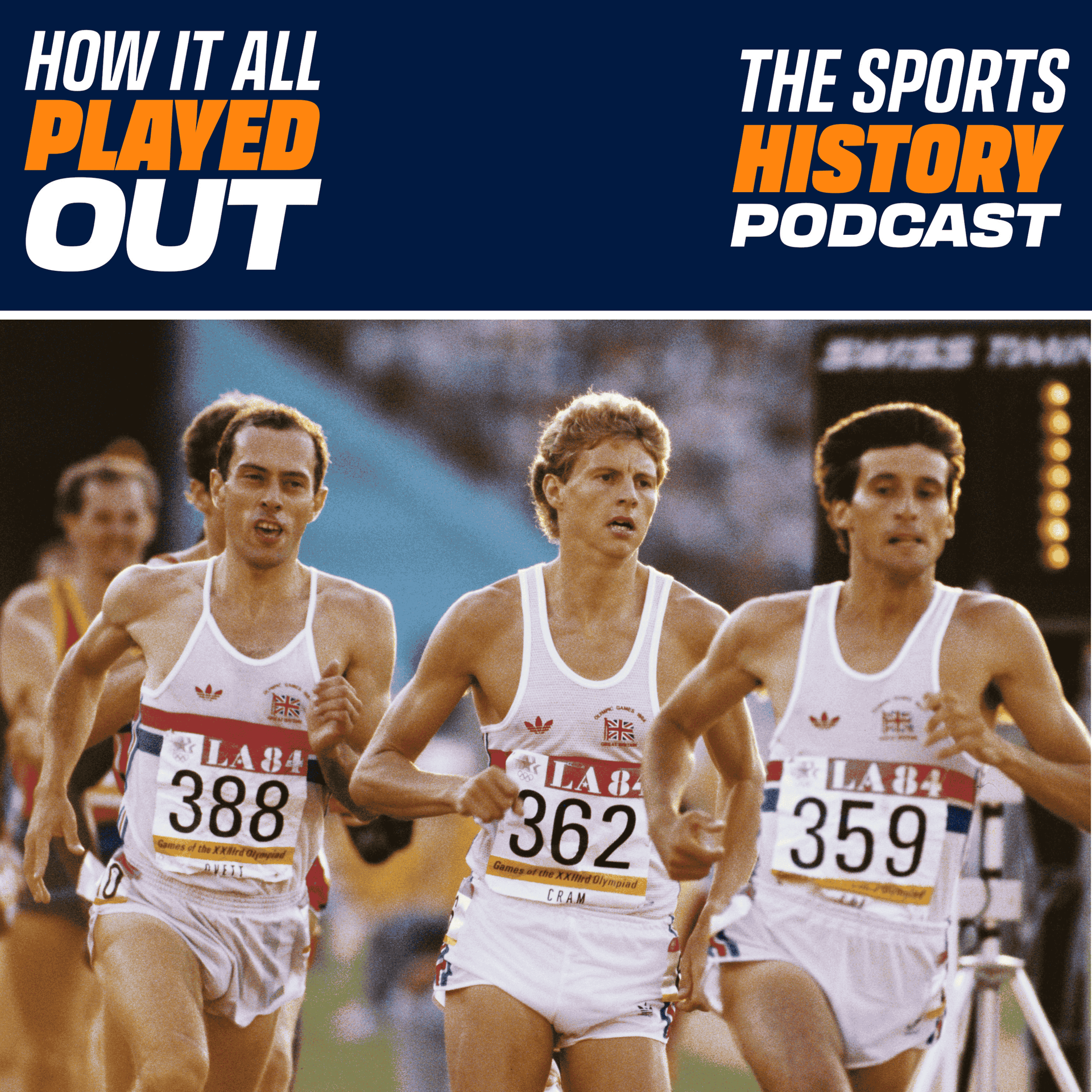
The Coe–Ovett rivalry that split Britain in late-1970s/1980s middle-distance running, culminating in the 1980 Moscow Olympics (800m and 1500m), then extending to later injuries and the 1984 Los Angeles outcomes.
Guests/backgrounds
The episode is hosted by Mark Pugach and Paul Hayward (sports journalists). It discusses athletes Seb Coe (Sheffield; coached by father Peter, an engineer/POW) and Steve Ovett (Brighton; working-class market-stall family; coached by Harry “Tiger” Wilson). No additional guests appear in the transcript.
Key claims
Their rivalry was intensified by media and geography (“Team Coe” vs “Team Ovett”), different styles (Coe tactical front-running vs Ovett’s 200/400-based kick), and geopolitical pressure (UK government urging Coe to boycott Moscow over Afghanistan). It also frames both races as “wrong-way” outcomes: Coe wins 1500 after failing 800; Ovett wins 800 after Coe’s tactical mistakes.
Notable examples
Oslo “Bislett” world-record week before Moscow; Coe’s nervousness (milk spill) and Ovett’s relaxed “sun rises tomorrow” attitude; Ovett boxing through East Germans; Coe overtaking six runners for silver; Coe’s redemption via Jürgen Straub pacemaking; Ovett’s later illness/injury and LA 1984 collapse; Ovett’s Brighton hero status (statue vandalized).
Written by AI. May contain mistakes. Listen to the episode to check what was said.
Chapters
Tap a time to open that second in VOThe Rise of Coe and Ovette
1:00 to 2:30
Explore the backgrounds of Seb Coe and Steve Ovette and their early rivalry.
“Well, Paul, I'm 12 again watching the Moscow Olympics and rooting for Team Ovet, which we'll come to in a second.”
Divided Nation: The Team Coe vs. Team Ovette
2:30 to 4:00
Understand how political climate influenced public support for the athletes.
“You had a Brighton market trader's family background against that of a future Tory MP and Lord and President of World Athletics.”
Character Profiles: Ovette and Coe
4:00 to 6:00
Delve into the personalities of Ovette and Coe, highlighting their differences.
“It's not as bad as Ronaldo's, is it, in Madeira Airport or whatever.”
Training and Mentality: Behind the Scenes
6:00 to 8:00
Learn about their training styles and mental approaches leading to rivalry.
“Peter Coe would call Seb my athlete in public.”
Key Milestones: Races Leading to Moscow
8:00 to 9:50
Review the important races leading up to the 1980 Olympics in Moscow.
“would be tactically and look very different and came from a different part of the country.”
The Political Climate Before Moscow 1980
9:50 to 11:40
Examine the geopolitical issues and pressures faced by athletes pre-Olympics.
“And there was a run he used to do up from the Hope Valley in Sheffield all the way up to the city center.”
The Olympic Games: Expectations and Doping
11:40 to 14:00
Discuss the expectations for Coe and Ovette amidst doping scandals.
“If you ever look at it on YouTube, it's only six lanes.”
The Build-Up to Moscow 1980
14:03 to 17:40
Explore the context and expectations surrounding Coe and Ovette leading to the Olympics.
“But so they turn up and Coe is the hot favourite for the 800, as you said.”
Coe's Struggles in the 800m
17:40 to 21:32
Analyzing Coe's performance in the 800m final and the resulting pressure.
“To me, this is the big point again about Ko and his character.”
Redemption in the 1500m
21:32 to 23:58
Discussing Coe's comeback in the 1500m race after his 800m disappointment.
“You know, he's lost the race that he's meant to win and he's cocked it up spectacularly.”
Show all 16 chapters
The Aftermath of the Olympic Games
23:58 to 26:05
The outcomes of the races and the impact on both athletes' lives and careers.
“they won each other's races there's nothing more beautiful it's the wrong way around British and ironic about the fact that they won each other's races.”
Injuries and the Rise of Steve Cram
26:05 to 28:07
Examining the injuries both athletes faced and the emergence of Steve Cram as a competitor.
“There's no athletics correspondence anymore.”
Cram's Emergence in the Rivalry
28:07 to 29:31
Insights into Steve Cram's role in the Coe-Ovette rivalry.
“We should say there's a third leg to this because Steve Cram had won the inaugural world championships in Helsinki in 1983 when Coe was out of form and ill.”
Ovette's Determination and Decline
29:31 to 30:56
Discussion on Ovette's health struggles leading to his Olympic performance.
“Very controversial, was it, actually, that they picked him in the end?”
Coe's Olympic Triumph and Legacy
30:56 to 32:59
Exploration of Coe's resilience and his achievements in the Olympics.
“And it's that victory actually that puts Coe ahead of Ovette in the pantheon, really.”
Reflections on Coe and Ovette's Impact
32:59 to 34:12
Reflections on the lasting influence of Coe and Ovette in sports.
“But that guy was an absolute fighter and a lion.”
Transcript
Automatic transcript. May contain errors.0:01This is a Global Player original podcast. For a time in the late 1970s and early 1980s, the UK was the epicentre of elite middle distance running. The brilliance of a couple of 800 and 1500 metre runners from Sheffield and Brighton dominated the sport and divided the nation. Some were Team Co. Seb, the determined, clean-cut, elegant athlete from Yorkshire, coached by his intense engineer of a father, Peter. And others rooted for Team Ovet. Steve, the barrel-chested, naturally brilliant runner with a fearsome kick finish, wary of the media, a little shy, a little misunderstood. He hailed from Brighton, where his family had their own market stall.
0:50Their utterly captivating rivalry culminated in two memorable races at the 1980 Moscow Olympics. On the eve of the World Athletics Championships in Tokyo, as Olympic champion Keely Hodgkinson and her training partner Georgia Hunter-Bell aim for a 1-2 in the 800 metres, and Josh Kerr prepares to defend his 1 ,500 metre title against Jakob Ingebrigtsen, we recall one of athletics and sports' greatest ever rivalries. This is how it all played out.
1:30Well, Paul, I'm 12 again watching the Moscow Olympics and rooting for Team Ovet, which we'll come to in a second. What makes this so extraordinary is that it came out of nowhere. Great Britain had no athletics heritage, really, to speak of. won bronze medal in athletics in 76, the odd gold here and there, 68 and 72, but no heritage in terms of really athletics, let alone middle distance running. And these two, Ovette and co, born within a year of each other in the mid 50s. Britain was divided in 1979, 1980, after Mrs Thatcher had come to power, divided politically. And we were certainly divided as to which camp we were in.
2:07You talk about Team Ovette, because you were definitely Team Ovette, having spent so much of your life in Brighton. Yeah, the great American sports writer Rick Riley once wrote a column saying you were either a Tiger Woods or a Phil Mickelson type of guy. And this is exactly the case with Coe and Ovette. Dave Moorcroft, the great Dave Moorcroft said it. He said you were an Ovette person or a Coe person. You had a Brighton market trader's family background against that of a future Tory MP and Lord and President of World Athletics. The press pushed very hard to portray this story as the tough against the tough.
2:46Now, Seb Coe wasn't really posh. He was just middle class, but it fitted the profile. Now, I lived in Brighton for 25 years. I come from very near there, from Lewis. And I can tell you that Ovet, even now, is a folk hero in Brighton and Hove for many, many reasons. Brighton is a kind of anti-establishment town, a nonconformist town in many ways. And Steve Overt kind of embodied the spirit, the working class spirit of Brighton. His grandfather ran a stall in the open market, which back then was a classic old fruit and veg market. Now it's really cool. If anyone goes to Brighton, I absolutely urge them to go to the open market.
3:21Fantastic food stalls, very cool, great coffee and food. Make sure you go there. But back then it was really a people's market. And his dad, Alan, smoked two packs a day. His mum, Gay, was the daughter of a local undertaker and conceived him at 15 years old. She was very blunt and combative. She was described as prickly and overbearing. A very hard taskmaster with young Steve. Very protective of him, very possessive about her son. But Ovette was just, to the people of Brighton and Hove, he was the local hero. There was a statue of him in Preston Park. Not a very good statue. Someone came... They never are, right?
4:02No, where he used to run. It's not as bad as Ronaldo's, is it, in Madeira Airport or whatever. No, it was actually much worse. And somebody came along one night with a chainsaw and cut it off at the ankle to melt it down. There was outrage, absolute outrage in Bridenhoban. Another much grander statue was erected to him down at the Palace Pier on the seafront. And anybody from the town who walks past that statue says, that's our guy, that's our hero. And, of course, at the time, it was easy for people in Sussex and Briden to say, OK, if Steve Ovette is the hero, Seb Coe is the enemy. Yeah. Well, I grew up about 20 miles from Brighton.
4:39So being obviously the sort of person I'm at, I have to have a team and I have to take a side, whatever it is. I remember saying to my dad, well, we're Team Ovette. He comes from Brighton. So it's as simple as that. Interesting what you say about Seb Coe because he is not, if you think about the film Chariots of Fire, Seb Coe's not the guy getting his butler, Nigel Havers, to fill up champagne and perch it on the edge of a hurdle in front of his stately home. I mean, that's just a load of tosh. He was born in London, but was brought up in Sheffield where his father was an engineer. It was actually a POW and was an engineer.
5:09And his father was his coach. Now, he would call his father Peter or coach when training and only dad at home. And I think quite a lot of people in athletics were rather suspicious of this self-made man, self-made coach, Peter Coe, coaching his son. Peter said, all the probabilities indicated that I was dealing with somebody with talent. And if you're doing that, don't play about. He was using the engineer's scientific approach to what he saw in his son, which was slight, elegant, intense, a fear of failure. I think of Seb Coe and Kevin Keegan in the same bracket. Absolute maximisation of the ability that they had.
5:52Whereas Ovette was a naturally brilliant runner, wasn't he? A little bit older, a great kick finish because he ran 200 and 400 a lot as kids. Coe was the sort of smaller athlete. Peter Coe would call Seb my athlete in public. And whenever Seb Coe ran to the shops, he would always want to be timed by his dad, probably calling him Peter because they were running. was I quicker than the last time I was there this was wonderful happenstance as simple as that wasn't it that these two appeared when they did born in the mid 1950s coming towards the end of the 1970s when they did to culminate in what happened in Moscow yeah very different characters different cities a long way apart they had different approaches to the game as Seb Coe said many years later you know I was a I was good cross country distance based runner Yvette was a good cross country runner but he came from a 200 to 400 meter base, which is where his finishing kick came from.
6:48So in the early 70s, when they first ran against each other in a schoolboy race in 1972, not knowing who the other one was, you know, you wouldn't necessarily have picked them out as rivals. But by 1978, they are opposite ends of a single spectrum, a spectrum of brilliant British middle distance running. They were front and back page news most days. If you were a track and field correspondent, you'd be expected to come up with a co-ovet story every single day, even though they only ran against each other seven times in 17 years. When they did race against each other, it was spectacular. And, you know, revisiting this story, Mark, I felt sometimes when you go back to these stories, you feel a tingle, and I felt a tingle over this one because the purity of the rival, the excellence of the two runners, the slightly kind of the epic and in some ways It's slightly tragic towards the end nature of it.
7:44It is completely compelling. And there hasn't been a rivalry like this in British sport. It's the best. If we were talking about boxing, we'd say styles make fights. And styles make fights here because they were different, as I said, because of Ovette's kick finish, because of his barrel chest, whereas Coe, so terrified of failure, would run from the front, would be tactically and look very different and came from a different part of the country. It's all there. I think also with what Sebco has gone on to do, to work in world athletics and so forth. The family was about a lot more than athletics.
8:14His mother was half Indian. She was an actress. So they talked, they loved boxing. They loved football. He was a Chelsea fan. He used to go to the shed. The shed in the 70s and 80s is not going to the shed today with metropolitan middle-class Chelsea. My brother-in-law is a Chelsea fan. He took me to the shed in those days. You know, you had to have your wits about you. You know, they liked jazz. They liked opera, good manners. They discussed politics. And I think you can see that in form is what Seb Coe has gone on to do. And Seb Coe was naturally very good in front of the camera, so he was very good with the press.
8:45There's a great documentary if you watch it. There's an amazing moment when Frank Boff, who was one of the leading sports presenters of the day, is interviewing Seb Coe, and Seb Coe is wherever he is abroad, and Coe says, thank you very much. And Frank Boff turns and looks down the barrel of the camera to everybody at home and goes, what a very attractive young man. That says it all. Whereas Ovette, your man, my man, our Sussex man, was wary of the media, didn't he? He didn't like them. He didn't think they knew what they were talking about. He didn't want to go to the press box and talk to them.
9:13No, he was very defensive, very suspicious. His mum, Gay, would, if a journalist introduced themselves, she wouldn't even look them in the eye. She was contemptuous of journalists. Yeah, I mean, it's funny, you know, they didn't really talk about each other very much. They didn't hype up this rivalry. Nowadays, they'd have agents and minders in their ears the whole time saying, you know, say something, rev it up, rev it up, because it's worth a lot of money. But they didn't poke this kind of commercial beehive they were both potentially looking at. But the rivalry was intense. It was quiet and sometimes it was hidden.
9:44Coe tells this amazing story of going out on Christmas Day in 1979 in the lead up to Moscow. And there was a run he used to do up from the Hope Valley in Sheffield all the way up to the city center. It was about 13 miles uphill. It was a really bad winter. There was a lot of snow, he said. The weather was, this is a great word, absolutely Wagnerian. You can't imagine Steve Overt describing the weather as Wagnerian. But he got home and he thought, that's pretty decent. That was a decent run for Christmas Day. But as he sat down, he began to feel, he says, a little uneasy. I thought, I bet he's out doing a second training run.
10:22So Coe goes up to his bedroom, throws back on his running kit and does another five or six miles. Comes back and thinks, OK, I've done it. You know, I've matched him. and in the Commonwealth Games in 2006 in Melbourne, Ovet and his son, Ovet's son and co are having dinner and co tells Ovet this story and Ovet replies, did you only go out twice that day? So they were each other's bet noire, but they tried to keep it hidden. Just one more thing on the press. One day, the press attache says at a meeting, have you got a message for the press? Because he wouldn't go up and he used to have to literally climb the steps and go to the press box.
11:00And he just went, yeah, tell him, happy Christmas. It was the middle of August. That was the attitude. 1978, they meet properly on the track for the first time at the European Championships in the 800 metres. And they're so intent on tracking each other and obsessed with each other. This is in Prague, that an East German called Olaf Baier runs between the two of them and goes and wins. So they look at each other afterwards and they go, okay, we're a little bit too obsessed with each other. 1979, no major championship. SEBCO sets three world records in 41 days in the 800 metres, in the mile and in the 1500 metres but it is all roads now pointing towards Moscow in 1980 they won't be able to avoid each other the intersection of two of the greatest races of all time after the break
12:01So just before the 1980 Olympics in late July, both Ko and Ovette break world records in Oslo within an hour of each other. This is the famous Bizlet meeting. If you ever look at it on YouTube, it's only six lanes. So it was a magical place for athletics and for running because spectators used to lean over the advertising holders and bang them. They're all metal ones. So there was a great noise which was urging the runners on. Ko breaks the 1 ,000-metre record. So he's now got four world records concurrently. Ovet then goes and breaks the mile record. And then two weeks later, again in Oslo's, equals the world record.
12:35And he only equals it because he's too busy waving at the crowd and everything. I mean, he's literally playing to the crowd. It's astonishing. So we go to Moscow, Paul, with two number ones. Kowe, though, is much, much stronger at the 800 and Ovet at the 1500. But essentially, we're talking about two number ones going to Moscow. Two sort of odds on favourites, really. and they might not have actually got there because Russia had invaded Afghanistan and the USA withdrew from the games. Coe particularly came under tremendous pressure from the British government to pull out in protest at the Russian invasion of Afghanistan.
13:11Peter Coe, his father, was called in to see Douglas Hurd who told him that they really ought to have nothing to do with it and Peter Coe said, I don't know what you're talking to me for, you should speak to my son, he's determined to go. And when Coe, Seb Coe, when pressure was placed on him to withdraw, he made a remarkable speech, which I think he shows his single-mindedness. He said, look, I'm only responsible to myself here. I've got a job to do. I want to go there and run and fulfill my talent. It's not my job to be the middleman in a geopolitical dispute. And just told the government to run along, basically.
13:47And I thought that was typical of him, that that's how focused he was. People were still trading with the Soviet Union, though, weren't they? They were still trading. They were still trading. So, you know, sporting boycott, but we're still going to sell them things. And the Americans were trading Osama bin Laden and the Taliban to resist the Russia. So there's all sorts of stuff going on. But so they turn up and Coe is the hot favourite for the 800, as you said. Ovet is odds on for the 1500. That's the way it's supposed to work out. The context, which we haven't mentioned yet, is widespread state doping programs across Eastern Europe and particularly in East Germany.
14:24And both Koh and Ova are up against these quite formidable, sizable, meaty, strong East German runners in both disciplines. So they are running against state doping programs as well as running against each other. And when you look at the footage of those races now, the Moscow Olympic 800 and 1500 meters finals, One thing that strikes you is the setting, this austere Soviet stadium, the Lenin Stadium, now known as the Luzhniki Stadium, where they've had a World Cup final recently. No razzmatazz, grey, brutalist, no colour, no noise, no energy. And these two great runners walk out into this very austere environment to settle an argument that has really been transfixing not just people in Britain, but people around the world.
15:14The British TV audience for the 800 metres on the 26th of July, 1980 is 20 million. 20 million people. I mean, that says it all. Interestingly, although all the stats pointed towards Coe in the 800 metres, he'd never beaten Ovet in a competitive 800, but they barely raced each other. You said earlier, they only raced each other seven times in 17 years and only ever at major meetings. Brendan Foster, the great Brendan Foster, is Coe's roommate and notices that he is nervous from the word go. He said he looked confused going off to the track. Coe said he dropped a jug of milk when he was at breakfast.
15:50The other Brit in the final, Dave Warren, says Coe looked very, very nervous. They were locked in a sort of little airless room for 45 minutes, a holding room, before the final. Ovette comes in at the last possible moment before he's disqualified, goes around shaking everyone's hands and goes, whatever happens, the sun rises tomorrow. So he's relaxed. That's how we do it in Brighton. That's what they do in Brighton. this is what Coe says about that race his words it was a fuck up from beginning to end every mistake you can make in the 800 I made too far off the back too wide too diffident no logic that day it was a slow scrappy race day everyone said he expected Coe to go off from the gun and he didn't Ovette gets boxed in so 800 is basically two laps Ovette gets boxed in in the first lap by the the Burley East Germans.
16:37If you watch it, he barges his way through to the extent he could have been disqualified today. He literally manhandles people out of the way. And Ko, coming off the last bend, has to overtake six runners just to get a silver medal. He's going to get nowhere near Ovet. He's left it far too late. I mean, you look at it, don't you? You just go, whatever happened to Ko that day, it looked like everything got to him. The pressure, Ovet's presence, the expectation, the favouritism. He got it horrendously wrong. Yeah, years later, he was talking to Ellie Oldroyd in a BBC interview, and he said, one of the things I'd have done differently was out of my hands, actually.
17:16He said, I just wasn't experienced enough in a championship environment. Messed it up completely and was berated by his father for doing so. Publicly berated? Publicly berated in the kind of language you wouldn't really generally use against your son. The BBC said they heard him whispering the C word at his son for the way he ran. Yeah, several people heard him say that. Nowadays, we'd call that kind of overbearing parent syndrome. But it was quite shocking to read. I'd forgotten that. To me, this is the big point again about Ko and his character. So in that situation, most athletes would have folded.
17:49They'd have realized that they slightly choked in the first race and that they couldn't handle the pressure and the environment and the occasion. And it would have got to them. It would have unraveled them. and Coe could have been a shadow of himself in the 1500 meters still still kind of stewing on what a mess he'd made of it in the 800 and a lot of people expected him I think just to just to fade away but instead he he got out quickly he didn't he didn't he didn't sort of stay in his room for very long he got back out there and started running and training he runs in a 1500 meter semi-final and whacks somebody spectacularly gets another bollocking from his dad he says I cannot begin to describe to you the language his dad used to tell him off for smashing his way through the field in the semi.
18:34So it's still very fraught. It's still a bit messy. It's still a bit, you know, on the edge. So if he'd not won the 1500, Coe says he might well acquit athletics if he bulls up the Olympics so badly. Yeah. Whereas it's so interesting, isn't it? When you look at people when they reach Mount Olympus. Ha ha ha. It's the Olympic Games. But for Steve Ovette, he actually says at one point in the documentary, I wanted to go home after the 800. All I ever wanted was to be Olympic champion. And I'd done it. And I interpret that even losing 1 % of your drive and determination is enough. He has a big night out.
19:09Apparently a leprechaun invades his celebratory party. He gets completely hammered, has a great night out. And he just goes, I wanted to go home. All I ever wanted to be Olympic champion. And I was. And the minute you can see, ah. And he left a note for his coach, Harry Wilson, who he called Tiger. This is when he went on. his night out just a little scribbled note tiger i hope you're as proud of me as i am of you steve harry says the greatest note obviously his life he was olympic champion and he'd also this i i couldn't quite remember where the first i l y sign was written in the sky i love you but it was here in moscow it was in moscow and it was to his girlfriend rachel waller yeah and before the 1500 it all kicks off doesn't it because gay over it and their their relationship is so close are almost more friends than mother and son, aren't they?
19:56Yeah, it's a suffocating relationship. Yeah, she kicks off, doesn't she? And it's that, before the 1500, what the hell's going on here? That cannot have helped Ovette's mental state. No, it can't have done. And it's remarkable to think that he had a night out after winning the 800 metres. And he's still got the 1500 metres to come. But quite right too, he's Olympic champion. Well, yeah, absolutely. And I mean, I think we're quoting a lot, we should say, from Pat Butcher's book here, The Perfect Distance. Great book, terrific book. Yeah, and Butcher asked Ovet quite straight, did winning the 800 metres kind of just weaken your appetite for the 1500 or at least blur your focus?
20:33Ovet replied, definitely, for the reasons you said. To the extent that if he'd won the 1500 first, he would never have won the 800. No. So whichever race was first that he won, I can see that, can't you? Rather than people go, oh, that's so unprofessional and how can you do that? He had not lost a 1500 metre race for three years and for 45 races. He was that much of a hot favourite. I still get that human reaction of running around the streets of Brighton dreaming of being Olympic champion. I am. No one could take that away from me. Yeah, and success was less sort of industrialised in those days.
21:06Nowadays, they'd have taken Steve over off to a laboratory and told him that he had to now win the 1500 metres because it would be worth this much money to him. and it was a moral obligation on him to keep going and keep winning things. But it was a more relaxed time. And I think, as you said, it was very human to say, I'm Olympic champion now and I'm not sure I can get myself up for the 1500 metres in the same way that I would have been had I not won the 800 metres. And so Coe, on the other hand, has got a point to prove. You know, he's lost the race that he's meant to win and he's cocked it up spectacularly.
21:35And the snappers have followed him the morning after when he went for his run. The photographers have followed him in a car on his run and he thought, okay, this is, whatever you take in sport to get yourself going again, your drive, right. They want the photos of misery. I'll show them. Well, his whole career is on the line now because had he lost both these races, he probably would have packed it in and history would have remembered him as the guy who smashed world records out of the park nonstop before he got to Moscow and then blew it and then choked in that Olympic stadium. And that would have been a very heavy burden to carry for the rest of his life.
22:12So after the break, redemption for Sebco.
22:30So 1 ,500 metre final, Ovette unbeaten in three years and 45 races. A third Briton in this one as well, Steve Cram, with a mass of blonde curls, didn't he? He's the coming man, yeah. 19-year-old Steve Cram. Now, he says that Ovette was nervous this time and he was on the bus and he heard Steve Ovette going, where is Seb? Where is he warming up? And he's thinking, what are you worried about? You're brilliant at the 1500. You're Olympic champion. Why are you worrying about him? It's his turn. And I think reading this, Paul, Coe gets a break here in the form of another East German, Jürgen Straub, who effectively sort of runs because it's four laps, give or take, runs sort of two laps as a sort of pacemaker.
23:07and in the end the race becomes a two-lap sort of warm-up and then an 800-metre race and Peter Coe clocks this in the stand and goes, yes, this is exactly to Seb's liking. Yeah, so in a sense Coe did win the 800-metre. Yes, exactly, yeah. But it was in the 1500. Yeah, 200 metres out, Straub is still four metres in front but Coe just goes gliding past him and you use the word redemption, it's never been more suitably applied. so Coe goes flying past Straub drops to the ground and kisses the track you know he saved himself not only is he now a 1500 meter Olympic champion but he saved himself from a very difficult second half of his life when as I said earlier he would have been called a failure you know the guy who couldn't deliver the guy who flopped on the big stage so it's 1-1 between Coe and Ovette and they won the wrong races they won each other's races there's nothing more beautiful it's the wrong way around British and ironic about the fact that they won each other's races.
24:05It's extraordinary, isn't it? It is, yeah, in a drab, austere Soviet stadium. And yet the magic of those two victories and the paradox, as we said, of them winning the races they weren't meant to win. But going home with one each, each with a gold medal, each having proved a point. Each Olympic champion forever. Forever. And of course, as we said earlier, the households around the country all celebrating the different race, depending on whether you were Team Ovet or Team Co because geographical, you and I were geographical Team Ovet because we grew up in Sussex. If you came from the north of New Yorkshire, you're more likely to be Team Co or because the cut of one's jib over the other.
24:44I mean, it was amazing how it divided everybody. And nowadays, that situation, that scene in Moscow would have swarmed with matchmakers and agents and money men and impresarios. People from Las Vegas would have flooded over to England to say, look, we'll set this race up, exhibition race in Vegas, you'll get$10 million each. You know, you two have got to spend the next four years before the LA Games of 1984 running against each other as often as you can and making as much money as you possibly can. That is the very opposite of how it worked out. And that is a beautiful thing as well. Because athletics wasn't professional at the time, really.
25:21There would have been some shamitarism, a little bit, you know, a little bit of money up front, a little bit of money under the table. But 1981, no championships. So they both say, right, what we're going to do is were going to break world records. In nine days in August, they swapped the world mild record three times. Coe won two of those, broke two of those world records, Ovette once. Both say it was their halcyon year. And this is a time before pay TV. So all this is happening. Obviously, Olympic Games are on free to air. I think actually that Olympics was on BBC and ITV, was on free to air.
Read the full transcript
25:52World records, they interrupted the news on BBC and ITV to show Coe breaking a world record, Ovette breaking a world record. That's why I said in the introduction, 1981, Botham's ashes, 1981, Kevin Keegan's the England captain. They were as big as Keegan and Botham because all this is being played out on free-to-air television and at a time when every newspaper has an athletics correspondent. None of them do now, do they? There's no athletics correspondence anymore. No, not at all. um and i mean so yeah absolutely going into that period between the two uh the 80 and 84 games uh people had very high expectations that they'd race against each other a lot of times but it goes it goes quite wrong their rivalry ends up being almost completely championship based um co gets a stress fracture that didn't help him and steve ovett is running through the streets of um hove in 81, I think.
26:45December 81. 81. He slips on some ice and collides with some metal railings outside a community center where my friend, who's an excellent senior runner, has almost like a, almost a shrine to him, I think, in his mind because he can't believe that Ovet got so close to where he works, you know. But it was actually a, it was a disastrous incident because Ovet was quite badly injured by this collision with the railings and is never really the same again. He never hits the heights that he did in that period from 78 to 80. So they're both injured. He has the odd good moment, doesn't he? He has the odd good.
27:22He comes back and wins. He can't sustain it because of what they call the church railings incident. The church railings thing, yeah. He can't sustain it. That's the issue. No, and there's a vulnerability in him. Nobody can quite believe two years after L.A. that he comes back and wins. He gets bronchial pneumonia as well. He has breathing difficulties and various ailments, But he comes back to win the Commonwealth 5 ,000 metres in 1986, which was regarded as a kind of heroic comeback. But anyway, to all intents and purposes, the rivalry with Seb Coe by 1981 is starting to drop off through no fault of theirs.
27:55It's just injury and illness. It's just injury and illness, yeah. But nevertheless, they get to L.A. with the public still, I think, dreaming of the rematch, wondering what's going to happen next, wondering whether Coe can retain his 1 ,500 metres. We should say there's a third leg to this because Steve Cram had won the inaugural world championships in Helsinki in 1983 when Coe was out of form and ill. And Ovette did run, but didn't run well, came fourth in Helsinki. There is a third man to this. There we go, Brighton. There is a third man to this as well, isn't it? So it's Coe Ovette. Can we have Coe Ovette part two like we did in Moscow?
28:27Or is the third British man who's the world champion and the European champion and the Commonwealth champion, is he going to win it? So it's interesting because everyone has built up this rivalry. They're thinking, well, actually, to what extent do we put Steve Cram into this conversation as well? Well, absolutely. I mean, we're kind of leaving Cram on the margins, I suppose, because we're talking mainly about the rivalry. But there's no question that there's this other figure emerging. He's a huge threat to this Cohen-Ovette story. I think fortunately for those two, Cram begins to dominate really after 1984.
29:02So that's fine. It all lays out quite nicely. But Coe actually is so weakened or so kind of off the pace by 1984 that he has to fight for the final place on the team, the GB team. He gets toxoplasmosis, which he thinks from the family cat. And he's basically laid out for eight months before the Olympics. Incredible. And the team GB don't really want to take him. They don't think he's got any chance. So Coe had to fight for the final place on the team. Very controversial, was it, actually, that they picked him in the end? Five days before the LA Games, Ovet had been stretchered out of a stadium with cardiac specialists telling him he shouldn't really run in the Olympics.
29:43But Ovet was so determined to be there, even though he had absolutely no chance of winning, that he was threatening legal action against team officials if they tried to rule him out on medical grounds. But he's a ghost by the time he gets to those games. So the 800 metres, Coe comes second to Joachim Cruz of Brazil. But this time, unlike Moscow, where he's absolutely cocked it up, Cruz is in cruise control. He's in control of the race. And actually, it's a very honourable silver for Coe in many ways. As they cross the finishing line, Coe sees Ovette on his hands and knees and he goes up to him and thinks, I think we're a bit too old to be playing with fire.
30:23And then he realises, Ovette's on his hands and knees because he's really struggling, because he's really, really not well. And all the things you've been talking about, about how ill he is and the cardiac expressions and whatever, is actually, this is all true. And they desperately try to persuade him, his family, not to take part in the 1500. But he's absolutely going to. But when they run the 1500, if you watch it, he steps off the bend of the last lap, Ovette. and he's actually stretched out of the stadium which is a terrible way for a brilliant Olympic career to end but he just cannot run any longer he cannot go any further yeah a terrible way for it to end and yet the abiding memory of it now is Ovet's courage and even trying yes he knew he had no chance but he had to he had to make a stand and of Coe holding off Cram yeah to defend his 1500 metres of title after everything he's been through the first man to retain the Olympic 1500 metre title, an astonishing achievement.
31:21And it's that victory actually that puts Coe ahead of Ovette in the pantheon, really. And people will say, oh, did they not like each other? They didn't know each other. But why would they know each other? Because they never raced against each other unless it was at a major championship. So occasionally there might have been teammates in a European Cup or whatever. They wouldn't have known each other. Coe didn't like Ovette's, what he called showmanship, the waving. He thought that was disrespectful. I thought it was hilarious growing up. I thought it was great. I thought it was the old ILY. You used to wait for that, didn't you?
31:47He had one little dig at him before the Moscow Olympics where he co-accused Ovet of running when it suited him and manipulating fields. He accused him of being... Well, he did do that. He would sometimes enter a race that Coe was in deliberately and then Coe would have to change races and then Ovet wouldn't even run in the race. We did do that, absolutely. There's a brilliant summary by Pat Butcher of these two runners and who they were and what they were about. But Butcher wrote, over discovered a talent and just ran with it wherever it might take him. Whereas the Coe's, father and son, created a talent and drove it where they wanted.
32:25That was the difference. Well, that's the engineer in Peter Coe. That's the scientist in Peter Coe, isn't it? Using all the data that he had. Yeah. And just to finish this off, just to think about Seb Coe coming back from being distraught at mucking up the 800 to win the 1500 and then coming back from being out for about eight months to win the 1500 again in 1984 is astonishing in terms of resilience and bloody mindedness and obviously skill and then thinking about Ovet and what he did and beaten for 45 races but then not winning the 1500 but having won the 800 earlier um it was it was a glorious time in british sport yes it was and you know when you talk to seb seb co now he's this kind of charming bane you know former tory mp lord as i said world president of world athletics and you can't actually see in him very easily that absolute animal that he had to be to win those races and to be that good but it's in there it's just hidden now by a nice suit and shirt and tie and lots of lots of titles and high office and everything.
33:31But that guy was an absolute fighter and a lion. And again, I think his greatest legacy, apart from the two Olympic gold medals in the 1500 meters, was bringing the Olympics to London in 2012, because people laughed at the idea that London could win that Olympic bid. And it was Seb Coe that made the difference in persuading the IOC that London could actually pull it off. And Steve Overt is now in Noosa in Queensland, where he lives there with his partner and still does a bit of TV and, you know, for British TV and for Canadian TV and so forth. But he's still a hero in Brighton. He's still a hero in Brighton.
34:08You only have to say his name and people get all misty-eyed, I promise you. Paul, that was great. I know you and I are really looking forward to that and that definitely took us back to our youth. I hope you've enjoyed today's show. If you have, please make sure you rate us, follow and subscribe so you never miss an episode. You know the drill. Check out last week's episode on Sven-Jørgen Eriksson with England playing their World Cup qualifiers and Thomas Tuchel in charge of the German. We thought we would tell the story of when England went overseas for the first time for their manager in a bid to end the drought, which went back to 1966, which goes back to 1966, and Sven's time in charge of England, which was very colourful on and off the pitch.
34:47So you can listen to that on Global Player or wherever you get your podcasts.
34:58How it all played out is presented by me, Mark Pugach, and Paul Hayward. It's a global original production in association with Apex Content Ventures. This is a Global Player original podcast.
From the publisher
"It was a f**k up from beginning to end. Every mistake you can make in the 800 I made. Too far off the back, too wide, too diffident, no logic that day" - Seb Coe
From the late 1970s to the mid-1980s, Britain ruled the world of middle-distance running. At the heart of this golden era stood two legends: Sebastian Coe, the Yorkshire-born record breaker, and Steve Ovett, the tough competitor from Brighton. Their fierce rivalry built towards the 1980 Moscow Olympics - but what unfolded stunned fans from both sides of the divide and redefined athletics history.
In this episode of How It All Played Out, ITV’s Mark Pougatch and The Observer’s Paul Hayward revisit Margaret Thatcher’s divided Britain to explore the infamous “Tough vs Toff” clash that gripped a nation. Despite only racing head-to-head seven times in 17 years, Coe vs Ovett became one of sport’s greatest rivalries, combining politics, class, and raw athletic brilliance.
Relive the drama of the 800m and 1500m finals in Moscow 1980: the crushing pressure, the mind games, the upsets, and the unforgettable battles between two British icons. This is the story of style versus strength, grit versus grace, and how two athletes pushed each other into the history books.
If you love stories of Olympic glory, athletic rivalries, and the golden age of track and field, this episode is for you.
Remember to follow or subscribe, and give us a 5 star review too!
We'd love to hear from you! Email us: howitallplayedout@global.com
Executive Producer: Adem Waterman & Adonis Pratsides
Producer: Sophie Penney
Head of Podcasts: Factual: Al Riddell
Director of Podcasts: Vicky Etchells