
In short
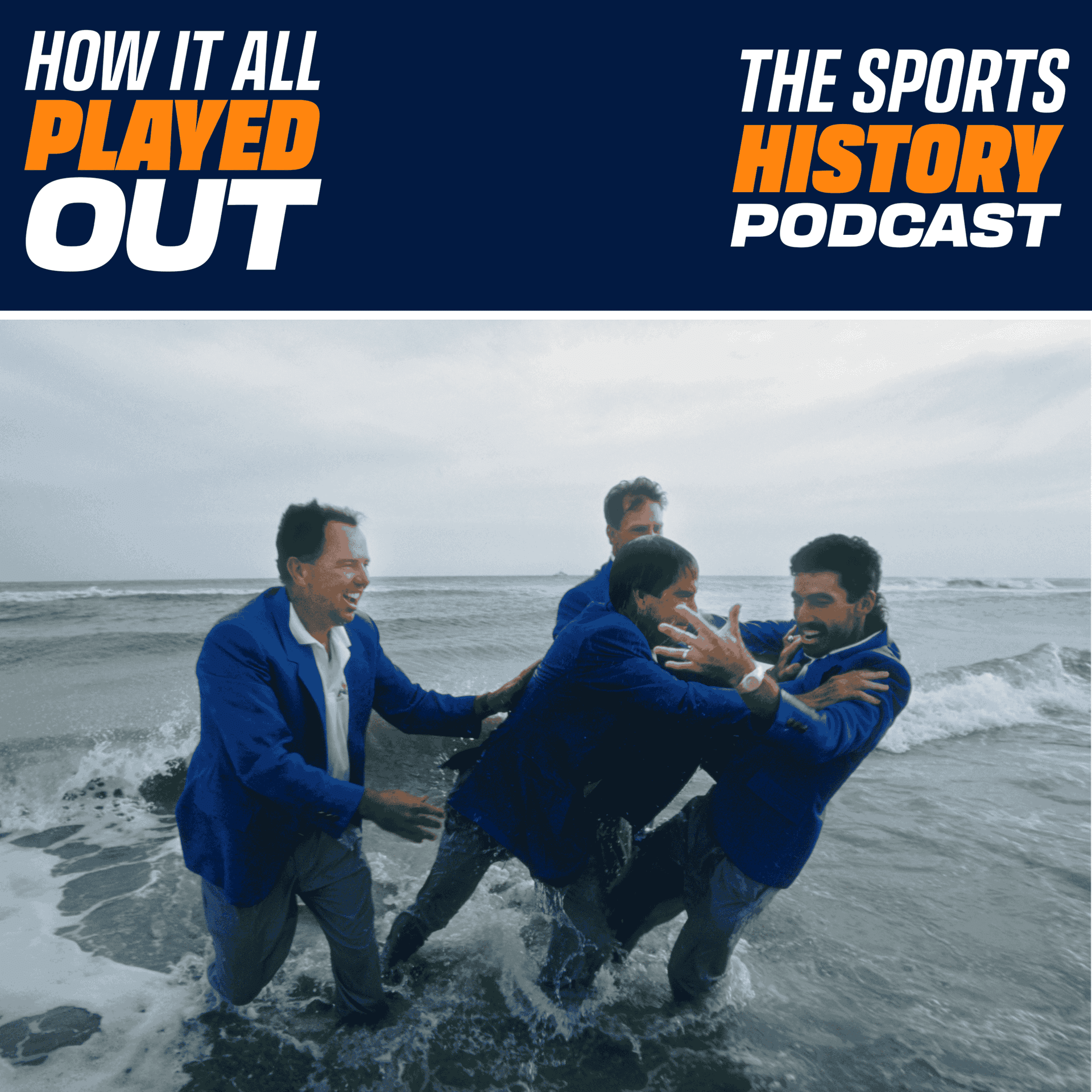
The episode traces how the Ryder Cup changed from a polite exhibition (1959-1985) into a hostile, TV-driven “War on The Shore” rivalry. Topic: ball tampering allegations, Seve Ballesteros as Europe’s “underdog” lightning rod, and the 1991 “War by the Shore” at The Ocean Course (post–Gulf War), plus later crowd/etiquette controversies like 1999 Brookline.
Guest backgrounds
none named in the transcript (hosts Mark Pugach and Paul Hayward only).
Key claims
Europe’s competitiveness surged after 1979 (USA vs Europe) and Seve’s leadership; alleged cheating rose in the 1990s; 1991’s military pageantry and disputes accelerated the modern, adversarial Ryder Cup.
Notable examples
1989 Belfry feud between Paul Azinger and Seve; 1991 camouflage hats, flyover, and “changing balls” (Azinger/“Nice try, guys”); Steve Pate’s withdrawal affecting singles; 1991 final-hole ball mystery; 1999 Brookline green invasion trampling Ola Tharbet’s line.
Written by AI. May contain mistakes. Listen to the episode to check what was said.
Chapters
Tap a time to open that second in VOEvolution of the Ryder Cup
0:11 to 1:17
Learn how the Ryder Cup transformed from a civilised exhibition to a fierce competition.
“The Ryder Cup is nowadays a huge commercial juggernaut, a travelling circus that moves from state to state in the US and from country to country in Europe, three days of cacophonous noise, colour cash and controversy.”
The Impact of Seve Ballesteros
1:17 to 3:16
Discover how Seve Ballesteros changed the Ryder Cup's competitive landscape.
“But in extraordinary the last 40 years, how maybe with a change in golf as well, it's gone from a genteel occasion to absolute mano a mano gladiatorial excess in many ways against noisy crowds.”
The Rise of European Competitiveness
3:16 to 6:12
Explore the underdog spirit of European golfers and their rivalry with the Americans.
“Without him, we wouldn't be where we are today because Europe wouldn't have started winning in the manner that they did, not just in Europe, but in America.”
The War by the Shore
6:12 to 8:08
Understand the events of the 1991 Ryder Cup known as the War by the Shore.
“1989 is a draw at the Belfry, so they retain the Ryder Cup.”
The Feud Between Eisinger and Ballesteros
8:08 to 11:15
Learn about the escalating feud between Paul Eisinger and Seve Ballesteros during the Ryder Cup.
“The opening ceremony features a military flyover and a Marine honor guard and a drill team from the Citadel.”
Controversies and Strategies
11:15 to 14:00
Examine the controversies and tactics used by both teams in the Ryder Cup.
“Interestingly, because we're so used to everything being televised nowadays, it was the first Ryder Cup televised live for its three-day entirety.”
The Cheating Accusations and Radio Issues
14:00 to 15:11
Learn about the allegations of cheating and radio issues during the Ryder Cup.
“By the time he turns his radio back on, they go to the 10th.”
The Impact of Steve Pate's Withdrawal
15:11 to 16:48
Explore how Steve Pate's withdrawal affected the European team's strategy.
“You know, this is this is not part of what the game is.”
The Controversial Final Matches
16:48 to 19:39
Delve into the dramatic final matches and the controversies that arose.
“So if you weren't fit enough to play Sunday, but you did Saturday, you shouldn't have played at all.”
The 18th Hole Drama
19:39 to 21:45
Understand the drama that unfolded on the 18th hole and its implications.
“So someone has kicked it there or thrown it there.”
Show all 14 chapters
The Aftermath of the Ryder Cup Victory
21:45 to 22:38
Discuss the aftermath of the Ryder Cup victory and its impact on players.
“Dan Quayle, who's the vice president, is told by Bernard Gallagher, you know, Britain and Europe had servicemen killed in the Gulf War as well, don't you?”
Legacy of the 1991 and 1999 Ryder Cups
22:38 to 28:03
Examine the legacy of the 1991 and 1999 Ryder Cups in shaping future competitions.
“The rest of the 90s, interestingly, it's not too over the top, actually.”
The Evolution of the Ryder Cup Rivalry
28:03 to 29:12
Learn how the Ryder Cup transformed into a fierce competition post-1999.
“Often when you see those labels, you think, oh, that's hyperbole, but actually both were applicable.”
The Growing Importance of the Ryder Cup
29:12 to 30:01
Discover the rising significance of the Ryder Cup and its global impact.
“You know, just trying to stage the Ryder Cup became a contest in itself where, you know, countries and golf courses would fight for the right to stage the Ryder Cup.”
Transcript
Automatic transcript. May contain errors.0:01This is a Global Player Original Podcast.
0:11The Ryder Cup is nowadays a huge commercial juggernaut, a travelling circus that moves from state to state in the US and from country to country in Europe, three days of cacophonous noise, colour cash and controversy. It wasn't always that way, though. For years, the Ryder Cup was a civilised, calm exhibition match which bore all the hallmarks of what makes golf the game it is, a game of sensible clothing, etiquette, strict rules and a lot of silence. Then in 1979, Great Britain, bored of being whipped by the Americans, morphed into Europe and Europe started competing and winning.
0:52The Ryder Cup changed overnight. It stopped being an exhibition match and became one of the most fiercely contested of global sporting occasions. Inevitably, that spilled off the course and into the crowds. How did golf go punk? This is how it all played out.
1:17It's interesting, Paul, isn't it, that along with cricket, maybe the most civilised game of all, and as we said in our opening, the Ryder Cup, which was essentially an exhibition match, you know, between 1959 and 1985, Europe didn't win at all. But in extraordinary the last 40 years, how maybe with a change in golf as well, it's gone from a genteel occasion to absolute mano a mano gladiatorial excess in many ways against noisy crowds. Yes. And there's another point there, which is that golf has always prided itself on being the most incorruptible game. the game where no one would even dream of cheating because it would violate every principle of human life for a golfer to cheat.
2:01But actually reading about these Ryder Cups in the 1990s that we're going to talk about, it's astonishing how much alleged cheating there was in those two Ryder Cups. And of course golf was always a game for lone hunters. It was an individual game. It was a game for individuals. And the Ryder Cup when it started was a ceremonial end of season get together. It was a friendship between British golf and American golf. There was no edge to it. It was all manners and nice meals and hotels and let's have a round and just keep the two tours connected. In the 1970s, Jack Nicklaus complained to Lord Derby at Royal Lytham that the matches, quote, just aren't competitive enough.
2:42The problem the Ryder Cup had was that the USA would thrash the UK year in, year out. And so, as you said earlier, Mark, in 1979, it became USA v Europe. And with that was born the concept of continental clashes, team golf in a continental cauldron. Now, that's great bringing the Europeans, but unless they brought in an X factor, nothing was particularly going to change. Not just an X factor that they were good golfers, but that they were competitive beings. And that's really where the modern phenomenon of the Ryder Cup owes so much to one man, doesn't it? to Seve Ballesteros. Without him, we wouldn't be where we are today because Europe wouldn't have started winning in the manner that they did, not just in Europe, but in America.
3:25And he is at the centre of our story here. He is at the centre of the controversies. So this is a character worth explaining because without him, the Ryder Cup might still be the exhibition match that it was in the 60s, 70s. Well, absolutely. So you had domineering, presumptuous and sometimes complacent country club America against this new thrown together outfit called Europe. You know, people from lots of different countries, lots of different backgrounds and cultures. It didn't sound like a very promising form. It never sounded like it would be a team. It never, it didn't sound like it was going to work.
3:55But the thing that Europe had in their favor was a kind of underdog spirit, a kind of resentment of this American arrogance. And in Seve Ballesteros, they had a leader for that feeling. He led through that feeling of, you know, these Americans looking down on us. They think they're better than us. You know, we can unite against them. We can beat them, you know. And Seve Ballesteros was a very kind of intense, brooding character. He was a sort of borderline genius on the golf course. He was creative. He was charismatic. You know, he was emotional. And he is the guy that Europe needed at just that point as a way of rallying, of rallying a European team and saying...
4:36He was a sort of touchstone of all. It was a lightning rod. That's the word I've got before, weren't they? All sort of centred around him. Yes, absolutely. And he's a brilliant player in his own right as an individual, but he sort of almost came to define himself with this battle, this historical battle against the Americans. Particularly, I think, as his individual career, because he'd been an Open champion. People probably remember. I remember as much about Sebi Bajosteiros holding a putt, I think, wasn't it, at St. Andrews, and he gives it the other day, and he's punching his fist. I think people remember that.
5:03But as his individual career just started to ebb away a little bit in terms of individual achievements, because, you know, you used to laugh about him hitting it into the car park, and then he'd rescue it from the car park because his short game was genius. It's almost as if his individual career and his Ryder Cup career crossed, didn't they? Yes. And as individually things weren't going quite so well from him, it was the Ryder Cup that just lit the Bunsen burner underneath him. He found a second life, I suppose, in the Ryder Cup. And he was also, you know, he liked money, Ballesteros, and he liked having a profile, and he liked his own brand.
5:35And, you know, his Ryder Cup brand was the passionate, fearless, implacable guy who'd lead his troops into battle against America. And you couldn't take your eyes off him, really. And some of it became quite personal. And even that was no bad thing for him because the European supporters flocked to him because they felt he was standing up to the Americans. So 1985, for the first time since 1959, the Europeans win at the Belfry. I remember this very clearly. It was a massive event. It was massive. But then two years later in Ohio on a Jack Nicklaus design course, they win away. Ohio, tough place to go.
6:10Good away win. But it was absolutely, that was a phenomenal win. 1989 is a draw at the Belfry, so they retain the Ryder Cup. So you've now got 85, 87, 89. Suddenly the Americans are going, well, hang on a second. This is our cup. What's going on here? And I think we have the situation going into 1991 where having won three in a row, the Americans are smarting from that. And it's coinciding with what's going on in global politics in 1991. Yeah. And we like a feud on this program. And a feud is developing nicely in 89 between Paul Eisinger and Servi Ballesteros, who go head to head in the singles at the Belfry.
6:51Ballesteros asked to have a damaged ball replace but Eizinger successfully objects to that so Ballesteros hits back by asking whether Eizinger had properly dropped his ball blah blah blah Eizinger says is this the way you want to play? Is this the way you want to play? The technical details are almost irrelevant but what you're getting is this feud developing in 89 between Eizinger and Ballesteros it becomes more and more entertaining more and more kind of febrile So this carries over beautifully into 1991, a Ryder Cup that is known in history as the War by the Shore.
7:41The War by the Shore is a pretty strong phrase to use in the context of a golfing tournament. Yeah, it certainly is, particularly given the global situation. Absolutely. This takes place at the ocean course at Kiowa Island, South Carolina, shortly after the end of the first Gulf War. America, the country, is still pretty much fired up by this. And some of the players turn up on day one in camouflage hats. The opening ceremony features a military flyover and a Marine honor guard and a drill team from the Citadel. I'm not quite sure what the Citadel is, but some of the Europeans are rankled a bit by this.
8:19They think the Americans have turned it into a Gulf War celebration. It's a display of hardware, isn't it? Did you see what Sports Illustrated's John Garrity said? The Europeans look like Soviet dissidents forced to witness a May Day parade of weaponry in Red Square. Yes. And Dave Stockton, the American captain, says it was the Gulf War years and there was a lot of American pride. and I wanted to feed on the American pride and I wanted people to be proud of America and what we stand for. Some of the people took it the wrong way. Now, I'm going to suggest, Mark, that some of the people who might have taken it the wrong way were people actually on the front line in American military uniforms.
8:58Because if you've been fighting in Iraq and you turn on your TV to watch a golf tournament and a load of millionaire golfers from California and Florida are channeling the Baghdad spirit, then I don't know about you, but I'd look at that and think steady on. And also, it was pointed out by the European team, of course, that there have been British military personnel in Iraq as well. This wasn't just an American military intervention. You know, there had been forces from other countries of the world. They just got everything wrong. There was just a misstep every time. That was a bit OTT or the military hardware.
9:31And then at the gala dinner, which is on the Wednesday night, so it starts on the Friday, on the Wednesday night, they obviously have a film going great, you know, Ryder Cup moments of the past. And it's essentially five minutes of Europeans and 20 minutes of Americans. Oh, they're great shots. And the Europeans are absolutely fuming. And Ken Schofield, who's the CEO, who I'm sure you've interviewed, I did a few times, was absolutely livid and either wanted to get on stage or walk out or both. But was basically just very, very offended and went, what is this? And even Dave Stockton had the grace to think, I've tried hard.
10:04Well, he said he tried hard to keep a lid on it. And yet at the same time, as you just said, he wanted the Americans to be proud of what they were. But he knew that the film was wrong. He knew the film really was cringeworthy because, you know, it takes two to make a great sporting competition. You can't have 20 minutes of film of one and five of the other. No, and Nick Faldo says if it's a war they want, let's give them one. And there's another really delicious little detail which I love, which is that Payne Stewart, the American golfer, opened the windows to the American team Kondo, which was directly above the Europeans, and he blasts Bruce Springsteen's Born in the USA as loud as his volume will go.
10:44Now, the reason I like that so much is if he bothered to look at the lyrics to Born in the USA, Born in the USA by Springsteen is often misappropriated as a patriotic message, but what it's about is about people being sent to die in Vietnam for no good purpose. And so the protagonist gets in trouble. with the police, whatever. And so he put him in the army and send him off to Vietnam. Oh, for the meat grinder. Yeah, exactly. So it's very much an anti-war, sort of anti-patriotics. It sounds like the great American rally. Yes, it does. I didn't know that, to be honest. Nor did Payne Stewart. Payne Stewart didn't read the lyrics.
11:16Interestingly, because we're so used to everything being televised nowadays, it was the first Ryder Cup televised live for its three-day entirety. Travis Pewterbaugh, World Golf Hall of Fame curator, calls it, in the end, a milestone in the event's transition from a gentlemanly exhibition to a high-stakes international competition. But Ray Floyd, who's playing again, was actually captain in 1989 to the Americans. He's back in the team. He said, listen, the Europeans were pretty bad at the belfry. He said, you know, they were quite smarting even at this stage. They were going, hang on, you were cheering bad American shots at the belfry.
11:50So before you get too high and mighty, just remember that. You don't know who you're going to play against. In other words, The European captain, the first one is foursomes, alternate shots. You put your four pairs down. The Americans put their four pairs down. And it's just pure coincidence that Eisinger and Ballesteros are playing each other. And actually, Dave Stockton looked at that and went, oh, my. He knew from the word go that it was something was going to kick off. Yeah, and kick off it did pretty quickly. So Ballesteros and Ole Fahbel accused the Americans of changing balls. Now, for the layman, what they were doing is using different compression balls on different holes to give them an advantage in terms of the approach shots and so on.
12:35It's a complete no-no in golf to do that. Ballesteros and Ola Tharbel are calling them out for this. They get away with it. The Americans, meanwhile, take umbrage with Ballesteros coughing in the middle of their swings. Floyd, Raymond Floyd, challenges Ballesteros in pretty forthright language, by all accounts. I pulled him up from kind of clearing his throat in the backswing when Freddy Couples was playing, says Floyd. And at the end of the day, just to cap it all off, Eisinger calls Ballesteros the king of gamesmanship. So after one day, the whole thing is bubbling nicely. I mean, we talked about Ballesteros' character.
13:11Eisinger, he's good humour, but he likes a contest. He's incorrigible. He's incredibly competitive. He's feisty. He's cussed. So he is up for this scrap as much as Biosteeros is. And there's another sort of little subplot to what was going on. The Europeans said that their radio... If you ever go to a Ryder Cup and you see it on the television, you'll see lots of people bombing around in buggies. Now, that's the captain and all their vice-captains. They're obviously going to see how matches are getting on. And they're transmitting news to each other and how people are playing. And they can talk to each other on walkie-talkies.
13:44Now, the Europeans claimed that their walkie-talkies were on an open channel. In other words, if they spoke to another guy on another buggy, everybody else could hear it. So one stage, Bernard Gallagher, who's the European captain, turns his off. So he's unaware of what's going on when Biosteiros and Olathabel accuse the Americans of changing the ball, which is against the rules. By the time he turns his radio back on, they go to the 10th. But the rules of golf mean you cannot retrospectively punish them with holes because you didn't call them up at the time. And apparently Azinger, as soon as he realised he was going to get away with it, stopped trying to fib and started admitting it.
14:21Because he knew nothing could happen. So this is another lovely subplot that Ballesteros thinks he knows he's cheating, but we can't do anything about it because the holes have been played and you can't retrospectively do anything about it. And, you know, did they sort of do something with the radios? Because the American radios are working fine, of course. Absolutely. And Ballesteros accuses correctly the Americans of changing the ball three times. and he says famously, this is one of the great Ryder Cup lines, the American team were 11 nice guys and Paul Azinger. Oh! And what did Azinger say coming off the 10th?
14:55Nice try, guys. Nice try, guys. So Azinger gets you tried, you were right, but you can't do anything about it. So that's Friday. It's all going off on Friday. And as Paul says, Pavin and Azinger are wearing camouflage hats. On Saturday, which is day two, There's a message from George Bush senior, who's president, saying basically, come on, America. And there are people then going, hang on a second, what's happened to this great sport that actually we've got a situation where the president, who shouldn't actually be taking sides, the president actually is saying, come on, the Americans. You know, this is this is not part of what the game is.
15:32So that was on Saturday. And then we get to the Sunday singles. and there's another really important backstory here which is the fact that on the Wednesday on the way to the opening ceremony there had been a sort of small car shunt and one of the Americans, Steve Pate had got bruised ribs and he wasn't fit enough to play on Friday but he played on Saturday and then he cries off on Sunday and this is very significant. Now he was drawn to play Ballesteros so Ballesteros would have beaten him and David Guilford, another European player was drawn to play Wayne Levi who was having an absolute shocker.
16:07So the Europeans were very confident about getting two points there. But because Steve Pate withdrew and the Europeans had to put a name in a hat just in case this happened, and it was David Guildford, that match was halved. So the Europeans go, well, we were banking on two points. We were probably going to get a point and a half. And the Europeans are really pissed off, aren't they? Bernard Gallagher says it was unsportsmanlike. Dave Stockton didn't tell me. I didn't know in advance. I only find out at breakfast. David Guildford's obviously really upset. No one's talked to him about it. this is a dream to play in the Ryder Cup, and now he can't play.
16:38And you, Steve Pate, were fit enough to play on Saturday and apparently get on a par five in two, a long par five, but suddenly you're not fit enough to play on Sunday. So if you weren't fit enough to play Sunday, but you did Saturday, you shouldn't have played at all. You should have been withdrawn before the Ryder Cup and somebody could have replaced you. So that's a big story. The more we talk about this, the dirtier it gets. I'm starting to feel that the American team was being managed by the CIA because there's quite a lot of dirty tricks in there. Radio's not working, balls being replaced, people suddenly dropping out in the singles.
17:09So all this means that we come down to the final match, which is Heil Owen and Bernhard Langer. So 27 matches have been played. If Langer wins the match, the match is tied and the Europeans retain the Ryder Cup. So Langer's two down after 15. He wins 16 and 17. He's putts brilliantly on the last three to stay in touch. And they stand on 18. And the interesting thing about 18 is you've got dunes down the left hand side and wind from the left and hale irwin has a fade which if you don't play golf means when you hit the ball it tends to drift right so hale irwin's thinking sheepers i've got wind off the left and i faded my ball is going to be taken right so i need to try and hit it down the left hand side and that's very well remembered mark yeah well in 2021 a piece appeared in Golf Magazine, written by a man called Mark Rolfing.
18:01If they didn't call him Golfing Rolfing, they bloody well should have been. There's something wrong with the world. There is, exactly, yeah. So Rolfing Rolfing was an NBC employee who was standing on the 18th tee in the scene you described, soaking up the atmosphere, enjoying the antagonism, and he watches Hale Irwin's ball sail off into the wind and into the sand dunes. So everybody thinks, anyway. That's way left, says Mark Rolfing, live on air. So they all pile down the fairway and Rolfing expects to be in the dunes looking for the ball himself because that's a common practice for on-course reporters.
18:45You must have done it lots of times because you walked down the fairways countless times. When we get to 1999, there was a big moment when I was looking for the ball. Yes. Yeah. Yeah. So he gets there and this sea of humanity parts as the ball searchers come through. They're heading into the sand, into the sand dune. And suddenly everybody realized that this ball is actually on the fairway. It's not in the sand dunes at all. Somehow it's found its way to the fairway. A snap hook into the dunes has suddenly found its way onto the fairway. Yeah. And it's amazing that the Europeans didn't make more of this at the time.
19:20There's no ambiguity about this investigative piece. He did a great job going back to speak to people and try and work out where the ball did actually land. How did the ball get there? He concludes all these years later. That question remains the greatest mystery of my broadcast career. So it's pretty clear what he's saying. And he's an American NBC employee. So if Hale Irwin's tee shot doesn't get back onto the fairway somehow, Langer probably wins that hole anyway. Yeah, absolutely. So someone has kicked it there or thrown it there. There was an official called Kathy Jordan says it hits her in the back.
19:51She said she had a welt to show for it. And in those days, the crowds weren't as well contained as they are now. There's no real ropeage or anything like that. So it's just us seeing the mass of humanity. I think there's every chance it did hit somebody. I'm sure that bit's completely true. It probably hit somebody and then somebody could just give it a boot. I mean, Bernard Gallagher says that a European supporter said to him a few days later, I saw somebody throw it back. Really? And Bernard Gallagher goes, well, maybe you did. But the case is closed, obviously. Nowadays, you'd see it because there were so many cameras.
20:19Yes. Yes. The cameras weren't as sophisticated. You know all those arcing cameras, tracing cameras you have now, trajectory through the sky? This is, you know, over 30 years ago. There was nothing like this. Much easier for the crowd to cheat in those days. Much easier to cheat. So suddenly they're both on the fairway off the tee. And now it's a completely different scenario. Yeah. And then we see Langer holding his putter 30 feet from the hole. Langer had problems with putting all the way through his career. Wonderful player, consistent over decades. He's, you know, a real exemplary figure, but his putting was a torment to him very often.
20:53So this 30-foot putt, you're not going to have much money on him to hold that. He hits it. He's too bold, and he rolls six feet past. So Irwin now has a 20-footer to win, which stops two feet short. Langer concedes the putt and leaves himself with a six-foot putt to save the Ryder Cup. And what does he do? Hits it around the lip. Game over. the Americans have won. And of course, they're right on the ocean. They all sprint into the ocean to celebrate. Yeah. Which winds the Europeans up as well. It does. I mean... Why not though? Why shouldn't they? Held Erwin's very gracious to Bernhard Lange, which is really worth saying.
21:32He's very, very gracious. The European team are very gracious towards him. Sebi Biosaurus is crying. Of course, he takes it so seriously. Payne Stewart comes over and puts his arm around players and goes, let's go and celebrate our friendship. It's a really good game. And at the closing ceremony, Dan Quayle, who's the vice president, is told by Bernard Gallagher, you know, Britain and Europe had servicemen killed in the Gulf War as well, don't you? Apparently, Quayle are absolutely bewildered. But Dave Sexton and Bernard Gallagher have never been friends since. Bernard Gallagher thought it was over the top.
22:02The whole Steve Pate situation, you know, the whole military hardware. It was just all OTT. But it was it was the start of what we know the Ryder Cup to be today, the war by the shore. Yeah, Bernard Gallagher says it was a turning point for the Ryder Cup quote and not in a good way. But one thing's for sure, this event is now TV dynamite.
22:38The rest of the 90s, interestingly, it's not too over the top, actually. we get to 1999 and we go to Brookline in Boston in the suburbs of Boston I was at this Ryder Cup I was commentating on course so you really are up close and personal and the Europeans play really well Mark James is their captain they're playing really well Ben Crenshaw is the captain of the Americans and on the Saturday evening so before the Sunday singles looks like Europe are going to win they're 10-6 up they need four more points to retain the Ryder Cup because they'd won it in 1997 in Valderrama, the Europeans. And Ben Crenshaw, I remember this very clearly, Saturday night press conference goes, I'm going to leave you all at one thought and I'm going to leave.
23:22I'm a big believer in fate.
Read the full transcript
23:26I have a good feeling about this. That's all I'm going to tell you. And they come out the next day in the most lurid shirts. They've sort of got prints of previous Ryder Cup teams. Sort of postcard print. Yeah, postcard prints in sort of magenta or purple. and all that. But can you picture it? I can. Yeah. But really, it all boils down to one of the most infamous moments in, I would say, almost in sporting history, not Ryder Cup history. Jose Maria Olathabo, who's still going, playing really well, is playing Justin Leonard and they're on the 17. And I'm standing 50 yards away from this, Paul. I'm not commentating on the match.
24:01I'm commentating on the match behind. Right. But it's 50 yards to my right. And Leonard hits this putt from about 40 feet and he hits it really hard. And I always joke, if it hadn't gone in, it'll still be rolling today. I mean, he hit it that hard. And it goes in and the green is invaded by players, by caddies, by wives who are not wearing golf shoes. You can imagine what they're wearing. And some of them are trampling over Ola Tharbel's line. It's got a 22 foot putt for a half to stay in the match, you know, and to still keep Europe ahead in the Ryder Cup. And some people are trampling all over his line.
24:36When Leonard hold that putt and the place went mad, you know, there's a few times in life where you don't quite believe your own sanity. Oh, most days. I remember pressing the button back to HQ, who were in a big truck, on site. And I went, have I missed something? Have the Americans won the Ryder Cup? And they went, no. Ola Tharbel's still got a 22-footer for a half. So I thought, well, now I know that. This is golf, where when you turn up a golf... Whenever I go and play golf, even at my age, I still feel like I'm being summoned to the head teacher to study. I'm waiting for somebody to tell me that I'm wearing the wrong trousers or the wrong hat or take my hat off or put my phone on site.
25:13Even when I play with really good friends of mine who are professional golfers, I play with one Andrew Murray a lot. I basically go, what have I done wrong? As I get out of the car, I go, what have I done wrong? This is golf and this is what they did on the 17th green. So I got a flashback then to Paul Gaskell and going to play golf for the 1990 World Cup in shorts and no shirt. And Bobby Robson saying to him, Gazza, you can't go onto a golf course with your shirt off. for two reasons one you've got no so do your burn so Ola Tharble has a 22 footer he doesn't hold it yes and I hadn't realised at this stage because I think I'm looking at the green Tom Lehman who's part of the American team had run up back past me on 17 fist pumping at the crowd you know just like he scored the winning goal in the World Cup final I have to confess I didn't see this because actually I've got my eye on Sam Torrance who's being interviewed by a colleague of mine, and Sam Torrance has absolutely lost it.
26:12And he said that was disgusting behaviour from Tom Lehman for a man who called himself a man of God, for someone who called himself a man of God. He was a very committed Christian, Tom. Yeah, I mean, people who don't know anything about golf might be wondering what all the fuss was about, but I don't think there's any bigger transgression than running onto the green and across somebody else's putting line when the match isn't finished. Because you put a lot of indentations on the putting green. That is a sort of like an acid trip in golf, people behaving like that. I mean, people say it's one of the worst things they've ever seen in golf.
26:40You have to understand, you have to put that in the context of golf and what it is. You might think it's terribly officious and terribly prim and terribly proper. And there are occasions there. It is like that. But that is just about the worst thing you could do in golf. Well, the great Alistair Cook, who was a man not given to overstatement, called it a day that will live in infamy in a letter from America is immortal weekly broadcast from the States. and the title of which was The Arrival of the Golf Hooligan. And the American media did its job, to be fair. They got stuck in on the American team.
27:14The Washington Post said, it seems an American team can't get through an international competition without acting like jackasses at some point. And the Los Angeles Times said the American team had violated every principle of proper golf decorum and decent manners. Yeah, they called them out, to be fair. They weren't client journalists. No, no. They absolutely called them out. It was only when I got back to 18 and back to the van that someone said to me, Monty's dad had to leave because of the abuse that was going on. In fact, Payne Stewart was very gracious to Monty. The Ryder Cup had been won.
27:45And on the last hole, he just gave him the hole and went, we're done here. Come on, America have won. Let's get off here. Very sadly, Payne Stewart died very soon after that in that plane crash. Absolutely, yeah. And I know he could be a bit of a jackass, but actually, more often than not, he got it. if 1991 set the tone it was never the same again after 1999 it calmed down a little bit in 202 because it was delayed the year by 9-11 I think everybody felt they had to behave but I think because of what happened in 1999 it's always been bubbling it's always been bubbling you'd have got long odds against the Ryder Cup this sort of gracious, polite, ceremonial event producing within less than 10 years the war by the shore and the battle of Brookline.
28:30Often when you see those labels, you think, oh, that's hyperbole, but actually both were applicable. Absolutely. So if you were a cynic watching these two Ryder Cups, you'd have said, we've just guaranteed our survival for the next hundred years because we've turned golf into something that it never was. We've turned it into an adversarial, you know, splenetic, feud-ridden, underhand, three-day battle between continents. Great stuff. Good work, everybody. What are we going to do with this now for the next 25 years. This is the prism through which we do it now. We'll keep finding the new characters.
29:03They'll keep disliking each other. Exactly. Yeah. We'll keep finding new controversies and we'll rev it up every time. We'll make the TV contracts bigger. We'll make the audiences bigger. And the Ryder Cup after that went through a period of incredible growth. You know, just trying to stage the Ryder Cup became a contest in itself where, you know, countries and golf courses would fight for the right to stage the Ryder Cup. And in fact, But, you know, you get golf courses being built now pretty much to stage in the hope that they'll get to stage. We've had Italy. We've had France in seven. We staging them.
29:33Yeah, I was in Portugal recently. There's a golf course just opened down on the south coast there. All they talk about is wanting to get the Ryder Cup to get the return on the investment. It's become a huge event. It's always had the stories. It's always had the personalities. Medina 2012, wasn't it? I think it was one of the greatest comebacks I've ever seen. and there's always something at a Ryder Cup to generate noise and heat and light. Well, we hope the Ryder Cup remains the great event that it's always been, but we will see because nothing exists in a vacuum. As always, thank you for listening to How It All Played Out.
30:09Do email us. This is our address, howitallplayedout at global.com. Don't forget to subscribe to the podcast on Global Player. Tell your friends about us. Give us a rating, please. Or wherever you get your podcasts from and we'll speak to you next time.
30:31How it all played out is presented by me, Mark Pugach, and Paul Hayward. It's a global original production in association with Apex Content Ventures. This is a Global Player original podcast.
From the publisher
Ball tampering, fans storming the golf course, bringing in the military... this is the story of how the Ryder Cup rivalry changed forever.
Can you believe that it was once a quiet, civilised exhibition between the UK and America? The War by the Shore and Battle of Brookline transformed all that.
So how did the Ryder Cup become the commercial juggernaut of colour, cash and controversy that we're seeing this week?
Remember to follow or subscribe, and give us a 5 star review too!
We'd love to hear from you! Email us: howitallplayedout@global.com And find us on socials: @playedoutpod
Executive Producer: Adem Waterman & Adonis Pratsides
Producer: Sophie Penney
Head of Podcasts: Factual: Al Riddell
Director of Podcasts: Vicky Etchells