
In short
The Sports Agents Podcast Episode Summary
Episode Title
Who Kidnapped Shergar? The Mystery of the World’s Most Famous Racehorse - How It All Played Out
Episode Overview
- Hosts: Gabby Logan & Mark Chapman
- Special Guests: Mark Pougatch and Paul Hayward
- Focus: The episode revisits the infamous kidnapping of Shergar, a prized racehorse, exploring the events surrounding his abduction, the involvement of the IRA, and the subsequent investigation.
---
Key Events
Introduction to Shergar
- Background: Shergar was born in March 1978 and became a legendary racehorse, known for his impressive performances on the racetrack, including winning the Epsom Derby in 1981 by a record 10 lengths.
- Ownership: Owned by the Aga Khan, he became a highly valuable stallion with shares sold at £250,000 each, making him a £10 million asset.
The Kidnapping
- Date of Abduction: February 8, 1983
- Location: Ballymany Stud, County Kildare, Ireland
- Details of the Kidnapping:
- Six armed men, posing as police, entered the stud with ease.
- The groom, Jim Fitzgerald, was forced to lead them to Shergar.
- The kidnappers demanded a ransom of £2 million, which tied to the financial struggles of the IRA at that time.
Immediate Aftermath
- Police Response: Delays in alerting the authorities (around 8 hours) complicated the search for Shergar.
- Media Involvement: Journalists were drawn into the story, with some being misled into believing they could facilitate negotiations for the horse’s return.
Investigation and Theories
- Search Efforts: Various theories emerged, including suggestions of involvement from the Mafia and the use of psychics in the search.
- Key Figures: Detective James Murphy led the police investigation, while Stan Cosgrove, Shergar’s vet, lost not only his share in the horse but also a significant amount of money through failed ransom negotiations.
Final Developments
- Outcome for Shergar:
- It is suggested that Shergar was shot shortly after being taken due to injuries sustained during his abduction.
- The official narrative from IRA informants indicates that the horse met a tragic end, but the exact circumstances remain unclear.
Cultural Impact
- Folklore and Legacy: The story of Shergar's kidnapping has turned into a kind of folklore, inspiring songs and discussions about the relationship between politics and sport in Ireland.
---
Key Takeaways
- Security Lapses: The lack of security at the Aga Khan stud is highlighted as a key factor in Shergar's kidnapping.
- Complex Negotiations: The fragmented ownership structure of Shergar complicated any ransom negotiations, revealing tensions between the shareholders.
- Historical Context: The kidnapping occurred during a tumultuous period in Irish history, with the IRA needing funds due to ongoing conflicts.
- Shergar’s Legacy: Despite the tragedy, Shergar remains a symbol of racing excellence, and efforts continue to find closure regarding his fate.
Conclusion The episode intricately weaves together elements of suspense, tragedy, and the impact of historical events on sporting culture, showcasing the enduring mystery surrounding Shergar's disappearance. Through expert analysis and storytelling, Logan and Chapman provide an insightful exploration of this bizarre chapter in sports history.
---
Listen and Engage
- Follow the Podcast: New episodes every Tuesday, Thursday, and Friday.
- Social Media Links:
- [TikTok](https://www.tiktok.com/@thesportsagents)
- [Instagram](https://www.instagram.com/thesportsagents/)
- [X](https://x.com/sportsagentspod)
- Provide Feedback: [Listener survey](https://forms.gle/YMUvajQktqBuimgh6) and questions can be submitted [here](https://forms.gle/9SBbW1SYWqXLKnRT7).
For more detailed insights and to engage with the hosts, visit the full episodes on [YouTube](https://www.youtube.com/@SportsAgentsPod).
Written by AI. May contain mistakes. Listen to the episode to check what was said.
Transcript
Automatic transcript. May contain errors.0:01Paul Hayward:This is a Global Player original podcast.
0:15Mark Pougatch:It was a cold, wet, filthy evening in County Kildare. The rain and fog that makes you think winter will never end. It's a downpour on a mammoth scale.
0:29Mark Pougatch:At 8.30 a Ford Granada towing a trailer pulls off the main Dublin road and into the Ballymany Stud near the famous Curragh racecourse
0:42Mark Pougatch:The men get out of the car and simply lift a latch on a gate and drive on in
0:52Mark Pougatch:Six men have pistols, a submachine gun and a plan At 8.40 there's a knock on the door of James Fitzgerald the groom who lives on site He's in charge of the stud His son Bernard answers the door A man wearing the uniform of the Irish Garda is standing there a balaclava over his face He looks at Bernard and says three words. Is he in?
1:37Mark Pougatch:We're going to take a trip to County Kildare in the Republic of Ireland. It involves a brilliant racehorse, the IRA, a ransom of£2 million and one of the most shocking stories from the 1980s. We'll go from a beautiful stud farm some 40-odd miles outside of Dublin to a call to both the BBC in Belfast and one to the leader of the Ismaili Muslims in Switzerland. We'll hear how three leading horse racing journalists ended up in the most bombed hotel in Europe and how desperation led to clairvoyance and psychics getting more attention than frankly they should have done and one vet losing£80 ,000 in cash, all in the search of a stallion stolen on the eve of the breeding season.
2:23Mark Pougatch:A stallion that is still yet to be found. This is how it all played out.
2:40shirgar the racehorse and the stallion is the perfect specimen everybody in racing and breeding
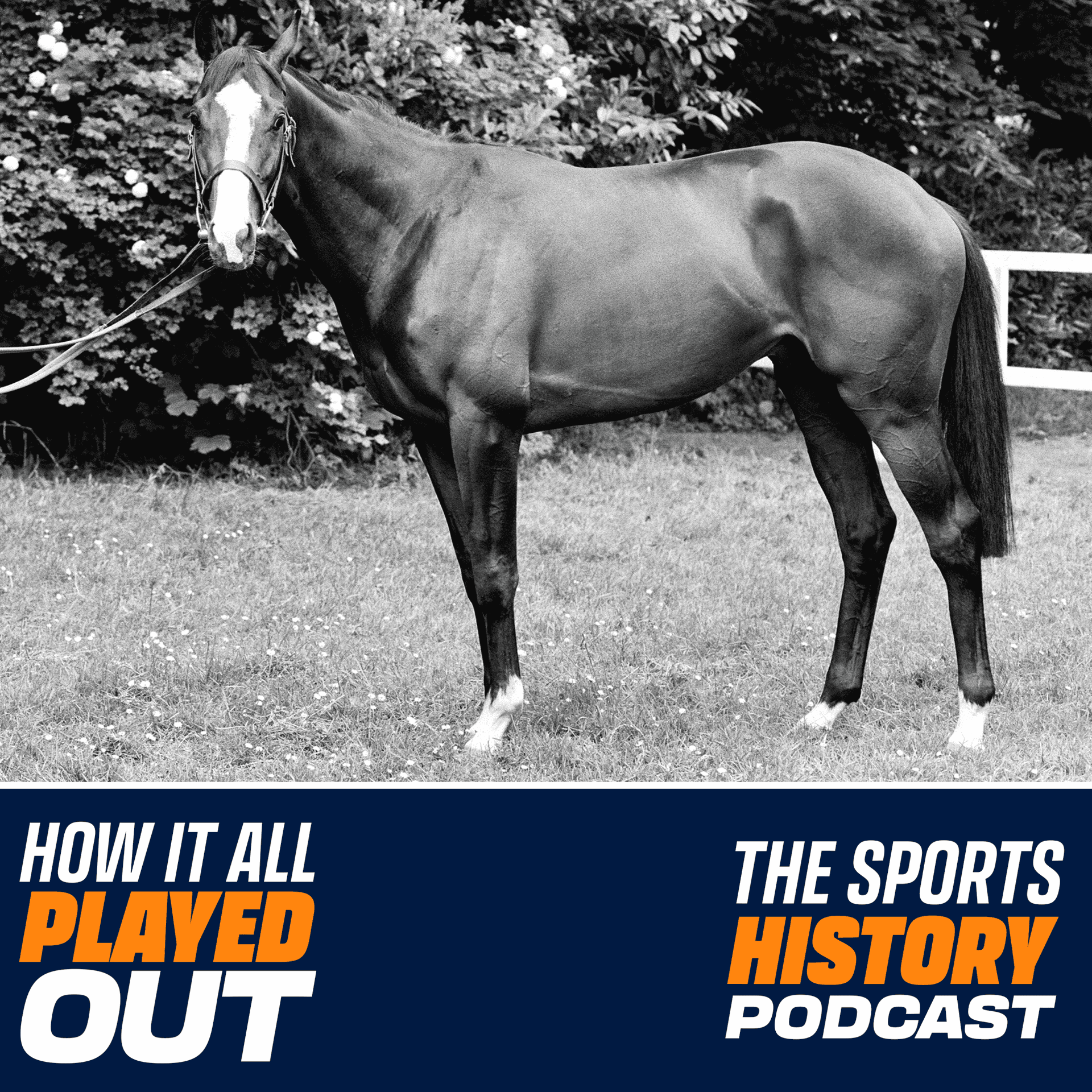
2:47Paul Hayward:is trying to breed every day and has been doing so for 250 years he is the point of the whole exercise he's born in march 1978 in kildare he's a bay colt with white socks and a white blaze the reason I mention those characteristics is that that might have denoted a flashiness. He wasn't flashy at all. He was professional, disciplined and extremely capable as well as being brilliant. So he gets from the Aga Khan stud to Michael Stout's yard in Newmarket, begins working on the gallops. And there's a veteran work rider at Stout's yard called Cliff Lines. And Cliff Lines gets on board Shergar, rides him up the gallops, turns to Stout and says, I think this is the one you've been waiting for.
3:33Paul Hayward:And this is Shergar as a two-year-old. This is Shergar as an unproven two-year-old. He's ridden by Lester Pickett in two races at two and he wins one, but he's still an undiscovered genius, if you like, because going into that winter, he's still 33 to one for the Derby.
3:50Mark Pougatch:So just to put it in context for people who don't follow flat racing closely, the classics, the five classics of the season, you have to be three, and only three. You're only allowed to be three. So Shergar is going from two into three from the summer of 1980, effectively, into the summer of 1981. And it has all changed, hasn't it, when we first see Shergar racing at the start of the 1981 season. Exactly.
4:14Jim Fitzgerald:Early in the 1981 season, in the spring, the derby trials, horses warm up for the derby in trial races at Sandown and Chester.
4:22Paul Hayward:Shergar wins two of them in the most spectacular fashion. He wins the Sandown Classic trial doing handstands. And famously, Richard Baerlein, the racing correspondent of The Guardian, writes, Now is the time to bet like men. Baerlein is so overcome with what he's seen, but he's also overcome by the potential profit to him because he started backing him at 33 to 1. and Shergar goes romping through these trial races and turns up at Epsom. I like to think he's probably the biggest certainty that I've ever looked through.
4:55Mark Pougatch:He's odds on by then, is he? He's odds on by then. By the start of the Derby.
4:58Jim Fitzgerald:He's four to 11 in the Derby. So that's long odds on in Derby terms. And even now, people remember him
5:04Paul Hayward:as the biggest certainty ever to stare through a bridle. So he's gone from 33 to one to odds on
5:09Mark Pougatch:in basically two months. Yes. Give or take. Exactly. and as you say because of his white socks his white blaze which is a stripe down his nose he's also very recognizable you know a lot of time you watch racing and if people don't aren't racing aficionados they think well they all sort of slightly merge into one but when you've got a horse with four white socks as you describe it like that it's very it's very distinguished and
5:31Jim Fitzgerald:he's also wearing the silks of the aga khan who's one of the premier owner breeders in racing his family have been in the game for centuries. Now, the Aga Khan specializes in these classic horses,
5:45Paul Hayward:these aristocratic horses from his own bloodlines. He's not a guy that goes to the sales and buys horses for three million guineas. He breeds them himself. And Shergar has the stamp of an Aga Khan
5:56Jim Fitzgerald:horse, his pedigree, his looks, his reputation. The line you hear about Epsom now is that if you were starting the derby today you wouldn't run it at emsum it's a it's a fun fair ride it's uphill it's down dale it's got turns and twists it's got a camber this is the reason why it's always been such a definitive test of a three-year-old colt in the search for the champion three-year-old colt of his generation so no bad horse ever wins the derby you can't win the derby if you're an average horse but you don't win it by 10 lengths either you win it narrowly because you're up against the best of your generation.
6:32Jim Fitzgerald:It's a scrap. It's a battle, you know. It's a battle against the track and it's a battle against your best contemporaries. So what you don't see in the derby is a horse disappearing over the horizon.
6:43Mark Pougatch:And he only won by 10 lengths because he eased up. At one stage, he was 15 lengths clear. And the great commentator, Peter Bromley, on the radio I work with a lot, said, you need a telescope to see the rest because he was so far ahead at one stage. He was, at one stage, 15 lengths ahead. and Walter Swinburne just let him cruise over the line effectively in the end. But 10 lengths to sit a record winning margin for a derby win.
7:07Paul Hayward:Yes, and the great story around the runner-up, a horse called Glint of Gold, he was ridden by a jockey called John Mathias and John Mathias thought he'd won the race because Shergar was so far clear that John Mathias couldn't see him.
7:23Jim Fitzgerald:So two furlongs out, you see that kick and Walter Swinburne just lets go on Shergar and off he goes and the rest of them are toiling and he quickens so far clear so quickly that Swinburne in the last half of furlong thinks my job's done all I need to do is stay on now and relax and just you know get the horse back on the bridle and canter across the line this is not
7:44Paul Hayward:supposed to happen in the derby and I can still hear Peter Bromley's voice that commentary there's only as you said there's only one horse in it you need a telescope to see the rest there's not only the exaltation in Bromley's voice, the shock, because that shouldn't happen. You're a 16-year-old who loved flat racing. Do you remember this really clearly? I do. I do. Because at a young age, I'd started to go race. I used all my pocket money. I got on the trains, and I'd go racing, and I'd have a bet. And my whole point in life was to try and
8:10Jim Fitzgerald:pay for the day out by backing winners at Ascot and Sandown. So I was already kind of intoxicated with horse racing and the best flat racers, because not only are they beautiful creatures, but they're incredibly hard to find and construct. And so the rarity value of Shergar struck me straight away. This is a horse in a million. And when you see an animal like that, there's something very magical about it because it's as if these horses are the absolute monarchs of the animal kingdom. You will not see a more beautiful creature and you won't see anything more beautiful in sport, really, in many ways than a top racehorse in full flow.
8:47Mark Pougatch:Well, it was beautiful for Walter Swinburne and for the Aga Khan and Michael Stout and for Richard Berline, who'd backed him from 33 to 1 all the way down to 11 to 4 on and made so much money, he bought a house in Sussex and, funnily enough, called it Shurga. So he, I mean, it's a very 1981's comment, isn't it? Bet like men. You wouldn't say that today. No, you wouldn't.
9:07Paul Hayward:But he made his money, didn't he? Well, and it's also the case that you wouldn't be able to do that now because I promise you the way the betting industry is now. They twig, wouldn't they? They would twig. They would not let you have very much money on at 33 to 1.
9:19Jim Fitzgerald:I would say Richard Berline now would be able to buy a garden shed, but not the house.
9:24Mark Pougatch:So he'd won the derby. After that, he wins the Irish derby. Lester Pigott's on him, interestingly. And Peter O'Sullivan, the great television commentator, says he only won, in inverted commas, by four lengths. But Peter O'Sullivan says he was only in an exercise canter. So again, a bit like the Epsom derby. He's won it so easily, he doesn't need to go any quicker. and then interestingly wins the King George VI and Queen Elizabeth Stakes at Ascot, known as the King George. The interesting thing about this is that he's against horses older than three. So does he have the power to beat the four and five-year-olds that are in that?
9:57Mark Pougatch:The answer again is yes.
9:59Jim Fitzgerald:Well, that's the point because once you've seen off your own generation, you have to take on the others. And so the King George at Ascot is the test of a three-year-old against the older horses. It's the generations coming together to find out who really is the boss. And Shergar really was the boss of that generation, all the generations. he wasn't quite as impressive as he had been at epsom or in the irish derby but nevertheless it's an authoritative win and by this point when he's beaten the older horses people start to feel you know we've got a wonder horse on our hands but also crucially discussions start turning towards stallion values and studs and what's going to happen to him when he stops racing because never mind the money he's winning on the track he's acquired a value as a stallion that runs into tens of millions of pounds.
10:41Mark Pougatch:And this is the bit, I think, where some people who love jump racing find it a bit harder with flat racing because they've got on board with Shergar. But by this stage, with the best one in the world, if he's going to go breeding, you're going to see Shergar race once or twice more in his lifetime. So, you know, you've got to get on board, get on board this train, which is going to be going to a terminus pretty soon. Something significant happens now. The Yaga Khan decides to split the ownership. So he splits it into 40 shares. He keeps six shares himself and he sells 34 at£250 ,000. This is very significant for the story we're going to tell.
11:17Mark Pougatch:Now, that values the horse at£10 million sterling. This is 1981. That's a record for a stallion at stud. And those who buy shares are the elite, aren't they, of the racing world. Robert Sangster, John Magna, who's very much still involved in the game, Lord Derby, some established stud farmers as well, like Coolmore, who are obviously massive these days. and his vet, Stan Cosgrove, which is very important. So this sort of spreading of the ownership will have big ramifications for our story.
11:47Paul Hayward:It will. And there's a little side issue there,
11:50Jim Fitzgerald:which is that Coolmore, who people will know from John Magna and Michael Tabor and Derek Smith and the Aidan O 'Brien, all conquering Aidan O 'Brien's stable of today, Coolmore twice tried to buy Shogar outright to take him as a stallion. The Aga Khan declined that offer
12:07Paul Hayward:because he realized he could make more money by splitting the horse up and also keeping six shares for himself. So Coolmore didn't manage to get a hold of him. But I would speculate, I don't know the answer to this, but I wonder whether Shergar would have been kidnapped had he been at Coolmore. Because as we know, the security at the Aga Khan stud, the Ballymani stud when the kidnappers arrived was lax. I wonder whether Coolmore would have had a tighter grip on their operation and whether had he gone there, he might have been safer. By September, Shergar had levelled off and had done his racing.
12:42Paul Hayward:And so they decided not to go to the Prix de L 'Arc to triumph with him and to retire him. He turns up as a stallion in Ireland. He's still so popular and so revered, despite the defeat in the St. Leger, which is a footnote, that he is paraded through the streets of an Irish village
13:00Jim Fitzgerald:and the whole place comes out to greet him.
13:02Mark Pougatch:So for the first 12 months that Shergar's at stud, He's paired with 35 mares, just doing some quick maths for everybody,£80 ,000 a time. So that's£3 million sterling. On the eve of the 1983 breeding season, which starts on Valentine's Day, he is due to cover 55 mares. So all this happens a week out of the breeding season. I think that's worth bearing in mind. You're talking about a stallion a week away from breeding season on February the 8th, 1983. That's quite a significant thing.
Read the full transcript
13:33Jim Fitzgerald:Many of those mayors are already on their way to visit him.
13:37Paul Hayward:He's fully booked for 1983.
13:39Jim Fitzgerald:Everything's looking good.
13:41Paul Hayward:None of them get to see him, unfortunately.
13:43Mark Pougatch:So, as we said, about half past eight on the evening of February the 8th, which is a Tuesday, it's been a filthy day in County Kildare. We're about 40-odd miles southwest of Dublin. And a Ford Granada pulling a trailer comes off the main Dublin road and literally goes through non-existent security. They literally just have to take open a latch off the gate and drive in. And I think when people think about that today through the prism of today's security around everything, let alone sport, you're thinking, what, a car can just literally drive in to a stud where the most prized stallion, certainly in Europe, is housed.
14:23Mark Pougatch:It seems inconceivable, doesn't it?
14:25Jim Fitzgerald:Particularly given the state of politics and so on and warfare in Ireland, this is a£10 million asset unguarded. But even though humans had been kidnapped in the 1970s, there's still no conception at all that anyone would kidnap a horse, even one that's worth£10 million. So I think that's where the disconnect was. You know, they didn't need security because it was inconceivable that Shergar would ever be stolen.
14:50Mark Pougatch:Well, that's what happens when we get to it later with the insurers as well, isn't it? The judge said, well, no one had ever stolen a horse before, so there was no precedent for it.
14:58Paul Hayward:Yeah, and the question we will answer next is, why do they do it?
15:20Jim Fitzgerald:Police have had the stud sealed off all day, but tonight they admit they had no leads in the hunt for sugar, and they don't know if those who took him are ordinary criminals or paramilitary or terrorist organisations trying to raise funds. The Ballymani stud holds bloodstock worth millions, but Shergar was the undoubted star.
15:41Mark Pougatch:That was a news clip taken from 1983 from ITN.
15:46Paul Hayward:Now, by 1980-81, the conflict in Northern Ireland was at its, I would argue, its most intense phase. So these were the years of the hunger strikes when 10 Republican prisoners starved themselves to death. These deaths further radicalised the Republican movement and led pretty much directly to the Brighton bombing of 1984
16:09Jim Fitzgerald:in which the IRA tried to exact revenge on Margaret Thatcher for allowing these prisoners to die. 100 ,000 people attended the funeral of Bobby Sands, who was one of the people who starved himself to death.
16:20Paul Hayward:So you can see in the year that Shergar was winning the Derby, it was a separate story, disconnected in many ways, But in Ireland, the whole island of Ireland, not just Northern Ireland, there is a conflagration.
16:32Mark Pougatch:I think the issue that disappeared is actually very relevant when we go back to the night of the kidnapping for James Fitzgerald, the groom. I think reading this is really significant and explains, I think, in many ways, his actions. So there's a knock on the door at 8.40. James Fitzgerald lives on site. He's got six children. He's the groom who's in charge of the stud. And his son opens the door, Bernard. and he looks at a man who's ostensibly wearing uniform of the Irish police, the Irish Guard, but he's got a balaclava over his face. And he goes, is he in? Now, when I read that, I was thinking, is he referring to his dad, the start manager, or is he referring to Shergar?
17:09Mark Pougatch:Because they've come for Shergar. Berder turns around to go and get his dad and gets a whack at the back of his head. James comes out and goes, what's going on? And there are men with guns there. And they make it very obvious from the word go, we've come to take Shergar. You take us to Shergar, we're going to go and take him. away well what would you do with someone with guns in your house who's pointing them at your family in an era that disappeared and if you don't do what they say you know what the history is so he goes to get the horse now of course even though shirgar is a stallion on the eve of breeding season he knows james and he knows james so he's quite calm with james with jim and he goes to get him and they put him in the back of the trailer and the trailer drives away and then they take gym somewhere else and they drive him around for three or four hours before they chuck him out about 23 24 miles away in a place called kilcock and they chuck him out about midday they use a password don't they king neptune we'll hear about king neptune quite a lot and they say don't call the police i think you can understand paul why he doesn't call the police because he's been driven around for three or four hours he doesn't know where he's going he knows that someone's kidnapped Shergar.
18:18Mark Pougatch:He doesn't know who they are, you might guess, or where they've taken Shergar. He doesn't know what's happened to his family. Two men have been left with them. He's very aware of the disappeared. It's the middle of the night and he's cold. I'm not surprised he doesn't call the police straight away.
18:32Paul Hayward:No, the human disappeared went missing between 1972 to 85. So this is this event. Right in the middle of this is right in this kidnapping of Shergar is right in the middle of that, the Irish finance minister, Alan Dukes, actually said that Shergar had been disappeared, quotes, disappeared. So he sort of included him with the human kidnappings. This was a crime wave at a particular point in the IRA's development when they needed money desperately, they were short on funds, and they came up with the idea of kidnappings to raise money very quickly.
19:07Jim Fitzgerald:But crucially, it's an eight-hour gap between the kidnapping and the authority authorities being alerted. So there's no chance of roadblocks. There's no chance of police interventions.
19:19Paul Hayward:By the time the police and the government get to hear about it, Shurgar has long gone into the night.
19:25Mark Pougatch:There's also the day, and no one quite knows whether this was just fluke from the kidnappers, it was also the day of the big goths racing sale. So the roads of Ireland are full of trailers because people are buying and selling horses. So there's absolutely no chance of stopping of any old trailer there's a there's a relay of extraordinary phone calls isn't there jim gets out the car goes to a chinese when he's thrown out the car goes to a chinese restaurant rings his brother who picks him up he then calls gillain drion who's the stud manager at ballymanny who calls stan cosgrove who's shergar's vet and then after that then stan calls sean berry who's a former captain in the irish army who calls the irish finance minister you mentioned him, Alan Dukes, who says he doesn't know what to do and he's got to deliver the budget the next day anyway, who calls the justice minister.
20:12Mark Pougatch:And all the while they're trying to get hold of the Aga Khan. So you look and you go, blimey, is anyone going to call? When is someone going to call the authorities? But for the reasons we've outlined, that's why there was the worry. And actually, so it's not till four o 'clock in the morning, pretty much the police are alerted.
20:28Jim Fitzgerald:Yeah. So that part of the operation was successful through the kidnappers eyes. Anyway, They bought the time they needed to make Surgard disappear and to get him to wherever they took him.
20:38Paul Hayward:And so out of the mist comes a gentleman called Chief Superintendent James Murphy, who's nicknamed Spud. He's teased by the press on both sides of the water for his trilby hat and country accent. It was an Irish journalist who called him the Irish Inspector Clouseau. But actually, a lot of people had a lot more respect for him than that. Nicholas Wichel, for example, who was the BBC's Northern Ireland correspondent, called him a very shrewd and charming man. Wichel said he did know more than he was able to share with us. Murphy called the kidnappers terrorists. He told them that negotiations would be impossible without proof of life.
21:17Paul Hayward:The police went farm to farm. But with the murder that we know about in relation to terrorist activity, nobody said anything. But the line that people always remember from James Murphy is when somebody asked him whether they had any clues. And Murphy replied, a clue? That is something we haven't got. So he was... That plays into the cartoon character, doesn't it? Exactly. The usual prejudicial portrayal of Irish police officers. So he was a bit of a figure of fun. But underneath it all, he knew his business, I think.
21:51Mark Pougatch:The interesting thing here is this is where the stories start to be quite muddled, isn't it? Because on the same night, on the same night that Shergar is taken about midnight, Jeremy and Judy Maxwell, who were renowned trainers who live in a farm outside Belfast, so in Northern Ireland, they get a call at midnight about Shergar being kidnapped. And they're thinking, what do we need Shergar's being kidnapped? We haven't heard that. And the next morning, so we're eighth into the ninth now, there's nothing on the news about that. so already we're getting mixed stories already we are getting the thought are there decoy trails being laid here because on the one hand the police are only told at four in the morning that shirgar has been kidnapped and yet the maxwells are called at midnight the night before
22:36Jim Fitzgerald:that he's been kidnapped yeah i hesitate to use this phrase but it almost turns into a sort of crime caper at this point you know there are people flying off in all directions there are wild rumors going around about vendettas about colonel gaddafi being involved gaddafi's regime in libya was supplying arms to the ira at that time there's even a suggestion that the american mafia are involved i mean the american mafia gets him gets dragged into everything doesn't it but
22:59Mark Pougatch:in this case something to some new orleans mafia and there were people talking to diviners and
23:07Paul Hayward:clairvoyants and travelers so it it had become it quite quickly became a bit of a pantomime a pantomime that sucked in three um british horse racing journalists who were i think i can say with some confidence that they were duped into thinking that they were they were go-betweens they'd been taken over to belfast to be the intermediaries so there's a phone call to the
23:30Mark Pougatch:bbc in belfast is that saying this is kim neptune if you want to see your horse again these three journalists i mean you know derek thompson very well you work with him a lot lord oaksie who was a very famous itv journo being an amateur uh jockey as well and peter campling from the sun They are told you must go to the Europa on the Wednesday evening. So it's kidnapped on the Tuesday evening. You must go to the Europa Hotel in Belfast, which was the because Belfast of the Hydra Troubles was the most bombed hotel in Europe. It felt like to me when I read that, I thought this this is this is all quite coincidental, isn't it?
24:01Mark Pougatch:That they've got to go to this particular hotel. But to be fair to them, if you or I were in that position and we get a phone call to say you need to come to this hotel because this, you know, this is the way to get Shergar back. we'd all go, wouldn't we? Yeah, we would.
24:15Jim Fitzgerald:Interesting cast of characters. I mean, John Oakesy, Lord Oakesy, his father was a judge at the Nuremberg Trials, for example. Very august man.
24:24Paul Hayward:Amateur jockey, breeder, establishment figure, racing journalist. And alongside him, Tomo was the, Derek Thompson, Tomo was the fun man of Channel 4 racing. You know, he'd kind of make a spectacle of himself and try and generate some energy and laughter. And again, he really knows his stuff, Tomo. But at that time, you wouldn't have chosen him as the most sort of serious-minded intermediary to negotiate with the IRA for the recovery of Shurgar. Nevertheless, the three of them go there. And at one point, so they're sent out into the countryside to continue the negotiations to go to the Maxwell's yard, as you've just said.
25:07But they were told by the kidnappers to lose the press.
25:11Jim Fitzgerald:And I was thinking, well, that's a bit optimistic because they were the press. So all three of them must be thinking, I am never going to get a better story than this.
25:19Paul Hayward:Which is why we'd all do it.
25:20Mark Pougatch:That's what I've said. You know, yeah.
25:21Paul Hayward:I know. It's every journalist's dream, isn't it? To be the story. To be in the story. So it's sort of gonzo journalism of a high order. But they're on the way to the Maxwell.
25:33Mark Pougatch:Well, they run through the kitchens to lose the press. It's the old kitchen bag, isn't it? Yeah.
25:37Paul Hayward:Yeah. And so they get up, they head out towards the Maxwell yard trying to lose the press. And they're stopped by men in Balaclavas who are not the IRA.
25:45Jim Fitzgerald:They're the police who are surrounding the farmhouse of Jeremy and Judy Maxwell. A call comes in asking for£40 ,000. That arouses suspicion because suddenly the price has dropped to£40 ,000. That's a bit odd.
25:57Paul Hayward:And then another call comes in asking for£1 ,000 for a photo of the horse. So it's starting to look like a bit of either a diversionary tactic or a scam.
26:08Jim Fitzgerald:But finally, a fairly serious call is made at 6.50 a.m. in the morning when a voice says he's had an accident. He's dead, which, according to the IRA supergirl, Sean O 'Callaghan, we'll talk about this later, is actually what happened. And that's the last they ever hear from the so-called kidnappers. John Oakes, who bless him, gets fed up and goes home.
26:30Mark Pougatch:Well, I think he's seen through it by then. Because, again, the parallel stories, Paul, all the time here, because while that's happening, which is why people think it's a decoy, the Aga Khan has brought in someone who used to be in the SAS, the Special Air Service, to negotiate, as it were, from France or from Switzerland, wherever he is. But the complication is, which is why we talked about the shareholding earlier, is you're not just negotiating with the Aga Khan. You're negotiating with all these shareholders. And some might be prepared to pay a ransom, but most of them certainly aren't because of course you know why would you pay a ransom for the obvious reasons if you pay a ransom for Sharga then every prize racehorse around the world is liable to be kidnapped there's a this is what makes it so complicated you know who are they
27:11Paul Hayward:actually negotiating with yeah well when I said it was a disastrous attempt by the IRA to extract
27:19Jim Fitzgerald:money from rich people one of the reasons for that is they didn't understand that that the Aga Khan wasn't the sole owner of the horse and that they could negotiate with one person they They were negotiating with 35 people, none of whom could agree on what the best course was. Some of them wanted to settle to get the horse back, but most of them didn't want to negotiate with the IRA. So those negotiations could have gone on for weeks and months, you know, had the horse himself not met what we think of as a very swift demise.
27:49Mark Pougatch:I think that that last phone call at 6.50, having grown up with a mother who preferred horses to most human beings, and I was quite often in the second category. She was probably a good judge. She was probably a good judge. You know, a mother who loved horses and being near them enough at the time. Even a horse, I'm not talking about a stallion, I'm not talking about a racehorse, just a horse. You know, you have to know what you're doing. You have to be careful of it. You have to make sure you stand in the right place or you're going to get seriously hurt. I think somebody we both know very well, Claire Balding, said you would only do this, talking about the RA, if you had no idea about horses.
28:26Mark Pougatch:Because the thought that you could put a stallion in a trailer. Now, it's one thing when he's with his groom, Jim, who would be able to keep him calm. But the minute Jim's gone because he's been kidnapped as well, you have got a stallion on the eve of breeding season in a trailer handled by four men. men who clearly are not adept at handing a highly strung, frankly, very horny racehorse, and you're driving him around, you would only do that if you had no idea what you were doing. So the thought that that horse would quite literally kick off in a trailer when it's being driven away, to me, is very, very, very plausible that he would do that.
29:03Mark Pougatch:I mean, I've heard, I mean, I've driven a trailer before and heard a horse kicking in the back. You know, the fact that he, you know, that he would fracture a bone in his leg, I think is very,
29:10Paul Hayward:very probable you cannot take a stallion out of its natural environment stick it in the back of
29:15Jim Fitzgerald:a horse box with no serious veterinary care and there was supposed to be a vet with them wasn't there well yeah i wonder whether this story is apocryphal if it's not true it should be as they used to say in fleet street that the the vet the vet pulled out on the day of the operation because his wife threatened to leave him if he took part in it so he stayed at home which meant that the The kidnappers had no real expertise. There was one of them apparently had had some experience of working with horses, but not at a high level. And suddenly they've got this raging stallion who's been taken out of his box in the middle of the night, doesn't know where he's going, doesn't know the people who are surrounding him.
29:54Jim Fitzgerald:And that is a recipe for disaster.
29:56Mark Pougatch:So no ransom is paid, but money does change hands.
30:15Mark Pougatch:so paul on a purely financial level most of the people involved in this are the elite of of european racing of world racing and extremely wealthy they can afford the financial loss of course it's a terrible story for them except one man his vet stan cosgrove he loses time
30:30Paul Hayward:and time again yeah he gets hit three times so stan cosgrove is a highly respected irish country vet very religious he loses shirgar as a patient as it were he loses his share in the horse as a stallion and he loses 80 000 pounds in cash for reasons that i will now explain stan cosgrove
30:51Jim Fitzgerald:gets led all around the houses as a kind of uh middleman between the kidnappers and the aga khan
30:57Paul Hayward:he gets led up the garden path in all sorts of ways goes to an airport and gives the code name Johnny Logan. Johnny Logan had won the Eurovision Song Contest for Ireland to meet the kidnappers but there aren't police there that deters them and the kidnappers don't show. At another hotel he's given a photo of the horse's head but the insurance company won't accept it as proof of life and eight weeks after the kidnap he's told by Dublin detectives that there's a man called Dennis Minogue who has information about Shergar and says he's still alive but wants a ransom bait of 80 ,000 pounds of Cosgrove's money.
31:32Paul Hayward:Why he handed the 80 ,000 pounds to the Irish police is a is a mystery that we'll never solve. But anyway, to cut a long story short, the money is left in the boot of a young detective's car in a remote location, but it disappears overnight. So Stan Cosgrove's desperate to get the insurance payout on his share in the horse, but he has no proof that Shergar is dead. He has mortality insurance, but he doesn't have any theft insurance. Now, Now, Lloyds of London paid£7 million to those with theft insurance, but those who only had mortality insurance got nothing.
32:06Mark Pougatch:Yeah, because there was no proof the horse was dead.
32:08Paul Hayward:And some of them sued their agents for not covering that base unsuccessfully in Stan Cosgrove's case. Well, that's the bit I was saying earlier, wasn't it,
32:15Mark Pougatch:that the judge actually said because no horse had ever been stolen before, it wasn't wrong of the agent not to say to you, oh, you need theft insurance as well, because it never happened before.
32:24Jim Fitzgerald:So meanwhile, as the search gets underway for the body, really, and a man called Des Leiden from the Irish Thoroughbred Association is charged with inspecting all sorts of carcasses. One is he's given a skull and he's told it's Shergar's skull. It's a bovine skull. A horse washes up in Dublin Harbour. He's got hairy hooves. He immediately sees that that's not Shergar. So the trail goes cold and it becomes a bit farcical. It becomes a bit of a running joke where Christy Moore, for example, writes a song about Lord Lucan riding in on Shergar And it becomes a kind of almost like an amusing folktale.
32:58Paul Hayward:I mean, it's anything but. So finally, we get some light shed on what actually happened to him. It's not definitive light, but it's a pointer in the right direction.
33:07Mark Pougatch:This comes from an IRA informer, doesn't it? Exactly.
33:09Jim Fitzgerald:Sean O 'Callaghan, who's a super grass, he's the highest placed IRA informer inside the Garda. He's working for the Garda, really, rather than British intelligence.
33:18Paul Hayward:So he claims that a man called Kevin Mallon dreamt this scheme up in prison and was put in charge of a special operations unit of the IRA to raise millions of pounds for the struggle. The chief of staff of the IRA at that time liked the Italian mafia model of kidnappings and the IRA Army Council gave the go ahead for Shergar to be kidnapped. Sean O 'Callaghan says, I only know what I've been told. So that casts some doubt on his testimony. But he claims that he was told by a man who was on the operation that Shergar had become fractious, had sustained an injury, had become fractious and was shot quite quickly after the kidnap.
34:00Jim Fitzgerald:Didn't really survive very long because he injured himself.
34:03Mark Pougatch:And actually, some of the other reporters are pretty graphic, isn't it? That he's machine gunned to death. You know, it's not a bullet in the head. he's machine gunned to death.
34:12Paul Hayward:I don't know how much of that was poetic license,
34:14Jim Fitzgerald:but it definitely adds to the haunting quality of this story, this idea that he suffered a brutal end. You know, he wasn't sort of calmly put down, but he was executed effectively and, you know, put in a shallow grave somewhere.
34:27Mark Pougatch:It seems to be that if anybody does have an idea of where he is, it's County Leitrim, isn't it? Near the border. That seems to be a very good documentary. And when the reporter went there. Alison Miller's documentary. Yes, and when she went there, People were very reluctant to talk about it. Now, it is near the border. So there's always the complications when it's near the border of Northern Ireland and the Republic of Ireland. But basically, she's told, I wouldn't be going around asking questions here. And that's very remote, isn't it? A lot of peat bogs. Frankly, very easy to bury something there.
34:58Jim Fitzgerald:Yeah, and that town is called the Falls Road of the South. It's one of the Republican strongholds. So if they were going to take him anywhere, they'd take him to a place with the least chance of detection or comeback. He was wiped out as a horse, as an animal, but he was pretty much wiped out as an influence in the breed. And again, to people who don't know much about racing, that might seem not a very significant thing. But actually, when you've been trying to do something for 250 years and a champion, an exemplar is wiped off the breeding charts by a kidnapping, it's pretty surreal.
35:32Mark Pougatch:But you have got one bright spot for everybody at the end of this tale. Literally this tale. Yeah.
35:38Paul Hayward:Well, completely. It's quite a touching story because when Shergar was cavorting around the field at Ballymanistad with little security and open to visits, really, people used to come down and see him.
35:51Jim Fitzgerald:And there were two young women who were Shergar nuts. They traveled down to Ballymanistad and said to the groom, do you mind if we give him a carrot over the fence? And the chap there said, yeah, of course, no problem. He loves carrots. You know, come and say hello to him. And Shergar came over. There was a nice exchange between these two fans. And the groom was so touched by this, he said, tell you what, don't tell anyone I did this, but I'll just give you a little lock of his tail hair. And the two women were ecstatic, of course, and they took this tail hair back to, I think they were from Northern Ireland.
36:20Jim Fitzgerald:Anyway, they put it in a keepsake box. And when Shergar was kidnapped, of course, people understood the value of this little lock of hair. And Des Lieden, the man who was in charge of trying to find the body, was given these little fragments of hair from Shergar's tail, knowing of course that if they ever did find a body and they needed to identify him through his DNA that this tail hair might just provide the answer so if there's a hopeful ending it is that one day that tail hair will be matched to a horse that's laying in the ground and of course that tail hair was given as a kind of act of love and friendship and I just I just like to think that
37:04Mark Pougatch:maybe that is the key to finding him still thank you for listening to how it all played out we'd love to hear from you give us an idea and say love you too to look back at this story to re-evaluate this story to bring this story to life which hasn't been told for a bit so email us how it all played out at global.com do hit subscribe please give us a rating as well let us know how we're doing and tell your mates as well and we look forward paul very much to seeing everybody next time can't wait
37:41Mark Pougatch:How it all played out is presented by me, Mark Pugach, and Paul Hayward. It's a Global Original production in association with Apex Content Ventures.
37:53Paul Hayward:This is a Global Player Original podcast.
From the publisher
Join us to uncover a mystery that's still yet to be solved.
We're revisiting this episode of How It All Played Out, where Mark Pougatch and Paul Hayward travelled to the home of Head Groom Jim Fitzgerald on a stormy night in County Kildare in the Republic of Ireland to investigate one of the most shocking stories from the 1980s: the kidnapping of prize racehorse Shergar.
This story involves the IRA, a ransom of £2 million and masked kidnappers with submachine guns, so travel back in time with us to explore a bizarre sporting story like no other.
Remember to follow or subscribe and give us a 5 star review too!
We'd love to hear from you! Email us: howitallplayedout@global.com
Get in touch on socials @playedoutpod
Executive Producer: Adem Waterman and Adonis Pratsides
Producer: Sophie Penney
Head of Podcasts: Factual: Al Riddell
Director of Podcasts: Vicky Etchells