
In short
Podcast Episode Notes: The Twenty Minute VC (20VC) with Alain De Botton
Episode Details
- Title: 20VC Alain De Botton on Why Companies Are Not Families | Why Status is Making You Miserable | Why Parents Want Their Kids to Fail | Why We Are Richer Yet More Anxious Than Ever & Why You Should Not Always "Be Yourself"
- Host: Harry Stebbings
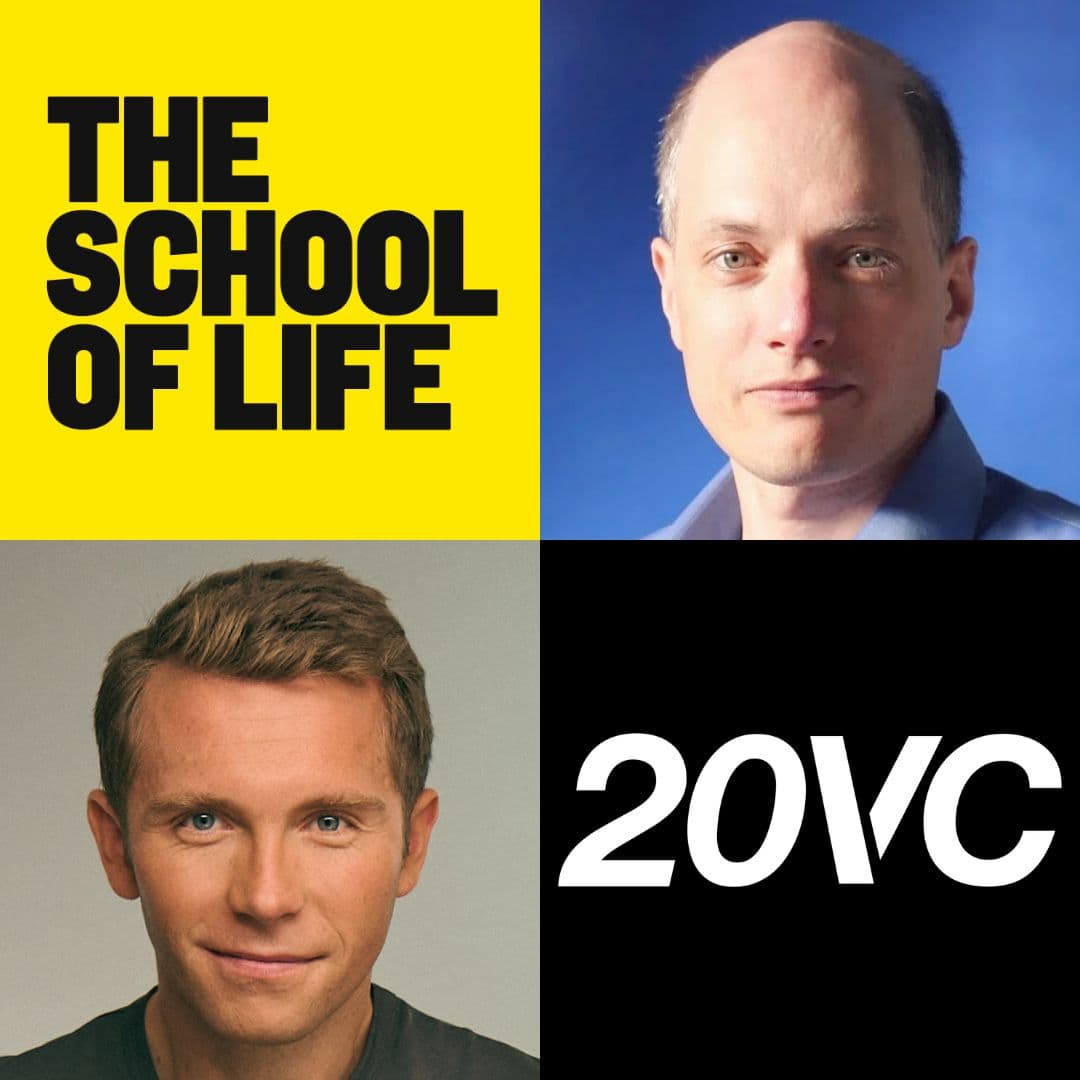
- Guest: Alain De Botton, philosopher and author.
Key Themes
- The Nature of Status
- Defining Status: Alain discusses that our desire for status stems from our need for love, esteem, and recognition.
- We often equate status with identity, particularly in modern society.
- Material vs. Emotional Needs: People chase material wealth not for its own sake but for the emotional validation it brings.
- Social Media Influence: Social media exacerbates our need for status and makes us more anxious.
- Observations on Happiness: The happiest individuals tend to seek status the least.
- Parenting and Failure
- Parental Expectations: Parents may inadvertently wish their children to face failure to foster resilience.
- Good Parenting Indicators: A well-adjusted child is one who does not seek fame or validation from others.
- Encouraging Early Initiatives: Parents should inspire children to pursue their passions early, even if they might be unrealistic.
- Meritocracy and Work
- Meritocracy as a Fallacy: Alain argues that true meritocracy is unattainable; it overlooks the complexities of life and privilege.
- Workplace Dynamics: Companies are not families; they serve to produce goods/services and should not mimic familial ties.
- Meaningful Work: The concept of meaningful work has evolved. It now often focuses on reducing suffering or increasing pleasure for others.
- Advice for Young Professionals: Seek fulfillment by evaluating interests and capacities, not just financial gain.
- Ambition and Sacrifice
- Tolerating Average: Alain stresses the importance of accepting one's mediocrity and not feeling compelled to constantly excel.
- Work-Life Balance: He emphasizes the tension between ambition and personal well-being.
- Self-Sabotage: The drive towards failure can be linked to childhood dynamics and parental expectations.
- The Human Condition
- Existential Reflections: Alain reflects on the complexities of human existence, addressing themes of success, failure, and the search for meaning.
- Religion and Morality: Religion can provide a moral framework that capitalism often lacks. It emphasizes community and the human experience beyond material success.
- Absurdity of Life: The conversation touches on the comedic nature of the human condition and the paradox of seeking meaning in a seemingly indifferent world.
- Capitalism and Entrepreneurship
- Critique of Capitalism: Alain discusses how capitalism often prioritizes profit over genuine human needs.
- Responsibility of Venture Capitalists: There’s an ethical imperative for venture capitalists to fund solutions to real human problems rather than exploitative ventures.
- Entrepreneurial Spirit: While everyone may have a latent entrepreneurial capability, developing it requires effort and awareness.
Conclusion
- Final Thoughts: The episode encapsulates Alain De Botton's insights into human behavior, societal constructs, and the pursuit of meaningful work and existence. It encourages listeners to reflect on their own motivations, the nature of their ambitions, and the importance of self-acceptance in a complex world.
Additional Resources
- For more insights from Alain De Botton, visit [The School of Life](https://www.theschooloflife.com).
- For a deeper understanding of venture capital, entrepreneurship, and meaningful work, explore [The Twenty Minute VC (20VC)](http://www.20vc.com).
Call to Action
- Engage with the episode and reflect on your own perspectives regarding status, ambition, and the nature of work. How do these themes resonate with your personal and professional life?
Written by AI. May contain mistakes. Listen to the episode to check what was said.
Transcript
Automatic transcript. May contain errors.0:00A marker of good parenting is that your child doesn't have any wish to be famous. It's a tremendous envy within families and within people. Envy is one of the key motivators. People are envious of their children. The problem with modern societies is that everybody wants to be big. Everybody wants to matter. If you don't have a plan, you'll full -pray to the plans of others. What goes wrong often in people's lives is they don't really have a plan. When companies start talking about loving their employees and being a family, etc. They've tied themselves in a knot. They've borrowed the language of private life.
0:29in order to foster a short term sense of togetherness. This is 20VC with me Harry Sterex. Now the show's date is one of the most meaningful we have ever done. A land of bottom has had a huge impact on how I think, act and lead. He's one of the greatest philosophers of our time, and this is one of the most broad, but really impactful discussions we've ever had. Whenever a thing from capitalism to ambition, status, what it means to be a loser, parenting, and so much more, It's one of my favorite conversations we've ever done on the show. But before we dive in today, we're excited to ignite your curiosity with a journey into the world of transformative ideas.
1:07If you're driven by the pursuit of knowledge and personal growth, you'll love exploring the vast collection of insightful book summaries on the Blinkist app. So with Blinkist, you can access expertly crafted summaries that distill the essence of thousands of influential books, allowing you to read or listen to each in just 15 minutes. I know they beat 20 VC. Being recommended by The New York Times and Apple CEO Tim Cook, it's no surprise that 82 % of Blinkist users see themselves as self -optimizers, and 65 % say it's essential for business and career growth. And speaking of business, Blinkist is also a trusted L &D partner for industry leaders like Amazon, in Hyundai and KPMG UK, empowering over 32 million users since 2012.
1:53As a 20 VC listener, even better, you get 25 % exclusive discount on Blinkist. That's B -L -I -N -K -I -S -T. Just visit Blinkist .com, forward slash 20 VC to claim your discount and transform the way you learn. And while you're optimizing your learning, let's also optimize your finances with Brex. The financial stack founders can bank on. Brex knows that nearly 40 % of startups fail, because they run out of cash. So they built a banking experience that takes every dollar further. It's such a difference from traditional banking options that leave your cash sitting idle while chipping away at it with fees.
2:28To help you protect your cash and extend your runway, Brad is combining the best things about checking, treasury and FDIC insurance in one powerhouse account. You can send and receive money worldwide at lightning speed. You can get 20X the standard FDIC protection through program banks and you can earn industry leading yield from your first dollar while still being able to access your funds anytime. Bracks is a top choice for startups. In fact, hey, it's used by one in every three startups in the US. Just check them out now, bracks .com -flash -dot -ups. And talking about building trust, secure frame provides incredible levels of trust to your customers through automation.
3:11Secureframe empowers businesses to build trust with customers by simplifying information security and compliance through AI and automation. Thousands of fast -growing businesses, including NASDAQ, Angel List, Doodle and Coda, trust secureframe to expedite their compliance journey for global security and privacy standards, such as SOC2, ISO27001, HIPER, GDPR and more, but by top tier investors and corporations, such as Google and Client Perkins, the company is among Forbes' list of top 100 startup employers for 2023, and Business Insiders list of the 34 most promising AI startups for 2023. Learn more today at SecureFrame .com.
3:55It is a must. You have now arrived at your destination. Alain, I'm so excited to make this happen. I am probably one of the biggest fans of your work. So thank you so much for joining me today. Thank you so much, thanks for having me. Now, I would love to start. We live in this kind of social media driven world, and I also live in this financial driven world, and at the core of both is status. And so I want to start with, how do you define status? And why do we want it so much? Well, let's start with the second bit. I think we want status if this distance doesn't seem too weird for love. I don't mean sexual love or romantic love.
4:30I mean, love in a broad sense is steam, friendship, recognition. We live in a world where what you do defines who you are. That's a relatively modern way of doing things. It wasn't always the case. But nowadays, first time you meet somebody, they will immediately ask you, what do you do? According to how you answer that, you will either be acclaimed and that's very interesting. Or you'll be left behind by the peanuts and you'll be made to feel that you don't really exist. You will become an invisible person. So we want status for very often material ends, but it's not really the material ends that we want.
5:06It's the love and respect and esteem that comes with those ends. I mean, if you said to somebody, right, you've got a choice. Either we give you 400 million pounds a year, but everyone who looks at you will treat you like a pariah, will treat you with ignominy, you'll feel shame, etc. But £400 million a year, or you can live on £15 ,000 a year and wherever you go, people will greet you with warmth, with adulation, with love, with respect, which one do you want? I think that vast majority won't want the second option. So people often say we're very materialistic nowadays. We're not particularly materialistic.
5:44What we are is we're hungry for status, love, respect, dignity, and we live in a world in which that status is available via the acquisition of material goods. It's not really the material goods. I mean, I'm sure you've had people sitting in this chair who will tell you again and again, I'm not doing it for the money. And of course, they're not. They're not. They're not doing it for the money. They're doing it for the love. Is the status element like a lack of respect for ourselves? We need other people to recognise us because we don't recognise ourselves as being good enough? Yes. And of course, people are different in the amount of estimation that they have independently of others.
6:20So we all know people who are, barely, we call them robust. In other words, they don't fold simply because the crowd is not, acclaiming them. Sometimes they might even be emboldened, they might feel thrilled by the disdain of the majority. But they can maintain self -belief, despite an absence of adulation. And then we know at the other end of the spectrum, people who will literally not be able to choose what to have for lunch without aligning their taste with yours. So worried are they about the consequences of in any way diverging from the views of others? We call these people people pleases, yes men or women.
6:56You know, these are people who any departure from the external verdict is going to be extremely dangerous. And you know, and on the whole, psychologists would argue, and you know, I think it's almost common sense, that the amount of independence that you're capable of in adulthood is directly related to the amount of love and a steamer were given as a child from people who esteemed you for yourself, as opposed to for anything that you did. Whenever you see a very robust individual who seems not to care, what others are thinking of them, probably there's somebody who early on said to them, doesn't matter what everybody thinks, you're my prize little bunny and they were three years old and it stuck and it gave them a kind of psychological armor which has lasted them into adulthood, tremendously valuable.
7:44Is this worse than ever before because of social media, because of life, the county of life, the wider recognition of, oh my gosh, it got a thousand likes, it went viral. Is this worse than ever today? Probably is, you know, it's been getting worse ever since we moved to large cities, which depending on what part of the world, you know, it's a, it's an urban phenomenon, it's, it's a modern phenomenon whenever you dislocate people from settled, um, village rural life where people are essentially defined by a much narrower, much more stable group of people. And also there's a limit to your achievement.
8:20So the sky's not the limit. It's like you're gonna roughly do what your parents did. These things keep a lid on some of this arrestlessness. So I think the defining mood of modernity, hyper -modernity is anxiety. Your business, business generally thrives. But what we mean by anxiety is an uncertainty about the future and both in an exciting and a worrying direction. But the point is the future is uncertain. We no longer believe that we live in cyclical time. Most of history people have believed in cyclical time. In other words, history just repeats itself. We don't believe that now. The seasons may repeat themselves, but that's about the only thing that does.
8:56Everything else, you know, think of the way the media is always reporting the new, the novel, and this has kind of colored our deep inside and our psyches. And yes, so are we more restless than ever before? are there more causes of anxiety before? Absolutely. All the indicators suggest that's the case. That's why everybody's scrabbling around thinking, okay, it's the paradox of modernity. We are richer than ever before, but more restless and anxious than ever. Do you agree with the removal from cyclicality of life? Ray Daly has written a book in terms of how we look at it. I think it was 1917 Spanish influencer in COVID and actually, although COVID seemed completely unique in terms of the same pattern of humanity actually.
9:35It's six people and there was another one in the 1700s, and it's actually still within cycles. Well, I mean, I think in many ways, yes, but also it's tremendously helpful, I think, for us as individuals to look out for these patterns because, well, it simplifies life. As we know, whenever you see a pattern, what you're essentially doing is removing the unfamiliar and the possibly dangerous from a situation, is you're thinking, oh, okay, I know what this is going to be like or what this is like. I mean, we get this with people, don't we? After a certain age, you think, I've met this person before.
10:05And of course you haven't met exactly that person, but you met someone a bit like them before because there are only so many human types and Ultimately, there are only so many human situations in many many cases I mean they say you know literary theorists like say there are only eight stories in the world There may be twelve there may be fifteen but there are not a thousand I think that's the point to be able to spot these patterns I think calms us down because one of the ills of the modern age is this belief that we are always in unparalleled Uncharted waters and that's an exhausting and I think untrue perspective on things.
10:34I mean, for example, we're filming at the time of the American election, a lot of doubts about where America's going, etc. A Roman historian would go, oh, we've been here before, you know, the teetering between empire and republic and republic and empire, decadent rulers, the pressures of, you know, the provinces on the center. We've been here before, there are patterns and historians of ancient China would go, well, again, we've seen these things before. So, you know, So the human animal doesn't change, our constitution is the same now as it was thousands of years ago. And that puts a cap really on the amount of novelty that we're able to build.
11:10We build a lot of new tools. We are tool builders. We always have been. And our tools are getting even more ingenious, complex, etc. But the people using these tools remain beautifully antiquated. When you speak about kind of the anxiety that comes from the ambiguity of not knowing what's to come, I think is the leader today. right, well then I must be clear, I must be very direct and know the answer and show the way. The trouble is I don't always know the answer. And so should we be confidently directing the crowd, even though we don't know the answer? Is it okay to say I don't not? Of course, I mean, you know, Socrates go back to Ancient Greece, Socrates apparently the wisest man in the ancient world was asked on what basis his wisdom rested and he said, because I know that I don't know.
12:01The birth of Western philosophies, the idea that by admitting and sensing one's ignorance, one can actually make progress, that the enemy of progress are people who think they know the answer. And that has to be the case that in many situations, that a naive inquiry is often the gateway to serious discoveries. And people who are leaders in their field often Then have about them a courage in asking the so -called obvious question, which isn't obvious at all, that they're able to put themselves in the shoes and they're able to inhabit without shame the position of someone who doesn't know, doesn't understand.
12:37So they might stick up their hand and go, what's everybody saying? We think we know what we're talking about. Do we? And questioning from first premises, these are often very useful moves. Is it bad to be status driven? Bad is a loaded term. I think it can be quite exhausting because if you think about what you might need to do in order to get status, it may not be in line with what you, in other parts of your personality, are after. So it can be an exhausting and slightly futile pursuit, also because, as we know from anyone who's sort fame, which is kind of the extreme end of status seeking. Fame generally doesn't deliver on its promises because what the fame -seeking person wants is love, respect, dignity.
13:24And what they find instead is envy, insecurity, backlash, etc. And so the capacity to be anonymous and to bear an anonymity is rather good at the School of Life at J .R. and we will say that a marker of good parenting is that your child doesn't have any wish to be famous. And you know, that's probably a good sign. Why is that? Because it means that they have an internal system of validation rather an external system of validation. They are not seeking to be known by strangers. They can be content to be known by a small circle of people that they actually know back. So it's two way rather than a broadcast system.
14:05So you have a broadcast system of knowledge. the world gets slightly impoverished. And so for my future parent, I should be telling my child that you are enough in yourself. You don't need the world to tell you your grade, believe in your inner potential. Right, I mean, you know, it then raises the question of what's legitimate ambition as opposed to what's status -driven ambition? And I happen to believe that there is such a thing as intrinsic ambition. And the ancient Greeks believed in the concept known as udimonia and udimonia is translated, Sometimes loosely is happiness, but it really means flourishing.
14:39And the Greek philosopher thought that the goal of every noble person should be the pursuit of eudaimonia. In other words, that everyone should be looking out for to enhance their flourishing and the flourishing of others. You know, what's that got to do with ambition? Well, the most legitimate ambition is in some ways to bite off some area of the eudaimonic project and make that the thing that you pursue according to your talents. It's a meeting of talent and interest over this area of Udimonia, which that's not very prescriptive. That allows for an enormous range of activities. But to let a child know, okay, you're part of the human project, don't seek money for its own state beyond a certain level, don't seek status for its own state growth, but pursue a Udimonic goal.
15:25I think that's a good message to send to a child. As first time I've said, Udimonic goal on this show, but I'm embracing this new task. You should do it every time. I have a world to trust me. I'm going to quote you for it. My question on the back of that is if a child's ambition is seemingly going to only end and sadness for them, do you as a parent have a duty of responsibility to say? I'm so sorry you will not be being on say. Well, you know, one of the things I did a psychotherapy training and one of the things they teach you in psychotherapy training is that an insight that a person reaches themselves is worth much, much more than an insight which has been given to them pre -prepared by somebody else.
16:02It's about the level of depth to which an insight will go in someone's personality. And this is a way to say, if you tell your child the answer, it won't be worth that much. But if you allow your child to find their way to the answer, then no lesson will really stick. And this is the agony of parenthood that you simply cannot rush the child to the answer. You can't say, this is it. This is how you should live. I've spent 50 years working it out and I've made lots of mistakes. You have to allow that they're going to make their own errors and from that learn. It's agonizing to watch. It's part of the reason why the human race stays so dumb because the transmission of knowledge from generation to generation is so, it always has to pass through the filter of what broadly you can call adolescence.
16:51In adolescence, lots of the good ideas, also some of the bad ideas, but lots of good ideas So the previous generation are thrown out, but it's a kind of filter that's applied and and some bad ideas to get thrown out I think you know looking at through an evolutionary biological lens That's maybe the function of adolescence is to is to act as a sieve between generational knowledge and but it does slow things down quite a lot Apparent who's had three divorces and has finally worked out the secrets of love Yeah, they got a kid and they're really gonna share that knowledge and is it going to transmit properly?
17:23Can I ask you, and we don't have the status, people go, loser. How do we think about the loser and its place in society today? Well, it's a very modern term. Let's go back to the ancient Romans. The ancient Romans thought that your success is only ever partly your success. It's a combination of your skill, talent and energy and the intervention of divine forces. It's not quite weird, like divine force, but the Greeks and the Romans, and in fact most pre -modern civilizations believed in divine intervention in all areas of life. So we are highly unusual in thinking that we are the authors of our own lives.
18:01Most societies, for most periods of history, have believed that any achievement is a combination of individual effort and divine intervention. And the Greeks had the unbundling of the gods, isn't it? The god of sun, whether it was lucky that we won because the sun shone on us. Absolutely, absolutely. And you know, I thought the Greeks were obsessed by it by hubris, by the concept of forgetting the role of divine intervention. That's the definition of hubris. And I was thinking that you are the master of your fate. All Greek legends, histories that are all about this. It's only ever about human arrogance.
18:36So clearly they were tempted by this. We've gone, Pokerliner Sinker for this temptation. Anyway, it's gone back to this concept of loser. So for example, the Romans were obsessed by the goddess of fortune, fortuna, All around Italy, they had shrines to God's fortuna. If your ship came in, if you were a merchant, if you were a venture capitalist in ancient Rome, and things went well, they had venture capitalists. More or less, if things went well, you would immediately go and thank the goddess of fortune because you knew it wasn't really you. I mean, you think it's all you. That's absolutely me.
19:02But, but, but. Even though someone else building the company doing all the work, it is me. Exactly. So, fortuna was the person you'd go and thank. And that's why you find it in language. So, in the medieval period in England, in English, English, an old -fashioned English. What is a poor person? A poor person is an unfortunate. Literally somebody who is word fortuna. Unfortunate. Fortuna has not smiled on this person. So why they poor, why they begging, etc. Well, you know, fortuna has, you know, fortuna has kind of done them in. Nowadays in America, as you point out, especially in America, what somebody who's not done well, they're not an unfortunate there or loser.
19:36Much tougher word, why they are loser, they're loser because the word loser suggests that people are operating within a race, then a fair race, fair race. Individual effort is fairly rewarded. And therefore, if you don't do well, consequences are not doing well, and much harsher. And this is, again, a sort of paradox of modernity, that we hold people much more tightly responsible for their faith. And therefore, if people mess up, the psychological consequences are harder than ever. Yes, we may have social security in certain developed nations, so people might not starve, but psychically, they might stuff, which is why rates of suicide are still will stubbornly high, especially in these societies where which plays great emphasis on individual success, because if you don't succeed and you've had every chance and it's a fair race, well what's wrong with you?
20:22And the answer is, well it could be something very wrong at which point you might think you don't really deserve to be around. So at its most extreme, that's what it can inspire. Two core things I just have to ask though, which is, you know, you mentioned Fortuna or the skill. You mentioned that as a venture capitalist, we think it's all us. If I'm all this, Alan, I do think I have heart palpitations. I have psoriasis. I'm aging as a 28 year old because I've worked every weekend for 10 years and I've given it my unwavering life while everyone else has had holidays and time off. Is it like a skill?
21:01Look, I would say that in your area of the world, it probably, look, it depends how far you want to draw the lens. So you had a certain amount of luck being born to the parents you were born to, in the society you were born to, at the time you were born, et cetera. So there are these sort of macro luck elements. And in many ways, you're standing on the shoulders of lots and lots of people, et cetera. But I want to think about your weekends too. And it's a combination. But I think what psychoanalysis, which is disciplined that I'm very interested in, tells us is that when people do stuff favorable or un -favorable, They're often driven by unconscious patterns in themselves, but they don't really understand and the whole concept of self -sabotage, some people going for it.
21:47In other words, a kind of drive towards ill luck. People make their own bad luck. What is that? We might all know people, for example, who, whenever they get close to success, mess it up. And you're thinking, what's going on here? And we might say, oh, just bad luck. But no, there is a sort of drive towards failure. which is a fascinating thing. And frequently, you know, what's going on there often is some sort of relationship that's being played out with a parent or a caregiver from childhood. A lot of parents are not necessarily, some parents are not necessarily that happy if they're children succeed, which can lead to an odd situation where people think, I'm not allowed to succeed.
22:25If I succeed, I might lose the love of people who depend on me not doing so well. So I better draw back. A lot of people are afraid of their own potency. afraid of their own power because it might upset somebody in their vicinity. Why would a parent be unhappy with a child being successful? How are you thinking in commonsense terms? Because there's tremendous envy within families and within people. Envy is one of the key motivators and people are envious of their children. Strange thought. I mean, one thinks surely that's not possible. Yes, absolutely. In other words, people can be threatened by the achievements.
23:03You know, there are people who think their children are too beautiful. That their children are too clever. Their children have got advices they didn't have. You have to be fairly settled in yourself to allow a child to have a better life than you had. I know the clichés that every parent wants that. No. I don't, I mean, I, experience does not bear that out. That's a nice story and it's obviously very true in some cases. But in other cases, no. It's more complicated. The message might be something like, you know, do well, but not better than me, or do well so that you don't humiliate me, but not so well that you threaten me.
23:35And odd messages are sent down the generations, very odd messages. So you succeed financially, but don't be happy. That can be a message that is sent through. You're allowed to make money, but the price you must pay is you must screw up your relationships. For example, that can be a message that's given by an unconsciously directed message. How is that unconsciously directed? I'm just interested, because that would be a message that I would give consciously. I think it comes from your whole orientate. First of all, let's just accept that things do happen between people that don't have words involved.
24:08It's quite odd because you think surely the only way in which I can communicate with another person is to say something to them. But that's not, or say something direct to them. But there's lots of indirect ways in which one person can influence another by suggesting what would make them happy, what they believe in. You don't have to, you know, you can talk about one thing and actually be talking about another. And when children grow up in families, the messages are, children get very good at sensing what their parents believe. Without the parent having spelt it out, you just, you kind of know because they're in a little micro moments constantly.
24:42Well, if my parent believed this about how to store butter in the fridge, probably means that they're also going to think this or that about whatever. So, suppositions can be made. And anyway, in that way, messages get sent. You mentioned the word found. It did want to touch on like, because like maritocracy is important. How do you feel when I say maritocracy in society's day? Politicians on left and right are very united in the idea that maritoxies, what we want to build, we want to meritocratic society. Because that seems like the best thing. In other words, a society where, depending on your talent and your energy and your skill, you will rise.
Read the full transcript
25:15And therefore, nothing should hold you back. It's opposed to the kind of old aristocratic model of like, you will rise because your parents rose. And if they didn't, Forget it. And that seems patently unfair. And it's a beautiful idea. It really is a very beautiful idea. It's a relatively novel idea. But it's also an idea with some difficulties in the tale, sting in the tale. Because if you really believe in a world in which everyone who gets to the top deserves to get to the top, you have to believe in a world in which those who get to the bottom deserve to be at the bottom and they're back to the concept of a loser.
25:44This is where a whole notion of human agency plays into political theory and whether somebody's right wing or left wing has a lot to do with where they stand on that issue. And traditionally, of course, Europe has stood more to the left and the United States has stood more to the right. And before these have become political positions, they start off as philosophical positions about human agency and how much we direct, how much we're able to direct our own lives. Is there a point in believing in something that is purely idealistic? What do you mean by idealistic? A true meritocracy. Yeah. And last one once, I mean, extreme communism would be a true meritocracy, it's impossible.
26:26Look, I think we can believe in meritocracy without believing that we already have it now. In other words, a nuanced version, because every person that you meet is going to have a kind of unique trajectory shaped by all sorts of things. And to simply say, I'll just look at people's bank balance. That's the best way of looking at somebody. That's going to be a reductive way of assessing people. You know, we're back to the concept of snobbery. And snobbery is an interesting thing, because a snob is really anyone who uses a particular system of judgment that's rigid and fairly one -dimensional to assess human beings.
27:01And so if you meet a cloth snob and you're wearing clothes like me, you go, this guy's not worth anything because for shorts. Exactly. So, clothes snob is not going to like that. But we need to discriminate between people. It's possible to discriminate. what identifies snobbery as a particularly unfortunate method of discrimination is its rigidity. And it joins other things like racism, etc. In drawing really arbitrary lines across human beings. So we're not saying everybody is equal. We're not saying there aren't differences in temperament, skill, etc. But it's really about how do you, what are the criteria which you're using?
27:34So, you know, Jesus, you know, fascinating. Christianity arises in the midst of the Roman Empire. and the Romans are real snobs. I mean, it's military virtue, it's money, you know, they're power -hungry. Yeah, that's the United States of their time. A long time's Jesus and basically says, well, there is a hierarchy, but it's different. It's a hierarchy of love. And the person who's at the top of the hierarchy is the one who loves the most. And the person who's at the bottom of the hierarchy is the one who loves the least. Very weird, properly revolutionary concept. The Western world is sufficiently bathed in so neocrestial ideology to have a little bit of room for that to know that there's some bit of the truth lodged there that when we assess people, sure we want to know if they're successful, we also want to know, are they nice?
28:19We have a little bit of time for that. I'm just intrigued because you mentioned obviously the role of religion there and the role of religion today. How do you think about that today? I worry that it becomes less and less important in society and we replace it with idols like Cristiano Ronaldo and Taylor Swift. And I also laid on if that's a problem or not. I'm an atheist. So the problem for me with religion is it's not true. And at that moment most people throw it all out and think, well because it's not true, it's got nothing to teach us. The problem is that religions, down the ages, made a lot of maneuvers that are tremendously valuable and simply because the supernatural claims of religion have turned out not to be verifiable.
28:57That doesn't mean that everything that religions were involved in has no meaning or no value. And so what do you think is the most valuable feature that religion brought? Well, I think that it relativized humanity. It placed human beings within a broader context. In every pre -modern society, there is something that's non -human, that's greater than everything human. So even the king or the queen is secondary to the God or some kind of supernatural force. I might say, well, who cares? What's the point of that? Well, what it does is relativize everybody. And the problem with modern societies, everybody wants to be big.
29:37Everybody wants to matter. There's a kind of impulse in everyone to be seen and noticed. And there's constant, therefore, humiliation. And so people are constantly on the edge of feeling that their size has not been respected. You go to a hotel and you say, I got my room booked and they say, well, I'm sorry, we don't have anyone at name. and you feel crushed and people don't respect you, you're going to a restaurant, you're not treated with dignity, et cetera, and people get tremendously upset, or you're in a car and someone cuts you up, and doesn't give you the respect that you feel your own.
30:06And the thing about religions is that they set us in a broader context where it becomes, I want to say pleasurable to be small. You feel that you're a tiny grain of sand within a vast context, and that relaxes you from the problems of the ego, which in a religion has been very interested broadly in the problem of the runaway ego Buddhism especially the idea that the more that you can see yourself as Evanescent immaterial etc. The karma you're gonna be and it's the constant striving to matter and to feel that you are Immortal that is at the origin of unhappiness or as Christianity would say sin You know that's sinful that the only thing that's eternal is God and God's love and therefore if you're trying to ape that You're gonna be your soul is gonna be sick So if that's a feature that actually relativism within society and where we sit, what's the worst thing?
30:59I mean, so I just do add, there are substitutes to religion, you know, that just because you do away with God doesn't mean you do away with something large and vast and that's what I think I think was struggling nowadays to find these replacements, so people will go to, you know, look at the stars, or they'll go to the natural history museum, or they'll watch a wildlife show. What they're trying to do, I think, is get in touch with that non -human sublime. And we struggle, but I think that's an impulse that people have. But you're asking another question, which is what's the worst thing about religious?
31:31Yeah, if that was the feature that religion brought, the good thing in the liberal society. Yeah, what is the rub, so to speak? What is the biggest downside? I think religious ideologies terribly prone to engaging aside a human nature, which is unfortunate, which is around authoritarianism, dogmatism, black and white thinking, friend or foe thinking, you know, religion's, religious ideologies can get very meshed in these really unhelpful ways of treating human beings. He said binary thinking that. I feel like everyone to say has to do meaningful work and all my work needs to be meaningful. It seems in, you know, 300 years ago, people did not look for meaningful work.
32:12They were quite happy just doing the farm work and that was okay. My first question is, what makes work meaningful? Well, I think that meaningful work is really work where you can feel that in some way through your labour you are either reducing the suffering or increasing the pleasure of another human being. And if you feel that, then your work feels meaningful. Let's think of some examples, right? So let's say you lay down wooden floors for a living. At the end of the day, you can look back and your floor is made a wooden floor. Someone walks across it, it can be satisfying for years, decades, hundreds of years.
32:50That's very satisfying. The problem of modern society is that many, many jobs are meaningful technically in the sense they are bringing a reduction of suffering or an increase in pleasure in people's lives. The problem is scale. The problem is that people work within gigantic organizations. in processes that can last so long that people lose the thread. Let's think about football. How long is a football game? 90 minutes, right? It's not a surprise that a game is 90 minutes because we like relatively short spans. It's more exciting. It's more engaging for us if something's 90 minutes. If you imagine a football game that lasts seven years, that's not going to be a very interesting football game.
33:33And also, it doesn't take place on one pitch, it takes place on 140 pitches, and it lasts seven years, and you're never quite sure of the goal. The goal will be announced in seven years. But by that time, you might be dead. That's not going to be exciting football match. And the analogy there is with certain modern businesses, as a multinational corporation, working for multinational corporation, you're making a product, it'll be launched to seven years. It's the work of 10 ,000 people. You're one bit of that. And you lose the thread. You don't know what you're doing, which is why many modern businesses invest quite a lot of time in what they call storytelling and other such things to try and remind people of what the point is, why are they getting up in the morning?
34:12There is a point, but it's almost, what was I say an artistic problem? The point is hard to hold on to because it doesn't enter the imagination in a kind of suitable way. Is this why we have missions? Companies have missions, you know, it could be Facebook, you know, I think it was to connect the world, Zoom is to make everyone happier. Sure, terrible mission there. Is that why we have missions to give meaning to those? I think that why we have mission statements, because the mission is maybe lodging the CEO's mind, but it's dropped out of everybody else's mind. And I think what's fascinating is if you ask people who work in large organizations, what's your fantasy job I once did this?
34:50And the answers are extraordinary, because people will say things like, I mean, I remember the top answers I got once when I asked people were to run a BNB, to retire and run a BNB, bed and breakfast somewhere. or quite a lot of fancies around small shops, like sandwich shops, bakeries, etc. Now, I think that is extremely monoshock. Anyone who's run a bakery or run a B &B, knows that it's not walk in the park. I mean, it can be meaningful, but it's also pretty exhausting and pretty tiring. The margins are small, etc. So why are these fancies exist? I think because they are examples of work where the benefits of your labor are very apparent to you on a fairly quick time scale.
35:27Someone comes in, they're hungry, there's a loaf of bread, you give it to them, they have a nice slice of bread and they look at it and you think, yeah, I've done it. So it takes care of the time and scale problem that otherwise afflicts many people in, by the way, let's also remember, this is the problem of modernity. This is the problem that Adam Smith identified. If you remember, you know, Adam Smith's great insight, 1776, is the division of labor leads to increase profitability. In other words, if everybody does a bit of a task, the outcome will be hugely more productive than if someone tries to do every bit of a task.
35:59The problem with that is that if you divide labor, you're also dividing meaning. So there is meaning in the organization, but there's not meaning in the individual soul of everyone on the production line as it were. And I think that explains the nostalgia for pre -modern forms of work, like Running of Acreary, where you can own more of the production process from production to consumption, and which provides, as I say, this sort of almost artistic satisfaction of, I can see how I have changed someone's life through my labour, which many people can no longer see. One of the most challenging things about venture capital is it takes so long.
36:38It is the seven year football game except it's not actually it's 12 years, it's 15 years. You might not be at that company, you might not be at life. I think it's across you will be, but it is so long for me as a leader, and for anyone as a leader where there is very long feedback loops. But gosh, I want my people to be feeling like they are working on meaningful work. Is there anything that I can do or I should think about? I called it an artistic problem a minute ago. It's also the fact that it's a problem of the imagination that people literally forget. I mean, storytellers, if somebody writes a very long novel, halfway through often people go, well, so we've just seen that so and so, you know, went to the house.
37:19And so there's a kind of recap of what happened or a reminder. And I think we need this in our own lives, often, a reminder of who we are, where we're going, what the trajectory is, and an evocation of it through imaginative means. So you might want to, you know, investment that you made seven years ago, you might want to show some pictures, show film, go make a visit to the place that, you know, just to kind of bring it back to life. What's actually happened? Do you think the desire for meaning for work is a new phenomenon. We mentioned earlier, hey, people were happy just going about their daily lives working on a field and the idea of meaning.
37:55Well, I think I would say that the process of modern labor have made more work seem meaningless than ever before. So it's not so much that we want more meaning, it's that quite naturally without anyone meaning to modern industrial processes have drained many jobs of their meaning. And so, you know, it's the quintessential sort of calf cafter -esque system of a lone bureaucrat in a vast system. The bureaucrat has forgotten what they're doing. They don't know the wider hole of which they're apart. And there's kind of despair sinks in. We're able to lead terribly disembodied lives. You give somebody a credit card and say, right, just, you know, you need a life, you don't have to talk to anyone.
38:35You can just lead a kind of life which doesn't connect you with anything or anyone. And so it leads to this kind of alienation, which is a feature of the modern workplace as well. What do you advise someone listening? Who thinks, again, the tube into work, or the matriolabrid is in your city, to sit in a cubicle, do a job that I don't care about, and this really is meaningless to me. I would say, if you don't have a plan, you'll full pray to the plans of others. And what goes wrong often in people's lives is they don't really have a plan. They know what they don't like, but they don't know what they do like.
39:08And the reason is that it's very hard to know what you like, because you're an individual, you know, everybody's got, it's an individual answer. And you have to do that terribly difficult thing of kind of getting to understand yourself, getting to know where your interests and your capacities could be plugged into somewhere in the world economy. And that's not an obvious answer. And you know, people often enter adult working life with terribly, terribly vague sense of what they really want. They can't actually say that. Say things like, I don't know, I want to be kind of creative. And you go, right, so what are your plans?
39:42Well, I thought I'd work for a magazine. All right, why do you want to work for a magazine? Oh, it's kind of fun reading a magazine. I think, okay, all right. You know, how's that going to work out, really? And that's a very loose plan. What did that person really mean by the term creative? And what's really the relationship between reading a magazine and then working in that magazine, etc. So people are... I was once told, do what you're good at, because it's too hard to know what you love. That's a very good one. Yes. Do you think that's good advice? And you'll learn to love what you're good at.
40:15But even that is very hard. What are you good at? You know, it's not necessarily very obvious what someone is good at. I would say it's hard to figure out what you're good at as it is almost as it is to know what you love. The way I think about it is that I think in all of us there's what you might call our true self, a true summary of kind of who we are, where we want to go to, etc. That true self is like a vase that's been smashed inside us and there's just shards of pottery everywhere and Everyone's goals to try and reassemble it and find out what it was what it what it's shape actually is But most of the time all we see is tiny fragments and so if you apply that analogy to to the workplace Many people switch you in the young and they enter the workplace and you say to them what are you interested?
40:56I don't know you go well in order to assemble an accurate picture of what you want to do try and collect every moment where there is a kind of little beep of interest or the temperature rises because you're thinking, yeah, I like that. I often advice people to say, keep a giant diary, keep a journal. At the end of every day, every working day, try and identify something that you really liked. What was your peak moment that day? And it might be, you know, I had a conversation about something, right? Write it down. And then you have to analyze it. Well, what do you think it was within that moment of pleasure?
41:28And often there's lots of lots of possible answers, you know, it's because we were in the kitchen. Well, is it really because of the kitchen that you had that moment? Actually, no, the kitchen's not really important. Okay, right, wasn't it? Oh, I was talking to my mum. Was it really important that it was your mum? No, no, it was that we were talking about, you know, whatever it is. So you can try and refine till you get to a kind of golden or of ORE of a kind of substance that is as it were your true working identity. But you have to assemble it and it takes a hugely long time and so for many people they don't get that ever I know many people who coming up for retirement and you know They've they've worked hard all their life and then they go yeah, I'd like to do something You know for me now and you think okay?
42:09Who are you and they go? I don't really know because I've just been so busy and I don't really know who I am or what I enjoy or Anything like this and you know what I asked the most bit because I have a lot of like students ask me because I started so young Basically, 12. I always say, what would you do when you have a day off? Completely to yourself, oh, I love going into expansive stores. Why do you love it? The way they make me feel. How do they make you feel? Oh, they make you feel appreciated and loved. Or maybe like five star hotels and premium hospitality could be interesting. Exactly. That's why the world can suddenly open up.
42:46What you just described now very beautifully is a process of inquiry which opens up doors. Imagine a company that's saying, we don't know what products we should be making. And you go, okay, all right, where did you start? What's at the core? And they might say, we're in filing cabinets. Okay, all right, so what is about a filing cabinet? What's about bringing order to things? Okay, so maybe this is a company about bringing order to things. So let's look at other things you might bring order to. Okay, you might bring order to car parking. All right, okay, so there's actually a link to in filing and car parking is all about introducing box like things into it.
43:18So maybe you need to expand into car parks and there's a logical thing and they go, oh yeah, right. So suddenly you can extend it. So what we know is I guess brand extension or brand definition has got an analogy in individual life as well. There are so many people who feel like they aren't doing what that isn't meaningful to them, but I'm paid a salary. I have rent, have obligations and I am scared to do something about it. What does one say to them? Start very young, I would say. Start very, very young because the younger you are, the your risks there are, it gets much, much harder to risk things when you get in, especially when you have a family, try and get the risk done pretty early, you know, fail a lot when you're very, very young.
44:00I was there. I was there. People call me an entrepreneur. I would never an entrepreneur because I started when I was 18 living in a house in Fulham, and if it didn't really work, I was still living in a house in Fulham, but it would be okay. That's right. That's right. That's interesting because I always say I had a calling to do what I do. Yeah. And I think you don't like the word calling or disagree with calling as a notion. Why is that? Well, I think calling makes it seem too distinct. I mean, literally, in this religious sense, like you're walking down the streets and you hear a voice of an angel who says, you must go to the next city and declare a new religion or something.
44:35And many people have never heard that voice. and they're still looking out for that voice. Where is it? I think if you tell people, if you're a functioning human, you're going to hear a voice saying, go and become a doctor or go and become a priest or go and become a gardener, they'll get terribly confused because they're not going to hear it. So that's my problem with it, that it's unnecessarily depressing. So rather than saying you're going to hear a voice, that's going to say something, I think it's much better to say, you're going to get moments of heightened interest. And you should, that doesn't contribute to a job, but like you were saying a minute ago, it's a part of an answer to the kind of job that you should do.
45:07But you have to assemble it. It's not going to come ready made like an external voice. You have to assemble from fragments a whole working identity and mission. I feel meaninglessness is increased in a world of remote work when you are sitting at home with a laptop in your kitchen every day, not talking to anyone. How do you feel about remote work? Come back to my football analogy. It's not just football over seven years in 150 countries, but it's like you have to go and sit at home without a football screen and you have to remember what it was like to be on the football pitch. Well, that's going to be really hard.
45:43You have to remember the office camera football. You have to remember the office as it were. So that's really, really hard. So it further alienates people from their sense of, you know, where the thing. But that said, there are many people who are actually quite well -motivated. it. They can see the goal. They don't need a reminder of their colleague. They got the colleagues in their heads. They don't need to see the building. They don't need to see the logo. They don't need to see a particular kind of desk because it's all in their heads already. And they can do it. So they can be by the beach.
46:15They can be in the shower. It doesn't matter because they can see it all. And for those people, arguably, at remote working is very good because it enables them to work without distraction, et cetera, et cetera. I don't know if there's a reason for that. I find it especially more challenging for younger other people. I think they lack meaning more when it's, they don't have the children, maybe where it's a big benefit to have that time, but also they struggle a lot more in remote work, I find. Yes, I mean, maybe it becomes harder for them to think, I mean, literally, you know, same thing, identity crises are often associated with a younger end of the spectrum.
46:48Who am I? Well, there's a kind of, there's a working identity crisis that can be spurred by remote working, which is, you know, I trained as an accountant, I took the exams, I'm now part of a gigantic accounting firm, etc. But now it's 12 o 'clock and I've been in my room and I'm very far from anyone and actually who am I? Am I an accountant or am I not just a sort of nebulous bit of biological matter on a spinning rock and I don't really know what's going on anymore and you as it were lose the plot literally lose the plot. You said something brilliant once about office work and I really just wanted to get the quote right which is one of the most welcome aspects of office work is that you do not need to be fully yourself.
47:28Yes, I mean, look, sometimes people talk about professional identities as being very fake, and that that's a problem, and the office is seen as a place of inauthenticity, as opposed to private life, where you can really be yourself. But let's also remember that sometimes people have spent a concentrated period with their friends and family, normally family of Christmas or whatever. they may be aching to get back to work because the true self of themselves and of those around them is just slightly unbearable. And they're longing for the relief that comes within authenticity when somebody says, how are you?
48:06And you go, fine, it's not true, but and goodness, you can get away with that answer because the truth is so complicated, so arduous, your own truth and the other person's truth, that it might just be not just a lie, but a welcome superficiality. It's so funny because it seems like we've seen the demonization of superficiality. It's this terrible thing. Sure, I never find it. I've never find it. In some ways, in some contexts it is, but let's also remember some of the joys of superficiality. It's like, I'm not going to get to know your soul. You're not going to get to know mine, but we'll have a fairly nice time on the surface and then we'll part.
48:41And that's okay. That could be okay. One thing I really struggle with managing teams there is, should you bring your full self to work? I don't think you should bring your full self anywhere. Because if we really think about what your full self is, it includes infantile bits of you, bits of you when you were two bits of you that are full of rage, bits of you that are full of envy and bitterness and confusion and etc. And things that are really very arduous to put in front of other people. So I think the notion of being yourself is that really, you know, I know there's a lot of sympathy if somebody's in a relationship and or been in a relationship and then they say to their friends, you know, I had to end the relationship, I had to get out because because I wasn't being seen for who I really am.
49:20And you want to go, okay, I can't get your point, but is it a always good idea to be seen for who you really are? I think a really loving perspective on somebody is to say, is to think, I can see who this person wants to be. I can see who this person aims to be. And I'm going to focus on that, not necessarily who they are at all points. And one can slightly be a bit deaf or a bit blind. So it should be to certain aspects that are, perhaps true, but uncomfortably so, and one might want to glance over. They're elements like I'm getting divorced. My mother's ill. Should you bring that into the office with you and we embrace you as a professional support mechanism as well?
49:57Or actually, is it a professional and personal? I can't quite understand that as a manager. Look, I think we're terribly cut up about what we're doing when we come to work. Is this a family? Is this a friendship group? I think it's probably more honest and therefore more effective to think, well, there are many kinds of association between human beings. The association known as the office or the factory, the workplace, is an association with a very particular end in mind, which is to produce goods or a service, probably at a profit, within a certain time frame, with a certain kind of disciplines.
50:31That's what we're here to do. And once you know that that's what we're here to do, it helps to answer the question, well, your mother's died. Okay, so how does that fit in with this other goal? Now, we know that if somebody is not shown any compassion or any mercy by those they work on, they're not going to be interested in working, they're not going to be motivated, they're not going to feel they want to be there. So the recognition of someone's humanity belongs to is part of workplace ideology, but then we're remembering why we're here. Ultimately, we're here to produce a goods or a service at some sort of profit margin.
51:07It's like if you were running a swimming team at school and you've got your mate who wants to come a swimming team And you want to say look I really like you But if I let you into the swimming team we're gonna lose the race not because you're a bad person But because you can't swim very well and that's a different project the project of friendship So it has some overlap with the project friendship But it is a different project and in this instance you don't belong to the team because you will undermine the team and And when companies start talking about loving their employees and being a family, etc.
51:38And then they got to lay them off. What's going on there? What have they done? They've tied themselves in a knot. They've borrowed the language of private life in order to foster a short term sense of togetherness. And they've forgotten that they are not in fact a family. They're very different from a family. Families don't lay people off. And if they'd remembered what they actually were, which is an association of people coming together for a microprofit, that would have led to greater coherence in their messages to their team. How do you feel when I say a family member working with another family member?
52:09High, high, my brother or high, my sister? Yeah. When you hire family members, you're almost always not hiring the very best at the level of talent. Because if you really want the very best talent, you should probably throw it open to lots and lots of people, and it's unlikely that your brother, a sister or mother or son or whatever is going to be the person who really outcompeats everybody else in a certain technical skill. But you're getting something else, which is quite hard to define. You're getting unbelievable loyalty. And that's worth something. And depending on the job, you can almost calibrate it.
52:43You're getting loyalty, you're trading pure excellence at skill for loyalty. And depending on the business and the area and et cetera, you might find that that's a good trade -off. That's a good trade -off because the person's not going to leave suddenly. They get a plug away at it, but lots and lots of time. Their interest in yours are going to be fully aligned, etc. And that's worth a lot, you know, because you get a whiz kid who is not really aligned with your values. They're only there for five minutes. They're going to shaft you, etc. Well, maybe it would be better to have your uncle. He's not too bright, but, you know, he's very nice and he's really on your side.
53:17It's been workplace ideology. I'm intrigued to hear how you feel about capitalism and capitalism's role in the modern world today. To have a small question. I mean, look, when we think about this, we've got to look at the demand side of capitalism. Governments are always keen to pump up demand, aren't they? We hear a lot about injecting liquidity into the economy and making sure that demand is steady. What never gets talked about in mainstream economics? Fuh, we understand the reasons why, but it doesn't get talked about. It's a quality of demand. From a purely economic perspective, it doesn't matter if people are buying psychotherapy lessons or buying handguns.
53:52Same thing for the economy. economy will grow. It doesn't matter what the product or service is, what matters is the energy with which it's being consumed. And this leads to serious problems. This is the neutral, or if you want to be more hard -line about this, the immorality of capitalism. It's not interested in human ends. It produces an enormous faith in the wisdom of each individual to choose the ways in which they spend their money and optimize their happiness. And we know from extreme examples like gambling that if you leave a person to decide on their ends without any assistance, well you get some quite bad decisions.
54:30And we know this from our own lives, we're always spending money quite badly. Capitalism doesn't care about that, because it doesn't matter if you spend it badly. There is no such thing as spending badly, there's only spending or not spending. This is where the individual in capitalism has really caught difficulties, because I think a good life isn't just about spending money, it's about spending money wisely. And what we mean by wisely is in line with your eudimonic goals in line with your flourishing. And it's terribly hard to know what we should be spending our money on. And there's a giant industry we call advertising, which is all about trying to hijack your desires, your unformed desires and say, you know, that's sort of slightly low feeling that you've got this afternoon.
55:11It's because you don't have this car. And it's like, oh, yes, that's right. I'm low because I don't have this car. And so what you end up with is, years ago, there was an advert called Bacardi. It was for Bacardi. And the strap line was it showed to a group of really happy people, like smiling, hugging, and so on. And it said Bacardi and Friends. And it was the whole thing about Bacardi and Friendship. So you look at that advert and you think the emotional part of you is tweaking at the word Friends. But they also know that what's really gonna drive you is the alcohol. And so you'll end up in your room with a giant cratered Bacardi swinging.
55:45and no friends, the thing you wanted was the friend, the thing you got was the drink. And that's what advertising does brilliantly. It shows us one thing that we really need, and it ties it up with something that we might desire, but probably don't need at all, and therefore sets us on the wrong track, which is why advertisers are brilliantly showing us happy families and sexy people and happiness, etc. Because it knows that those are the things we really want. You mentioned gambling, the thrill. They often show the excitement, the spinning of the roulette wheel and the euphoria. totally agree.
56:14Is there anything that should change then in terms of advertising if you had a magic wand? Really what advertising should do is to give us a more honest definition of what bit a human suffering it's actually able to solve. So in other words the watch is not going to solve your love life. So to show a couple having a happy dinner that's not right because there's nothing about that watch and a happy dinner. There's no connection at all so please don't connect it and the audience should be trained, should be taught how to decode these adverts, so that we don't fall for these things, because we do, we fall extraordinarily, we buy a bar of soap, because that soap has been magically associated with calm, and order, a calm and order of fantastic things.
56:55It's very little relationship between this fancy soap and calm and order, really, which we're doing, it's probably taking a philosophy class. But it's not an inherent bug of capitalism, because there's no way I'm going to show my bicardy with this student sitting alone in sadness in the dark. Oh, okay. Well, Harry, let me take an optimistic view. So the pessimistic view capitalism is, we cannot possibly have an economy that flourishes while addressing people's true needs, because everybody will just stay home and not buy anything. And so therefore the only way in which we can get a flourishing economy is to sort of con people into buy these, they don't really need at a highly accelerated rate.
57:30I don't think that's true. I think that is too pessimistic. I think there are constantly things that are missing from our lives that are both genuine in and for which a business could be invented. Every time you encounter any kind of unhappiness, you're encountering something that's a business idea that might not have come to fruition. So some of the people go, you know, capitalism's finished, we've got everything we need. We don't, we don't, run through an average day, go through an average day and think of all the things that are missing. Literally try and keep a note. Everything that's missing in your life at, at, at course of an average day.
58:00So you wake up in the morning and you're hungry, so you go to kitchen and you have 17 kinds of breakfast cereal. That suggests that properly should not become an entrepreneur of breakfast cereals because we kind of got enough. And so that's not great. But a minute later your partner comes in and they say something in a slightly aggressive tone and you're putting into a slightly strange mood and so 10 minutes later you're actually annoyed and you're kind of upset. Hmm, business idea there. What's the business idea? Well, business idea is that there's something in relationships that really causes us pain much more than the pain of not having granola with extra fiber is really an acute pain and we haven't got a solution.
58:35So that's an entrepreneurial challenge. And what's the solution? Well, I don't know. Maybe we need another book or we need another film or we need a service or we need an app or we need a brain implant or whatever. This is the genius of entrepreneurs. But there's a genuine problem that is there. And so a capitalism worthy of its title and worthy of esteem is one which accurately engages with people's sincere problems and makes those the drivers of profit rather than aiming to derive profits and things that are disconnected from genuine sources of happiness. Do you think venture capitalists have a more responsibility than to fund the genuine problems, not the ones which prey on human weakness, about gaming, in particular, would be one, for instance, mobile gaming, gambling.
59:18You could name any number. I look, I'd say moral loosely, but I think certainly their lives will be more meaningful, their souls will be happier and ultimately life which should be more fun and interesting too, if they're able to identify genuine problems and help us solve genuine problems. I mean, people in business who I've met who are most satisfied are those who can stand back after a career and go, it's fantastic. We solved some genuine problems. We didn't just sell in a bubble gum to the under -ates. You know, they didn't need it and it wasn't gonna help. Or we set up a chain of casinos.
59:50There's something yet, it's gonna make money, but it will make money. but it's exploiting human ignorance. We've been told everyone can be an entrepreneur. Do you believe everyone is an entrepreneur? Or do you think entrepreneurs are born? I think that entrepreneurial opportunity and to be able to see entrepreneurial opportunity is a faculty that exists in a latent form inside everybody, whether it's then developed is a different thing. But I think really what we mean by this is an interest in solving new problems. Solving problems, you know, entrepreneurs I've met are relentless at identifying and thinking in depth about things that have not yet been solved.
1:00:28I know, of course, that there's many bits of the entrepreneurial puzzle, and very often, people we call entrepreneurs are really one half of a team, and they might be the visionary person, but there's an accountant somewhere in the background, there's a people person somewhere in the background, etc. and they make the thing work. So often what we mean by that sort of basic stage of entrepreneurism is it's a visionary thing where you see, it's a kind of utopian vision. It's like, how should the world be? Not what is it like now? What should the world be? And it could be many things. What should the world be like in a state agency?
1:01:01What should the world be like in the world of shoes to take to the beach or whatever it is? But you're sort of seeing a version of a world that doesn't yet exist. Would you consider yourself an entrepreneur? I've started some ventures and so in that sense, yes, yes, I would see myself. I'd love to do a quick fire with you if that's okay. go for it. So what makes a great leader? I think a great leader is someone who has got a sense of what they're trying to do because everything flows from that and why they're trying to do it. All the other things that we associate with good leadership, management, etc.
1:01:32flows ultimately from a knowledge that are really secure hold on what it is that you're trying to do. As you know, we've spoken so much today about how hard it is to keep your objectives properly in focus. So, good lead was got those objectives in focus. What did you believe that you now no longer believe? I think life reveals itself to be ever more complicated. So, I think I used to think that, you know, you climb up the top of the mountain and then that's it. But I think life shows you that there's always another peak. So, if they're not joy in that. No, it's sensible. We did not be dissatisfied if you reached the peak.
1:02:08You're sitting on the top with your I think life's capacity to spring ever more of its puzzles is a cambious -like exhausting at points. How do becoming a father change you? I think it gave me an upfront perspective on what human beings are like in their very fragile beginnings. And I think that, you know, we remember our own childers, but only partially and coloured by all sorts of local things. And then we get to meet other adults normally. So to see what a human being is like as it were in its infantile form, it gives you tremendous insight also into what's going on inside adults because inside every adult is a child.
1:02:44And so, you know, to follow someone's journey from the day they're born to adult her just gives you an unbelievable sort of store of psychological knowledge really. Without sounding stranger, actually think to some of your advice every single day you said on Christ's on being you need to infantilize your partner and actually think you need to infantilize many more people in life around you in terms of a seven year old Oh, they're tired. They haven't eaten and annoyed and you need to do that with your partner too And it's not what a horrible person whatever yeah, and that has changed how I interact with the world many of the moves We need to make around children are also moves.
1:03:21We need to make around adults And it's not being patronizing to think that it's actually honoring what human beings like which is a fascinating conglomerate of the child and the adult. We know that we have to be patient and forgiving towards children. We kind of know that whereas we're constantly forgetting it around our fellow adults, which is why it's so moving, for example, to see a fellow adult sleeping because you think, oh, when you always see the child, someone sleeping, someone falls asleep in a train next to you and you think, goodness me, this middle -aged person, I can see the child in them and they're always there.
1:03:52What would you do if you knew you would not fail? If I knew I wouldn't fail. Well, as we're talking about entrepreneurial things. I think there are some wonderful entrepreneurial ideas that are scary primarily because they may not work out. So I'd love to build a retreat center somewhere in which people can come and do in -depth work on themselves. Probably it should be in a place like Mallorca or an island, a beautiful island, and it should have lots of bedrooms and be a modern version of a monastery. So that's what one should do if one new one couldn't fail. Why would you not do that? I might do that, but I'm worried about it failing.
1:04:28Some of these big projects that I dream up in the night, you think, oh, wow, big capital expenditure here. It's frightening, but I like your attitude and perhaps we'll have a chat afterwards. Well, there's two things that would make this fail. One is funding and two is distribution. And the hardest is actually not the cash is the distribution. Do you mean execution? I actually mean the distribution, meaning the customer acquisition. How do you make people interested enough to buy it? Sure. And that is the one thing which you have, which I would say very, very few other things. So we're going into business?
1:04:55Yes. Fantastic. Yeah. Let's just... If we can get a good valuation. And then to come with them. Should social media be banned for children? Look, banning is a tough word. I think it should be banned for adults more. How about, sir? Well, because we suffer much more. And we've got heavy responsibilities. I mean, there's no doubt that there are technologies that hack our minds, just as there are foods that hack our minds. I mean, it's very hard to start eating ice cream and stop anytime soon. You just want to start. You're on a roll because we were made to not be able to withstand temptations, which you're associated with, of course, evolutionary advantages.
1:05:34And what happens in modern societies, these companies hack into our biology in order to exploit our lack of self -control. And it basically says that humans can't be trusted. Because if you actually go to my Instagram, it's protein recipes, it's gym routines, and and it's crypts of amazing people like you, which inspire me. I don't have love Ireland or any. But at certain points, look, it's, it's, Eulice is being tied to the mask. Remember the famous story of Eulice is, he's sailing along and he, he passed the island of the sirens and the sirens are gonna chop up his chip. And he says, you know, timey to the mast.
1:06:07And there is a way in which sometimes we may need to be tied to the mast. And, and you know, someone almost just, please remove my phone. If you could have dinner with anyone in the world, who would you most like to have dinner with and why them? I think rather than just giving you their name, I'd like to tell you so what they'd be like. I think it'd be somebody who'd suffered quite a lot, gone through a lot of things, but had a really optimal attitude to suffering. They hadn't become bitter from it. They'd become, they'd gain a kind of perspective, a humanity. It would have sort of flexed their soul and they'd be generous and sympathetic and open and funny and dark and naughty and wise.
1:06:45That'd be my ideal, didn't I, come back? I was sitting with a founder who's probably a bigger fan of yours than even I am and he drove every single one you've ever done. And he said, what painting do you think a struggling founder should spend time looking at? A struggling founder. Well, I love the paintings of a German 19th century artist called Casper David Friedrich who does large canvases of, he does mountains, he does cliffs, he does waterfalls, he does oceans and people are looking out at tiny human figures are looking at these vast spaces of nature and they're terribly relaxing. Again, you think, I'm just a tiny little thing in a wide and indifferent cosmos and far from that being crushing, you think, well, let's go for it.
1:07:26Final one for you. What question are you not often asked that you think you should be asked more? You've done interviews before. People interview they focus on what's gone right and what you know, but I think to be asked, what do you still puzzle by? What can't you work out? What remains means mysterious, because that's really the cutting edge. What remains most mysterious? What are you? I'd say that I've worked out about 0 .0 .1 % of the puzzles that face me and most human beings. All of us are fated to run out of time before we've done more than scratch the surface, which is, you know, real existential.
1:08:02You're already oscillating on that you really do question yourself on. You know, constantly the human project teeters from incredibly meaningful to totally absurd. and I spent a lot of time smiling and laughing because there is something inherently comedic about being human and that we have to take ourselves incredibly seriously just to get through the day. And it's obvious that the whole show is kind of a dream and is sort of folly. And yet we have to kind of balance these alternatives. You know, head in the clouds and feet on the ground. It's difficult being human. This has been, I've done many shows.
1:08:34I've had prime ministers all, I've had the founders of the biggest companies in the world. I was nervous for this show. I didn't know this was such an impact on me and so that was an incredible all Joyce do and have him in the studio. If you want to watch the full episode you can on YouTube by searching for 20VC, that's 20VC. Now before I leave you, we're excited to ignite your curiosity with a journey into the world of transformative ideas. If you're driven by the pursuit of knowledge and personal growth, you'll love exploring the vast collection of insightful book summaries on the Blinkist app.
1:09:14So with Blinkist, you can access expertly crafted summaries that distill the essence of thousands of influential books, allowing you to read or listen to each in just 15 minutes. I know they beat 20VC. Being recommended by The New York Times and Apple CEO Tim Cook, it's no surprise that 82 % of Blinkist users see themselves as self -optimizes, and 65 % say it's essential for business and career growth. And speaking of business, Blinkist is also a trusted L &D partner for industry leaders like Amazon, Hyundai and KPMG UK, empowering over 32 million users since 2012. As a 20 VC listener even better, you get 25 % exclusive discount on Blinkist, that's B -L -I -N -K -I -S -T, just visit Blinkist .com, forward slash 20 VC to claim your discount and transform the way you learn.
1:10:05And while you're optimizing your learning, let's also optimize your finances with Brex. The financial stack founders can bank on. Brex knows that nearly 40 % of startups fail because they run out of cash, so they built a banking experience that takes every dollar further. It's such a difference from traditional banking options that leave your cash, sitting idle while chipping away at it with fees. To help you protect your cash and extend your runway, Brex can buy the best things about checking, treasury and FDIC insurance in one powerhouse account. You can send and receive money worldwide at lightning speed.
1:10:41You can get 20X -the -standard FDIC protection through program banks and you can earn industry leading yield from your first dollar while still being able to access your funds anytime. Brexit is a top choice for startups. In fact, hey, it's used by one in every three startups in the US. Just check them out now, brex .com -fordslash -dot -ups. And talking about building trust, secure frame provides incredible levels of trust to your customers through automation. Secure frame empowers businesses to build trust with customers by simplifying information security and compliance through AI and automation.
1:11:19Thousands of fast -growing businesses, including NASDAQ, Angel List, Doodle and Coda, trust secure frame to expedite their compliance journey for global security and privacy standards, such as SOC2, ISO 27001, HIPER, GDPR and more, but by top tier investors and corporations, such as Google and Clienter Perkins. The company is among Forbes' list of top 100 startup employers for 2023, and Business Insiders list of the 34 most promising AI startups for 2023. Learn more today at Secureframe .com, it is a must. As always, I so appreciate all your support and stay tuned for an incredible episode coming this Wednesday with jam at back vanches on the most profitable vancha investment in European history.
1:12:06Can you guess it?
From the publisher
Alain De Botton is one of the greatest philosophers of our time. His work has had a profound impact on me more than any other. I have wanted to do this episode for the last 8 years.
In Today’s Episode with Alain De Botton We Discuss:
1. Why Status is Making You Miserable:
-
Why are we richer yet more anxious than ever?
-
What is the right way to define status? Why do we want it so much?
-
Is it bad to want status? What are some non-obvious signs that you are seeking status when you do not realise it?
-
Does social media enhance the desire for status? How so?
-
Do the happiest people want status the least? What are Alain’s biggest observations in how truly happy people think about status?
2. Why Parents Want You To Fail:
-
Why is the sign of good parenting when your child does not want to be famous?
-
Why do your parents sometimes want you to fail?
-
What should parents do if their child wants to chase an unachievable goal?
-
Why should parents encourage their children to start very early?
3. Why Meritocracy is a Fallacy & Meaningful Work:
-
Why does Alain believe a true meritocracy is an impossible dream?
-
Why is meritocracy a bad thing when taken to the extreme?
-
Why does Alain believe that companies are not families?
-
Why does Alain tell people that they should not bring their full selves to work?
4. WTF is “Meaningful Work”:
-
What does it mean to do “meaningful work”?
-
Why do humans need to do “meaningful work” today in a way that we did not many years ago?
-
What are Alain’s biggest pieces of advice to young people today, unsure of what they should do with their lives and careers?
-
Why does Alain believe the idea of a “calling” is BS?
5. Ambition, Achievement and Sacrifice:
-
What does Alain mean when he says “you have to tolerate your own averageness”?
-
What does Alain say to the young generation who want work/life balance?
-
What does Alain mean when he said you “cannot be at war with yourself”?
-
Does Alain agree that to achieve you must sacrifice?