
In short
Podcast Summary: The Twenty Minute VC (20VC) - Episode with Dan Gill from Carvana
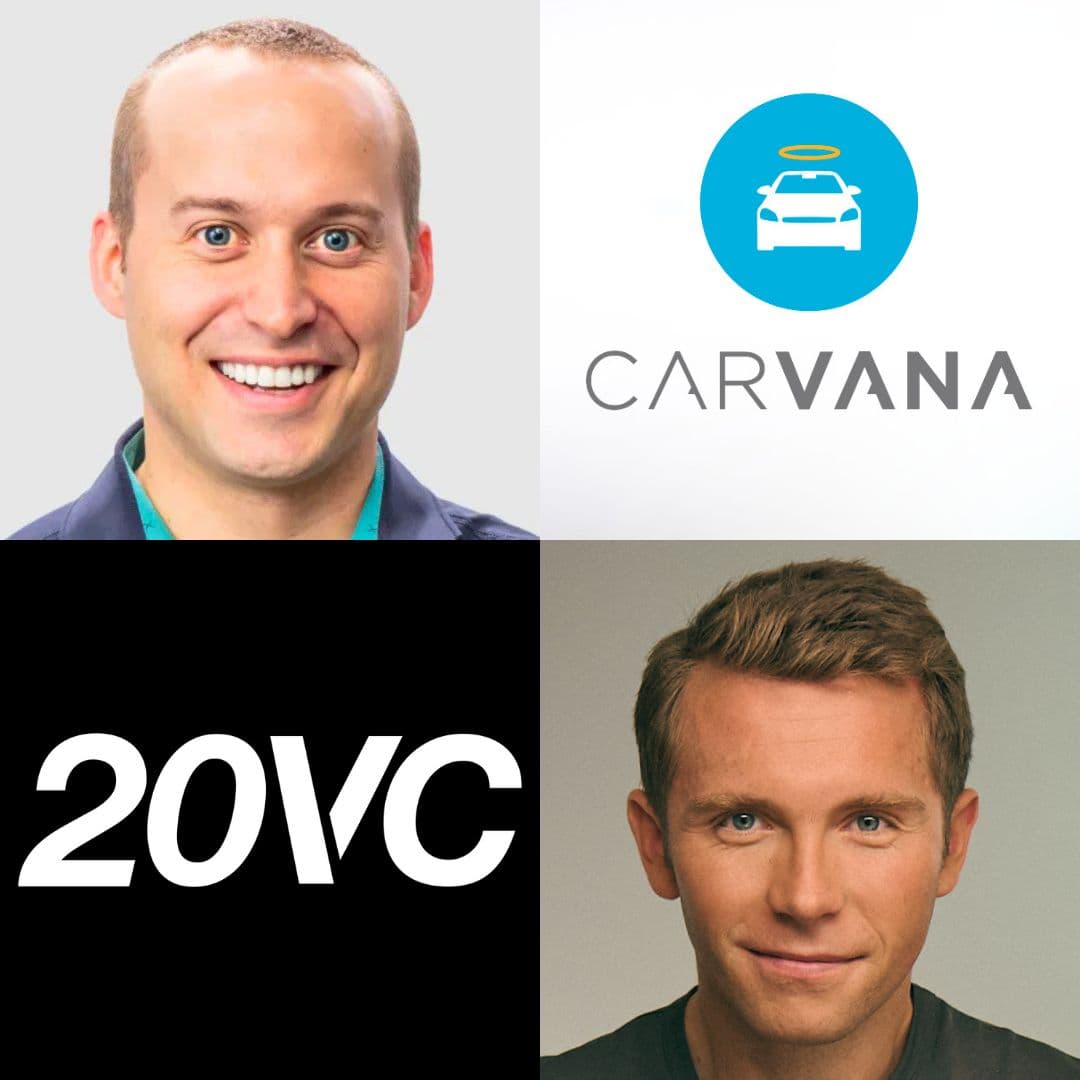
Podcast Overview Title: The Twenty Minute VC (20VC) Host: Harry Stebbings Featured Guest: Dan Gill, Chief Product Officer of Carvana Episode Title: Carvana: The Most Wild Story in Public Markets: From $60BN to $400M and Back to $40BN Episode Description: This episode shares the remarkable journey of Carvana, a car retail company that saw its market cap soar and plummet dramatically, ultimately rising to $41 billion. Dan Gill discusses the challenges, strategies, and future of Carvana.
Key Highlights
Carvana's Market Journey
- IPO’d at $2 billion.
- Peaked at $60 billion.
- Dropped to a low of $400 million (99% loss).
- Currently valued at $41 billion.
Reflections on Growth and Challenges
- From $60BN to $400M:
- Key mistakes and missed opportunities.
- Maintaining team morale during drastic value loss.
- From $400M to $40BN:
- Identification of core drivers for recovery.
- Economies of scale benefits.
- Impact of vertical integration on profit margins.
- Future Prospects:
- Potential market for selling new cars.
- Exploration of peer-to-peer car sales despite previous failures.
- Consideration of adding Chinese cars to their platform.
Product Insights and Advice
- Product Development:
- Importance of understanding customer needs and preferences.
- Key considerations for product prioritization and development.
- Advice for startup founders regarding idea selection and north star metrics.
- Team Structure:
- Lessons learned from restructuring teams for better prioritization.
- The significance of accountability in team dynamics.
- Operational Efficiency:
- The importance of vertical integration in maintaining competitive advantage.
- Strategies for improving unit economics.
Key Metrics and Frameworks
- North Star Metric:
- Identifying what drives the business's growth and customer satisfaction.
- Prioritization Framework:
- Focus on one major improvement to maximize impact on overall business performance.
Leadership and Company Culture
- Dan Gill shares insights on leadership during difficult times and how transparency and communication foster trust within a team.
- The cultural difference of being based in Phoenix versus Silicon Valley, emphasizing grit and commitment among employees.
Takeaways
- Exceptional Outcomes Require Exceptional Effort: Hard work is a requisite for success, especially in competitive markets.
- Prioritization is Key: Focus on impactful changes rather than trying to tackle everything at once.
- Transparent Communication: Maintaining an open dialogue with teams can help navigate through challenging periods.
- Adaptability is Crucial: Companies should be agile and willing to adjust strategies based on real-time data and market conditions.
Conclusion The story of Carvana encapsulates both the risks and rewards inherent in the tech-driven automotive industry. Dan Gill's insights provide valuable lessons for entrepreneurs and leaders, particularly in product management and team dynamics, highlighting the importance of resilience, strategic prioritization, and customer focus.
For further information and to listen to the full episode, visit [The Twenty Minute VC](http://www.20vc.com).
Written by AI. May contain mistakes. Listen to the episode to check what was said.
Transcript
Automatic transcript. May contain errors.0:00We IPO'd at about two, we peaked at about 60 billion, we dropped back down to 500 million, and we're back to 50 billion. The fun thing about dropping by 99 % is that the difference between a 98 % drop and a 99 % drop is another 50 % drop. This is 20 VC, and I am so excited for this show today. Kavanaugh is one of the most wild stories in the public markets. the company IPO'd with a market cap of $2 billion before skyrocketing to $60 billion. Only for the company to lose 99 % of their value, hitting a bottom of $400 million in market cap. Today, the company is stronger than ever and with a market cap of $41 billion.
0:47That is a hundred X in the public markets, utterly insane. Joining us in the hot seat is Dan Gill, co -von as CPO, the man who oversees all technology functions, as well as strategic partnerships for the company. But before we dive in today, if you're building a B2B app and want to sell to enterprises, you'll need some really important features like single sign -on, user provisioning, audit logs, and fine -grained authorization features that take just like months to build and maintain it's a nightmare. Well, that's where WorkOS comes in. WorkOS is modern identity platform that makes adding enterprise features quick and painless with flexible APIs and tools like Enterprise SSO, Direct Resync and Fine -Grained Authorization.
1:28Work OS helps you move upmarket really, really fast. Trusted by companies like Poplexity, Vacelle and Sierra, Work OS gives you everything you need to win. Enterprise customers, including a free auth kit for up to 1 million users. Check it out at workOS .com, that's workOS .com. Now that you've nailed Enterprise features with Work OS, Let's talk about creating amazing product experiences. Get your users to do what you want them to do. That's the simple power of Pendo, the only all in one product experience platform. Pendo combines analytics, in -app guidance, session replay, feedback management and road mapping, all purpose -built to work together seamlessly.
2:09Trusted by over 10 ,000 companies, Pendo is transforming how businesses understand and engage their users. Plus they're the creators of Mind the Product, the world's largest product management community. See the magic for yourself, visit pendo .io forward slash 20 product hyphen podcast to get started. You have now arrived at your destination. Dan, I am so freaking excited for this. I love the carbon business model. So thank you so much for joining me today. It's really an honor. I've admired what you built and you've got quite a record of impressive guests. So I'm honored to be here. Well, my friend Flashry will get you everywhere, but I do agree.
2:48It's been a fun journey. Now, I heard from a mutual friend that you were US gymnast. That's a rarity on the show. So, can you actually just start with how did your time as an athlete impact your approach to growing companies first? Yeah, I mean, gymnastics influenced me in every way. I'm incredibly fortunate that I found it. I'm not a large human. And so I probably would have been pretty mediocre at almost any other sport. But I am a very intense person and a hard -wired competitor. And so at least I had an outlet in gymnastics. The shortest version is I did my whole life. I did it through college.
3:27I got to compete for the US, as you mentioned. And I took a shot at the Olympics in 2004. And so leading up to the Olympics, I completely shredded both of my shoulders, like ruined them. And so I decided to stop seeing doctors so that that I could take my crack at the Olympic Games. And so I go to try and make the Olympics in 2004. I finally get to the trials and, you know, an underdog to make the team. But on day one, I have like the competition of my life. I did high school in Northern Virginia and so the Washington Post is like, local kid might make the Olympics. And it was like this big thing.
4:00And then on day two, I fell on my best event, which you cannot do. And my Olympic dreams were over. So I go back home and the doctors say, you can't do gymnastics anymore. You've done irreparable damage and you just would never be able to do it again. So it was just sort of like taken from me and I had planned to continue competing for a while and whatever. But it ended up being just such a blessing in disguise. I had surgery straight away and I immediately started looking for jobs. And so sort of the full circle of gymnastics is that it gave me a work ethic and a perseverance. And you know, those are the attributes that I seek out and others and try to surround myself with when we're gonna pursue enormous goals together.
4:41Do you think young people today want to work hard enough? No, and I would say it's not for everyone. I also think if you want to be exceptional, there is no other route. Exceptional outcomes require exceptional effort, period. So I try and still add in my daughters, certainly, and look for that in terms of who we're gonna add to our teams, but I don't think it comes for free or is the default. I'm just throwing shit out there. It's Friday. I don't want to have fun today. I'm just going to sit there about adding people to teams. A lot of people go into product from consulting. How do you feel about the right background going into product?
5:17Do you like consulting? Do you not? What's optimal? We've had great success with a small number of consultants that have joined, but you've got to look for that very specific type. It is the person who comes from consulting and says, I hate it. We do all the research and we make these recommendations and then we hand it off to someone else to either do it or not do it. And I hate it. If you get the type of consultant who says, I know everything and now I should make all the decisions, absolutely not. It's you need the people who have been put through that meat grinder. Consulting can be very hard work, but you need the people who hate it because they don't get their hands on the finished product and they don't get to see it all the way through.
5:57And we've had incredible success with that archetype, but not the type that thinks like, Now that I've seen the way that a dozen companies operate, I'll tell you how to operate yours, because operating is hands -on business. How important is it to have people in product who've delivered products to that customer segment before? Say, if you're doing consumer social, they've done consumer social before versus B2B. How important is that past domain expertise in product? I would say it can be valuable, but it is not what we index on. When I'm hiring, I use two attributes, and I've sort of tried to pass this through the organization.
6:34The two I look for are horsepower and give a shit. That's what we look for in the hiring process, because the fun thing about Carvana is there's basically not a single person at Carvana that's done their job before. We've taught people about the automotive industry and put fresh eyes on a lot of assumptions about the automotive industry that are really long held. And so being able to question that in the event. and test horsepower in a hiring process. I will often ask what their favorite piece of technology is. I want to know if you're gonna say what your favorite app is or favorite piece of hardware or whatever, you better have gone into the advanced settings and know what's buried under there and be able to compare and contrast it relative to competitors.
7:19And why do you use that? And what did you think when you used the competitive product and what are the differences? And why did they make those decisions? and if the CEO handed you the keys to the product, what would you do differently? Those sorts of things you can really assess horsepower. Forgive a shit, my favorite question is to ask, what is the hardest you've ever worked in your life? And I'm not necessarily asking, you know, at work in your job, I'm asking anything. It could be that in high school, you had a sick parent and you were trying to be on the track team and you were trying to get into school and it doesn't matter.
7:53It's just demonstrating that you have gone through something incredibly difficult and you've pushed through and I want to hear That you have that intrinsic drive. Let's fucking go. When did you work the hard? Tell me that when did you were like you're like that time? Well, I mean I found it and built a startup for seven years and and you know That's not hard to work than being CPO of cov owner. It is harder I think the CEO seat is the is the lonely a seat there is the adage that that shit rolls downhill and and I think most CEOs Know that the most toxic stuff rolls all the way to the top and sort of by definition It means that all these incredibly capable people that you trust to do so many things for your business and that they are really Exceptional and you've chosen to work with them have decided they can't make the decision and they need you to do it And so the CEO -C is the worst of the worst.
8:47And I didn't have a single moment for seven years where I didn't feel the crushing pressure of making sure that all these people who had chosen to work at my startup, we're gonna stay employed and have a great outcome and we were all gonna win together. And it's a crushing experience. I think we have a lot of former founders on the Carvana leadership team and throughout the business. And so we bring a lot of that founder mindset and accountability, but it's different. Everyone says that being a PM is like being sea of the product. Do you like that analogy? I don't. I think that being the PM you need to be obsessed with every aspect of the experience and I think that you need to really, intimately, understand the system.
9:31What I mean by that is any good experience has so many inputs and so many outputs and you really should have a fingertip sense of the relationship between all of those inputs and outputs where if you're going to make an improvement to one part of the funnel, you should have an intuitive understanding of what you think will happen as a result of that, and you should know how to prioritize as a result of that. But the CEO and saying, I own a P &L is so much less important, really, of saying, what is my total payroll and what are the payroll taxes associated with that and the total expenses. There's a lot of things that you need to do as a CEO that I certainly don't what product leaders have to think too much about.
10:12I think they need to be obsessed with the customer experience and with the metrics that they're moving. Let's talk about prioritization first. There are a couple of like hotspot words that I heard that I like want to dive into. You mentioned prioritization. What are your biggest lessons on product prioritization that you've had over the last 10 years? Corvana has been completely obsessed with unit economics from the beginning. is not right. And I don't mean that rudely, but there are some marketplaces and companies where you have to be elastic to unid economic change. And so it's okay to be negative for years if at scale it becomes really positive.
10:50Revolution is a good example in the bank. I think you're 100 % correct and that is our experience. But the Excel model that our CFO built 10 years ago has been quite prescient when we said this is where our long -term margins will come from. This is where the economies of scale will come from. These are all the areas that we want to vertically integrate so that we have massive unit economic advantages. That was laid out and some of that takes a long time to come to fruition, but it's been built very intentionally in a very specific order. Can you help me understand how does the margin improvement in Calvallna happen?
11:28Is it you get discounts on bulk buys of cars? Is it you get better at transformation margin? Can you help me understand how that margin profile changes from bluntly really challenging to really get? Yeah, absolutely. A lot of it is about vertical integration. So when I get to explain carbonate to new employees or to investors, I use one super zoomed out slide to start with and say, look, we sell a commodity product. And if you can sell a commodity product and capture more profit than anyone else can, and I don't mean raise prices, I mean capture more of the profit pools surrounding the transaction.
12:08And in an automotive, that is financing, that's insurance, that's accepting trade -ins and being able to monetize those effectively. There are a lot of hands in the cookie jar of any given automotive transaction. So if you can grab more of the profit pools associated with that transaction and you can spend less on a variable expense basis, you know, at a dealership, that's the sales guy, the sales manager, the finance person, the finance manager, all of those sorts of things. If you can drive those variable expenses down, that also means all the third parties associated with the transaction. You're inheriting their cost structures, you're inheriting their profit margins anytime you're using third parties.
12:49So if you can do more of the work yourself as a first party and drive those expenses down, now that transaction is worth more to you than it is to anyone else. You're generating more of the profit pools, you're spending less and you have a greater profit per transaction that you can give back to customers in the form of lower prices or repeat purchase incentives and other ways that make you very, very difficult to compete against over time. And so that was the vision is let's capture more of these profit pools and vertical integration. Let's reduce the variable expenses aggressively and now we've got a massive unedeconomic advantage.
13:23Now some of those expansionary products that you mentioned there from financing to insurance to trade -ins will be more impactful than others. What was the most impactful from a margin transformation perspective? Financing is a huge one. In the automotive retail, about 90 % of transactions are financed. And because the industry is so fragmented, it's basically just outsourced to lenders. And so dealerships generally get basically a lead Gen -Fee, about 1 .5 % of the amount financed of the car. But the lender is making closer to 10 % of the amount financed, right? Because these are multi -year loans and they're collecting interest throughout and net of all their expenses, et cetera.
14:05So on a $25 ,000 car, that's about $2 ,000 of profit per car in spread. And so we built at Carvana, we've built ourselves as a full spectrum lender. We do our own proprietary credit scoring, loan structuring, decisioning, underwriting. And even from the beginning, we had 60 % attach of Carvana's financing. We did more than 10 ,000 combinations of down payment monthly payment APR and loan term on a per car customer basis, pre -calc everything. And so by just making it transparent and intuitive, we had higher attachments than we ever thought we would get from day one. As simple always better in product, you said about transparency there.
14:48I'm thinking simple UIs, incredibly minimalist, is simple in product always better? Yes, simpler is better. As product leaders, we spend a lot of time sanding the frictions off of experiences. And that's a good intuition. And I know that at so many points in Carvana's life, we've had instances of just trying to get a little bit too cute in terms of how much customization we offer to people versus just giving really thoughtful defaults. On the other side, sometimes you pick your battles and you need to take a really big swing. I think the best example for us was that from day one, we did 360 degree photography of every single vehicle on the site.
15:29you could spin the car around and fly in through the window and do a tour of the interior and all of these things. It was a very complex and new experience for customers, but it was also fundamental in establishing Carvana as the future of Carbying. We wanted it to feel different. So what do you think different is better in product? I always oscillate between customers like what they know, just give them what they know. versus actually sometimes a new product paradigm is amazing and differentiated and leads to what it is. How do you think about that? I think don't make me think. As a consumer, you need to feel comfortable, especially in something that's not habit -forming.
16:13People learn to use snap over time, and I found snap to be utterly unintuitive at the beginning, but it was habit -forming, and they they did teach people a new paradigm that was ultimately different. If I'm trying to find something on an e -commerce site, being able to search and filter and see results and click through, you don't need to fully reinvent that paradigm. But for example, on how we want to, you're not gonna get to test drive the vehicle, right? You're not at a lot going and sitting in every single vehicle. We need to bring you as close as humanly possible to every single detail. We wanna show you if there are cosmetic things that we chose not to fix and we're going to take a high resolution video and let you look at it so that we set really, really accurate expectations.
16:57And that was completely different from anything that had ever been done in automotive retail because we had to solve a very specific consumer problem. You mentioned the multiple different products there. I'm really interested to hear about how you think about a review, so to speak, of what you've done. What did you do that you wish you hadn't done with the benefit of hindsight? Well, I would say my biggest regret is more of a team structuring regret than a specific product decision. So for the first many years at Carvana, I said that my job was to build a machine that can parallel process the needs of the business.
17:32And there is a lot of truth in that. You need to build capabilities as primitives that can be snapped together and for a vertically integrated business like ours. We do need to do many things at once. But I took it too far at one point we had 90 very small teams working in parallel. But that also means 90 different prioritization cues. And ultimately there are not 90 number one priorities. The fifth priority of a certain team might actually dominate the number one priority of many other teams, but they're not going to get to it because it's fifth on their queue. And so what we did in 2022 is we went from 90 back to eight and we forced so much more cross -functional prioritization and we asked resources to be more flexible between teams and to have a willingness to jump into different projects and reprioritize more dynamically.
18:25And this ended up being so huge in putting more effort and speed behind the most important priorities in the business. So if I'm an early stage founder, what should I learn from that? Don't allow for siloification or fragmentation of teams. What's the takeaway? I think that's exactly right. I think it is to be incredibly disciplined and rigorous about your prioritization. There's such a temptation to want to do all of the things at once, but probably the product advice I give more than any other piece of advice is if you can only change one thing and you have to hold all other things exactly as they are right now, what is the one thing that you want to change.
19:06What I mean by that is you have to understand the complex system and we can all look at any product or any piece of technology and think of so many things that could be better, but you have to say, if I take this one thing that I want to change and I make it perfect, what do I think is going to happen? How much lift am I going to get in conversion or ultimately in the unity economics of that business? Because you can't change everything all at once. You're too diffuse with your energy and your effort. And so you have to force yourself to say, if I make this thing that I want to change absolutely the best I can possibly imagine it being, what's going to happen inside of this complex system?
19:42And then really focus your energy on the one that you have the most conviction will have the largest impact. And you've got to serialize more as opposed to trying to parallel process. I'm a startup founder. You're an angel in me. Thank you for your belief, by the way. Of course. Your money's just going up in flames if you invest in me as a startup founder. My question to you is, OK, that one One thing, how do I know which one to choose? What is the advice on the right nor star metric and how to know you've got it right? Because you can walk down a path of many one things. Choosing the one thing isn't that there is only one thing.
20:15It's about putting them in order. And so what I like to ask founders when I'm working with them or investing in startups is how is it that your moat gets wider and deeper as you build? And I want to hear how you're sequencing those choices and saying once we've got the incremental gross profit of being able to originate these loans, right? And we're making far more gross profit than anybody else. We're going to plow that back into market expansion. And as we do that, we'll have a broader selection to choose from. And that's going to increase conversion of people who are coming to the site. And also, as we then increase conversion, we can hold more inventory.
20:53That's going to get the inventory closer to the customer, which drives delivery times down. And that's going to increase conversion even further. So I can add more inventory, right? And these things build on one another. It is a flywheel. Thank you, Jeff Bezos. I want to hear how you're going to sequence many one things. I just don't want to hear that you're doing them all at once. How do you think about staging product expansion? That's the other hard thing. I totally get you not doing it all at once. You're absolutely right. But you have the opportunity to create a product suite as you have done brilliantly with Carvana.
21:23When is the right time to add another product? Well, working in enterprise software earlier in my career, I was sort of a Jeffrey more accolade, right? So you've got the crossing the chasm and other books to rely on a bit there. It's one of my favorites. I read it when I was like 14, 15 at boarding school. I was single for all of my teenage years. And now I... It's shocking. I didn't know what it was. I was like, you know, are you an early adopter of being a snap? And like, what have you crossed the chasm? I know one If I can raise that. I think that what we like to hear is how does that particular effort accelerate the spin of the flywheel?
22:02So let's use Carvana as an example. We could license so many pieces of software that we've built. There's a lot of companies in our industry that would love to use software that we've built. The idea of us generating $10 million of incremental SaaS revenue or $100 million of incremental SaaS revenue doesn't actually make the core business better. That is contributing to the core flywheel as opposed to building an ancillary product. And so we like to see the ways in which these product offerings accelerate one another and make the core offering better and better and better. Okay, so it has to go back to the core offering and it has to drive value there.
22:41What product decision did you make that was the biggest mistake in Carvana's time? This is a fun one. It's a fun one. It's somewhat counterintuitive. One thing that we did early is we wanted to offer free shipping for everyone. We are an e -commerce business and we want to give you a broad selection and our cars are in these 100 acre facilities around the United States. Like 5, 6 ,000 cars on the ground. We have a nationwide logistics network that we own and operate and we wanted every car in the network to be free for every customer in the network. because the trueism of e -commerce is that you must have free shipping and consumers love free shipping.
23:20So you think, okay, that seems reasonable. But in our case, the costs are very high. How much does it cost to ship a car? It depends, but we were shipping cars upwards of 1 ,500 miles. If you're gonna move a car from Philadelphia to Fort Worth, Texas, and while it's in route, the customer says, Oh, sorry, I bought another one while I used the free option. You gave me for the one that you were sending. I bought a different car. That's very expensive to us. And now we've got to basically restock that car. We've got to find another customer. Meanwhile, these are depreciating assets. They're losing value with every passing day.
23:56So what we then came to over time is that we can't allow for that and we need to charge for shipping when you're moving a car from a long distance. We want to offer free shipping. If we have a car that's close to you, It's still a wonderful value proposition to say, this is free delivery to your door, and we want to offer that. But if we're going to move a car a long way, we actually added in a non -refundable shipping fee to just create a little bit of friction at that moment to say, we're going to start moving this thing, but it's going to cost you money and it's non -refundable. And what ended up happening is as a result, we unclogged our network from wasted access transport, that brought delivery times down for everyone.
24:37We have fewer late deliveries from this sort of excess clogging of the network and we sell more cars So by taking away free shipping we actually sold more inventory. What's your primary customer acquisition channels stay done? We like many have come around to the fact that brand advertising is incredibly powerful and that we want Carvana to mean something as a brand to our customers and so we spend a lot of time storytelling. What are your biggest lessons or piece of advice when it comes to effective product storytelling today and product marketing for founders listening? People like to conflate storytelling with sales and they like to shit on sales.
25:23I don't want to be in sales. And the truth of the matter is you're in sales and you better be in sales. You better be in sales to attract incredible talent, but you also should be storytelling because it's motivating and inspiring for your teams to know what they're chasing after. Let's contrast it to not having a more fulsome story. When, you know, if you look at a particular product and you say, we've got to make this product massively better. An engineering mindset may say, like, well, I see the thing that's broken and I'm going to fix the thing that's broken because nothing else matters until we get better at this immediate next step.
26:00But you're actually trying to get many, many people to collaborate and work on this thing and telling them, no, we're trying to get way over there. And when we get all the way there, this is how much better the unit economics are going to be and we can give a better customer experience and a totally differentiated offering, which is going to help us carry more share of market, et cetera. People are more motivated and more excited to go chase after that. And so you need to be able to paint a high -resolution picture of what that future looks like so that people when they get completed in the what you've asked them to do, they understand the why and they can keep going autonomously and independently.
Read the full transcript
26:38I just think that being able to paint pictures of the future is absolutely requisite and it's something that you should work really hard on. What's a good picture of the future and what's a bad picture of the future? I hate Zoom. It's like, may everyone happy? Who's going to be like, no, I disagree. I want sadness and still to plan everyone. It's completely ridiculous. Like, you know, VED20VC is very explicit. We are not for beginners. If you don't get what we talk about, no worries. This is not the show for you. We are full or against a brand, and that is great. Nike and Adidas, McDonald's and Burger King.
27:13What is good, not good? Exactly. As you said, be intellectually honest. Be transparent about what you are and what you're not. So for Corvana, we have always said that we intend to build both the largest and the most profitable automotive retailer ever built. And we're unapologetic about the fact that we are building a highly profitable business. And we're going to do that by offering the best experience, the broadest selection, and the best value for consumers in a way that allows us to capture market share that no one's ever captured before. What is the best experience, uh, margin most? Well, it certainly sub -scale trying to move cars across the country.
27:53There is so much underutilization of assets. These are big nine car haulers going down the freeway. And if they've got three cars on them, it's not a very good use of expenses. Um, but you have to be willing to move those trucks and get cars to customers. Because if you say I'm going to wait until the nine car hauler is full, then I can only tell you I will get you your car somewhere between three and 11 days from now, which is not a good customer offering, and it's going to take a long time, which is low converting. And so you have to be sort of willing to absorb some of that underutilization for a period of time, but then once you get to the point where you're actually sort of fulfillment constrained, instead of demand constrained, there's so much incredible optimization work to be done, where we get, we've done so much software building around intelligent labor utilization and logistics network and fulfillment utilization to make the unit economics really, really sing.
28:50And that takes time. Do you know the lesson that I have from interviewing 30, 40 of the best CPO in the world? Lay it down. The lesson is the best, or not product people weirdly, or they don't sound like product people. They sound like intense business leaders who understand unit economics and product better than anyone else. And the good just get product and the bad don't get either. Yeah. The combination of getting business and unity, con and product is what makes the best. Do you agree or is that a stilltid view of what a great CPO is? I completely agree. You have to be unapologetic about the fact that you're building a business.
29:31We say we do not win by shipping features, we win by moving metrics. And ultimately, while there are so many input metrics, and you should have a very clearly defined unit economics driven hypothesis for why we're taking on any given initiative, and you should have leading indicators that you're measuring from minute zero of launching a new initiative, and looking for evidence that your hypothesis is valid or invalid. Ultimately, if it doesn't drop to the bottom line, you have not contributed to anything. It has to ultimately show up inside of the business, and we are unapologetic about that. It is everyone's responsibility to care about that.
30:08That's product, engineering, analytics, design, operations. It is everyone's responsibility to care about the initiatives that we've taken on and what we're prioritizing and seeing that all the way through to economic impact for the business. And so, yes, I think it's absolutely the case that everyone should be rigorous there. I mean, I'll ask you a rude question. Do it. Is it difficult being a CPO in a company slash business where the product is almost not the software product? And what I mean by that is the delivery time is really important, letting me know where it is and when it's coming, and then ultimately, it's on my drive and it's as I thought I would.
30:47That is really the product. The pixels that I discover it with, yes, important, but nowhere near as important as the other two. Is that difficult being CPO in a world of that? Not at all because the technology is what unlocks all of those capabilities. If you really want to get a car a thousand miles as fast as possible and profitably, there is so much technology to be built to do that. You have to have all of these vertically integrated systems. You cannot have humans in the loop for every single decision. And so our articulation of that, when I would hire engineers early on, and there was all this thing about there are certain companies in Silicon Valley that are engineering led.
31:29And I would say, we are not engineering led. We are customer led. And you need to be completely on board with the fact that we're trying to unlock more and more value for customers by doing so. We're going to win a very big game by a very large margin is everyone not customer led. I think that this notion of being engineering led can sometimes be trying to romanticize and give too much control or a perception of control of it's really all about the technology. If you build it, they will come and that is not singularly true. I think you need to have a go -to -market muscle and you need to have tight feedback loops and analytical rigor and obsession and there are emotional aspects to using any product that really matter in psychographics and all of these things.
32:17I think you do have to actually be customer obsessed and I don't think that every organization evangelizes it in the same way. You mentioned tight -feed bot loops there. Every product team has product reviews, but they sum a dumbbell in me and sum a dumbbell in me terribly. What have been your biggest lessons in how to do effective product reviews? You can hide from the metrics. Several years ago, we took on an operating cadence where there is at least one executive team member, sometimes more than one that meets with every single team in the company every single week. And we do a review of what did you say you were going to do last week, what actually got done, and what are you going to do this week?
32:56And then how are we seeing that in the results? You have to have a hypothesis for why we're taking anything on, and those hypotheses have leading indicators of whether they're true or not. Every single week. What do you do when there is a team that consistently has a chasm between what they said they were going to do and what they do? reconfigure the team. We like to have single threaded leaders that are highly accountable for those initiatives and the prioritization and execution of those initiatives. And so we look to that leader and really try to understand their diagnosis for why it's working or why it would not be working, but it is that leader's responsibility to ensure that it is or to change course.
33:35What extent do you listen to team members on product reviews? And what I mean by that is, I think we should do this. That's great, Dan, back in your box. Yeah, we love the ideation coming from everywhere. We have a number of product managers in our organization that were customer advocates. They were on the phones listening to customers and dealing with customers all day every day. We have ones that were loan underwriters. We have ones that did home delivery of vehicles. And they know how the experience actually works and where the tooling has been falling down and where the frictions are and how to make those gains.
34:08And so we love that coming up from the bottom, but we have a very high bar for rigor. You better have a hypothesis for why this is going to matter. And a good framework for that is the magnitude of impact times the frequency of occurrence. You can say that something is a horrendous experience. But if it happens one in every 50 ,000 deliveries, that's not a very good thing to bring to the table. Even something with medium pain that happens one in every 50 deliveries is much more important for us to pay attention to. And you can distill that into a unit economic impact. You can say, what is this doing to our cost per unit or what is this doing to our profit per unit?
34:46And we ask everyone to collapse their ideas into that unit economic framework so that they can be compared apples to apples. Gustav from Spotify, who I think is one of the best CEOs in the world, he always says, talk is cheap, so we should do more of it. And now I fundamentally disagree with this. I think speed of execution is everything. And actually, I think dictatorial product leaders generally work best. It's like, you've got to appease people and make them feel heard, but ultimately, we're going to go. So what extent is he right versus I right? Clarity of thought and clearly articulated strategy is very important.
35:21And so whether that's an Amazon 7 -pager or, you know, what do you do? Do you do a 7 -pager? Do you do slide decks? We do like written communication. Written communication is hard to hide. You have to distill your perspective into clearly articulated pros, and you can't hide. And so, well, that's not what I meant. It's like, well, you wrote it down, as opposed to if you just presented in slides. So, we really like written communication for PRDs and proposals of major initiatives in the business. I really agree with you on the importance of writing. What do you think are the most non -obvious other skills that product people or the best product people have?
35:59You mentioned their writing, we mentioned business mindedness. Any others way you're like, when I look at my team, the best have this less obvious skill. High accountability is the number one thing you have to look for where people take it personally when things aren't succeeding. And it's just that willingness to go the extra mile, to go and watch the customer session replays and to take notes and to do the product tear downs of competitive products and compare and contrast to sit and read every word of copy on the page out loud, feel embarrassed when it's not intuitive. It's that taking it personally that you want to get it right is the number one thing that we look for, is just that willingness to want to go the extra mile and to want to sweat the details.
36:46A lot of founders worry about take home assignments when they have someone amazing, an incredible talent coming from a top company and they're like, I don't want to give down a take home assignment. He's so, so kind of important. How do you advise founders on take home assignments, how to do them right in product and what not to do? Well, let's go the other way first and say the single best way to hire someone into an organization is for them to reach out to you with a vision for how your organization gets better and they're so passionate about it and they already have ideas. When ever anyone asks me, could you connect me into any companies?
37:21When does that happen, Dom? It is rare, but it happens. There are those people who, at least when they say, can you connect me into company X? Well, I say, why do you like that company? And it can't be like, oh, I heard they're doing well or I see their stuff. I hope they just raised me around. It needs to be, I love the approach they're taking and I want to be a part of doing this. And even if they don't have that, I will encourage them, you need to go and create that for yourself. You need to write down why you believe in this business. And proactively, I mean, there is nothing more magical than being a founder and having someone tell you, I love what you're doing and I want to be a part of it.
38:01It's the most intoxicating feeling because you're so self -conscious, you have so much pressure on yourself and have someone that sees it and gets it and wants to be a part of it. Is it just an intoxicating aroma for a founder to feel. So let's start with that, that you want people when they're applying to be very specific about why they're applying. They're not just lobbing in a resume and hoping that you say yes. So that's one thing. Two, when it comes to, can you have them do take home assignments absolutely? I think you need to. This was something I learned very early in my career when we were selling enterprise software, is I had a sales leader say, how can you hire a rep without making them dance.
38:38That was really stuck with me is how can you ever possibly hire someone who you're going to trust to speak to your customers without hearing them pitch a product? And you have to hear that. And I think in product, how can I trust someone's judgment without asking them to first put their thoughts in writing and break down a problem and hear how they would approach it? How do you think about the challenge of whether to get them to work on Covana where you have a huge amount of knowledge, asymmetric information, And you'll probably just think that everything's not great because it's not a level that you are having spent years there versus a neutral product where you start on a level playing field.
39:13It is an asymmetric advantage, but we always have them do Carvana problems. And we'll try and make it something that is relevant to us. So we'll stand up, you know, a dummy SQL database and say, query this and tell us what you would do in this strategy to increase a touch of warranty products on a sale or, you know, what's that going to do to the unit economics of the transaction? And we'll give them a bunch of historical data and it'll be non -intuitive so that you have to sort of fair it out, those non -intuitive realities that are buried inside of the data and then come to a conclusion on what you would change in the interface to make it better.
39:48And you're right that it's an asymmetric advantage that we understand it quite well, but you get to see level of effort and critical thought and the versatility there. And so we aren't hesitant. We also don't hire super, super senior people. we like to grow our talent from within. And so I would not have the issue of, boy, this person's such a big deal. I can't possibly ask them to do homework. We're the insider of a 10X engineer. Hi, the 10X engineer overpay them. There's no question that there are individuals in almost any functional organization that are many fold more effective than others.
40:22And I think that that often has more to do with work ethic, accountability, pride those sorts of attributes than just raw intellect. I should be honest, we are not building AGI here. You can have singular insights that unlock. But I do believe there are people who are better at turning big problems into small problems and executing with urgency and accountability and that can really move mountains as individuals. You're not building AGI, you are delivering cars. But that is very important and you have to, I'm sure, come up with ways to tell Ernie about ways that you are leveraging AI to make your margins better, your product better, because you're a public company.
41:08And every public company needs an AI story. Do you agree with that that every public company needs an AI story? And as a CPO today, how are you thinking, how can I leverage AI to get as much juice out of this as possible? 100 % and we've been all in on AI for years. So zoom out for a second and say that a computer can only give an answer to a customer or take an action for a customer if the computer has access to that information. And in automotive retail, there are so many human decisions. You're negotiating the sticker price of the car, you're negotiating the finance rate, you're negotiating the trade in, you're negotiating all of these individual things.
41:48Whereas in our world, all of these systems are deterministic and algorithmic and have been built that way from day zero. And so we can have an LLM tell you, Harry, given your credit score and the vign of the vehicle that you entered, you have $3 ,000 of positive equity on that car applied to your financing. That will unlock a 7 .4 % rate. And this Tesla Model Y will now be $612 a month with $1 ,000 down. That information is knowable in our world and it is not knowable in the sort of physical dealership world and the vast majority of cases. And so we lean very hard into AI because we think we're structurally advantaged to leverage it and offer increasingly frictionless experiences to our customers.
42:33In the UK, we call it throwing in and grenade, yeah. I told you this Friday, so I'm just going to have a bunch of old stuff. I often think it was where I say if we're in the same city, it would be buddies. Yeah, yeah. And then you meet other people in your life, we wouldn't be. But my little grenade throw in is BYD is crushing in London. They are everywhere. Now I'm a believer in Adam Smith's invisible hand, minimal market intervention. And then I saw the other day how the unity economics of these Chinese cars are being subsidized so heavily. It is not a fair game when the Chinese government pays for 30 -40 % of the cost.
43:18To what extent is Chinese cars a net negative for your business? And do you worry? On one hand, for any new brand to want to enter the United States, think about what it takes to get cars in the hands of customers. How much capital and how much time to get land and get zoned and get staffed and start to fulfill and get those cars in the hands of consumers. Would you sell Chinese cars? I think that that's a complex sort of geopolitical question of what are the right moves for the government to make in terms of allowing US automotive manufacturers to thrive and grow and protect them from this very subsidized unit economic model that could come in.
44:02I'm being on payahdan. Do you think Carvana should sell Chinese cars? I think that we should be selling other people's cars and we want to be Amazon for cars. We want to be able to distribute the cars that consumers want. Wondafely ambiguous. That was beautifully done by the way. I don't think Americans want Chinese cars. You guys are so, the sentiment against China from you is very different in the UK. What do we not see about Carvana that we should see? And what does the world not understand about this business that you're like, that's the really special thing? I think the amount of vertical integration that we've taken on is pretty staggering.
44:42It's hard to see from the outside. There's I think early on a bit of a misconception of, oh yeah, I can buy a car online. I go to Google, I search, and I see cars. That's a listing site. you're going to go to a dealership and transact that car. It's not an e -commerce model for automotive. When you look at the number of companies that we've had to build, we are a full FinTech. We're a lender. We have one of the largest automotive -reconditioning companies. What do you think you've vertically integrated that you shouldn't have done? I still look at Shopify and Stripe. And Shopify, I mean, in Stripe's partnership is incredible, but why Shopify is never vertically claims credit strike, I have no idea.
45:24Yeah. We pulled back on a couple of the bets, even bets that I mentioned today. And so we have examples where we said, hey, this is such a logical adjacency. Let's take it on and we pulled it back. Why did you put it back out of interest? That was during the 99 % drawdown of the stock where we needed to say, hey, it's time to focus on the core. Make sure that the Uniteconomic model is crystal clear to the world and get on better footing. and so that was part of the refocusing. Dan, the market cap stays 50 billion. The market cap was 5 billion? We IPO'd at about two. We peaked at about 60 billion.
46:04We dropped back down to 500 million, and we're back to 50 billion for the second time now. You dropped down to 500 million. The fun thing about dropping by 99 % is that the difference between a 98 % drop and a 99 % drop is another 50 % drop. It was a harrowing ride for a minute. I didn't know you dropped to 500 million. Yeah. Oh my God. So tell me, as a leader, what do you say to your team when it's 500 million? With the benefit of hindsight, it was so healthy for us to go through that together, because what you say to your team is, here's what the rest of the world misunderstands about the truth.
46:45What you're reading in the Wall Street Journal or what you're reading in any of these publications, let's be really clear about what that version of the truth is and then let's articulate to you our version of the truth. And then we're going to check back in in 30 days and we're going to tell you which one is more true. And so in 30 days, did we do exactly what we said we were going to do and as everything checked out that we told you before, yes, it has. All right, let's roll that forward another 30 days. And we We were just doing an enormous amount of communication through that about here's exactly where we're going.
47:17Here's how to express that in unit economic terms. Always our obsession. This is what we're going to do in terms of cost per unit. This is what we're going to do in terms of gross profit per unit. And this is how we're going to see through this storm and just share those results again and again and again. There are the people that opted out immediately at the beginning of that drop and said, like, this isn't for me. This thing's never going to make it. And I always knew it was never going to make it. There's sort of that crew and good riddance. Please move along. There's something that just couldn't handle the swings and that's totally understandable But those who chose to stay it has been so galvanizing as an organization to go through that process together and to rebuild that trust and say wow you were right We were misunderstood from the outside and we did do exactly what we were said We were gonna do so now what are we gonna do next and everybody's charged up and ready to run at that hill with the benefit of and having survived, I think we're in better shape than we've ever been as an organization and really poised for an exciting future.
48:16500 million. It's quite a drop. Oh, I'm just, I remember someone, we mentioned our friend earlier, showing it to me at like three or four, I think it was. Seems rich, it could go low. I'm like, oh, that's like a, oh. Just a nice hundred bagger. And this is what's amazing. that's a hundred -barget in public markets. Yeah. It's been an incredible journey. Wonderful people who really care. We're an organization based in Phoenix, Arizona. And there's a little chip on our shoulder that we're not, you know, Silicon Valley and whatever. But the truth of the matter is, I would pit our team against any team in the world.
48:57Why is being in Arizona helped you over being in Silicon Valley? You have to opt into the mission. You know, we kept a very high standard around these things like grit and accountability and problem solving and biased action and those things, once we sort of found the right people, they were fully bought in because if you have those characteristics, you can be employed elsewhere. You could choose to go many different places, but you're in Phoenix and you have chosen to be with Carvana and we've really built a very long 10 -year group, 90 % of our senior leadership has been with Kovanna since before 2019.
49:36So well before the drop. Our executive team has been together for 10 years. You know, we've built a real cohesion. I'm still getting over this 100 -barger. Now it's going to keep me up at night. You've ruined my day. Listen, I want to do a quick fire on, dude. So I say a short statement, you give me your immediate thoughts. So that's not okay. What's the most common reason early companies do not gap product market fit. I think that founders are often in such a hurry to found something that they aren't rational enough about what they pick to go and found. I think there's a lot of companies out there that are features and not products.
50:11So you better have a very clear vision for how that feature is a wedge to something much, much bigger or something indispensable for an organization, not like a, well, we're just going to build it and we'll wait and see. And so I really am obsessive about this notion of how does your moat get deeper and wider as you execute? And I think a lot of founders lack that vision. What do you know now that you wish you'd known when you got into product? That it's at least 50 % if not more about people and not just making product decisions. You know, fortunately I love people. I'm a pro social guy. I love my teams.
50:46But really, the leverage is in getting lots of people to move with urgency and to care and to understand the mission and the vision and to attack it. And that's a lot of what it's about. It's not just making product decisions and saying, let's go do this. You've really got to get a lot of people to run hard along with you. Well, it's the most recent wow moment you've had with a consumer product. And why that one? I have to give you two. One isn't crazy recent, but it's fun was the first time that my wife tried Google Maps inside of virtual reality and she was like tromping around our living room like Godzilla and like looking in our apartment window and and just like experiencing this immersive experience and I'm still a big believer in what's going on in the metaverse and and I'm very excited by where that all can go.
51:39I think a second one literally two days ago I got a Rivian and I'm obsessed with it. There's just so much craft in every detail of that car. Like the headrests have like a plaid inlay in the middle of them and when you're setting the flow of the direction of the air vents it's this beautiful animation and you can save it as your default so that when I get in the car the air vents point in a specific direction and my wife gets in the car they point in a different direction and there's just a lot of craft in that car. I love it. It's beautiful. God yeah, we really do live in hard times. Don't we?
52:13When I get in the car, the air in this car, God, God, life is tough. Hey, we're not doing the events left versus right. Jesus. I would not do your other part in history to live in. This is I'm happy to be here. Do you know what I find funny and it's going to ruin the whole interview? I don't even have a license.
52:35I've never driven a car. I don't get it. You don't have a license to that's wild. Well, I hope my daughters never have to drive. I think they'll be full self -driving. Question for you. Jaguar rebrand, terrible decision that will hurt the company, or weirdly genius move to get attention. I'm not a fan of the rebrand, if I'm honest. I think that Jaguar already means something. And when you built brand equity for so long and their brand has stood for quality and innovation and luxury and all these really great things. I think you could have reinvented product and really let the product speak and tell the story of why the product is different and better as opposed to trying to reinvent the brand, which I think already had plenty of value.
53:24I don't necessarily see it on the Heritage Adam and I understand they want to appeal to a new demographic, a specific Asian. for the Heritage Adam and Israel Asia loves. Yeah. What one piece of advice would you give to a product leader starting a new role today? Ultimately, you do need to understand the whole system that you're stepping into. And so I think product is really about having a system's mindset where I've mentioned this a little bit where you have to understand all of the inputs and all of the outputs and where the leverage is. And so my number one piece of product advice is always if you can only change one thing and everything else has to stay constant.
54:01What is the one thing you're going to change? Imagine that future where that one change is as perfect as you can make it. How does that impact the business, you know, KPIs that you're responsible for? And that's what I always tell product leaders. What other function has the most tension with product? We've really fought this hard. Corana is such an operationally intensive business, But we have to be hand in glove between technology and operations. And I think sometimes operations has a reputation for wanting a bandaid for a pain that exists today. And sometimes product thinks they're smart and knows more.
54:38And don't worry, we'll handle it. But you really actually need product to live in the weeds with operations and intimately understand the challenges and the experiences and the frictions and the deficiencies. And so you want those folks to be so close together and embedded. So I think product and operations can sometimes be intention, but we work really hard to try and slam them together and make them best friends. What about the way that we build product today will be completely different in 10 years time? The siloization of functional orgs are going away. AI is reimagining what it means to write code or to do analytics and even to do design.
55:19The most versatile problem solvers and thinkers are just going to be able to cover more ground than they're able to today. Will Carvana have more or less people in 10 years' time? It's an interesting question because there are aspects of our business that are very people -centric, and I think we will want them to be people -centric forever. The person who shows up on your driveway and delivers your car, even if that car were a self -driving car, I think, you know, there's still that customer service and the face of our brand that's going to be really important and that scales slightly sublinearily in terms of labor optimization, but is going to need to scale with unit sales.
55:56On the other hand, we're very transparent that I do not think that to sell twice as many cars, we need twice as many product managers or twice as many software developers, we should be expecting incredible leverage over our fixed expense base in those areas and and expecting those people to cover more ground over time. How will AI and patch your customer service, specifically support teams? We believe that people don't want loans and they don't want trade -in values and they don't want loan underwriting, they want their car. They came to get a car. And we need to remove as much friction as humanly possible while also giving the customer confidence along the way that they're making a good decision.
56:35And so what we want is to automate everything and make everything self -service and intuitive. And if we can hit an API to get data on you to help our underwriting decision, instead of you having to provide a document to us, we're gonna do that. But if at any moment you're not feeling confident or you're nervous, we want you to be able to pick up the phone and talk to someone who's knowledgeable and confident and competent and give you that. Well, why can I say, Tavana, support today, are we hiring more support people? Or do we replace with AI? It's both what we want is for we want to have the best people.
57:09I think we want to retain them for longer than you would see from a typical customer service agent because they're exceptional. And I think what you end up doing when you have a business as complex as ours is you need to specialize. You have people that specialize in the early part of the transaction, people that do the loan underwriting, people that do the registration work, people that do the title work, people that talk about the delivery because it's so complicated. But as we make those systems more integrated and more intuitive and AI can handle all the low hanging fruit I want the person to answer the phone that can traverse any of those systems and say here's exactly what's going on with your car I've got you covered I'm gonna follow up with you in two hours when I have more information and we're gonna be good to go And so we want the caliber of those people to be just off the charts and we want AI to handle as much of the low -hanging fruit as possible Final one, as a CPO analyzing other companies around you, which other companies' product strategy have you been most impressed by?
58:05I love the go -to -market of SpaceX. First order, if you're going to drop the cost of getting to space by an order of magnitude, I have nothing but respect for the operational discipline required to do that. but simultaneously you're going to then use that advantage to build out Starlink, which is likely to be an insane cash cow of a business that will allow you to continue to invest. It's brilliant and it's really to be admired because it takes such incredible vision and discipline and execution to do it and that's what I love the most is is disciplined execution operators. I literally tweeted say, I've been in private markets for 10 years.
58:45I've never seen institutional demand be so concentrated towards one company stock. Before it was always like, oh, I want Figma or all over a world or notion or whatever, everyone just wants space access. My question to you is for space access, if you enter at 360 billion, there are multi trillion dollar companies, but I think you also have to grapple with the fact that space access is mission is to make us multi -planetary. In the payoff timeline of terraforming Mars feels very long. You know, you've got to buy into this notion that it's about becoming a multi -planetary species as opposed to just building out starlink and can that alone be a $2 trillion business or whatever.
59:28I don't think about it as much from like what's its current valuation year of the investor. I think about it as like, I love the way this business is constructed and how clever it is to be able to take on such an enormous a swing while also building something so profitable and useful. Last one I promise. Open AI at 160, anthropic at 40 or XAI at 50, which one do you buy? I wouldn't invest in any of them. I think that the foundational models are trending towards commoditization and it's going to be difficult to capture all of the gains relative to what Google can capture and Microsoft can capture and others.
1:00:09Do we not agree though that cloud is commoditized? And despite that, AWS is still very valuable. Google Cloud is still very valuable. Azure is very valuable. Is there a difference between these comparisons? You can't, those things are commoditized and they add value added features on top of them. And what you've quoted is companies that are already valued at $5 ,000 to $160 ,000 a piece. And there's just an enormously long way to go to accrue the kinds of revenues and margins that will justify significant upside on top of that. And you have to believe that they're not going to be accrued by the cloud providers, by bringing these sort of foundational models into existing distribution channels.
1:00:48I wish we had a dinner party. You're amazing. You got such a fun energy and great at what you do. It's been really fun. I have to admit, I've wanted to see that show for a while. I'm such a fan of the Covana business model and Dan was incredible there. If you want to watch the episode in full, you can find it on YouTube by searching for 20 Vc to watch that in video. But before we leave you today, if you're building a B2B app and want to sell to enterprises, you'll need some really important features like single sign on user provisioning audit logs and fine -grained authorization features that take just like months to build and maintain it's a nightmare.
1:01:23Well, that's where Work OS comes in. Work OS is modern identity platform that makes adding enterprise features quick and with flexible APIs and tools like enterprise SSO, directory sync and fine -grained authorization. Work OS helps you move up market really, really fast. Trusted by companies like Poplexity, Vacell and Sierra, Work OS gives you everything you need to win, enterprise customers, including a free auth kit for up to 1 million users. Check it out at workOS .com, that's workOS .com. Now that you've nailed enterprise features with Work OS, Let's talk about creating amazing product experiences.
1:02:01Get your users to do what you want them to do. That's the simple power of Pendo, the only all in one product experience platform. Pendo combines analytics, in -app guidance, session replay, feedback management and road mapping, all purpose -built to work together seamlessly. Trusted by over 10 ,000 companies, Pendo is transforming how businesses understand and engage their users. Plus they're the creators of Mind the Product, the world's largest product management community. See the magic for yourself, visit pendo .io -4 -20 -product -hiphon -podcast to get started. As always, I sir appreciate all your support and stay tuned for an incredible 20VC coming on Friday with one of the hottest AI startups in tech.
1:02:41Soon.
From the publisher
Carvana is one of the most wild stories in the public markets. The company IPO’d with a market cap of $2BN before skyrocketing to $60BN, only for the company to lose 99% of it’s value hitting a bottom of $400M market cap. Today the company is stronger than ever and with a market cap of $41BN. Joining us in the hotseat is Dan Gill, Carvana’s CPO, the man who oversees all technology functions, as well as strategic partnerships for the business.
In Today’s Episode with Dan Gill We Discuss:
-
From $60BN to $400M Market Cap:
-
What did Carvana do that Dan wishes they had not done?
-
What did Carvana not do that Dan wishes they had done?
-
How do you maintain morale in a team when the company has lost 99% of it’s value?
-
From $400M Back to $40BN Market Cap:
-
What have been the core needle movers in Carvana’s market cap surging?
-
How does the Carvana business model benefit from economies of scale?
-
How does vertical integration of the different products Carvana sells change the margin structure of the business?
-
The Future of Carvana:
-
Why does Dan believe there is a massive market for Cavana in selling new cars?
-
Why does Dan want to move into the peer to peer market, a market where so many before have failed?
-
Why does Dan think Carvana should sell Chinese cars on the platform if American citizens want to buy them?
-
What revenue line does Carvana not have today that Dan believes will be the biggest in 10 years time?
-
Product Advice, North Star Metrics, Idea Selection:
-
What is the product advice that Dan gives more than any other?
-
How does Dan advise startup founders on how to know they have the right north star metric? What is his framework?
-
How does Dan advise founders on how to select the right idea to work on?
-
What is Dan’s prioritisation framework for if an idea will have a larger enough impact and is therefore worthy of being worked on?