
In short
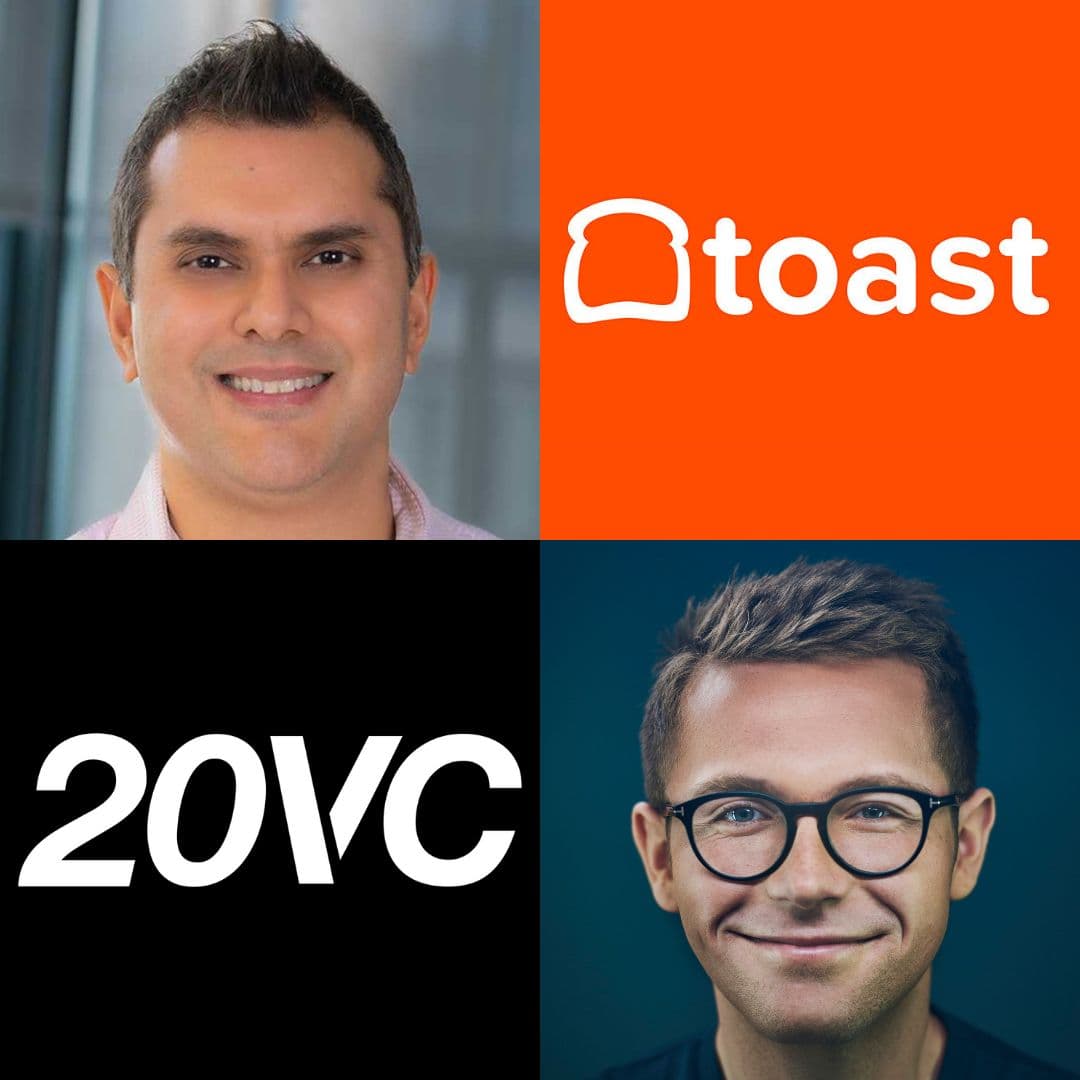
Podcast Summary: The Twenty Minute VC - Episode with Aman Narang, CEO of Toast
Podcast Overview Title: The Twenty Minute VC (20VC) Host: Harry Stebbings Description: The podcast features interviews with top venture capitalists and successful founders, focusing on venture capital, startup funding, and the entrepreneurial journey.
Episode Title 20VC: Five Lessons Scaling Toast to $14BN Market Cap | The Biggest Mistakes Founders Make in Fundraising, Hiring and Selling with Aman Narang, CEO @ Toast
Guest: Aman Narang, Co-Founder and CEO of Toast Market Cap of Toast: $13.5 billion Key Statistics:
- $1.2 billion in annual recurring revenue (ARR)
- 48.4% of revenue from payments
- $1 billion in annualized loans through Toast Capital
- 112k restaurants using Toast (13% market share)
- 75% of new locations come from inbound channels
---
Key Discussion Points
- Biggest Mistakes Founders Make
- Fundraising Focus: Founders need to prioritize fundraising and investor relations early on.
- Hiring Managers Early: Founders should hire management professionals before they feel the immediate need.
- Control: Many founders hold onto control longer than necessary, which can slow growth.
- Lessons from Scaling to a $14BN Market Cap
- Successful Strategies: Aman highlights the importance of speed in execution and learning from customer feedback.
- Mistakes: Acknowledges that not hiring enough management early on hindered growth.
- Scaling Challenges: Discusses what typically breaks in companies during rapid scaling.
- Crucial Moment Decisions in Expansion
- Product Release Timing: Identifying the right moment to release new products is key.
- Toast Capital Success: Efficient scaling of Toast Capital to $1 billion in loans.
- Market Expansion: Criteria for choosing new geographic locations to enter and the approach to enterprise vs SMB markets.
---
Key Takeaways and Lessons
Speed and Iteration
- Importance of Speed: Aman emphasizes that speed is critical in business—once product-market fit is identified, companies must act quickly to capitalize on it.
- Iterate and Learn: Early iterations of products are essential for understanding customer needs and preferences.
Hiring and Management
- Management Value: Founders often underestimate the leverage they gain from hiring strong management.
- Team Dynamics: Building a diverse team of specialists and generalists is crucial for a well-rounded approach.
Fundraising Insights
- Funding Strategy: Founders should dedicate time to fundraising alongside customer engagement.
- Investor Relationships: Establishing strong relationships with investors can lead to vital funding opportunities.
Scaling Challenges
- Foundational Support: Rapid growth can expose weaknesses in infrastructure and support systems.
- Customer Base: Understanding the core customer and their needs helps in building a product that truly serves them.
Market Adaptation
- Flexibility in Strategy: Adapting strategies based on market feedback and the competitive landscape is vital to long-term success.
- Data Utilization: Leverage customer data effectively to enhance service offerings and operational efficiencies.
Reflective Insights
- Leadership Growth: Aman reflects on his journey, recognizing areas for improvement in communication and leadership style.
- Value Creation Focus: Prioritizing value creation over short-term metrics leads to sustained business health.
---
Final Thoughts Aman Narang shares insightful lessons from his journey with Toast, highlighting the importance of speed, effective management, and adaptability in scaling a successful SaaS company. The conversation encapsulates the challenges and strategies involved in building a business that not only survives but thrives in a competitive market.
For more information and to access the full episode, visit [The Twenty Minute VC](https://www.20vc.com).
Written by AI. May contain mistakes. Listen to the episode to check what was said.
Transcript
Automatic transcript. May contain errors.0:00If there's one thing to do over, it's very much recognizing that once you see signal that you've got product market fee, you got to move fast. Speed matters a lot in business a lot. I actually think personally there's so much value in just getting stuff out iterating, learning and recognizing that when you move fast, you can also pivot fast if something doesn't work. I always tell people that toast wouldn't exist without Android and Cloud and embedded payments. Like those are the tree trends that really drove the beginnings of toast. One of the going on. The reality is you can benefit from people that are domain experts and specialists in specific areas, but you also don't want to lose your entrepreneurial spirit.
0:39So I am one of the biggest vertical SaaS nerds and with that being the case, toast is one of the best in -class vertical SaaS companies of all time today with a market cap of $13 .5 billion. I'm so excited to sit down with a man Naurang, CEO and co -founder of toast today and five astonishing facts. They have 1 .2 billion in ARR. Toast Capital has reached a billion in annualized loans. They have 875 restaurants in the US. 75 % of locations are coming from inbound channels. And finally, and this is incredible. The first investor in the company invested 500K at a 3 million price. Is that the best ever angel investment?
1:20But before we dive in today, all of you listening use tons of software every day. Sometimes it fills us with rage. You can't figure something out. The chatbot in the bottom right is useless. You keep getting bombarded with these useless pop -ups. And for those of you who build products, no one wants their product to feel like this. Thankfully, a company exists to help users without annoying them. Command bar. It does a couple of very helpful things. First, it's a chatbot that uses AI to give users extremely personalized responses and deflect tickets. But it can be beyond just text. It can also co -brows with the user and show them how to do things inside the UI.
1:56Magic. But it can also detect when users would benefit from a proactive nudge, like a helpful hint, or an invitation to start a free trial. Command Bar is already used by world -class companies like Gusto, HaschaCorp, Yoppo and Angelist. If you're a product CX or marketing leader, check them out at commandbar .com slash Harry. And talking about incredible companies with Command Bar, I want to talk to you about a new venture fund making waves by taking a very different approach. It's a public venture fund anyone can invest in, not just institutions and accredited investors. The Fundri's Innovation Fund is democratising venture capital, which could have big consequences for the industry.
2:34The fund is already off to a good start with $100 million into some of the largest most in -demand AI and data infrastructure companies, companies like OpenAI, Anthropic and Databricks. Check out the Innovation Funds' impressive list of investments for yourself by visiting Fundrise .com slash 2 .0 VC. Carefully consider the investment material before investing, including objectives, risk, charges and expenses. This and other information can be found in the Innovation Funds' prospectus at Fundrise .com slash innovation. This is a paid sponsorship. And finally let's talk about Squarespace. Squarespace is the all -in -one website platform for entrepreneurs to stand out and succeed online.
3:16Whether you're just starting out or managing a growing brand, Squarespace makes it easy to create a beautiful website, engage with your audience, and sell anything from products to content, all in one place, all on your terms. What's blown me away is the Squarespace blueprint AI and SEO tools. It's like crafting your site with a guided system, ensuring it not only reflects your unique style, but also ranks well on search engines. Plus their flexible payment options cater to every customer's needs, making transactions action smooth and hassle free and the Squarespace AI, it's a content wizard helping you whip up text that truly resonates with your brand voice.
3:51So if you're ready to get started, head to squarespace .com for a free trial and when you're ready to launch, go to squarespace .com slash 20vc and use the code 20vc to save 10 % of your first purchase of a website or domain. You have now arrived at your destination. A man, listen, I have heard so many great things from so much of your camp table. So thank you so much for joining me, Stamma, friend. I'm excited to be here, Harry. Now, I always want to go back to a little bit of the childhood, actually. I was shaped by actually my mother getting amass. It was a very hard moment in my childhood.
4:24When you think back to the most shaping moments in your upbringing, what do you want all to that really stand out? I had a great upbringing. I had these very committed parents, especially my mom, who really lived for me and my brother. And even today, like I show up, you know, and my parents live next door to me. They're like, what can we make for you right now? So I was very fortunate to have been brought up in this household with lots of family and extended family that just cared deeply and made you feel so special. And then in ninth grade, I went to boarding school because we were living in Nepal.
4:55I was born in India and moved in Nepal when I was seven. My dad felt like I needed to go to boarding school because the school was too easy that I was at. That's what he told me. You know, I showed up. I probably didn't help myself because I was a confident kid. They put me in my place and that was really, really tough. I was bullied and I only lasted a year. Actually, I had to school. So that was a shaping experience for me. It taught me a lot about grit. It taught me a lot about working through challenges, working through a tough situation where folks that wanted to make sure life difficult like I think they had put a target in my back at one point.
5:31So that experience, I think, I look back to, but I'm grateful for it because I'd really do think it made me stronger. I totally got that. I think in today's day and age, that's cool to sell side -by -mast. That's what these people turn out to be in life. But I do have to ask you, I think life is also made by pivotal yeses and noes. If you think back to a pivotal yes or no, what is one for me that really shaped your journey? So the first job is toses the second job really I've ever had. The first job was this company called Indeca and they sold e -commerce software. That's where I met Michael founder Steven John.
6:04That's also met Steve Papa who was a founder of Indeca. After Indeka was bought by Oracle, Stephen I actually talked about how we wanted to build a business together at some point I was joke around that initially we were shamed into building a startup because we'd talked for so many years to everybody But how one day we're gonna start a business? It's when Oracle bought Indeka. They're like you're leaving right because you've talked about Building a business forever and so now it was like became real because we had to go figure out fundraising and figure out what we wanted to build and Unlike 2008 when we initially Stephen I had really gotten going when the iPhone came out It wasn't as obvious what we were going to work on.
6:36So in 2012 and 2013, we were trying to raise some early capital. And we were confident because we felt like we'd come out of this company in Deca that was successful about Biorco and we had no after no after no. I remember we had eight or ten VC meetings and maybe we just were naive and everybody said no. And so one of the big yeses was the founder of Indecca, right? Who wrote the whole check? You wrote like a half million dollar check at what price? I don't remember exactly. I was like two and a half million, three million, something like that.
7:05And I remember the conversation with something along the lines of like I don't understand restaurants I don't have an experience in restaurants, but I respect you guys, so I'm gonna bet on you So that yes was really really important. We would not be here without that yes amazing one for him as well So I think you paid him back for that. Yes, yeah I've heard you say before that actually it wasn't so much restaurants or a level of hospitality Yeah, it was actually just wanting to work with your co -founders Yeah, how important and how do you think about the art of the pick? choosing what idea to work on.
7:35Do you have to love and follow your passion with the space that you choose? I've been very fortunate in my life at Indeka, I'm at Steven John and you know these were these proverbial 10X engineers which I think people underestimate. You need people that can build with velocity and are practical. You said that a practical and build with velocity is speed the single most important thing when you're moving from zero to one. I think in general speed matters a lot in business a lot. I think speed really does matter. I think a lot of times people underestimate they think that it's about getting it exactly right I think a product management one of the things I find is there's so much work that happens to describe all of the permutations of the problem When you realize like 80 % of those are not relevant at least not relevant now One of the most important things you can do is try to get something out because you learn so much from your end user That is way more important than anything you can come up with where you know You're coming up with, you're doing work to analyze the problem ahead of time and doing user requirements research.
8:35And I actually think personally, like there's so much value in just getting stuff out, iterating, learning, and recognizing that when you move fast, you can also pivot fast if something doesn't work. I mean, when we started toast, I remember the first six months, like Nicole and Heather and Amy were like, what are you guys doing? You're couch all day. You're like, I've done anything, right? There's all these ideas that have just like gotten nowhere. But because we were moving fast, we could iterate and we had time, right? If you take in two years to get the first thing into the hands of customers, what would exist?
9:04What decision did you not move fast enough on that with the benefit of hindsight you'd wish you'd move faster? Now, we were really naive. We were first time founders. We were in our late 20s. We probably thought no end of ourselves. And so one of the things that was the Achilles heel for me was, I always leaned into scarcity and doing more with less. I had in my head that I'm going to outwork everybody. And so I'm going to make sure that the time and energy that I spend leading and managing means that we need to hire people actually do stuff. Right? So I had zero value for management. I just wanted to hire people that could sell, they could code, they could, and that's it.
9:42And I'll do all the management, Steve will do all the management. We don't need any other managers. We didn't know how to manage anyone, by the way. And so we got into this business. And one of the biggest mistakes was not recognizing that you don't just get leveraged from hiring salespeople or engineers, we actually get a ton of leverage from hiring people to help you. If there's one thing to do over, it's very much recognizing that once you see signal that you've got product and work for, you've got to move fast, right? Because other people see the signal too often. And building out a team around us would have just helped us move faster.
10:14Does management get easier? Does running toast get easier? Yes, for sure. I mean, I think there's always new challenges, but it does, I think, fundamentally get easier. Like there is something you realize where like early on in a company, it's all about this entrepreneur mindset about doing more with less If a lot of generalists you're trying to figure out how everyone's in everyone's business trying to make it work and the good thing is You have a lot of empathy you're small you're like us against the world and you a lot of context and what's going on everywhere Right just because you're small and at some point you're like, okay, we've got to start to build up and scale And one of the mistakes most founders make is and I remake this mistake was you don't want to give up any control because you're like, well, I need to know what the heck's going on everywhere because otherwise we're gonna effort up.
10:54The reality is you can benefit from people that are domain experts and specialists in specific areas, but you also don't want to lose your entrepreneurial spirit. This is why all these massive companies are like, you want to be more entrepreneurial, you want to go back to innovation. And so this is balanced. I always say, like, you want to have a company that's got a balance of like specialists and entrepreneurs. And so one of the things I love is this, and Chris, our old CEO brought this to TOSIS, the zones to win book, I hadn't read it. The one thing I really took away was this horizon framework really works because it's not just about innovation and horizon three and horizon one is different, but the people in horizon one and horizon three are different.
11:30You need both in a company if you want to build a generational company. When do you bring in the specialist? Because we always hear that you need the journalist from zero to one. When is that right time to bring in the specialist? One of the expressions I've heard that I like is you've got to have clarity on when you can put the pedal down. And what that really means is like you're working on trying to find, do you have everything lined up to actually just go, right? And so that could be performance marketing, it could be sales, it could be, but really start to scale and put right and for toast We made a bunch of starts and stops there.
11:59In fact, there were these times where I remember and you can imagine You're like trying to race capital and grow and and having a meeting or like we need to stop selling It's like what are we talking about stop selling we fought through it, but we had issues I remember one one discussion ahead was rational and it's like it's great that you've got the Tesla but it's not helpful when it's always in the shop. And the point they were trying to make was the product did not work well enough. And so we had to slow it down and stop many times. Recognizing when you can put the pedal down is really important in companies.
12:27And so when you're starting to put the pedal down, back to your question, that's when you think you can really benefit from the specials. I've got muscle memory and I've seen great before, and you can figure it out, but it just takes a lot longer. You mentioned the 100 restaurants there, and clearly feeling some signs of signal that that was market poll. Was that immediate in terms of when you released product in the market with toast? Did you immediately feel like there was early product market fit? Or was it a iteration game to go, ah, we actually have customer demand? So the initial idea, as I mentioned, was six months in, we hadn't figured out what we're going to work on.
13:00And then one of us had done some research on Ali Payne, we chatted about using your phones to order and pay at restaurants. Yeah. We were sitting in a bar in Cambridge. I think it took us like 20 minutes to get our check one evening. and they're like, what, this could be faster. You could use your phone, you could pay, and the table would turn over. There's all this, you know, there's people waiting outside. We started with these QR codes you see today at restaurants. It didn't go anywhere. We couldn't scale it. And so we pivoted and we got, and this was a lot of questions about whether getting into restaurants off or trying to rebuild something like a Pona Sale was a smart idea.
13:30But once we pivoted to this Pona Sale, if the one thing that was very clear, when you went and talked to restaurant tours about this, they would give you time and day because they did not like what they had. And one of the learnings for me and for the team was often telling you to think of startups and it's like, well, what's the 10x idea? And like Rebuilding POS does not sound like a 10x idea. But getting signal from customers is like a good sign. Like when we go and pitch these QR codes, we get no time of day. They're like, please go away. And when we showed up, when talked about, hey, we can help you run your restaurant better on the point of sale, there was so much interest.
14:03It gives hours. It's a down with us for hours. And one thing is home with the POS. It's a bit like a bank account, I think. incredibly sticky, but people don't switch much. When you look at your numbers today, I think it's like 70 % of 75 % of new locations are like go to toast. And like 25 % is actually like switches, so to speak. Did you worry about that? And how did you think about actually that core challenge of just the challenge of the switch? Yeah, we did. We did. I mean, it's funny how these ideas get incrementally bigger over time. You know, initially the thinking was we'll be move all this technology to the cloud.
14:35When someone's opening a new restaurant, maybe that'll be enough to get those restaurants out of toast. And then we realized that this is dramatically better than what's out there. Despite our challenges, we got that signal from customers. And then we realized, wait a minute, like these point of soul systems at the end of their computers, they don't after four years, they can't slow down. So that's the cycle right there of how often people need to at least go visit this decision. And then we also realized that we could bundle more into a single solution, and obviously the cloud makes this easier.
15:03We could also offer a great value and a price. In fact, early on, people didn't understand they're like, why do people buy those? And it's like, well, it's just cheaper. And that's not a good reason to invest in a VC fundable startup. And I was like, no, it can be a good reason. Is it just being cheaper? Is that an okay answer, do you think? No, it's not just cheaper. It's got a cheaper and better. Yeah, fundamentally, I don't think you can always, you can just go ahead and send yourself. You don't think when you're a startup, you're never going to be better. You're always going to be behind in terms of product.
15:30Your R &D spend is going to be nil, compared to someone else's. Your CS is going to be nil, compared to someone else in terms of customer support. You're always going to be kind of behind in that way. How do you think about that for the start -up? You can get a lot out of grit, I really do. I mean, when we went in and relaunched, I can share a couple of stories. I remember sitting down with restaurant tours, and 80 % of the features these platforms offered actually didn't really matter. What actually mattered was the world was moving to digital and moving to phones, right? I always saw people toast when it exists without Android and Cloud and embedded payments.
16:03Like those were the tree trends that really drove the beginnings of toast. And so what people cared about was, hey, people are ordering online. Can you make that easier with my kitchen versus getting a fax in a fax machine? That's what we were getting at. You know, people were doing it at the time. And so a lot of what people were asking for actually wasn't done very well. Again, back to the 10X engineers. Like one of the things that we could do even if it was has sometimes buggy, we could build a lot of software very quickly. So it was in our sweet spot to go build for what customers needed. And then, I think on some of the support and the experience, I think I remember the first big restaurant we got, it was this restaurant, they all sat at nightclubs.
16:38And this guy's name was Billy. I still remember we got this meeting with this guy. He was excited about toast. He was a no -nonsense type of guy. And he said, well, it seems like my partner is excited about using you guys. Why should we switch? And I said, well, these handhelds, because the Android form factor is mobile, will allow you to turn your tables faster. That was like one of the key differentiators that Toast offered. He said, okay. And then he said, well, what about support? And he said, what about support? And he said, I can't get support. My current provider to the morning, and if we can't use their system, it's hugely problematic as you can imagine.
17:09I remembered that Steve had updated the website like a couple of days ago to say that we had 24, seven support. And so I said, well, you don't need to worry about it. We're small, but we have 24, seven support. And so he said, you know, wife Nicole is like, oh, we have lots of stories about that. But he, like, what's your website? And he goes to our website and he calls number. And the phones start stringing in my pocket, because it was a Google voice number. And the way it worked is, like, I knew there was four rings after we went to the Google voice number. And I was like, that's going to just make a pathetic if you don't pick up the phone.
17:39I was like, hoping, like, you know, I held the phone, to the turn of the buzzer off my pocket, one ring, two ring, three rings, four, three, I picked up the call. And from the inside, look, I'm telling you, we have 24 or seven support. How did he respond? He's still a customer. That is amazing. Okay, so we have this early demand. We clearly have these signals. Before we go to product expansion, all of the exciting chapters, a bit more cash, venture funding is important. I spoke to Ken to Vassima before this. And I know that there's a little bit of a story in terms of Vassima's investing. Talk to me about Vassima, as they said, no, before they said yes.
18:16Talk to me about that. Yeah, this is back to the string of nose that we got and how many knows did you get later time I mean we met with like all the prominent BCs that say in the Boston area I think a lot of it was on us We we were probably a little bit confident because we felt like we were good engineers and we'd come out of this company That had been acquired and been successful and probably didn't do a good enough job even articulating what we wanted to do I remember like in these meetings to be like what is cack? What's LTV? I think trying to make customer like at least the way my brain worked was we're here to make customers successful That's what everything else will follow later.
18:46It doesn't even matter. Do you still believe that? Yes. Absolutely. I think those metrics and all the things matter. It's like in sales, right? You need the data and the scorecards. But if you're like sitting there looking at a scorecard trying to tell people you got to do better, that's not helpful. Well this is my question because I obviously am an nerd who says you mess this day. And you look at sales efficiency of a Cedar or a Cedar or a Cedar or a C Company. And it's like, it may suck. But actually you need to create that customer love, that brand advocate in an early restaurant owner, which creates what of mouth, which creates a micro brand.
19:14which improves your sales efficiency. And so it's like to what extent is once to spend disbelief and say the sales efficiency will get better versus you're being an idealistic VC? You need both. I think like you need to have some model. You need to have some model that says, this is what it could be and it could be a good business. Like I remember like modeling out with toast could look like without the full platform and the Fintech capabilities and the payments and it was like, well, it's gonna be kind of hard to scale because you're selling door to door with people, right? It's a very highly considered purchase.
19:44Did you know that from day one? Did you know that the Fintech component would be a feature? Yeah, I think so. So it's not like, yeah, yeah. And we realized, not maybe on day one, but I think we realized within 10 customers that the financial model was not obvious to me. Because restaurants were like, well, and this is early too, but we were making two, three hundred bucks a month on the software at most. And it was just, it was not obvious given how much products weren't very good either, but the amount of support, I remember talking to one customer being like, you call me too much like this is not skillable at all given what you're paying us.
20:16You want to get some model that is at least somewhat credible in your head. So you want to put together some simple model that says here's what it could be. But then after that very quickly pivot to like, okay, how do we make customers love what you do? So you need to do both. But I think in back to Bessimer in early days, we met with Kent. Of course he didn't invest and we raised to Steve and then Kent put him on in our series A. And so we had this conversation many times and we asked him like, hey, how come you didn't invest? And he was like, well, you guys seem like nice guys, but he showed up and he presented and you know the feedback We got and what we noticed was you were arguing between the two of you while halfway through the pitch about what the strategy was And so we were a little spooked and so you know, we probably didn't do ourselves any favors That is amazing what price to then up come in at about a hundred I think to be fair on camera that's a very understandable element.
21:05When you look back, what would you have done differently about how you fundraised in the early days? Probably put more time into it. Like we were on the one hand, like rightfully so they're so focused on customers, but you need balance. You also need to step back and say like, okay, how are you going to build a company and make fundraising in the important part of that? And so just getting good at it, not great at it, but at least good enough at it where you just started through, like putting it in a nice pitch deck, like I think it's probably important. I totally agree with you. Okay, so then you raise the round from Basmum and you have can on board.
21:33and we have the cash to scale and expand. Katherine told me that actually there was then this period of kind of violent and aggressive growth with his exact words. What were the first things to break? I think one of the first things, the one of the first things to break was just, we back to putting the pedal down, we're like, oh, we should go higher sales capacity and we should try to expand. And we just didn't have the infrastructure to scale. We didn't have the leadership back to, trying to micromanage everything. We didn't have the infrastructure, we didn't have leadership, we didn't have the products.
21:58I'm so sorry, what does it mean you didn't have the leadership? because you were that as founders, you'd built out a founder, led sales playbook, and you then transitioned to a sales that playbook. What does it mean to not have the leadership? I'm just showing that. A given example, we were signing up customers, and I think we were maybe over indexing revenue and scale, because you know, that's one of the metrics that a lot of people care about. And you get all these customers signed up, and then they would either not go live because we didn't have the onboarding setup in a way that was scalable and we're trying to brute force it.
Read the full transcript
22:32Or we had customers that felt like we were abandoning them after they went live because we didn't have any supporting for structure. And the products themselves were in some case not fully baked. And so I think a lot of these functions were not set up to scale. It was affecting customer sentiment. And I remember like when Chris joined us, the Chris was a CEO that was with us for I think really the early days. And that's actually one of the tough moments in the company because Stephen and I were having a lot of issues around how fast to move because the reality is you've got a scale, right? You've got capital, you've got to deploy the capital, you've got to scale.
23:06On the other hand, you've got to do it well enough where things don't just all break. And so one of the expressions I've heard is like, you've got to make sure in an organization everything's kind of in sync. And something can be ahead of another thing, but it can't be so far ahead that the whole thing starts to fall apart. For us, it was just we did not have the team to help us scale. And I want to simple analogies that I think come to appreciate is at some point you go from doing to coaching and teaching others Right how to do and then it becomes about okay like how do you hire well? Right? How do you onboard well?
23:36And those were all things that I grossly underappreciated why did you not take the C .O. role earlier? That wasn't given it Actually, that was one of the most I mean look I think I noticed on this I'm sorry about that in a long time. I love that. I can't what told you about that. When you're early, no one cares about roles and titles as much. It was like trying to build this business. We weren't over -indexion. Any of the Steve was the CEO. I was the president. We were trying to make this company survive. No one cared. And then at some point, we just raised this 30 million, whatever the money was around, real round.
24:10We were going to put the pedal down in scale. And it was very clear that we did not know what we were doing in the scaling phase. And did your VCs feel that? I think to some extent, I think Steve Poppins was the first investor who was like a friend and mentor. I think he picked up on it too. I think we all kind of picked up on the fact that was one of the rocky phases in the company where we were dealing with the real growing pains. And we had worked with Chris at Andecca. And one of the superpowers Chris always had was he knew how to get the best out of people. And I remember in the session, we're sitting there trying to figure out the future of the company.
24:42And it was hard to be like, we're going to bring someone in from the outside. But in most of the stage was the company out at this point five million error. No, it was like two million error pretty wrong Yeah, yeah two years and it was the best decision we made we were able to get someone in that we could You know that gave a space to go do our thing But also was just a really good sounding board and coach and also had seen how to like scale and lead people in ways that we didn't And so back to your question. I just wasn't wasn't given it. Okay So then we have the 30 million dollars and we have to scale and we have some points breaking, we have strategies to scale.
25:18What did you do with the benefit of hindsight you wish you hadn't done? You know, one of the things that toasts that was interesting was, and this is still an issue today, is how much do you want to do? So our focus from day one was we're going to solve for restaurants. I'm going to be the best solution for restaurants as the verticals, you know, the thesis and the strategy was by building a platform that was purpose built. We can solve the problems of this industry better than anybody else in the world. As we got going, we realized the sales efficiency, though, wasn't quite there. And so we just say, well, what can we offer where we can make the financials work?
25:53Because it was a highly considered purchase factor, which you said. It's like, you know, a phone of sales, like, I think it's described to me many times as like a root canal switching out phone of sales systems. And so you have to show me to increase the all -poo on a customer basis to make the sales efficiency back. Exactly. Exactly. And so one of the big challenges was how do we build out more of the platform? and do it fast enough while scaling locations. And so one of the challenges that we faced was how many products can we do well? And then how many segments of the market can you really do well?
26:23Like I remember one of early customers, I think it was Urban Outfitters, they had all the restaurants in their retail stores. They wanted us to do that, you're doing such a great job, do all our retail. And I'm glad we said no, right? And really focused in on restaurants. That was always challenging to figure out like what is the right surface area for us to be able to go to market with? What did you do that you wish you hadn't done there? It's a good question. So for me, it's an interesting moment. We saw the creator economy hype of the easy wins that you get from having big famous people on the show.
26:51And it's very easy to get big numbers of your very famous, but actually that's not who we are. We are incredible shows with the best entrepreneurs in the world. Fark having big celebrities on, it's about incredible lessons with great entrepreneurs at our business. Yeah, we did that and I wish we hadn't done that. I think for us, one of the biggest things was we were trying to move very fast and trying to scale as fast as possible. Capital was cheap. Was it always cheap? No, once we raised our first round, it was really hard. We couldn't get any capital, but once we raised our first real round, we saw the numbers get better.
27:25It was all about how fast can you move? And so I think one of the learnings was on the one hand, you've got to move fast, right? It's like the gold rush and you've got to move as fast as you can. On the other hand, it's very important to get your foundations and your culture right. It's like the measured twice cut ones. There's some of that that I think we could have done a lot better early on. And so for us, had we slowed down to speed up, there were a lot of opportunities where we could have slowed down to speed up that I think would have just made it a lot easier in the long run. I remember those one time when we were shipping out hardware to restaurants and every piece of hardware, like close to a felt like every piece of hardware that we shipped came back in 90 days.
27:59And we were still selling it because we're like, we need to get more customers on the platform. What did you do when you have returned cycles where it feels like so much is coming back so quickly? What is the management decision on that? One of the things that was a crucial decision that we made was we built this platform on Android versus IOS and it was not in hindsight. It feels like a strategic decision, but in reality it was simply because we thought Android was an easier platform to build on. But what happened was Android had this proliferation of hardware. I think one of the complexities was the hardware that we got didn't have the right configurations to support like card readers and all the components that you need in a restaurant.
28:37And so as we get in the hardware back, we were looking desperately to go find a device that would actually work in the restaurant and get in great environment. And so we just always remember we'd have these conversations. So we just need to find enough time, make it through like the next quarter before we got like this device we had found with a partner in China, Elo, that we could we had more confidence in scaling. When we think about expansion, there's kind of three full segments of products, expansion, segment, expansion, and geospension. When we think about those three, the product expansion, I can nuts what you've done.
29:08Like, toast capital, we have amazing researches that I'd love to pen like it's all just me. But like in 2019, you did toast capital, I think it was the notes I got. And now it does over a billion in annualized loans. Wow, question for you. Totally normal. I was going to ask, is toast to FinTech business or SaaS business. It's definitely both. I mean, if I were to force you to be one, customers carried deeply about our software. That's why they picked us. But it's a great business because it's a FinTech business. I think the two together are a compliment. But I think it's often quite removed for founders starting today, where they look at some of my toast and the products we that you have is incredible.
29:46Did you have that vision for the products we from day one, or does it come over time? It came over time. Initially it was, how do you solve the needs of the restaurant through the point of sale better because that's where we started. You can only do so much to begin with anyways. And you can imagine when we started, you know, we were going after these slightly bigger restaurants because there were other providers that offered something very simple if you had two employees. And so for us, we had to, we realized like our niche had to be restaurants, even if they were S &B restaurants, these more complex operations that had more in revenue, more employees, more scale, more complexity.
30:17And so you'd go into the restaurants and, you know, we talked about pitching for on a sale. We got a few customers that way. But But then I remember we had this meeting with this guy, Chris Kane and finale. And it was like, I've got point of sale. I've got payments. I've got a loan. I've got online ordering. I've got scheduling. I've got inventory. I've got gift cards and loyalty and all this stuff has to integrate in some way to the point of sale because that's the central nervous system of the restaurant. And so our choices like we can either partner or build. Sometimes people didn't want to partner because we really see any companies.
30:43We're like, we have to build it. Those individual point solutions were always there. But we're so much more feature rich. We're much better. because we are a point solution. To what extent do you say yes, maybe, but it's better as a bundled offering, and it's okay to be 20 % less than a point solution per faction? Yeah. Because it's a bundled offering, or do you say no, we are better than those point solutions. Forget that. I think it depends. It comes over time. Like in any of these markets, the reality is it's very segmented. So in certain segments of the market, you may have something simple that can work.
31:17And then, I remember in Victoria, they Pete's line restaurants It's really complex. And when we got some pizza restaurants, like the ability to manage the complexity of the modifiers and how all the different ways you can order pizza and have pizza delivered, we couldn't support so we had to partner. So I think it's really a segment segment specific question where as you build out the platform in certain segments, you might see success and other segments you have to you have to partner. What secondary product has been the biggest game changer? Payments, toast capital. How does that come about?
31:43You guys sit in the room and you're like, let's do loans. How does that come to be? This was, I remember our CFO at the time had done some research on Fintech more broadly and all the things we could do. So we were not, we were just talking about loans, we were talking about embedded finance and banking and payments and the, and the, and the, and the thesis was once you're the payments provider, that's such an anchor product in terms of you got all this data about the sales and about the success of the restaurant. And so what else could you do? And we had seen some other examples where lending was a product that, you know, others had built.
32:17And for us, one of the challenges was often when we go sell these restaurants, they had an existing loan, or they wanted to finance their hardware. And so we had all these partners and we said, well, what if we could do this in our own? And what we realized was because we're the payments partner, we could do a better job of assessing risk, we could make the process of getting the loan out. The payment back was really simple because it was just built into the payments flow. And so that's really what the beginnings was for for capital. And also we realized that it was it was a good business to be in.
32:45What was the hardest element of building toast capital? It's not knowing how to assess risk. The biggest question we have to answer when we lend that money is, what are the odds that the restaurant will survive over the next three, six, and twelve months? What was the worst ancillary product decision that you made? Which product did you do that you're like, all that didn't work? With that many, actually, where we've tried. And the one thing that's great about toast, back to the zones to win horizons, we've got teams that are focused on scaling what we have and their teams that are tinkering. and this is across the business.
33:15You actually have that separated in the all -glite team -curing teams and skating teams. We have both. There are certain teams within each lines of business. We've got teams focused on scaling our products. You can imagine the Fintech business, for example, we've processed like 160 billion in volume every year. And so that's about scale and making sure that it works all the time. But then there teams within the Fintech LLB that are thinking about what are the next adjacencies where we can create value. So there's within the LLBs, but we also have a new Ventures program. We bring in folks that otherwise want to maybe go start companies and go raise capital through VCs and want to come work a toast and Want to go build something and we try to make them as Separate from the core business as we can and so one of the things that we always talk about is the benefits of being part of toast Have to outweigh some of the challenges, right in terms of you know the overhead of being part of a larger organization And so we do both in terms of both models What was the worst product expansion which product was like that was a flop and a fail?
34:13In two learnings one is it's not good enough to just build commodity products because it's integrated on the point of sale There was thesis was hey if we just do more and more and more if these products are integrated the point of sale people will buy But you know you can't just build a phone system and say oh because it's integrated the point of sale That's good enough for someone to swap out their phone system. It has to be better. It has to be better one big learning I think the second big learning was within the solutions that the stakeholder we serve the best is the restaurant owner of the operator.
34:42We've been building technologies to serve the stakeholder for a very long time. And the other stakeholders that exist, whether it's employees or guests or suppliers, we're starting to get there. Like we have now tons of rich data about other stakeholders, but it's not something that is like a superpower of ours internally. We're not a consumer company, we're not a company that knows how to support all these stakeholders as well as we know how to serve restaurant operators. When we've built these applications so far, like app products to serve the guests or the employees, it's not to say we won't get there and we're doing some really cool things to their credit, but it's something we're learning.
35:17There have been lots and starts and stops. So that's like product expansions to a certain extent. So funny, I'm such a nerd on your business. I love the toast business, as you know. So the other element is segment expansion. And you mentioned that kind of you like to actually almost be in the middle of it, seen like in the early days, which is like, you have enough revenue where it's a sustainable business, it's not only robust, but also it's not the largest corporations in the world. You're McDonald's or your Starbucks. But you've actually spread across both now. I mean, again, I have incredible people who do a lot of the work for me now, the joys of our jobs.
35:492023, you did bakeries and cafe products and a more like self -serve lower cost. and then 24 we did restaurant management and more heavy enterprise. What have been the biggest lessons in what it takes to expand down to SMB and do while there? Yeah. We have been in the enterprise business actually for a while. In fact, we have more market penetration within mid -market than we even do in SMB today. I think a regional change. So we don't have lots of enterprise businesses at massive scale, but we have lots of restaurants that have hundreds of locations and have some of the same complexity. Who has the enterprises at massive scale?
36:24A lot of it is still on either custom homegrown or legacy on -prem solutions. These solutions are so wired into everything else these chains do. Will you replace them over time? Yes, I think so. I think look, it goes back to like, there was a time when a lot of this technology was simpler. Like if you had a simple point of sale system to take orders and payments, that's very different than, I remember early on, I thought this was a glorified calculator at least. It's not because it's the operating system. So I'm just the ERP of the restaurant. So as you build on top and you add online ordering and Piosks and employee scheduling and all sorts of capabilities to process what all the stakeholders is a massive list, the tech gets more and more complex.
37:05And so if you're an enterprise chain, that is not your core competency to build more and more software. And so I think that's where I see cloud providers like Toast grow and take over over time. And especially because if you look in the four walls of restaurant, whether you're in a food truck or a cafe or a bakery or a full serve restaurant or your enterprise change, often the needs are actually quite similar, which is how do you make this, like restaurants are about operations, workflows, speed, efficiency, you know, seconds matter. And so the software is about, often about like, how do you turn the tables faster?
37:35How you move the line faster? How do you make the kitchen more efficient? Are you making sure there's good governance of people or stealing from you? Like, those are the things that the point of sale does within the restaurant, that doesn't change. And so there's a lot overlap, back to like second strategy, There's a lot overlap, whether there's a restaurant here in London or there's a restaurant in, you know, there's a lot of overlap, 100%. Yeah. But the requirements are different. In terms of like you can't have the same direct outbound model in terms of sales, you need a more self -serve model with SMB, you probably have a light touch customer support.
38:0620 % is not actually the case, are they actually fundamentally different companies? Yeah, I mean, the sales model is definitely different, for sure. The service model, I think, is somewhat different, but there's also often franchise which I can feel a little bit like SMB. But at the end of the day, when did you see the flywheel kick -in on sales efficiency specifically? The flywheel is, I mean, we got going early on, we were getting feeling the ground, getting these partnerships. We were lucky that we found some of these key partners to get us going. And then we started to do some performance marketing, we built inbound marketing, and all those things started to help us.
38:43Then we saw this effect. Actually, this was Jonathan than Vassalore had a revenue who noticed this, which is as you get density, and it's kind of obvious, I guess, in hindsight, but as you get density, because restaurants have a unique business, where every street corner you got like five of them, right? And so we were starting to see this pattern where like you go sell one restaurant on a street and you get all of them. But there's so many that it's like, there's like microfly wheels that you see. Like, and Cambridge Massachusetts, you think toast is maybe the only point to sell. The pattern was actually at a very micro level and a local level.
39:13And so we started to look at this data to say, what are we seeing in terms of these different markets? And we saw this pattern that as you get more restaurants, you get better word of mouth. And you get more referrals, you get more top of phone, you convert better, you grow faster. How does that change your approach then in terms of outbound sales, in terms of all design? Is it focusing hyper -local, building very local teams doing kind of guerrilla marketing on a per -street basis? How does that actually change with that realization? Yeah. One of the challenges is like, how do you play the long game in the short game?
39:42If you were playing a short game, you just hire more and more sales and it's the most successful market to grow even faster because the productivity was some of the best. We were cutting territories and growing faster and our reps were more productive. But they also had to put the foundational teams in all these markets around the country. That's always easier actually than we would be noticed was to actually add maybe more in these markets we were seeing more success in. So you balance the two. But at the end of the day, the more important thing was actually like, can you hire great people? This goes back to scaling companies and this goes back to the processes to actually assess What you're looking for, like, and we have these big three on how you hire now.
40:15How do you onboard? You have an onboarding program. One of the things we do is everyone that joins a company whether you're at IC, a BDR, rep closing deals or a manager, you have to go sell. Like, you're a district manager. It's great that you've managed people before, they're in the running sales team, but you got to go sell toast for a quarter and learn it. For a quarter. Yeah. Why do you want to get a rule of this? It helps you have context when you show up. Then you've got to get out there, too. So they said both, combination of like you've got to get out there with prospects and the customers and you've got to learn some of the basics You don't show up and look foolish because you just you know don't have any expertise or an industry perspective Which is that I felt honestly.
40:52I remember the first year I was just learning so much about this business because we've never worked in restaurants. It's a 12 -views -ort. Yeah, how do you take to IPA? Nine years. Nine years. What was the market cap on IPA? 20 billion. Nine years to 20 billion. You know early on we were like, oh we get this 10 billion ARR or a hundred million ARR that will be amazing. We weren't worried about what it could be or it couldn't be, we're just focused on the customers and building a good business. So we have product expansion, we have segment expansion, and we have geo expansion. Yeah. You're making a much more concerted effort in terms of international expansion, it would seem.
41:24How do you think about build versus buy on international expansion? One of the decisions we made was this point of sale platform is the central nervous system of the restaurant, and there's a lot to it. There's a lot of surface area to our product. where we think about like M &A and where it's worked is often products that are great products with great founders earlier where they can plug it into our go -to -market engine and we drive better sales efficiency for them. Like that's where we've seen success and so when we think about expansion to segments or Gios or products it's been often about that's the one rule that we've kind of stuck to which is the central level system has to be toast.
42:01Given the importance of that POS and being that kind of heartbeat of the, the kind of restaurant itself. Yeah. But actually the acknowledgement that it's incredibly difficult to get people to switch. Yeah. Does it not make sense just to do a roll -up play on international expansion? Get at each individual country, pick up the individuals, and then plug in the ancillary products that none of those guys have, and juice up your arpeggies on that. Yeah. Now, our beliefs are that if we go into these markets and offer the best solution, I know this is hard to switch and all that, but there's plenty of opportunity.
42:30I always liked this expression of like, you know, you've got strong opinions loosely held, like I think, you know, as we grow and scale that might change. So far, that's a spin that these totally got. I've done five M &A's now. I think four. Four. Okay. What's not what that you really learn from? Back to the thesis on the M &A has been, you take great products with great entrepreneurs and you plug it into a go -to -market engine and they can scale faster back to like one of the benefits we've got is we've got this on the ground sales model in these markets, restaurants like to buy for people in person and we've got enough R -Poo that you can actually scale it that way.
43:00And so if they're point solutions of products where you're trying to sell, let's say through E -com or through, you know, inside, those don't scale as quickly. And that's worked quite well. The challenge that I think you have to be careful about is to say, let's say there's a product that's having a lot of success in a segment of the market. Like let's say you have a product that's having a lot of success in the down market or with larger groups. And you say, well, bring a down market into the smaller restaurants and plug it into a what a marketing that's going to work in. What you don't realize is like, well, those restaurant tours don't have the people to do all these specialized things that may help them because you can imagine a restaurant tour is just trying to make sure you get through the day.
43:39Often they're like, I had more of the expressions that I like is like restaurant tours are like in the here and now, they're dealing with right now. And so it's like one of the learnings has been as you add more of the product, but portfolio you got to think through like, Can the your buyer actually absorb it? Right versus if you buy from a solution that serves a different segment of the market, maybe they serve a different segment of the market for a reason. If that makes sense. How much juice can you extract from restaurants? I know that's a horrible statement and it's one of the V .C. But how much revenue can you actually get before you hit the ceiling and go, we go to go to retail?
44:16First of all, I think it's about value creation. I think the monetization follows. It always starts with value creation. This is one piece of advice. It's like everyone should focus on what is the value you're creating. I think often companies get in trouble when they're looking around to say how do we drive our metrics versus the customers metrics. And then back to like the strategy of like how much can you do, it's really hard. But the fundamental question is like how much can you do well, which actually goes back to people always goes back to people. If you've got average talent, you get in the details of why is not working.
44:43There's a million reasons why not the things don't work and you get into this mode of like you're micromanaging. versus bringing great talent and actually they go and figure out a lot of how much can you do and how much can you do well always goes back to people on talent. When we think about all the different variables and all the different ways in which you can grow, as we looked at, and maybe you could argue we're doing too much, but we see opportunity where the platform we serve, the strategy can work in other segments, in other GOs, upmarking enterprise, and we can expand the platform. And the question is, how do you sequence all this in ways that is thoughtful?
45:14And so one line I like is like, you know, you underestimate what you can do over a decade or over estimate what you can do in a year. So this is a long game. Like, it's not about doing all this in one year. It's about a longer -term strategy of like, we're looking how much we did in the first 10 years. Well, how much can you do in the next 10 years? And that's the mindset you've got to have. It's so funny because I have obviously a media business and a venture business. And I say the only thing that matters is knowing that the supply of great guests drives our entire business flywheel. We get great guests in the show.
45:40We have amazing shows. We deliver amazing value to millions of founders. and then more founders will want to take money from us. We make great investments and it'll lead to more great guests in the show. Yeah, makes sense. The only thing that matters is getting you in the hot seat. Yes. But it goes back to the values. Very generous. Thank you. Not at all. I've made many hiring mistakes, dude. What's your biggest hiring mistake? The hiring is hard. And so just building a rigorous process, actually, is really important. And we're still not great at it in Transwringer's Hard because it takes time.
46:08Right? Like you're busy, but like just as a different function. Yes, it does. But I think fundamentally like doing the hard work to say what are you looking for up front the process writing it down? Right being clear about it. Sometimes you don't make the basics are lost like what are you hiring this person for? What are you going to do and being clear about it as a group in the interview process like having a thing Amazon does as well Like writing down your notes like clearly the transcript or what happened in the interview and I think in the interview itself You have to be able to go deep because you live so much time It's hard to go deep and have ask hard questions so many don't know one of the things I've learned is you have to do it even if it's uncomfortable or hard because you have to understand where has this person really dealt with challenges and had to be resilient, what have they done that has been impactful where they were the driver and the bus and not just the passenger.
46:50That's what's really important in the process. Do you have my favorite question to ask on that is what trait do you have that you're most ashamed of but has also contributed to your success? 100%. Yeah, your superpower is also often your kryptonite. What trait do you have that you're slightly ashamed of? Yeah, but it's also like, what should you success? Yeah. What would it be? When I get fixated on something, I can be very annoying and - Oh, Steve told me. Or I can be, you know, passionate in the details and care deeply. So I think there's a fine line often there where you - it's great to be in the details and care and go deep.
47:27But also - Are you a micromanager? I think it just - it depends on the situation. I'm sure there are people who would tell you that I'm not a great manager or that I am a micro -manage and I have to learn along the way. Do you hear a great CEO? I'm learning. I mean, look, I think a lot of this goes back to, we're all on a learning journey. And as long as we, is all of us trying to get better every day, that's the most important thing. More than whether or not I'm good or great or bad, like I think that's what matters. What are you not great at today that you would like to get better at? I think communication and recognizing how important it is to align and inspire a big group is really, really important.
48:01I've always underappreciated that. Where I get the most energy is like solving the problems in the details or coming up with like the strategy of the business and thinking about the competitive landscape and the chessboard. And those things matter. But actually, like if you're managing a team at scale, it's really, really important to make sure everybody understands where you're going and why and why we're making certain decisions and you've got to over communicate a lot of that. And I think that's an area where I absolutely want to get back. You have to over communicate. You also have to create a sense of follow a ship.
48:28Yes. And the reason why you don't have a follow a ship, not you, but leaders in a follow a ship because they don't feel like that was that tick. Yeah, I feel like they're being sold to by politicians, by people hate politicians. Yes. One thing that you're very good at, you're authentic. Yes. You're not selling this animal fucking great CEO already. People buy that. Yeah. At the end of the day, people buy from people. I would say businesses, there's one thing I learned from Chris, like businesses about people. At the end of the day, finally back to like, you know, it's not a business strategy, like, but any strategy you want, but the PowerPoint together and Excel spread together as it says, you know, here's a business model.
48:57It's about the people. And so 100 % likes about bringing great people, great values, complimentary skills, and then being aligned and what matters, having the right tension in the organization where you can work together, but also push each other. Yeah, those things are what magic happens. Final one for you, do a quick far round. I suppose Steve, before sorry, needs is that you have not much tolerance for BS. And you said before, I think it was a humble mindset towards learning or something, was a culture, a cultural value. One of the values is lead with humility. Lead with humility. Yes. Brilliant value.
49:28So values that are good are ones where you could take your opposite side. So it's like for me we work unbelievably hard and you will do the best work of your career. And I believe that more hours leads to more success. A lot of people say it's wrong, strategic work, less hours, balance, go somewhere else. Both strategic and I just think actually brute force most things. Do you go to gym this morning? Yeah, I can't take the opposite side of learn with humility. Is that a good value? Is that not a mistake? I think for us leading with humility is about recognizing that as a leader, you've got to be close to the front line.
50:07That's one way to interpret that value. Back to build a great business, you have to stay close to customers, just go to the people that are actually doing the work. Because things change. Even if you had some perspective from 10 years ago, how things happen? Things change. Not being close to the front lines, you're making important decisions about the future of the business. If you don't have context and perspective and texture and what's going on, you can make a really bad decision. I am pushing you. I'm just wondering if that's still because no one's going to say, oh, I did, because what you were saying there is actually customer proximity drive success or customer facing teams.
50:39In fact, not just customer facing teams, all of the frontline teams, but no one's going to say that not being close to customers drives the excess. So your question is, what is that a good value? Yeah. I mean, I think you can take it to an extreme where you also have to have some level of self confidence because you want to go in and say like hey I've done it and confidence instills confidence and others and so I think it's a balance there of anything but I think overall it is a good value I do think most people as individuals most companies they can get in trouble if they think they know that they're the shit like I think there's a lot of value to just always being balanced and always being grounded but I know it's interesting you said Steve said that I have no tolerance for BS no tolerance yeah I've been told to my face many times that Steve's the fun one Listen, I want to do a quick fight.
51:24So I say a short statement, you give me your immediate thoughts. Does that sound okay? Sounds good. So what's been the most memorable near -daq experience for toast? It was actually pretty early when we were building these QR codes. I said, you know, we were trying to get... We spent a year working on this and we were ready to give up. And that pivot to point of sale, like that was the closest we came to shutting it down. Did you have much money then? Like, we close from where, guys? No, not at all. We were like funding this from the little money we had made from the last company. What four member do you not have that you would love to have?
51:53I mean, I've heard just like great things about Satya, about how he's transformed Microsoft, you know, in terms of building an amazing culture and learning mindset and growth mindset. That's somebody that comes to mind. What was the most memorable first investment? I remember we'd go in a Steve Papa's house. This is like, we went on a new Hampshire. We're driving from Boston, New Hampshire. We put together some slides and sitting down and meeting him. And he looked at this. I remember one of the things he noticed was our spreadsheet had zero graph by a factor of 10 in the meeting. at the end of the meeting, I think he said something like, yeah, I don't really understand restaurants.
52:23And that's all I thought he said. I think at the end of the presentation. Did he commit on this poll? No, no. We had a couple meetings. I think at one point I had to tell him, I was like, look, we've done good work for you. I had a minimum, some will acquire us, even if it doesn't work. What was the hardest round to raise? You know, it's interesting. We've been really fortunate. Like once we got that series B, we grew up in a world of low interest rates and there was a lot of capital in the business, had really good fundamentals. Not to say it was perfect, but had good fundamentals. We hired some great people to surround us that were really good at it, if I'm honest.
52:55So it never felt like we were constrained by capital. What have you changed your mind on in the last 12 months? It's actually interesting you bought up leading with humility. I think one piece of have gotten advice is trust your instincts more. Because I think sometimes you can end up in a world where if you don't trust your instincts, you can move too slowly. What did you not trust your instincts on that you should have done? often the hardest decisions are about people, not about business and strategy. What's your biggest most unorthodox advice for founders listening? This may sound odd, but don't raise too much capital.
53:26I think there's all this perspective, I think we're playing a runway that's healthy, that's good. On the other hand, like, you know, if BC's aren't stupid, they're going to raise too much capital to get diluted early on. Secondly, I think there's a lot to be said about doing more with less. What did you do more with less that really comes to mind? You said earlier about scarcity driving creativity. Is there an example where like we didn't have money and so we did this for us like we didn't have the money to try to do a lot of marketing and get the brand out there You know the creativity we had was to go find all these trade shows and go make sure toast was right next to the biggest provider in the space Tell me what do you know now that you wish you'd known when you founded toast culture values really do matter It really do matter.
54:11They really do matter. And like, spending the time hiring the right people really does matter, especially the leadership levels. If you get caught up in like the here and now and what happens the next deal or you know, someone's once told me like if you're going to prioritize like an interview versus a deal versus let's say, you know, like an internal meeting, you really want to make sure there's one thing you prioritize. It's like the interview because especially early on when you're founding the culture, if you get it wrong, it's hard to change afterwards. It's not easy. We said about BS me so AI.
54:41Yes. Every public company is the only one in AI story. Yes. To what extent is it like a bit of an AI story for public markets versus, this is a genuine innovation. Yeah, it's interesting. I think maybe I'm a little bit skeptical by nature. So I always am trying to figure out why something might not work. I think that's a healthy way to look at things also. And so with the metaverse or with crypto, I always struggled with first principles on like on how this was going to scale in battle and many ways have been wrong. And it's interesting, it felt different because you were seeing like real applications, you know, you can go to the doctor, I went to the doctor recently and like, yeah, I listened to our conversation, figured I want to do it, it worked.
55:21I was pretty impressed. And so you're starting to see like these early signals, I don't know how scalable it might, yeah, I might be where the internet was, pretty bubble, like where like things have to like, you know, which applications take out, we're still trying to figure out. But the fundamental technology, of being able to, especially like things like voice AI is so powerful. You can listen to our conversation, have a conversation. The other thing I think about is like, I want an AI personal assistant. I think that's coming. That can actually, can you think of the internet? What's been amazing is you can do so much, but you have to learn all these interfaces, and it's complex.
55:52I would love to just talk to someone and say, can you get me a table tonight or can you? I have a set change in future restaurants. I think the biggest thing that we're going to see is helping restaurants leverage data to be smarter. Like you think at restaurants today, most restaurants do not have any data or perspective on how to do some very basic things Like how do you price a menu? What do you put on a menu? What's inflation doing? How am I doing it all to my competitors? And so one of the one of the most fundamental things that AI can do is Helping the average restaurant tour be smarter about some very basic things in their business You know most restaurants don't optimize yield.
56:24They don't know how do you maximize the right guests in the tables? You know you think an airline or you think a hotel? They're optimizing yield all the time restaurants don't have no ability to do that That's one opportunity. I think that other opportunities and voice imagine like an adrived through or you go order at the table and imagine the advice and we're not there yet is listening to what's going on and just knows what to do. So I am as we've discovered a massive toast fan. When I think about the future and value creation and we think about toast being a hundred brilliant all the business, what is that pathway to a hundred brilliant all this?
56:57Is it a much deeper partnership integrations in the restaurant vertical, I'm really only more of that wallet. Or is it the expansion much more into retail, hospitality, hotels, and expansion on that segment basis? Paying that part away. Yeah, I think it's a talk about a few things when I talk about the longer term strategy of toast. One, we've got 13 to 14 % share in the US in restaurants, we've got a scale, and be one of the leading providers in the space. That's priority number one. As we've built out this anchor solution to power restaurants, we have the ability to create a lot of value by having a broader platform.
57:34And so doing more for restaurants over time to support the broader ecosystem and more of the stakeholders is an opportunity where we believe we have a right to win and create value for restaurants. Then the platform we've built, we think about all the complexity of hardware and software and network, you know, applies a lot of brick and mortar articles, not just restaurants. And so the same deep approach that we took to say we're going to solve for the needs of restaurants. We've got to do it gradually one by one in other sub -borticals starting to start with food and beverage retail with grocery, convenience stores and gas stations and what you see is in bottle shops What you see in these subcategories is these are also businesses that have complexity that lots of employees There's lots of revenue and so the sales model the service model and the complexity in depth the product really applies And so that's that's a growth opportunity for us and then I think over time You know if you think about upmarking enterprise in international We've got to just be thoughtful about how many markets we can do without falling over.
58:28I think it's all about how do you do it thoughtfully across all these growth factors and how do you sequence it over the next decade versus the next year or two? Do you worry about recessions? What I mean by that is, your business obviously depends on consumer spending and transaction volume in large parts. You have consumer budgets hit and they don't even spend as much. Not as much because if you think about, we went and studied some previous recessions and which you see is restaurants are largely very resilient. People love to go out to eat. And so, yes, they may be some shifting in terms of shifting from FSRs to QSRs, or they might be a little bit of shifting, but it's not dramatic.
59:03One of the things that's great about toast is the value proposition is about efficiency. It's about how do you do more with less? It's how do you turn the tables faster? How do you drive incremental demands through online ordering channels? That's cheaper. The value proposition in some ways is actually stronger when things are more challenging. In fact, one of the things that longer term that we don't talk enough about is the data. As you get to see in today, we've got 100 million plus guests that are dying at toast restaurants. We've got millions of employees working at toast restaurants. We've got hundreds and thousands of suppliers in the toast platform that interact through our supplier and accounting product.
59:36So, the ability to leverage that data to create value for restaurants, I think, is like a big area where we have a lot of potential over time that's underappreciated. You think of McDonald's, right? When what they do for their franchisees is not just about providing tactics about helping them think through what to put in menus itself, about helping them think through how to get the best pricing on their delivery. It's about helping them get marketing in brand. So we think in some ways, like I like that model, about how do we provide our small business restaurants, the ability to leverage the data and the expertise to run a better business.
1:00:14So that's an area that I think we're also thinking about it for the next decade. As I said throughout this, I love the business itself. I'm the biggest vertical saasner. This has been such a joy to do. So thank you so much for joining me. It's been great, Harry. Thank you so much. As you can tell, as such a fan of a toast business, I'm warden incredible journey to the $14 billion market cap today. I want to say thank you to a man for being such a great guest. If you'd like to see the full video, then you can check it out on YouTube by searching for 20VC on YouTube, but before we leave you today.
1:00:43All of you listening use tons of software every day. Sometimes it fills us with rage. You can't figure something out. The chatbot in the bottom right is useless. You keep getting bombarded with these useless popups. And for those of you who build products, no one wants their product to feel like this. Thankfully a company exists to help users without annoying them. Command bar. It does a couple of very helpful things. First, it's a chap bought that uses AI to give users extremely personalized responses and deflect tickets. But it can be beyond just text. It can also co -browse with the user and show them how to do things inside the UI.
1:01:17Magic. But it can also detect when users would benefit from a proactive nudge, like a helpful hint, or an invitation to start a free trial. Command Bar is already used by world -class companies like Gusto, HaschaCorp, Yoppo and Angelist. If you're a product CX or marketing leader, check them out at commandbar .com slash Harry. And talking about incredible companies with Command -Bor, I want to talk to you about a new venture fund making waves by taking a very different approach. It's a public venture fund anyone can invest in, not just institutions and accredited investors. The Fundrise Innovation Fund is democratising venture capital, which could have big consequences for the industry.
1:01:55The fund is already off to a good start with $100 million into some of the largest most and in -demand AI and data infrastructure companies, companies like OpenAI, Anthropic and Databricks, check out the Innovation Fund's impressive list of investments for yourself by visiting fundrise .com slash 2 .0VC, carefully consider the investment material before investing, including objectives, risk, charges and expenses. This another information can be found in the Innovation Fund's prospectus at fundrise .com slash innovation. This is a paid sponsorship, And finally, let's talk about Squarespace. Squarespace is the all -in -one website platform for entrepreneurs to stand out and succeed online.
1:02:37Whether you're just starting out or managing a growing brand, Squarespace makes it easy to create a beautiful website, engage with your audience, and sell anything from products to content, all -in -one place, all on your terms. What's blown me away is the Squarespace blueprint AI and SEO tools. It's like crafting your site with a guided system, ensuring it not only reflects your unique style, but also ranks well on search engines, plus their flexible payment options cater to every customer's needs, making transactions smooth and hassle free, and the Squarespace AI, it's a content wizard helping you whip up text that truly resonates with your brand voice.
1:03:12So if you're ready to get started, head to squarespace .com for a free trial, and when you're ready to launch, go to squarespace .com slash 20vc and use the code 20vc to save 10 % off your first purchase of a website or domain. As always I so appreciate all your support and stay tuned for an incredible episode coming on 20 growth this Friday.
From the publisher
Aman Narang is the Co-Founder and CEO of Toast, one of the best-in-class vertical SaaS companies of our time with a market cap today of $13.5BN. Five astonishing stats that show the quality of the Toast business today:
- $1.2bn in ARR with 48.4% from payments.
- Toast Capital has reached $1bn in annualised loans originated.
- 875k restaurants in the US (Toast has 112k: 13% market share)
- 75% of locations are coming from inbound channels
- The first investor in the company invested $500K at a $3M price
In Today's Episode with Aman Narang We Discuss:
1. The Biggest Mistakes Founders Make:
- Why does Aman believe that founders should spend more time fundraising and with investors early?
- Why does Aman believe founders should hire managers before they think they need them?
- Why does Aman believe that founders do not give up control early enough?
2. Lessons Scaling to a $14BN Market Cap:
- What did Aman and Toast do so successfully that allowed them to scale to $14BN market cap in 12 years? What worked?
- What are the single biggest mistakes Toast made that hindered their growth most?
- What are the first things to break in hyperscaling companies?
- What opportunity did Aman and Toast not take that with the benefit of hindsight, he wishes they had taken?
3. Crucible Moment Decisions: Expansion:
- How did Aman and Toast know when was the right time to release a second product?
- What has enabled Toast Capital to scale to $1BN in loans so efficiently?
- How did Aman and Toast scale so successfully into both enterprise and SMB? What are the biggest lessons from doing so? What did not work?
- How do Aman and Toast approach geographic expansion? How do they choose which countries to expand into?