
In short
Podcast Summary: The Twenty Minute VC (20VC) - Episode with Eran Zinman of Monday.com
Episode Details
- Title: 20VC: Monday.com: Scaling from $6M to $120M in ARR in 3 Years
- Host: Harry Stebbings
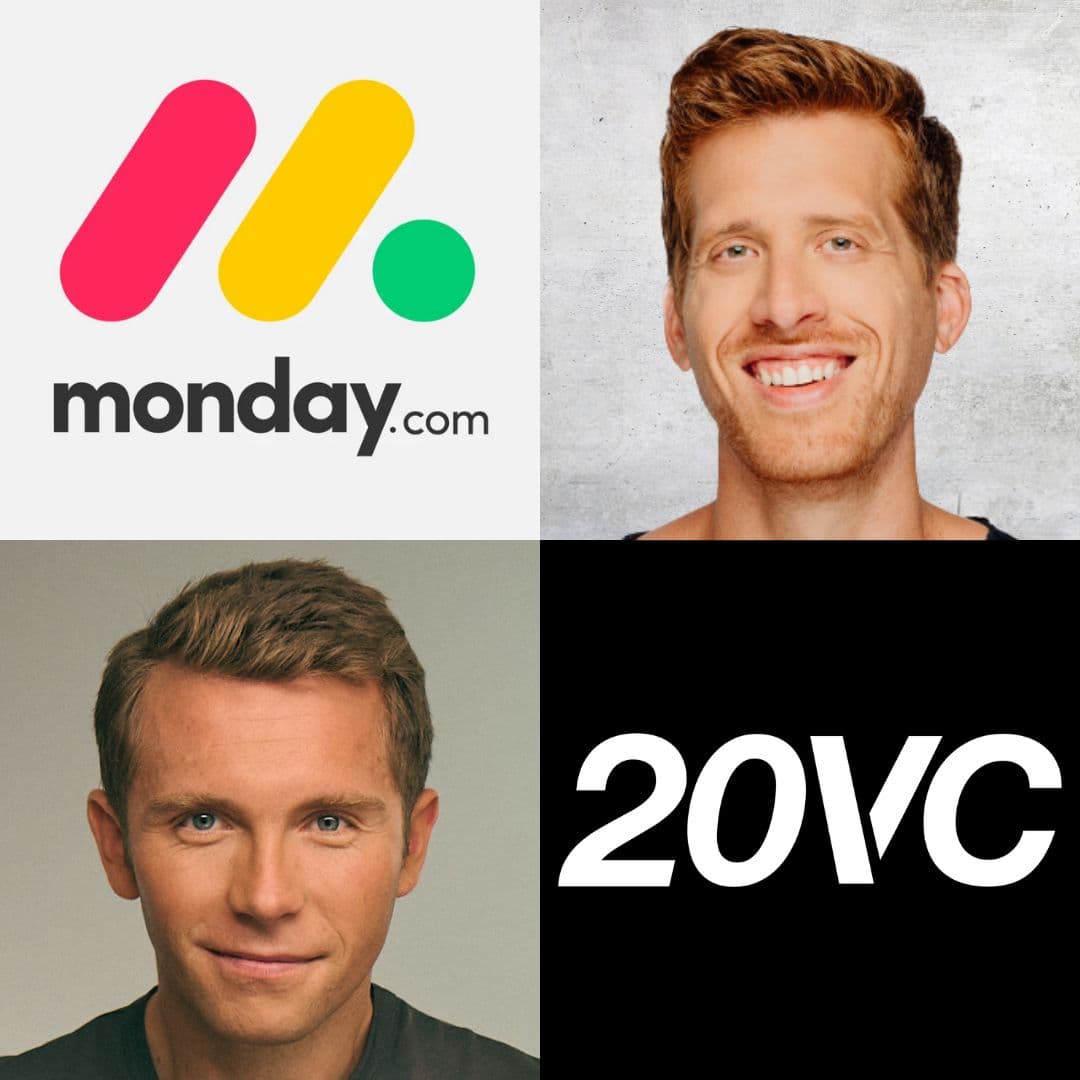
- Guest: Eran Zinman, Co-Founder and CEO of Monday.com
- Description: This episode dives into the remarkable growth story of Monday.com, which went from being rejected by 99% of investors to reaching a market cap of $12 billion post-IPO.
Key Themes and Discussions
- Early Rejections and Learning from Failure
- Investor Challenges: Monday.com faced significant difficulties in raising funds initially, with 99% of investors rejecting their proposal.
- Embracing Failure: Zinman discusses how failure in his first startup taught him valuable lessons about the importance of feedback and adapting quickly to user needs.
- Growth Journey
- Rapid Scaling: Monday.com grew from $6 million to $120 million in ARR within three years.
- Pivoting Strategy: The company initially focused on communication tools before pivoting towards project management, which significantly increased traction.
- Performance Marketing Engine
- Building a Marketing Machine: Zinman highlights the development of an internal tool, dubbed "Big Brain", to track every marketing campaign and user interaction effectively.
- Cash Flow Focus: The emphasis on optimizing cash flow and quick returns from marketing investments was pivotal to their scaling strategy.
- Going Upmarket
- Sales Team Implementation: Originally hesitant about building a sales team, the need arose as they aimed to scale with larger clients.
- Balancing SMBs and Enterprises: Monday.com aims to serve both small and large businesses, recognizing the necessity to adapt products for varying customer needs.
- Multi-Product Strategy
- Expanding Offerings: Zinman discusses the flexibility of their platform leading to unexpected use cases, such as CRM functionalities built by users. This led to the decision to offer a dedicated CRM product.
- Customer-Centric Development: The growth of new products was driven by direct customer demands, emphasizing the importance of listening to user feedback.
- IPO Insights
- Reasons for Going Public: Zinman reflects on the company's maturity and the strategic decision to IPO, highlighting the benefits of being a public company, such as investor sophistication and transparency.
- First Day Experience: He recounts the emotional highs and lows of the IPO day and the surreal moment of seeing Monday.com listed publicly.
- Co-CEO Structure
- Unique Leadership Model: Zinman shares insights on how the co-CEO dynamic with Roy Man works effectively due to a shared vision and mutual trust.
- Future of SaaS and AI
- AI Integration: Discussion on how AI will influence SaaS pricing and functionality, emphasizing a future where AI enhances rather than replaces human elements in business operations.
Key Takeaways
- Importance of Feedback: Regularly obtaining user feedback is essential for product development and improvement.
- Adaptability is Crucial: The ability to pivot based on market demands can lead to significant growth opportunities.
- Marketing Efficiency: An effective performance marketing strategy can transform a company's cash flow and growth trajectory.
- Customer-Centric Products: Developing products that meet the specific needs of users can lead to unexpected market success.
- Strategic Scaling: Successfully scaling involves both maintaining a strong product while also building relationships with clients.
Conclusion Eran Zinman’s journey with Monday.com is a compelling example of how resilience, adaptability, and a customer-focused strategy can lead to extraordinary success in the SaaS industry. His insights provide valuable lessons for entrepreneurs and investors alike.
Written by AI. May contain mistakes. Listen to the episode to check what was said.
Transcript
Automatic transcript. May contain errors.0:00It will still hard for us to raise funds back in the days because people didn't get the idea. We grew from 6 million of ARR to 18, the year after, and then from 18 to 50 and 50 to 120, you know, in the three years. What I found about founders is that you try to avoid the hardest things in your business. If something is very painful, that's the right time to get into it and fix it. The story of Monday .com is insane. Turned down by 99 % of VCs. The company than scaled from $6 million in Aero to $120 in just 3 years. Today the company is public with a market cap of $12 billion. They have an incredible co -CEO structure which is very strange.
0:45And Aaron, the guest today, does not use email. I'm so excited to bring this one to you today. Joining us in the hot seat we have Monday's co -founder and co -CEO Aaron Zinman. This is a special one. But before we leave you today, Harvard Management Company is constantly seeking out the next generation of great investors and entrepreneurs. HMC has managed Harvard University's endowment for nearly 50 years and was one of the first institutional investors in venture capital. Their experience and long -term investment horizon makes them ideal partners to get world -changing ideas on a path to viability and success.
1:18They work as a true partner, providing insightful perspectives to help managers succeed. I personally have had the pleasure of working with the HMC team and can say that they are truly exceptional partners and savvy investors. So whether you're launching your first fund or your fifth, HMC welcomes the opportunity to partner with both developing and established managers. Have an idea you want to share with the team? Just send it over to ventureathmc .harvard .edu. And after securing top tier partnerships, like those with Harvard, the next step is building trust with customers and Secure Frame makes that simple and seamless.
1:51Secure Frame empowers businesses to build trust with customers by simplifying information security and compliance through AI and automation. Thousands of fast -grown businesses, including Nasdaq, Angel List, Doodle and Coda, trust Secureframe to expedite their compliance journey for global security and privacy standards, such as Sok2 and ISO27001, CMMC, NIST, Standards and more. Bad by top -tier investors and corporations like Google and Cliner Perkins, the company is among Forbes's list of the top 100 startup employers for 2024. Cheetu's best software awards for higher satisfaction products and a recipient of the 2024 Cybersecurity Excellence Awards.
2:31Something I definitely never got in school myself. Learn more today at SecureFrame .com. You have now arrived at your destination. Aran, I am so excited for this. I had so many great things from Avy, from Nino, from Rajiv. I spoke to pretty much the whole cap table. It was a lot of fun, but thank you so much for joining me today. Thanks for having me. I'm excited for this. I'm so am I. Let's have one is do it for a while. I'm like the biggest Monday nerd. I love that many reasons why I'm just Actually single But I want to start I heard you're a really great video game player and this is a commonality in great founders that I've interviewed So why are video games correlated to success in founders?
3:15Wow, you've really done your research, huh? That's yeah, I told you Yeah, I actually love video games. They actually play to this day. So it's been an old habit of mine as a kid. When I was young, I used to play a lot of strategy games. One of my favorites ever was... I don't know if you remember, but it was called the Command and Conquer, Red Alert 2. It's a strategy game. I think if you play the right games, you can learn a lot from them, especially strategy games. On one hand, you need to see the big picture all the time. You need to understand the strategy, you need to understand what's going on.
3:48but also, hand of the tactics, know all the details, act quickly. Kind of similar in business, I guess. I think it totally is. I remember Toby Shopify saying to me that he thought that it was more relevant if you'd manage clans in games before, and if it'd been to university, I think, and I thought that was rather apt. I agree, it's as hard as doing that in business. Now dude, you know, Monday is not your first business, and I remember after your first business, you said something which is failing as part of our success. And I just want to dive into this because I think it's important. What have you learned about embracing failure over the years?
4:26And how do you think about that statement? Yeah, there's something that really goes with me in my journey because prior to Monday, my first startup I was in the middle of a uni. I built some sort of a search engine, tried to compete in a category, which is an extremely competitive. I think the more interesting part of it, it was a complete disaster. Like I built a product, I worked it for about 14 or 15 months before launch it. After 14 or 15 months, I didn't raise it any money, I just felt I wasn't ready. And eventually it was a big failure. I ran out of money, personal money, and ran out of energy.
5:03I remember thinking to myself after I closed that company, I always said all my resources, you know, personal, financial, I'm at 0 .0, I must have learned something. I didn't spend all that time without learning anything. After a lot of processing, I realized that I've learned that the reason I failed in that company is that I was afraid to fail. You know, it might sound weird, but I was so afraid of negative feedback from customers. I was afraid people were going to write about me on TechCrunch or on a blog post. I thought people were going to be critical of my product. I don't know, I was just afraid.
5:39And I swore to myself that when I build my next company, I'm going to fail. I'm going to fail often. I'm going to be happy about failures because I want to learn as quickly as I can and improve and get actual feedback from users because after 14 months working on that product people gave me feedback that if I've shown them like a mockup or like an early version, I would get the same feedback and I will be in a total different place today. And we keep that DNA up until today and Monday. We fail. We tell people try it out. A, B, test, get feedback from customers, just learn. And it's a big part of our DNA today as a company.
6:15As much as one can get used to failure, it's never easy to accept. When you look back at the different challenges you faced, what internal fail has been the most challenging to accept? You know, growing up, you know, writing code, that was always this like a smart kid, you know, in school, in uni, and you know, when you build an actual product, the people need to use, nobody cares about your achievement or knowledge, or how much you know about anything. It's all about the product. Is it good enough? Do people really want it? It's not about an exam. It's not about somebody saying great job. It's about actually succeeding in the real life.
6:49And I think it was not ready for that. I tried to not fail. I tried, I wanted everybody to clap and say, this is an amazing product. And this is not the way you build things. You need to get feedback. You need to get people involved, get their opinions. Let's go back to 2012. You and Roy are sitting together, that pulse. I love the name. I really, really, is brilliant. Jenny, I actually like it. I remember, you're so funny, dude, when I emailed you for the first time, your email was at Dappulse. Oh, yeah. Yeah, you didn't respond.
7:23But my question is, you're sitting with Roy. How do you guys come up with the idea for Dappulse now, Monday? Yeah. Initially, both Roy and I had my own startup, Roy also had a startup. And I remember us sitting down, I was working in a company called Cunduit. Roy was working at Wix. I guess it's a little bit counterintuitive because I think a lot of founders, when they think about starting a new business, they often try to think about something that nobody thought about before or a new idea. This is one approach, but we took a very different approach. You know, the, I always say the work management, project management, industry was always packed with a lot of tools.
8:01But we kind of had a different view about the market. We said, look, if we look at the market today, CRM, what's the leader Salesforce? IT might be service now. But who's the leader today about managing work and processes? Like, who is it? Who's the number one vendor that people rely on to manage the core of their work, apart from the CRMs and the service part of it? And when you think about it, there was none. And we just felt there's such a huge vacuum today in the market. And it doesn't make sense that there isn't one company that became like the dominant player in that market. So we said let's try to tackle that opportunity.
8:37One principle that was very important for us from day one, and I think it was a critical component of our success, we said we want to take a very different approach to how we're going to do it, because we, both of us, we didn't consider ourselves to be like the best managers on the planet. I don't know what's the best way to manage a team or a group of people or, you know, a business, But I can give people the tools to do it and they know what's best for their business. So from day one We said we don't know exactly what's the solution for every business But we're gonna give people the ability to customize Monday for their needs because they know best about what's right for their business Since day one nothing in the product is rigid everything is a hundred percent flexible They can change it to their needs and basically our own customers build their own product on Monday today So we go with the idea that hey, we want it customizable so people can make it fit their business.
9:28When we launch, do we have immediate trash? Like is there initial success that we know we have? How did that go? No, no, I mean the first few years was really challenging, I would say. When we started in 2012, our main focus was around communication. If you remember back in the days there were other players like Yammer, HipChat, it was the days before Slack. So we initially thought that it will be more focused around communication and collaboration, but one thing that we found is that a lot of those tools are under the category of, yeah, we can use it, but it's a nice to have tools. It's not something that is kind of managing the core work of businesses.
10:05So we pivoted from that. I think the first, here and a half, we kind of focused on communication and then we kind of pivoted the business to focus more on that flexible management. And that was a big pivotal moment in the life of the company. How is that pivot often found as faced with the dilemma of, I'm told that resilience and persistence is important. And I should just keep going. And then we're also hearing of Pivots where a pivot is required. How do you advise founders on whether to keep going and be persistent versus when to change direction and pivot? Yeah, this is an extremely tricky part because, you know, both Roy and my co -founder and I were software developers.
10:45our natural instinct is to go to the office and write code. That was our go -to. We always felt that we're one feature away from getting the right product. And we kind of spend like 70 or 80 percent of our seed round. We set down and set ourselves, look, something is not working. It's not about the next feature. We need to talk more with customers. We need to understand what they're looking for. And we've done something that's very natural for us. We went and again interviewed a lot of potential customers. And instead of showing them what we built, we actually interviewed them and asked them how they managed their businesses.
11:24So we kind of took that into our own pivot as a company. Okay, and so we pivot and then we go to the more known product that we have today, which is obviously DePulse at this time now Monday. Did we get customers then? Was that immediate traction when we released that V1? When we had the initial version of the collaboration tool, we have about three or four paying customers. One of them was Wix. So we had a limited attraction, but when we pivoted the company, that was a really meaningful moment in the life of the company. We launched our payment system, and I remember to this day, the first time a new customer has actually paid for the software without us talking to them.
12:02I bought a TV, I actually mounted it to the wall, and I built a dashboard that showed the number six. That was the amount of customers that we had. And every time a new customer came in, there was like a big like Homer Simpson sound. Like, whoo -hoo. I remember one day we sit down riding code and I hear this, whoo -hoo, in the background and six turns into seven, seven turns into eight. You know, I remember even one day that we had three new pain customers in one day and I was so excited, I call Roy my co -founder, I told him, look, we got three new customers in one day, we can conquer the world, I'm sure that without momentum.
12:38them. How much of these customers paying at the time? I would say $12 per seat. But the exciting part was that we never talked to them. They got the principle of the product. They got the value just onboarding. That was the exciting part. It just felt like we built something that can turn into a machine. And I think that's more than anything we'll excited at. One thing I find challenging is horizontal products and getting to the first 1000 customers or 1000 users. When you think about that, Monday is the joy of it is a horizontal product, but then the challenge is it's a horizontal product. So your product marketing can't be that tight.
13:13When you think about getting the first customers, how do you think, or what are your biggest lessons in scaling to the first 100 or 1000, given what you've seen? You know, initially I thought that most of our customers are going to be startup companies or tech companies like us, but we started to do marketing on, actually Facebook was the first platform that we started to do performance marketing on. And I think what's great about it is it has such a broad audience and it brought us a lot of customers that we couldn't expect to have like we got, you know, churches, hotels, retail, airplane manufacturing.
13:46Over the years we found that up until today, 70 % of our customers are actually non -tech companies. That's amazing because it just opens up the 10 and the audience of the company so much. And we're going to dive into that because it's an incredible start. But at this point, we're getting customers. Okay, we've got the woohoo coming in. You're doing much better than me. But we've got that coming in. But you've spent 70 to 80 % of your seed round at this point. Your runway is pretty tight. What happens now in terms of funding? So actually here, I give a lot of credit to our board members. Specifically, you mentioned Ovi.
14:21I would say the typical investors seen that a company spent 80 % of their seed round and didn't reached like product market fit. Maybe would they kind of give up on the company or send that company to do like around A and try their like outside, but you know something and I give Avi from on trade capital a lot of credit. He saw the potential. He told us I never forget this. I believe in you guys, even though you know I don't know why, but I believe in you guys don't do an A round just go out. I'll give you the money. Let's do a convertible. just scale what you're building. I think this was the pivotal moment for the company because if we would go and try to raise funds, you know, it's a long process, especially when you don't have momentum.
15:02Maybe the company wouldn't be what it is today, but because he gave us this runway, I think it really helped us leverage the momentum we already had. Was that the A? Yeah, so that's complicated. So we finished, we kind of ran out of money from the seed round. We actually just gave you some data. we raised 1 .4 million. I think it was 2 million pre. That's back in the day. Good times. Yeah, for investors. 30 % of the company. We got this convertible when we wanted to do the around, actually our existing investors put the money in, with the convertible to get us into an around. I think it will still hard for us to raise funds back in the days because people didn't get the idea.
15:46Maybe we didn't also didn't do a good job raising money, but throw an eye. But what did they not get about the idea? I always felt like this company is going to be a huge success. What they don't get, like I didn't get it. I mean, I can tell you, if you want my business. Yeah. You are selling low ACV contracts, we like enterprise. PLG was not as notable as it is now in terms of being able to scale into massive businesses. And you're selling to at hospitals and to hotels and to churches. Dude, this is in a really big business. Like this is like SMB play. You can't make money selling to SMBs, right?
16:26And so we've got all these investor heuristics, which tell us this isn't a good business. Yeah, so this is great feedback. I always felt like, you know, it's all temporary. Like eventually we'll go out of market. Eventually we'll sell to large enterprises. I always believe in our ability to execute and to change the company to kind of fit to the next stage. And maybe that's something we didn't communicate well enough to investors or didn't build our confidence around that. We got a lot of nose. I would tell you that in our A, B and C rounds. So is that when you raised the 7 .5 million A? Yeah, with the converter world, it was 7 .5 million.
17:01What do we expand on next? We've got 7 .5 million. Where do we go now? Okay, so something that I feel we've done, which was really meaningful to make the company successful in scale, So we actually built a very powerful performance marketing engine. We called it big brain. It's a tool we built within the company to track every campaign, every user. We made an early decision in the life of the company to build this tool internally. It was very tempting to use off -the -shelf software for that, to do analytics, monitoring. But we were very ambitious. We said, we're going to build a huge company.
17:34I don't know what we got a confidence, but we just said, we're going to build a huge company. we need to build our own tool because this is going to be a main part of our ability to scale this machine. So we built this tool, we invested heavily into that. So we tracked everything, every click, every view, every ad, any user saw all the way through the sign up funnel conversion, expansion, and so on. And with that, we built a very efficient marketing machine. Now when I say efficient, I think a lot of founders get this wrong and maybe this is an important message, something that we optimized for from the very beginning was cashflow.
18:09I think a lot of SaaS metrics are optimized not for cash. If you think about standard SaaS metrics like LTV, CAC, whatever, they never mention cash, like it's not about cash, it's like more about around the county and predictability, but we always try to optimize for cash. What I mean by that is that let's say we raise 7 million, okay? I want to invest this in the most efficient way in performance marketing. So what's the best way to do it? We said we want to invest into performance marketing and we want to collect cash on cash as quick as possible from our customers. So we've done a lot of AB test to get people to pay more annually to improve speed to conversion, to find campaigns and keywords that get customers to onboard faster and pay more like quicker for annual subscription.
18:55So you turn that five million. So every let's say a million investing to performance marketing, you get 70 or 80 % back after a month. We built a very efficient machine around that. So we actually managed to turn 5 million of money raised from investors into a 15 million one five performance marketing budget. So we built a very efficient machine that recycles money and kind of reinvested that back into the business. I think our customers has been the biggest investor of Monday, more money than we ever raised from investors. When you think about building that cash cycle that is at velocity and at speed, is it multiple things that lead that to be very efficient?
19:36Or is it one or two things which really drove it like annual payments? A lot of things. First of all, we track the expenses. We ask Facebook, we ask Google to can we pay you, can we postpone the payments? Like can we drive campaigns and pay you every nine days, for example? So we optimize the expense on one hand. On the other hand, we optimize for campaigns. We actually pick campaigns based on the return, how fast it is to get customers on board. We optimize the onboarding, we optimize the payment format. There's a lot of steps involving to that. The point is we optimize for that. We optimize for that KPI to make the business very efficient.
20:12It's a key part of our DNA epithelial day. Monday is really efficient in terms of cash flow. It's a huge part of our DNA. We started from day one, literally. We've got big brain. We're building this performance marketing machine. It's starting to work and we're building this cash flow cycle. First, how much revenue do we have when we raise the seven and a half? Wow, probably three or four million of error. Fuck, I really miss these times. Now you do an A when you go, like, you know, a design partner.
20:43That wasn't a joke. And that was me crying in my studio. Okay, and so we have this performance machine. It's working. When do we go out and raise the B? Because then you raised 25 from insight, correct? Oh, yeah. When we raise our B -round, we raised 25 million from insight. That was going to, I was saying, a bet around for the company. So we raised 25. I think when we raised that round, we had like 7 million of RR. What was the price on the round? I think it was around 100 million, pretty. Stan and 20 % dilution. Yeah, yeah. So we raised 25. Let's ask the question of upmarket. SMBs and kind of lower ACVs is kind of where our home is.
21:23When do we still decide to go upmarket? Yeah, so after we've done the B -Round with inside, you know, a few things happened. One, we branded the company as Monday. We changed names from the polls. And I think it was about a year after that. I remember that board meeting. It was in New York. and one thing that Roy and I said always that we're never going to have a sales team in the company and I remember that we had this warming and we came to the board and said look we're probably wrong and we have to have a sales team in order to scale the company to the next level and we built an amazing sales team you know going forward to today we have more than a thousand people in our sales team but it was not obvious back in the days.
22:06Why did you decide that was the right time? Being developers and product people and building this incredible performance marketing engine, we felt that we can scale the company to infinity. But what we found is that having a great product is not enough because when you want to scale within existing customers, the product plays a very important component, but there's other things. You need a relationship with people. They want somebody to talk with and I just felt that it wasn't a good product for our customers Like they had the own processes they care about security they care cared about governance They want to help with unwording people into the product and software is not enough as I said we were we were always ambitious we I remember Roy and I talking and we said we don't want to be an SMB company forever like we have such huge potential.
22:57We want to be doing both SMB and go up market. And this is what we have to do. So let's do it. A lot of founders are told wait until you're pulled up market by large enterprises. Is that good advice? It worked for us. I think let's say the opposite is also not optimal. I think that if you start as a small company and you have an amazing VP of sales, you know, they can sell anything, even if your product is really crappy. That's It's a curse. It's not something positive because we work so hard to improve the product because every improvement, you know, just improve our marketing machine, it's improved the retention of our customers.
23:34And it's built a DNA, a special DNA in the company. And then when we felt that we're missing people knocking on our door saying we want to scale and there was nobody around to help them, it just felt we have to do it. We have to mature. We had to add this layer into the company in order to scale to the next phase. I get you, but a lot of other people say, and I see this myself as an ambassador, it's such a different company to build an enterprise business. Not just sales teams need customer success, you need SDRs, you need A's, you need CS, you need security, SOC2s, compliance. Is it a completely different business to build?
24:13I think there's a different between a company that pivot into the enterprise and a company that want to sell to the enterprise in addition to selling to SMB and mid market. We didn't pivot into the enterprise. It's not a lot of companies say, look, we tried SMBs, we tried at mid market, we spent so much energy and effort converting those customers, we might as well just focus on the large ones and get a higher ACV. That wasn't our strategy. We wanted to capture, like we call it like a pyramid, the whole pyramid, the baseline of the SMBs and mid -market but also the tip of the pyramid with the large enterprises.
24:49So it was always about adding that layer but also making sure the product is good enough for SMBs and mid -market. When did you start to see PLG tapering off and really wanting to implement the sales team alongside it? What sort of level of revenue was it? Probably 40 or 50 million of ARR. Wow okay and so we're still on the 25 million from inside of this round. Yeah we grew really quickly. We grew from six million of ARR to 18 year after and then from 18 to 50 and 50 to 120, you know, in the three years. So it was like super rapid growth. You know, I think it was 40 or 50 million, maybe even 60 that we kind of added the sales team.
Read the full transcript
25:29Do you appreciate how strange that growth is? And what I mean by that is that when you're doing it, are you like, whoa, we know that we are one of the special ones. I'll tell you something funny. You mentioned Jason Lampkin. Don't tell me you told him and he didn't respond. No, no, no. One of the reasons I didn't reply to your email is that I don't use email, but I actually made Matt Jason a few years ago. I was one of his biggest fans. When we started in 2012, 2013, nobody knew about Sass, anything. I became the biggest geek on Sass. I read every article. He put on Sass, or he wrote answers on Quora, if you remember.
26:07I remember I went to Roy and I told him, you know, I read an article from Jason, he said that when you get to one million, you need to get to 10 in four quarters. And then once you get to 10, you need to get to 100 in like, I don't remember, like five or six quarters. And I said, look, we have to do it. We have to do it. You know, Jason said so. And when I met Jason a few years later, I told him like, thank you for the guidance and everything. And it was very ambitious to get that goal. You told me, you know, I was talking about like the best companies, the like what investors want to invest into that.
26:41And just I took it as grand like literally this is what we need to do. So I guess ignorance is a bit sometimes. Dude, that growth isn't incredible. When you look back at that growth, what broke first? Because scaling companies is very hard. What was the first thing to break in that intense period of hyper scaling? I think at some point when we reach 50 or 60 million, you know, the performance market engine was working really well. But at some point you understand that if you want to reach to 1 billion, Actually, when we got to 50, we built a dashboard. We called the road to 1 billion. We built a vertical TV in the office showing that we want to reach 1 billion by the year of 2023.
27:22We actually missed it by one year. It was like a vertical dashboard and we said, we are here 50 million. We need to get to 1 billion. And we put it for everybody to see in every office around the world. And I remember when we sat down, we said, But we cannot do it just with the performance marketing engine because when we ran the math, we had to invest so much money into performance marketing in 2022 or 2023. It didn't add up. So it was obvious to us that in order to scale to that magnitude, it's not enough to have a very efficient performance marketing engine. We need to build a very robust sales team and to expand our customers because eventually when you reach one billion and you want to grow 30%, you have the majority of revenue need to come from existing customers.
28:04I read and our teams are amazing now for research. So when I say I read, I was given the numbers. But I read that you spent in 2023, 17 million a month on performance marketing. Yeah, something like that. A little bit less, but around that, yeah. How did you spend so efficiently in performance marketing when so few others did? Again, it's all thanks to the amazing engine that we built. We're very efficient in terms of cashflow, you know, over 25 % free cashflow positive. So we just scaled this cashflow machine to the extreme. Did you focus on a small number of channels and really hammer them? Did you spray and pray and see what, what?
28:50How did you approach the kind of portfolio approach to channel spend? No, we never spray and pray. We don't believe that pray, I mean, I pray sometimes, but it that doesn't help you with performance marketing. We measure everything. When we build a new campaign, we track everything. We avi test everything. Why was YouTube so successful? Let Monday has crushed YouTube. You know this as well as I do. But why? So first of all, the rebrand was a key part of that. That was one of the main reasons we rebranded the company because we wanted to pick a name that's people can remember because when you see an ad, you have about five seconds of attention to capture people.
29:28And again, we managed to track when people saw the ad, we would not just track links, but also people viewing the ad. And we saw there's a great ROI on that, and we managed to get a great presence on YouTube. And it was, again, cost -effective to do it the way we've done it. What channel did you spend on that you wish you hadn't spent on? Look, Facebook was amazing for us because I think it just changed the trajectory of the company. But definitely, you know, AdWords, YouTube, we tried everything. We're doing everything. But which one's least effective? Least effective? Yeah, which one are you like, we spent on it and it was a waste of money.
30:03That's not the way I look at it, because it's not about effectiveness. It's different audience. When people search on Google, they have a specific intent. I'm looking for a project management tool. But some people are not searching for a project management tool but are browsing Facebook. And there's two different audiences, but both of them can be potential customers. Some people have intent. Some people have, I need a new platform from the back of their minds, I'll just go on Facebook and suddenly a commercial about working and doing, huh, maybe it's an opportunity. It's a different kind of audience that we kind of target.
30:37Is it not like the most expensive ad word? Like CRM, respectfully, the competitive land field or land mines that you kind of face is intense? Is it not the most expensive ad word by? It is, but it's very cost effective for us. If we go forward, we build our multi -product strategy. So basically what happened, and maybe I'll give you some background before we talk about marketing around that. So basically people, we got everybody using Monday. And one thing that was super surprising for me is that a lot of people use Mondays at CRM. And because it's so customizable, you can build your own boards, which is like kind of the equivalent of a table.
31:14And they build context, they build deals, they build dashboards, automation, like a full flash CRM. Like why? It takes so much effort to do that. I'm not talking about a few hundreds or even a few thousands, tens of thousands of accounts built CRM on top of Monday And the same goes for death the same goal for service those products were not born out of same air They were born because customer demand and when we interviewed people like why did you do it? What did you go all that effort to build a full -fledged CRM when you could just buy off -the -shelf product and they said like we want control I have an idea was the best CRM for me I don't want to use off -the -shelf product.
31:53It's very rigid. It's built in a very specific way. They told me our only option, basically, was to go to Salesforce because it's enterprise -ready. You can customize it, but the cost of doing that and the complexity of customizing that software. And Settles is just an example. I'm talking broadly about enterprise products. They look for something different. And we gave them on one hand the freedom to build their most amazing CRM, but they've done it themselves. No third party vendor, no special IT team, they build themselves and they felt proud about that CRM. So eventually we said, look, let's build a CRM product, let's package the Monday platform into a full -fledged CRM and build like deep feature, you know, call recording, call analysis, email marketing, and we've done that.
32:41That strategy has been a huge success on multi -product strategy. You know, the CRM today is growing faster than what Monday did back in the days. What's the CRM product today out? Ravinyuize? The last investor day last year, it was growing from almost 0 to 25 million in one year. Are we seeing the complete bundling of SaaS tools? You mentioned that the cool recording elements, you mentioned quite a few different products within that, which kind of bluntly kill a load of other adjacent products. Are we seeing the bundling of SaaS tooling again? Look, I don't think Monday will replace all SaaS tools on the planet, But our vision, our grand vision is that from day one, we built a platform, we didn't build the product.
33:23I think that's something that a lot of investors got wrong about what we're building. Maybe we didn't explain it properly, but we didn't build a work management or project management tool. From day one, we built the equivalent of force .com, which is for Salesforce. We built a generic platform, not about work management, not about CRM, just the building blocks. And then Work Management was the first implementation and then came CRM and Dev and service. The effort that it takes us to customize the platform as a CRM as Dev is minimal compared to the compound value that we get because we build it on our Monday platform.
34:00And eventually I see definitely CF Future where a company by several tools and consolidated on Monday for the core business use cases, whether it's CRM, Work Management, Dev, Service, and the compound value of using several those tools, the flow of data, automation, processes is a huge value ad. The reason I'm excited, so much about the future of the company, I really feel from the bottom of my heart, is that we have one of the biggest opportunities today in the software market, and we have to execute in order to deliver that. But I really feel that we got everything right. We just need to scale the company to the next phase.
34:37What do you know now about going multi -product? that you wish you had known when you went multi -product. Maybe one lesson is it's not just about the product itself. Go to market is as important and every product have a very different go -to market. It's unbelievable. It's so different, different buying dynamics, different buyer, different decision process, different way people consume ads. They're all special in their own way. As a result, do you have to build independent teams for every product? How do you think about how the company changes with the additional product line that's built. Yeah, that's exactly how we think about this.
35:13We have different business units dedicated for each product. Every product is in different phase. So CRM is more mature and than dev and then service and obviously work management is kind of the most mature product. But every product has its own team, its own marketing efforts, dedicated salespeople, and we scale them. It's like small startups within the company. Dude, when you look at the revenue lines today, Monday is like what's Monday call revenue? I mean, we now we reach one billion if they are about like three months ago, I think. Okay, great. So we've got a billion of error and then CRM is like 25 as we said in the yesterday.
35:48Yeah, that was like you before that, but it's bigger today. What's smaller line of revenue today will be one of the biggest lines of revenue in five years time? Definitely CRM will be very dominant going forward. Dev as well. Well, actually the moment we got to Monday's service is unbelievable. Still early days. Who do we compete against for Monday's service? We'd CRM, we'd compete with HubSpot, Salesforce a little bit, Zoho, Service. We can see Giro Service, FreshDesk, a little bit of service now, although they're very focused on the enterprise. When we look at the names that you just mentioned, like on CRM alone, respectfully, wow, how do you advise founders who are told, oh, that's a really horribly competitive industry.
36:33For me, it sounds like it's an opportunity to disrupt that industry. You know, this player has been dominating each one of those industries for a very long time. People willing to pay a lot of money to use those tools, they bring a lot of value. And I think it's just an opportunity to disrupt that market. Do you pay attention to competition? When I built my first startup, I remember that I used to log in to, you know, tech -run, or read tech news, and every time I saw a competitor that I felt was competing with me, I felt this weird feeling in my stomach, and then I swear to myself, and then never going to do it again.
37:04I'm just going to focus on myself and my journey, so I don't. So you don't pay attention to competitive products? I mean, we analyze them and we look at them and see what they're doing, but I don't feel like that's what's going to stop us in any way. I feel if anything, it's in our hands. It's in our control, in our executionability. Okay, so when we think about executionability with an eye moving forwards, you're an incredibly insightful Smart founder everyone is questioning horizontal software's ability to sustain in the next wave of AI How do you respond to the question of Monday sustaining when we live in a world of agents when we see a new generation of AI Impact all of that's for me.
37:45This is one of the things that excites me the most because what we already seen once we now built a lot of AR functionality is that people use AI inside Monday. So, and so easy for them. We took the same principles of easy, busy experience and custom, custom ability and a standard of building like a dedicated AI product would just allow their own customers to integrate AI into their own workflows. So we helping them today make their own work more efficient. The agents not make Monday a simple system of record or a database, given they do all information and data, collection, retrieval, and migration, and then bring it back to Monday.
38:27And is that a good thing or a bad thing? I think it's an amazing thing. I think that there will always be room for system of records. I don't think that anybody will be willing to put their future into an AI bot without having the ability to question what's going on, see dashboards, graphs, and all that data. So I think it's very important to track the data. I don't think that will go away. Maybe some of the work being done by people will be done by AI, but it doesn't take away the fact that you need to analyze the data, you need to see it, you need to track it. And also I think there's still going to be a substantial human element that will be part of that.
39:00So I don't think that SAS tools will go away. I think if anything, some of the work can be replaced by AI, but still the fundamental principle of why those tools exist is strong and will remain going forward. Do you think AI will change the future of SAS pricing? for sure for sure you know I think a lot of Sastos have been very focused on sit count and you know once you replace you know human labor with AI functionality pricing should adjust and maybe be more focused on consumption in addition to seats can I go to the IPO why did you decide to IPO when you did you know we live in a world now where there is such extended windows of private capital you don't need to IPO as we're seeing was striped data breaks stalling how How did you think about when was the right time?
39:45First of all, it was more random that you might think. We just felt that eventually we want to build a huge company. When we look at the most inspiring SaaS companies in the world today, they were all public. I think it's as a layer of maturity into the business. I really liked the fact that we're a public company because, first of all, public market investors really surprised me. They're way more sophisticated than what I thought. I thought that initially when we went public, I thought that it's all about the private market, those investors, but public market investors are super sophisticated and smart.
40:21And also, I think that cadence of quarterly earning reports really add the great cadence to the company. So all in all, I think it was a great move for us as a company. You go out at 7 .5 billion? How does that feel? You know what? You tell me you like stories. So let me tell you a story. I'll tell you about the day of the IPO. It was long two weeks in New York. It was actually on the edge of the COVID kind of lockdown. So I think it was one of the first IPO that was done in person after the COVID lockdown actually. And it was all in Zoom because before COVID used to take like a bright jet and meet investors and do like a bus tour, but it was mostly on Zoom.
41:04So we were exhausted like a day before the IPO. So here it is, the IP of the big day. We go to NASDAQ. It's a beautiful ceremony. I remember seeing kind of the opening of the trade day. And then a few hours go by. I do a bunch of interviews on TV, newspapers, and it's like four or five PM. I look at to my left, I see Roy, my co -founder doing interviews as well. And we're alone, like literally alone. Everybody left. We're alone. I had like this blazer that I never wear but for the IPO. We were both matching suits. We took off the blazers and we walked to the hotel like 25 minutes like with the white t -shirts.
41:48We walked to the hotel. I go to my hotel room. I sit down on the bed and just stare at Netflix for like three hours. That's the IPO day. That's the anticlimax of the IPO. But the day after I was that hard because it's like you know and triathletes or iron men or people who run a marathon There's so much build up and then it happens and it's like oh Yeah, the day after when I woke up I opened my iPhone Opened a Stocks app and added Monday and that was the most exciting I felt it in throughout my old body when I saw the Monday Taker. It just felt real. What was first 24 hours performance? I think we went up like 10 or 15 % so it looks good.
42:33It's a tough morning when you wake up and it's like, Oh, yeah. You mentioned Roy there. You are co -CEOs. That is a crazy arrangement in traditional startup land. It's worked phenomenally well for you, which is amazing. What have you done to make co -CEOs work? When we started the company, actually, Roy was the CEO. and I was the CTO. So within starters, co -seos, but I remember like a week into the company, he told me, look, I want us to do everything together. So I told him, of course, like we co -founders, but he told me, look, everything, you know, raise money together, be co -seos, they told him, okay.
43:13And we would meet investors and it was weird because I would sometimes talk about the business and he would talk about technology. And then next meeting will switch roles. I think we got everybody kind of confused. But after a while, he just told me, let's make it official. Can I name ourselves, co -seos, just so we don't have to explain it to everybody. What's so special about him is that it's one of those people that has no ego. Like, you want to do what's best for the company. He doesn't care about his own title or to be on top of somebody else. We spend a lot of time together. We actually, we walk home every day, like walking.
43:47We live in Tel Aviv, so we walk every day. We spend hours just to sing and talk about things. You walk home every day together? Wow, what's been your biggest lessons on board management? You have a great board. First of all, my number one rule is never surprise the board. Never. That's like the worst thing you can do. Actually, one of the things we built into big brain is, I don't know if Avi told you, but we used to send every day like a daily SMS of the company performance every day to our board members. Whether it was good or bad, it was automatic. So when they came to the board meeting, they knew the numbers better than I do.
44:21Like they saw everything. like the board meeting was basically done on the numbers and the metrics because they had full transparency and that's something that I really believe inside the company knows of for our board members. And if we had something that we wanted to make a decision about, we always talk with each one of them individually before the meeting because the last thing you want is to get into a ego fight. So just get their opinions and change the things before the meeting. So we talk more about the future than waste time on disagreements. That's so interesting. I wonder if that's possible, to for a fund.
44:52I'm just wondering now if I could actually have that with my investors or at least my board. Well, like whenever we had a change of marks for a new investment or whatever it was, okay. One to think about. Listen, I could talk to you all day. I want to do a quick fire with you. So I say a short statement, you give me your immediate thoughts. That's not okay. Okay, just no, no tricky questions. And then that never took you. What do you believe that most around you disbelief? Maybe something that's not intuitive is about sending goals. Most people, when they said goals, they try to figure out what they can do.
45:23I never think about it this way. I'm thinking about what I want to achieve and then try to figure out a way to do it. Because when you build like a plan for next year, bottom up, people will kind of think about a plan of what they've done last year and let's do it again with small adjustments. Always think about how can we do it above and beyond and then just change how people think about what can be done and how they can achieve it. Why don't you email? I never got anything good out of an email. I'm an extreme believer in focus. You ask me about investments. I don't do investments. I focus 100 % on the company and I always try to set my own priorities because I think all those tools really distract you.
46:00I always try to look inside and try to understand what's most important for the company. And when you start going to be managed by external tools, I think it's a huge distraction for the company. It sounds wonderful, dude. But how do you actually do that because when you have like investors, board members, customers, they get in touch by email. You set up investor meetings by email. So how do you not do email? Just I'm so fascinated. No, I mean, we have other people in the team that use email for coordinate meetings and other things. It's not like a company rule. I just don't do it myself. And so you slack and what's happened?
46:36Yeah, we use Monday a lot to sync. We use Slack. What's up? Kind of more instant communication What's your biggest lessons on priority setting? Your fascinating mind comes at focus. What's your biggest lessons on priority setting? What I found about founders is that you try to avoid the hardest things in your business, because usually the hardest to change. And I always think to myself, if something is very painful, that's the right time to get into it and fix it. And I always try not to avoid going down and deep into the hard things, because I think eventually those are the things that cause stress.
47:15And once you deal with them, it just changes your mindset and the course of the company. So I always try to focus on the hardest things and try to figure out what's now working in the company. What's the single hardest element of your day job? It's cozy of Monday. I think fighting the right balance. I think that for many years I didn't have the right balance of family life and work life. and I was really stressed and I've made a decision a few years ago to make a change. It's been a lot of time with my family today. I'm more efficient. What have you changed to allow yourself to do that? Actually, I went to therapy and one of the things my therapist told me, which really resonated with me.
47:53She told me that, you know, I can do the extra meeting. I can do the extra thing, but at the end of the day, I'm a leader in the company. I'm leading the company. So people look at me and when I'm exhausted, when I'm stressed, when I don't have patience, it just reflects on everybody else. And I need to take care of myself in order to be able to take over the company. And it's really hit deep on me. And I just felt, I should treat myself like a professional athlete. I should be at my peak all the time. I mean, you look wonderful. But how do you know? No, you do. You're really fantastic hair, by the way.
48:26I've been thinking about how this is a solid hair. How do you look after yourself well today, then? Actually, I exercise every morning. What time do you get up? I have three little kids. So my baby usually wakes me up at just like 6am. I try to exercise every morning before I go to work and then I try to spend time with my family in the evening. It's not always possible. It's really something that charges me as a human being. Do you need much sleep? Yeah, I got the ordering, so I've improved my sleep. So when do you go to bed if you get up at 6? Well, I'm embarrassed to say, but usually like 10 p .m.
49:06Wow. Yeah, that'll do it. Do you watch your diet? Are you healthy? Yeah, well, I hope so. But yeah, like I said, I tried to optimize my sleep, my nutrition, my exercise regime. I just feel that I need to be sharp, I need to be at my peak, I need to take care of myself, you know, to take care of the company. So I really treat this like professionally, I guess. I listen to a lot of podcasts about supplements and just health -eliving, I guess. You can be CEO of another company for a day, which company did you choose to be CEO of? Wow. I'm fascinated by Microsoft. I think that's a company that's done one of the biggest transitions in the history of software or tech.
49:46It had its lows, it had its highs, but I think I'm really interested to understand what was the transition. I think the so -tie of the CEO of Microsoft have done its tremendous job pivoting the company. So it would be interesting to see this from the inside I guess totally get you an agree if you were Mark Banny of today What would you do with Salesforce? Salesforce is an amazing company. It's an inspiration It is so much credit for building the SaaS industry If you could ask him one question. What would you ask him? One question for Mark I think it is one of the people that probably knows the best in the world of how to build you know a sales machine at scale So I think there's so much I can learn from him about how to do it.
50:26I think he probably forgotten that I didn't learn yet Probably a question around that I guess. What about the way your parents brought you up? Are you deliberately not doing with your children? Oh, wow. It's a good one. Look, I think my parents first of all, I love them and I appreciate the way they raised me and I think they taught me a lot of important lessons. I think my dad taught me to go deep on everything I do, everything. He always asked me like, why? He always asked me to, he forced me to understand every decision, every thing that I've said. He always asked me like, explain to me why.
51:00And I think just developed a sense of me that I always try to understand why and dig deep. And I think my mom told me a lot about compassion and how to deal with people and to be ambitious and to be a winner, I guess. Maybe something that I've learned along the way that maybe I do differently is also to accept different paths of how people grow up and what they care about and what's not. I try to be very open with my kids and try and send what they care about. I'm not trying to push them in any way and just let them be who they are. I often think about what is a successful person, like what defines success.
51:38Is it status, is it money, is it professional career? Is it happiness and I don't know what the answer is? It's not it's market cap. I just want my kids to be happy. I don't know how what the best way to achieve it, but that's what I want for them. Why don't we you happiest with my family for sure? That's the moment I find peace inside. I love the company. It's one of the most meaningful things I've done in my life, but spending time with my kids, it's like the best thing for me in my life. What stage of the company did you find most unnatural for you as a CEO? Everyone, every stage now. I've never done it before.
52:20It's a new experience for me and I learn a lot of things along the way. But I want to continue in this journey and I want to keep learning and evolving as a person. Final one, what question are you never asked by employees, by investors, by board members that you should be asked, you think? Oh, wow. You have tricky questions, Harry. I don't know what's the answer, but nobody asked me why we built this company. Like why did we go on this journey? Been an entrepreneur. It's not intuitive. Why people do it? It's a big question. Why did you decide to be an entrepreneur? My question life is to find out exactly, but I think it's a combination of trying to prove myself, I don't know, to whom, but maybe to myself, and do something meaningful and good that affects other people.
53:06but I don't have the full answer yet, I guess. Arann, nice to appreciate you putting up with my deep and meaningful questions, my bluntly meandering around different topics. You've been fantastic, so thank you for joining me. Thank you, Harry. It's been a pleasure. BELL RINGS My word, I'm such a fanboy of the Monday business. If you want to see the episode in full, you can find it on YouTube by searching for 20VC. That's 20VC. But before we leave you today, Harvard Management Company is constantly seeking out the next generation of great investors and entrepreneurs. HMC has managed Harvard University's endowment for nearly 50 years and was one of the first institutional investors in venture capital.
53:44Their experience and long -term investment horizon makes them ideal partners to get world -changing ideas on a path to viability and success. They work as a true partner, providing insightful perspectives to help managers succeed. I personally have had the pleasure of working with the HMC team and can say that they are truly exceptional partners and savvy investors. So whether you're launching your first fund or your fifth. HMC welcomes the opportunity to partner with both developing and established managers. Have an idea you want to share with the team? Just send it over to venture at hmc .harvard .edu.
54:16And after securing top tier partnerships, like those with Harvard, the next step is building trust with customers, and Secure Frame makes that simple and seamless. Secure Frame empowers businesses to build trust with customers by simplifying information security and compliance through AI and automation. Thousands of fast -grown businesses including NASDAQ, Angel List, Doodle and Coda trust Secure Frame to expedite their compliance journey for global security and privacy standards such as SOC2 and ISO27001, CMMC, NIST standards and more. Bat by top tier investors and corporations like Google and Cliner Perkins, the company is among Forbes' list of the top 100 startup employers for 2024.
54:57Cheetu's best software awards for higher satisfaction products and a recipient of the 2024 Cybersecurity Excellence Awards. Something I definitely never got in school myself. Learn more today at SecureFrame .com. As always, I so appreciate all your support and stay tuned for an incredible episode coming on Monday.
From the publisher
The story of Monday.com is insane, turned down by most VCs, then scaled from $6M to $120M ARR in just three years. Today the company is public with a market cap of $12BN. Joining us in the hotseat today is Monday's Co-Founder and CEO, Eran Zinman.
In Today's Episode with Eran Zinman We Discuss:
03:03 The Role of Video Games in Founders' Success
04:12 The Fail That Taught a $10BN Founder Everything
09:40 Pivoting to a $12BN Company: How, When and Advice on Pivots
14:15 Why 99% of Investors Turned Monday Down: Fundraising Lessons
17:05 Building a Performance Marketing Engine
21:25 How to Scale ACV and Move Upmarket
28:54 What Have Been the Most Effective Marketing Strategies
29:08 How Have Monday Been So Successful with Youtube Ads?
29:43 Biggest Challenges and Lessons in Channel Spend
30:50 Building a Multi-Product Strategy: The Rise of Monday CRM
34:37 Competing in the SaaS Market: Is Competition Good?
39:30 The IPO Journey: Why Then? Pros and Cons of Being Public?
42:38 How a Co-CEO Structure Works
43:55 How to Manage a Board
45:04 Quick-Fire Q&A