
In short
Podcast Episode Notes: 20VC with TS Anil, CEO of Monzo
Episode Overview
- Podcast Title: The Twenty Minute VC (20VC)
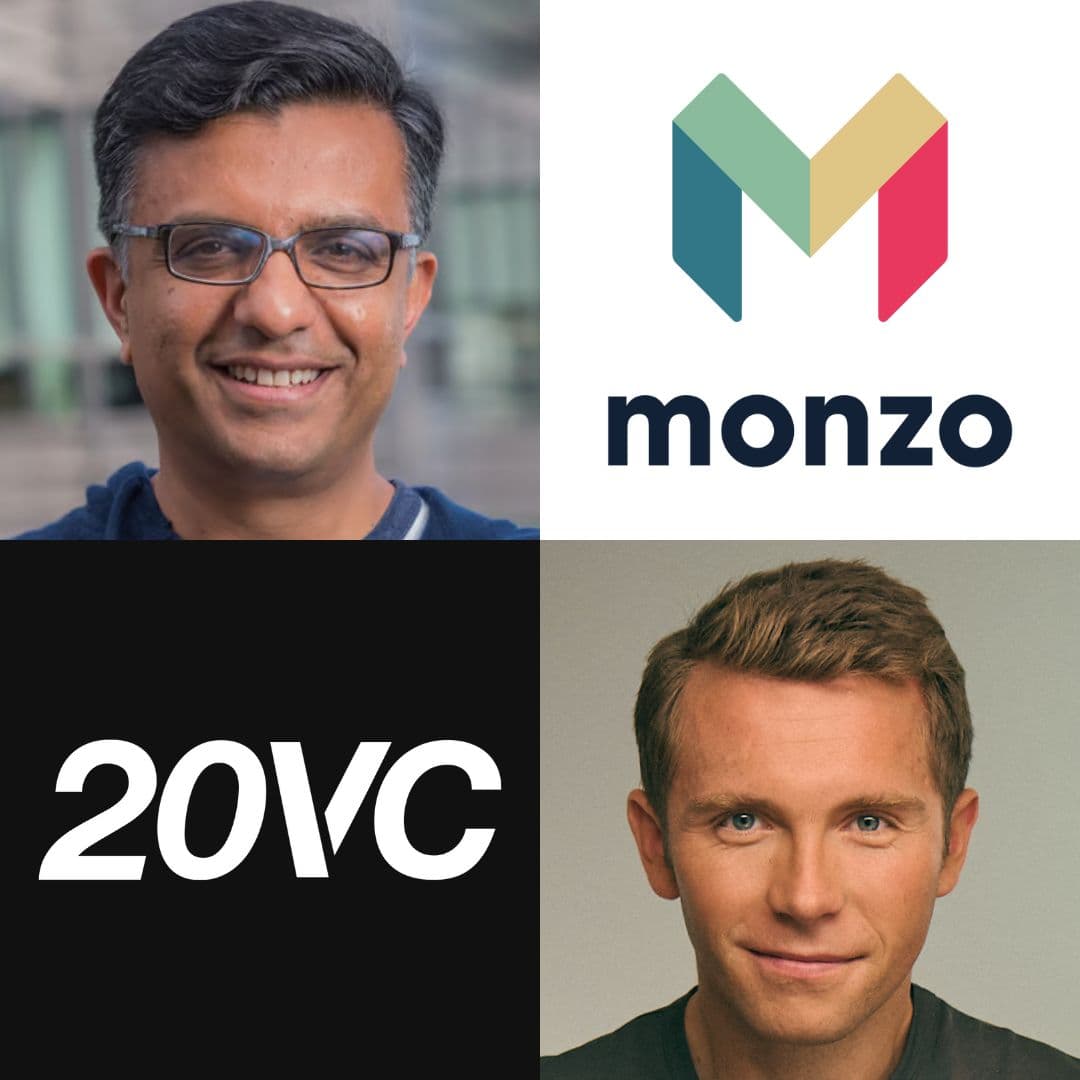
- Episode Title: 20VC: Monzo: The Greatest Turnaround in Tech
- Host: Harry Stebbings
- Guest: TS Anil, CEO of Monzo
- Release Date: [Insert Date]
- Main Theme: The remarkable turnaround of Monzo from £40M in revenue and significant challenges to achieving £1BN in revenue and profitability, alongside a customer base of over 10 million.
Key Topics Discussed
- The State of Monzo Before TS Anil
- Initial Challenges:
- £40M in revenue with a 40% down round.
- Major layoffs and low employee Net Promoter Score (NPS).
- Limited runway and falling revenues due to COVID-19.
- TS Anil's Vision and Leadership
- Motivation for Joining Monzo:
- A desire to reinvent customer relationships in financial services, as traditional banks had failed to innovate.
- Approach to Challenges:
- Emphasis on tackling interlocking problems rather than focusing on a singular issue.
- Implemented a comprehensive 100-day plan to address multiple issues simultaneously.
- Monzo's Business Model
- Revenue Growth:
- Transitioned to a profitable model with diversified revenue streams, including transaction-based revenues, lending, and subscription services.
- Product Development:
- Focused on delivering user-friendly financial services while maintaining mission-driven principles.
- Example: Chose not to pursue cryptocurrency trading to align with their mission of fostering customer trust.
- Customer Engagement and Culture
- Work-Life Balance:
- Advocated for a culture that values employee well-being alongside high performance.
- Customer Trust:
- Engaged with users through transparent communication and educational resources to demystify financial decisions.
- Future Expansion Plans
- International Growth Strategy:
- Discussions on expanding into Europe and the US, leveraging partnerships instead of chasing banking licenses due to regulatory challenges.
- Market Analysis:
- Identified potential markets in Europe, with a strategy to use Ireland as a base for expansion.
- Reflections on Fundraising
- Funding Rounds:
- Insights on the difficulties of initial fundraising, particularly during a down round.
- Discussed the evolution of investor confidence as Monzo’s story and metrics improved over time.
- Key Takeaways for Leadership
- Essential Traits of Great Leaders:
- TS Anil emphasized the importance of vision, operational excellence, and the ability to scale the execution of the business.
- Discussion on Future Directions
- Going Public:
- TS Anil expressed the importance of timing and the current lack of urgency to go public, enjoying the support of patient investors.
Conclusion The episode highlights TS Anil's effective leadership and strategic vision in transforming Monzo from a struggling startup into one of the UK's largest digital banks. The conversation emphasizes the importance of aligning mission with business strategy, fostering customer trust, and maintaining a high engagement culture for long-term success.
Recommended Listening
- For those interested in fintech, venture capital, and startup growth, this episode provides valuable insights into navigating challenges and leveraging opportunities in a competitive landscape.
---
*For more information on the podcast, visit [The Twenty Minute VC](http://www.20vc.com).*
Written by AI. May contain mistakes. Listen to the episode to check what was said.
Transcript
Automatic transcript. May contain errors.0:00This is 20VC with me Harry Stabbingson, state we feature what I believe is one of the greatest turnarounds in modern tech. When TS and Il took over Monzo, they had very little runway, they had a 40 % downround, mega layoffs and very poor NPS for employees, with just 40 million in revenues. Today, they are the leading UK digital bank, they have 10 million customers, they have a billion in revenue and they are profitable, What an insane journey with T .S. at the helm and today he joins us in the hot seat to unpack it. This is a very special episode. But before we dive in today, I'm almost started with one simple idea.
0:39The tools you need to grow your business shouldn't put you out of business. That's why they work directly with developers to get exclusive discounts of 80 to 90 percent. 80 to 90 percent off software, saving entrepreneurs over half a billion dollars since 2010. Some of the biggest names in tech like Mailchimp, Zapier and Dropbox got their start on AppSumo and with a rotating selection of hundreds of tools, you'll find all the software you need to make your life easier in 2025. Plus with a 60 day money back guarantee, you can try any tool risk -free. Start the year off with savings, get 10 % off your first order with the code 20, lower a case of VC and a free tool exclusively for 20 VC listeners.
1:20That's code 20 lower case VC for 10 % off plus a free tool at app sumo .com. The next step is building trust with customers and secure frame makes that simple and seamless secure frame empowers businesses to build trust with customers by simplifying information security and compliance through AI and automation. Thousands of fast -grown businesses including NASDAQ, angel list, doodle and coder, trust secure frame to expedite their compliance journey for global security and privacy standards, such as SOC2 and ISO27001, CMMC, NIST standards and more. Bat by top tier investors and corporations like Google and Client Perkins, the company is among Forbes' list of the top 100 startup employers for 2024, Cheetu's best software awards for higher satisfaction products and a recipient of the 2024 Cybersecurity Excellence awards.
2:11Something I definitely never got in school myself. Learn more to stay at SecureFrame .com. You have now arrived at your destination. T .S. I'm so excited for this and I've spoken to most of your cap table in preparation for the show, so thank you so much for joining me. Just weird to be asked. I'm excited to be early. Listen, we've had it in the calendar for a while. Now I want to start with, when you took over, it was a tough time. There was 40 % down -ound. There was little runway. There was high -engineering nutrition that was low employee MPS, it was tough. And also, you're in the U .S. Why did you decide to take on the challenge?
2:47You know, to answer that, I'm going to have to back up a little bit, Harry, back up because, as you know, I've spent many years in different sorts of financial services companies and banks around the world. Through it all, I had this big unscratched edge of really thinking that someone needed to reinvent the sector, someone needed to reinvent how customers and money worked with each other. And in the bigger places I had worked, I tried to do it, right? But it was clear that the legacy players were never going to fix it. With the best of intent and the best of wanting to do it, it was never going to get fixed by incumbents, right?
3:18And the history of incumbents transforming their industries is anyway very, very sketchy. And for all of the obvious reasons of legacy tech and legacy mindset and business models to protect and this and that and the other. So it had been a thing for me for the longest time. So it wasn't an accident that I ended up in the conversation with Monzo in the first place because I'd been seeking to do that thing, be a part of a team that was going to change the sector for forever and ever. So that commitment and belief in the mission was very real for me. So encountering what Monzo was when I started, of course, you've talked about all of the things that were wrong, or broken or difficult, but if I looked at the hand I had to play, there were some good cards in that hand.
3:57We had found a magical product market fit with our initial current account product. We'd found a brand and a tone of voice that had really resonated across the country. So in addition to that, all of those problems you talked about were real. Right? We were running out of capital and there was COVID on, our revenues had fallen off of a cliff. Monetization was lagging the user growth. So every version of problem that you can think of, we certainly had that as well. But if I looked at the full hand, this was when I wanted to play. And I guess at a deeper level, I've never been shy to run towards a fire.
4:26Never been one to sort of balk because it feels difficult. If anything, it feels more like, yeah, I'm going to give this a swing. I'm going to give it everything I've got. And it won't fail because of something I did not do. That's because the deep sense of like, I'm going to try and make this work. What was the single hardest thing that you had to embrace in terms of those challenges? There's some situations where you have to sharpen focus and just do the one thing. This was not one of them. I wish it was like, this was the one thing we did that sort of unlocked everything else. and sadly it was not because it was a set of interlocking problems that we needed to raise capital because we had limited runaway and we had wanted to fund the ambition but to raise capital investors needed to have conviction to give investors conviction we needed a ship product and drive some momentum to drive momentum and ship products I needed the regulators to trust us to drive that trust we needed to fix a set of controls to keep them commensurate with the size of company we'd already become the size of bank, we'd already become.
5:29And then to do all of those things, you need to write people. Every one of these things was like an interlocking problem in a way that it wasn't about doing the one thing. Now, you look at this whole landscape of things that needed to dig in and get right. A lot of people and teams freeze in the space of that kind of overwhelm. We chose not to freeze. We said we're going to dig in. Look at everything that needs to happen. Build a plan, we start with like a hundred day plan. Then just go after each one of those things, like chip away at each of those things. There isn't an answer other than to say we dug in on the whole damn thing.
6:02Right? We say we're going to put our arms around this whole thing, dig in grind away at each of these problems and then you start to unlock things. So in being interlocking, the good news is that if you get a couple of things right, you start to create positive and virtual cycles as well. On the like product momentum element, I'd rather do it have an insane product velocity And I always attributed that to that not having a banking license and so not needing to be quite so constrained. And you obviously have that. Is it the banking license that prevents the speed? Is it management? Is it team? In the arc of time, you have to get all of these things right.
6:36So sequencing it should be gotten a license later on a life cycle versus earlier. Here's the thing. In the early days of a company when you're building the foundations of the company, you build a great tech stack, you figure out the product market fit and the brand, and how you want to go to market and all of those things. But in a regulated business, you also put in place the muscles to operate this at scale in a regulated context. Getting that right early on has meant a few things. It's meant that we've earned real trust from our customers. It's meant that we know how to do that and continue to scale.
7:06We know that getting it right actually creates a motor on our business in a very, very important way. Hindsight is a lovely thing and we could debate, you know, what sequencing is better or worse, but here we are. The largest you get a little bank and so much more. It's interesting to your point on the timing. Next, he regrets doing it so late. He wishes he had done it earlier like he had done. I did not expect that. Mission is so cool to Monzo in many ways. Did that ever prevent product build out? I got suggestions before the show and people said that there were products that would have been profitable for the business that we deliberately chose not to because they're against our mission.
7:42Sure, let's talk with cryptocurrency trading. Okay. That's a good one where we chose to not do it because letting the average customer buy 100 crypto currencies because we could make a buck off of it just felt not on mission at all. And it was clear to us that if you wanted customers to trust us and do what's right for them and the long term financial interests, we were going to have to take them on a journey. The goal was, of course, we will offer all sorts of asset classes in time, but really build it down helping customers understand what they're doing. And so we chose to walk away from that.
8:18Is that not assuming that consumers don't understand crypto well enough to trade it? Which, when you tell me, Harry, of the millions of customers investing in cryptocurrency rank number 75 because they saw a tweet, does that sound to you like a customer that understands that currency and the reasons why that particular currency has got tailwind of growth? No, but I'm as far right free market as you can come. And so I think that you can't be the the operator of consumer knowledge and saying, you are smart enough versus you are not smart enough. And so I'm not going to buy it. I don't disagree for a minute, right?
8:51Because this is not about us being paternalistic, right? This is about us presenting to the customer the information to help them make a good decision, right? So if I want to have them invest, I think we should give them the tools to make good investing decisions. Do you think it was the right decision on QuipTi? If it wasn't, if we really, if we really to get it, that we would have launched it in the time since, right? So it wasn't a one -off decision, which wasn't a point in time decision, we've chosen not to do it yet. How do you think about stocks with that in mind? Sure. As I said, at ultimately in my mind, we want to give customers a full range of asset classes to invest in.
9:23I think it's just about sequencing. And I'd rather have, as part of a broader investment proposition, I think we should make all of the choices available to the customer. But how do you think about the right sequencing and giving the many options you have in front of you? Sure. So with investing, like we've done with every other product that we've built, we've built it with really going deep and understanding what our customers wanted. What we learned from customers was that the two reasons most British customers, most customers in the UK stay out of investing and keep their money in cash by the way to one of the largest savings versus investments markets in the world is because of two things.
9:55One, they think it's only for rich people and two, they don't understand it. Now if you take those two insights, what we did with the product and the reason we're on the journey is we said, let's start, let's solve those two problems. Let's make education available to customers in the app. So we demystified and it's not terms and conditions or disclosures. It's like let me tell you what you need to do to make a good decision here. And we said we can start investing the last little as one pound. The idea was to solve for getting this vast majority of people. We have not of 10 million customers now, Harry, to get started on the idea of making long term decisions with their money.
10:27So we started with mutual funds and in time we will do ETFs and all sorts of other asset classes. And so to your point about sequencing, along that journey, the other asset classes will come. And they will write time to do it. But in the meantime, we're not just in just a fast buck. How do you think about that trade off? Because everything's a game of trade off, which is what's so hard in managing businesses and product strategy. But that trade off between new product innovation like investing in different stocks and then crypto versus mortgages, student loans. How do you think about that trade off?
10:57Yeah, so I mean the quick backdrop though of this is that we intend to meet all of these needs of a customer. Budget, borrow, spend, save, ensure, invest, all of that in a single place. That's what we're building. The sequencing is driven by many things, right? Is driven by when we feel ready in terms of everything that we need to do to launch that product. Where does it fit into our journey of sort of building out the economics of the business? What are customers saying they won't write this second? So a bunch of different things that I've been forming, that particular sequencing. Moggages is an example.
11:26I don't think we've ever do it on our own balance sheet, but we already are making Moggages visible to our customers. Even if they've not, if it's not a monzo mortgage, They've taken it from somewhere else in the app leveraging our technology a customer can actually track their mortgage Our mortgage is good business. Let me reframe that question. What part of mortgages is great business? The problem to be solved is at the front end of the customer journey and We will solve that problem and we will originate for other balance sheets and there's enough enough You know large balance sheets in the country with lots of lazy capital and and liquidity that will happily distribute mortgages through us to our customers.
12:03So I want to play in the front -end portion of that. I would rather not deploy our capital and I balance sheet to funding the mortgage asset itself. Mortgage origination fee would be like a 90 % margin, 100 % margin business versus branch. And that's the good sheet, which is, it's the front -end where we can differentiate where the customer sees pain. Let's solve that problem, make the capital free high margin, fees off of that, and give the asset to someone else. Is there a loss leader product in this product suite? one which you need to have, but it's not a great business, but it's important for the rest.
12:32The challenge is going to be defining what's a product versus what's a feature and stuff like that, but we don't seek to monetize every product and feature. As an example, the gambling block. I don't know if you know about this feature that we built. A few years ago, three, four years ago, coming out of a customer feedback about someone who had spent too much money online gambling the night before because they kept topping up their account. A customer service agent that was talking to them had this idea that maybe we just give them the ability to block those transactions. So customers can set up a gambling block on their account which says that don't let me top it up.
13:01And if I choose to unblock it, I have a 24 hour cooling off period. The staggering numbers had more than 600 ,000 customers have turned that on. And it's not something we seek to monitor. In fact, we actually went and lobbied with the government saying every bank should make it available. So that's an example of a product feature that we're not doing for sake of It's good for the customer and we will do it. A whole bunch of budgeting tools are free. We don't price that. The thing we here to get, which is the heart of, I can see that's kept a click on your face, we have to dig into this one. At the heart of this is rejecting this false binary that is your mission oriented or your great commercial business.
13:39I think of that as a false binary because I think done right both of these things reinforce each other. Talking to you about our mission and what what months are really good at what we stand for and what we invest in every day, what we have built on the back of that is a business where the largest UK digital bank, but not just in terms of the numbers of customers or revenues, but in the quality of those customers. The engagement that we get from those customers, tracked in weekly active users or daily active users is off the charts and leaks ahead of our competitors. The commerciality of it is as an example, we add over 200 ,000 new users a month.
14:11The vast majority of those are word of mouth. In an industry where people spend 100 quid to acquire an account or more. The engagement level that I said mean that the propensity to buy every new product from Onzo is off the charts. You care about it being in the primary account. Of course we do. Not for its own. It's interesting. I had Antoine Manel who's had a growth at Ravoli at 120 Gerstion and he was like, no, we're like a snackables. You don't try it. Try it. And then over time, we don't care necessarily at first bite. The frame question. And do I get it first bite? No, I'd like to get that at first bite.
14:41I'd like people to come and bring the whole relationship to Monso in the first instance and many and like large segments of customers do. People that are new to banking coming of age, new to the country. I don't have another bank account in this country by the way. Bring their entire relationship to us and that's amazing. But I'm also fine if someone wants to try our south and use us for more and more because the unit economics of that make commercial sense and it's a great way to make sure more people touch and feel Monso. The reason main bank matters is not just because of the fact that you get more of share of wallet and higher RPs because you can get that same RPs even if someone not using the main bank but takes out another bigger product from you, you can get similar RPs.
15:17But because when more of the relationship comes into Monzo, the ability for that customer to actually manage their money better for us to add value by actually connecting the dots for them inside of this inside of the product is massive. And most customers' anxiety is also driven by the fact that their freaking wallet is fragmented. That I borrow here, I save there, I invest here, I insure there. that is high anxiety for most people and it doesn't let them optimize and make good decisions But when you sort of consolidate that when you bring it into a single context there's so much you do on the back of that Can I ask what's the all for you today?
15:49145 pounds 145 pounds on the retail side on the retail side and 550 on the small business side I want to deposit for a second because those numbers are Part of the proof point about the side of mission and mission and business. Can I just say oh, sorry How does that compare to a traditional high street bank? A high street bank which has disproportionate revenue contribution from mortgages would probably be three, four hundred on the retail side. Wow. But that's mortgages. If you capital adjust, if you risk adjust, if you expense adjust, it obviously things are very quickly. So when we break down your 145 on the retail side, what is that like in terms of how much I fundamentally makes money?
16:29Two answers for that. Maybe the first is just what that revenue mix looks like. So we're targeting and very close to these numbers. We're about a third, a third, a third, a third, a third is transaction -based revenues, interchange FX and so on. A third is on balance sheet lending when customers take out an unsecured borrowing product from us, loan or an overdraft or a month of flex. And then the last one third is what I describe as good fees. And I say good fees because this is not stuff where we make money when customers make mistakes. It's not gotcha fees. These are fees like subscriptions when someone takes out a subscription product from us or on the market place if they originated mortgage in the future.
17:06The interest margin that we make on the savings product, so that's the last one third. I'm always interested in my things, things that you've learned from things, maybe they didn't get right. What did you build that you maybe reflect on the thing we shouldn't have built on? One of the products that we were really interested in building out was energy switching and we shut that down, I say a year or two years ago now almost, because a few things happened. We thought was a logical extension of the financial control center helping people sort of get good choices and make good decisions Also, amazing business on the original I should sorry if you got the chip provider so the market turned right with caps and energy costs and so on came in Right that market change and we just prioritized it lower so we may get back to it if you know becomes a thing again That never quite what you learn from that.
17:47How do you reflect on that? I mean the big learning is to make sure that you stay close to customers always and are solving problems that they are seeing versus something that But you think is intuitively right. It's a constantly learning. It rate fast. And I guess last year just, you know, the recognition that, you know, we're operating the very dynamic market. So you've got, you have to roll with it. You said about it rate fast. You spoke earlier about product velocity. I spoke to Anu before the show. And she said that one of the many achievements you've had is like the unbelievable acceleration and product velocity that you've been at the center of.
18:18How do you accelerate product velocity as you do as specifically as possible? You can take this back to 2020, the early weeks after I had started. It was important to do two or three things. The first was have high conviction in the two or three things that we were going to do, so focus and then make sure you got those across the finish line. Number one, number two, I think it was this thing about playing across different horizons. First horizon being stuff that you can ship in the next six to eight weeks. And then stuff that you knew had longer lead times, but you needed to get started now if you wanted to meet that thing that you wanted to launch in three quarters from now.
18:52So building a clear view of how do you play across these horizons and get going? Right, so the subscriptions product that we launched in, I'm gonna say early July of 2020, we had taken many runs at that product internally, right? And it was still spinning, but we hadn't brought it across the finish line. So that was one where we said, okay, digging in, we're gonna ship this in four weeks, let's figure out everything that we've learned, make the right decisions, and just crack on. And we did. So that one was a, this is a four week horizon thing, we're gonna get it done. The longer horizon, you know, an example of one are borrowing business that we'd already launched loans and overdrafts, but it was clear as COVID kicked in, we needed to hit the pause button and really build that for scale, which means invest in like world class underwriting tools, in understanding how the life, the customer journey would work much better, and all of the controls associated with building a borrowing business at scale.
19:43So that one we said okay, get started at crazy intense pace knowing that was nine months away even to before we could ship it Right, but you need to invest in those longer lead time things as well If you're gonna get it done because if you just prioritize the what can we get done quickly? You'll forever be in a tactical mode without actually building this building out the business that you're setting out to build strategically From a shipping perspective that year was also about stuff that was not visible to customers You know product debt and tech debt is well understood in the industry But we define this idea of controls debt, right?
20:16So when a company is scaling as fast as we were, you need to make sure that again, back to the point about a regulated industry, that the control scale alongside as well. And you don't want to pick up debt on the control side. Tom said on the control side, you know, I've known Tom for years. And he said, I hated it at the end being CEO. I just spent all of my time with regulators. Is that the life of a CEO of a bank? Well, it's one part of the life of a CEO of a bank. Here's the way I think about it though, which is that... And I say this inside the company a lot, if we were running an e -commerce business that we wanted to run at scale, we wanted to build Amazon.
20:50If we sat around winging and ringing our hands and complaining about warehouse logistics and oh my god, the supply chain is a bitch to handle. I mean, you don't have a business then. You wanted to, you like on the labor terms. Exactly that, right? If it's the business you're in, own the whole damn value chain and get great at it. I just did a show with Jason Citron from Discord and he said that empowerment and alignment are two of the biggest BS words of management. Do you agree? No, I don't really get all. They may be the hardest, they may be the most annoying and painful things, but sadly they're not.
21:26How do you run a business and build it to scale if your team is not aligned with what you're trying to do, right? How do you run a business where people that are closest to the decision, closest to the customer are not freaking empowered to do that I think, like how do you build that? So I get it, they're big words and they're knowing words and they're bandied around all the time in ways that like strategy and synergy and you know Where was the team most misaligned in terms of product decisions, strategic decisions? I said there was two things that we needed to build real alignment on early at the more senior levels There was this false binary of are we a tech company or are we a bank?
22:02And I say that's a false binary in the same way that I wouldn't expect the world's bestie commerce companies to say, are we a retailer or are we a tech company? You're both, but straddled at all. So you don't frame a false binary that results in saying, I like this, I don't like that. Right? So at the senior levels, there was that misalignment. I think at more junior levels, there was a misalignment about this idea of a mission and a business plan. And I would say a mission without a business plan is a bumper sticker. Anybody can write a strapline and our mission is going to be powerful because it's back to the business plan making money work for everyone That standing alone without a business plan to make it happen, right is a strapline You and I could write like five more in the next up in the next two minutes But that with a business plan that reinforces it makes it incredibly powerful We were launching a new fee that we were gonna charge customers for something and we were of course doing it the month's away, which was like wickedly transparent to the customers, then you exactly how and when we were going to charge this thing.
23:01But I remember someone asking me in one of the meetings when we were discussing it, that TS doesn't seem like it's off mission, like we shouldn't be charging for this, you know, charging a fee feels like it's not on mission. And I remember saying then, if we choose to not charge for things where we transparently and with the customer and where we believe we're adding value to the customer, if we choose to not charge it and we see that as somehow being a mission thing to do, it's effectively saying I'm doing charity at the cost of the VC. I shouldn't take any credit for it. I'm taking the VC's money and and scaling an unprofitable business to be even more unprofitable.
23:32That's there's there's no good that comes out of that. What do you not monetize today that will be the biggest monetization neighbor in the future? I still think transaction based fees will be the biggest thing we do, but it's already there. So it's not as though it's a new thing we're building or I still think it's going to be a big thing as we expand the ways in which people pay and get paid. That's probably going to still going to be the biggest thing we do. This subtext in the question that you're asking me, right, which is, like, is there the one thing? And here's the deal. When we're building a product that is about meeting all the needs that you've all it has, it's by definition going to be a diversified revenues, which by the way is a high quality business model because it isn't hostage to economic cycles and credit cycles or interest trade cycles or any of that, you build it, like, quality business.
Read the full transcript
24:13You mentioned the fees and the transparency around them. Do you think we're able to transparent with that fees? I'm not a customer. I can't blame you for trying. I can't blame you for trying. 10 million customers in the UK. And a half a million small businesses, sir. And a half a small, very important addition. How big can one get in the UK? And when does one think about, hey, we really have to internationalize now. That was the biggest question segment that everyone had. When do we go international? I think the when do we go international is now. We're public about the fact that we're investing in building out a strategy for Europe.
24:46We're public about the fact that we have a small team in the US building product for the US cost for the American customer We've had that for a while. Not really. We did the first in the first iteration of the US What we spent our time on was applying for the banking license and we pulled out of that process when it felt like Regulation there was unlikely to grant any fintech players licenses So we pulled out of that process that was the that was the sort of first decision. It's the right decision to pull out Oh totally because I mean nothing has moved you know on the regulatory front on that in the couple of years or three years Even since we pulled out so yeah that's absolutely what we're doing now be different because we're not looking to go in with the banking license.
25:18The US FinTech industry has this well -established model of a partner bank, a sponsor bank, and most of the US FinTech industry operates with that model. That's what we're doing. So working with a partner bank and building out product for the customer and focused on the things that we do really well, which is work close to the customer and nail what will help them make better. Why has no one on the US here? It's interesting, Harry, so I've spent a lot of time looking at talking to different US FinTech companies. There's lots of hypothesis. I have a couple. One is too much cheap capital, chasing US fintech.
25:50Because what that I think I ended up doing was create a context where most fintech entrepreneurs felt like they were being incented to grow users. And the number of businesses that we look at in the market, which is a mediocre product, sort of fueled by cat marketing dollars, but the actual business, the actual product doesn't resonate. The actual product is not doing what they wanted to do. And the monetization is coming from early wage access or some like one piece of it as opposed to all of the other sort of talk about the business is staggering. So I feel like money chases the wrong things and people sort of build businesses that were sort of cack fuel businesses in effect.
26:26But there's another reason, right, which is US Fintech has been a developed industry for a while in being a developed industry for the last couple of decades, what you have is really great Fintech companies that have solved thin slivers of needs, right. So for P2P, there's a Venmo or there's a cash app for point of sale lending, there's someone else for something else, there's someone else. So it's a very fragmented front deck industry, but which is where we see the opportunity, the idea of bringing it together in a single place for the American customer seems very attractive. How do you think about the importance of the right anchor product or entry point?
26:58I know Vlad at Robin Hood very well. He came in here and found mine for a long time. I don't really get stock trade, I don't know how he's gonna get killed with this. It's such a bad friend of a shit friend of all. Stock trading is the entry point for product expansion. Seems difficult to get my head around. How do you think about the right entry point Yeah, so on its answer, we're still in a bit of discovery mode on that why will they come question because ultimately, is it an account? No, I don't think so. It's a very credit hungry market. It's a market where a lot of people have been trained to apply for credit and that's the hook product.
27:33I mean, ultimately we think about it across, you know, why will they come? Why will they stay? And then how do we make money? We're still early days in sort of pounding the table and saying this is a high conviction answer to that question. So let's take into that like why they come in the US you said it's kind of still in the ideation phase or kind of figuring it out. Where do you think it is and what is it? I mean credit is the obvious hypothesis as I said right because if you look across the FinTech industry both in terms of how people are monetizing it and what's driving user growth credit and it's a JSON products like early wage access and so on seem to be a big part of the industry so that's that's what we're sort of working on and getting ahead around what that real thing there is and what's best product for the customer that context.
28:11Is there not like 50 early wage products, like wage stream in the US? Does that not just eat well that valley prop? It does. And that's why I said we're trying to figure out what's the differentiating thing that we can really uniquely bring. How do you think about the US expansion trade off between the European expansion? So I think it's possible to be insanely ambitious and very disciplined at the same time. So it sounds like a catch all, but let me explain what not doing that would look like. Not doing that would look like, we look at the US and say we have an okay product. Now let's just go by growth.
28:43So that's being ambitious, but not being disciplined. We're saying, we're going to build a great product first, not burn a whole bunch of cash on the way to getting there, not painting buses and doing crazy things anytime soon. Build a great product, see that customers are using it. It's resonating with them and then sure as hell, right, being terribly ambitious about building scale in that market. What does that mean in terms of how you think about Europe versus Europe. So you're still building out the strategy, still working with the regulator, still building out what we think the game looks like.
29:12In the meantime, we have people building product for the US. So in some sense, this is back to my play across Horizon's point, right? Because you're planting flowers and bushes and trees all the time. What is that? It's from a resource allocation perspective then. If you think about $100 in the Monzo Bank camp, 15 go to the US, 20 go to Europe and 65 goes to the UK. on a snapshot basis this year, it's more like three and seven and 90. Wow. Right, because we're in US. Yeah, because I don't need to spend that just yet, right? I could take the opposite approach that says, no, no, no, I want to show you the growth.
29:46I want to show numbers and I want to sort of manage this for a short term uptake. When does it become like 20? On the other side of feeling like we've got the high -conviction product. Absolutely. Not shy to invest. Not shy to aim for big numbers and build an extraordinary business in the US. just like we have over here. But it's a little bit caught before the hostess say, why aren't we spending 20 today? In terms of European expansion, what do we need to do in that? Here's the thing about Europe, and obviously it's easy to see it as a single market, and it is in some ways, and it's not in a whole bunch of others.
30:17So when Europe is a different question than sort of which markets and so on, that's the work we're doing right now. Which do you think is the most important in Europe to Enfield? I think in the long how can I make everything? We want to be bigger across Europe. Sequencing it as a function of where do we think, size and odds of success, sort of match up better. But the thing that we will do in the US, in Europe, just as we've done over here, like what won't change? Build a single global tech stack on the back of which we can build amazing products and ship them. Number two, build close to the customer.
30:48Understand what the customer wants and build what's right in that context. A size of market odds of winning. Where is the first one and two that we go to with Monser in Europe? Too early to answer that questionary, but we also probably come up with the fact that we're choosing Ireland as a beach head into Europe. That's the regulatory regime we want to work with and that's where we want to domicile out of. When you look at size of market and all the potential, I wouldn't have put Ireland in the top five. I was answering those two criteria, I was answering in the context of where do we want to enter and win, where do we want to domicile out of?
31:19And Ireland is an attractive market. It's not the biggest market. And so of course, we want to do more than that. We'll start there. What will be the biggest challenge in expanding across Europe? It's different countries with different make -ups of what attracts customers, what is the real pain point they feel, what segment is more attractive or more underserved. Getting those nuances right is not trivial. Here's an alternate product strategy. If we were playing to have a thin layer product that was thin R2, scaled to lots of customers, but fundamentally met a very narrow need. You can do that a lot more easily.
31:54But what we're looking to build is this idea of a business with high engagement with customers, extraordinary economics up and down the PNL, and in sync with the mission that we have, you end up at a different place in terms of how you think about the strategy, right? You don't think about planting vanity flags, but you think about it in terms of, how do I build businesses of scale everywhere? Why is engagement a core matric fee? If you think about your relationship with your money, sometimes you would say the less you think about it, the more frictionless it is, the less you engage would be more successful.
32:24How do you think that engagement is a much success? So two things. One is the way we define engagement is usage. I'm not defining engagement as how much time do you spend thinking about your money? I'm defining it as... How much time on app? Looking at balance. Right, so that's another thing. Engagement is how much do you use monzo? So we look at it in terms of a weekly transacting usage, not just revenue active. You can have a lazy balance with us and be making money for Monzo. I don't think of you as an active customer. Are you using the product? So that's engagement. Why is that important? Well, because it's correlated with the high R push that you see.
32:57Those are our average R push. You can imagine what the highly engaged customers, even within the base, you know, disaggregate that, what those R push look like. So engagement drives greater economics for the product itself, but also the ability to buy more product from Monzo. An example, you know, talked about investments a lot today, but when we launched our investments product, I literally did one press interview and by that evening, we had 150 ,000 customers add themselves to the waiting list for the Monzo Investments product. The distribution is the outcome of something. And I'm saying that's the outcome of engagement and trust with us.
33:29So this is why I love it when people say, oh, it doesn't get easier with time. It's like, it freaking does. It is so hard to get a hundred people to give a shit about you in the early days. you get 150 ,000 when you have an incredible customer base like E .D. But that incredible customer base is not an accident. And that's the point. It's come about because we've built that love and trust. It's because warm fuzzy words like mission are not warm fuzzy words for us. It's about saying, how does it actually connect with the customer? What's the real problem we're trying to solve? And how do we stay manically obsessed with that?
34:00Because it drives all those second -order effects. But back to your question about engagement, and why is it important? So that's one, right? That greater engagement is greater economics, R, P, etc. There's a second piece of this because what we're effectively building out, Harry, is a consumer platform where engagement is measured in the trust that customers place with Monzo. The love that they have for Monzo, but here's a trivia question. Do you know how many times more likely it is that a customer uses the word love when they're writing a review about Monzo? seven times more likely than anybody else.
34:35And this is in the context of an industry where love and banking, love and financial service just don't go in the same zip code. But we're building this consumer platform where that engagement is measured in trust and love and doing more with Monzo. And on the back of that, we earned the right to do so much else for customers. There's some tropes in startups, which are commonly said. I'm just intrigued how you feel about them. You said they're about the 150 ,000 people when I said about stop trading. building, they will come, agree or disagree. No, disagree. It's a difficult industry if the only thing that mattered was the product, how do you reach customers?
35:13You have to create the virtual cycle. In our case, that virtual cycle is the virality of it, is the tools that make people want to talk about us. You've built a great product so that you create the love, but then you need things to happen around that. It's not just about the great product. being first is everything. Depends on the industry. Sure, there's some sectors where that's probably true. Do you think it's important that you're first to market in the market? We're 500 years late to banking. There's nothing first about that. And yet, here we are. There are many areas I could go down. Another one that was so important for everyone who was bluntly IPOs.
35:48How do you think about when you'd like to go public? We have the luxury of time. We have the gift of time because we have plenty of capital to build out our ambition. and not only that we have extraordinary supportive investors, patient, but also supportive, as it would give us more capital if we needed it. So it's not a thing for its own sake. We know we'll make a great public company one day and we'll get there when we get there. Why would you go public soon? You have high -supported, high -tech pocketed investors, plus an awful lot of scrutiny that you're bringing into your company when you don't need to.
36:19So two things, one is we already know how to operate in a highly regulated context. So the gap between a tech company like us versus another tech company that just doesn't have to deal with scrutiny is pretty white So with the gap for us from here to becoming a public company is not insane. Let's start there But why become a public company at all? I mean this you and I could come up we take some time to come up with five names of great brands great companies That we respect that are not public right so we feel like at some point it's good for the business It's good for investors. It's good for the brand to eventually become public anyway So that's but I just think there's always like a why now and there is this extended window privatization with larger larger funds moving earlier and earlier meaning that you can be private for sure I'm happy to see sure yeah, but so I guess it's just say why ever not why now so yeah Why ever I think it's a good question and we're to the extent that that's not what we're obsessing right this second There is a why ever thing that we should answer as well.
37:12Yeah, would you go public in London? I knew you'd ask that of course. It's it's the question you need to take a swing at Well, you know exactly what I'm going to say. London's talking, Shane, Jost, me to Tom and do a show with them. Because my question is who would go public in London? You can't go public in London. But it's totally for us to call it Harry. I mean, that's the honest answer. I could say it lots of different ways, but that's the honest answer. Could you bring a picture for me as to why you would go public in London? I mean, this is a whole market where a huge brand in the UK. So there's lots of reasons to be to think about the UK.
37:42There's no institutional support at scale that will provide liquidity. and both the last government and this government are doing a bunch of things to improve that. There's been no death of policy changes that have come about and so on. And we have the gift of, I said, we have the gift of time. We have the gift of choice as well. And we'll wait and watch. There will be a time when we need to make that decision. It's not now.
38:04You asked me about tropes, by the way. Yeah. So you could go back. That was a bad one. Give back. Give back. This one, you know, I genuinely don't think I have a better answer than to say, you know, we don't have to make a decision today. and we'll make it when we need to make it. That's the honest answer. I could say it in long ways, but that's the heart of that one. But, you know, to the tropes was this, you asked me this thing earlier as well about... Common Mexican sapsions. Founder mode. How about that? Oh, so it's all the rage that debate about, you know, Founder mode and so on. Is there survival bias in the analysis and how people talk about it and so on?
38:37But here's how I think about it. I think to build a great company at scale for the long term, a leader has to be good at a few different things. Really good at setting the ambition for the company and a product vision to go there, be able to operate really close to the product and the user experience and the way value is created. And then three, be able to scale execution, which means build the right leadership and the team and the culture that allows you to continue to scale at bigger and bigger numbers. So you have to be good at all three and some of these qualities get dubbed as one thing or the other.
39:11I think a debate about it's this is the only thing feels to me like a trope right it's I think of it like a triathlon right you have to swim bike and run if you want to win this at scale. So any discussion that feels like oh all you need to do is be great at swimming feels like kind of totally missing the point. Is it difficult coming in as a CEO when there is such idolization or founders today? I'm sure it was difficult in some ways early on but it was difficult only in that I was an normally, most people, investors included, were used to seeing a 20, 30 -year -old in a founder -page mode. In that sense, hard because there was an expectation of what they expected to see.
39:48And then I rock up and it's different. Earning credibility and trust takes a different path. It was easy to see me as someone with lots of experience in big companies and a safe pair of hands, but what at 10X the company? And the team needs to believe that, investors need to believe that. So hard in that sense, sure. But what's life without taking challenges like that on how many rounds of e -rays now see you Three rounds three rounds and the last one was at 5 .9 correct Which was the hardest round and which was the easiest the first was easily the hardest really why the first was the hardest because You know, I mean you open this one much to be rose then we raised to 150 million pounds 250 Yeah, and that was pretty quick off to come in and we did the down -round Within minutes after I start like three weeks after I started and then we topped up that down -round over the next six months Is employee moral down when you have a down on it?
40:36Everyone you look like really proclaims the damages of down rounds. Is that wrong? It's not wrong. You know, in an industry where everybody likes to talk up the valuations, the interim valuations. Of course, it's a thing and you need to manage that. You need to explain to people why. But importantly, as a leader, you have to see through the storm, to the business you're building on the other side of it. And this was a storm. And we needed to know that we will, you know, we will write this ship. But really, this is not about safe pairs of hands writing the ship. but it's about building that business that you're going to build on the other side of it.
41:07So of course it's hard to pretend otherwise it would be silly, but point is you have to play the long game and you have to have that conviction as the leader that you're going to get it done because everybody's picking up on your energy. Everybody's picking up on the cues of your conviction about it. What was the easiest round? This last one we did. And how much was that? With $650 million. $650. Why do you think that was easier? Because anybody looking at our story by then could see the the fact that we would be on a doubling -kegged revenue trajectory for a while. Anybody looking at the business could see everything that we talked about in terms of customer engagement and love wasn't warm fuzzy fluffy, but meant that our output is significantly higher than any competitor.
41:50The stickiness of revenue is higher than anybody else. It could see the dynamic of that business, could see that by growing users as aggressively as we are, but it's not because I'm burning cash. It's because people are recommending us. So the dynamics of the business were clear. Things that we've been saying for three or four years were not just narrative, but were visible in every way you cut and looked at the business. And so our focus was really on getting quality investors, wasn't just about the color of money, it was about who'd we want on the journey with us. Which invests that you not have, the e -bmost like to have?
42:22So we're at the cusp of, in the next round, whenever we do, it will get the big institutional investors. So right now we have a few, we have GIC, and others who are institutional investors, but I think our journey looking ahead is not VC names. This is our Ontario Teachers Fund. That's a CPIB. Yeah, yeah, yeah. So we have a very fun round, which is... What? That was... Your face is like, ah, fuck. Because you have this... Let me drop my hands and bleed and let's go... Let's get into it. So this is round, this is not for me. This is purely from your friends. Okay. Okay, so we're going to do this new round.
42:59So I don't know the questions here, but I get given them in these cards. Okay, you ready for this? Which current product would you close down if you could and why? We did an energy switching, it's probably the best example of it, that we already closed down. Nothing else today. Who is your least favorite investor on the cap table? You really want to give me the kid myself. These are your friends, this isn't me. This is genuine, this is your existing cap table who suggested this. Well, let's have some fun at Anu's expense. Oh. Oh. Okay. She's never going to be true. She's the most favorite. She's the reason I'm here at Monza actually.
43:39Really? Yeah. She was actually first connected with Tom and Jonas. Wow. What do you believe that most around you just believe? So, you know, when you're building a business with as much ambition as we are, there's always naysayers, right? So the journey of people just believing in the early days of Monza was, oh, this company's never going to make it, right? We just have to look for it easy way to sell the company and get out. Then they would be things like always gonna be a great and cool app But like really be like like a few million customers and that's it Then it was or you have customers, but you never make money or you have revenues will never make profits and so on and so on and so forth And it's been fun proving each of those naysayers wrong So even now when I say to you that we're when I look ahead I think globally they would be a handful of companies only in the next decade that will truly be doing this business at scale and and managing people's money, transforming that relationship that customers are money have with each other.
44:28And on the back of that, build businesses with extraordinary economics and growth. And we're playing to be one of them. Saying that out to you, there's going to be people that will naysay about lots of bits of that. It's going to be fun to prove that set of them wrong as well. No, I agree there. And I think the composition of global banking changes entirely from the regional players doing it to five global. Yes. What's the hardest element of being CEO of Monzo? And you can't say time. No. I could, but I think that trope about it being a lonely job is real. I'm surrounded by the best people. I have an amazing village and yet I think any CEO role has an element of loneliness in it.
45:05Why don't I have nighttime bed as well? So why is he a therapist? What would you do if you knew you could not fail? I'd aim to build a global Fintech company that would be extraordinarily mission oriented and a generational company that is not just amazing for customers, amazing for the economics of it, but also amazing for its employees. I actually had this quite the other day and I thought it was amazing. It was the heaviest things in life and not iron or gold, but unmade decisions. What one would be yours? So this is not one that weighs on me or anything, but it's obviously one that I think about and I'm learning about more and more, is the IPO decision.
45:41It's an unmade decision, timing, location, all of it. And so we know we have to make it at some point. It's not one that weighs on me, but it does require that we think diligently about it in the coming months and years. What's your favorite consumer brand? And why? Klee Shade, but Real, Apple. What? Because it's magical design meets magical functionality, meets like extraordinary business at scale, the most valuable company in the world. And still a brand that inspires intimacy and trust with everyone. And you ask me about Apple, watch coming in. I'm in that ecosystem and I love being in that ecosystem.
46:16It connects across my life to the whole point about an operating system. It's it's does in the background so much for me in terms of protecting my data and making me feel like I can trust them. Yeah, all of that comes together there. What concerns you most in the world today? Judgment without kindness, opinions without curiosity. Do you think we are too opinionated without curiosity? As a world I think we are. It's become easier to shout out an opinion and harder to say, tell me more, learn more. What do you know now that you wish you'd known when you joined Monze? That would take us two years to get a really good coffee machine in the office.
46:50I would have just brought my own early on. Also, like you were in SF, you're a family, no? I do. Yeah, you were in SF with a family. It's COVID when you take this job. I mean, it says... And I'm working with a set of... What did your wife say respectfully? She thought I was crazy. You know she wasn't sure which of the bigger question to ask me why I was doing it or how I was doing it Because I would start my day at two or three every morning which is already 10 o 'clock or 11 o 'clock in the morning here in London Did it fail now totally felt nuts? Yeah, I mean and you kind of love did it the same time, you know I had this thing that I would joke With the team and with everybody at the time this idea of you know what type one fun and type two fun are So type one fun is when you're having fun in the moment right great concert great party get whatever type two fun is is like that camping trip gone bad, which you know is gonna be an amazing story later, and you know it's gonna be fun when you look back at it and recount it to yourself, and you remember that you lived through it and all of the crazy that happened.
47:47So, yeah, every day was some combination of type 1, fun and type 2, fun. Every single day, it keeps score of how many face punches did we get today, how many body blows did we get today? Because when you're in existential time for a company, there's all of that happening all the time. How do you deal with the body, please? All the face plays, but like, But quite literally the way I said, like the Society of Type 1 Fund, Type 2 Fund for me would be a joke about it and say, oh, that's definitely going in the book. That's going to make a great story, right? It feels like shit right now. But you know, you abstract yourself out of that moment and actually look at it with a hindsight.
48:19What's the best story of Type 2 Fund? Oh dear God, there's so many, you know, an investor that I would have spent months working on in 2020 and they're that close and I know that it's going to be pivotal for us and it changes our story because on the back of that I will be able to raise more capital and they don't pull the trigger and that would be just like And it's all it and it always feels personal. It is personal So yeah, no no dirt with those in any capital race, especially if it's not type to fun I mean that in the nice way. There's no fun about that. I've been rejected many times to for fun It's like but they but if I but yeah I'm not not for public wrecked but not for public record but many of those are great stories we actually recount and tell ourselves, remember that and then my team will say to me like, you should never have gotten out of bed for that call, right?
49:07You should never have gotten out of bed for that size of check. And I beg you, the question would be what would I get into bed for, not what I get out of bed for even, right? Because you just have to do what you have to do. So no event in isolation may feel like that, but that phase feels like type 2 for it. That phase of you know, the whole world's sort of crashing around you. There's not many believers. And yet you have this conviction that you're going to build this thing out with this amazing team with you. And as I was saying earlier, you sort of see through the storm. It's an extraordinary privilege to have an experience like that.
49:36Monserv is always kind of a nice culture, but like a world -life balance culture. Do you buy that? So, I mean, here's the thing, there's a false binary in what you're saying, right? Because there's this belief that a values -oriented culture can't also be a high -embeish and high -growth culture. And I actually don't, I reject that binary, because I think, Well, no, I've used specific value that rejects that, which is the life value rejects that. It's a but work life is a part of that then overall value system because ultimately I believe that if you hire amazing people put them into a culture which really values them as an inclusive culture, people work incredibly hard against that mission and it's a lot of things would add up to this culture where you care about customers not because they're a number not because they're an R -POO not because because they're sort of stepping stone or vanity metric, but because they say, okay, let's build it right.
50:33And I think if you get that magic right as a company and as a team, the outcomes of that are the quality of the business that we're building. I mean, the proof points are here. Right, if I was saying this to you four years ago, you'd have been right to be even more skeptical and say like, what the hell, they're never gonna happen. Right, but look at where we are now. 4C2 at billion and profitable. Yeah, you proud of yourself. I'm proud of the team. I inherited some amazing people that I've got to partner with you know, Jonas Coffan was stayed on a CTO. Sujata, the CEO who joined us right after I'd started.
51:05And all of the amazing people that we've hired since then, and the amazing original mononauts that are still here building out the dream, I'm insanely proud of all of us. The odds were decked against us. The naysayers were having a field day. And it's amazing to actually build out what we've built. How has the way that you lead changed in four years? Yeah, a lot feel like it feels to me like it has not changed. The size of my ambition for what we think one's a will be has not changed. If anything, it's only been amplified. At each point of inflection in the business, what we have done as a team has bent the curve upwards.
51:38Like this whole building hate visions. Because if you stick to a vision, you kind of put this artificial grass ceiling on yourself and you kind of downward -flect the curve of what it could be. And actually, when you turn the next page, you're like, whoa, stocks is that? I wouldn't have guessed that. So that's it, you have to have a really clear sense of scale of ambition, you have to have a really clear sense of the product vision that you want to build out, but on the journey to getting there, right, you hope like hell that you only inflect to raising the ambition. It's like rock climbing, right?
52:09You always focus on the next ledge, right? You know that you want to get to that summit, but the focus on the next thing and the next thing, that's exhilarating, right? It's fun to take stock for a minute and see how far you've come, but really what you're thinking about is the next thing. Yeah. Final one for you. What question have I not asked or are you never asked that I feel really guilty for this show, did you? I'm so sorry. DS, tell me a song or a track you'd recommend I listen to now. I wish people asked me that more often. I always have music playing in my head since I always attract them, but it's sort of looking...
52:45What's your favorite track? If I put on a track that is the one track that's going to E dancing. What track is it? I've never asked that question in any time. So I'm a cheap date with dancing. You could play like 500 different tracks and you wouldn't have to convince me to get on the floor. Then talent is not correlated with desire to be on the floor. With enthusiasm. So that's a low bar. I don't think there's a one track. You could play even your 500 tracks. I would do it for me. But different question is, if there's a There's a few, but I guess what I'm going to go with is Eddie Vedder, where Pearl Jam, he did this insane collaboration in the 90s with Nusrat Fateh Ali Khan.
53:30You know, Nusrat is. Nusrat is a Pakistani Sufi music singer, probably one of the best musicians of the 20th century. Pearl Jam, Eddie Vedder, Granger Ocker from Seattle, and Sufi Kavali singer, Nusrat collaborated on this album, which was a soundtrack of the movie Deadman Walking. And there's a bunch of tracks in that which are amazing. The face of love, the long road are both insanely beautiful tracks that never feel tough lift me. I'm really sorry. I'm going to make you listen to this after this. No, no, you can. I'll listen after this. You've been amazingly patient and kind. Thank you for putting up with my pressing questions and I really appreciate it.
54:11Thank you very much for having me, you're happy. Now let's go have a laugh. That show was so much fun to do with T .S. in -person in the studio if you want to check it out you can find it on YouTube by searching for 20VC That's 2 -0 VC on YouTube. But before we leave you today, I'm soon most started with one simple idea The tools you need to grow your business shouldn't put you out of business That's why they work directly with developers to get exclusive discounts of 80 to 90 % 80 to 90 % off software saving entrepreneurs over half a billion dollars since 2010 Some of the biggest names in tech like MailChimp, Zapier and Dropbox got their start on AppSumo and with a rotating selection of hundreds of tools, you'll find all the software you need to make your life easier in 2025.
54:57Plus with a 60 day money back guarantee, you can try any tool risk -free. Start the year off with savings, get 10 % off your first order with the Code 20 lower a case of VC and a free tool exclusively for 20 VC listeners. That's code 20 lower case VC for 10 % off plus a free tool at app sumo .com. The next step is building trust with customers and secure frame makes that simple and seamless secure frame empowers businesses to build trust with customers by simplifying information security and compliance through AI and automation. Thousands of fast -grown businesses including NASDAQ, angel list, doodle and coder, trust Secureframe to expedite their compliance journey for global security and privacy standards, such as SOC2 and ISO27001, CMMC, NIST standards and more.
55:45Bat by top tier investors and corporations like Google and Cliner Perkins, the company is among Forbes' list of the top 100 startup employers for 2024, Cheetu's best software awards for higher satisfaction products and a recipient of the 2024 Cybersecurity Excellence awards.
56:06As always, we so appreciate all your support and stay tuned for an incredible 20VC on Monday with Nebiel Hyatt at Spot Capital.
From the publisher
TS Anil is the CEO @ Monzo, where he has been the mastermind behind the greatest turnaround in tech in the last 10 years. When TS took over at Monzo they had £40M in revenue, very little runway, had a 40% down round and had large layoffs and low employee NPS. Today they are at £1BN in revenue, profitable and the UK’s largest digital bank with more than 10m customers.
From $40M Revenues to $1BN Revenues and Profitable:
1. What are the most profitable elements of Monzo’s business today? How will that change in time?
2. What did TS do with Monzo that he wishes he had not done? What did he not do that he wishes he had done?
3. How does TS approach expansion? How will he win Europe against the competition of Revolut?
4. Why have no European fintechs won when expanding into the US? What do they do wrong?
5. How does TS think about the decision to go public? Will he go public in London?
6. How does TS respond to the notion that Monzo has a “work life balance” culture in the face of the fierce culture of Revolut?
7. What have been TS’ biggest lessons from raising $1BN for Monzo from the largest institutions in the world? What was the easiest round? What was the hardest?
8. What three core traits does TS believe all great leaders need to have? If you do not have them, how can you develop them most efficiently?