
In short
Podcast Summary: 20VC with Nikesh Arora - Creating Competitive Advantage
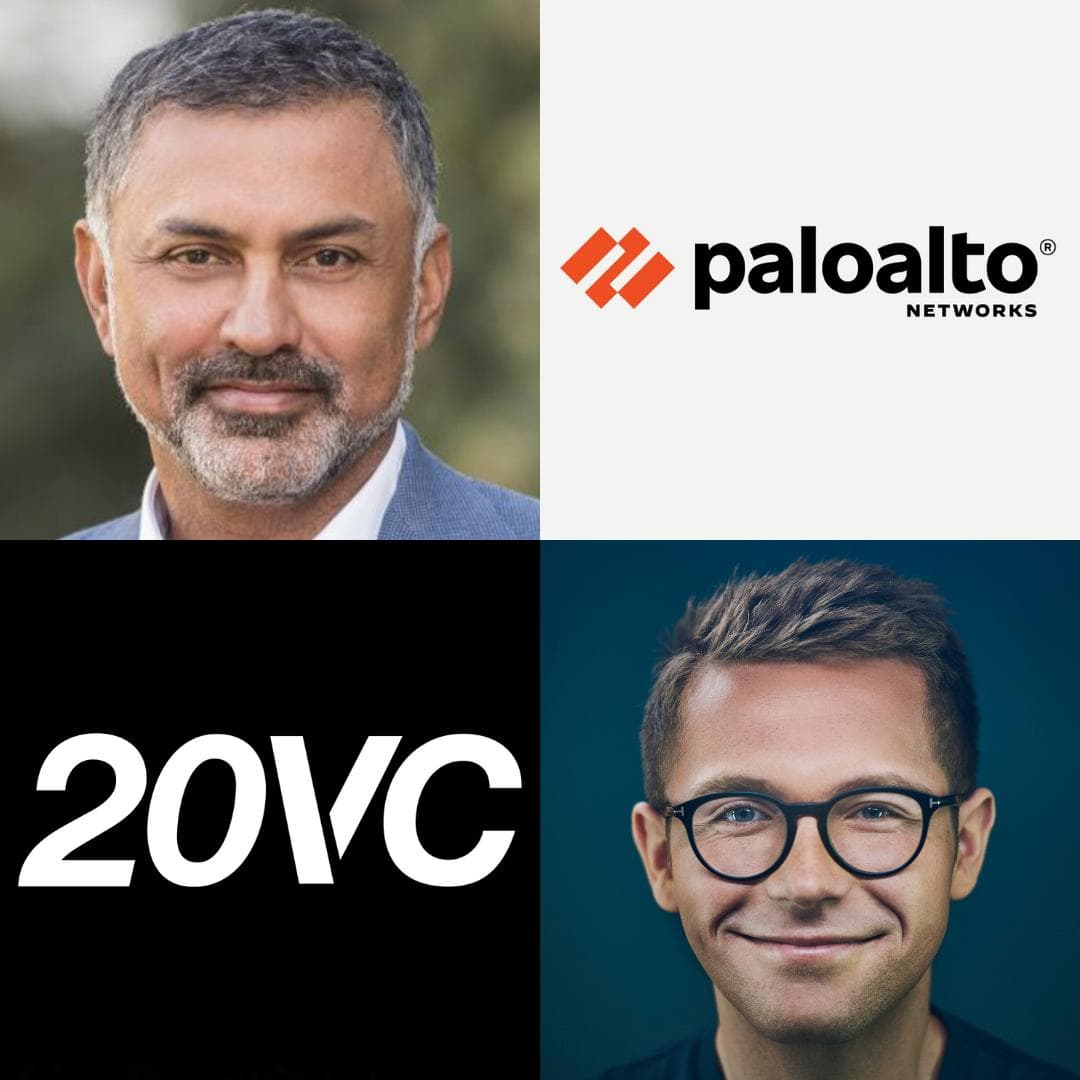
Episode Overview In this episode of The Twenty Minute VC (20VC), host Harry Stebbings interviews Nikesh Arora, the CEO of Palo Alto Networks, the world's leading cybersecurity company with a market cap of $102 billion. They discuss Arora's experiences at Softbank, Google, and his leadership philosophy, touching on competitive advantage, communication, and parenting.
Key Discussion Points
- Career Journey and Lessons
- Transitioning to CEO:
- Arora reflects on his path from President & COO at SoftBank to leading Palo Alto Networks.
- Highlights the importance of conviction in business and the balance of relying on team members for outcomes.
- Learning from Masa Son:
- Insights gained from working with Masa Son include understanding risk appetite and the importance of innovation.
- Experience at Google:
- Emphasizes that tech companies thrive on product innovation and the dangers of stagnation.
- Understanding Competitive Advantage
- Moats and Defensibility:
- Arora believes competitive advantages last 2-3 years in software and emphasizes building sustainable moats quickly.
- Acquisition Strategy:
- Discusses Palo Alto’s M&A strategy focused on acquiring innovation and talent early before companies inflate in value.
- Reasons for Incumbent Failures:
- Common reasons include losing product shine, lack of innovation, and failure to adapt to competition.
- Leadership and Communication
- Best Leaders' Traits:
- Effective resource allocation, clear communication, and the ability to motivate large teams are essential traits of successful CEOs.
- Delegation:
- Arora shares his approach towards delegation, emphasizing the importance of trusting team members while managing responsibilities.
- Personal Insights on Parenting and Wealth
- Reflections on Wealth:
- Arora discusses his evolving relationship with money, stressing the importance of instilling values in his children regarding work ethic and ambition.
- Parenting Philosophy:
- He shares strategies for raising children in an affluent environment, highlighting the balance between providing for them and ensuring they understand the value of hard work.
- Life Lessons and Philosophy
- Work-Life Balance:
- Arora mentions the sacrifices made for career success and the importance of being present in personal relationships.
- Marital Happiness:
- Emphasizes the importance of mutual support and respect in maintaining a happy marriage.
- Final Thoughts
- Future Vision:
- Arora expresses the need for continuous learning and adaptation, especially in a rapidly changing tech landscape influenced by AI.
- Resilience of Humanity:
- He reflects on the resilience shown during crises, emphasizing human adaptability and the collective ability to overcome challenges.
Conclusion Nikesh Arora's insights into leadership, competitive strategy, and personal growth offer a valuable perspective for entrepreneurs and business leaders alike. His emphasis on continuous learning, innovation, and strong values in both professional and personal life provides a roadmap for navigating the complexities of modern business.
---
For the full episode, visit [20VC on YouTube](https://www.youtube.com) and search for the episode title.
Written by AI. May contain mistakes. Listen to the episode to check what was said.
Transcript
Automatic transcript. May contain errors.0:00You find a market where nobody owns to build a product, you're either a genius or totally stupid. Computer advantage lasts for about two to three years in any enterprise, software business. Our view on acquisitions is we buy innovation, we buy product, we buy early, because we buy later you're paying multiples for revenue, which I don't believe in. I mean, if you look at Masa, he's one of the geniuses of our times, where he's one of the very few people in the world, his risk appetite hasn't changed as he ages. This is 20VC with me Harry Stabbings, and I'm so excited for the show's day. It is not often that you get to welcome the CEO of a $100 billion company to the hot seat, so a big day today.
0:35And Nikesh Arora joins us in the hot seat. Nikesh Arora is the CEO of the largest cybersecurity company in the world, Palo Alto Networks, with a market cap of $102 billion. Before joining Palo Alto Networks, Nikesh was the president and COO soft bank group. And before that, Nikesh bent ten years at Google as a senior Zach and President of Europe, the Middle East and Africa. This is an incredibly wide -ranging show discussing everything from leadership, competitive advantage in business, to parenting and what it takes to have a great marriage. So get the notebooks out. But before we dive into the show's day, we're all trying to grow our businesses here.
1:12So let's be real for a second. We all know that your website shouldn't be this static asset. It should be a dynamic part of your strategy that really drives conversions. That's marketing 101. But here's a number for you, 54 % of leaders say web updates take too long. That's over half of you listening right now, and that's where Webflow comes in. Their visual first platform allows you to build, launch and manage web experiences fast. That means you can set ambitious marketing goals, and your site can rise to the challenge. Plus, Webflow allows your marketing team to scale without relying on engineering, freeing your dev team to focus on more fulfilling work.
1:51Learn where teams like Dropbox, IDO and Orange Theory trust Webflow to achieve their most ambitious goals today at webflow .com. And speaking of incredible products that allows your team to do more, we need to talk about secure frame. Secure frame provides incredible levels of trust to your customers through automation. Secure frame empowers businesses to build trust with customers by simplifying information security and compliance through AI and automation. Thousands of fast -growing businesses, including NASDAQ, Angel List, Doodle and Coda, trust Secure Frame, to expedite their compliance journey for global security and privacy standards, such as SOC2, ISO 27101, HIPER, GDPR and more.
2:34Back by top tier investors and corporations, such as Google, Client of Perkins, the company is among the Forbes list of top 100 startup employers for 2023, and business insiders list of the 34 most promising AI startups of 2023. Learn more today at Secureframe .com. It really is a must. And finally, a company is nothing without its people. And that's why you need Remote .com. Remote is the best choice for companies, expanding their global footprint where they don't already have legal entities. So you can effortlessly hire, manage and pay employees from around the world, all from one easy to use self -serve platform.
3:10Plus, you can streamline global employee management and cut HR costs with the remote's free HR IS. And hey, even if you are not looking for full time employees, remote has you covered, with contractor management, ensuring compliant contracts and on time payments for global contractors. There's a reason companies like GitLab and DoorDash trust your remote to handle their employees worldwide, go to remote .com now to get started and use the promo code 20VC to get 20 % off during your first year. Remote opportunity is wherever you are. You have now arrived at your destination. Nickesh, I am so excited for this.
3:48I've wanted to do this one for a long time. Thank you so much for joining me today. Well, thank you for having me. Not at all, but I always believe that great entrepreneurs are, I actually shape pretty early in their childhoods. When you go back to your childhood, Nickesh, how would your parents have described you? How would your teachers have described a young Nickesh? That's a good question. My mother's visiting and if you ask her she'll tell you. She wasn't available for comments, Adelaide. She would say I always get my stuff done, never gave any trouble. It wasn't one for rules, but not in a sort of a disruptive way of just didn't like to follow too many rules.
4:24So I kind of did what made sense to me. I got my stuff done on time. I was kind of pretty boring when I was a young kid. Did you know that you were going to be successful? Some entrepreneurs have an innate feeling that they would be. Did you have that? If you talk to my wife, she'll tell you that the one thing I don't seem to lack is self -confidence. So I'm not sure when she's being funny about it or when she's being sort of in a supportive about it. But I put my heart and soul into whatever I do. I tell people that if there is an element of doubt in your head that you're not going to get something done, you're just increasing the probability of it not getting done.
4:57So you have to attack or address everything with some degree of conviction. It kind of goes with life, right? I take on everything with the degree of conviction. Otherwise, why would I take a job like Paulo Alto six years ago, right? Why would I set myself in a situation where I did not have any conviction that I was going to do well? Now, you have conviction, you walk in, and you give it your heart and soul every day. Where was your conviction most misplaced when you review your career? Or where did you put it and it was wrongly placed? I don't know if conviction is wrongly placed. I think conviction generally, in hindsight, you can always analyze stuff and say, Oh my God, you know, you shouldn't have had that conviction.
5:32I think you always take on stuff, A, with conviction, two with the belief that everybody else is going to do their part. So to make sure that entire thing is going to work, is usually conviction starts to not result in outcomes that you want when a lot of different people get involved. And you have to rely on other people for part of your outcomes that need to happen. And then the question is, can you rally those people in your direction? situations where I wasn't able to achieve the outcome that I set out to was usually when perhaps I wasn't able to bring everybody along or perhaps I wasn't able to convince other people who had a stake in the outcome that this was the right direction this is the right thing to do so there's learning of that for me and I had to possibly work harder on getting by and I had to work hard and understanding their perspectives so I think those those are situations if I would have back and say oh my god had I gotten those people along I'd have gotten to a better outcome or perhaps replace those people depending on the the right strategy should have been.
6:26Is the way that you get people convinced? Has that changed over time? Yeah, look, I think we all get to where we get to to a certain point in life by being individually excellent. And whether it's coming first term class or second term class or top of a class, you're really good. It doesn't matter what other people do, what other people think. You prove that you're smarter than people around you. Usually that's why you get your job. And typically when you get your first job, you're given an individual task. Whether you're coding, you're doing something else, you're actually given a task. then you say, great, I know what the rules are, I know what it takes to win.
6:57When you get a first management job and you say, wait a minute, this is a different job. Now your task is not to do a great job yourself. Your task is to get the same level of quality to the three people who are going to work for you. That's where I think our first challenge comes in as individuals, as you transition from individual to manager. It's like, how do I get three people to deliver the greatest outcome that they can deliver? And perhaps that outcome is going to be different from me. I think it's one of the saddest things that are in the way that we expect everyone to make that transition from IC to manager and actually there's nothing wrong with being a lifelong IC and being incredible at what you do.
7:30There's expectation that everyone should scale. I think is a flaw. I totally look, you know, by the way, organizations have understood that and you realize that many of these smarter organizations that I see are individual contributor ladders, but you can actually be very successful as an individual contributor. But you know part of it is that scale requires us to mobilize a lot people towards a great outcome. That scaling of that requires not just sort of leading from the front and getting people convinced that this is the right thing to do. It's also to inspire them to do their best work because if you can get 10 ,000 people motivated in the right direction, you can achieve more bigger sets of things.
8:09I don't think we, it's sad. It's just the scale of the outcome and result that you want that requires mobilizing a lot of people. Speaking of that scale and mobilizing a lot of people, you know, you spend a long time at Google in a very formative period of their hypergrowth profile. What one or two of your biggest takeaways, having seen that up front, having lived it so viscerally. One thing which I learned at Google, which has stuck with me and I've tried to implement the repowel to, is that in the end, tech companies live and die by their products. Very often, if you look at the graveyard of tech companies, you realize it's when products started to lose their shine and their lustre, somebody else came up with something better, something faster, something that worked a lot better, met the customer needs.
8:49That's when companies, these other companies started to get and go away. Do you think that's still the case today, given the infinite supply of products? I think that was true a decade ago, but when discovery becomes the paramount problem today, is it not distribution that separates the winners? Yeah, it's not a big deal. I can't say you say that. It's always been a yo -yo between content and distribution. Whether you take newspapers, remember those days when people talk about these going to bicycles and go to newspapers, people doors, that was distribution. It didn't matter who was your editor and mattered which kid was throwing which newspaper at your door because if you couldn't find the kid for the new newspaper that you and I decide to publish, it doesn't matter.
9:30That point of time distribution was king and editors were okay. Today, if you look at the internet, we can all write on the internet. Distributions is no longer a limiting factor. Today, Brad and Contan becomes important, right? Suddenly, like the influencers who have hundreds of millions of people look at Harry with his podcasts, so many people want to watch it, his brand is important. distribution is not your problem. You don't have to worry about saying, how do I hook up bandwidth to my house and how do I make sure that everybody in the world who wants to see this can see this? I don't know.
9:56If you apply that to AI and you think about a lot of the unbundled vertically specific AI applications in the application layer, I think they will lose despite being better products because Microsoft has distribution. They will tack on the product, which is the same, maybe five, 10 % worse, and win because they have distribution. Well, it depends. You can talk about consumer application enterprise. I think an enterprise is definitely brute force and distribution does matter. I think on the consumer front, that's the app store. Why are certain things more successful than the others? I think you can tell me more than I can tell you.
10:30But why is TikTok more successful? Why did my space never take off? Why does Snapchat take off in a certain direction? Distribution is available to everyone. The question is, how do you create a virology? How do you get the momentum from a distribution perspective? Turn that into a bigger thing than everything else in your category. Listen, as the end of the day, I'm freewheeling here. You mentioned TikTok that way. They win in large part that people don't like to admit this. They win because they had the weapon of cash in an infinite supply that they leveraged incredibly well. For getting TikTok, you made a grill discreet.
11:02You can argue that by all means, more than welcome for that one. But to what extent is Cash a weapon in company building? As my old boss Eric Schmidt used to say, Cash does solve all problems from mankind but does take care of a lot of them. So, yes, having a lot of cash and balance, she is not a bad thing. You know, there's pros and cons. You know, it's just like, you know, people have too much money. They get spoiled. If companies have too much money, they get spoiled. And they're not judicious. And sometimes, say, no, scarcity breeds the best outcomes because you're very judicious about how you spend your money.
11:33Now, in that context, you know, cash has been useful both for enterprise companies and well -run consumer companies for creating distribution and being user competitive advantage. As long as you understand that you are doing that to get scale and share and your underlying economics have to work in the long term, right? Your contribution margins have to be right. We're just spending more money acquiring customers but your contribution margin is positive. I think the danger is when you have businesses which have negative contribution margins, psych standing at the street corner and giving it to a dollar is in return for a dollar.
12:04That's a dangerous thing to do because eventually you run out of dollars. How do you think about projecting yourself out to a time when that does make sense? There's a lot of sorry for just going so off -travel. There's a lot of businesses where, yes, today, we may be contribution margin negative, but when you actually project out a year, two years at scale with network effects, we actually have a very different business and margin profile. Well, at the end of the day, the contribution margin that you have for your business is a consequence of both your fixed and variable cost. Now, if you say, my fixed costs are going to decline as I get scale, and to get scale, I need to go spend dollars to get to a place where my margins become positive.
12:39it, I understand. If your variable costs are higher than your revenue, we have a problem because your variable costs are not going to start becoming a small percentage of total revenue over time because of your variable costs. I think it all depends on what you're selling, what your cost structure is, what your contribution margin profiles look like, how much cash is needed to get to the other side. And can you raise that money in that time frame? Now there are some amazing businesses, you look at what Uber did, like Uber had to get scaled because you had to build a service, you had to get distribution, and you had enough consumers to be able to use those services to be able to go make all the math work.
13:13And both Travis and Dara eventually got to a point where they made it work. There are other businesses where it didn't seem to work. And there are some examples I think where they crashed and burned because they kept burning money and then suddenly they ran out of money. Nickyash, I don't like competitive markets. I find your customer acquisition costs higher, your retention is lower, it takes more in times a brand spend, it takes better product marketing. It's just that you have less pricing power. That's just a shitty, a consumer, right? Because they get two really good companies competing for their attention and creating better and better services of product for them.
13:48Sure. I'm an ambassador, Nickesh. Yes, I understand that. You want nine monopolies which can build great businesses over time and 100X your outcomes and then you can get out of them then taking what are you about the regulatory issues afterwards? Exactly. Got it. How do you feel about competition. I feel about competition. Look, in the business we're in the enterprise space, it's inevitable. You find a market where nobody owns to build a product, you're either a genius or totally stupid. You're a genius because you found something nobody has figured out yet, and eventually, as you start winning, other people will figure out trying to chase you and build product, or you're totally stupid because there's no business there, we just burning good money after that.
14:25So in any enterprise business, we discover. I think the competitor advantage lasts about two to three years in any enterprise software business. The question is, can you go ahead and build a mode in that time frame? Can you get momentum? Can you break through and get to a place where you sort of cash the wave or other people are not able to cash the wave? There are examples in the world where certain businesses have caught it early, run that product of Azure two or three years, and kept building more advantage over that time frame, where there are always a few years ahead of the competition, which today are multi -hundred billion dollar companies, and then it will become too hard to catch.
14:59In the consumer space, I think to your point, that possibly is even a shorter window than two to three years. And that point in time, distribution and scale becomes really important. And that's where people have used both viability and some version of lots of cash to balance sheet to drive the distribution capability, because that allows them to get escape velocity. You said momentum there. I constantly oscillate in my mind where the speed is the most important determinant of success in company building. How do you think about that? So the net of it, I think momentum is important because it's both from innovation, perspective, and agility perspective.
15:32Because in the early days, you will have a lot of ideas. You will test a bunch of stuff. The question is, you know, nobody walks out. I'm pretty sure that very rarely is it that you're first incarnation of your product as perfect product market fit. That's very rare. You really, you know, if you look at the largest companies today, they were all created for different reasons and they ended up getting product market fit for a totally different reason, right? Well, it's a Google or Facebook or a YouTube. They're all start of a different intents or Slack and it's early generation of me gaming company.
15:59So everybody starts the different intent. They keep innovating. They keep iterating. They start looking at product market fit. And then suddenly, you see a spark and say, let me go double down and that spark and move as fast as I can. Because I want to collect more and more people around this phenomenon that I'm created. So yes, I think speed is important. Whether in the consumer space or the enterprise space. But the enterprise customers have slightly be different standards and expectations because they're highly unlikely to last too long on an experimental set of products. Speaking of kind of the world, Manning Man again and speed, I do think in the investing world of your former shop in Softbank, can I ask you, what are one to two of your biggest takeaways from that?
16:35It is such an interesting firm and massive, such an incredible figure. I mean, you look at Massa, he's one of the, I think the geniuses of our times where he's one of the very few people in the world, his risk appetite hasn't changed as he ages. Funny like when we're kids our parents and entire life is spent in de -risking us right don't walk across the street home I had or don't get on the bicycle you don't know how to ride one or you'd marry don't get a big mortgage in case he can't afford it so if you look at how we're all brought up over time we're all brought up to constantly de -risk ourselves so our risk appetite changes unbeknownst to us but this is an amazing man it doesn't matter he loses a lot of money in one deal he stands up the next morning says holy shit I found that next thing's gonna be hundred extra here and he goes out and goes all in every time and he's done that multiple times.
17:20And he was the richest man in the world for 80 plus days. And then he lost a lot of money. Then on back, and he levered everything, and bought a soft -pang mobile business from Vodafone and turned that billion dollar investment to $40 million. He's been doing that on a constant basis and look what he's done with arm. He's taken that and he was insistent. He said, he said to me, I've been wanting to buy that business for 18 years this time, and I'll buy it. I myself couldn't understand why he thought it was going to be so valuable. would look today is a 130 billion dollar company. He was right.
17:50Not just that. He actually bought a bunch of it back pre IPO because he still believed in it. So you've got to give him high marks or convictions, something you talked about earlier. You got to give him high marks for his risk appetite. And you know, he goes all in. How did you prevent the de -risking in yourself? I think compared to Massa, all of us are on the de -risk phase compared to what he's able to do and how he's able to execute. So What was the hardest part of the role? When you look at it from the outside respectfully in a cashier, it just looks like you smashed it, well done. I'm sure that were internal challenges.
18:25What was the hardest part about adopting the new role? Hardest part was being stupid. Not used to that. I didn't understand anything about cyber security and then of somebody walking the first day and somebody saying, well, in a firewall measure, there's no, it's our traffic and east to west traffic. What does that mean? So within SSL decryption, what are you decrypt the traffic, the inspected you, encrypted, it and I said, what is this guy talking about? All right, and so well, then sometimes you have a proxy server, Zscaler uses that, we don't use that. So this is just like every sentence is new.
18:53I don't go to cybersecurity school, I land myself a top job in a company that does this for a living. So every morning, every person walks in has more wisdom, more knowledge, more experience than you. All the time you start to feel stupid. As your job to parse through all that stuff and try and make sense of it, and you don't know when the next sentence comes out of your mouth, whether it's a really good question or it's a really stupid question. And so yes, the hardest part is going to the learning process in full public display and then getting those people to do things which you think makes sense, where you might have just set a whole bunch of stupid things right before that.
19:24That's kind of a complicated tight trope to navigate. Were you nervous about having conviction in a new field where you didn't have such knowledge? People listen to your words, you're the CEO, they carry weight. I would be nervous to have opinions because I don't necessarily have the domain expertise. The good news is now I get more knowledge than I used to get in the first month of the first year. My hit rate has increased, but that's the hardest part to be willing to expose yourself and the lack of your understanding and then convince people that I do have other skills which are needed to run this place.
19:55Do you think you can only do that because of the success you've had before? No, I don't think that's true. I think it doesn't matter. The richest people and smartest people, it doesn't matter how smart and how rich you are, you still don't like feeling stupid. I don't think you can do that just because you've been successful because it's very funny if you look, I was on somebody the other day, you're always known by your last act. It doesn't matter what you did before. If you screw something up, people say, oh, that guy just screwed this up. Yeah, maybe he was lucky earlier. This time he met his maker.
20:21So the positive success is help you get the job, but that's okay. Now that stable stakes, you're in the job. The question is how are you going to keep it? Now you're going to know amazing, and that requires you to go back to basics and start from the ground floor and start to understand what needs to happen. And that requires, say, healthy dose of humility every morning. On a reflection, when you look now, And you can say yes, but I asked Daniel this, do you think you're a great CEO? I think the results speak for themselves and people can decide if one is a great CEO or not. So far what the collective team here has been able to achieve has been done in the cybersecurity industry before.
20:54What do you think you did so right that other people haven't done before that enabled your success? We looked at the industry and yes I may not have known the cybersecurity industry but having had the privilege of investing next to Massa or having, you know, or to Google for 10 years, one has become a student of business. And he said that and look at analyze business and say, why is this industry so unique? Why is it that the largest player has 1 % market share? That is not the industry structure of any other industry. Are you talking about winner takes all like search, winner take all. Google took all.
21:26You take it YouTube, right? You take a look at Netflix or something like that. You are, you do see in the consumer space, there are a lot of industry sub -sectors or winner takes all. Enterprise also you'll see in sub -sectors there are dominant market shares which are in the double digits and sometimes the 20 -30 -40 % range. What is wrong with this industry structure? Why is it 1 %? And you look at the waves of success in this industry, you know, the stars of 10 years ago are no longer the stars of today. So that's kind of very unique in cybersecurity. You see there it's a, what are the unique ingredients of this company versus every other companies is out there and you realize this cybersecurity industry lets innovation happen in the next company that comes around.
22:08And they get really good at selling their innovation, they maximize it, they generate huge amounts of cash flow from the better mouth strap they built 10 years or 15 years ago, but the next mouth strap is usually built by a different company. So the approach we took was, and I said, look, I'd seen this before when I was at Google, and there was generally a feeling that we're really smart. We can build amazing things and other people aren't there as well. Learned from that and said, listen, now there are smart people out there. that there are C1000 cybersecurity companies, people like you are funding, these people must be really smart.
22:35If you're not smart enough to build it ourselves, let's go find someone who's kicked our ass with a lot less resources. So we've had 19 companies the last five years, right? We had no prior to back to the year, those of your humility. Somebody else did it better. Let's go bring them on board. And then the difference we made, well, we said, we'll let them run our business because they did a really good job out there. The only thing we can give them is more resources, more scale on the distribution front. or we can do is get them better innovation. So let's clear the decks with them run as fast as they can, get them more resources to get them distributed.
Read the full transcript
23:05We've done it 19 times, love them have worked, some of them have happened. That's allowed us to at least creep up in market share and get to 3 % to 4 % now for one. Is there a danger that you lose your innovation and become a roll -up shop? Oh, let's be clear. Follow also in the last five years, we have delivered north of 100 products. Through a combination of organic and inorganic, The organic innovation we've done in the last five years is more than entire history of the company. We have been spurred in the category of innovation more and more so because of all these amazing people we've been able to acquire from the outside.
23:39Our largest best studying product right now, XIM, is built in house. We have a large portfolio, but a lot of the good successful products have been built in house. Some of the ones have been acquired. When you look at the best and the worst acquisitions, If you separated the two, what are the biggest lessons from the best and the worst and how does that impact your future decision making? The things where they haven't worked out, I think perhaps one of the early ones didn't work out because you really didn't have enough of a playbook about how we want to execute an acquisition. So we're a bit sloppy that caused some of the founders to leave, that caused a bit of disarray.
24:13You know, we got better about it, learn from it, and pull it up our socks and make sure that the next 18 that we did we're going to be a lot better than the first one. I think one of the cases we just called the market wrong. We expected to be a large market. It didn't sort of transpire because our view on acquisitions is we buy innovation, we buy product, we buy early because we buy later you're paying multiples for revenue which I don't believe in. Like why would I pay 10 times revenue? I'd much rather buy a really great team and an amazing product which has done a proof of concept and thus 2030 customers which is working for.
24:43So if you buy them later in life, you're not just paying a lot more money for the distribution slash customer base that they have. So some of the ones we bought early, some of the markets didn't pan out, so we would expect them to so they didn't end up being bigger businesses. So it was more of a perhaps wrong technological bet, but on the flip side, the ones which we did do where the market paned out the way it was, and I think to some degree, we were able to spur the market and grow the market. Those that don't really well for us. Do you believe the best of the best resource allocations? I still go back to the idea.
25:13Most companies are inefficient. I think every company could be a lot more efficient, a lot more effective. I mean the best CEOs are who are able to motivate lots of people to deliver great outcomes in a consistent, coherent manner together. Why do you think my companies are inefficient? You know I've discovered in the last six years that you sit in your room and you say something, you have a point of view, but you need to make sure that point of view is understood by the person out in the front. I usually say people don't come to work to screw up. Nobody comes to work and say oh my god I'm going to do a shitty as -jaw I can possibly do today, let me go see how I screw up.
25:46So if you believe that people are well in tension, you've run a rigorous hiring process, you've hired smart people. The question is, why do you not get the greatest outcomes from everyone in the company? Because if you could get the greatest outcomes from 15 ,000 people, maybe three times better than we are today. And it boils down to one thing. It is lack of effective communication. So people are sometimes told the what and not the why. And if we understood the why out in the front line, we do a much better job of innovating, much better job of adapting, much better job of living by the principles of why we're doing this as opposed to what I need to do.
26:20Many companies get into the water and there's a lot of enablement in every company which are saying, you will do this and somebody calls pick up the phone, ask them the following three questions, if they don't go to page two, do this and decide you solve the problem. And I understand why people do that, but you have to respect the individual intelligence and make sure you're doing an effective job of communicating the why every day to people. And when things change, you're supposed to make sure we know about it. So I think one of the things that great leaders do is make sure that every understands the principle, every understands how they contribute and add value to the overall outcome.
26:50Very often people do their work and it's not clear to them how that contributes to the overall whole. I think there's a lot about people, there's a lot about motivating them, a lot of getting outcomes from them, which make for great companies. And I think great CEOs are great business strategies. Is there a job to see around corners? You have to see two to three years out and see where the wind is blowing because most of stuff that you can impact is going to create great outcomes to the series so now now to the next six to 12 months. It's challenging for teams when there's change, when there's pivot, when decisions are made and then you have to communicate them and get them on board.
27:22Eric Schmidt once said, I wish I'd made better decisions or my better decisions faster. Yes, I've heard and say that, yes. How do you think about your decision making process? Some people like a lot more information to make decisions and if you had per if you all way for perfect information it might be too late. So there's always a certain amount of gut, a certain amount of intuition, a certain amount of guesswork involved in making decisions. As I always say, all the easy problems get taken care of before they get to me, all the easy decisions are done. So when you're leading an organization, you end up with the hardest decisions.
27:59And they matter. And normally people come to you because they've agitated over them for weeks or months and they've tried every different thing because most people don't like coming for help, especially to the CEO. So you know they're in a bind when they come to you because they haven't been able to solve it. So then they're expecting you to make a good, quick and thoughtful decision. That's your all, dangerous words. You want to be good, you want to be quick, you want to be thoughtful. So part of our job is leaders is to be able to make good decisions with limited information. You are going to get some wrong.
28:26The question is, are you able to identify the wrong decision and go back and correct it, than it should be. So I think decision -making for all of us needs to be quick, but also needs to be, we need to be adaptable that if we've made the wrong decision, we have the ability to check it and be able to go back and have the courage to go back and say, listen, I think I screwed up. It's time to go change course and that did work. Neckash, what's been the best decision you've made to see of Palo Alto in our works? And what did you learn from that? You have to put yourself into learning mindset. You just cannot afford to stop learning because A, we're in a very innovative industry.
29:04The bad guys are always looking for a new way to come hack you. They don't use the same technique they used yesterday, which you figured out. So every morning you wake up, there is a new technique that figured out to come after you. So you have to be in a constant innovation learning mindset. What was the worst decision? You know, at Google, I was very struck with Eric when they bought Android. And I said, Eric, I used to work in a mobile industry. I thought he hired me for my experience. He shouldn't be buying Android. There's 200 OSs out there. And Eric turned to me and said, you know what? respect everybody's opinion, but then we do what makes sense to us.
29:35I said, okay, I get it. And we kind of worked out. At Palo Alto, you know, I was very, very enthralled by the idea of doing consumer service security. We actually spent a few years trying to build a product and then we realized that that was a bad idea. But we invested resources. But then, like I said, my management team and I, we collected, we sat down and said, shit, it's not working. What do we do? So we had the courage to shut it down even though we had invested good resources and built something. We said, listen, We cannot go out there with this. It might perpetrate this for some time because we might think that we have to prove something But we should be able to call a bad decision about decision number one.
30:09We did. When are you able to call a bad decision a bad decision? When should one read the TV's and say enough is enough? As I said, a part of our jobs as CEOs is to look around corners. Contextantly look at data and reassess what's going to happen. I tell the story. I was on a flight to India. I was going to speak at my alma mater about 35 ,000 people that were graduating and I landed in Dubai and I saw all this flutter about Chad G .P .T. You know, my God, opening as long as this amazing product, which is an AI product, there were all kinds of rhetoric around it, but I had nothing to do for a few hours, so I tried to figure out how to get access to it, which I was able to surprisingly.
30:45And I started playing with it. And next three hours, I read out my entire graduation speech and I made it all about how AI is going to be pivotal moment for every one of us. The reason I tell you the story is that I use the flight back to think about how does that impact Palo Alto And we launched a series of things internally which were drastic measures which and required us to rethink everything and you played the movie forward is AI Gonna make sure that everything's gonna be different in 10 years and not for sure 20 for sure The question is what do I need to be doing today that I'm the next Amazon and not the next Costco Which is also a great company, but I'm the next Amazon or I'm the next company that is gonna be really successful because we were able to adapt to AI effectively as a big challenge.
31:26Do you know what thing we overestimated adoption on a year -long period and underestimated in a decade -long period? Yes. Yeah, I look at a lot of enterprises today, especially in Europe, I think 48 % don't know what slack is, 92 don't know what notion is. I mean they have no notion of notion. All right, you passed the dad joke, Nick Ash. Oh, thank you very much, Eric. Checking that post. There we go. But like the idea that we are all going to adopt, right, the biggest companies will adopt AI overnight, I think, is naive. Adoption is one thing, being able to accelerate your business and use that as a competitor advantage to another thing.
31:59Every brick and mortar business by now has adopted the internet, but none of them used it to become Amazon. So the question is, is adopting enough or can I use it to change the trajectory of my business? Those are two different questions. I'm sure every company adopted their pace. Can somebody adopted what enough that it changes the trajectory of their business? Leveraged it and became better, bigger, faster. Everybody has adopted the internet. Everybody's enabled e -commerce. They still have their brick and mortar stores. A bunch of entrepreneurs took that trend and said, you know what? I'm going to chain the economics of this business in such a way.
32:28I don't need physical stores. I would be able to create shipping warehouses and go ship this to wherever you want and I can have it. The everything store. That only one company did. So they used the technological shift to build an entire new business, which is worth $3 trillion compared to everybody else who was able to marginally improve their business. That's a question. What does that mean in terms of how you think about running Palo Alto today? You know, am I going to apply AI in my business? Yes. Am I going to get more efficient? Yes. Already we've got people working on it. I'm pretty sure a lot of companies are thinking about it.
33:01How do you get leverage from whether you can write code using all these code tools now, whether you can go to customer support efficiency based on deploying that element, ingesting data and building a faster sort of knowledge retrieval systems. So we're all going to do that. And that's going to be good for all of our businesses. This is, and some companies will do it faster than the others, and they will have better margin sooner. Some companies will take longer, but the fact that I have better operating margins because I was able to deploy AI internally is not going to make me a better competitor to somebody else, unless maybe I'm using cash generated from it as a better competitor.
33:32The question is, can I use the technological chain that is out there to build a net new business? So can I build a series of AI security tools that I come out first with, and I get disproportionate market share because I was fast? What will be the term by the your successful with that or not? I have better eye security tools that I can build, take more market share. When you nervous about such a change of strategy, I remember when you made the change publicly and was like, whoa, I think part of what one has to understand is we see the business every day. Now, as I said to you earlier, in the enterprise business, there's a two to three or product innovation mode that one has for the most part because if you build something cool, other people want to build it because they know they're losing business because they don't have it.
34:15So if I got a two or three year run away, now's the time to capitalize on it. And I can't wait around for that to diminish or go away. So took the decision to go and we're moving fast. That's what we're going to do. What do you think is the biggest constraint on your business today in the cash? Our biggest constraint is that time. You know, we're transitioning our business from having sold to different parts of the organization to actually having to get to the leadership and get them bought into this transformation. Yeah, we get it. This happened for Salesforce. It happened to work day. It happened to other platform companies Why shouldn't there be a platform in cybersecurity?
34:48Why shouldn't there be a Salesforce or cybersecurity? Are you having as much fun as you always did? I have fun every day. I always joke here The US government takes away 50 plus percent of my money in taxes. I don't get to make all my decisions at home Here I get a million ninety percent distance. Great. It's wonderful. Do you actually though? That's kind of what I think there Which is like people think being a CEO is great and in some ways it's a bit like being a politician I think that's a big difference between CEOs and politicians. It's okay for us to, you know, when we make a decision, it's some people are not happy.
35:18It's okay for us to make that decision because hopefully time will prove that that was a good decision. Time will prove the bad decision. You can go back and say, sorry, you were right and I was wrong. But politicians don't get that opportunity. You make a decision and people are not happy. They don't vote for you. The difference is, I, you know, it's very funny. There was a CEO for company who ran for public office in California and as a privilege of having dinner with that person and Larry and Larry asked that person what's the biggest difference between you know being a CEO and running for office.
35:47The person said, you know, spend my entire life maximizing profit and generating shareholder value where economics was important because in the end that's the language shareholders understand. And he said in politics is one person one vote. People are important. Every person is important. It doesn't matter who they are. And it's a very different mindset. And if you look at people who've been doing one worse than the other for a very long time. You realize that CEOs do not, what did you say earlier? Are people out for the brand or against the brand? They're very few people in the middle? That doesn't go down well in politics.
36:16You don't think? I'll push back on both of those statements. Okay, number one. One person, one vote, as funny politicians will spend a lot more time with Bernard, I'll know than they will, someone on the street. Well, I expect that has got to do with the fact that, you know, economics are important. Donations, yes. Donations count, and you need support and financial support of course, but it's still going to be a part of the election. Sure. You're just going to use that money to try and convince more people. But still, after you've introduced them. For the mechanics, the access, the infrastructure that someone can bring is important.
36:49That's not going to be as fundraising with Vody, but that's OK. And then I would... LAUGHTER You're almost a politician here, though. And then I would say that absolutely brand and you are either for or you are against. If I was, you know, an advisor to a political candidate, that you have to mean something to someone. Yes, I'm sure you have to, but I think that's fair. Politicians and politics are also changing. There used to be a lot of people who would go down the middle for a very long time not to piss somebody off, but now people are deciding where the larger work banks are deciding to stand for that because that helps them get there.
37:20But see, I still hold by my state when being CEO is nothing like being a politician. Can I ask you on one thing that I define really hard, is relationships to money, actually. When you think about relationships to wealth over time, How has yours changed over time because I think it's one which is a challenge actually? That's a good question. Look, I think I came just kind of into money So I've been blessed that I've had the opportunity to make some money along the way in my various jobs at Google or Softbank or here Degrowing up with no money kind of shape. How do you think about money? For sure.
37:52Look, you relish everything that you get to enjoy and we meet once a week at home and that's kind of like Oh my god, how does that even work? It works perfectly fine in India. Or we drank Coke when somebody had a party or a house in Marpeyrans would let me have it because there was excess Coke around the house, Coke as in Coca -Cola. I'm not gonna confuse. It's a very adventurous household. It's not a rural household. Oh, trust me, trust me, it's a far from it. So I think you enjoy the smaller things in life, much more. You know, when you have to go play cricket and one person has a cricket ball, and when they say, I gotta go home, that take the trade ball and go home.
38:29Nobody else has one because now many of us could afford having a green ball lying in a house. They start to appreciate that these things have a meaning. So I think, yes, it does shape how you grow up. It does teach you the value of money, teach you the value of resources over time. I think at the same time, even if you have more of it, you don't actually be as much value to it, be on a certain point because you know you can go back to living a much simpler life if you have to because that's how you grow up. That's how you grow up for 20 plus, 25 years of my life. I started in the United States with five guys, one bathroom in a five bedroom place I don't know why that place had one bathroom in five bedrooms in Jamaica plain right by Roxbury in Boston That was my first two years and first year and a half in the United States.
39:08It's a very strange Configuration for a house. I know. I think it was a large three floor house I think that that floor was the sort of the entertaining section. They decided not have too many bathrooms That is one easy bathroom in the morning, huh? It made for some interesting I'm going to be honest, so I think the secret to a romantic relationship is separate bathrooms actually. I think this is like crucial in that. There was no romantic lesions between those five guys all there, so that's pretty good. Yeah, just to clarify that. And there was no excess Coca -Cola and there was no romantic relationships in the bathroom.
39:41Parifications important. How do you think about on the money side? It's one thing for yourself. That's an easier thing actually because it's only yourself who you're actually influencing. with children, it's not a thing you're influencing another being. When they're brought up in a world of wealth, how do you even be the same hustle, ambition, hunger in children? That's a great question. Look, I have three kids. I have a 26 -year -old and younger kids, and in a part of it actually boils down to how you bring them up and the values you teach them. And my wife does a really good job of making sure that our kids understand the value of money.
40:18How, if you don't mind me asking, it's hard. Like, they are not allowed to squander resources. They're not allowed to go ahead and get what they want. They have to make sure they understand the value, but they have to understand it's not everything is not easy to come by. They have to go to tasks to make sure that they earn the right to enjoy the resources that they have. Now, I mean, said that, but there's a quality of life difference. There's a quality of life difference in terms of what I grew up at every day or my kids grew up at every day. And that's something you have to accept that there's a difference in quality of life in the United States and India.
40:48You have to understand that there is a basic quality of life that is different for a children than you have for yourself. You have got to make sure you don't over -correct because I've seen situations where people are constantly reminding their kids when I was your age, I didn't have this, I didn't have that. And I mentioned to the kids, okay, I get it, but you're no longer in India, this you're no longer of that age. This is my peer group, this is what I'm growing up with, so I've got to live within these parameters. So I think to that extent, I have seen kids of very wealthy people who have a very strong of work ethic, they've tried to prove to themselves, to their family, that they can work hard, they can make it on their own.
41:23And I've seen seen kids are very poor people not want to work hard. I think part of it is nature, part of it is nurture. There are kids who will do things based on how they're brought up, what values that are inspired into them and what they get inspiration from. And I'm like 26 year old, works as hard as I do or sometimes harder. Has the way that you done fatherhood changed when you compare how you were as a father with your 26 year old to how you are with your younger children. Yeah, I think it depends if you ask me, I should say probably not a whole lot. If you ask me that first time in a row, I probably was running around trying to work hard to make sure I was going to make it.
41:57Now I have a little more time in my hands, so I can, I can stop and smell the coffee or I can spend more time with my kids as they're growing up. It's never enough time because to grow up fast. So I think from that perspective, a while, a while, a while, I would say that I'm not spending enough time and not doing enough with them, which I should be doing. So I think there's balance, but I'm pretty sure that my kids today are getting a lot more of my time than my older kid got when she was growing up. Do you believe in balance and being truly great? You see the videos of Edon mask who talks about the early days of him building when he lived in the office.
42:26His girlfriend will come visit him in the office. You see Sam Altman who say just like when you want to stop, keep going. Do you believe in the balance? Look, one believes in the balance, but I think it would be wrong of anyone us to say that in the process of trying to get what you're trying to get done, we don't sacrifice other things while getting there. So yes, will I sacrifice something on the family side sometimes for sure? Will I sacrifice spending time with my friends in the trim for this? Yes. Will I end up working non -stop for a bunch of time? Yes. So I think we all aspire for balance, but you said that earlier, like, you know, there's a bunch of us who are in mission driven trying to get stuff done, we over indexed trying to get stuff done.
43:06Is there anything you won't ever sacrifice? Some people are like, I will never sacrifice my eight hours of sleep. Other people are, I will never sacrifice my gym session. One has to adapt a little bit all the time. I will never sacrifice my kids' birthdays. I learned that lesson the hard way. My older daughter reminded me once that she'd gone back and looked through the pictures and I wasn't present to a few of them. And I think since that day, as possibly 14 years ago or 15 years ago, I've never missed her birthday. Even once I had to... Did that upset you? Yes, it did. And it sort of, she showed me the mirror and God bless her because I remember I flew from Europe one evening at 6 p .m.
43:41And I made it back here by 7 .30 and I surprised at her dinner at her birthday dinner party day 30 was she didn't think I was gonna make it but I did so yeah it did make me feel horrible. I've learned Chanel covers up for a lot of sins as well just as a tip. I think that's an ad not an or. Ah, haha, my mother's the one that I'm covering up for so it helps with parents they'll just get bored with Chanel. Final one on you mentioned your wife several times I did just have to ask and I'm learning from you in so many respects on this What's the secret to a happy marriage? You've been married now for several years happily What is a secret to a happy marriage?
44:16I think both of us being able to pursue our passions Giving each other space to do that Respecting what each one is doing. There are no real stereotypes in our household. Are they having a healthy Balance between spending time together and being able to other things. Having shows back always knowing that the other person is going to be there for you. That's why you go back home. And I met this guy a long time ago on a flight. He was in his 70s and I was possibly in my late 20s. I don't know this conversation came up about happiness. And he said to me, happiness is about waking up in the morning and being excited about going to work.
44:48And happiness is finishing a good day of work and being excited about going home. Listen to Cash, I want to go into a quick fire with you. I've mined very personal areas and you've been very patient with me in doing so. I'd love to ask a few quick files, that okay? Okay, so what few change your mind on most in the last 12 months? What have I changed my mind the most in the last 12 months? You know, I'm constantly reassessing our strategy constantly reassessing, you know, who is right for the role or not in different circumstances. So, and I keep moving back and forth on certain some of these things and...
45:20Does that worry? Flip flopping is difficult. No, constantly reassessing is different from flip flopping. In many years ago, used to be an equity analyst and you spent a lot of time and you shop one morning and say I think we should buy this stock and then the afternoon something would happen like holy shit I didn't know that was gonna happen and the company told me they weren't gonna do something like this and they didn't do it and you have to make a decision you can flip flop which makes you look bad or you can double down but you have to reassess so you learn early in your life as an equity analyst said it's very important to have conviction and not have noise distract you unless there's real signal in what's come up noise has the ability you're distracted because you just made a big bet.
45:59So whilst I go back and forth and reassess, before I act on it, I just step back and decide if I have enough information and things have changed substantially for me to change my decision. So you asked me how many, what have I changed my mind on? You didn't ask me what have I acted on when I changed my mind. So two different things. Fravo the politician. It's not a politician. You want to have a honest conversation and give you an honest answer. What are you most concerned about in the world today? Who are you? You know, I try and worry about things I can control. I try not to worry about things I can't control.
46:29There's a lot of things to worry about in the world. You can worry about wars. You can worry about pandemics. You can worry about the economy if you want to. You can worry about elections if you want to. But I think one of the things we all saw in the last five years is the tremendous resilience of humankind. If I told you that we all have to live under close doors, have to wear a mask, not be able to fly anywhere, not go to public places, not go to the movies theater, not even go to the grocery store, you see this and say holy shit, that's gonna be horrible, all kinds of bad things gonna happen, people are starting crazy stuff and the world is gonna come to an end.
47:02And it didn't. Seven plus billion people around the world somehow adapted on a dime, turned around, did it, we lived an orderly life to stock market one up, you see this and say holy shit, how did that happen, what just happened? And there's all kinds of disaster theories, there are all kinds of doomsday theories out there, people say oh my god, this is at the end of the world. He sometimes say, oh, he's shit. None of that happened. We all are happy. We're all alive. Everyone's appreciating each other more. And as some people, they're all kinds of crazy things. So he's to then say, that's only possible if you believe that we as human kind from Minisman and the Zillian.
47:33So I'm pretty sure collectively we'll get through most of these things, which we want to worry about right now. If you could choose one person as a board member who you don't have, who would it be? Could be anyone. Not McGonady. Well, not anyone. Oh my god. You weren't for God. Of course. I enjoyed it. It was a great guy. Nonviolent people, very inspiring. People liked him. Yeah. On that silent protest, they were already out to your board only. Yeah. What do you think, Mahatma? He was not a violent guy. I was good to have nonviolent board members. I was going to act Carl I can't for you, but I guess that's a bit of a different one.
48:06See, the very important thing when you ask these questions about pick somebody is better to pick people not alike. What's the kind of thing that anyone's done for you? And I remember I had written to 400 plus the alumni of the Northeastern University MBA program. My backup plan was to go to a PhD at Boston College because it was 1992. It was really hard to find a job. I wrote seven letters to Fidelity because there were seven albums at Fidelity and one of them wrote on the CV, said it to three of his direct reports saying, her CV looks interesting. I got a call from one of those three people and I had a getting that job.
48:38And that was very kind of him. He didn't have to. He just took a letter took a look at the CV He wrote it centered somebody that was amazing and it ended up getting an interview and I'm getting a job So bad. Nicky, I swear. Do you want to be in 10 years? Oh, I don't like life. I do not plan life There's nowhere. I want to be in 10 years. I want to wake up happy in the morning do what I'm doing enjoy it I don't go home happy have a great time my family and things are I didn't set a stop you didn't set a stop price for when I hit this No, a stark price done amazingly well from when I started is going to result in a reasonably good outcome for me and a lot of people here.
49:12So it doesn't matter. It's keeping score. A stark price is about keeping score. They're not about making some amount of money. Thank you for putting up with me, Nakash. I appreciate that I'm not the easiest person. My mother tells me often. But I think you really had extended patients today because they're probably been more difficult and normal. I enjoyed it. Thank you for your time, Harry. It was fun. I have to say, it shows like that which just made me feel so lucky to do what I do. Having the chance to learn from a legend of industry like Nick Ash is just incredible. I love doing that. If you want to see the full episode you can check it out on YouTube by searching for 20 BC, that's 20 BC.
49:47But before we leave you today, we're all trying to grow our businesses here. So let's be real for a second. We all know that your website shouldn't be this static asset. It should be a dynamic part of your strategy that really drives conversions. That's Marketing 101, but here's a number for you. 54 % of leaders say web updates take too long. That's over half of you listening right now, and that's where Webflow comes in. Their visual first platform allows you to build, launch and manage web experiences fast. That means you can set ambitious marketing goals, and your site can rise to the challenge.
50:22Plus, Webflow allows your marketing team to scale without relying on engineering, freeing your dev team to focus on more fulfilling work. Learn where teams like Dropbox, IDO, and Orange Theory, Trust Webflow to achieve their most ambitious goals today at webflow .com. And speaking of incredible products that allows your team to do more, we need to talk about SecureFrame. SecureFrame provides incredible levels of trust to your customers through automation. SecureFrame empowers businesses to build trust with customers by simplifying information security and compliance through AI and automation. Thousands of fast -growing businesses, including NASDAQ, ANGEL list, DUDELE and CODA, trust secure frame, to expedite their compliance journey for global security and privacy standards, such as SOC2, ISO 2701, HIPER, GDPR and more.
51:13Backed by top tier investors and corporations, such as Google, Client of Perkins, the company is among the Forbes list of top 100 startup employers for 2023, and business insiders list of the 34 most promising AI startups of 2023. Learn more today at Secureframe .com. It really is a must. And finally, a company is nothing without its people. And that's why you need remote .com. Remote is the best choice for companies, expanding their global footprint where they don't already have legal entities. So you can effortlessly hire, manage and pay employees from around the world, or from one easy to use self -serve platform.
51:49Plus, you can streamline global employee management and cut HR costs with the remote's free HR IS. And hey, even if you are not looking for full time employees, remote has you covered, with contractor management, ensuring compliant contracts and on -time payments for global contractors. There's a reason companies like GitLab and DoorDash trust your remote to handle their employees worldwide, go to remote .com now to get started and use the promo code 20VC to get 20 % off during your first year. Remote opportunity is wherever you are. As always, I so appreciate all your support and stay tuned for an incredible episode coming this Wednesday.
From the publisher
Nikesh Arora is the CEO @ Palo Alto Networks, the leading cybersecurity company in the world with a market cap of $102BN. Before joining Palo Alto Networks, Nikesh was the President and COO of SoftBank Group. Before that, he spent ten years at Google as a senior exec, and President of Europe, the Middle East and Africa. Before that Nikesh was CMO for the T-Mobile International Division of Deutsche Telekom AG. Nikesh serves on the board of Compagnie Financière Richemont S.A. Previously, he served on the boards of SoftBank, Sprint, Colgate-Palmolive Inc., Yahoo! Japan and Tipping Point.
In Today's Episode with Nikesh Arora We Discuss:
1. From Investing with Masa @ Softbank to CEO of Largest Cyber Company:
- What are Nikesh's biggest lessons from working and investing with Masa @ Softbank?
- What are Nikesh's biggest takeaways from 10 years at Google and working with Eric Schmidt?
- What does Nikesh know now that he wishes he had known when he started his career?
2. What Makes the Most Valuable Businesses in the World:
- How does Nikesh think about competition and monopolies?
- How does Nikesh assess the idea of defensibility, moats and sustaining competitive advantages?
- What are the most common reasons why incumbents are overtaken?
- How have Palo Alto Networks been so successful in their M&A strategy?
- What has worked in M&A? What has not worked? What is their process?
3. What Makes the Best Leaders in the World:
- Does Nikesh agree that the best CEOs are the best resource allocators?
- How do the best leaders communicate with large teams at scale?
- How do the best leaders approach decision-making? What is Nikesh's framework?
- How does Nikesh approach the idea of delegation? What does he delegate vs what does he not?
4. Behind the CEO: Nikesh Arora: Husband and Father:
- How does Nikesh reflect on his own relationship to money today?
- What are Nikesh's biggest lessons in what it takes to bring children up in a world of affluence and ensure they have hunger and ambition?
- What are some of Nikesh's biggest lessons on parenting?
- How does Nikesh reflect on what it takes to have a great marriage?