
In short
Podcast Summary: The Twenty Minute VC (20VC) - Episode with Vlad Tenev
Overview In this episode of *The Twenty Minute VC*, host Harry Stebbings interviews Vlad Tenev, co-founder and CEO of Robinhood, a commission-free stock trading app. The conversation explores Tenev's journey with Robinhood, insights into leadership, navigating crises, and the future of financial technology.
Key Topics Discussed
- Surviving a Scandal: The Gamestop Saga
- Challenges Faced: Tenev reflects on the hardest elements of the Gamestop situation.
- Lessons Learned:
- Importance of clear communication during crises.
- The value of storytelling and how it can influence public perception.
- Reflections:
- Tenev discusses what he wishes he had done differently during that period, highlighting the need for more transparency.
- Advised founders to take their time during crises rather than rushing to communicate.
- Founder Mode and Leadership Myths
- Analysis of "Founder Mode": Tenev evaluates Paul Graham’s concept of "Founder Mode," discussing its merits and pitfalls.
- Leadership Evolution: Tenev shares how he has grown as a leader, emphasizing the importance of being adaptable and open to criticism.
- Scaling a Juggernaut: 8x $100M Revenue Lines
- Scaling Challenges: Tenev describes the hurdles of managing multiple revenue lines, each exceeding $100 million.
- Product Launch Decisions: Discusses the timing and strategy behind product releases.
- International Expansion: Reflects on the difficult decision to pause Robinhood's launch in Europe during the COVID-19 pandemic and whether it was the right choice.
- The Future of Financial Services
- Wealth Management and AI: Tenev predicts AI's transformative role in financial services, focusing on replicating human financial advice at scale.
- Home Ownership Debate: Discusses the changing perceptions around home ownership and investment, advocating for broader access to capital markets as the new "American Dream."
Key Takeaways
- Crisis Management: Effective storytelling and clear communication are vital during crises.
- Leadership: Adapting to feedback and being open to criticism can enhance leadership effectiveness.
- Product Development: Timing and resource allocation are critical when launching new products in a competitive landscape.
- Future Trends: The integration of AI into financial services could significantly lower costs and enhance customer service.
Closing Thoughts Vlad Tenev emphasizes the importance of focusing on personal and organizational growth while navigating the complexities of entrepreneurship. His reflections on leadership, crisis management, and the future of wealth management provide valuable insights for current and aspiring founders.
Additional Information For more details about *The Twenty Minute VC* podcast and to access show notes and resources, visit [20vc.com](http://www.20vc.com).
Written by AI. May contain mistakes. Listen to the episode to check what was said.
Transcript
Automatic transcript. May contain errors.0:00So now Robinhood has eight business lines that generate a hundred million a year or more in revenue. And that's up from I think three a few years ago. And some of them benefit from higher rates, some of them benefit from lower rates. I do think Robinhood is actually stronger in a declining interest rate environment than in a rising. This is 20 VC with me Harry Stebrings and oh my gosh, I was blown away by that. 8 lines of revenue with over 100 million in revenue. Incredible. I'm so excited to welcome Vlad 10 after the show's day. Vlad is a co -founder and CEO of Robinhood, the commission -free stock trading and investing app with a market cap today of $20 .7 billion.
0:44And over the incredible 11 -year journey, Vlad has raised over $5 billion. From some of the world's best investors, including Sequoia and Reese and DST, Ribbit and Index to name a few. But before we dive in, What to Henry Ford and AI having common? Neither could change the world without automation. In the future, there will be two types of businesses, those that have automated and those that wish they had. Uipath, the undisputed leader in automation, is taking us into the era of a genetic automation. Uipath's new AI agents don't just follow rules. They think, they make decisions. They work alongside the world's most powerful software robots, already trusted by over 10 ,000 businesses.
1:25If a gentick automation sounds new, just think of UI Path as more growth, not more overhead platform, or happier customers, happier employees platform. Whatever you want AI to do for your business, a gentick automation with UI Path will make it happen. Try UI Path's new AI agents for free at uipath .com. The future of automation is both a gentick and robotic, so don't get left behind. And speaking of transforming your business with cutting edge technology, let's dive into another game changer. Atio. Atio is the next generation of CRN. Setting up atio takes less than a minute, and in seconds of syncing your email and calendar, you'll see all of your relationships in one place.
2:08All enriched with very valuable data. Atio also lets you build zpistyle automations, gives you powerful reports, and works perfectly for any go -to -market motion from PLG to sales -led. An atio is designed for the next era of companies like yours and companies like yours shouldn't have to deal with inflexible one size fits all CRMs. So join industry leaders like 11 labs, replicate modal and more to scale your start up beyond the next level, head over to atio .com, forward slash 20 VC and you'll get 15 % off, that's 15 % off your first year at atio .com forward slash 20 VC and if atio helps you stay ahead by streamlining your relationships and operations.
2:54Now if you're looking to stay ahead on the investment side too, Fundroises Innovation Fund is taking venture capital to a whole new level. It's a public venture fund anyone can invest in, not just institutions and accredited investors. The Fundroises Innovation Fund is democratising venture capital which could have big consequences for the industry. The fund is already off to a good start, with a hundred million into some of the largest most in -demand AI and data infrastructure companies. Companies like OpenAI, Anthropic and Databricks, check out the Innovation Fund's impressive list of investments.
3:28For yourself, by visiting Fundrise .com, slash 20VC. Carefully consider the investment material before investing, including objectives, risks, charges and expanses. This and other information can be found in the Innovation Funds perspective at fundrise .com slash innovation. This is a paid partnership. You have now arrived at your destination. Vlad, dude, we've known each other for a while. I'm so excited to have you in the studio. Thank you for joining me. Well, thanks for having me. It's good to meet you in person and be here in person. You know, it's so lovely to do it in person. I want to go from like, you know, very cheery, happy start to actually kind of reflect Like to one which is, I think we were just talking about the slabitization of CEOship, seeing people on television, seeing the strong leader and everything just looks up into the right.
4:12And I think we are shaped a lot by our past. When you think about your past, what challenging moment do you think defines who you are today most? Being an immigrant moving from Eastern Europe to the US, that was probably like one of my earliest memories, right? When my family actually, right after the Berlin Wall fell, had an opportunity to move to the US. Like very little travel was happening from Bulgaria, which is where I was born to the Western world. But these people from University of Delaware came and were impressed by my dad, who was a professor of economics in Varnable Garia. He got an opportunity to come to the US.
4:53But of course, we didn't have the money to sent the whole family. So it was like him coming by himself for a year, just trying to make it work, trying to build a stable foundation. And then my mom came a year after him. I was living with my grandparents and like they were taking me to school. And I didn't see my dad for about a year and a half. My mom for at least six months. And my aunt, who I think was a teenager at the time, She was like into grunge music. She loved Nirvana and Sound Garden. She took me to America on what was my first plane flight and I remember when I when I kind of landed at JFK JFK's kind of the it was like the new Ellis Island right where the migrants would would first come I landed in JFK and I saw my parents and I hadn't seen my dad for a year and a half It was almost like meeting strangers in a way and I was just like very shy.
5:51Took me a little bit of time to open up. I was hiding behind my aunt's leg, just sort of like peaking with one eye out. Being, being apart from my parents, I think was tough, but also had the benefit of making me independent. And, you know, moving around to different schools, going from the school in Bulgaria, near my parents' apartment, to the school near my grandparents' apartment, to being dropped in kindergarten in the US without speaking any English. And it was a little bit terrifying. Like, you're just in this new place, you can't even speak the language, you're in school. It was a little bit scary at the time, but it taught me to just adapt to different situations and to be very flexible.
6:33And I think that's helped me much later in life. You know, I've interviewed 800 of the best founders over the last decade. And the single biggest commonality in the most successful founders is a high frequency of moving in childhood. You're forced to assimilate with different environments, different cultures, different people, make new friends, enemies, whatever that is. That's right. Yeah. It's a really interesting trait. Can I ask you, when you think about moving there and America being the land of opportunity that it was, do you think it's still that land of opportunity? I think this with the UK, like to the best time I don't want to come to London.
7:04And the answer to me is no. Do you think America is the land of opportunity that it was when you went? I think so. And for me, entrepreneurship didn't really become a viable option until relatively recently. I grew up on the East Coast. People weren't really starting technology companies on the East Coast. To me, as I've kind of gotten older, I moved to Stanford, California, really because when I was a kid and my family took our first road trip. Once we got in a little bit of money and my parents felt comfortable taking vacations financially, they took me to California for a road trip. And I remember being in San Francisco one morning and this was in the summer.
7:45So I had to buy a jacket because it was just like too cold to be outside. We took the 45 minute drive to Stanford, California to check out the campus. It was like 85 degrees perfect. The students were like sunbathing in the main quad. everyone just looked so happy and like they were having a great time and I wanted to be a lawyer at the time I'd seen a few good men which was a Tom Cruise movie and I was like man that's cool like I want to be that guy and I had this video this photo of me in front of the law school But yeah, I wanted to go to Stanford because because of that feeling that I got it wasn't because I wanted to be an Entrepreneur or that I wanted to be in Silicon Valley so to me it's felt more and more like the land of opportunity the older I get.
8:29And I think now even with COVID, when there was this narrative of people moving away from Silicon Valley going to, you know, Miami or places like that, Austin, Texas, now it's feeling like the energy is sucking people back in. You know, there's artificial intelligence companies, Palo Alto Silicon Valley right in the epicenter of that big tech companies are continuing to innovate. So it still feels like the hotbed of innovation, for sure. Someone said to me the other day I want to show you that great leadership is about being a conductor and to be a conductor you must turn your back on the crowd.
9:03When you think about that statement, when have you turned your back on the crowd most significantly? Yeah, I think that's an interesting question. You know, I was reading the Rick Rubin book. I don't know if you've come across it. I have. I've actually just been gifted it. I have already. I was gifted it also and you know, it was just sitting on my coffee table for a while, but something compelled me to pick it up. And it's all about artists and how they create. And I think he does a great job of distinguishing an artist from a business person. One, I think his thesis for what makes a great artist is that you don't really care about who's looking at your work.
9:42You're building something to make yourself happy. So really the customer for an artist is yourself. If you're proud of the work and it expresses what you want to communicate at that point in time, It's a great work and you almost have to like divorce that from whether it's commercially viable or whether anyone likes it and Even when you're kind of like showing people your work of art you have to be really careful Not to listen to them too much because good art almost like alienates as many people as it makes really happy So if you're not like alienating anyone probably everyone just feels somewhat neutral and it's not gonna be memorable Yeah, business is a little bit different because I think there's an element of art to designing a really good product and you have to be proud of it and to some extent you're building it for yourself.
10:33But you also keep in your mind what's useful to a customer and what they can benefit from. So in terms of this conducting analogy, I don't think you can turn your back on the crowd completely or at least not through all stages of the life cycle of building a product. I think that you kind of start with an inspiration and an idea. In the best cases has come from within. We've been fortunate to build several kind of really, really good products at Robinhood. And I think the initial idea, the spark came from within, and it didn't come from customer research or a lot of feedback. But I think customers play a much bigger role in refining the idea, and actually like, we ping pong ideas off of customers, use the feedback to adjust the interface.
11:20And sometimes it changes it quite a bit, but there's a little bit of like, art, a little bit of business in creating a new product that I think is really interesting. Do you think you alienate people enough? And what I mean by that is actually when you think about business, you're not a kill, you're a aridass, you're an apple or your Samsung, your McDonald's or your Burger King. I know you guys have Taco Bell and some Chipotle's and other things, So I'm not going to comment because I don't know the comparisons that right, but you are like four against the brand. Do you think you alienate enough?
11:51Uh, I think we could probably alienate more. Yeah. I think that it's hard to alienate because people are naturally sensitive to criticism. It hurts more to get sort of like a piece of biting criticism than it feels good to get praise, creates a natural tendency to avoid alienating people. And you have to almost like exert influence if you wanna have your product or your marketing or your message be compelling. It's a very tough thing. And to some degree, it has to start at the top of the organization. But I think for myself, I can take more risks. So what I try to do is whenever possible, if there's someone whose vision I believe in, even if I disagree with it, I try to let them try things and be bold and have a perspective.
12:44One of my biggest weaknesses is I really care what other people think, and I'm actually quite sensitive. And it really hurts when I see shit on any social media about me. You said about sensitivity there. I spoke to so many of our mutual friends and they told me actually that you're an introvert and in the nice way that you're a maths nerd said would love by the way. But Are you sensitive and how do you think about building that muscle to withstand the criticism that comes? I wouldn't say I'm an introvert. If there's actually one thing that I struggle with on a personal level, it's like being alone.
13:20I get a little bit uncomfortable being alone and, you know, why is that? I don't know. I think that maybe it comes from childhood. I'm an only child. When I grew up, I actually spent a lot of time alone. My parents never were able to afford a babysitter until I got older and didn't need one, right? So as a kindergartener, I would walk home from the bus stop to my apartment. I had the key in my backpack, you know, the latch key child. This is very rare now. I've been told you can't really do this in 2020. People are more protective over their kids, but I would let myself in do my homework, call my parents at work or they would call me to make sure I got home okay.
14:03Play with my friends sometimes, but a lot of times I was just sort of like alone. And then when I got to college, it was always like living with roommates or with a bunch of people in a house. When I go out places, I would have, you know, a lot of friends with me. So, yeah, sometimes I hear about people doing like solo traveling or living by themselves for an extended period of time. and it feels like somewhat foreign and actually kind of scary to me. So my area of discomfort is less being with other people. I get energy from other people and it's more like... I find the hardest time alone. Night time, which is when the lights go out and you're kind of in bed with your own thoughts.
14:45Yeah. You have a much busier life than me, but it is busy now. Is the only time when it's like silence. Yeah. Not usually at my house. I usually have multiple crying kids and it changes a lot I totally get that I was shouting to Mickey and he said listen the gate You said you were in the best CEO version of yourself right now But that was in large part. I think because of the experience you had over the last few years He said one you've got to ask his game stop was it was a tough period for him as a leader What did it teach you about telling stories? Yeah, that is a tough one and I think to your point You mentioned the introverted thing.
15:22I think before GameStop, to some degree, I was like never really comfortable in a media setting. I think this is a little bit different because this feels more like a conversation, but like you're on CNBC or Bloomberg or one of these shows and you have three to five minutes. You have this artificial situation where you have to deliver sound bites. You can't really explain yourself. That one was during COVID. So all of these interviews that at least I'd normally be in a studio for are happening over my zoom connection Very little sleep and it wasn't just the night before the the GameStop fiasco It was probably like the month leading up to it where volumes were just going vertical the crypto markets were exploding as well And we were we were a major player in that Robinhood was the number one app in the app store and my feeling at the time was you know Everyone was sort of like, wow, you should be really happy.
16:17You're the number one app in the app store. I had an Instagram and TikTok, not just financial app but everything. And inside I had to like juggle the happiness of that that moment, but also just like the fear that something could happen. I don't know what, and it could go off the rails. It was almost like too much growth. And so all of this was happening at the same time and you're running all of these threads in your brain. like I have this issue, I want to dispute this point, I want to like appear confident, like I'm on top of things. And I had that not really going for me because you know, I was 32 years old at the time and I hadn't done much media and I looked rather young.
17:01I think that whole episode sort of like age me, you know, I look at pictures of myself in 2020, I look much younger. My big takeaway is I think you almost have to like clear out all of those voices in your brain and When everything goes away you could actually get much more clarity about how to communicate and I think story telling is a big part of that I mean if you clear out your brain and remove what you think you should be saying or what messages you want to convey I think what's left is is the stories I tend to picture things in my mind when I think about game stop by I think about like being cooped up in my little house and not really being able to eat for days because I was just like pacing around small kids at the time.
17:45They were just kind of running around and it was just like a very unsettling. What would you say differently when you review kind of what you did say what did you say or not say that you wish you had done the opposite of I did a clubhouse with Elon Musk on Sunday Thursday was when the game stop trading restrictions were first put into place. And then we were a little bit nervous about sharing all of the details. Part of it was we want to make sure we didn't get anything wrong because if we got anything wrong, then we would have to correct it. And that looks bad. That tends to, I mean, you've got people into all sorts of conspiracy theories, right?
18:25And we were, people thought there was this whole collusion narrative with Citadel that ended up being disproved. And so we wanted to make sure that we communicate everything correctly and we didn't leave anything out or make any mistakes That made us communicate a little bit later than perhaps I would have liked But it came out in pieces It was like one detail here the other details there and then it was Sunday when I kind of gave the full play -by -play on a clubhouse being interviewed by Elon Musk and And of course, in all the lawsuits and litigation that followed all the other details came out over the following several years.
19:04But I think in hindsight, not saying anything until giving the entire story of how everything happened, I think would have probably worked better. I felt this pressure to get out there and communicate as early as possible. But I think in hindsight, taking my time a little bit and just saying like, like, hey, we're working through solving the problem. I'm gonna release a statement or get out there as soon as I can after cleaning up the mess. I think that probably would have been a little bit better. Who do you cool when the little seats are dropping when the shit is really hitting the phone? Lots of lawyers.
19:40But who's the friend? What was really interesting was I started getting phone calls from all sorts of people that maybe I wouldn't have had an opportunity to talk to people or connecting me with Elon Musk before, but he kind of wanted to give me some advice on how to handle the situation. I talked to Zach, Mark Benioff. The one benefit was amazing network, he's managed it. These guys were like, hey, I saw this on TV. I really think you could have done a better job on that Sorkin interview and here's what you should do next. And it was interesting to have those discussions. It was brainstorming on brand marketing, business strategy, business model with some of these folks in a very kind of, very unique time.
20:24You imagine some incredible founders that you are yourself an incredible founder. What did you make of PG's founder mode essay, which went incredibly viral recently? Might take on it. I think it's a little bit like a horoscope in the sense that it was so vague in general that everyone kind of thinks that it's relevant to them. It's like, oh yeah, that's me. I'm in founder mode, not manager mode. And I think that's why it resonated with people. You can paint your own picture, but it kind of feels like it's talking about you. Every founder that I talked to was like, yeah, PG really gets it. This is exactly how I operate.
21:02Every manager or executive was a little bit offended. So yeah, it was packaged well, but I think it captured a feeling. I don't think it was like, if you're looking for a tactical guide to like founder decision making, I don't think there's much in the way of specifics there. How did you think about kind of refinding the culture? And when do you think it broke? It kind of broke a little bit at the beginning of COVID. What were the signs that it broke? Well, there there were a couple of things that happened simultaneously that were very difficult I think one of them was just going remote fully and then the second thing was we went through a gigantic hiring burst.
21:41I want to say we were under a thousand people at the end of 2019 So right before COVID, I think we're right around a thousand maybe a little bit under and then in 2022 January of 2022 when we finally announced you know that we were a remote first company after a couple of years of ambiguity I think we were about 4 ,000 people So we sort of like over 4x in a fully remote setting and we were opening up offices everywhere How many you know between two to three thousand see over hide we overhired yeah Part of it was we were kind of responding to the issues that we had in 2020, which were huge amount of growth, influx of customers.
22:23I mean, our revenues went up like 4x in a year, from right around 250 million to about a billion. At the time, it was fun, but it was also a little bit disconcerting because I was like, well, we haven't really done anything. You know, this thing happened. Now we're growing. And I think if you're not careful, there's a tendency to think that you're doing a great job as a leader. I mean, revenues going up, people are using my product, all these other companies that maybe were hit hard by COVID or doing poorly. Does that mean I'm a better chief executive than than the chief executives of those companies?
22:59I think at the time, I was getting some positive feedback, but there were things that were breaking that we had to deal with as well. I think what was kind of not very fulfilling to me was we didn't really ship that many products in 2020 and 2021. We were just kind of trying to keep the train on the rails because we were dealing with infrastructure issues, historic volumes, lots of load, customer support we had to grow. What did you not do that you wish had done? In hindsight, since we're in the UK, we decided to abandon our efforts to expand to the UK that year. I remember this because you were planning and it was publicly known that you were planning it and obviously me being in the UK was excited for it.
23:39Yeah, yeah. We announced in the UK, we went to friends and family, and maybe about a thousand people. And then COVID hit. So it was like March of 2020. I remember having to make a decision. It was like, we need all the resources we possibly can get on the US side. You know, we have this new business in the UK. I think it was a tough decision. I thought about it a little bit. Why did you think that? And I went back and forth. I think at the time it seemed like, I mean, the US business was so big and it was growing so fast It was going through an inflection point and it felt like we had to put everything that we possibly could on making that work and Ensuring it up and the UK just seemed like it would be hard and it would be distracting and I couldn't even travel there most likely It was sort of like easy to to abandon and we didn't abandon it fully.
24:33I mean we kept the license and then we went live what ended up being Three years later when we finally launched earlier this year Yeah, but sometimes I think about that and of course all always difficult to was that a mistake not it then I think it's hard to compare the Against the counterfactual which you don't have certainly it would have been the right decision if you know We ended up having some massive infrastructure issue in the US had we not allocated the resources and we had another big problem. In a world where we could have done both, I think learning to be an international company a couple of years earlier probably would have been a good thing.
25:10I don't know how to say this without being too direct to a blunt. Why is Europe in the UK interesting to a tool? Compared to the US market, it's tiny. You look at compared it to say like free trade, which is a botany average at best businesses. Why is it interesting for you? I think from the very beginning, we had a vision that Robin Hood would be a global company that wherever you are in the world, you'd be able to download our app from the App Store, have access to the best financial products anywhere. And you know, you could fund with your local currency or cryptocurrency or whatever the easiest way is, you could invest your money, you could spend it, send it to people.
25:51So we could help anyone with any financial need. And I think as a technology company, we feel like we have an advantage to doing that. What have you decided to not do most recently that was a hard decision? It's a constant game of trade -offs. Yeah, there's lots of things that are great ideas in our space that we know will work, but we haven't gotten around to them yet. So for example, earlier this year we launched amazing margin rates. We were frankly not very competitive with our margin product in the US up until recently. And then we changed our rates. We were able to do that because we made a lot of investments in risk management.
26:29So now we have the best rates. But if you think about the things that we offer, great margin rates, 24 hour access to the markets, also particularly relevant in the UK, there are things that institutions want to. So if you're a hedge fund, for example, you also want 24 hour access to equity markets. You want access to crypto. Not a lot of them can get that easily. you want access to low margin rates and the institutional market, it's a very big market. We could take a lot of our infrastructure, adapt it to institutional. We don't have to rebuild a ton of the technology. Similarly, you look at a company like Fidelity, a big asset manager in the US.
27:09They have a big 401k business. That's also a B2B business. You're helping startups and larger companies manage their employee retirement plans. That's a good complement to our retirement offering. So that's something that comes up. Servicing registered investment advisors. That's a big market. Individuals that manage money on behalf of other customers. You mentioned kind of funding through crypto that one of your investors said the whole question depends if you want to go hard. One should ask is why are you not bigger on crypto? Well, on retail in the US, we're kind of like close to the same size as Coinbase.
Read the full transcript
27:47We charge a lot less, so we have less revenue. But in terms of volumes and retail volumes, it's pretty close. So even though we started later, we've generally grown market share quite substantially. We weren't originally offering crypto. That was kind of an area we moved into. So we didn't launch at the same time as some of the original crypto companies. but I think we've been picking up market share and building the product, getting more aggressive over time. We have the BitStamp acquisition and that's a global company. That's actually one of the OG exchanges. So I think we're going to continue to invest, but I'd say we've done quite well in crypto relative to most of our competitors.
28:31You can tell, Mickey, that one then. You mentioned the acquisition there. I think it's a constant question for technology leaders today, which is, do we build it ourselves? do we partner, do we acquire? How do you think about that, build by partner decision -making process when adding new products or enhancing existing? We've made some great acquisitions in the past, which has been the best one. The one that has led to the most interesting new product. And I guess to some degree it's still early, so I can't quite declare full victory, but we feel pretty good has been the credit card. We bought a company called X1.
29:10They had a really nice credit card product right around the SVB crisis. Credit companies had quite a bit of trouble. The banking system in the US was very, very strange that that hit credit startups, perhaps the hardest. So we were able to, we were able to acquire X1 and that led to the Robinhood Gold credit card, which I think if you look at the reviews and how initial customers are using and enjoying the product. The reviews are better than free trading. The best initial feedback that we've gotten on any product that we've rolled out. What is the single reason why you think it's been a success?
29:48Three reasons. One is the economics. So 3 % cash back on all categories across the board. The second is the digital experience. You can create these virtual cards, one time use cards that people really like. And then the design of the card is really nice. It's a solid gold card if you refer 10 friends But I see am I not to be glad because like Revolute have had these features for years my question is I look at this like revolute is a 45 billion dollar company now And I think it will probably be a hundred billion dollar company and people should on me And then we look at the biggest competitor in the US and it's 15 billion dollars with chime I don't know me that bad is chime, but that's a pretty high valuation applied to chime Why is it that the US has not delivered in a way that a European company has with that?
30:37Yeah, I mean, it's an interesting question. I'd say, Revolut has done well in Europe. They learned how to go international very quickly because it's not just the UK business, but it expanded into Europe and other markets. My sense is, US still early for them, right? No one's trying US. Yes, Monza, you couldn't revelry to try. The value prop of cross -border spending is a very relevant value prop in Europe. You have a lot of travelers that need pounds here, need euros when they go over to the mainland. They have a good solution to that. Now whether the investing side is working particularly well, I'm not sure.
31:19I don't really have any data there. I'm just intrigued by is it the investing product a better entry wedge and anchor product than a current account? I think both work. It kind of depends on what time scale you look at things by, right? I was reading the Amazon book and eBay initially was a much larger company than Amazon and they kind of thought it was very silly that Amazon would build their own fulfillment centers and run their own warehouses and if you're just kind of a software layer connecting buyers and sellers, yeah, the perspective was like that's a much better business, much higher margin.
31:57But like Amazon did something that was very hard and very difficult to replicate. And I think it took any of their case 20 plus years, but eventually that started compounding. You can also look at Nvidia as an example. I mean Nvidia started in the early 90s. It was sort of like the last Silicon can valley company that wasn't really doing software. They were still a hardware company. So it's this strange kind of alien thing. And 30 years later, they kind of started taking off. Sometimes it's difficult to judge these things in the first five to 10 years, or in the case of Robinhood the first one year.
32:35What ones two things do you need to be a hundred billion all the company? A couple of different vectors of getting there. One of them is being number one in the active trading space. So winning the active trader market, I think just that is a large space. You have Charles Schwab and TD Ameritrade. The combination is kind of the market leader right now. They've got very little international presence. But they serve active traders pretty well. We've been growing our market share. Options was up 20%, close to 20 % last year. Equities up 14%. So we are on the path to being number one. And we're getting net inflows.
33:15That's going to require a bunch of things, but I think that's kind of our core business, so it's a predictable path. The second opportunity, and the one we're putting more and more focus on, but it's sort of like an arc that'll play out over five plus years, say, that would be being the place where millennials and Gen Z keep the majority of their assets. I think that one is interesting because there's over 70 trillion of assets that's going to be moving from silent generation and baby boomers down to Gen X millennials and younger. And we've got more millennial customers than our main brokerage competitors put together.
33:53Same with Gen Z. If we can actually build a better service for them, make it a no brainer to move their accounts over, we get a portion of that 70 trillion of assets that are going to be in motion. Not a very large percentage of that is needed for us to significantly increase our revenues. A so totally weird one. Do you think it's bullshit that people should buy their own home? So what I mean by that is that you know the American dream of, oh, you buy your own home the minute you can. And actually, there's kind of the wealth effect. And actually, you know, young people actually say have a lot more cash and they spend it on Taylor Swift concert tickets, which for thousands of dollars each.
34:28And Chanel handbags for the thousands of dollars each. Because the house is just so far out. It's too expensive. Is that a good thing? In some ways or not? I mean, I think it depends on whether you're viewing it as an investment. If that's sort of like your way of investing, there's probably more efficient. I mean, if you think about real estate, you're paying a lot of taxes, depending on where you live in the US, the taxes on property can be north of 1%. And that's big every year that's kind of layered on. There's commissions every time you buy or sell, it's like 5%. And then you add maintenance fees and insurance and all those things.
35:09And if you kind of look at it as an investment, it starts to kind of affect the returns. You compare that with investing your money in Robinhood. You're not paying any commissions on equities. You can diversify globally. I wrote a piece one time about how investing and access to capital markets is like the should be the real American dream. everyone should be doing it like they were talking about home ownership decades prior. I think it was Bill Ackman who said on our show that we should give it, I'm forgetting the number which is the most important part, but I think it was like every newborn baby should be given X amount of money that is put into the S &P and they're able then to finally take ownership of that over time.
35:50That is the secret to ownership of the American economy for the next generation. Yeah, I think that there's a couple of people that are working on that, right venture capitalists, Brad from Altimeter, I think it is. Yeah, I think it's a noble pursuit, you know. I can ask a bit of a strange one. You mentioned Nvidia, you're a public company CEO. Do you feel that you have to have an AI story? Yeah, I think that's an interesting question. I think at any time you see a new trend or something that everyone's talking about, it's always good to ask, is this something that is real and can deliver a tangible value?
36:27Or is it a fad? Am I just like thinking about it because I hear about it on the news? We could have talked about NFTs. This was two years ago. How would we store our NFTs in Robinhood? Exactly. Big faux pas by being like, we're all in. I think NFTs came up and there have been several phases in the past where NFTs have done very, very well. I mean, you look at crypto kitties back in 2017. It was kind of the first NFT boom. Everyone was buying a kitty and everyone was talking about it. And then of course, the apes and all the other things back in the last boom, open sea and whatnot. We looked at it at that time because Robinhood had a big crypto business.
37:09And we just decided that it didn't make sense, right? And for AI. And crypto is probably the more general example. Obviously, we entered crypto, but for us as a financial company, I think we do view it as an asset that our customers want to trade and a fundamental technology that could change the financial system more on an infrastructure level. AI, I think, is going to be a powerful platform shift and we've lived through a couple of them. I think Robinhood and its current incarnation went through a few platform shifts and really that helped distance ourselves from the companies that owned this base before we came.
37:49One of them is cloud, one of the first cloud -based brokers. When we got started, it was very unusual. I mean, we were talking to our counterparties for execution, for clearing. We said, hey, we don't have servers in our co -lo. We're going to use Amazon. And they were like, we don't think that's secure. And it's funny how things have gone in 10 years. Now, the idea of not trusting Amazon Web Services for hosting your server seems laughable, but back then it was a real thing. But I mean, this question actually is coming back in regards to AI, which is a lot of large enterprises. I'm not giving open AI my data.
38:24Yeah. And so that is actually becoming an increasingly prevalent question again. I think there's details like that that have to be worked out, but the point that I was laboriously getting to was, I think, AI is going to be a huge technology shift that's going to change our space, going to change the financial services. But do you need to have anything today saying, oh, we are doing X with AI to make ourselves sexy? We're looking at several ways in which AI products could help our customers. And I do think that AI is going to change financial services. And I think the products that work, this might be a little bit of a hot take when a lot of people ask, like, what, which AI products, you probably think of this as an investor.
39:07Like, what am I going to invest in? What's going to get traction? I think to me, if there is right now an existing market of people paying a human to do a service for them that AI could replicate at much lower cost, I think that's a real business. And you can think of that outside of financial services with like self -driving, right? There's Uber, there's Lyft. I pay someone to drive me to somewhere. That's a valuable service that you can attribute value to. If a car can do that without the driver and I would be willing to pay possibly just as much, it'll cost less over time, but there's a value to that.
39:45So I think that will be successful. In financial services, customers pay for financial advice and that they pay a lot of money, very valuable. On the low end, it's sort of like 2 % of your assets under management. On the high end, it's like half a percent. And that scales to hundreds of millions of dollars in some cases. if you can replicate the service, do you think you can replicate the service? When you think about nuance and baguio, see risk profiles preferences, how they change at different times. There's a couple of different things there. One is the asset allocation algorithm side of it, taking a risk profile and recommending a portfolio.
40:25That doesn't actually require AI, and a lot of advisors are using software to do that. The real value is kind of in this concierge service. I mean, if you have a wealth manager or a family office, they can kind of like abstract your entire financial life for you. They take care of your budgeting, they take care of your trust in a state, they take care of your insurance, they help you with any legal things, managed well simultaneously. And these are expensive financial professionals. If you can deliver that type of service to the mass market to people that don't have millions of dollars, I think that would be very valuable.
41:01And I think AI, you'll see it impacting the space in two ways. One is a tool to existing advisors. I mean, some people aren't going to be comfortable trusting a machine with all those things, but it can help an advisor serve more clients simultaneously. And then some customers will be comfortable with a full technology solution as long as it does more than just the asset allocation. And so I think you will see that in the next couple of years, really start taking off and good products have recently become possible with like the latest models that can reason and make better decisions. The models are likely going to get better and better.
41:40I think you'll start seeing them replace more traditional knowledge workers. One final one just on market, which is like when you think about interest rate changes, volatility, it's a really hard business view in the way that actually your business can change so much dependent on something completely outside of your control, which is like interest rate changes. will drive a massive amount of buying or pull back. You just get comfortable with that. The best way to actually compensate for that is diversifying the business. So now Robinhood has eight business lines that generate a hundred million a year or more in revenue.
42:14And that's up from I think three a few years ago. So we've got eight unique business lines that are nine figures a year. And some of them benefit from higher rates, some of them benefit from lower rates. For example, when rates are low, money tends to move from interest on cash and yield products, low -risk products, into equity, crypto, and options. When rates are low, margin is more compelling. So you tend to see increases in your margin book. And we're getting more competitive there. So we've been growing our market share. I think over time, I do think Robinhood is actually stronger as in a declining interest straight environment than in a rising.
42:54But over time, as we continue to diversify the business, you get a smoothing out of revenues. We'll get a smoothing out of revenues. Just like, you know, diversification helps smooth out investment returns. As a reason why we have 30 at seed my friend, listen, I'm going to do a quick fire with you. So I say a short statement, you give me your immediate thoughts. Does that sound okay? Sure. What book written before 1965, would you most recommend? I actually recently if I had to think about what I've been reading the story of civilization has been very interesting Have you read that one? No, by Will Durant and R .E .L.
43:30Durant is very good probably in the early 60s or late 50s I don't tend to read things longer than a tweet, but um give it a go You can have AI summarize it for you. There we go. How is becoming a father changed you as a CEO? It's made me more patient having small children tests ones patients You're used to kind of like getting what you want largely and if you don't there's really a rational explanation But with with kids you don't get that as much They really want what they want and they have tantrums if if they don't get it You can't get angry at them also and they throw yogurt at you I mean it's not like you can like shout at the I mean you can try yeah, but they've got me beat in the throwing yogurt side of things What's been the biggest near -death experience for the company that you remember when I say near -death experience you get Oh, that's fine.
44:18I mean, GameStop is up there for sure. What moment was it? There was a cool in the middle of the night, when your phone was in another room because of your sleep hygiene. Yeah, exactly. And that was a very short -lived experiment to try to sleep better, and that'd be as addicted to technology. And so your wife wakes you up and says, hey, there's a phone call for you? Yeah, yeah. And it's like, we got this bill in the automated clearinghouse system for $3 billion. Yeah. That was terrifying. Do you go back to bed? No, I didn't sleep for probably 72 hours after that. All right, I'll do it. I got my workout in Friday, the Friday afterward.
44:58Do you still work out when all of that shit is hitting the farm? I mean, I miss my Thursday workout, but Friday I got back into it. I think after the immediate crisis was like resolved, that Friday afternoon, after the market closed, was like, you know, the temperature went down from like 110 to probably like 102. And it had been increasing steadily. So that was that was a nice little break. If you were like, no, I went back to bed. Yeah. I resumed my sleep pattern and I dealt with it in the morning. It's very easy and remote work to just end the Zoom call, right? And then the the entire problem goes away.
45:34It's all in the computer. Why do you not think people should care about who you vote for. I think that for a similar reason why you shouldn't really care too much what stock someone on the internet is buying. It's useful as a signal, but I think people tend to like copy what others do too much. And I generally think people should think for themselves. I mean, the whole point of Robinhood as a product is that we're building a tool for you to make your own decision as an individual. and fundamentally people are smart and needs and technology can help them if they're willing to make their own decisions and take control over their own money.
46:13But ultimately, what have you changed your mind on last in the last 12 months? We were talking a little bit earlier how the entire culture of the company reverted. I don't think I got a chance to finish what happened after we sort of like got into a bad state during COVID, but we announced that we were a remote first company. I immediately regretted it and then we had to pull that back and ask people to come to the office. Why did you regret it? You just saw straightaway productivity down. I mean, I didn't even see productivity down, but you know, we were kind of struggling with this decision for a while for many years and have you ever sort of like Decided to flip a coin on something because you were tired and and you didn't know what to do and you're like, you know, I'll flip a coin.
46:59And then when the coin is in the air, you're kind of like, man, I hope it lands on heads. That's how I ended up getting married, non -jewsion. It was a little bit like that. It was like as soon as we made the decision, I had the feeling that it was a mistake. It's a good way to test your true conviction of like, well, let's see what happens. Yeah. I think people have different feelings about this. This is a very hotly debated topic, but I do believe that there's a value in much like reading a book that's still relevant after 50 years. Remote work is a pretty new thing. Humans have been like building relationships and working together in person for thousands of years and I don't think that that's going to go away instantaneously through technology.
47:41I think that that's a it's a pretty high bar to kind of declare that the dominant new working style. I completely agree. In the UK we're all back to all in person. But final one for you, you've done many different interviews. People see you on TV a lot. What do you think someone listening doesn't know about you? That you kind of just wish they would. I think the one lesson you can call it storytelling or what have you. I think that it's helped me be happier, be like a happier human, and probably a better leader to sort of like think less about what other people think about me, because I think it can be pretty distracting.
48:17And I think it's natural to be be aware of what others think about you. But if you're not kind of rubbing at least some people the wrong way by your existence, you're probably not doing anything interesting. You're probably not being sufficiently interesting. And I don't think the goal is actually to be interesting to other people too. But I think it's to have a point of view and to change things. I've gotten much happier if once I've stopped caring about what others think of me to such a degree. Yeah. I've so enjoyed doing this in person. Thank you so much for seeing down with me. It's so lovely to make it happen finally in person.
48:57So I really appreciate it. Yeah. Thank you for having me. I just want to say on a personal note, Vlad has been a great friend, a great advisor to me personally, and always just being incredibly supportive when there's been nothing in it for him. I always think you see the measure of a person when they have nothing to gain and and how they respond and act in those times. And Vlad is truly one of the greats. So a very special man, and I'm so grateful to him for giving up the time to be on the show today. If you wanna see more, you can of course find it on YouTube by searching for 20VC, that's 20VC.
49:29But before we leave you today, what to Henry Ford and AI having common? Neither could change the world without automation. In the future, there will be two types of businesses, those that have automated and those that wish they had. UI PATH, the undisputed leader in automation, is taking us into the era of a genetic automation. UIPass new AI agents don't just follow rules, they think, they make decisions, they work alongside the world's most powerful software robots, already trusted by over 10 ,000 businesses. If a genetic automation sounds new, just think of UIPass as more growth, not more overhead platform, or happier customers, happier employees platform.
50:10Whatever you want AI to do for your business, This, Agentec Automation with UI Path will make it happen. Try UI Path's new AI agents for free at uipath .com. The future of automation is both agentec and robotic, so don't get left behind. And speaking of transforming your business with cutting edge technology, let's dive into another game changer. Atio. Atio is the next generation of CRN. Setting up atio takes less than a minute, and in seconds of syncing your email and calendar, you'll see all of your relationships in one place, all enriched with very valuable data. Atio also lets you build ZPS style automations, gives you powerful reports, and works perfectly for any go -to -market motion from PLG to sales -led.
50:55And Atio is designed for the next era of companies like yours, and companies like yours shouldn't have to deal with inflexible one -size -fits -all CRMs. So join industry leaders like 11 labs, replicate, modal and more to scale your start up beyond the next level. Head over to attio .com, forward slash 20 VC and you'll get 15 % off, that's 15 % off your first year at attio .com, forward slash 20 VC and if attio helps you stay ahead by streamlining your relationships and operations. Now if you're looking to stay ahead on the investment side too, fun rises innovation Fund is taking venture capital to a whole new level.
51:37It's a public venture fund anyone can invest in not just institutions and accredited investors The Fundroise Innovation Fund is democratizing venture capital which could have big consequences for the industry The fund is already off to a good start with a hundred million into some of the largest most in demand AI and data infrastructure Companies companies like open AI and Thropic and Databricks check out the innovation funds impressive list of investments for yourself By visiting Fundrise .com, slash 20VC. Carefully consider the investment material before investing, including objectives, risks, charges and expenses.
52:13This and other information can be found in the Innovation Funds Prospector at Fundrise .com. slash Innovation. This is a paid partnership. As always, I so appreciate all your support and stay tuned for an incredible episode coming on Monday with the one and only Sam Altman at OpenAI.
From the publisher
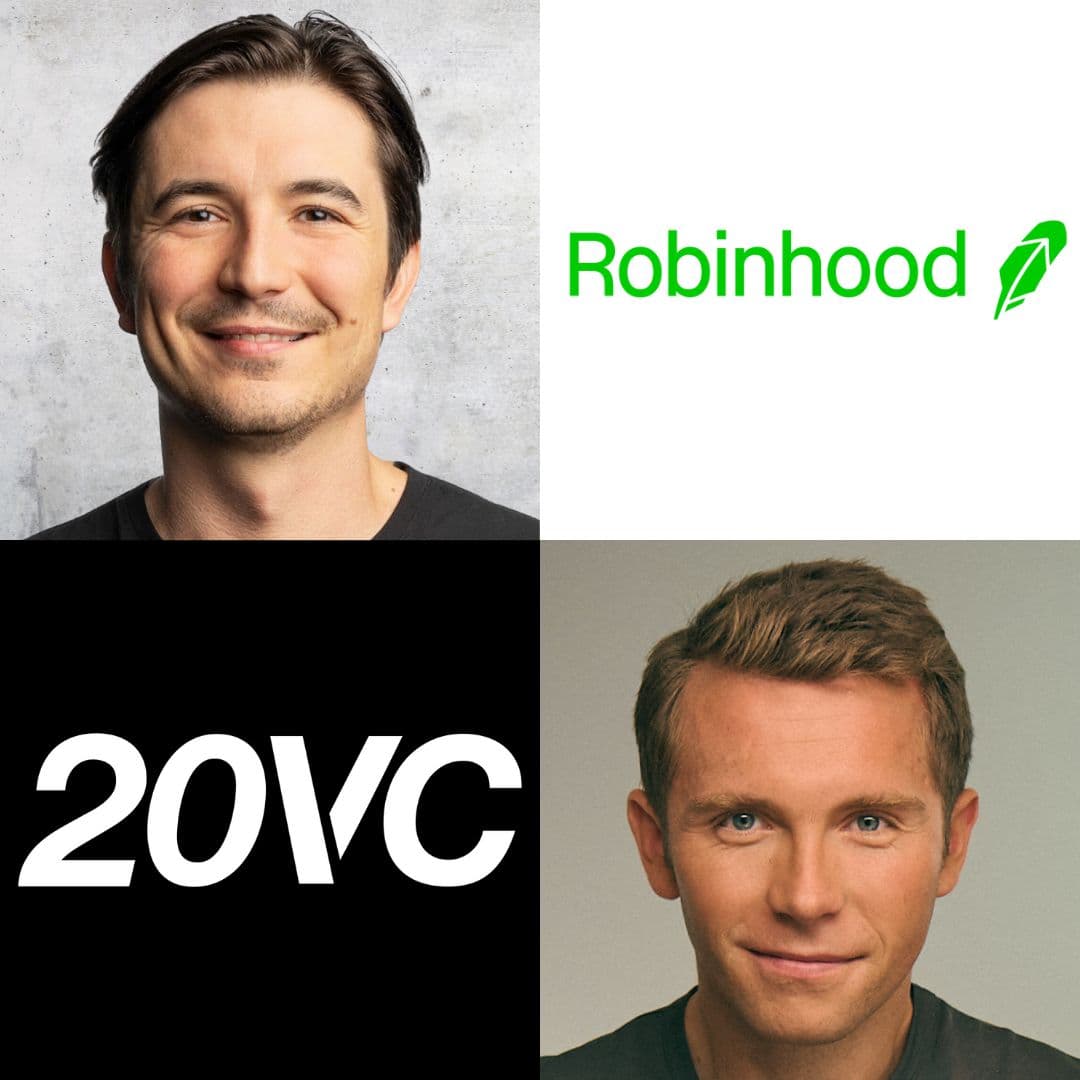
Vlad Tenev is a Co-Founder and CEO of Robinhood, the commission free stock trading and investing app with a market cap today of $20.7BN. Over the incredible 11 year journey Vlad has raised over $5BN from some of the world’s best investors including Sequoia, a16z, DST, Ribbit and Index. Before Robinhood, Vlad started two finance companies in New York City.
In Today’s Episode with Vlad Tenev We Discuss:
1. Surviving a Scandal: The Gamestop Saga:
-
What was the single hardest element of the sage for Vlad?
-
What did the sage teach Vlad about how to tell stories effectively?
-
What did Vlad not do in the period that he wishes he had of done?
-
What did he do that he wishes he had not done?
-
What advice does Vlad have for any founder going into a crisis?
2. Founder Mode and The Biggest BS Myths of Leadership:
-
How does Vlad analyse and assess Paul Graham’s “Founder Mode”?
-
Where is Founder mode right? Where is it dangerous?
-
What canonical leadership statements and lessons does Vlad most disagree with?
-
How has Vlad changed most significantly as a leader?
3. 8x $100M Revenue Lines: Scaling a Juggernaut:
-
What have been the single biggest challenges of scaling 8 lines of revenue each with over $100M in them?
-
What have been Vlad’s biggest lessons on when and how to release new products?
-
Why did Vlad decide to abandon the Europe launch? Was it right with the benefit of hindsight?
-
What did Vlad not invest in with Robinhood that he wishes he had of done?