
In short
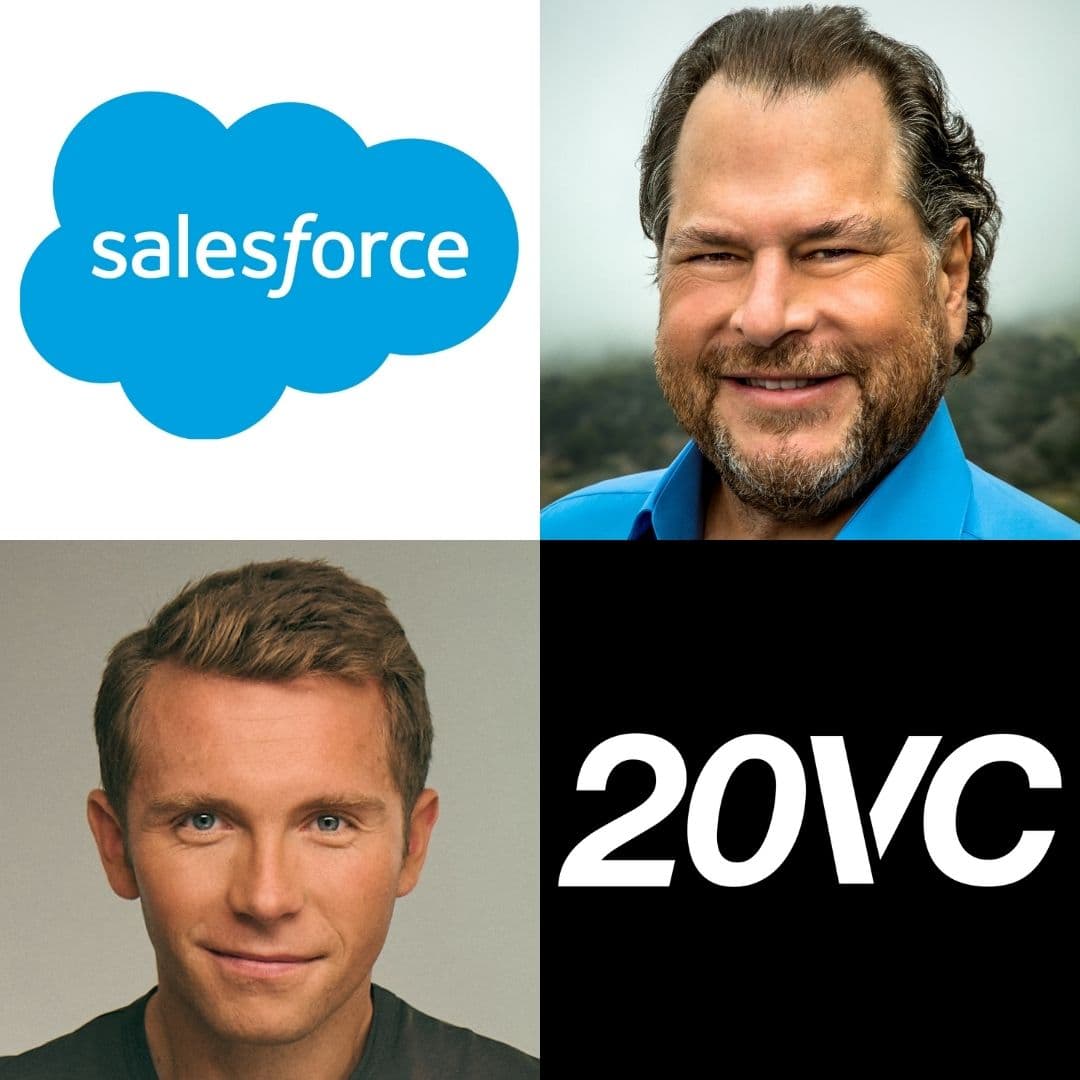
Podcast Summary: The Twenty Minute VC (20VC) - Episode with Marc Benioff
Episode Overview
- Title: 20VC: Salesforce Founder Marc Benioff on The Future of LLMs, Agents, Labour, and Management Lessons from Steve Jobs
- Host: Harry Stebbings
- Guest: Marc Benioff, Founder of Salesforce
- Key Themes: Future of AI, Digital Labor, Management Insights, and Personal Growth
Key Points
Introduction to Marc Benioff
- Marc Benioff is hailed as an iconic founder and visionary, having established Salesforce 25 years ago.
- Under his leadership, Salesforce has grown to a market cap of $346 billion, generating $38 billion in revenue and employing over 72,000 individuals.
Future of Large Language Models (LLMs)
- Commoditization of LLMs:
- Benioff argues that LLMs are nearing their upper limits and are rapidly approaching commoditization.
- The future lies in smaller, verticalized models specialized for specific applications.
- Model Selection:
- Discusses the competitive landscape of AI models including OpenAI, Anthropic, and X.ai.
The Future of Agents
- Agent Force in Salesforce:
- The new agent technology layer is crucial for Salesforce to avoid becoming merely a database.
- Agents are used to enhance customer experiences, as seen in partnerships with businesses like Heathrow Airport.
- Impact on Workforce:
- There’s a growing reliance on agents that could redefine traditional roles, with a focus on integrating digital labor with human labor.
Future of Labour
- Layoffs as a Strategic Tool:
- Benioff views layoffs as a necessary strategy for CEOs to prepare for future challenges.
- Discussions on whether Salesforce will have more or fewer employees in the next decade, with an inclination toward growth through digital labor.
Management Lessons from Steve Jobs
- Influence of Steve Jobs:
- A pivotal meeting with Jobs shifted Benioff's perspective on leadership and focus.
- The importance of honing in on one primary initiative (Agent Force) rather than spreading attention too thin across multiple projects.
Personal Reflections and Growth
- Beginner's Mindset:
- Emphasizes the importance of maintaining a "beginner's mind" to remain open to new possibilities and not become stagnant in leadership approaches.
- Resilience through Challenges:
- Reflects on the lessons learned from difficulties faced over the years, particularly during transformative periods in Salesforce’s journey.
Quickfire Questions
- On AI:
- AI's potential for good and bad, stressing the need for education around its impacts.
- On Personal Insights:
- Discusses the need for businesses to use their platforms for societal good, highlighting Salesforce's philanthropic initiatives.
Conclusion
- The episode encapsulates Marc Benioff's insights on navigating the evolving landscape of technology and leadership in the era of AI. Emphasizing the importance of focusing efforts, maintaining adaptability, and harnessing the power of agents and digital labor as key components for future success.
Resources
- For more details on this episode and additional content, visit [The Twenty Minute VC](http://www.20vc.com).
Closing Remarks
- This episode serves as a rich source of knowledge for entrepreneurs, investors, and anyone interested in the future of technology and management. The insights provided by Benioff are instrumental for understanding the dynamics of AI and the future of work.
Written by AI. May contain mistakes. Listen to the episode to check what was said.
Transcript
Automatic transcript. May contain errors.0:00We're doing our business plan for next year for 2025 right now. We're not adding any more software engineers next year. We have increased the productivity this year with Agent Forest and with other AI technology that we're using for our engineering teams. By more than 30 % to the point where our engineering velocity is incredible. And then we will have less support engineers next year because we have an agentech layer, but these current large language models. There's a lot of folks building those today and they're rapidly becoming a commodity. Everything needs to be about Agent Force, it's Salesforce.
0:33This is the only thing that really matters today. This is 20VC with me Harry Stabbings and the story of me and Mark Benioff is pretty special. He is one of my all -time heroes and I emailed him 53 times before he agreed to do a show with me. He did it, it crushed all records and it was his first ever podcast. Today he is back on the show to discuss the future of agents, The future of LLM's, Labour and the United States. This was such an honour for me to do to have Mark Bat was incredible. But before we dive in today, we're excited to ignite your curiosity with a journey into the world of transformative ideas.
1:09If you're driven by the pursuit of knowledge and personal growth, you'll love exploring the vast collection of insightful book summaries on the Blinkist app. So with Blinkist you can access expertly crafted summaries that distill the essence of thousands of influential books, allowing you to read or listen to each in just 15 minutes. I know they beat 20VC. Being recommended by The New York Times and Apple's CEO Tim Cook, it's no surprise that 82 % of Blinkist users see themselves as self -optimizes, and 65 % say it's essential for business and career growth. And speaking of business, Blinkist is also a trusted L &D partner for industry leaders like Amazon, Hyundai and KPMG UK, empowering over 32 million users since 2012.
1:55As a 20 VC listener even better, you get 25 % exclusive discount on Blinkist. That's B -L -I -N -K -I -S -T. Just visit Blinkist .com, forward slash 20 VC, to claim your discount and transform the way you learn. And while you're optimizing your learning, let's also optimize your finances with Brex. The financial stack founders can bank on. Brex knows that nearly 40 % of startups fail, because they run out of cash. So they built a banking experience that takes every dollar further. It's such a difference from traditional banking options that leave your cash sitting idle while chipping away at it with fees.
2:31To help you protect your cash and extend your runway, Brad is combined the best things about checking, Treasury and FDIC insurance in one powerhouse account. You can send and receive money worldwide at lightning speed. You can get 20X to standard FDIC protection through program banks and you can earn industry leading yield from your first dollar while still being able to access your funds anytime. Bracks is a top choice for startups. In fact, hey, it's used by one in every three startups in the US. Just check them out now, bracks .com -fordslash -dot -ups. And talking about building trust, secure frame provides incredible levels of trust to your customers through automation.
3:13Secureframe empowers businesses to build trust with customers by simplifying information security and compliance through AI and automation. Thousands of fast growing businesses, including NASDAQ, Angel List, Doodle and Coda, trust secureframe to expedite their compliance journey for global security and privacy standards, such as SOC2, ISO27001, HIPER, GDPR and more, but by top tier investors and corporations, such as Google and Kleiner Perkins. The company is among Forbes' list of top 100 startup employers for 2023. And Business Insiders list of the 34 most promising AI startups for 2023. Learn more today at Secureframe .com.
3:58It is a must. You have now arrived at your destination. Mark, I am so excited for this. Our second time. Thank you so much for joining me once again. Great to be with you, Harry. and glad that we have a slightly better video set up this time. We've got a fantastic video set up. You know, younger and younger Mark, which is. I have like two dogs here, but underneath the desk. So hopefully I'm petting one and I hope that they don't start barking, but I'm just giving you the heads up on that. Well, fingers crossed. Listen, I've interviewed many VCs, so it might more sense than what they say, so don't worry about it.
4:30My question to you to start, actually. You're saying that VCs are like barking dogs? Which do you know what at least barking dogs stop? but yes, my question to you is, I hear that you've actually got quite an interest in podcasts now. And I'd love to hear your thoughts on how you think about it. You are my first Harry and you'll always be my first and you know, you never forget your first Harry. Joe Mark is not something I ever thought I'd be really proud to hear. But it fills me with pride. How do you think about the changing importance of a CEO brand? When you think about that today, how do you think about that when you listen to podcasts?
5:06Well, I listen to more podcasts than ever myself, which is what all of a sudden, I, it occurred to me, I should be doing more podcasts. I, you know, will just tell you this, which is that I listen to more podcasts myself. I enjoy podcasts. I realize I need to learn how to be on a podcast. Like, I don't know the snappy things to say. I don't know how to like get people's attention right away that I haven't been on a podcast. So I may see some crazy things or terrible things. So get ready for something crazy to happen because I don't know how to do the podcast very well. A lot of my friends are really good.
5:40They're scripted, they're reading, they say these really punchy things. I'm like, wow, they really like priming themselves. I'm like, I've got my dogs, two golden retrievers under my desk. I'm like crazy things are happening and no, I don't know what to do. I don't know how to put on a podcast. So I've done 3000 and I can give just two bits of advice. The best are art and science. The art is telling a story, making someone feel like they're a part of the journey, bringing them into those early moments of Salesforce magic, and then the science is, and I learnt three lessons from that. You need the combination of resonance with the consumer and learning, and the two together makes for magic.
6:20Fantastic. Well, that must have been an example right there of the Made for Magic podcast. You said that you love other podcasts and shows. I saw your tweet last night where you said no mud no Lotus with regards to Jensen and his talk with Patrick Collison where he said nothing great is achieved without pain and suffering and so I wish upon you plenty of pain and suffering Do you want to be charming of Jensen? Why did you tweet it and how do you feel when you heard that? Well, that was an inspiring talk from Jensen Which is why I tweeted it and no mud no Lotus well that came from one of my teachers and good friends techno -hahn.
6:57Tic -n -hahn was an amazing influence on my life. He is someone who really brought mindfulness to the West and learned really how to meditate from him and what meditation was all about. I learned that I could cultivate my beginner's mind or what the Japanese called Shoshin. You know, in the beginner's mind, you have every possibility, but in the experts' mind, you have few or none. When I think about Tic -n -hahn, he always say to me, You know, mud, no lotus, and what he meant by that was, yeah, you have to go through difficulty and you have to go through suffering to get to beauty and love. And this is an incredibly important part of my life and how I think about it.
7:36And that's why I meditate every day. We talked about that. The first time we had a podcast, I spent every day in mindfulness and meditation and try to come back to my breath and clear my mind because there's so many difficult things happening all the time. Yesterday, I spent the whole day doing my earnings. So by the time it turns out, you know, for this morning, I need to get a few minutes to clear my head. When we think about pain and suffering that has led to the greatest lessons, what pain and suffering that you've been through maybe with the Salesforce journey has led to the greatest outcomes in terms of learning?
8:11I think yesterday is a great example. We had a great quarter hairy. We delivered clear guidance to 38 billion in revenue this year, 12 .9 billion in cash flow 32 .9 % margins. This was our guidance and the numbers were so far ahead. The market advanced our stock today. I think about 9%. It was adding another large tech company onto our company. So we ended up in the mid $300 billion in market cap. You know, when I think back, I think our stock was about one -third this value two years ago, one -third. What does that say to me? Well, two years ago, we had a really difficult moment. We were like flying an airplane as a good example.
8:52And we found out the two pilots were gone in the front. And the one guy with the parachute jumped out the door. And we had these unusual resignations that happened that kind of blindsided us. We had a lot of unusual things. The financials were not what we wanted. And we had to start making changes. We had to make financial changes and technology changes. We had to rewrite our product. We had to create new products. You probably know we've introduced this incredible new platform agent force that we can talk about. We also rebuilt our financial model and Addressed financial issues in the company that we had not been willing to address up to that point And then what that resulted in was two years of really hard Difficult work, but it resulted in yesterday where after two years the stock has tripled We have delivered a financial transformation We have delivered probably the most exciting new AI product in the history of enterprise software and a level of customer success We just have never seen before so this is a great example of no mud no Lotus because if we hadn't gone through that two years ago We probably would not be where we are today.
9:58So this is our second conversation And so I feel like I can be more direct Why when you look at the guidance that you have when you look at the results when you look at the amazing product But why is it that people say, I don't know how Salesforce will fire in a natural generation of AI. Do agents really help Salesforce? Yeah, we're in a really competitive industry. Number one, number two, when you think about Salesforce and AI, we are the number one enterprise AI supplier in the world today. We'll do more than two trillion enterprise transactions this week. No one is delivering AI at this scale to more companies globally than we are.
10:35And now we've delivered the first scaled, secure, trusted enterprise, agentech platform, which we call Agent Force. This is the way that so many companies right now are deploying agents. One great example is your favorite airport there, Heathrow. It's one of our large customers. One of the busiest airports in the world where customers really have a lot of complex issues happening all the time where they've evolved into really starting to focus more on customer success of Heathrow because people have had so many challenging situations and we're building an agentech layer completely around the airport with Heathrow so that from the beginning of your journey to your end you're going to be partnered with an agent to make sure you have an absolutely great experience at Heathrow.
11:20I think this is going to be pretty awesome. Do you have to own that agentech layer? Because if you don't own that agentech layer, don't agents just pull and summarize data and Salesforce becomes a database? And is that a bad thing? Well, let's talk about what we're doing and what we can do that others cannot do because of the nature of our platform Which we've now delivered this platform to 135 ,000 customers the next version of agent force is coming We're going to announce that December 17th. I hope you could come to San Francisco and we can talk about it then We have an incredible new agent force 2 .0 about to ship on agent force 1 .0 The first thing to know is that we automate every customer touchpoint This is one thing that's really unique about sales for so far.
12:03Heathrow, of course, we have our sales cloud and they're selling B2B and all these companies. Number two is customer service and support, our service cloud, our marketing cloud, where the most skilled enterprise email system in the world, our commerce cloud, our analytics, Tableau, Slack, MuleSoft for integration. All of these keep components together is the sales for flat from this. We've been doing for the last 25 years. And for the last two years or so, we've been focused on building our data cloud, which is the amalgamation of all of our customers' data so they can take all of their sales for simpletations and all of their data and bring it all together.
12:40And then the third layer is the agentic layer on top of that. And those three things are not three products. It's actually one piece of code, one integrated piece of code. And why that's important, Harry, is this. For AI to work really well and to get the level of accuracy and low hallucinase, low, low hallucinogenics that you need in enterprise AI today, you have to have as much access to the data and metadata and workflow as possible. And we have over 230 petabytes of that data in our platform. That makes it very unique. And it's not just the data, it has to be the metadata as well. That's how you get the real accuracy.
13:16What is the biggest challenge that sales force will have to overcome to achieve the dominance in the next generation of AI as you outline that? This idea that we are going to have a little not just a sales force, a service force or marketing force, but an agent force for our customers, we shipped it October 25th in the quarter which closed at the end of October. We already sold 200 deals. We will do thousands of agent force deals this quarter. and what we have to do is really show each and every customer what the magic of agent force is and how it can provide tremendous value to them. And as an example, it's Salesforce.
13:54This week, I think I already told you, we turned on help .salesforce .com. I stripped out my previous support infrastructure. I've plugged in a new support infrastructure. It's all 100 % agent -based. And we're going to be able to rebalance our headcount based on that we have a digital workforce and a human workforce now. We have digital labor in our company and human labor now. I need to bring that to every single company and to explain that is extremely difficult because this is a new horizon for business. This is the most exciting thing that's ever happened for business because we are going to start to bring in digital labor into business for the first time.
14:33You said that about digital labor in human labor, will Salesforce have more employees or less employees in five years time? I think we'll probably be larger. It's a good question. Number one, we're doing our business plan for next year for 2025 right now. We're not adding any more software engineers next year. We have increased the productivity this year with Agent Force and with other AI technology that we're using for our engineering teams by more than 30 % to the point where our engineering velocity is incredible. And then we will have less support engineers next year because we have an agentech layer.
15:08We'll have more sales people next year because we need to really explain to everybody exactly the value that we can achieve with AI. So we will add another probably one to 2 ,000 sales people in the short term. Mark, you're the master of sales. When you think about this agentech layer and what you're serving digital and human work is, how does pricing in SaaS change? when you are pricing digital labor, do we sell by seat or does that change? Agent Force is consumption pricing. So you're being charging per conversation, the starting price is about two bucks per conversation, and then it's negotiated based on volumes for customers.
15:43It's basically per user for humans and it's per conversation for agents. I was surprised when I heard you say, though, that we're near the upper limits in Al Al Amuse. When I heard that, I was like, huh, what made him say that? So I will just say that we look at what's happening with LLMs. That is very exciting. We've all had these great experiences with LLMs and what's happened. But we've had a lot of great experience with artificial intelligence in the last 60 years. And in the last 60 years, the history of AI is a new model or a new technology will come along. And a bunch of folks will kind of get to the point where it becomes a commodity.
16:20And then we kind of hold until we wait to the next one. and then it goes on and we've moved from machine intelligence and machine learning to deep learning to the advanced aspects of AI to where we are today and we're kind of waiting for even some of the new models to emerge after this generative AI models but these current large language models. There's a lot of folks building those today and they're rapidly becoming a commodity and they're rapidly maturing, they're pressing. That's not unusual in AI. AI kind of, you get a model and then you start to hit the upper limits of what's possible in that model.
16:56We have some of the best people in the industry working on these LLMs, but you can see that the growth rate and the maturation rate of those models has slowed because we're starting to commoditize them. Can you take me inside the internal discussion that you had at Salesforce of whether you should really invest in building out your own LLMs versus leveraging others in the commoditization of Al Alams that we're seeing now. Well two out of the top five models in the industry are Salesforce models. We also use a lot of other models. We change that on a regular basis and we've invested in a lot of model companies, including the Thropic and Mistral and Cohear and many of them.
17:36Even personally, I've invested in many amazing models. I've invested in an incredible new NextGen model company from Fefe Li, who AI at Stanford or has been runs research for me at Salesforce is amazing. We have really a selection of capabilities today. So really it's really fit for purpose. What the model is that you want for the task that you're trying to accomplish. Do you think that will continue to be the same feature that we look at, which is a world of many models and you seem to go to different models for the different use cases that you need? Yes. And that is a great place to be. I'm gonna ask a really young fire question, But as I said, I can just phrase everything as a second.
18:15There's no unfair questions. OK, you've got open AI at 160, anthropic at 40 or x .com at 50, which one would you rather invest in? I know, no, if I really want to invest in any of them right now, in those cases, we're seeing all of them to be in about the same kind of product. A lot of them are really becoming the same technology. So this is the moment where each of them needs to kind of pick their poison and go out and become their own company. I don't think being just a generic company is the right move anymore. You need to decide what vertical you're going to be in or what your best specialty is.
18:51I think we're starting to see that. For example, we saw perplexity go off and try to be something truly unique in financial services. This idea that different models are going to really operate for different industries differently is where the models are going to start to really shine. What is an unknown question mark that you have about the future of AI and Salesforce in next 12 to 36 months that you are spending a lot of time thinking about. The number one thing that I think about every single day is how to explain the customers, the huge value that they can get from agent force. That's why I felt it was so important that I'm eating my own dog food, sorry to my dogs here, that I've moved my whole support infrastructure to the agent platform.
19:35I will move my whole sales platform to the agent platform as well. I'll move my whole company onto Agent Force for no other reason what to show my customers what is possible We are in such a new world right now in terms of what is possible today versus even just six months ago that customers do not Understand this and what it can mean for them that is really all I am focused on my number one focus is Agent Force and my second one is how do I find as much fuel in my company to drive the first that is key and we mentioned also expanding distribution. These three things are on my mind continuously.
20:13How do you think it's most likely that you will find the fuel? The way I'm going to find the fuel is by using agent force. I mean, agent force is going to let me rebalance my workforce. I have 9 ,000 people in support today. I will not have as many people in support in the future because I'll be able to move. More of those folks into sales or into other functions in the company where I'm looking to hire people. And that is a big opportunity for me as a CEO. So respectfully Mark, do you move them? Do you just do the logical thing which is remove the cost and actually have higher margins, which is a perfectly logical thing for any business leader to do?
20:48How do you think about that? A lot of them will get moved. We have a lot of opportunity at Salesforce and we have a lot of growth happening. So for the vast majority of those, we're going to be able to move them and find new opportunities for them and we'll be very excited about that. Even in the layoffs that we had, which were very dramatic in the company two years ago, we have hired a lot of those employees back into the company. How do you reflect on these laughs? Well, I think that when you think about kind of no mud, no lotus, we went through this two years ago. It was a moment where I don't want to do layoffs.
21:19I hated it. Everybody then looks at you as you're doing this terrible thing. Nobody likes the word. It's a horrible thing. But the company had to be restructured. I had no choice. I was up against the wall. I had a clear vision of what the future was. but the current reality did not match the potential for the company for where it could be as evidence by today's financials and what's possible today. So, Layoff is an important tool for CEOs to be able to use, to be able to prepare for a company for the future. And nobody wants to hit the button, nobody wants to take the action, no employee wants to hear the words.
21:54It sends chills down everybody's spine, including my own. But sometimes it's very important for us to do that. I mean, you can see that organizations that need to get rebuilt. This is a good tool for them to use and CO should not be afraid. And I think that that example that Salesforce went through for the last 24 months is a good one. We mentioned in the beginning the art telling the story and the science, the learnings that come from it. I do want to discuss two amazing decisions and two tough decisions or plenty of mistakes. If I would ask you, what are the two most strategic decisions you made with Salesforce that worked out?
22:30And what did you learn from them? What would be the first that come to mind? Well, I think something I just did is very important. I had a great relationship with Steve Jobs. I worked for him in 1984 in the Macintosh Division when I was writing assembly language code. And later when I started Salesforce, he was very generous and would say, hey, come down and see me. And we would have talks about different moments or challenges that I was going through. And one time I got a call and said, hey, just come down. I want to show you something. And I went down and he was working on the iPad and he's like, here's two iPads and I'm like, wow, I love both these sides He goes, no, we're only going to do one size and then I'm like, well, this is really awesome that you can work on the iPhone and the iPad and you got your Mac and you have all these products you're working on your day is probably really full No, Mark, that's not how I do things at Apple.
23:21What do you do Steve? I only do one thing one time I have the A team at Apple. We only focus on one thing. So I'm just going to focus on the iPad and That was a very impactful meeting for me because up to that point I think I was doing too many different things and so when I've just rolled out Agent Force You'll notice that we're not going to talk a lot about all of Salesforce's products, which are amazing You know on the podcast. I'm going to keep coming back to Agent Force because that's all I'm focused on right now That's his advice to me. Focus on that. Put your best people on that. Make that happen.
23:56Is that difficult as a leader to not make other divisions feel less important if you're just pumping one? Absolutely. And you have to find ways to be able to constantly bring it back around everybody. So even like we reviewed our marketing cloud and our commerce cloud yesterday, both amazing products that we have, of we just went through Black Friday and Cyber Monday, we delivered more emails and more transactions and more GMV than I've ever seen in my career to our customers. We did it with 24 -7 perfect accuracy, but a lot of the conversations that I have with those two organizations is, what is your agent first future?
24:33What is your agentech layer? How are you gonna make your products even better through the power of AI and agents now? When we look at, and we have, you know, we have our examples and we're showing customers today, the future of an agent first marketing cloud or an agent first commerce cloud, how will that transform you? How is that gonna transform your customers? Everything needs to be about agent force, it's sales force. This is the only thing that really matters today. All of our 75 ,000 employees, our tens of thousands of sales people, and our 135 ,000 customers, we need to really boot them into the present moment of what is possible with this incredible breakthrough.
25:09I love that story of Stephen the lessons there on the flip side of like the worst decision on the worst mistake when I asked that What's the time that comes to mind and what did you learn from that? Well, I think that what I've really learned over 25 years of leading sales forces I think that when you look at agent force when you look at everything that we've just gone through I think that for CEOs the most important thing and this is what I try to remind myself constantly is you've got to cultivate your beginner's mind You have to be ready in today's day where everything is changing by the minute whether it's technology or political or economic You've got to be ready to cultivate your beginner's mind where you have every possibility and in the experts mind There is few the Japanese word is Shoshin Shoshin Beginner's mind that idea how do I get back to Clearing my mind so I can really see what the possibility is let me tell you a story I was getting ready for Dream Force and you know we just had 50 ,000 people to San Francisco in September.
Read the full transcript
26:11What I do for two months beforehand is I go on the road and I do all these focus groups. And meeting with all these customers, the big demo that we are doing was not for Louis Vuitton, it was for Gucci. And we run a lot of work for Carine and we even met with Francois, the CEO of Carine and it was an awesome meeting. And the whole demo for Dreamforce, everything was Gucci. And we were so excited about Gucci. And what we had done with our new point of sale system, Harry, which is amazing. All the changes we've made at the customer touchpoint layer, the data cloud was incredible. And things were going along.
26:46I was very satiated with how the Gucci demo looked. I felt it was very visionary. Gucci loved it. They even came to our headquarters and saw it. And then about a week two before Dreamforce, I got the first customer feedback on Agent Force. We had delivered it to the first five customers which included companies like Wiley, the book seller, open table, the restaurant company, ADP, Disney, et cetera. And when I was reading through the feedback from the customers, I'm like, wow, this product is a lot farther along than I realized. And I don't think anything is more significant for Salesforce than Agent Force.
27:22And I hit my Steve Jobs button and I pivoted the entire company over a period of two weeks, brought everybody and then said everything and all the messaging for Dreamforce is now officially going to change. We are going 100 % on Agent Force. And the question at that point was, what is Agent Force? And a lot of employees had not been brought into what we had been building. We had an incredible effort underway to deliver this agentic layer. It just happened a lot faster than we expected. And then we delivered it production October 24th. So we pivoted the company. We launched it a dream force We delivered it on October 24th and in the first last five days of the quarter We closed about 200 agent force deals will do thousands more this quarter That was the moment where I was like yes, you have to cultivate your beginners mind and then you have to do one more thing You have to trust yourself you have to trust yourself to know you have to hit that Steve job I was buttoned and go and say, no, this is now I'm only going to focus on the one thing and this is my one thing.
28:24So all of a sudden, Astro, you can see him behind me here, went from being regular old Astro to Agent Astro. Here we are today talking about this. Mark, are you knackered at the end of Dreamforce or Agent Force? It is an intense period for you. You are on stage. We see you crush it. Are you knackered at the end? Well, I would just say it's exhaustive. I mean, yesterday was also exhaustive, earnings is exhaustive, dream force is exhaustive. When you're the CEO of a large company, you better be ready to have a lot of exhaustive moments. You've got to leave it all in the field. You've got to be ready to do everything to make it totally successful.
29:01I'm constantly asking myself this question. Am I doing everything? Do I have all the ideas, concepts, notions, people? Is everything necessary to make agent force totally successful right now? I ask myself that question every single day. Is everything happening correctly? Am I doing everything? It has to be exhaustive. And there are moments like dream force or earnings or product launches or, you know, international travel is one, you know, where you do, you have to leave it all in the field. And that's an important part of success. After 25 years of being the CEO of Salesforce, from growing it from an idea, like you see with a lot of the venture capitalists and that you do or entrepreneurship that you do.
29:46I was right there at Ground Zero to growing it as the singular CO all the way to today at 38 billion in revenue. Whoa, you have to be ready to leave it on the field each and every moment or you're not going to get to where you want to go. So, you got to put it behind you and really go. Jensen Huang said, if he'd known how hard it was going to be, he wouldn't have done it. You look at 38 billion in revenue mark. I mean, 30 billion. If I asked you the same, would you have done it? You know, it's funny. My neighbor here is David Kirk, who led the creation of the GPU for Jensen, probably the most important piece of technology that he has at Nvidia, as the chief scientist.
30:27He led the RU group and the team. And at the end of the effort, he had built the best chip that they had ever seen. It became the heart of the game machines that became the heart of AI. and then he retired and said I did it. And he said, but I'm not gonna keep doing it. And instead, he became the chairman of his kids' school and he invested in this community and incredible person. I have a huge amount of respect for David Kirk. And Jensen, who I also have a huge amount of respect for, then had that technology, it was going into these game machines and incredible things were happening. And a few years later, he was at Stanford and he saw this incredible innovation with deep learning.
31:04And he was the only large company CEO and tech who said, you know what? Deep learning is such a big idea and this technology is pretty darn close to GPU to what you need. I'm going to pivot my whole company and I'm just going to be out deep learning. And he did that in 2013. Right when it came, he saw the vision models, he saw all these incredible models. I saw all those models too and while I added it in Salesforce, I didn't pivot Salesforce entirely around deep learning. He was the only one in our industry to do that. He deserves a lot of credit for having the vision and the insight, but also hitting his own Steve Jobs button to pivot his company because he did a hard pivot at that point.
31:44And he said, no, I'm just about AI. That's why a couple years later when OpenAI started, he was ready to bring them those boards and say, hey, build OpenAI using this, not the CPU, the GPU. you and that again was about David Kirk, but also about his focus on artificial intelligence. This idea that you have to be ready to pivot, to put it all behind you, to go, to leave it all in the field, but ultimately it only works if you have a beginner's mind. And all of those cases, those pivots are only working if you're ready to really go. And you might not know that you're at that moment if you're not in that flow.
32:21And I think sometimes CEOs are so in that cycle they're going like this, they're going like this that they don't have the opportunity to slow, stop, break, split, and just get back into the present moment right now. Breathe. Realize what it is that you need to achieve right now to achieve your greatest most amazing success. What are those values that will guide you? This is something we all need to kind of take a thought about. final one for you to a quick fire. You tweeted that you loved the Mark Andreessen conversation with Joe Rogan. I really did. Yeah, and there was one element in there that I was really intrigued to your thoughts on where he said tech companies didn't just cave to censorship.
33:02They were coerced, especially big tech. Did you agree with that statement? Well, I was shocked by a lot of the renovations that have come that the government has been so involved in some of these social media companies and their operations and he revealed a lot of that in that podcast. I think a lot of people should listen to it. And a lot of things I had never heard before, whether it was involving banking or social media, I thought that's one reason I should actually retweet it. I was surprised how viral that went. Do you think that's true, though, in terms of big tech being sentencing co -host in the way that it was?
33:35I haven't seen it in my own company. That's why I've been so surprised that, but I don't rent a social media company. So I don't really know what the government does with these big consumer platforms. We almost bought one. You probably remember we almost bought Twitter. I guess there's been a lot of moments now where I thought, do you think about what happened if you had a boat, Twissa? I think about that a lot. And I guess in a lot of ways I'm happy I didn't, because I don't think I would have enjoyed that part of it at all. Why? Because that's not kind of exactly the reason that I was buying it.
34:05I was buying it because I thought Twitter, and this is kind of a funny thing, because I thought Twitter is like one of the greatest vehicles for distributing not just content, but also applications. I as you know Harry we've talked about this several times. I worked at Apple in 1984 and when we had the Macintosh we had this great app dev system called hypercard and hypercard is an incredible technology model when I look at those little frames or those little photos inside those Twitter feuds They look like this sometimes they're filled with a video sometimes they're filled with a photo But for me what I saw in my mind's eye was an app and I thought it was a card actually And a card and an app were the same thing in HyperCard.
34:48And I thought we could build a kind of a wizzy wig tool to build apps and run them in those card frames. And that you could have photos, you could have videos, but you could have apps. And I was gonna build an app store and an app dev tool and I was gonna deliver apps in frame. And that's why I like it. You know, I'm just an app dev person at heart. And I've always loved application development deployment from my very earliest days in software. where when I was 15 years old, my first product that I wrote was hard, how to juggle, then I wrote 10 software adventure games. But in my heart, I just love this idea that you could build these things with tools.
35:25And when I went to work with Oracle in 86, that's what I really enjoyed doing was building application development deployment tools. And that's what Salesforce has become for so many customers, the ability to easily build these amazing next generation applications. Today we called them agents. Another tweet. Why are you so excited for Elon and Doge? What would you like to see happen? Well, I think that it's funny where you hit this point. I think quite a few times in the podcast how important is that fiscal responsibility in your company. I think it's important that fiscal responsibility in your country also and I think we've gotten away from that in the United States And I hope it gets back.
35:59I hope we get back to a balanced budget. I think that should be a bipartisan issue I think that's probably true in every country that we need to have more fiscal responsibility and that that would be a great thing for us We're going to do a quick fire and then I'm going to let you go. So I'm going to ask you five quick questions. What is your favorite consumer brand today and why? Oh, you mentioned Louis Vuitton. I love Louis Vuitton. I just got a windbreaker yesterday. They make my size, size 60. I love Louis Vuitton. I love the experience online. I love in the store. I love the luxurious. I also love their sales force customers.
36:30So I'm constantly testing to make sure my product is working correctly. But I do love Louis Vuitton. What have you changed your mind on in the last 12 months? What I've changed my mind on in the last 12 months is how impactful AI could be for customers. When I saw the breakthrough with Agent Force, I didn't expect it to happen as quickly as it was. I didn't realize the power was at our fingertips and I did the hard pivot at Dream Force to make Agent Force something real for all of our customers and now it has been delivered into all 135 ,000 customers and it's ready for them to turn it on now.
37:05What do agents not do today that they need to do in the future agents need today to be multimodal they aren't They're mostly text -based because that's kind of the generation of capability and they need to rapidly become a Multimodal experience and that will be extremely important penultimate one what concerns you most in the wild stay mark I think one thing that does some coming back to the AI theme is that there's a lot of good parts of AI And there's a lot of parts that could become dark. And I think we all need to get educated about AI, all the good parts and all the bad parts. We've seen the movies, you know, we saw a minority report and we saw war games and her and Terminator, but we need to realize, AI is not there yet, but it's gonna get there and that we need to be spending more time looking at what all of the potential of AI is.
37:54Look, technology's not good or bad, it's what we do with it, with technology that matters. You know, we should look at that very closely that AI is probably the most powerful technology we've ever seen and how are we going to use it for The betterment of our society. Do you believe some of them that will hit ag in 2025? I don't think we are in agai in 2025 So I think that's an optimistic thought. I think the we're going to hit the maturation of the LLM in 2025 So I'll say that I believe that LLMs are becoming commodities and that we're cresting the LLMs that they're getting incrementally more successful but not exponentially more successful.
38:32So we'll see the full maturation and commoditization of the LM capability in 2025. Final one for you. You are asked so many questions by everyone. What question has no one asked you that you lie in bad and go, God, why does no one ask me this? I would say people don't really reflect on a very simple thought about Salesforce. When Salesforce started 25 years ago, we put 1 % of our equity profit and time into a 501c3 public charity. A foundation here in the United States. It was easy at the time, Harry, because we had no equity. We had no profit. We had no people. We had no venture capital. So we just carved out a piece of our company.
39:09Now, 25 years later, we've given away about a billion dollars. We run 50 ,000 nonprofits and NGOs for free. On our service, we've done over 10 million hours of volunteerism. This is where businesses really the greatest platform for change. to see the impact that Salesforce has had. Now, more than 20 ,000 companies have also copied us in doing that. We even have a foundation called Pledge1 % .org to advocate companies and it's created billions of dollars of philanthropic aid to local communities. Even Salesforce has been able to give more than $150 million to its local public schools in San Francisco and Oakland.
39:45Now, there's no question, Harry, this simple fact, business can be used for good. Why is it that most more people aren't asking me how can they use their businesses to improve the state of the world? That's your pithy statement Mark you said at the beginning you need a statement That's the state. I guess I'll need one Harry. Thank you for that I hope it I hope it influences you and your own companies and your investments Honestly, Mark. It's such a joy. Thank you so much for doing this again It's great to be with you always. I hope we'll do a third and fourth and fifth podcast as well I have to say it is shows like that that just make me so thankful to do what I do I mean, the man created Salesforce $38 billion in revenue next year.
40:24What an incredible 25 year journey. I want to say huge thank you to Mark for being such a fantastic guest, friend, what a fantastic dude. If you want to see more, you can of course watch it on YouTube by searching for 20VC, that's 20VC. Now, before I leave you, we're excited to ignite your curiosity with a journey into the world of transformative ideas. If you're driven by the pursuit of knowledge and personal growth, you'll love exploring the vast collection of insightful book summaries on the Blinkist app. So with Blinkist, you can access expertly crafted summaries that distill the essence of thousands of influential books, allowing you to read or listen to each in just 15 minutes.
41:04I know they beat 20VC. Being recommended by The New York Times and Apple CEO Tim Cook, it's no surprise that 82 % of Blinkist users see themselves as self -proclaimed. Self -optimizes, and 65 % say it's essential for business and career growth. And speaking of business, Blinkist is also a trusted L &D partner for industry leaders like Amazon, Hyundai and KPMG UK, empowering over 32 million users since 2012. As a 20 VC listener, even better, you get 25 % exclusive discount on Blinkist. That's B -L -I -N -K -I -S -T, just visit Blinkist .com, forward slash 20 VC to claim your discount and transform the way you learn.
41:45And while you're optimizing your learning, let's also optimize your finances with Brex. The financial stack founders can bank on. Brex knows that nearly 40 % of startups fail because they run out of cash. So they built a banking experience that takes every dollar further. It's such a difference from traditional banking options that leave your cash sitting idle while chipping away at it with fees. To help you protect your cash and extend your runway, Brex can buy in the best things about checking, trading, treasury and FDIC insurance in one powerhouse account. You can send and receive money worldwide at lightning speed.
42:20You can get 20X -the -standard FDIC protection through program banks and you can earn industry leading yield from your first dollar while still being able to access your funds anytime. Brexit is a top choice for startups. In fact, hey, it's used by one in every three startups in the US. Just check them out now, Brax .com, Ford Slash startups. And talking about building trust, Secure Frame provides incredible levels of trust to your customers through automation. Secure Frame empowers businesses to build trust with customers by simplifying information security and compliance through AI and automation.
42:58Thousands of fast -growing businesses, including NASDAQ, Angel List, Doodle and Coda, trust Secure Frame to expedite their compliance journey for global security and privacy standards, such as SOC2, ISO 27001, HIPER, GDPR and more, but by top tier investors and corporations, such as Google and Kleiner Perkins, the company is among Forbes' list of top 100 startup employers for 2023, and Business Insiders' list of the 34 most promising AI startups for 2023. Learn more today at Secureframe .com, it is a must. As always, I so appreciate all your support and stay tuned for a whopping episode with TS Anil, a CEO at Monzo on the show on Wednesday.
From the publisher
Marc Benioff is one of the iconic founders and visionaries of our time. From the founding of Salesforce 25 years ago, Marc has in many ways created an entire industry. He has scaled the company to a market cap of $346BN, $38BN in revenue and over 72,000 employees.
Ask Me Anything with Marc Benioff:
The Future of Models:
-
Why does Marc believe we are at the upper end of LLMs and they are commoditising?
-
Why does Marc believe the future of models is many smaller, verticalised models specialised in different areas?
-
OpenAI vs Anthropic vs Xai. Which would Marc buy and which would he short?
-
What is the single biggest barrier to Salesforce winning the AI war in the next 10 years?
The Future of Agents:
-
What does Salesforce need to do to prevent becoming a database in the next generation of AI?
-
To what extent do agents hurt vs help Salesforce?
-
What do very few people understand about agents that is very important?
The Future of Labour:
-
Will Salesforce replace it’s human labour with digital labour? Will Salesforce be bigger or smaller in 10 years time, people wise?
-
Why does Marc believe that layoffs are a crucial tool for CEOs to win?
-
How will a future of digital labour change the pricing model of SaaS tools today?
Management Lessons from Marc Benioff:
-
How did one meeting with Steve Jobs change how Marc views leadership?
-
How does Marc analyse the required mindset to win as a CEO today?
-
What has Marc changed his mind on most in the last 12 months?