
In short
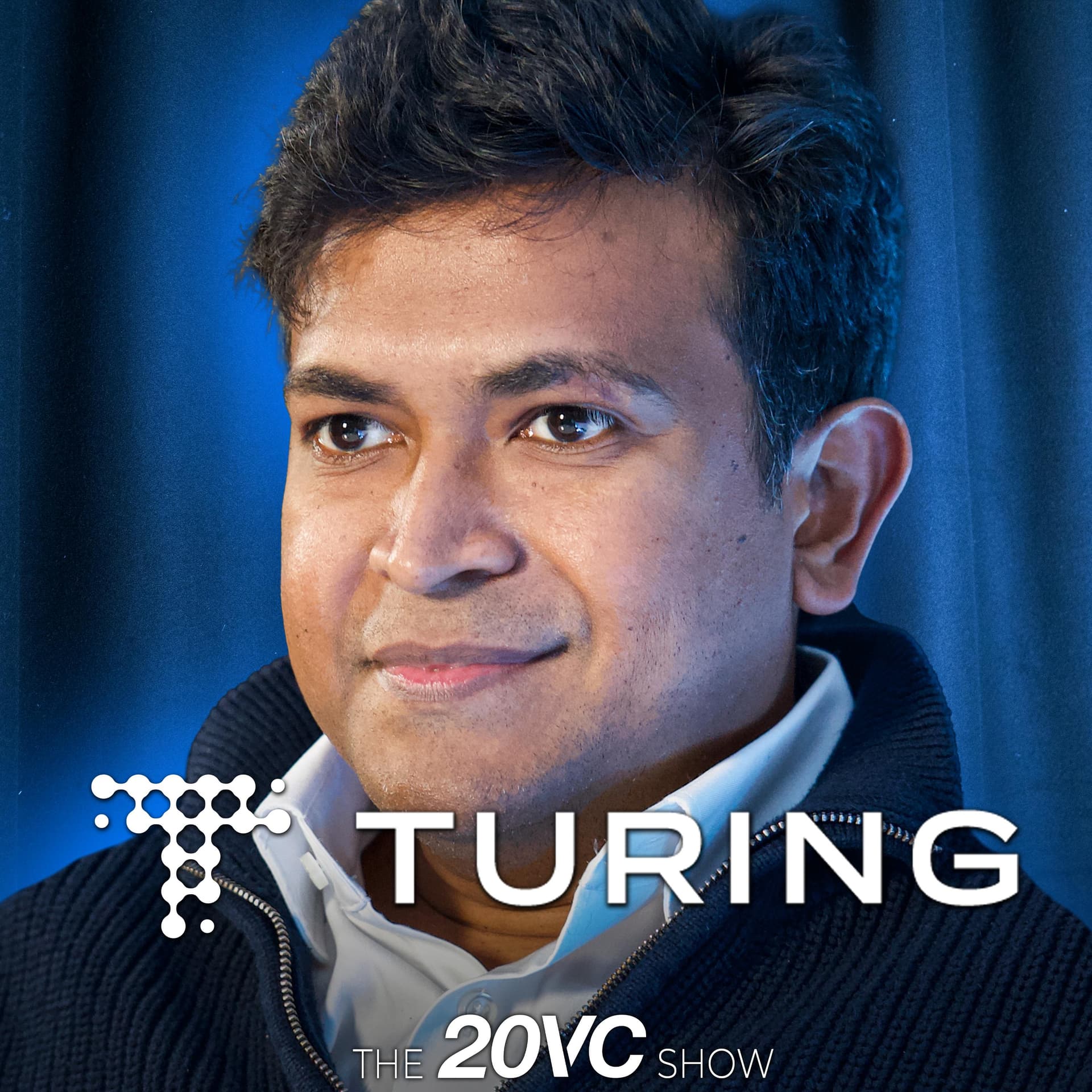
Podcast Summary: Episode with Jonathan Siddharth @ Turing
Overview In this episode of *The Twenty Minute VC*, host Harry Stebbings engages with Jonathan Siddharth, Founder and CEO of Turing, an AI company with impressive growth and revenue achievements. They discuss the evolution of data labeling, the future of knowledge work, and the implications of AI on traditional SaaS models.
Key Points Discussed
- Current State of Data Labeling:
- Siddharth argues that the era of data labeling companies is over, stating that we are now entering a phase dominated by research accelerators.
- He emphasizes that the complexity of required data has increased, moving from simple tasks to domain-specific workflows needing specialized expertise.
- AI’s Data Requirements:
- It is critical to understand the increasing sophistication of data needed for training AI models.
- Siddharth highlights the shift from using AI for simple tasks to applying it in real-world job functions, such as law and finance.
- Future of Knowledge Work:
- Siddharth predicts that 99% of knowledge work will be automated within the next 10 years, resulting in significant changes in productivity.
- He discusses the concept of "data-driven feedback loops" as crucial for maintaining competitive advantages in enterprises.
- Challenges in AI Adoption:
- Enterprises face significant hurdles in adopting AI, primarily due to poor internal data organization and resistance to change.
- Decline of Traditional SaaS:
- Siddharth claims that traditional SaaS products are becoming obsolete in an AI-driven economy, where companies may opt to build their own custom applications instead of relying on third-party solutions.
- Implications for the Workforce:
- The conversation includes a vision for a future where AI amplifies human capabilities, creating new roles and opportunities in various sectors.
Detailed Agenda Breakdown
- 03:35 - Data, Compute, Algorithms: What is Most Abundant? What is Lacking Most?
- 09:18 - AI's Data Requirements: Insights and Misconceptions
- 17:05 - Challenges Enterprises Face in AI Adoption
- 20:38 - Prediction: 99% Knowledge Work Gone in 10 Years
- 27:12 - Data-Driven Feedback Loops as Competitive Moats
- 36:08 - Data Labelling Market Dynamics: Who Wins and Loses?
- 38:23 - Revenue vs. GMV: Clarity in Data Labeling Revenue Models
- 45:20 - The Death of SaaS: Transition to AI-Centric Business Models
- 51:23 - Future User Interfaces: Will Phones Remain Dominant?
- 57:07 - Quickfire Round
Key Takeaways
- Transition in AI Models: The evolution from traditional chatbots to agentic systems requires a significant change in data and operational strategies.
- Increased Complexity of Tasks: As AI systems become more sophisticated, the data required also evolves, necessitating expert input.
- Future of Work: There is an expectation that AI will not just replace jobs but will enhance human productivity, potentially allowing individuals to manage multiple responsibilities simultaneously.
- Revenue in Data Labelling: Distinction between true revenue versus GMV is important in understanding the sustainability of companies in the data labeling space.
- SaaS Evolution: Siddharth firmly believes that SaaS will transform dramatically, with companies moving toward developing bespoke solutions using AI frameworks.
Closing Thoughts Jonathan Siddharth's insights provide a provocative view of the future landscape of AI, emphasizing the importance of adaptability, the role of data in model training, and the potential for AI to reshape industries and knowledge work. The discussion raises critical questions about how businesses will adapt and how future technology will redefine work.
For more information and resources related to this episode, visit [The Twenty Minute VC](http://www.20vc.com).
Written by AI. May contain mistakes. Listen to the episode to check what was said.
Transcript
Automatic transcript. May contain errors.0:00I think the era of data labelling companies is over. And it's now the era of research accelerators. All knowledge work is going to be automated. It's only a matter of time. I don't see an AI bubble. These models are incredibly powerful today. SaaS as we know it, I think is over. I think it's completely over. This is 20VC with me, Harry Stebbings, and I'm so excited for the show today. So I'm fascinated by the data labeling market. McCaw, Surge, Turing, Invisible. there are seven players that I know of that do over a hundred million in annual recurring revenue. All of them have more than 50 % of their revenue from two customers.
0:38The way they use the term revenue is also sometimes super unclear versus GMV. There are bluntly just a lot of questions. Today, I do not pull any punches with the man leading one of these companies, Jonathan Siddharth, founder and CEO of Turing, a company that he has scaled to over$350 million in annual recurring revenue, raising$225 million in the process and now being a profitable company. This is an amazing discussion and as I said, the tough questions get answered. But before we dive into the show today, are you drowning in AI tools, chat GPT for writing, Notion for docs, Gmail for email, Slack for comms, and you're constantly copy-pasting between them all, losing context and losing time.
1:24This is the AI productivity tax, and it's killing your output. At 20VC, we're all about speed of execution, and Superhuman is the AI productivity suite that gives you superpowers everywhere you work. With the intelligence of Grammarly, Mail, and Coda built in, you can get things done faster and collaborate seamlessly. Finally, AI that works where you work, however you work. Superhuman gets you from day one with zero learning curve and it's personalized to sound like you at your best, not like everyone else using generic AI. Get AI that works where you work. Unlock your superhuman potential. Learn more at superhuman.com forward slash podcast.
2:06That's superhuman.com slash podcast. And just like superhuman gives you superpowers in your inbox, Vanta gives your company superpowers in security and compliance. Customer trust can make or break your business, and the more your business grows, the more complex your security and compliance tools get. It can turn into chaos, and chaos isn't a security strategy. That's where Vanta comes in. Think of Vanta as your always-on AI-powered security expert who scales with you. Vanta automates compliance, continuously monitors your controls, and gives you a single source of truth for compliance and risk.
2:43So whether you're a fast-growing startup like Cursor or an enterprise like Snowflake, Vanta fits easily into your existing workflows so you can keep growing a company your customers can trust. My listeners can get$1 ,000 off Vanta by going to vanta.com forward slash 20VC. That's V-A-N-T-A dot com forward slash 20VC, 20VC for$1 ,000 off Vanta. And like Vanta builds trust with automated security, AngelList drives momentum by helping you find and fund breakout startups. If you're listening to 20VC, you know we have a really freaking high bar. Well, AngelList is the modern platform used by the best-in-class venture funds, where over 40 % of top endowments and banks are LPs.
3:29Their customers include a top five venture firm, 20VC, and they now have, check this out,$171 billion of assets on the platform. They combine an all-in-one software platform with a dedicated service team that moves as fast as you do. One manager said this awesome quote, AngelList feels like an extension of my fund. Another said AngelList gives me total peace of mind, the attention to detail, lightning fast response time, and just real sense of ownership from the team are exactly what I need to stop worrying about back office ops. So if you're starting a new fund, don't be a moron. Just use AngelList.
4:04They're incredible. Head over to angellist.com forward slash 20VC to learn more. You have now arrived at your destination. Jonathan, I've been so looking forward to this. Thank you so much for joining me in person. It's such a treat to do it in person while you're in London. Thank you for having me, Harry. Now, I want to start with a little bit of definitions because everyone thinks they're talent marketplaces and then everyone pushes back on talent marketplaces. How do you describe it? And why are we not dealing with talent marketplaces anymore? I think of a talent marketplace as something that's basically matching talent to something.
4:38Maybe it's an opportunity. So Turing is not a talent marketplace. What we do at Turing is we're training superintelligence. We work with seven out of the eight frontier labs. To get to superintelligence, you need research, compute, and data. Research, the labs do in-house with OpenAI, Anthropic, DeepMind, et cetera. For compute, we have Jensen to thank and maybe NVIDIA as well. Well, on the data side, Turing powers the data pillar. On the data side, there's been a significant shift in the last couple of years. So a few years back, the models weren't quite smart enough. And as the models have gotten increasingly smarter, the data needed to improve them has become harder to generate.
5:18And this is because it's more sophisticated data that's required to improve the models. It's like vertically specific people in task and workflows that isn't so obvious like cat pictures. That's correct. And there's a shift in the data going from simple to complex. I mean, let's take coding, for example. A few years ago, the kind of data set a contractor could generate might look like, hey, write a Python program to sort some numbers. Today, the data that's generated might be write a B2B marketplace app that connects doctors with patients and write it on for Android with Kotlin Java, write it for iOS with Swift and write it on the web, like with Next.js or something.
5:57That's the complexity. So there's a shift in going from simple to complex. So it's no longer the kind of data that low-skilled, medium-skilled contractors can generate. You need expert humans in every domain. The second shift is we've gone from teaching AI to take tests and pass tests to teaching AI to do real work. It's less about having AI pass the bar. It's more about, can AI do the job of a lawyer? Can it do the job of a privacy lawyer, a compliance lawyer, a paralegal? Having AI be good at doing economically valuable work, that's a shift. The third shift is we've gone from chatbots to agents.
6:37We started off with chat GPT where you're asking questions, getting answers, which is great. But now it's about the models becoming agentic, where they can execute complex multi-step workflows in a real-world business setting. And the type of data you need for that is totally different. How is that different? That's so interesting. So in the transition from chatbots to agents, how does the data required change with that transition? When you are training a chatbot, you'd usually do a lot of SFT and RLHF. SFT, where you're giving the model input prompts and output completions. You kind of teach the model to imitate experts.
7:13With RLHF, you're basically teaching the model to produce responses that a human would tend to prefer. RLHF is used to train what's called a reward model. And then the model is trying to produce completions that give it a high reward. With agents, and let's define an agent. I mean, different people define agents in different ways. I would define an agent as something that's capable of taking action in the real world or in the physical world. Something that's executing a multi-step workflow, calling different functions. The agent could be operating a computer or making backend API calls to actually do stuff.
7:50You might have an agent to file your taxes. You might have an agent to prepare your monthly financials. So to train an agent, you would also want to teach the model how to do tool use. So you teach the model how to call other functions, how to use other applications to be more leveraged. Today, the dominant paradigm is reinforcement learning. And oftentimes, these agents are trained through reinforcement learning, where you'd build what's called an RL environment, which is like a mini world model for business. And in that aural environment, you have input prompts, output verifiers, and you'd have the full system state tracked along with the data model.
8:29Let me give you an example. Imagine a workflow for a salesperson that an SDR would go through where before a sales call, let's say the salesperson has to research the prospect, look up Salesforce to see whether somebody from the team has already spoken with this human. And maybe if needed, looking up this person's contact information, maybe using ZoomInfo or something like that to reach out to them. This required this human to use three different tools, LinkedIn, Salesforce, and ZoomInfo. In an RL environment setup, you'd create a mini world model with clones of these applications that are created with a fake database with like synthetic data.
9:08And the prompt might be prepare for a call with this person. And then after the call is done, update Salesforce, right? Let's say that's the prompt. And you have what's called a verifier to check whether the agent completed the task. And in this case, and this is where I think AI is kind of beautiful and somewhat magical, you set up the agents in this environment, and the agent is going to try different trajectories, try different tool calls to try to complete the task. And you would set this up so that the curriculum is optimally defined. The curriculum is the set of tasks that you have this agent do.
9:41If it's too easy and the agent completes everything, the model doesn't learn much. If it's too difficult, the model doesn't learn much. You'd ideally want the right mix where the model is kind of getting positive and negative feedback. It's very similar to the technique that AlphaZero used in mastering Go, where the model played against itself. It's kind of like a form of synthetic data because the agent is trying different approaches by itself. But it's humans. I mean, in this case, at Turing, we create these aural environments at massive scale for every workflow you can think of across every function, across every industry.
10:14And so you create the RL environments to create the data that then allow the models to train to have further use cases like that. Correct. And we create RL environments for every industry you can think of, retail, healthcare, life sciences. Imagine like this four-dimensional matrix where the first dimension is every industry, like financial services, retail, healthcare, podcasting, maybe it's one of the dimensions. The second dimension could be every function, software engineering, marketing, sales, finance, et cetera. The third dimension could be every role in that org chart. Let's say in sales, there was SDR as like a role.
10:46The fourth dimension is a workflow that a human goes through in that role. You can think of every role a human has as like a composite of workflows. And we are creating RL environments for every workflow, for every role, in every function, in every industry. That's like$30 trillion of knowledge work. Is that possible to have that breadth and quality? Yes. How? Time and lots of money. Because I was speaking to candidly one of your competitors board members the other day in prep for this. And he said the big thing that we all got wrong was we are so in innings one of the acquisition of verticalized data.
11:24There is so much room to run in the data acquisition for dental, for SDRs, for product managers, you name whatever function you want. Do you see us very much in innings one of the data acquisition for these very specific vertically focused workflows? Absolutely. It's innings one, and I believe in slow takeoff. I'm sorry to pour cold water on all the AI doomers that might be listening to this, but we are not in a rapid takeoff scenario. I believe in slow, steady takeoff for AGI and eventually superintelligence. So we're still in innings one. It's going to take a while before we get all of this data into the models.
12:03When we think about then the breadth that we go after, and us specializing in RL environments, Just so I understand the marketplace that we sit in, because there is your macaws, there's your surges. How do you differ for those, for people who are wondering, hang on a minute, I thought they were all one? Turing is a fundamentally different animal. So what we do is we're training superintelligence for all these frontier labs. To get to superintelligence requires research, compute, and data. The data needs have significantly changed. It's more complex data rather than simple data. It's more real world data, data that touches how real humans do knowledge work.
12:41And you need data to train these agentic systems. What the labs need in a partner in this new world is somebody that has research DNA that could be a proactive research partner for them. Because these paradigms keep changing. Last year at this time, we were not talking about reinforcement learning at all. But then two things happened. O1 dropped in December. DeepSeq launched in Jan. And now it's all about aural environments. It's not just imitation learning, it's also reinforcement learning. So the labs need a data partner that's more research-oriented. Second, the labs need a data partner that also touches the real world.
13:19So at Turing, we don't just generate data to train the models for the frontier labs. We also work with enterprises. We work with Disney, Pepsi, BlackRock, Fiserv, Johnson & Johnson, to build fine-tuned custom models to solve real-world enterprise problems for those enterprises. So this is like FDs that you send in to go and build custom models. Correct. So we touch reality. We know where the models break in the real world. How much of business is that, the FDs deploying custom models versus more horizontal? So the horizontal business is bigger, but this business is also fast growing. And third, you need a platform with the world's smartest humans on it as well as experts in different domains so that you can build these RL environments.
14:04And you need that platform to be really good at sourcing talent, vetting talent, matching talent, and generating data. I think the era of data labeling companies is over. Turing is a research accelerator, and it's now the era of research accelerators. The labs want to work with a proactive partner that can think about what types of data are likely to be helpful for these models and can make recommendations to them. Why would you need a custom model? When you look at a lot of the customers that you mentioned there, for the ones where you have FDs who go in and build custom models, what is the reasoning around that?
14:37And is that a temporary moment in time or is that a permanent requirement from them for a certain reason? I think it's a permanent requirement. I'll give you an example. Let's pick an insurance company. For insurance companies, two really important problems they have to solve are underwriting and claims processing. Let's pick underwriting, for example. So with underwriting, the problem statement is you might get multiple types of unstructured medical data. It could be somebody taking a picture of their medical history on their smartphone, or it could be some OCR data from somebody's medical history or data in PDFs, et cetera.
15:14And a human has to look at that person's medical information and then decide, is this person high risk, medium risk, or low risk? What medical conditions do they have? Do they have cardiovascular? Do they have renal? and how do you price insurance for somebody like this? Do you even take them on as a client if you're an insurance company? Now, this is a problem that an LLM can solve really well with a human-in-the-loop system. You may not need a trillion-parameter world model to do a task like this. In fact, there's lots of research that shows a smaller language model will actually be faster and more accurate at a task like this than a giant world model.
15:52And the insurance company also may not want their data to go back to like a frontier model. So oftentimes in these cases, what we would do is we would work with a frontier lab, take one of their smaller models, maybe something in the half a billion parameters to 10 billion parameter regime, have an AI system built that's on-prem with the customer that's fine-tuned on that enterprise's proprietary data, because this insurance company might have data from like the last decade of humans making judgments, right? You want to make use of that data, but you don't want to help other competing insurance companies with your own data.
16:32So normally for these cases, you would have a smaller fine-tuned model that's fine-tuned on your proprietary data, distilling your proprietary human knowledge into the models. That human underwriter that's been doing this job has a lot of institutional knowledge in their brains. You'd want to distill that into the LLMs. And this human that I mentioned, who's doing this job of underwriting, they might be using other internal tools inside this insurance company. You might want to automate those tool calls in the agent. So you'd build basically a version, almost like a chat GPT agent that's smaller and fine tuned for that specific workflow and use case.
17:09I do think this will become more popular across the board. And it'll be a big market for the frontier labs. If you want a general purpose assistant, I think you need a trillion parameter model that can answer anything to be a universal assistant. Is that a good business for you? When you think about taking someone else's model, retrofitting it to a business, doing a lot of custom work with your own engineering teams in those businesses, is that a good business? It would be a good business. We're still early, but it's growing pretty fast. We have this unique vantage point where because we are generating data for all the frontier labs, we get to see a glimpse of the future before it arrives.
17:48And the glimpse of the future that I see is that all knowledge work is going to be automated. If a human's job involves looking at a computer, analyzing what's on the screen, using different tools using a keyboard and a mouse, it's going to be automated. It's only a matter of time. I mean, these computer use agents are going to keep improving over the next decade. That's$30 trillion of digital knowledge work. My question to you is, I spend a lot of time with very large companies, mostly where I speak to them. The thing that I'm astounded by is we hugely underestimate the pace of AI progression in terms of technological capabilities.
18:26But consistently, what I see is the laughable state of internal data, internal processes. I mean, Jonathan, these guys are so far off adopting Slack and Notion, let alone building custom models and embracing the latest AI tools. I respectfully push back on the all-knowledge work automated, maybe in 20 years, but not in a 10-year time frame. Am I wrong? What do you think is the biggest constraint or obstacle? The inability for them to try and implement new tooling. But what if the cost is too high? If they didn't do that, if the hypothetical insurance company that I told you about, if there was a competitor of theirs that could operate with 100th the head count, while delivering a better experience to their customers by pricing insurance deals better, making more money from insurance premiums, less claims payouts, they'll get their lunch eaten?
19:21I think they will. I think you'll see this transfer of value from old incumbent who can't adopt new tools to start up company, hence why we invest, who is eating their lunch. Absolutely. Ah, I see. So your theory is that the incumbents won't adapt and it'll just be a forest fire and you'll just... 100%. We will be on a 10 to 20 year decline of incumbents who are unable and unwilling to adopt new tools because of data, because of permissioning, because of internal buying processes. I mean, I go to a European bank, you will be astounded by how bad it is internally, the poor quality of the processes of buying technology, it's abhorrent.
19:59I have a hypothesis. My hypothesis is that companies will be very slow with back office automation, but in the front office, for example, I speak with financial services clients in New York, like some of the biggest companies. I speak with the C-suite of these companies, and they are extremely interested in applying AI to help them make better investment decisions because it directly translates into helping them make more money. It's a lot easier to convince people to use a piece of technology to make more money than to save money. And in financial services, it's pretty brutal, right? It's kind of an efficient market.
20:37If there is alpha to be found in how you can allocate capital better, make investment decisions better, figure out what opportunities to invest in, price deals better, you'll get killed if you're not at the bleeding edge. And I've heard Mark Chen, the head of research at OpenAI say this, about how financial services is usually at the bleeding edge among all the other industries in the S &P 500. But even they are like about two years behind usually relative to the state of the art. So I agree with you that in back office automation, it'll probably be very slow and it'll probably be the upstarts that'll do things well.
21:14I think the change management will be too slow. But I'm optimistic about front office, especially in financial services, life sciences, pharma, where if you can accelerate the time to discover a drug or to get to a molecule, if you can help somebody win in the main thing that they care about in their industry, I think they'll adopt it faster. I'm always told by a dear friend, Rory O'Driscoll at Scale. I don't know if you know Rory, but fantastic investor. And he always says to me, listen, value generation from AI is fundamentally dependent on one simple question. Will we see the transfer of budget from human labor to AI technology?
21:52And if we see that transfer of budget, oh my God, the$30 trillion that you said, it does. And if we don't, we operate in maybe a slightly larger software technology budget world, but by no means a world that we can have the valuations and the money that we have going in. When you look at that, are there any areas truly today where you're like, we have seen the full transition from human labor budgets to AI technology budgets? I think the transfer is pretty high in areas like customer support, copywriting, SEO, like some of these marketing related areas. As you would expect, the transfer is faster in these low risk to fail areas, like when it's relatively easy.
22:37But I'd encourage your listeners to look up GDPVal, which is this paper by OpenAI, where they measured the impact of today's AI models in automating all types of economically valuable work. It's a lovely piece of research. I encourage everybody to read it. Where they did this study, where they looked at, I think, like nine verticals and 44 occupations. They took a very diverse sampling of different types of knowledge work, everything from financial services to real estate, to healthcare, to law. And they took very specific occupations. And in those specific occupations, they took real tasks where like a real deliverable has to be produced.
23:19Imagine an engineer, like a civil engineer, creating a blueprint for a building they're about to build, or somebody who's at the set of a movie studio coming up with a schedule for how you organize your crews, like real work, right? And for coding, you can imagine like a real world software engineering project. and they saw that today's models were quite good at achieving parity with the best human experts in that field. We were roughly at like, I say we, I don't know which side am I on? I mean, the side of the AIs or the humans? I think you're on the side of the AIs. Oh, really? Yeah, yeah. I mean.
23:51From that positioning, that would infer so. Yes, yes. But Turing is like a blurry line, right? Like as the CEO of Turing, like passing the Turing test is about not being able to tell the difference. So what I noticed was about 50 % of the time in GDP Val, like the best models were producing work that was indistinguishable from a human expert, which is remarkable. And kudos to OpenAI, where they also flagged that the number one model was Claude 4 Opus, although GPT-5 was quite good also. And this was for relatively simple tasks, like a task requiring one single step. Whereas in the real world, if I give you a task to do a certain project, you won't just go off and do it.
24:31You might ask for clarifying information. You might do other things to acquire more context. You might go brainstorm with other humans to do that task, and you would do it in a sequence of steps. So there's more room to go. But I think we are well on our way to AI eventually automating all types of knowledge work. What happens in that world? If AI automates all types of knowledge work, What happens then? Three things that will happen. First, we'll all have the potential to be 100x more productive. Today, I'm able to run one company. Elon can run maybe like five companies. But in a world where I'm 100x more productive, maybe I'm able to run 100 companies.
25:10Elon maybe runs 600 companies. Every human will just be so much more leveraged. The nature of a job itself could change. Today, we are accustomed to the idea of like one person doing one job. but people could be doing multiple jobs at the same time. People could be running different companies at the same time. The second implication, I think, is it's going to be wonderful for entrepreneurship. So you, Harry, I think are going to be very happy because today, for a lot of ideas, founders are intelligence constrained. I think of being capital constrained as a form of being intelligence constrained.
Read the full transcript
25:45For example, if you pick a therapist who wants to start a mental health startup. Today, that founder would have to raise at least a few hundred K, if not a few million, to recruit some software engineers, maybe a marketing person or a growth person, maybe a product manager. But in a future where AGI exists, this person will recruit a marketing GPT, a software engineer GPT, a PM GPT, and get off the ground for a lot less capital. A million flowers will bloom. Lots and lots of non-technical founders will start companies. we'll see a broader distribution of founders than just those who live in London or Palo Alto who are kind of connected to these pools of capital who might start companies, which I think is wonderful for the world.
26:26Do you think we will? What I mean by that is there's six and a half million people today in the UK of the working population who actively do not work because of an inability to work. I'm not going to get into the analysis around that because I'll get in trouble for it. I think we grossly overestimate the intelligence of the general population And I know that sounds incredibly arrogant, but most people say actually a lot of people just don't want to work and are not at the level of recruiting GPT's assistants. Do you not worry that it will widen the chasm between those that have and those that haven't?
27:00I'm an optimist. And I think the opposite will happen because what we're really doing when we're training superintelligence is you're basically training intelligence as an API. And what's the alternative to that? It's like hiring a human to provide you with that intelligence. That human is quite expensive. And if anything, that creates an even broader gap between the haves and the have-nots. Whereas for$20 a month, if you had access to the smartest experts in coding, in STEM, in sales, in marketing, I feel like more people will be able to start companies and produce active, valuable work. I believe that when we have access to superintelligence, I firmly believe this.
27:40we are not all going to chill out on a beach somewhere and contemplate what do we do next. I mean, we humans, like we are tool builders. We are problem solvers. We'll solve problems at higher and higher levels of abstraction. In a world where we have AGI, we'll just solve much more exciting problems. Maybe we'll cure diseases, reverse aging, maybe go to the stars. I don't think we'll be bored. I'm glad. I often hear the UBI and we're going to sit and write poetry. And And I think that might be a little bit challenging. When technology is not the moat, what is the moat? I had the founder of Base44 on, and he said 99 % of code in the next year will be written by AI.
28:17Technology is no longer the moat. What is the moat in that world? I think one moat will be data-driven feedback loops. For example, one reason Google had such a great lead in search for a while was these data-driven feedback loops that come from people using your product and generating data that gives you, the algorithm developer, a high quality gradient for which direction to step in. So the importance of page rank was known. The recipe for ranking search results was well known among Google, Yahoo, Microsoft, and a few others. Obviously, people move around these companies all the time. But the advantage Google had was because everybody preferred Google and liked that search engine, you saw a much more representative set of queries.
29:06You had data from clickstream, from the clickstream of what results people were clicking on. That helps your algorithms improve at a much faster rate. I think data-driven feedback loops will be key for all types of enterprise applications also. Today, OpenAI and ChatGPT has a good data-driven feedback loop. In enterprises, again, I think it's wide open. Whoever is deploying the right custom fine-tuned models and agents for specific workflows or roles or functions or companies, if you get in first and solve a customer's problem really well, you start getting that flywheel going where you will discover first where the models don't work well.
29:48And you will use that data to work with a company like Turing to generate additional data to plug that gap. So you will improve. This is what I mean by it's important for the models to touch reality. I feel like the models have touched reality in consumer. We haven't yet touched reality in enterprise. And the only way we'll improve is by deployment. And that deployment is fundamentally predicated on handholding, correct? Yes. Handholding. And I feel like there's still a lot of first mile schlep and last mile schlep that needs to be handled. What does that mean? First mile schlep and last mile schlep?
30:20When I say first mile schlep, I mean, for that underwriting co-pilot example that I gave you for that insurance company, I painted a pretty rosy picture of like how you take this model, you fine tune it on your proprietary underwriting data. In the real world, it doesn't work that way. First mile schlep is, let's say I'm talking to the CEO of this insurance company or the CTO of this insurance company. They'll say, our data is a mess. It's in silos. It's super fragmented. Some of the data is in spreadsheets. Some of the data is in a file that Bob has. And Bob doesn't work here anymore, right? The data kind of is all over the place.
30:53You first have to acquire the data, convert the unstructured data into structured data into a format to fine tune LLMs. You might want to set up good infrastructure for evals. You'd want to create good evals for the models or agents. You might want to build a workflow designed for partial autonomy. So this human underwriter that's about to use this model to evaluate these medical histories, you might want to build a cursor-like interface for them so that they can work alongside the AI to do their job. Also, training the humans in these new workflows, you want to make sure you're collecting data the right way.
31:31The way, for example, we do deployments is like a tandem system where you'd have a human and AI doing the same job for a period of time, where a manager can see the output of both. If the agent is right and the human is wrong, you train the human. If the human is right and the agent is wrong, you've created a data point to fine tune the next iteration of the agent. So the agent is steadily improving over time. If the agent is right and the human is wrong, why didn't you just fire the human? I mean, it depends on at like what frequency, right? Like you track things like precision and recall, like you'd want to analyze this over a period of time.
32:06Like you wouldn't fire them over like a single mistake. A bit harsh. Yes. What's the margin on that business? It varies. Like we're also in the early innings of figuring out how to price that. Today, we do it in a relatively simple way where we're just billing these things for time. I don't think that's the right way to do it. We'll switch to a more value-oriented pricing model at some point. Right now, we're just laser focused on the Frontier 8 labs. So enterprises for us is a longer term play. When you look at revenue numbers in this space, a lot of people shout back, they're not revenue numbers, their GMV.
32:45Given our understanding now that, Bundy, there's no talent acquisition from your business. It's all an RL environment creation business. When you look at the other announcements of alternative providers, can you help me understand, are they revenue or are they GMV? And is there mislabeling being done here? So I don't want to comment on other companies, but we think about revenues differently. Like the way we think about revenues is more in terms of gap revenues? It's like traditional revenue numbers. I'm an investor, Jonathan. Essentially, I'm trying to understand and learn from you of how I should weight revenue in today's AI world versus the previous historical world.
33:24Should I be impressed by these revenue numbers or should I not? I think it depends on the type of revenue. Obviously, these are not SaaS ARR numbers, right? These are not those types of revenues. This is a different beast. I think this requires thinking from first principles. The revenue here is reoccurring in the sense that oftentimes when you're working with a lab on helping the models improve in some area, and I'll speak to Turing, I don't want to speak to other companies. When we are helping a lab, let's say, improve their models for coding or multimodality or tool use, or working on RL environments for automating all types of professional knowledge work, it's usually a reoccurring project.
34:05Projects will start, projects will end. And as long as you're doing a good job, there is lots and lots of demand, but you have to consistently keep doing a good job. It's also important to be a trustworthy partner to the labs. We take secrecy very seriously. We make sure that our projects are all firewalled between labs. Oftentimes, even with teams within the labs, sometimes that's the level of secrecy that you would need. I'm reminded a little bit about how I've been told Foxconn operates. I mean, I don't know anything about that, but I've been told that they have different floors where maybe on one floor, the iPhone is getting made and on another floor, maybe a Pixel phone is getting made.
34:44And obviously, you have to firewall all of that. Of the eight largest providers, do they not spend with all of you? They spend with a handful of companies. They do that to have some level of resilience. And I imagine there's some price benefits to having more than one person that they could work with. But I think the resilience piece is important. I mean, we know what happened with the, you know, when the scale investment happened, the labs did benefit from having other partners that they could work with. I would say it's a small handful. It's a small handful that are trusted. And of course, there's probably a giant pool of smaller startups, but it's a small handful of big companies in the space.
35:23Which one do you worry about most? So this is just a big, big market that's growing super fast. I'm excited for like all the companies in the space. I feel like different companies come into this world with a different DNA. Which leader do you most respect? Sam Altman, Elon Musk. Of the data providers, Jonathan. Of the data providers? I'm pushing you, dude. This one, I'm going to get a name. I mean, I have a lot of respect for Alex Wang from Scale AI. I feel like Alex and Scale were prescient in seeing the importance of data. And I admired how having started in autonomous labeling, like how they kind of navigated the ups and downs.
36:09Yeah, I really like the way he operates as well. I feel like there are certain elements of leadership that I think I share with him. And I think he did a great job for scale. How did scale being acquired impact Turing's business? We just got flooded with a lot of demand. And we've also amped up pretty significantly in multimodality. Multimodality was something I think scale was quite strong in. Multimodality is teaching the models to operate well with not just text, but audio, video, image, etc. Outside in, I've heard that because of their roots in autonomous labeling, they were quite good in multimodal stuff.
36:51It was good primarily from just increasing demand. I feel like they were the company that had been working in the space the longest. Do they have a business left? Again, I mentioned Rory O'Driscoll, I think you said in a show with me recently that there's this kind of carcass or husk left behind. If everyone benefited from that being bought, they can't be doing that well. I don't know enough about their business, like in terms of... Do you pay attention to competitors? I pay attention to competitors in terms of things that they do well and when there are any significant learning opportunities from them that could help us serve our customers better.
37:31Do you worry about revenue concentration? You said about kind of eight of the biggest labs. Say if you look at like an open AI, they have, I don't know, whatever it is, 100 million, you all know these numbers much better than me, but say 100 million paying customers, I'm just taking a 10 % on a billion people, but give or take 100 million, whatever. And then you look at, say, a business like ours here, where there's like seven core customers. How do we feel about revenue concentration? The last time I checked, I was told that for NVIDIA, 39 % of their revenue comes from two clients, and roughly 50 % was like four clients.
38:03So in this market, I don't worry that much about revenue concentration. I think we are in the same boat as NVIDIA in that there will be lots and lots of spend from these big eight companies. Look at the scale of the spend, right? Like Stargate is like 100 billion a year investment on compute. There's going to be significant amounts of spend on compute, energy and data. It's a little weird to have this level of concentration, but things could change. I think it's also possible that governments spend even more. I think it would make sense for governments to build their own internal versions of some of these models, which would require proprietary data again to be collected.
38:43Do you not think they'll have to. And what I mean by that is like, we'll see sovereignty of models. Like, I do not think there's any way you'll have the German healthcare system working with American model providers. I think you're right. I think it'll be necessary. In that world, do you provide that FDE service to governments? Yes. The work that we're doing in not just training superintelligence, but in deploying superintelligence is with that goal in mind. For these governments, I imagine will help them not just with fine tuning their models with data and evals, but also helping them with the first mile schlep and the last mile schlep to make these systems actually work.
39:18And you might want to have full control over what type of human data is going into these models. Like if you're the German government, presumably you want German nationals to be the ones that are contributing data, whether it's for SFT or reinforcement learning. So I'm worried that we are potentially not going to see AI deliver the immediate revenues that we've promised. And we're going to go through a kind of cooling period, which everyone kind of suggests and thinks that we're going to go through in the next six to 18 months, which is, as I said, it doesn't hit the revenues that we said it would.
39:49And kind of the AI bubble deflates slowly. To what extent do you think that's possible? Or we'll see this continuing gradual increase as we kind of touched on there? I don't see an AI bubble. These models are incredibly powerful today. A, GPT-5 is like fucking awesome. I don't know what people were talking about when they're talking about, you know, I know there was some chatter. I think we've just gotten used to magic. I feel like A, these models are incredibly powerful today and they're the worst they'll ever be. They're only gonna keep improving. I say that about the Gemini Pro models, the Grok models, the Claude models.
40:25Like these models are amazing. And there's a very significant model capability overhang. By that, what I mean is the models are capable of X, but what we are getting out of the models is X minus delta. With the right agentic scaffold around these models, in terms of the right system prompts, the right user prompts, giving the models access to the right context, teaching the models how to acquire additional context, teaching the models how to use the right internal tools, there is significant amount of capability that can be unlocked with today's models. For example, you, Harry, I imagine, when you do an interview with somebody, one of the things you probably do is you apply your secret sauce to pull out the right clips from the interviews, like what to highlight, what are the catchphrases, what will drive more engagement.
41:11That can be done by a model with the right agentics capital that's fine-tuned on all the work that you've done in the past. I wish. Every weekend I go through every single show and I pick out 15 to 20 clips per show and then I make notes on each one. Yeah. Are you saying, Harry, that you want to use Turing? If you could fucking make it work, dude, I'd pay you a lot of money. Yeah, maybe we should partner. That'd be great. Seriously, every weekend I spend probably three hours per show, definitely 12 hours a weekend doing that. I think there is this model capability overhang where the full potential of the model has not been unlocked by humans yet.
41:48And no, I don't think there's an AI bubble. I think there are some growing pains. What are the growing pains? I think everybody keeps citing that MIT report about how 95 % of pilots fail. But because we are in the business of deploying AGI in enterprises, I can tell you why I think that happens, which is one of the growing pains. Step one is that most enterprises need to do some work to structure their data in the right way. Again, that first mile schlep has to be done. Second, you should surround the model with the right agentic scaffold that I just described, the right prompting, the right context engineering, the right internal tool calls that you should teach the model to call.
42:28All of those have to be distilled into the models. You need really good evals. You also need a workflow designed for partial autonomy. Andre Karpathy articulated this first when talking about why cursor works so well, because it's not designed for full autonomy. It's designed today for partial autonomy, for humans to collaborate with the AI to do that specific task. So that cursor for X needs to be built for every role, for every workflow to help humans work more easily with the models. Does every role need to go through that pathway of cursor for X before it goes to full autonomy? Or are there some roles like customer service where it just goes to full autonomy?
43:06Some roles where you can see that the models are quite good at matching humans. I think we don't need that intermediate step. There are certain roles where by virtue of how the models are trained, where they're pre-trained with tokens on the internet. And then of course, with talent from research accelerators like Turing, that's fine tuning the models. but there are certain types of roles where the tokens from the internet give it sufficient intelligence to do the job well. Customer support is an example. But if you pick other roles, like for example, if you picked the role of, let's say, an AI researcher, or you picked the role of a lawyer specializing in venture capital financing, it's possible there's not enough of those tokens on the internet.
43:47So the models will be relatively weak there out of the box. And also the way a Wilson Sincini does financing, might look different from the way a Cooley does it. Maybe they have their own way. So you might want to fine tune them on your own proprietary data, distill the proprietary intelligence of humans working there. So for those things, like you may need to do some fine tuning, the models may not work very well out of the box. A lot of people suggest the circular deals between some of the large providers suggest the strains in the ecosystem or the bubble-like tendencies. Do you think that's fair or not?
44:20I sort of categorize the world into two classes. Class one is those that believe in AGI. Let's call it the AGI-pilled group that believe that we are on the path to getting to AGI. And let's define AGI as an AI system capable of at least matching humans in almost all types of intellectual knowledge work. Then there is a world, maybe another category of people that don't believe this will happen, we'll hit a wall, right? And in the past, there've been other AI paradigms where we did hit a wall. For the camp that believes in AGI, and I believe in AGI, unsurprisingly, but I love AI and it's been my passion for like the last 20 years.
44:59I really believe that we will get there. If you believe that, the grand prize is so amazing, right? Like if you've solved intelligence, you've solved all of humanity's grandest problems from curing diseases to potentially pausing aging to like interstellar travel to energy. All of our problems are intelligence constrained. So the prize is so large. I mean, whoever wins the super intelligence race will probably win search, will probably win consumer devices, will probably win operating systems, will probably win cloud, like business productivity software. It's like the prize is so massive that it's worth placing big forward bets in these areas because the cost of not winning is too high.
45:39Whoever wins AGI would also probably win social networking. So you can see why the big eight are excited about it because it's you're playing for everything it's like whoever wins this could be responsible for that 30 trillion dollars of knowledge work automation if you're zuck you spend 100 billion dollars on it if you lose or fail likely everyone else will fail in which case you're behind just like they are and you've lost 100 billion dollars which isn't a huge amount of your free cash flow maybe 12 to 18 months of free cash flow if you don't spend that 100 billion dollars and someone else does and wins you lose two trillion three trillion dollars of market cap.
46:12Correct. You have to play. You have to play. Imagine if somebody built a more engaging social network and social networks have just one unit, which is attention. I mean, we all only have like maybe four to five hours a day to spend on an app. If there was a more engaging app, then yeah, those are high stakes. Do you agree then with the notion that if you believe in AGI, you cannot be investing in SaaS apps? Yes, I absolutely believe that. SaaS as we know it, I think it's over. I I feel like quite a few SaaS apps were built at a time when software was relatively hard to build and complex to build.
46:51Imagine if you were building some customer support software, some customer support bot. To build a company like that, you would have had to hire some Stanford PhDs in NLP. You'll collect data for six months. You'll use a support vector machine or a neural network that'll kind of sort of work, and then you'll deploy it and you'll grind away for a while, there is a significant amount of capital that needs to be invested to get an app like that to work well. So it made sense for many companies to not bother doing that if that's not their core business. Let me just use like some third party SaaS app.
47:24Now, many of these AI applications are incredibly easy to build on top of these LLMs. So I feel like most companies will start building custom software super easily. I mean, we help companies build some of these custom apps, the bar to create many of these apps significantly comes down. So that's one risk. Risk number one, companies do it themselves. Risk number two is you get sonic boomed by the foundation model companies. Sonic boomed, meaning they move into the apps layer and just create it themselves. Yes. It could happen, right? The models are becoming agentic. I mean, you've seen many of these agents, right?
48:02Fundamentally, it's about computer use agents. If the models get better and better there, it's possible the model is all you need. Imagine if you wanted the model to, let's say I'm doing some HR thing. Hey, update my medical benefits information to add. We've just had a new daughter. We want to update my medical information. If the model is agentic and it is sufficiently integrated into the database of the organization, you don't need anything else in the middle. So that's the second risk. The model is becoming more agentic. The third, and I worry about this a lot, I feel like a lot of our software was designed to be used by humans.
48:40Humans navigating a GUI and clicking around and doing things. I think that's going to go away. I think of four pillars to superintelligence. It's multimodality, reasoning, tool use, and coding. Multimodality is important because we humans interact in natural language. We talk, there's video. The future might look like some type of ambient AI that you talk to that will just go and do things. and maybe it'll use the GUI of the current SaaS application as like an intermediate step or it'll use MCP and use tool calls and get what it needs. The GUI was like designed for a world where humans were using a keyboard and a mouse and clicking around and doing things.
49:17I think humans can do better things with their time than click around and... Actually, one big change that I have is I never actually type emails anymore. I use Whisperflow and it's so good in transcription that I don't ever type emails ever. Yeah. Now the trouble is everyone knows what I'm saying in my emails. Yeah. There was before founders interned at Turing back in the day. No way. So how do I feel about it? No, I don't agree. Why? Because the average company today has between 80 and 100 different SaaS products that they engage with. So one, just the multitude of how many they'd have to create, number one.
49:50Number two, maintaining them. You think they're going to maintain 80 to 100? Oh, my God. You're going to have like just teams and teams of people doing maintenance and updates and debugging? I don't think so either. And that is for the technology savvy. Let's talk about every plumbing provider, law firm, accounting firm, restaurant that can barely use Wix and Squarespace, let alone build out their own CRM system and POS system. Not a freaking chance. And then we move to foundation model companies moving into very vertically specific elements. You know, we're in a business that does AI for patent creation updates and collaboration.
50:29Sam is not going there. Sam has health, you know, solving cancer, you know, energy utilization. I don't think Sam's touching patent creation and updating. And so I think for the more verticalized you go, the more defensibility you have. And so I think for those reasons, SaaS has life. Mine is a very biased perspective because it's my job. Is that all wrong again? You're the master here, Jonathan. So like VCs are literally middlemen. I'd say, Harry, you have an interesting data set because you invest in a ton of startups. So I would be curious looking at your sample of startups that you've invested in and just tally how many SaaS apps they use today at every stage and see if that has changed like post-ChatGPT.
51:16My hypothesis is that today's companies use fewer SaaS apps and have fewer people. Do you think we have more or less software engineers in 10 years? more. I think the definition of a software engineer will change. A Stanford doctor who's in oncology, who has an idea for like some cancer detection type app, now that person will be able to create like a very simple version of an app that somebody could check by themselves and send, do like a home diagnosis. I think there'll be more software engineers because if you define a software engineer as somebody who's capable of building a software product to solve a real problem, that pool of builders is going to expand way beyond people who've graduated with like a four year computer science degree.
52:01So we have more software engineers creating more software and the problem then becomes discovery. How do we solve the discovery problem in a world of infinite software? You might have an agent for yourself that's talking to other agents on the internet. You might have an agent of yourself that's like discovering startups to invest in. And while you and I are chatting, I don't know, you might be having like a million conversations with entrepreneurs from all over the world who today you're kind of constrained by space and time. But in the future, you'll only be compute and data constrained. Do we lose the phone as the interface to this world?
52:36We obviously see Sam and Johnny. There's rumors of pendants and some hardware devices. I'm not asking you to comment on that. I'm just saying, does the phone still remain the primary interface and design device? I think we'll have some type of a device that we'll carry that's always on and processing multimodal tokens. For example, as I'm talking to you, if I were to envision my perfect device, it would be something that has, it should have cameras. So maybe it's a wearable as a glass or something that I'm having on me that's processing visual input because I want to be able to read your body language.
53:11I might have like a AirPod-like thing in my ear that's whispering to me that maybe says, Jonathan, as you were talking about multimodality, Harry seemed less interested. His body cues suggest that he was losing interest. But when we were talking about AR, he perked up. So those types of feedback and cues I think would be good. So I envision a device that I think of it in terms of sensors and effectors. In terms of sensors, like obviously it has to be listening to stuff. It has to be seeing stuff. But in terms of effectors, it'll probably also be speaking in my ear. Ideally, it should be something that you can talk to and have it do things later.
53:49For example, I might say, remind me to follow up with Harry on that idea for using Turing to automate clip generation. So it has to remember that and come back later. So I do think there'll be all sorts of new devices and glasses, hearing these AirPod type devices seem obvious. They could be like, do you remember this device that was called the meeting owl. No. Like during like the COVID era, like one of the tools that sort of spiked was like this, it was basically like a speakerphone for like having better distributed team Zoom meetings. Okay. When somebody's talking, it would focus on them like with like a camera.
54:27It was also a decent speaker. So I can imagine devices like that. So it's hard to predict. But the thing that I almost feel confident about is that the phone will look so different. I mean, when we think of our smartphone, it's basically a computer with like a phone app in it, right? Like the phone app is like the least interesting part of the phone. And I think even for an AI device, it'll probably have some phone app in it, but everything else I feel like will be magical. Like, I feel like I would definitely benefit from a device that's constantly listening to everything that I'm listening to, constantly processing all the video audio input that I'm processing, something that's paging things to memory, like maybe it'll like write things down and be able to look it up later.
55:10I see it almost like an extension of my brain. Before we move into the quickfire round, I do just have to ask, what does your market and the data provisioning market look like in 10 years? I always try and think about like market composition and dynamics. Is it a winner take all? Is it a very fragmented? Is it a three or four? What does that look like? the market will reward players with research depth because the pace of AI research is so rapid. Like all these RL environments, like this spiked in like the last 12 months after O1 came out in December and DeepSeek came out in Jan. So now it's like, in addition to imitation learning, we are in this reinforcement learning regime.
55:51One year later, it could be something totally different. So I think the market will reward a company with research DNA and it'll reward a company that can move fast and adapt very quickly. Because this is, I mean, when you're serving... Do you think this is a monopoly market or do you think there'll be many winners? I think there'll be a few winners. I do think for the labs, it helps them to have a few partners for resiliency. I imagine also for price competitiveness. I think there'll be a few winners. In the realm of robotics and embodied AI, we are still very early. At Turing, we are scaling up on the robotics side as well in terms of data that we generate.
56:28But there's so much data that's missing that the models need to see that they haven't seen yet. I can totally imagine some newer companies also coming up that don't exist today. If you were to invest in companies in your space, where would you invest? Probably in robotics or embodied AI. The vertical stuff, I mean, we are scaling up pretty massively in generating data for different verticals. I don't see that as like a big white space. But I think everybody is relatively early with robotics. And robotics is such a vast realm that there could be interesting things to do there. One way I see the space, again, think of like these three dimensions.
57:07The first dimension being the type of intelligence that you're baking into the models that could be in coding, in STEM, in functional expertise, like sales, marketing, software engineering, or vertical expertise, like healthcare, legal, finance, et cetera. So the first dimension is the type of intelligence. I do a cross product of that with the modality, audio, video, image, computer use. So that's multimodality. That's the second dimension. The third dimension is multilinguality, like different languages. The fourth dimension is different learning paradigms, like imitation learning, reinforcement learning, pre-training as well, which is unsupervised learning.
57:43All of those may require different platforms to be built. Like we've had to adapt our platform for imitation learning, for reinforcement learning, for multimodality. So I feel like in this matrix, there's like all sorts of new opportunities that could emerge. And I only listed like the digital intelligence. I didn't talk about physical intelligence. So I think robotics is like wide open. I mean, the kind of data that a robot that is in someone's home is totally different from like a robot that's doing things in a factory and humanoid versus non-humanoid robots. And I could talk to you all day.
58:14I do want to move into a quick fire answer. So I say a short statement, you give me your immediate thoughts. What's one widely held belief about AI that you think is wrong? I don't think we'll see rapid takeoff. I think we'll see incremental continuous improvement in AI. I actually think this is good for the world because if what we believe happens, which is all types of digital knowledge work gets automated, I think humanity needs time to prepare its workforce. I think we could use the extra time to upskill humans, to rethink education, to make sure there isn't massive job displacement. I also think in the steady, continuous improvement in AI models, there'll be value realized every step of the way.
58:59Unlike self-driving cars, I feel like people have this wrong model for AI that comes from self-driving cars where you get it 99 % of the way accurate and if you can't solve the last 1%, they're not useful. AGI is not like that. I think when we automate the job of an underwriter or a claims processor or a CEO, there's incremental value that's unlocked for every percentage improvement in the models becoming more reliable. I believe in slow and steady takeoff, and that's actually going to be great for the world. You mentioned DeepSeek a couple of times. Do you think we underestimate China? It depends on who you ask.
59:32The folks that I work closely with don't underestimate China. I think it's very impressive, like the progress that they've made in open source with DeepSeek, Kimi K2, Kuen. These models are state of the art. So no, I don't think, at least among like the frontier AI circles that I'm in, I think there's a clear realization of like how close they are. The world seems to be moving to closed models. Is that good or bad? I think it depends on the application. Firstly, in enterprises, it's often a mix between closed and open models. We do see demand from enterprises that want either. The closed models often are easier to get started with, but there are some cases where enterprises prefer open models for cost, customizability.
1:00:26And I'm talking about the small language model regime between the half a billion parameters to 10 billion parameters. I worry a little about frontier models. I feel like for frontier models, there is some value in keeping some of the technology closed, just because of how powerful they are. And I feel like the US labs are extremely responsible and safety conscious in how they think about training these models, deploying them. Do you think Elon is? You mentioned reading his book earlier. Elon is often chastised for his lack of care around some of the training elements. Do you think he is? And do you think actually he'll benefit from not having that guardrail?
1:01:08I think Elon is also like he cares a lot about humanity, too. Like the at least if you in his book, like one of the things I recall reading is his motivation for getting into AI was that he wanted an AI that was specious and loves humanity. That was one of his reasons to get into it. Everything I see about the Grok team, I feel like their goals are much like any of the frontier labs, quite noble in terms of having this powerful AI that can help humanity understand the universe, solve some of our biggest problems. What did you believe that you now no longer believe? I used to believe that to build an enduring, valuable company, you hire a strong exec team, operate with a lot of leverage, hire great people and get out of the way.
1:01:58I used to believe that. Now I believe you hire great people and work really closely with them and their directs, and their directs, and their directs. Get as close to the ground as you can, where ground truth usually exists with the customers. The next step to customers is the engineers writing code and the salespeople talking to your customers. Now I believe in being, basically I used to like for lack of a better word, follow the org chart a little bit. And this was also part of one of my learnings from Elon's biography is that he was so hands-on. He would be walking the factory floor and asking an engineer why this door in the Model 3 has three bolts instead of maybe two.
1:02:40It is a different way to operate where you are in the details of the most important things that matter, completely working in a flat structure, operating as close to the ground truth. you can. I feel like in the early days of starting Turing, like now that I think about it, I may have had a subconscious desire to be liked. I think I must have. Now I don't. Now I just think about just doing things that would solve our customers' problem the best. What was the most unpopular decision you've taken with Turing? Turing is switching from a distributed team to a hub and spoke model. So we are now working from an office in San Francisco.
1:03:23And we've recently opened an office in Palo Alto. We're going to be opening an office in London as well. For some people, that wasn't very popular. Some of them left. And yeah. We like in-person. We're big fans of in-person here. Final one, when you look forward to the next decade, what are you most excited for? So for me, my mother has MS. I think that we'll have some pretty groundbreaking breakthroughs in our mass drug discovery that we haven't had for ever. That excites me. I'm excited about AI making new discoveries, automating AI research itself to get to a point where AI is in some self-improvement loop so that we could get to superintelligence faster.
1:04:04So automating AI research and getting AI to the point of making new breakthrough discoveries, I'm excited by that. And I've always been fascinated by AI as this exoskeleton that makes you a lot more productive. Have you watched the Iron Man movies? Yeah. In the early Iron Man movies, he's wearing the suit and the suit is obviously giving him superpowers. And then in the later ones, the suit is quote unquote agentic, where he has these drone suits, where there's an army of his suits that go off and do things. I'm excited about a future like that where every human on the planet has access to agentic AIs that help them amplify their fullest potential.
1:04:49Today, Harry might have 100 ideas, but Harry's able to do maybe two of them really well. I like a future where Harry can do the remaining 98. And I like that for like the 7 billion humans on Earth. Jonathan, I love conversations which are very natural and free flowing. You can tell that I don't really pay much attention to the schedule, but you've been fantastic. So thank you so much for joining me. Thank you, Harry, for having me. But before we leave you today, are you drowning in AI tools, chat GPT for writing, Notion for docs, Gmail for email, Slack for comms, and you're constantly copy pasting between them all, losing context and losing time?
1:05:30This is the AI productivity tax, and it's killing your output. At 20VC, we're all about speed of execution, and superhuman is the AI productivity suite that gives you superpowers everywhere you work. With the intelligence of Grammarly, Mail, and Coda built in, you can get things done faster and collaborate seamlessly. Finally, AI that works where you work, however you work. Superhuman gets you from day one with zero learning curve, and it's personalized to sound like you at your best, not like everyone else using generic AI. Get AI that works where you work. Unlock your superhuman potential. Learn more at superhuman.com forward slash podcast.
1:06:12That's superhuman.com slash podcast. And just like superhuman gives you superpowers in your inbox, Vantage gives your company superpowers in security and compliance. Customer trust can make or break your business. And the more your business grows, the more complex your security and compliance tools get. It can turn into chaos, and chaos isn't a security strategy. That's where Vanta comes in. Think of Vanta as your always-on AI-powered security expert who scales with you. Vanta automates compliance, continuously monitors your controls, and gives you a single source of truth for compliance and risk.
1:06:49So whether you're a fast-growing startup like Cursor or an enterprise like Snowflake, Vanta fits easily into your existing workflows so you can keep growing a company your customers can trust. My listeners can get$1 ,000 off Vanta by going to vanta.com forward slash 20VC. That's V-A-N-T-A dot com forward slash 20VC20VC for$1 ,000 off Vanta. And like Vanta builds trust with automated security, AngelList drives momentum by helping you find and fund breakout startups. If you're listening to 20VC, you know we have a really freaking high bar. Well, AngelList is the modern platform used by the best-in-class venture funds, where over 40 % of top endowments and banks are LPs.
1:07:35Their customers include a top 5 venture firm, 20 VC, and they now have, check this out,$171 billion of assets on the platform. They combine an all-in-one software platform with a dedicated service team that moves as fast as you do. One manager said this awesome quote, AngelList feels like an extension of my fund. Another said AngelList gives me total peace of mind, the attention to detail, lightning-fast response time, and just real sense of ownership from the team are exactly what I need to stop worrying about back office ops. So if you're starting a new fund, don't be a moron, just use AngelList.
1:08:10They're incredible. Head over to AngelList.com forward slash 20VC to learn more.
From the publisher
Jonathan Siddharth is Founder and CEO of Turing, one of the fastest-growing AI companies advancing frontier models. Jonathan has led the company to an astonishing $350M ARR with just $225M raised and a profitable company. A Stanford-trained AI scientist, Jonathan previously helped pioneer natural language search at Powerset, which was acquired by Microsoft.
AGENDA:
03:35 Data, Compute, Algorithms: What is Most Abundant? What is Lacking Most?
09:18 What Does No One Know About AI's Data Requirements That Everyone Should?
17:05 The Biggest Challenges Enterprises Have with AI Adoption
20:38 Why Will 99% of Knowledge Work Will be Gone in 10 Years
27:12 How Will Data-Driven Feedback Loops Replace Technology as the Moat
36:08 Who Wins the Data Labelling Market? Who Loses?
38:23 Is Revenue BS in Data Labelling? Are Players Calling GMV Revenue?
45:20 Why is SaaS Dead in a World of AI?
51:23 Will the Phone be the Primary User Interface to an AI World?
57:07 Quickfire Round