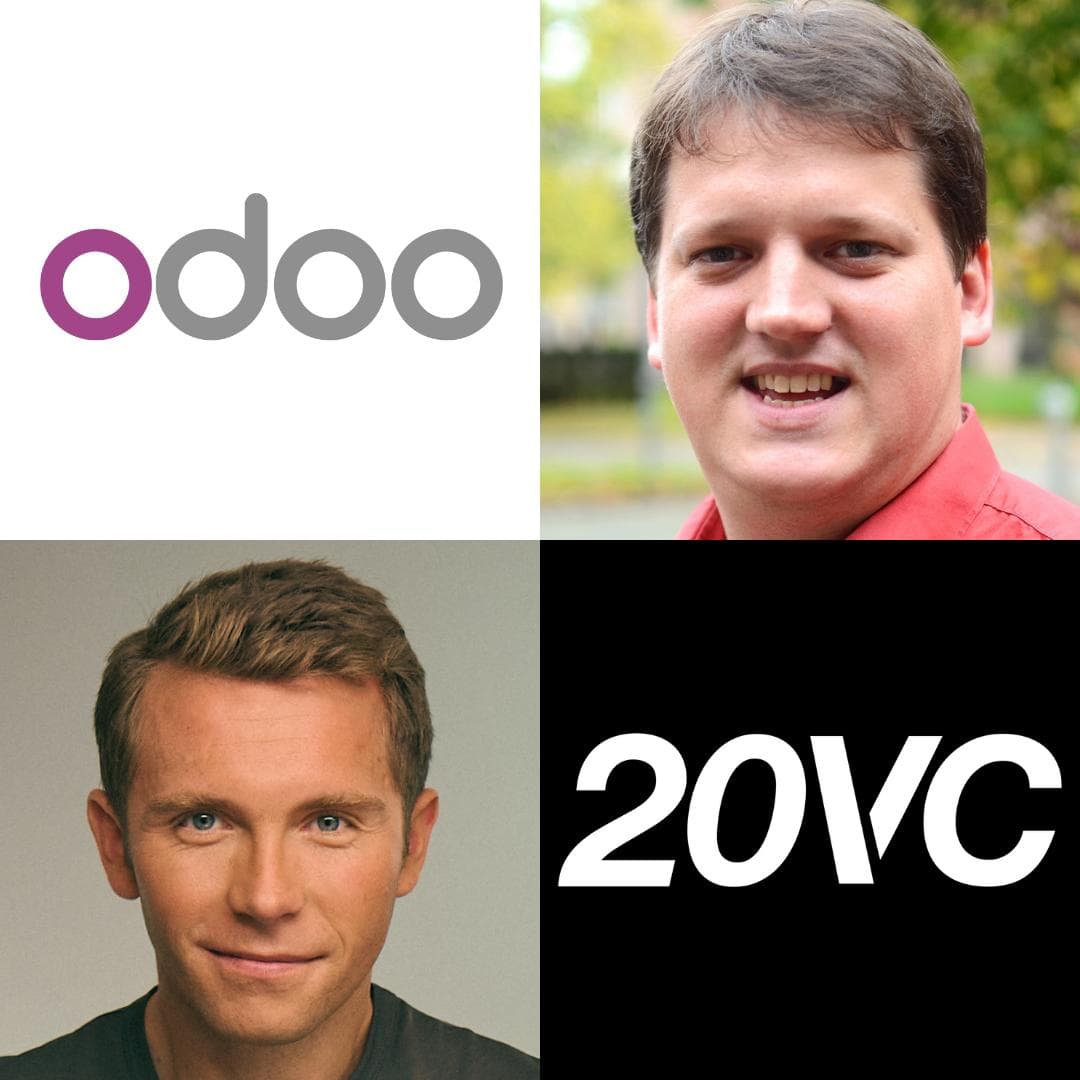

In short
Podcast Summary: The Twenty Minute VC (20VC) - Episode with Fabien Pinckaers, Founder & CEO @ Odoo
Episode Overview
- Title: The $5BN Company Built from the Belgian Countryside | The Story of Odoo
- Host: Harry Stebbings
- Guest: Fabien Pinckaers
- Key Themes:
- Unique management philosophies
- The journey of Odoo, a Belgian software company
- Fabien's unconventional views on money and company growth
Key Takeaways
- Management Beliefs
- Titles are Overrated: Fabien argues that titles are often meaningless in a company, preferring a focus on actual contributions.
- Hiring Philosophy:
- Odoo hires young talent (under 30) and relies on a single interview for hiring.
- They assess candidates on practical skills rather than resumes.
- The Billionaire Who Doesn't Care About Money
- Non-Materialistic Mindset: Fabien openly discusses his lack of interest in wealth accumulation; he doesn't own a house and has no plans for an IPO or selling Odoo.
- Liquidity for Investors: He plans to manage investor liquidity through secondary transactions rather than traditional exit strategies.
- Rejections from Venture Capital
- VC Turndowns: Fabien shares insights on how every VC turned down Odoo, reflecting on lessons learned and the company's valuation strategy.
- Focus on Low Valuation: He intentionally aimed for lower valuations to buy shares and maintain control.
- Scaling to $650M ARR
- Emphasis on Focus: Fabien believes that losing focus is one of the biggest mistakes companies make as they scale.
- Hurdles with Growth: He reflects on moments when Odoo faced near bankruptcy and how those experiences shaped their current strategies.
- Open Source and Business Model Evolution
- Transition to Open Core: Fabien details the pivot from an open-source model to an open-core model, allowing for sustainable revenue while maintaining a large community base.
- Pricing Strategy: They’ve learned from pricing mistakes over the years, adjusting to align better with customer expectations and needs.
Company Insights
- Odoo's Growth: Currently generates $650M in ARR, with over 5,000 employees and 50,000 customers worldwide.
- Management Strategy: Focuses on a flat organizational structure, avoiding traditional management hierarchies and processes.
- Culture: A strong emphasis on autonomy and responsibility among team members, fostering an environment where everyone is encouraged to take initiative.
The Future of Odoo
- Long-Term Vision: Fabien envisions Odoo as a transformative force in the management software market, aiming for commoditization akin to Microsoft Office.
- Competition: He sees Odoo’s primary competitors as large, established players like SAP, but believes Odoo can outperform them through superior product quality and affordability.
Conclusion Fabien Pinckaers embodies a unique approach to entrepreneurship, emphasizing product integrity, employee autonomy, and a long-term vision over short-term financial gains. His insights challenge traditional notions of management and venture funding, marking Odoo as a compelling story in the SaaS industry.
---
Additional Resources
- Podcast Website: [20VC Podcast](http://www.20vc.com)
- Odoo Website: [Odoo](https://www.odoo.com)
Fun Facts
- Odoo's customer base has seen exponential growth, with plans to continue this trajectory without the traditional pressures of VC funding or an IPO.
This episode provides a thought-provoking look at building a company focused on product excellence and employee empowerment rather than conventional metrics of success.
Written by AI. May contain mistakes. Listen to the episode to check what was said.
Transcript
Automatic transcript. May contain errors.0:00You have to be obsessed. I don't think you can succeed if you are not obsessed. I always wanted to price to be low because in every transaction I was purchasing shares. All the managers are always buying shares that I do. We never sold shares. We will never sell. No, there will never be an IPO. When I was 26, I purchased the domain name sorry acp .com because I thought that one there would be much bigger than them and then I would use this domain name. This is 20VC with me Harry Stabbingson. and I cannot tell you the joy, it brings me to share this story today. The world needs more entrepreneurs like this one.
0:33Today, we tell you the story of the best company that you might not have heard of. Odo, built from the countryside of Belgium, they do an astonishing 650 million in Aero. They have over 5000 employees and they have over 50 ,000 companies as customers. As you heard in the intro, their founder does not ever want to sell the company, IPO, he believes that titles and companies are total BS, and most management is done completely wrong. Everything you thought about management will be changed following this episode, and I'm so excited to welcome Fabian Pinkers, founder and CEO of OD. But before we dive in today, here are two fun facts about our newest brand sponsor, Kajabi.
1:17First, their customers just crossed a collective $8 billion in total revenue. Wow, second, Kajabi's users keep 100 % of their earnings with the average Kajabi creator bringing in over $30 ,000 per year. In case you didn't know, Kajabi is the leading creator commerce platform with an all -in -one suite of tools, including websites, email marketing, digital products, payment processing, and analytics for as low as $69 per month. Whether you are looking to build a private community, write a paid newsletter, or launch a course, Kajabi is the only platform that will enable you to build and grow your online business without taking a cut of your revenue.
1:5620 VC listeners can try Kajabi for free for 30 days by going to kajabi .com -4 -20VC.
2:09Once you've built your creator empire with Kajabi, take your insights and decision making to the next level, with AlphaSense, the ultimate platform for uncovering trusted research and expert perspectives. As an investor, I'm always on the lookout for tools that really transform how I work, tools that don't just save time but fundamentally change how I uncover insights. That's exactly what AlphaSense does. With the acquisition of Tegas, AlphaSense is now the ultimate research platform built for professionals who need insights they can trust, fast. I've used Tegas before for company deep dives right here on the podcast.
2:42It's been an incredible resource for expert insights, but now with AlphaSense leading the way, it combines those insights with premium content, top broker research and cutting edge generative AI. The result? A platform that works like a supercharged junior analyst delivering trusted insights and analysis on demand. AlphaSense has completely reimagined fundamental research, helping you uncover opportunities. From perspectives you didn't even know how they existed, it's faster, it's smarter, and it's built to give you the edge in every decision you make. 20 VC listeners don't miss your chance to try AlphaSense for free.
3:16Visit AlphaSense .com -4 -2 -0 to unlock your trial. That's AlphaSense .com -4 -2 -0. And to be here, incredible products. When you're building a business, you're going to encounter obstacles. Your banking doesn't have to be one of them, though. Just talk to a founder who uses Mercury like Sanpei Omichi, the founder of Alice .com, a modern immigration law firm helping startups and their employees immigrate to the US and there are 20 BC portfolio company. And Sanpei says, using Mercury was a no brainer for me when I started my company. I was able to get an account open immediately and using Treasury and the checking account has been a breeze.
3:55So you need to visit Mercury .com to see why founders like Sanpei use Mercury to help them, hit the ground running, make the most of their money, and see all their business moves in one place. Mercury is a financial technology company, not a bank. Banking services provided by Choice Financial Group, Column and A and Evolved Bank and Trust members of the FDIC. The provider of this testimonial was not compensated and is a client of Mercury Advisory LLC.
4:24Fabian, I am so excited for this. Listen, I am a sass nerd and Odo is one one of the most incredible stories. So thank you so much for joining me, Sté. Thank you for having me. Now, I would love to start. You started your first business at 13 with a business management software company. What's the story there? Oh, it was just, I'm a developer. I also like management. I was reading a lot of books. It was just friends of my father and I did management software for them. And I started with one and then do it and a lot of people. Well, you kind of aware that you were building a business and you were wanting to make money at the time.
4:57How are you thinking about it? It's not so much about getting money. It was more about building something. What I like is to build software that people use, that I have an impact for them. So the money was great, but it was 150 euro at the time. So it was just for doing something. What happens next? Then you're in school, you're 15, 16. Are you just like the smallest kid in school and school's easy? I didn't go to the lecture. I was more doing business or having fun and drinking bills. But I continued developing software for companies during the university. I did a lot of things like e -commerce, I did various antivirus games.
5:36I had a t -shirt company, lots of different things. You had a t -shirt company? Yeah. What was that about? I'm passionate about open source, you know, Linux stuff and so on. So I did e -commerce with Linux, t -shirt and ties and dbn and everything. I totally sold a lot, but it was really painful to post all these t -shirts every day. My God, you realize that the challenge is actually selling physical products. It started to be a logistic challenge for a first student that wants to drink beer. It's not great. I love that. Okay, so what would you say was your first real business? Because you had an art marketplace, no?
6:09Yes, that's a big one. It's an outsold eBay. I was selling more objects than eBay .be. So 15 ,000 art per month at the time. I was working with auction houses, antique dealers, Alton Palace, and I started to be one of the biggest of the bigest of Beijing, actually. Was that making much money? Not so much. The business model was shitty. I think I get something like 5 ,000 Euro per month, which for me as a student was great, but for what I built was nothing. OK, so we have that. And then, how does Odo come about? I'm passionate about development, of course, and management. And Adouf was for me kind of a way of putting all my patients together in a single software.
6:54So I had all these different activities, T -shirts, art markets, antivirus and everything. And at some point, I said, okay, I will top everything and focus on one thing that I really like is to build management software. And that's what I did with Adouf. And I started small with the auction houses. They were my customer for Ecommerce websites. What was your first product? I did the opposite of tradition. You know, usually you start with an MVC, small project. I did the complete opposite. I did everything. I started with accounting, logistic, purchase, everything at one. So it took me two years to build the first version of the product.
7:29Was that the right decision? Because we're trained in MVP, lean startup. You went for, as my team called it, the fast startup, which is doing it all first. So I remember an article of Paul Graham at the time and he said if you want to have a big impact to build a big company You have to fix a big problem. So I had this story in mind that I want to do something very complex and Doing everything companies need is actually a big problem. So I started to to tackle this challenge I love that you worry that by doing everything you lose focus. Yes, and also it was very risky because it took time to monetize and and get to something that I could and everything, but know that I'm looking back, it's probably what MEDO do today.
8:13It's because I thought about a big picture, everything smoothed together, and it's not a patch of different software. How do you have feature parity? How are the products as good as the single point solutions when there are 50 of them in the early days? Initially, I started as a service company. So I built everything customers were asking for. So I did features and features and features, the product. Which is what we're told not to do. Yeah, but I bootstrap the company. So when you bootstrap a company you need money and the my way of getting money is to just sell services and development and not a good business model.
8:45But I grew the company to 100 people on that basis. So it's kind of worked but I struggled a lot like a few years close to bankruptcy. Wow. Okay. So you scaled to 100 people with a professional services very hands on approach. Yes. In that time you said bankruptcy loomed. Tell me the one of those times what happened. What was the worst time? Oh, it's not like there is one time. When you are close to bankruptcy, it's for months and months and months. So you don't sleep, you walk much harder, you get customers just because they pay faster or not because it's a good deal. So you do bad trade off, but because of that I was the main shareholder and I stayed one so I didn't need it more yet at the time.
9:23Why did you not raise money? Initially, I think I was not just thinking about it. I was building the business, growing the company, focusing on that. I wanted to keep the majority of the shares. And in 2010, then I had to do a pivot in the business model. I wanted to stop services activities and refocus as a software vendor model. That's when I raised my first round. So 2010 we go, we want to focus on software and we want to be less services. Talk to me about that decision and how it came to it. That's what I wanted to do initially from the beginning, but it gets to a point where the software was very complete, but with a sheet using the face.
9:57So I was not a via -bollit and I thought no, it's time to refocus and invest in R &D and build us off the model where I get recurring revenues and everything. So I decided to stop all my services activities from one day to another. Wow. I had to fund that. I needed to do my first fundraising. How much did you raise enough? Three millions of euro. Three million euros. How did it go? This is your first round. This is the first round you raised. Very well, actually. This time. So, come time not so. As a Belgian company, there is not a lot of big VCs in Belgium. So you basically go to Paris, London and Germany and you meet all of them.
10:29The IT world is not that big and I got at the end something like 10 offers, which was quite good. So I picked the best one. Wow, who did you pick? It was Sophie Nova partners leading the round. Amazing, love that. Okay, and see you three million. What was the price? To a seven million of euros. Three money. So 10 millions of. Wow, so 30 % of the company. Yeah. Wow. That was not a good valuation. That would have been a good deal for them though. Thank you. Okay, that's amazing. So then we raised that money and we replaced the service inside of the business. Now we can focus on UI. What happens next?
11:04So Odo is open source. So even though I started a software vendor model, we were still open source. So what we were selling is maintenance software and maintenance support, bug fixes and things like that. So maintenance contract. So we stopped our service activities and we built a partner network all around the world. It worked well. The thing is most customers, they were paying for the first year, but second year they were telling us the software is good, I don't need my turn on the anymore. So the business model was not great because the product was open -sourced, there was no license fee, so they were just continuing using the software but not paying me.
11:38Wow, okay. So what do we do now? That's a problem. After two years I get close to zero money in the bank account again. So I had to do another pivot in the business model and And that time I switched to an open core business model where 80 % of the features are open source and 20 % are for a fee. Okay. And so we switched to open core with that 20 % being for a fee. How does it go then? Do we have much money at this point? I don't know. I was close to zero. I think I had something like two weeks left or something. Are you sleeping? Not that much at that time because you have problems. We have pressure from the board.
12:12You have issues with the business. You have everything goes together when you don't have money. It's very hard. but we made it so it's okay. And so we're doing open core now, we're going to do the 20 % paid features. What happens then? Then everything gets really good. So doing all these years, or do build a software and a community, so we had a big software and a big community, but no revenues, or limited reviews. And once we started to monetize efficiently, then everything went very smooth. It was different because we used to fight to survive, that was our main motivation, just surviving, and optimizing everything because we had no cash.
12:46And from one year to another, then we get a lot of cash and the business model worked and we had no more cash issues. And we had to find our motivations elsewhere. Absolutely, love this. Okay, so open core starts going really well. What does that mean? We're like making a lot of money. What sort of revenues are we at now? Something like 15 millions. And so what happens then? We just progress with open core and continue to scale. That's the business model we still have today, where we grew on top of that. So if you look at the past 20 years, we basically grew at 50 % per year, year after year, every year.
13:18There was not a big bang or... To as just continuous growth year after year. With the growth, there are always challenges. There are always problems with culture, with skating teams. What are the first things that break? So one of the big issues I had at the time is that I deceit the community. Because I build a community with me on the open source mindset. Like we are open source, we always view open source. and the property is bad and we are not like that and things like that. I fought to keep this open source business model, but to the point where we were close to bankruptcy, so I had to switch.
13:51And when I switched the open core, it started a big fight with the community. They were deceived because we built them on another story. And so the marketing was very bad. A lot of people criticizing us or partners were living, trying to find competitors. But the product was good, so the majority of them stayed with the product. Looking back, if I had pitched them correctly, like we are to the open source, but maybe in the future we will need to monetize, then I wouldn't have had that many issues. Do you think great product always wins? Yes. And that I'm sure about that. We have had difficulties, but the thing that kept us is the product.
14:26Okay. Why is it then that we are told focus on distribution, focus on marketing, focus on brand. If great product always won, the world would look very different. But at the end, the great products always win, no? You can save time with marketing. You can save two or three years. You can grow the company. But at some point, you cannot, the product matters. I am on a market that is very slow. You know, ERPs are very slow. ICPs is still shitty after 20 years. Microsoft Dynamics too. On a slower market, it's the best product that wins. What product decision did you make that with the benefit of hindsight looking back, you wish you hadn't made?
15:05The worst decision I did and the best ones are the pricing. I did a very bad pricing change. When you have difficulties, you try to change everything. Change the product, the business model, the service you sell and the pricing. At the time, we were changing the pricing every year, which was very complex. Changing the pricing every year. Yeah, we were experimenting. Wow. And one of the worst decision I did is one of these price change. We probably lost one year of growth because when you work with partners, if it doesn't work, then it takes time to rebuild the trust and everything. What was wrong with the pricing?
15:40So the way I do works is that you have a suite of business apps, CRM, e -commerce, accounting, so many products. Yes, and at that point I wanted to have a price that grows the value of the software. The more users you have, the bigger the price, like usually, but also the more applications you have, the bigger the price. So it did price which was like 10 euro times the number of users times the number of application you use. So it was growing very aggressively. It was too high. So the partners didn't like it. They did a big pushback. They refused to sell it. It was really difficult. But you know when you have a partner on the twerking you change the price.
16:16You never know the partners. They always react to any change. So you never know if it's because the price is wrong or it's because of the transition or the resistance to change. So when you have this, for a few months, you try to convince them. My price is good. You don't understand the value. The price is good to have a price allowing with the value. So it took us like nine months to go back to the old price. So it was very hard for the company. Incredibly challenging working with partner networks and pricing. You also did a pricing change in 2022. That's one of our best decisions. Yeah. I mean, I saw the numbers post the pricing.
16:50And it's like this. It's up into the right. Why was that such a good decision on the benefit of hindsight? This price change was actually to decrease the price on the small clients and increase it for the larger clients. And for the small clients, we were actually too expensive. For all our applications, it was something around 120 euros per user and per month. But if you have a single user or two user, 120 euros is still a budget. So we decrease it to 20 euros. At the time where everybody were increasing their price, it was weak inflation. everybody was increasing the price, so it's decreased 20 euros.
17:23And so acquisition started to boost very quickly. We attracted 2 .8 times more clients since that date. Wow, that's insane. How are we acquiring customers in the early days? What does that look like in terms of that marketing acquisition funnel? Early days and today it's still the same. It's our main user acquisition is World of Mods. It's because we have clients that are very happy, they talk to other clients and then bring us more clients. Still today, the majority of all it is world of more. Going back to the point of product winning. You need a strong product to do that. You need a product that is capable of turning your users into fans.
18:00What do you think about that kind of adage, the common saying, startups, that speed is the single most important thing in success? I agree. I agree, but I see that in speed of how you build your assets. Or it's the product. So it's very important to move forward fast and evolve very quickly and innovate and also build business. But it's not so much about building your revenue. At least in my case, the revenue grew at 50 % per year. It's not huge, but it's still good. It's just that they did it for 20 years. That's what leads to such large revenue numbers today. At the end, it's big. Totally. What was the hardest things in those early days?
18:38I think it was always a matter of survival. When you don't have cash to pay the employees at the end of the month, it's really hard. When you have to dismiss people you like, but you have no other options, it's very hard to. Yeah. Why did you not raise more? Talk to me about this second fundraiser. You said the first one was good, but we sold 30 % of the company. It was not that good. It's a good one. What about the second one? How did that go? And where was the business? So in every fundraising, the timing is the most important thing. And for me, the timing was not right at the time. So we raised 7 millions of euros at a valuation of 23 pre -money, so 30 posts.
19:14And it was a time where we needed money. How much revenue were we at? That's not exactly maybe 20, 20 millions. 20 million in revenue. Yeah. And you were doing it at 30 million posts. Yes. Oh. I think we were a bit less, but still it was not a good valuation. Wow. How did that fundraise go? It was not we got one offer from X -Sanche, but only one. Did you meet many investors? Yes. Why were they saying no? I think they were scared about everything that we had to pivot. It was the business model that was not there. The Trashion was there. We had difficulties to be profitable. We had a growth, but not as exceptional growth, regular growth.
19:57Wow, that is amazing. What a great deal there. One thing that people particularly like to say is vertical SaaS, because it's not bluntly, it's a lot more targeted in your customers. You have a customer profile that you can message to, you know where they are. You have a very horizontal product. Yeah, we did the opposite. Yeah. How do you think about winning with a horizontal product when your customer is everyone? Instead of being the best in one industry, what we wanted to be is to be the best in applications. So we want it to be the best CRM mode, the best accounting or the best website builder.
20:31And that's the way with these things, not based on customer, but based on applications. As these applications get mature, pretty much all the CRM they look the same today. So it's not so much about CRM for that business or that business, they are the same. So it's more about the quality of your product, no rather than how you customize it for a specific segment. As part of, my vision is to commoditize the management software market. And when you see that as a communism, I think everybody will use the same CRM, the same accounting, the same website built or it doesn't have to be dedicated to one.
21:05Industry, it's like a phone, whatever your industry use the same phone. What do you mean when you say the commoditization and software? Because there are so many different people in so many different markets within your product line -up. You have different views on UI, on workflows, on messaging. What do you mean when you say about the commoditization of business? If you look today, the small and mid -sized companies, they don't have a single application. They have a mix of a lot of different applications. They have a lot of spreadsheets, but they use Slack for discussion, MailChimp to send email, WordPress for a website.
21:36They have plenty of applications. These applications don't integrate well to each others. It costs a lot to maintain. It's not completely efficient. Something that nobody succeeded to do is to offer one platform that does everything they need in just a few clicks. And that's what we started to do. Everybody failed, Microsoft tried with Dynamics, SAP tried, Oracle with Netsuit tried, but equipment rate on the market is still very low, less than 10%. So I do believe that once you get to the maturity level, it management software will be like Office, everybody use the same word and Excel and slide and PowerPoint and everything.
22:11I think for management software it's going to be the same. When it gets mature, perfectly integrated and very affordable, then you can transform from the market and offer this product form. Very low. Why do you think it done so well and grow into such scale where Microsoft and SAP have tried and failed? Our thing or product is yours ahead of the competition. There is no way they can do what we do. Why? I mean, they have the money, they have the talent, why? It's not so much about the money in order to build such a complex of them, because companies are complex. To make it super easy, it's more about having the right people, a few of them, a few genius guys, rather than having an army of 10 ,000 developers.
22:49And we get that. We are extremely good developers and good management. We are extremely focused. I think as company growth, they defocus themselves. You always have middle management that want to launch their new departments, their new product, then we have been focused all along on one thing your thing is to improve our product. I didn't want to talk about the team, because you said to me earlier, I don't never recruit VPs managers or even team leaders. Yes. That's very unusual. Why? So we have a very strong culture. We are a startup that grew super fast. So we have a culture that is very strong.
Read the full transcript
23:22One way to keep the culture alive is to avoid having these external managers and team leaders coming with their habits. Probably good habits, but not in our environment. That's one thing. The other reason is that the way I see team leaders is that they are not there to manage people. So how to do we have no planning, no budget, no forecast, none of this, no process. The what I expect from a team leader is to have a team just make your team become better. That's the only objectives I have on a team leader. And so in order to do that, you have to be the best of the team. There is no way you can make a team of the repos become better developer if you are not the best developer of the team yourself.
24:00And when you recruit external managers, they are probably not as good as your team already. I'm confused. If you don't have a budget, how do you plan your business? We do have a budget, but it's the role of the CFO, the finance team. And we don't share that with the teams. So the budget is just about, can we recruit ESON or NO or much? And that's it. The team leaders, they don't have to worry about that. Even the directors, they don't have to worry about that. They only have to worry about making their team become more efficient. And how do you measure more efficient? You don't need to measure, you know.
24:30When you walk with the team, and that's what I expect from the team leaders to work with the people, when you work with people you know is good on that. You don't need to put a KPL, I'm pretty sure in your team you know who is good and who is not just by working with them. And so when we think about a no forecast, how does that work? So we do have so the finance, the CFO has a forecast just to check that the cash is okay, but apart from that it's more rational thinking. I need to buy this, is it worth it? Is the investment worth that? If you give If budget to people, they will just spend the budget.
25:01They won't have any responsibility. If you don't give them budget, they will have to spend responsibly. And so we teach ultimately that to be responsible. Do you get them to set goals or? No, no. No. What kind of goal can you give to a developer? I mean, it's very subjective. Like, develop these tasks. Maybe you can do today. They're taught by this timeline. Yeah, but then there's a number of users. They're not your users. The task change all the time. The features change all the time. Hit this number of users. Hit this number of activity. retention. So on some teams like the six people we have goals obviously they have sales target but it's an exception most teams don't have.
25:37I have a story about that. Yeah please it's so different I love it. I'm from Belgium and we had the company in the US was struggling a few ten years ago was struggling to grow and so I needed to relocate myself and I went there for three years and when I arrived there we had three consultants and they were completely overloaded they are no we have 10 to go to the accessory but they were completely overloaded. Too many clients and project was real mess. And the quality was not great of what we were delivering. So I asked one of our best consultants from Belgium to come in the US and help me restrict your data, grow the team, take the most complex project and deliver them.
26:14And this guy came, went to the US. And I had a director in the US at that time who told me, here is how I manage the team. I have KPI about customer satisfaction, time to deliver a project, a number of applications deployed and I told him, no, don't do that. Just focus on day -waring your project. Say, no, I need this KPI, who can you manage? So I couldn't convince him to drop his KPI's. And so I waited to see what happened. So he did his KPI. And after three months, the guys who had the worst KPI's, what's the top expert I get from Belgium to deliver all the projects. And when you look at the number, then we understood the reason why I had the worst KPI's because we gave him all the shitty projects that were complex to deliver.
26:51I mean, things are very subjective. If you put KPI, it's very difficult. It was abuse for the world team that this guy was the best. Yet, on the KPI, it was the worst. It just gave him the worst project. Can I ask, when you don't have the titles and you have team leads, does that make it harder to hire really great people? Because great people often won't be a big title. I think it's easier to scale when you don't need to get the top people. I mean, you just recruit young people, a lot of them and train them and make them evolve. It's easier than always looking at the best VP of X, the best managers of X.
27:20Tell me about how you recruit young people so successfully because you have such a big team now. I mean, in Belgium, there's 1800 users. Yes, 5000 in total. Yeah, 5000 in total. How do you recruit young people so well? So the way we proceed is that we just assess on the job. So if a developer will ask him to develop. As this person will ask him to do a demo and pitch the product, just that. So we don't look at resumes, we just make them do some practice and look at it. One thing I noticed is that we also do an IQ test and it's the second best predictive KPI on the performance of the person. That was the first being, how good they are.
27:59The first being, how good at development you are. One of the issues I had with the recruiter at the time is that if they were talking like 30 minutes, 40 minutes on the resume, doing the test for two hours, the way they assess people is based on how much time they spend on talking on the topic. So if you discuss a lot about the resume, then it will impact the way you will qualify the candidate. So I asked them to stop working on the resume because the problem with the logic test is that they just get a number. It did 19 % or 20 % or 90%. But you don't spend time on it. You just get a number. So I had to turn them to say, no, this IQ test is really important.
28:36Your discussion on the resume is not so much, so spend less time on that. So I hate as a second biggest predictor. Yes. Fast day. So we get them to do the core action. We get them to do the IQ test. What else is involved in that process? So that's it. And our process is extremely fast. It's one meeting and we decide right away. So usually we recruit within five days and everything is automated. So you apply online, you can book your meeting with the interviewer right away into his calendar. Then you get the meeting within two, three, four days. After the meeting, the next day you get an offer.
29:10Wow. And we beat the market because we are fast just because of that. Wow. How often are you right? We're often told that actually good hires are right 50 % of the time. If you are recruiting smart people, it's quite easy to notice. I mean, if you watch a developer developing for three hours, you probably know at the end of his good or not. We've got core action. How good they are developing. How good they are at sales. They are IQ test as well. That's not a culture fit. You can have smart people who are, you know, politely assholes. How do you think about that added human component? It's really exceptions.
29:45The majority of the time people will fit in your culture. If your culture is great, I will come to it after what we are. I do believe that most people match. Really? Sometimes you have issues, but it's really exceptional. It's probably less than 1%. When someone's not great, how fast do you know? Quite quickly, within six months. OK. Even before the pro is for the younger team leader to act, nobody wants to dismiss someone. So it's hard to act, but you quickly notice. What are the reasons why younger people struggle when you bring them up? It's always competencies. For me, it's always, you will succeed or you will never.
30:23For us, probably more than 90 % of the people who dismiss it's always competencies. Like, it's not good if it doesn't understand. We're often characterized. We're both European. I'm a proud Londoner. You're a proud Belgian. People always say that young people in Europe, we don't want to work like they do in the US. We don't have the work ethic. Do you agree with that? I think young people are different from what you used to have 20 years ago. But the new generation, they want to work. It's just that they need a purpose. They are ready to work a lot to do a great thing. And we did great thing because the average age of a to do is 26.
30:56And we build a 5 ,000 people company with 26 years old. So it's young and we build something big with millions of users. So they are capable of working. It's just that they need purpose, they need passion, they need to have an impact. They won't work if they feel like they don't have an impact. Average age is 26. Yes. Give a war about emotional maturity. As I get older, I just look at, I've changed a lot. When I was younger I was more rash, more fast and emotional, and now I'm just more thoughtful and deliberate. What calm? Is that a very challenge? No, I think. The key is to train people, to make them evolve fast.
31:37You can get the younger one, but if they evolve fast, it's... How do you stretch your training? One month of onboarding, where you have a lot of e -learning, test, exercise, certification, everything. And then it's more about coaching on the job by the team leader. And so the team leader is responsible for the training of their teams. And now the first month we have a dedicated team to train everybody and after that they join the team and then they do the team leader. Okay, got you. How many people are in a team? It's quite small team like 10 people. 10 people. One team leader is around 10 people.
32:07Okay, got you. And they have like weekly team meeting and that's like we don't have a lot of meeting. I forbid the recurring meeting but the company they can do meetings but on the job or for or specific tasks or trainings, but not rickering meeting. I mean, rickering meeting is a way to manage people and we try to avoid manager with one team leaders that work with them. So we try to avoid rickering meeting. Wow, so they don't have a weekly team rickering meeting? No, they work with each other every day, so they don't need. Sure. Do you like remote work? It's OK. I don't do. I don't know. Are there any other elements of traditional management that we always hear rickering meetings, things, a huge emphasis on culture fit more than that you'd suggest.
32:50There are any other elements of management that you're like, that's not right. I think a lot of CEOs are not right. Why? If you look at the agenda, there are constantly meeting people, going to have a coffee with someone or going to events, and I think the company needs them more than the external people. How do you spend your days? A 50 % of my time is in the product, so research and development, with the product owners and developers and the other 50 % is improving your internal processes. What does that mean? Improving your internal? It changed months by months. It could be if we have, if our marketing is not good enough, I will walk one or two months with marketing.
33:27If the service needs some pivot or improvements, I will walk there. Sometimes it's in a country I was one year in India last this year because the company was not growing enough so I relocated myself for one year. So it changes. You relocated yourself to India for a year? Yeah. You've got a wife and kids as well. Yes, they came with me. They came with me. That time because when I was to the US, it was not that easy. How was that? You're in good your up. Yes. Yeah. How was going to India for you, packing up with your two kids and wife? I loved it. I mean India is an experience. It's colorful. It's noisy.
34:00It's full of activity. Why was India not growing? You know, when you grow a company from one to ten, it's a challenge, real challenge. But when you grow to ten to 100 people, it's a different challenge. And then from one hundred to one thousand, it's still a different. the director there was one of four first employees I started with him when he was a student. He grew the company to 200 people and then it struggled there. It's been seven years since the company only had 700 employees and it couldn't grow. And the guy was good, it just that he needed some help. So I came there to help and we grow to 800 people.
34:32Still the same team, so it's still the same managers. So I replaced nobody because they were all very good. It just that they needed a little bit of help. Okay, and so they need a little bit of help. West India are now fee. Yeah, no, we have 800 on preys. We grew contracts. So when I arrived there, we were signing 16 new clients per month. It's nothing. And no, we are around 800 per month. And it's growing. It's continues to grow. If I were to ask you the challenges going from 110 to 100 and 100 to 500 or whatever we want How much? How would you describe them? So for one to ten is about building the business.
35:13It could be the product, the service offer, it's all about you and the team working on improving the business and the product. Ten to one hundred is the time where your job change. As a founder, you start to have middle managers. And so the culture is not you anymore. It's the middle manager and the way the behave with the people. So we spend way more time communicating to ensure that the culture is Aligned that everybody's alliance one going to above 1000 and more. It's all about scalability to make things super smooth and clean So that you keep growing when we speak about the team I actually spoke to one of your investors.
35:48I think it was one of your investors or team members I can't remember which one said this but they said that you said I hire people for being world -class something The flip side is that they are catastrophic at other things Can you talk to me about that? If you look for people that are perfect in everything, you will get people that are average and everything. I mean, if you want people who speak multiple language, who is a good developer, who is a good communicator, who is probably going to be average. So if you dismiss people because they are bad on something, expect to have a very good average on everything.
36:18If you want people who transform your company, they have to be extremely good on something. And for that, you will have to accept their weaknesses. So I train recruiters to look for the strengths and accept some of the weaknesses. Some you can't. But it's important to not look for people. So when you discuss the aftermath of the interview is more about how easy, very good, very good, very good, something, and not about, I think it doesn't speak that language very well. Or it doesn't do that. You focus on where is good rather than weakness. Are there unacceptable versus acceptable weaknesses, or is it just how good your strength for me it's it really depends on the departments I have departments that are extremely flexible they can accommodate anybody you are not social they will put you in the super it's a piece and so that's fine so it really depends on the context what when you biggest hiring mistakes Fabian it's not so much about hiring but it's about firing I'm always too late how do you think about improving that moving forward I keep thing to myself when there is a doubt there is no doubt you know we are entrepreneur and as an entrepreneur, we are always optimistic.
37:25We want things to make it work. We think it's going to be better. And even if it doesn't work with someone, we always think it's going to be better. Because you can survive if you are not optimistic as an entrepreneur. And so when you start to think negatively about someone like it doesn't work, I don't know what to work with him, that's probably because it's too late. And so you would fire sooner. Yes. In terms of like sooner, you mentioned India there and the incredible scaling from 16 to 800 or whatever it is. Going into different geographies, going international, is a massive strategic decision for companies.
37:55You seem to have done it pretty early and all over the world. You've got people in Dubai, you've got people in India. How did you think about going global geographically? I'm not working on it. The key is not so much about the country or the city. The key is to find the right director. You can have the best location you go in San Francisco or Silicon Valley and you have an average actor. It won't work. It will actually be very bad, it will spend a lot of money and everything. If you have the right director, the city is not that much important, especially for us as a SaaS player where we sell everything online.
38:30So that's why we have a company in Buffalo. Nobody goes to Buffalo. It's because we had an amazing guy in your team, we wanted to do something with him and said we want to you to create a company and build some, he wanted to go to Buffalo. So he's a team in Buffalo opens an office. Yes. And we always proceed that way. We first find a person and only after the person will define where we go. How do you think about like budgeting then for them? I know it's the finance team, but you just give them a budget and let them go. No, we don't work with budget, but we have people that are responsible. And because we only do internal promotions, it's people we walked with for years.
39:06So we know they are going to be good. They will spend efficiently. We don't have that kind of issue with it. You only do internal promotions. Yes, we never recruit managers and directors. Never ever. Even when you open a subsidiary in a different country. You send them out. Yes. And one thing I tried to is to never go to tier one cities. I think it's much better to go to tier two cities. Why? The key when you scale a business is retention. And when you go to tier one cities, we have an office in San Francisco. So we didn't always follow that. It's happened. But we learned from that. And when you are next to...
39:41Was it bad? Retro, respectively. If it would have opened elsewhere, it would have preferred, yes. Why? Because you are next to Google and Microsoft and Apple. How can you get the best people with that? And then you have a higher turnover than in other cities. In Buffalo, we have no issue. Nobody is living. People are happy. They have a very high salary for the area. Retention is very good. And return shouldn't be the key of growing your business. People return. Why do you think it's the key to growing your business? For every job, like take a salesperson, his first two years he will sell X. When he has three, four, five years experience, he will sell double.
40:16If you keep them only three years, you will have well less efficiency than if you keep them five, six, seven years. Do you think people are destined for certain stages of company development? It's a Silicon Valley trope that, oh, he's a zero to one person or she's a zero to one person, but they're not an at scale person. No, I think it's possible some of the people but smart people they can evolve. The majority of the people that are still working with me, where with me since the beginning so, and we grow from one to five thousand so. Can I see you mentioned there, you're around Google, you're around Facebook and all the big players in San Francisco.
40:51You are in intensely competitive markets. I interviewed this week I interviewed two people Fabian and Odo and Mark Benioff at Salesforce. You compete with the biggest companies in the world. How do you think about competition? So I feel like we have no competition, which we have plenty of competitors, but I don't feel like we have competition I will explain why. So we are a suite of business apps. Whatever you need, we have it like a CRM, accounting, logistic So we do everything the companies need and we do it extremely affordable. You start with 20 euro It's 20 euro per user and you get all these apps.
41:23Nobody did that. Nobody succeeded. On the market You have two types of market. You have the large players like a Cp Microsoft. They do several applications but it's shitty, it's slow, it's expensive. And people are not happy using it. And then you have the small player, like Slack, MailChimp, send email Trello, Asana, and so on. They do one thing very well, so they acquire a lot of user, but they only do one thing. Nobody succeeded to do the benefits of both. I've hauled the applications that the company needs and being extremely simple and affordable. So for me, it's more about cracking something that nobody succeeded to crack, rather than competing against others.
41:56How would you feel if someone said, Oh, we're with ODU because they're the cheapest. Yeah, it's true. It's part of my value to try to be the cheapest. If I can decrease the price, I would do it right away because I want to commentate the market to make technology affordable. Obviously, I would prefer this. Because it's against all lessons that Mark Andrews and very famous investor always says, I mean, literally, we release the show today. And Mark Andrews and says, if you're on a small company, charge small prices. You're on a medium company, medium prices, big company, big prices. Yes. Yes. In a way it's true, but if you want to communicate the market and I have every company on your software, you have to have a very small price.
42:34Do you think we're going to raise the price? I mean, what's the price of Google works, please, or Microsoft Office? It's not a very high price, but everybody uses them. But they monetize those businesses with other cash cows, which is, you know, search for Google and most predominantly. But how do you think about your ultimate cash cow? If we're doing commoditization to the bottom. I think why is that important? I mean, we don't have cash issues. We are growing since 2014. We didn't raise money anymore. We are profitable. So why would I charge more if I have all the money I need to accelerate?
43:05Because you are, I don't know if you're revenue is a public. It's 550 million this year. 550 million this year. Great. Fantastic. Wow. Fuck. I saw a deck of yours. Our team got from like 2023. And it was like 200 million or whatever. Yeah, we grow by 50 % per year. Wow, okay, fuck. Okay, but 550. If you only get to be a hundred billion dollars business, you need what, 10 billion in revenue? First, I don't care about the valuation. I do care about the revenue because cash is the way to finance what I need to do. Valuation is not important for me. Why? I don't care. I mean, what I want to do is to develop a dude.
43:41That's the thing I would like to do. I don't care about money. I don't need money. So, why should I care about valuation when... You have to understand Fabian. This show is very strange for me. We don't hire like VPs, I don't care about valuation. Okay, great. It's a good side effect to have a good value, but it's not what you drive you. I mean, it's way more important to deliver software that transform companies with an impact to your clients. Do you think we build companies completely wrong today? Because all I talk about with founders is what revenue do you need to get to raise your series B?
44:18What revenue do you need to get to get your series C? I'm not an investor. What I would look to is the product and the capability to build a product. At the end, it's always the best product that wins. You set financing what you need to finance. Yeah. I can't spend, we get so much cash that I can't spend it. I'm trying to recruit as fast as I can and that's enough. Is there anything that you would love to spend on that you don't have the cash to spend on? No. I couldn't burn much more in marketing, but I don't think it would help a lot. What do you think about the ODO brand? Because respectfully for the size of company you are and how many customers you have in traditional technology circles It's not the biggest brand in the VC circle.
45:00No in small admitsize company. It starts to be what a stage Do you start to see your brand build when we started to invest in marketing more aggressively like four five years ago? Because Jason Lumpkin says when you get to like 10 million in revenue you get to have like a mini brand. Do you think that's true? Yeah. The other thing you mentioned earlier was you need have to be optimistic as a founder. It's like, cool to what we do. Otherwise you'd done so much. How important is naivety? I think I was very naive. I don't know if it was good or bad, but I was very naive. When I was 26, I purchased the domain name sorry acp .com because I thought that one there would be much bigger than them and then I would use this domain name.
45:42I just had 26 years old. I love that. Sorry, as they be. And I thought it was, I was really thinking I would in five years disrupt the CP because I was very naive. That is absolutely amazing. Do you still have the domain name? Yeah. We used it when we released the version 14, I guess, because that was a really good version that was, I mean, my opinion much better than the CP at the time. So we use the domain name, we replace the homepage with one big word, sorry, CP. How are SAP still so big? They are in monster. They are the clear and nearly only leader for large companies. For very large companies there is only SAP or I could try to do something but it's all about SAP.
46:24Do you still want to displace SAP? Yeah. What do you think that timeline is now? First I think it's just a matter of time. I think I don't know how they can survive to what's coming in from them. We have so much advance years in ahead. We are stealing so much clients to them that it's just a matter of time for me. But it's going to take time, 10 or 20 years, I don't know. Where is SAP better than you today? On products no, on marketing not even. They are more known, but they don't have a good brand, but they have a huge market. So their customer base is massive. Where they succeed today is large corporations.
47:00As more and mid -size they failed. On the large companies, they are still the main option. You spoke out about your sales team. Sales teams are really hard to build. building a go -to -market function is tough. What have been your biggest lessons on building the sales team effectively, Fabian? How do you recruit the VP of sales? Not for us, it was not recruiting, but promoting. And for me, it was clearly a leader, someone who trains the other, who can explain everything. So that's important. About scaling the CST for us, it's all about the product. We really teach them about doing demos and a lot.
47:35They do two demos per day, and then ones to do that for a few weeks, to start to become good. Two demos per day. Yes. When the product is so cheap, what's the ACV, the average contract value? It's 3 ,500 ARR. 3 ,500 ARR. That's not enough to justify outbound. We don't do outbound. We don't do on inbound.
48:01We are not typical. Why do we not do outbound even now? So to be fair, we started a few months ago, but it's only a few people I think 30 people at the company. So this was before up to half a billion in revenue, you were only doing inbound leads. Yes. Wow. But we get a lot of leads. Okay. And so why did we decide to help out now? So as we are getting very mature, now we are starting to launch applications per industry. So we have an application for the plumber, for the restaurant, for every industry, we launch 50 industries and that's easier with the own both strategy. But we are just testing and we have 30 people out of something like 1 ,900 sales.
48:41Wow. How did you determine which industries to go into? You mentioned they're plumbing and rationally. It's a matter of product market fit. So we have the product we have and this product already answers a lot of industries. So we started where we are good. This is the most unique story I've done. Where else do most other companies fail as they grow? We've touched on a lot, we touched on CEOs, we touched on high. They defocus. A lot of companies, they defocus as they grow. I'm not being worried, is that not what you've done? No. We only have one product, one way to deliver the service, only three big departments.
49:13All our companies, where operate the same way, our product is only 400 ,000 lines of code. So even though it looks like it's complex because it does a lot of things, it's still extremely simple. No, I still feel that we have a very simple company. How do they defocus then? Or they launch new products, new departments, marketing ideas of X, they spend time meeting clients in the press and everything. When you start to have managers and managers of managers and team leaders, they all want to do something, they all have ideas and the complexities that there is like a dark force that push everyone to complexify the company.
49:52And to keep your company simple, you always have to fight back against that. My favorite is brainstorming meetings. Hate brainstorming meetings. Can I ask you, when you look back on this incredible journey, what did you do that you wish you hadn't done? I wish I would have better communicated to the community because I built this open source community on the fact that we are open source and we'll always remain open source. I think I would have saved one year in the development of the company if we would have pitched we are open source today but maybe in the future we'll need to monetize. How long did it take to rebuild that trust?
50:24Probably a year. And still today you have negative people claiming, oh, but you are not really open source. And we still have from time to time negative comments of that time, as to a few years ago. You said about also the money, like, I'm not really at first about the money. Very interesting thing to say to a venture capitalist, by the way. But you recently did this transaction, a secondary transaction. Yes. What was the transaction? Talk to you on that. So it was 500 millions of euros. At a 5 billion valuation, it was as summit partners, one of our earlier investors, who sold to Sicilya, Capital, BlackRock, Mubadala, Capital G.
51:00Okay, so 505 billion. You think that's the right price? You think that's the right price? It's not. It's not to be a correct price. You think so? I think it's still quite low. I think so, but I... You're doing half a billion in revenue, right? Yeah, but you have to understand something. You're margin is a good too. You have to understand something. I always wanted the price to be low. Because in every transaction, I was purchasing shares. All the managers are always buying shares that are doing. We never sold shares. So for us, if the price is low, that's fine. Except you were buying shares every round.
51:33Every round we were buying shares. And to the point where we get a big loan because we don't have money, we are just simple personnel. So we get a big loan to just to acquire shares and at every round. Were you getting investors emailing you constantly saying, hey, we want to meet, we want to meet, we want to meet. Yes. Why did you not meet them? With a time. I meet them when we have an operation. So once every three years we get a transaction, then I'm happy to meet everybody. But do you not think it's helpful to build a relationship beforehand? I think it is, but I had better things to do, like developing the company.
52:05Okay, so you have 500 million now in secondaries. Who does I go to that early employees or? No, it was the summit partners, mostly, where it was also a secondary, we were quite sure that the secondary transaction in 2019. And so you didn't sell any in this round either? No. No, since 2014 we didn't do any fundraising. It's only secondary transactions. Can I ask how much of the company do you have? 57%. But I only did two fundraising, very bad valuation, but I still kept the majority of the shares. Do you factor in that that makes you worth 2 .8 billion dollars? Yeah, but as I said, it's on the paper, I don't care.
52:42It's not like I have money in my bank account. It just... I have only a company that's huge, but that's it. It's not, but you have a real company. That's way more important. Yeah. But like most valuations are like fake. Yours is real. Like you could sell it. It's a real one. We are extremely profitable. Yeah, you could sell to say people to anyone today. We will never sell. Please, uh, industry, I'll exit. So it's clear with you. Why don't you not want to sell ever? Because it's much better to transform companies, change the world, disrupt the CPE and having money and go on the beach. But you like to IPO?
53:16No, there will never be an IPO. I don't want to. Why? Because I think a public company tends to refocus on the short term. And the whole success has always been to build for the long term. And I don't want to refocus everybody on the earning calls, quarterly results and that kind of things. First, second, I don't want the constraints and the complexity that comes with being public. I like to say anything like I could say I think it'll do his worst way more than five meters maybe seven billions But if I was public I couldn't say that so I like to be able to Disclose whatever I want to not have the reporting so I want to keep the company simple and for that I prefer to avoid IPO How do you think about liquidity then for the other 43 % of your account table who will want some financial asset at some point?
54:04First, we are all aligned. So it was very clear since the beginning with every investor that there is no IPO, no industrial exit, it's going to be a song on the written transactions. And they all agree it for one reason is that if you have a really good business, really, really good business, that's this great, like crazy profitable. With the best API you can get on, it's going to be easy to sell. And you do that on a stage every three years? Yeah, every three four years. When one of the investor wants to sell, we help him sell. Do you have any investors that would like to sell now? No. I got it.
54:38Because we just did this 500 million transaction and we had more acquires than people selling so. How did you choose the people that you chose? We are working with Sequoia, Capital G, BlackRock, Moobada. It's just the best you can get. It really is. How do you think about the future of... I had to put you, I had Benny off on the show. So everyone is saying that Salesforce is the company to be disrupted. What do you think about the future of Salesforce? They will continue. But other challenges like us will grow much faster. Do you think agents help or hurt you? Yes, but I also think it's overrated.
55:16It's a mix of both. There is plenty of good use cases in AI, but there are also plenty of overrating in AI too. What's overrated? For Mark VanJoff, the agent force. that they presented during Dreamforce, they use case where you show that you can call a help desk and ask information about your order and then change your order. For that, you have a very good UX, a good portal when you go, you click on the button from your email and change your order. It's way more efficient. I'm pretty sure that if I call this help desk, it's my shitty English accent, he won't recognize me, only will ask me a question to identify me that are very complex to answer to.
55:56So in a lot of way, UX, having a very, very good product is more efficient than AI, but there are also a lot of uskys where AI is good. I'm not saying it's bad for, for instance, in accounting, it transforms from the market. We have no 98 % of 5 % recognition on invoices and bills and everything, which is better than the humans. And that transforms from the market, no, the accountants, they don't need to record that in a system anymore, they just validate. it. How do you think about integrating AI most effectively into O2 today and moving forward? I think you have to start with the problem. A lot of people start with the solution.
56:30I want to do AI. That's the solution. But if you start from the problem, you look where people are wasting time, where they are inefficient, then you get to good use cases. And from this problem, what is the best solution? Sometimes it's just UX. Very well -done features that make them save a lot of time. Sometimes Sometimes it's AI, sometimes it's a different algorithm. AI is one of the tools to improve your software, but there are a lot of them. Do you think we'll go through an AI winter in the next few years, where the ROI that's been promised isn't quite delivered in the time frame that's expected?
57:02It's going to be interesting, but for sure there will be also very destructive use case, so even though that happens, we will win a lot of things. Now, do you have a board for your company? Yes, five people. Do you like it? It's one of the only things that I don't like to do presentations in general. Why? I prefer to work on the product, improve marketing department or the salespeople rather than writing PowerPoint. Having said that, yes, there was time when I didn't like it but no, it's good because we have good investors. When you look at your own CEO shape, where do you need to improve? I think I don't want to be older.
57:46As time goes on, I feel like I'm not as smart as I was before and I'm slowing them a little bit and I don't like that. Would you say that you're also the CPO, the chief product officer? Yes, yeah. Are the best companies? But I'm also working in the head of marketing. I'm also working a lot with your other department, service department, so I'm doing a lot of things. Which is the least natural for you? I'm a generalist, so I think I'm good in a lot of things. Maybe what we are doing though. I trust you. I think you're very good at this. When we think about O2 becoming a hundred billion dollar company, I know you said you're in care about the valuation, but you say, what does O2 need to do to become a hundred billion dollars?
58:27Continue doing what we do today. Right, 15 years. Not de -focusing, innovating year after year with the same pace, growing the company 50 % per year while keeping the culture. When do you really need to go into enterprise? We are doing enterprise now. Do you take clients from SAP? Yes, a lot in the business. Thanks for a sub -foyal, which is a disaster nobody wants to go. So that opens the door to new entrants like us. Do you need to build an entirely different company if you go into enterprise? Yeah, I have to create a different department. The methodology, the way we pitch and we sell is different.
59:00Having said that, we kept part of our culture. Even though it's a different department, they are still part of our company. How's it different first? I'm just interested. This market is owned by service companies. So when you want to buy an ERP, it costs millions in service and implementation and everything. As a software vendor, the thing I want to do is to lower the service as much as I can. I'm not interested in service revenues. It's only 18 % of all of the revenues. But the service is necessary. You need to deliver and put the client in production and everything. And because we try to sell the least service possible, that changes a lot in your implementation methodologies.
59:31And so we developed metallurgies over the time that are extremely efficient, not focusing too much, and that bypass some of the heaviness of traditional metallurgies. Love that. What was the biggest challenge in building out enterprise? For us, it was the culture. There is something funny when we start working with a large client. Usually, when we do the demos and they see the product they are dreaming, there are everybody's excited. But I know that the first one, two or three months are difficult because it's going to be a cultor clash. Our teams are extremely efficient, direct, they sometimes doesn't work very well with the culture of large companies.
1:00:08They just want to deliver and move forward. And we sometimes have a cultor clash within the first or second months. And then both companies align themselves and then the project gets smooth. But we often have that. How do you think about your culture more broadly? In a company culture is one the hardest thing. And you said before to me that it matters more than processes. Yes. Yeah, obviously. So the counter from me to do is three things, at least for the people. It's autonomy, responsibilities and evolution. I think everybody says that, but for us it's true and for a lot of companies it's not true.
1:00:43Autonomy, responsibility and evolution. Yes. Autonomy meaning everyone can make decisions. Yes, and you give them the authority to do it and the tools to do it. Even one my daughter's decisions. Yes, but people are smart. If they are not sure they will still ask They can decide whatever they want, but you know that they are smart or they won't do things that are against the company What was the second one? Responsibilities people must take their responsibility and young people that they are not responsible by default School the education system killed that so we have to train them of Deciding How do you train them to be responsible?
1:01:21It's the way you believe with them So let's say you have a salesperson who we need to do demo to a client. He comes to your office I need a barcode scanner for my demo. Can I buy you one at $50? I don't know if you want sure It will always ask you if you tell him you're smart I mean, you know if it's worth it or not decide and the way you behave with the people will force them to take their responsibilities How do you think about the like expenses element in Netflix is like hey? You're the owner if you think it's reasonable spend company money on it. How do you feel about that? Having a process that control what they spend would cost more.
1:01:56Because if you have a purchasing department and this guy has to ask the purchase department just to buy a $30 scanner, because you're more than $30, he will waste maybe five days just to get the product whereas we can just buy online on Amazon and get rainbows right away. It's a good trade -off. You said about evolution in growth. People want titles when they grow. It's a way of showing their progression. I'm going to get VP of sales. I'm going to get a head of product, whatever it is. When you don't have those titles, your team leads, how do you think about evolution and signifying it? So, on titles that to do, we have something funny is that everybody chooses title.
1:02:34And so people take funny titles or other people say, direct or of X, we don't care. We print the business card, they decide what the title they want us to put, because I want to kill that. It's what matter is what you do, not the title you have. Do you worry about what that says to the external world? And what I mean by that is if I'm 23 or 24, and I'm a junior salesperson, say, and I put VP of sales. Yes, but people are smart. Most people won't do that. What you will do is... This is why... A director of sales department. And that's fine. Can I ask, when you think about your strategic mistake building the business, if I ask you one that really comes to mind, is there only you that come to mind?
1:03:14The business model has been hard. It took me 15 years to get to the right business model, open core business model. I tried as a service company, then I tried as selling maintenance and support, and only after I went to I tried SaaS, SaaS walked, and then the open core. I've so enjoyed doing this. You are an incredible CEO, CMO, CPO, you've built this insane business. You've also got two kits. How do you balance being a father to children and being the CEO of now 5 ,000 person? like everybody else. It's not difficult to be a father. Yeah, but they don't run a 5 ,000 person company. Yeah, I think my life is easy on no.
1:03:52Then it was when we were 100. Why? Because we don't have cash issues anymore. You don't sleep when you don't have cash, when you pay salaries lit, you feel very bad, you have to work two times more. I think my life no is still complex, but much easier than before. So it gets easier over time? Yes. It gets easier as the company gets mature and financially sustainable. What does great fatherhood mean to you? I don't know, just make them evolve. Like my team had to do. Final one, if you could change anything about the journey, anything at all, what would you change? I think I would say to myself when I was younger, take care about how you manage the community.
1:04:36The switch on the business model took me too much time to... That one's really stuck with you, hasn't it? Yeah, because I went too far. I really wanted to build something open source. It was my passion. And I went up to the level where I couldn't pay salaries for years and years. And it's funny because what I wanted to do is to build an open source software. And that was my purpose. And it turns out that when I decided to switch to an open core business model and said, it's not anymore 100 % portals. Only 80 % open source and 20 % for free. I could 10 times the development team. So I know I'm contributing way more to open source than before so it was bad computation from my side.
1:05:13What would you do if you weren't doing this? I think I would do the same. I don't know what I can do better than that. It just seems like ODO is such a part of you. Do you know what I mean? Yeah, it is. But I mean, when you build such business with fast growing company, you have to be obsessed. I don't think you can succeed if you are not obsessed. I'm thinking about it all the time. If you look at it like just a job, I don't think you can get It's such a fast -gore company. Do you mind people looking at it as a job? Because I think what I struggle with is my expectations are misaligned to their expectations.
1:05:48Like you, I work, I can found it, I work my ass off, I'm obsessed. But to people who are working on companies, it's a job. That's fine, I understand. I mean, they don't own 56 % of the company. So it doesn't stand, it's not mine. Listen, I've so enjoyed this. I want to move to a quick fire round. So I say a short statement, you give me your immediate thoughts. Does that sound okay? Yes. Do you think investors are valid? It's hard to say, but it's very difficult for some they would participate a few hours per month, like two hours per month, four hours per month, to be as deep as you in the business.
1:06:20So I do believe they add value to pinpoint elements, to challenge you, but at the end the solution always has to come from you. So they give at a point of view, they challenge you, but they will never tell you what to do. At least if you treat them that way, you might do a lot of mistakes. How do you not have on the board that you would most like to have on the board. Don't care. As I said, the board is not the most important thing for me. It's an advisor. Yeah, it's an even, for me, the executive committee and the team leaders I'm working with are way more important than the board. And I shouldn't say that.
1:06:55That's mine. No one listens. No one listens. At the end, it's the guys who do the things and they challenge me even more than the board. so you can be CEO of any other company for a day which company GQs or the government. Yeah, I have to be president of Belgium. Yes. What would you change? Oh, education, recognition broken. It's very slow. They don't have good expectation on the kids. In Belgium, they don't even teach IT, no computer course. My kids were in India. In India at 11, he has He has lecturers on entrepreneurship, on leadership, Python development, chess, and things like that. In Belgium, we have none of these.
1:07:36We only have math, friendship, physics, biology. Wow. Is Indian education better than Belgium? No. In Belgium, all the schools are average good. In India, you have from the very war, very bad to very, very good ones. So the range is much broader, but you have extremely good schools in India. Do you pay people differently depending on geography? Yes, of course. There's not uniform salaries. I think you should pay people very differently based on competencies too. The best people should have much more than the other ones. Do you have transparency around salaries? We publish our average salaries on our website, because it's part of a recruitment process.
1:08:14We tell you the exact salary that you will have, and you can configure it to choose your car because there is cars in Belgium. Choose your benefits and everything. It's online on our website. People say if the candidates really obsessed about title, they're not good. You agree. No, I understand. And some people like title. It's okay. That's why they can choose the title that they do. If they like it, they will do it. If they don't care, they will just get a funny title. You can buy. You're an investor now for a second. You can buy open AI at 160 billion and and then they're going to drop it at 40 or X at 50.
1:08:47I don't like both of them. Why not? They're both risky. They are both difficult. It's difficult to say what will happen with both. First, I don't want to be an investor. The thing I like the least is to go to board meetings and like that. So that doesn't interest me. What do you do with your money today? I still, if I have money, I don't have a lot of money in my bank account. But if I have money, I will buy your do shares, even more. I mean, it's the best investment I can do. So it's probably fine on shall. I don't know. Another company that can give me 50 % year after year with, and I'm quite sure, but I'm pretty sure that companies that do better, but this one I'm sure they will do.
1:09:29You said it's purely financial, but you don't give a shit about the financials did. Like if you were to cash out, say if I give you two points, if I, the, the, the small amount of money I have on my account, I still have to decide what I do with it. Yeah. And because I don't need money, I just invest it in the do. Does that make bringing children up easier? If I give you 2 .6 billion, it doesn't change anything because I'm still the same man than 10 years before. What about the way that you have a very small car? I don't have a house. I live in the house of my wife. We were in India in a very small apartment, so it's not like I'm a big living.
1:10:01It doesn't change anything to me. What about the way that your parents brought you up? Have you done differently with your children? My father, he was an auction house selling all stuff, more in the modern stuff. But he teach me how hard it's important. Work is important. It was, and it's still, today, working 10 to 12 hours per day is working even more than me sometimes. What question have I not asked that I should have asked? I think you're good at your job. If I were to say that you owed 10 years time, what would be a great answer? To predict the future, you have to understand the past. If you look at the past in IT, it started with the operating system.
1:10:45So it started with, you are probably too young. I'm not too young, I don't think. But thank you. MS, Dr. Doss, you're in the X -Menik. It started with a lot of operating systems. I'm too young. Lots of operating systems. Fast forward today, it's only Windows, iOS and Linux. And then came the office. After the complexity of operating system, we were purely technical. came the office with the complexity of user experience, word excellence. There was a lot of office tools, works, world perfect, and everything. Lotus 1 .2 .3, fast forward today, it's only Microsoft Office and Google workspace. And though comes the, in addition to the technical complexity and the UX complexity, we also have the complexity of businesses.
1:11:25Companies are complex. I do believe that management software will follow the same trends. Today there are plenty of factors, but in the future such technology will be so, So it will be a commodity, like so much mature that there will be one, two or three players that will have to wall market. That's my goal to do it just to survive. It's so special for me, seriously, to do shows like this. One, I mean, what an amazing business. But two, and I don't mean to say it sicker fanatically, but what an amazing guy. Like, it's so rare to find someone who is so pure in that love for their company, that product.
1:12:01And it really is just inspiring, dude. So you say that this is your least natural habitat. You've been incredible and thank you so much for being so fantastic. Thank you. It's good for my ego to come here. You know, the world needs more entrepreneurs like Fabian, what an incredible authentic founder. I just love telling the Odo story. I love it also. I never want to sell. I never want to IPO. Our management team have never sold stock. Just what an incredible founder. What a joy to do if you want to watch the episode in full you can find it on YouTube by searching for 20vc That's two zero vc on YouTube.
1:12:40But before we leave you today Here are two fun facts about our newest brand sponsor Kajabi first their customers just crossed a collective $8 billion in total revenue. Wow second Kajabi's users keep a hundred percent of their earnings with the average Kajabi creator Bringing over 30 ,000 dollars per year in case you didn't know Kajabi is the leading creator commerce platform with an all -in -one suite of tools, including websites, email marketing, digital products, payment processing and analytics for as low as $69 per month. Whether you are looking to build a private community, write a paid newsletter or launch a course, Kajabi is the only platform that will enable you to build and grow your online business without taking a cut of your revenue.
1:13:2320 VC listeners can try Kajabi for free for 30 days by going to kajabi .com -4 -20VC.
1:13:36Once you've built your creator empire with Kajabi, take your insights and decision making to the next level, with AlphaSense, the ultimate platform for uncovering trusted research and expert perspectives. As an investor, I'm always on the lookout for tools that really transform how I work, Tools that don't just save time, but fundamentally change how I uncover insights. That's exactly what AlphaSense does. With the acquisition of Tegus, AlphaSense is now the ultimate research platform built for professionals who need insights they can trust. Fast. I've used Tegus before for company deep dives right here on the podcast.
1:14:09It's been an incredible resource for expert insights. But now with AlphaSense, leading the way, it combines those insights with premium content, top broker research, and cutting edge generative AI. The result? A platform that works like a supercharged junior analyst delivering trusted insights and analysis on demand. AlphaSense has completely reimagined fundamental research, helping you uncover opportunities. From perspectives you didn't even know how they existed. It's faster, it's smarter, and it's built to give you the edge in every decision you make. 20VC listeners don't miss your chance to try AlphaSense for free.
1:14:43Visit AlphaSense .com -2 -0 to unlock your trial, that's AlfaSense .com forward slash 2 .0. And speaking of incredible products, when you're building a business, you're going to encounter obstacles. Your banking doesn't have to be one of them though. Just talk to a founder who uses Mercury, like Sanpei Omichi, the founder of Alice .com, a modern immigration law firm helping startups and their employees immigrate to the US, and there are 20 VC portfolio companies. And, Sanpei says, using Mercury was a no -brainer for me when I started my company. I was able to get an account open immediately, and using Treasury and the checking account has been a breeze.
1:15:22So, you need to visit mercury .com to see why founders like Sanpei use Mercury to help them hit the ground running, make the most of their money, and see all their business moves in one place. Mercury is a financial technology company, not a bank. Banking services provided by Choice Financial Group, Column and A and Evolved Bank and Trust members of the FDIC, the provider of this testimonial was not compensated and is a client of Mercury Advisory LLC. As always we so appreciate your support and we hope you enjoyed the episode's day with Fabian.
From the publisher
Fabien Pinckaers is the Founder & CEO of Odoo, one of the most incredible businesses that you might not have heard of. Built from the countryside of Belgium, they do an astonishing $650M in ARR, they have over 5,000 employees and have over 50,000 companies as customers. Even better, Fabian openly does not ever want to sell the company, IPO, believes that titles in companies are total BS and most management is done completely wrong.
In Today’s Episode with Fabien We Discuss:
1. Everything You Know About Management is Wrong:
-
Why is it BS to give people titles in a company?
-
How does Odoo hire people after only one interview?
-
Why does Odoo prefer to hire really young people under 30?
-
Why does Fabien think it is the worst to build a team in Silicon Valley?
2. The Billionaire Who Does Not Care About Money:
-
Why does Fabien literally not care about money and does not even own a house?
-
Why does Fabien refuse to ever sell or IPO Odoo?
-
How does Fabien plan to offer liquidity to investors if he never wants to sell or IPO?
3. Why Did Every VC Turn Down the $5BN Odoo:
-
What are Fabien’s biggest lessons from being rejected by every VC for Odoo?
-
What did they not see that they should have seen?
-
Why did Fabien always want the price of the company on every funding round to be as low as possible?
-
How does Fabien advise founders on pitching VCs today, knowing all he knows?
4. Scaling to $650M in ARR: The Biggest Lessons:
-
Why does Fabien believe the biggest mistake companies make is they lose focus?
-
What did Fabien not do with Odoo that they should have done?
-
What did Fabien do and invest in, that with the benefit of hindsight they should not have done?
-
When did the business start to break with scale? What would Fabien have done differently knowing all he does know?