
In short
Podcast Episode Notes: 20VC - The Future of Foundation Models & Music
Episode Overview
- Title: 20VC: The Future of Foundation Models | The Future of AI Consumer Apps and Why OpenAI Did a Disservice to Them | The Future of Music: Spotify vs YouTube & Spotify vs TikTok
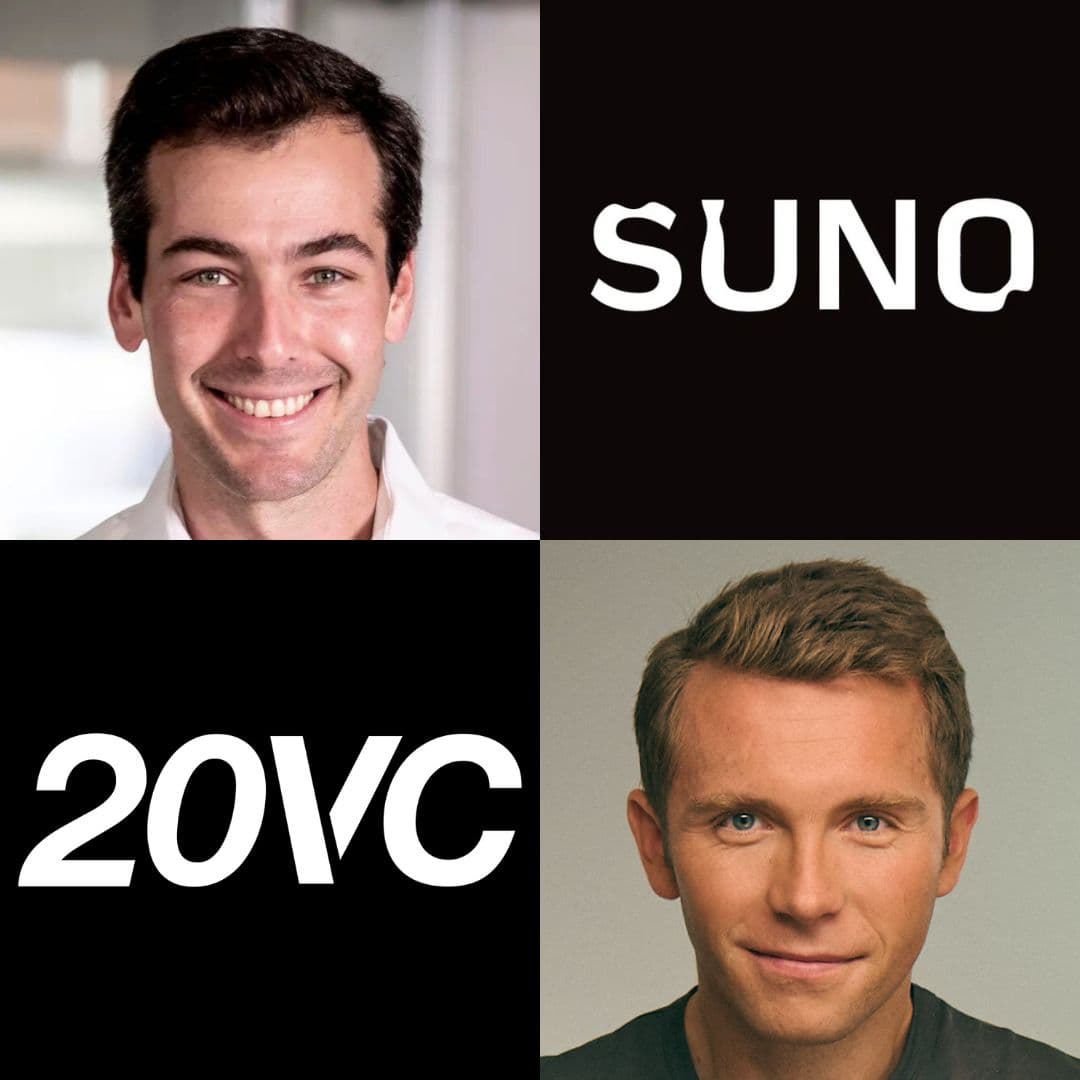
- Guest: Mikey Shulman, Co-Founder and CEO of Suno
- Air Date: [Insert Date]
- Host: Harry Stebbings
Mikey Shulman discusses the future of AI models, the impact of OpenAI on consumer apps, and the evolving landscape of the music industry, particularly focusing on Suno's role in democratizing music creation.
Key Discussions
- The Future of AI Models
- Key Competitors: Discussion around competing AI companies like Anthropic and OpenAI.
- Model Types:
- Will the future consist of many specialized models or generalized models?
- Mikey suggests that music will likely require smaller, specialized models.
- Scaling Laws: There is skepticism about whether scaling laws will continue to apply to music as they do in text-based AI, due to music's subjective nature.
- Consumer Apps and OpenAI's Impact
- OpenAI's Disservice: Mikey believes OpenAI's focus on text chat interfaces has misled consumers about the potential of AI in other domains, especially music.
- Consumer Preferences: He posits that consumers may not prioritize paying for superior models in the future, as they will focus more on the experience.
- Importance of Taste: Mikey stresses that having a good taste in music is more important than technical skills.
- The Future of Music
- Suno's Lawsuit: Discussion around Suno's ongoing lawsuit with major music labels, primarily concerning the training of models on copyrighted material.
- Music Discovery: Mikey envisions a future where music discovery is as engaging as gaming, integrating interactive elements that transform music creation into an enjoyable experience.
- Competition:
- The battle between Spotify and YouTube regarding music distribution and user engagement.
- Mikey sees TikTok as a significant player in music discovery but believes Spotify has the potential to win through better engagement.
- Monetization and Business Models
- Suno's Revenue Model:
- Mikey emphasizes the importance of generating revenue from day one to validate the product's value.
- He highlights the challenge of competing in a talent war against larger companies like OpenAI.
- Future Business Models: Mikey proposes new models where artists receive compensation for their music being used in generative contexts, focusing on user engagement over traditional streaming models.
- Innovation and Technology
- AI Models: Mikey discusses how Suno's AI leverages transformer models and innovative audio representations, but he believes future advancements will need to focus more on the music's cultural and emotional aspects rather than just technical improvements.
- Interactivity: He suggests that music creation should resemble video games, enhancing user engagement and making music creation more accessible.
Key Takeaways
- Empowerment through AI: Suno aims to empower more people to create music, moving away from a 'precious' music model to one that is more participatory.
- Collaboration with the Industry: Mikey advocates for collaboration between AI companies and the music industry rather than litigation to foster a vibrant music ecosystem.
- Social Elements in Music: The future should blend music creation with consumption to enhance the overall experience, making it more interactive and enjoyable.
Closing Remarks Mikey Shulman encourages an active approach to building the future of music with AI, emphasizing the potential for a more vibrant industry where many can participate and thrive creatively. The episode concludes with Mikey reflecting on the evolving roles of technology in transforming traditional industries and the importance of maintaining the social aspects of music.
---
For more information and resources, visit [20VC website](http://www.20vc.com).
Written by AI. May contain mistakes. Listen to the episode to check what was said.
Transcript
Automatic transcript. May contain errors.0:00Open AI, they did every AI company a huge disservice because everybody thinks that just like empty text boxes now the right interface and it is for chat GPT and it is incorrect for basically everything else. At some point I don't know if it's version 4 or version 5 there will be a last model release that is released as a model. Everything else is just product releases. This is 20vc with me Harry Stabbings and today we feature Suno, a company where I had the most visceral wow moment with that product since the iPhone. Soono is the future of music. They've raised over $125 million for the company, from the likes of Lightspeed found a collective Nat Friedman and Daniel Gross, and today we're joined by Soono's co -founder and CEO, Mikey Schulman, to discuss the future of models and the future of music.
0:45But before we dive in today, here are two fun facts about our newest brand sponsor, Kajabi. First, their customers just crossed a collective $8 billion in total revenue. Wow, second, Kajabi's users keep 100 % of their earnings with the average Kajabi creator bringing in over $30 ,000 per year. Kajabi is the leading creator commerce platform with an all -in -one suite of tools, including websites, email marketing, digital products, payment processing and analytics for as low as $69 per month. Whether you are looking to build a private community, write a paid newsletter or launch a course, Kajabi is the only platform that will enable you to build and grow your online business without taking a cut of your revenue.
1:2720 VC listeners can try Kajabi for free for 30 days by going to kajabi .com -4 -20VC. That's kajabi .com -k -a -j -a -b -i .com -4 -20VC. And after building your online empire with Kajabi, it's time to scale your global team with remote seamless hiring solutions. So every business is a global business in 2025, but how do you Payroll for your global business and team and comply with international labelers will remote handles payroll benefits taxes stock options and compliance to help companies of all sizes pay and manage full time and contract workers all over the world. No matter where your team lives or works, remote global employment solutions keep your team, your finances and your intellectual property secure.
2:13Remote never charges hidden fees just best in class global employment solutions for a low flat rate. Remote is funded by index vanses, Sequoia Capital and the host of the greatest podcast ever, Harry Stebbings and 20VC, head over to remote .com forward slash 20VC, that's 20VC, and begin hiring within minutes. Enjoy 10 % off your first three months by using the promo code 20VC at checkout. Now that your team is up and running worldwide, make sure your finances work just as hard with Brex, the ultimate financial stat for startups. So when Brex was founded, it wasn't just about creating another financial product, it was about solving the really gritty challenges that founders face daily.
2:55Let's be honest, building something from the ground up is hard enough, without dealing with clunky outdated banks that pile on fees and leave your cash idle. Brex is different, it's the financial stat that scales with you, no matter where you are in your journey, from corporate cards to maximising your runway, to earning yield on your cash. Bracks was designed with founders in mind to make every dollar go further so you can focus on building. And here's what really stands out to me. Bracks combines the best of checking, treasury and FDIC insurance in one powerhouse account. You can send and receive money globally at lightning speed, earn yield from day one and still access your funds whenever you need.
3:32It's no surprise that one in three venture back start ups in the US with companies like Anthropic, Coinbase and Robinhood trust Bracks to help them grow. If you want to join the smartest startups on the planet, head over to brax .com forward slash startups and see what they can do for you. You'll have now arrived at your destination. Mikey, I am like the biggest fanboy of Suno and I have created like 25 songs in the last few days so I'm so excited for this. Thank you for joining me. So good to be here, thank you for having me. Now I would love to just start with for those that don't know what Suno is.
4:05What is Suno and what is Suno not? Yeah, Suno is a way for everybody to experience all of the joys of music, meaning not just background listening to music, but losing yourself in the process of making music, of sharing music, of editing music, of being a much more active participant in music. You know, I like to think we're not making music, we're making musicians. I love that as like a tagline, but I actually spoke to Miniano before the show. And he was like, did you go to ask him about the origin? because it was an enterprise AI audio tool. And it wasn't what you see today. Can you talk to me about that pivot?
4:40I wouldn't call it a pivot. You know, we always knew that audio was really far behind the world of text. You know, that's where we came from, our backgrounds are all NLP. And we thought it would actually be a lot harder to do good, generative stuff. And so we thought the first product would be more sense -making. You know, try to scratch your head and think back to like GPT2. No one was really making interesting text with GPT2. but GBT2 was like this interesting tool for understanding text and that's where we thought we would be stuck for a couple of years until we learned to scale these things up and it turned out we were wrong and that good generative capabilities came out much much sooner and so the interesting thing here is the ability to generate stuff and so we kind of very quickly threw out the sense making tool.
5:22I already just love chatting to you because we just go off in many different directions. Do you think scaling laws will continue? You said they're about the generative improvements. For music, it's very different from text, and I think people will very slobily look at the world of open AI and anthropic and the hyperscalers and say audio is just a couple years behind which it is, but that scale is going to solve all these things. But unlike those domains where you're trying to just get more and more answers to objective problems like I want to get a better SAT score. I want to do better on this benchmark.
5:54Music is totally subjective. So scale is not the answer to all the problems, so that the models stay relatively small, and there are other techniques that you have to use to actually have these things have good taste. So we live in a world of many small models in music. I don't know about many, but scale is not as much of a panacea as it is in text. If we think about like insight developments, you said to me before, music should more closely resemble a video game in the future. I thought this was a fascinating analogy or comparison. Why should it resemble a video game? The thing about video games is that they're interactive, they're engaging, they're rich experiences, they're fun by yourself, they're more fun with your friends, and when I think about what music should be for me, it should be all of those things.
6:36In that sense, I wanna make music more like a video game. Nobody half plays video games the same way people kind of put on music in the background and half pay attention to it. And then the other way is I think if you accomplish all those things and if you make music interactive and you make music engaging, people will pay for it like they pay for video games. And I'm sure I don't need to tell you the video game industry is so much bigger than the music industry and most other industries. And it's because people have no problem parting with their hard earned money to experience those things. And to me, it seems like just crazy that music should not be as engaging as Fortnite.
7:09I agree. The people will pay for it. I think I did the $300 option as fast as I could. Thank you for your support. By the way, I don't, I tweeted this yesterday actually because of this. Sorry. But I didn't think in the future we will pay more for access to newer models I think that is just a stage of the development cycle that we're in in five years time We won't pay more for a better model. You'll just get the sooner product I I grew that very strongly. I'm not even sure you'll know what model there is at some point I don't know if it's version four or version five there will be a last model release that is released as a model and Everything else is just product releases because in the end And you know, it's not today, but in the end, I think people aren't going to care what powered the thing.
7:49You're just going to care that the music made you feel a certain way, and there's going to be lots of things that go into that. Can I ask, what power is Sino? Yeah, it's a transformer model. We've not been shy about that. Our competitive edge here has not been to innovate on the architecture and has been to innovate on the audio representations. So if you like, you can think it's not obvious how to tokenize audio, but if you spend and night and day doing that and basically take everything from the open source text community for how to make and scale models, that's a pretty good recipe. I do just wanna go back into something you said there, which is we're not cheapening music we're making it more valuable.
8:23With total respect as an economist, which I'm not, but as a venture investor, I proclaim to be something I'm not as a frequent job. When you increase supply, it reduces the price. You are making supply infinite. Does that not reduce price? I think it reduces the average value of any given piece of content, but I think it greatly Increases the value of music to society or to any given person. I think that's what we want right like we want a bigger more vibrant music industry That has way more participants in it that has way more engagement and not this more precious thing We're very few people have access to actually doing it to making it and the range of experiences that the average person has is kind of limited and therefore not valuable I want to start before we really dive into the company.
9:08There were elements that we were talking about before where you were like, I'd like to touch on these. And they were not in my purview of like, okay, these are logical ones to go with. You said to me, quantum computing will be amazing, but you still should not do it. Why will it be amazing? But why shouldn't we do it? I think the promises are incredible. There's a big part of me that wishes that we knew more things to do with these quantum computers, but I just see a rush of commercial dollars into the space where far more research was necessary and people are so short -sighted, including if I may, in your business, VCs are so short -sighted, you expect returns over a certain time horizon.
9:47And at least from my vantage point, the challenges are not, they're still physics challenges. They're still like basic research challenges that have to happen here. And so it's not something where you can kind of just turn the crank and make companies out of it. And to my knowledge, all of the companies that spring up around this are not doing all that well. And to my knowledge, the best stuff that happens happens in this weird public private partnership type of situation. But if you agree, it's amazing. Should we not pursue it, go through that trough of disillusionment, not pain to get to the amazing outcome?
10:18We should. You should not. You know, career advice, it's a very risky career because it may not work. You know, we so so there's to be spicy people should not join companies he's doing it just yet. But if that's the case, we will never get to that and that. I agree with you. It's like a tragedy of the Commons, but like it's an irrational decision right now, right? So it's like, it's gonna need some massive government intervention, I think, in a good way to make it happen. And we should do that, but. Should the government fund it? I think so. Not venture investors. I don't think so. I don't think you're gonna get your money back in a reasonable time.
10:48Cool down to process investing, my friend. Do you know how long it takes? Yes, yes. No, but this is a decade. This is my point. Why do physicists and economists make the best machine learning engineers? Great question. Two completely different reasons. I think, you know, and I'll preface this with like, building an AI company. You are in the business of trying to find talent and trying to find underappreciated talent. Let's be honest, I will pay you less than open AI. I will pay you. And I need to find a reason to convince you to come join us. And I think for economists, economists are great at thinking about natural experiments, they're great about doing kind of first principles reasoning in a way that isn't just like turn the crank, get better at this benchmark, but it's much better at thinking about what are these benchmarks really mean?
11:37Are there natural experiments that I can pursue there? Because lots of economics research happens in kind of data poor environments, and I think those are really interesting perspectives. Physics on maybe a little bit closer to experimental physicists just get good at running high -quality experiments really quickly. And AI is an empirical discipline and so whoever can run more high quality experiments quickly will win. How do you compete in a war for talent with Open AI, with Anthropic, with the massive incumbents that we have in the space who are paying millions of dollars? Yeah, we don't pay millions of dollars.
12:07So how do we compete? There's a couple things. One is we're not in Silicon Valley. If you want to be in one of the cities where we are, we're headquartered in Cambridge, Massachusetts, we're kind of the coolest AI company. Certainly in Cambridge, Massachusetts. There's something else that goes back to what we were talking about before, which is that if you're interested in a different AI problem, in the problem of how do I align models not to objective truth, but to human taste. I think there's nowhere else to do it. How do you align models to human taste when human taste is so subjective? Yeah, it's really hard.
12:36We have the advantage of having a lot of usage, and so we can run, we have a lot of data, we can collect a lot of data, we can run a lot of a -b tests on things. In the future, there's probably a lot more personalization that happens in this domain, but in the meantime, it's similar techniques that align models to human preferences for like RLHF, for chat GPT, etc. But it's totally not obvious that that is what the future should be. You know, it's totally not obvious that the same techniques that are used to align LLMs to weird human tastes should be the same techniques that we use to align music models.
13:09How far will large model providers go into the application layer? I'm And listen, there's nothing say OpenAI doesn't move into customer support or music creation. Totally. We think about this a lot. They will try. I don't know if it will be music. Customers support seems honestly bigger. The thing that OpenAI is going after is, let's be honest, I hope to build a giant company. But general intelligence and customer support are both much bigger than music. No, customer support is not. Come on, Sandask is like a $10 billion company at best over bit by P providers. The future of customer support might be much, much bigger than Zendesk, right?
13:48If everything can be automated. You have all these BPO's, you have all these. It's not obvious to me. I'm quite certain that the future of music is also much bigger than it is today, but maybe that's not dawned on the folks at OpenAI. What I will say is that this isn't just, it's the same thing about things being taste. This is a product game. At the end of the day, people will use Suno because it's a better product, not because there's a better, bigger model under the hood. We are in the business of selling pleasurable musical experiences to people, plain and simple. And so a chat interface is not the be all and end all that people want to do for that.
14:21You know what's amazing about your product is your time to wow, which is like five seconds. I typed in slow inspirational song to run to male guitar vocals. And it came out with like unbelievable in five seconds. I'm very happy we use Transformers because it lets us kind of get that too quicker. We can actually measure, it's super important what you said, and we keep a very close eye on making sure we deliver an amazing experience for your first song because it matters a ton, and I can tell you for example we can introduce a little bit of artificial latency into the product and we can see people like it less.
14:56Probably an inch second. Sometimes you see like the working in the background, loading some magic and people feel like more values being created with that psychological experiment of it takes a little bit more time. Yeah, but 10 seconds is worse than 8. I don't see us getting to 1 second anytime soon, but I think the crossover that you're talking about we're still kind of far away from. What is the metric for a successful user? Is it three songs created, one song shared? How do you think about that? There's a few things we look at there. The most salient one is actually just like, did you hit the paywall your first day?
15:26Even if you didn't go through it for whatever reason. If you hit the paywall, you just enjoyed the last 10 or 12 minutes of your life. And I know I did something good there. If you made one song and threw it away and never came back to it, we didn't wow you you didn't have that magical experience We missed our mark. So I think that's like kind of the most important one and it's it's fairly high How the fraction of people that hit the paywall their first day? This may be completely crap. We use a feedback But I found actually the numbers drawing because you price it annually. Yeah, it's like bigger numbers And so like when you see 300 bucks, you're like wow, it's a lot But if you showed me that 2999 I'd be like mmm Fair enough.
16:03We do want you to do an annual subscription though. I think in some sense, not the most deliberate decision, but we made a decision to start charging from day one, which is like a little bit against the traditional wisdom of Silicon Valley, just like give the product away for free, scale, scale, scale. And we didn't want to be a novelty item. We wanted to be giving people something that they enjoyed enough to pay for. And so I remember when we launched this thing, it was a discord bot. we started collecting, you know, we always had this free tier, same free tier as it is today, and if you wanted to do more, you had to pay, and a surprising number of people subscribed in that first month, and it was a sign that like, hey, this is a real thing, but even without the revenues, which are fantastic to have, and they offset a lot of GPU burn, knowing what gets people to subscribe is such valuable data that I don't know like how we would do this without it.
16:53What do you mean by that? What did you learn from that valuable data? Imagine it were just only the free tier or everything were totally free. When you hit the end of your free tier, I don't know why. I don't know if you wanted to continue or didn't want to continue. I don't know how to pick out the users that I want to interview that found this really valuable or not really valuable. Like, I'm kind of lost in the desert a little bit. And if you have it and you can say, okay, these are the people who subscribed. These are the people who subscribed before they even hit the paywall. Let's go talk to them.
17:22Let's figure out like, what was that magical moment they had? Or these were the people that hit the paywall and didn't subscribe. Let's go talk to them. Let's figure out why we didn't wow them. Sure, maybe we would be a little bit bigger, but we would also have, I think, a worst product if we hadn't had that data at our hands. Can I ask you, you mentioned GPU burn, yeah, rather than you're setting that. What percentage of your span today is GPU burn? It's the biggest thing by far. It's a few times payroll. We also have a big research cluster that these technologies didn't exist when we started the company, you know, and research is still a huge part of what we do.
17:53How do you anticipate that changing moving forwards? I don't. I hope GPU prices come down, but we'll probably just get more. So you just get more on the product, it's better and better and better. No, you need to run high quality experiments. And so the machine learning team, as you know, will almost certainly not scale as quickly as a softer team, or said differently, research is not something that you can solve with scale. You can just throw more bodies and you'll get comparatively more results. It will be sublinear returns there. and so it's very important to really understand like, okay, I have like really talented researchers doing the problems that are going to be really important for the future of music.
18:30I wanna discuss the future of music and I wanna kind of go to the product itself. I love the output. I'm just starting with Blunt question. There is lawsuit from RIAA in June 2024. Was there any basis to this lawsuit? The lawsuit is basically saying that you use their media to train your models. I have to be very careful what I say and don't say about a lawsuit. So yeah, we know that there are some copyrighted works in our training data. That's not illegal. It's stock standard for the industry. It's what every AI company does. In some sense, the lawsuit wasn't totally shocking. Most AI companies get sued.
19:07Everybody in music gets sued. It's a highly litigious industry. It's a little bit depressing in some way because I think there is a much bigger and brighter future of music to build together with the existing industry instead of kind of fighting it out and having the potential for this thing to just be net smaller. You know, I'll say something ill of lawyers for a minute, but we were talking about economists and there's this famous econ paper from like the 80s looking at why do some countries grow and some countries don't grow and and um, by the sky, Andre Schleifer. One of the conclusions is basically like they're looking at the ratio of like how many engineers There's earned a country and how many lawyers are in a country.
19:46The conclusion is like, more engineers equals more growth, more lawyers equals less growth. And that's like a little bit reductive. But I think that instead of fighting it out, if we were talking, which we were before this lawsuit happened, at least to some of the players in that lawsuit, if we were working together toward building a bigger future of music, everybody would just be happier. And the music business is one that has such an embedded fixed pie mentality. There's a fixed pie of money out there and we are all just trying to divide it unfairly for ourselves and if we were focused on growing that pie, I think like just everything gets easier.
20:22You mentioned that it's very natural for AI companies rather it's open AI or any of the others to have lawsuits and be under the same pressures. When you think about how that naturally gets resolved between new AI players and traditional incumbents in any industry, so not specific to this sort of with new AI companies, bluntly using venture dollars to pay off large incumbents. Is it equity distributions to larger incumbents to feel like they have a part of the companies? How does this play out? I don't know. There's like the traditional Silicon Valley mentality of like screw you existing industry.
20:57I will disrupt you. There's nothing that you can do about it. And then there's like the existing incumbent approach, which is like, I will sue you until you go away. And like both of these are obviously wrong. People will ding us for building a tech company in Cambridge, Massachusetts, but it's actually nice not to have that embedded Silicon Valley mentality of screw you existing industry. I'm going to disrupt you and there's nothing you can do about it. Every single person at Suno has an incredible, deep love and respect for music, which culturally is amazing, but also just keeps people out of that mentality and much more focused on building a bigger, brighter future, hopefully with the incumbents in the industry.
21:34And by the way, there are plenty of incumbents in the industry who do work with us. How would you like the incumbents to have behaved to a suingy? I'll talk to us first probably. Yeah. And they don't. Some did, some didn't. On paper, I would say it just seems silly to throw a bunch of venture dollars at lawyers instead of sitting down and talking about how you could work together. Deciding to sue first and then ask questions later seems to me to be inefficient. It is a founder when you get a lawsuit. How do you respond? I mean, I would obviously rather not get sued, right? Like I think, you know, I think I would be bullshit on you.
22:06So I know some genuinely, you know, probably psychotic founders who are like, yeah, fuck you. Like, feed off the pain. This means I'm winning. Like, you notice me because I'm, you're suing me. I mean, there's certainly an element of that, but those people I think are lying if they tell you, like, this is a good thing. It's like, maybe it's a sign of a good thing, but it itself is not a good thing. If nothing else, it's gonna cost money and time. If they win, what happens? If this lawsuit goes to trial and we lose, it's obviously not good for us. The company, the company's not dead, but it's obviously not good for us.
22:36I don't think that's likely. I would just be thinking about a the game theory of what all players want here and b what is the best future of music for everyone? Even if you could make sooner or sooner like companies or AI companies go away, do you really want that? What if the music industry can be as big as the gaming industry? There's gonna be a lot of happy people. When we think about the future of music then, how does that look? Because you have existing players today, you'll Spotify's most name in the world. How does that look in your ideal world? There's a few different ways. I'll tell you what I hope it is, which is that there are a lot more people participating and there are a lot more experiences on tap.
23:15And so what does that mean? That means we didn't just want to build, let's say, a company that makes the current crop of creators 10 % faster or makes it 10 % easier to make music. If you want to impact the way a billion people experience music, you have to build something for a billion people. That is first and foremost giving everybody the joys of creating music and this is a huge departure from how it is now. It's not really enjoyable to make music now. It takes a lot of time, it takes a lot of practice, you need to get really good at an instrument or really good at a piece of production software.
23:47I think the majority of people don't enjoy the majority of the time they spend making music. Do you not think that's like running? It is hard to run, it is painful to run, you don't particularly enjoy it but you love running. And you get good at it and you get better at it and you speak to the runners and they love front. Most people drop out of that pursuit because it was hard. The people that you know that run, this is a highly biased selection of the population that fell in love with it. I'm jumping back and forth but you know we talked about kind of the training and you said training on copyrighted music.
Read the full transcript
24:17At what point can you train on sooner music? Because you have such a library now. When can AI train on AI? A huge open question for how do you do this in a way that doesn't impart just massive bias into models. We work on it a little bit. The bigger players are hitting data walls and are more actively working on it. And like everything else, it's really nice to have the big players solve a lot of the really thorny problems for you. And you can kind of focus on your competitive advantage. Some hoping somebody solves that problem. And it's not us. When we spoke before, you said that it's not good to have two worlds, AI, music, and like normal music.
24:53So what does that look like? And what does that look like from a customer experience? I said to you before, like, why isn't Spotify just blended into the app? And then you have both in one home. From a customer perspective, at the very least, it would just be a bummer if I had to go to two different places. I don't know if there's any content that you know about that doesn't exist on Spotify that you're looking for, but it's a huge pain in the butt to go to another app to go find it. I don't. I think some audiobooks, which on that yet. Wow, okay. That just shows you that there is a lot of friction.
25:24And if there were two worlds of music, I think that would A be friction for the average consumer. But I actually hope it's much more than just consumption. There shouldn't be like a set of fun experiences around making and sharing music. And that is somehow disjoint from all of the other music that you listen to at a party while you work out while you're in your car commuting, whatever it is. Like together these things are much bigger than if you just separate them. I totally agree with that separation, the friction that comes with that chasm, but then that means you either need to move into Spotify, or Spotify need to move into you.
25:55Or both, or neither. I think there's lots of different worlds that are possible here. Time will tell which of these things is correct. How do you think artists feel about Suna? I will tell you that they love this. Well, actually yes, so it's a biased sample of artists that I speak to, but the vast vast majority of artists that I speak to, behind closed doors admit that they use and love Suna. Is there a way to create like personalised models for different creators. And what I mean by that is that Ariana Grande comes to and says, hey, I want to do a deal with you where I give you exclusive access to my content.
26:29Then I'm able to train on my content and I can leverage my brand, effectively have full control, but unlimited supply of future Ariana Grande songs in seconds. The answer is yes and I would love to do that. Depending on what her contracts look like, she might not even be allowed to do that, which would be kind of crazy. Why would you not be able to just doesn't own all of her music? But she owns her name and likeness. I would love to get to a world where she can have models that make Ariana Grande songs, you know, you've noticed in our product you can't make Ariana Grande songs if you put her name in We're gonna wave our finger at you and you're gonna say like that's not what the future of music is That's not original music.
27:05Sooner is for original music. It's not for impersonating people But if she uses it, it's not impersonating this is an immensely powerful tool for her to make music for people writing writing songs for her to hear it how she would do it, or maybe even she's forward -leaning enough to wanna give this over to her super fans. And her super fans can make, but I can only describe as the equivalent of fan fiction if she wants that. And that would be in a immensely engaging activity, way more valuable and way more engaging than like having an AMA with her if you're a huge fan. If I listen to, I love Dean Lewis, this kind of male guitarist using Santos, clearly I need a therapist.
27:43But I click go to radio on Spotify and I hear other songs like his. He does not get paid for other songs like his What is the difference between me going to Suno and saying give me some songs like Dean Lewis But actually focused on an Australian man and a Australian woman Sadly sung with guitars and he gets a cut for that because Dean Lewis is in the prompt Right now you can't do that. I would love to see a future where you can with him opting in to that as an example How does that completely change what you can do? The thing that people don't realize is that right now, we've made something where people enjoy making music so much they are paying to create the music.
28:23This has nothing to do with listening. I think that a big part of the future of music is rethinking a lot of these business models where right now it's set up in this capped stream share. The stream shares are a certain size and everybody is kind of fighting over it and artists don't make a ton of money from that. And there are hopefully new business models that you can figure out that are much more tied to the enjoyment that people get that are way more tied to artists if people want to actually be interacting with the artists themselves. What awesome of those business models, son. Imagine you found some creator that you really love, teenager and Saskatchewan, and you just love this guy's music.
29:01You could have a Patreon thing where you can pay him directly. You could have your own kind of fork of his model. If you were cool with that and you were cool with that and you're paying him for that and now you're making songs that are, you know, your riffs on what he does. Let me give you an example. We had this remix contest with Timberlin and a tremendous number of people submitted remix songs. And to me, getting to remix the music of your musical idol is like the ultimate form of engagement with them. It is so much cooler than like honestly even meeting them backstage after a concert. The old model of stream share does not properly account for an interaction like that.
29:40Talk to me about that partnership. Tim Blaine is obviously a huge industry figure. How does that even come about? If you talk to anyone in the business they will tell you, like he is the cutting edge of technology and music and has always been. He was a fan of the product actually before we met him, which is amazing and I think you can't fake this stuff. And so it's really an amazing partnership for a variety of reasons. One is we learn a ton working with him. We do a lot of product development with him. So he has access to stuff before anyone else does. The next thing is that obviously this provides some amount of recognition for us.
30:14Do you think it legitimizes each traditional music industry? Yes, I do. But I think the real thing that this does is that you have someone who has made it, who does not need to do this. Publicly saying, yeah, I use Suno and it's awesome. This kind of gives cover to up in commerce to be more open and vocal about using it. Can I be blunt? Do you just like pay him for that partnership? No, we don't pay him in cash. So they got my equity. Yeah, he's an advisor to the company. Yeah, fantastic. I calm, I think, did this very well. I don't know if you're calm enough. Yeah, yeah, yeah. Of course, did it phenomenally well and with some incredible people.
30:47Would you like to do more of these partnerships? And when you think forward about the GoFord, like distribution and legitimacy, do you think that's important? We always wanted to do this and continue to want to do this with players in the existing industry. Timberlin wasn't the first and he certainly won't be the last. Who would you most like? A lot of pop music has gotten boring. For example, music or boring. Oh, boy. We could talk about this for hours. Songs have gotten shorter, yes, but also much more homogenous in melodies, harmonies, song structures, and music innovates very much sonically.
31:20Like they're really interesting sounds and they all fit into the same song structure. And this is a product of the technology that people use to make music, digital production. This is a product of streaming. This is a product of platforms like TikTok. I think what we've seen with Olivia Rodrigo is we're seeing people now change the structure of songs to align to the algorithms of social channels. 100 % How do you think about that? Is that sad? It's not obviously good or bad. It just is. Those algorithms have spread that music to way more people than otherwise would have. You said the word they're discovery.
31:52You said about making more music just a second. How do you think about the future of music discovery when there is an infinite supply of music? In some sense, it gets harder and in some sense, it gets easier. People don't realize the extent to which discovery is already extremely algorithmic now, and that you are not always being fed as much of the long tail as maybe you want, or maybe it is exactly what you want. So what do people think about music discovery that they get wrong? I think people don't realize the extent to which the music that is popular is a product of recommendation algorithms.
32:26You should ask somebody at Spotify or TikTok and not me. I think that they probably reverse the causality. Things break on TikTok, and then they become famous on Spotify, but that is a function of both algorithms and people pushing music, and not necessarily only a function of the quality of the music. How do you think about the battle between Spotify and TikTok for music discovery? They're both really important bits of that ecosystem. But like I think TikTok went on the short form video discovery, and I think that Spotify went on the algorithmic, discover weekly playlists, which is much less visual and much more traditional list -based recommendation engine.
33:04I think that's right, but a lot of what becomes popular is also found on TikTok first. How do you think about YouTube versus Spotify? Because that's the other big battle. There's like long -form video and the short -form video battle. And Spotify are trying to take on both at the same time. I hope that Spotify wins. It would mean that people are finding music more engaging. Like YouTube is more engaging than Spotify as measured by the amount of the the our proof for ads for example, right? Why do you think that is? Videos engaging. There's a ton of just background listening to music, which on its face is not bad.
33:36I'm not anti background listening to music, but there's so much more that is possible. You know, I'll point this out to people like I interview a lot of engineers, maybe a hundred percent. I'm not sure I've interviewed an engineer in the last two years that does not listen to music while they code. But the whole point of that is not to pay attention to that music, right? Like so much more is possible with music than like something you put on the background to deliberately not pay attention to it Spotify doing Spotify video in the big push in. How do you think that plays out? I hope people find it more engaging met let me let me let me answer the video question more tangentially like this The vast majority of JNI video companies have asked us for an API so that they can have you know Sooner music behind their their AI videos and the answer is always no why the reason is we are trying to make music more valuable for people And being the background music for your video is not making music more valuable.
34:27Like, this isn't a cost thing. You can go get epidemic sounds music for very, very cheap. And that can be the background for your video. What was Sino, did you not do that you wish you'd done? A very obvious one for me is actually getting off of Discord. We released our first product in August of last year. And in November, we put up a very thin web app. And I got this totally wrong. I said we're gonna be on Discord forever. I look at mid -journey. They're printing money. It's just a Discord bot And now it's not but at the time it was I did not appreciate just how much a good UI will totally change the experience for people Discord is not the best UI for what it is that we do It's better for mid -journey that it is from than it is for music But like so much more as possible We released this web app which is not even the full functionality of the Discord bot in November And it takes five days for 90 % of the traffic to move over to the web Five days there's no world in which you can say that I got that right so you wish you'd done the web app and the mobile app sooner Yeah, if you'd done them sooner would you not have cannibalized the discord audience and there would have been no reason for them to be that Like I would argue strategically that you know have 400 ,000 people still on the discord by the way Well nobody leaves discord service now discord serves a completely different purpose Which is it is a community and it is an amazing resource for us to talk to the community and an amazing resource for us to get feedback from the community But I think that the product would have reached more people if we had built that web app sooner.
35:57You said about kind of the importance and the significance of Trudy Great UI. What is Trudy Great UI to you? Oh boy, I'm always thinking about like the UI should just in no way resemble what it does today. But I think good UI is just like, what did you enable that is completely not doable in the old pattern? In thinking like that, this would be, what could I not do in a digital audio workstation? It wouldn't be really easy for me to take a whole song and cover it in a different genre. But if I think about, oh, that is actually something somebody might want to do, let me think about that as a first -class citizen workflow and let me build that.
36:34And that could be a really simple UI, a really beautiful UI, really intuitive UI, but it's also just totally different. How do you think about prompt guides? And what I mean by that is you have the, it's almost reminds me of knowledge management systems, which is like the screen of death. Bluntly prompting, you see the box of death, and for someone who's used to prompting, you're kind of like, okay, I know to be specific to include very pointed directions. For other people, it may be less important. How do you think about the importance of prompt guides? I'll be preface it with OpenAI. ChatGPT is amazing.
37:04They did every AI company a huge disservice because everybody thinks that just like empty text boxes now the right interface, and it is for ChatGPT, And it is incorrect for basically everything else. I hate to be this guy going to reject the premise. I hope that in six months from now or 12 months from now, we're not using the word prompt. There are just far more intuitive ways to interact with the music. And we shouldn't be guiding you. We should be listening to you. You know, I had Balsky and Gustav on the show and they said that we will kind of measure the quality of the candidate by the quality of that prompts.
37:35Do you think that is not true? I really hope that's not true. Somehow, this would be a huge missed opportunity if we are caring about the inputs and not the outputs. Shouldn't you measure it by the quality of the music or the quality of whatever it is that they're doing, right? Maybe if it took a really complicated prompt, is that a good thing or a bad thing? Well, if it took a really complicated prompt and 1600 iterations, that's a failure of my product, not a failure of the candidate. I asked you, you know, what did you not do that you wish you had done? What did you do that you wish you hadn't done?
38:05There's a part of me that wants to say allow remote work. That's like a spicy one. Things it's not spiked. I mean, this is the nicest way. Every single CEO I was walking in the part with the CEO's, one even enterprise sales company. She was like, I know remote work is killing my company. I just can't get people back. We never, you know, we built the company in person and we make exceptions for people to be remote and it is generally worth it. It's just... very hard. No, it is very hard. No, it's not. Some people are worth it, but I think as you scale, exceptions are a sign of judgment. I think judgment is so underrated on how important it is.
38:40It's like compared to people's skills. And as you scale, the judgments required to make these exceptions, I think it's very, very hard. We are much bigger than we were a year ago, and I think this is already beginning to get difficult on, like, is that person an exception, is that person an exception, etc. Can I ask you on the funding site, you've raised now how much? A little over 125. A little over 125. The last round came quite quickly. How did you think about that? Was it important to some manual position in the space as the market leader? Was it needed for GPU spend? What was the rationale behind that?
39:13Yeah, I think about capital as a weapon and you can go and deploy it. And if you have, there are step changes where more capital let you do something differently from, you know, if you just added 10 % more capital to your balance sheet. Do you think founders and VCs are aligned? 99 % of the time, yeah. There's like lots that I wish I knew before starting with gumming. What do you know that you would shoot, man? We reserve a good portion of our fund for capital later on in case you need it. That's code for like, I'm going to take my pro rata and there's nothing you can do about it. Stuff like that.
39:44In the good cases. In the good cases. In the bad cases, I'm not gonna give it to you. Yeah, exactly. No fucking way. So that's, you know, that's billed as very founder friendly and it's actually the opposite. How have you scaled revenue in a way that other generative AI image generation, and your other forms have not? Care about it, I think is the answer. Like there's no secrets here. It's like we started charging from day one. Maybe that was a bit of a happy accident. We always looked at it. And I care a lot more about building a giant platform right now than I do about revenues. But I need to make sure that these things are somewhat commensurate.
40:17Sure, you can come up with edge cases where like I have to sacrifice, you know, I have to do the intel thing. at the sacrifice all my revenues for this next opportunity. But absent that, the revenues growing is a sign that people are experiencing something that they want to pay for, and that is a good thing, and we shouldn't be ignoring that. Has that ever been a time where revenue focus is led to deprooritization of growth? No, because we've always prioritized growth on top of revenues. You know, this is like good people have the capacity to keep both things in their head. Yes, we want to grow, but we also don't want to sacrifice revenues.
40:49And if you hold my feet to the fire, maybe maybe I can give you a quantitative number of, I care about growth twice as much as I care about revenues, but where we are now in our journey, we are not really making trade -offs yet. We've reached a tiny fraction of the addressable audience for the product as it is today. We are building much more product with way more valuable and fun experiences that will reach an even bigger audience. So if I am making trade -offs now, I'm doing something wrong. How do you think about Soono being a social network? And what I mean by that is it's quite easy you'd see it go down the SoundCloud route where you have kind of profiles and thought which we have to say in two notes.
41:24But like the followers, the likes, and it's much more socially interactive and there's real social capital tied to status and profiles. There's a bit of that. I think where SoundCloud goes wrong, I mean there's two things, one is it's still hard to make music. You're kind of limited there and it's still kind of, there's the creators and there's the consumers and they don't really mix. And so that's a bit unfortunate. Music by itself is social. Is it social like Facebook social? Is it social? Mayor, you have like lots of peer -to -peer stuff or the long tail of Instagram. Is it social like the top end of Instagram where you have people who look like they spend mid -six figures on every post and make their livelihoods doing it and have a hundred million followers?
42:03The answer is it's both of those and it's everything in between. And so it's kind of crazy. Like Instagram is a good example here. It's kind of crazy that the same platform lets me DM you something silly and lets me consume content from a true professional, you know, who spends all day, you know, agonizing over this post, why can't music be the same way? Right? Like music shouldn't be special like that. I feel quite unnerved today. And I feel quite unnerved today, like in this time, because I've never known the world in such a state of flux. And obviously there's global conflicts and everything in between, no, elections just changing kind of the structure of country so quickly.
42:37But also just like, I really cannot predict the future of labor, the future of content creation, the future of content distribution, the future of information, everything is up for grabs. And you can say what you want. I mean, in a nice way, we've been creating music since before time, and sooner is able to do that in seconds, beautifully. I just feel uneasy that there is so much change so fast. What would you say to me? I think some of this applies outside of music, but I think to whatever extent there are two sides of this thing. There's like the old industry, and then there are the disruptors.
43:10And there's one thing that both sides will agree on, and everyone on both sides will say, well, we know it's coming, we know it's inevitable, meaning AI. And I think people in the existing industry will say, we know it's coming, and they say this, I think they don't want to sound like decals. They don't want to sound like hermits, right? And people in the AI community will say it, and because it's like a security blanket, it's like, oh, don't worry, I'm not coming to disrupt you, but we know it's coming anyway. And I think in both cases, this is a really bad thing to say because in both cases, on both sides, this is basically just putting your hands up and being like, it's coming, I don't even have to do anything about it.
43:46And the future is ours to build. We can build a good future of music with AI and we can build a bad future of music with AI or we can sit back and let someone else do it. And I'm quite energized by the fact that like, I think we how can you as a public company CEO, say of a UMG, how can you say we know it's coming and not address the core of creation? What that person would do in that case is say yes, AI is an important part of the creation stack right now and Not try to address the like well, what about all the other people who who want to create with these new tools also? It applies just as much to me as it does to the to the CEO of the universal music group of like we can actively build a bigger Better future of music with AI or we can just wait and someone else in another country not bound by US laws not with the same intentions will build a worse future of music with AI.
44:37And I can think of lots of distal beauty. What is a worse future of music with AI? Two particularly bad ones. One would be like a group in another country that doesn't want to follow the laws will make it so that you can without permission impersonate your favorite artist and just make endless copies, you know, endless Ariana Grande songs like you said without giving a cent to Ariana Grande. That would not be great. There is musicly possible today. Totally. Yeah. Totally. Yeah, you saw this with the Drake week and go straighter thing. It's like, and it'll be good, and it'll just get better and easier.
45:10That's not a good future. There's another bad future, I think, though, which is like music is meant to be social, but there's like a local optimum, I think where music gets less social and it gets way too hyper personalized. And so I would hate for the future of music to be you, open your phone, you open an app, you hit play, and it knows everything about you, it knows what you did this morning, it knows who you texted yesterday, and it knows your mood, it like has your Apple Watch, you know, it has your heart rate, and it just streams you endless music that only you're gonna like that is just hitting that nerve in your brain.
45:40It's like a drug. This is extremely anti -social, and somebody might do that also. I think that would also be a shame because it misses out on a lot more, that's fun. There is an inherent tension between social stuff and personalization, and I don't wanna make the hyper -niscient genre for all the youth. I have a tip for that because as I said, I created a song for my girlfriend before it's that good like you will. It's fantastic. No, at least that's two. You made it for somebody. Like that is so much more social than what exists now where you listen to music from artists, you love the music and you see a piece of yourself in the artist but you don't actually interact with them.
46:17You making a song for your girlfriend is amazing. You might say, well, I really wish you had spent 10 ,000 hours playing guitar and then you could have done that without the help of Sino. But short of that, is it bad that you did that? No, I think it's actually great that you did that. I don't want it to be only that. Music is social but there's something about art that's all about the artist. And, you know, I think a lot of artists won't even care what other people think of the music. It's just a world where that type of stream is just so pleasurable that you forget about everything else. I think is not as big or good or valuable as what could be.
46:49He said the word art before we do it quick. I can't believe I'm quoting Ben Affleck. But he said, I'm sure you maybe saw this in a panel. He said, asks his, I'm boss sizing it, knowing what to do, craft is knowing when to stop. How do you think about that? Hemenway said, right, drunk at it sober. I think where this all goes is that, and this is a very natural progression that's that's already happening. Where does this all go? It's increasingly tasteless, the only thing that matters in art and skill is going to matter a lot because you're gonna be able to make a lot of stuff and the people who are going to be recognized are people who are able to pick from the vast quantity of stuff and use in the case of music their ears to say that was good and that was bad.
47:30That is accelerating a trend that already exists. Think about it like 30 years ago you wanted to be a rock star, you wanted to be an amazing guitarist who could shred, you know, and 15 years ago you wanted to be a DJ where you had to learn these pieces of software, but maybe it wasn't quite as virtuosic as it was if you had to, you know, spend 100 ,000 hours playing your instrument. And now people want to be influencers. I want to be famous for the sake of being famous. In music, it's not really influencers like that. But look, you see this even with playlists. There was a crop of people who made playlists.
48:02This is compilations of other people's music. And it's just like, I have good taste and you are going to care to listen to my playlists. And I think this is where it goes. It's like, I have good taste. I make good, soon -o music. Yeah, I can't play the piano. I can't play the guitar, but I am very good at picking through the synom music and finding the way to make it sound Like you wanted it to hear and that makes me a creator. Listen, I want to do a quick fire with you So I say a short statement you give me your immediate thoughts. Okay. What do you believe that most around you disbelief? That AI is inevitable.
48:30I think everybody believes it's inevitable and I don't think it is. Why is it not inevitable? We need to do it if we if we just say it's inevitable. It's not gonna come and happen. We need to go and do it Do you agree we're going to go through a trough of disillusionment? Everyone is kind of expecting AI now and next year. I went to an event very recently with one of the biggest banks in the world and some of the biggest CEOs. And it's like, the ROI's not here. We thought it was here. And it really felt like we were going on the downward in terms of like an AI winter. I live in a bubble in Cambridge, Massachusetts.
49:00You live in a finance bubble and London. Those people are going to potentially have a disillusionment. But like, is the whole world going to be like that? I don't know. I'm not sure, because I think most people are still not expecting anything. Should take talk be banned. My gut is no, but most banning things, I have a visceral no reaction to banning things. Apparently, I just learned Australia's banned social media before the age of 16. I don't think that's a good idea either. These things are typically fairly heavy handed and don't necessarily accomplish what they want. Maybe that's a trade -knit tactic.
49:33I'm also not sure you want my opinion on that. I'm like some tech guy who does music. Tell me, what's the hardest element of being CEO of Sino? I don't know if this is special to us. I think it's focused. I think at any given time, there are 30 things that we could do that would be very impactful for the company and we have to choose three of them and we have to choose carefully. The future of music is green field right now. We could be tacking a lot of different things and we have to be choosy with which ones we What would you like to do but will not do for the benefit of focus? I mean, off the top of my head, like everybody's asking for an API.
50:06Do we want to do that business? I don't know, that doesn't really build the future of music that I want to do. There's always attention between how much of the power tools, the old power tools do we want to build versus figuring out what the new power tools are for creating music. What have you changed your mind almost in the last 12 months? Ooh, probably that good judgment is more important than good skills. And it's because we know how to assess skills and we don't know how to assess judgment. So everybody's teaching for the test here. How did having children change how you lead? The first order of thing is I have less time, and so you have to just be a little more ruthless with prioritization.
50:39The flip side answer is patience. Like when you see fast learners, you have to be patient with them. Little kids are incredible learners. They pick up things so much faster than you and I do, and it is incredible to see. Tell me, what concerns you most in the world today? People are not good at realizing what is the first order of effects of the issues they deal with or the things that they are doing. and people usually glom on to the second order effects because sometimes they feel, I don't know if they feel smarter or it feels closer to home, but people are not good at judging effects' eyes.
51:09I'll give you some examples. I teach this course at Sloan at MIT's Business School, so you need to have an AI policy because it's course. Are you gonna allow students to use chat GPD? And you get a lot of people saying GPD is the end of education. And my answer to that is, no, the first order effect here is that GPD means that every person in the world has like a median competent tutor or sidekick. This is obviously amazing for education and if you can't recognize that fact, I'm not sure you have such good judgment. Now let's talk about the second order effects, which is that like, yeah, all my homeworks just got packable by, you know, one good prompt.
51:44And my response to that is like, yeah, okay, so I as the instructor now need to change what I teach people. That's scary and that's a lot of work. But if I don't change what I teach people, Well, I'm not really preparing them for the real world. Most companies are going to let you use GPT when you're like doing your day job. I should probably prepare people to do that. But ultimately, I'm sorry. What's the coolest use case that someone's used for sooner that you didn't expect? Coolest. Tons of usage with kids. Kids love music. Kids resonate deeply with music. Half of my usage of the tools with my three -year -old.
52:15So that I didn't expect. But lots of things we didn't expect. We were at the top of what people put, the Gen A .I. products that people put on their ramp credit cards, which means that like lots of, and so we were surprised, people are using this for cold outreach, for sales, for marketing, for all kinds of stuff. That's very cool. That's very exciting. That's entirely new use cases. And it's very hard to say no to cold outreach when somebody wrote you a personalized song. I imagine it's very effective. Dude, I told you I sent the Revolute team the song we did for Nick Straonsky, that's the O.
52:44And it was great. Yeah, I love that. Listen, final one, what question have I not asked you that I should have asked. I think you asked and we didn't, and then we got sidetracks. It's like, what should the future of music be? Because should is the real word there, because we need to build it. It's the question that I think about night and day more than any other question. The good outcomes here look like a lot more people doing a lot more music for a lot more hours of the day. And all of the economics will flow downstream from that. And I think about AI as a tool for achieving many of those ends.
53:16It lets a lot more people participate in creation. It lets us recommend music to people more. It lets us. It will let you tailor a song for your girlfriend to her tastes, which is like very, very powerful because it turns out she needs to like the song for that effect to happen. It's one where a lot more people I think can make a living doing music. And right now, not enough people can actually make a living doing music. And I think about Instagram, or I think about photography, pre and post Instagram, very few people made a living doing photography. And now a lot more people can make a living doing photography because of Instagram.
53:49And yes, it changes the tenor of photography. Yes, it changes that every individual image is less valuable than it used to be. But in aggregate, this is a much, much better future. That is what I would like to do for music. Isn't Mikey? I've loved it. You know I love the product. I've so enjoyed this discussion. So thank you so much for putting up with my wayward side questions and you've been fantastic. This was so fun. Thank you. Now if you want to watch that show live in the studio you can on YouTube by searching for 20 VC, that's 2 -0 VC on YouTube. But before we leave you today, here are two fun facts about on newest brand sponsor, Kajabi.
54:28First, their customers just crossed a collective $8 billion in total revenue. Wow, second, Kajabi's users keep 100 % of their earnings, with the average Kajabi creator bringing in over $30 ,000 per year. In case you didn't know, Kajabi is the leading creator commerce platform, with an all -in -one suite of tools, including websites, email marketing, digital products, payment processing, and analytics for as low as $69 per month. Whether you are looking to build a private community, write a paid newsletter, or launch a course, Kajabi is the only platform that will enable you to build and grow your online business without taking a cut of your revenue.
55:0620 VC listeners can try Kajabi for free for 30 days by going to kajabi .com -4 -20VC.
55:19And after building your online empire with Kajabi, it's time to scale your global team with remote seamless hiring solutions. So every business is a global business in 2025, but how do you do payroll for your global business and team and comply with international labor laws will remote handles payroll, benefits, taxes, stock options and compliance to help companies of all sizes pay and manage full time and contract workers all over the world. No matter where your team lives or works, remote global employment solutions keep your team, your finances and your intellectual property secure. Remote never charges hidden fees just best in class global employment solutions for a low flat rate.
55:59Oat GitLab, the world's largest all -remote organization, Trust Remote to run their global team. Remote is funded by IndexVansions, Sequoia Capital, and the host of the greatest podcast ever. Harry Stebings and 20VC had over to remote .com forward slash 20VC, that's 20VC, and begin hiring within minutes. Enjoy 10 % off your first three months by using the promo code 20VC at checkout. out. Now that your team is up and running worldwide, make sure your finances work just as hard with Brex, the ultimate financial stat for startups. So when Brex was founded, it wasn't just about creating another financial product, it was about solving the really gritty challenges that founders face daily.
56:39Let's be honest, building something from the ground up is hard enough, without dealing with clunky outdated banks that pile on fees and leave your cash idle. Brex is different, it's the financial stat that scales with you, no matter where you are in your journey, from corporate cards to maximising your runway, to earning yield on your cash. Bracks was designed with founders in mind to make every dollar go further, so you can focus on building. And here's what really stands out to me. Bracks combines the best of checking, treasury and FDIC insurance in one powerhouse account. You can send and receive money globally at lightning speed, earn yield from day one and still access your funds whenever you need.
57:17Plus, with 20X's standard protections through program banks, your cash is not just working harder, it's working safer too. It's no surprise that one in three venture -bound startups in the US, with companies like Anthropic, Coinbase and Robinhood, I mean my god these companies are incredible, trust Bracks to help them grow. If you want to join the smarter startups on the planet, head over to bracks .com -thlash -startups and see what they can do for you. As always I so appreciate the support and stay tuned for an incredible episode coming your Monday with Shervin Pishvah.
From the publisher
Mikey Shulman is the Co-Founder and CEO of Suno, the leading music AI company. Suno lets everyone make and share music. Mikey has raised over $125M for the company from the likes of Lightspeed, Founder Collective and Nat Friedman and Daniel Gross. Prior to founding Suno, Mikey was the first machine learning engineer and head of machine learning at Kensho technologies, which was acquired by S&P Global for over $500 million.
In Today’s Episode with Mikey Shulman:
1. The Future of Models:
-
Who wins the future of models? Anthropic, OpenAI or X?
-
Will we live in a world of many smaller models? When does it make sense for specialised vs generalised models?
-
Does Mikey believe we will continue to see the benefits of scaling laws?
2. The Future of UI and Consumer Apps:
-
Why does Mikey believe that OpenAI did AI consumer companies a massive disservice?
-
Why does Mikey believe consumers will not choose their model or pay for a superior model in the future?
-
Why does Mikey believe that good taste is more important than good skills?
-
Why does Mikey argue physicists and economists make the best ML engineers?
3. The Future of Music:
-
What is going on with Suno’s lawsuit against some of the biggest labels in music?
-
How does Mikey see the future of music discovery?
-
How does Mikey see the battle between Spotify and YouTube playing out?
-
How does Mikey see the battle between TikTok and Spotify playing out?