
In short
Podcast Summary: The Twenty Minute VC (20VC)
Episode Details
- Title: 20VC: Three Core Lessons Scaling Freshworks to a $5.2BN Market Cap
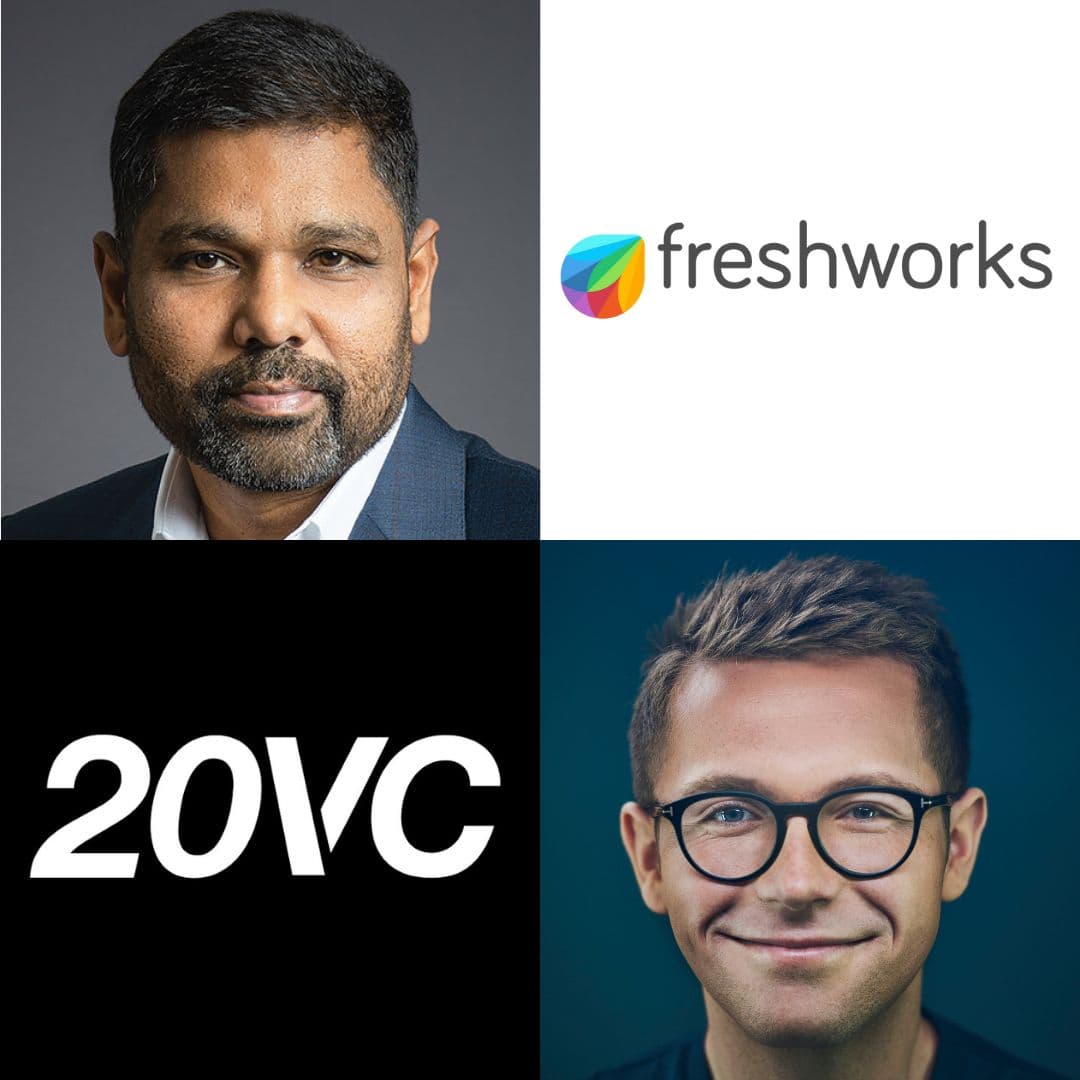
- Guest: Girish Mathrubootham, Co-Founder & CEO of Freshworks
- Host: Harry Stebbings
- Date: [Insert Date]
- Description: Girish Mathrubootham discusses his journey in founding Freshworks, the challenges faced, and insights on scaling a successful SaaS business in India.
---
Key Themes and Discussions
- Founding Freshworks: A Journey from Frustration to Innovation
- Inspiration for Freshworks:
- A poor customer service experience led Girish to comprehend the shift in power dynamics between consumers and companies, prompting the idea for a customer support platform.
- The initial product was named Freshdesk, which aimed to empower users in their interactions with corporations.
- Early Challenges:
- Girish faced significant challenges when starting Freshworks in 2010, including product development and market entry.
- Product Development:
- Launched the first product in 2011 and quickly garnered user interest, leading to significant early traction and customer acquisition.
- Scaling to $5.2BN: Lessons on Product, Pricing, and Market Strategy
- Global Focus:
- Girish emphasizes the necessity for Indian companies to achieve global recognition and success before establishing a strong foothold in the domestic market.
- Pricing Strategy:
- Freshworks adopted a low-cost entry pricing strategy, which proved effective in capturing the SMB market.
- Girish notes that starting at a low price and scaling up is more effective than high initial pricing.
- Learning from Competitors:
- Girish reflects on missed opportunities, such as losing ground to Slack, and the valuable lessons learned from those experiences regarding product positioning and market dynamics.
- Leadership Lessons and Building Company Culture
- Evolution of Leadership Style:
- Girish's leadership style has evolved to focus on creating an environment for performance and empowering his team, rather than micromanaging.
- Hiring Mistakes:
- The podcast reveals the importance of conducting thorough reference checks and being actively involved in the onboarding process of new leaders.
- Cultural Challenges during COVID-19:
- Girish discusses the difficulties of maintaining company culture remotely and emphasizes the importance of genuine interpersonal relationships within the workplace.
- India's Potential in Tech and AI
- Current Landscape:
- Girish asserts that India is on the cusp of becoming a significant player in the global tech landscape, particularly in SaaS and AI, supported by an increasing number of startups.
- Misconceptions About Indian Tech:
- A prevalent misconception is that Indian tech companies primarily focus on the domestic market. Girish clarifies that many are designed for global markets from the outset.
- Girish's Investment Perspective
- Founders' Traits:
- Key traits Girish looks for in founders include domain expertise, world-class craftsmanship in their offerings, and their ability to build strong teams.
- Investment Lessons:
- Reflections on personal angel investments and the importance of aligning with founders who demonstrate resilience and a deep understanding of their market.
---
Key Takeaways
- Empower Your Team: Successful leadership involves creating an environment where teams can thrive and innovate.
- Global from Day One: Startups should aim for global markets initially to enhance their growth potential back home.
- Learning from Failure: Every setback provides valuable insights that can guide future success.
- Adaptability is Key: As industries evolve, so must your strategies regarding product development, pricing, and market engagement.
---
Conclusion In this engaging episode, Girish Mathrubootham provides a wealth of knowledge for entrepreneurs and aspiring leaders. His insights on scaling a SaaS company, leadership, and the future of Indian tech offer lessons applicable across various industries.
For more insights and full episodes, visit [20VC's website](http://www.20vc.com).
Written by AI. May contain mistakes. Listen to the episode to check what was said.
Transcript
Automatic transcript. May contain errors.0:00First thing is what gives them the right to win in that market. You have to have spent a lot of time in the problem domain to be able to solve that problem. Number two, craftsmanship. If everything that they do, whether it's a deck that they send or a product mock that they have, can I see them to be world class because you cannot win in a global market without being a truly world class product? And then their ability to hire a great team. The great founders who know the distance are the ones who are able to build a great team. If you hire a great team, the work will get done. This is 20VC with me Harry Stabbing.
0:34So what a special day. I think it's the first Indian guest we've had on the show. In seven years, I'm so excited for this. And what better guest than Gyrish Mathrabutham found and see of Freshworks? India's first SaaS company to list on NASDAQ. Today, Freshworks has over 596 million in Aero. with a $5 .2 billion market cap. Gyrish is also a founding member of SAS Boomi, Asia's largest community of founders and product builders, and on top of that, Gyrish is also the founder of TogetherFund, a $150 million fund, focusing on Indian B2B companies going global from day one. But before we dive in, let's face it, your employees probably hate your procurement process.
1:16It's hard to follow, it's cobbled together across systems, and it's a waste of valuable time and resources. And as a result, you probably are facing difficulties getting full visibility, managing compliance and controlling spend. It's time for a better way. Meet Zip, the first modern intake to pay solution that can handle procurement and all of its complexities, from intake and sourcing to contracting purchase orders and payments. By providing a single front door for employee purchases, Zip seamlessly orchestrates the procurement process across systems and teams, meaning you can procure faster with the least amount of risk and get the best spend ROI for your business.
1:53With over 4 .4 billion in savings for our customers, Zip is the go -to solution procurement for enterprise and industry disruptors, like Snowflake Discover Lift and Reddit. Finally, a solution employees love to use, where buying things for work just works. Get started today at ziphq .com, slash 20vc. And speaking of game changer with Zip, we have to talk about Kool -E. The global law firm built around startups and venture capital. Since forming the first venture fund in Silicon Valley, Coole has formed more venture capital funds than any other law firm in the world, with 60 plus years working with VCs.
2:30They help VCs form and manage funds, make investments and handle the myriad issues that arise through a fund's lifetime. We use them at 20 VCs and have loved working with their teams in the US, London and Asia over the last few years. So, to learn more about the number one most active law firm representing VC backed companies going public, head over to coolee .com and also coolee .com. Coolee's award -winning free legal resource for entrepreneurs. And finally, travel and expense are never associated with cost savings, but now you can reduce costs up to 30 % and actually reward your employees. How?
3:06Well, the van rewards your employees with personal travel credit every time they save their company money when booking business travel under company policy. Does that sound too good to be true? Or Navan is so confident you'll move to their game -changing all -in -one travel corporate card and expense super app that they'll give you $250 in personal travel credit just for taking a quick demo. Check them out now at navan .com -4 -2 -0 -VC. You have now arrived at your destination. Gareth, I am so looking forward to this. I've spoken to so many mutual friends before we do this, so thank you first for joining me today.
3:41Thank you for having me. Now I think the great entrepreneur has shaped early garish and so I want to hear, how would your parents and how would your teachers have described a young garish? I don't think they would be very fond of me at that time. I was always the naughty, the revolutionary kid like Horde and Fitton. I have been pulled up by my teachers several times. Like I've been asked to leave the class in engineering so I think I was always the one Horde and Fitton or at least been tried too hard. I think Naughty Boy is always a good start to any school in career. We look at fresh works today and it's this incredible business.
4:17Every business starts somewhere. 2010, it was not obvious. Take me to the founding moment of FreshWorks. How did that come to be? And what was that origin story? Before the origin story is I spent almost 10 years of my career building products. I was an accidental product manager. My boss threw a challenge to me saying, a year on authoritative person you are in marketing which is a very conservative role. So you should try building products. I went and googled for the term product manager roles and responsibilities in 2001 and out 2002 I think and that's how I stumbled upon being a product manager and I really fell in love and created multiple products.
4:55The Freshworks origin story I think there are two stories in it. One in 2009 I was moving back from Austin Texas to Chennai, India. I was shipping all my household goods back and amongst them was my price position of 40 -inch Samsung LCD TV. Long story short, two and a half months later my stuff arrives, the TV comes broken. I thought, okay, I have bought shipping insurance so it should be fairly easy to call the shipping company and get the insurance process claimed. And five and a half months of back and forth submitting multiple documents, they simply wouldn't process the claim. And so I went and shared my experience on an online forum which is where I originally got the reference for the shipping company.
5:34So I wanted to really hurt their lead gen because I had a bad experience. As expected, the community started engaging and the president of the company came and apologized the same day and the next day money was in my bag. And the backstory here is in my career, I have built four customer support help discs in different categories, all on prem. And what happened to me in my life was something which was intriguing because you know in customer support when you call a call center when you call your cable company. As a user, you always feel powerless, right? Like you, it's you one person against a big giant company.
6:10But here what happened in my life was, Hey, I was able to take on a much bigger company, share my story, get other users to come and see what's happening and then force the company to do the right thing. So I sensed a paradigm shift in the power dynamics here. So and I started researching. The first thing I found was on YouTube, there was a United Airlines brakes guitars. There was a song by a musician. I don't know if you've seen that. It's called United brakes guitars. This was happening on YouTube. This was happening on blogs. So that's where the idea to build a fresh help desk came about. That's why the first product and the company was called fresh desk.
6:44And so we launched in 2010. So we launched FreshWars 2010. What happens then? Do we have like immediate product market fit? Is it very clear that it's working? I launched the company in 2010. We launched the product in June 2011. I'll tell you what happened. March 18th and 19th were very, very important days where we were a small team of six people and I was not coding. I was doing everything else. One of the things I was doing was I was trying to participate in an app sumo contest called the Lean Startup Contest where the price was $50 ,000 if you write a blog post on how your startup is a Lean startup.
7:21While I was waiting for the product to get ready, I was as the CEO and marketer I was trying to do these things to see if I could get some money. I actually wrote a nice post on hacker news on how a simple comment on hacker news made me quit my comfortable job and start a startup. So I shared that story and posted on hacker news event viral on March 18th. It stayed on as the first post for like three four hours and on the top page for like more than a day, which is pretty incredible on hacker news. And I had a website with a simple woofoo form, the product was not ready. There were so many people were coming in and filling all those woofoo forms like hundreds of users had already signed up.
7:59So I talked to my team on March 19th and said, Hey, we have all these people showing up at our door. Can we cut down our scope and release something quickly and start engaging with these users? So March 24th, we put out a beta or at least an alpha, which we started sending out a few customers. May 15th, we launched our beta version with 500 people trying our products. By August, we had like 70 customers. So we had 100 customers in 100 days, 200 customers in 200 days. We have not yet reached funds. So we were actually off to a great start. Help me out here because we often hear the trope that you should always be embarrassed of your V1.
8:39Were you embarrassed of your V1 when you look back now? And do you agree with that scope? Would you actually think that you should just ship as soon as possible? So I actually was terrified with the alpha release that we put out. I'll tell you, even though we had like 300, 400 users who had signed up, I was worried that the product would crash. So I first sent it out to five people who had signed up way back in October. And then nothing happened. Nobody came and then I sent it to 15 people and then I sent it to 30 people. So I was trying to see, make sure that, hey, the servers wouldn't crash because suddenly 100 people are coming in, right?
9:11And I wouldn't say I was embarrassed. But today if you look at the product and if you look at what was there. Yes, you could say that. One of the things that worked well for us was we had priced our product very low. So we were fishing in a very different pond. So our product was priced at $9, $19, $29 per agent per month. That was the highest. Our competition, the lowest price was $29 a month to get started. So which means we had basic functionality that did its job. Like you can call it minimum viable product. I call it minimum desirable product. Something that will work well, people are happy with the UI, they're happy with the price.
9:49And not surprisingly, many of the early customers that we got were really small SMB customers or educational institutes wouldn't have large budgets. And my learning as a product manager has been that you can always grow into a much higher price point, you can build more features and create all these enterprise versions. But when we started, we were really solving for that SMB customer with a basic price. Do you think it's much easier to start low and go up than it is to start high and go down? Start high and go down never never works in the history of software You can tell me which company are succeeded in starting at enterprise and Actually winning in SMB.
10:25It's not happened But if you look at many companies including Salesforce and Freshworks, we have all and now you can see HubSpot and and most of the companies always start small and then it is possible to build over time and go up I think there's a couple of different aspects I just have to dig in on here. You also chose to be global from day one. If I was advising you, Girish, which is why I should never be advising you, I would have said that's a terrible idea. We should focus on a very specific region. We should dominate it. We should build brand. Why did you decide to be global from day one?
10:57And what are some lessons from that choice? Yeah. See, the fundamental lesson that I learned in life was taught to me by my boss. He said, Girish, it's easier to earn one dollar than earn one rupee. You have to have worked with Indian customers to really understand how hard it is to do business with customers in India, especially when you're an early stage product, your roadmap will go for, they would hijack your roadmap. But if we win globally and then go to India, the chances of success are actually even better. If you see most of the even Indian startups are doing well, like I would say Browse Stack, ChargeBee, they're all global companies who first won globally and then win.
11:36Just help me understand that why is that? Is that because Indian markets need social validation from external international markets before they will buy? What is the reasoning? I think to some extent that could be true, but also Indian customers are used to a services mindset Like if you go to US or Australia customers there know that they are buying a Shringcraft product they know that hey the product is the product if I like it I'll buy it if I don't like it. I don't buy it if I have some feedback I'll give the feedback if I need a feature I'll ask and wait. Imagine going to Microsoft Office and asking for a feature like, when are you going to get it?
12:12So I think global customers have the awareness. Indian customers have been used to a lot of services mindset where they would say, hey, why don't you come to my office? I'll tell you what needs to be built and you build it. Is there anything you would do differently about your geographic expansion? Sorry, knowing all that you do now. No, I would do exactly the same thing. because at the end of the day, one of the reasons for a fresh work success is the market. Right? So when you are servicing a large market and you're able to service it with the right unit economics, that's the best formula for a startup to win, even if you have, let's say, average CEOs like me.
12:49So when you were priced so much lower than ever and else, how are you able to have attractive unit economics so early with such smaller ACVs? You have to understand the whole unit economics of if you break down the CAC, the customer acquisition cost, for a SaaS startup that is being built in India versus the US, see in the US the CAC would be two -thirds sales and one -third marketing. Because sales people are so expensive, if you're sitting in San Francisco or even London for that matter. What we did was what is today known as product -led growth. So we actually do a lot of SEO work and Google ads and stuff like that.
13:27and look at the keyword density. So we make sure that we are able to drive traffic from people who are searching for all those keywords. The website is designed to get the customer into the product quickly without talking to anybody in sales. So the pricing is open, and the products are built to be intuitive, do it yourself kind of product. So the online buyer who's coming in feels like, hey, I'm trying to do this, and I feel simple enough easy enough. I can do it on my own. And the pricing is here. you can put your credit card on file, there's no back and forth contract negotiation, no redlining of contracts, no non -disclosure agreements.
14:03Okay, I like it. It's $29 a month or $19 a month for three seats. I'll just put my credit card and buy and go. When you review that strategy and where we are today, do you think that keyword approach, that SEO focus, that keyword targeting, that approach would work today in the plethora of PLG mass that we have today? It's still a place it's part, right? So I'll also tell you some of the areas of research where we're working on like search engine optimization. Now we have a generative engine optimization, right? Like a lot of people are going to go to chat GPT and ask about which software should I use.
14:40How do we make sure that the AI models are trained to tell customers that fresh works is a great product? That is when the future is going if people are not going to Google for search, but they're going to chat GPT. So we need to do that. But are you seeing people shift in terms of reformability? OK, I've started doing that. A lot of employees have started doing that. I'm sure you have probably started doing that. Are you going to charge your GPD more often now? If that is true, when we have questions, we want answers. So we have moved from a world of search for keywords and get a bunch of links to, hey, I have a question.
15:12Give me the answer, right? So I think that is a very fascinating world. Couple of things that just have to unpack before we move on to enterprise and SMB. You mentioned the low pricing being really easy for them to sign up and just low friction You know Mark Andreessen said if I could have a billboard I would have on it raise prices What are your biggest lessons on pricing from the very successful low pricing you have and how do you reflect on that? At the end of the day pricing is all about who are you selling to? What do they care about? What is your entry wage into the market? So if I have something that can solve a great problem for a large enterprise and and I can increase my prices and charge whatever I want.
15:51Then that could be the strategy that Mark Andreessen is saying. But if I am the 600 and first help desk, like when we started fresh desk, there were 600 help desks already in the market. There is a website called helpdesks .com where you can go and filter and search what kind of help desk you want. So for us, we wanted to win by superior execution with better design, better UI and a great price and then build our brand and then race prices. Of course, today we have customers who pay us a couple of million dollars a year, also many customers who pay us over a million dollars a year, but we also have customers who start off paying $29 a month.
16:28Is this not a product marketing nightmare, Girish, in the way that you have 500 people who all serve the same customer base or similar product sweeps? How do you think about the product marketing challenge of differentiation in such a crowded field? One of the tools that we used in product marketing. That's a great question by the way. A lot of times in the early years, right? When you are getting traffic to come to your website, you're not really controlling who's coming in. It could be a 5 % company or it could be a team member from a 5 ,000 % company who's trying to come and buy something. So, as early as 2013, we closed enterprise customers like Burger King, DHL Pearson.
17:07So, all these like teams of users from these companies came online, looked at the product, it solved for their use case. Of course, it was not an enterprise wide deal, but it was for one team within a larger enterprise. Like, if you remember, there was a company that Tesla bought another Elon Musk company called SolarCity. So we entered SolarCity, I think, with a 25 -C deal. Two years later, when we hired our first president of sales in the US, he went and spoke to SolarCity. We found out that 13 different teams were using it more than 1000 licenses. They were almost paying us a million dollars a year, but under 13 different in voices.
17:41So the CFO was not even looking at us in the top 10 vendors by payment. So we were flying under the radar because all these teams were using the product. Packaging is an answer which our tool we use to kind of segregate the SMB players with limited feature set and we put all the enterprise features like sandbox, audit logs and all the other stuff into an enterprise plan so that larger companies can actually migrate towards that. We in short, you have to keep the experience consumer -like, but all the advanced features need to move away and surface itself with the right time. So I have so many companies that were invested in now who say, hey, we're in SMB and we want a scaled -wind price.
18:23And I say, no, no, no. Like SMB market is so much bigger than you think, and building an enterprise business is so much different. It's a different business. Do you agree with that perspective? It is hard. See, if it was easy, everybody would have done it, Right? See today, Frisch was as over 67 ,000 customers and more than 2 ,000 plus customers actually pay us over $50 ,000 a year. So we have a long tail of SMB customers like 87, I think 87 % of our revenue comes from customers who pay us over $5 ,000 a year. And so we have that long tail and we have a few big whales. So why do you have 13 % then beneath?
19:03I always think like often your smallest customers will be almost difficult. They'll be the ones who can play in the most on social, who just aren't champions, cut the bottom and you don't need them. We are always looking for optimal ways to find customers who are higher value customers, but it is the nature of the game. Like when you are dealing with search globally, you will attract all kinds of customers, right? So we have our sales processes to and are marketing fine tuning to take us towards the right customers, but also we are, we are to remember that fresh works is a multi product company pretty much all of our $5 ,000 customers probably started off paying us $100, $750 or whatever.
19:43And and even some of our $50 ,000 plus customers are actually SMB customers who have adopted three, four products from us. So, so this strategy of keeping the long tail open, feeding it, and then letting customers grow and use multiple products and and give us more value as work well for us. What are your biggest lessons on one's to a second product? You have a product suite today, you mentioned that people using multiple. What are big lessons on one to expand to a second product? So you have to do it when your first product is actually doing well. What we have done at Freshworks always is when you have one product that's like the wheels are spinning fast, money is coming in.
20:21So while you're continuing that I always say that my job as product manager, I have to worry about the revenue that's going to come in 26 and 27. My sales VP or my president can worry about the revenue that's going to come this quarter or next quarter, right? So, product person has to worry two, three years down the line and do the work now because when you do the work now, you will probably launch it next year and then it will start to build slowly and then for you to get momentum, we take two, three years. Honestly, Girish, when I listen to you, everything seems like it kind of just worked and I know that the startups never liked that.
20:53And so, when we look at the movement from SMB to enterprise, It's the pricing structure, the global from day one. Where did it go wrong? What broke and what are some lessons from that? Yeah, so first of all, I'll tell you, clarify that when we layered on a second go -to -market motion, we were focused on mid -market, not necessarily enterprise. So mid -market we define as 500 employees to 5 ,000 employees, because we found that, hey, that segment of the TAM is huge. They are probably not big enough to have budgets in the millions of dollars for the enterprise systems and their needs are similar and so the sweet spot for us could be in the 500 to 5000 employees.
21:31So that's when we overlaid the second good market motion of now what we call as a twin engine model. One of the life lessons that I've had is you have to learn to live with the consequences of your decisions, right? I will tell you the number one challenge for fresh works is or for any company for that matter is balancing this two good market motions, right? The needs are different. The friction as you rightly said product management child product it becomes hard, but we are also enjoying the fruits of that decision. We are a multi -product company that is working in multiple segments. So our revenue is coming from like we are second product recently crossed 300 million dollars in ARR.
22:06So now we have two product lines north of 300 million in ARR. So when we are enjoying the fruits of that and the second product fresh service is squarely winning in mid -market. It's the most affordable alternative. We are winning enterprise customers every day, every quarter. And so when you are enjoying the of fruits of that, we should learn to live with the challenges and frustrations that come with that. What are the challenges and frustrations I just want to dig in on this because I think that's what learning has come from. Yeah, so I think there are tons in every department. So the number one difference in product management is when building for an inbound user, you focus on intuitive do it yourself product.
22:44When you're building for the enterprise customer, they are not going to do it themselves. You need an SI partner who will be trained to use it. So product managers can actually build stuff that's not very user friendly. My challenge internally is how do I drill into my product managers that even if you're building for mid market enterprise, it doesn't hurt to keep that intuitive user friendly interface. That is one of the stuff in product, right? Pricing enterprise sales guys always want the highest possible price because they believe they can sell when I'm selling inbound users, the sticker shock will drive away website visitor.
23:17So I need to make sure that the pricing is affordable and open. Enterprise sales guys will want to say contact sales. They don't want to publish the pricing on the website. So how do you balance this? So now we make a philosophy that our pricing will be open. It will be on the website. So that's the company policy, right? And the other important challenge would be hiring. When you're hiring leaders, it's incredibly hard to hire leaders who understand both the nuances of both these businesses. So if I hire enterprise sales or marketing folks who do not get the imbalance side of business, then that part of the business could start suffering.
23:52If I hire inbound folks who don't understand the enterprise business, then that could also be made our share of gone through our share of challenges in terms of getting the right people who are experts on one thing, but how do you build a complimentary team where every function gets its deservedly rich? What are the biggest hiring mistakes you made there? I think hiring is one of the hardest challenges of business building. Oh, so I think my biggest mistakes have been there. I'll give you three or four right number one I did not do ref checks on candidates who actually came through like investor referrals costly mistake I should have talked to people who reported into those leaders and got a style of their management style on a couple of occasions have gotten carried away by the resume like hey they work for a great company went to a great college they should be incredibly smart and so obviously there'll be a fit here no boom didn't work out cultural misfits my management style I'm usually very hands -off in terms of when I hire a new leader, we look at all the best candidates and then we hire the best possible candidate.
Read the full transcript
24:50Then I step out of the way and let them play the game also. A lot of us in India, like we have not been there done that. So a new higher experienced talent, we assume that, okay, we are going to learn from this candidate so we let them play, right? But what happens is one of the most important lessons I learned which every CEO should do is while you can be hands off the initial period of letting the leader transition and settle in, you have to be closely involved in all the big decisions, you have to be watchful of how they're treating their people. So one of my OKRs now or my performance objectives is when I hire a new management team member, getting them to success is actually my OKR.
25:29So I need to make sure that... What are the biggest lessons and what it takes for them to be successful in that period? OK, you need to be on top of the more and you can't just leave them, but what is that actually break down into? Is granular and specific as possible? I'm really interested. I'll give you a couple of stories there. One of my friends, Chandar, who is the CM of Kupa, wrote a LinkedIn post recently. He said, when when you're changing jobs, philosophies are portable, playbooks are not. You can bring your philosophies and values, but you cannot take, bring your playbook and use it as a template to run in the new company.
26:01And the way I used to tell that one of my first meetings with every new leader that I hired, this is an original management lesson from me. I said, I always ask the leader, you need to learn to ask which cow which ditch. There is an ancient Indian fable which says, hey in a village when a cow falls into a ditch, you first need to take the cow out of the ditch and then you fill the ditch with sand and then you go and educate the villagers on how to prevent cows from falling into ditches and the sequence in which you do these things is important. And that is the original story and my adaptation of that is as a new leader, When you come with all your experience in a fast growing startup, you have to understand that there are already hundreds of cows that are falling into ditches.
26:47So if you want to be successful at fresh works, you have to ask the question, which cow, which ditch, which means where can you help? What are the top two or three most important priorities or problems that you can help solve? Go and help those cows from the ditches and then we will listen to you, give us a lecture on how to prevent cows from falling into ditches. What was the biggest cow in the ditch to follow your analogy that you didn't identify for a while? 2015 we were really really growing fast and we were hiring a lot of sales folks and the sales wheel was spinning faster than the engineering wheel.
27:23We didn't hire enough engineers. We added like thousand customers or something like that. Feature requests were coming flying in and our engineering team was actually involved in a Ruby on Rails upgrade. So we couldn't even ship enough and so I realized that okay, how do you balance hiring across the org and so we did not have a process to do headcount planning in advance looking at okay, where are the revenue numbers going to be next year and how much now we have a full blown headcount planning process but but that was a big mistake that I did where I didn't hire product developers enough. How do you think about the balance on the product suite?
28:02I was really interested, but I didn't want to interrupt your flow when you were doing my different products. When you said your second product now crosses 300 million in an error, you have a resource allocation question as the leader, which is, I can put more money into growth, plow this forward, or I can do a third product and a fourth product. How do you balance between investing more in that killer product second that works versus expanding further with net new products? Yeah, in the early years the first decade as a VC funded company see one of the things you have to understand in that inbound model The secret source for fresh works was the business model disruption of being able to Profitably serve the long tail of the global SMB from Chennai when I was enabled to articulate it as early as 2012 When fresh disk the first product had not even hit a million dollars.
28:49I was already working on the second product called fresh marketer I had booked 40 domains starting with fresh in 2010 and 2011. So my dream was to build a multi -product company and use the inbound PLG motion across so many products. You also have to understand that when we took our first round of VC money and then we spoke to some of our investors, they actually gave me advice, which is good advice at that time, 2012. Gereesh, your first product is not even a million dollars in revenue. If you build a second product now, you would be confusing the market. people think you're pivoting from customer service to marketing and and if you're going to raise your next round of VC funding that investor will be confused on why you're doing this.
29:29So I actually killed the fresh marketer product that we built in 2012 because it was good advice. But then I actually convinced our board to let me build fresh service which is today the three hundred million product because fresh service in a sense was help desk for employees. Fresh desk was help desk for customers. So and there was a company that Microsoft acquired called Pareture, which had done something like that. You had Pareture for IT and Pareture for CS customer service. So in that sense, we are taking something that is already working, they're ticketing knowledge based self -service model.
29:59And what is working well for external customer service? We were trying to do the same thing for internal employee service. So I convinced our board to let me build the second product within that narrative of being a help desk for employees. And that product hit one and a half million in the first year and six and a half million in the second year. and the board understood the power of the model, then my early VC investor, Shaker from Excel said, what are all the products that you can build? Have you ever had a product know work? Yes, two examples I can give you. One is a product called FreshConnet.
30:30This was the early days of Slack, when we saw Slack really growing rapidly. So I could see that enterprise collaboration was actually gaining momentum. And this was even before Microsoft Teams had launched. The theory in my mind was if I look at how our customers or our employees were using Slack So they would get a customer service ticket and then they would go on Slack and ask somebody for help and then that person will say Okay, send me the link to the ticket then they'd copy paste the ticket link and then the person would go there They need to have a login and then they would read the customer contacts and then they come back on Slack and offer help So we found that okay, Slack is actually winning because enterprise software is broken in collaboration So what we wanted to do was bring context and collaboration together.
31:14Like while you are working on a customer service issue, how can you collaborate on that ticket then and there? Like how you do in WordDoc, right? Google Doc. But what had happened by the time we were late, like we took more than two years to launch. And by the time both Slack and Teams have actually started winning so many users, when we took it to our customers, the CIOs actually told us, we are already dealing with Slack and Teams. We have to sanitize on one. please don't give us a third. So I think we were late and we lost the game but do you know right away when a product isn't working or do you think it takes time to know?
31:48I think you will know at the end of the day customer adoption will tell you pretty quickly whether it's working or not right so and we knew that so what we did was we conceded collaboration so today our same fresh connect code that we built is integrating with Slack and Teams So we considered collaboration to teams and slide. Can I ask you, when you think about your leadership now, we've spoken about so many different aspects from the pricing, from the geo -expansion, to the building, hiring teams, how has your leadership style changed, Girish? How have you changed as a leader? One of the things I've always believed in is my job as a leader is to create an environment of performance hire the right people and get out of the way.
32:28Personally, I'm more like a jack of all trades, right? Like I don't write code. My style has always been believe in the power of a team build the right team higher great people with a learning mindset and with the right passion to excel in whatever they're doing create an environment of Performance get out of the way. How do you create an environment performance? You find people who are passionate about what they do that starts with our hiring process and the context in India you have to understand is everybody finishes is computer science engineering and then figures out what they want to do in life.
33:00So, I have folks working in sales, in pre sales, in marketing for all computer science engineers. So, that's a very different content, which means our hiring actually identifies what are they really good at because if you are truly playing to your passion, you don't have to work for a day in your life. Somebody said that. So, what becomes play? So, that is core to getting the right people on the job. And that's the first thing for environmental performance. Second thing is all about culture. How do you treat people? We build genuine relationships. Our manager training program is called Lead with Heart.
33:36So I've never done empty pep talks, sugar -coated feedback. Like if I am happy with somebody, I'll tell them I'm happy. If I'm unhappy with somebody, I just do it in private. But I actually tell them what didn't work out. I am still friends with all the people I've fired and let go also. because it is never personal, it's all about having that open conversation, telling people why something is not working out and why we have to part ways. So creating that environment of performance means you need to act when you have made bad hires. I've also said in one of our early versions of a culture called that, don't be a jerk, even if you're brilliant, don't be a brilliant jerk.
34:13And we've seen that it's about team winning, not about an individual superstar win. as there ever been a moment where it feels like the culture is broken. In pockets as the company grows larger, specifically around Covid, it was incredibly hard to build culture on Zoom. Like I have felt that we had taken a few steps back, like the next two, three years has been incredibly hard, that nobody coming into office, people jumping from Zoom meeting to Zoom meeting. Why, I still don't know how to build culture when nobody's coming into the office. Can I ask a bit of a weird one, but in the journey that you have as an entrepreneur, You change financial profiles as well.
34:49I always ask this because I think it's such an interesting one How do you reflect on your own relationship to money? So money doesn't really change a person. It only amplifies who you really are and I know so the other thing I believe is the purpose of money is to serve society so beyond a certain need I have no interest to kind of keep accumulating more and so I I believe it's it's more about giving and giving back So for me to truly succeed in life, you need to unleash your purpose. We have this incredible opportunity to make an impact on so many lives, lives of our employees who have been with us for so many years.
35:24Now when they share their stories of them buying a home with cash or being able to spend for their siblings' weddings and things like that. Or we have a software academy where we take students who can't afford college, teach them software skills and then place them in companies. FC Metras is an example where we are helping young sports people built into athletes. I did just want to ask, when you were talking about young people on purpose, what do you advise the thousands of young people stay who don't know what their purpose is? See, I think this is where the Maslow's need hierarchy has to play in.
35:59It is quite common for young folks to not worry about things like purpose because, and I'm sure all of us are familiar with the Maslow's need hierarchy. First comes the physiological needs, then the safety needs, then social needs and esteem needs. I think people have to go through the journey and when you don't have enough for yourself you're not going to be able to think about purpose. But I think it's okay. Like when I reflect back on my younger days, I did not actually have a lot of purpose. It was more about hey I need to first make money, I need to provide for my family, I need to do all these things and then once you, it dawns on you.
36:34Like once you become successful, once you make money and And then you realize, okay, what do you want to do? That is time and it's okay. I do have to ask, India and Europe are often characterized in the same way, which is every generation we say, ah, now's the time for European tech, or now's the time for Indian tech, and we're still kind of waiting. There's amazing companies like FreshWorks or Spotify in Europe, but there's not that many. Why is now different, or is now not different? This is the time. I would now say now is the time for Indian tech product companies and this is going to be the decade of India as a Product nation.
37:10What I am seeing we are living the reason why I even started a fund called Together Fund and we I'm a co -founder of an Organization called SAS Boomi. We just had our annual event two weeks ago in Chennai. So in 2016 when we first came together as a bunch of There was a grand total of 40 SaaS companies building global products in India. We didn't find any ecosystem, so we decided to create an ecosystem. Last year, there were over 3500 companies in India and 1000 people, 1000 founders attended SaaS Boomi. This year, there are over I think 6000 companies in SaaS and AI in India and 1600 of those founders were attending our event.
37:52and so we are just seeing this tsunami of startups happening and I will also tell you in the last two weeks alone at our fund together fund we have received 150 applications from startups in two weeks. We have never seen this kind of deal flow before. This is really really happening. The other challenge to people put to the ecosystem and they put it to Europe too is the lack of liquidity markets. That's changing now that was the that's the old perception. So when you look at what has happened in the recent years the flip Walmart acquisition of Flipkart showed that a very large M &A can happen in India.
38:26The Freshworks IPO on NASDAQ showed that you can take an Indian startup and actually list in the US. The local listings are actually even more attractive when you look into Zomato and Paytm and so many other startups actually listing in India. So there are also been PEE exits like PEE back exits. So all different kinds of liquidity has actually been demonstrated it now and yes that was the complaint against India that hey there is no liquidity but it is starting to change. What's the biggest misconception about the Indian tax ecosystem? What do you hear the like, oh fuck sake I wish that would change.
38:58People think that we will build for India first and then go global as opposed to many of the Indian SaaS product companies are actually starting global on day one and that I have found many times when I am talking to LPs and investors they don't get it because the US company would sell in US and Australian company would sell in Australia first and then branch out. So they're all coming with that preconceived notion where we had to educate them saying, hey, these are global product companies that are getting customers internationally from day one and there is a playbook for them. In terms of those incredible companies that and founders that are building in these markets, you then choose to be an investor as well.
39:35We see that together fund logo behind you. Talk to me about that decision, Gersh, because you could just be an angel investor. Why I like institutionalize it with a fund. And in your decision making framework, why did you decide that was the right decision? Yeah, so I think I was angel investing before starting the fund. I've made around 60 or 70 startup investments, but most of my investments are small. Like $25 ,000 could be the average check size, right? So when we created SaaS Boomi, we started opening up our playbooks and sharing this with startups because the dream was about India as a product nation.
40:10See, when you look at it from outside, it'll look like, hey, Gresh is doing fresh works, he's doing sass boomy, he's doing together fund, and also he's doing FC Madras. Why are you doing all these different things, right? Like, in my mind, it's a unified connecting theme. How can I be a catalyst in creating world champions from India or world leaders from India? For the first three, it is India as a product nation. So when we did all the work in sass boomy, we still realize that our startups had to go for funding from traditional investors while they are very savvy financial investors, there was very little operational expertise that any investor in India actually brought to the startups, which means you could end up with a good investor or a bad investor sometimes looking at excel sheets and not really understanding how to help the startup.
40:55This is why when Manu and I, both of us co -fronted as Bumi talked about this, he proposed this idea. At that time, there was not a single VC fund was focused on B2B global SaaS products from India. Today everybody wants to invest there, right? But when we started the fund, even today we are the only operator -led fund in India and we are the only fund that's focused on SaaS and AI investments only. Generally, all the VC funds were sector -agnostic, like they would invest in consumer internet, they would invest in marketplaces, they would invest in FinTech, they would invest in SaaS. Like we believe that we can build an operator network and truly help these startups really scale and that's how we can be a catalyst in that journey of creating the next few global product companies from India.
41:38Is it harder than you thought? I find a lot of operators you move to Vanshara like God, it's more hard work than I thought it would be. Is it different what you thought it would be? See I think it is hard work but I will say I'm tired not stressed because it's like playing a game. Like I see I'm always anyway working with startups even when I made say like 60 to 70 startup investments. I have spent time with startups. So I enjoy doing that. I learn a lot interacting with these younger founders. In terms of time everybody has only 24 hours a day and I get my time to play tennis and do the other stuff that I like which is watching movies and so everything else is work.
42:13So it just keeps going. What's the most non -obvious thing you look for in the Founders You Bag? So for example for me I look for early signs of exceptionalism in something. It could be an exceptional footballer when they were nine. it could be they made money selling cookies when they were eight and made a $5 ,000 whatever it is. What's non -obvious? Three or four things I don't know if it's not obvious or obvious. First thing is what gives them the right to win in that market? Because sometimes I meet founders who say, hey I evaluated 160 ideas and I picked this one based on these 70 parameters that I looked at.
42:48Super smart founders but I don't get excited by those founders. So for me you have to have spent a lot of time in the problem domain to be able to solve that problem. So what gives you the right to win in that market? That's number one. Number two, craftsmanship. Everything that they do, whether it's a deck that they send or a product mock that they have, can I see them to be world class? Because you cannot win in a global market without being a truly world class product. And then their ability to hire a great team. Well, this may seem obvious. Many times you see people hiring just younger folks, fresh out of college, they don't have the ability to sell their vision when they don't have anything, right?
43:28But building a product is not about you, I building a company is all about people. The great founders who go the distance are the ones who are able to build a great team. That's my opinion. That's the most important part of the challenge. If you hire a great team, the work will get done. But if you have great ideas, but you don't have a great team, then no matter what you do, you're solving it. final one. What's the biggest investing mistake you've made? I've made many. I've also made many. I think when I was angel investing, I have a very optimistic person, right? And I love founders. And so it's hard to say no.
44:03So a lot of times I have given them checks just to help them even when I'm not 100 % convinced that they would work. So then I realized that I'm not really helping them. So then I got my angel investing bar also to be a little bit higher. Is that a mistake? That was a deliberate choice to help someone. It's very kind of you. But I didn't think that. Yeah, I thought you asked for investing mistakes. Yeah, but I didn't think that's a mistake. Yeah, no, no, no. They were all investing mistakes because the companies wound down. I lost my money. I counted as an investing mistake. I don't regret my decision.
44:33But from an investment standpoint, I think, I, by the way, my one investment returned all my entire angel portfolio. So, and I still have seven unicons there. Wait, where, which one? Charge B. charge B. What price did you invest at charge B? I think it was 2 .4 million pre -money valuation, a 20 -acre investment turned into a 3 .4 million return. Wow, did you sell? Yeah. Well done, Garrosh. You can play for FC Madras for two years now with that. Dude, I love this. Can I ask you a weird one? What's the secret to a happy marriage, Garrosh? So I think everybody has to go through that and be patient and be a good listener.
45:11I think that's the secret. Your wife is always right as well. That's your final final edition. Listen I want to do a quick five so I say short statement you give me your immediate thought does that sound okay? Okay, so what do you change your mind on most in the last 12 months? Yeah, I always thought poker was gambling. I'm starting to learn how to play poker and I realize that it is a much better strategy game Is not gambling. What's your biggest weakness as a leader? My biggest weakness is probably I don't hold people accountable. I like to inspire, I like to tell people what needs to be done, but I expect them to do it.
45:48I'm not the kind of person who will like hold the whip, like ask for status updates and make sure everything is tracked and I think that's not my style. Are you a head or a heart decision maker? Heart. Tell me, you can have dinner with anyone that are alive. Who do you have dinner with? Jeff Bezos. I always look up to the vision and the the audacity of how Amazon has grown and again from one product to multiple products starting from literally a garage like how we started. So I think a company that's product and engineering at its core, not sales or marketing. What's the biggest mistake you see founders make today?
46:25Under estimating the market, fighting with co -founders. Final one for you. Where's Gyrish and Tanya as you've got together fund, you've got freshwork, see you've got FC Madras. 2034, where's Girish then? Maybe while watching India play in the World Cup. Girish, I've loved having you on. I had so many good things. Thank you for being so open and for putting up with my questions. This has been a joy to do. Thank you. Thanks for having me. I enjoyed it too. I have to say, Girish was just such a great character to have on the show and I so enjoyed that discussion. If you want to see the full video of that episode, you can check it out on YouTube by searching for 2 -0 VC, that's 20 VC, but before we leave you today, as face it, your employees probably hate your procurement process.
47:07It's hard to follow, it's cobbled together across systems, and it's a waste of valuable time and resources, and as a result, you probably are facing difficulties getting full visibility, managing compliance, and controlling spend. It's time for a better way. Meet Zip, the first modern intake to pay solution they can handle procurement and all of its complexities from intake and sourcing to contracting purchase orders and payments. By providing a single front door for employee purchases, Zip seamlessly orchestrates the procurement process across systems and teams, meaning you can procure faster with the least amount of risk and get the best spend ROI for your business.
47:44With over 4 .4 billion in savings for our customers, Zip is the go -to solution procurement for enterprise an industry disruptors, like Snowflake Discover Lift and Reddit. Finally, a solution employees love to use, where buying things for work just works. Get started today at ziphq .com, slash 20vc. And speaking of Game Changer with Zip, we have to talk about Cooley. The global law firm built around startups and venture capital. Since forming the first venture fund in Silicon Valley, Cooley has formed more venture capital funds than any other law firm in the world, with 60 plus years working with VCs.
48:21They help VCs form and manage funds, make investments, and handle the myriad issues that arise through a fund's lifetime. We use them at 20 VC, and have loved working with their teams in the US, London and Asia over the last few years. So to learn more about the number one most active law firm representing VC -backed companies going public, head over to Coolee .com and also Cooleego .com. Coolee's award -winning free legal resource for entrepreneurs. I'm finally traveling expense and never associated with cost savings, but now you can reduce costs up to 30 % and actually reward your employees.
48:56How? Well, the van rewards your employees with personal travel credit every time they save their company money when booking business travel under company policy. Does that sound too good to be true? Well, the van is so confident you'll move to their game changing all in one travel corporate record and it spends Super app that they'll give you $250 in personal travel credit just for taking a quick demo. Check them out now at navan .com forward slash 20VC. As always I so appreciate all your support and stay tuned for one of the best shows we've ever done coming this Monday with Daniel Dines, founder of UI Paths.
From the publisher
Girish Mathrubootham is the founder and CEO of Freshworks, India’s first SaaS company to list on NASDAQ. Today, Freshworks has over $596M in ARR with a $5.27BN market cap, with investors like Accel Partners, Sequoia Capital, Tiger Global Management, and CapitalG. Girish is also a founding member of SaaSBOOMi, Asia’s largest community of founders and product builders, and has invested in over 60 startups. On top of that, Girish is also the Founder of Together Fund, a $150M fund focusing on Indian B2B companies going global from day 1.
In Today’s Episode with Girish Mathrubootham We Discuss:
-
From Online Forum to the Founding of a $5BN Company:
-
How did a horrible customer service experience prompt Girish to start Freshworks? What was the aha moment?
-
What were Girish’s biggest challenges founding Freshwork in 2010?
-
How was building the first product? What worked? What didn’t work?
-
Biggest Lessons on Product, Pricing and People Scaling to $5.2BN:
-
Why does Girish believe Indian companies have to win globally before winning India?
-
What were Girish’s biggest mistakes scaling Freshworks? What were his lessons?
-
Why does Girish believe starting high and going down never works in software?
-
When does Girish think is the best time to build the second product?
-
How did Freshworks lose against Slack? What did he learn from the experience?
-
The Biggest Lessons to Becoming the Best Leader:
-
How has Girish’s leadership style changed over time?
-
What were Girish’s biggest hiring mistakes?
-
What was Girish’s biggest challenge in building culture during COVID?
-
What is one piece of advice Girish believes every CEO should follow?
-
How India Will Become a Global Player in Tech, AI and Football:
-
Why does Girish believe now is the time for India tech?
-
What are the most common misconceptions of India tech?
-
What traits does Girish look for in founders he invests in?
-
What was Girish’s biggest investment mistake? What did he learn from it?