
In short
Podcast Notes: The Twenty Minute VC (20VC) - Episode with Vlad Tenev
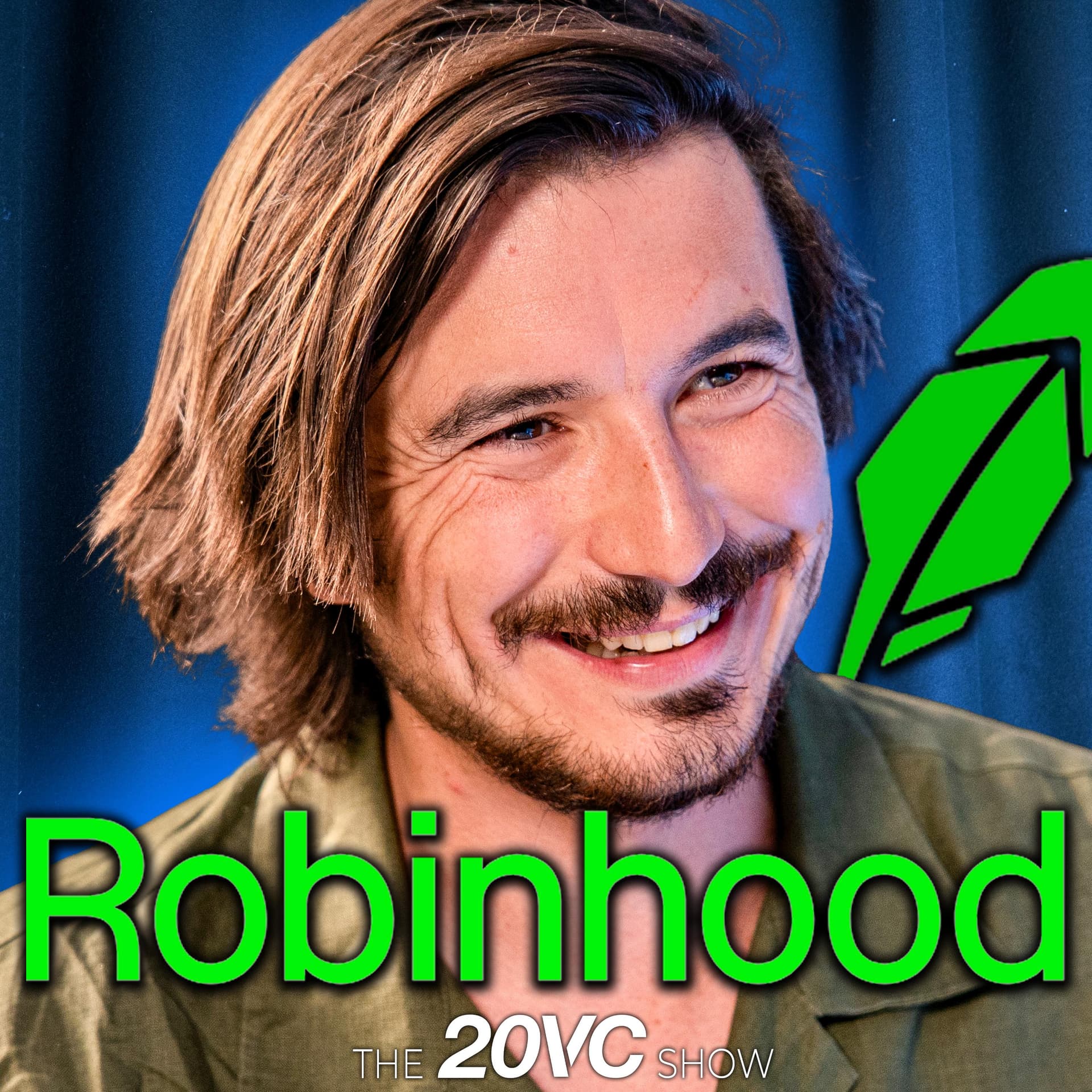
Episode Overview Guest: Vlad Tenev, Founder and CEO of Robinhood Market Cap: Robinhood's market cap has surged from $15-20 billion to over $85 billion in just 8 months. Episode Title: 20VC: Vlad Tenev on Robinhood's $85BN Resurgence Air Date: [Provide the date of the episode if known]
Key Topics Discussed
- Tokenization in Finance
- Vlad emphasizes that tokenization represents a significant innovation in finance.
- He advocates for tokenization mechanisms that work without requiring consent from companies being tokenized.
- Robinhood's Financial Growth
- Robinhood's net revenue increased by 58% to nearly $3B.
- Transition from a $500M loss in 2023 to a $1.1B profit in 2024.
- Development of nine business lines, each generating over $100M in revenue.
- AI Integration
- AI contributes significantly to software development at Robinhood, with up to 50% of new code being AI-written.
- Internal AI systems, such as Robinhood Cortex, enhance customer support efficiency.
- Customer Base and Market Position
- Focus has shifted from primarily targeting first-time investors to include digitally native active traders.
- Active traders are characterized by their high volume and specific technological needs.
- Crypto's Role in Revenue
- Vlad predicts that crypto will become Robinhood's largest revenue source.
- Discusses the potential of stablecoins to replace traditional banking rails.
- Product Innovations
- Launch of a tokenized product for private shares, specifically targeting companies like SpaceX and OpenAI.
- Plans to roll out features like a cash delivery service to cater to high-net-worth individuals.
- Regulatory Landscape
- Vlad discusses the challenges and opportunities presented by regulations in both the EU and the US.
- Acknowledges the importance of regulatory clarity for successful tokenization of private markets.
Key Takeaways
- Market Resurgence: Robinhood's impressive turnaround in market cap and profitability demonstrates effective strategic execution.
- AI Adoption: The high level of AI integration showcases Robinhood’s commitment to innovation and efficiency.
- Diversification: Expanding product lines and a new focus on different customer segments highlight Robinhood's adaptability in a competitive market.
- Future Vision: Vlad envisions Robinhood as a comprehensive financial platform catering to both retail and institutional clients over the next decade.
Notable Quotes
- "Tokenization is the biggest innovation in finance."
- "AI writes 50% of all net new code at Robinhood."
- "We need to make sure that everyone has access to the best investment opportunities."
Episode Structure
- 00:00 – Introduction to Tokenization
- 03:28 – Market Cap Growth and Strategic Insights
- 06:40 – Role of AI in Development
- 10:02 – AI Chatbot for Customer Support
- 12:11 – Customer Segmentation and Transformation
- 18:05 – Tokenized Private Shares Discussion
- 21:23 – Vlad’s Vision for 'Capital as a Service'
- 26:45 – Unique Innovations like Cash Delivery
- 29:55 – Cultural Shifts at Robinhood
- 33:20 – Future Business Lines
- 40:00 – Future of Robinhood in Financial Infrastructure
Conclusion Vlad Tenev’s insights on Robinhood’s journey, the future of finance, and the implications of technology innovations provide a compelling look into the evolving landscape of fintech. This episode highlights both the challenges and opportunities present in the integration of AI and blockchain technology in financial services.
For further details, visit [The Twenty Minute VC official website](http://www.20vc.com).
Written by AI. May contain mistakes. Listen to the episode to check what was said.
Transcript
Automatic transcript. May contain errors.0:00Everyone likes tokenization in principle, but it's not really as attractive when it's being done to you. I think it's important for the tokenization mechanism to work without the opt-in of the companies that are being tokenized. I do think it's a big problem that a retail investor can't get access to Stripe shares. I've shared this viewpoint with Patrick and John, and they give me some variant of, oh, well, we're just a small Irish family company. Please don't tokenize my shares. This is 20VC with me, Harry Stebbings, and I'm so excited for the show today. Robinhood is one of the most incredible stories of Wall Street in the last 12 months.
0:38Check this out. They have nine lines of business that do more than$100 million in revenue. Net revenue is up 58 % to nearly$3 billion. They had a$500 million loss in 2023. In 2024, it was a$1.1 billion profit. Stocks up roughly 4x. Market caps at like$85 billion. 18 months ago it was like 15 20 billion it has been the most insane turnaround Vlad is one of the great CEOs of our time and I'm so thrilled to have him in the studio today but before we dive into the show today I love seeing the team come together to make this show happen what I don't love is trying to keep track of all the information the data and the projects that we're working on across dozens of platforms products and tools that's why we use Coda the all-in-one collaborative workspace that's helped 50 ,000 teams all over the world get on the same page.
1:34Offering the flexibility of docs with the structure of spreadsheets, Coda facilitates deeper teamwork and quicker creativity, and their turnkey AI solution, the intelligence of Coda Brain, is a game changer. Powered by Grammarly, Coda is entering a new phase of innovation and expansion aiming to redefine productivity for the AI era. Whether you're a startup looking to organize the chaos while staying nimble or an enterprise organization looking for better alignment, Coda matches your working style. Its seamless workspace connects to hundreds of your favorite tools, including Salesforce, Jira, Asana, and Figma, helping your teams transform their rituals and do more faster.
2:13Head over to coda.io slash 20VC right now and get six months off the team plan for startups for free. That's Coda, C-O-D-A dot I-O slash two zero VC and get six months off the team plan for free, Coda dot I-O slash two zero VC. And while Coda keeps our team sharp, AngelList keeps our fund sharper. If you're listening to 20VC, you know we have a really freaking high bar. Well, AngelList is the modern platform used by the best in class venture funds where over 40 % of top endowments and banks are LPs. Their customers include a top five venture firm, 20 VC, and they now have, check this out,$171 billion of assets on the platform.
2:59They combine an all-in-one software platform with a dedicated service team that moves as fast as you do. One manager said this awesome quote, AngelList feels like an extension of my fund. Another said, AngelList gives me total peace of mind, the attention to detail, lightning fast response time, and just real sense of ownership from the team are exactly what I need to stop worrying about back office ops. So if you're starting a new fund, don't be a moron. Just use AngelList. They're incredible. Head over to AngelList.com forward slash 20VC to learn more. And once you've set up your fund the right way, it's time to make sure your startup's brand looks just as sharp.
3:36Have you heard about.tech? It's the domain extension for startups with tech at their core. While most dot-coms are taken or cost as much as Bay Area rent, dot-tech gives you a sharp, clean domain that tells the world exactly what you do. Don't settle for a long and awkward domain name. Signal focus, clarity, and intent with your own dot-tech domain. It's trusted by over 500 ,000 tech startups worldwide and just makes sense. You're building a tech startup and your domain should say it too. Go to www.get.tech forward slash 20VC. That's 20 spelt out. Or your favorite registrar like GoDaddy or Namecheap and grab your.tech domain today.
4:18That's get.tech slash 20VC. You have now arrived at your destination. Vlad, dude, it is so lovely to have you back in the studio. Do you know what's funny? When you were last in that chair, you had a market cap of 35 billion. And today, I think the market cap is about$85 billion. And so it's been a pretty good eight months. Was that eight months ago, really? Yeah. Yeah. That's amazing. And I felt pretty good back then. It's always nice when the market cap goes up, things get easier. You walk a little bit straighter. People listen to what you have to say. We don't look at it, of course. That's what they tell you.
4:52You can't pay attention to it. Is that the biggest load of BS in the company? I'm friends with Daniel at Spotify and it's$148 billion now. And I think he feels a lot better now it's 148. He does. Yeah. I think it's very difficult. I don't know if it's easier with other companies, but my product pushes stock prices into your brain by using it. It's just hard to ignore. So I think it's especially difficult for a business like ours. It's the most meta thing, isn't it? If you do like you guys looking at stock prices on Robinhood. Yeah. It's like talking, doing a podcast about podcasting. I did just want to start on that because it has been insane.
5:26I tweeted last night that it's kind of the story of Wall Street, Bluntley, which is just this insane rise of Robin Hood in the last year. If you were to put it down to one or two things, what do you think the street has appreciated that they did not before? We've been saying the same things and articulating a strategy pretty clearly over the past two years, really. And I think it just takes time to understand that it's working. We've gotten unfortunate in a sense that many things have worked very, very well. When you look at cost stabilization slash reduction, to what extent is that efficient management and just becoming leaner versus AI introduction and AI being the driver of that?
6:05AI is a big part of it. And I think we have been pretty mum on how much we've been using it internally. I think we've been talking about it in very general terms. And we've started to roll out AI products. Actually, Robinhood Cortex, our AI system, rolled out to customers today. But the impact that it's had on internal teams, ranging from software engineering to customer support, like the really big internal teams, has been huge. In terms of software engineering, you're banning off that it was 50 % of Salesforce new code today. What would you say yours is? That sounds right. It's difficult to say with these agentic systems, right?
6:44We've moved from GitHub Copilot, which is an autocomplete system, to Cursor and now things like Windsurf, where, I mean, nearly all of the code is written by AI and the adoption rate within engineering for us is close to 100%. It's hard to even determine what the human generated code is. If I had to guess, it's the minority. Customer support wise, you said that is the other big pillar. I think we're best in class there, actually. Even stronger than the dedicated customer support AI companies in terms of what we've done there. And so you've built your own or you use off the shelf? We've built our own.
7:21Wow. Why did you decide that versus use off the shelf? Well, first of all, when we started, the off the shelf companies like Sierra, for instance, they were just getting off the ground. The big companies that we were using were a big Salesforce customer, were not as developed yet. And so we built a lot of things. For a company like Robinhood, a lot of the complex work is in system integration. It's getting all of the data to answer customers' queries. And also, we're starting to do actions. Based on your query, we need to do some kind of action. And that requires a deep level of integration with our backend systems that I think most vendors haven't really figured out how to do yet.
8:05Why have you been quiet around it when the street clearly appreciates AI efficiency stories within public companies? I think we've been thinking about how to tell the story better. One of the things we've been thinking about is should we just have an event, like a product event like we just had in the south of France? That sucks for a location, dude. Where are we going to choose it? Let's do the south of France. Yeah, well, it's probably not going to be in the south of France again because we just did that. There's lots of great places to have events. Yeah, and I think there's now enough meat and enough things that we can talk about that it would actually be a really cool event.
8:40Would you ever make your customer support tool a SaaS product that you would open source to everyone? I mean, Revolut has now done this with their HR tool. Yeah, we've had discussions about that internally. The challenge is the value is in the deep integration with our proprietary data. I don't know if we want to get in the business of like going into companies and doing deep integrations with their proprietary data. But generally, I ask the question for everything. If we build a great tool internally, can we actually make it available as a service to others? Because that's the way to ensure that it stays great.
9:12There's external pressure from customers, not just internal teams. So I'm a huge fan of that type of platformization. Where do you think AI is not where you would most like it to be? There's still a problem with hallucinations, and there's a lot of work that needs to be done to kind of like scaffold against that. That's actually one of the things that was the origin for the company that I'm chairman of, Harmonic. Can we design a system that prevents hallucinations by design and ensures that every step of the reasoning is logical and follows from the previous one? that entails a different approach to generating AI output, one where every piece of output is checked before it comes out.
9:57And there's a very clear measure of correctness. I think that's going to be an interesting system that will change everything. We're going to get to harmonic because it's super exciting. And congrats on the series B, super exciting there. Thank you. The product expansion has been insane. I spoke to Neil Mater specifically before, he said about the speed of product build. When we look at it, you started with young, first-time traders added options and crypto attracted maybe higher risk profiles. Then speculative traders, high volume spec traders, Robinhood Gold and Cash Management led to more. I guess my question is, how do you think about the different customer profile types you serve today?
10:35And how's that changed over time in your thinking, given the massive product expansion recently? There's been one big change, which is recently we started thinking about not just the millennial and Gen Z customer, but also the active trader, like the digitally native active trader. And that's a very different type of profile. You can almost think of them, they have some similarity with gamers. They've got like the screens, the headphones, the fancy keyboards, and they're just locked in to their system. And they have very specific needs. They need to be at the frontier of technology and innovation.
11:10They care about speed. They care about latency. We really had to get into that customer's head to design products like our futures ladder, like Robin Hood Legend. Why did you decide that was a market that you wanted to go after? We were kind of aware of this being a market that was important to us back in even 2019, but we weren't really doing much about it. So we had our strategy that was, we're going to make an extremely simple to use mobile app with zero commissions. And we were targeting first timers because the thesis was, well, first timers would benefit from this. They like ease of use and commissions are really a big barrier if you're starting with $100.
11:51That wouldn't have been possible before. What happened was when we went live, we started getting active traders that were high volume incidentally without actually going after that customer base. And that was because the value prop of zero commissions was so strong that if you were someone that was paying$1 ,000 a month in commissions, you would do all of the the fancy research elsewhere and just do your trading on Robinhood. The value prop was strong, even though it wasn't explicitly designed for that. And so we built an active trader business, incidentally, without even trying. And we were aware of this.
12:28We were like, well, there's a lot of our revenue, which is much higher than we anticipated when we modeled this first-time investor business, is driven by a well-defined kind of circumscribed chunk of our customers. And we ignored that for a while because what we were doing was working very, very well. But in 2022, it became apparent that we weren't treating this customer base well, and they were even more important. They're actually resilient. Since they're active, they have bearish strategies. When the market's moving down, they remain active. When the market's moving sideways, they can do multi-leg options.
13:02From that point on, we realized we weren't serving them well. They were churning to other platforms. They were outgrowing us. And so we put some of our most hardcore people on the task of making Robinhood the best platform for active traders and not just serving them incidentally. I think that was actually the number one reason behind our business turnaround. It's realizing that that was actually the core of our business and we needed to invest in it in order to have resources to do other things well. Do you think the memification of stocks is a good thing or not? When you have things that take public attention and really capture the zeitgeist like, I think you bluntly put the core weaves in the circles in them actually at this point, but the GameStop's of the world.
13:44Is that a good thing because it actually brings more people into markets, they can learn they're entering the market for the first time? Or is it fundamentally bad because bluntly it's not artificially inflated because it is real, but it's not based on fundamentals? People are buying these stocks generally for a very different reason than a meme coin, for example. I think they legitimately believe that these are going to be gigantic industries. CoreWeave, for instance, is one of the few opportunities that as a public markets investor, you can actually buy into AI, the growth of the AI industry.
14:20I mean, if you think about it, what are your options if you want to invest in AI as retail? You've got NVIDIA. IMD. Yeah. NVIDIA is$4 trillion. You've got Tesla, where AI is maybe 10%, 20 % of the story there. So you don't have too many opportunities at sub-trillion valuations. So when CoreWeave comes along, that's like AI exposure at a lower level, and people are interested in that. And then Circle, you have the stablecoin industry, and people are betting that that's going to be a big thing. And that's sort of like clean exposure to stablecoins. In terms of availability of exposure, you guys did the fascinating new product, so to speak, in terms of the tokenization of kind of private companies.
15:02Talk to me about the decision around that new product. Take me to that room. What was the discussion like and how did you come to the decision that this was a product you wanted to do? Yeah, I mean, it was very clear from the beginning. I actually wrote an article in the Washington Post in January that argued for tokenization. And you said the tokenization will be the biggest innovation in finance in the last decade. Yeah, I said that yesterday. It wasn't quite as clear, I guess, back in January for my Washington Post op-ed. But I think there's two benefits of tokenization that are very, very extreme.
15:38One is like stable coins, it's going to be the easiest way to get exposure to U.S. assets if you're outside of the U.S. So stable coins, very popular outside the US for people that want to get their hands on dollars. In the same way, I think stock tokens will become the best way to get exposure to US stocks and other assets. So that's like the ex-US use case. The use case that's going to be very powerful even within the US, where we actually have decent access through Robinhood and other things to US stocks, is illiquid assets that actually have not been successfully made tradable or accessible to retail, like private companies, but also real estate and even things like art.
16:23So I think in the US, that actually is very, very meaningful. We wanted to demonstrate that we have the technology built to do this outside the US. All that's left is just details and in the US regulatory clarity. We wanted to start with the two companies that I think are significant, hard to get, challenging, but also in demand. And that's SpaceX and OpenAI, which incidentally were the two that I used as examples when I wrote my opinion piece on this. I have more LPs than ever call me about access to both of them. So I completely agree with you in terms of those being the demand side. The question I have for you is just so I actually understand then, if it's a token, it's not equity or it is a reflection of equity.
17:04what am I actually buying just so I get it? I'd say the analogy is to a stable coin. Basically, if you think about it, we have some traditional assets in a box. We tokenize that one for one, and the tokens actually get put on blockchains where they're tradable. So for stable coins, Circle, for example, has some US treasury bills and notes in a box that back the tokens that are freely tradable. In this way, we have access to private company shares or other types of exposure because OpenAI doesn't have shares. They're a nonprofit. So they have profit participation units and convertible interest securities that give shares upon a successful conversion to a for-profit.
17:49So OpenAI is particularly complicated, but you can think of it as exposure in an SPV, like a traditional instrument that then gets held by Robinhood and tokenized and given to retail. They were a little bit upset by this. Yes. Were you surprised that they were upset by it? I thought part of it was unfair. They issued a statement that said, you know, please be careful, which I thought was a little bit gratuitous. But I think it could have been worse. I understand from OpenAI's perspective that they've got a lot of stuff going on. They're trying to convert to a for-profit. The last thing they want to deal with is, you know, some guy tokenizing their stocks.
18:28They don't even understand exactly how that works. but it's sort of like a confusing distraction at best. But I would say it's in line with their mission. Their stated mission is to build artificial general intelligence and make sure it benefits all of humanity. So one way to make sure it benefits all of humanity and not just executives and wealthy investors is to make humanity have ownership of it, which up until now hasn't been possible. Some of the most important companies of our time have not been accessible to retail. And I think that's a huge problem. So is there anything that you would have done differently about the launch or the messaging?
19:05I think this like statement that it was somehow unsafe was not very positive for us. I mean, if you look at OpenAI Newsroom Twitter, this was actually the most popular tweet that they tweeted ever. It has like the most likes and reposts, which surprised me. So I didn't quite think that it would resonate so much. I don't know. I don't know. It's so new. I don't know if I would have done much differently. I think the problem is everyone likes tokenization in principle, right? But it's not really as attractive when it's being done to you. It's sort of like a digital nimbyism. Everyone's like, oh, great.
19:43Tokenization. Kidding. Make it happen over there. The problem that's happened in private markets in general is the best companies have lots of options. They can raise money from anywhere. So they sort of like don't consider retail. And that leads to this adverse selection problem where basically the only companies tapping retail are the ones that don't have any other options. And that's why all of the initiatives to give access to retail to these opportunities have failed thus far. And so I think it's important for the tokenization mechanism to work without the opt-in of the companies that are being tokenized.
20:19And I think that's actually the innovation that we've been able to drive. We figured out how to make this work without actually having the companies opt in. Are you fearful that regulation will stop that? Because if it works, this could be the biggest line of revenue in your business, no? I think it could be big. In the EU, it's pretty clear. I mean, EU has clear crypto asset regulation in the form of Mika. In the US, more work needs to be done for sure. There's two elements to it, accredited investor laws and also crypto laws, which both need to happen in order to truly unlock this. Part of the reason why we're demonstrating this in the EU, aside from just giving our EU customers access to all these amazing products, is that it could show the rest of the world that there's real value here.
21:05And you heard the SEC chair, Paul Atkins, say, you know, tokenization is an innovation and the SEC has to stop putting up roadblocks and start embracing these innovative technologies. I think we've got support from both sides in effect to improve this. How do you think about inventory? And what I mean by that is you mentioned the two there that are kind of the gold standard. Could you go as low as a series B? When you look at harmonic, I know you announced around today, Iliad did it, Kleiner Perkins did it, you're the chairman. There's a lot of people who would love to buy into that harmonic token right now if you put it on Robinhood.
21:40Does it go that low? How do you think about where the line ends in terms of accessibility? It's a great question. My intent would be to go as low as possible. And it's funny because we're kind of straddling the crypto and the traditional finance side. And if you talk to crypto people, crypto people will tell you the future is on-chain issuance. What you're doing right now is not ideal compared to on-chain issuance where the equity goes on-chain from the very beginning. What I tell them is nobody gives of shit about on-chain issuance. The only place where people are even thinking about on-chain issuance is in your head.
22:19What people want is capital as a service. If you're an entrepreneur, you want capital in your bank account quickly and with as little friction as possible. And I think that's where this eventually ends. You should be able to go on Robinhood or maybe other services as well. Maybe upload some information and actually you'll be competing in a marketplace. So there will be pressure, market pressure to make information that's clear and as compelling as possible. You push a button and then money enters your bank account and you can get back to running your business. That's the logical conclusion. It's capital at all stages, but perhaps the most interesting is the earliest stages.
22:57And I think if we succeed in doing this, there'll be more startups. It'll become easier to create a startup. I mean, it's incredible. And it kind of actually plays homage to what crowdfunding always promised to be. Yeah. But never actually was. What does that look like then in terms of the rollout from that six to 12 months of tokenization and what assets you tokenize when and how you do it? Well, what's live right now in Europe, fully live is public stocks. And we've got about 200 plus of all the big ones. So we're going to continue to roll that out and get to thousands. We will make the private stocks tradable as well.
23:30Why does inventory matter in the thousands? When you actually look at like trading volumes and you see the concentration of names that trading volumes go towards. Do you need much more than 200? I think that you never know what's going to become popular. There's always a long tail and something happens in a random company. It's interesting. And we don't really want to be in a business of picking winners and losers and what stocks you want to buy. We'd like to keep it simple and just say, generally speaking, if it's listed, we'd like to actually offer it to all listed ones. There have been issues where unfortunately, sub-dollar stocks are left listed for too long and some of these have turned into scams.
24:11And I think that's a problem that we'd like the listing exchanges to deal with. We've had to deviate from that to some degree, but ideally if it's listed and we just turn it on and we're good to go. So we moved from 200 to 1 ,000 there. Great. What else? On the public stock token side, this product will progress in a couple of stages. We're in stage one where every time we mint or burn a new token, we actually go to the market, to the NASDAQ or NYSEE, to an actual exchange for every trade. So every time you buy, one new one is minted. And the second phase is we put these tokens on Bitstamp, our exchange.
24:50And so then you can trade the tokens directly against other cryptos and also dollars. That needs stage one because we need to have a supply of a significant number of these tokens minted before we can enable the liquidity. So phase two unlocks 24-7 trading. And then phase three, you can actually interface with the blockchain directly and you can self-custody, you can do all the collateralized lending and borrowing, all the DeFi, the self-custody. And that's when things start to really get interesting. I think the crypto wallet will be a first-class experience for all of these tokenized assets.
25:27Is that a$100 million revenue line for you? Because you have nine products that are$100 million revenue lines now. The crypto wallet up until recently has not even been monetized. I think we're just starting to monetize it. When you look at the nine, which do you think is most underappreciated? I guess I don't really even think about it that way. I mean, we break it down as nine revenue streams, but I just think of it as we get customers. Customers become Robinhood Gold subscribers. And once you're a Robinhood Gold subscriber, we get you to use all of our products and increase your average revenue per user on the platform.
Read the full transcript
26:06We do break it up into business lines. We consider that, but it's sort of a map of the world. What I really care about is the reality of how many customers do we get? How much money are they putting in the platform? Are we serving all of their financial needs? And I think you can slice and dice it by lots of different ways. If they're putting all their money into Robinhood, I think we're happy. In five years time, which do you think will be the biggest revenue generator? Crypto is interesting because right now crypto is sort of this like separate segment of the business. We look at it and the outside world perceives it as a different asset.
26:43How big is your crypto business going to be relative to say your options business or equities business? It's very much like this is a separate asset that you're trading. But what we're starting to see already is crypto is going to be this layer behind everything. Everything is going to be powered by crypto to some degree. What do you mean by that? Just so I understand. Well, I'll just give you an example. Robinhood Gold has a interest piece where you can earn interest on your cash. Well, as we get stable coin out, crypto will have that as well. You'll be able to earn interest on your stable coins and that'll be a significant business.
27:18And you might consider that part of crypto, but that's something that's akin to a savings account. Prediction markets over time, you see overseas things like Polymarket. That's a prediction markets business, but it's also powered by crypto. The joys of me is I have no ego. And so I'm not afraid to ask very stupid questions. I hang out with Jack Zhang from Airwallex, who I don't know if you know, but he's fucking brilliant. One of the most underappreciated founders. He's very negative on the future of stablecoins. How do you see the next three years of stablecoins? And would you share his negativity?
27:51I don't know if I would go that far. There's definitely use cases. I mean, I'll just give you an example. Robinhood uses stablecoins for our corporate purposes. So we have this use case where we trade a lot of crypto that requires settling with counterparties. I mean, if our customers buy a bunch of Bitcoin. We have counterparties that we have to send dollars to, and they send us the Bitcoin back. During market hours, Monday through Friday, everything works fine because we can settle intraday. We can wire them dollars. They send us the crypto to our wallets and everything's fine. What happens on a weekend where the banking rails are closed and something's happening in the crypto markets and we've got retail customers that want to buy billions of dollars of crypto.
28:38You have a difficult situation potentially because we can't move the money. So what happens is either you have to take counterparty risk, meaning you have to trust that one side will deliver the dollars eventually when they can and send them the crypto ahead of time, which is a tough one because counterparty risk multiplies if you have lots of counterparties. Or you have to have lines of credit, lines of credit with your counterparties that are expensive, or you have to pre-fund in the bank accounts that you have, which can be different. All the counterparties tend to have different bank accounts unless you force them to centralize.
29:15And so you have to pre-fund and plan for what could be an insane amount of volume. And that's very capital inefficient. I literally have goosebumps listening to these different options and shit. Yeah, it's not good options. And we had to deal with this in 2021. And our solution was to raise lots of capital and pre-fund and hope that it was enough. But now with stable coins, we can just send you the dollars over the weekend. They instantly get to our counterparties. They can send the crypto back. Problem solved. So that's a real use case. And that's led to us adopting it. So the 24-7 movement of dollars in real time is a real thing.
29:53And I don't think you can argue that outside of the US, particularly in developing countries, stable coins have become the easiest way to get access to dollars for retail. And I think that's a real thing. They basically obsoleted American Express travelers checks, which, you know, foreigners and countries with depreciating currencies would like stockpile these things to keep their money. Are you ready for a really unfair one? Let's see it. Of the nine products that do 100 million in revenue, if I forced you to shut one down today because of focus, which would you shut down? Instant withdrawals revenue.
30:28Yeah. So we make money from customers withdrawing money from Robinhood into their bank account instantly. It's a good business for us. How big a business is that? I want to say this is nine figures. I mean, we can check that, but I think that's one of them. But yeah, it's a big business. Our GM there is very proud of this business. And he hates when I say this, but I tell him, hey, if your business goes to zero, I would not be upset because that would mean nobody's withdrawing money from Robinhood. If it's just like everyone just keeps their money in Robinhood all the time, we feel pretty good.
31:00So one of the goals we have is remove all reasons why someone would want to move their money out to an external bank account. Great answer. It's like being in a job interview and being asked for your biggest weakness and you're like, I just worked too hard. Okay, me and you've got a whiteboard. We're planning a new product. Chalkboard. Oh, God, I hate chalkboards. Rhyme me at school. What product have you not done that you would most like to do? Private markets is one that I've been very excited about. I think we have a plan to do it. The time between having an idea and executing on it with a new product has decreased quite a bit.
31:40I mean, if you told me six months ago that I'd be sitting here embroiled in some controversy because I've tokenized private markets and we've been able to deliver that to customers, I would have been surprised, but like the team has been executing unbelievably well. What we talked about earlier, which is still in the future of having this like capital as a service offering, if you just press a button and money is deposited in your account, whether it be a business account or a personal account, I think that would be quite meaningful. The one that no one can crack and everyone wants to, people have tried, Nick at Revolut wants it, is the ultra high net worths and the super high net worths who are with Goldman or with Pictet or with JP.
32:23Do you want that market? Yeah, we're interested in that market. How do you win it where others haven't? I don't know if a lot of people have really tried very hard, to be fair. I think that people making$100 ,000 is a very nice market too. And I think it can be very, very tempting to go up and say, okay, why don't we serve the people making a million, five million? and ultra high net worth. Like if you can literally be my family office, I think that is an attractive proposition. And actually that's my goal. I'd like to have all of my personal stuff on Robinhood. And I don't think we're very far from being able to service my needs adequately.
33:02What do we not have today that we do need to service your needs? Yeah. So private banking, which by the way, we're rolling out happening very, very quickly. To my knowledge, this is the first digital private banking product that's really designed for, I mean, private banking has been a very brick and mortar experience. All of the features require a branch. Nobody has been able to crack how to deliver that service without a branch. And I'll give you an example, cash delivery. I don't know if you heard about this cash delivery innovation, which I'm very excited about. One thing that high net worth individuals have access to from private banking is a cash truck.
33:38So I was like floored by this when I got to the level where this could happen. But like First Republic Bank, which is now sadly defunct, had the service where cash would be delivered to your house. And, you know, you don't have to go to an ATM. They offered it for larger amounts of cash and it would come in an armored vehicle. I don't know anyone that has ordered a cash delivery in the thousands from a cash truck. I'm with Goldman. I don't think they fucking do cash trucks. Is that actually a thing? It was a thing. It was why we love First Republic Bank. Because going to the bank and going to an ATM is annoying.
34:15Much more convenient to have the cash brought to you. Do you still use cash? Yeah. Yeah. Wow. For what? Tipping. Oh, you Americans. You don't tip. No, this is an American thing. Yeah. Why do you need like 50 grand in cash? You got to tip. I got a lot of people that give me services. You know, you got to tip them all. That's amazing. And also I have people that work for me that use services too, and they have to tip people. So there's like a whole operation. So you're going to do cash trucks? Amazing branding. Can you imagine like dollar herd cash trucks? Yeah, I don't think we want to operate the trucks.
34:51but we asked ourselves, what would this look like if this was a mass market product? Okay. Not everyone needs an armored truck going to their house and that's quite expensive, but everyone gets a DoorDash or a Deliveroo like you have here, right? Can we solve the needing to go to an ATM problem for you and just get the cash delivered to you, either if you're at your house or if you're out somewhere and you need cash. And this has happened to me a lot of places. My wife gets her hair cut, she wants to pay in cash, and then I have to go look for an ATM. It's annoying. So yeah, we're going to solve that problem by combining the logistics of on-demand delivery with all the work that we're doing in finance, and you'll get cash delivered to your house.
35:34So nobody's been able to figure out how to handle the ATM problem, right? Nothing ruins the private banking vibe more than having to go to a 7-Eleven or a CVS to have to withdraw cash. It's not a premium experience. You also don't want to send customers to some other bank. I'm sure Citi is great, but I don't want my customers going to Citi if they're a private banking customer. So how do you do a branch list? People still have these needs where you have to go to a branch. Well, you should bring the branch to the person. I think that's a thread that we're going to pull on. And that's what high net worth individuals have.
36:09They have people coming to their houses for all of their needs. If you need a notary, they show up to your house. If you need to buy a watch, they'll show up at your house. That's the goal. I think that's how we have to deliver it to our customers. The thing I think that's so interesting with your business is the different insertion points that different players have taken. And so if you look at yours, when you think about like commission-free trading being your insertion point into the first customer base, when you look at Revolut, it's FX is the core. When you look at Monzo, it was actually just like the current account was a hard one to get first, but the current account was the core.
36:41And then each expand from there. If I'm totally honest, and I hope I can say this knowing you a little bit over the years now, I thought yours was kind of the lightest in terms of like commission-free trading. It feels like looser, but I was clearly wrong when I look at what you've done. Why has actually commission-free trading been the best insertion point or was it not? It was just execution alone that was. I think that's a good question. I think that you could build a big business with all of these insertion points, right? And these guys have. I mean, Monzo and Revolut have done very, very well.
37:15Big, impressive businesses. Do you worry more about Revolut or Chime? I think I'm more impressed by Revolut. You know, Revolut's got product velocity, international scale, strong founder, impressive guy. I don't think we like bud into each other very much. Chime, we don't bud into very much either because they're targeting sort of paycheck to paycheck customers. Their customers aren't really investing, but we'd like to get into there too. We'd like to continue to go down market and eventually serve someone that doesn't have money to invest. I do think that the end state of Robinhood involves the current account as well.
37:49We have to get people's paycheck. It's just easier that way if you can have everything go through Robinhood. What is the timeline to that, do you think? Well, banking's rolling out very, very soon, imminently to the first customers. How do you think about the regulatory tactics that have been done by Monzo, Revolut, Starling, where they've really gone for the banking license. When you sit back and analyze that, how do you reflect on, analyze that? It's different depending on the jurisdiction. In the US, banking license has traditionally been very onerous. You have folks in your board meetings approving new products.
38:25So that's tough. You do in the UK, Monzo. And Revolut, to my knowledge, doesn't have a banking license here and it's been fine for them. Well, it's bluntly been the advantage, which is it's enabled a product velocity that Monzo weren't able to have because they had regulatory provisions, which meant they couldn't move that fast. Yeah. There are certain advantages in the other direction, which is if you want to be someone's bank, you can say that we're a bank. 100%. Some people really care about that. Behind all of this is actually the machine that makes it. You know, Neil at Maitre's, I think, a very dear friend of yours.
38:58And he responded when I asked him, I love Vlad, all in caps. He asked very specifically, how did Vlad go from a culture and company that shipped almost nothing, sorry, it was his words, to now shipping at the most extraordinary pace, as specific as possible? We were kind of gummed up in 2020 and 2021 trying to scale. We went from end of 2019, we had 800 employees and we had 200 or so million in annual revenue. Still a big business, But by the end of 2020, we had close to a billion in annual revenue. We quadrupled the business. That was tough because it happened while we were remote. We were dealing with pandemic.
39:43We hired all these people. I think in hindsight, we ingested too many people. It became hard to operate. You know, these were new people that didn't know how to work with us. We were all remote. We had to also scale customer support. This was before AI. So if we quadrupled our customer base, we had to more than quadruple our customer support team because, frankly, we weren't even doing a great job with the folks we had back in the day. So it was making sure we have really, really good talent. That involves some cultural changes to reorient the company post-COVID, bringing people back into the office so we could onboard better.
40:20How important is being in person? I make sure everyone's in person for all of our companies. I'm a big in-person bull in general. Yeah, I think we've operated much better since we, and it was actually very painful for us because we went remote first. So I had to like pull that back entirely, which pissed a lot of people off. Is it as bad as you think? A lot of people are like, well, I can't pull it back. I think very few doors are actually one way. Totally. There's no one way doors that I've encountered. It can be done. We've done it, which I think is a great example. Okay, so we're back in office.
40:52We have new personnel. Anything that you've done to really fucking supercharge product delivery, iteration shipping? I think AI has been important. I think there's probably like 12 little things that you just go and do. If you really want to ship fast and deliver fast, you have to orient your culture towards optimizing for that. It's difficult in financial services, especially because you also have to protect people's money and be safe. And I think it's an important thing to not treat these two things as things that counterbalance each other. Oh, well, we can't ship fast because that compromises safety.
41:29You have to say, no, I want you to do it at high quality, which means delivering it safely. But also, once you know what to do, executing relentlessly. That's relatively like Steve Jobs. No, I want it beautiful and today. And fast. I totally understand that. What's your framework for deciding what new products to do versus not do? I think I follow my intuition quite a bit. Do you agree with the tutorial style of the leadership? I think that certain things have to be top down. The vision has to be top down. How many direct reports do you have? I think it's about 15, 15 to 20. I think you know when it's necessary because it's very, very clear when something needs to be top down because you have people that aren't agreeing with things.
42:11They're like disagreeing with each other. And I think if that goes on for too long and it's not intentional, that's probably a sign of some form of dysfunction. And that's when you need to be top down. But I don't think you have to be top down to an extreme degree. That's the difficult part. What I try to do is be clear about where we're going and what the end state is and give people who are in the details and can focus on their thing a lot of autonomy to how you achieve the actual thing. And then they become owners of it. They become accountable to it. So I wouldn't be top down and dictate exactly how everything is done.
42:50For some things, I'll have opinions, the products that I'm very close to, how the events are done, how it's announced. I want to make it clear that my GMs, the product leaders, the folks that are close to the ground can overrule me. And I just encourage them to actually yell at me and tell me I'm being an idiot when they think so. What element of your leadership do you know is bad but continue to do regardless? I've been accused of having low emotional intelligence. Do you work on that or do you just accept that, hey, that's part of me? I try to work on it a little bit. Maybe I'm inept, but I don't know.
43:27I consider myself somewhat emotionally intelligent. Do you tie your happiness to the performance of the company? I try not to, but it's sometimes hard to avoid. I mean, just think about it. I'm pretty happy now. In 2022, I was kind of in the dumps and it took an inordinate amount of effort to like climb out of that. I can't remember who it was, but someone asked, did you ever feel in the dumps that it actually wouldn't work? I never really felt like the company was in danger of going bankrupt or anything. The good thing about 2022 is we'd raised$6 billion in cash in 2021, which, you know, can be a good and a bad thing, but we had - This was before you went public?
44:08This was after we went, 2022 was after we went public. We raised a bunch of cash in the IPO, I think 1.5 to 2 billion, but also during GameStop, we raised like 4 billion. So we had a lot of cash, but it was painful. And I did ask myself whether I was like the person to do this, right? Because I went from leading a growing startup that went public and that was a nice capstone. Many people consider going public to be sort of like a end goal in and of itself. And then I was like administering a reduction in force and leading a turnaround. Do you like being public? I've never met a public CEO who actually likes it.
44:45I like being public actually, yeah. You do? I do. Why? I think it's great because we flipped, in my head at least, from thinking about all the public company stuff like earnings and all of that, from being a nuisance to being just a fun opportunity to connect with our community of shareholders and retail investors. So if you look at our recent earnings calls, I don't know if you've seen them. The vision is it's like a post-game press conference. So I've got the Robinhood logos behind me. Post-game press conferences are a lot of fun. They're fun if the team wins or if the team loses. Because if the team wins, you've got them wearing the nice designer clothes.
45:24They're feeling confident. They're talking good. If you're rooting for the team, you want to see them win. And if they lose, sometimes you get dirt about like what player is not pulling their weight or, you know, they come in with like the towel over the shoulder and getting railed by the press. Like you played bad. Why did you not get any assists? Why did you only score seven points? So, you know, getting a star player getting railed on by the media after a terrible game is always entertaining. This is like the business equivalent of that, really. Do you think Stripe should go public? I think Stripe can do whatever it wants.
45:58Obviously, they can raise infinite amounts of capital from the private markets to run their business. I do think it's a big problem that a retail investor can't get access to Stripe shares, which has been a category defining company. I've shared this viewpoint with Patrick and John, and they give me some variant of, oh, well, we're just a small Irish family company. Please don't tokenize my shares. We'll see. Dude, I'd love to do a quick fire round. I could spend all day talking to you. What have you changed your mind on most in the last 12 months? Prediction markets. Prediction markets is kind of an interesting category of thing.
46:35Some people consider it gambling. So you have the whole like, is it gambling or is it investing controversy that we're continuing to contend with? It's sort of the bane of our existence to some degree. I believe it's investing. Many people believe that it's gambling. And it's also like the, is it going to be state regulated? Is it going to be CFTC federally regulated like a future? So I think we have lots of debates about what that looks like in our product from separate apps, separate tabs, separate brand to the other spectrum, just fully integrated, which is basically the direction we've gone.
47:10That's a heady one. That one's at the frontier. Private markets, I'm guessing is going to be tough to navigate. There's a lot of people that don't like what we're doing there, but I'm quite motivated to actually make that work. So I think will ultimately prevail there. Which competitor do you most respect and why then? I think Revolut's a good one. Revolut, you know, you can tell the culture is in a good place. That's the no bullshit company that cares a lot about winning. I think it's pretty clear. So respect them tremendously. I respect Coinbase. I think they're a technology company in our space.
47:44We come across them quite a bit. We collaborate in some ways, but no bullshit, founder led. I think they've done very well. And I think there's a lot of smaller players that also are hungry and doing well. Any that are non-obvious, but super interesting. I think Altruist is somewhat interesting as a competitor. Have you heard of Altruist? It's funny. It's great. We have all these competitors in all these different fields. Well, you do everything, dude. There's quite a lot to compete with. Yeah. Altruist is kind of our competitor in the RIA custody business, the products we offer to advisors to serve their end clients.
48:23Their pitch was, we're Robinhood for advisors. They do some things very, very well. And we believe we can be Robinhood for advisors. They have a CEO who's a good looking guy. He's kind of the, you know, hanging around all these advisory conferences. And, you know, we entered that space via acquisition a couple of months ago. So that should be interesting. We booked this in yesterday, and I stalked the shit out of you. And you'll be impressed, I think, by the level of stalking the shit out of you I did. Let's see. I hear that you now have a personal trainer and you didn't for many years. You solo trained for many years.
48:56Well, you didn't see my men's health article, did you? No. So I was in men's health about a year and a half ago. I didn't get the cover, unfortunately. Fuckers. Which I thought was very disappointing. I think I deserve the men's health cover. Why didn't you buy a men's health? I didn't have the money back then. I don't know how much they're worth. I can order you a cash truck if you'd like one. But anyway, there's a men's health feature on me working out with my trainer. And I think for that one, I deadlifted close to 400 pounds. But they showed the picture of me deadlifting 135 for some reason.
49:29We're going to put this out right here. It's going to be beautifully visualized for this video. Wow. Well done. Thank you. So how did like training change? I had a bad back injury right around the time I had my first child. I was like lifting incredibly heavy weight and I popped the disc in my back. So I had surgery scheduled because I literally couldn't get up from a seated position without excruciating pain going up my leg. So I had the surgery scheduled. At the last minute, I kind of bailed from it. I'm like, ah, it's feeling a little bit better. It took two years to become pain-free from the time I popped the disc.
50:07Then I kind of like rebuilt from first principles. So during COVID, I started working with a trainer. And for the first year when we were all remote, we were doing body weight and dumbbell stuff only. And then gradually over time, I got into like lifting heavy, doing barbell work again. But it was just going from working out by myself, as you said, to like rebuilding my form and doing like from the ground up, like just it's like a basketball player rebuilding their free throw. I had to just do everything properly, starting with very little weight. I was sold when I heard that you're in men's health.
50:40That's the coolest thing that you've said for the last hour. I'm still super impressed. What purchase under$500 has had the biggest impact on your life? Total washlet. What is that? You've never heard of this Japanese toilet? No. Yeah. You don't use Luro? I do, but for drying only. Ah. Yeah. This must be so disappointing when you go to a place without it and you're like, shit, I've got to go back to the old way it is disappointing yeah i'm sorry let me just make sure next time you're here we'll get one of these for you you should get one uh yeah i mean it's it's fine i just uh try to avoid using the bathroom you've opened my world to cash trucks and not that's amazing japanese toilets japanese toilets dude um they even have a portable actually if you don't want to spend the 500 for 30 bucks you can get this little thing that's battery operated and you can take with you If you want to go to 10 ,000, you get the full toilet.
51:34Oh, I'm sold. Yeah, that has some nice features. That is. I'll ask for it for Christmas. What's the biggest advice on marriage? I've only done it once, so I don't have voluminous advice. You don't, but you've been through a shit ton. I mean, Christ, Vlad. Yeah. And you're still together. My wife and I would disagree with this. I think she's more of like, you know the movie Severance? Yeah. She would prefer a more severance-like existence where it's sort of like I come home, I don't really think about work, and I take off my work clothes and I'm in home mode and there's sort of more strict separation.
52:13I prefer closer to full integration. My work people coming into my house and hanging out with my kids and me doing a meeting while I'm on vacation. My kids coming to work, so it can't just be one way. It has to be both ways. I think that's one thing we disagree on. But I think there's something also about just like full unconditional commitment where you just know that if you have an issue or a concern, you can work it out. Penultimate one, which one was the hardest? Oh, shit, that turned into a good thing. So for example, when I was 17, I was kicked out of school for being heavily, very bulimic.
52:46And because of that, I went to this really loose school where they gave you loads of free time and I started a podcast. Oh, amazing. Being public through 2022, seeing our stock go from, I don't know what it was in 2021, irrationally high perhaps, but it was still high after we went public down to being worth below cash was a very - I mean, that's offensive, isn't it? It was below cash. So people were betting that we would just like waste our cash and never be profitable. It was offensive in hindsight. It was tough. And I think that in hindsight led to us making a bunch of decisions and investments and like responding to it in a very positive way that now we're reaping the benefits of.
53:28Okay, final one for you. Where is Robinhood? And you can choose the timeframe in five or 10 years time. But where is Robinhood in five or 10 years time? Well, the vision behind Robinhood is to make it possible for everyone, whether they be an individual or a business, to buy, sell, or hold any financial asset or conduct any financial transaction. That involves us going from US primary to fully global and from retail only to serving not just retail, but business and institutions. Dude, I so appreciate you. I so appreciate all you've done for me. You've always been so good to me. Thank you for joining me.
54:08And this has been so much fun. Always a pleasure. Now, before we wrap up today, I just want to say Vlad first came on the show six or seven years ago when we were very small. I was very young. He's been a friend, a mentor, a supporter for the last five or six years. He's just an incredible dude. I'm so grateful for the friendship and he was incredible there. If you want to see the episode, you can watch it on YouTube by searching for 20VC. That's 20VC. But before we leave you today, I love seeing the team come together to make this show happen. What I don't love is trying to keep track of all the information, the data and the projects that we're working on across dozens of platforms, products and tools.
54:48That's why we use Coda, the all-in-one collaborative workspace that's helped 50 ,000 teams all over the world get on the same page. Offering the flexibility of docs with the structure of spreadsheets, Coda facilitates deeper teamwork and quicker creativity. And their turnkey AI solution, the intelligence of Coda Brain, is a game changer. Powered by Grammarly, Coda is entering a new phase of innovation and expansion, aiming to redefine productivity for the AI era. Whether you're a startup looking to organize the chaos while staying nimble, or an enterprise organization looking for better alignment, Coda matches your working style.
55:25Its seamless workspace connects to hundreds of your favorite tools, including Salesforce, Jira, Asana, and Figma, helping your teams transform their rituals and do more faster. Head over to coda.io slash 20VC right now and get six months off the team plan for startups for free. That's Coda, C-O-D-A dot I-O slash 20VC and get six months off the team plan for free, Coda dot I-O slash 20VC. And while Coda keeps our team sharp, AngelList keeps our fund sharper. If you're listening to 20VC, you know we have a really freaking high bar. Well, AngelList is the modern platform used by the best-in-class venture funds, where over 40 % of top endowments and banks are LPs.
56:12Their customers include a top five venture firm, 20 VC, and they now have, check this out,$171 billion of assets on the platform. They combine an all-in-one software platform with a dedicated service team that moves as fast as you do. One manager said this awesome quote, AngelList feels like an extension of my fund. Another said, AngelList gives me total peace of mind, the attention to detail, lightning fast response time and just real sense of ownership from the team are exactly what I need to stop worrying about back office ops. So if you're starting a new fund, don't be a moron. Just use AngelList.
56:47They're incredible. Head over to AngelList.com forward slash 20VC to learn more. And once you've set up your fund the right way, it's time to make sure your startup's brand looks just as sharp. Have you heard about.tech? It's the domain extension for startups with tech at their core. While most dot-coms are taken or cost as much as Bay Area rent, dot-tech gives you a sharp, clean domain that tells the world exactly what you do. Don't settle for a long and awkward domain name. Signal focus, clarity, and intent with your own dot-tech domain. It's trusted by over 500 ,000 tech startups worldwide and just makes sense.
57:24You're building a tech startup and your domain should say it too. Go to www.get.tech forward slash 20VC. That's 20 spelt out. Or your favorite registrar like GoDaddy or Namecheap and grab your.tech domain today. That's get.tech slash 20VC. As always, I so appreciate all your support and stay tuned for an incredible episode coming this Thursday with Rory O'Driscoll and Jason Lemkin.
From the publisher
Vlad Tenev is the Founder and CEO of Robinhood, the greatest story on Wall St of the last decade. In the previous 18 months, Robinhood has increased its net revenue by 58% to nearly $3B; a $500M loss in 2023 turned into a $1.1B profit in 2024. Robinhood's stock is up roughly 4x, lifting their market cap to north of $80B. Today, Robinhood has nine lines of business that do over $100M in revenue.
Agenda:
00:00 – "Tokenization Is The Biggest Innovation in Finance"
03:28 – How Robinhood 4x'd Its Market Cap in 8 Months
06:40 – AI Writes 50% of All Net New Code at Robinhood
10:02 – Why Robinhood Built a Secret ChatGPT for Support
12:11 – The One Customer Type That Transformed the Business
15:29 – "CoreWeave Is Retail's Way Into AI" — The Meme Stock Defense
18:05 – Inside Robinhood's Tokenized Private Shares Product
21:23 – "Capital as a Service" — Vlad's Wild Vision for Startup Fundraising
24:10 – The $100M Revenue Line Vlad Wishes He Could Kill
26:45 – Robinhood Is Building... Cash Delivery Trucks?!
29:55 – "We Were Shipping Nothing": Vlad on the 2020–2022 Culture Crisis
33:20 – What Line of Business Will Be the Biggest For Vlad in 5 Years Time
35:11 – The One Competitor Vlad Actually Respects
36:55 – From Men's Health to Japanese Toilets: Vlad's Weirdest Quickfire Yet
38:40 – "I Was in the Dumps": What 2022 Taught Vlad About Resilience
40:00 – Where Robinhood Is Headed: The Next Decade of Financial Infrastructure