
 The Unfounders
22 Nov 2026 · 24m

 Add vo to ChatGPT or Claude to ask about everything you hear
vo listened to this episode to put together the overview and transcript, so there may be the odd mistake.
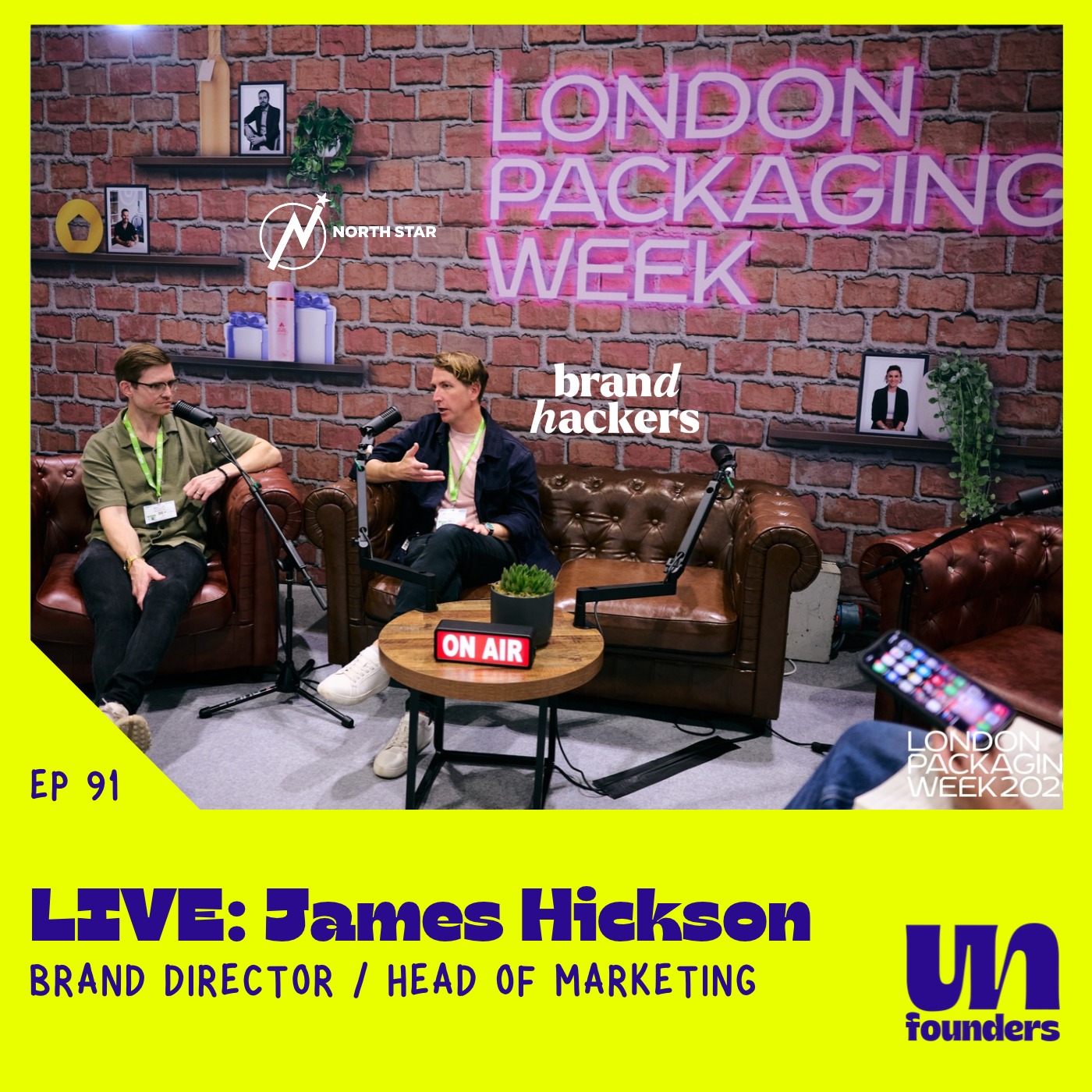
Live episode from London Packaging Week on how brand strategy and packaging drive growth, customer acquisition costs, and retail performance—especially for challenger brands.
James Hickson, works across Brand Hackers (packaging/design/brand strategy for challenger FMCG brands with £1–40m turnover) and Northstar (data/category data provider helping brands win retailer space).
Packaging must match brand strategy and tone of voice; many brands skip strategy and just “design the look.” Authenticity matters—inauthentic humor/sarcasm fails when it doesn’t fit the product promise or audience. Field/store visits and “10-5-2” shelf testing prevent costly mistakes. Data should start with category data, then shopper/consumer packaging testing.
Innocent (carton copy/tone; drinks trolley culture), BrewDog/Punk IPA (craft beer packaging arms race), Surreal and Oatly (tone-of-voice imitation risks), Sunday (distinct form factor), Monday haircare (simple bottle shape), Here We Flow period care (ice-cream tub format), Method soap (displayable packaging), Freddy’s Farm (packaging refresh boosted sales/distribution), and a Waitrose-listed brand whose retail pack looked like Waitrose Essentials and underperformed.
0:00James Hickson: Hello, hello, hello, and welcome to a very special edition of The Unfounders, live at London Packaging Week. Now, this was such a cool opportunity, thanks to Casey and Serena for having me involved. We sat live in front of an audience who had these amazing noise-cancelling Wi-Fi headphones, so they could listen to me and James talk all things branding, packaging, everything around that. James Hickson is a good friend of mine. He is working at Northstar and Brand Hackers, and we dig into everything around craft beer, innocent, brew dog, his time there, what he's learned along the way. brands we think are being disruptive and iconic with their packaging.
0:33James Hickson: There's loads within this, it's a really really fun chat and hopefully you enjoy it as much as we did live. So without further ado, let's get on with it. We all know that brand is important right? But what if I told you it can impact growth and customer acquisition costs by up to 50 %? Against Ordinary are a brand agency who help founders, marketing departments, scaling teams ensure their brand is the most powerful tool for growth. From brand strategy, tone of voice and visual identity to helping you get retail ready with ongoing brand growth retainers. They really are the full circle agency for growing your brand.
1:05James Hickson: B and the team are absolutely fantastic. Just imagine what they could do for your brand. So what are you waiting for? See how they can be your grand growth partners at againstordinary.com.
1:24Welcome Mitch and James.
1:26James Hickson: Thank you very much. Thank you for everyone coming here today. I just want to firstly say to anyone listening at home, this is a live edition from London Packaging Week. Super excited to be here. And with the unfounders, if it's new to you, what I do is I like to speak to employees working in amazing businesses, doing great things. Often we only hear the stories from the founders, but today we have some fantastic employees. And James is a good friend of mine. He's worked in a whole breadth of brilliant brands. So James, can you let everyone know where you currently work and what your roles are.
1:54Yeah, thanks for having me on today, Mitch. It's an interesting format. Good to be here at London Packaging Week. Yeah, so I currently work across two different brands. So I do a lot of work with an agency, marketing agency called Brand Hackers. We work with challenger brands anywhere from sort of, you know, one to 30, 40 million ties in FMCG predominantly. And that work covers a range of different things. But within that, we do a lot of packaging and design and brand strategy work. And I also work with a company called Northstar who are a data and category data provider who again work with challenger brands helping them secure more space and you know and take better stories to the retailers obviously data is data but quite often the packaging is is a big part of the story we're telling and talking to retailers about so there's some nice overlap there yeah definitely I think from your career
2:40James Hickson: and your background we'll dig into this a lot more but we are Northstar customers at PACT it's been super helpful for us every time we kind of open the platform like we had the refresh yesterday of all the new data, just seeing kind of our performance. It's just great to kind of see how you stack against the bigger brands and at a price that is affordable for challenger brands, which is nice. Let's take things right the way back to we're at a packaging event from a young age. Where was your kind of first foray into going, oh, I really like this packaging. Like for me, I think back to like children's cereal.
3:04James Hickson: Like you think of the toys you get inside the packaging and just being excited by the characters. Like you're kind of ingrained, oh, this is fun. And then you try the products and you're like, oh, this is good. And now that's essentially what brand hackers are doing for bigger brands, but being like, hey, look, it's shiny and it's nice. and now you should buy us. But for you, when did that begin? That's a good point. I hadn't really thought of it like that, but I'm probably similar to you. It probably went back to that same sort of thing in the sort of 80s and 90s. You used to literally pour out of the cereal packet and hope you were the one that got the toy that was in the bag.
3:31They don't do it anymore. It's such a shame. But I do wonder that, you know, that Kellogg's kind of core range, you know, Rice Krispies with Snap, Crackle and Pop or Tony the Tiger and that sort of thing, almost was sort of subliminally that entry point into wow, packaging is quite cool. I would say my first kind of time I really sort of stood up and took notice and became into packaging was probably about 2007. So I was probably about 20, 23 or something. And I picked up a carton of Innocent Smoothies. They've been going about 10 years and weirdly, I'd never, never tried them. I guess I was maybe a bit young to be their demographic and, you know, treat myself there on promotion.
4:01And they still had the smoothies in cartons, bought it and looked at the back, you know, as you do, or as I always do now. And I was just sort of blown, blown away by the kind of the copy and the tone of voice and the imagery and that sort of thing, which obviously they're very famous for. And that was a big part of how they built their brand. And I thought, oh, this is really cool. So then I kind of went back and bought another one and I had different copy and packaging, you know, and imagery. And I was like, wow, they're really using their packaging as part of their brand. I probably wasn't thinking of it in that sort of astute way at the time, but that was kind of what they were doing.
4:29I mean, actually that was what first got me into FMCG. I, you know, I decided basically on that day I wanted to work for Innocent. I was like, that's the company I want to work for. These guys look cool. I love what they're doing. And then from then I just started to sort of notice packaging a bit more. I'd start to think, oh, I like the colors on that. or I like the design on that or I like the shape of the bottle or you know what have they done on the back of the packaging I was always sort of disappointed when a brand didn't you know didn't have anything on the back they just had kind of technical information you know so such a waste of space and then I guess you know my you know innocent I was worked it for a couple of years and was sort of in in the thick of it and seeing how they how they kind of look at packaging but then the next step on from that was getting into Krapia and the first time I saw Punk IPA on a shelf blew me away I mean you know nowadays it's one of the worst design packs I've ever seen but like back in 2009 or something when you saw that blue label on a tesco shelf and context is really important a blue label on a tesco shelf when everything else was big fat 500 ml bottles of old man's real ale with you know with steam trains and and sheep on it and then you had this really kind of aggressive looking bottle with bright colors and a name like punk ipa it was just
5:31James Hickson: kind of off to the races then you know i think both both innocent and brew dog had very different takes on brand and building brand in terms of like innocent definitely inspired a generation of marketers of brands kind of going we want to be like innocent like there was there must have been a period of time where everyone was like just do what innocent are doing and you've kind of seen like the follow-through of like brands like surreal i mean they've got ex-copywriters from innocent now but like you can see what surreal are doing in that space with their tone of voice with their playful like it's just so good like when you speak to challenger brands at brand hackers and you're like okay we've come to you we've got this idea this is our concept like what kind of steps do you take them through in terms of like this is how you find that tone of voice because it's you do get a lot of me too now it's like well they're just very much trying to be innocent or Oatly another great example really strong tone of voice but that now more and more brands are trying to be more like Oatly so how do you try and keep it unique and what are the ways you've worked them through that I mean it I think it all comes back down to your brand strategy and how coherent and clear that is and I think a lot of brands maybe skip that bit you know I'm kind of amazed when I see brands that are on the shelf and they've got packaging designed and then I'm kind of talking to them about you know maybe they're talking about evolving their packaging say well what was the brand strategy behind the current one they're like well we didn't really do one we just a designer just mocked it up and we kind of like the look of it and that's kind of okay if you're very early stage but as you develop and you get listings and that packaging becomes such an important part of of the whole kind of commercial proposition that is when your brand strategy which tone of voice is a part of comes right through and so what you put on pack whether it's front of pack and the claims the way that you put the claims the design the look and the feel and then the copy that you put on the back that needs to match that needs to almost match the promise that your brand gives.
7:06So, you know, if you go and speak to the founders of Surreal, they probably are quite sarcastic and take the piss and are quite funny and they have funny copywriters. If you went into, you know, a really more traditional business and they had all this kind of quite cutesy, wacky, you know, copy on there, and then you went in and it didn't quite match with either the product and the product promise, or even just the people who are running the business, it just doesn't feel cohesive. And so I think it's like finding your tone of voice, which is really authentic, and then finding a way to put it on your pack in a way that's interesting because i think you can be not everyone has to be funny not everyone has to be cute and there was a time when the innocent thing was just going mad and everyone was just saying like i'm a bottle it's like you know you're not a bottle you're a piece of plastic like i actually really hate i'm going to try and do this word anthropomorphizing that's not the word but you know what i mean like making you know inanimate objects have like a personality i don't really think a bottle is i but that was like everywhere because innocent were doing it and it was brands that didn't really make sense big corporate brands doing 500 million trying to act like they were this kind of cutesy thing.
8:00So I think it just needs to kind of come back to who are you? What do you stand for? Almost like what are the people running you? You know, as in working for you, owning whatever it might be, and be really authentic to that. And then it can work. Now, how do you do that as you scale? I always think Ben and Jerry's are a good example. You know, started in the 70s, two hippies, all about activism, and they can still do that 40 years later. And why can they still do that, even though they're now a massive company distributed around the world, owned by Unilever, et cetera, et cetera. I think it's because that ethos and that spirit still lives at the heart of the company and anyone who goes and works in Ben & Jerry's even if they're a Unilever employee if you're in within Ben & Jerry's you have to have that kind of mindset and that belief you can't really bring a whole different kind of personality and just hope that you can just sort of adapt so I guess my sort of very long-winded point is the tone of voice and the strategy does come out of the organization and that's often the founder at the start but as you get bigger that's the people who are there yeah I think you can tell when a
8:53James Hickson: brand is inauthentic in terms of they're trying to be sarcastic they're trying to be funny they're trying to be playful in a category that just doesn't make sense i mean we at pact we sell organic fruit and veg like it's fruit and veg at the end of the day we can't suddenly just take the piss out of something that's going on in the news um it wouldn't really land with our customers and our demographics so it's knowing that and actually being authentic to your brand going back to the craft beer stage from brew dog you obviously had your bottle shops and craft beer as um i kind of spoke to you before this interview it was like for me when the craft beer boom happened packaging was just unlike any other sector you wouldn't see that in syria you wouldn't see that in hair care but nowadays you do like i can't remember the the brand but you've got the the brand of hair products that looks like it's ice creams and is it sunday i just remembered seeing it and they're charging like 15 quid for a moose or whatever it is but people are buying it because it's it's instagramable it's people like want to share on social thinking from like that craft beer what are some examples of like sunday brands you think have really kind of nailed who they are and what they're doing disrupting a category yeah and i have a think on those in a second terms of specific ones there's a couple that come to mind and actually i think um ut's or maybe call it you know hair care and that's what it's quite a good space for that with craft beer i was in craft beer in sort of i would say the heyday sort of 2012 to 2020 was when it was you know it was going bonkers loads of new breweries opening up and packaging almost became like an arms race it was like who can release the the most interesting new packaging i mean interestingly and and you know good for this audience at London Packaging Week and slightly nerdy point.
10:21Part of the reason that happened was because it went from a situation where in order to put your beer in cans, you had to order 250 ,000 units, which meant you weren't going to sort of change it up very often. And then can companies realized actually there's loads of small breweries who want to put their stuff in cans but can't afford that many. So they started selling plain cans that would then get labeled in the same way that you would with bottles. And suddenly that opened up this whole new kind of space for really nice looking labels, loads of interesting designs. And more importantly, with breweries, the way that you stayed relevant and fresh in craft beer was that you released new beers, new recipes at a really regular interval, probably one a month, one every two months.
10:57It was always a new IPA, a new stout, whatever it might be. And it was almost like that was how you got your customers keep coming back over and over and over. You'd have a core range, but you'd always have this really exciting other range, but you couldn't just say, here's a new beer and it's not that interesting. You just match it with some amazing packaging. And so it was mostly design led rather than sort of format led you know so it was mostly looking at different artistry different um you know label textures that kind of thing but it was such a great time i was selling lots and lots of different beers at the time at a shop selling 300 different beers at any one time so every week as a packaging nerd that's perfect because you're literally just getting new deliveries and i'd spend ages just going and looking all through the packaging and you know artists were probably getting loads of work so good time to be in there but i think you do start to see that in in other categories a bit more i think i always think monday hair care is a really good example it's owned by a company called Zuru who weirdly is like the biggest toy company in the world they also make nappies and then they have a hair care range it's like unbelievable new zealand based company and what they did was they just come out with a very simple bottle it's all one color including the you know the brand the name and other sort of things it's almost like you can't quite see it but the shape of it is just so distinctive now they've been copied a few times now they've been duped as it always happens but when they came out again you kind of they would have looked at that hole and gone everyone looks the same everyone's in either big kind of rectangular bottles or it's dark or it's purple or whatever it might be and they just change the form factor and it's very elegant as well and I think they probably just got a ton of sales just off the back of that I think they say Sunday's another good example different Sunday spelt as in the ice cream as opposed to Monday well that's quite funny and I think like we did some work with Here We Flow which is a period care company and again you know I don't know we weren't working with them on their packaging so I'm not sure why they did this but they would put their tampons in a I think it's kind of called an ice cream tub type pint isn't it yeah it's like a sort of ice cream pint yeah and again i don't know they did that stand out i expect they probably did and it and it bloody worked because again if you look at the period care aisle it's a load of sort of rectangular boxes that all look very similar and so suddenly they put them on the shelf and they completely stand out and i think that's really interesting in terms of how you can bring that in you know and there's the the famous thing of method soap you know the guy who started that like with eric ryan the method was his first business and he made lots of money from it but he's gone and done that three more times where he's gone into boring categories he'll walk up and down supermarket aisles and say which category needs disruption which one just look where everything looks the same and then he'll release a new product which is better product but also the packaging is a big part of that the form factor is a big part of it he's a designer by by trade so that's really important to him and there's loads more like that from from his perspective that i think is really interesting so it's whether it's okay it's more eye catching on shelf but it's that thing of oh it's more likely to be used at home because if your method soap looks really nice and you leave it out on display and then friends see it and this sort of thing that famous thing of your you know when they release the the washing up liquid most people hide their fairy liquid whereas they would everyone would display it proudly yeah i know um fiona fitzpatrick says
13:40James Hickson: like it's it's the kind of self-care stuff that you want to keep on show and it's like that that cool that like if you go to someone's house and you see it like oh that's really nice the same with like citizens of soil is another great example of like it's an olive oil staple that you want to put on a table you want to show off this this gorgeous bottle and i mean the olive oil category over the last five years has just gone bonkers um in terms of like amazing designs and what you can actually buy. But I think consumer appetite for this, for the story, for all the stuff that you need to be able to convey both online and on shelf is amplified through social media.
14:10James Hickson: What's something you think people get wrong when they go from being like a D2C brand, like many brands start out. It's like your quickest route to market is just selling direct. You can ship it from home. Great. And then you suddenly get your first retail listing, your product sat on shelf. It maybe doesn't work. You work with a lot of brands in that kind of phase. Has there been any examples who are like, we helped to do this? And again, with Northstar, you can see the data, you can see rate of sale increase and all these things. So do you have any kind of data to tie it all in? Yeah, so I think there's some good examples of where, you know, a packaging change has really, really helped sales.
14:40You know, we work with a brand called Freddy's Farm who make dried fruit snacks, a little bit like bear snacks. And their packaging, you know, their product was really great. It's all made on a farm in Kent, very authentic story. The packaging just looked quite basic. And to be honest, they'd spent a grand and a half on the packaging when they launched. You know, that wasn't their main focus. They were their farmers and they were very focused on the actual product. What we did with the refresh for them was said you're actually just leaving so much money on the table because people are looking and they don't think you're very premium because the packaging doesn't look premium.
15:05But actually you are one of the, you know, you're authentically the, you know, one of the sort of better quality products on the market, but you're not showing up that way. So we did a lot of positioning and work and packaging refresh on that sense and just saying, you know, perception is everything because when you're trying to go on shelf and you're trying to get that first, that person to almost just take that risk, you know, reach up to the shelf and take you off the shelf. you need something that's going to draw them in and if they're already buying bear snacks or they're already buying something that's a bit more premium if you don't look that good on shelf they're not going to pick you up and you don't have any real estate like a like a landing page or a website to tell them your story you're relying on them picking it up and then hopefully turning it around so we did this refresh with them and they suddenly looked you know not premium in a really sort of hosh way just they just looked as quality as they were and their sales absolutely jumped you know overnight they got additional distribution off the back of it it really really did make a change.
15:53So that's a good example of where it really worked. An interesting one where I'm not saying this didn't work, but there was an interesting phase from, it actually wasn't D2C, it was a brand that we kind of worked with. I won't actually name them because they're currently in the phase of changing, but they're very big in food service where their packaging looked really, really lovely, but actually was a bit less relevant because it was quite often, you know, behind a fridge or whatever it might be. And then they decided to take it into retail, got a great listing in Waitrose and, you know, there you go.
16:20They're on the shelf in Waitrose looking great or so they think until they suddenly realized they look quite like the Waitrose Essentials range and again going back to the context being really important on a barista shelf they looked really premium really different to the other products that you know you'd normally see on a barista shelf but actually in a fridge where they've got a lot more competition that they're sitting next to including some at the sort of both ends of the scale they realized that they for a start weren't standing out on shelf they weren't they didn't have much shelf presence and secondly they were kind of giving off the wrong cues and weirdly they you wouldn't have predicted that if you've seen them in a coffee shop in a coffee shop they look great on a waitress shelf not so much and so sometimes you don't know until you kind of get there and then you realize that the data kind of says why aren't we selling as well and so you then kind of go back to the drawing board and you don't necessarily throw the whole baby out of the bath water but you can do some tweaks and they're doing some work on that at the moment which i think will really help it's just going to kind of elevate and there's a world where i think you can have a retail packaging that's slightly different from your dc or your food service i think that's okay you know you i think you adapt your packaging to the audience and the market you're going into that makes sense yeah Do you guys do that with packs?
17:21Do you have a sort of differential?
17:23James Hickson: Not at this stage. We're doubling down on retail, but being in Frozen, you have that barrier instantly. You have a physical door space, so you have to disrupt. And also the way people stack freezers, it's like they open the door and just throw it in. So actually we have to work twice as hard to try and do it. Online, we turn up really well. It's very evident who we are and what we do. In store, it's always like any time I'm nearby a store, I'm like, I'll stack the packs up so it sits nicely. And we want some SRPs and all of that piece. So it's just a bit more like it. But when I used to work at Hura, very much we had a food service box that was very practical for the chef's perspective.
17:53James Hickson: And then our retail pack was much more like the copy was on there. The story was on there. It was much more playful. Like it was two very different things, like same as when you're selling. If you're selling to a chef, you tell them the cook times, the practicalities, how it holds. They don't care about your life story, sustainability goals and all of that. Whereas the sales team might or the marketing team might. So it's also knowing that just because I'm wary of time from your kind of career history, working for brands like Innocent and BrewDog and everyone else. What are some of the key things that you learn in those kind of environments that you still take with you to this day that you can share that's like, yeah, that's super helpful?
18:27I think one of the things is definitely, again, this sort of sounds quite obvious, but I think not a lot of brands do this, is spend a lot of time in store. I mean, you know, we are talking about packaging that's going to be in retail stores. You know, when we're at Innocent and at BrewDog, in fact, we'd be out in stores all the time, doing store visits, seeing how we look against competitor set, seeing what else other people are doing. They had a real kind of curiosity culture in both those companies. Otherwise, you're just sort of sitting in a silent. I think lots of people now try and do too much behind a laptop.
18:55So whether that's competitor research, whether it's even if it's selling, you know, I'm always telling people to go out and do field sales, which I know sounds like a bit odd, you know, talking about packaging, but it's the same sort of thing. It's getting out there. And if you do field sales, you know, with your brand, when you're talking to the decision maker, you'll hear from them actually do you know what i don't think that will sell because of x y and z and the x y and z is that's the sort of the little nuggets that you want to take home because i can't remember which brand we were working with but they hadn't realized it but they were going into these places and their bottle was too tall to fit on the shelf and there was this bottle that looked beautiful it was so amazing dc wise it looked great and they loved it and it was like their pride and joy no retailer would take it because it wouldn't fit on the shelf so they had to go back to the drawing board but they wouldn't have known that if they were just kind of let's say they were just sending loads of emails and saying aren't we great you know the buyer might have said well we they might not have seen it and gone actually that's just that much you know so these sort of nuances that you get when you actually get out into the real world, I think are really, really important.
19:42So I think that's one thing I think just always kind of keep coming back to, you know, putting yourself in the customer's eyes. Like what is your packaging communicating? How clear is it? Look at it at different angles. I mean, literally like, you know, they talk about the sort of the 10-5-2 test. So what does it look like 10 feet away, 5 feet, 2 feet? How obvious is it, you know, of your messaging? Have you got the right key benefits called out? Have you got the balance between benefit and rate? Like don't sort of settle on your packaging once and just, you know, don't want to change it all the time but do kind of review it every six months nine months and just make sure that it's doing what you what you want it to do and also as you evolve as you become bigger as a business your packaging probably needs to do different things um and i think that's really clear you know really key is you know you bring in new new demographic you you get bring in new customers that sort of thing and is it still doing what it needs to do you know three years after you first sort of put that packaging out there so i think i think that's that be curious and don't rest on your laurels is probably the probably the thing i'd say and just switching to your north
20:36James Hickson: Northstar hat, data, like I'm all in on data this year. It's been super helpful. Like the more we're growing at Pax, the more we see our impacts in the wider industry. Like we have great data with Beat and Ocado, but actually the first time we had Northstar, we're like, wow, actually it's not just Ocado, it's the category. So to anyone who works in the industry and is like, I'm thinking about data, but I don't know where to start. Like, what would you say is the first port of call to look at? Yeah, I think if you've got your first retail, you know, your first market listing, data is when, you know, you're going to be able to really work out how you can either grow that listing or make sure that you're, you know, you're going to defend it and not lose it.
21:09I would always start with category data. So we have a product called Polaris, which is EPOS data, covers the whole market and tells you what's happening in your category. So, and this is the key thing you need to understand, you know, what are your sales, but they're not that useful in isolation. What are your sales compared to your competitor set in terms of your category? Who's growing, who's winning, who's losing? Are there brands that you can maybe target, go after, have buyer conversations, other kinds of things that you're seeing in the data that can influence your, you know, your NPD funnel.
21:36Maybe you're thinking of which brand, you know, which new products that you might want to bring out. Well, actually, if you see there's a particular flavor that's doing really well in your category, maybe you want to lead with that one. Maybe you've seen some NPD in another category that you think you can bring in. So I think category is always the first place to start. And I think, you know, if you can get that from Northstar, you know, we give you some really good stuff. I would always try and beg, borrow, and steal as well, you know, at the very early stages. But as you grow, I think you can really then start to develop out and it's where the shopper and the packaging stuff comes in getting shopper data is really really important um you know shopper data that tells you who's buying it what else they're buying in their basket what are they swapping in and out but then also how are they thinking about your packaging so you might want to work with a you know company like sticky beak for example who do consumer testing on packaging and things like that and i think if you can bring all these different data sources whether it's category shopper sticky beak sort of packaging that all of those things just help you build a picture so it's almost like you know packaging is lovely and beautiful uh you know to sort of to bring it back to that but there's so much data that you can use to kind of help inform that as well and i think if you can bring them all together then that's just you know that's the golden goose and innocent were great at that you know very creative company but very data-led amazing well this is a one for for anyone who's
22:41James Hickson: joined us now on the unfound on the unfounders podcast i speak to amazing employees and not founders and one question that i ask every person that comes onto my podcast is what is a song that represents your journey your experience something that comes to mind you're like it could be a particular thing like i know is it the drinks trolley innocent was it uh was that a thing like i know there's different ones that people relate to but is there a song that if you think of your career that comes to mind god that's uh that's a good one i mean weirdly actually it's yeah i don't know if it's my kind of my my whole career but yeah i think just innocent used to have the drinks trolley it came around at four so it's probably a good kind of tip off and someone would always put on the playlist and it usually would end if i always did end uh with closing time i can't remember the band but it's that it's i'm not gonna say but it's it's quite a famous song from maybe the 80s and it's basically goes closing time and and that was kind of the moment when everyone would sort of go right let's get on the pub basically nice nice way to have fridays amazing well really enjoyed it i mean there's so much more we can dig into we'll probably do a proper record as well outside of this but to anyone in the audience for anyone listening at home everyone's sat with headphones on so if you have put headphones on to listen to us chat thank you so much for coming along bim mitchley host the unfounders and head of sales at pact and this is the wonderful james hickson from Brand Hackers and Northstar.
23:53James Hickson: Thank you very much. Thanks so much for having me.
Recorded live at London Packaging Week, I sit down with my good friend James Hickson for a cracking discussion. James works with challenger brands at Brand Hackers and Northstar, about how packaging builds distinctive brands and earns attention on shelf.
We touch on his experience at Innocent and BrewDog to explain why authenticity, retail context, and category data should guide packaging decisions. As well as his time owning a craft beer shop and so much more.
We tried to make it practical, helpful and enjoyable, I know you're gonna love it, enjoy!
If you want to build a brand consumers love, you NEED to speak with my incredible sponsor Against Ordinary - the masterminds behind my gorgeous brand.
They have a 5-Minute Brand Test to help you uncover what’s working, what’s holding you back, and where your untapped potential lies. Give the Brand Scorecard a go today!
Don't forget to check out the ever growing Unfounders Song Selection playlist on Spotify.... it's WILD.
Ps - Have you got a guest you'd love to hear from? Submit a guest request form on our website here.
Intro by Free Flowin' from Uppbeat
Music from #Uppbeat (free for Creators!):
https://uppbeat.io/t/hey-pluto/nod-your-head
Chapters:
00:00 Live from London Packaging Week: meet James Hickson
02:38 The cereal toys and Innocent pack that sparked a packaging career
05:33 Build an authentic brand voice, not an Innocent imitation
08:52 Craft beer's packaging arms race and category disruptors
13:39 Why packaging must work on shelf, not just online
15:54 When food-service packaging misses the retail context
18:27 Store visits, shelf fit, and the 10-5-2 packaging test
20:34 Start with category data, then add shopper and packaging insight
22:39 The Innocent office song that closed out Fridays
Scan the code with your iPhone camera
Listen in the app.