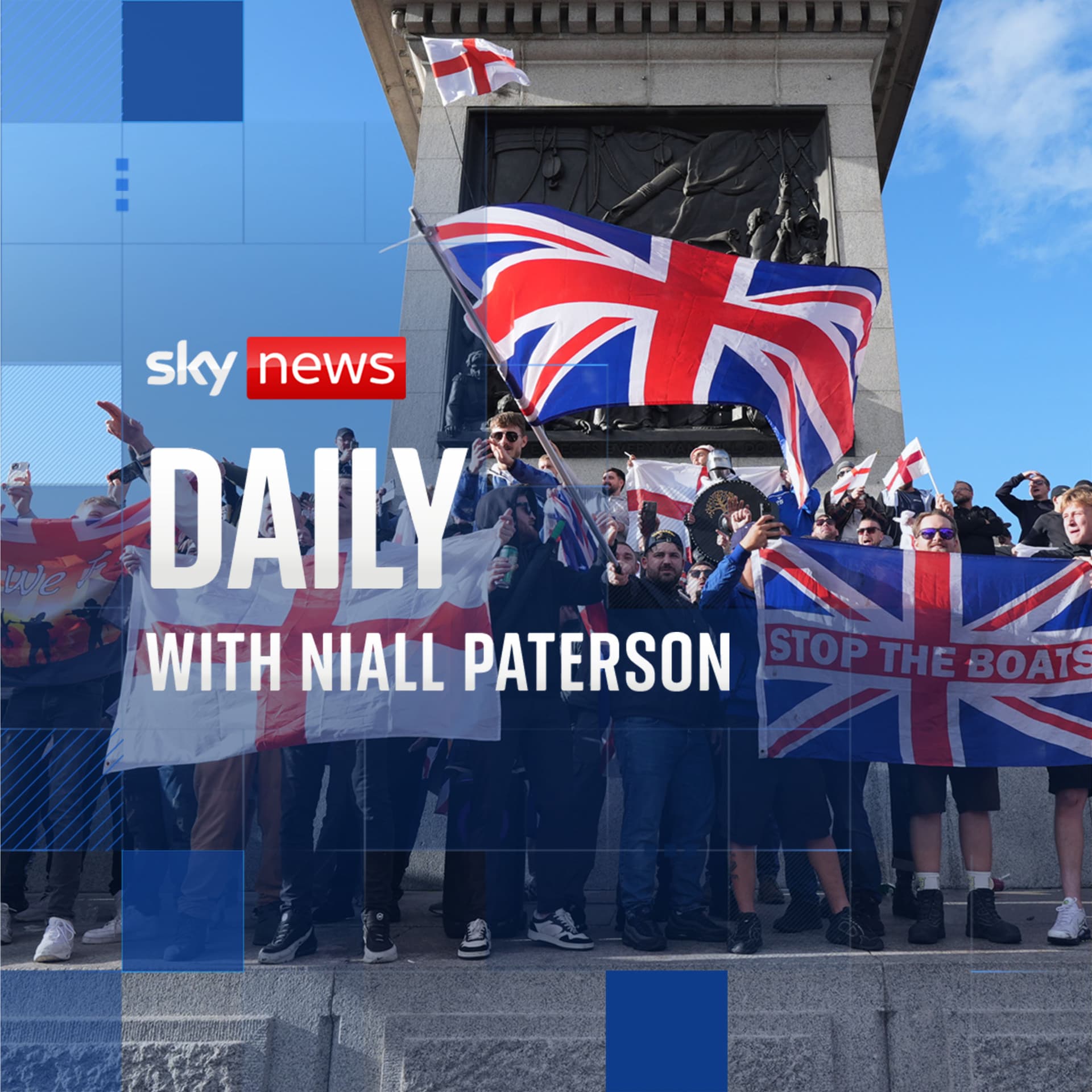

In short
Britain’s 2025 summer flag-raising campaign (especially St George’s flags on lampposts/bridges) and how “patriotism” became entangled with immigration/asylum politics, online far-right amplification, and claims of who is “invited” in society.
Guests
Sundar Katwala, director of the British Future think tank and author of How to Be a Patriot; Tom Cheshire, Sky News data and forensics correspondent.
Key claims
Intent and context determine meaning; lamppost placement and graffiti signal exclusion, not just pride. The far right helped coordinate via groups donating flags (e.g., Britain First; Patriotic Alternative). Social media/algorithms (X, Elon Musk; Tommy Robinson’s return) pushed narratives into feeds, then streets. Englishness is portrayed as more inclusive long-term than “Englishness” used in this campaign.
Notable examples
Operation Raise the Colors, Wheelie Warriors, Churchill’s Lions, Whittle Flaggers; Dartford’s inclusive St George’s Day parade vs flags “halfway up the lamppost”; protests outside asylum hotels; Unite the Kingdom rally billed as a “free speech festival.”
Written by AI. May contain mistakes. Listen to the episode to check what was said.
Chapters
Tap a time to open that second in VOThe Rise of Flags in 2025
0:45 to 1:42
Exploring the unexpected prominence of flags during summer 2025.
“an event of such national importance that it wasn't entirely clear why it was happening Sorry that you feel so...”
Cultural Perspectives on Flag Usage
1:42 to 4:04
Discussions on how flags symbolize diverse meanings across cultures.
“I sat down with the director of the British Future Think Tank and author of How to Be a Patriot, Sundar Katwala, and our data and forensics correspondent, Tom Cheshire, to try and find out.”
Intentions Behind Flag Raising
4:04 to 6:30
Analyzing the intentions behind the rise of flags and their political implications.
“But how can one tell the intent simply by looking at a street festooned with flags under?”
Polarization of National Identity
6:30 to 10:51
Examining how national identity has become polarized in recent times.
“It's also saying if we fly it in an aggressive way and clearly lampposts aren't people or houses.”
Political Responses to Patriotism
10:51 to 14:00
Discussion on how political figures are responding to rising patriotism and flag usage.
“protesting outside hotels, they definitely think everybody agrees with them.”
Patriotism and Identity in Modern Britain
14:00 to 18:14
Explore how patriotism can be inclusive and reflect modern society.
“The answer, I think, is not to reject or retreat from the symbol or critique what people are doing.”
The Future of National Symbols and Patriotism
18:14 to 20:54
Discuss the potential evolution of national symbols and their meanings.
“I think at that point we've given away our national symbols.”
Transcript
Automatic transcript. May contain errors.0:01Sky News, the full story first.
0:10Coming up, did you notice anything appearing on your lampposts and motorway bridges this summer that you hadn't seen there before? Well, as we head into Christmas here on the Sky News Daily, we're putting the flag flying under the microscope with our experts, profiling the moment that patriotism and politics collided with an almighty bang.
0:33Hi everyone, welcome to The Daily and with Christmas fast approaching we thought we'd take a look back at 2025 but through the prism of some of the moments that defined the year and this summer Britain raised a flag an event of such national importance that it wasn't entirely clear why it was happening Sorry that you feel so... Shameful being here Why can't you be proud? I am proud I am proud It's about being divisive. We're absolutely tripping over from patriotism to an overt display of nationalism. Supporters called it patriotic. Critics called it pathetic. Everyone else just wondered why flags kept getting more airtime than the Ukraine war.
1:14Because as the flags went up, the tone went down. And what were ostensibly genuine criticisms and concerns about the levels of immigration in this country, on occasion, metastasised into something far darker. A representation of Englishness from the 13th century onwards, the flag of St George became a cultural Rorschach test, capable of being interpreted entirely differently depending on who was looking at it. So what on earth happened? I sat down with the director of the British Future Think Tank and author of How to Be a Patriot, Sundar Katwala, and our data and forensics correspondent, Tom Cheshire, to try and find out.
1:52You've always seen it actually at rallies. You see it at protests. What was different about this, though, was it wasn't taking a flag to a demo. They started going up on lampposts, on roundabouts, roundabouts being spray painted. And that started happening across the country. There are all sorts of different groups doing it. There's Operation Raise the Colors, the Wheelie Warriors, Churchill's Lions, the Whittle Flaggers, all these different groups. This was up and down the country. And, you know, I remember going to Lincoln to do an interview and just driving around, especially in the sort of suburbs.
2:20And you see it absolutely festooned on the streets. And that was a new thing. internet culture, social media into the streets and then back in that sort of feedback loop there. And I think it sort of presented it to a way that normal people hadn't come across before. So you see it at a protest or you see it in these online spaces, but actually if you're just driving around your local town, suddenly you had this very, very visual and for some people quite threatening sort of thing. Other people say it's patriotic. That felt very new. Sunder, what was your reaction the first time you saw this? I think flags are interesting in this country because we're a strange kind of country.
2:55It surprises people to think, but everyone's got more than one flag because it's a multinational country before it's a multi-ethnic and a multi-faith country. And that goes back centuries. But the English don't tend to think about that so much when the English use two flags, the Union flag and the St. George's flag. Often that's been interchangeable. I'm very pro-flag and I like flags and I'm in favour of using them more and thinking about how their fabric unites us. But I feel very differently about flags in different contexts. Most people do. I mean, I had face paint on with my daughters when the lionesses were playing.
3:31And we actually had quite welcoming bunting in Dartford High Street, where I live, that had been left up. And it was clearly quite supportive, positive bunting. And then the flags halfway at the lamppost felt different. And then there was graffiti on the street sign at the end of my road after there was an immigration process. So it's the same symbol I've got and my daughters have got on our face on our street sign. It means something completely different. So intent really matters. Reception really matters. And everyone feels that and then articulating why that's the case and what we do about it is harder.
4:03Intent really matters, of course, as you say. But how can one tell the intent simply by looking at a street festooned with flags under? The thing that really gets it across is who's invited and how can you tell who's invited? So actually, here in Dartford, we've got a St George's Day street parade every year. And it's very successful. And it's really obvious that everyone's invited, that people can fly the English flag, feel proud to be English. And everyone's invited because it's the primary schools and secretary schools. And they're just incredibly diverse. So it couldn't be more obvious that everyone's invited.
4:36Everyone feels invited when I take my daughter to watch The Lionesses. It's a very soft, very inclusive, very young, very gender balanced group. it's fairly obvious that you're meant to feel a bit threatened by some people some at the time and there's a difference between the flag in my car before we go out in the quarterfinal or the semi-final of a major tournament because if you handed them out and say fly them to show if you're supportive then people would make their decision when you fly them halfway up the lamppost they look a bit sad they look a bit mournful but somebody has decided that this territory is going to be claimed for that flag to send a message and some people might think it's quite a benign patriotism's good we're allowed for our flag message and we know that some people are doing it with a this isn't for you message to some people so that's where the intent comes across with the sense it's been done with a sense of somebody's not invited.
5:29To what extent then was the flag raising coordinated because I suspect in some parts of the country it felt quite spontaneous. Yeah, it's a mixture of both. I think Sundar's point there about intention, I mean, you can see who's doing this. And it's part of the genius of the campaign that actually people see it and they want to get involved in that. It has happened, that sort of spontaneity. But the sort of extreme right has always been really good at that sort of co-opting local interests. You look at who's been putting up the flags, you know, Britain first have been donating flags. This is not that spontaneous.
5:59We've seen other groups, Patriotic Alternative, that is the organised far right. That's not to diminish, I think a lot of people are asking, why shouldn't we be proud of our flag? That's completely fair enough. There is also this mix of this is an organisation, it is a campaign as much as sort of spontaneous local feeling. But Sunder, for those who are feeling uncomfortable at the flag raising, it's very difficult to argue against any flying of a flag as just a pure simple of patriotism. It's a deliberate trap and a provocation by saying something reasonable, we should be allowed to fly our flag.
6:31It's also saying if we fly it in an aggressive way and clearly lampposts aren't people or houses. So you're conscripting lampposts. That does remind me of Belfast a bit more than it does of Birmingham. Two different flags are being flown together. And I think that's interesting. The attempt to threaten people with the Union flag and the St. George's flag in combination actually triggers a different Rorschach effect. It's quite easy to really challenge the use of the Union flag in that context and say, if you're doing that, say, Sundar, you're not welcome. This isn't for black and Asian people or this isn't for Muslims or whatever group.
7:04I can really powerfully say back, learn the history of your flag, learn the history of your country, learn the history of the world wars and who fought on them and what that flag has been for. I think because that's the state flag, it's the citizenship flag. That flag's been used well in a multi-ethnic way, very solemnly for remembrance, very celebratory for the Olympics, been messed around with pop culture for 50 years. The English flag is more vulnerable to that use, I think, because it's actually also a very safe flag in the context of the national football team and the rugby team. When we're flying it for Goward Southgate's team, Thomas Tuchel now, for the Lionesses, it's very clear that everyone's invited.
7:44But we just don't use it very often. We don't actually have many English institutions, apart from a Church of England and some sporting teams. And so you don't see it very often. So it's more vulnerable. It's also a misremembering in some way that this is somehow the flag of the far right, because most of my lifetime, the far right was using the Union flag, the National Front, the British National Party. It was only with the English Defence League coming up that they started to use that. I've never wanted to reclaim flags because the whole idea of reclaiming means that somehow it belongs to this fringe element.
8:15I just want to use flags confidently and well in ways that show the fabric can unite us. Tom, the stated ambition of flying the flag is patriotism. But given what you've described taking place this summer outside those asylum hotels, there is very definitely a link to concerns about immigration, asylum and the whole system. Yeah, I think what people talk about, debate about, that has certainly shifted. And I think that's probably actually welcome, because when you have these conversations, and if it is a Tommy Robinson leaving it, it's ceded the ground entirely. But now, you know, this is very much Labour policy.
8:49It's quite hardline. It's looking at Denmark and things like that. And you see it in different ways, you know, Unite the Kingdom, the big rally that Tommy Robinson held. That was a free speech festival is what it was billed as. And it's exactly what I was saying about this slight trap and provocation. Who could disagree with this? But actually, there's a lot else being sort of smuggled into it, too. I think the other aspect of why it's sort of we're all talking about it is the online space. I think X and Elon Musk is so crucial to this. A, just sort of Tommy Robinson and other people being back on X is one of the things that Elon Musk did.
9:22He reinstated. But more than that, he's really gone out to support. He spoke at his rally. He is trying to put the conversation around this. You can avoid those spaces a lot of the time. But on X, it's being pushed towards you. We did a story earlier this year about how those right wing narratives are being pushed by the algorithm. We have lots of data to support that. So you see these flags and it's on your feed. And then someone sees on there and thinks, I'm going to do the same thing. It's on the street. And suddenly something that you could ignore. Politics is not for everyone the whole time.
9:48But now the difference with the flags is you can't not have a view when it's on your lamppost, as Sundar is saying. We have on record flaggers telling us that this is linked to anti-immigration sentiment. but we have had sizable amounts of immigration for a number of years in this country. So I'm just wondering what has changed that the response has evolved into this kind of adopting the trappings of patriotism to make the point that people are perhaps not welcome. I think it recurs. I mean, there were lots of union flags for the National Front. They were doing that all the time, having their send-the-back debate.
10:22So there's an opening up we needed. It's much harder, actually, to say in the 10 years since the Brexit referendum, and we're not even allowed to talk about immigration. We talk about a lot. We actually disagree about it. We then had exceptionally high immigration. Immigration's fallen a lot, but that hasn't changed so much of the political argument. Partly, I think the media and political debate, the public debate is lagging behind. The fact that after a record rise, there's been a fall. And partly the asylum issue is just much more polarised and much more polarising. Now, the people flying flags, making claims, protesting outside hotels, they definitely think everybody agrees with them.
10:56Also, the people who liked the riots a year ago, it was a very small single digits. The people who liked the violence thought most people liked the violence. So there you see your X distortion effect where people are living in that bubble. But two things have been going on at the same time, and this has been missed, I think, that actually our national identities have become more inclusive in the long term while being more polarised in the short term. We've got a 97 % norm that black and Asian people are British and they should be in parliament. And people trying to open up that debate, I mean the ones born here as well, they're not going to shift the Overton window, actually, because nobody standing for election is going to do that.
11:36You've still got Nigel Farage keeping his distance from Toby Robinson. Englishness is a slightly different thing. It's not quite as open as Britishness, not quite as open as Scottishness, actually, although that's debated and contested as well. But Englishness is open in this way. Migrants become British. They don't often feel they become English. That was the story of my dad. But they're often surprised that their children who are born in England feel English as well as British and then are accepted as English. So the idea that we're going to have a debate about whether Marcus Rashford is English is ridiculous.
12:08Having a debate about whether Rishi Sunak is English is partly because Asian Englishness is not quite as familiar as black Englishness. So there's actually a long term shift to inclusion where the white majority is actually more open to the idea that ethnic minorities in England are English and the ethnic minorities still aren't as sure. I don't have a call to action next year, which is let's unite England by pride and not prejudice, because pride can unite England. There are loads of things we'll be proud of that everyone who belongs to England can share. Do you know what? I will admit, for a long time, actually, I felt quite separate as a Scotsman to this debate that was taking place in England.
12:44I kind of assumed it's the type of thing that the English do. It's not what we do. And then head to Glasgow, parts of the community there who are flying the flag in exactly the same fashion. it is almost actually I think for a lot of Scots unbelievable that we find ourselves in that position and especially when you've got a technically nationalist party running the government there which is exactly the thing you go to any of the rallies the pro-independence rallies and guess what you're going to be seeing an awful lot of but then head away from George Square out of the city centre and head into the suburbs and see the flags and you're scratching your head you see a similar sort of thing in Ireland where, you know, despite the deep divisions, especially in terms of religion, it's now become a rallying cry.
13:29And, you know, this is something Tommy Robson posts a lot about is sort of anti-immigration protests in Ireland. There is a point here, I think, that you'll hear this a lot when you go to the rally. The old distinctions of left versus right don't make much sense. And they say that's why you can't call us far right. I reject that bit. But there is sort of these weird alliances of breaking new things happening and uneasy bedfellows actually becoming quite enthusiastic bedfellows. It's a strange time of flux like that. Sundar, what do you make of the way in which the political class have responded to this?
13:57I think there's some anxiety about how to respond, partly because actually, if you're going to govern the country and let all the voices be heard, you need to speak to the people who think patriotism should be welcome. The answer, I think, is not to reject or retreat from the symbol or critique what people are doing. It's to demonstrate the good version. It's to use it at town halls. It's to use it across ethnicities and faith groups together and to show that it can have that meaning to many of us, even if some people don't want that. I think the Scottish and Welsh discussion in 2026 is going to be different when you have the elections, which will make it much harder to say this is something the English do and we don't.
14:39England's clearly had a higher level of ethnic diversity than Scotland and Wales. Both Scotland and Wales have talked about wanting to be welcoming countries. And I think the Scottish national movement did something very important in the early 90s. They said, we want to be very, very clear. We're going to ask for independence and we want Asian people who are born in Scotland and come to Scotland to form part of that. There's been an elite consensus for that, but there's also an appeal to the populist right and the far right that plays into the sectarianism of Scotland and to other cleavages. So I think that welcoming general approach can work really, really well, but it's got a downside when you say nobody does that here, if a significant part does.
15:19But 2014, while it was a very polarising referendum in Scotland about should the country be independent, these kind of questions of integration, identity and immigration were kind of settled across it. I think in 2026, you're going to see a bigger argument about different ideas of Scotland and its place in Britain and Europe. What in your mind is it to be patriotic, particularly given that it seems so difficult to put your finger on what it means to be English? Patriotism is a very simple thing. It's love of country. It's belonging to country. Patriotism in a diverse society. If it works, it's going to be shared across people in that different society.
15:58Most of our democracies are going to see a clash between different forms of patriotism. The thing that makes Britain in a better place than America or France is we're actually quite temperate. We're quite conflict diverse in this country. That can mean we duck debates that we want to have. But there are also things we share that go across, whether you think it's a good or a terrible idea for Nigel Farage to be prime minister or what you think about the Green Party or the Labour Party or the Conservatives. We share quite a lot of things in this country, not just our sporting teams. The monarchy still has a role that reaches across the political tribes for most people.
16:32Our traditions of remembrance, we can reinvent and tell the true story of the world wars and what they can mean in diverse classrooms. The NHS isn't just a way we deliver health care. It's something we're proud of the way we've decided to do it. And I think we've got to put more energy into the things that show our political divisions don't divide us and invite everybody to share some foundations. We are neighbours together, even if we've got different political views. And I think you've got to do that with each of the national identities that matter to people. Most people want that, but they don't hear that spoken to and they get a lot of this pick-aside politics.
17:07But actually the inclusive patriotism that are represented by the occasions that bring us together, our sporting teams and so on, are still the majority view rather than the people who stand on two sides of a protest about asylum and immigration outside of a hotel. Also, we can't forget, we're still in the era of identity politics, even though peak woke might have passed. And that idea you're talking about being a temperate society, I think that is probably our national character, especially compared to, say, the French or the Americans, as you point out. But recently, it hasn't felt like that.
17:38People have rallied behind these flags very politically. The Palestine-Israel-Gaza war has been such a lining, wrong, contentious, huge marches. And that's been front and centre as well. So I think there is a bit more of that opposition, which does feel unfamiliar to British politics and completely agree is those big rallying events to get behind. Sunder, is it your view that we need to reclaim the flag from those who themselves claim to have done exactly that? I don't want to reclaim something that doesn't belong to one fringe group. I just want to use, in a normal way, the symbols of our country to represent the country we've now become and we do it brilliantly um around football tournaments olympics and so on but that that risks leaving you you know a 90 minute nation where we've got an inclusive patriotism until we until the whistle blows i think we've got to normalize that sense that actually the people who belong to britain easy argument to make the people who belong to england scotland wales nor 19 they've got different traditions they've got different political views there are things we share we're going to be good neighbors together and we're going to work on a shared identity that recognises and respects difference and invites everyone to the party.
18:50I think we've got to mark things like St George's Day in a way that reflects how most of us would feel about it, how most people feel at the school gate in the six forms etc rather than feeling if some people with quite toxic views want to say they own it, the rest of us retreat from it. I think at that point we've given away our national symbols. So I don't want institutions to hide under the table because it's got too polarised. I want to ask them to come out and, you know, convene, share, lead the version that will feel inclusive and take the heat and temperature out of these ideas about identity.
19:24What do you expect to happen around flag-waving, flag-raising, nationalism, patriotism in 2026, other than, of course, the Tartan army scaring the bejesus out of several United States states? I do think having the World Cup it's going to take some of the heat out of it. It will let to reclaim it. I mean, the other aspect of that is there's going to be lots of flags out, lots of drinking. And a lot of it depends on the political situation in terms of what is happening with asylum hotels. It isn't just in a vacuum. There has been a massive increase in immigration. There are these very visible places where people can gather.
19:58There have been crimes committed. And so if that becomes less of an issue, if the government are able to get control of it, and then you have a football tournament where people feel good. And I think the economy is a big thing around this. If that's feeling better, I think we could be in a better place. If none of that applies, I think you could have another long summer, fractious summer. You know, we didn't see full-scale riots this summer like we saw the year before, but I certainly don't think that's out the question. And you have figures, Tommy Robinson especially, who've proven they can rally, you know, tens of thousands, nearly 200 ,000 people on the streets.
20:29They've got more organised, they've got more donations, more money. They're going to put that machinery to use. So that's on the fence, but it could be either way, really. I expect it to be contested. We expect the people with the strongest views to mobilise. What I'm expecting is a bit more of a contestation about which views of patriotism get heard. And I think we need the argument that shows it's not sort of pride as prejudice. It's pride that doesn't require prejudice getting its voice, getting its time. We'll definitely do that for the football while our teams are still in it. But my test is that we do it beyond the football as well.
21:06We talk about why we're doing it and we see ourselves doing it. And we'll see more people wanting to join in, strengthen numbers of the people who aren't on those kinds of marches that make other people feel that they're dividing our society. And that is your lot for this festive edition of The Daily. We have a couple of similar episodes available looking at moments from the year. One focuses on the now former Prince Andrew. The other a reminder of that day in the Oval Office when Trump ambushed Zelensky. So keep your ears peeled for those. Whatever you want, whatever you're doing, do have a very Merry Christmas.
From the publisher
Coming soon to a lamppost near you? That was the feeling over the summer, as flags started appearing on buildings, bridges and posts – but the undertone was unclear. For some, flags were about national pride, for others, it felt like a nationalist warning.
While patriotism and pride can be expressed in inclusive ways, the current political climate has made it a more polarised and contentious issue. So, how has the debate changed?
In our final festive episode looking back at the biggest moments of the year, Niall is joined by director of the British Future thinktank and author of ‘How To Be A Patriot’ Sunder Katwala and our data and forensics correspondent Tom Cheshire.
Producer: Soila Apparicio
Editor: Mike Bovill