
In short
How the Gaza crisis and US focus on the Middle East may be affecting the Ukraine war, including battlefield conditions, troop levels, and ceasefire prospects.
Guests
Professor Michael Clarke, Sky News military analyst; Adele Robinson, Sky News correspondent (hosts/recommends a related documentary).
Key claims
Russia is pushing along a ~1,000 km front, threatening more Ukrainian oblasts (up to seven). Putin is pursuing outright conquest (“all Ukraine is ours”; “wherever the Russian soldier treads is Russia”) and believes US attention has shifted. US support for Ukraine is slowing as Patriots and other assets are diverted (e.g., to Israel) and focus shifts toward the Indo-Pacific.
Notable examples
Russian “human wave” dismounted attacks; Ukraine strikes on Russian oil refineries and ammunition/industrial sites; Ukrainian sabotage via GUR; Neptune missile hit on the Moskva; drone production ramp-up (targeting millions).
Written by AI. May contain mistakes. Listen to the episode to check what was said.
Chapters
Tap a time to open that second in VOFocus Shift to Gaza
0:30 to 1:15
Discussion on the proposed ceasefire in Gaza and the overshadowing conflict in Ukraine.
“With a proposed 60-day ceasefire on the table in Gaza, all eyes are firmly placed on the Middle East.”
Introduction of the Guest
1:15 to 1:55
Adele Robinson introduces her documentary and provides context about the dark side of the internet.
“President Trump claimed he could end the Ukraine war in under 24 hours, straight after taking office.”
Ukraine Conflict Update
1:55 to 2:34
Detailed analysis of the ongoing conflict in Ukraine and recent military developments.
“Yeah, I mean, Gareth, on the ground, the Russians are pushing this offensive always and everywhere, all the way around the front.”
Russian Military Strategy
2:34 to 4:09
Discussion on Russia's military strategy, troop numbers and tactics in Ukraine.
“The Americans have lost interest in Ukraine.”
Casualties and Tactics
4:09 to 5:53
Insights into the casualties on the Russian side and their tactical approach in the ongoing war.
“Yeah, well, they've got about 750 ,000 troops committed now.”
Ukrainian Response and Strategy
5:53 to 7:47
Exploration of Ukraine's military tactics, their challenges, and resource shortages.
“And those that do survive, reports of them being sent off the battlefield to a hospital, barely treated and sent back to the front lines.”
Historical Context of the Conflict
7:47 to 9:32
Reflecting on the origins of the conflict and the current state of Ukrainian morale and support.
“And so they're being overwhelmed by the numbers that the Russians can put in, not by the tactics or their firepower.”
US Support and Military Aid
9:32 to 11:15
Analysis of the changing US military support for Ukraine and its implications.
“And in a way, they've got to hang on for something to change in Russia and something to change in Putin's circle.”
European Involvement and Innovation
11:15 to 12:42
Discussion on European countries' support for Ukraine and innovation in military technology.
“Ukrainian politicians have decried the lack of resources that are coming in their direction.”
US Reprioritization of Strategy
12:42 to 14:00
Examining the US's shifting focus towards the Indo-Pacific and its effects on Europe.
“And the American argument of kind of putting American needs first, is that actually true?”
Show all 13 chapters
Geopolitical Impacts on Ukraine
14:00 to 16:41
Discussion on how Middle Eastern geopolitics affects the situation in Ukraine.
“But it is absolutely the case that the United States is reprioritizing away from Europe, away from European security, away from European defense.”
Trump's Focus and Challenges
16:41 to 18:17
Analysis of Trump's shifting focus away from Ukraine and the implications.
“It's six months on and it's still rumbling on.”
Emerging Threats to Children Online
18:28 to 19:11
Discussion about the dangers posed by online groups targeting vulnerable children.
“Online sadistic groups are targeting vulnerable children.”
Transcript
Automatic transcript. May contain errors.0:00I'm Sam Coates. And I'm Anne McElvoy. Britain has a new Prime Minister and every day from 7.45am we'll help you make sense to the day ahead in just 20 minutes. That means taking you inside Westminster with our forensic insight, sharp analysis and the stories behind the headlines. From the battles in Parliament to the conversations shaping government. We'll set you up each morning for the day ahead in British politics. Hit follow and listen to Politics at Sam and Anne's wherever you get your podcasts. With a proposed 60-day ceasefire on the table in Gaza, all eyes are firmly placed on the Middle East.
0:36But what about the conflict in Ukraine? I'm Adele Robinson, a correspondent for Sky News, and I wanted to give you a recommendation for when you finish this podcast. I've made a documentary for YouTube called The Comm, Online, Sadistic and Deadly. It takes a look inside one of the darkest corners of the internet and the disturbing community that exists there, exploring how young people can be drawn into it and the devastating consequences that can follow. It's a story that's difficult to hear, but one I think is really important to understand. You can find The Calm on the Sky News app, website and YouTube channel.
1:14Throughout his presidential campaign, President Trump claimed he could end the Ukraine war in under 24 hours, straight after taking office. Six months later, the conflict continues, with a brutal summer offensive underway. But as the world looks away, what is happening on the ground? And how is the focus on the Middle East affecting a potential ceasefire in Ukraine? Here to talk us through it all is Sky's military analyst, Professor Michael Clarke. Michael, fair to say that the events in the Middle East, certainly of recent weeks, has shifted focus away from Ukraine. But I want to kind of take a step back to the conflict.
1:53What would we find at the moment? What is the situation on the ground? Yeah, I mean, Gareth, on the ground, the Russians are pushing this offensive always and everywhere, all the way around the front. So the front is a thousand kilometers long. And I suspect that that's a Putin strategy. They're trying to push everywhere. And by everywhere, they're now trying to push in some new areas. So they're pushing in the north and Sumy and Kharkiv, which hasn't been part of the front for a couple of years. So it looks as if the Russians are trying now to push into Dnipropetrovsk, as well as threaten up in the north in Sumy and Kharkiv.
2:27So they're actually threatening now seven oblasts instead of four. And I think the message is pretty clear that the crisis in the Middle East since the beginning of this year has taken the pressure off Putin. The Americans have lost interest in Ukraine. And at the Petersburg Economic Forum, Putin is quoted as making two statements, which have been well repeated. One is he said, all Ukraine is ours. And he's gone back to saying that, which is what he used to say in 2022. And the second one he said is that wherever the Russian soldier treads is Russia, meaning that wherever we send our army, we'll conquer it.
3:06That's it. So it's a statement of outright conquest. Just as a side note, it's interesting when you consider that there are Russian peacekeepers in the breakaway province of Moldova. There's Russian peacekeepers in the breakaway province in Georgia as well, in Abkhazia and South Ossetia. So that argument he's making isn't just confined, is it? Not at all. To Ukraine. He sees a much bigger vision, much bigger picture in due course. Yeah, I mean, he perceives, I'm sure, that the United States has lost interest in Ukraine, that Trump both admires him and is frightened of him. and that this is the moment, subject to the Russian economy, this is the moment when he can be more expansive in his objectives.
3:46And you can see that in the last month in the sort of statements that are coming out from Putin and some of the people around him. They're much more confident now in Ukraine, which is why they don't want a peace talk. They think that they can push the Ukrainians much, much further before they need to draw a halt. What is the situation? How many troops are the Russians committing? What are they committing? What are they kind of getting up to in terms of the actual physical fighting? Yeah, well, they've got about 750 ,000 troops committed now. Remember, the initial invasion was less than 200 ,000 because it wasn't really an invasion.
4:18It was an attempt at a coup backed by the military. They thought they would just grab the government in Kiev and then the military would control the cities to suppress any dissent very quickly. And so there they are now trying to occupy the biggest physical country in Europe. And so their army has gone from a quarter of a million, which it was before 2022, and it's building towards one and a half million. So they're serious about swamping the territories that they want to control. They used up their first army in the first year of the war. And everybody effectively was in numerical terms was replaced.
4:51Now they're into their third army, which is this army of 750 ,000 troops, most of whom receive literally a couple of weeks training and they're sent straight to the front. and that means that there's no innovation. They're condemned only to keep on doing more of the same because they're learning at the front. They're sending everybody to the units who are fighting in this Second World War fashion, almost human wave attacks. And from a technical point of view, how are they fighting? It's known as dismounted. Instead of using their armour, their tanks and their armoured vehicles as the spearhead, they're too vulnerable now to drones and artillery fire.
5:25And so they're using dismounted troops, small groups of troops in eights and tens, moving forward in very small areas, I mean, literally, you know, a third of a kilometre at a time, a few hundred metres, and then trying to dig in, and then the next group go in. And, of course, they lose a lot of troops on the front line, and they're using motorbikes. Most of them don't survive. Most of them are facing, it's a suicide mission, really, but they keep on doing it. And as a result, the Russians have now topped the million casualties. That's killed and wounded. And those that do survive, reports of them being sent off the battlefield to a hospital, barely treated and sent back to the front lines.
5:59Units have kind of crippled, effectively, people on crutches or with shrapnel in their back or blinded in one eye. It is such the mentality of the Russian high command towards the ordinary Russian that they're just prepared to grind them into oblivion. Yes, it's the Second World War mentality which doesn't really care very much about the welfare of its troops. And what they do is they reduce every objective to rubble and then they go and take control of the rubble. And so the only city that they occupy now that they didn't occupy before 2022 is Mariupol. They haven't taken any other cities. So they've been taking villages and settlements and strategic crossroads in a physically very large country.
6:40But that only does them so much good. They're still struggling. It's cost them a million troops to take 20 percent of a country. Ukraine, for its part, is also striking Russia as best as it can. But it's also striking deep into Russia. What are the Ukrainians? Yeah, the Ukrainians are trying to conduct a more strategic campaign by hitting Russian oil refineries to actually affect the price of petrol in Russia. They also tried to go for ammunition dumps and strategic areas. So factories that are making particular components, say for armoured vehicles or for missiles. And they've been pretty successful, either striking them with drones and occasionally missiles and with sabotage groups.
7:17And they're creating, I think, a certain sense of unease in Russia that you never know who the saboteurs may be because they're Ukrainians who may seem just like Russians and speak perfect Russian and many will have lived in Russia maybe for many years before they become saboteurs. So the GUR, who are the military intelligence arm of the Ukrainian forces, are doing pretty well. If the Ukrainians only had the ammunition, if they only had the weapons, they would just kill everybody. But they are out of ammunition. They're out of sleep. They're out of men. They're out of time. And so they're being overwhelmed by the numbers that the Russians can put in, not by the tactics or their firepower.
7:53But, you know, they don't have enough forces to prepare a separate strike force behind the lines to then come forward. So they're having to do the best they can whilst fighting always and everywhere all the way around the front. always and everywhere, which surely says that the Ukrainians are deeply fatigued. It's worth pointing out this didn't begin in 2022, did it? This began in 2014 with the little green men in Crimea that turned out to just so happen to eventually put their Russian flags on their uniforms. They're all on holiday. They're all on holiday. Together, all 5 ,000 of them. With ammunition and body armour and guns.
8:27Farcical, absolutely farcical. Brutal, though. And it's been brutal now for over a decade. A weary nation in the term of Ukraine. But what about the level of support for continuing to try and fight back? Where does that lie? And that's the problem. I mean, the Ukrainians are getting tired. Of course they are. And they're short of manpower. And they've probably got to mobilise even more. So they're only mobilising men over the age of 25. If they're going to carry on this war, if they are prepared to carry on, and who's to say whether they are or not, I think they're going to have to bring the mobilisation age down to 20 or even 18, as we would.
9:00But they're deeply resistant to sending the younger people to war for obvious reasons. They're short of troops. I mean, there are 33 million Ukrainians now living in free Ukraine. If you take out the age structure of that population, it doesn't give you a great recruiting basis. And the first flush of patriotism, people rushing to the colors to defend Ukraine in 2022 has worn off because I think people hope then that they could reverse this invasion inside a year. and here we are three years later and they're still losing territory, albeit slowly. And in a way, they've got to hang on for something to change in Russia and something to change in Putin's circle.
9:39And that's perhaps more in hope than expectation. That's a tough thing. However, I have to say, historically, you know, that's what the British were doing from 1939 to 1941, hanging on against a power that was bigger and better than us in most respects until something changed. And thankfully it did, but it might not have. So there is a sort of logic if you've got no other alternatives in terms of national survival, but just to hang on as long as possible. The thing that changed, though, in the 1940s was that America entered the war. The thing that's changing in 2025 is increasingly America is becoming more war-weary in terms of Ukraine, at least.
10:22It had been supplying huge swathes of ammunition, of Type 1 Abram tanks. It's given the green light for the F-16s. It's given every piece of tech you can really imagine. But that's slowing. And what impact is that having? It's starving the Ukrainians now of the things they need. We said originally when Trump said no more aid to Ukraine. In fact, he didn't quite keep to that because there was a little bit of aid went. And there was a continuation of the original package from 2024 of 62 billion. And that's still working its way through. And so when we were looking at this just after Christmas and the beginning of the Trump era after January, We said that the Ukrainians can last out till the summer on what they've got.
11:01And here we are now in the summer and it's running out. And the Americans now are reporting that they're diverting some Patriot air defense missiles or they're not supplying them because their own stock has got so low and partly because they're sending a lot of Patriots to Israel. So the Ukrainians will not now get all the things that they thought were in the pipeline. Ukrainian politicians have decried the lack of resources that are coming in their direction. but they have also done one thing, in fairness to them, is ramp up homegrown production, whether that's from the Neptune missiles that were used to sink the Moskva, whether that's first-person drones.
11:36They have increased their own domestic capacity. Yeah, the Neptune was very successful. The Neptune was their own anti-ship missile developed entirely by themselves, and the first hit was on the Moskva in 2022. Flagship of the Black Sea Fleet. Flagship of the fleet, yeah. So they hit the bullseye first time with that, and they've developed a terrific production line for drones. And they did say a couple of years ago, we'll produce a million next year. Well, they're now talking about three to five million. And so drone production is ramped up hugely because drone production has become the artillery of the modern era.
12:07And at the moment, the Ukrainians are producing about as many as the Russians say they're producing. But they are, with one or two exceptions, they're better. They're better at operating them and they're more inventive. But they still need a lot of help from Western companies, very often small companies that you've never heard of, working in the back of a shed in Luton. You know, these companies can actually make a difference. And the British government, along with other governments, particularly in Germany, in France, in the Scandinavian countries, are working quite hard to bring these little firms through so they can offer their innovations as quickly as possible if they are usable.
12:43Shall I, I didn't think Luton was going to get a shout-out during this conversation about the conflict in Ukraine, but it is indicative of the fact that the conflict has brought in the whole of Europe and the West and beyond as well. Yeah, yeah. It is my job to be slightly cynical. And the American argument of kind of putting American needs first, is that actually true? Are they running out of capacity? Or are they just reprioritizing it, maybe more towards Israel, the situation in the Middle East, and also maybe their own backyard? Yeah, I mean, the United States is absolutely reprioritizing.
13:18So it's reprioritizing mainly to the Indo-Pacific because it worries about that. And the argument that we all make, look, if you want to worry about the Indo-Pacific, then make sure that Russia fails in Ukraine because that will make your life a lot easier in the Indo-Pacific. The one thing that will make your life harder with China is a successful Russia. But the United States, this administration, just don't accept that argument. And funnily enough, like all other presidents, President Trump is pulled back into the Middle East. Every president from Bill Clinton onwards, well, Jimmy Carter actually, has tried to get out of the Middle East and every single one of them, time after time after time, gets pulled back into the politics of the Middle East.
13:54It's one of the historical curiosities. And here is Trump pulled back into the Middle East in ways that he thinks he can make a difference to. We'll see if that's true. But it is absolutely the case that the United States is reprioritizing away from Europe, away from European security, away from European defense. And that's an issue for NATO as well as for Ukraine. It's an issue for the northern countries in NATO, the southern countries in NATO. So, I mean, European security is remaking itself as we speak. It's not that Trump is uniquely hostile to Europe or that he's foolish or whatever. The fact is that the Americans see the world in a different way to the way the Europeans see the world.
14:31I want to take a few moments just to consider the impact of the geopolitics in the Middle East and what that means for Ukraine. because there's an argument on one side that the distraction from the war in Ukraine aids Putin, allows him to make more gains, takes away the military and political focus. But at the same time, in only a matter of months, his long-term ally Bashar al-Assad falls. A few months later, after signing a security pact with Iran, Israel widely bombs it. Russia again does absolutely nothing. So you can look at the Middle East in one of two ways. It is a useful distraction for Putin, but it does also expose some of his weakness and lack of capacity.
15:13It is the case. I think the Russians are overextended globally, and that will tend to play itself out. And, you know, Putin is not going to get it all his own way because Russia has some intrinsic weaknesses. I mean, he's got this aggression. He's created a war economy, and that does create intrinsic weaknesses. But in the core areas that he worries about, the things that he wants to leave behind as his legacy, he thinks he's doing quite well. So, you know, he will want his legacy to be by the time he dies. He's hopeful that he will have reabsorbed Ukraine, that he will have reabsorbed Belarus after Lukashenko or even while Lukashenko is still there.
15:49He'll have taken in Moldova. He'll have reabsorbed Georgia and quite likely northern Kazakhstan. So, I mean, his ambition, I'm sure, is that by the time he dies, he'll go down as the czar, the leader like Catherine the Great, Peter the Great and Stalin. who made Russia a great power. And he feels that in this next four years of Trump, and maybe longer, of a Trumpist candidate, he has his opportunity in global politics. He has the space in global politics where the United States will not stop him doing that. Final thought then, considering everything that we've just talked about, Iran, the Middle East, the Indo-Pacific, will Trump divert his attention back to Ukraine and Russia?
16:33Will there be focus again on that war? because, you know, he said he was going to solve that within the first 24 hours of taking office for the second time. It's six months on and it's still rumbling on. As far as Ukrainians goes, I think the United States has given up on thinking about Ukraine and the Ukrainian ceasefire. There's only one Trump team and it's a very top-level team. And by and large, it's a very small group of senior decision-makers. They're able people in their own way, but they're amateurs when it comes to world politics. And they can only deal with one issue at a time. And they've actually, I mean, Steve Wyckoff is in theory dealing with three different issues, at least three, which is Ukraine, with Gaza and with Iran.
17:11Now, you know, even, you know, even Kissinger, great professional that he was, would have struggled with three simultaneous issues. And Steve Wyckoff certainly struggles with them. And he shows that he's, you know, he just doesn't have any background in any of them, to be honest. Trump clearly has got his teeth into Middle Eastern politics at the moment because I think he sees an opportunity there. Whereas when he looks at Ukraine, all he sees is problems. I mean, he sees the issue that Putin is not going to go for a ceasefire. And I don't think Trump would risk failure. And that's the point. He only ever identifies himself with success.
17:43And if success doesn't look as if it's going to come, he moves on, moves on to the next issue. And we all said, you know, he fails in Ukraine, so he moves to Gaza. He fails in Gaza, so he moves to Iran. And we'll see now if he's going to circle back on Gaza, Iran, and a bigger sort of Middle East settlement. He seems to be excited by that prospect. and good luck to him. Maybe there's a scope for somebody with a naive why not attitude to make a difference. But as far as Ukraine goes, I think Trump has given up on it and I don't expect him to go back into Ukraine because it's too close to failure from his point of view and he'll never get that close to anything that fails.
18:19Michael, thank you so much. And that is all for today. If you've enjoyed this episode, click follow wherever you're listening so you can get the next one straight into your feed. We'll be back again tomorrow.
18:41Online sadistic groups are targeting vulnerable children. The sheer amount of potential victims is astounding. It's a very real threat and it is here in the UK. It will always shock me. A young boy could commit such awful offences. Some of the content has been the worst I've ever seen. Parents need to be aware of what can happen on these sites. Find The Calm on Sky News YouTube.
From the publisher
Meanwhile, the US has ordered a pause in sending weapons shipments to Ukraine due to concern about a low stockpile in America – but to what cost?
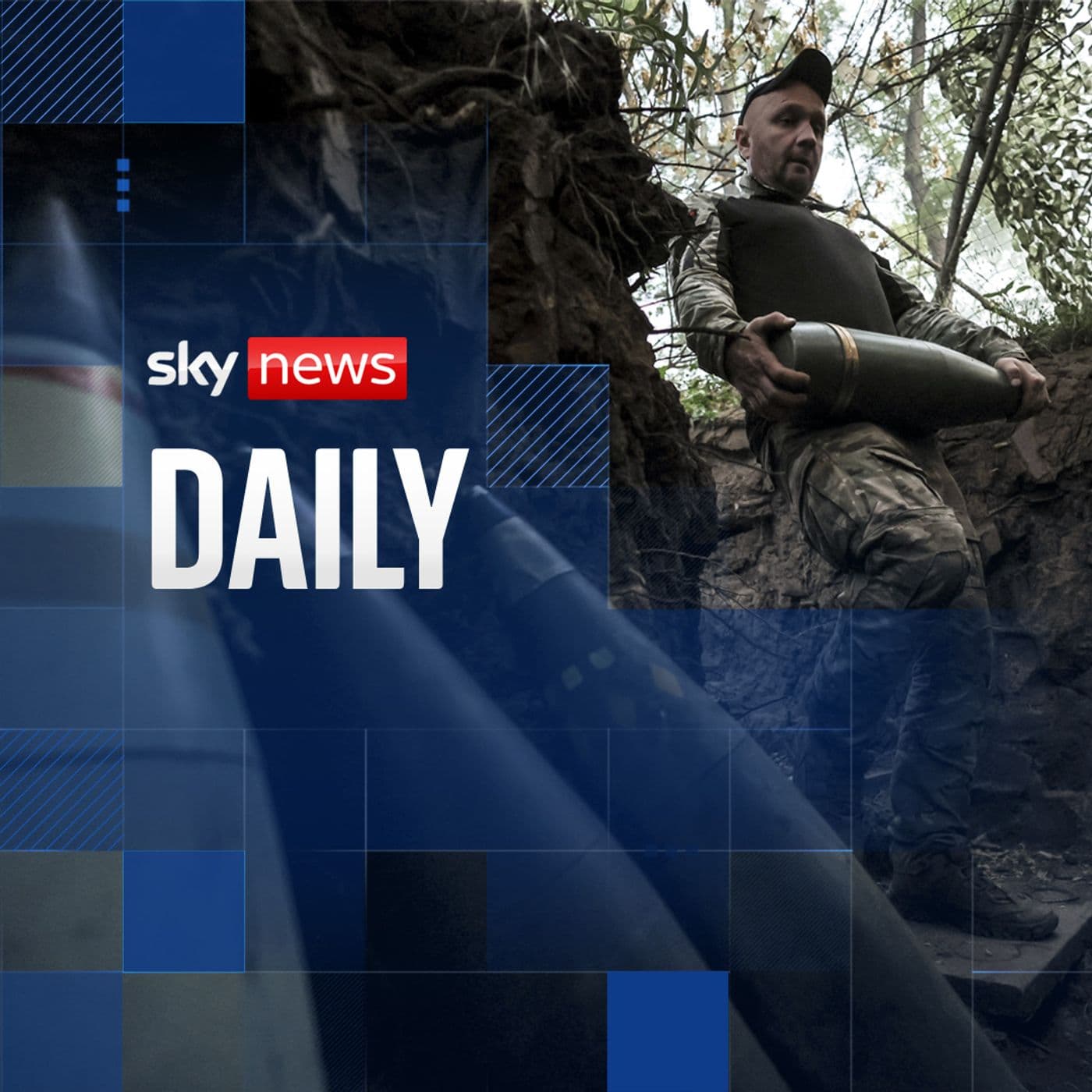
In today's Sky News Daily, Gareth Barlow is joined by defence analyst Michael Clarke, who explains what’s going on in Ukraine and why attention has faded.
Producers: Natalie Ktena and Emily Hulme
Editor: Philly Beaumont