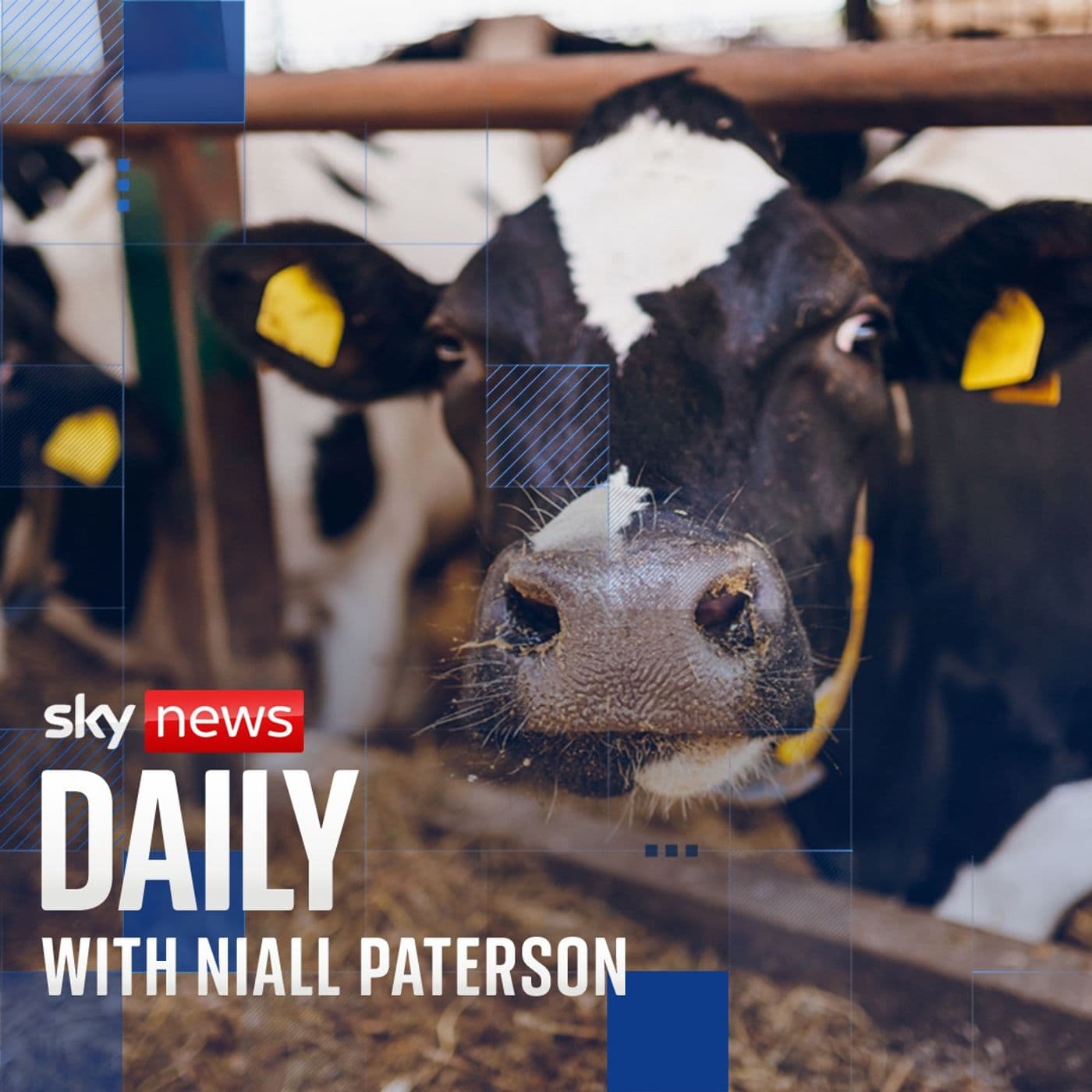

In short
Episode topic: How selective breeding of cattle (“Cool Cows”) and related strategies aim to cut methane from cow burps to slow climate change.
Guest backgrounds
Thomas Moore, Sky News science correspondent.
Key claims
Cows and other livestock produce at least 12% of global methane; methane traps ~28x more heat than CO2 and lasts ~12 years. UN estimate: cutting methane 45% could avert ~0.3°C warming. Cool Cows measures methane using a feeding hood and ear-tagged calves, then breeds low-methane bulls/cows; offspring may emit ~2% less methane, potentially ~40% herd reduction in 20 years.
Notable examples
controversy over a Beauvais/Arla feed additive trial (misinformation about Bill Gates/depopulation); other additives including daffodil-bulb extract (~30% methane reduction). Mentions manure biogas and diet changes as broader solutions.
Written by AI. May contain mistakes. Listen to the episode to check what was said.
Chapters
Tap a time to open that second in VOSelective Breeding of Cows
0:30 to 0:41
Discussion on how selective breeding can impact methane emissions from cows.
“How the selective breeding of cows could reduce the methane in their burps and make a real impact on climate change.”
The Methane Emission Problem
0:41 to 1:30
Exploration of methane's role in climate change and its sources.
“How does a banana trigger a CIA-backed coup?”
Understanding Methane's Impact
1:30 to 2:29
Details on methane's potency as a greenhouse gas compared to CO2.
“It may surprise you to learn, I certainly was, cows and other farm animals contribute at least 12 % of global methane emissions.”
The Cool Cows Initiative
2:29 to 4:25
Introduction to the Cool Cows breeding program aimed at reducing methane.
“And that is why we're talking about cows.”
Selective Breeding Practices
4:25 to 7:18
How traditional selective breeding can help reduce methane emissions.
“and they were certainly using their heads to butt us around.”
Feed Additives and Controversies
7:18 to 8:16
Discussion on the use of feed additives to reduce methane emissions in cows.
“But there will be some people who still want to have that burger, have that steak.”
The Biology of Cows
8:16 to 9:22
Explanation of how cow digestion contributes to methane production.
“There was no evidence behind it whatsoever.”
Agricultural Greenhouse Gas Contributions
9:22 to 11:10
Statistics and implications of agriculture's impact on greenhouse gas emissions.
“Thomas, how much of our greenhouse gases actually come from agriculture?”
The Broader Discussion on Diet
11:10 to 12:20
The need for conversations about dietary changes and sustainability.
“But in the States, there is this move towards biogas.”
Transcript
Automatic transcript. May contain errors.0:00Thomas Moore:How does a banana trigger a CIA-backed coup? Do AirPods herald the arrival of a new global order? What do LED lights say about the future of humanity? I'm Ed Conway, and in each episode of my new podcast, Stuff Matters, I take an object, crack it open, and reveal the world-shaping forces hidden inside. This is economics told through the things we think we understand. Search Stuff Matters on your podcast app to listen and follow. Coming up on the Sky News Daily. Pardon me for being rude. It was not me. It was my brood. How the selective breeding of cows could reduce the methane in their burps and make a real impact on climate change.
0:44Thomas Moore:How does a banana trigger a CIA-backed coup? Do AirPods herald the arrival of a new global order? What do LED lights say about the future of humanity? I'm Ed Conway and in each episode of my new podcast Stuff Matters I take an object, crack it open and reveal the world-shaping forces hidden inside. This is economics told through the things we think we understand. Search Stuff Matters on your podcast app to listen and follow.
1:21Thomas Moore:Here's one for you. How much do burping cows contribute to climate change? Well, it turns out our bovine friends aren't exactly environmentally friendly. It may surprise you to learn, I certainly was, cows and other farm animals contribute at least 12 % of global methane emissions. Now, we more commonly associate carbon dioxide with global warming, but methane traps 28 more times heat than CO2 and takes more than a decade to break down in the atmosphere. So bring down the methane and you could pretty quickly see massive environmental results. That's certainly the thinking behind the Cool Cows breeding programme at Scotland's Rural College.
2:03Thomas Moore:Here to explain, our science correspondent Thomas Moore. Thomas, look, as a fan of many breeds, including the Ayrshire from my part of the world, what on earth is your problem with cows? They produce an awful lot of methane and that is a problem because it is a big contributor to human-caused global warming, but is also an opportunity for making a rapid difference to the amount of pressure there is in the atmosphere that's driving up the global heat. And that is why we're talking about cows. Now, so methane has accounted for about 30 % of all the global warming from human emissions. Yeah, because I commonly associate global warming with CO2, carbon dioxide.
2:41Yeah, absolutely right. But methane is that other greenhouse gas. And livestock account for about a third of all the methane emissions, almost as much as leaks from the fossil fuel industry. So let's look at it. So it's a big problem. So it's about 80 times the heating power of carbon dioxide. So methane causes a huge problem once it's in the atmosphere. But it only lasts for 12 years up there, then it just breaks down. So if you cut off the amount of methane going up into the air, you very quickly make a big difference to the amount of global warming. So the UN has reckoned that if you cut methane by 45 % in the next few years, you'd avert around 0.3 degrees of global warming.
3:26I think we're trying to keep global warming to 1.5, so 0.3 could be a big deal here.
3:31Thomas Moore:Okay, so let's talk about the solution, or at least a group of farmers, a group of academics who think they might just have it. And it involves something called, which I have to admit, I loved, cool cows. Cool cows, yeah. So fun fact on cows, they belch every 90 seconds. But in those belches, there is an awful lot of methane. Most of the methane in a cow comes out the front end, not the back end. All right. Thomas, so you might not want to answer this one, but what does it smell like in this place at the Agricultural College? Do you know what? It was fantastic getting in the pen with these calves.
4:04These were calves that were born back in the spring, so about six months old. Very cute. They were fantastic. They had a fantastic bread of straw. They didn't particularly smell. They did do an awful lot of producing a lot of manure, should we say. But no, the methane didn't smell at all. It is an odlerous gas. So that was absolutely fine. They were quite feisty, though. We were trying to do some filming, and they were certainly using their heads to butt us around.
4:29Thomas Moore:Thomas, so what exactly are these academics actually doing? So what they're doing is they're measuring the methane in the air they give off. They've got this special hood that dispenses some feed, so they stay there for a while eating the feed. and at the same time the machine is just measuring all the methane coming off. And then there's a calculation because it's all tagged to something they wear on their ears. They know which calf is producing how much methane every day. So they can identify, they know that in a herd there'll be some big methane producers and some lower methane producers. The idea though is to match up low methane producing bulls and low methane producing cows, get them to have a calf and that calf will have even lower methane emissions about two percent less than their parents and this is how they begin to breed cool cows i mean you're taking me back to my standard grade biology here this sounds an awful lot like mendo and his eplants it's selective yeah it is selective breeding it is traditional breeding practices that have been going on for centuries in this country and that's why you get really stocky beef bulls that produce fantastic steaks and high yielding dairy cattle that produce phenomenal amounts of milk and that has been done through traditional selective breeding there is no genetic modification involved in this whatsoever do we know whether this sort of selective breeding has any effect on well the things that we tend to selectively breed for in cattle already milk yield quality of the meat and so on as far as we know no that we are specifically taking dairy cattle in this case but The yield, clearly they would not want that to drop off because then it becomes economic to farmers.
6:10But they do want to reduce the amount of methane. And the gains are potentially huge because they are cumulative. So when that low methane producing calf then goes on to have its own calves, that is cumulative and progressive. So they reckon within 20 years, you could reduce the amount of methane coming from a herd by 40%.
6:30Thomas Moore:I mean, that is an incredible amount. but there's just this little voice at the back of my meat-eating head, Thomas, saying, look, if you want an easy way of reducing the amount of methane produced by cows, surely there's an easier way. Have fewer cows. Yeah, and that's the point of the food sustainability researchers. Now, they say that, look, it's great that people are trying to reduce the amount of methane produced by cattle either by selective breathing or by looking at feed additives. But, you know, there is that problem of the manure. You can't avoid it. Cows produce an awful lot of manure.
7:04That goes into tanks on the farmyard, and that produces an awful lot of methane. That is the big concern. But not everybody wants to have a plant-based diet. Many people have reduced the amount of meat they eat. Myself included. Indeed, and me too. But there will be some people who still want to have that burger, have that steak. And what the farmers are saying, well, we can improve the sustainability of the beef that people do choose to eat.
7:28Thomas Moore:What are the other options when it comes to reducing methane? and we've talked of course about the selective breeding but you mentioned feed. Yeah and this ran into a bit of controversy last year. You might remember Beauvais. Now Arlo which is a major dairy producer they said that they were going to introduce this chemical additive on a trial basis in a selected number of farms and although the Food Standards Agency that this was perfectly safe that there was no trace of this chemical additive in the milk itself there were people that turned it into this conspiracy theory the complete misinformation that this was somehow linked to Bill Gates, and again, falsely claiming that it was part of a depopulation plot.
8:10They were encouraging people to pour milk down the toilet. And this became a massive thing on social. There was no evidence behind it whatsoever. What is true is that it reduced the methane produced by the cows by around 30%. Now, there are other feed additives, including one made from an extract of daffodil bulbs, which again could reduce the amount of methane by cows by around 30%. So there is a lot of hope that if you can combine breeding and feed, you make a big difference.
8:39Thomas Moore:Isn't it possible for us to just change what we actually feed cows in the first place? We can't get around the fact that cows eat grass and grass is a particularly tough, fibrous plant to break down. You and I can't do it and we've become very ill if we try to eat too much of it. Cows have four stomachs. Ruminants have four stomachs. There's sheep too. And they can regurgitate and chew the cud and swallow it all over again. And that's the process of breaking down grass. And it's helped by microbes in their stomachs. And that is what causes the methane. You just can't get around it. But you can change the number and the type of microbes in their stomachs, either through breeding or through the feed additives.
9:22Thomas Moore:Thomas, how much of our greenhouse gases actually come from agriculture? because in this part of the world, we produce and consume an awful lot of dairy and an awful lot of beef. And that is not globally always the case. Yeah, so the agriculture currently accounts for 10%. And that's why the National Farmers Union says it wants to reach net zero by 2040. Now, that looks a long way off. I mean, livestock account for a huge proportion, 9 million cows and calves in this country. And that's going to have a big impact. And again, sheep too, a lot of methane coming from that. Now, at the moment, there are huge parts of the world where meat is a treat.
9:57They don't have it on a daily basis. But as people become richer, economies grow, they're eating more meat. So this is a concern that if we don't deal with this problem now, it will get bigger and bigger. Now, here in the UK, we've actually reduced beef consumption by 62 % since the 1980s. So it has fallen by quite a lot. And part of that was because of BSE and health concerns, some of it environmental too. So it's all together that is having a big impact and driving beef consumption downward.
10:28Thomas Moore:Thomas, as you know, we are big fans of renewable energy here on the Sky News Daily. And I just wondered, is there no way in which we can harvest this methane? I mean, it burns, doesn't it? I mean, it's a fuel source that's going to waste. Yeah, and there are some farmers, large dairy producers, not so much in this country, but they do collect together the manure in big tanks. And then the biogas that is given off is then pumped into the gas system. And you can get great energy that way. But we don't really have huge barns of cows around the year kept inside. So they're out in the field generally in this country for between six and nine months of the year.
11:10And that's the way we like our beef. But in the States, there is this move towards biogas.
11:14Thomas Moore:Let's be brutally honest with each other here, Thomas. I mean, it's great. The work that is going on in Scotland is incredibly exciting and the work around feed, again, incredibly exciting. But ultimately, to halt the changes in climate that we have seen, we are needing a bigger, broader discussion about diet, about what we eat and what we eat sparingly, what we should be eating that we don't already eat. And I just don't feel like any of us are involved in that conversation or perhaps even ready for it. Well, I think younger people are actually, Neil. And I think that's why you see so many younger people who do become vegetarian or vegan, because there is something that they control.
11:54They can't decide where the household buys their energy or what car they buy or anything like that. But they can decide what they eat. They know that that does have a big impact on their personal carbon footprint. And I think that's an opportunity for everybody. if they can't afford to buy an electric car, well, you can actually have a more plant-based diet, which is actually cheaper than a meat-based diet very often. So there is that opportunity. But you're right, we do need to look at the food system, and there is a lot wrong with it. The amount of waste it produces, how supermarkets have completely eroded seasonality.
12:24We don't know what time of year raspberries are ripe because we can get them every week of the year from some part of the world, but they are flown in. So there's a lot wrong. But what's happening at Scotland's rural college and the breeding they're doing with the cows is trying to address one small part. Thomas, thank you.
12:47Thomas Moore:And you can see Thomas' full report over on the website skynews.com. The Sky News Daily is back again tomorrow.
12:58Thomas Moore:How does a banana trigger a CIA-backed coup? Do AirPods herald the arrival of a new global order? What do LED lights say about the future of humanity? I'm Ed Conway, and in each episode of my new podcast, Stuff Matters, I take an object, crack it open, and reveal the world-shaping forces hidden inside. This is economics told through the things we think we understand. Search Stuff Matters on your podcast app to listen and follow.
From the publisher
The problem is they also enjoy burping and breaking wind and it's having a huge impact on global warming.
The steaks couldn’t be higher and that’s why an agricultural college in Scotland has developed the Cool Cows programme to breed the animals in a way that means they expel less gas.
Niall is joined by our udderly brilliant science correspondent, Thomas Moore.
Producers: Natalie Ktena & Tom Gillespie
Editor: Mike Bovill