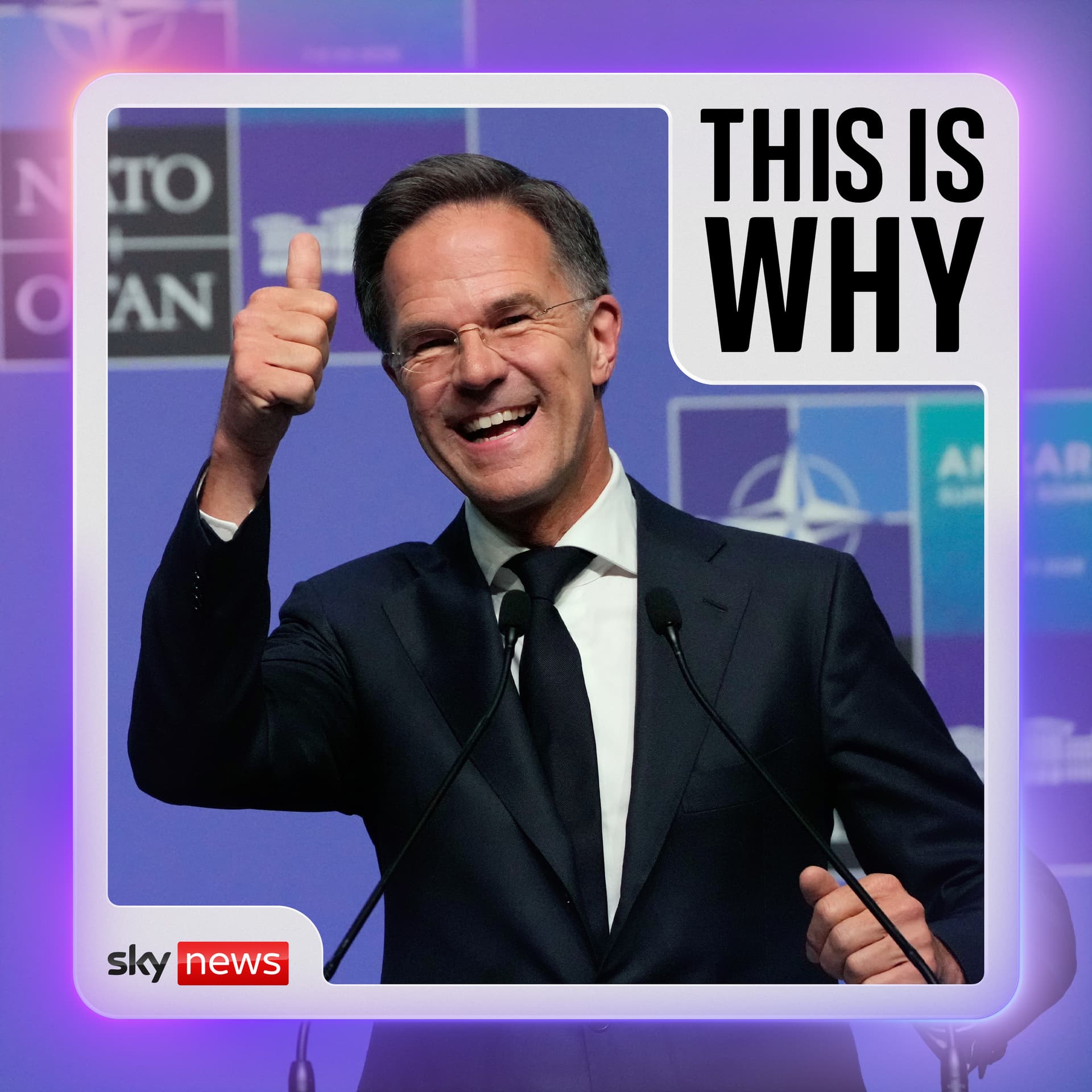

In short
Stuff Matters episode on NATO Secretary General Mark Rutte’s diplomacy with Donald Trump, and whether his pragmatism is strengthening or exposing NATO’s fragility. It uses “objects” as a framing device but focuses on geopolitics and defense spending.
Guests
Rachel Elihus, Director General at the Defence Think Tank RUSI (RUSI). She previously worked with Rutte at NATO; she describes him as pragmatic, straightforward, low-ego, and habit-driven (e.g., cycling to NATO HQ).
Key claims
Rutte keeps NATO united by taking pressure off allies (“Trump whisperer”/“duct tape” framing), pushing defense investment (toward 5% by 2035), maintaining Ukraine support, and reframing Ukraine as US national interest. Critiques: he may not correct Trump’s falsehoods boldly enough and should defend Article V/ally sovereignty more forcefully (e.g., Greenland).
Notable examples
MH17 shaping his view of Russia’s willingness to attack civilian targets; NATO Ankara summit declaration; Trump talk of Greenland and lashing allies; Rutte’s “daddy” remark reported in press; US force presence and defense industrial integration continuing despite Trump threats.
Written by AI. May contain mistakes. Listen to the episode to check what was said.
Chapters
Tap a time to open that second in VOMark Rutte: NATO's Pragmatic Leader
0:57 to 2:18
Discussion on Mark Rutte's political background and his approach to NATO leadership.
“which is pretty handy when your next job is NATO Secretary General and the elephant in that room is Donald Trump.”
Rachel Elihus on Rutte's Character
2:18 to 4:12
Interview with Rachel Elihus about Mark Rutte's personality and effectiveness.
“Rachel Elihus is Director General of the Defence Think Tank, Roussi.”
Rutte's Views on Geopolitics
4:12 to 6:29
Exploration of how events like MH17 shaped Rutte's geopolitical perspective.
“allies are not going to agree on everything.”
Transatlanticism and NATO Spending
6:29 to 8:38
Discussion on Rutte's support for NATO and the challenges of defense spending.
“Yeah, well, here in Europe, we're fortunate that we live in a relative state of peace and people can go about their daily business without thinking about security and defense very much.”
Rutte's Achievements at NATO
8:38 to 11:09
Assessment of Mark Rutte's successes and challenges as NATO Secretary General.
“on board and deliver that for the Netherlands.”
Rutte as a Trump Whisperer
11:09 to 14:00
Analysis of Rutte's relationship with Trump and his diplomatic strategies.
“But it is also in part due to the belligerence and the words of the United States President Donald Trump.”
Concerns About the High North Security
14:00 to 14:58
Discussing the importance of security in the high north region and NATO's role.
“President, you've got some concerns about the security of the high north.”
Mark Rutte's Relationship with Trump
15:13 to 19:38
Exploring Mark Rutte's diplomatic approach with Donald Trump and its implications for NATO.
“I hesitate to say that he has been in pursuit of a bromance with Donald Trump, but clearly he has not capitulated, but used the sort of language that Donald Trump appreciates.”
Challenges of Supporting Ukraine
19:38 to 21:24
Analyzing NATO's strategies and challenges in supporting Ukraine amidst geopolitical tensions.
“And so I think people were just scratching their heads as to what was the motivation behind this behavior.”
Measuring Rutte's Success at NATO
21:24 to 21:56
Discussing the potential measures of success for Mark Rutte's tenure at NATO.
“It's just a technicality because for all intents and purposes, their supply lines, their forces, their command and control and communications are very integrated with those of NATO.”
Show all 11 chapters
Ed Conway's Podcast Promotion
22:34 to 22:59
Another promotional segment for Ed Conway's podcast Stuff Matters.
“Do AirPods herald the arrival of a new global order?”
Transcript
Automatic transcript. May contain errors.0:02Sky News, the full story first.
0:11He's the longest serving Dutch Prime Minister turned Secretary General of NATO. But Mark Rutte is much more than just a Trump whisperer. And this is why.
0:25How does a banana trigger a CIA backed coup? Do AirPods herald the arrival of a new global order? What do LED lights say about the future of humanity? I'm Ed Conway, and in each episode of my new podcast, Stuff Matters, I take an object, crack it open, and reveal the world-shaping forces hidden inside. This is economics told through the things we think we understand. Search Stuff Matters on your podcast app to listen and follow. Anyone who spends 14 years as Prime Minister knows a thing or two about reading the room, which is pretty handy when your next job is NATO Secretary General and the elephant in that room is Donald Trump.
1:08You know they fight like hell. You can't stop them. Let them fight for about two, three minutes, then it's easier to stop them. And then daddy has to sometimes use strong language. You have to use strong language. Every once in a while you have to use a certain word. Former Dutch PM Mark Rutter became NATO Secretary General in 2024, bringing with him a reputation for pragmatism, charm and political durability. They called him Teflon Mark because nothing seemed to stick. But the question now is whether that survival instinct is exactly what NATO needs or whether it comes at a cost. Because Rutter's handling of Trump, or should that be daddy, has become a story in itself.
1:44Mark, you sit next to Donald Trump in moments where he talks about conquering Greenland, talks about lashing out at allies like Spain, starting trade wars. Things that it doesn't seem like the old Mark Rutte would approve of. Does this have any effect on your self-respect when you sit next to him like that and say nothing? You know, what I always do is acknowledge when praise is due. And I think we should praise Donald Trump for the fact that NATO is so much stronger. So is Mark Rutte brilliantly keeping the alliance together in the age of Trump? or has he shown us just how fragile NATO has become?
2:21Rachel Elihus is Director General of the Defence Think Tank, Roussi. In fact, she worked for a time with Rutter at NATO. So I began by asking her, what's he actually like? There is an awful lot to talk about in terms of Mark Rutter's kind of professional career, but it was a career that kind of intersected with yours for a time. I mean, you worked alongside him briefly at NATO on a personal level. What's he like? I think he's very true to what you see on the television. He's quite pragmatic. He's quite straightforward. He's very direct. He just likes to get things done. I'd also heard rumors that he was something of a creature of habit, that he liked to go on certain walks.
2:57There were certain restaurants that you would always end up going to if you were part of the inner circle. We have a habit of choosing NATO secretary generals that like their habits. And maybe that bleeds over into their pragmatism and their ability to withstand what's a very difficult job. So yes, Mark Rutte still likes to ride his bicycle to NATO headquarters, despite the questionable Belgian traffic and bike lanes. NATO Secretary General Stoltenberg, before him, took regular trips back to Norway and was also a cyclist. So I think these are people who are very set in their ways and very comfortable with themselves.
3:29So what was it that first attracted NATO to Mark Rutte in the first place? Was he the best candidate or was he the safest pair of hands, perhaps? I think he checked both those boxes. I recall going through a lot of names of individuals that would have been quite good for the alliance, whether that was Danish Prime Minister Emette Frederiksen or it was, I think, former British Secretary of State for Defence, Ben Wallace. They would all have been fine and had a lot of the pedigree. But I think what Ruda brought that others lacked was that pragmatism and that straightforwardness. People looked at his record where he'd been prime minister in the Netherlands for, I think, 14 years.
4:06And over that time, he built a lot of coalitions among very difficult, disparate groupings. And when you look at that, that's a skill you need to bring to the alliance where 32 allies are not going to agree on everything. And of course, in that role, you have to reach out to all of those members of NATO. So perhaps his own internal political compass, not necessarily of huge relevance, but where can we put him on the political spectrum during his time as a politician, first and foremost? He's difficult to place because I think in a European context, I think you'd call him both socially and economically liberal, but pragmatic.
4:42But he was always willing to walk and work across the aisle in order to get a decision. He was always willing to compromise and he was very low ego. I think that's something that has worked for him well at NATO as well. It's never about him. It's always about the result you're trying to achieve. I think he once famously said, if you're looking for vision, go see an optician. He's very focused on results rather than that grand, strategic, somewhat vague vision that many politicians hold forth. No one spends 14 years in politics, let alone 14 years as a prime minister, without acquiring a bit of baggage along that way.
5:16Reading around Mr. Rutherford's conversation, the nickname that came up during his time in politics, Teflon Mark. I mean, what does that tell us? Was that born of admiration? Was that born of criticism? Where did that come from? As far as I understand it, the criticism comes from a sense that even when he was wrong or slightly off target, he didn't take personal responsibility for that. I didn't follow his career in Dutch politics as closely as I'm now following his career as NATO Secretary General. But I could see that because he doesn't have that high ego and he doesn't personalize what he's trying to achieve, there could be a perception that he is a bit like Teflon and just deflects responsibility.
5:56whether that's fair or not, I'll leave it to you. I will leave it to those listening to this podcast to go off and have a look at that themselves. But one event during the time that he was Dutch Prime Minister did seem to shape his views of the geopolitics of this world. And that was the downing of MH17, the passenger jet that came down, I think in Eastern Ukraine, but went down with three figures Dutch nationals on board. What do you know about what that did to his view of Russia, of conflict, of circumstances in which he now finds himself dealing with directly as NATO Secretary General. Yeah, well, here in Europe, we're fortunate that we live in a relative state of peace and people can go about their daily business without thinking about security and defense very much.
6:40And so I think people were maybe a bit naive about the fact that we were not at a constant state of peace and that there were actors like Russia who were willing to move into the civilian space where we all live and operate and create a threat there. So who would have thought that there could be an attack on a civilian aircraft when we were not technically at war with a nation? And so it's really important that Mark Ruda has been so direct about that and has made it very clear that we are in a persistent state of conflict and we have to be aware, whether it's the safety of our computers, the safety of our airports and the civilian infrastructure.
7:15So I think it made him personally less naive about what Russia was willing to do to achieve its goals in Ukraine and elsewhere. And it's a vision that is very similar to what we see from the Baltic states and Poland, who have a history with Russia, that maybe some of the NATO allies in the southern part of the alliance, like Spain and Portugal, do not. And so that appreciation that he brings to the near proximity and the reality of the threat, I think has been a useful carryover from his time as prime minister into the NATO role. Let's focus on the time spent at NATO. Was Mark Rutte always a kind of a transatlanticist, or was it only after those events that took place in Ukraine that really the role of Secretary General became a natural fit for him?
7:55Well, in Dutch politics, he wasn't minister of foreign affairs and he wasn't minister of defense. And the roles he had before he was prime minister were probably more, I would say, domestically focused in education and elsewhere. So it's really hard to point to a clear position on that transatlantic barometer during his time as prime minister. But I think he was consistently supportive of NATO. I mean, I did see him turn up as prime minister to a number of NATO summits. Again, just very pragmatic, very straightforward, unapologetic about the challenges we were facing from Russia and elsewhere.
8:25You know, he did push back on defense spending. A lot of people don't remember, but the Netherlands was not always meeting 2%, much less 3%. And they were actually one of the laggards in terms of understanding the importance of defense spending. And there were a lot of struggles between him and his finance ministry to bring everyone on board and deliver that for the Netherlands. But, you know, I know I would put him forward as a transatlanticist in terms of the EU. He and his Dutch colleagues are often known as part of that group of frugals who resist federalism and centralization of power and try to keep the member states having a measure of power and leverage as well.
9:00From your perspective, what has he achieved since taking over at NATO? Well, I mean, I have to give the guy credit. He really has been delivering. I was at NATO until 2024 under President Biden, and there was a lot of the same requests for European allies in Canada to spend more on defense. They didn't always produce results. And I think we just saw at the NATO summit in Ankara that he's encouraged allies to continue to move towards delivering on defense spending. He's brought them across the finish line in terms of investments and some critical capabilities like air defense. And he's even managed to keep everybody together on Ukraine.
9:39I know it's short and I know it's sweet, but that NATO declaration that was released at the summit in Ankara these past few days has everything in there. It recognizes the long term challenge from Russia. It recognizes the threat posed by Iran in terms of freedom of navigation and nuclear proliferation. So you might question his methods, but I think he is getting results. Can I just be a touch cynical just for a second in the sense that, yeah, clearly he has gained commitments for spending. Spending increases all the way up to 5 % by 2035. But you yourself know from your time working back at the Ministry of Defence, back when I was briefly a defence correspondent on the 2010 Strategic Defence and Security Review, you know, committing to spend money on something isn't exactly the same as actually spending that money, is it?
10:26You're right. In many cases, there's a lot of talk and not a lot of delivery. And Mark Ruda will have a role in that, as will his staff and going country by country to every ally and holding them to account in terms of what they've signed up for, both in terms of defense spending and the capabilities they're investing in. The responsibility is also on national leaders to have the courage to tell their people what sort of a threat environment we're in and why we might need to make a tradeoff between taxes and spending or between spending on defence and development aid and that there will be tradeoffs and this will be tough and everybody will have a part to play in keeping our country safe.
11:00Clearly, the commitment to increased spending across NATO members is welcome and, you know, in part and large part, thanks to the hard work of Mr. Ruta. But it is also in part due to the belligerence and the words of the United States President Donald Trump. I mean, to what extent is it fair to describe him as a bit of a Trump whisperer? Well, I think Mark Ruda would be the first to admit that you might not like President Trump's methods either, but he has gotten people's attention. And the threat of a withdrawal of U.S. forces from Europe or a threat of withdrawal of the U.S. commitment to NATO's Article 5 security guarantee has really gotten people to start talking less and really putting that investment in real capabilities and readiness.
11:43So he is a Trump whisperer in the sense that I think he takes a lot of pressure off the individual NATO allies. He's the one who's willing to go in there and take the shame for the sake of the other 32. So again, it's uncomfortable and it's difficult to watch all the flattery and the simplistic messaging. But if it's the one guy who takes the pressure and the heat off the other allies and allows them to get on with the real work that needs to be done, I think that's probably a gift. I've heard him described as kind of the diplomatic equivalent of duct tape, not particularly sexy, not particularly glamorous, but it holds the whole thing together.
12:19I mean, how fair an assessment do you think that is? I'd hesitate to comment on his utility in keeping 32 allies together is quite impressive. He speaks for the alliance and what's good for the alliance. He doesn't speak for individual allies. So the criticism that he has received sometimes, I mean, I think I saw something around the fact that he talks far too little about European sovereignty. I mean, that's not really the position that the Secretary General of NATO, a transatlantic alliance, that's not the talking point that he should be delivering. That is for, you know, Commission President or somebody else to deliver.
12:55His goal is transatlantic unity and keeping the US in. That is awfully hard, though, isn't it? When the United States president is talking in imperialist terms about the annexation of Greenland. Yes. And I will say for all the goodness that we've just talked about surrounding Mark Ruda and his effectiveness, I'd say there are two areas where I'd give him probably a C or a C minus and he's got to do a bit better. The first is when he hears something that's a deliberate falsehood. If the president is being misleading about the facts, he has a right to correct the record. And I think we saw that a little bit when he was doing the press with President Trump recently.
13:31He made a roundabout point of how NATO countries' bases had, in fact, supported the conflict in Iran, even if that hadn't been immediately apparent. So he does some correction, but sometimes he comes at it in a way that's too late or not bold enough. And then the second, of course, would be when we're talking about the security of an ally and that precious Article V collective security guarantee, which says an attack on one is an attack on all. He really has to speak out. I have a hard time thinking that Secretary General Stoltenberg would not have very strongly defended Denmark's sovereignty and Greenland's sovereignty and really pushed back on that and said, look, I understand, Mr.
14:11President, you've got some concerns about the security of the high north. It's an important region. But I can assure you, together with our allies in the kingdom of Denmark, NATO can take care of this together with the United States, I think would go a long way.
14:33How does a banana trigger a CIA-backed coup? Do AirPods herald the arrival of a new global order? What do LED lights say about the future of humanity? I'm Ed Conway, and in each episode of my new podcast, Stuff Matters, I take an object, crack it open, and reveal the world-shaping forces hidden inside. This is economics told through the things we think we understand. Search Stuff Matters on your podcast app to listen and follow.
15:13I hesitate to say that he has been in pursuit of a bromance with Donald Trump, but clearly he has not capitulated, but used the sort of language that Donald Trump appreciates. There was, though, the one occasion on which it was said that he had referred to Donald Trump as, in inverted commas, daddy. I mean, what was the truth of what went on there? Because it wasn't quite as it was first reported. I think he did actually use that word. He was just trying to capture the moment that took the tension out of the room with someone like Donald Trump, who has a very big ego and wants to take credit for things.
15:51Calling him by that name and suggesting that he was primarily responsible for getting allies to spend more on defence, maybe gives him a little bit more credit than is due. But I would agree. I mean, it makes you a bit uncomfortable because getting defence spending on track and getting the alliance to deliver is not the job of any single person. It's a lot of hard work behind the scenes by all 32 countries who are members of the alliance. But what do we know of the views of those 32 members, particularly our European allies? What do we know of their view of the way in which NATO has been man managing Donald Trump?
16:28I think that's a difficult question. The fact that NATO is still there and it's producing real results, that has to be a relief to countries who at one point thought that a second Trump administration meant the end of the alliance or the United States withdrawing all its forces from Europe, when in fact, the opposite is true. If you look behind the scenes, there's a strong U.S. force presence in Europe. Europeans continue to be integrated with transatlantic defense industry. There's more co-production and cooperation and co-development in that defense industrial space as well. The support to Ukraine has been maintained.
17:01So, again, you might not like the person, but if you look at the real facts on the ground, there's still a strong deterrence in defense across the alliance. Let's speak specifically then just about Ukraine for a second. In terms of his activities on that, as you've already mentioned, a united position. If we put America to one side for a second, a united position when it comes to the defense of Ukraine and indeed Ukraine's right to defend itself in the ways in which it has. But have we done enough? I mean, has he done enough to encourage the member states of NATO to do more than they perhaps would have been willing to in the first place?
17:33I think the books will be written once Trump is out of office and Ruta's out of office. But that change in position from the U.S. president in terms of his views on Ukraine is probably down to quite a bit of careful dialogue and lobbying from Mark Ruta, who probably explained that Ukraine is fighting for alliance security, that Ukraine is innovating in a way that will help the United States have a leg up on China and other adversaries for a long time to come, that Ukraine has a lot of capabilities and resources that will help U.S. defense industry. I mean, I'm sure he's painting this picture of Ukraine as a winner that has helped change Donald Trump's view on who the strongest power is in that Ukraine-Russia relationship.
18:19As to whether the alliance is doing enough, that's a continual question. When I was at NATO, it was always a balance between helping Ukraine stay in the fight and push back on the Russians and eventually be strong enough on the battlefield to have the upper hand in a political solution. But behind that, every single one of those countries that's supporting Ukraine also has to have in the back of their mind the fact that Russia could also attack NATO. And so they need to hold enough in reserve so that if the worst case scenario, the unthinkable does happen, that there's still something in the closet to have that to keep up their end in that second part of the fight.
18:55Whilst noting Donald Trump's change of heart towards Vladimir Zelensky, towards Ukraine, perhaps largely down to Mark Ruta and the fact that on paper you can argue that Zelensky is a winner, which always goes down well with Donald Trump. Before he had that kind of change of heart, was the feeling within NATO, was Mr. Roota's feeling that there was an existential risk to the organization, that Donald Trump wasn't just doing what he traditionally does, noising off, shouting loudly, and that there was a very real prospect that the United States could have withdrawn? That seems like a fair assessment, at least in the early days when President Trump seemed to have a strangely close relationship with President Putin.
19:37We saw Elon Musk turning off Starlink for a period of time that really complicated things for the Ukrainians. And so I think people were just scratching their heads as to what was the motivation behind this behavior. Was it a lack of understanding? Was it something deeper than that? I think now we know that it's down to personalities and a superficial understanding of the genesis of the war between Russia and Ukraine. And now that U.S. and allied support to Ukraine is quite strong and continues. But as with anything, when you have a new leader coming in, you do need to frame things in a different way.
20:11And in this case, I think allies and Ruta did a good job in framing support to Ukraine as in the U.S. national interest. When time comes for Mark Ritter to move on, what would count as success in your eyes for him at the end of his term? Well, right now, I think the measure of success is rebuilding collective defense in the alliance. I mean, there were almost two decades where countries underinvested in defense. A lot of them took advantage of the peace dividend and didn't really invest in their security and defense. And to the extent they did, it was for out of area expeditionary operations of choice.
20:48So not things that were really down to the survival of your country and the threat of your country being attacked. So if he's at the end of the day, strengthened collective defense, made Europe step up in the NATO alliance and made NATO a bit more European so that it can operate either with or without the United States, I think that would be a real measure of success. And then equally, even if Ukraine is not a member of the alliance, you want them so integrated into the alliance's command and control, defense industrial pipelines, that membership doesn't really matter. It's just a technicality because for all intents and purposes, their supply lines, their forces, their command and control and communications are very integrated with those of NATO.
21:35Do you think he would be happy to be remembered for his time at the head of NATO as the man who saved the organization from Donald Trump? Probably. But again, I think my impression of him is that he's very low ego. And so even if that were the case, he'd be happy to cede credit to others. Rachel, been a pleasure talking to you. Thanks for your time. Thanks. And that is your lot for this week on This Is Why. Do get in touch with your thoughts. A couple of days ago, we covered Nigel Farage's resignation from the Commons, setting up a by-election in Clacton. Iltaf Syed got in touch to say this. Why does the government waste taxpayers' money on a gimmick resignation?
22:14Surely he should be barred. Sadly, we will be returning to Nigel Farage and whatever happens in Clacton in the not-too-distant future. For now, though, make sure you have a great weekend. We'll see you the other side.
22:33How does a banana trigger a CIA-backed coup? Do AirPods herald the arrival of a new global order? What do LED lights say about the future of humanity? I'm Ed Conway, and in each episode of my new podcast, Stuff Matters, I take an object, crack it open, and reveal the world-shaping forces hidden inside. This is economics told through the things we think we understand. Search Stuff Matters on your podcast app to listen and follow.
From the publisher
Mark Rutte has spent years quietly building a reputation as one of Europe's most effective political operators. Now, as NATO secretary general, he's trying to keep the world's most powerful military alliance together at a time of growing global uncertainty.
So, who is Mark Rutte? Niall looks at the leadership style that's defined his career, how he's navigating some of the biggest challenges facing NATO, and why his ability to build relationships could shape the alliance's future.
With insight from Royal United Services Institute director general Rachel Ellehuus, we explore what makes Rutte tick, and what his leadership could mean for the years ahead.
Have you got a question for Niall? Email us at why@sky.uk
Become a Sky News Insider! You can listen to Stuff Matters, Electoral Dysfunction, and Trump100 without ads, get new episodes early, exclusive bonus episodes and much more, by becoming a Sky News Insider. Sky News Insider requires a paid subscription and is available to UK listeners aged 18 and over. Find out more and subscribe here: skynews.supportingcast.fm