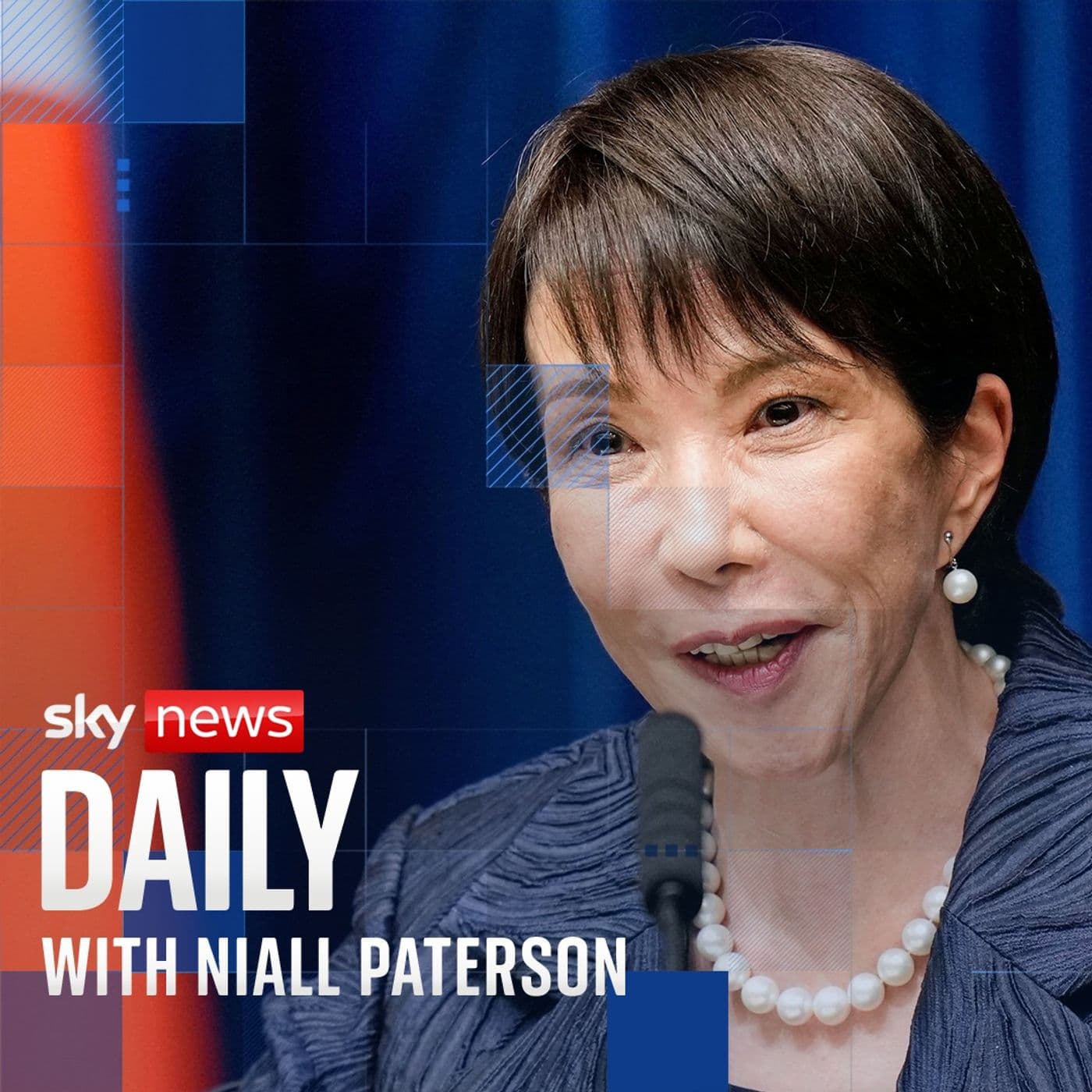

In short
Sanae Takayichi (Sanae Takayichi/Takeuchi in transcript) becoming Japan’s first female prime minister, and what her conservative-nationalist agenda could mean for Japan’s economy, gender politics, and foreign relations (China, South Korea, US, UK).
Guests
Dr. Kristen Surak, Associate Professor of Political Sociology at LSE; expert on Japanese politics; research translated into 12+ languages. Background: raised by conservative Japanese parents; memorized Imperial Rescript on Education; faced gendered education limits (sent to junior college); later TV announcer; interned in the US for Pat Schroeder; rose in politics from early 1990s, joined Liberal Democratic Party, served in Shinzo Abe’s cabinets.
Key claims
her gender doesn’t drive election—her conservatism does; nationalist ties (Nippon Kaigi), Yasukuni Shrine visits; patriarchal gender views (opposes different surnames law; opposes female imperial succession); may focus on women’s health (infertility/menopause). Examples: Jiao Yu/Senkaku disputes; removing Japan’s WWII apology to South Korea; coalition shift to Japan Renovation/Innovation Party.
Written by AI. May contain mistakes. Listen to the episode to check what was said.
Chapters
Tap a time to open that second in VOBackground on Sanae Takeuchi
0:30 to 2:30
Exploring the background and early life of Japan's first female prime minister, including her influences and initial career.
“Coming up on the Sky News Daily, she's the heavy metal drumming, motorbike riding, Thatcher loving first female Prime Minister of Japan.”
Political Ideology and Influence
2:30 to 7:10
A discussion on Sanae Takeuchi's conservative views, nationalism, and her approach to gender issues in Japan.
“Kristen, for those of us in the UK who may not be aware, just give us some of the backstory.”
Challenges and Significance of Her Leadership
7:10 to 9:50
Examining the significance of having a female prime minister in Japan and the challenges she faces in a patriarchal society.
“Do you find that surprising at all, given those formative experiences and being told that as a girl, you cannot go to Tokyo University, we're going to send you somewhere closer?”
Japan's Political Landscape and Foreign Relations
9:50 to 12:20
Analysis of Japan's political instability and Takeuchi's foreign policy outlook, particularly regarding the U.S. and China.
“That was broken twice, once by Junichiro Koizumi, whose son was running against Takeichi for this position.”
Regional Dynamics and South Korea
12:20 to 14:02
Discussing the evolving relationship between Japan and South Korea under Takeuchi's leadership.
“Does she view it as an existential threat?”
Geopolitical Dynamics of Japan and South Korea
14:02 to 16:39
Explore the evolving political landscape between Japan and South Korea, particularly under Takeichi Sanai's leadership.
“I mean, South Korea, Japan, again, there has been at times an uneasy relationship between the two.”
Takeichi Sanai's Personal Life and Public Image
16:40 to 17:29
Learn about Takeichi Sanai's private life, including her workaholic tendencies and relationships.
“So she took his name the first time around legally while she still ran as a politician under her maiden name.”
Japan's Societal Challenges and Cultural Power
17:30 to 18:19
Discuss the societal challenges Japan faces with an aging population and the impact of its cultural exports.
“But I think for where Japan is going forward, it's a country that has managed to do well by, in a sense, being the second fiddle in a lot of ways.”
Transcript
Automatic transcript. May contain errors.0:00Dr Kristin Surak:How does a banana trigger a CIA-backed coup? Do AirPods herald the arrival of a new global order? What do LED lights say about the future of humanity? I'm Ed Conway, and in each episode of my new podcast, Stuff Matters, I take an object, crack it open, and reveal the world-shaping forces hidden inside. This is economics told through the things we think we understand. Search Stuff Matters on your podcast app to listen and follow. Coming up on the Sky News Daily, she's the heavy metal drumming, motorbike riding, Thatcher loving first female Prime Minister of Japan. So what else do we know about Sanae Takeuchi?
0:42Dr Kristin Surak:How does a banana trigger a CIA-backed coup? Do AirPods herald the arrival of a new global order? What do LED lights say about the future of humanity? I'm Ed Conway and in each episode of my new podcast Stuff Matters I take an object, crack it open and reveal the world-shaping forces hidden inside. This is economics told through the things we think we understand. Search Stuff Matters on your podcast app to listen and follow.
1:14Dr Kristin Surak:Hi everyone, welcome back to The Daily Work. By now you must know the drill. Every Friday we take a person or an event leading the news and we take our time in telling you all you need to know. So, have you noticed that recently we've become rather used to television hosts becoming world leaders? Donald Trump, for one, obviously. Vladimir Zelensky is another. But have you heard of Sanae Takayichi?
1:43Dr Kristin Surak:Having started out in the broadcasting world and clearly having a decent set of pipes, She entered politics and was recently elected Prime Minister of Japan. She just so happens to be its first female leader, and she cites Margaret Thatcher as an influence. She also loves to ride motorbikes and used to play drums in a heavy metal band, which, let's be honest, you don't traditionally associate with the Iron Lady or even politics in general. She takes on the job with the Japanese economy struggling, with China expanding its influence, and with Donald Trump in the White House. So, who is Sanae Takeishi?
2:15Dr Kristin Surak:Here to tell us all we need to know is Dr. Kristen Surak, Associate Professor of Political Sociology at the London School of Economics. She's a leading expert on Japanese politics, whose research has been translated into over a dozen languages. Kristen, for those of us in the UK who may not be aware, just give us some of the backstory. So she's got a rather unusual one for a woman who's known for her very, very, very conservative views. So she grew up in Japan to actually quite conservative parents. They had her memorize and recite the Imperial Rescript on Education, which is a kind of an old recitation about honoring the emperor that was used during the late 19th and early 20th century when Japan was a very expansive empire.
3:03She was a very, very bright student, you know, being raised by these fairly conservative parents, and she got into some of the best universities in the country. However, her parents said, well, because you're a girl, you can't go all the way to this top university in Tokyo to study. We want to keep you local. You need to go to a junior college. And so she commuted three hours each way to college in Kobe, close to where she grew up, and did very well, ended up working for a number of years in a research institute, teaching and those sorts of things. And then she actually landed a job as a TV announcer on a major national program, which raised her profile quite a bit.
3:42But she was interested in politics. And so in that time in the late 1980s, she interned in the U.S. for Pat Schroeder, who interestingly is a member of the Democratic Party in the U.S., but probably taught her a thing or two about what it's like to be a woman in politics. And so Takeichi first got elected in the early 1990s, was an independent, rejoined the Liberal Democratic Party of which she's a member now and which she's now leading as the Prime Minister of Japan as well. And she's been able to rise in those ranks quite well over the past really two decades. She was in Shinzo Abe's first cabinet when he was first prime minister in 2006.
4:25Then when he was prime minister through the 20-teens, she was a very close ally of his and held a number of different portfolios in that cabinet, which gave her a range of political experiences that she will probably be drawing on now as prime minister.
4:39Dr Kristin Surak:How significant then is it for a country like Japan to have its first female prime minister? Well, it's striking that it hasn't happened so far, but it's also a country where the vast majority of politicians are old men. So currently in the House of Representatives in Japan, which is the main body within the government, it's only 15 % female representatives. So the fact that she's broken that gender barrier is significant. But I think at the same time, it's also important to remember that she's doing this with very conservative political views. And it wasn't the fact that she was a woman that got her elected.
5:18It was really the fact that she was representing among the top candidates the most conservative set of views out there.
5:26Dr Kristin Surak:Describe to me a little bit more then, Kristen, her political ideology. Conservative, very conservative, you say. But there's quite a lot of nationalism in there as well. Indeed. So she, for example, is a member of the Nippon Kaigi, the Japan Conference, which is a very conservative group that advocates for the revision of the way that Japanese history is narrated, including Japanese imperial aggression against its neighboring countries in the first part of the 20th century. She said that the way that Japanese history is taught is often kind of, you know, self-berating, and it's not creating a proud nation that, you know, we should all be celebrating, for example.
6:05She's gone a number of times to Yasukuni Shrine, which holds the souls of Japan's war dead, but also very controversially, the souls of Class A war criminals and a number of, you know, B and C war criminals as well. She has, you know, fairly strong nationalist views. She also has very fairly conservative gender views. She's, for example, defended patriarchy as the way to go. She's against women and men having different family names if they're married. She does not want to revise a law that would enable husbands and wives to have different surnames. She does not support female succession to the Chrysanthemum throne, to the monarchy.
6:45And this is a big issue in Japan where the number of potential males who can take over the throne is diminishingly concerning. And many people have thought, well, why don't we have an emperor? So we've had this in the past. She is against having a Japanese emperess. And there's a wide range of social issues where she really cleaves closely to very, very traditional depictions of what a family is and what gender roles ought to be.
7:10Dr Kristin Surak:Do you find that surprising at all, given those formative experiences and being told that as a girl, you cannot go to Tokyo University, we're going to send you somewhere closer? One gets a sense in looking at her own biography. I mean, she was raised by very conservative parents and that comes through in her politics even today. But there might have been a slight rebellious streak there because, you know, she did things in her background. She was a member of a heavy metal band. She was a great fan of drumming. She was an avid motorcycle riding fan. And it's probably that slight rebellious streak that you can go in on your own and you can do it yourself that has driven her to the heights of political power in Japan.
7:52I mean, Margaret Thatcher is one of the key role models she cites in a very kind of general way where she just thinks that strong conservative women have an important role to play. And she's really followed that through.
8:06Dr Kristin Surak:Clearly, her socially conservative views mean that she is unlikely ever to be seen as a card carrying burn your bra feminist. But she is still the first female prime minister that quite a patriarchal country has ever seen. I mean, will that have a knock-on effect, do you think, for the lives of women in Japan? So where a difference might be made is in recognition of some health issues. And that's where she has made moves in the past that indicate she might try to bring more attention to things like infertility. She herself is infertile, as well as menopause and perimenopause and sort of health issues that sometimes get underplayed because they affect women rather than men who are often considered to be the health standard for the country.
8:56But I think in general, her views on gender are more conservative than the views of many men in politics. And they are conservative in the first place for that group. So, you know, if one digs a bit, one can find something where she might be slightly different, but she's not going to play that card. And if anything, she's going to likely continue the line that she's been taking for the past couple of decades, which is patriarchy is good.
9:25Dr Kristin Surak:By my count, she's the fourth Japanese prime minister that the country has had in five years. And look, we can't be sniffy about that here in the United Kingdom. You know, look how many prime ministers we've had over the past decade or so. But it does suggest that this is a country that is in a bit of a mess, at least politically. Yeah, it's interesting in looking at longevity and prime ministers. Japan for, you know, about the past 35 years, it had a revolving door for the prime ministers, one to two years max, and they were in and out. That was broken twice, once by Junichiro Koizumi, whose son was running against Takeichi for this position.
10:00He lost. Koizumi was very popular. He was very flamboyant. He liked singing Elvis, notably. And then Shinzo Abe, also in power, the longest ruling Japanese prime minister in power, you know, across the 20-teens. But beyond those two, it's been very difficult for anybody to hold the helm of state for that long. But at the same time, it's the same party that's in power, almost unbroken since the 1950s. It's been the Liberal Democratic Party. So it really just comes down to who's going to be the head of that party and how they're going to direct it. Now, the biggest shift within that in Japan is that for about 25 years, the Liberal Democratic Party has been ruling in coalition with a party called Komeito.
10:41That coalition fell apart. That had been a very stable coalition, and now that's gone. And instead, the LDP has formed a coalition with a fairly right party called the Japan Renovation Party, or the Japan Innovation Party, as it's sometimes translated. And it's that right wing shift in this last election, where there were a number of very small parties that were leaning actually quite far right, that the LDP was leaning more towards thinking we need to pick up those votes and thinking then that Takeichi is the person to do it.
11:09Dr Kristin Surak:She is by no means the first television host turned world leader that we've seen in recent times. What of Donald Trump? It does sound like these two might actually get on. It'll be interesting to see how that goes. They both have fairly hawkish foreign policies towards China. And my guess is that they would connect on that. But Japan, ever since Trump has been in power this time around, has been very concerned to preserve its relationship to the U.S. My guess is she's going to try to turn on whatever charm she has, and she's going to praise him for his accomplishments and his MAGA base. I think she'll see a lot that she would probably relate to herself within that and hope that that relationship comes off in terms of what she wants out of it.
11:58She may have more success than her predecessor, Shigeru Ishiba, in part because she leans much more right than he does. One of her key mentors, Shinzo Abe, was known within Japan sometimes as the Trump whisperer. They had a very strong relationship. And my guess is she's going to be taking cues from what he was doing in terms of how she tries to manage it.
12:18Dr Kristin Surak:I wonder if we can just dig a little bit more deeply, though, into the relationship with China. Does she view it as an existential threat? Is she prepared to try and have some sort of rapprochement with a country that, you know, Japan has long had a very, very uneasy relationship with. It's a complicated situation in East Asia. Japan and China do have some territorial disputes over the Jiao Yu Senkaku Islands. And in general, Japan has been concerned about the geopolitics side, its geopolitical relations with China. At the same time, its economic trading with China is hugely, hugely important.
12:57So she's at the same time in all of this, you know, with fairly conservative nationalist leanings, she's also somewhat pragmatic as well. So my guess is she's not going to go out and try to provoke anything with China directly. She would like to expand the military. She would like to expand what the Japanese military can do, and she'll have to manage that while maintaining a solid relationship with China. Now, what this means with China will also depend on what China's balancing as well. So China's looking to consolidate its position internationally at a time when it sees the U.S. is playing in some ways a weak card or sometimes disrupting some of its traditional alliances and its allies.
13:43China is trying to pick up those pieces and put together its own set of allies and coalition partners to move within the space. So what it decides is important and whether it's going to sort of posture against Japan or try to stoke things against Japan will depend on these other things China is balancing.
14:01Dr Kristin Surak:What are some of the other big names in the region? I mean, South Korea, Japan, again, there has been at times an uneasy relationship between the two. But my perspective was laterally things were certainly getting better. They have been, but it'll be interesting to see how this changes. So South Korea has recently elected a president who is more left-leaning and more social policy oriented and these sorts of things, which is moving in a different direction from where Japan just went in electing Takechi Sanai. So in the early 1990s, the Japanese prime minister apologized for Japanese imperial aggression during World War II and during its colonization of Korea.
14:39And it's begun to make more moves to recognizing women, for example, who were pushed into sex work by the Japanese military establishment during that time. So Takeichi Sanai does not want to recognize it. She wants to take away or remove that official apology from Japan towards South Korea. And so we might see actually increasing tensions between Japan and South Korea.
15:02Dr Kristin Surak:And what do you think the relationship between Japan and the United Kingdom will be under her leadership? It would be very beneficial, I think. When Trump was first elected for his second term as president, there was a lot of interest between the two governments, between the UK government and the Japanese government, in terms of thinking, well, what can we do together? We've got a lot of uncertainty coming down the path vis-a-vis our most important international partner, also known as the U.S. Now that relationship is becoming more uncertain, it's becoming more unpredictable. Maybe there's more that Japan and the U.K.
15:36can do to partner up. And there's certain ways in which growth sectors and sectors of investment fit sort of hand in glove between the two countries. So whether the U.S. is going to be number one in terms of her foreign policy agenda. But if she's thinking very strategically, she'll start looking at the UK as well as a potential economic partner, as well as intellectual exchange partner for scientific research.
16:02Dr Kristin Surak:Kristen, we've talked an awful lot about her politics and her geopolitics. I'm just wondering, how much do we actually know about her private life? Does she still play the drums? That's a good question. It's rumoured that she might pick it up on occasion, but she's a complete workaholic. She's, you know, like a 24-7 style workaholic. She's married. She's been married twice to the same man whom she reportedly never even dated in the first place. He was a fellow politician. He apparently called her and proposed to marry her. She gave it a week, reached on the call and said, OK, they got married.
16:36And they were they were married for a number of years. Then that fell apart, interestingly, because she does not support a change in law that would enable husbands and wives to have different family names. So she took his name the first time around legally while she still ran as a politician under her maiden name. And they got divorced and then they got married a couple of years later. And the second time around, he took her name.
16:57Dr Kristin Surak:And look, what does this all mean for Japan in the 21st century? I mean, this is a country that so many of us have had a relationship with through popular culture rather than through geopolitics. What do you think the country looks like under Takahichi? I mean, we've talked a little bit about geopolitics. politics. We've talked a little bit about the economy and the economic challenges, but there's that big social challenge of the aging society. It's already a population in decline, and it's growing smaller every year. And that creates a lot of challenges when you have a shrinking, aging population.
17:30But I think for where Japan is going forward, it's a country that has managed to do well by, in a sense, being the second fiddle in a lot of ways. So it sees itself as supporting the U.S. in every single way it can. It rarely, rarely ever goes against the U.S. in anything. It's got a fairly diversified economy. So in that sense, it's fairly resilient. And it has this, you know, what's known as soft power, the cultural power of anime, which now South Korea has gone in for that. You have Taiwanese versions of that. China's doing its own, but Japan is still a major player with that globally, on top of what's now become massive tourism.
18:13So there's been this huge cultural boom in some ways in Japan, and a lot of questions coming up in Japan about that. Do they want as many tourists as that? How do they handle that? Could be good, could be bad. And that's where the real debates within Japan are right now.
18:28Dr Kristin Surak:Dr. Kristen Sirk, been a pleasure to talk to you. Thanks so much for your time. And that's your lot for a very busy week on The Daily. We've covered Prince Andrew and Virginia Ed Conway took us inside the data centres powering the AI revolution. We pondered Britain's involvement in other people's wars. And we spoke to the farmers reducing the methane in cows burps. You can scroll back for any of those wherever you got this one. And for more from our chat with Kirsten, just head over to the Sky News YouTube channel where you can find the video of our conversation. The Sky News Daily is back on Monday.
19:02Dr Kristin Surak:Till then, do have a lovely weekend and take care.
19:09Dr Kristin Surak:How does a banana trigger a CIA-backed coup? Do AirPods herald the arrival of a new global order? What do LED lights say about the future of humanity? I'm Ed Conway, and in each episode of my new podcast, Stuff Matters, I take an object, crack it open, and reveal the world-shaping forces hidden inside. This is economics told through the things we think we understand. Search Stuff Matters on your podcast app to listen and follow.
From the publisher
A former television presenter and heavy metal drummer has become the first woman to be elected prime minister of Japan.
Sanae Takaichi is known for her right-wing views and cites Margaret Thatcher as an inspiration. But it's not just her political beliefs that are controversial – Ms Takaichi has a love of hard rock and motorbikes, despite her deeply conservative background.
Why has it taken so long for Japan to elect a female PM? And what challenges does she face domestically, as well as on the world stage?
Niall is joined by Dr Kristin Surak, associate professor of political sociology at the London School of Economics and a leading expert on Japanese politics.
Producers: Natalie Ktena & Tom Gillespie
Editor: Mike Bovill