
 Ask ChatGPT



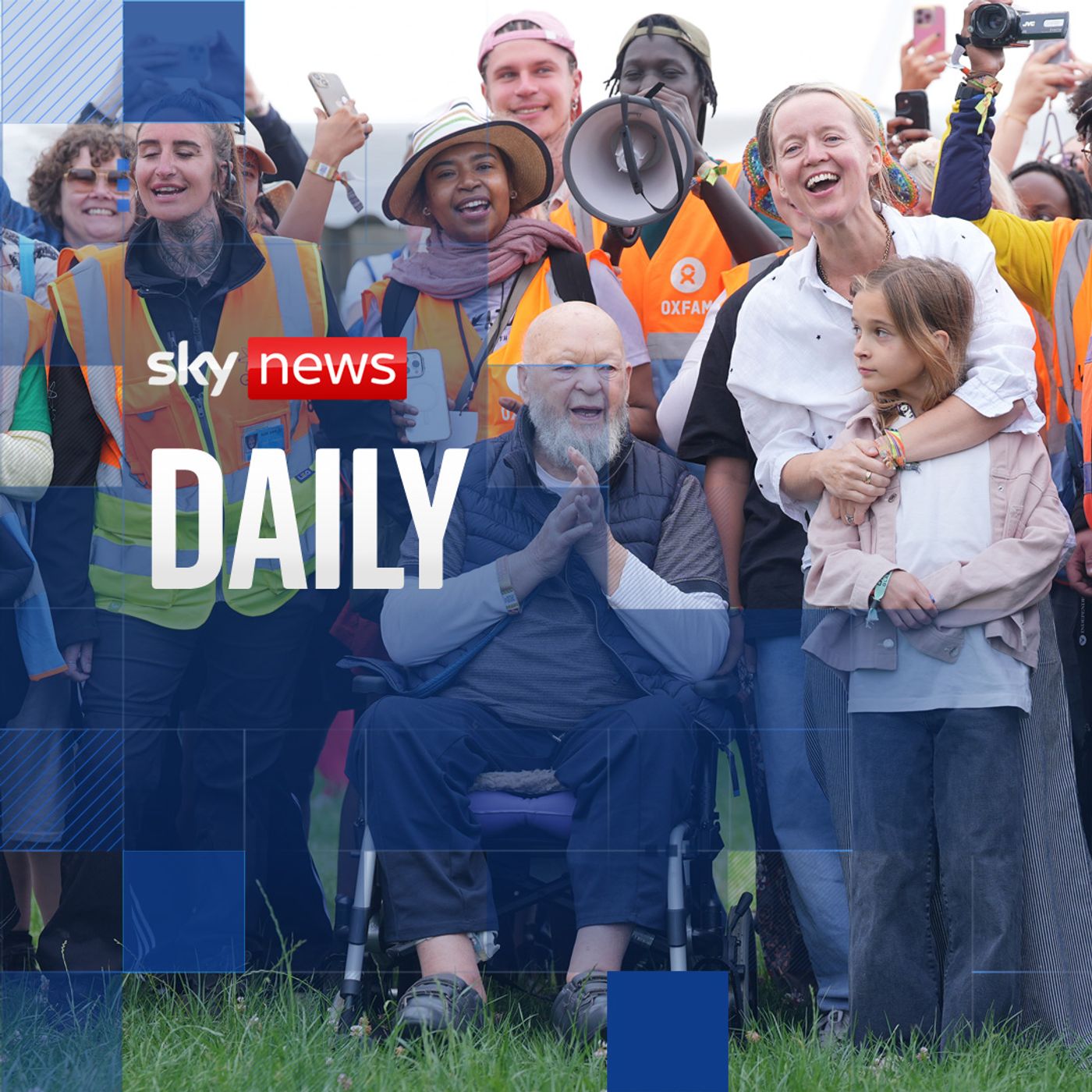
Glastonbury’s leadership transition as founder Michael Eavis hands control to his daughter Emily Eavis, and how the festival’s countercultural, ethical, and environmental mission has evolved. The episode also references online “sadistic” groups targeting vulnerable children, via a Sky News Daily intro.
Claire Gregory, entertainment editor and Glastonbury veteran; Joe Rush, creative director and artist behind Carhenge (involved since 1985 after a roadblock stopped a peace convoy).
Emily became central after her mother Debbie died in 1999; she pushed inclusivity, female equality, and banning single-use plastic (2019). Michael is described as a dairy farmer and “rascal” who endured riots, licensing battles, and COVID.
1970 Pop, Folk and Blues Festival (Led Zeppelin gig inspiration; £1 tickets with free farm milk); Emily booking Jay-Z; 2023 all-male lineup controversy; 2024 female headliners Dua Lipa and Scissor; Carhenge creation; Glastonbury sold out in 35 minutes.
Written by AI. May contain mistakes.
A look at the transition of Glastonbury from Michael Eavis to his daughter Emily.
“The changing of the guard at Glastonbury.”
Discussion on what makes Glastonbury special and its cultural significance.
“Apparently for tax purposes, Michael has transferred much of his financial interest in the festival to his daughter Emily, not Aiken.”
Joe Rush shares his artistic involvement and experiences at Glastonbury.
“is Glastonbury Performing Arts Festival.”
A detailed look at Michael Eavis's personality and his role in Glastonbury.
“Before the cameras were rolling and the microphones were switched on, you told me that there had been some wild nights with the Avisites down at Glastonbury.”
Exploration of Emily's rise and her vision for the festival's future.
“So pretty impressive that that's where they started.”
Overview of Glastonbury's origins and its evolution over the decades.
“Let's turn to Emily Evers, the daughter, because back in, I think it was 1999, Michael Evers' wife, Debbie, founded Glastonbury, where she very sadly passed away.”
Learn how Emily Eavis has transformed Glastonbury's lineup and identity.
“go into denial of the festival, like shut myself off and just play my violin.”
Discover Emily's commitment to gender equality and its impact on the festival.
“and it really did kind of, it stamped this kind of new phase of Glastonbury to kind of move away from these maybe traditional kind of rock and alternative music roots and say, look, we are about more than just one thing.”
Explore the commercialization of Glastonbury and its evolving nature.
“So in that sense, she is also making her mark.”
Understand the various challenges faced by modern music festivals today.
“You know, you're competing for the best artists.”

Get the gist, explore an idea or ask about something said.
 Claude
On This Is Why, what are the key points of this episode?
Searching your listeningAutomatic transcript. May contain errors.
0:00I'm Adele Robinson, a correspondent for Sky News, and I wanted to give you a recommendation for when you finish this podcast. I've made a documentary for YouTube called The Calm, Online, Sadistic and Deadly. It takes a look inside one of the darkest corners of the internet and the disturbing community that exists there, exploring how young people can be drawn into it and the devastating consequences that can follow. It's a story that's difficult to hear, but one I think is really important to understand. You can find The Calm on the Sky News app, website and YouTube channel. Coming up on the Sky News Daily with me, Neil Patterson.
0:33The changing of the guard at Glastonbury. As founder, Michael Avis hands his controlling stake in the world-famous festival to his daughter, we ask, just who is Emily Avis? Online sadistic groups are targeting vulnerable children. The sheer amount of potential victims is astounding. It's a very real threat, and it is here in the UK. It will always shock me. A young boy could commit such awful offences. Some of the content has been the worst I've ever seen. Parents need to be aware of what can happen on these sites. Find The Calm on Sky News YouTube. Now I remember my first trip to Glastonbury.
1:18Well, some of it anyway. I was barely in my 20s and thus able to go days, tolerating living on little more than lager, pot noodles and wet wipe showers. It was a revelation. The music, the art, the food, even the toilets. It all combined to make the almost mythical Glastonbury experience that keeps people going back year after year after year. The festival is now so much bigger than when I first went and it's almost entirely unrecognisable when you compare it to the first almost 55 years ago. But it still has a socially aware counter-cultural core, and that's down in no small measure, to its founder, Michael Leavis.
2:00Well, we always think we're going to run out of big bands, but they keep coming through every year, so there'll be some out there. But the times they are a-changing, as Bob Dylan sang at Glastow many years ago. Apparently for tax purposes, Michael has transferred much of his financial interest in the festival to his daughter Emily, not Aiken. complete surprise, the two have been running the show together for many years. Paul McCartney has to be about the best thing, really, I think. Radiohead, particularly in 1997, which was just that amazing gig. And Primal Scream, Chemical Brothers in 2000, when the crowd was just enormous because the fence came down.
2:35What about Robbie? I mean, Robbie wasn't going to do it, you know. And it was you encouraging me as well. You were keeping on saying, get Robbie, get Robbie, wouldn't you? Yeah, I was. I thought it would be good. So I made it happen. So, as Glastonbury kicks off properly and the festival enters this new era, we thought we'd look back at how it all began and find out a bit more about the new boss, Emily Evis.
2:59So, in just a while, we'll be chatting to one of the festival's creative directors and the artist behind the iconic Car Hinge. But we're going to start with Glastonbury veteran Claire Gregory, also our entertainment editor. Claire, good to see you. So what is it exactly that makes the sort of people that attend Glastonbury year after year bang on about it quite as much? It does inspire kind of almost like a cult-like following. So it was, you know, born out of the counterculture in the 1960s. And yeah, of course, like as time's gone on, corporations have come in and things have changed a bit. But I think it does do its best to kind of continue to be ethical and environmental.
3:39and you know if you go to the stone circle and the healing fields which are kind of you know world away fields away if you will from kind of the main stages where all the the rowdy music's going on you know those hippie traditions they are still there you can feel all of that still and i think that's probably at the heart of what makes it quite so special and certainly to the family that is the heart of it the evises how unusual is it for one family to be at the heart of something so culturally significant in the UK? I mean, I'd say extremely unusual. It is a cultural kind of touch point. It's such a big deal for so many reasons.
4:17You know, we often think of the music, and of course that's a big part of it, but there's every kind of performance art going on. In fact, the real name of Glastonbury is Glastonbury Performing Arts Festival. It's far more than just music. And it manages to be a kind of leader in these kind of areas, and it's seen as a pinnacle of lots of artist career. So we've got a whole lot of other stuff. was it all the theatre, the circus, the Las Vaginas, you know, and there's poetry and there's green politics and there's green debates and there's flowers and we've got train sets, we've got ghost trains, we've got a lot, you know.
4:51It's not just about the musicians. There's a whole heap of creativity in all its forms generated by people like Joe Rush. Now, he's an artist responsible for the iconic Carhenge and is one of the festival's creative directors. Joe, just how did you get first involved in Glastonbury? Did Michael have a hand in it? Well, inadvertently, what it was, was that basically I was in a squat in London. This was in 1985. And I'd got a burned out bus that I'd turned into a giant skull. I put all my sculptures on them, my metal sculptures. And my intention was to drive to Stonehenge Free Festival in 1985. But what happened was that Margaret Thatcher had set up a roadblock to stop the travellers going in, to stop the peace convoy going in.
5:35And by the time we'd actually got ready to leave London in our skull bus, Middle England was in lockdown, and so we decided to go to Glastonbury. And so that was how we ended up at Glastonbury. And the first person we met, funny enough, was Michael. It was a muddy year. We towed the thing in the mud and parked up in front of the main stage, which was probably a bit cheeky. And Michael turned up in a Land Rover. And I was such an arty little brat at the time, you know, I had a shouting match with him in the middle of the field. But eventually, you know, we worked it out and he's a very good judge of character, Michael.
6:11He's a very good judge of what's going to make that festival better. But in terms of the festival, clearly Michael Leavis knows how to put on a big old music festival. But as an individual, personality-wise, what's he like? You must have spent plenty of time with him over the years now. Yeah, I mean, he's a proper old rascal. Let's be right about it. You know, he's a proper old rascal. and uh you know to make that festival happen you know he's had times where they've refused his license times where other people have taken his license off him and forced him to bend over barrel to make the festival happen he's been through so much he's been through riots and you know covid and all these other things and he just kind of just deals with it you know he deals with it and at any point he just explodes into laughter and i've never known a man who would just open his mouth and roar with laughter at any point in however tense the situation it is.
7:05I think it's probably what's got him through. Joe, you know I'm going to have to pick you up on the use of the word rascal. I have to hear more about that because he just strikes me as a lovely old gentleman farmer. There's a rapscallion side to him, is there? Well, to be honest, there's a rapscallion side to any gentleman farmer. You know, farmers are farmers. And Mike is a farmer first and foremost, and he will tell you that himself. He's a dairy farmer, you know, and And I've been up there in 1987 when there was, you know, a quarter of a million people in that festival and gone to look for him and found him in the milking shed, milking the cows, you know, so he's a proper farmer.
7:41He is a bit of a rascal, but, you know, you have to be a bit of a rascal to be in the rock and roll business, don't you, really? But he's a straightforward man. He's an honest man and he's a very kind man. Very supportive for people. He can see if someone's going to be good and he picks up on it straight away and he's practically always right. So he's got a very good intuition, which is why the festival is what it is. Now, Joe, I'm going to be slightly cheeky here. Before the cameras were rolling and the microphones were switched on, you told me that there had been some wild nights with the Avisites down at Glastonbury.
8:13I'm not asking for lots of specific details, but just give us a flavour of how wild, wild can be down at Worthy Farm. Well, you know, the thing that Michael always states as one of his favourite things was when he first broke the first fence and people pushed it down and the thousands of people ran across the fields. And Michael, who really should have been mortified, was absolutely cleaveful, you know, to see these hordes of people just running in, you know, fighting for freedom. And he loved it. And that's what kind of says the character of the man. It does feel that the festival is in something of a period of transition.
8:51Michael stepping away and Emily stepping up, although, of course, she's been heavily involved in the running of the festival for a number of years. I mean, personality-wise, how does she compare to her father? She's not the same as her father, but she's got brilliance as well, and especially on environmental and social, the way that the festival is moving, the way it's become more inclusive, the way we're bringing in people who wouldn't normally come to that festival. One of her really big things I think I was most impressed with was her determination to stop the use of single-use plastic in the festival.
9:24So she's got a very strong social drive as to how the festival can progress. And Michael's got this fantastic idea of what will really stand out in the festival. So they're not the same, but they're both really positive drivers to the festival.
9:46Back to our entertainment editor, Claire Gregory, by now champing at the bit to be heading down to Glastonbury. Claire, clearly it wasn't always as it is now from tiny acorns, massive festivals apparently grow so how did it all begin? It's an unusual story Michael and his then wife they went to see a gig themselves they went to see Led Zeppelin at an open air concert in Bath which is just kind of down the road from Somerset and it was after that that they decided to put on what was then called the Pop, Folk and Blues Festival that was in 1970 and even that was attended by 1 ,500 people which isn't bad When you think of just hosting a kind of a party of 100 people's enough effort.
10:26So pretty impressive that that's where they started. And in fact, they'd booked the Kinks. You know, this is a band that everyone even today has still heard of. Ray Davis. They were, yeah. They were supposed to headline, but actually they were replaced at the last minute by a band which were then known as Tyrannosaurus Rex. Of course, we know them as T-Rex. Mark Boland. Yeah, Mark Boland took to the stage. Now, tickets then cost a massive whopping£1. Really? One pound, and that included, this is amazing, free milk from the farm. So as part of your pound ticket price, you got you some milk from the farm, from the dairy cows.
11:01Now, I have checked, and that is equivalent to sort of nearly£20 by today's money, which is still a bargain. I mean, you can barely get a pint of milk for that, can you not? Yeah, yeah. I don't know if that's entirely true. But you look at the scale of the festival now, and you look at those inauspicious beginnings back in the early 70s. I mean, how does one go from that field to where we are now? Yeah, there were. And it kind of after that very initial event in 1970, then the next year was a free festival, Glastonbury Fair. And then from that, that's really what Glastonbury that we know kind of morphed from.
11:35It started making profit in 1981. And that was at the point where Michael Leavis started kind of giving that profit away again to worthy causes that we still see kind of at Glastonbury today. Oxfam, Greenpeace, WaterAid, these are all causes that he's been supporting for many, many years. But, you know, there were ups and downs in the 70s and 80s. There were some issues with council charges, with the local district council saying that they'd broken some rules. There was a big row between security and looters one year. But once it got to the 90s, it was smoother sailing. And in fact, possibly one of the trickiest parts in Glastonbury's history was, in fact, the pandemic years.
12:11Michael Leavers actually gave an interview in 2020 saying he thought they might go bankrupt if they didn't have another festival in 2021. But Emily has talked about how good they are at evolving the festival and that's how they made it through the pandemic. But like many, many live events, that was probably one of the most difficult phases for them. Let's turn to Emily Evers, the daughter, because back in, I think it was 1999, Michael Evers' wife, Debbie, founded Glastonbury, where she very sadly passed away. And this was the point at which, what, the transition began to start happening? Yeah, and it sounds like it was incredibly organic.
12:43Emily was the youngest of her siblings. And so when her mum got very poorly, her older siblings, they had kids and jobs and lives. And Emily was studying at college at the time. And so it just seemed natural that she would be the one that would go home to kind of support and help with the family. And then when her mum died, her mum had been a huge part of Glastonbury as well. And I think she's said in interviews that she and Michael at that point really threw themselves into kind of putting on the next Glastonbury in a kind of almost like a tribute. And it was from then that that kind of really set the wheels in motion.
13:17And it's almost as if she sort of never went back. She's said multiple times that it wasn't the life plan. It was never like, I'm going to take on the family business. She thought she was going to be a primary school teacher. But at the same time, Glastonbury, if you are the daughter of Michael Evis, I mean, it has to be a pretty big part of your life when you've got, I don't know, however many rock stars sitting around the kitchen table sharing a cup of tea with you. I've got lots of memories of mayhem around that time of year, just from a child's perspective, lots of activity and people rushing around.
13:47But a specific memory was when I was five, and I ended up playing violin on the main stage. I have no idea how it actually happened, but I used to play the violin from when I was about three. And I think I used to sometimes go into denial of the festival, like shut myself off and just play my violin. And for some reason I ended up like going on before the headliner on a Saturday night and um and you missed it so I missed the whole thing unfortunately you know it's it's absolutely incredible and I just think perhaps being there and absorbing it as she grew up even though she didn't realize it at the time that would have been kind of preparing her to to end up taking it on and you know we all no one knows how weird their childhood is right until they're older so I guess at the time she didn't realise how unusual it all was.
14:36But has she then followed entirely in her father's footsteps or has she put her own stamp on it? No she's definitely put her own stamp on it I mean she sort of was the person to book the first hip-hop headliner Jay-Z and I'm sure you know anyone that has read a Glastonbury headline in their time will remember the sort of controversy. The country lost its mind over that. Jay-Z, a rapper, headlining Glastonbury. Who'd have thunk it but he killed it. Yeah, he absolutely did and it really did kind of, it stamped this kind of new phase of Glastonbury to kind of move away from these maybe traditional kind of rock and alternative music roots and say, look, we are about more than just one thing.
15:15It is, as I was saying earlier, it's a kind of totally diverse line-up and the idea that a headliner had to come with guitars and that, it seems quite odd now, but it was a controversial decision at the time. And she was proven right, I suppose. And I suppose that was maybe quite critical for her. So clearly Emily has had a practical effect on the festival, but how else is she making these changes felt? You know, she is an advocate for female equality. And in 2023, post-pandemic, Glastonbury came under fire for its all male lineup. You had Guns N' Roses and Elton John and Arctic Monkeys. And she was in a bit of a bind anyway, because of the way the pandemic had come and things had moved around, artists were no longer available.
15:57I think, you know, there probably were, it was probably a more limited kind of range of options that she had than usual. But she did at the time speak publicly and said, look, it's the music industry, it's the pipeline. I can only put on headliners that are available. You know, if there aren't enough women to put on, then I can't do it. And then of course, last year, there were the two female headliners with Dua Lipa and Scissor. So in that sense, she is also making her mark. And then the other big thing is the environmental stuff. In 2019, it was her that was behind the decision to kind of ban all the single-use plastic bottles and, you know, cut that waste and, you know, support the environment in that way.
16:31But brass tacks here, Claire, it's not the same, is it? It's not what it once was. It is too commercial these days. I speak not on my own behalf, but on behalf of the many people listening to this podcast that aren't quite as glasto-daft as you. Well, I think it's, I think it has changed. Of course, it has over the years. I mean, the reality is now it's£378.50 to your ticket. And you don't even get free milk with that.
16:58You know, it's 200 ,000 people. Just with that ticket price alone, of course, do the maths. That's a huge amount of money for a pair of people to go. And that's just your entry. You know, after that, you've got to be able to buy food, drink, everything else. And plenty of people pitch up how many days before the festive leaving starts so they can get somewhere to sleep. So that you can sleep somewhere half decent. Yeah, that doesn't feel like those kind of stone circle, kind of hippie roots of where it started. Sandals and wet wipes. Yeah. Not quite the same, is it? Exactly. Exactly that. So, yeah, of course it's changed.
17:29Of course it has. But it has to evolve if it wants to keep selling out. But none of which is to say that, you know, Emma Leavis doesn't have challenges ahead. No, of course. Of course. The festival, all festivals are beset by kind of issues, things like rising costs. You know, you're competing for the best artists. You've got to watch out with all those conditions of licence put on you from local councils and things like that. I mean, operational costs are up, staffing costs, everything. It is hard. But then you look at Glastonbury. I just checked. Again, it sold out in 35 minutes last year. And you think, well, they're doing something right that other festivals aren't.
18:06Thanks, Claire. And you can keep up with all the events at Worthy Farm. Just head to the website skynews.com. And if you're off to the festival, do make sure to drink plenty of water and don't forget your wet wipes. The Daily is back on Monday. Hope you have a cracking weekend.
18:46need to be aware of what can happen on these sites. Find The Calm on Sky News YouTube.


