
In short
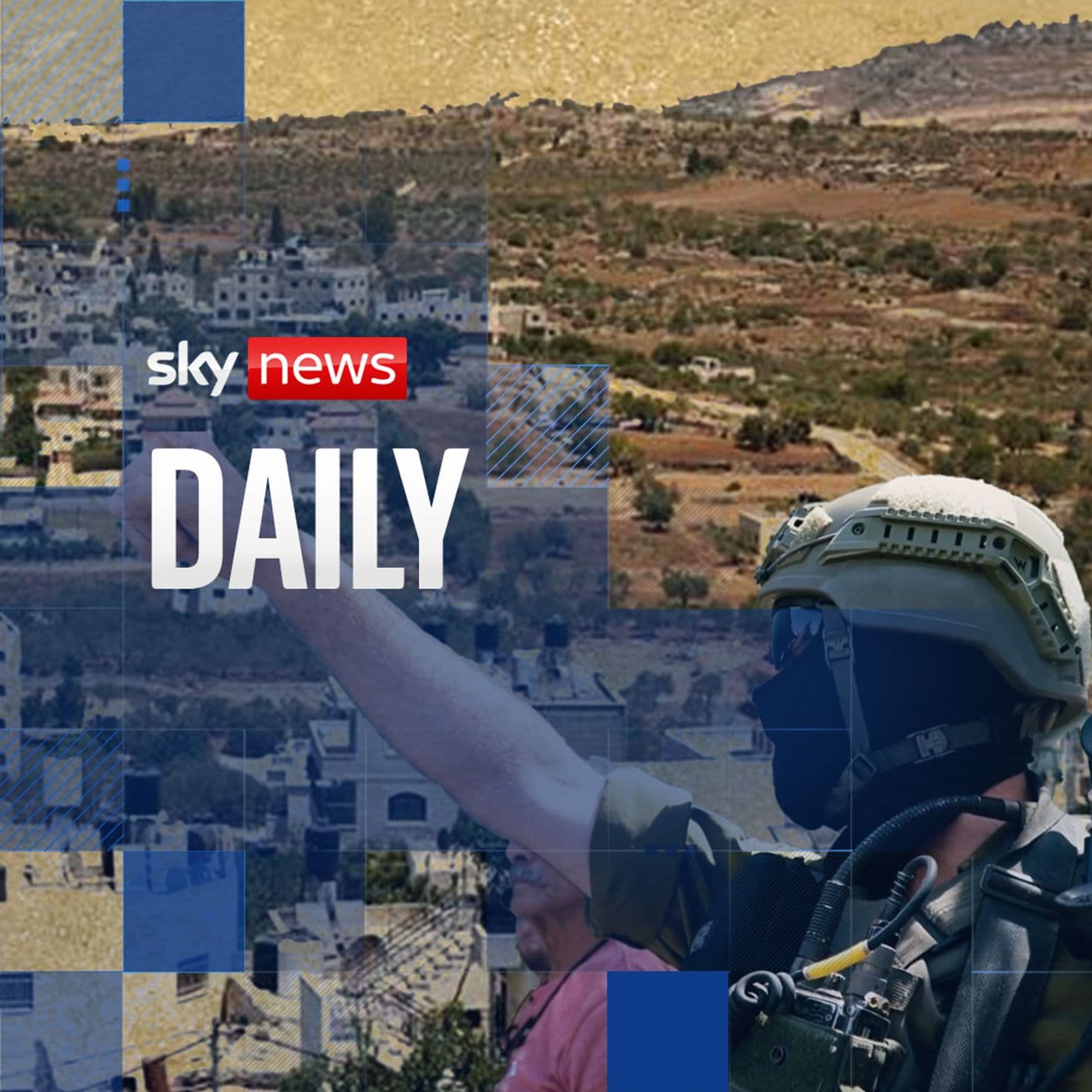
The Daily episode “Inside settler violence in the West Bank” explains how Israeli settlement expansion and Israeli military control shape daily life for Palestinians since 1967, and how conditions intensified after Hamas’s Oct 7 attacks. It argues that settlers use religious claims that the land was given by God, while the IDF cites security to justify widespread restrictions, gates, checkpoints, and movement barriers that Palestinians experience as collective punishment. Key examples include IDF closing streets in Hebron so settlers/Orthodox Jews can access a road to a tomb, soldiers stamping a vendor’s fruit boxes, and a village road padlocked shut. Correspondent Stuart Ramsey reports settlers taking land from Mohammed Robin, who says he has lawyers and no legal basis exists.
Guest
Stuart Ramsey, Sky chief correspondent who spent two weeks in the West Bank.
Written by AI. May contain mistakes. Listen to the episode to check what was said.
Chapters
Tap a time to open that second in VOContext of the West Bank Conflict
0:30 to 1:56
An overview of the geopolitical situation in the West Bank, including Israeli control and Palestinian areas.
“Coming up on The Daily, Sky's chief correspondent takes us inside the West Bank.”
Defining Settlers and Settlements
1:56 to 4:30
Explaining what settlers are and the nature of settlements in the West Bank.
“Let's just start by explaining exactly where and what it is.”
Settlement Violence and Implications
4:30 to 7:14
Discussion of the violence associated with settlers and the role of the Israeli Defense Forces (IDF).
“I feel like I'm kind of reaching for the dictionary here, but again, we should probably define settlement.”
Escalation of Settlement Activity
7:14 to 10:00
Insight into the recent increase in settlement activities following the October 7th attacks.
“if you're in Ramallah because it could take days to get where it should actually be a 30-minute journey.”
Settler Justifications and Beliefs
10:00 to 14:01
An interview with a settler revealing their views on divine entitlement to land.
“The increase in the actual number of being built has dramatically increased in the last, well, since October the 7th, another couple of hundred probably, and we saw them being developed even while we were there.”
Exploring Settler Perspectives and Experiences
14:01 to 17:36
The discussion delves into the views and experiences of settlers in the West Bank and their impact on the region.
“I mean, obviously quite fundamentalist in terms of his religious, orthodox, you may wish to say, rather than fundamentalist.”
Transcript
Automatic transcript. May contain errors.0:00Hello, Ed Conway here. Here is what might sound like a slightly random question. What do AirPods, bananas and a pair of shoddily made running trainers from the 1970s have in common? On the surface, not very much. But on my podcast, Stuff Matters, I will uncover the deeper stories behind each of them. You will see how together they tell a fascinating new story about the world we live in. The first full series of Stuff Matters is out now. Just search for it on your podcast app and follow. Coming up on The Daily, Sky's chief correspondent takes us inside the West Bank. After reports of increased violence and intimidation by Israeli settlers in Palestinian territory, what hope for a two-state solution?
0:48Hi everyone, welcome back to The Daily. Look, for obvious reasons, it's been Gaza dominating the headlines lately, especially with Israel pursuing even greater control of it. But what about the West Bank? Since 1967, it's technically been under military occupation by Israel, with Palestinians allocated certain areas and Israelis others. For years, though, Palestinians have complained that Israeli settlers have been taking their land. And since the October 7th Hamas attacks, there's been a marked increase in the violence and intimidation as those settlers take more and more of what is technically, legally, not theirs.
1:29But as you'll hear, the settlers claim a religious justification, that this land has been theirs for millennia. As for the military, the IDF, well, they say security concerns demand their presence. Our chief correspondent Stuart Ramsey spent two weeks in the West Bank to find out what on earth is going on, and he is back on the podcast. Good to see you, Stuart. Look, everyone's eyes have been on the war in Gaza, of course, but I think people don't tend to understand exactly what's been happening in the West Bank. Let's just start by explaining exactly where and what it is. OK, so the West Bank is on the West Bank of the River Jordan.
2:04Makes sense, yeah. Incredible number of people I've mentioned this to have actually no idea whatsoever. And obviously then it borders Israel. It is, since 1967, basically designated a Palestinian area and would make up the lion's share of a Palestinian state linked to East Jerusalem and, of course, Gaza. And when you say border, do we mean hard border? There is actual sort of hard border and there's now a large border fence that Israel has built, ostensibly 20 years or so ago, to stop Palestinian terror attacks in Israel. But there's more to it than that. Even after two decades, it's become a symbol of that separation between Israelis and Palestinians.
2:46But the interesting part about it is that that isn't a border with a line that Israel doesn't cross. Israel controls what is called Area C. There's three areas, I'll come to that, but Area C of the West Bank is controlled entirely by Israel and it takes up about 60 % of the West Bank. A lot of the farmland is there, etc. Area A is meant to be completely in the control of the Palestinian Authority and its security forces, and by Israeli law, no Israelis are allowed inside. And Area B is run by the Palestinian authorities, but with an Israeli military presence. But the point of the matter is, since the October 7th attack by Hamas on Israel, things have fundamentally changed.
3:29The designations of areas A, B, and C means nothing because there are the IDF, the Israeli Defense Forces, everywhere. And what we have witnessed is that when they wish to close down an area and allow Israeli citizens inside, even in Area A, they will do so. And that means that all of those classifications, which did hold sway for many, many years, no longer exist. I mean, the reason you went to the West Bank was these kind of increasing reports of violence, of intimidation by Israeli settlers in the West Bank. I suppose we need to start with, you know, what is a settler? Settler is somebody who believes fundamentally that the state of Israel is made up of Israel and the West Bank, which is the Holy Land.
4:13and that God has told them that that should be their home. And those settlers believe they should settle in the West Bank and completely take over what is the West Bank now. And when one discusses with them what happens to the Palestinians, it's sort of much along the lines of, I don't care. I feel like I'm kind of reaching for the dictionary here, but again, we should probably define settlement. I mean, because there are pockets of populated areas all across the West Bank, aren't there? There are indeed. So if you've got the Palestinians living in the main cities, then the disputes usually start over farmland and quite often on the tops of hilltops where settlers will move in, pretty much say that they're going to take over this land, put an Israeli flag.
5:00After that, it developed, they start building temporary accommodations like caravans and the like. But eventually it looks like a sort of housing complex in Florida with huge gates and green lawns driving up and a security guard at the thing. And the slight difference being, well, not just armed, but heavily armed security and more often than not, an IDF patrol nearby or on base. They develop into enormous towns. There's hundreds of thousands of settlers. The numbers are never absolutely clear, but let's just say half a million. It could be higher. And those people are unlikely ever to be convinced to leave.
5:44I'm presuming that there has to be an element of force or at the very least an element of intimidation. I mean, someone plants a flag in my back garden. That doesn't mean they're getting my back garden. But this goes to the nub of it because, yes, there are settlers who are extremely violent in their own right. I mean, a young man was killed while we've been on this last trip in the last two weeks or so. A Palestinian man who was objecting, along with others, to a digger going onto their land and destroying the land. But they are aggressive and they are armed. Worse, though, and this is the point that upsets the Palestinians, the Israeli Defense Forces assist them.
6:19Not necessarily going and doing their work for them, but to make sure that there is some protection for the settlers. And it goes further than just actually if there is a fight to develop and the Palestinians would be stopped from doing it, from perhaps being an actual fight. The Israeli defense forces and their security generally have imposed massive restrictions on movement of Palestinians within the West Bank. Facilitated by the IDF. The IDF does it and Border Patrol does it. And they have security checks all over the place. But more importantly, and this is what we've really seen the massive growth in, is the imposition of barrier gates at roads going in and out of villages that can be closed whenever they want, always under the umbrella of security concerns.
7:09but it's made life intolerable for most Palestinians because you can't, for example, guarantee a business meeting in Hebron if you're in Ramallah because it could take days to get where it should actually be a 30-minute journey. But in that part of the West Bank where Palestinians are living but there is an Israeli security presence and there is supposed to be, it is legitimate that there is an Israeli security presence isn't the IDF there to assist the Palestinians as much as anyone else? They should be because the argument would be that they're there to protect the rights of Israel and to protect the security of Israel, but also to protect the security and rights of Palestinian individuals who are not allied with and have nothing to do with terrorism, which, you know, there are terrorist organizations that have worked out of the West Bank.
7:56The point is they don't do that at all. Just watching the way people are treated, you're like second class citizens. As one Israeli commentator put it to me, my government, which he disapproves of, is practicing apartheid here. And that is exactly the way it looks and feels when you are there. The casual, vindictive mistreatment of people happens right in front of you. Back, back, back, back. We were in the town of Hebron and the IDF were closing a section down. that was to allow settlers and Orthodox Jews to walk up a road in Palestinian. OK, they're closing the town down because they want to go up this street along here, which goes up to a tomb.
8:41Yeah, OK, sorry, sir. But as they were closing it down, a lady who was selling, goodness knows what, it's in her back, but meagre wares on the side of the road, but she had boxes that she would use to put them in and take them away, fruit boxes. The soldiers told her she had to leave and then just stamped all over the boxes.
9:02There's completely no point. Those boxes are worthless, but they're useful to her. And then you see it all the time. So military territory, so please turn around and go away. OK. Could you just explain, though? Are you putting in a new gate? This is classified. Please turn around and go away. OK. Also another one is, you have a village. that for no reason at all, the road in and out is closed by a barrier gate. There's huge, big gates with huge cement blocks around them, so you can't drive past them. So they get locked, padlocked shut. Can I go to the village, though? No, you can't. Is there another way round?
9:42Maybe, I don't know. OK. I'll leave you at that, then. Thank you very much. I mean, obviously, since the October 7th attacks, things have been febrile in all parts of the Middle East, but in the West Bank, I'm assuming, that we have seen an escalation to the tempo when it comes to these settlements. Absolutely no doubt about it. The increase in the actual number of being built has dramatically increased in the last, well, since October the 7th, another couple of hundred probably, and we saw them being developed even while we were there. And the effect that that has had, particularly they're assisted by two members of the Cabinet who are very, very much supportive.
10:21One is a settler himself, a government that's basically moving more towards supporting the settlers. So you have settlers that are really on a roll. You have legitimate massive security concerns caused by October the 7th. Of course, yeah, absolutely. And you have the IDF, which has taken the view of assisting the settlers. Or Israeli citizens. I mean, that's really what they're, I suppose, they're doing. But as we also saw, they're actually building defences. and building the barrier gates. I mean, you met one man, Mohammed Robin, who literally went to work one day, came home and discovered that his house wasn't his anymore.
10:57That's right, and the land had been taken off it. It's been there since 1952. His grandfather had worked on the land. He came back from work and he was told he couldn't stay. I'm now going to follow him, see where he is. Settlers have taken everything, apparently, from inside the house as well, which is fairly common. But we're going to follow him and see where he's sat. We heard about him and he took us up to a mountain top or a hilltop I should say that overlooks his smallholding That's his land Yeah Where the cars are standing now And they also took over there another two dunams And very quickly two men, armed men in a four-wheel drive buggy came up to see us Never spoke to us You say armed?
11:43They were armed with rifles I mean every settler is armed Well, we've introduced ourselves, but I think they're trying to go back down, probably because we're here. They're not making much action, but because these settlers are armed. Not quite sure if they're heading back or what they're going to do now. We believe, though we don't know for certain, because they wouldn't ever answer, but they could be military, because we know that the military had assisted people to get in there in the past, or settlers, or both. And there is no legal basis, is there even a purported legal basis, for those settlers taking Mohammed's land?
12:23No. So our understanding from Mohammed, and he does have lawyers, is that he is the rightful owner of that land. If there is no legal basis for what they are doing beyond that catch-all security concerns, which seems to be being used an awful lot, I wonder when you did manage to speak to one of these settlers, from whence the justification came. Hi, Daniel. Hi, how are you? Very good, how are you? Very good, nice to meet you. Nice to meet you, Stuart Ramsey. Daniel Winston, nice to meet you. Where are you going to take us, Daniel? I'm going to take you up to Hart Kabir, let's come out of the street so you don't get hit.
12:58Daniel Winston was the settler that I was speaking to, who has been in Israel for over 20 years. He's an American citizen, but he's an Israeli citizen. His justification is really quite simple. This land was given to Israel by God, and that's it. Difficult to argue against that, isn't it? Well, you could argue against it in as much as I put it to him, if God may have given you the land, okay, but it's 3 ,000 years has gone by since, for example, Israeli Jews were in Hebron. As I pointed out, Romans used to control London, but no Italian has ever said that Park Lane belongs to them. as which he answered, which obviously is sort of a silly question, but the point he made was, well, first off, Italians don't care.
13:44And secondly, they didn't get given the land by God. And I did, and we believe it. Now, that is a fundamental position whereby, and he said it, international law is trumped, in his words, by the Bible every single time. I mean, Daniel, how did he strike you? I mean, obviously quite fundamentalist in terms of his religious, orthodox, you may wish to say, rather than fundamentalist. But how did he strike you as an individual? He sounds quite clever. He's very well read, well educated, can see the legal arguments for and against. Told me himself that when he grew up, he was part of what he described as a lefty group of Jewish university students who didn't believe in what the state of Israel was doing.
14:29He claims that his conversion happened when he started researching and taking – as he wasn't particularly religious, but he's extremely religious now. As he developed his religious knowledge in his view, he took the view that it was quite clear this land belongs to Israel and Israeli Jews. And this is the absurd and really weird thing. You actually find yourself in 2025 having arguments with a well-educated man about the scriptures and the definitions of something and who was given what from thousands of years ago. I'm not angry. I'm not a, you know, one of those frothing at the mouth of the settlers who are going to like yell and scream and like, you know, start throwing things at you because I don't like what you're saying.
15:10I don't like what you're saying because what you're saying is wrong. It is not consistent with the historical record. There was never a Palestinian state. Even if I were to say, OK, well, these poor people, they have to do something. They have to go somewhere. And I would say, well, not on my account. I'm just getting the impression of a group of settlers, the IDF, both seemingly operating with complete impunity in the West Bank. Total impunity. And to a level that I hadn't seen on such a regular basis. I mean, this wasn't just like a one-off incident. You know, it wasn't like we went there and over a course of two weeks we saw a few nasty incidents.
15:51It was like literally every day, everywhere you went. It's like land grab taking place in this village, settlers breaking a well in that village. It just could be absolutely continuous. And we would go to some. Sometimes the problem had passed. Sometimes it would be ongoing or it's about to get worse. But it's happening daily and this continuous control of people's movement and the security gates being closed and then the barriers closed and then checkpoints being closed. Checkpoints closed for the night because you can't use the road into quite big towns. Just simply closed down and that's it.
16:31Nothing you can do. How would you then characterize life for Palestinians in the West Bank? Tough. It isn't like Gaza, obviously, but we've been watching Gaza. That's one of the reasons we wanted to go to the West Bank to see, you know, they're involved in their own conflict, not as acute as Gaza's, but a conflict as every bit as bad. It's bad for business for a Palestinian if you can't guarantee supplies of food. It's as simple as that. If you're wanting to have building materials, you can't get a hold of them. It's tough. And the breaking down of human rights is regular. The indignity is regular and the annoyance is regular and there's actually nothing they can do about it.
17:11And that's the sense of helplessness is what you get more than anything. And, you know, the international community, they should do more. But you're faced with a government that can stare down international communities and does on a regular basis. And the October 7th has given them a cast-iron security excuse at every turn. Thanks Stuart and you can find his full documentary Inside the West Bank on the Sky News YouTube channel well worth your time and there is of course even more analysis over on skynews.com and whilst you're here why not check our podcast from yesterday we looked in depth at the targeting of five Al Jazeera journalists in Gaza just scroll back wherever you're listening to this one The Daily is back again tomorrow
18:03Hello, Ed Conway here. Here is what might sound like a slightly random question. What do AirPods, bananas and a pair of shoddily made running trainers from the 1970s have in common? On the surface, not very much. But on my podcast, Stuff Matters, I will uncover the deeper stories behind each of them. You will see how together they tell a fascinating new story about the world we live in. The first full series of Stuff Matters is out now. Just search for it on your podcast app and follow.
From the publisher
Chief correspondent Stuart Ramsay has been in the West Bank, witnessing the Israeli settlers who are forcing Palestinians from their homes. He also sees how the Israel Defence Forces (IDF) is protecting the growing number of Israelis claiming this land is theirs.
Stuart meets one Palestinian man who left for work and when he returned home, he found it had been taken over by Israeli settlers. He also meets the settlers who say this land belongs to them.
To watch Stuart’s film in full, click here.
Producer: Natalie Ktena
Editor: Paul Stanworth