
In short
Whether Britain’s railways are safe after a mass stabbing on an LNER train in Cambridgeshire, and what could realistically reduce risk (e.g., airport-style security, policing, technology).
Guests and backgrounds
Martin Brunt, Sky News crime correspondent (reports from Peterborough Magistrates Court). Graham Wetton, former Metropolitan Police officer with 30 years’ experience handling critical incidents; policing commentator.
Key claims
Airport-style scanners are impractical due to thousands of stations and many entrances. Police response was fast: train driver coordinated an unplanned stop at Huntingdon, enabling armed police to reach the platform within about eight minutes. Trains are generally safe overall (minister cited 27 crimes per million journeys), but fear and intimidation are widespread. More police presence, better conflict-resolution training, and possible tech like facial recognition are proposed; however, resource limits remain. Knife crime is a serious societal issue, not an “epidemic” proven by one incident.
Notable examples
7-7 bombings comparison; Wetton cites daily confrontations and that many incidents are reactive; Brunt mentions an off-duty Metropolitan Police officer calming a threatening Victoria Station carriage situation.
Written by AI. May contain mistakes. Listen to the episode to check what was said.
Chapters
Tap a time to open that second in VOReflections on Past Incidents
0:22 to 1:07
The host shares personal experiences of fear associated with public transport after attacks.
“Some of you will be listening to this podcast on the bus, or perhaps while staring out of a train window as you make your way home.”
Security Measures Discussion
1:07 to 1:44
Exploring the feasibility of implementing airport-style security on trains.
“The violence on the LNER train involved a knife.”
Police Response Analysis
1:44 to 2:42
Analysis of the police response to the train incident and its effectiveness.
“Let's pick up on that with our crime correspondent, Martin Brunt.”
Policing Strategies and Visibility
2:42 to 3:41
Discussion on police visibility and its impact on public confidence in train safety.
“Martin, what do we know then about what will be taking place on the network in terms of policing today?”
Challenges in Preventing Knife Crime
3:41 to 6:10
Debate on the practicality of preventing knife crime in public transport settings.
“They do real live exercises and they do tabletop exercises.”
Role of Increased Police Presence
6:10 to 8:08
Discussion on increasing police presence and resources on the rail network to enhance safety.
“as of this moment, public transport is actually generally pretty safe?”
Potential Use of Technology in Policing
8:08 to 9:56
Exploring the role of technology, including facial recognition, in enhancing rail safety.
“You speak to people that work on trains, and I've worked alongside British Transport Police for a number of years, there are a significant amount of incidents, confrontations, etc., disorder on trains, on train routes.”
Evaluating the Concept of Train Marshals
9:56 to 12:20
Discussion about the potential implementation of train marshals for safety and security.
“What's the role of intelligence then when it comes to policing our public transport networks?”
Assessing Police Response to Recent Incident
14:00 to 15:40
Explore the effectiveness of police response during a recent violent incident.
“I'm much more comfortable with somebody suitably trained, suitably experienced and on the train system to act in that role as maybe a guard slash train marshal, whatever you want to call it.”
The Growing Concern of Knife Crime
15:40 to 17:13
Discussion on the rising prevalence of knife crime and its implications.
“You know, we can't be lucky all the time.”
Transcript
Automatic transcript. May contain errors.0:00Graham Wettone:Coming up on the Sky News Daily, after a mass stabbing on a train at the weekend, we ask, are attacks like this simply unavoidable?
0:12Graham Wettone:Hi everyone, good to have you back with us on the Daily. Our focus today is going to be on that horrific attack on a train in Cambridgeshire, so this might not be an episode for the kids. Some of you will be listening to this podcast on the bus, or perhaps while staring out of a train window as you make your way home. So how safe do you feel after what happened? The reason I ask is that I still vividly remember how I felt 20 years ago getting on a bus to head to work in central London. The day after, a bus was blown up in central London on 7-7. I was nervous. I was suspicious. No doubt some of you listening are feeling exactly the same.
0:52Graham Wettone:The police investigation into what happened on the train is still very much in its early stages. No doubt there will be more to say on another occasion. Today, though, we wanted to consider whether anything, anything at all, actually can be done to make you feel safer. The violence on the LNER train involved a knife. So, predictably, it's being asked if airport-style security, metal detectors and X-ray machines and so on, whether they could be used on the trains. Here's Transport Secretary Heidi Alexander's take. I don't think airport-style scanners would be the way to go. I understand why you asked the question and I understand why some of your viewers might be wondering about that.
1:33We have thousands of railway stations across the UK and those stations have multiple entrances, multiple platforms. So what we can't do is make life impossible for everyone.
1:44Graham Wettone:Let's pick up on that with our crime correspondent, Martin Brunt. He's outside Peterborough Magistrates Court. Martin, of course, charges have been brought, So that does limit somewhat that which we can say. But looking at what took place at the weekend, this looks like a pretty remarkable response by the police.
2:01Martin Brunt:Yes. And I think the key to that, Neil, is that the train driver, instead of stopping in the middle of nowhere after the alarm was raised, after the train had left Peterborough, decided in consultation on the radio with LNER headquarters and with signallers to make that unplanned stop at Huntingdon. If the train had stopped in the middle of nowhere, perhaps on a high embankment or in a woodland area, it would have been very difficult for armed police and other emergency services to get there in a rush. By going on to the station, it cut down that time and it meant that police could get onto the train, onto the platform very, very quickly, within, what, eight minutes of that alarm being raved.
2:46Graham Wettone:Martin, what do we know then about what will be taking place on the network in terms of policing today?
2:51Martin Brunt:There'll be lots of police around, principally not just on that network, the LNER network, but at major train stations, particularly along that route, there will be more police visible. I mean, it's very much at this stage a question of reassuring people. I guess there will be people reluctant to get on a train because of what's happened. Perhaps if they see more police around, they might feel emboldened to take a journey that they might otherwise have decided not to. This kind of reassurance visibility, high visibility of cops is something that always happens after the event. How useful it is, I don't really know, but you can understand why it's being done.
3:40Graham Wettone:How do police forces prepare for events such as this?
3:45Martin Brunt:They prepare as far as they can. They do real live exercises and they do tabletop exercises. And I was talking to an old friend of mine who used to be head of media at Scotland Yard, who in March this year, ironically, took part in a tabletop exercise for BTP communications staff. And the scenario there was a multiple stabbing on the train travelling along that line near Peterborough, between Peterborough and Huntingdon. You know, remarkable that they should have chosen that. And then something so like that unfolded on Saturday night. They can only test their systems so far. But of course, you know, what's that old saying?
4:27Martin Brunt:No plan survives contact with the enemy. So you're never quite sure if an event that you train for unfolds exactly how it's going to unfold. But I think, you know, given that there were these two exercises in the last few months, then surely some learner must have come out of that and perhaps contributed to the way they reacted on Saturday night.
4:52Graham Wettone:The fact that those preparations have taken place speaks to concerns about incidents of this type happening. But have you ever seen anything like this before?
4:59Martin Brunt:Well, you know, there are knife attacks on trains. I mean, they're not common. I mean, they are quite rare, but when they do happen, you know, they are huge events. I've covered cases where people have been stabbed on trains in different circumstances, but a multiple stabbing on a train like this is a very, very unusual thing. And it's difficult to know how you counter that happening. There's been a lot of debate over the last 48 hours about should passengers getting on trains have to go through knife arches have to go through something akin to the kind of security operation that's in place at airports for instance that seems to be very very impractical because you know there are so many more people using trains and stations have multiple entrances and you would need so many staff and it would hold up people for so long it's difficult to imagine that you could really have any kind of system that would be practical, that would ensure that nobody gets on a train with a knife.
6:04Martin Brunt:I don't know the answer to that. It seems an impossible thing to guard against.
6:09Graham Wettone:Does it follow then, Martin, that whilst it certainly doesn't feel like it as of this moment, public transport is actually generally pretty safe?
6:17Martin Brunt:I think it is, yes. I was listening to Heidi Alexander, the transport minister, this morning on Sky News saying that for every million passenger journeys there were 27 crimes. Now that seems remarkable doesn't it? A remarkable low level of crime but I have to say that the transport minister might like to take a late night train out of London as I do quite regularly and see the level of anti-social behaviour and the level of threat. You know I was on a train two weeks ago, the last train out of Victoria Station, and there were two people behaving very oddly, swearing, effing and blinding, and putting a lot of people in our carriage in fear that something violent was about to happen, because who knows who might be carrying a knife.
7:06Martin Brunt:It was only the presence of a very brave, off-duty, metropolitan police officer who intervened and calmed down the situation that everybody on the on the carriage was able to feel a lot better now that wasn't a crime but it perhaps was coming close to it and i think that experience of mine um is replicated all over the country where people traveling on trains and are intimidated are put in in fear in that way you know even if it doesn't as i say turn into a crime you talk there martin about
7:40Graham Wettone:about the fear that many people, many people in this country have of someone carrying a knife, being, you know, being in the same vicinity as them. It's an overused phrase, but are we truly in the middle of a knife crime epidemic right now?
7:53Martin Brunt:I don't think you can look at one incident like this, horrific as it was, and say that, you know, there's an epidemic going on. I mean, the problem with knives, as we've always said, and you and I, I'm sure, have discussed this in the past that they're just so readily available aren't they how do you guard against anybody anybody
8:11Graham Wettone:carrying a knife in public thanks martin so let's bring in graham wetton he's a regular commentator on policing himself a former met officer with three decades of experience of dealing with critical incidents graham what can actually be done to reassure people that they are safe on a train it's going to be costly but if you want to make them safer increase the police presence on the rail network, increase the train crews on the rail network, train the train crews as well around more conflict resolution. You speak to people that work on trains, and I've worked alongside British Transport Police for a number of years, there are a significant amount of incidents, confrontations, etc., disorder on trains, on train routes.
8:49This was a very, very serious incident the weekend that highlights some of the risks, etc. But there are literally daily occurrences of confrontations. And I think the train network does need to be a lot safer. But it will take people and kit and equipment to make them much safer if that's where society the public and the rail authorities want to go do we have a police presence in a railway network we do but again british transport police like everybody at every other police force has suffered cuts in resources funding etc so you can only spread your offices and resources as you know where you can and clearly they will focus on the the main transport hubs and those main stations the main routes etc they also have to police traveling football fans on trains etc so that takes a considerable number of resources as well as they police those those popular routes when they're very very busy so you can only got so many resources they're going to spread so thinly across the whole round network so again it's down to resources and cost and having a more visible deterrent and presence on the rail network but it will take an investment in people and money to increase that.
9:57Graham Wettone:What's the role of intelligence then when it comes to policing our public transport networks? It strikes me that in the majority of the cases that you've been mentioning where there have been confrontations on public transport, the police are responding to a report that the event has already taken place. Yeah, you're quite right. It becomes very reactive as opposed to proactive. So you've got some information on intelligence that a route's going to be busy and maybe it's going to be, as I said, either football fans or pop concerts or people going to different events that might have differing views, protest events, etc.
10:31But it's difficult to be proactive because some of these confrontations and a disorder comes from people disagreeing at the time. You can't predict that. You can't predict how people are going to react to each other sitting on a train.
10:40Graham Wettone:We will have passengers with high levels of concern about taking to the trains right now. In the short term, what can be done to reassure them? We'll see in the short term. I think the British Transport Police will focus their resources, their finite resources, on the rail network, probably in that area, the East Coast line, et cetera, because that's where the focus of attention is at the moment. So increase the resources. They may even get officers in on rest days, extend their shifts so they have a more visible presence on some routes, et cetera. But after a period of time, that's going to have to come back to, now I'll say it, normal policing, normal resourcing levels.
11:16And that's where the issue is going to come when people don't see that visible presence. And that's where we need to start looking at what actually we want to do with our own network. Do we want it to be more visibly safer? Are we happy with maybe using some technology? I've mentioned live facial recognition. I heard the Transport Secretary mentioned that. More use of facial recognition at stations. So more use of technology. So we get more of a notification that maybe somebody who is at risk to the public is boarding a train at a certain station and then plotting ahead and then deploying resources to deal with that.
11:48So technology can be a great aid in policing, as we've seen in recent years. But again, there'll be some who will criticise that and won't like the fact that they're being scanned as they go into a station to make a train journey.
11:58Graham Wettone:But in circumstances where the individual is not known to the authorities, if someone wants to take a knife onto a train and attack people, I mean, it's unavoidable, isn't it? Sadly, you're right. It's completely unavoidable because there's nothing to stop you at all. I could walk now across my kitchen, grab a large knife, go down to the station, which is literally a two-minute drive away, board a train into Central London with a large knife on me. There's nothing to detect that at all. No one would know I've got it on me at all. The police and the train stop would have to then react if something happened and I was to pull that knife on somebody.
12:32So you have to have that response capability across the whole network from policing. and we'll come back to that age-old argument over the last 10, 15 years, that there are not enough police now on the streets of the UK in comparison with how our population is increasing. Now, the demand on policing is increasing. The number of calls are done every day. We are spreading our resources even thinner across society.
12:56Graham Wettone:What do you make of the idea of people being on trains, you know, in a security role? We've seen air marshals on planes for a number of years now. I mean, is rail marshals an idea that might have legs or again does it just simply come down to costs you know my wife actually suggested that to me in the car yesterday she said to me what about air marshals like we see on planes we were literally driving around the m25 yesterday chatting about this and she said exactly the same thing that's an option for the rail authorities if they want to employ some more staff train them up accordingly and put like a train marshal on it or increase their train crew or even train some of the existing train crew with more like restraint and de-escalation techniques that's possibly available but I can tell you from living just outside London I can get on the train and you really sit there with not a train girl there's a train train driver but on many on many routes there's no guard as such so they'd need to increase the amount of staff and resources they have again we know at the weekend of course at least one LNER worker was was was instrumental in limiting the amount of injury and death but are you as a former policeman entirely comfortable with someone who is not a policeman taking on that role on a train it depends on the background and the training if they are properly trained and instructed and told about the legal use of force when you can use force and and more importantly de-escalation techniques so you don't actually have the result to using force i started policing i had like one small lump of wood in my pocket so my de-escalation technique which is exactly what i'm doing now which is talking too much um it was talking to people.
14:24I'm much more comfortable with somebody suitably trained, suitably experienced and on the train system to act in that role as maybe a guard slash train marshal, whatever you want to call it. But it is around the right people with the right training and knowing what their role is.
14:42Graham Wettone:Enough time, Graham, has passed that we have a pretty good idea of the nature, the extent and the speed of the police response. I mean, given all that we have been discussing, was what we saw from the police at the weekend the best possible response to the situation that took place? Yeah, I think so. I've looked at the timelines, but just looking at the time the call came, I think 7.39, the first time BTP were told about, you know, violence being used, et cetera, 7.42. I think they arrived at the station about 7.44, and within about three minutes, they had the suspect detained. I think that's a phenomenal response.
15:17In some respects, there's an element of luck there because it was so close to Cambridgeshire Police Headquarters. So that probably aided the response time. A phenomenal response by all emergency services, you know, even the ambulance, the paramedics. But I think there was an awful element of a lot of luck in that, in that where it was, where the train stopped, where the police station was, the resources being available to get there as quickly as we saw. You know, we can't be lucky all the time. but a significant and fantastic response by not just the police but you know colleagues in all the 999 services as well they all did their job and the LNER staff as well fantastic job by the train crew and a train driver and diverting that train to Huntington great decision
15:57Graham Wettone:final question let's return to this this this issue of knife crime and the idea that there is currently an epidemic is that perception or is it reality i saw some figures recently that that i think the in the metropolitan area um knife crime has gone down from the previous year i look back on my career knife crime and knife incidents were fairly low in comparison with these days it's literally that the figures are through the roof compared to what i dealt with and what i reported said it's clearly a significant and major issue with knife crime across society yes the figures may drop one year and go up and next and drop another year but we've seen over the last maybe 20 30 years a massive rise in the use of knives the prevalence of knives on the street and bear in mind we normally talk about we do stats stats that's the reported incidents we're seeing somebody's inevitably go unreported people don't bother ringing the authorities or tell the police you know we see loads of clips on social media people chasing each other up and down streets with with machetes and things um not all of those get reported so i think there's a massive issue with those types of offences.
17:00I think there needs to be more of a deterrent, more of a, again, more of a presence of police on the street. If you think you're going to be caught and arrested and possibly imprisoned, you may not carry it. It may deter you. So I think there's a huge issue for society around the whole use of knives and prevalence on the streets.
17:17Graham Wettone:For the very latest on the police investigation, just head over to the website or the app and do give us a follow if you haven't already. The Sky News Daily is back again tomorrow.
17:33How does a banana trigger a CIA-backed coup? Do AirPods herald the arrival of a new global order? What do LED lights say about the future of humanity? I'm Ed Conway, and in each episode of my new podcast, Stuff Matters, I take an object, crack it open, and reveal the world-shaping forces hidden inside. This is economics told through the things we think we understand. Search Stuff Matters on your podcast app to listen and follow.
From the publisher
From stabbing attacks to assaults and antisocial behaviour, do you still feel safe taking the train?
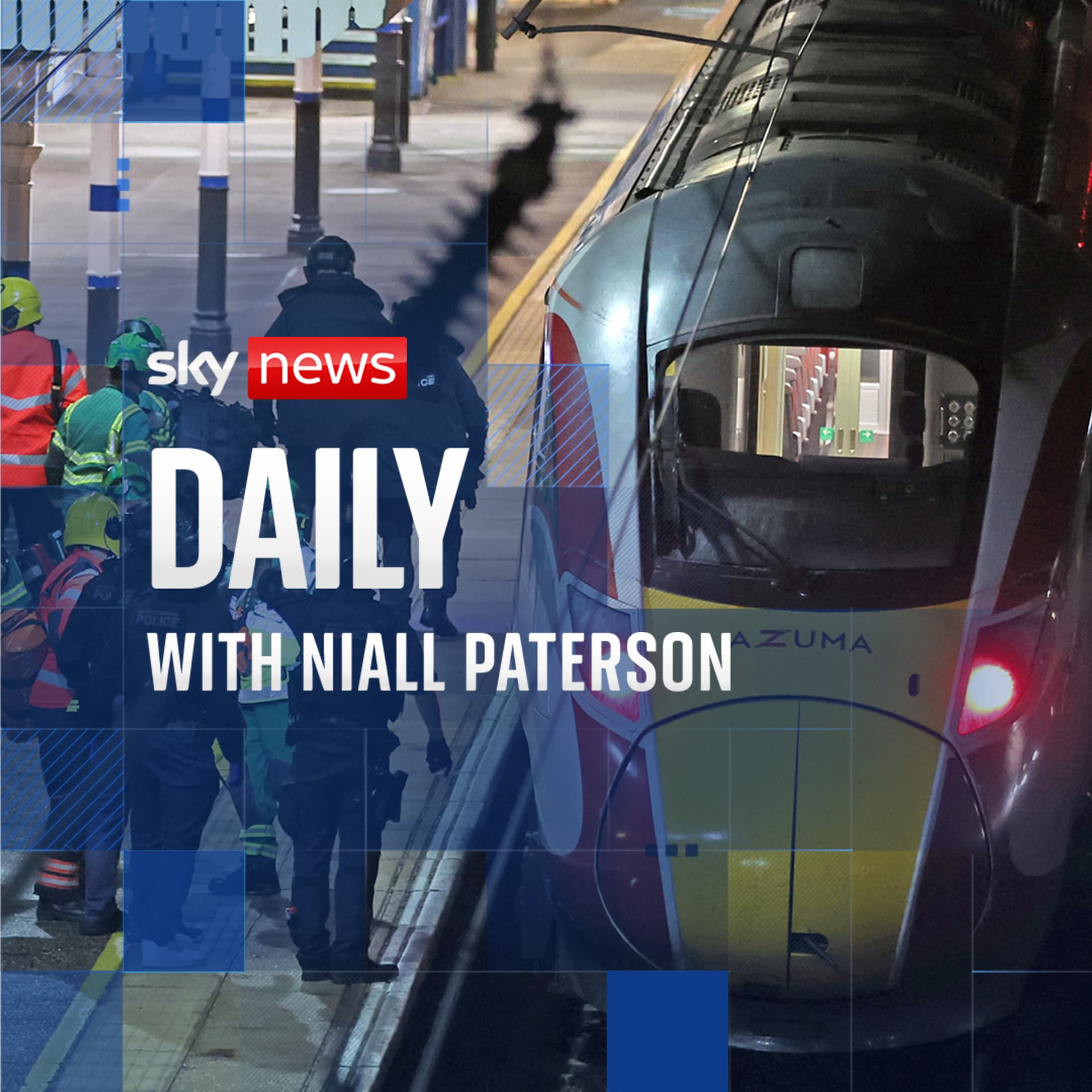
On Saturday evening, 11 people were injured on board a high-speed train travelling between Doncaster and London.
The rampage might well have been worse if it wasn’t for the actions of the staff on the train and the swift response from the emergency services. But can we every truly be prepared for such an attack?
Niall discusses whether similar incidents are unavoidable with policing commentator Graham Wettone and Sky News crime correspondent Martin Brunt.
Producers: Tom Gillespie & Araminta Parker
Editor: Mike Bovill