
In short
A visit to “Data Centre Alley” outside Washington Dulles, arguing AI’s growth is constrained by physical realities—power, cooling, rare materials—and may resemble a speculative “AI bubble” like the dot-com era.
Guests
No named guests. The episode features Ed Conway (Sky News Daily) and references experts/institutions: Bank of England Governor (economic historian), IMF, and companies/industry actors (OpenAI, Amazon Web Services, Meta, Google, NVIDIA, Digital Realty).
Key claims
AI isn’t “cloud-only”; it depends on heavily guarded data centers with GPUs, liquid cooling, and massive electricity demand. Data center power use is rising sharply and strains the grid. AI monetization and earnings are uncertain, raising bubble risk. Building AI also requires large quantities of copper and other physical inputs, with geopolitical supply risks (US–China).
Notable examples
Virginia’s Loudoun County data centers (4.9 GW; Denmark-like consumption); AWS server outage; “Digital Dulles” under construction (1 GW, multiple substations); copper shielding and wiring around GPU racks; NVIDIA’s outsized stock concentration in the S&P 500.
Written by AI. May contain mistakes. Listen to the episode to check what was said.
Chapters
Tap a time to open that second in VOThe Importance of Data Centers
0:30 to 1:18
Discussion on the significance of data centers in powering the AI revolution and the US economy.
“The US data centres powering the AI revolution.”
Inside Data Center Alley
1:18 to 2:28
Ed describes his observations of Data Center Alley and its critical economic role.
“Ed, speaking to us from the United States, just describe what these places look like.”
Security and Access in Data Centers
2:28 to 3:18
Insight into the security measures and access challenges at major data centers.
“They had their headquarters around there.”
Power Requirements for AI
3:18 to 4:25
Discussion on the immense power needs for data centers and the implications for the US grid.
“But what we did see, and like I say, it's very rare to get access because if you're one of these big companies, whether it's kind of OpenAI who run ChatGPT or Amazon or anyone else, these places are heavily guarded.”
Economic Impact of Data Centers
4:25 to 6:26
Analysis of how data centers influence the US economy and power consumption trends.
“If you're an internet company, if you're providing cloud services, you need all of these things.”
AI's Economic Potential vs. Challenges
6:26 to 7:56
Exploration of AI's potential for economic growth versus the challenges of power supply.
“But what's also massive is you've got all those power lines running into it.”
Future of AI and Data Centers
7:56 to 8:28
Discussion on the future of AI and the need for expanded data center capacity.
Physical Resources and Manufacturing
8:28 to 9:52
Examination of the crucial physical resources needed for AI infrastructure.
“You know, there's no internet without it.”
The Role of Rare Earth Materials
9:52 to 12:06
Impact of rare earth minerals on the AI industry and global tensions surrounding them.
“So there's a very physical underpinning to this.”
The Importance of Copper in AI
12:06 to 14:00
Insight into copper's critical role in AI data centers and the demand for resources.
“Both the Bank of England and the International Monetary Fund are genuinely concerned that this might be a bubble.”
Show all 12 chapters
The Physical Demands of AI Growth
14:00 to 15:52
Learn about the physical resources needed for AI and the challenges they present.
“And the amount of copper, by the way, that everyone is chasing for right now to make the energy transition a reality is also staggering.”
Job Impacts in the Age of AI
15:52 to 17:34
Explore the potential job losses and opportunities created by AI advancements.
“I mean, we know that AI will undoubtedly lead to some jobs going, some professions, some careers just no longer existing.”
Transcript
Automatic transcript. May contain errors.0:00How does a banana trigger a CIA-backed coup? Do AirPods herald the arrival of a new global order? What do LED lights say about the future of humanity? I'm Ed Conway, and in each episode of my new podcast, Stuff Matters, I take an object, crack it open, and reveal the world-shaping forces hidden inside. This is economics told through the things we think we understand. Search Stuff Matters on your podcast app to listen and follow. Coming up on the Sky News Daily, Ed Conway has his head in the cloud. The US data centres powering the AI revolution. When you think of artificial intelligence, well, if you're anything like me, you probably think of the clouds of ones and zeros floating through the air to the apps on the phone in your pocket.
0:49The reality is that AI has a very real, very large physical presence. The data centres that power it. We've been inside Data Centre Alley in Virginia in the States to see firsthand the technology that's currently driving both the AI boom and the US economy. It's a tale of high tech, big risks, and huge demands on the electric grid. In short, it's the biggest story in economics right now, which is why we sent our economics editor, Ed Conway, to check it out. Ed, speaking to us from the United States, just describe what these places look like. You could actually see them as you were flying in. So if you ever fly into Washington Dulles Airport, as you're coming into land, you see all of what look like big kind of warehouses.
1:32Imagine like a kind of a big kind of supermarket or something like that. But then what you'd see if you look a little bit closer, particularly if you get down at ground level, is that around all of these big warehouses, which kind of look pretty anonymous from the outside, around all of them, there are just pylons everywhere. So there's all these electricity cables and substations. And it is a quite a surreal place. And I didn't kind of expect that. I mean, like these places are some of the most important economic sites or just any kind of sites in the world right now in civilization, because that is what provides not just AI, but the internet.
2:10The internet is basically this web of different service centers around the world. And it just so happens that the biggest concentration of them by far is this area just outside Dulles Airport in Virginia. It's kind of random that they happen to be there. It's actually because AOL, America Online, were the very first internet organizations. They had their headquarters around there. And it so happened that they built some of the very first internet-based service centers around there. And then gradually this cluster has developed. And like I say, these are the machines. These are the places that are powering the AI revolution.
2:43These are the places where if you have your email, a lot of the time they will be dependent on these servers. These are the places where if they go down, then lots of the internet goes down. And that's something we experienced literally just, you know, in this week when Amazon Web Services, so that they run a lot of the cloud services, a series of their servers went down in this area. So I don't, by the way, know if there's a coincidence that Sky News visits this area, and then all of a sudden you have the biggest internet outage in recent history. You didn't hit any big red buttons, did you? Just tell me what you actually saw.
3:15I don't think so. I don't think so. I hope not. But what we did see, and like I say, it's very rare to get access because if you're one of these big companies, whether it's kind of OpenAI who run ChatGPT or Amazon or anyone else, these places are heavily guarded. There There are levels and levels of security precisely because what's going on there is so important, not just for what we're doing, but for national security. You know, the Internet is the basis, the foundation for so much of what goes on in the military and the financial in all of these different worlds. And, you know, basically, if you are running an important Internet service, you need to have some sort of server capacity.
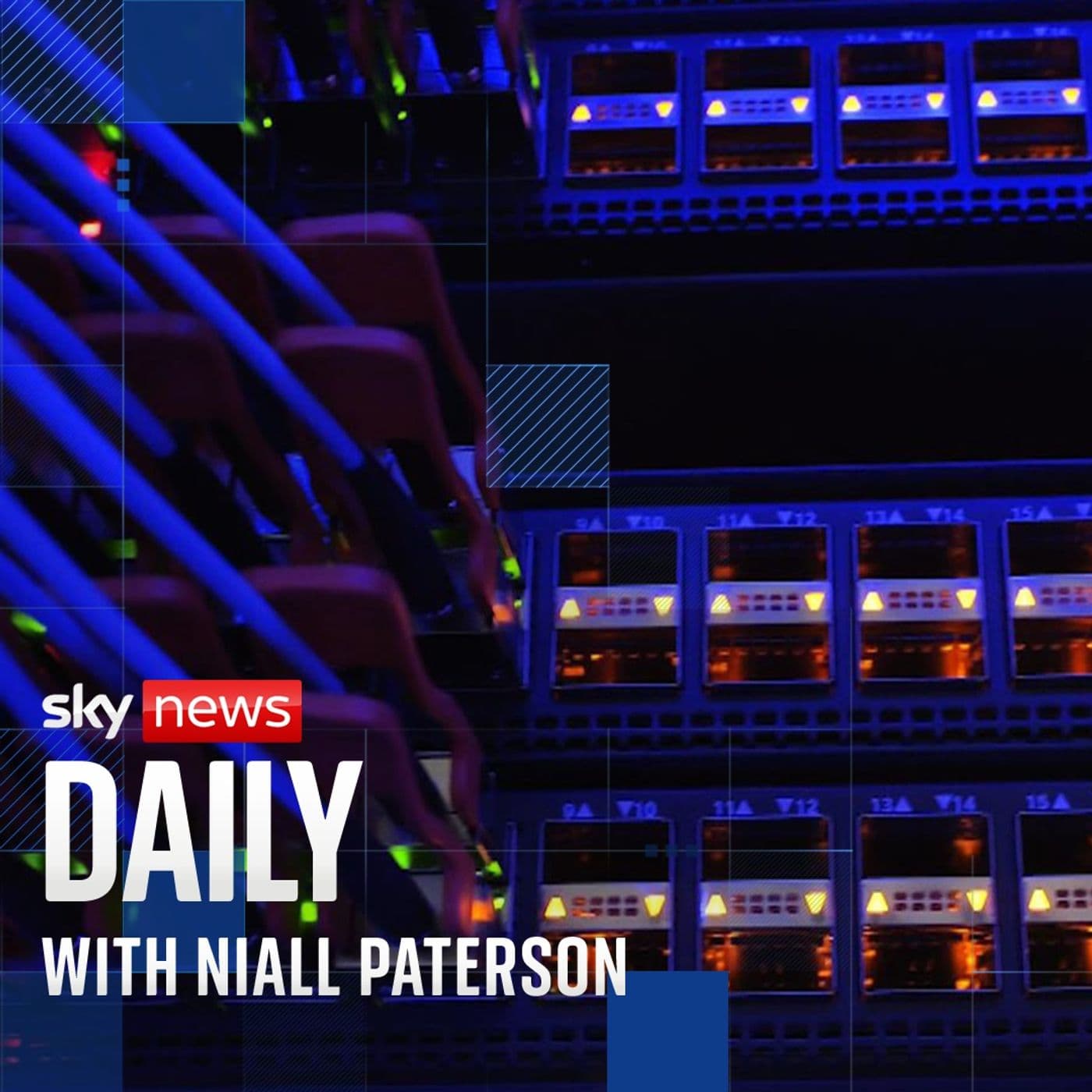
3:54So if you're open AI, you will want to have those. They're called GPUs. So basically, they're graphics processing units. It's the brain that is making AI possible. The things that are made by NVIDIA, you know, that company that you've probably heard of that's now the world's biggest company. These things, we saw them whirring away. You can hear the GPUs literally as the fans are trying to cool them and you've got liquid running through them. By the way, it's not just AI. It's also like if you're a big bank, you need server centers to ensure that your services can actually run. If you're an internet company, if you're providing cloud services, you need all of these things.
4:30And they generally don't let journalists in. It was really only something that came off at the last minute. And what we saw was, it's funny, I was kind of thinking of these dystopian places, empty corridors that are so far that you can barely see the end of them in the distance. very few people there they have scooters to get around because everyone needs to get from one end to the other at these enormous places but the thing that struck me about the one that we went inside is that rather than being one big open place with like you know rack upon rack upon rack of computers as far as the eye can see actually there were lots of kind of rooms which they called suites so you've got the data center and then you've got data suites and each of these little suites within that room then you've got the computers running away and the point here is that the company that we kind of looked inside some of their server centers, they're called digital realty, like real estate.
5:21And for them, it is kind of like real estate, they provide this service of will give you the power, will give you the kind of cooling capacity, and you can plonk your server racks there. And so in each of these rooms, it was like a little kind of, you know, a little real estate area, where, whether it's a bank, or whether it's a kind of AI company. That's where they put their computers. You've mentioned power there, Ed. Why the need for so much power? It's all power, Neil. It's like AI, also clouds as well, the internet, it's power. You need an incredible amount of power to run these servers. To put it into perspective, okay, so Loudoun County, which is the name of this area, you know, data center alley, they sometimes call it, where very few people live, but you've got lots of these server farms everywhere you can see.
6:10That small area, I think it's like maybe 10 miles square, consumes 4.9 gigawatts of power, which is more than the entire consumption of Denmark. And that's growing. That's trebled in the last six years. And it's going up at an astonishing rate. So we saw this farm that's under construction. They're calling it the digital dullest. It's massive. But what's also massive is you've got all those power lines running into it. I think it's six substations they need for a single place. So I told you that the whole place is 4.9 gigawatts. This single one, the new one that's being constructed right now, that alone is going to be one gigawatt.
6:46And just to give you another sense that they kind of put that into perspective, that's kind of a very big power station, a very big nuclear power station for one data center, one data center. The extraordinary exponential rise in these places, in the power consumption, everything else, that's AI. So America, if you look across America as a whole, power consumption in the US has basically been flat for decades. All of a sudden, in the last couple of years, it has gone up. It has gone up incredibly sharply because this is the biggest thing that's happening in the economy right now. Can I give you one other example about the extent to which this is the biggest thing in the economy?
7:28So recently, GDP growth, in the first half of the year, the annualized rate of GDP growth, So gross domestic product, the whole economy in the US was running at about 2 % annualized number. Takeaway data centers, and it was running at 0.1%. Basically, AI looks like it has provided almost 100 % of the economic growth in the US right now. Well, certainly in the 90s, you know, 90 % of economic growth, which is staggering. It is all AI. and again that's part of the reason why this is not just a fun thing to talk about and to go and visit this is fundamental to well-being right now in the u.s and around the world what about the grid can the grid in the united states cope with well not just the amount of energy that's been taken out but right now but presumably with the expansion in these kind of data centers you know there's going to be even more demand and very very soon yeah i mean that's i think that's a question everyone's asking themselves and i think i think for a lot of people when they look at the share prices of all of these companies when they look at the the enormous very optimistic promises that many of them are making about uh where ai is going in the future all of which are really really ambitious um they ask themselves okay so how are you going to achieve that and the only way to achieve that is through an extraordinary expansion in data center capacity there's no ai without data centers.
8:54You know, there's no internet without it. There's no AI without it. And there is no data centers without power. And building new power stations, as we know in our country, is pretty hard. It takes quite a long time. Frankly, it is a big issue in the US. They took decades to get the most recent nuclear power station built. And, you know, a lot of the power in Virginia comes from gas. I think quite a bit of it comes from coal. And so the power has to come from somewhere if you want the AI revolution to happen. These days, everyone, well, the vast majority of people use ChatGPT or indeed other AI services and tap in their question.
9:29And I was probably slightly oblivious to the fact that when they ask that question, there is a server farm somewhere around the world, often in Virginia where we visited, which is whirring away in order to satisfy, to answer that question. And that whirring of the GPUs, the processing units, the brains, the coolant that goes through those computers, that is incredibly power intensive. So there's a very physical underpinning to this. And probably the most compelling argument to why AI might not satisfy all of the hopes that a lot of people have is that we just simply won't be able to produce enough power to power all of those chips and make it happen.
10:11Haven't we missed a step though in our discussion, Ed? I mean, you mentioned there if someone types a question into chat GPT. I mean, you know, I think that for most people is the sum total of their experience with AI right now. Do we know yet what it's for and how we're going to be able to monetize it to justify the expenditure that's going into these places? In short, no. But what we do know, I suppose, and there was an interesting speech from the Bank of England Governor about this just in Washington. He's an economic historian. He's looked at things like the Industrial Revolution and what happened with cotton and how we learned how to mechanize the production of making textiles.
10:47And that was kind of the beginning of the moment where everything changed for the global economy and everyone started getting better off. And I guess his point is that AI is probably the best hope we have of something similar happening today. And it's the best hope for that because essentially you could envisage a world where a lot of work is done by AI. And so if you think about what's the manufacturing, what did the industrial revolution do it took a lot of jobs that were done physically and by human energy and used other forms of energy and mechanization so that we humans didn't have to do everything i mean there is another event in history isn't it that we could well be heading towards and it's not the industrial revolution it's it's the dot-com bubble bursting you know back in the early 2000s there there was huge investment huge speculative investment that seems to be happening right now and it all went wrong if you look at the the stock market at the moment particularly in the us it's mostly the us um it is it is just it's it's flabbergasting just how much the share prices of companies like nvidia which is the one that makes those chips but also what they call the hyperscalers so the ai companies whether it's open ai or meta or indeed google most of them have massive bets in ai and have benefited as a result um and i think the you Both the Bank of England and the International Monetary Fund are genuinely concerned that this might be a bubble.
12:15When the IMF says, listen, this looks worrying and it could be like the dot-com bubble, which is what they basically said last week, then I think we should all be kind of listening. And I think we should be listening, especially because in some senses, this isn't as bad. You know, the levels of kind of share prices versus kind of earnings, not as bad as the dot-com. but in other respects you know look at the extent to which the the s &p 500 which is something that you know again if you're in the uk you may not spend that much time thinking about the s &p 500 but a lot of your pension will be in the s &p 500 if you have investments a lot of them will be there or it's affected by it because that is the main stock market index in the world that has never been as concentrated in a single company nvidia in this case uh ever before in history so that's That's worrying.
13:06Is there not another potential problem? And one that I imagine is quite close to your heart, given the work that you've done on it in the past. You need to build these things. To build these things, you need rare earth minerals and metals and all the rest of it. China and the United States appear to be on a collision course right now. I mean, if you can't build it, then the industry gets stymied as well. Actually, the striking thing, when we were at the data center, we looked at the cross section. They had this kind of demonstration area where you can look at the different bits and pieces and parts that you need to make a data center.
13:35And one of the striking things is they had a whole server apparatus, like the rack, basically, an AI rack. And what you could see is each of the graphics processing units, the brains, was surrounded by this shield of copper. And there were copper, big copper wires going in there. The coolant went down copper pipes. the amount of copper you need to make AI a reality is staggering. And the amount of copper, by the way, that everyone is chasing for right now to make the energy transition a reality is also staggering. So what we're basically doing with AI is we're doubling down on our demand for physical resources to try to give us the growth that we want in the future.
14:25It's physical. It's all physical and that everything depends on that and you know i won't bang on about it but i wrote a book about this a couple of years ago but don't don't feel you have don't feel you have to buy it but but what i will say though neil and this is like that book was saying basically this stuff is a really big deal um that book was kind of written before chat gpt was really a thing this stuff is doubly a big deal now because we need the physical um foundations and so you need that copper and blimey you see it in person and you see how much physical stuff you need you see the size of the wires that need to plug into each different data center and you're you're bowled away by it you see the size of the substations you need to make ai a reality everything we think is kind of you know in the cloud it's physical and unless we face up to that and work out where the physical stuff is going to come from.
15:23That's another reason why all of the dreams that we have, all of the hopes, all of the boom is not going to materialize. It's not going to happen. The data center experience really reminds you just how much physical stuff and energy and water, because the amount of water you need to cool all of these processes, which are just whirring away and creating lots of heat. That's also massive. Do you need people, Ed? I mean, we know that AI will undoubtedly lead to some jobs going, some professions, some careers just no longer existing. I mean, is this a sector in which you see the opportunity for people to actually find employment?
16:06Well, there ain't much employment in data centres, to be honest with you. I mean, there's a lot of people, when we saw the one under construction, there's a lot of people there. And actually, you are seeing a construction boom in the US of these things. So there are jobs being created by that. So it's obvious now which jobs are maybe at risk. And we can look at a lot of our jobs, maybe our jobs, Neil. I think everyone out there, probably most people listening to this will have thought in the last couple of years, hold on, am I safe from this? And I think it's incredibly unsettling. And that's before you think about everything else.
16:44you know, the ways that this is changing our culture. It's extraordinary. By the way, though, you know, it's scary to live in these times, but it's also, it can be exhilarating as well. And I think for a lot of people living in the Industrial Revolution, they had the same experience. Suddenly, fields were turned into, you know, kind of mines, and there were machinery everywhere. And it was kind of, it was, it was, you know, bamboozling, but also exciting, but also scary at the same time. So we're in that kind of similar moment right now. It's easy to kind of think and ponder about which jobs might go.
17:15What's a bit harder is to work out what jobs might be created in the future. And the Industrial Revolution destroyed a lot of jobs, but it created a lot of jobs. And I kind of hope that it'll be the same this time around. But that's a bit of a matter of faith, isn't it? And you just don't know until it's happened. But that's the way it's happened every single time in history. Thanks, Ed. And for his full report inside data center, Ali, just head to skynews.com. The Daily is back again tomorrow.
17:45How does a banana trigger a CIA-backed coup? Do AirPods herald the arrival of a new global order? What do LED lights say about the future of humanity? I'm Ed Conway, and in each episode of my new podcast, Stuff Matters, I take an object, crack it open, and reveal the world-shaping forces hidden inside. This is economics told through the things we think we understand. Search Stuff Matters on your podcast app to listen and follow.
From the publisher
In the US, artificial intelligence has accounted for the vast majority of economic growth so far this year - not least because of the patronage of Donald Trump, who's also fond of taking AI-generated jibes at his critics.
But does the US have enough access to the infrastructure and materials needed to fuel this economic boom? Has it become too dependent on AI and could the bubble be about to burst?
Niall is joined by Sky's economics and data editor Ed Conway - who has been in the US visiting the largest concentration of data centres in the world.
Producer: Tom Gillespie
Editor: Mike Bovill