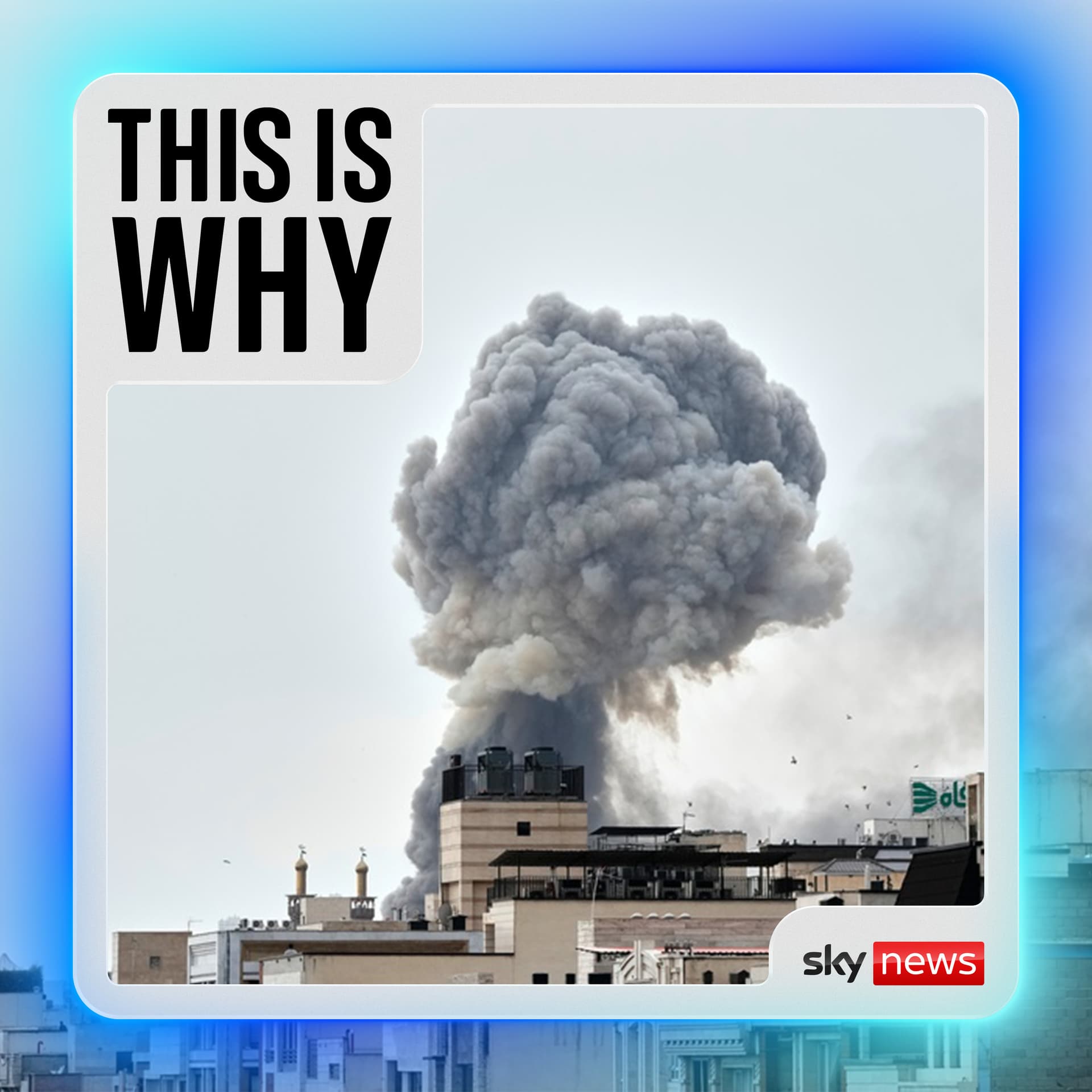

In short
Podcast Notes: This Is Why - Episode 1: Is the UK being dragged into Trump’s Iran war?
Air Date: [Insert Date] Host: Niall Paterson Guests: Deborah Haynes (Security and Defence Editor), Dominic Waghorn (International Affairs Editor) Podcast Description: This Is Why takes one story each day, explains how we got here, and why it matters to listeners.
Episode Summary In the inaugural episode, the discussion revolves around the escalating conflict in the Middle East following US and Israeli strikes on Iran. The UK, initially reluctant to engage in the conflict, modifies its stance, allowing the US to use British airbases for defensive operations. The episode delves into the political implications of this decision, the involvement of the UK in the conflict, and the broader context of international relations.
Key Topics Discussed
- Background of the Conflict
- US and Iranian Hostilities: The US has launched military operations against Iran, with the UK following suit by allowing the use of its bases.
- Immediate Impact of Conflict: Concerns about hundreds of thousands of British nationals in the region facing danger due to the conflict.
- UK’s Political Stance
- Keir Starmer’s Decision: Initially blocked US usage of UK airbases, later reversed the decision citing British interests under attack.
- Political Ramifications: The Labour government faces scrutiny for its involvement in a potential regime-change war, raising historical parallels to past conflicts.
- Military Involvement and Capabilities
- Extent of British Military Involvement:
- Bases provided for US military operations.
- UK F-35 and Typhoon jets reported to be engaged in operations.
- Lack of substantial naval presence in the region (no major vessels currently deployed).
- International and Domestic Reactions
- Criticism from Former Diplomats: Calls for Trump to take a decisive stance against Iran to avoid escalating costs.
- Public Sentiment: Widespread concern about the UK being viewed as weak internationally due to its reliance on the US.
- Implications for the Future
- Long-term Risks of Involvement: The uncertainty surrounding the strategies employed and potential outcomes of the conflict.
- Concerns about International Law: The legality of US actions questioned compared to past wars justified with UN resolutions.
- Broader Consequences
- Shift in Global Power Dynamics: Discussion of how current events might embolden other nations (e.g., China regarding Taiwan).
- Potential for Increased Hostility: The risk of the UK becoming a target due to its military ties and actions against Iran.
Key Takeaways
- The UK is increasingly entangled in US military actions, raising concerns about its international standing and military capabilities.
- The Labour government under Keir Starmer finds itself in a precarious position regarding its foreign policy.
- The episode highlights the complexities of modern warfare, international law, and the geopolitical landscape, raising questions about future engagements.
Conclusion The episode provides a comprehensive overview of the current situation involving the UK and Iran, emphasizing the intricate balance of political relationships and military strategy. As the conflict unfolds, the implications for British nationals and the UK's standing in global affairs remain a central concern.
Call to Action Listeners are encouraged to engage with the podcast by submitting questions or topics for future episodes, enhancing the interactive nature of the series.
---
For more episodes and insights, you can find This Is Why on Sky News and other platforms.
Written by AI. May contain mistakes. Listen to the episode to check what was said.
Chapters
Tap a time to open that second in VOUK's Involvement in the Iran War
0:46 to 2:04
Discussion on the UK's changing position regarding the US-Iran conflict.
“The United States has requested permission to use British bases for that specific and limited defensive purpose.”
Political and Military Implications
2:05 to 4:23
Exploration of the political ramifications of UK's military involvement.
“And I think every prediction that the British had made in terms of contingency planning in the past always envisaged if there was like a strike against Iran by either Israel or the US, then Iran would lash back out.”
Risks of Escalation
4:24 to 6:18
Analysis of potential dangers as UK gets more involved in the conflict.
“It's going to be a very expensive missile fired by the UK against presumably a much cheaper drone launched by Iran.”
Legal and Strategic Confusion
6:19 to 8:01
Debate on the legality and strategy of UK military actions in relation to the US.
“Although I would say, given that the UK right now militarily is pretty weak and very reliant on the US, it doesn't make sense to me why we've decided to not let the Americans use our bases from the very beginning.”
Future of UK-Iran Relations
8:02 to 14:03
Discussion on the future implications for UK-Iran relations amidst the conflict.
“Because a few weeks ago, the pretext was that the Iranians were doing barbaric things to their own people.”
The Vulnerability of the UK in Global Politics
14:03 to 16:42
Explore how the UK's stance in global politics is shifting amidst US military actions.
“it kind of makes the UK in this new world of might a bit more vulnerable perhaps.”
Transcript
Automatic transcript. May contain errors.0:02Niall:Sky News, the full story first.
0:09Deborah Haynes:We might be thousands of miles away, but the UK is now inextricably tied to the United States war with Iran. And this is why.
0:32Deborah Haynes:Hi everyone, Neil Paterson here with the very first episode of This Is Why. And look, no prizes for guessing what we're talking about. We're now into the third full day of the United States war with Iran. A war in which the UK said it was not going to be an active participant. That's now changed.
0:51Dominic Waghorn:The United States has requested permission to use British bases for that specific and limited defensive purpose.
1:00Deborah Haynes:So why has the PM had such a change of heart? Well, look, that is where This Is Why comes in. The whole point of this podcast isn't just to tell you what's going on, but explain the context. And a big part of that is the vast number of Brits currently in the region. Since Saturday late afternoon, we've been hearing and feeling blasts. Some too close for comfort.
1:21Dominic Waghorn:We've been woken up by them the last two mornings.
1:24Deborah Haynes:With hundreds of thousands of Brits literally in the firing line, just how deeply involved are we going to get? Is this just the start with more to come, or the full extent of our support for Donald Trump? Dear Lord, you guys must have had precious little sleep over the weekend.
1:41Dominic Waghorn:It's a busy weekend, and for me at least, It wasn't expected. So I was taken by surprise on Saturday. You weren't though, Debs.
1:49Niall:Not really. I heard mutterings that it was anticipated to happen. And there's only a finite time you can keep that much force at that high readiness before using them or losing them.
1:57Deborah Haynes:Well, of course, the voices you were hearing, our defence editor, Debra Haynes, and our international affairs editor, Dominic Wycorn. Let's start with the biggest change. I thought we weren't going to get involved in this. What happened?
2:07Niall:The war happened. And I think every prediction that the British had made in terms of contingency planning in the past always envisaged if there was like a strike against Iran by either Israel or the US, then Iran would lash back out. And because we have so many assets in the region, of course, we'd be pulled into that. And that's exactly what happened.
2:25Dominic Waghorn:The problem is, of course, that we've gone to that from saying that they couldn't use our air bases, which had clearly really provoked and easily provoked American president to then, as a result of that, came out and sort of criticised Keir Starmer's Chagos plan. And in a sense, we kind of got the worst of both worlds, because I guess we're now involved in a campaign that seems to have a very uncertain strategy and uncertain outcome. But we seem to have sort of not be flavour of the month in DC. So however much influence we would have had before, we've got even less now, probably.
2:53Deborah Haynes:Hasn't Donald Trump criticised the extent of our involvement as well?
2:58Niall:So on Sunday night, the Prime Minister said, OK, right, Iran is attacking our Gulf allies, our British interests in the region, and therefore the US can use these bases to launch. But he was then agonising over the language. It has to be like defensive operations. So the US can launch strikes from our bases, provided they're going after Iran's ballistic missiles and launch capabilities. But you've just had Pete Hegseth giving a press conference now. Secretary of War, he didn't name Keir Starmer by name, but he was saying how Israel is a capable ally, obviously gone in with Israel. The Americans like capable allies, unlike our traditional partners who are wringing their hands and clutching their pearls and humming and hawing about the use of force.
3:42Dominic Waghorn:And the backdrop to this, of course, is the Americans say the Europeans are just freeloaders and, you know, under Donald Trump, that we've just not spent enough on defence, can't be relied upon as allies and that we'll tar with the same brush. So we're kind of involved but also regarded as sort of feckless, solanimous Europeans anyway.
3:57Deborah Haynes:But what is the extent of our involvement? How can strikes on another country be thought of as defensive?
4:04Niall:So in terms of the extent of our British involvement, as far as we know, it's only the giving of these bases for America to launch bombing raids, presumably, against targets. We've got F-35 jets flying out of RAF Akritiri in Cyprus. We've got Typhoon jets flying out of an airbase in Qatar. We know that the typhoons have shot down a drone. It happened yesterday. It's going to be a very expensive missile fired by the UK against presumably a much cheaper drone launched by Iran. And then we've also got a counter drone units on the ground and a counter drone unit in Iraq blasted a drone out of the sky on Saturday, the first day of the war.
4:42Niall:Jets are still flying. Obviously, we've had additional forces, radars, counter drone capabilities move to the region. But frankly, this really exposes the limitations of our ability to actually be in place. I think it's a really good statistic that's worth sort of sharing. We used to have a big naval presence in Bahrain. We had two big warships, a frigate and a destroyer, four mine hunters and a vast support ship, an RFA, a fleet auxiliary ship. Today, guess how many we've got?
5:12Dominic Waghorn:None.
5:12Niall:Literally none. And the last mine hunter is making its way home. Yeah. I mean, that's pretty extraordinary. Just for the last week or so.
5:20Deborah Haynes:But it is also true to say, isn't it, that even given the kind of the paucity of our involvement in this particular conflict, we have now made ourselves a target, haven't we?
5:29Dominic Waghorn:Potentially, yeah. The other problem, I think, is just the political optics of this is it's, again, a Labour government involved in a regime changing war in the Middle East that has an uncertain kind of strategy. And it's based on dodgy intelligence, arguably. You know, the argument made by Donald Trump that the Iranians would be able to strike America fairly soon with a ballistic missile and have been rubbished by experts. And I think Keir Starmer's kind of damned if he does, damned if he doesn't. You know, if he doesn't show willing with this, then it's very difficult for transatlantic relations.
5:59Dominic Waghorn:Now he's got involved, then in a sense, our destiny is sort of bound up with the Americans. And it's very hard to know where this is going to go. So it's not surprising we're hearing from former British diplomats urging Donald Trump to take the win, saying that you've killed Khamenei. you have made some impact on the regime from here on in it just gets more costly and it's hard to see how it doesn't become more of a downside you know unless they're able to wipe out the entire regime but if they do then you're looking at civil war and chaos which also look very very bad and look very similar to iraq nowhere near that yet but as we get more involved in this and britain gets more involved and the conflict spreads the downside the liability for all involved only obviously escalates.
6:38Niall:Although I would say, given that the UK right now militarily is pretty weak and very reliant on the US, it doesn't make sense to me why we've decided to not let the Americans use our bases from the very beginning. It wouldn't have been instrumental, but it would have been a gesture Donald Trump would have appreciated. As we have tied up our destiny so closely to the US as things stand, it does make us in a fairly weak position now. And you've got to remember that the Iranian regime has blood on its hands. It has killed British soldiers in Iraq.
7:12Deborah Haynes:But the pretext for this conflict is Iran's nuclear ambition. And I thought the United States showed the evidence that we had wiped that out during the last round of airstrikes. I mean, why are we here again? I thought Donald Trump said he got the job done.
7:26Niall:That's a really good point in the sense that how can the two things be right? No one on the intelligence side has come out and backed up that claim by Donald Trump that he obliterated it first time round. But this time round, they've really hammed up that Iran is planning to build this intercontinental ballistic missile capability. But the crucial thing is it doesn't have it right now. He talked about imminent threat in that statement that he gave. That's obviously them trying to give a nod to international law and legitimacy.
7:50Deborah Haynes:Using the language of it at the very least.
7:51Niall:But it just doesn't exist. Like, for example, for the UK, Iran right now does not have the capabilities to strike the UK mainland with a missile. Yes, it could hit Cyprus, but not the UK mainland.
8:01Dominic Waghorn:But also the pretext of shifted, hasn't it? Because a few weeks ago, the pretext was that the Iranians were doing barbaric things to their own people. And as protests were out in the streets in their thousands, had been killed in their thousands by the regime, Donald Trump said, don't worry, help is on its way. And part of the kind of justification for this has been trying to get a deal from the Iranians, committing to them not doing so again. Part of it's to do with the missile programme, part of it's the nuclear programme. So it's all a bit confusing. Why has Sir Keir Starmer thrown his hat into the ring in this one?
8:32Deborah Haynes:Is it just because he didn't have another choice?
8:33Niall:Well, he's not really thrown his hat in the ring, has he? No. He's kind of like got his hat out and he's sort of like, you know, waving it near the ring. Because I think throwing it into the ring will be when, if the UK actually launches a strike against Iran, and that hasn't happened yet. So I think for now he is still dancing this strange dance of needing to look like he's defending British assets, but not wanting to go all out offensive against Iran. I think the problem will come is if there is a big attack against a British base that causes mass casualties. That nearly happened on the first day, I think it was, with that strike in Bahrain against the US naval base where the Brits are also located.
9:13Niall:And we were told that the explosion detonated 200 metres away from some British personnel. So that would have been very bad.
9:19Dominic Waghorn:We should also say just briefly that this also plays into the kind of narrative the Iranians have about us, about the British, that we are duplicitous, that we are responsible for a longer history than the Americans actually of meddling in Iran. This will add to that narrative, I think, and it will be costly potentially for hostages being held in Iranian prisons and for British-Iranian relations.
9:41Deborah Haynes:But isn't that the point where we have to direct our attention to the British nationals that are in the region? The 300 ,000 or so, according to the Foreign Secretary, Yvette Cooper, and the logistical nightmare that it is going to be to get them out.
9:53Niall:Yeah, I remember Lebanon, wasn't it, 2006, when we had that last massive evacuation of British nationals. And now we just don't have the same assets available to be able to go and launch the same kind of operation. I guess commercial flights, I mean, I don't know where the ships are to go and help them.
10:07Dominic Waghorn:Well, it's that where it's sort of long drives across the desert to Riyadh, I suppose, isn't it?
10:11Niall:Under fire.
10:12Dominic Waghorn:Under fire. And who's going to be driving them? And it's a nightmare for them. Like Gillian, one of our presenters, had been saying her daughter's out there, went out there for a holiday, which was going to be on a yacht. She's now spending nights rather frightened, I'd imagine, in car parks under the hotel. That is the fate of tens of thousands of Brits there. It's a terrifying scenario. It also strikes the very heart of the kind of economic proposition of the Gulf states. They're meant to be stable, safe havens, places that tourists go to, that businesses invest in. And that's massively undermined by all this, of course.
10:44Niall:And actually, that's a really good point, because that's the justification that Starmer is giving now for allowing the Americans to use British bases, that this is defensive. Surely he could have come out at the beginning and said, if Iran attacks us, we will allow America to use our bases to be able to defend us. But that didn't happen.
11:00Deborah Haynes:Don't we now have cart launch, essentially, after that attack on RAF Akrotiri? That that is a direct attack on the United Kingdom, and that actually, for all the justification that he's provided up until that point, that's all the Prime Minister needs?
Read the full transcript
11:12Niall:Yes, because now, surely, Iran has attacked us. If it was an Iranian drone, presumably it was, I guess it could have been fired from Lebanon by Hezbollah, and the investigation is going on. And I was wondering, what have we got to be able to attack Iran if we decided to do that? our fighter jets that are in the region, they can't carry fire ballistic missiles. That has to be done by a submarine. And actually, an interesting fact, we know publicly that our one definitely operational, astute class attack submarine is currently, guess where?
11:40Deborah Haynes:Go on.
11:42Niall:Australia. Or somewhere on the other side of the planet. We have other attack submarines, a small number of them that are operational, or at least could be worked up. Whether that is the case, they can fire ballistic missiles. But then we've got fighter jets that can drop bombs. I was talking to someone earlier, Iran has it hides understandably, it stockpiles of ballistic missiles in these, he called them like missile cities, or in these like big sort of underground, rocky kind of caverns. But if you bomb the entrance, then it means they can't get the missiles out. And then of course, when you've got the launchers above the ground, given that there's so much American and Israeli stuff in the sky to see that, you can quickly go and hit them.
12:22Dominic Waghorn:But even if we had a considerable air force, I mean, would that make a big difference given what the Americans have thrown into the region, what the Israelis have got currently? At the moment, we're not doing
12:28Niall:anything in response in terms of militarily.
12:31Dominic Waghorn:We can't defend our assets because we don't have the military assets there to defend them. And we're saying we can't really evacuate our nationals either.
12:37Deborah Haynes:Can I be deeply cynical just for a second and suggest that maybe part of the reason why we are not accelerating our response, despite the fact we have had an attack on a British base, is because we're a bit confused as to the legality of everything. We have said use of our bases for defensive purposes to strike kind of missile targets, you know, that bit is legal. Doesn't that rather leave hanging in the air the stench of the idea that the United States' actions were under international law illegal, and that is the British government position.
13:05Dominic Waghorn:Well, it's such a massive contrast, isn't it, between what's been happening in the last week or so with Iran and what happened 20 years ago with Iraq, where Tony Blair and George W. Bush bent over backwards to get UN Security Council resolutions to get at least the fig leaf of international law to justify what they were doing. And they used arguably dodgy intelligence to do so.
13:23Niall:Although you're both assuming that actually matters anymore, given what world leaders were saying at Munich at the security conference, that old world order has ended and we are in a new era of great power.
13:34Deborah Haynes:Just explain that, because there was this kind of settled view after the Second World War.
13:38Niall:It's been unravelled over time and we were as guilty as anyone in terms of the Iraq war and our involvement of that. Countries have looked at the world order and thought that people only use it selectively. And now the widely held opinion is that at the moment it has been completely trashed.
13:53Deborah Haynes:Might is right.
13:53Niall:Might is right. And in that context, again, you have to think back strategically for the UK. If the world order, if you can't uphold it and America is taking this action, it kind of makes the UK in this new world of might a bit more vulnerable perhaps. Well, and the whole of Europe. Well, if we haven't stood alongside America, given America has the might right now, while we are all supposedly rearming, and that's exactly it, is when middle powers, small powers need to club together, need to get strong or else they're going to get squashed.
14:24Deborah Haynes:Look, one of the ironies of a life in journalism is that sometimes I think that whilst we spend all day, you know, day in, day out talking about a topic, I'm not sure that when we get home at night as a result we fully process what's going on. on this story. I have sat there deeply, deeply worried about what this might lead to, not just in the next few months, but in the next couple of decades.
14:46Niall:I totally agree. I was just thinking how what we're seeing in terms of the unravelling of those rules and predictabilities and certainties that we've kind of taken for granted, frankly, since the end of the Second World War and definitely since the end of the Cold War, that's falling away. Suddenly, Donald Trump has not criticised Vladimir Putin about his invasion of Ukraine overtly. But for the UK and others, of course, we absolutely condemn it. And yet we are not absolutely condemning what the US has just done in Iran. It means people like Xi Jinping looking at this happening and thinking, well, you know, if I make my move militarily on Taiwan, I'm kind of like, I'm okay.
15:24Niall:This is the way of the world now. It's about military might. And I think in a world like that, it becomes a whole lot more dangerous.
15:30Dominic Waghorn:It's the way of the world. And it doesn't have to be the way of the world. But it's certainly the way the world is seen by those figures in the American administration who are making it become that way. I think if we had another Democrat president who doesn't believe in this sort of total breakdown of the rules-based world order, then we could go back probably to something approximating that again. But the problem is this is the second time Donald Trump has been put into power and is exercising this completely radical worldview and then making it happen in terms of what he's doing in a military sense in the Middle East.
16:04Dominic Waghorn:And the problem is that he doesn't have a clear understanding, I don't think, of what he's getting involved in. It's an asymmetrical war, not just in the balance of military power, but also in terms of desired outcomes. For the Americans to win this and for it to be successful, they have got to achieve their aim, which is regime change. All the Iranians have to do is avoid that happening. They've just got to survive, hunker down and get through what, you know, you'll know more than I will, Debs, but what, two, three weeks is what they've got in terms of munitions to throw at them. If the Iranians get through that and they are a very resilient regime and they've put in place for years now the ability to survive a kind of regime changing assault like this then where are we in terms of american standing and also britain is sort of tying its horse to this uh adventure in the middle east where does it leave the uk deep breaths everyone dominic deborah good to have you on
16:52Deborah Haynes:and that's your lot for this the first edition of this is why we are on monday to friday one story every day where we tell you, well, not just what you need to know, but why things are happening. More than that, though, we want you to get involved as well. You can email me directly, why, at sky.uk. You can leave comments under any of the articles or indeed social videos that are associated with the podcast. Let us know what you want us to cover, be it a particular topic, story. You might have even seen a phrase in the news that you don't understand. Let us know and we'll do something about it.
17:28Deborah Haynes:Also, turn your attention to my colleague's podcast, Yalda Hakim's podcast, The World, out now with more context, and of course, Trump 100 with the boys and girls over in the United States. We'll see you again tomorrow.
From the publisher
War is raging in the Middle East after the US and Israel carried out strikes on Iran.
Keir Starmer has risked his special relationship with Donald Trump by initially blocking the US from using UK airbases.
Despite later changing his mind, what kind of tightrope is the prime minister walking – and can he stop Britain being sucked into war?
Niall is joined on this first-ever episode of This Is Why by Sky’s security and defence editor Deborah Haynes and international affairs editor Dominic Waghorn.
Have you got a question for Niall? Email the show – why@sky.uk