
In short
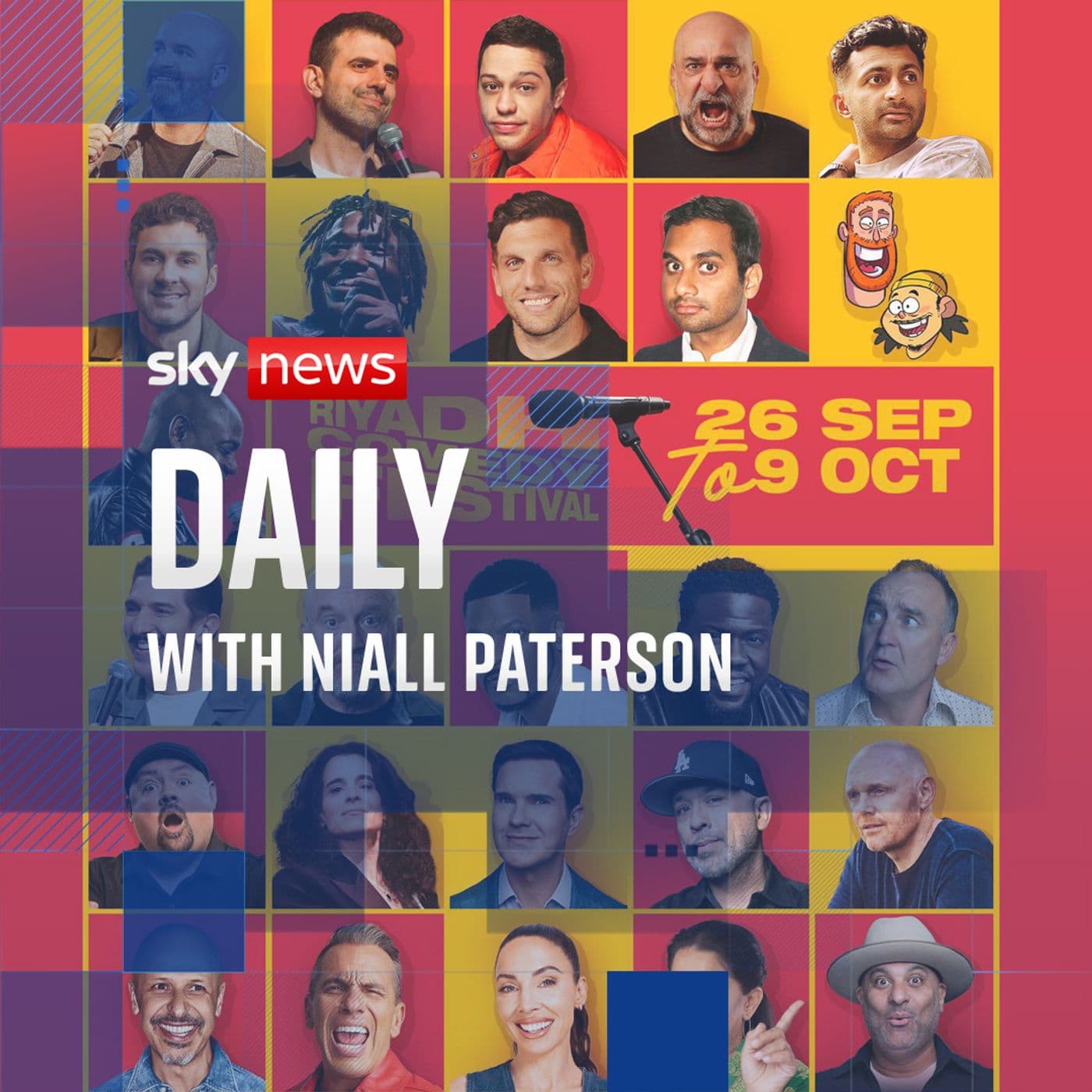
The episode debates whether Saudi Arabia’s first Riyadh Comedy Festival is “comedy washing” (reputational management) rather than meaningful cultural change.
Guest
Nish Kumar, comedian and host of Pod Save the UK, who argues he would not perform there and suspects invitations are ethically compromised.
Key claims
the festival is funded by Saudi Arabia’s General Entertainment Authority, not ticket buyers; performers had to sign contracts restricting topics (royal family, Islam, government); and there’s no evidence comedy is liberalizing Saudi society.
Notable examples
Saudi Arabia previously had a Hassan Minhaj Netflix episode pulled locally in 2019 after it criticized Mohammed bin Salman; the festival lineup included Dave Chappelle, Louis C.K., Bill Burr, Aziz Ansari, Jimmy Carr, Jack Whitehall, and Omid Jalili. Kumar also discusses “comedy as canary in the coal mine” for rising censorship.
Written by AI. May contain mistakes. Listen to the episode to check what was said.
Chapters
Tap a time to open that second in VOThe Riyadh Comedy Festival: An Overview
0:30 to 2:06
Discussion of the Riyadh comedy festival and its implications on freedom of speech.
“Coming up on The Daily, it's just not funny.”
Ethical Dilemmas in Comedy
2:06 to 3:20
Exploration of ethical concerns surrounding comedians performing in Saudi Arabia.
“Or, as those who attended claim, the beginning of a dialogue that leads to positive change?”
Contracts and Censorship
3:20 to 5:10
Discussion on the contracts comedians must sign and their implications.
“whereas this is a whole initiative that has been financed by the General Entertainment Authority that gets its money from the Saudi Arabian government.”
The Complexities of Cancel Culture
5:10 to 8:06
Examination of the cancel culture debate and comedians' responsibility.
“I think that there's two channels to this.”
Comparing Artistic Boycotts
8:06 to 9:38
Discussion on the effectiveness of artistic boycotts in enacting change.
“But that was completely blown out of the water by the brutal murder of Jamar Khashoggi.”
The Ethics of Comedy and Artistic Boycotts
14:01 to 16:46
This segment explores the ethical implications of performing in politically sensitive locations and the historical impact of artistic boycotts.
“I do think that there is this kind of ongoing conversation about whether it's ethical right now to gig in Israel or perform in Israel.”
Comedy's Role in Social Change
16:46 to 17:08
Discussion on whether comedy can instigate political change and how comedians respond to societal issues.
“Do you never worry then that people might see you as just a bit preachy-ish or Or do you see this as the job of comedian?”
Personal Crisis in Comedy
17:08 to 17:55
The speaker reflects on their existential crisis regarding the value of comedy amidst serious societal issues.
“listen, the ethical thing to do is, in stressful times, is actually to provide people with an escape.”
Finding Humor in Serious Topics
17:55 to 19:19
Conversation about finding humor in serious topics and the philosophical depth that comedy can provide.
“means that I'm right where I'm supposed to be.”
Transcript
Automatic transcript. May contain errors.0:00How does a banana trigger a CIA-backed coup? Do AirPods herald the arrival of a new global order? What do LED lights say about the future of humanity? I'm Ed Conway, and in each episode of my new podcast, Stuff Matters, I take an object, crack it open, and reveal the world-shaping forces hidden inside. This is economics told through the things we think we understand. Search Stuff Matters on your podcast app to listen and follow. Coming up on The Daily, it's just not funny. Comedian Nish Kumar on the backlash to the comedy festival hosted by Saudi Arabia. How does a banana trigger a CIA-backed coup?
0:42Do AirPods herald the arrival of a new global order? What do LED lights say about the future of humanity? I'm Ed Conway, and in each episode of my new podcast, Stuff Matters, I take an object, crack it open, and reveal the world-shaping forces hidden inside. This is economics told through the things we think we understand. Search Stuff Matters on your podcast app to listen and follow.
1:11You'd be hard-pressed to find a comedy festival with a more stellar line-up. Americans Dave Chappelle, Louis C.K., Bill Burr and Aziz Ansari were there. Plus there were Brits flying the flag. Jimmy Carr, Jack Whitehall, Omid Jalili. The problem is that the gig was the first Riyadh comedy festival in Saudi Arabia, a nation not best known for its freedom of speech. In fact, it's rather better known for the subordination of women, the killing of journalists and at least 283 executions this year so far. Difficult to find the laughs in any of that, though pay packets that would make a banker blush seem to have made it a bit easier for those who chose to perform.
1:51Not all who were invited did, though. In fact, many believe these heroes of comedy should never have gone in the first place. Initially, we had sports washing, using sport to distract from things like your utterly tarnished record and human rights. So was the Riyadh Festival just an example of comedy washing? Or, as those who attended claim, the beginning of a dialogue that leads to positive change? Well, Nish Kumar is a comedian and host of the Pod Save the UK podcast. is there any amount of money in the world that would have compelled you to perform at the Riyadh Comedy Festival?
2:28Jimmy Carr:You've asked, I think, probably the question that everybody in the English-speaking comedy world has asked, has been asked and asked of themselves. I'm in the sort of privileged position of not having been invited. I honestly don't know if there is an amount of money that would have compelled me to do it. I would like to think there isn't an amount of money that would compel me to go to Riyadh. Given some of the things I've said about the Saudi regime and their track record on dealing with people who are critical of them, I suspect even if I was invited, it's an invitation I would be wary of saying yes to, in case the whole thing was some sort of sting operation.
3:07I was surprised at the cast list that were able to go and were able to compartmentalise their opposition.
3:14Jimmy Carr:I think people should just be very clear about what this is. If you tour generally, the money comes from ticket buyers, whereas this is a whole initiative that has been financed by the General Entertainment Authority that gets its money from the Saudi Arabian government. So then you do have to ask, what is the ethical position that this government is taking? I've seen a lot of people say, well, I went out there to perform for the people of Saudi Arabia. But the reality is the checks are being cut by the General Entertainment Authority. There is this practice of insert name of activity and then the word washing.
3:58Jimmy Carr:So whether it's sport washing or culture washing, there is also an element of reputational management that this kind of thing absolutely achieves. And it has successfully achieved that in Dubai. The normalisation of Qatar, the normalisation of Abu Dhabi, a lot of that has been achieved by investment in culture, investment in the arts, investment in sports. Do you want to be a part of that? That's the question I think you have to ask. To participate in the Riyadh Comedy Festival, you had to sign a contract which stipulated things that you could not talk about. The royal family, Islam, you know, you could not mock, you know, the country's government.
4:39Have you ever been asked to kind of sign a contract like that? Would you ever sign a contract like that?
4:44Jimmy Carr:I've never been asked to sign a contract for anything. I mean, I will say I am also incredibly administratively haphazard. So it's possible that I've signed a contract without realising it. So if I have, I will caveat this by saying I am congenitally incompetent. So it's possible that I've signed it. but I've certainly not abided by it at any point in my career if I have signed it. I think that there's two channels to this. So we've talked about one, which is the kind of engagement. Why are they doing this? What are you participating in? Then there is this kind of freedom of speech question. I've read a lot of think pieces and posts on social media accounts by people who've gone to do this.
5:28Jimmy Carr:And they've said that this is an attempt to reach the people and it's part of engagement with the region. I don't know how much you're reaching the people if you're only participating in a conversation that happens around parameters that are set by the government. Some of the very high-profile names on this list have been involved in a very, very tedious conversation in the last decade about cancel culture and things that comedians can and can't say. Let's name one of them, Dave Chappelle, who certainly is not in need of any money at all. He clearly is arguing that he went there for the reasons that you're now arguing against.
6:04Jimmy Carr:there's been a sort of tedious back and forth about cancel culture to the extent where if i get in a cab or i'm at the hairdressers or or anything and somebody asks me what i do and i say i'm a comedian they say oh that must be very difficult now because of all of this cancel culture when i was starting in comedy if you told somebody you're a comedian they'd say tell us a joke then and you'd roll your eyes and think my god i yearn for the days of tell us a joke because it pivots now immediately to well it must be hard to do things because of cancel culture i've always maintained that it's an awkward conversation because we can't we have we have absolute freedom of speech not only do we have absolute freedom of speech we have we are all broadcasters now because of you know podcasting and the internet and social media so we're having conversations grown-up conversations about what is responsible to say but i am absolute in my commitment that governments should not legislate around freedom of speech and i think we've got ourselves in a broadly a pretty good place in that you can't actively incite violence but other than that you can kind of say whatever you want and certainly as a comedian i'm sort of free to say whatever i want there are bad actors who have stirred up a conversation spurious conversation about censorship that some high-profile comedians have participated in so imagine my surprise to find out that having talked so much about how important free speech is that they would go and perform in a show funded by a government that is telling them that there are subjects they can and can't talk about on stage.
7:33Jimmy Carr:That to me seems like a supreme act of hypocrisy. Saudi Arabia has form in terms of restricting what comedians can and can't say, not just within the boundaries of its country. In 2019, they pulled an episode of Hassan Minaj's Patriot Act on Netflix. Now, that wasn't pulled globally. It was just pulled in Saudi Arabia. That entire episode was about the idea that Mohammed bin Salman is presiding over a liberalised regime in Saudi Arabia. The idea that he was trying to propagate is that he is a kind of Western-educated liberal who is changing Saudi Arabia, making it more liberal. But that was completely blown out of the water by the brutal murder of Jamar Khashoggi.
8:14Jimmy Carr:So Hassan actually did an episode about this and at the request of the Saudi government, it was pulled by Netflix in Saudi Arabia. If the premise is we're bringing comedy to these people and we're going to liberalise them with our fantastic comedy. There is no evidence that that is happening. And if anything, the evidence is that they are pulling things from streaming services that are critical of the regime. They are stopping comedians from talking about issues that might lead to people talking about, you know, free expression, freedom of speech. So there's a problem. It does feel like for a lot of those who turned up, it was.
8:47It was all about the money. It hasn't always been kind of like the hidden truth of the life of a comedian. there are gigs that you have to do for the money, that there is a corporate network of gigs that even professional comedians at the top of their game like you will still dip into. And when you do those gigs for a big bank, a multinational of some kind, maybe it's not written into your contract, but there's an unseen line perhaps over which you would probably not stray because you're getting paid for it.
9:17Jimmy Carr:Sometimes I feel that I've become a parody of myself, But the last corporate I did was the Renewable Energy Awards. But yeah, there are points where you kind of go, where has this money come from? Is it ethically right for me to do this? What I would say is most of the names on this list do not need the money. They are very, very affluent. I saw this lower profile comedians on the bill or people who have, you know, been removed from the bill who did talk about the money as being life changing. But I think for a lot of the most high-profile people on this list, they don't need that money. This is not life-changing money for them.
9:53Jimmy Carr:And I sort of fail to see why they have decided to say yes to this. Because if you don't need the money, you're going there for the experience. But the experience of performing in Saudi Arabia is compromised by the various contractual stipulations on what you can and can't talk about. So I'm not angry, I'm just confused. What do you think of those that you know personally? I mean, you mentioned Jimmy Carr, I'm sure you bumped into him on the circuit. Omid Jalili, of course, was over there as well. I mean, what do you think of these guys? I mean, I read Omid's piece in The Guardian where he defended his decision to go there and it concluded with, I'll be back there soon, you know, just hope none of the shows are axed.
10:35When you read that, how do you feel?
10:36Jimmy Carr:I've got no problem in voicing my displeasure with the things that my co-workers do and I I'm sure I will get into it as I have done with Jimmy Carr on a number of things that he has done in the last couple of years I have no compunction with talking about that to his face I have brought stuff up with him before I will do it again he's engaged in a string of activities recently that I have deep, profound moral and philosophical problems with. I don't mind upsetting Jimmy Carr. I've done it before and I'll do it again. Just talking about your own kind of style of comedy and the gigs that you've played, away, of course, from Saudi Arabia.
11:17Have you ever found yourself censored? Or indeed, have you ever found yourself censoring yourself?
11:22Jimmy Carr:I mean, I'm very fortunate in that I've come to a position in my career where largely people who come to see me know what they're getting into. People that come to see me expect a certain amount of discussion about contemporary issues. There are gigs that I've done where I thought it might have been better for me to censor myself because I've upset people. I mean, I felt a tremendous amount of pushback. This is outside the realms of doing stand-up, but there was a tremendous amount of pushback. I hosted a satirical show on the BBC from 2007 to 2020, which was the Mash Report. I was told that the show was being canned for budgetary reasons.
11:59Jimmy Carr:And then a year later, of the sun ran a story saying that it was part of the sort of war on wokeness at the bbc and i have publicly and privately pressured the bbc to issue a clarification that that wasn't the case and no one has done that it's hard for me to believe that somebody was actually going out of their way to get rid of the show but i think i think for some people in the there's a sense at the bbc where it's a kind of useful myth to have out there that the corporation is like taking a stand on perceived leftists because of the kind of criticism and the pressure that it's under from the conservative press who don't want a balanced BBC they want no BBC I think that's sometimes why I've struggled to answer this question about cancel cultures because my experience is some of the people that have cried the loudest about censorship are some of the thinnest skinned people I've ever come across.
12:51Jimmy Carr:We've seen Conservative Party in this country. We see it now almost every day with Donald Trump's Republican Party. You see the same thing over and over again. They come out, they say, we defend free speech. People are too easily offended. Everyone needs to grow up. Words can't hurt you. Blah, blah, blah. And then when someone says, I think Donald Trump's not very good at his job, they go, oh my God, how could you say that? How dare you say that? The FCC is going to start looking into broadcast licences for people who say that he's not particularly good at his job. I would be more willing, I think, to engage in a dialogue about whatever we're calling cancel culture if I felt it was happening with people that were acting in good faith.
13:37Jimmy Carr:This Riyadh Comedy Festival means that I now, I'm not interested in talking to Jimmy Carr about censorship because I don't think he is serious about it. Are there any places, Nish, that you yourself wouldn't go other than Saudi Arabia? And you mentioned the United States. I mean, given what's going on under Donald Trump, would you feel safe and happy to do your comedy that side of the Atlantic? Would you go to Israel right now on a comedy tour? I do think that there is this kind of ongoing conversation about whether it's ethical right now to gig in Israel or perform in Israel. And, I mean, again, I am unlikely to be invited out there Fair enough.
14:17Jimmy Carr:Under the current Israeli regime, everybody doesn't like the idea of artistic boycotts instinctively. But the artistic boycott in South Africa was hugely significant in terms of shifting the cultural tide. So when people talk about going out there and performing and that's how you change things, actually the artistic boycott in South Africa, by not going there, a lot of the artists that refused to perform actually moved things forward in that country, perhaps more than they would have done. I mean, away from the South African example, can you think of anywhere where the presence of comedy has affected positive change, be it in shifting societal attitudes, be it influencing government policy, you know, moving autocracies to becoming democracies?
14:58Jimmy Carr:There's that, it's a Peter Cook quote about how the cabaret clubs really did a job on preventing the rise of fascism in Germany. There's always been this idea that actually comedy is nice to have, but it doesn't actually move the dial meaningfully. I've spent really most of my career answering that question by saying, no, comedy can't change things. Unfortunately, a lot of the comedians who have very, very high profile podcasts in the United States of America may well have had a very decisive and detrimental outcome on that country's history. For their support for Donald Trump, presumably. Their support for Donald Trump.
15:34Jimmy Carr:Yeah. Support which they're now, several of them have now publicly said that they regret because of the actions he's taken in office. To those people, I would say, if you didn't think he was going to do this, I have a lot of magic beans I would love to sell you for exorbitant sums of money. What I do think is that comedy is often the canary in the coal mine when things are going down the toilet. And I think that governments will often start by censoring comedians. And that is so rather than us being instigators of change, we are bellwethers of bad things that come in. John Oliver's show that he did in the wake of the Jimmy Kimball Farago, John Oliver used bits from a documentary about Russia and slide into autocracy.
16:23Jimmy Carr:and one of the things that they kept saying was we wish we'd spoken out earlier when Vladimir Putin took a satirical puppet show that's a bit like spitting image off the air because it was making fun of him and journalists at the time said we didn't think it was that serious a thing and now when we look back on it that was the first sign that things were about to kind of go south in terms of free speech. Do you never worry then that people might see you as just a bit preachy-ish or Or do you see this as the job of comedian? I am in a kind of existential crisis on a personal level about what I do and the value of it.
17:03Jimmy Carr:And in part, the last show that I did was trying to wrestle with that in some instances, you know, because there's part of you that thinks, listen, the ethical thing to do is, in stressful times, is actually to provide people with an escape. I was doing a show a couple of weeks ago after the kind of Tommy Robinson rally in London. And my mum called me and said, listen, are you going to do your material tonight or are you going to do something fun for a change? And the phrase something fun for a change is devastating in the way that only a mother can absolutely devastate you. So the thing that I'm clinging to at the moment is like I grew up watching comedians talk about serious things and make them into something that was funny.
17:48Jimmy Carr:and watching them, that gave me relief about those particular serious issues. So that's the thing that I've been trying to imitate. So in a sense, the trouble that I've gotten into in my career means that I'm right where I'm supposed to be. Nish, mindful of your comments earlier about your conversations with members of the public. Just to conclude, go on, tell me a joke then. LAUGHTER
18:17Jimmy Carr:you know like the thing that i think about all the time is there is a point in spinal tap where they are michael mckean and christopher guest stood over elvis's grave and because it's a documentary they are literally stood over elvis's the real elvis's grave and they're singing heartbreak hotel and you sort of see this scene of them reacting to us and then there's a point in it where they're sort of silently contemplating elvis's grave and christopher guess says it really gives you a sense of perspective doesn't it and michael mckean says you know what it's a bit too much perspective to be honest and like i think too much perspective is the key joke maybe ever there are times where I'm talking about whether it's like the collapsing economic system especially when you talk about the climate crisis there are points where you go you know what, it's actually a bit too much perspective I do think too much perspective is one of those things that a moment where comedy distills something quite philosophically profound Thanks Nish and that is it for the Daily for this week and we've had a busy one here on the Daily we've covered everything from England rugby star Lewis Moody's MND diagnosis to the collapse of the China spy case.
19:34Just scroll back wherever you found this episode. And do give us a follow if you like what you've had. We're back Monday. Till then, take care.
19:51How does a banana trigger a CIA-backed coup? Do AirPods herald the arrival of a new global order? What do LED lights say about the future of humanity? I'm Ed Conway, and in each episode of my new podcast, Stuff Matters, I take an object, crack it open, and reveal the world-shaping forces hidden inside. This is economics told through the things we think we understand. Search Stuff Matters on your podcast app to listen and follow.
From the publisher
But there's a catch.... they're not allowed to say anything that could cause "embarrassment" to Saudi Arabia, its royal family or any religion. The outcry has given you a new phrase to learn - "comedy washing".
What is comedy washing and what evidence is there Saudi Arabia is trying to carry it out? Why have comedians agreed to perform at the festival and how can they defend their decision?
Niall is joined by stand-up comedian and host of the Pod Save The UK podcast Nish Kumar.
Producers: Tom Gillespie, Soila Apparicio
Editor: Mike Bovill