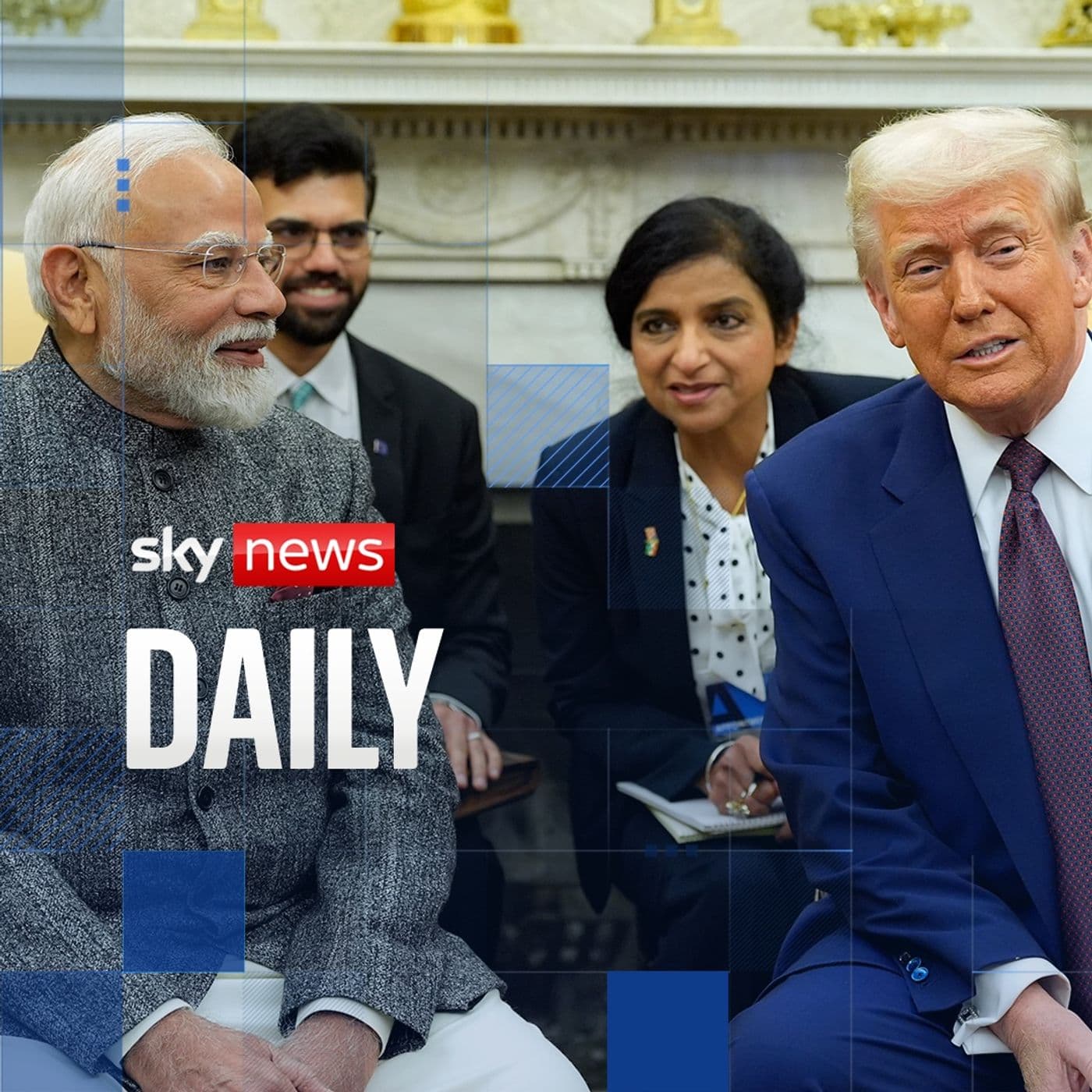

In short
The episode argues that Western sanctions on Russia haven’t stopped its war financing; instead, Russia rerouted oil sales to India and China. It focuses on Donald Trump’s proposal to pressure India with an additional 25% tariff on Indian goods to stop India buying/processing Russian oil, and contrasts this with Biden-era policy.
Guest backgrounds
Ed Conway, Sky News economics and data editor, analyzes sanctions, energy trade flows, and tariff effects.
Key claims
Sanctions are tightening under Trump, not easing. Russia still sells energy (and some fertilizer) to fund its war; Europe remains dependent on Russian gas/LNG. India is surprised by harsh U.S. treatment and prefers business with Russia over G7-aligned sanctions. Tariffs may be undermined by transshipping and stockpiling.
Notable examples
Russian oil “laundering” via Indian refineries returning diesel/kerosene to Europe; Nord Stream/pipeline disruptions; Rolls-Royce/Porsche/Bentley routes via Georgia/Azerbaijan; Russia buying in rubles instead of dollars.
Written by AI. May contain mistakes. Listen to the episode to check what was said.
Chapters
Tap a time to open that second in VOOverview of Trump's Strategy on India
0:45 to 1:11
Discussion on Trump's approaches to India's economy and Russian oil.
“But on my podcast, Stuff Matters, I will uncover the deeper stories behind each of them.”
Sanctions and Oil Trade Dynamics
1:11 to 2:00
Examination of the effectiveness of sanctions against Russia and oil trade shifts.
“Russia is still selling huge quantities of crude oil, except it's now mostly going to India and China instead of Europe.”
The U.S. Sanctions Regime Under Trump
2:00 to 3:19
Insights into how Trump's sanctions on Russia compare to Biden's policies.
“And Ed, you've been taking a closer look at all of this.”
Europe's Energy Dependency and Economic Implications
3:19 to 5:25
Analysis of Europe's reliance on Russian energy and its economic consequences.
“which is more complex than people might have thought.”
India's Position on Russia
5:25 to 6:39
India's strategic business relationship with Russia despite global sanctions.
“When we come to this winter, okay, if you're in continental Europe, heating your home, you will partly be doing that on Russian gas because it's Russian LNG coming in to help top up the system.”
Trump's Tariffs and Their Potential Impact
6:39 to 9:25
Exploration of Trump's tariff threats on Indian goods and their repercussions.
“I think India have been taken aback, they're definitely taken aback by the way that America has reacted to this.”
Global Economic Shifts and Future Implications
9:25 to 12:05
Discussion on the potential decline of U.S. financial dominance and global shifts.
“And so I think, I imagine they will be kind of thinking of ways they can kind of play that better.”
Transcript
Automatic transcript. May contain errors.0:00Hello, Ed Conway here. Here is what might sound like a slightly random question. What do AirPods, bananas and a pair of shoddily made running trainers from the 1970s have in common? On the surface, not very much. But on my podcast, Stuff Matters, I will uncover the deeper stories behind each of them. You will see how together they tell a fascinating new story about the world we live in. The first full series of Stuff Matters is out now. Just search for it on your podcast app and follow. On this episode of the Sky News Daily with me, Gareth Barlow, it's Donald Trump targeting India's economy in order to stop the war in Ukraine.
0:38Hello, Ed Conway here. Here's what might sound like a slightly random question. What do AirPods, bananas and a pair of shoddily made running trainers from the 1970s have in common? On the surface, not very much. But on my podcast, Stuff Matters, I will uncover the deeper stories behind each of them. You will see how together they tell a fascinating new story about the world we live in. The first full series of Stuff Matters is out now. Just search for it on your podcast app and follow. Western Allies have made a big show of sanctioning Russia following the invasion of Ukraine three years ago. But this simply hasn't worked.
1:18Russia is still selling huge quantities of crude oil, except it's now mostly going to India and China instead of Europe. However, is all of that about to change?
1:27Gareth Barlo:Well, I understand India no longer is going to be buying oil from Russia. That's what I heard. I don't know if that's right or not, but that's a good step. We'll see what happens, OK? That's Donald Trump, of course, hopeful the thread of an additional 25 % tariff on Indian goods is enough to persuade the Prime Minister Modi to turn off the tap on cheap Russian oil. And in fact, despite the warm words and strong handshakes at their Alaskan summit, is the Trump White House prepared to hit Vladimir Putin in the pocket far harder than his predecessor, Joe Biden. Now, it's always a pleasure to welcome our economics and data editor, Ed Conway, to the podcast.
2:05And Ed, you've been taking a closer look at all of this. A lot of people assume right now that under Donald Trump, the White House is far easier on Russia than it was before. And then there's the reality. When you look at the sanctions regime, it is getting tougher now on Russia than it was before. Tougher. You know, a lot of people thought Donald Trump would come in and the sanctions would be over. In fact, he's tightened them. And partly what this comes down to, you know, ultimately, Gareth, it's like, how does Russia finance its war machine? You know, and the answer is it sells lots of stuff and it's mostly energy.
2:37To some extent, it's things like fertilizer, but it's mostly energy. Fertilizer still goes to Europe. So that oil that was previously going to Europe, it's going to other places instead. And it is now, most of that oil is now going to China and it's going to India. Donald Trump has said that he's going to impose either tariffs or sanctions or both on India for taking Russian oil. And that is pretty extraordinary because during the Biden administration, we never had anything like that at all. While everyone's kind of fretting about is, you know, Donald Trump bringing Vladimir Putin in from the cold.
3:09And of course, you know, he is. Obviously, he is. They've met. But at the same time, there's this parallel story happening, which is the U.S. getting tougher on Russia when it comes to the sanctions. which is more complex than people might have thought. Pre the invasion, Europe is like the greedy piglets suckling on just as much Russian energy as it possibly could do. And Russia obliged by building great big pipelines under the sea and over land to just pump Europe full of energy. Europe goes, right, we've got to stop that. The Germans go and build liquefied natural gas import terminals to quickly try and get them off so they could bring in Qatari or American liquefied natural gas.
3:46And it leads Russia to have to do the same, right? It leads Russia to go, well, now we've got all of this energy, we need to sell it. How has it gone about rebuilding its economy and its processes to start, rather than sending fuel west, sending it south and east instead? Where things have changed is that rather than sending the oil to Europe, which it was before, it sends it to India and it sends it to China. Previously, a Russian tanker might come into the UK, they'd go to a refinery, stuff would get refined, we'd have diesel and kerosene for planes and stuff. Now, a tanker goes from Russia, it goes to India, goes to an Indian refinery, the Indian refinery turns it into kerosene, it turns it into diesel, and lo and behold, that diesel and kerosene find its way back to Europe.
4:29So we are still part of the same energy ecosystem. It's just that there is someone in between laundering the oil. For gas, it's still going to Europe. You know, Nord Stream and various other pipelines going through Ukraine have stopped. that's mostly because Russia stopped them because of legal challenges and because of the explosion under Nord Stream it's not because Europe suddenly said oh we don't want it Europe is still sucking in more liquefied natural gas from Russia than any other part of the world no other country in the world comes close to Europe the European economic model is built on cheap Russian gas and if you're going to completely forswear any of that gas well Europe's already de-industrializing you've got chemicals plants shutting down, car plants that are struggling to make ends meet.
5:13This is happening right now in many parts of the UK as nothing compared with what we would see if Europe truly did say we're not taking any Russian gas. So the reality, the real politic here is very different from what you see Ursula von der Leyen talking about. When we come to this winter, okay, if you're in continental Europe, heating your home, you will partly be doing that on Russian gas because it's Russian LNG coming in to help top up the system. It's the reality of what we are going through right now. But I think they're faced with this alternative, which is your economy is just gone if you bring a complete end to it, or at least large parts of it are gone.
5:48What are the Indians saying for their part? Because the accusation at their door, the feet of Modi, is that you are bankrolling by processing, if not also buying for your own consumption, Russian oil. Yeah, but India sees Russia as, if not an ally, then it's not someone that they have any kind of truck with. They're doing business with Russia. And I've had these conversations with Indian ministers for years now. They're not part of the G7. They're not threatened by this. So why would they be imposing sanctions on Russia? You can make all the points about, well, they just invaded Ukraine. Well, it's like, well, there's a European issue there.
6:24There are many other conflicts in the world that you seem to be pretty relaxed about, like stuff that's happening in parts of sub-Saharan Africa. So why should we be behaving any differently to the way that you're behaving in other parts of the world? That's kind of the position. I think India have been taken aback, they're definitely taken aback by the way that America has reacted to this. They didn't expect to have quite such a harsh treatment from Donald Trump. Partly they don't like the fact that India did a deal with Russia that said that we're going to buy this oil off you and we're not going to buy it in dollars, we're going to buy it in rubles or other denominations.
6:59America wants to retain its kind of the dollars dominance of global finance. Modi was definitely surprised. And we'll see how the diplomacy goes because it's Trump. No one knows. Does that weaken the impact of tariffs when it's so unclear as to what they'll be, when they'll be? There was definitely kind of a moment early on where everyone took him quite seriously. And latterly, when they saw just how often he was rolling over some of these deadlines, they were like well actually there's this taco trump always chickens out was was the the abbreviation that people were using quite a lot the acronym um so since since he's shown that he he will sometimes fold people haven't taken it quite so so seriously also there's a kind of question mark over in some cases does it really change the nature of trade so if you're in america you impose tariffs, 50 % tariffs on China because you don't want some widget to come from China.
7:56Well, Chinese companies have been just getting the widget, sending it to a factory in Vietnam and putting a different bit of kind of apparatus around it. And then it gets exported as a Vietnamese export. That's trans shipping. There's been a lot of trans shipping happening since these tariffs have been imposed. There are so many kind of deep unanswered questions about where this leaves us. So you've got economists saying, look, it's going to be crazy inflation in just the same way that economists said that these sanctions are going to kill the Russian economy. They didn't kill the Russian economy because Russia was really good at finding a way around them.
8:30And China, which has spent the last two years watching what's been happening to exports going in and out of Russia, watching the fact that you've got Rolls Royces, Porsches, Bentleys going over the border, not directly into Russia, but via countries like Georgia and Azerbaijan and other places. They've been watching that and thinking, what lessons can we take from that for as and when we have sanctions or indeed tariffs imposed on us? So what will the Indians do with this threat? Will they hope that it's another Trump taco moment, that it will go away, will be reduced? They had felt that, you know, the relationship started quite well with Trump.
9:10It's not gone particularly well subsequently. Everyone seems to have realised that you need to kind of subjugate yourself a little bit. you know, you're there in the court of the king and you need to flatter him. India didn't play that very well. And so I think, I imagine they will be kind of thinking of ways they can kind of play that better. But we've not talked here in this conversation about Trump threatening to put tariffs on Russian oil on China. China's been targeted with a, I was going to swear then, but an awful lot of tariffs, a ton of them, if not more, from the US, but not in this perspective.
9:44Why not? He might do. I think there was a throwaway line that he might impose some extra tariffs on China as well. Theoretically, if India does face these tariffs, they would be facing, I think, slightly more than China. You're in this realm when you get up to kind of like close to 50%. That's just prohibitive levels that mean the trade is just very unlikely to float. Whether it's 55 % or kind of 45%, it doesn't make much difference. These are just so high. We've yet to see the full impact of this so far because partly because stuff has just gone via other countries and partly because there's been a lot of stockpiling happening in the run-up to this.
10:23And the real impact, if the tariffs stay in place, we're probably not going to see the real impact until towards the end of this year in the economic data and maybe a little bit later. And the question is, what does Trump do at that stage? And the answer is, no one knows. And to what degree do you think countries like the US and European nations consider the political opportunity that sanctions provide. Is there an element that, you know, sometimes we're almost gifting some of these more autocratic rulers a little bit of a helping hand in potentially running countries in a way that we wouldn't agree with, but they're being able to blame on the sanctions that are being imposed upon them?
11:03Well, potentially. And then that comes back to a bigger issue of, you know, is this a soft power approach? This might well have turned out to be the moment where America's dominance of the global financial system, where it started to kind of go away. So I mentioned, you know, Russia is buying oil in rubles rather than dollars. There's seismic things going on. You've got countries like China and Russia who see a future where they have enough of a financial and economic ecosystem that they don't have to depend or interact with America at all. And that is seismic. And that might well be the point in history where we're at now, where we look back to 2022.
11:47And that was the point where China and Russia thought, well, it doesn't really matter. We don't really need America. And we can go off and do our own thing. And in India as well. That's the profound thing that I don't think anyone knows where we're heading. But it's a very real possibility with all sorts of consequences. Thanks, Ed. You can watch Ed's full analysis at skynews.com or on the Sky News app. The Daily, of course, is back tomorrow.
12:36You will see how together they tell a fascinating new story about the world we live in. The first full series of Stuff Matters is out now. Just search for it on your podcast app and follow.
From the publisher
So, could Donald Trump's latest tariff threat against those countries put a squeeze on Russia's economic pipeline and help bring an end to the war in Ukraine?
Despite the warm words and strong handshakes at their Alaskan summit, the Trump White House seems prepared to try new ways to hit Vladimir Putin in the pocket.
But has the failure of the western sanction regime to cripple the Russian economy shown India and China that Trump's trade war bark is worse than his bite?
On today's episode, Gareth Barlow speaks to Sky's economics and data editor Ed Conway about how the Russian energy landscape has changed and the potential impact on peace in Ukraine.
Producer: Emily Hulme
Editor: Mike Bovill