
In short
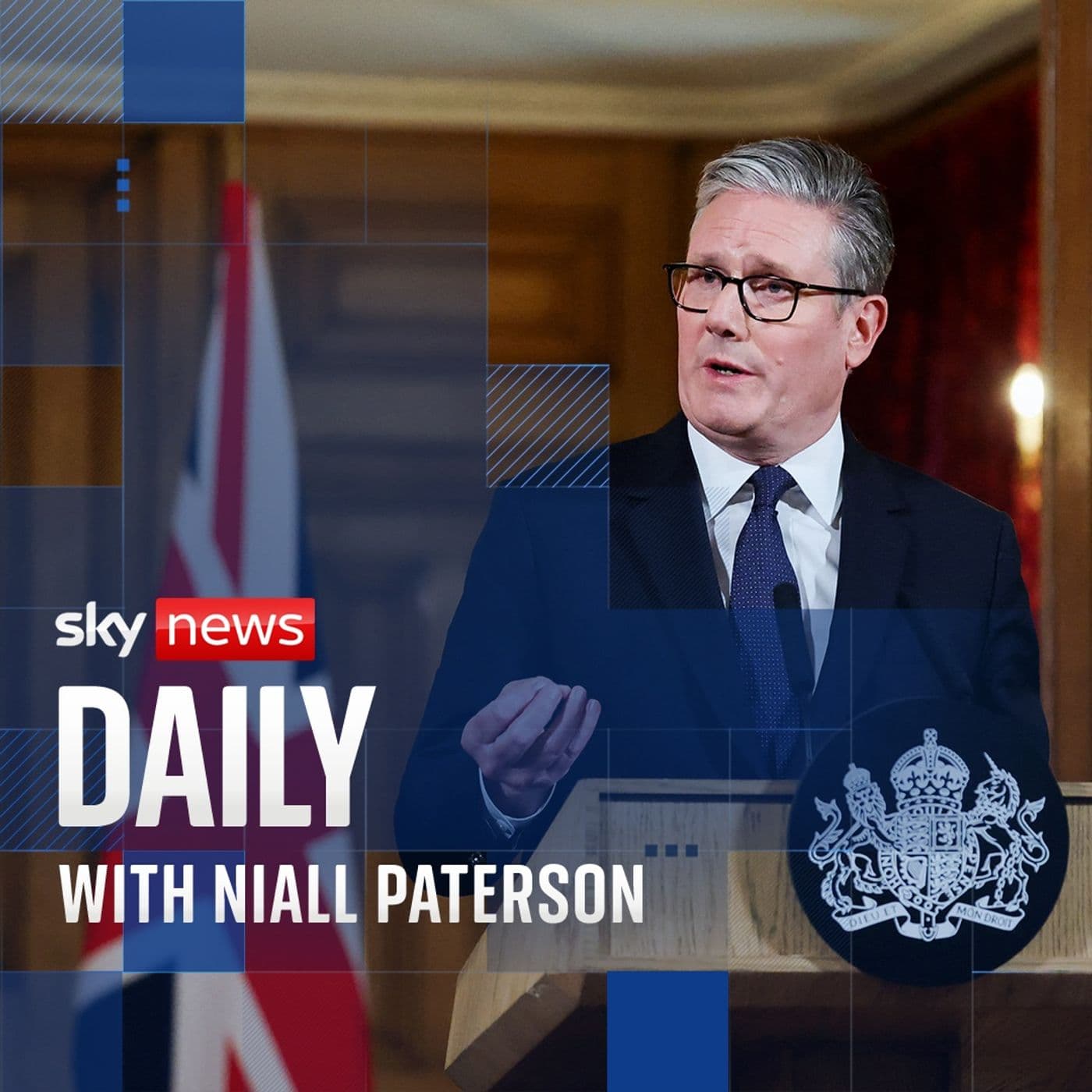
The UK’s formal recognition of a Palestinian state amid the Gaza war, and the political/security implications for a two-state solution, Hamas, Israel, the US, and UK Labour.
Guests and backgrounds
Odeh Bashir, 23, Deir al-Bala resident; argues recognition is too late and calls for stopping genocide. Professor Michael Clarke, Sky security and defence analyst; explains statehood criteria (Montevideo Convention), practical effects, and likely Israeli responses (annexation of West Bank zones). Scarlett Maguire, former Labour special advisor to Harriet Harman, Margaret Hodge, and Sadiq Khan; discusses internal Labour pressures and Starmer’s decision-making.
Key claims
Recognition is meant to preserve the two-state solution and counter Netanyahu/US denial; it may enrage Israel and worsen short-term conditions; Hamas will claim “victory” but Britain/France aim to replace Hamas via UN/Gaza administration planning.
Notable examples
Montevideo Convention (people/territory/government); West Bank “Zone C” (~60%); illegal settlements (~400); Israel elections next year; India recognized Palestine in 1988; UK/France/Canada/Australia/over 150 UN recognitions; Trump portrayed as the only actor who could force ceasefire and hostage release.
Written by AI. May contain mistakes. Listen to the episode to check what was said.
Chapters
Tap a time to open that second in VOUK Recognizes Palestinian State
0:30 to 1:41
Neil Patterson discusses the UK Prime Minister's announcement to recognize Palestine and its implications.
“Coming up on The Daily with me, Neil Patterson.”
Voices from Gaza
1:41 to 2:55
Odeh Bashir shares his perspective on the recognition of Palestine and the urgent need to stop violence in Gaza.
“A pledge to the Palestinian and Israeli people that there can be a better future.”
Understanding Statehood Recognition
2:55 to 5:48
Professor Michael Clarke explains what statehood means for Palestine and the implications of UK recognition.
“So that was the first step towards peace, towards justice and towards dignity for the Palestinian people.”
The Rationale Behind Recognition
5:48 to 7:58
Discussion on the reasons for UK's recognition of Palestine and the shifting political landscape.
“In the PA's case, it's just corrupt and inefficient.”
Domestic Political Reactions
7:58 to 12:20
Scarlett Maguire analyzes the domestic political implications and pressures surrounding the recognition decision.
“Because the fact is over 150 countries now in the United Nations recognize a Palestinian state.”
Labour Party Politics and Palestine
14:00 to 16:28
Explore the complexities of Labour's stance on Palestine and its political implications.
“It has been Labour Party policy for some years.”
The Role of Global Leaders in the Conflict
16:28 to 17:28
Discussion on President Trump's influence over the Israeli-Palestinian conflict and potential resolutions.
“But in the meantime, actually, we have to do the right thing.”
Transcript
Automatic transcript. May contain errors.0:00How does a banana trigger a CIA-backed coup? Do AirPods herald the arrival of a new global order? What do LED lights say about the future of humanity? I'm Ed Conway, and in each episode of my new podcast, Stuff Matters, I take an object, crack it open, and reveal the world-shaping forces hidden inside. This is economics told through the things we think we understand.
0:25Michael Clarke:Search Stuff Matters on your podcast app to listen and follow. Coming up on The Daily with me, Neil Patterson. The Prime Minister announces that the UK will formally recognise the state of Palestine. But why? And what can it possibly do to bring peace to Gaza? How does a banana trigger a CIA-backed coup? Do AirPods herald the arrival of a new global order? What do LED lights say about the future of humanity? I'm Ed Conway, and in each episode of my new podcast, Stuff Matters, I take an object, crack it open and reveal the world-shaping forces hidden inside. This is economics told through the things we think we understand.
1:07Search Stuff Matters on your podcast app to listen and follow.
1:14Michael Clarke:Well, we certainly knew it was coming. Hi everyone, Neil Patterson here with the Sky News Daily and today we return to Gaza. A couple of months back, the Prime Minister announced that by the time of the UN General Assembly, if Israel didn't meet certain conditions, including a ceasefire, the UK would formally recognise the state of Palestine. And with no peace in Gaza and the General Assembly taking place this week, on Sunday, he carried through on that promise. Today, we join over 150 countries who recognise a Palestinian state also. A pledge to the Palestinian and Israeli people that there can be a better future.
1:58Michael Clarke:And yes, the UK isn't alone in doing this. Frankly, plenty have done so well before now. But the United States remains unconvinced. This just isn't something Donald Trump supports. Neither does Israel's Prime Minister, Benjamin Netanyahu. He's called it an absurd prize for terrorism. And funnily enough, prescribed terrorist Hamas are over the moon. There are now plenty of questions about what this recognition will achieve in terms of a two-state solution, the freeing of the hostages and an imminent end to the conflict. There are also questions as to the extent to which Sikir Starmer was inspired, or perhaps even pushed, to make this decision by the left wing of his party.
2:36Michael Clarke:I'll be talking to one former Labour advisor in a little while. Professor Michael Clarke, Sky's security and defence analyst, will be here in a moment to talk us through the practicalities of recognising Palestinian statehood. First though, let's hear from Odeh Bashir, a 23-year-old man who lives in the city of Deir al-Bala. It was about righting the wrongs of the UK government in the past after the bell for declaration. So that was the first step towards peace, towards justice and towards dignity for the Palestinian people. But I thought to myself, what took them too long? It was 700 days after the genocide started in Gaza.
3:22What we need now is not a recognition. What we need now is to stop the genocide, is to stop the killing of the Palestinian people in Gaza.
3:32Michael Clarke:Professor Michael Clarke, our defence analyst, is back on the daily. Michael, look, what does statehood actually mean? What does the UK recognising the state of Palestine practically do? Well, recognition is a matter of degree. So if all states in the world recognise you as a state, then you're clearly a state. If only half the states in the world recognise you, then to that degree you're not legitimate. In terms of statehood, the Montevideo Convention famously said that you've got to have three things. First, what is the Montevideo Convention? Is it just an agreement between nations? Yeah, it's a convention.
4:05It's not a treaty. So it's an agreement between nations. It goes back a long way now. and it says pretty clearly that you have to have a people who self-identify as a people. You've got to have territory and you've got to have a government. And the argument is, well, the Palestinians have got all those things. They've got Palestinians, 10 million of them, 7 million in the area we're talking about. They have territory. There's some dispute about how big their territory should be in relation to Israel, but everyone accepts they have territory and territorial rights and they have a government. It's a pretty poor government.
4:34It's split between Gaza and the West Bank. The Palestinian Authority is not well respected, but it is government. So they have people, they have territory, they have government. Therefore, they have the requirements of a state if countries choose to recognise it.
4:47Michael Clarke:In Britain recognising the state of Palestine, are we accepting that the West Bank is part of Palestine? That's right. You'd say the West Bank is occupied by the Israelis. The Israeli settlements on the West Bank are all illegal in international law. There's about 400 of them between the West Bank and the Golan Heights, which is also Syrian territory. So the Israelis shouldn't be there at all. There's three quarters of a million Israelis living in international law terms illegally in those places and have been since 1967. The West Bank would be a very important part of a Palestinian state. But not a war one.
5:22Michael Clarke:Indeed. But then again, on the point of there being a government there, you have the Palestinian Authority, which to me doesn't look desperately democratic, given that the president has been there for the best part of 20 years. And in Gaza itself, you have a government in the form of a terrorist organization, Hamas. I mean, does that truly qualify as a government? I mean, in both cases, the Palestinian Authority that was established really after the Oslo process in the 1990s has not covered itself in credibility. I mean, it's a one party rule. They don't have elections. It's in Hamas's case, it's terrorist.
5:56In the PA's case, it's just corrupt and inefficient. One of the things that Britain is involved in at the United Nations at the moment is trying to come up with a new version of an administration for Gaza that would have nothing to do with Hamas and would be a new version of the Palestinian Authority. So what they say is the idea behind recognising Palestine as a state is partly helping out in creating an alternative for Gaza, which the Israelis have failed to do.
6:24Michael Clarke:If we accept that it meets the criteria for statehood, why now? What is the rationale for the British government making this recognition public at this point? It's because the two-state solution has been the only basis that anyone can think of that holds the prospect of peace in this particular dispute, which goes back to the 1930s. Nobody thinks the two-state solution is going to work immediately, and we're further away from it now than we've ever been. And the 7th of October attacks put this two-state solution further away. But against that, we also have to say that Benjamin Netanyahu has spent the last 20 years, almost all of them in government, denying that there could ever be a two-state solution.
7:06And that's what the Israeli government now say. The two-state solution is gone. It's dead.
7:09Michael Clarke:So, in essence, this is a bulwark against those, Netanyahu included, who say there is no such thing as Palestine. There is no such thing as Palestinians. Our recognition provides a counterpoint to that. Yeah, that's exactly it. And so the rest of the world or parts of the rest of the world are saying, no, there is a Palestinian state. We still believe in it. It is the only route to a peaceful solution, even though it's further away now than ever. But nobody's got any better ideas. And this really this declaration, they know it's not going to have any effect on the Netanyahu government other than to enrage them.
7:40But it's really playing to Israeli public opinion. There are there are elections in Israel next year. Nobody thinks that there can be any progress towards a peace with Netanyahu's government in place. So they're hoping for a change. You can't engineer it, but they're hoping for a change of government. And this, in a way, is is playing to the Israeli public to say, look, you are becoming an absolute international pariah. Because the fact is over 150 countries now in the United Nations recognize a Palestinian state. And now some of the big ones are doing it. So now Britain and France and Canada and Australia, some of the influential voices, Commonwealth voices, the Commonwealth is lining up on this.
8:15India recognized a Palestinian state back in 1988.
8:18Michael Clarke:But the conditions then were somewhat different to the ones that were in. Now, isn't some of that rage justified, given that this is an unconditional recognition of the state of Palestine? I mean, Hamas will claim this as a victory, and you can't do anything about that. They'll say whatever they're going to say. Well, they've said quite a lot, that, you know, proof that their weapons are a symbol of Palestinian honour, proof of the justice of their cause, vindication, literal vindication of the barbarity that we saw on October 7th. I mean, that's what they would claim. Against that, the British and the French governments are saying, yes, but look, we're working hard at the United Nations to replace Hamas, to make it clear that whatever comes next in Gaza must have nothing to do with Hamas.
8:59And, you know, Keir Starmer was very keen to make that point in the joint press conference with President Trump. That may not convince many people. That's their line to say, you know, this is not a victory for Hamas. We are replacing Hamas. We're working to do that. But this is a warning to Israel that you cannot keep throwing out the two-state solution because ultimately that's where we've got to end up.
9:18Michael Clarke:But what is likely to be, though, the immediate and medium-term reaction from the Israelis? I mean, we've had a relatively new foreign secretary, Yvette Cooper, saying that Israel cannot use this as a pretext for further expansion in the West Bank. They'll expand into the West Bank whether this declaration is made or not. What it may do is that the Israelis may then start to declare annexation of some parts of the West Bank. They won't declare all of it. But there are three zones, an A being a C zone. And in the A zone, the Palestinian Authority has complete control. In the B zone, it's shared with Israel.
9:52And in the C zone, zone C, Israel has total authority. And the C zone is about 60 % of the West Bank. So one view is, well, let's just annex the C zone. We control it anyway. We just declare that it's Israel now. The Netanyahu government may do that, or they might annex smaller areas along the border on the Jordan River or parts of East Jerusalem. They may do that, and they'll say that we've been pushed to it by this diplomatic betrayal on the part of Britain and France and Canada and Australia and so on. Against that is the argument that they're moving towards that anyway, and we've got to try to keep the two-state solution as a viable alternative, not for now, but for the future.
10:33But does it necessarily bring us any closer to peace? I mean, nobody pretends this is going to make any difference to what's going on on the ground this year and next year and probably the year after. But this is playing to the longer term and playing to the, as it were, the political orientation of all of this.
10:48Michael Clarke:There is consensus that this is the right thing to do, but being the right thing to do is not necessarily always the tipping point for actually doing something. This has real-world consequences. You're right. Hamas will make a lot out of this, And it's entirely plausible to argue the short-term effect of this will make things worse before they make them better. But to give up on the idea that the Palestinians deserve a state is to give up on the idea of any sort of peaceful settlement for the future. It is possible, isn't it, that all this could come back to bite Keir Starmer on the bum? It's a divisive declaration because, I mean, it's unique in the sense that it divides us from Israel and from the United States.
11:28And for Britain to take that position is very singular. And you wouldn't have expected that before the 7th of October. You wouldn't have predicted that three or four years ago on almost any issue. So there we are. We're standing against the US policy, against Israeli policy on a very important issue. It divides opinion in Britain. Conservatives are saying it's just caving into Hamas. They're taking the same view as the Americans. So it's divisive internally in British politics. It's divisive in the Labour Party. and, of course, a lot of the timing of this and a lot of the move towards this is a move to placate that side of the Labour Party.
12:03So there's a big domestic element in this as well. It's a pretty big moment for Keir Starmer because he's taking a stand and he may well believe it. He may well think that this is just the right thing to do for the future and I want to be identified on the right side of the argument. But he will take some hits for it, for sure, politically and domestically. And Britain will take some hits for it in terms of our relationship with the United States. Thanks, Michael.
12:26Michael Clarke:So let's pick up on those domestic politics of the PM's decision. Scarlett Maguire was a special advisor to a number of senior Labour politicians, including Harriet Harman, Margaret Hodge and Sadiq Khan. When we had Sir Keir Starmer announcing two months ago now his intention to recognise Palestinian statehood, to what extent do you think that was as a result of pressure coming from some within his party? Certainly, there was a lot of pressure. I mean, remember, the British people also, even then, were feeling that what was going on in Gaza had to be stopped. There's also the fact that actually, we want a two-state solution.
13:06A two-state solution is the only answer. And only by recognising Palestine does it look as though we could get there. What he did two months ago was he said to Netanyahu, I will not do it if you acknowledge a two-state solution, you have a ceasefire, you let aid in. And Netanyahu's response was, no, none of these. And so we are where we are now.
13:33Michael Clarke:But it doesn't look good, does it, when you appear to have been bumped into a major decision of this nature by members of your backbench, even members of your own cabinet? I think the Labour Party makes decisions as a collective. I think it's very good that there are proper discussions in cabinet. There is absolutely no question that Keir Starmer A, does believe in a two-state solution. He also believes in recognising Palestine. It has been Labour Party policy for some years. If we view the decision-making process through that prism then just for a second, there were those who were angry that the British government, in their view, was not doing enough.
14:12Michael Clarke:Is this, in your mind, enough to appease them, to assuage their concerns that Britain, the British government remains still too close to that of Israel? Of course. I mean, this was never, ever going to appease everybody, right? This was much, much more than saying, I'm going to stop a rebellion on my backbench. It really wasn't about that. It was about how do we get to where we get to and actually keep the mass of members of the Labour Party, members of the Parliamentary Labour Party, and frankly, the British people, saying, we are trying to do something and we will go on trying to do something.
14:54And this is a first step.
14:55Michael Clarke:But this isn't going to be the end of it, is it? I mean, if the calls for, you know, an end to the sale of arms to Israel weren't loud enough from within the Labour movement, I mean, there's going to be a cacophony now, surely. We are talking baby steps. We're talking what can we do and how can we be effective. Well, one is that we have to work internationally. So there is Canada, Australia, France and Portugal this time all with us. And the other thing is working with the other Arab states because Israel needs its neighbours. And actually the Gulf states, the Arab states are absolutely with us, we have to do something.
15:38I mean, there's a moral purpose as well as a political purpose.
15:42Michael Clarke:Oh, totally. And when we are talking about famine, when we are talking about tens of thousands of deaths, when we're talking, the United Nations is talking about genocide taking place in Gaza, discussing internal Labour Party politics might feel just a touch de tro. That said, you know, politics has to be practical. And, you know, there are knives out for Keir Starmer right now. I mean, you're absolutely right. But I don't think that he thinks that Palestine is going to save him. This isn't just about politics. It really is more than politics. I mean, if you want an example, in The Guardian today, there is an article saying this isn't enough.
16:21I mean, you know, nothing will ever be enough on Gaza for the people who want to get rid of Kiyah. That's what they can do. But in the meantime, actually, we have to do the right thing.
16:34Michael Clarke:Is this a vote winner or a vote loser in net terms, do you think? So first of all, in polling terms, there is a feeling of revulsion about what's going on in Gaza throughout Britain. But actually, most people feel that what's going on in Gaza is unacceptable and it cannot be allowed to go on. I'm wondering, your personal view, what is likely to come next? Are we edging closer to a solution, be it a two-state solution or anything else? Or are we actually moving further away from it? Well, at the moment, there's only one person who can solve this problem, and it's President Trump. If President Trump moves against Netanyahu, then anything can happen, right?
17:19But at the moment, he's chosen not to. He made that quite clear last week. He is allowing a bloodbath, and he is allowing the aid not to get through, the food not to get through. I don't know what's going to happen because I don't know how he can be persuaded. He's got to persuade Netanyahu to go for a ceasefire, to go for a resolution that includes, very, very importantly, all the hostages being released. At the moment, President Trump is the only man who can do this. And all Britain, France, Canada, Australia, and the 140 others are saying, the world feels this way. please can you join us
18:02Michael Clarke:Thanks to Scarlett, to Michael and of course to you for listening Do give the podcast a follow if you like what you've heard The Daily's back tomorrow
18:11How does a banana trigger a CIA-backed coup? Do AirPods herald the arrival of a new global order? What do LED lights say about the future of humanity? I'm Ed Conway and in each episode of my new podcast Stuff Matters I take an object, crack it open and reveal the world-shaping forces hidden inside. This is economics told through the things we think we understand. Search Stuff Matters on your podcast app to listen and follow.
From the publisher
The UK prime minister made the decision after months of pressure from dozens of his own MPs – but will it be enough to appease those in Labour who want to go even further? What does he hope the move will achieve and could it lead to the UK banning arms sales to Israel?
Niall is joined by Sky's security and defence analyst Michael Clarke and former Labour adviser Scarlett MccGwire.
Producer: Emily Hulme and Tom Gillespie
Editor: Mike Bovill