
In short
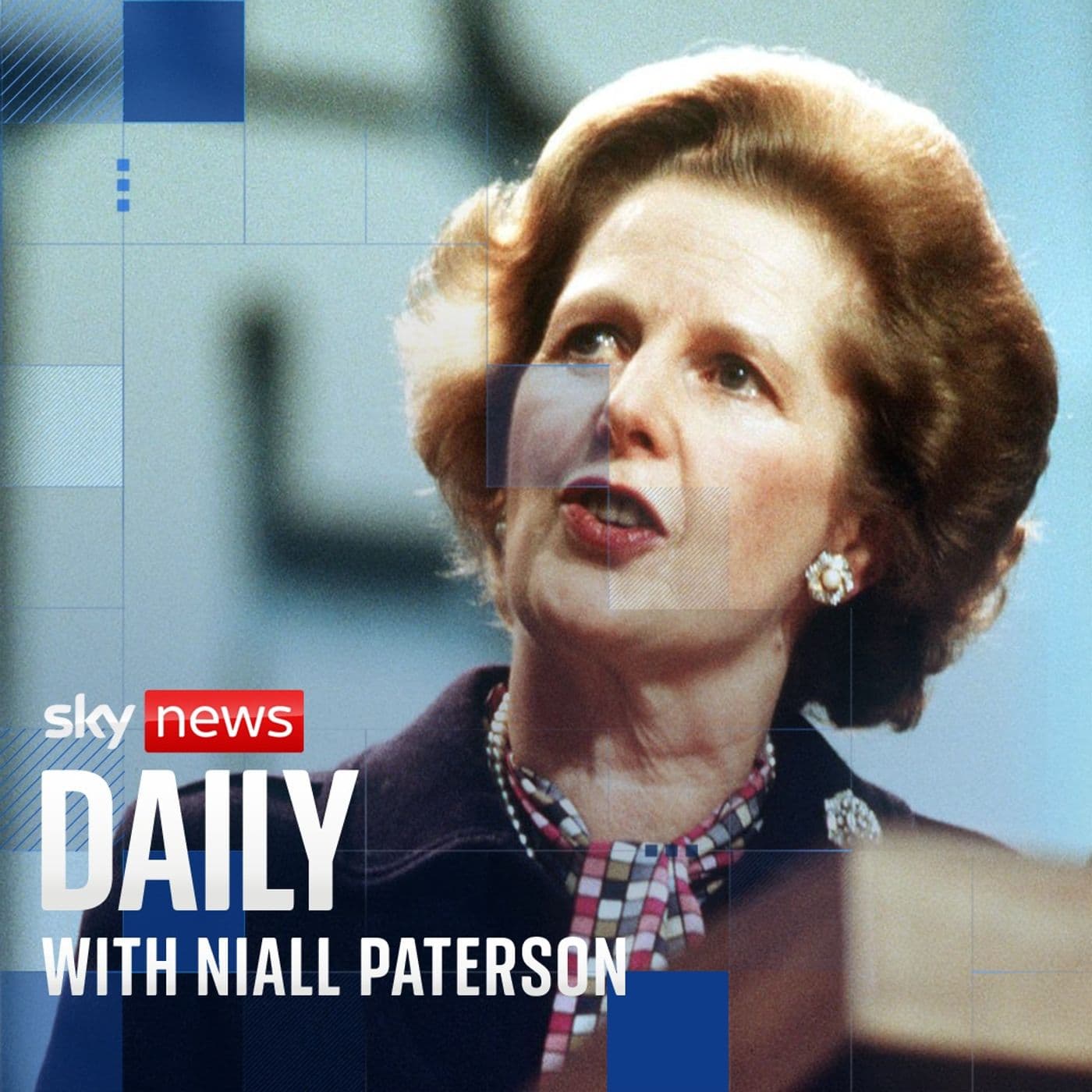
The episode (Sky News Daily) marks Margaret Thatcher’s 100th birthday and asks why her political legacy still shapes Britain.
Guest
John Craig, Sky News chief political correspondent and “walking political encyclopedia.” Background: he recounts Thatcher’s rise from Grantham (born 13 Oct 1925 above her father Alf Roberts’s corner shop), her education (chemistry and law), and her MP career (Finchley from 1959; previously stood in Dartford).
Key claims
Thatcher was an “outsider” who beat Willie Whitelaw to lead in Feb 1975; her “tame the unions” pledge and 1980 “U-turn if you want…” speech; the Falklands War and Reagan alliance aided Cold War outcomes; she supported the European single market while opposing federal Europe; she waited to fight the miners, defeating Arthur Scargill.
Notable examples
milk “snatcher” (ending free school milk), 1981 cabinet reshuffle, 1983 election majority 144, 1984 Brighton IRA bombing, council house sales, major privatisations (e.g., Thames Water, British Airways), and her 1990 leadership loss to John Major. Guests’ view: she’s revered by Conservatives but loathed by many on the left for community destruction and harsh union/industry impacts.
Written by AI. May contain mistakes. Listen to the episode to check what was said.
Chapters
Tap a time to open that second in VOMargaret Thatcher: A Political Icon
0:30 to 1:02
Exploration of Margaret Thatcher's significance in British politics.
“A hundred years on from her birth, the Iron Lady continues to cast a long shadow over British politics.”
Early Life and Political Rise
1:02 to 2:20
Discussion on Thatcher's upbringing and her rise to Prime Minister.
“This is economics told through the things we think we understand.”
Leadership and Challenges
2:20 to 4:10
Analysis of Thatcher's leadership style and the challenges she faced.
“and walking political encyclopedia, John Craig.”
Achievements and Controversies
4:10 to 6:04
Review of Thatcher's major achievements and the controversies surrounding her.
“But she beat Willie Whitelaw, became leader February 1975.”
Thatcher's International Influence
6:04 to 7:58
Insights into Thatcher's role on the global stage during the Cold War.
“Now, in 1981, she had a big reshuffle when she kicked out a lot of the old Tory toffs and brought in the likes of Norman Tebbett and Nigel Lawson into her cabinet.”
Europe and the Single Market
7:58 to 9:45
Discussion about Thatcher's views and influence on Europe and the single market.
“I mean, she got on well with people like Mitterrand, Helmut Kohl, the German Chancellor, and she had her European allies.”
Crisis and Resilience
9:45 to 12:07
Examination of Thatcher's response to crises, including the Brighton bomb.
“Now, her son, Mark Thatcher, gave an interview in the past week or so to commemorate her 100th anniversary, suggesting she would have backed Brexit.”
Legacy and Ongoing Influence
12:07 to 14:00
Reflection on Thatcher's legacy and how it shapes current politics.
“but there were Margaret Tebbit, Norman Tebbit's wife, was left paralysed for the rest of her life.”
Legacy of Margaret Thatcher
14:00 to 17:29
Explore the complex legacy of Margaret Thatcher and her impact on politics today.
“Really, if you're talking about a Prime Minister with a big legacy, I think the two that really stand out are Attlee and Thatcher in her different ways.”
Thatcher's Ongoing Influence
17:30 to 18:15
Discuss how Margaret Thatcher continues to influence politics a century after her birth.
“a controversial leader, as we've said, who divided opinion.”
Transcript
Automatic transcript. May contain errors.0:00How does a banana trigger a CIA-backed coup? Do AirPods herald the arrival of a new global order? What do LED lights say about the future of humanity? I'm Ed Conway, and in each episode of my new podcast, Stuff Matters, I take an object, crack it open, and reveal the world-shaping forces hidden inside. This is economics told through the things we think we understand. Search Stuff Matters on your podcast app to listen and follow. Coming up on the Sky News Daily. A hundred years on from her birth, the Iron Lady continues to cast a long shadow over British politics. So, who was Margaret Thatcher and what is her legacy?
1:01the world-shaping forces hidden inside. This is economics told through the things we think we understand. Search Stuff Matters on your podcast app to listen and follow. We shall not be diverted from our course. To those waiting with bated breath for that favourite media catchphrase, the U-turn, I have only one thing to say. U-turn if you want to.
1:35The ladies not for turning. To say she divides opinion would be to put it mildly. Hi everyone, welcome back to The Daily, where we're doing another of our weekend deep dives into a person who's been in the news, and this week would have seen the 100th birthday of Margaret Thatcher, Conservative Prime Minister, from 1979 to 1990. Now, that no doubt feels like the dim and distant past to many of you, but her influence is still very much felt in politics today. Whether it's for her achievements, her role in ending the Cold War, for example, or the lowlights of her career, the miners' strike and poll tax spring to mind.
2:15Margaret Thatcher is remembered as a politician of significance and impact. So, who better to discuss her legacy with than our chief political correspondent and walking political encyclopedia, John Craig. It began in Grantham in Lincolnshire. Her father was Alderman Roberts, Alf Roberts. He ran a corner shop and she was born above the shop. It was the 13th of October, 1925. And of course, she talked a lot about Grantham over the years, for example, in her autobiography. She said, I'd grown up in a household that was neither poor nor rich. We had to economise each day in order to enjoy the occasional luxury.
2:56And then she said,
3:09Let's just continue with the rewind button. How did she become Prime Minister? I mean, a female Prime Minister at a time when female world leaders weren't exactly thick on the ground. She succeeded Ted Heath. She became MP for Finchley up in North London, 1959. She was a frontbencher under Heath. In the Heath government, she was education secretary. You may remember there was a slogan, Thatcher the milk snatcher. She stopped free school milk. Now, after Heath lost twice to general election in 1974, some of the grandees stood, and it came down to a battle between Margaret Thatcher and Willie Whitelaw.
3:49Now, Willie Whitelaw was very much the establishment candidate. She was seen as the outsider. At the Tory conference last week, parallels were drawn between the circumstances between when Mrs Thatcher became leader and Kemi Badenowt coming after a heavy defeat. And, of course, there were plenty of Tories who said, well, Margaret Thatcher struggled in the early years, just like Kemi is now. But she beat Willie Whitelaw, became leader February 1975. That was when Harold Wilson was prime minister. He quit in 76. Jim Callaghan became prime minister. I heard a speech by the current chairman of the 1922 committee, that is Bob Blackman.
4:28He said that in the 70s, Margaret Thatcher was patronised not just by Labour prime ministers, Wilson and Callaghan, but by the Tory establishment. They were terrible snobs, the Tories in those days. Some people might say they still are, but they're not really. Nothing compared with the 1970s. So she was the outsider. She'd been to a grammar school. She'd gone to university, done chemistry and then law. And as I say, was elected to Parliament in 1959. She actually stood in Dartford twice in 1950 and 51. And you know how she met Dennis Thatcher? Dennis gave her a lift back to London in his Jag. And you know another parallel with Kemi Bader-Noch?
5:10That's how Kemi Bader-Noch met Hamish, her husband, because Hamish gave Kemi a lift back home in his car when she was the candidate against Tessa Jowell in Dulwich and West Norwood. So there are a few comparisons between Thatcher and Kemi, but not convinced that she's another Thatcher. I mean, Margaret Thatcher was seen in a way that Kemi Baden-Ock is not as a strong and powerful leader. I mean, she became known as the Iron Lady and she's still thought of in those terms by many within the party. The Iron Lady was a term that the Russians gave her. So she became leader in 75, won an election in 1979.
5:50One of her great pledges, of course, was to tame the unions. And that was one of her great achievements, her supporters would say. But she struggled in that early period as prime minister to 79 to 81. And she made a famous speech at the Tory conference 1980. You turn if you want to. The lady's not for turning. Now, in 1981, she had a big reshuffle when she kicked out a lot of the old Tory toffs and brought in the likes of Norman Tebbett and Nigel Lawson into her cabinet. That was a cabinet really in her own making. And then, of course, the Falklands War changed everything in 1982. That was the year I became a political correspondent.
6:31And the Falklands War began in about Easter time. The Commons sat on Easter Saturday, went on till June. And of course, then she went on to win a massive majority in the 83 election, majority of 144, which at the time was seen as huge. Of course, Tony Blair and now Sir Keir Starmer have got bigger majorities than that. But yes, the Iron Lady, she was tough. She had a great ally in Ronald Reagan. And she and Reagan, of course, are credited with playing a key role in the collapse of the old Soviet Union, coming at the end of the Cold War, the bringing down of the Iron Curtain. So she had her fans, particularly in Eastern Europe.
7:11The Americans absolutely loved her. Her relationship with Ronald Reagan was brilliant. That made her a major figure on the international stage. She was a strong leader at home, but she was a big figure on the world stage, too. She absolutely strode like a colossus, if you like, at things like European summits. Remember those? There's a famous quote, which I absolutely love. François Mitterrand, the socialist French president, said she had the, let me get this right, the smile of Marilyn Rowe and the eyes of Caligula. Well, let's talk about Europe just for a second then, John. The Conservatives, over the course of my career covering politics, have always had a complicated relationship with Europe, the EC, and then the European Union.
7:56I mean, how much of that was down to Thatcher? Well, it was pretty, it was much more cordial back then. I mean, she got on well with people like Mitterrand, Helmut Kohl, the German Chancellor, and she had her European allies. It all really fell apart after she left at Downing Street in 1990. I went to a fringe meeting at the Tory conference where Michael Heseltine was speaking. It was the European movement. Nobody's more pro-European than Michael Heseltine in the Tory party, with the possible exception of Kenneth Clark. But Michael Heseltine said that Margaret Thatcher's greatest achievement was to help create the European single market.
8:35And he also went on to talk about how she was more practical than doctrinal, both abroad and in the UK. You talk to people who served with her in the 80s, leading the run up to that miners strike in 84, 85. She waited. She didn't get into a battle with Arthur Scargill and the miners in the previous years, or Joe Gormley, Scargill's predecessor. She waited till the coal stocks were high, and she fought a canny battle, you could argue, with the miners and overcome Arthur Scargill. I mean, she called them the enemy within. But in terms of Europe as well, she had her successes. I mean, she did clash, famously, with a commission president called Jack Delore.
9:17The Sun ran a famous headline, Up Yours De Law. Also, towards the end of her time in Downing, I remember there was a big clash at a European summit, and towards the end, I remember a statement in the Commons when she said, no, no, no, in terms of something that the Europeans were planning. She was very much against European integration, a federal Europe, but she was big, as Michael Hestine said, big supporter of the single market. And there's been a lot of conjecture. Would she have supported Brexit? Now, her son, Mark Thatcher, gave an interview in the past week or so to commemorate her 100th anniversary, suggesting she would have backed Brexit.
9:58I'm not convinced she would have been a Brexiteer. And I certainly don't think she would have backed reform. I interviewed Mark Thatcher at the Thatcher dinner. He was he was being complimentary about Nigel Farage in our interview. But he but I would have thought knowing Margaret Thatcher, bear in mind she was the son of a Methodist lay preacher. And she was OK. She she she liked she she used to flirt with men and so on, like people like Cecil Parkinson. There's been a suggestion in the last few days that she might have had an affair with her chief whip, Humphrey Atkins. No idea. Well, that's true.
10:34Not convinced. But she flirty loved Cecil. I think Margaret Thatcher would have regarded Nigel Farage as a rather vulgar character. So one of the most successful prime ministers of modern times, but inevitably it couldn't last forever, could it? It all started to go a bit wrong for her late 1980s when some of, for example, there was Geoffrey Howe's resignation. Michael Heseltine, of course, had quit in 86. And of course, there was the challenge to Margaret Thatcher. There was a stalking horse called Sir Anthony Mayer, who was an MP for Cluid in North Wales, an obscure backbencher. He was even called the stalking donkey by some MPs.
11:14In 1990, Heseltine stood and there was a leadership contest. And, of course, John Major succeeded and not Michael Heseltine. Another famous quote. It was said at the time, he who wields the dagger never wears the crown. And that's very true in politics. You speak, though, to members of the Blue Rosette Brigade, and they often say, you know, Margaret Thatcher, she was made of different stuff, and perhaps we saw that during the Falklands, but I think we can say with certainty that we saw that steadfastness when there was, of course, the attack on the Conservative Party conference in Brighton. The Brighton bomb in 1984.
11:53That bomb went off at 10 to 3 on the last night of the conference, the Grand Hotel, the famous Grand Hotel in Brighton. Enormous bomb. It had been planted by IRA weeks before. And it made not only huge damage, but there were Margaret Tebbit, Norman Tebbit's wife, was left paralysed for the rest of her life. Norman Tebbit never forgave the IRA because it changed his life completely. I remember the rescue in the morning was carried on breakfast TV. It was before Sky News in those days. Norman Tebbett was pulled out in his pyjamas and Margaret Thatcher went up to John Cole, who was the veteran political editor of the BBC at the time, lovely man, Northern Irishman, and said, John, the conference goes on, the conference goes on.
12:45And they were back in that hall at 9.30 or whatever it was in the morning. She wasn't going to let the IRA disrupt the Conservative Party conference. and that showed great courage and that was an attempt to kill her and Dennis and half the cabinet. So what else will she be remembered for? I mean, what is her legacy today? I mentioned the miners' strike, also big privatisation of industries, taming the trade unions. A lot of the industries we talk about now, Thames Water, that was privatised by Michael Howard in 1989. British Airways, all these industries were privatised. The other big achievement, her supporters would say, council house sales, enabling lots of people who had been tenants to buy their own homes.
13:31A real great long list of her achievements. But in the end, she became too dogmatic. She fell out with the likes of Geoffrey Howe and some other ministers. And of course, the Tories were worried they were going to lose the 1992 election if she'd stayed on. John Major became prime minister. He won in April 1992, majority of 21. But of course she's still absolutely revered, loved and adored by many Tories, both young and old. Really, if you're talking about a Prime Minister with a big legacy, I think the two that really stand out are Attlee and Thatcher in her different ways. I've lost count over the years that I've been doing this job of the number of Conservative politicians who've tried to style themselves as the heir to Thatcher.
14:16Yes, but there hasn't really been a party leader, has there, that's like Margaret Thatcher. The leaders have been completely different in character. Margaret Thatcher, I guess, really, you'd say was a one-off. She always talked about sound money. I mean, that was one of the reasons, I think, why she would have no truck with Nigel Farage, because he's spraying promises about spending all over the place at the moment, whereas at least Kemi Badenoch is trying to say we're not going to spend money we can't afford. So she's trying to follow the Thatcherite way, but she's no Margaret Thatcher, really.
14:50What do you think Thatcher would make of the Conservatives under Kimmy Badenock? Well, I think she'd be loyal, as some of the old guard like Heseltine are, because they desperately need to be. I mean, what would she say about leaving the European Convention on Human Rights and those sort of policies? Because the Tories are very much divided on that, aren't they? Because they say, well, Winston helped frame those policies. Now, the argument to use, of course, is that they're now out of date. She was a pragmatist. She didn't fight a battle that she thought she couldn't win, whether it was the miners or Argentina, Galtieri and the Falklands.
15:23And she did have some spectacular successes. I mean, I think back, some of the legislation she put through on privatisation, some of that really struggled and she battled through. She was formidable at the dispatch box. But was that the full story, though, John? The stereotype that we have of her as, you know, as ramrod straight, you know, absolutely tough as nails, the Iron Lady, all the rest of it. I mean, you know, there are reports that she was anxious before her meetings with the Queen, for example. We just had the case for the defence, haven't we? Let's have the case for the prosecution.
16:01You go to many northern communities, they still are very bitter about the miners' strike. They claim that, of course, unemployment got very high, I think it got to three million at one point. And, of course, there are plenty of enemies of Margaret Thatcher, particularly on the left in the trade unions, who say that her policies were brutal, that she destroyed many communities, particularly mining communities, steel communities, for example. There was a big strike by the steel workers in the early 80s as well. There are many industries that critics will say she let decline, like shipbuilding is one that declined under her time as prime minister as well.
16:42And of course, there are those also who claim that privatisation has been bad for many of those industries. For example, I mean, look at the water industry now. I mean, you could argue that was an industry that should never have been privatised. So, yes, she had her critics. Plenty of those, particularly on the Labour left and in what you might call working class communities, mining communities and so on. the loathing of Margaret Thatcher is still there. I'm going to say, I'm going to put my neck out here and say, in a hundred years' time, people will still be talking about Margaret Thatcher and her legacy.
17:17Probably, yes. I mean, people still talk about Disraeli and Gladstone and Lloyd George and various other prime ministers, don't they? I mean, I dare say it'll be studied by history students because she was one of the most formidable leaders, a controversial leader, as we've said, who divided opinion. The left loathed her, the right adored her. The Tory conference, images of Thatcher were everywhere. They, I mean, they love her, they adore her. And the number of events, dinners and seminars and talks and so on and exhibitions at the moment shows that people still are fascinated by her a hundred years after she was born.
17:58She's regarded by Tories as a successful prime minister and every Prime Minister, I suppose, or every leader of the party in the years to come will want to be like Margaret Thatcher and achieve some of the electoral success that she did and also shape the future of the country in the way that she did. She transformed the country. My thanks to John and, of course, to you for listening. It's been a busy old week here on The Daily. We've discussed what next for freed Israeli hostages, the gangs fighting for control of Gaza and the 730-plus police officers sacked for misconduct. So if you like what you've heard, why not scroll back and find another episode or just give us a follow.
18:36That way you guarantee that every evening you get all you need to know about one story in the news. The Daily's back on Monday. Till then, take care.
18:52How does a banana trigger a CIA-backed coup? Do AirPods herald the arrival of a new global order? What do LED lights say about the future of humanity? I'm Ed Conway, and in each episode of my new podcast, Stuff Matters, I take an object, crack it open, and reveal the world-shaping forces hidden inside. This is economics told through the things we think we understand. Search Stuff Matters on your podcast app to listen and follow.
From the publisher
Evidence of her enduring influence is the fact that it's not just Tories who claim a debt to her but also opposing politicians, with Rachel Reeves recently branding herself the "iron chancellor".
She was also a very divisive figure, with lasting anger over her handling of the miners' strike and the controversial poll tax.
So, what is Baroness Thatcher's legacy to both her party and the country? What would she have made of Brexit and the rise of Reform UK? Will she still be talked about in another 100 years?
Niall Paterson is joined by Sky's chief political correspondent Jon Craig.
Producers: Tom Gillespie and Soila Apparicio
Editor: Wendy Parker