
 Ask ChatGPT



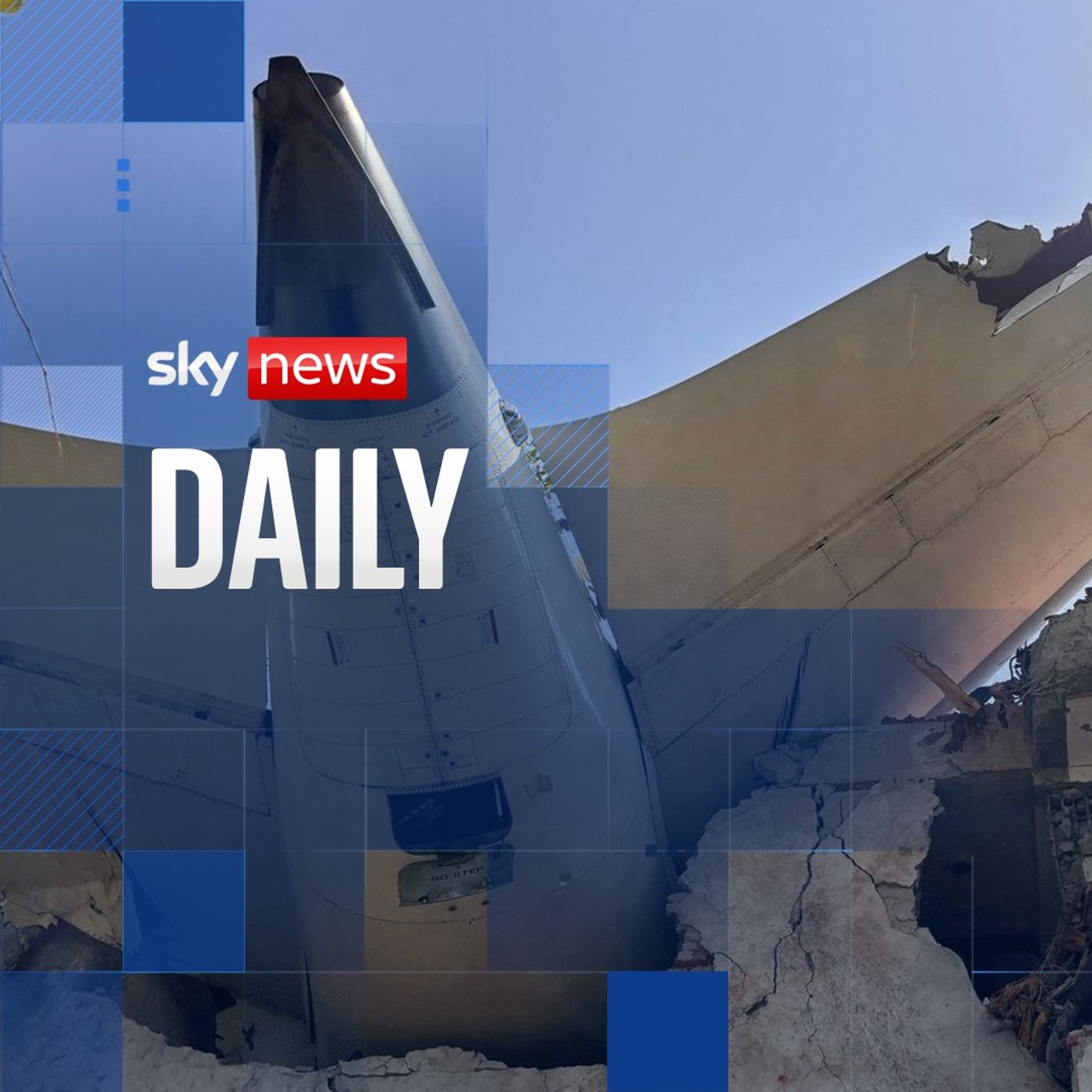
An early report on the crash of Air India flight AI-171, a Boeing 787 Dreamliner that took off from Ahmedabad and crashed seconds after departure near residential buildings; the episode discusses what might have caused it, what investigators will do next, and general flight-safety context.
Ian Petschnik, Communications Director at Flightradar24.
Flightradar24 communications role; provides analysis based on flight data and early observations.
Takeoff roll appeared normal, then the aircraft lost height shortly after; speculation includes possible flap/controls issues, but the flight data recorder (FDR) and cockpit voice recorder are needed to confirm. Air India CEO Campbell Wilson expresses sorrow, says injured passengers were taken to nearby hospitals, and casualties are not yet known.
Similar early-after-takeoff accident categories—mechanical failures (e.g., bird strikes) or pilot-related maneuvers leading to loss of altitude. Investigation timeline: preliminary report in about a month; final report in 1–18 months.
Written by AI. May contain mistakes.
Air India's CEO expresses sorrow and uncertainty regarding the crash.
“The chief executive of Air India, Campbell Wilson, gave this statement in the last few hours.”
Flightradar24's Ian Petschnik discusses the early investigation of the crash.
“So let's speak now to Ian Petschnik, Flightradar24's Communications Director.”
The importance of flight data and cockpit voice recorders in crash investigations.
“So this is purely speculation at the moment.”
Discussion on Ahmedabad Airport's surroundings and the Boeing 787 safety record.
“And anything that needs to be done to that memory module to ensure that the data can be read and then analyzed is performed.”
Exploration of common issues leading to accidents shortly after takeoff.
“But as far as flight safety goes, the aircraft has a near-impeccable safety record.”
Ian Petschnik reassures listeners about the continued safety of flying.
“But more generally, what happens in accidents like this so soon after takeoff?”
Anticipated timeline and processes following the crash investigation.
“Appreciate we're talking just a matter of hours after this happened in its early days in terms of investigations and finding the flight data recorder that you and I were talking about just a few moments ago.”

Get the gist, explore an idea or ask about something said.
 Claude
On This Is Why, what are the key points of this episode?
Searching your listeningAutomatic transcript. May contain errors.
0:00Coming up on the Sky News Daily with me, Matt Barbet, an Air India plane heading to London Gatwick with 242 people on board crashed just seconds after taking off. What could have gone so catastrophically wrong?
0:23Less than a minute after taking off from Ahmedabad Airport in the northwest of India, flight AI-171 sent its final signal. There are pictures of a huge fireball and plumes of black smoke as the plane crashed into residential buildings near the airport. The Boeing 787 Dreamliner was carrying 242 people at the time. 53 of them were British citizens. The chief executive of Air India, Campbell Wilson, gave this statement in the last few hours. And most importantly, I would like to express our deep sorrow about this event. This is a difficult day for all of us at Air India. I know that there are many questions, and at this stage, I will not be able to answer all of them.
1:08The injured passengers have been taken by local authorities to the nearest hospitals. We are actively working with the authorities. As we're recording this, it is just too soon to say how many casualties there may have been. So let's speak now to Ian Petschnik, Flightradar24's Communications Director. Ian, it's great to have you with us. Really appreciate you taking the time. The first question is the most obvious one. Based on what you've seen and heard so far, what do you think might have happened here? It's very, very early in the investigation. It's far too early to speculate on exactly what happened.
1:44But what we know from the data, we know that the aircraft departed, the takeoff roll seems quite normal. And then shortly after takeoff, the aircraft lost height. So with a good amount of speed, the aircraft losing height, then that becomes a question is, why did that particular event take place? And that's what the investigation is going to focus on. People seem to be focusing on something to do with the flaps. They can see from some of the footage that the flaps might have not been in the right position. Can you expand upon that a bit more? Sure. So this is purely speculation at the moment. But one of the things that we're seeing in video from today is that the landing gear stayed down a bit longer than as usual, though that's not uncommon for all sorts of reasons to leave the gear down a little bit longer.
2:32But one of the things that folks have noticed in the video is possibly a flap issue, though the video is of such quality that I'm not willing to go that far into it at the moment. That's why having the flight data recorder and the cockpit voice recorder is going to be key because those parameters are in fact included on the FDR. So it'll be easy to tell one way or the other. The FDR is for those of us. The flight data recorder. So that's the crash protected memory that includes all sorts of parameters, engine parameters, control parameters, including the position of the flaps. Once they find the black box, if you like, the flight data recorder, what happens next?
3:13And who will be analyzing that stuff? Once the boxes are found, the data is extracted from the memory module. And anything that needs to be done to that memory module to ensure that the data can be read and then analyzed is performed. India has an air accident investigation branch that is quite good, and they'll likely be leading the investigation unless they delegate it to another investigation authority, which is possible under the International Civil Aviation Organization rules. But generally, the place of action, and because it's the country of registration of the aircraft, India will likely lead that investigation.
3:54Ahmedabad Airport is where the plane took off from. What do you know about that? Is it surrounded by a dense population? Is it a difficult airport to land and take off from? What do you know? So the airport is at both ends of the runway, does have population buildup. There are neighborhoods roughly at each end of the runway, though the runway itself is fairly long. And the airport itself is not necessarily difficult to depart from. What about the plane itself? What's its safety record like? the Boeing 787's flight safety record is quite good. This is, in fact, the first flight hull loss of the aircraft.
4:39There have been certainly many issues with the 787, dating back to the initial problems with the lithium-ion batteries on board, all the way through some structural issues that Boeing has worked through. But as far as flight safety goes, the aircraft has a near-impeccable safety record. This seems to be a flight issue rather than something that was known before to be a 787 problem. I think that's certainly something that investigators are going to look at. Was there something wrong with the aircraft? Or was this piloting? Was this a combination of multiple factors? In events like this, it usually is multiple factors.
5:23Does there tend to be similarities in terms of safety record between airlines or are there differences? And what is Air India's track record? Sure. There are certainly differences around the world, depending on to which standard airlines are holding themselves and being held and where they're operating. Air India has recently a very good safety record. So this is an airline that has been dramatically improving both its operations, but also the company generally with recent turnarounds. Can we just look back at then sort of similar accidents happening, ones that have happened really soon after takeoff?
6:11What tends to be the issue? And I appreciate we're speculating a little bit, Ian. We're not focusing specifically on what's happened in recent hours. But more generally, what happens in accidents like this so soon after takeoff? Generally, what things fall into are a couple of different categories. One, you have a catched off of a mechanical failure of the aircraft right after takeoff, usually due to some external force. So in the case of bird strikes, for instance, things like that, where you're dealing with the aircraft not being able to gain enough altitude and gain enough speed to operate safely.
6:46Or there are instances where we've seen some pilot issues where the flight crew has performed maneuvers which have led to the loss of height and the crash of the aircraft. Ian, it would be good to get your take more generally on flight safety. Of course, people's attention turns towards that when they hear about something like this happening, which is terrible. and it's hard to maintain the context on just how safe flying is. Is it safer these days than ever before? Have there been blips recently which have made it less safe? Well, yeah, I think it's important to remember that flying is continuing to get safer and safer and safer.
7:31Statistically speaking, it's the safest form of transport and continues to be for many years. There are fewer and fewer major accidents based on the number of flight hours. So more flights and just fewer accidents as a percentage of those aircraft. Certainly this year and stretching into late last year, there have been a number of high profile incidents around the world. And I think people are concerned and if they feel afraid of flying or nervous about flying, I think that's a perfectly reasonable concern. But it is a safe form of transport. And the structures in place to ensure that crew are trained, that aircraft are operated safely, is a global effort and one that continues.
8:23So I think that it's important to remember that the flying is extremely safe. Appreciate we're talking just a matter of hours after this happened in its early days in terms of investigations and finding the flight data recorder that you and I were talking about just a few moments ago. But it would be good to give people a sense of what is likely to happen next based on previous similar occurrences. What's the likely timescale looking forward? So generally, there will be what in the US the NTSB calls a go team. I'm sure that the Indian accident investigators have a similar setup where they will send expert investigators to the scene and they will collect physical evidence.
9:06They will search for the so-called black boxes, so the flight data recorder, the cockpit voice recorder, and collect any evidence they can that can provide clues to what happened. And generally after about a month is when we would see a preliminary report that provides a set of factual information. It won't provide any conclusions to what happened or why, but it will generally provide a guidepost as to where the investigation is headed. And then usually we'll see a final report anywhere between a year to 18 months after any accident. but that'll depend on where the investigation takes. So it could take quite a while.
9:50In the meantime, desperately sad for so many people and others will be wondering what has happened to their loved ones which is important to keep front of mind. Ian, I really appreciate you joining us. Thank you very much. That is all from us for today on the Sky News Daily. For more updates about the Air India crash, you can head to our website, news.sky.com or of course download our app too. The Sky News Daily will be back tomorrow. Bye for now.
10:44No hassle. No one called him boss. He's still on the couch. Astonishing. Sell your car today on Carvana.com. Pickup fees may apply.


