
In short
The Daily discusses the Israeli airstrike in Gaza that killed Al Jazeera journalist Anas al-Sharif and four colleagues, and Israel’s claim that he was linked to Hamas.
Guest
Diana Magny, Sky News international correspondent in Jerusalem, who reports on the strike using video and debris evidence from near Al Shifa hospital.
Key claims
Israel says al-Sharif ran a Hamas rocket battalion and provided documents (personnel tables, training courses, military ID/rank, a phone directory entry, and an injury tracking form) to support senior Hamas involvement; Al Jazeera, al-Sharif, CPJ, and a UN press-freedom reporter dispute this.
Notable examples
al-Sharif’s on-air comments about starvation; his posthumous “love letter” to a Palestinian state; Netanyahu’s “fake news” photo argument (e.g., a baby with cerebral palsy).
Written by AI. May contain mistakes. Listen to the episode to check what was said.
Chapters
Tap a time to open that second in VOIsraeli Airstrike on Al Jazeera Team
0:30 to 2:14
Discussion about the Israeli airstrike that killed journalists including Anas al-Sharif.
“Coming up on The Daily, five journalists from Al Jazeera are killed in an Israeli airstrike in Gaza.”
Anas al-Sharif's Profile
2:14 to 4:26
Overview of Anas al-Sharif's background and significance in journalism.
“Diana Magny is Sky's international correspondent currently in Jerusalem.”
Israel's Allegations Against Anas
4:26 to 6:42
Exploration of Israel's claims regarding Anas al-Sharif's ties to Hamas and the evidence presented.
“But he basically based himself in the North since the beginning of the war.”
The Targeting of Journalists
6:42 to 9:48
Analysis of the increasing danger for journalists in conflict zones, specifically in Gaza.
“He certainly had huge reach, didn't he, on social media, and many people will today have seen a message written by him but released posthumously.”
Challenges Faced by Journalists in Gaza
9:48 to 12:00
Discussion on the struggles Palestinian journalists face while reporting.
“And it knows that it is easy to silence that voice.”
Israeli Government Response to Media Reporting
12:00 to 14:02
Examination of Israel's reaction to media portrayals and its efforts to control narratives.
“The challenges are that they don't have the food or water that they need, that they run the risk of violence, of being killed, just doing their daily work.”
The Humanitarian Crisis in Gaza
14:02 to 18:26
Explore the complexities of the humanitarian crisis in Gaza and Israel's narrative.
“So he put up a series of famous photographs now that he called fake news that, for example, one that was used by The New York Times showing a starving baby.”
The Humanitarian Crisis in Gaza
18:30 to 19:04
Explore the complexities of the humanitarian crisis in Gaza and Israel's narrative.
“Here is what might sound like a slightly random question.”
Transcript
Automatic transcript. May contain errors.0:00Hello, Ed Conway here. Here is what might sound like a slightly random question. What do AirPods, bananas and a pair of shoddily made running trainers from the 1970s have in common? On the surface, not very much. But on my podcast, Stuff Matters, I will uncover the deeper stories behind each of them. You will see how together they tell a fascinating new story about the world we live in. The first full series of Stuff Matters is out now. Just search for it on your podcast app and follow. Coming up on The Daily, five journalists from Al Jazeera are killed in an Israeli airstrike in Gaza. Israel claims he had served as the head of a Hamas terrorist cell, but have produced little evidence to support that.
0:43Hello, Ed Conway here. Here is what might sound like a slightly random question. What do AirPods, bananas and a pair of shoddily made running trainers from the 1970s have in common? On the surface, not very much. But on my podcast, Stuff Matters, I will uncover the deeper stories behind each of them. You will see how, together, they tell a fascinating new story about the world we live in. The first full series of Stuff Matters is out now. Just search for it on your podcast app and follow.
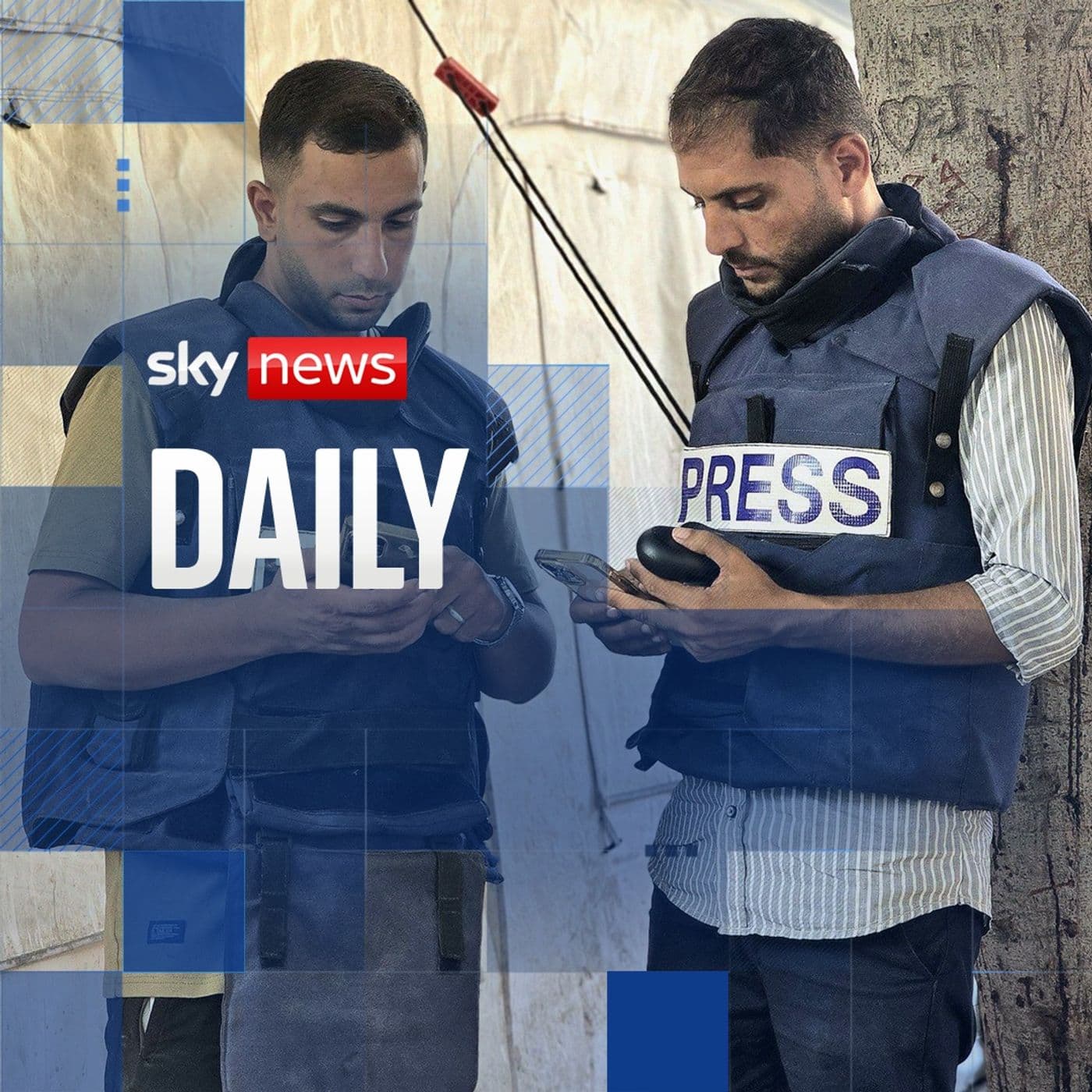
1:20Hi everyone, welcome back to The Daily. Now, the voice you were just hearing. That was Anas al-Sharif, correspondent for the Al Jazeera News Channel. He and four colleagues who also work for the Qatar-based broadcaster were killed in an Israeli airstrike at the weekend. But let's be clear, this was no accident. The Israeli military has confirmed he had been targeted. They claim he was a Hamas terrorist. And look, that's certainly an allegation that's been made by the IDF before. Anas al-Sharif's employers say, we haven't seen any founded proof, only unfounded allegations. Close to 200 journalists have now been killed inside Gaza since the start of this latest conflict.
2:01And don't forget, reporters from international news organisations like Sky are barred from entering Gaza by the Israeli authorities. The fog of war is lying pretty thick over the Gaza Strip right now. Diana Magny is Sky's international correspondent currently in Jerusalem. Diana, what do we actually know about the strike on that team from Al Jazeera? Well, I felt a bit, Neil, as though I was watching it in real time because we got video from our sort of crew coordinator last night of a very heavy bombardment and a strike very close to our camera team's flat. And she wrote, it's a very difficult night for our teams in Gaza.
2:41And then literally a few minutes later, she sent the news, Anas al-Sharif has been killed. and it was an Israeli airstrike on the tent that he and his Al Jazeera crew members lived in and worked from just outside the courtyard of the Al Shifa hospital. And it was also a place where a lot of other journalists would load up their battery, would try and broadcast from. And if you look at the debris from the hit, you can see a lot of the sort of broadcast debris. You can see the charging stations, you can see the cables, you can see the massive amount of force that killed Anas and his colleagues, because there's just shrapnel all across the wall of the hospital, which was the back to their wall.
3:26And I'll just read out their names. Anas al-Sharif was the most high profile. He was a correspondent for Al Jazeera. There was also Mohammed Craika, also a correspondent. Ibrahim Zakhar and Mohammed Nufal, they were both cameramen for Al Jazeera. And then Mouamun Aliwa was the crew driver. And we believe that two others were also killed as part of that strike. And the IDF have said, given a reason for killing Anas, but they haven't given any reason at all for killing the rest of them. Let's talk about Anas al-Sharif, because as you say, he was the most high profile of the number and was the target of the IDF strike.
4:02What do we know of him? So he was 28 years old. He was born in the Jabalia refugee camp, which is right next door to Gaza City, and grew up there. and he's married. He had two small children, a wife. His father was actually killed in an attack on the family home in 2023 after threats had already been made by the IDF against Anas al-Sharif. But he basically based himself in the North since the beginning of the war. If you remember, Neil, back at the start, the IDF had come in from the North and they'd forced everybody to evacuate further South. But he stayed in Gaza City and he stayed reporting when very few people did.
4:43And he's a really well-known figure across the Arab world. I was watching social media video this morning when I came in and it was of the aftermath of the shooting and people were screaming, Anas, Anas. And the taxi driver said, are you watching about Anas? And I said, yes. And he said, we were all listening, looking at this last night. We were all crying. My little girl was crying because she knew that he had a little girl. You know, this man was very famous. He was a really loud voice across the Arab world from Gaza and from Gaza City. And I think that's really important to note as Israel prepares its attack on Gaza City, that they've just silenced one of the most important influential voices from it.
5:27We know ahead of the strike that Israel had complained about his coverage. What was it that they were dissatisfied with? They believed that he was a Hamas operative. What the IDF have said is that he was running a battalion that targeted Israeli civilians with rockets. They've had a thing about Al Jazeera. They have stopped Al Jazeera from broadcasting in Israel and they've said that it is integrated by Hamas. But they particularly singled Anas al-Sharif out really for quite a long time. And he has always said, what I am doing is what any journalist should do, telling the story from the ground.
6:05But it was the kind of style and language that Israel is not going to like. The last set of complaints came after he cried on air in a report that he was doing about starvation in the Gaza Strip. And as illustration, you know, literally 10.54 last night, which was very shortly before that airstrike killed him and his colleagues. He wrote a post on X saying, if this madness does not end, Gaza will be reduced to ruins. its people's voices silenced, their faces are raised, and history will remember you as silent witnesses to a genocide you chose not to stop. You know, that's not the kind of reporting that Israel is going to appreciate.
6:47He certainly had huge reach, didn't he, on social media, and many people will today have seen a message written by him but released posthumously. Yes, that is true. It was a really powerful message that he'd obviously prepared in case he was killed because he felt that it was coming. It's really a love letter to the idea of a Palestinian state. You know, he says, I entrust you with Palestine, the jewel in the crown of the Muslim world, the heartbeat of every free person in this world. I entrust you with its people, with its wronged and innocent children who never had the time to dream or live in safety and peace.
7:21I think the parts that I really remembered, you know, he had these two little children, Sham and Salah. He says, I entrust you with my beloved daughter Sham, the light of my eye, whom I never got the chance to watch grow up as I dreamed. I entrust you with my dear son Salah, whom I'd wished to support and accompany through life until he grew strong enough to carry my burden and continue the mission. So it's really poignant and extremely, extremely sad published upon his death. Israel have alleged that Anas al-Sharif was not simply a member of Hamas, but senior within the organisation for a lot longer than the past few hours.
7:57What evidence has Israel provided in support of that claim? So in October 2024, they published a set of documents about him and about six other journalists for Al Jazeera that they claim to be working for Hamas or Islamic Jihad. It included personnel tables, terrorist training courses. It said that he was the head of a rocket battalion, that he joined Hamas in 2013. It gave his military ID, his rank. There is a phone directory that it says is from Hamas, which includes his number. They also gave an injury tracking form, which Hamas is supposed to have, on which his name is written. And their point is that he was a terrorist.
8:42And in their words, a press badge isn't a shield for terrorism. Now, Al Jazeera has refuted that. Anas al-Sharif himself has refuted that. The Committee to Protect Journalists has refuted that. The UN special reporter for press freedom has refuted that. But as is so much the case with this war, it's a lot of he said, she said it. It is a war of accusations, one against the other. Well, we do know that a number of journalists, in fact, I think up to now, 186 of them have been killed since the start of the war. When you see numbers like that, one has to question whether or not journalists are being targeted.
9:23Do we have any proof that they have been? I think it's very clear that journalists are being targeted in the same way as we've ourselves proven that medical health workers in Gaza are being targeted. You know, these are people who are seeing every day what is happening on the ground and who have a voice to speak out about it. And Israel does not want that voice to be heard across the Arab world or across the rest of the world. And it knows that it is easy to silence that voice. And that is what it is trying to do, because this is the worst conflict there has ever been for journalists. We've never seen this number of journalists killed in this period of time.
10:03And I should say it is journalists and media workers, people working for organisations. And the numbers vary a bit, but the Committee to Protect Journalists say it's 186. And that is before the deaths of these five media workers last night. And what does that mean then for the way in which this war is being reported? I mean, kill the journalists and you don't have eyes on the ground, but also you serve to put off others from picking up the microphone, from picking up the notepad and pen. News organizations around the world are relying on teams in Gaza to send them footage and to report for them because foreign journalists are not allowed into Gaza unless with a military embed.
10:46So we are dependent on these incredibly brave Palestinian journalists, because when I say that 186 journalists have been killed since the start of the war, they're all Palestinians in Gaza. No one else has been able to go in. And this is why there's this campaign to try and allow foreign journalists into Gaza as well. Not because we feel that we can tell the story better than the correspondents and the teams on the ground. We can't necessarily. But because they are all being killed and they need support. They don't have to carry the burden of telling this story on their shoulders themselves. There are others.
11:23And Diana, you've been in touch with our team on the ground in Gaza in the aftermath of the death of Anas al-Sharif. I mean, how are they dealing with all this? It's a terrible day for them. You know, they're covering the funeral, but they also feel it deeply because all of these people knew each other. That tent that the Al Jazeera crew were in, our teams have used to send footage. You know, it's tight knit, the journalistic community. And I sent them a message today saying how sorry I was. and this is just part of what they wrote back. We're still in the field committed to telling the truth and being the voice of Gaza.
11:56Your encouragement reminds us why we must keep going no matter the challenges. And the challenges are huge. The challenges are that they don't have the food or water that they need, that they run the risk of violence, of being killed, just doing their daily work. They see family members, loved ones, friends killed every single day. They don't get any counselling filming dead bodies day in, day out. I mean, it is incredibly relentless, incredibly difficult. The closest you've been to being inside Gaza is flying over Gaza in an aid plane. I mean, that must be, at the very least, incredibly frustrating.
12:34Yes. How can you tell the story properly without actually being there, without feeling it, without looking people in the eyes yourself? And you're right. I've just seen it from the air. We were in a plane for about five minutes over Gaza and so high up you could hardly make it out. And otherwise, foreign media are only able to go on embeds with the IDF, where you literally have no access to people in Gaza. You're just with soldiers. Benjamin Netanyahu says that he's now going to expand the opportunities for foreign journalists, but still that they can only go in with the IDF because of security concerns.
13:14And those security concerns are valid, especially as Israel launches its offensive in Gaza City. But journalists are used to operating in incredibly dangerous environments. Look at Alex Crawford and Swader in Syria just now. You know, there are some who will go and try and tell the story if Israel would allow us, which at the moment they do not. Diana, from the very early stages of this conflict, my view has been that Israel has been incredibly combative when it comes to reporting that they see as inaccurate or not telling the full story. And we got more of that, didn't we, from Benjamin Netanyahu, Israel's prime minister, on Sunday.
13:54What was he saying at this news conference? So he said that he wanted to puncture the lies that are being put out there about Israel and its role in the humanitarian crisis in Gaza. So he put up a series of famous photographs now that he called fake news that, for example, one that was used by The New York Times showing a starving baby. But in fact, that baby had cerebral palsy. So his point was it wasn't starving. It was ill. In fact, the fact of the matter is you can have cerebral palsy and be starving all at the same time. But he is trying to recapture the narrative, basically, which he feels has shifted away from Israel because of these terrible images of famine and starvation.
14:34and the accusations made against Israel of forced starvation and also in some corners of genocide. And I think he was trying to draw a line in the sand and reset and say, I want to flood the Gaza Strip with aid. We will do that. It's Hamas who is taking the aid away. But he was very, very reluctant to acknowledge that there is starvation there. He was asked about it once. He didn't reply. I then asked about it again. and he acknowledged that there was deprivation. Given what the IPC says is the unfolding specter of famine in the Gaza Strip, would you accept that your 11-week blockade, complete blockade on Gaza, played a role in that?
15:16And also, given the killings that we have seen at the GHF aid sites, how will you guarantee that that kind of disaster will not happen when you have a million more people displaced? There was a problem of deprivation, no question about it. And so we had to solve it. And the way we solve it is the way I described it to you. And there are now not zero trucks, but at least in, I think last time I checked, hundreds of trucks that went into Gaza. That's alleviating the situation. And when you have no shortage like that, then you don't have also the crowding around distribution points. And by the way, a lot of the firing was done by Hamas, seeking to have response by our forces.
15:56And very often they didn't. They held back. They stayed their fire, even though their own lives were on the line. So I thought it was interesting there, especially about these aid killings around the GHF, the Gaza Humanitarian Foundation aid sites, that he did acknowledge that some of the killings might have been the result of IDF fire, even if his point is that it's always Hamas who opens fire first. I mean, let's be honest about it, Diana, from quite early on in the conflict again. I mean, there would be those who suggest that if there is fake news being issued, it has been issued by Israel.
16:29I mean, interesting, though, that he did go so far as to accept that there might have been some Israeli involvement in what has happened at some of these aid points. Look, this is a war on the ground and it's also a war of propaganda. and Israel has the right to defend its narrative just as Palestinians in Gaza do and just as Hamas feels that it does. And that is what Benjamin Netanyahu is extremely good at doing. This was a very slick press conference. And when he talks, a lot of his arguments sound very compelling. And our job is to present those arguments and to interrogate them and to see what the facts on the ground tell us is the case.
17:08And that's why we're pressing for access into Gaza. OK, so is that when we'll know truly what's been going on inside Gaza? I mean, does the fog of war created by these claims and counterclaims lift when international journalists finally get access? I think we get a better glimpse, a better insight. You know, the IDF cannot say shooting at aid sites has nothing to do with us when there are 1500 people who have been killed and that number rises every day. Who's doing the shooting? Is it all Hamas? You know, the IDF says we carry out investigations. We know that most of those investigations don't ever reach any kind of conclusion.
17:45We ask the IDF for responses on what seem to be egregious human rights violations, you know, day in, day out. Sometimes we get answers. Sometimes we don't. A family in Gaza City, for example, their entire extended family wiped out in one go. And the IDF will be like, where are the coordinates? And then suddenly your request will sort of slip into the ether and nothing will come of it. You know, there needs to be more forensic examination of what they have been doing. That only happens on the ground. Yes, it would help lift the fog of war. And the IDF can't stand there and claim none of this has to do with us if they won't allow for more transparency.
18:25Thanks, Diana. For the very latest on Gaza, simply head to SkyNews.com. The Daily is back again tomorrow. Hello, Ed Conway here. Here is what might sound like a slightly random question. What do AirPods, bananas and a pair of shoddily made running trainers from the 1970s have in common? On the surface, not very much But on my podcast Stuff Matters I will uncover the deeper stories behind each of them You will see how together they tell a fascinating new story about the world we live in The first full series of Stuff Matters is out now Just search for it on your podcast app and follow
From the publisher
Israel says Sharif was the head of a Hamas cell but has only produced limited evidence about its claims.
Al Jazeera rejected the accusations and said the strike was a "blatant" attack on press freedom.
On this episode, Niall Paterson and Sky News international correspondent Diana Magnay look at Anas Al-Sharif's career, Israel's claims and the international condemnation of what happened.
Producer: Natalie Ktena and Emily Hulme
Editor: Paul Stanworth