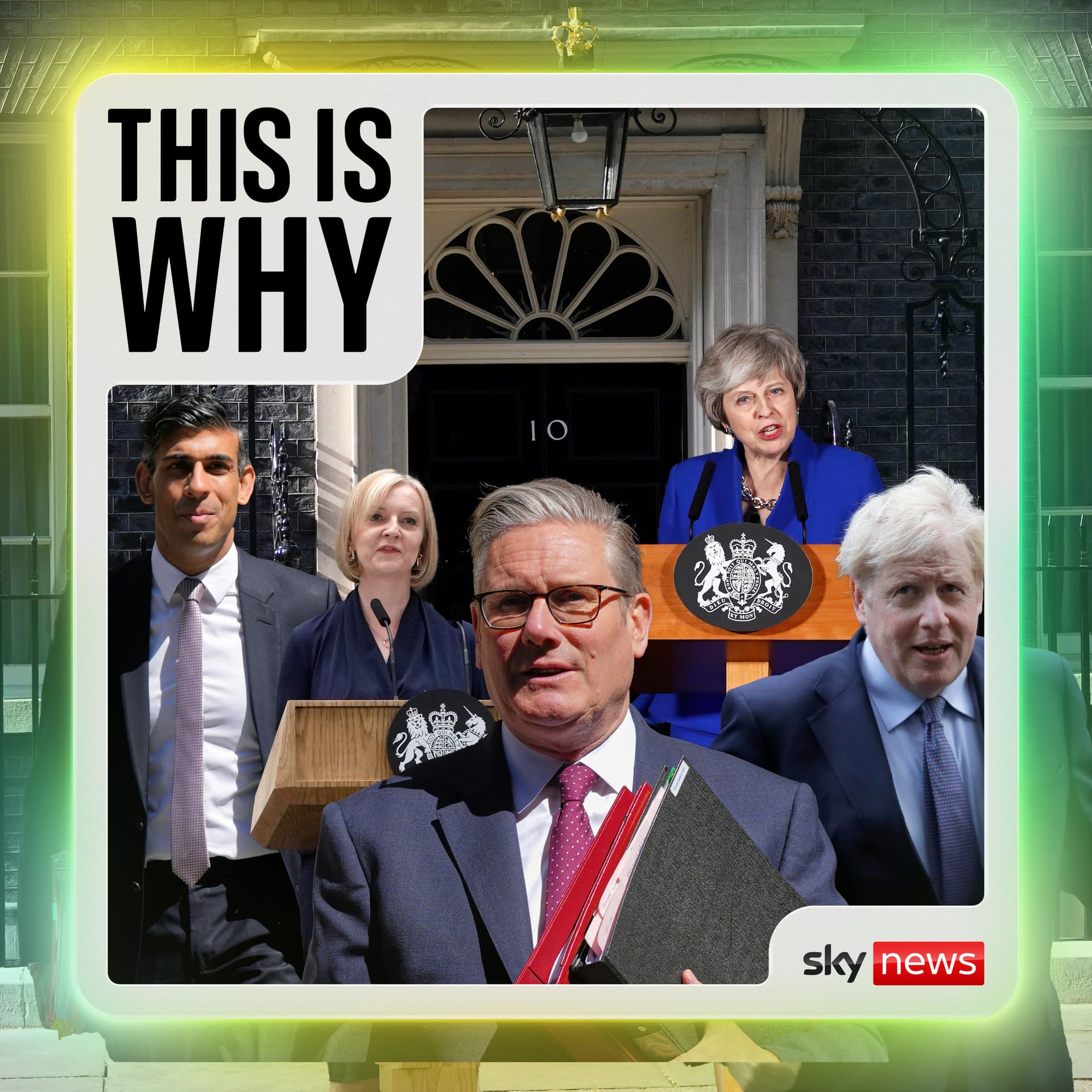

In short
Why the UK seems addicted to rapid prime minister turnover, and why voters increasingly punish leaders.
Guests
Scarlett Maguire, pollster and founder of Merlin Strategy.
Key claims
Over the past decade the UK cycled through six prime ministers and may soon have a seventh; this “churn” is a more modern phenomenon driven by worsening public expectations, faster media cycles (24/7 news and social media), and voter impatience shaped by cost-of-living pressure. Voters personalize dislike of leaders (especially Keir Starmer) but also blame the broader political system after declining trust since scandals like MPs’ expenses. Polling should be treated as trend data, not week-to-week noise.
Notable examples
Focus-group tests where an unknown backbench MP was liked until identified as an “establishment” MP; local-election “change not delivered” dynamics (e.g., Sunderland, Barnsley); comparisons to Boris Johnson replacing Theresa May and Canada’s Trudeau/Mark Carney leadership change.
Written by AI. May contain mistakes. Listen to the episode to check what was said.
Chapters
Tap a time to open that second in VOThe Cycle of Resignation
0:41 to 2:14
Discussion on the frequency of prime minister resignations and public sentiment.
“The past ten years, the UK has got through six prime ministers and soon we might be on to number seven, and this is why.”
Public Perception of Leadership
2:14 to 3:38
Exploration of how public opinion shapes perceptions of political leaders.
“So why, as a society, is it seen as fair game to pound leaders out of office as the pace of politics gets ever faster?”
Expectations vs. Reality in Politics
3:38 to 6:06
Analysis of changing public expectations of political leaders over time.
“Keir Starmer and from this Labour government that has sped that process along its way.”
Media Influence and Voter Engagement
6:06 to 7:34
How media coverage affects public engagement with political issues.
“You think of 1979, you've got 17 % interest rates by the Bank of England.”
The Role of Political Parties
7:34 to 10:01
Examining the impact of political parties on public perception and leadership.
“So the public are increasingly less watching things like the news at 10 or 6 o 'clock.”
Polling Skepticism and Its Effects
10:01 to 14:01
Discussion on the effects of polling on public perception of politics.
“How much do voters in your focus groups accept the flaws of leadership?”
The Role of Polling in Political Trends
14:01 to 16:28
Learn why polling should be viewed as one of many data points rather than the sole indicator of political trends.
“I am in general quite a polling sceptic pollster, which is not a gimmick or in any way a criticism of the industry.”
The Complexity of Political Leadership Changes
16:28 to 17:39
Explore the challenges and implications of frequent changes in political leadership amid complex societal issues.
“It was not unheard of, but it was sort of presumed if you got a big enough win the first time around.”
Show Closing and Next Steps
17:39 to 18:54
Get insights on political podcasts to follow and the latest updates on political events.
“but that's sort of party political, you know, reviving the Conservative Party's chances.”
Transcript
Automatic transcript. May contain errors.0:02Sky News, the full story first.
0:30for the day ahead in British politics. Hit follow and listen to Politics at Sam & An's wherever you get your podcasts.
0:41The past ten years, the UK has got through six prime ministers and soon we might be on to number seven, and this is why.
0:56We should aim to have a new prime minister in place by the start of the Conservative Party conference in October. I will shortly leave the job that it has been the honour of my life to hold, with enormous and enduring gratitude, to have had the opportunity to serve the country I love. It is clearly now the will of the Parliamentary Conservative Party that there should be a new leader of that party and therefore a new Prime Minister. I cannot deliver the mandate on which I was elected by the Conservative Party. I am resigning. I will surely be seeing His Majesty the King to offer my resignation as Prime Minister.
1:35To the country, I would like to say, first and foremost, I am sorry. It's something we seem to be getting used to, a tearful farewell from a podium outside number 10 as a Prime Minister steps down. I'm Gareth Barlow, and at the time of recording, Sir Keir Starmer has so far resisted the temptation to join David Cameron, Theresa May, Boris Johnson, Liz Truss, Rishi Sunak as well, in disappearing from Downing Street. But a challenge to his leadership does feel inevitable. It's staggering that only one of those recent former MPs was beaten in a general election. The rest resigned for various reasons, from public pressure all the way through to partygate.
2:14So why, as a society, is it seen as fair game to pound leaders out of office as the pace of politics gets ever faster? Scarlett Maguire is a pollster and founder of Merlin Strategy. and we're going to discuss all of that with her. We'll get on to the kind of the why in a bit and some of the drivers behind this, but I'm just interested as kind of where the public lies at the moment. Do they see the issues with prime ministers as a personal issue or do they see the issues with prime ministers as part of a kind of bigger political issue? It's both. And so it does become deeply personal with prime ministers and they're standing amongst the public.
2:48I think we're certainly at that stage with Keir Starmer where there is an almost visceral dislike of him and that's from voters across the spectrum. And that does feel very personal and very personalised to him. However, it feeds into this greater frustration that you're seeing. And ever since the expenses scandal, for example, trust in politicians has been getting lower and lower and lower. It will continue somehow to get lower still. And this is what it's also symbolic of. So people are very frustrated with this prime minister that they do not feel is up to the job. But they're also incredibly frustrated with the whole political system and have, to a large degree, lost faith in it.
3:23And that makes me wonder then, they get tarnished with that brush, they're all the same, politicians, they're all the same. And therefore, are kind of politicians doomed to fail somewhat, just because of the office they hold? I don't think they're doomed to fail. And I do think there've been mistakes from Keir Starmer and from this Labour government that has sped that process along its way. I don't think all of this was absolutely inevitable from the start. But I think part of the problem that they had was failing to grasp the mood of the electorate correctly. So when they campaigned for the election in 2024, they correctly identified that the public were desperate for change.
3:57That's why every time you saw Keir Starmer behind a podium during that campaign, there were change in big letters behind him. They correctly identified that voters were very fed up. I think they thought just a change from the Conservatives would be enough. I don't think they quite understood the urgency with which voters felt the whole country needed changing, you know, and that that needed to happen in voters' minds quickly and quite fundamentally and that sort of incremental tinkering was not going to cut it with them. It wasn't just enough that they weren't like the Conservative Party that came before.
4:26So I think there's a sense that voters are incredibly impatient. However, I do still think that there are things you can do to mitigate that. And I think this Labour government has not done that. I can maybe slightly contradict myself though slightly, which is to say just anecdotally, I have tested, I do lots of focus groups. And one of the things that's interested me is your very question, are all politicians doomed to fail just by nature of their title? And so I tested a very unknown backbench MP from one of the two main parties, incredibly unknown. No reason why anyone walking down the street would have ever recognised them.
4:59And first, I just tested them completely out of context to Parliament. And the response was incredibly positive. I said, oh, we like what they're saying. That makes a lot of sense. As soon as I told them they were an MP for one of the two establishment parties, the mood completely turned. And I think that does tell you quite a lot, actually, because it means that as soon as you put someone in the context, of Westminster, SW1 politics, it gets harder with the public, not easier. Thinking back to the introduction where we kind of listed off the recent incumbents of the Office of Prime Minister, Cameron May, Johnson Trust, Sunak and now Starmer.
5:32You know, it feels like it's been quite the conveyor belt of leaders. 2022, we had three prime ministers in one year. Has the pressure on prime ministers to constantly be through the state of churn always been like this? or is this a more kind of modern phenomena? I think it is a more modern phenomenon. I think that's certainly true. But I also think that potentially, I know some people contradict this and say, oh, you should have been here in the 70s. It was just as bad. But the state of the country is in relative to the expectations of the public about what the state of the country should be in, I think has got a lot worse over the last five to 10 years.
6:05And I think that's part of the reason why we're seeing this acceleration. That's really interesting. You think of 1979, you've got 17 % interest rates by the Bank of England. Do you think of the early 1990s, You've got 15 % interest rates. You've got the issues across Europe. You've got kind of people in negative equity where their mortgages are worth more than their houses at times. But expectation is really interesting there. Was there maybe a bit of a kind of post-war hangover that kind of maybe influenced how people felt in the 70s? Whereas now we're expecting constant boom and constant success?
6:35I do think people are expecting, and I can completely see why. And by the way, I think they're right to expect growth, you know, economic growth, which we've seen very little of for the last 20 years. But yes, I do think people, again, this is where the relative things are so important. It's a little bit like when you talk about crime, for example, it's sort of no good telling someone the area is safer than it was 30 years ago if it's less safe than it was five years ago. And I think that's a similar sort of position in the economy. And one thing that really strikes me is when you ask voters, first of all, their overwhelming number one issue is the cost of living.
7:06And they separate that from the economy. That's a slightly different point. But it's the cost of living and the pressure they're feeling financially. And then when you speak to them in focus groups, they say things like, I'm working twice as hard just to get by. You know, so 10 years I was working this hard, but I could afford nice things. I could go out to the pub, I could go on holiday. Now I'm having to do twice as much work, I'm having to do two jobs, whatever it is, and I can barely afford to keep my head above the water. And I think that is an incredibly strong driver of some of the things that we're seeing.
7:33If we think a bit more about the contribution to kind of the disdain towards prime ministers, Parliament loves PMQs on a Wednesday. Westminster loves PMQs. The press loves PMQs. What does the public make of it? They largely ignore it. So the public are increasingly less watching things like the news at 10 or 6 o 'clock. They're increasingly not so much engaging with where you would just see the clips and say, well, they never really watched it live. It's midday on a Wednesday. So they've got other things to do. There will be some people, but it's quite rare to think that the public can be glued to their TV screens at that point to check what they're all saying.
8:07So they don't pay much attention to it. And I think they pay even less attention to it now because, again, because of where the energy in terms of the voter movement has been over the past year. So that's been with reform and the Greens in terms of where they came from before. Something you hear from voters generally is that actually sort of irrelevant what the Labour Party and Conservative Party are shouting at each other about over PMQs because they see or they feel like there's stronger political opposition to both those forces outside. We were talking in the introduction about the fact that this feels like a bit more of a modern phenomenon.
8:41If we kind of think back to the list of prime ministers, especially in recent years, we've kind of gone through five or six in very swift succession. and if I think about how life has changed in that period we've become a more transient society we kind of want content in the instant we want deliveries within a couple of hours we want our food within 20 minutes I wonder to what degree we kind of view our own lives how that then influences how we view and what we expect from the people in charge yeah I do think that has an impact especially when you think about the media cycles that are generated from social media and 24-7 news as well, although that's not a brand new phenomenon, obviously.
9:18But yes, as I said, there's a huge impatience for the public. But this is impatience that hasn't just materialised since 2024 and the Labour's general election result has been bubbling up for a very long time. And I think especially when we've just had this set of local elections and there are so many different dynamics to pull out of it. But if we look at, for example, the progress reform made in a lot of the Brexit voting parts of the country, which was quite significant. if you look at places like Sunderland and Barnsley as sort of flagship examples of that, if you speak to those voters, they'll say, well, we've been voting for change that we've not got for 10 years.
9:51So for voters that they actually think it's not so much that they think that, hang on, we told you last week we wanted this fixed and it's not fixed. They're saying we've been trying to send you this message for a long time. How much do voters in your focus groups accept the flaws of leadership? Because we're all human, right? We all have flaws. But it strikes me that politicians are held to an incredibly high standard, understandably so. But are we maybe expecting too much from human beings? I think human flaws they're actually quite tolerant about. So you have someone like Boris Johnson, and then even in terms of if you think about his own supporter base, obviously became a very unpopular politician, but someone like Jeremy Corbyn still has people in his corner, no matter what, who really like him, who will sort of take whatever he does.
10:42And I think there are other examples of this as well. I think Nigel Farage is also a good example. There are lots of sorts of, what you might call flaws out in the public domain that a lot of the public price in. And so that's fine because we think he's on our side. And actually the flaw they won't tolerate is that sense of, you know, I don't trust what you're saying and I don't trust that you're in this for me. and I think that's something that's a little bit more fundamental but I think there's quite a lot of other things they are actually a bit more willing to tolerate. Now that can turn. I think the thing is if you're a politician as long as you're delivering people will put up with an awful lot.
11:15If they don't feel like you're delivering then they'll give you a much harder time for all those other things as well.
11:30I'm Sam Coates from Sky News. And I'm Anne McElvoy from Politico. Downing Street drama, leadership battles and policy U-turns. We're on it before it breaks. We take you straight into the rooms where the real political conversations are happening. Smart Insight, clear analysis in your feeds by 7.45am. So you start your morning fully brief for the day ahead in British politics. Hit follow and listen to Politics at Sam & Anne's wherever you get your podcasts.
12:06There are 403 Labour MPs at the moment. There is only one leader of the party. There's about 30 or so people in cabinet. So Keir Starmer represents an awful lot of people. But it always strikes me as remarkable how little understanding or knowledge or name recognition there are of the rest of political spectrums. Yeah. How does that play into the fact that maybe one person is having to take the rap for flaws that necessarily aren't always theirs? Well, I mean, they are the figurehead. That's what they stand to be. That's why they stand to lead their party. And so, yes, the public do put an awful lot of responsibility on their shoulders.
12:45And I think there's an understanding that even if it's not something they've directly done that has made things go wrong, but it's something somewhere in a department or with parts of the world, they still see that person is taking ultimate responsibility, but like a CEO in a company. if things are going very wrong, but it wasn't actually necessarily their decision making. It's like, well, you were the person in charge that sort of oversaw all of this. And so if you didn't know, that's also your fault. And the public have an attitude that's quite like that. But I think the problem is, and again, this goes back to this fundamental distrust in the political class in general, which is, by the way, much, much more pronounced in reforming green voters than it is elsewhere.
13:19So there's quite a lot that unites reforming green voters, and distrust in the political system is definitely one of them, is that it wouldn't really help if they spread the responsibility more evenly between those 403 Labour MPs because they're just as distrustful of the MPs. Yes, there's an awful lot that the public hang on the sort of politician's shoulder, on the PM's shoulders, but it's not as if they would give anyone else an easier time or are giving anybody below them an easier time either, really. This question is asked with the greatest respect considering your work is polling. But there's been a lot of talk about polling and the accuracy of.
13:53How does that impact how the electorate views the system broadly? Yeah, so I think it's a great question. I am in general quite a polling sceptic pollster, which is not a gimmick or in any way a criticism of the industry. It's genuinely not. I just think that it should be treated as one of many data points. And I'm a much bigger fan of looking at long term trends than I am at looking week to week voting intention, which I think can be very noisy and quite distorting as well. So, you know, we have several voting intention polls released every week and you'll get a lot of excitement saying this party's up one point, this party's down two points.
14:25And ultimately, it doesn't really matter. You have to step back and look at what's happening over a couple of months. But in general, for the point we've been over the last, you know, six months or so, I think it's only really worth zooming out to say that, you know, reform still on top. Signs, they plateaued relative to a few months ago, even gone down a bit. And the Greens have risen, for example, and the Labour and Conservatives are still struggling and are still sort of at the nadir. So all of that is to say that I think polling plays an interesting role in this. And I think polling is going to play a very interesting role in the next election, which I don't think will be because pollsters are trying to do anything nefarious far from it.
15:01I think people always forget that pollsters basically only incentive is actually to be right. You know, they don't want to be wrong. It doesn't look good for them. Exactly. It doesn't look good for them to be wrong. So there's no real incentive. But what I think you'll see is, and I think we even saw this in the local elections, because polls will be saying quite different things, because it's very difficult to predict, especially on a seat level, what's going to happen because we'll have five parties, six parties in Scotland and Wales competing in a lot of these areas. If you look at places like Birmingham, there are quite a lot of candidates winning with less than 25 % of the vote.
15:28You're going to see that all across the country. So it's going to be very hard to call, which means that multiple pollsters will make multiple projections and they will say very different things about different seats. And so you already saw this election, different parties using different pollsters to say, no, we're best placed here. We're best placed here. And I do think that's going to make it just a lot more noisy and probably quite unhelpful for people actually trying to sort of see their way through that and work out who is best to vote for for them. Final thought. There's the old adage, Rome wasn't built in a day.
16:00And society and economies and the world is far more complex than when Rome was built. And parties are constantly skewering their leaders, certainly in recent years, at a time when the world is so turbulent. are they maybe setting themselves up to fail because they don't give themselves or their leaders enough time to really build change and as we at an electorate not giving people really enough time to enact meaningful change? I mean I think it's quite difficult we already have the issue that you know we have elections every five years but that means that parliamentarians minds are set to relative short cycles I think that's only going to be at least in our system before it was rare for a government not to get a second term.
16:44It was not unheard of, but it was sort of presumed if you got a big enough win the first time around. Exactly, that you'd be looking for a sort of 10-year plan at least. That has obviously now gone completely out of the window. If you're in one of these parties at the moment that's thinking about, yes, I actually have a good chance, because they all do actually have a good chance of forming a coalition in 2029. I bet their horizons are much shorter than even the five years because I think they'll probably quite rightly predict that they might not last that full term if it is this sort of unwieldy type of coalition.
17:12So I think that's a problem on the one side. And then on the side of then the specific questions of leadership, obviously it, I think, sets back the potential for change if you have churn and if there's too much going on at the top because you won't be able to focus on things. However, I think it's also very leader dependent. So if you have a leader in place that isn't bringing about change, you're still probably better off changing it for someone who does. And I think there's examples of this. In terms of political success, you can look at Boris Johnson taking over from Theresa May, but that's sort of party political, you know, reviving the Conservative Party's chances.
17:46Not necessarily what was best for the country, but that's an interesting example. And I think, again, there's a very interesting one if you look at Justin Trudeau and Mark Carney in Canada. So that was, you know, they got rid of a leader. Some people might say, well, you don't want to get rid of a leader now because it's very unstable times. It'll be too much churn. You're about to go to an election. And that's actually then resulted in more stability than they've seen there for a long time. So I think it's dependent on situation. Scarlett, absolute pleasure to have you with us. Dear listener, a pleasure to have you with us.
18:11The situation surrounding Sakhir changing almost minute by minute. So check out Sky News for all the very latest. Don't forget to listen to our political podcast, Electoral Dysfunction and Politics at Sam & Anne's. This is why, and we'll be back tomorrow.
18:32I'm Sam Coates from Sky News. And I'm Anne McElvoy from Politico. Downing Street drama, leadership battles and policy U-turns. We're on it before it breaks. We take you straight into the rooms where the real political conversations are happening. Smart Insight, clear analysis in your feeds by 7.45am. So you start your morning fully brief for the day ahead in British politics. Hit follow and listen to Politics at Sam & Anne's wherever you get your podcasts.
From the publisher
Keir Starmer is on the brink, as more and more Labour MPs and ministers call for his resignation – less than two years after he walked into Number 10.
He remains defiant (for now), but whatever the fate of the prime minister, his predicament is one we've seen repeated over the past decade in a seemingly never-ending cycle of chopping and changing leaders.
Since David Cameron's resignation in 2016 – after Britain voted to leave the European Union – no prime minister has served a full parliamentary term.
Gareth Barlow speaks to pollster and founder at Merlin Strategy Scarlett Maguire about our impatience with politics and why the country feels ungovernable.
Have you got a question for the show? Email us: why@sky.uk