In short
A critique of Andy Burnham’s housing plans, arguing that ambitious targets risk failing due to structural constraints in the UK construction sector and public finance.
Guests
Mari Arora (host). David Byers, Deputy Property Editor at The Times and The Sunday Times.
Guest backgrounds
Byers covers property policy and markets for major UK newspapers; he references interviews with firms including Savills and build-to-rent investors.
Key claims
Labour’s 1.5m homes by 2030 is expected to miss badly (Savills estimate ~837k). Burnham’s council-house push (biggest since WWII; 500,000 bespoke social-rent homes by 2030; £40bn investment) is “most significant” if it works, but builders “can’t build” due to soaring costs (up ~20% in four years), labour shortages (lowest builders since 1998; Brexit-era worker exodus), planning delays, and insolvencies (4,000 firms insolvent to Feb). Funding is questioned: housing benefit spending (~£38bn/year) dwarfs planned social-home building over a decade. Renters’ Rights Act and higher taxes may push landlords to sell; Zoopla data shows buyer interest in affordable areas down 20–30% in regions like West Midlands and Northeast.
Notable examples
Help to Buy (350,000 loans 2013–2023; £24bn) and its “Help to Sell” effect on new-build prices; VAT on materials/labour (20%) and VAT receipts (£171bn, ~15% of revenue); Putney example for proportional property tax (about £1,500/year increase on a £672k terraced house).
Written by AI. May contain mistakes. Listen to the episode to check what was said.
Chapters
Tap a time to open that second in VOAndy Burnham's Housing Promises
0:54 to 2:57
Discussion on Andy Burnham's commitments to build affordable housing.
“That's why the government's putting such an effort on building the number of homes that we need in this country.”
Challenges in the Housing Market
2:57 to 5:24
Examination of the challenges facing housing construction in the UK.
“So it's a massively ambitious programme.”
Builder Shortages and Costs
5:24 to 7:40
Insights into builder shortages and escalating construction costs.
“First of all, they have said that they want the restoration of a scheme called Help to Buy, which is a scheme that basically offered government loans to first-time buyers.”
Funding for Social Housing
7:40 to 10:03
Exploration of funding options for building new social housing.
“So you're going to see a huge swathe of builders retiring.”
Tax Reforms and Housing Affordability
10:03 to 12:14
Potential tax reforms to improve housing affordability in the UK.
“And therefore, if it is affordable, you don't need to pay them housing benefit in the first place.”
Political Implications of Housing Policies
12:14 to 14:03
Discussion on the political ramifications of proposed housing policies.
“First-time buyers have had their stamp duty discount cut last year, so it would help them get on the ladder.”
Housing Policy Discussion and Consequences
14:03 to 16:30
Explore the implications of recent housing policies and their effects on the market.
“can hear it coming from Kemi Badenok already.”
Andy Burnham's Political Ambitions
16:30 to 18:32
Delve into Andy Burnham's housing agenda and its significance for his potential premiership.
“Ultimately, there has to be moves to make housing more affordable and more plentiful if Labour wants any chance of winning the next election, really.”
Transcript
Automatic transcript. May contain errors.0:02Sky News, the full story first.
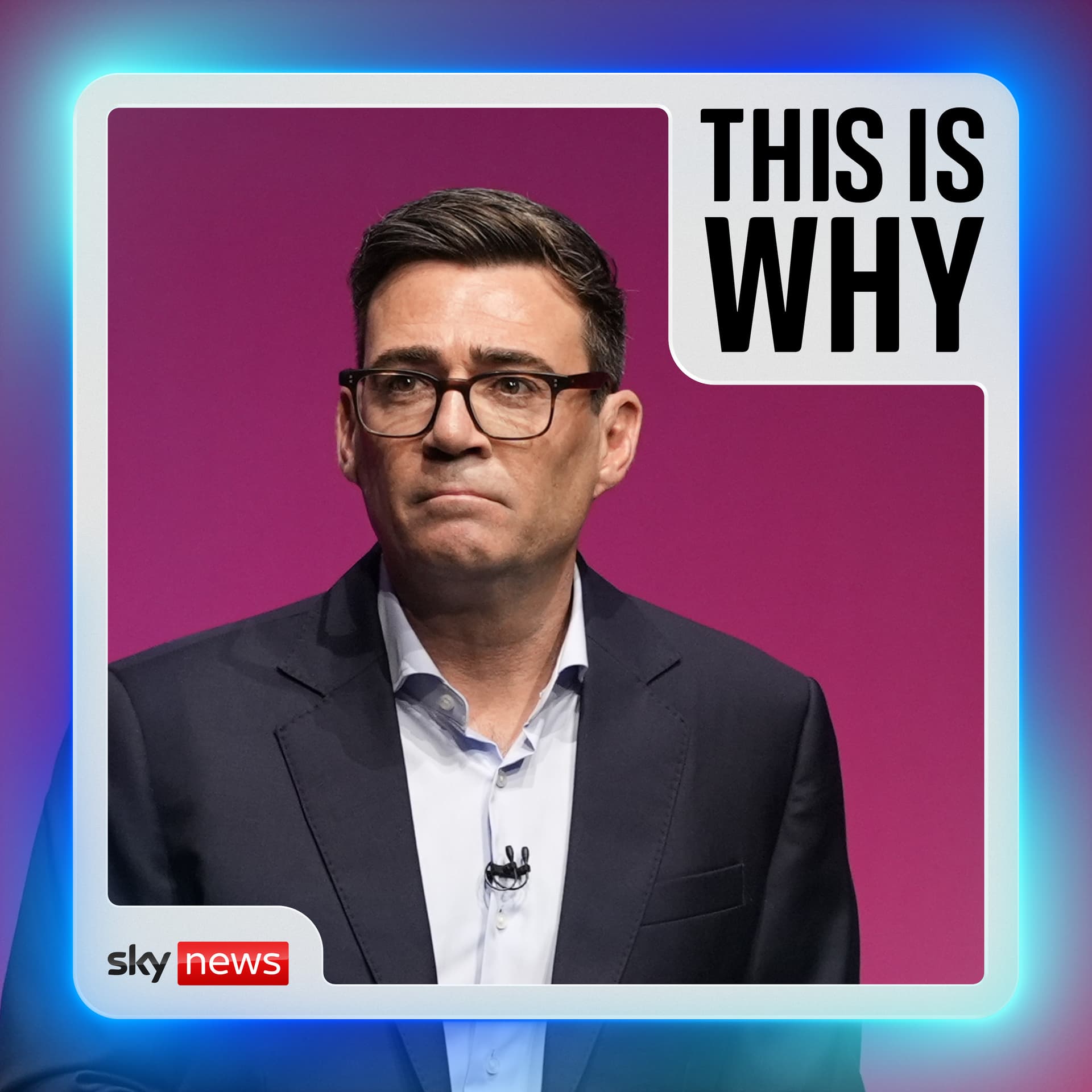
0:11Andy Burnham is promising to make housing more affordable and this is why.
0:21How does a banana trigger a CIA-backed coup? Do AirPods herald the arrival of a new global order? What do LED lights say about the future of humanity? I'm Ed Conway, and in each episode of my new podcast, Stuff Matters, I take an object, crack it open, and reveal the world-shaping forces hidden inside. This is economics told through the things we think we understand. Search Stuff Matters on your podcast app to listen and follow.
0:54That's why the government's putting such an effort on building the number of homes that we need in this country. The government is on track to deliver its manifesto commitment of a million new homes. It's time to build one and a half million new homes across the country. Successive prime ministers have tried and failed to build enough homes to meet ever-growing demand. Most recently, the Labour government set a target of building 1.5 million homes by 2030, a pledge it's expected to miss by well over a third. High energy and labour costs, strict planning regulations and depleted social housing stock have all contributed to demand outstripping supply.
1:35But Andy Burnham claims he will make things better. Working with local areas, Number 10 North will oversee the biggest council house building programme since the post-war period. However, this isn't the first time we've heard bold pledges that I never met. I'm Mari Arora and joining me is David Byers, Deputy Property Editor at The Times and The Sunday Times. David, thanks so much for being with us. We're talking about housing, of course, one of the kind of pillars of a society. So we had this big speech from Andy Burnham. He said he was going to build all these social houses. First of all, just talk us through what were some of these commitments from Andy Burnham.
2:17So Andy Burnham has said, as a fundamental part of his philosophy, that he wants to create the biggest generation of council houses since the Second World War. He reasons ultimately that the current definition of affordable rent, which is the quoted of the development cement build with every project, is fundamentally broke. It's basically ineffective because that means that properties can be 80 % of local market rent, which basically is still too expensive for most people. So he says instead the government should commit to building 500 ,000 bespoke homes for social rent by 2030. And for reference, just 65 ,000 affordable homes were completed in England in 2024 to 2025.
2:57So it's a massively ambitious programme. He's called for what he says is£40 billion worth of investment to make that work. Whether or not that's separate to the government's current pledged£39 billion social and affordable homes budget, we will wait and see. But that's basically the nub of it. I mean, Savills, who I spoke to about it, said it would be the most significant jump we've seen at any point in the last 15 years for social housing, if it works. The pledge is bold, but I feel like we've been here before. I feel like we've heard these pledges before. 1.5 million homes we heard from Keir Starmer just a couple of years ago.
3:32It looks like they're not going to hit that target, nowhere near. So how achievable, deliverable, realistic are Andy Burnham's pledges? I think we need to talk about the 1.5 million for a start, because the government is going to miss that by such a spectacular degree. And this is all homes, not just affordable homes. So the government said 1.5 million in England by the end of 2030. In fact, what the government is going to manage, according to Savills, is about 837 ,000. So they're going to miss the target by 662 ,500. And the number is actually shrinking each year. Now, why is that? And this is one of the big problems that Andy Burnham is going to have to come across.
4:10Soaring building costs mean that developers are reluctant to build. So they're up 20 % in four years. That's because of the problem of importing goods across various broken supply chains because of the Russian invasion of Ukraine, because of the Iran war. And house prices have only risen 4.5 % in that time. So building costs are accelerating over house prices, which is important because it's not worth builders building things unless they can sell properties for roughly the same increase that they've spent building it. Plus, on top of that, Britain has its lowest number of builders since 1998. And this is thanks to another policy we've been hearing about recently, which is Brexit.
4:4610-year anniversary, massive exodus of Eastern European construction workers, and there's also a long-term issue with recruitment and retention. So the big issue he's going to have in building anything at all of any significance is the same issue that Keir Starmer has had, which is that builders can't build. 4 ,000 building firms became insolvent in the year to February. And of course, more broadly, it was the issue of affordability that a lot of people can't actually afford to buy regular mainstream homes as well. So what can the government actually do to kind of support smaller organisations, stop them potentially going out of business, for instance?
5:24The developers themselves have made repeated calls to the government. First of all, they have said that they want the restoration of a scheme called Help to Buy, which is a scheme that basically offered government loans to first-time buyers. And around about 350 ,000 of them received those loans between 2013 and 2023. The government loaned 24 billion of taxpayers' money. Now, developers like that idea because it means that more first-time buyers can afford their properties. It means greater certainty for their investors when they build construction projects that people will buy them. The only problem with that scheme is, and this is why repeatedly the Treasury has refused to relaunch it, is that it drove up the price of new builds.
6:04So, of course, developers love this because it was nicknamed help to sell from the point of view developers. The other thing that other builders have called for is basically the removal of VAT and building materials. Now, this sounds a little bit techie, but basically, whenever anyone carries out a retrofit or refurbishment project, effectively builders pay VAT on it. They also pay when they're buying items as well. So 20 % on materials and labour and for retrofit refurbishment projects. And the government, they want tax breaks basically to make things more affordable as building costs soar. This is another slightly intractable problem, though, because VAT is incredibly lucrative for the Treasury.
6:42brought in 171 billion receipts, which is 15 % of the whole of the government's revenue in the last financial year. So again, Andy Burnham may not be wanting to change that either. The other thing is he can write a nice letter to Mr. Trump telling him to stop with all this Iran war stuff. And if the Straits of Ormars opens, then construction costs will get cheaper. Well, this is what I was going to mention. I mean, the cost of not just labour, but energy is part of the reason it is so expensive to build houses. And I suppose the question is, how much power does the government actually have to bring down energy costs that would then knock on and reduce building costs?
7:19Yeah, this is a real issue. And the other big issue, as well as that, is this issue of retention and recruitment. So I went to build a training school recently, and it was really interesting. They were telling that something like 25 % of all builders now are 55 or over. And obviously, for people who are 55, you might say, well, I'm not old, I can still do the job, but that probably puts them about 10 years from retirement. So you're going to see a huge swathe of builders retiring. So there has to be recruitment and retention as well by building firms. And at the moment, a huge number of college building courses, something like 40 to 50 % of people who graduate from those courses go on and work in human resources or something.
7:56So there's a really problematic issue within the construction sector at the moment, really intractable, really difficult. And that is going to make building the homes the government wants difficult. And perhaps 1.5 million homes, that pledge was a bit of a gimmick and wasn't realisable. Why have so many prime ministers failed to meet their housing aims? That's a very good question. I think the cost of building has been a problem. I think the planning system, which fundamentally disrupted developers for years and years, has been a problem. I speak to people in the build-to-rent sector, American builders, who say that they can't get any investors because the investors are looking at a 10-year delay before being able to complete their projects because of our ludicrous planning system so they don't invest.
8:44And I think that's a fundamental problem. And the other issue is the fact that wages have been outstripped by inflation for such a long time. Affordability has dropped and dropped and dropped. Average home now costs something like seven or eight times people's earnings. So long-term problems with affordability in the planning system and the construction sector have made it an absolute nightmare for protected governments, these structural reforms that need to happen. Let's go back to Andy Burnham for a second. He has talked about this big social housing building scheme he wanted to enforce. How is he going to pay for it?
9:16Because of course, the money's got to come from somewhere. Is this going to come from borrowing, for instance? It's very difficult to see how he's going to be able to pay for it. I suppose he might answer that if you built more social housing or housing that people could afford, then the benefits bill gets commensurably cheaper. I mean, there's a really interesting statistic that the government currently spends roughly as much on housing benefits in a single year, which is 38 billion, as it plans to spend on building new social homes over an entire decade. And housing benefits obviously are paid to help people to sustain them in homes they can't afford.
9:50Just to clarify, the reason people say that that would reduce the spending from the government is because if you weren't needing to pay people housing benefit, that would save you money. But the only reason you are paying people housing benefit is because the housing is so unaffordable in the first place. And therefore, if it is affordable, you don't need to pay them housing benefit in the first place. That's the logic, right? Exactly. And the other thing, I think that obviously, one thing that could be done to try and bring in revenue to the government is continue to boost the housing market.
10:21Because in doing so, what you're doing is stimulating various parts of the economy from interiors firms to removal firms to construction firms and bringing in more stamp duty as well. So if you stimulate the economy, if more people are buying homes, if you go for growth, then ultimately stamp duty tape, which is very lucrative, will also come in. So again, the economy motors, more tax comes in, you can afford to do this. But it's an enormous programme. And I'm a little bit sceptical as to whether he's going to be able to do it. There is another scheme that he has, another key policy. He wants to get rid of stamp duty and he wants to also get rid of council tax and replace both of them with what is known as a proportional property tax, which is basically where you pay every year a tiny amount of your home's value instead of council tax, instead of stamp duty, which is a rebalancing thing because at the moment, for various reasons, people in the
11:20Bearing in mind the size and value of their homes versus the north, that would be rebalanced. But again, that's not going to generate an enormous windfall for a long time. And they'd have to do a massive revaluation of all homes, which hasn't been done since 1991. And the other issue with that, I suppose, and this is probably one of the reasons many people haven't done it, is you will probably upset a lot of people in London and the southeast who, as you say, in relation to their property value, pay less council tax and suddenly people in London, especially who are Labour voters, generally their council tax would go up.
11:55It will. And in fact, one good example, a£672 ,000 terraced house in Putney would have a bill increase of more than£1 ,500 a year under that scheme. On a positive note, it would remove the upfront cost of stamp duty, which many property experts have said for a long time is holding the market back. First-time buyers have had their stamp duty discount cut last year, so it would help them get on the ladder. And it would also end that sort of ludicrous fact that we are paying council tax on properties from 1991 valuations. But on the other hand, it would be an enormous, expensive and laborious revaluation, and the South would not like it at all.
12:34And the Green Party would probably love it, bearing in mind Labour hemorrhaging votes to the left. So it's a tricky one. And I suppose it brings us back to all of these things. when Andy Burnham and Labour MPs were standing there taking selfies in Westminster. They perhaps forgot that you've got all of these big structural issues and once the honeymoon's over, he's got to deal with all the same stuff the previous government dealt with.
13:01How does a banana trigger a CIA-backed coup? Do AirPods herald the arrival of a new global order? What do LED lights say about the future of humanity? I'm Ed Conway, and in each episode of my new podcast, Stuff Matters, I take an object, crack it open and reveal the world-shaping forces hidden inside. This is economics told through the things we think we understand. Search Stuff Matters on your podcast app to listen and follow.
13:34This is just me with my political hat on for a moment. I worry that actually you will end up in a situation where if you start to increase those taxes on London and the South East, for instance, you will get potentially parties like the Conservative Party saying, well, why would you disincentivise people who are potentially wanting to save up for a house or save up for a more expensive house? Why should they be punished just because they've decided to save up more cash? I can hear it coming from Kemi Badenok already. Yeah. And another thing that Conservatives are saying. The Conservatives, by the way, have also pledged to abolish stamp duty altogether, but they haven't come up with any viable alternative policy to fill that black hole yet.
14:15But one other question being asked is, if you've just bought a home and then you have to start paying proportional property tax at 0.48%, or indeed 0.96%, if you're a second homeowner, you've paid double taxation because you've already paid the stamp duty bill and now you're paying the proportional property tax. Are you going to be paying double? Do you get a stamp duty refund if you bought a home a year before the policy comes in. So a lot of it depends on the detail of any reforms. But because of the revaluation, it almost certainly won't happen until the next parliament anyway, because it's so complicated.
14:50Could you see any possible unintended consequences of the Andy Burnham pledge on social housing? I'm thinking about the Renters' Rights Act, for instance, that people have said unintended consequences have been things like a lack of housing supply on the market because of landlords selling up. Well, the landlord selling up point is a very good point. And landlords on subject to the Renters' Rights Act have long been complaining they're going to be selling off because of higher stamp duty, because of higher tax burdens, and now because of the Renters' Rights Act. But interestingly, recently we received some data from Zoopla, which showed that interest in housing, as in interest from buyers in housing in the most affordable areas, is now plummeting.
15:32So it's gone down by 30 % in a year in the West Midlands, for example, 20 % a year in the Northeast. And that's always been the reverse. But these statistics suggest interest in housing in the poorest areas is plummeting. And the reason I think for that is because landlords have stopped taking an interest in buying in those areas. Landlords are no longer investing on the scale that they previously did. So if landlords divest in big numbers, then you've got a bit of a problem and landlords have often said they might. Landlords feel very badly taxed and very badly affected. So yeah, I mean, the Rent is Rights Act has been broadly welcomed by tenants, of course, and has given tenants much more security and tenure.
16:10But I think there is a danger of landlords selling up if they're put under greater and greater pressure, for sure. What does this all tell us about Andy Burnham's policy agenda when it comes to things like How much of this is going to be a key defining cornerstone of his premiership were he to become Prime Minister? Let's not forget he's not actually the Prime Minister yet. What does it show us about his agenda and his ambitions? Well, I think he talks a good game. I think it has to be a key cornerstone policy because I think people's frustrated aspirations when it comes to home buying and people's struggles with the cost of living crisis are absolutely fundamental to Labour's electoral prospects.
16:48You've seen on a broader level when it comes to potential Labour voters, seeing wages outstripped for years and years by inflation now, who haven't got a hope in hell of getting on the property ladder and who have found mortgage costs becoming more expensive, have had chronic affordability problems. Ultimately, there has to be moves to make housing more affordable and more plentiful if Labour wants any chance of winning the next election, really. The Conservatives have no costing behind their abolition of stamp duty pledge, but it's a very potent one because the barriers to home ownership is so great and stamp duty prevents people upsizing.
17:24And because they can't upsize, people can't downsize because there are no buyers for their properties. So it comes up the whole market. It's a massive issue and it comes down to those developers who at the moment aren't building. So it's a difficult job and I'm not sure that a few soundbites about number 10 of the North are going to fix it easily. Finally, just tell me what you think the PLP are going to make of these housing pledges from Andy Burnham. When I say the PLP, I mean the Parliamentary Labour Party, Labour MPs looking to win their seats in the next election. Some of them are really worried on very small majorities.
17:57All those on the left will be very pleased with the pledge for social housing overhaul, for sure. It's all a big distraction. I have to think at the moment you've got almost a situation where the government is going through a sort of either a nervous breakdown or a severe divorce. but then it books itself a holiday to the Caribbean and everyone forgets about the divorce for a bit and has a nice holiday and then they come back and realise they're still getting divorced. And I think it's a bit like that. Everyone's got this wonderful apple pie and everyone's got these wonderful ideas about social housing.
18:24But when I think they come back in a few weeks' time, the realities, the economic realities of the situation are going to be very, very difficult. David Byers, thank you so much. And don't forget to get in touch with your suggestions for future episodes by emailing us at y at sky.uk. This is why we'll be back tomorrow.
18:54How does a banana trigger a CIA-backed coup? Do AirPods herald the arrival of a new global order? What do LED lights say about the future of humanity? I'm Ed Conway and in each episode of my new podcast Stuff Matters I take an object crack it open and reveal the world-shaping forces hidden inside This is economics told through the things we think we understand Search Stuff Matters on your podcast app to listen and follow
From the publisher
Every prime minister promises ambitious plans to build new homes – every prime minister in more than half a century has failed. Andy Burnham says he’ll be different.
The former Manchester mayor is on the verge of becoming the new tenant in Number 10 and wants to oversee the biggest council house construction programme since the post-war boom.
But you have to go back to 1970 for the last time any government fulfilled its housebuilding target. So why is Mr Burnham so sure he can succeed where his predecessors have failed?
Mhari Aurora speaks to David Byers, deputy property editor at The Times and Sunday Times.
Have you got a question for the podcast? Email us: why@sky.uk