
In short
The UK’s decision under Prime Minister Andy Burnham to provide additional military support to Saudi Arabia, framed as defensive, amid Houthi attacks and regional energy-security concerns. The episode explains that the US is not providing the same support, and argues Britain is acting to protect stability and oil/Red Sea shipping routes, especially around Bab el-Mandeb.
Guest backgrounds
Dr H. A. Hellyer, Senior Associate Fellow at the Defence and Security Think Tank RUSI (RUSI). He discusses Middle East security and defence policy.
Key claims
Houthis are indigenous to Yemen but closely aligned with Iran; they have increased attacks on Saudi and gained/contested control along the Red Sea coast, threatening Saudi oil export routes. UK aid is time-limited, defensive (RAF refuelling aircraft for defensive missions), and meant to avoid mission creep.
Notable examples
Saudi interception of a ballistic missile over Riyadh; Houthis’ pressure near Bab el-Mandeb; comparison to UK’s earlier diplomatic lead when the Assad regime fell.
Written by AI. May contain mistakes. Listen to the episode to check what was said.
Chapters
Tap a time to open that second in VOUnderstanding the Military Assistance
0:45 to 2:26
Discussion on the nature and significance of the UK's military assistance to Saudi Arabia.
“Parents need to be aware of what can happen on these sites.”
The Houthi Movement Explained
2:26 to 4:26
An in-depth look at the Houthi movement in Yemen and their relationship with Iran.
“Because of course, the reason that the Saudis are asking for this assistance is, as you say, regarding the Houthis.”
Impact on Saudi Arabia and Regional Stability
4:26 to 7:18
Exploration of the Houthi threats to Saudi Arabia and implications for regional security.
“One, they've been attacking Saudi Arabia, so they've been sending over strikes into Saudi.”
Saudi Arabia's Expectations from the UK
7:18 to 10:33
Discussion on Saudi Arabia's goals for a closer relationship with the UK amidst regional changes.
“When it comes to Iran, there's also a great deal of synergy.”
The Political Landscape and Timing
10:33 to 13:58
Analysis of the political implications of the UK's military aid to Saudi Arabia, especially in relation to US policies.
“The announcement coming, of course, as Andy Burnham gets on a plane to go, of course, to the UN General Assembly, but also to meet with Donald Trump in the margins.”
The Complexity of UK-Saudi Relations
14:00 to 16:39
Explore the nuanced relationship between the UK and Saudi Arabia amid military support discussions.
“Like I said, he said yes, no, yes, no over the past week or two.”
Transcript
Automatic transcript. May contain errors.0:02Sky News, the full story first.
0:11Britain is giving Saudi Arabia more military help. The United States is not. And this is why.
0:24Online sadistic groups are targeting vulnerable children. The sheer amount of potential victims is astounding. It's a very real threat, and it is here in the UK. It will always shock me. A young boy could commit such awful offences. Some of the content has been the worst I've ever seen. Parents need to be aware of what can happen on these sites. Find The Calm on Sky News YouTube.
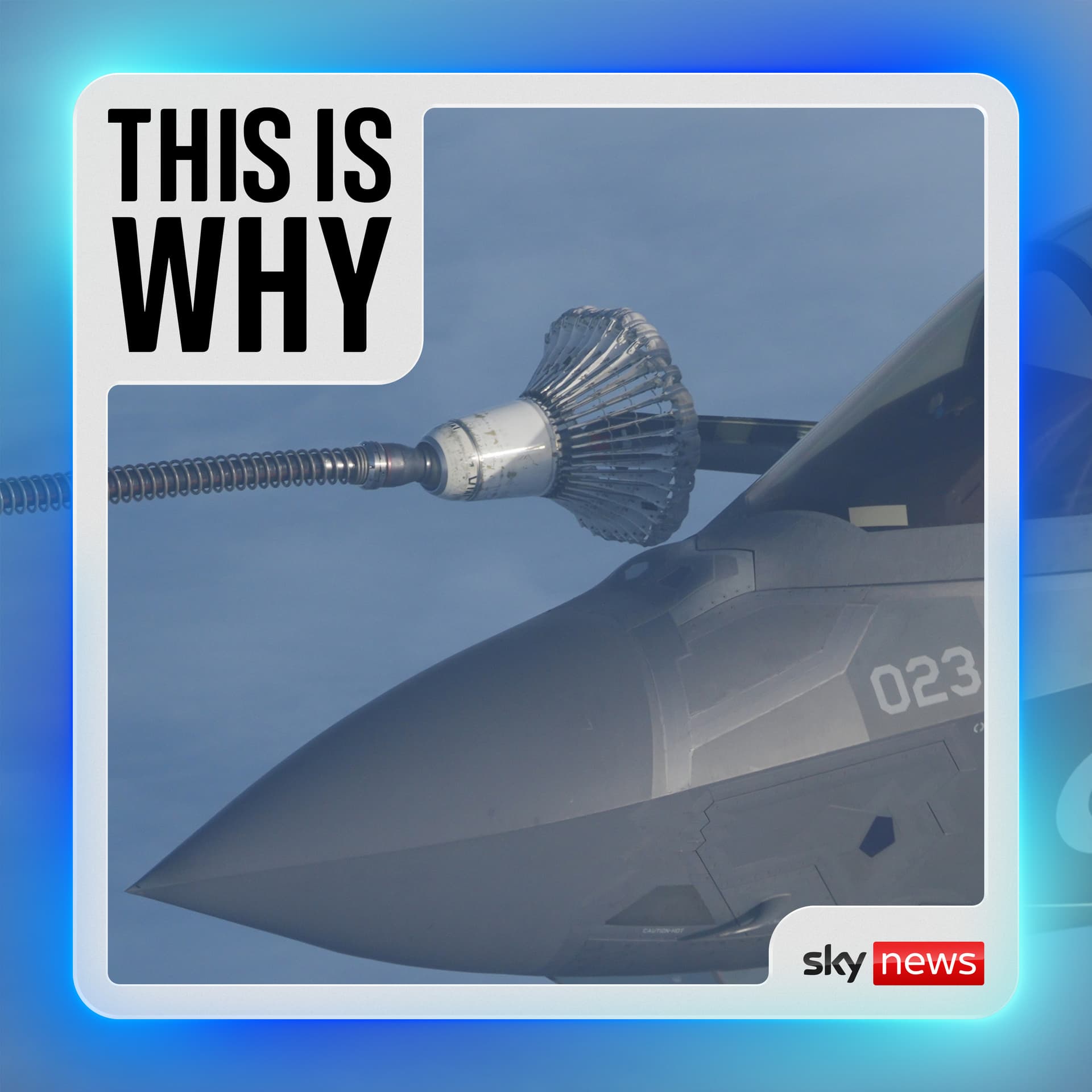
1:00Hi everyone, Neil here. And look, when the government announces military help for another country, I always want to know what's coming next. We've agreed to this, but then what happens? On Saturday, Saudi Arabia said it intercepted a ballistic missile heading for its capital, Riyadh. It was fired by the Houthis, the Iranian-backed rebel group in Yemen. They've also seized a key port and islands near Bab el-Mandeb, the strait that's the southern entrance to the Red Sea. It's also another vital route for oil coming out of the region. That's why the UK has agreed to send an RAF refuelling aircraft to support Saudi jets, only though to be used in defensive missions.
1:42But this comes on top of air defences and British personnel sent earlier this year. Andy Burnham made the announcement as he headed to the UN in New York, where he's also meeting Trump for the first time. For more on the politics, you can catch Beth Rigby and team on the latest insider edition of our sister podcast, Electro Dysfunction. But here, we're going to take a proper look at what Britain is trying to achieve in the Middle East. Dr H. A. Hellyer is Senior Associate Fellow at the Defence and Security Think Tank, Roussi. Hesham, always great to have you on the podcast. Can we start with what it is exactly that Britain has agreed to do here and how significant a commitment do you take this to be?
2:22So I think the new prime minister, Andy Burnham, is trying to thread a little bit of a needle here. It's very clear that Britain's interest in making sure that greater stability in the region, greater flow of energy, diminishing tensions in the Gulf, particularly around the Straits of Hormuz, and of course when it comes to the Red Sea and Ba 'bun Mandab and the Houthi take over, none of that is in the UK's interest. Because of course, the reason that the Saudis are asking for this assistance is, as you say, regarding the Houthis. Just remind us who exactly they are and what has made Saudi Arabia at this point reach out to the UK for help.
3:03So the Houthis are an indigenous movement to Yemen. They're not a foreign implant or anything like that. They come out of the Zaydi community, which in the context of the Muslim world is extremely small, but only exists really in Yemen and very small pockets elsewhere. But it is indigenous. So people saying that this is purely an Iranian element in Yemen, I think, overstates. The Houthi movement or Ansarullah, they come out of that community. I won't say that they represent that community because there are many Zaydis that are opposed to the Houthi movement. So there's that complexity as well.
3:44But they are not the same following of Islam as what you would find in Iran. They are separate and distinct. Having said that, they are incredibly aligned with Iran. So there's a very close alliance between the Houthi movement and the regime in Tehran. So I think it would be overstated to say they're simply a proxy, which I think many are tempted to do. But I think the objection to using the word proxy also sometimes represents a misunderstanding about how closely aligned they are with Iran at present. What is it that they've been doing inside Saudi Arabia that has that has so vexed Riyadh of late?
4:22Certainly there's been an increase in the tempo of their operations. Well, there have been two things. One, they've been attacking Saudi Arabia, so they've been sending over strikes into Saudi. Now, I should say that what has really kicked things off over recent weeks is that there were raising tensions and escalations within Yemen itself, and it seemed as though the Houthis might be on the back foot. And this was after a lot of signaling from the Saudis that they were aiming to support an escalation in Yemen to allow the Yemeni government to take over territory that had been captured by the Houthis over recent years.
5:03That did not go as planned, clearly, because the Yemeni government did take certain territory, but did not hold on to it. And actually, the Houthis are now in control of more territory than they were before, and most crucially along the Red Sea coast, and of course, around the Bebal Mendeb straits. Now, I don't know if we can say they've held the strait per se, because it's quite difficult for them to hold it. It's very flat terrain around that area. So there are reports of them gaining it, losing it. But the fact is, is that it's not under secure Yemeni government control. But what we can say is that the Houthis are playing merry hell with the Saudis' ability to produce and indeed to get their oil out of the country.
5:49Absolutely. So the concern from Riyadh is that the Red Sea is going to become another chokehold where they cannot actually get through Bebel Mandab in the same way. Well, not quite the same way as Surah Hormuz, because at least there's a Suez Canal on the other side. But with regards to Beban Mendeb, that's tremendously important for any ships leaving Saudi going south, of course, but also anything going through Beban Mendeb going further up north to get eventually into the Mediterranean Sea and Europe and so on. So no, the Houthis are certainly causing a great deal of concern for the Saudis. It's frankly a concern that is incredibly well-grounded because this is a non-state militia in control of highly significant and important parts of Yemen, just on Saudi's border.
6:41Take us inside Saudi Arabia itself now, Hisham. Take us to Riyadh. What is it that the Saudis want from what strikes me as a deepening relationship with the United Kingdom? I mean, one refueling plane will no doubt be of some assistance, but we are also seeing deepening kind of trade and investment links between the two countries. What is it that Riyadh wants from us? Well, I don't think this is new, to be honest. I think that Riyadh has had very longstanding relations with London. So for example, Saudi is very prominent in the international coalition to uphold the two solution in Palestine-Israel, right?
7:20London has been very clear about this. When it comes to Iran, there's also a great deal of synergy. And of course, the UK is looking to broaden its wider footprint internationally. This, again, is something that has been ongoing since Brexit. Saudi is looking to expand its own relationships, particularly after recognizing, which I think has been going on for a decade at least, that the US is not the most secure security guarantor. So I don't think any of this is new. I think it's just continuing an existing trend. On paper, at least, well, from the mouth of the prime minister, the justification for this additional bit of military kit is cost of living crisis, that regional security means rising fuel prices.
8:08These fuel prices affect every single person when they go to the petrol pumps. How valid a justification is that? Well, in terms of a vow that's a justification, if you mean morally, that's another issue. And I think that there are a lot of people who will be concerned about this move because they remember what happened in Yemen when Saudi went in the first time. And there are many critiques of that particular period, which should not be swept under the rug. If you mean on a strategic level, would the continuation of this conflict mean deepening problems for just the ordinary person in the UK in terms of energy?
8:52I think that's really undeniable. I think that if you have chokeholds on both sides of the Arabian Peninsula, then yes, you're going to have increasing oil prices and a wider international crisis. I don't think there's any doubt about that. I think that he's also reflecting, though, a bit of caution here in terms of being very clear. This is very time-bound, so it's not unlimited. It's not about putting troops on the ground. It's being framed very much as being defensive. And of course, the Houthis are attacking Saudi as well. And keeping in mind, when it comes to Saudi and Yemen, this isn't Saudi versus Yemen, right?
9:31The Yemeni government, the internationally recognized government, is quite aligned with Saudi Arabia. So this is about Saudi versus the Houthi movement. The most excruciating period of politics that I can ever remember. I have to say as a government minister, never quite sure what the cabinet office did, but just hold meetings. It's gone down like a bucket of sick. I kind of thought that decades of experience meant that you weren't swallowing this vapid... Oh, blimey! Hello and welcome to Electoral Dysfunction with me, Beth Rigby. Me, Ruth Davidson. Me, Harriet Harman. and Mae Jess Phillips. Electoral Dysfunction, wherever you get your podcasts.
10:26Now Hisham, as you know, I am neither a deeply cynical nor suspicious man, but there is something about the timing of this, The announcement coming, of course, as Andy Burnham gets on a plane to go, of course, to the UN General Assembly, but also to meet with Donald Trump in the margins. So I appreciate the instinct for, how should we say, seeing ulterior motives here, because there are a few things that come together. Of course, the Saudis asked Donald Trump for his support, and reporting is very clear that he said no, then yes, then no. And maybe by the time we've done this, he would have said, no, yes, again.
11:05I'm not sure. Who knows? Who knows? So there is that sense within Saudi that, of course, they have been confirmed yet again that the United States is not necessarily the reliable partner that they thought it was. So I know a lot of people will be seeing this as Andy Burnham jumping in to say, hey, look, we're more reliable. and that may be a part of it i think frankly much more than that is the analysis that this is actually in britain's interests because of these the energy crisis but also because of wider concerns around how this could work out if the conflict expands and continues within the wider region but it is true to say that britain is doing something that other allies are not doing so so i do wonder what is holding those other countries back from doing what Andy Burnham is doing, because let's face it, everyone's facing the same cost of living crisis.
12:06That's true. I will say we sometimes do get ahead of the pack, right? So just to give you another example, when the Assad regime fell, the UK was the first country to send a senior diplomat to Damascus to meet with the new authorities. Of course, others followed. And I think that there is frankly caution being expressed by other European states for two reasons. One, I think people remember the last time that Saudi escalated in Yemen, and they don't remember it fondly. So there's that. The second is that I think that one of the reasons why the Houthis were able to do what they did in the last couple of weeks is because there seems to have been, you know, quite a dramatic miscalculation and misassessment in the Riyadh about how much capacity the Yemeni government had and how easy it would be to push things forward.
13:11There will be those, though, who point to the fact that politically Donald Trump does seem in a pretty weak place domestically, midterms coming up. I mean, is this a point where someone like Andy Burnham, pointing to what he is doing as regards Saudi, as regards the Houthis, might just be able to nudge the president of the United States on his Middle Eastern policy? Maybe just nudge him in the direction of coming to the table to provide assistance for the Saudis as well. I do think that it's highly unlikely that Donald Trump would listen to Andy Burnham on this particular file, simply because Andy Burnham and him don't really have a relationship.
13:50They haven't seemed to have developed much of a rapport yet. Maybe that will change after this. But this would be a major shift. It may be one that Donald Trump takes anyway. Like I said, he said yes, no, yes, no over the past week or two. So he may very well decide that, okay, Britain's gone in, so it looks kind of silly if I haven't. So that wouldn't really be about Andy Burnham per se. It would be about how this appeals to how Trump looks at the region. Are there, however, dangers for the United Kingdom in broadening, deepening its relationship with Saudi Arabia? I mean, you don't have to be an expert to know that.
14:30Saudi Arabia has a very checkered record when it comes to human rights, when it comes to state-sanctioned execution. You know, is this a reliable partner for the United Kingdom or is this a partner that we will just by necessity have to keep at arm's length? So I think you put your finger on a point that's very crucial in understanding how Britain's foreign relations have developed, not just recently over the past year, but over many decades. And it's an ongoing discussion how much we center, for example, the human rights file within our relationship with state A or state B or state C, how much we make it a part of the overall relationship and what other factors come in.
15:16And I'm not sure where Andy Burnham will go on this particular point. Certainly over the last 20 years, you've seen highs and lows in the relationship between London and the Rio Grande. And the lows usually came about as a result of concerns over human rights violations. But I don't think that that ever led to a breakdown of relations. Going back to the direct involvement that the UK has announced, I just find myself dwelling on this idea that Britain's support is purely defensive. I just wonder how meaningful that distinction is when ultimately we are helping one side in a wider conflict. It just feels as if it is much easier now for Britain to deepen its involvement in this particular conflict in defensive terms than it is to pull back from it.
16:11I see your point, honestly, maybe because I see these various defense and political relationships a little bit differently, given how many things we've seen in the region. And also given Andy Burnham, his cabinet, his parliamentary party, I don't think any of this comes naturally and instinctively to Andy Burnham's government to sort of get in here. I think they're doing so cautiously with calculation. and I wouldn't have been surprised by the way if he had said no not doing this so I don't think that there's mission drift that's very plausible here because it's very time limited it's very precise it's very calculated if anything I suspect that Saudi is probably asking why aren't you doing more like we need more than this they may even be frustrated that there isn't more assistance but I think that he is proceeding very cautiously and carefully.
17:08Hesham, thanks very much indeed. Thank you. That's your lot for today. You can get plenty more analysis of the announcement from Michael Clarke and Chums over on the Defence Insider app. We'll pop the link to that in the notes. And do remember to send over your thoughts. Why? At sky.uk. We're back tomorrow.
17:34The most excruciating period of politics that I can ever remember. I have to say as a government minister, never quite sure what the cabinet office did, but just hold meetings. It has gone down like a bucket of sick. I kind of thought that decades of experience meant that you weren't swallowing this vapid... Oh, blimey! Hello and welcome to Electoral Dysfunction with me, Beth Rigby. Me, Ruth Davidson. Me, Harriet Harman. And me, Jess Phillips. Electoral Dysfunction, wherever you get your podcasts. Thank you.
From the publisher
It's been a busy week already for Andy Burnham - who approved his first military intervention as prime minister just hours before his inaugural meeting with Donald Trump.
The RAF will now provide Saudi Arabia with "purely defensive" air support against attacks from Yemen's Iran-backed Houthi rebels, after Burnham agreed to Riyadh’s request.
The Saudis had earlier been turned down by Trump – so why is the new PM so happy to help? And is it really due to cost-of-living pressures as he claims?
Niall Paterson is joined by Dr H A Hellyer, an expert in geopolitics across the Middle East and Europe and a senior associate fellow at the Royal United Services Institute for Defence.
There is more exclusive content on the situation in the Middle East on the new Sky News Defence Insider app.
Sky News Defence Insider is a subscription app designed for audiences seeking deeper insight into defence, security and global affairs.
Download and subscribe here.
Paid subscription required for full access. UK only. 18+. T&Cs apply.
Have you got a question for Niall? Email us: why@sky.uk